



Abstract
Do integration crises reinforce legal differentiation in European integration? Are differentiated EU policies under stress prone to cascading opt-outs? We argue that integration crises as such are unlikely to cause further fragmentation in already differentiated EU regimes. If the EU decides to adopt new treaties and laws in response to the crises, however, these are likely to reproduce and extend pre-existing patterns of differentiation. Empirically, this study offers within-case counterfactual analyses of differentiation in the Euro and the migration crises. Whereas the Euro crisis triggered a major institutional change in the Eurozone, the member states could not agree on a thorough reform of the asylum system. Correspondingly, we observe excess differentiation in the Euro crisis but stable differentiation in the migration crisis.
Introduction
The theory and practice of differentiation are closely linked to paralysis and crisis in European integration. Deadlock and ratification failure in EU negotiations have regularly produced proposals for differentiated integration (hereinafter, DI or differentiation) – to exempt or exclude individual member states (at least temporarily) from, or to allow non-member states to participate in, selected EU policies. The first general proposals for DI came up in the 1970s, a period of economic crisis characterized by the ‘oil shocks’ and ‘stagflation’ and a period of paralysis in European integration in the aftermath of the ‘empty chair crisis’ and the difficulties surrounding the Community’s first enlargement (Stubb, 1996).
However, the member states only started to implement DI when European integration picked up speed again in the mid-1980s. One prototypical case is the 1985 Schengen free travel agreement, an international treaty signed by 5 out of 10 member states outside the European Community framework. Another is the Treaty of Maastricht with opt-outs secured by the UK during the treaty negotiations and by Denmark after the negative Danish referendum of 1992. Ever since the EU has used DI to bring together coalitions of the ‘willing and able’ and to salvage agreements threatened by domestic non-ratification.
The ‘polycrisis’ has presented the EU with a new set of challenges (Zeitlin et al., 2019). In the earlier cases, the problem consisted in overcoming obstacles on the way to ‘more integration’. DI helped achieve agreement on new EU policies and member states, and it produced a net gain in integration as a result. By contrast, the recent crises have raised the spectre of disintegration in already integrated EU policies (Vollaard, 2018). Two of them – the Euro crisis and the migration crisis – hit the most differentiated domains of the EU: the Economic and Monetary Union (EMU) and the Schengen–Dublin regime.
How do crises affect DI? DI responds to international heterogeneity and the politicization of integration (Schimmelfennig et al., 2015; Schimmelfennig et al., 2023), which are typically exacerbated in crisis situations. Crises, thus, potentially drive the membership further apart and cause additional fragmentation. This is the pessimistic scenario. According to the optimistic scenario, however, crises might draw the member states together by demonstrating the need for common efforts and solidarity. We are interested in exploring whether crises that hit differentially integrated policies create centrifugal or centripetal effects (Kölliker, 2006). Does DI introduce break points into the institutional architecture of the EU, which produce ‘cascading opt-outs’ (Jensen and Slapin, 2012) under stress? Or do crises create pressures to overcome divisions among the EU member states and strengthen the uniformity of policy integration?
The literature on European crises focuses on explaining whether and why they have influenced the institutional integration of the EU. Yet, it does not examine their impact on differentiation specifically (e.g. Biermann et al., 2019; Börzel and Risse, 2018; Genschel and Jachtenfuchs, 2018; Jones et al., 2016; Schimmelfennig, 2018). By contrast, research on DI has theorized and studied its drivers, conditions and effects without particular attention to the effects of a crisis (Adler-Nissen, 2014; Jensen and Slapin, 2012; Kölliker, 2006; Schimmelfennig and Winzen, 2020). Our study addresses this gap by analysing how differentially integrated policies develop under the impact of a crisis.
We argue that neither the pessimistic nor the optimistic scenario hold true generally. Crises as such do not have a determinate effect on how differentially integrated policies develop. Rather, DI is path-dependent and contingent on the crisis response. If EU member states respond with additional integration, that is, an increase in EU-level competences and resources, the crisis likely produces more differentiation, too. Otherwise, integration crises do not trigger opt-out cascades either. This observation corresponds to earlier research, which has established that differentiation is generally used in the EU to facilitate agreement on further integration when the intergovernmental heterogeneity of preferences and capacities is high – and especially in the policy domains of core state powers, in which sovereignty and distributional concerns are salient (Genschel et al., 2023; Schimmelfennig and Winzen, 2020).
We test this argument in an analysis of the Euro and the migration crises. These crises threatened the two most intensely and durably differentiated policy areas with disintegration. By contrast, the Brexit crisis was initially triggered by the freedom of movement within the internal market, which only allows for temporary differentiation after the accession of new member states; the rule-of-law crisis threatens uniform liberal norms; and the COVID-19 crisis affected a policy area – health policy – that was hardly integrated at all. Moreover, the two crises vary in their integration outcomes. Whereas the Euro crisis resulted in a significant increase in EU-level competences and resources, the migration crisis has failed to produce a major reform of the Common European Asylum System in its aftermath (Börzel and Risse, 2018; Schimmelfennig, 2018; Scipioni, 2018). This variation allows us to test the relationship between crisis-induced integration and differentiation.
Methodologically, we rely on tools of within-case counterfactual analysis. Cross-sectional policy comparisons are difficult to apply due to the idiosyncrasies of the EMU and the EU’s border and asylum policies. Drawing on data covering the entire history of European integration, we predict the counterfactual development of differentiation by extrapolating long-term pre-crisis trajectories to the post-crisis period. We compare these extrapolations to observed post-crisis differentiation to identify the causal effect of crisis on differentiation. We examine the crisis effect at the level of treaty law, legislation, possible spill-over effects from monetary or interior and justice policies into other areas, as well as the possibility that the EU’s crises might have delayed new member states’ accession to the Eurozone and Schengen area.
The polycrisis has not produced cascades of differentiation; rather, the boundaries between ins and outs have remained stable. We do not find strong evidence for crisis-related delays in the processes of reintegration. Yet, the polycrisis has not helped to overcome pre-crisis divisions either. Whereas we do see a rise in differentiation in the Euro crisis, this differentiation is a corollary of a boost in integration and reproduces existing patterns of insiders and outsiders. As in earlier negotiations that were unrelated to crises, differentiation acted as a facilitator of integration. In the migration domain, the lack of further integration went together with stable patterns of legal differentiation.
Crisis and DI: Theoretical expectations
DI is generally understood as an instrument to overcome decision-making deadlock under the double conditions of heterogeneity and unanimity. When collective decisions require consensus among EU member states, pronounced heterogeneity of state preferences and capacities turns into a major obstacle to agreement. Exempting (or, sometimes, excluding) states that either disagree with the substantive goals and the institutional form of an integrated policy or do not meet the requirements for participation facilitates consensus among the willing and able and allows them to advance integration.
In the history of European integration, differentiation has been used in two contexts predominantly: treaty revisions including the integration of core state powers and the accession of new member states (Schimmelfennig and Winzen, 2020). Whereas enlargement has typically produced temporary ‘multi-speed integration’, the integration of core state powers (Genschel and Jachtenfuchs, 2014) – such as defence, interior, monetary and fiscal policies – has led to durable DI to accommodate those member states that were most concerned about the preservation of their sovereignty, redistribution to poorer members or other states’ capacity to implement the policy.
Because DI in the domain of core state powers reflects deep-seated attitudes towards integration and structural differences between member states, we expect that the choice between uniformity and differentiation in negotiations about the EU’s crisis response follows the pattern of the original integration agreement that is threatened by the crisis. Specifically, crises of differentiated policy areas are likely to reproduce or increase the existing divisions but do not change the groups of ins and outs. If the participants of an integrated policy agree on further integration as a response to the crisis, they increase the scope of differentiation between themselves and the outsiders; if they cannot agree on further integration, or do not consider it necessary, the existing scope of differentiation remains unaltered. In other words, the differentiation effect of crises is moderated by its integration effect.
This conjecture assumes path-dependent differentiation. From a historical-institutionalist perspective, the original decision to differentiate constitutes a ‘critical juncture’ that puts insider and outsider member states on different trajectories of integration. In the course of (differentiated) integration, the insiders invest in and adjust to the integrated policy, thereby producing sunk costs, increasing returns and endogenous interdependence (Pierson, 2000). If a crisis hits the integrated policy, exposing its deficits and causing policy failure, it impacts differentially on insiders and outsiders. The insiders are both more affected by the crisis and, because of path dependence, more inclined to contribute to policy preservation and consolidation. By contrast, the outsiders have no reason to reconsider their original rejection of policy integration and few incentives to help save a failing policy – unless they suffer from major externalities of the integration crisis. Consequently, the higher the risks and costs of policy reversal are, and the more policy preservation requires additional supranational competences and resources, the more likely the insiders agree on further integration and diverge from the outsiders.
The lock-in explanation of the crisis effects on DI partly contradicts two alternative expectations. The more pessimistic scenario of ‘cascading’ DI (Jensen and Slapin, 2012) expects differentiation and, potentially, disintegration among the insiders as a result of integration crises. Integration crises create costs for the member states to fix the policy but often do not affect all insiders in the same way. They thus create intense intergovernmental conflict about burden-sharing and reform. In addition, integration crises are typically accompanied by heightened domestic politicization. Together, these crisis features not only inhibit agreement on policy reform but also produce centrifugal tendencies. The prospect of Grexit and sovereign default in several other Eurozone countries during the Euro crisis, as well as the threat to exclude Greece from the Schengen area in the migration crisis, demonstrate that differentiation cascades are not far from reality.
Moreover, the original differentiation of integration tends to facilitate further differentiation (Schimmelfennig and Winzen, 2020: 34–36). Defecting insiders can use the institutional precedent created by DI, and they can join forces with those member states that are already outsiders. At the same time, integrationist governments find it easier to build coalitions in favour of additional integration, and of leaving behind unwilling or unable members in the select group of insiders than among the, on average, more integration-sceptic full membership of the EU (Jensen and Slapin, 2012). The main factor distinguishing the lock-in from the cascade mechanism is path dependence and the concomitant assumption that the insiders’ costs of exit or exclusion surpass their costs of policy preservation.
The alternative optimistic scenario of crisis-induced reintegration assumes that there is a significant risk for the crisis of the integrated policy to spill over to the outsiders and that the outsiders’ costs of insider disintegration exceed their costs of integrating with the insiders and contributing to policy preservation. This alternative scenario has empirical credibility, too. It is corroborated by the observation that legal differentiation is often followed by cooperation and informal institutionalization in practice in order to mitigate the costs of exclusion and intergroup externalities (Adler-Nissen, 2014; Dyson and Marcussen, 2010; Genschel et al., 2023). By contrast, the lock-in mechanism presupposes outsiders to be sufficiently isolated from crises hitting the integrated policy.
Finally, we apply these theoretical perspectives to our empirical cases. Comparative analyses of the Euro and the migration crises suggest significant differences in explaining why the former triggered a major leap in Eurozone integration, whereas the latter failed to produce far-reaching reform of the EU’s asylum and border policies (Biermann et al., 2019; Börzel and Risse, 2018; Schimmelfennig, 2018). These analyses underpin the expectation that the Euro crisis increased the scope of differentiation between Euro-ins and outs, and that the migration crisis did not have a relevant differentiation effect.
In the Euro crisis, insiders and outsiders were differentially exposed. Whereas the global financial crisis had affected all EU member states initially, the subsequent balance-of-payment crisis put the fiscally weaker Eurozone countries in a particularly difficult situation, because – and in contrast to deficit countries with national currencies – they were unable to use external devaluation to reduce their deficits (Walter et al., 2020). In the absence of Eurozone bailouts and transfers, this constraint threatened them with sovereign default and exit from the Eurozone. The need for Eurozone bailouts and the austerity conditions attached to them generated both significant conflict among the fiscally weak and strong Eurozone governments and high domestic politicization. At the same time, sunk costs and endogenous interdependence in the Eurozone had reached a level that would have made a series of exits or the disintegration of the Eurozone prohibitively costly for all Eurozone countries (Schimmelfennig, 2018). To preserve and consolidate the Eurozone, its member states therefore agreed on financial support for cash-strapped member states (the European Stability Mechanism (ESM)), tougher budget surveillance and the supranational supervision and resolution of banks. The combination of high path dependence among insiders and comparatively low impact on outsiders contradicts the assumptions of the cascade and reintegration mechanisms.
The migration crisis was also characterized by pronounced distributive conflict between more and less affected countries as well as domestic politicization. In contrast to the Euro crisis, however, disintegration risks and costs were lower and member states were able to control the migration flow by a combination of national measures and externalization (as in the EU-Turkey agreement). Moreover, the EU’s asylum and border management regimes lacked strong supranational bodies pushing for and facilitating an integrative crisis response, as was the case with the European Central Bank in the Euro crisis (Schimmelfennig, 2018). Consequently, the less affected Schengen area member states did not agree to further integration; and because the voluntary Schengen non-members (the UK and Ireland) were geographically remote from the source of the migration flows, they had no reason to reconsider their outsider status. Thus, outsiders lacked an incentive to join and insiders lacked the consensus to integrate further.
Data and analytical strategy
We analyse differentiation during the Euro and the migration crises based on the Differentiated Integration in EU Treaties (EUDIFF1) and Differentiated Integration in EU Legislation (EUDIFF2) datasets, which identify differentiation in EU treaties until 2019 and legislation until 2018. 1 In brief, the EUDIFF1 dataset starts from a list of all EU treaty articles in force each year and codes whether each member state was legally exempted or excluded from the article. We aggregate these data into ‘differentiations’ (Schimmelfennig and Winzen, 2020). A differentiation of a member state consists of all differentiated treaty articles in a year that lie in the same policy area (out of a list of over 40 areas defined according to the chapters of the EU treaties) and that have the same start and end dates. We can then, for example, say that the United Kingdom had a differentiation from the Schengen area since the beginning. We can also count the number of differentiations across all member states in any given year and policy. The EUDIFF2 dataset lists all EU legislation in force each year and codes differentiations for each member state. We treat a piece of legislation as differentiated for a country if this country is legally excluded or exempted from at least some part of this law. Via the legal bases, each law can be related to the same policy areas as in the EUDIFF1 dataset. As with EUDIFF1, EUDIFF2 enables us to say how many differentiations were in force in each year and policy.
For our analysis, we are interested in the differentiation of domains potentially affected by these two crises. The EUDIFF1 and EUDIFF2 datasets also account for whether treaty articles or legislation are based on the ‘monetary policy’ chapters of the treaties. EUDIFF1 furthermore measures differentiation in the articles of the ESM Treaty, the Fiscal Compact and the Intergovernmental Agreement on the Single Resolution Fund (Banking Union). Together we refer to these provisions as the monetary policy domain. Furthermore, both datasets cover the EU’s Area of Freedom, Security and Justice (AFSJ), which might have been affected by the migration wave. Specifically, we take the AFSJ to encompass treaty articles and legislation based on the treaty chapters on visas, asylum and immigration, and police and judicial cooperation in criminal matters, the Schengen area, the Charter on Fundamental Rights and the Prüm Convention. Finally, for reasons discussed below, the crisis might have affected differentiation in the Single Market. In EUDIFF1 and EUDIFF2, the Single Market refers to treaty articles and legislation based on the treaty chapters on the free movement of goods, workers, services and capital, and the freedom of establishment. The EUDIFF1 and EUDIFF2 datasets thus enable us to chart the development of differentiation systematically and comprehensively in the policy domains that could have been affected by the Euro and the migration crises.
However, regarding our analytical strategy for the identification of the crisis effect on DI, we face a twofold challenge. Crises remain relatively rare in the period in which differentiation has become common, and EU policy areas are very heterogeneous with respect to differentiation and its causes (Winzen, 2016; Winzen and Schimmelfennig, 2016). As we explain in the Online appendix, this means that several research designs, including the difference-in-difference, synthetic control and regression discontinuity designs recommended by Burk and Leuffen (2019) for studying DI, face problems.
Our approach, which could be described as within-case counterfactual design, draws on a mix of techniques from within-case analysis and forecasting studies (e.g. Gerring, 2007; Bechtel and Leuffen, 2010; Böhmelt and Freyburg, 2018). Because we have data covering the entire EU history and because legal outcomes such as differentiation tend to change only slowly once in place, we have significant information about differentiation in the policy areas hit by the crisis, which we can use to assess the crisis effect. Specifically, we use pre-crisis information to predict a counterfactual post-crisis trend. Comparing this trend to the observed development then constitutes our estimate of the causal effect of crisis on differentiation. We operationalize this design in the following sections at several levels of analysis: EU treaty law, legislation in monetary and interior policies, and legislation in related policy domains that could plausibly be affected by spill-over. The specific techniques used (including logistic regression analyses with out-of-sample predictions and the extrapolation of necessary and sufficient conditions) depend on the characteristics of the data at these levels of analyses. We begin by focusing on the EU15 member states to avoid the complication of enlargement and then extend the approach to the EU28.
Treaty differentiation during the Euro crisis
First, we begin with the effect of the Euro crisis at the treaty level. In this context, extrapolating a post-crisis differentiation trend from pre-crisis data is straightforward under certain assumptions. If we assume that the EU adopted the ESM Treaty, Fiscal Compact and Banking Union because of the crisis, which is uncontested in the literature, then differentiations in these treaties constitute the crisis effect under two conditions: (a) no other treaties would have been adopted without the crisis and (b) treaty differentiation in monetary policy would not have declined after 2010 due to countries joining the Euro area. The first assumption is plausible. The Lisbon Treaty entered into force in December 2009 after a multiannual ratification process. It included provisions for simplified treaty changes, reflecting the EU’s intention to avoid future reforms. The second assumption is plausible for the EU15. All Euro area opt-outs before the crisis were long-standing. There was no sign of a preference change in Denmark, Sweden or the United Kingdom.
Against this backdrop, Figure 1 counts the number of differentiations – countries with an opt-out from any part of the Euro area – each year before and after crisis onset. Differentiations tripled after 2010, initially due to the (not crisis related) new provisions of the Lisbon Treaty and then driven by opt-outs in the mentioned new treaties. Without these new treaties, differentiation would have stagnated, thus suggesting a strong crisis effect of nine differentiations in total. The same countries that already had Euro area opt-outs before account for this effect. This supports the assumption of path dependence.
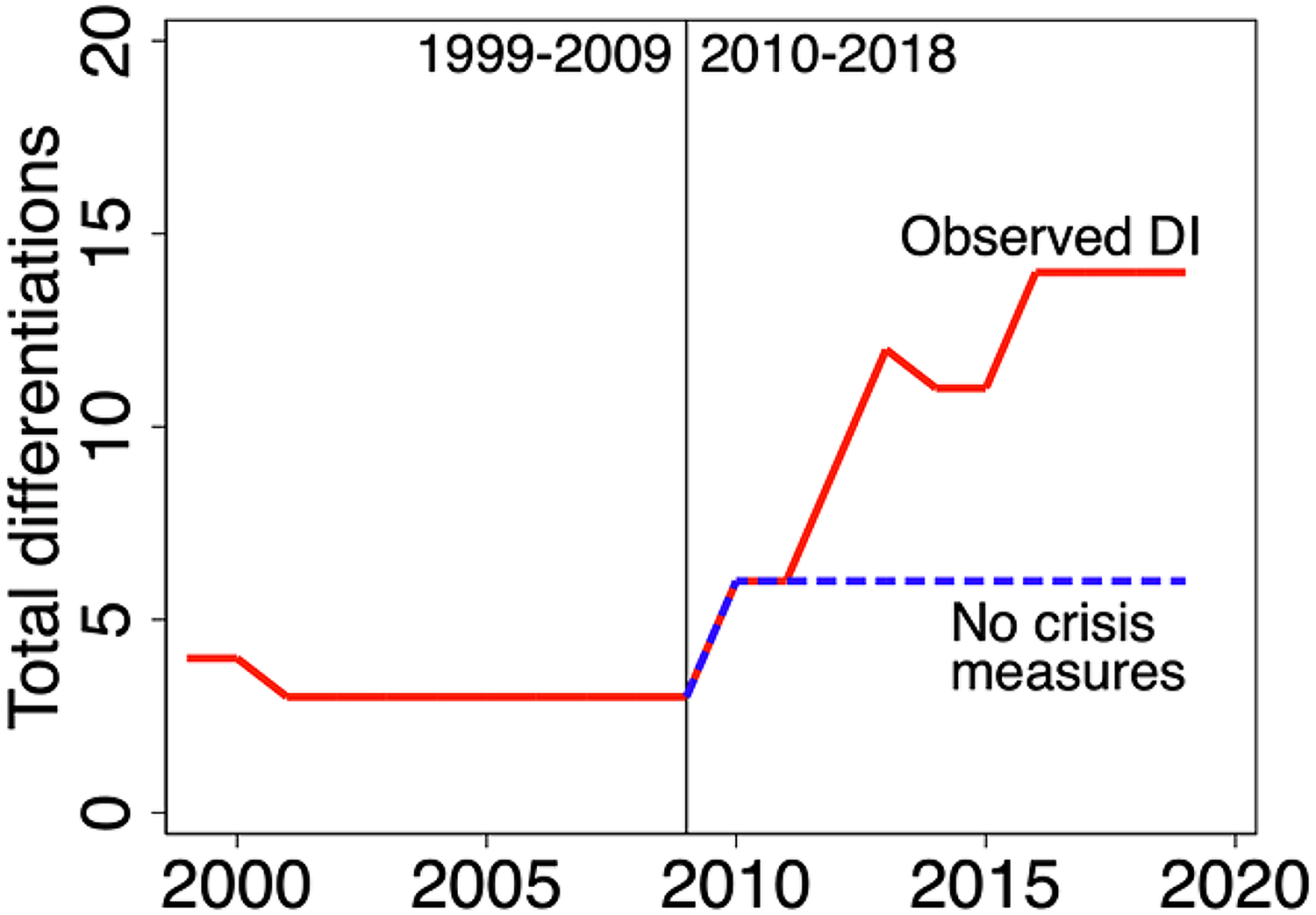
Treaty-level differentiation in monetary policy.
Differentiation in monetary policy legislation
Next, we examine legislation in monetary policy. Identifying the crisis effect is more complicated than at the treaty level but facilitated by the fact that monetary policy legislation is rare, rigid and dependent on treaty law. Three empirical regularities from the pre-crisis period (1999–2009) underpin our strategy: First, in monetary policy, treaty differentiation is a necessary condition for legislative differentiation (Table 1). Second, lagged differentiation is a sufficient condition for differentiation for a given law-country combination (Table 2). This pattern was not perfectly consistent from 1999 to 2001 but has been fully consistent since then. Third, legislation in monetary policy is rare and stable (Table 3). From 2006 to 2009, the number of laws in force remained unchanged. We rely on three empirical regularities to construct a deterministic model in which no differentiation is predicted for a country-law-year observation if the country is a member of the Euro area. In turn, a differentiation is predicted if the country had an opt-out from a given law in the previous year. Lagged differentiation would be a less effective predictor if the EU produced more new monetary policy legislation, but we saw that this is not the case. This model makes consistent in-sample predictions for the timespan 2000–2009 with minor exceptions in 1999 (Table 4). 2
Treaty differentiation is necessary for legislative differentiation.
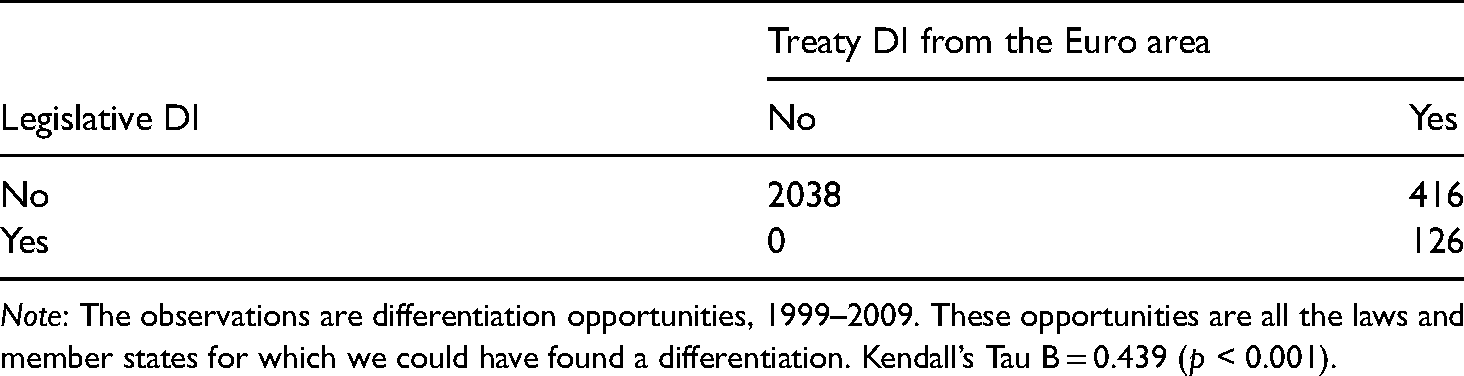
Note: The observations are differentiation opportunities, 1999–2009. These opportunities are all the laws and member states for which we could have found a differentiation. Kendall’s Tau B = 0.439 (p < 0.001).
Lagged differentiation is sufficient for legislative differentiation.
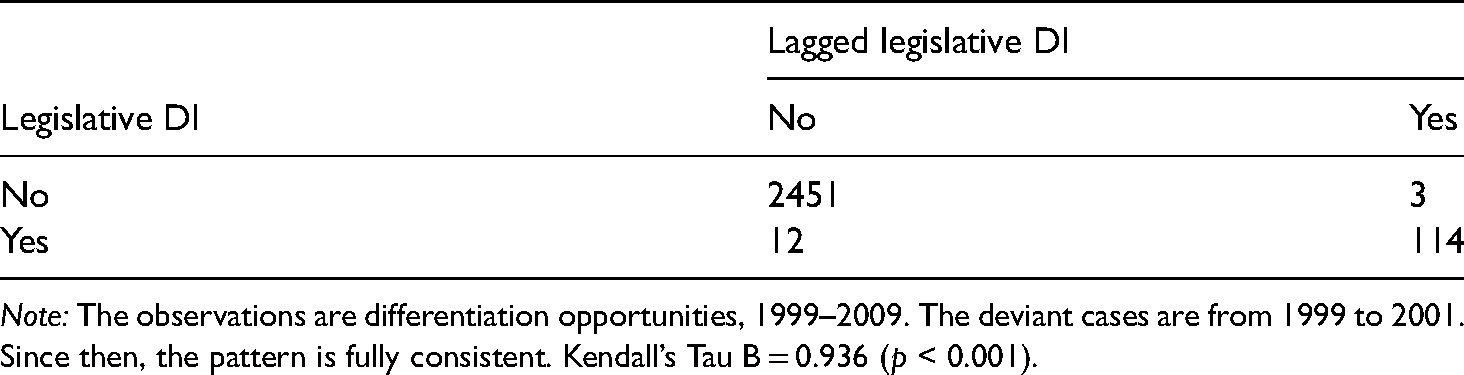
Note: The observations are differentiation opportunities, 1999–2009. The deviant cases are from 1999 to 2001. Since then, the pattern is fully consistent. Kendall’s Tau B = 0.936 (p < 0.001).
Pre-crisis monetary policy legislation is highly stable.
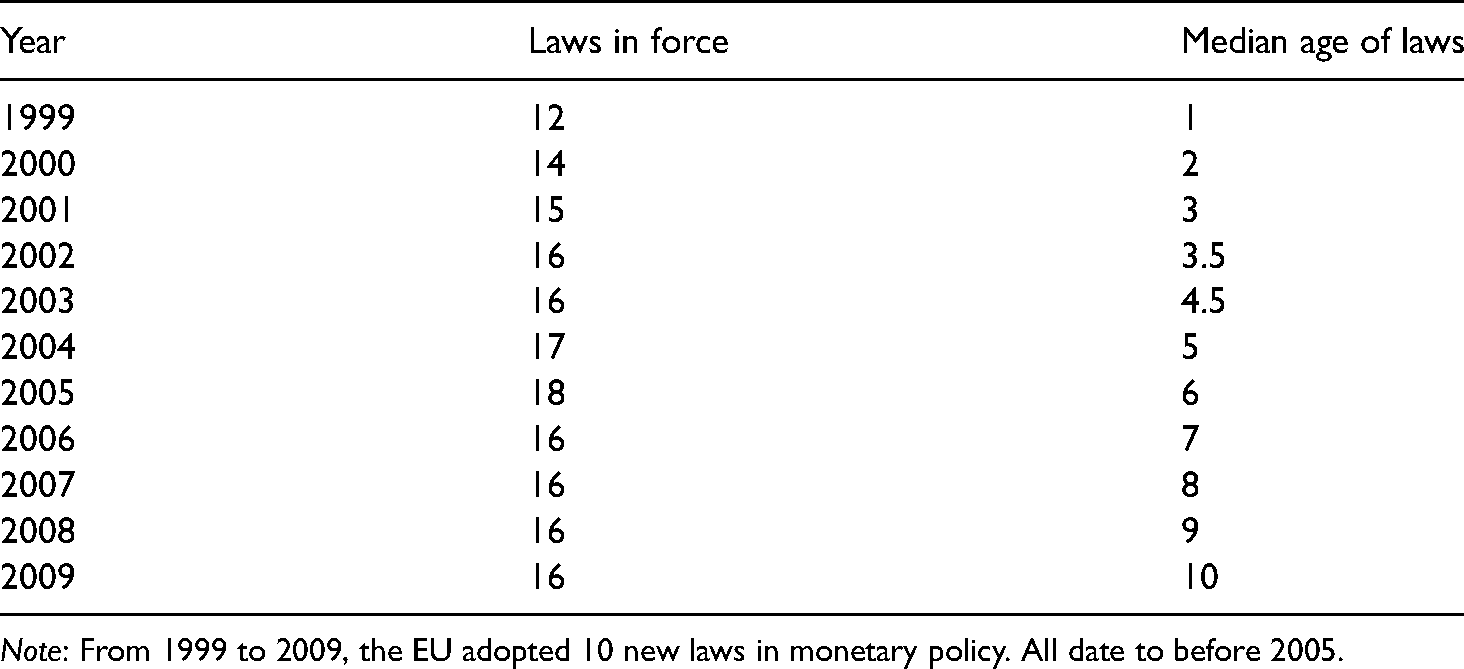
Note: From 1999 to 2009, the EU adopted 10 new laws in monetary policy. All date to before 2005.
Predicted and observed differentiation, 1999–2009.
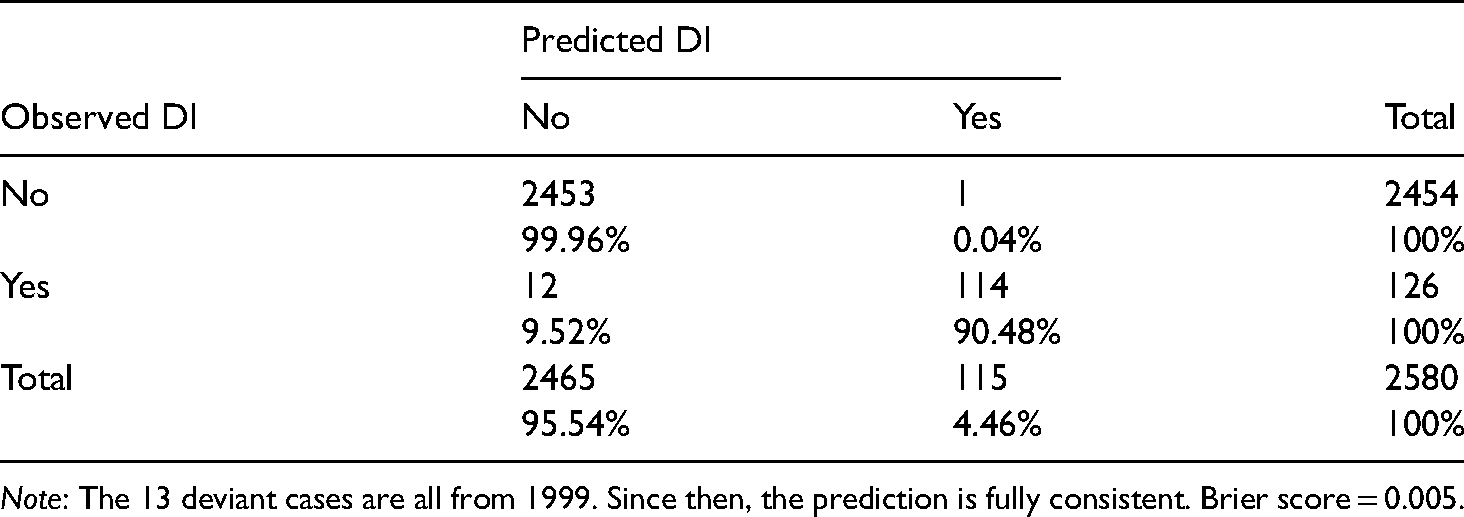
Note: The 13 deviant cases are all from 1999. Since then, the prediction is fully consistent. Brier score = 0.005.
Before we can apply this deterministic model to the post-crisis period, we have to define which new laws the EU would have made in the absence of the Euro crisis. The simplest approach is to assume, on account of the stability in the immediate pre-crisis years, that the EU would not have made any new laws. Then we could simply apply the deterministic model to the laws in force. We refer to this scenario as legislative stability. 3 Yet, this scenario could be too simple. We thus juxtapose it to alternatives in which we assume that EU law production would have continued. Yet, which new laws would the EU have made? We adopt an empirically grounded approach. We listed all observed post-crisis laws (17 in total) and examined each to assess whether it would have been made without the crisis (see the Online appendix for further details on how we identify crisis-driven laws). Based on this, we assume that 12 laws from 2010–2018 would have been made without the crisis (comparable to the 10 new laws between 1999 and 2009).
Regarding these 12 laws, the second question is: Would they have included opt-outs for any country? The simplest approach is to assume no differentiation. We call this the growing unity scenario and believe it is not implausible. Following the major consolidation of the Lisbon Treaty, it could have been expected that most monetary legislation would be about routine currency administration – such as transporting Euro coins – that applies to all member states and that also forms part of pre-crisis legislation (see the Online appendix) (e.g. Moravcsik, 2008). Yet, this assumption could be criticized as too strong. We thus add the third scenario, which we deem most plausible: routine law-making. In this scenario, we assume that countries with treaty-level Euro opt-outs (which is a necessary condition for legislative differentiation) obtain differentiations from new laws with the same probability as before 2010 (22%). This prediction adds a probabilistic element (and thus a confidence interval) to the routine law-making scenario. 4
Figure 2 compares all three scenarios to observed differentiation. We can think of them as lower (legislative stability) and upper boundary (growing unity) and most plausible (routine law-making) causal effect estimates. Focusing on the most plausible (routine law-making) scenario, we observe a crisis effect of 1.4 percentage points more differentiation per year since 2010, albeit with significant uncertainty. In absolute terms, we for instance observe 11 additional legislative differentiations in 2018. Our lower boundary scenario (legislative stability) is similar, reflecting that routine law-making in monetary policy is very stable. We find the new differentiations predominantly in four laws on macroeconomic and budgetary surveillance adopted in 2011 and a law on the Single Resolution Mechanism of Banking Union adopted in 2014. As treaty differentiation is a necessary condition, all of these are produced by Britain, Denmark and Sweden. Finally, the upper boundary (growing unity) scenario suggests a larger effect. Although likely an overestimation, note that this scenario correctly traces the initial decline of differentiation in 2010, which resulted from the EU adopting (undifferentiated) laws in response to the Global Financial Crisis (2007–2008). This is a reminder that routine monetary policy legislation need not be differentiated and that our preferred estimates might be conservative.
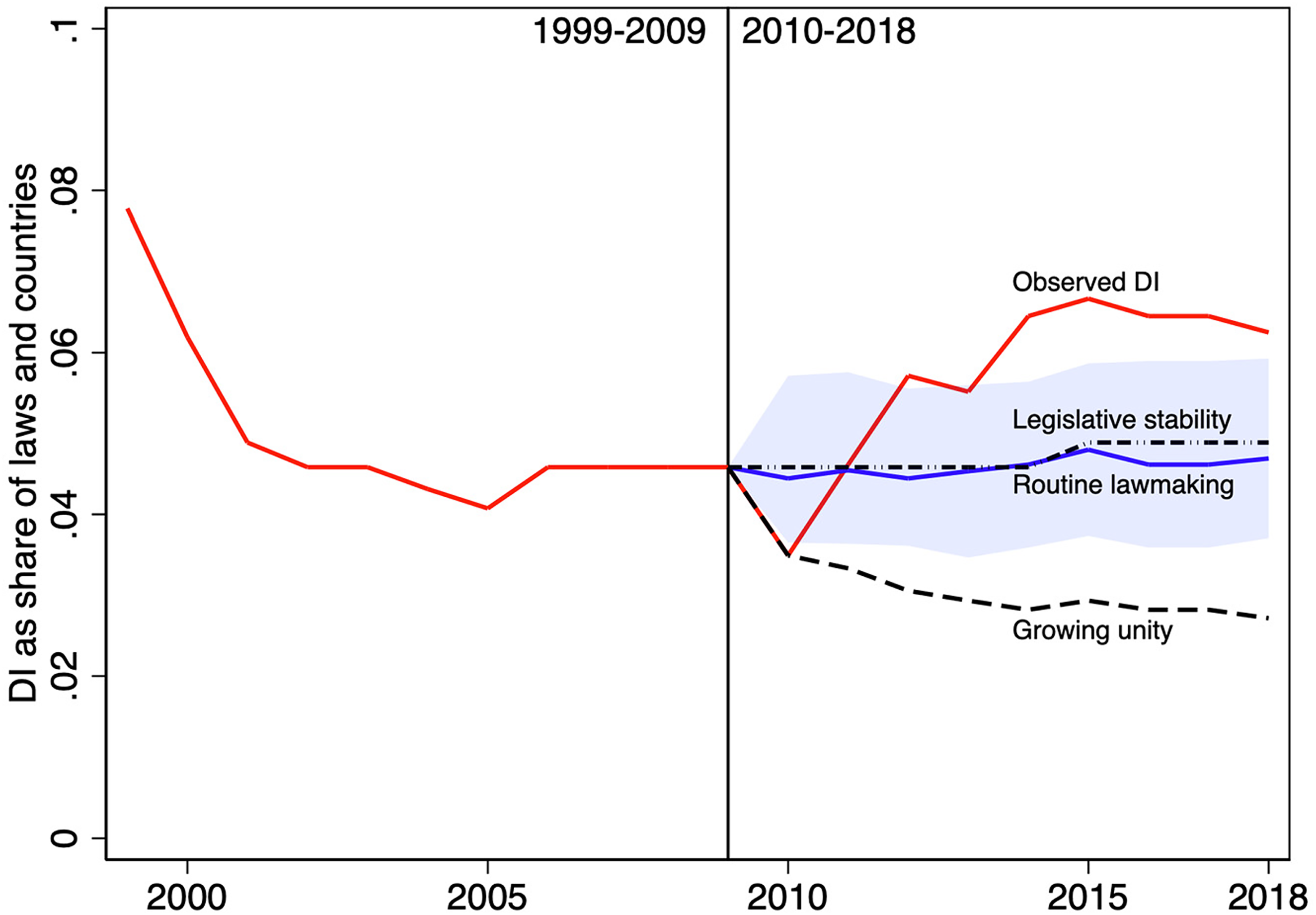
Observed and counterfactual differentiation scenarios in monetary policy legislation.
Spill-over of crisis differentiation into the market
Did the crisis also affect differentiation in EU market legislation? To predict a post-crisis differentiation trend in the market, we specify a logistic regression model that estimates the probability that a member state obtains a differentiation from a law in a year. We then derive a differentiation outcome for each country-law-year observation and aggregate these outcomes to the EU level to calculate the level of differentiation in a year. 5
Our model includes structural variables only: lagged differentiation, a time trend, the age of a legal instrument, and a countdown of the first 15 years of a country’s EU membership. Lagged differentiation reflects the rigidity of legal outcomes (see the Online appendix). Moreover, market differentiation becomes less likely in older laws, over time, and gradually after enlargement (Schimmelfennig and Winzen, 2020). Our analysis is aided by declining legislative productivity due to the EU’s ‘better regulation’ agenda (see the Online appendix) (e.g. Radaelli, 2007). Harder-to-predict new laws become rarer, and differentiation increasingly reflects lagged differentiation and the other variables. Note that country characteristics such as Euroscepticism would be endogenous to the crisis and invalidate our out-of-sample predictions. Thus, we cannot predict which countries opt out of EU legislation, but we can obtain outcomes at the EU level.
For the post-crisis period, we again define which laws the EU would have made without the crisis. As above, we determined for all post-crisis market laws whether they resulted from the crisis (see the Online appendix). We classified laws motivated by the financial crisis but loosely related to the Euro crisis as unrelated to the crisis (and thus included in the counterfactual scenario) to avoid overestimating the crisis effect. One might object that the EU would have made even more laws without the crisis. Note, however, that additional hypothetical laws would depress counterfactual differentiation (because of the low propensity of differentiation in the market) and thus overstate the crisis effect – not adding more hypothetical laws to our counterfactual prediction is the conservative choice. 6
Figure 3 shows that our model makes plausible in-sample predictions from 1970 to 2009. Lagged differentiation accounts for much of this performance, although less so, the fewer new laws the EU adopts towards the end of the series. We find a strong difference between observed and predicted differentiation in the post-crisis period. This difference stems mainly from five new and strongly differentiated laws in the areas of banking supervision and budgetary and financial stability. As noted, we cannot draw country-level conclusions, but it bears mentioning that Euro outsiders but also members account for the observed opt-outs. In each year after 2013, the crisis added 60 new differentiations to market legislation.
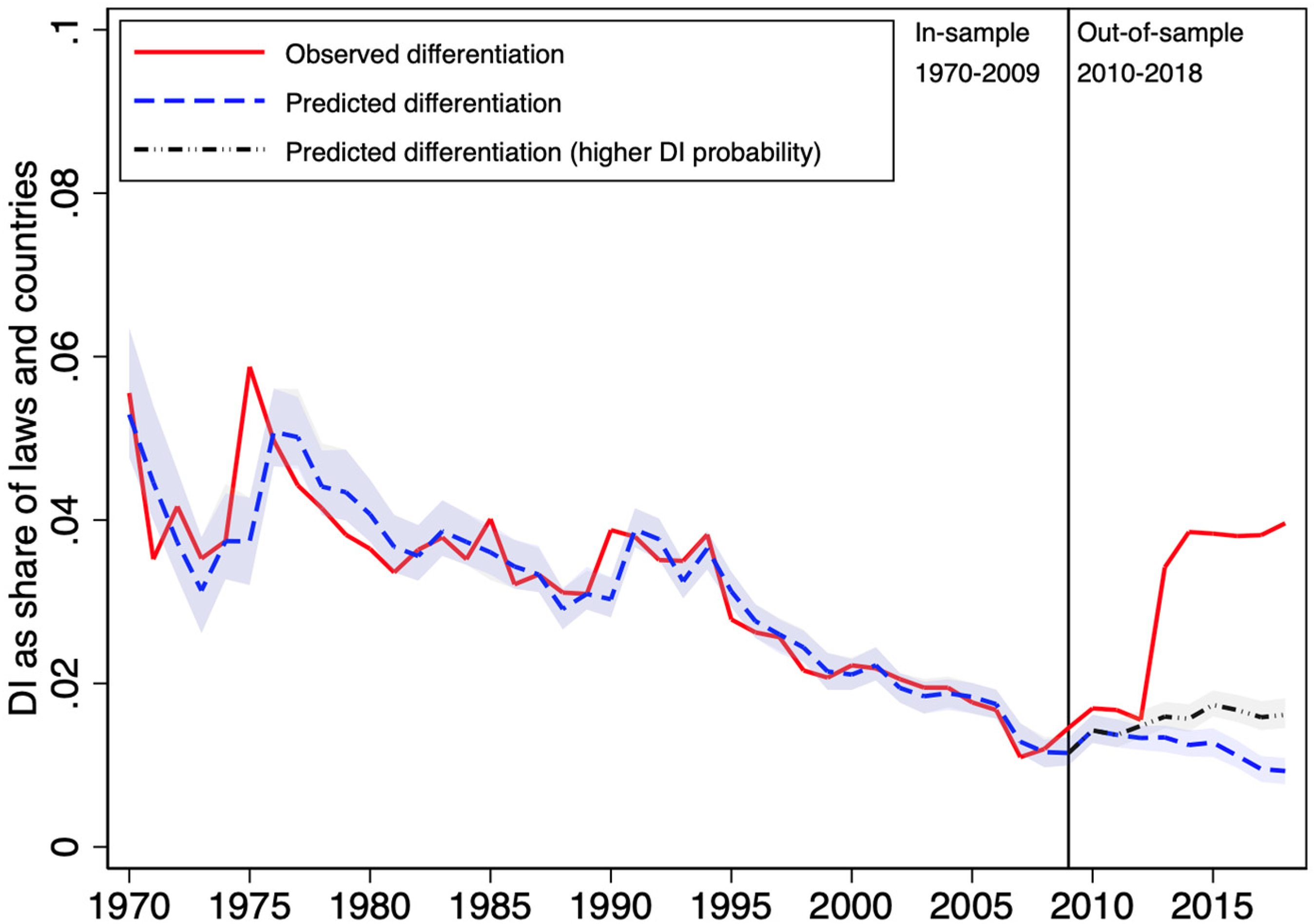
The Euro crisis effect in market legislation.
We present three additional checks. First, for a conservative scenario (the dashed and dotted line in Figure 3), we assumed a tenfold differentiation probability in new post-crisis laws. This strong assumption establishes a ceiling for the causal effect estimate. While this scenario predicts rising differentiation after 2010, it still suggests a large crisis effect. Second, we ruled out that setting the onset of the crisis to 2000, as a placebo test, would create a comparable effect (see the Online appendix).
Third, as discussed in the Online appendix, differentiation has become rare in the market domain, which means that the accuracy of the predicted differentiation trend reflects, to a large extent, the accurate classification of negative outcomes and depends considerably on the lagged dependent variable. To assess the robustness of the results further, we sorted market legislation into subfields based on their legal bases (Figure 4). Differentiation trends are similar across subfields until the Euro crisis. They then diverge due to the impact of the crisis on the freedom of establishment (e.g. conditions for the establishment of banks) and capital mobility (Epstein and Rhodes, 2016). Approximating the logic of a difference-in-difference design (with four policy subfields, we do not have enough observations for a systematic analysis), we can compare differentiation in the affected and unaffected subfields before the crisis and after the crisis, and then take the difference between these comparisons. This yields a crisis effect of 3–4 percentage points. Thus, the effect estimate above (2–3 percentage points) is plausible and likely conservative.
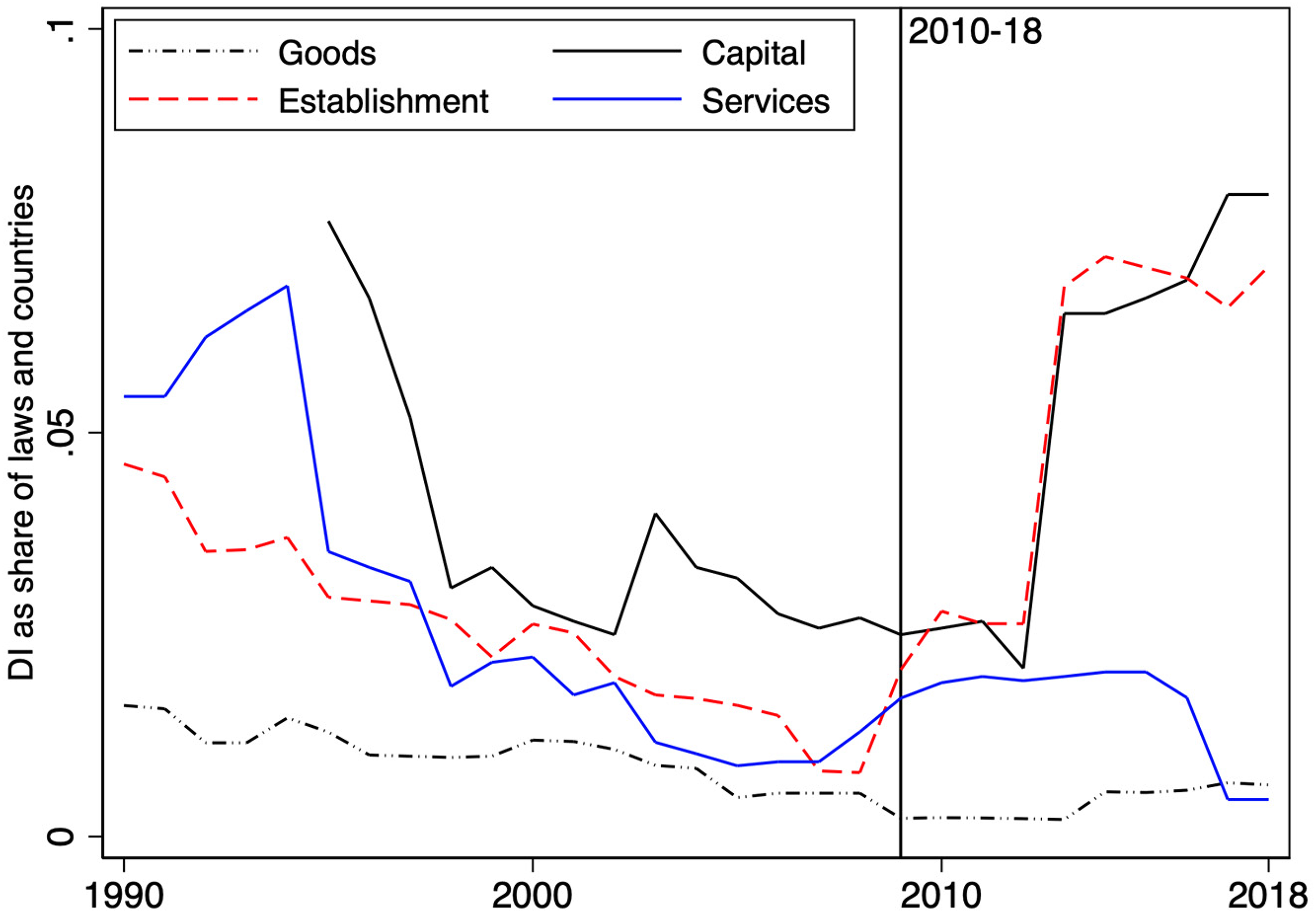
Differentiation in market subfields.
Eastern enlargement and differentiation in monetary policy
We have ignored enlargement to circumvent the problem of the staggered Euro accession of new member states. 7 If crises delay the Euro adoption of new members, we might underestimate the crisis effect by not including early Euro adoption (i.e. more unity) in the counterfactual. We rely on case knowledge to establish the earliest Euro adoption for each new member, thus creating a ceiling for the effect estimate. Four countries had joined before 2010. Estonia had announced accession in 2011 before the crisis. For the remaining countries, we relied on the accession rules (participation in the Exchange Rate Mechanism for 2 years and compliance with the convergence criteria) and target dates for Euro adoption that governments had set before the Euro crisis. Our early adoption scenario (justified in the Online appendix), which errs on the side of earlier adoption in hard cases, assumes unchanged Latvian adoption in 2014, Lithuanian adoption in 2014 rather than 2015, and other countries’ adoptions in 2015. Croatia could not have joined by 2019.
Figure 5 compares observed differentiation for the EU28 to a scenario without early Euro adoption (as shown in Figure 1 for the EU15) and one with early adoption. The crisis effect is larger since some new member states remained outside of the Euro area after 2010 and, intuitively, grows further under the early adoption scenario. Overall, in the EU15 and EU28, the Euro crisis increased differentiation.
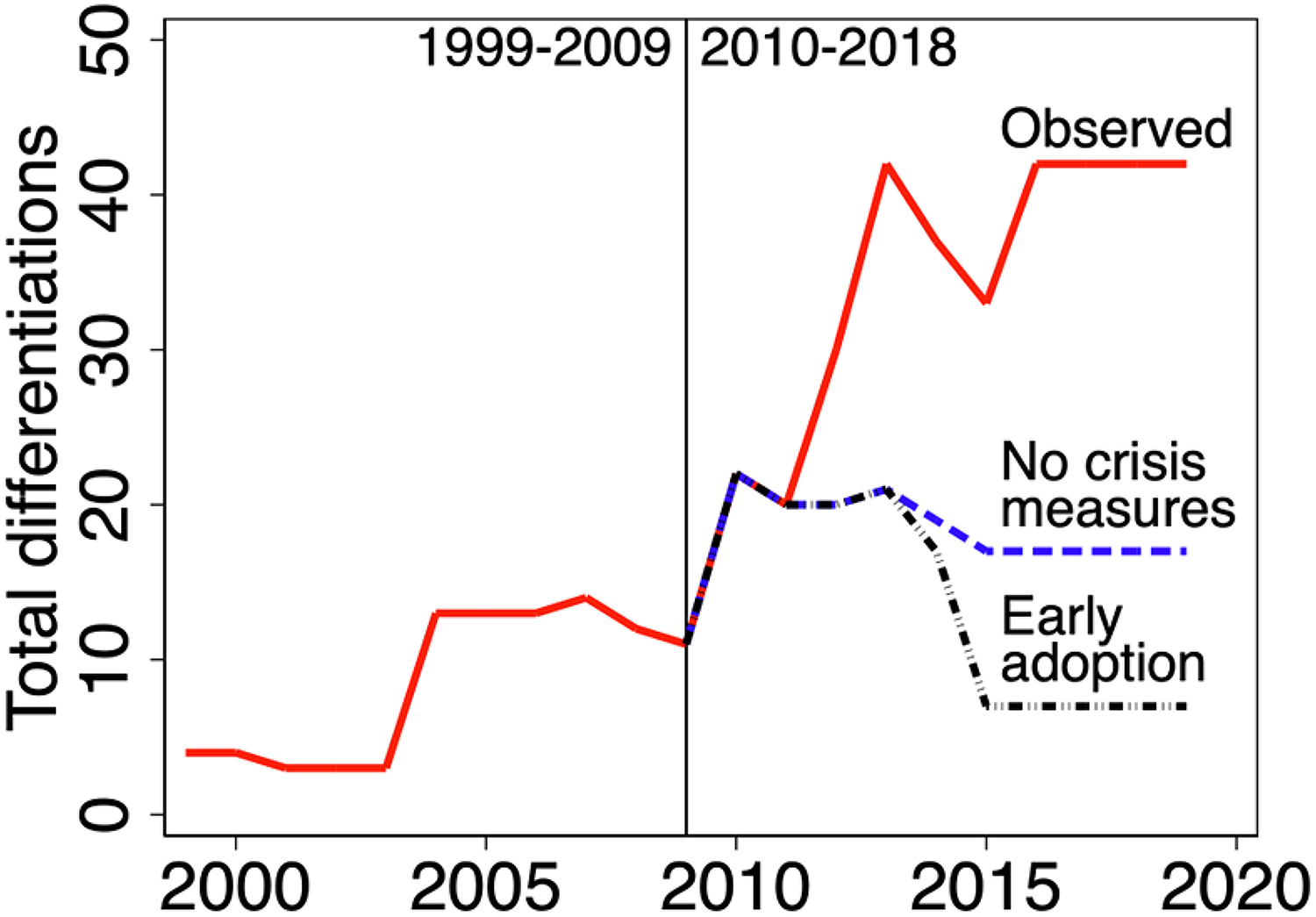
Crisis and treaty differentiation in monetary policy in the EU28.
We can also extend the analysis to monetary policy and market legislation. Since the idea and results are very similar to the analyses presented so far, we do so in the Online appendix. We find that the crisis effect on legislative differentiation in monetary policy is in the same direction but larger for the EU28 than EU15 as more countries opted out of reform legislation. In the market, the effect is very similar to the EU15 analysis but slightly smaller, reflecting that the new member states have generally obtained little differentiation in market legislation since joining the EU (Schimmelfennig and Winzen, 2020).
To conclude the analysis of the Euro crisis, we have found a crisis effect at all levels. This effect is linked with the treaty and legislative reforms of EMU, including the creation of the ESM, reinforced rules for fiscal discipline and macroeconomic stability in the Fiscal Compact and European Semester, and Banking Union. These reforms have mostly led to further differentiation for countries with existing Euro opt-outs and to more integration among Eurozone members. Except for the market, in which crisis legislation entailed exemptions for more countries, the crisis has thus primarily widened the gap between Euro area insiders and outsiders.
The migration crisis and DI
How do the results of the Euro crisis compare to the migration crisis of 2015? We first highlight that it did not have effects at the treaty level or in market legislation. In the second step, we examine its effect on justice and home affairs legislation more carefully.
Regarding the crisis effect at the treaty level, there have not been any new interior policy treaties. Nor is it plausible that the migration influx could have delayed the expiration of existing treaty differentiation. The British and Irish opt-outs from the Schengen agreement, as well as the British and Danish opt-outs from interior policies have existed since long before the onset of 2015. The Danish referendum of December 2015 could have been affected by the crisis but was about reconfiguring rather than abolishing the opt-out (e.g. Migliorati, 2022). Bulgaria, Cyprus and Romania remain excluded from the Schengen area for reasons that date back to before the crisis and that are not related to migration primarily (e.g. Lacatus and Sedelmeier, 2020). 8 Finally, Croatia’s bid to join the Schengen area has faced opposition from neighbouring countries related to refugee flows. Nonetheless, the EU started its technical evaluation in mid-2015 as requested by Croatia before the crisis, and allowed Croatia to join the Schengen Information System in 2017. The European Commission positively assessed progress in 2019 (European Commission, 2019). While the Council might block accession in the future, this could no longer be considered a crisis effect. Within the time frame of our analysis, Croatia’s progress has been as fast as EU procedures and the country’s governance capacity realistically allow.
Furthermore, we found no sign that the migration crisis affected market rules – especially, on the free movement of workers. Empirically, we examined new legislation on the free movement of workers (and all other market legislation) adopted since 2015 but found no law or instance of differentiation that could plausibly be attributed to the migration crisis (see the Online appendix). Theoretically, this is unsurprising. In the Euro crisis, key problems in banking and finance had obvious links to market legal bases. In the migration crisis, this is only superficially the case. Free movement of workers legislation governs the internal movements of citizens, not the treatment of people entering from outside of the EU. In contrast, pertinent legal bases exist in the justice and home affairs domain, which is where a crisis effect could be expected and should be analysed.
The effect of interest is thus confined to EU interior policies, which include visas, migration, asylum, police and judicial corporation in civil and criminal matters and borders. As for the Euro crisis, we extrapolated a logistic regression model predicting pre-crisis differentiation to the post-crisis period to establish a counterfactual trend. We included the same structural variables (lagged differentiation, a time trend, the age of the legal instrument, time since enlargement) and dummy variables for treaty-level opt-outs in interior policies and the Schengen area. We again examined new post-crisis legislation qualitatively, classified laws as crisis-driven or not, and excluded crisis-driven laws from our counterfactual trend (see the Online appendix).
Figure 6 shows a small crisis effect. The counterfactual and observed trends rise over time. Focusing on the EU28 (Figure 6 (b)), post-crisis differentiation has been about 0.5 percentage points higher per year due to the migration crisis. In 2018, we find 53 more cases of differentiation: 21 of the 53 new differentiations are found in 8 new, crisis-driven laws that the EU adopted in 2015 (see the Online appendix). Additionally, the counterfactual trend predicts lower levels of differentiation than observed in new laws not related to the crisis. We need to be cautious, however. The EU adopted three unusually contested (and differentiated) laws in 2016 and 2017 (on property conflicts in marriages, in registered partnerships and on the European Public Prosecutor’s Office). The differentiation in these laws exacerbates observed differentiation compared to the counterfactual trend. It is thus advisable to consider the estimate an upper bound of the crisis effect.
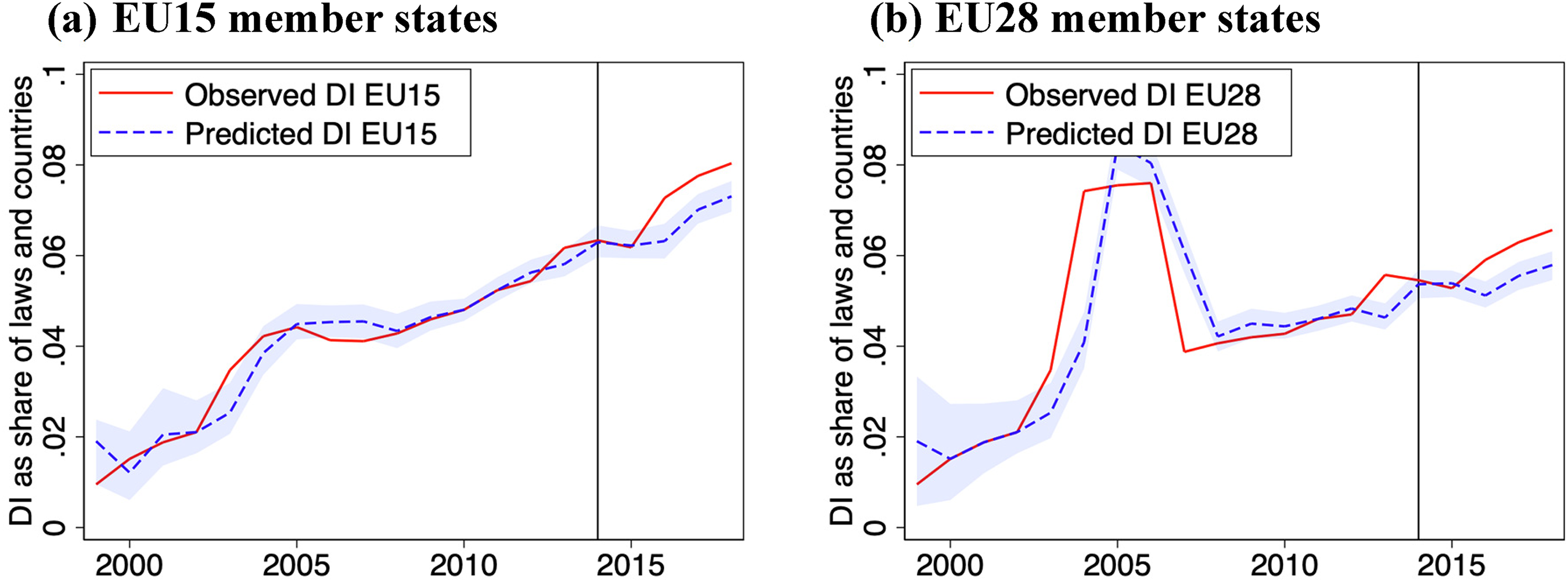
The migration crisis and differentiation in interior policy legislation.
Overall, our findings suggest that the migration crisis had a much smaller effect on differentiation in the EU than the Euro crisis. We have found no signs of an effect at the treaty level or of spill-over into the market, but an increase in differentiation in interior policy legislation. Yet, this effect is modest and does not change the general path of interior policies towards growing differentiation. Related to this, salient legislative activity not related to migration might have led us to overestimate the crisis effect.
Conclusions
What happens to DI under conditions of crisis? Against plausible expectations of crisis-induced opt-out cascades, on the one hand, and closing of ranks, on the other, we argue and show that, in the Eurozone and migration cases, integration crises as such have not made a difference for DI. Whereas the Euro crisis has led to a marked increase in differentiation in both monetary and internal market policies, the migration crisis has had at best a modest effect on legislative differentiation only. It is important to note that our within-case counterfactual analyses are based on assumptions about stable non-crisis patterns and trends, but the differences between the crisis effects in both policies remain unaffected by varying assumptions and highly conservative scenarios.
Our analysis suggests that DI has shown considerable stability under the impact of a crisis. Both the EMU and the AFSJ have not only remained differentiated throughout the Euro and the migration crises, but the composition of insiders and outsiders has not changed either. Insiders did not exit from the integrated policy; the outsiders that joined followed their pre-crisis plans; and the outsiders that did not join would most likely not have done otherwise in the absence of the crises.
Arguably, the crises have even confirmed or reinforced the division that had caused integration to be differentiated in the first place. For one, the crises provided ample evidence for the sovereignty, identity and solidarity problems entailed by the supranational integration of core state powers. Governments and societies that had refused the integration of monetary and interior policies saw their concerns vindicated. With regard to the EMU, the crisis has even made outsider societies more sceptical of adopting the Euro (Hobolt, 2014). On the other hand, the massive risk of Eurozone disintegration prompted the insiders to invest in major reforms that widened the integration gap between ins and outs.
Finally, the difference between increased differentiation in monetary, fiscal and financial policy and stable differentiation in asylum and border policy is unrelated to the pre-crisis differentiation of both domains. Rather, the difference in additional differentiation simply mirrored the difference in institutional crisis outcomes. Counterfactually speaking, had the EU achieved an agreement on the proposed major reform of the Common European Asylum System, the differentiation between participants and non-participants would have increased, and had the Eurozone not been able to agree on the ESM, the Banking Union, or more rigid fiscal rules and supervision, the differentiation between the Euro ins and outs would have remained stable (if the Eurozone had survived without these reforms).
Admittedly, our analysis is based on only two policy domains and instances of crises. Yet even a cursory glance at the other crises of the EU’s polycrisis seems to corroborate the main insight of our research – that there is no determinate relationship between integration crises and DI. The rule-of-law crisis developed in a domain of uniform integration. Despite the considerable heterogeneity between liberal and illiberal member states, it has not resulted in legal differentiation. Rather than conceding the rule-of-law backsliders opt-outs from the relevant EU norms, the EU has gradually expanded and sharpened its instruments to sanction non-compliance. The Brexit crisis started with conflict about the freedom of movement, which only allows for temporary differentiation after the accession of new member states, but it ended with disintegration – the withdrawal of the United Kingdom from the EU. Fears that DI makes the EU more likely to run into crises or produce an ‘ever looser union’ have thus proven as misplaced as hopes that uniform integration makes the EU crisis proof or that crisis would bring about a less differentiated union.
Supplemental Material
sj-docx-1-eup-10.1177_14651165221121720 - Supplemental material for Cascading opt-outs? The effect of the Euro and migration crises on differentiated integration in the European Union
Supplemental material, sj-docx-1-eup-10.1177_14651165221121720 for Cascading opt-outs? The effect of the Euro and migration crises on differentiated integration in the European Union by Frank Schimmelfennig and Thomas Winzen in European Union Politics
Supplemental Material
sj-do-2-eup-10.1177_14651165221121720 - Supplemental material for Cascading opt-outs? The effect of the Euro and migration crises on differentiated integration in the European Union
Supplemental material, sj-do-2-eup-10.1177_14651165221121720 for Cascading opt-outs? The effect of the Euro and migration crises on differentiated integration in the European Union by Frank Schimmelfennig and Thomas Winzen in European Union Politics
Supplemental Material
sj-dta-3-eup-10.1177_14651165221121720 - Supplemental material for Cascading opt-outs? The effect of the Euro and migration crises on differentiated integration in the European Union
Supplemental material, sj-dta-3-eup-10.1177_14651165221121720 for Cascading opt-outs? The effect of the Euro and migration crises on differentiated integration in the European Union by Frank Schimmelfennig and Thomas Winzen in European Union Politics
Supplemental Material
sj-dta-4-eup-10.1177_14651165221121720 - Supplemental material for Cascading opt-outs? The effect of the Euro and migration crises on differentiated integration in the European Union
Supplemental material, sj-dta-4-eup-10.1177_14651165221121720 for Cascading opt-outs? The effect of the Euro and migration crises on differentiated integration in the European Union by Frank Schimmelfennig and Thomas Winzen in European Union Politics
Footnotes
Acknowledgements
The authors would like to thank audiences at the Hertie School of Governance, Berlin and the Annual Congress of the Swiss Political Science Association (Bern, 4–5 February 2021), as well as the anonymous reviewers and the editors of EUP for their helpful comments and suggestions.
Funding
The authors disclosed receipt of the following financial support for the research, authorship, and/or publication of this article: This work was supported by the European Commission Horizon 2020 research program (InDivEU, grant number 822304).

Supplemental material
Supplemental material for this article is available online.
Notes
References
Supplementary Material
Please find the following supplemental material available below.
For Open Access articles published under a Creative Commons License, all supplemental material carries the same license as the article it is associated with.
For non-Open Access articles published, all supplemental material carries a non-exclusive license, and permission requests for re-use of supplemental material or any part of supplemental material shall be sent directly to the copyright owner as specified in the copyright notice associated with the article.
