




Abstract
There has been much criticism of donor governments who give aid to states that violate human rights. This has fuelled concerns about how such coverage affects public support for foreign aid. In response, donors increasingly use aid suspensions to signal to domestic audiences that a regime has been sanctioned and aid is not misspent. This article examines how reports of rights violations affect attitudes to aid and what, if any, impact donor responses have on public perceptions. We conduct survey experiments using nationally representative samples of the British public. Our findings demonstrate that reports of rights abuses reduce public support for aid. However, contrary to conventional wisdom, any response from donors, whether it be to justify continuing aid or to cut aid, prevents a decline in support. In policy terms, the findings demonstrate the importance of government responsiveness in maintaining public support for a frequently contested aspect of foreign policy.
Introduction
In recent years, Western development agencies have faced ever greater levels of scrutiny and criticism. After more than a decade of bipartisan support for official development assistance (ODA) on both sides of the Atlantic, donor agencies find themselves under siege from sceptical newspapers, populist politicians, governments and increasingly, public opinion in donor countries (Hurst et al., 2017; Glennie et al., 2012; Lindstrom and Henson, 2011). This has fuelled growing concerns about the negative impact of declining public support for aid on long-term international development efforts (Lightfoot et al., 2017).
Much of the criticism of foreign aid has focused on high-profile cases of human rights violations in countries receiving Western aid, such as Ethiopia, Malawi, Myanmar and Rwanda. Such criticism has frequently been directed at donor governments who provide aid to states implicated in rights abuses, and some journalists have used a narrative suggesting that the design of Western aid makes taxpayers in donor countries complicit in the nefarious activities of repressive regimes (see Dasandi and Erez, 2019). And in recent years, such cases have been used to justify calls to end foreign aid.
Concerns that reports of rights violations in recipient states negatively impact public support for aid have led donors to demonstrate increased willingness to suspend aid – particularly general budget support (GBS) – to states seen to be violating human rights; what scholars refer to as ‘political conditionality’ (PC; Carothers and de Gramont, 2013; Dijkstra, 2013; Molenaers et al., 2015a, 2015b). While Western development agencies have traditionally used PC to try to influence the actions of governments that receive aid, they now increasingly use it as a tool to signal to their own citizens that ODA is not fuelling human rights abuses, and is spent effectively. Fisher (2015) discusses this in the context of the UK government and the Department for International Development (DFID), arguing that DFID officials view the imposition of PC in such human rights-focused ‘trigger’ cases as an effective and necessary mechanism for protecting the reputation of the Department, UK aid programmes and specific modalities (notably GBS). This ‘expressive’ use of PC is aimed at managing public opinion via the media.
This article makes two important contributions to the literature: (1) it provides the first test of the effects of reports of human rights violations on public support for aid in donor countries and (2) it shows how different donor responses, such as suspending aid, influences public attitudes to aid. Recent studies have addressed the extent to which the public in donor countries support aid being made conditional on recipient states’ human rights records (Allendoerfer, 2017; Bodenstein and Faust, 2017; Heinrich and Kobayashi, 2018; Kobayashi et al., 2017); however, there has been little consideration of whether reports of human rights violations in recipient states impact on public support for aid in donor countries themselves, or how donor responses to such reports affect public attitudes to foreign aid. This article addresses this gap in the literature.
Focusing on the UK context, we ask two questions: first, how do negative framings of aid, in terms of human rights violations, impact citizens’ perceptions; and second, what effect does the UK government’s use of expressive PC have on public attitudes to aid? To answer these questions, we conduct a survey experiment using a nationally representative sample of the British public. We provide respondents with six different treatments that reflect real, but non-specific, scenarios relating to overseas aid and government responses. The first set of three treatments presents respondents with (1) a positive account of UK aid and development progress, (2) a negative description that focuses on the UK government providing aid to governments that are accused of repression and rights abuses or (3) a combined treatment containing both the positive and negative messages. The second set of treatments focuses on the UK government’s response (i.e. expressive PC) in which respondents are presented with three different treatments in which the government (4) justifies, (5) cuts or (6) diverts its aid away from the regime accused of rights violations.
Our findings show that information about the context in which aid is delivered is important for public support: when respondents see a positive message about aid and its outcomes, their support for aid increases; if respondents are exposed to negative or mixed message that highlight rights abuses in recipient countries, they become less supportive of aid. These results are in line with our expectations. The findings for government responses to rights violations are more surprising and run counter to the assumptions underpinning the use of expressive PC by the UK government and other donors. We find that any government response – whether it be to justify, cut or divert aid – has the effect of preventing a decline in support that otherwise results from individuals’ exposure to negative news about rights abuses in bilateral aid recipients.
These findings suggest that donor governments have more room for manoeuvre than is typically assumed in responding to human rights violations in countries that receive aid. What appears to matter most in responding to negative stories about aid linked to rights abuses is that there is a government response of some sort, rather than the government simply suspending aid.
The article is structured as follows. In the next section, we discuss the literature on PC and public attitudes to aid, and how the two are increasingly linked through the growing use of expressive PC by donor governments. In doing so, we set out our theoretical framework for the analysis. The second section discusses the methodological approach used in this study, including the case selection rationale and the wider implications of the UK-focused findings, and outlines the treatments and experimental design. In the third section, we present the empirical findings of the experimental analysis, looking at the effect of the treatments on overall support for aid and how individual-level characteristics impact these results. We conclude by discussing the wider policy implications of our findings.
Donors, Public Opinion and PC
Public Opinion and Foreign Aid
While much of the research on donor aid programmes has focused on donor government objectives, and the relationship between donor and recipient governments, in the past decade, the role of public opinion in shaping the design and size of Western aid programmes has attracted increased interest (Bodenstein and Faust, 2017; Hudson and vanHeerde-Hudson, 2012; Lightfoot et al., 2017; Milner and Tingley, 2013). This is based on a growing scholarly recognition of the role of public support in providing the legitimacy for international development initiatives (Fransman and Lecomte, 2004; Paxton and Knack, 2012). Studies have considered the extent to which public support, or lack thereof, plays into donor decisions on the scope of development budgets, both in general and in relation to specific modalities, particularly GBS (Bodenstein and Faust, 2017; Corbett, 2017; Faust and Koch, 2014; Hurst et al., 2017; Molenaers et al., 2015b).
There is little consensus within the literature, however, as to the role of individual-level drivers in determining support for aid or development more generally. While some studies have shown that values and attitudes are far better predictors than standard socio-demographic variables (Bodenstein and Faust, 2017; Henson and Lindstrom, 2013; Prather, 2011), others have shown socio-demographic variables to be important, in particular age, religiosity, income and education (Paxton and Knack, 2012; vanHeerde and Hudson, 2010). Education has been a key variable of interest in understanding support for foreign and internationalist policies (Holsti, 1996) as individuals are thought to have less well-structured attitudes, and also possess less information about policies in this domain. Thus, education is thought to serve as a proxy for exposure to greater levels of knowledge, information and understanding, which has been correlated with greater support for development efforts (Diven and Constantelos, 2009). Wood (2019) directly tests the relationship between information and public support for aid, and finds that while some forms of information can shift public attitudes to aid this is not based on people simply updating their views when provided with additional facts.
In addition to individuals’ values and socio-demographic background, a key factor that is widely seen to influence public perceptions of aid is the media. While there has been little systematic analysis of the impact of media coverage on public attitudes to development, the assumed importance of the media is based on the notion that ‘since few members of the public have personal experience of international development efforts or travel to aid recipient countries, the media presumably play a key role in determining the nature of public support for official development assistance’ (Scott, 2014: 169). Several studies find that the key source of information for the UK public on the lives of those in developing countries comes from television and newspapers (DFID, 2010; Joly, 2014; Scott, 2014). As such, media coverage of aid to partner governments is likely to have a significant influence on public support for aid, although this is likely to vary according to individuals’ beliefs and backgrounds (Scott, 2014; see also Wood, 2019).
Broadly speaking, we expect more positive media coverage of foreign aid, for example, highlighting the beneficial impact of ODA in recipient states, to increase public support for aid. In contrast, we expect negative reports, particularly those focusing on human rights abuses recipient states, to lower public support for aid. Reports of human rights violations are likely to be especially damaging for the public’s opinion of foreign aid because such coverage goes beyond the standard criticism of aid being ineffective in improving the lives of those in the Global South (see Owa, 2011), to raising concerns that by providing aid to repressive states, Western governments and citizens may be complicit in rights abuses occurring in recipient countries (Dasandi and Erez, 2019). Indeed, recent evidence suggests that citizens in donor countries strongly favour aid being made conditional on respect for human rights in recipient countries (Allendoerfer, 2017; Bodenstein and Faust, 2017; Heinrich and Kobayashi, 2018; Kobayashi et al., 2017). Furthermore, some suggest that due to concerns over Western governments’ (and citizens’) complicity in rights violations, there is greater media and non-governmental organisation (NGO) coverage of human rights abuses that occur in countries receiving Western aid (see Ron et al., 2005).
This suggests a set of relationships between donor agencies, partner (or recipient) governments and the public in donor countries. We present the relationships between these three actors in Figure 1. The figure shows the basic links between the three actors as discussed above: donors provide aid to governments in developing countries with PC based on respect for human rights; the public in donor countries form perceptions about governments receiving aid, significantly influenced by media coverage; and the public provides legitimacy and support to the donor agency and foreign aid.
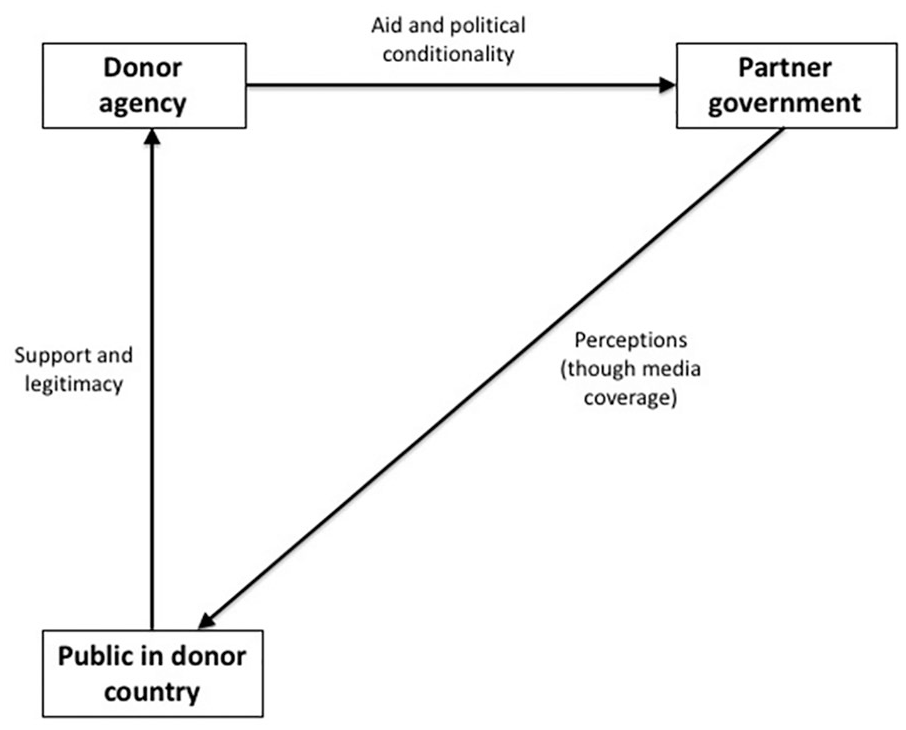
Relationships between Donors, Partner Governments and the Public.
We use the term PC to refer only to impositions of aid reductions or suspensions by a donor in response to a perceived transgression of a ‘political’ condition (assumed or codified) underlying the aid relationship. Typical examples of such transgressions for European donors since the late 1980s have included violations of human rights, democratic backsliding or corruption (De Felice, 2015; Molenaers et al., 2015a), and our conceptualisation of PC in this regard draws on long-standing scholarly practice (Crawford, 1997; Stokke, 1995; Uvin, 1993). We recognise, however, that broader definitions of PC have been used more recently – referring particularly to aid used to incentivise political reform and donor agendas ‘beyond aid’ – and include this clarification to prevent ambiguity (Koch, 2015; Molenaers et al., 2015a: 2-3).
PC and Foreign Aid
There are signs that the standard model of relationships between the three actors is changing. Recent scholarship has sought to establish the role of public opinion in governing specific aid decisions – notably PC linked to GBS (non)-disbursements – in the post-2007 era of ‘austerity’ and increased public scrutiny of government spending in Western states (Molenaers et al., 2015a). One argument in this regard has been that a range of European donors have sought to influence domestic public opinion of – and support for – aid programmes through the media by enacting approaches such as PC (Bodenstein and Faust, 2017: 968; Fisher, 2015; Molenaers et al., 2015a). This has been aimed at responding to, or heading off, media criticism of donor complicity in high-profile human rights or governance violations in aid-receiving states – what Adam and Gunning (2002) refer to as ‘show-stopper’ events.
Drawing on a framework developed from the literature on economic sanctions, for example, Fisher (2015) argues that UK impositions of PC since 1987 have been increasingly informed by concerns regarding domestic public opinion (see also De Felice, 2015; Hayman, 2011). Thus, where use of PC during the 1990s was primarily intended as instrumental – to influence the behaviour of recipient governments – its employment since the early 2000s has instead been mainly, and increasingly, expressive. PC is increasingly used to signal to domestic audiences that the donor government disapproves of the particular political trajectory or action by an aid recipient and that ‘taxpayers’ money is safe’ from being misused to finance the nefarious activities of a violent autocrat.
The use of expressive PC in the UK context, however, appears to be premised not only on the signalling of moral principle, or notions of what is expected from responsible public servants (the necessity to ‘account to the British people’ for decisions made, and their consequences), but also on reputational concerns relating to the perceived integrity of aid programmes themselves played out in the media (Barratt, 2008; De Felice, 2015; Zorbas, 2011). Indeed, at the core of expressive PC appear to be two assumptions on the part of DFID officials: (1) that crises and scandals involving Western aid disbursements (directly or otherwise) undermine and undercut domestic levels of support for aid programmes and (consequently) the disbursing agency and (2) that comprehensive, well-publicised and –reported aid suspensions in such contexts serve to reassure donor publics that their money is being ‘protected’ and not ‘wasted’ (Fisher, 2015: 21).
Such concerns are perhaps understandable in the UK context where DFID has come under increasing scrutiny from conservative media outlets since 2007 for its perceived wasteful spending and uncritical support for dictatorial regimes. DFID has also faced calls from the political right to have its independence revoked and its mandate transferred back to the Foreign and Commonwealth Office (FCO), which materialised in June 2020 when Prime Minister Boris Johnson announced that DFID would be merged with the FCO (The Independent, 2019, 2020). Reputational damage for DFID officials has therefore long been perceived as potentially existential. As a result, PC impositions have dramatically increased since the UK Labour Party lost power to the Conservative–Liberal Democrat coalition government in 2010; 1 seven occurred between 2004 and 2010 and the same number between 2010 and 2013. Reputational concerns have also been found to influence the use of PC by other donor agencies (Swedlund, 2017). 2 We represent the use of PC for expressive purposes in Figure 2. The figure illustrates the logic informing DFID’s usage of expressive PC, which is to counter the negative media framing of aid being provided to governments accused of human rights violations.
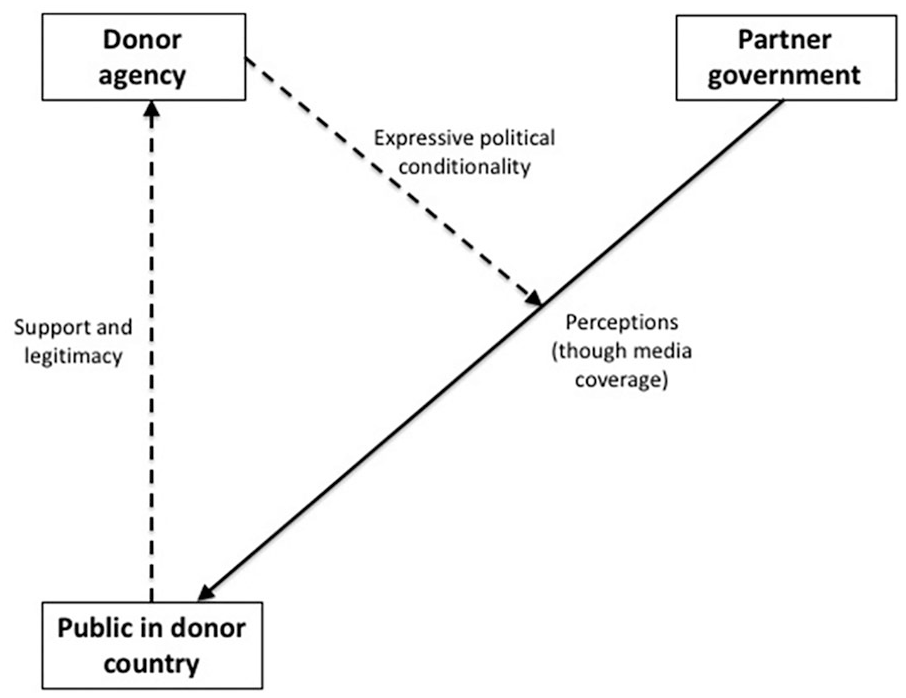
Relationship between Donors, Partner Governments and Public with Expressive PC.
There is nevertheless little research, both within scholarly literature and development organisations, into whether DFID’s, and other donors’, assumptions in fact hold true. There is no evidence available – beyond the conjecture and supposition of Western development officials (Fisher, 2015: 22) – that public support for aid or for an aid agency improves or remains the same following an aid suspension. The existing literature focuses largely on how Western publics perceive aid and aid agencies and their reasons for supporting or opposing development programmes and ministries (Glennie et al., 2012; Henson and Lindstrom, 2013; Hurst et al., 2017; Milner and Tingley, 2013; vanHeerde and Hudson, 2010; Wood, 2019), with determinants of public opinion on PC itself an important, but nascent, area of enquiry. Recent work by Bodenstein and Faust (2017), for example, sheds light on the relationship between ideological leanings and public support for PC as an instrument, both at an individual and country-level, noting that left/right leanings play a significant role in governing public support for/opposition to PC, at least in pre-2004 EU Member States. More closely related to the subject of our study, Allendoerfer (2017) finds that a majority of US citizens support aid cuts to regimes accused of human rights abuses, with the perceived strategic importance of the recipient to the country tempering this tendency to a limited degree (see also Bodenstein and Faust, 2017; Heinrich and Kobayashi, 2018; Kobayashi et al., 2017).
Our contribution is to link public support for a range of potential donor decisions on responding to a human rights crisis to the broader dynamics of public support for aid and domestic donor reputation-building. While previous studies help to explain whether US or European citizens support PC impositions on rights-violating regimes, and what factors drive levels of support, this article examines whether PC impositions impact upon public support for aid more generally and, indeed, whether the instrument influences public opinion on aid programmes, positively (as assumed, in this case, by DFID) or otherwise. Through the use of survey experiments from nationally representative samples of the British public, we identify the causal effects of donor responses to human rights violations on levels of public support.
Design and Empirical Strategy
This article considers the relationships between coverage of rights abuses in recipient states and public attitudes, and between donors’ framing of aid decisions and public opinion, in one major OECD–DAC member state – the United Kingdom. The results are of relevance to the UK context, although they extend to other Western donors who employ PC with domestic public opinion in mind – notably the so-called Nordic Plus group (Norway, Sweden, Denmark, Ireland and the Netherlands) and the EU (Koch et al., 2017). The choice of the United Kingdom reflects its dominant role within the international development community: it is the third largest OECD–DAC bilateral donor worldwide; a key driver of norms and aid policy across the OECD–DAC community, promoting itself and being considered by many donors, as a ‘trailblazer’; and opinion-leader on issues such as tied aid and GBS (Carothers and de Gramont, 2013; Organisation for Economic Cooperation and Development (OECD), 2014; Owa, 2011). It has also been clearly established that UK officials have come to use PC for expressive purposes over the last decade, and thus, the United Kingdom represents an important test case. 3
The data for this study are drawn from two embedded survey experiments conducted using nationally representative samples from YouGov’s online panel. 4 Both of our survey experiments were part of a larger (omnibus) survey with non-related questions. 5 We begin by testing whether coverage of human rights violations in developing countries negatively impacts public support for development as presented in Figure 1, in the context of human rights violations. Next, we examine whether the use of expressive PC by DFID can counter this impact by influencing public attitudes to aid. The six treatments set out below make reference to aid spending and programmes in Zambia through a range of vignettes.
A Focus on Zambia
The selection of Zambia itself was premised on three rationales. 6 First, Zambia has been a major recipient of UK development assistance, since it gained independence from the United Kingdom in October 1964 (OECD, 2019). It is therefore a long-standing, significant element of the UK’s development portfolio and presence in Africa. 7 Second, Zambia enjoys a fairly low-profile within the UK media, political discourse and public imagination. Responses were less likely, therefore, to be informed by existing prejudices or perceptions on the country itself, as opposed to aid in general or preferred UK government responses to crises in recipient states. In the 12 months prior to the first survey conducted for this study, for example, there were 438 mentions of Zambia in the Daily Mail online edition (the most-read UK newspaper website and second most popular print newspaper by circulation) compared with 753 for Rwanda, 1327 for Ethiopia, 1360 for Uganda, 1390 for Zimbabwe and 3425 for Kenya. 8
Finally, while we sought to avoid biasing the treatment effects by choosing an African country more readily identified with rights abuses, we wanted to anchor the vignettes in plausible and real-world scenarios to produce results with clear and direct relevance for the assumptions held by policy-makers on expressive PC. The treatment vignettes used here were constructed as hypothetical, but were anchored in events in Zambia following the close-run August 2016 presidential election, where the government was accused of cracking down on opposition supporters. 9 For example, the repressive frame (and half of the combined frame) used in both surveys bore some similarities to contemporary political events in Zambia at the time of the surveys (see Supplementary Material for details).
Survey and Vignettes
In the first survey (n = 1665), respondents were randomly allocated to one of three treatment groups: combined, progress or repression. 10 Our aim here is to determine whether public support for aid spending is negatively impacted by reports of human rights violations, which to our knowledge has not previously been examined. To test this, we compare the effect of the negative information with a standard positive aid message about progress. Because overseas aid is notoriously a low-salience, but high-valence issue, demonstrating that the public are responsive to different outcomes in aid recipient countries is a first step. Our expectation is that in relation to the combined message, the progress frame will increase support and the repression message will reduce individuals’ support for foreign aid. The combined message serves as our baseline from which we compare changes in support for giving aid against the progress and repression frames.
Combined. Zambia is one of the world’s poorest countries. But working together with the Zambian government, aid from the UK DFID has meant that 9 of every 10 children are now enrolled in school and poverty has been cut by half. However, human rights and democracy observers are becoming increasingly concerned about recent events in Zambia where there has been a crackdown on political opposition. Independent media organisations critical of the government have been shut down and last week two opposition leaders were jailed.
Progress. Zambia is one of the world’s poorest countries. But working together with the Zambian government, aid from the UK DFID has meant that 9 of every 10 children are now enrolled in school and poverty has been cut by half.
Repression. Human rights and democracy observers are becoming increasingly concerned about recent events in Zambia where there has been a crackdown on political opposition. Independent media organisations critical of the government have been shut down, and in last week, two opposition leaders were jailed.
In line with experimental realism (McDermott, 2003), the design of these vignettes is focused around replicating, as far as possible, the language and framing of UK government statements and narratives on rights violations. While the experimental literature has demonstrated the trade-offs in maximising internal and external validity of lab-based experimental designs (Barabas and Jerit, 2010; Druckman et al., 2011), our approach is to mirror DFID responses for two principal reasons. First, as noted in our theoretical expectations, DFID responses to human rights violations are framed with public opinion in mind. The political context and environment in which they operate both dictate and constrain their public response. Second, where issues are typically low-salience and low-knowledge for the public, providing respondents with treatments that they are most likely to be familiar with is vital (Iyengar, 2011). Our approach ensures that the survey elicits responses to commonplace articulations of aid policy contexts and decisions, maximising the ecological validity of our inferences.
We framed the vignettes around two common issues, the progress vignette on the effectiveness of UK aid and the repression vignette on the closing down of political space. The latter, therefore, focused only implicitly on the risks posed to UK aid effectiveness in Zambia; a more direct comparison would have required the vignette to focus more directly on the ineffectiveness of UK aid in Zambia. Although methodologically ‘cleaner’, this approach would have meant introducing a narrative around UK aid failures which has been almost entirely absent from the UK government’s public discourse on development aid in recent decades.
The DFID (2011) suspension of GBS to Malawi, Zambia’s neighbour, and perhaps the most recent and similar case to that proposed in the survey vignettes, for example, was framed by DFID around the perceived failings of the Malawian Government itself around ‘economic management and governance ….[whereby] . . . poor people in Malawi and British taxpayers alike have been let down . . . [but] . . . in the meantime we will use other programmes to ensure that programmes to protect poor Malawians . . . are able to continue’. DFID’s framing here, as in many similar cases, focuses not on perceived ineffectiveness of UK aid efforts, but instead the transgressions of the recipient government and implicitly, the likely bearing of this on aid provided directly to it. We also sought and received comment from DFID officials on the wording of the vignettes in advance of the survey, incorporating minor amendments to reflect framings which they felt were more in keeping with DFID public statement and press release language.
The second survey was fielded to a new sample (n = 1672), and again, respondents were randomly allocated to three treatment groups, this time measuring support for giving aid in response to different degrees of PC placed on the UK’s aid programme to Zambia. 11 In each of the three treatments, respondents saw the combined statement from the first survey and then one of the following.
Justify. The UK government has been following these events closely, but defended giving direct budget support to the Zambian government. A DFID spokesperson said: ‘UK aid has helped the Zambian government lift thousands out of poverty in an incredibly difficult context. We are closely monitoring the political situation in Zambia and we have rigorous checks to protect UK taxpayers’ money’.
Cut. The UK government has been following these events closely and in response has suspended aid to the Zambian government. A DFID spokesperson said, ‘It is clearly not possible to provide direct budget support to Zambia’s government at the moment. No UK aid will be sent until we are fully satisfied that the political situation has been resolved’.
Divert. The UK government has been following these events closely and in response has suspended direct budget support to the Zambian government and instead has directed UK aid to health and education programmes in Zambia. A DFID spokesperson said: ‘We will continue to use UK aid to support the most vulnerable in Zambia but will now channel aid away from the government’.
Our expectations are that the cut message is likely to have the largest positive effect on support for aid, followed by the divert frame. We expect the justify message to produce a negative effect on individuals’ support for aid. This is based on the argument that cutting aid sends the clearest signal to the public that foreign aid is not linked to human rights violations, while diverting aid provides some reassurance that repressive regimes do not directly receive any taxpayers’ money. In contrast, the justify message could be interpreted to suggest the UK government is doing nothing to address the rights violations in Zambia. These expectations are in line with the underlying assumptions that inform donor agencies’ use of expressive PC, and are also supported by recent studies that suggest the public in donor countries strongly favour aid conditionality on the basis of human rights (e.g. Allendoerfer, 2017; Heinrich and Kobayashi, 2018).
Our outcome variable is general support for providing overseas aid: Thinking about overseas aid to poor countries, please indicate the extent to which you think that the UK government should give overseas aid, where a score of 0 means that it ‘should not give aid at all’ and a score of 10 means that it ‘should give aid very generously’. We measure general support for overseas aid at the beginning of each survey and following receipt of the treatment, which allows us to measure within-subject treatment effects for our outcome of interest. 12 We use this pre–post-test approach for several reasons. First, in piloting with between-subjects designs, we found it difficult to leverage differences between groups on a support for aid measure. The ‘stickiness’ of support for aid is confirmed by other work (Hudson et al., 2020; vanHeerde-Hudson, 2014; Wood et al., 2020). As such, we opted for a within-subjects design to provide greater statistical power. This is because each participant effectively serves as their own control, meaning that ‘between study designs require 4 to 8 times more subjects than a within study design to reach an acceptable level of statistical power’ (Bellemare et al., 2014: 16). Second, in line with existing work showing individuals’ attitudes and values tend to be the strongest predictors of support for aid (Bayram, 2016; Bodenstein and Faust, 2017; Henson and Lindstrom, 2013; Prather, 2011), our prior was that the effect of the treatments is likely to vary according to people’s pre-existing levels of support for aid (see Morton and Williams, 2012). Those who had more strongly held views – either for or against – may be less malleable than those in the middle. Measuring pre-treatment support would allow us to directly test whether the different messages lead to changes in an individual’s level of support for aid conditioned on pre-existing support. Nevertheless, we acknowledge that there is also the risk with within-subjects design that respondents will try to demonstrate consistency in their responses to pre- and post-treatment questions. In our questionnaire, the pre-treatment item was placed at the beginning of an omnibus survey, with a series of non-related items between this and our treatments and post-treatment measure to minimise this risk. Ultimately, the fact that we do see significant changes in individual support suggests, if anything, the results we report here underestimate the treatment effect.
Results and Discussion
Reports of Human Rights Violations and Support for Aid
We begin by looking at how positive and negative framings of UK aid to Zambia affect public support for ODA. In Figure 3, we compare pre–post, within-subject treatment effects on support for giving aid. In other words, we test the effect of the treatment by asking the same question at the beginning of the survey and post-treatment to see the extent to which individuals change their mind. Consistent with our expectations, reports of human rights violations reduce public support for foreign aid. Starting with the repression frame, support for giving aid falls from 4.91 to 4.68 (p < 0.05). Once exposed to negative information about events in Zambia, support for aid falls. The opposite is true for respondents who received the progress frame: support for aid giving increases, although the magnitude of change is smaller (from 4.74 to 4.85, p < 0.05). Finally, we find that for respondents in the combined treatment group, support falls an average of 0.19 points (from 4.89 to 4.70, p < 0.05). Clearly, the mere mention of negative outcomes linked with aid spending drives down support. Therefore, in line with our expectations we find that positive coverage of the effects of ODA in recipient states increases public support for aid. However, contrary to our expectations, we find that while the repression frame reduces public support for aid, it does not reduce support for aid more than our baseline, the combined message. Our results suggest that any mention of negative outcomes linked to human rights violations in recipient countries leads to individuals becoming less supportive of aid than they were previously.
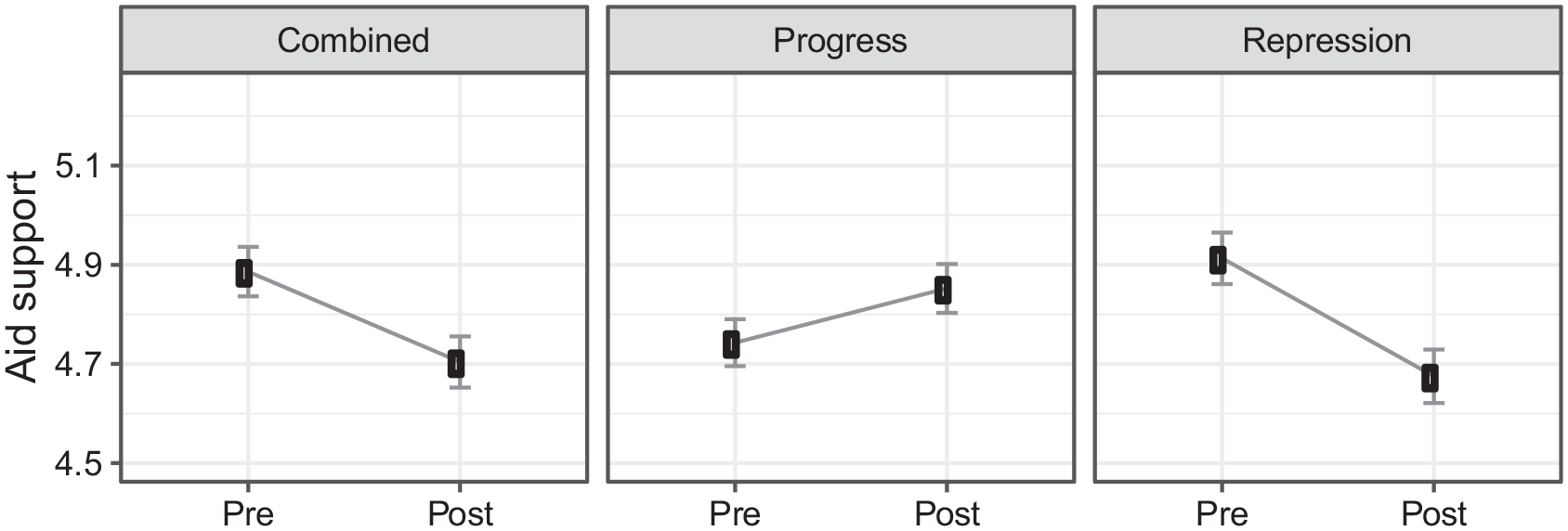
Framing Treatments: Pre–Post-test Scores in Support for Aid.
Donor Responses to Human Rights Violations and Support for Aid
Next, we consider the effects of the different government responses to the crisis. All respondents saw the combined statement used in the first survey and were then given one of the three government response treatments. The results presented in Figure 4 demonstrate that there are no significant effects for the different treatments. The effect for the justify treatment is positive, but falls just outside traditional levels of significance (p < 0.10). As such, the findings are counter to expectations about the expressive conditionality response of cutting aid being more effective than other types of government response. However, when we compare the pre–post effects of the combined treatment as the baseline to the three government response treatments, we find a significant and positive change in the slope, indicating that the negative effect the combined treatment has on public support for aid disappears with all three government response treatments. In other words, any response by the government – be it to justify, cut or divert aid – has the effect of preventing the decline in support for aid that otherwise occurs with the mention of repression. Therefore, while the specific type of government response to rights violations does not impact public support for aid, the mere act of responding stems a decline in public support for aid.
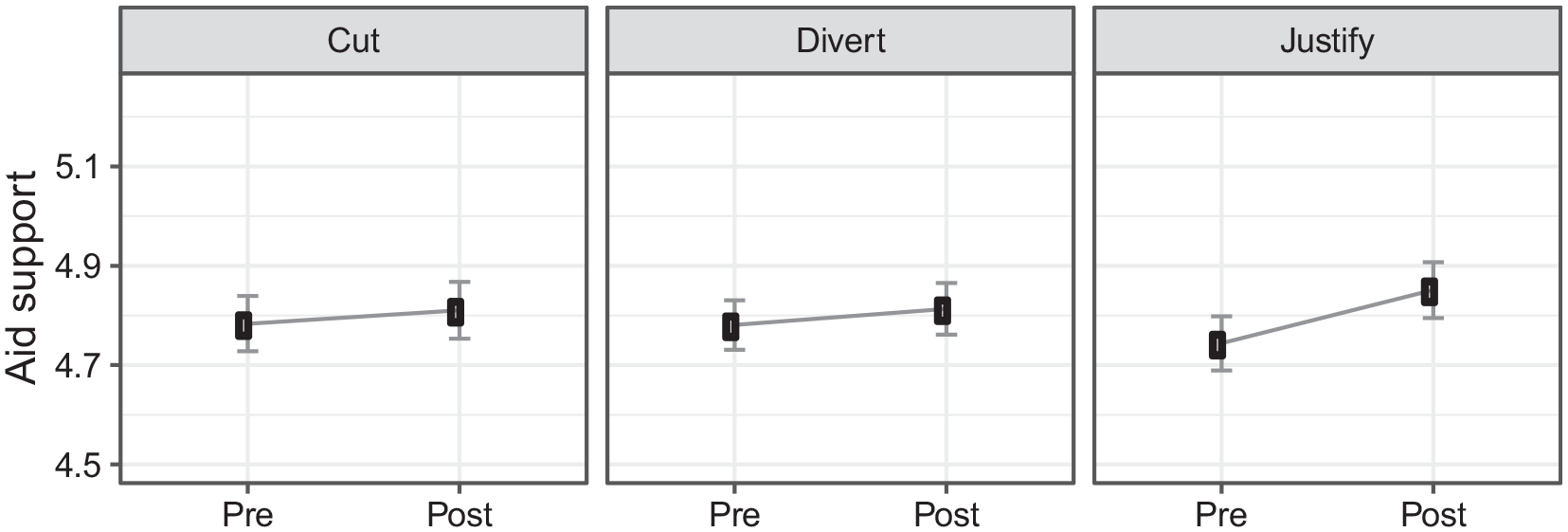
Government Response Treatments: Pre–Post-test Scores in Support for Aid.
Individual-Level Characteristics and Support for Aid
We conduct additional tests using relevant covariates, using a linear mixed-effects model to estimate the pre–post treatment effects. Mixed-effects models allow us to simultaneously bring longitudinal effects into account at the same time as estimate other relevant covariates. This is important in pre–post-test designs since measurements are not independent because they come from the same individual. Mixed-effects models account for these non-independencies and individual differences by assuming different random intercepts for each subject. 13 The results from the mixed-effects models are shown in Table 1. The results table shows the fixed parts of the model, with the fixed-effects coefficients for the treatments interacted with the post- condition, including confidence intervals and p-values. 14 We report three models, to show the results to be robust to the inclusion of key socio-demographic covariates, including social grade, and educational attainment, as well as political preferences.
Individual Characteristics and Support for Aid.
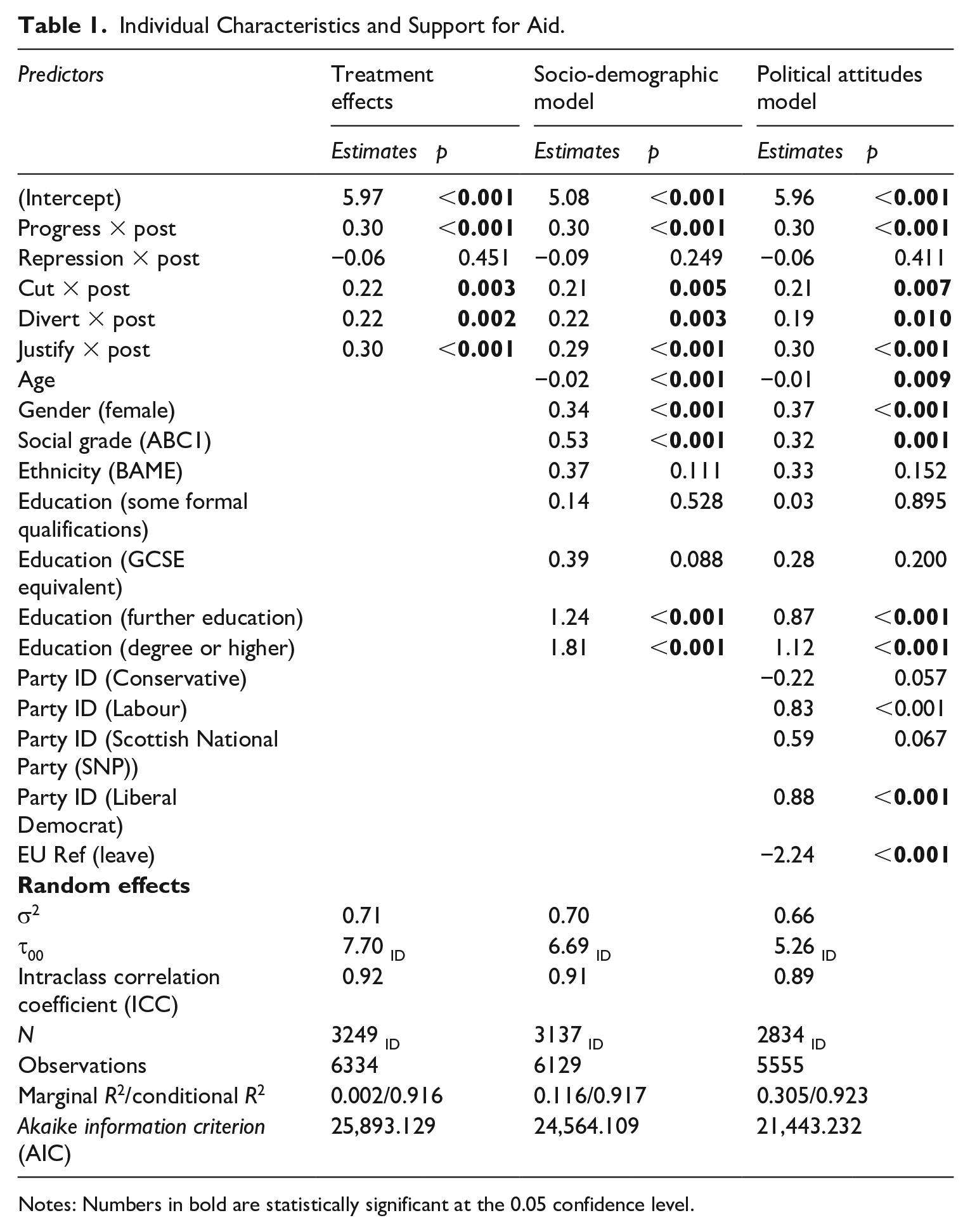
Notes: Numbers in bold are statistically significant at the 0.05 confidence level.
The key effects of interest are the interaction terms which report the pre- versus post-test effects of each treatment. We do not report the results of the aggregated effects of each treatment and the overall difference between the pre- and post-measures as they are not of substantive interest. The results table confirms that, compared with combined × post, the effects of cut × post, divert × post and justify × post are all significantly positive (as well as progress × post-treatment) and the repression × post is not significantly different from the baseline. This confirms the difference in slopes between the Combined and the other treatments and shown in Figures 3 and 4. The results across the three models show that the treatment effects remain stable in size and significance with the inclusion of different covariates. These covariates also suggest that support aid tends to be more positive among younger, female, more educated, higher social grade respondents who voted Labour, Liberal Democrat and Remain in the 2016 EU referendum.
Within the logic of expressive conditionality, the varying responses to crises can be used proportionately and in response to a perceived violation within a donor country (e.g. repression, misuse of funds/corruption), however, for DFID they are ultimately a signalling device to show commitment to transparency, accountability and value for money for UK taxpayers. In other words, expressive PC is used to respond to public concerns about rights violations in aid-receiving countries, by signalling that DFID will address issues to ensure that UK aid is being spent effectively. The intended effect is to drive up support for overseas aid programmes. However, as we show here, there is no evidence to suggest that public statements by DFID that ODA will be cut in response to a human rights violation increases support for overseas aid. Instead, we find that all three responses – justify, cut and divert – have the impact of preventing a decline in support for aid that otherwise occurs when individuals are exposed to reports of human rights violations in recipient countries, and indeed, the justify response comes closest to increasing individuals’ support for aid (though this falls just short of the 0.05 confidence level).
Discussion and Implications
The findings of this study support, and in other ways confound, assumptions underlying the use of expressive PC by donors. We find that reports of human rights violations decrease public support for foreign aid. Importantly, our results suggest that any mention of human rights violations, even when combined with coverage of the positive impact ODA has in recipient countries, leads to a fall in individuals’ support for aid. However, we find no evidence to suggest that the UK government’s decision to cut aid does more to reassure the public about the value and effectiveness of aid than other types of government response, such as diverting or justifying aid. Instead, our results suggest that to reassure the public about the value of aid in the context of human rights abuses, it is important that the government engages and responds to the crisis, rather than simply cutting aid in response. We find that any response whether – justifying, diverting or cutting aid – prevents declines in public support for giving aid brought about by negative reports about human rights violations.
Our results challenge a key assumption of DFID and other donor governments’ use of expressive PC: that cutting aid will have a positive effect on public support for ODA. In fact, our results suggest that a government response that justifies continuing ODA provision increases support for aid most, although this result falls just short of statistical significance at the 0.05 level, but is positively and statistically significantly different from a baseline measure of no response. These findings have important policy implications for how donors engage with coverage of human rights violations in recipient states.
Our findings have implications for how donor agencies respond to negative media coverage of foreign aid. In recent years, media scrutiny and criticism of UK aid spending has grown considerably, particularly in right-leaning newspapers such as the Daily Mail (the country’s second most-read daily) and The Daily Telegraph. 15 One of the most prominent and long-running targets of this media campaign was an effort to scrap the UK government’s commitment to spend 0.7% of national income on foreign aid which included launching, advertising and providing links to a petition entitled ‘Stop spending a fixed 0.7 per cent of our national wealth on foreign aid’ (Daily Mail, 2016). The petition attracted over 235,000 signatures on the parliamentary petition website and consequently was debated in Parliament in June 2016. 16 This criticism of aid has frequently been premised on the view that UK aid is funding corrupt autocrats in developing countries who commit widespread human rights abuses and, critically, has been an important driver of ministerial pressures on DFID officials to implement expressive PC (e.g. Daily Mail, 2014, 2018).
Our findings raise questions about DFID’s use of expressive PC to counter criticism of aid. We find no evidence to suggest that the use of expressive PC in response to negative reports increases individuals’ support for ODA. This is important because there is a risk that over time the continual use of expressive PC may reinforce the critiques made by right-leaning newspapers that UK aid is going to regimes that commit rights abuses, and therefore should be cut. Instead, our findings highlight the importance of engagement and response from DFID regarding negative coverage of aid spending. An alternative to using expressive PC has been for DFID officials not to respond to reports of human rights violations by aid-receiving governments (Dasandi and Erez, 2019: 1142–1143). Our results suggest that negative coverage of aid linked to human rights abuses can indeed reduce individuals’ support of aid in general. However, this can be mitigated by the government choosing to engage and respond to such events. Our analysis suggests that what matters is that the UK government engages with, and responds to negative coverage of aid spending, not that it necessarily suspends aid in response to such reporting.
A further implication of our findings is that donors have more room to manoeuvre in responding to coverage of rights violations in aid-receiving countries than is generally assumed. The results suggest that while it is important that donors do engage with, and respond to, such negative reports, the actual policy response they employ matters less than whether or not they respond at all. This means that donor governments can focus on responding to rights violations in a way that improves the lives of those in developing countries rather than in signalling to domestic audiences to build public support for aid. This is important for two reasons. First, donors’ decision to cut ODA in response to rights abuses can have a significant negative impact on the lives of vulnerable groups living recipient countries, and as such is a decision that needs to be carefully considered (Dasandi and Erez, 2019). Second, there is little to suggest that PC improves human rights in recipient countries (see Hayman, 2011), in some contexts it may even worsen rights in the recipient state (Allen, 2014). Our findings suggest that governments should engage with the public and communicate its response to human rights concerns, its response can and should be based on trying to improve the lives of those in the countries it provides with aid.
Conclusion
In this article, we present two key findings. First, reports of human rights violations in countries receiving foreign aid leads to a decline in public support for aid. When respondents hear positive messages about aid and its outcomes, they are more likely to increase their support for it. If the message is mixed or negative – highlighting rights violations in the country receiving aid – respondents are likely to become more opposed to aid. More broadly, our findings highlight the influence of framing and messaging in shaping levels of public support for aid.
Second, and turning to the question of expressive PC and its impact on public support for giving aid the results are more surprising and run somewhat counter to the assumptions underpinning the use of the instrument by DFID. The results suggest that all three types of government response we consider affect general levels of support for aid. Specifically, we find that a government decision to cut, divert or justify aid disbursements has the effect of preventing the decline in support for aid that respondents otherwise experience when exposed to any mention of a human rights crises in aid-receiving countries. We show that these results are robust to the inclusion of a host of covariates.
The implications of these findings, as we have discussed, are significant. Our analysis suggests that donors may have more room to manoeuvre in responding to negative coverage of aid spending – specifically linked to human rights violations – than is generally assumed. The results suggest that while it is important that donors do engage with, and respond to, such negative reports, the actual policy response they employ matters less than simply responding. A broader implication of the study is that the decision by donor governments to use PC and its response to human rights crises more generally should be based less on concerns about public support for aid domestically, and more on promoting development and human rights outcomes in aid-receiving countries. We find that as long as donors engage with the public and communicate their response to concerns about human rights abuses, their response can and should focus on improving the lives of those in aid-receiving countries. The central message is that when faced with negative coverage of aid spending, particularly linked to human rights crises, donors should engage with the public and communicate their response to the crisis, regardless of what the appropriate response is deemed to be.
Supplemental Material
sj-pdf-1-psx-10.1177_0032321720980895 – Supplemental material for Human Rights Violations, Political Conditionality and Public Attitudes to Foreign Aid: Evidence from Survey Experiments
Supplemental material, sj-pdf-1-psx-10.1177_0032321720980895 for Human Rights Violations, Political Conditionality and Public Attitudes to Foreign Aid: Evidence from Survey Experiments by Niheer Dasandi, Jonathan Fisher, David Hudson and Jennifer vanHeerde-Hudson in Political Studies
Footnotes
Acknowledgements
The authors would like to thank Nic Cheeseman, Jack Corbett, Tobias Heinrich, Nadia Molenaers, Miranda Simon, James Weinberg, Scott, Matthew S. Winters and Terence Wood for their helpful comments on previous drafts of the paper.
Declaration of Conflicting Interests
The author(s) declared no potential conflicts of interest with respect to the research, authorship and/or publication of this article.
Funding
The author(s) received no financial support for the research, authorship and/or publication of this article.

Supplemental Material
Additional Supplementary Information may be found with the online version of this article.
Notes
Author Biographies
References
Supplementary Material
Please find the following supplemental material available below.
For Open Access articles published under a Creative Commons License, all supplemental material carries the same license as the article it is associated with.
For non-Open Access articles published, all supplemental material carries a non-exclusive license, and permission requests for re-use of supplemental material or any part of supplemental material shall be sent directly to the copyright owner as specified in the copyright notice associated with the article.
