




Abstract
Which membership-based voluntary organizations constitutive of civil society such as parties, interest groups or service-oriented organizations keep their members active and which forms of activism do they cultivate? This article addresses this important question distinguishing two forms of ‘member activism’: ‘member involvement’, defined as members working for an organization, and ‘member influence’, defined as members’ participation in intra-organizational decision-making. Building on incentive-theoretical approaches to leader–member relations and resource dependency theory, we present a theoretical framework specifying distinct drivers of each form of member activism, which is tested using new data from four organization surveys conducted in four most different European democracies. None of the theorized factors has the same robust effect on both involvement and influence. Most notably, professionalization – reliance on paid staff – has a positive effect on involvement and a negative one on influence, stressing the need to distinguish carefully the different roles members play in civil society organizations.
Keywords
Introduction
Which membership-based voluntary organizations constitutive of civil society, such as political parties, interest groups or service-oriented organizations, keep their members active, and if so, which forms of activism do they cultivate and why? While these organizations – by definition – have members and are dependent on them to some extent, this dependency varies and the particular roles that members play in them differ widely, irrespective of organizations’ political or social functions (e.g. Evers, 2014; Gauja, 2015; Jordan and Maloney, 1997; Schlozman et al., 2015; Skocpol, 2003). Building on the literature on the uses and functions of organizational membership in party and group research (e.g. Hustinx, 2014; Maloney, 2012; Scarrow, 1994, 2015), this article conceptually distinguishes two forms of member activism: member involvement is defined as members working for or providing valuable information to organizations, an organizational resource that can help ensure organizational functioning and maintenance. The narrower notion of member influence on intra-organizational decision-making allows members to hold organizational leaders to account (Binderkrantz, 2009: 660–661; Cross and Katz, 2013; Gauja, 2017; Halpin, 2006). Being qualitatively different, their drivers are not necessarily the same, which provides the foundation to integrate arguments from the party, group and non-profit literatures to theorize which organization-level characteristics invite member involvement rather than member influence and vice versa. 1
To study both forms of member activism is important as the two phenomena have been associated with important yet distinct political and social benefits. The exercise of member influence helps channel member preferences into the political process and thereby contributes crucially to democratic representation while enhancing members’ capacity for self-governance (Dekker, 2009: 228; Gauja, 2017; Hustinx et al., 2010: 420–421). In contrast, the broader notion of member involvement – akin to the notion of volunteering in social organizations within non-profit research (but equally applicable to parties and interest groups) – has been associated with social benefits such as the cultivation of well-being and life-satisfaction through social interaction, the enhancement of human capital, as well as the mobilization and detection of unmet social needs (Hustinx et al., 2010: 417–418, 422).
Building on two basic assumptions, we theorize drivers of member activism from the perspective of those actors in charge of the day-to-day running of an organization, linking classical incentive-theoretical views on leader–member relations (Moe, 1980; Wilson, 1973) to resource dependency theory (e.g. Beyers and Kerremans, 2007; Froelich, 2005; Pfeffer and Salancik, 1978): First, member influence and involvement impose different ‘costs’ on leaders: 2 member influence on intra-organizational decision-making curtails organizational leaders (e.g. Evers, 2014; Maloney, 2009; Van Deth and Maloney, 2012; Webb, 1994); member involvement in organizational activities (e.g. participating in meetings, engaging in recruitment activities, supporting fundraising) can be steered by leaders (e.g. Hustinx, 2014; Pestoff et al., 2012; Scarrow, 1994) and is compatible with any type of organization, including those that give their members little or no say (Jordan and Maloney, 1997; Kreutzer and Jäger, 2011; Maloney, 2012). Second, neither form of member activism is necessarily self-sustaining (Andrews et al., 2010: 1192; Han, 2014; Scarrow, 1996): To keep members actively involved requires resources that organizations might have or not or, alternatively, might prefer to invest elsewhere. To grant members influence requires procedural channels organizations might or might not provide. Leaders’ inclinations to make such investments are fundamentally shaped by the availability of critical resources (e.g. state funding) enhancing organizational autonomy from various forms of member support (Schmitter and Streeck, 1999: 79–80).
Our study of member activism from an organization-centred perspective contributes to relevant debates in politics, sociology and non-profit research on the changing roles and relevance of members (e.g. Andrews et al., 2010; Barasko and Schaffner, 2008; Scarrow, 2015; Van Haute and Gauja, 2015). Those include the organizational consequences of professionalization (Binderkrantz, 2009; Poguntke and Webb, 2005), the hybridization of associations (e.g. Billis, 2010; Jordan and Maloney, 2007), the cartelization of parties (e.g. Katz and Mair, 1995, 2009) and the participatory implications of party decline (Lawson and Merkl, 1988; Norris, 2002). Concretely, researchers on parties and groups alike have argued that an influential membership active in intra-organizational decision-making can decrease organizational efficiency; thus, leaders often prefer passive over active members (e.g. Evers, 2014; Maloney, 2009; Van Deth and Maloney, 2012; Webb, 1994). It has been suggested that this trade-off might be especially pronounced when organizations strongly depend on state funding perceived as a more reliable income source than membership fees while making organizational leaders less dependent on members (Bosso, 2003; Halpin, 2014; Kreutzer and Jäger, 2011: 637–638; Maloney, 2012; Whiteley, 2011). Similar effects have been attributed to parties’ and groups’ increasing reliance on paid staff as central feature of group hybridization and party cartelization, which has been associated with organizations’ centralization and detachment from society (Billis, 2010; Mair, 1997). Finally, comparing member activism in parties and interest groups puts arguments made in the important debate on party decline to the test, suggesting that participation in parties as potentially outdated venues of political participation might be increasingly compensated for by citizen involvement in alternative, more issue-specific organizations (e.g. Lawson and Merkl, 1988; Norris, 2002). However, as highlighted by Katz and Mair (2009: 762–763), ‘it is less than clear that [non-governmental organizations] promise any more civic engagement or accountability than political parties’.
We test our hypotheses on the basis of new data from four recently completed population surveys, which we conducted in the UK, Norway, Germany and Switzerland – each covering regionally and nationally active organizations, data that reveal a remarkable discrepancy between member involvement and influence: Among organizations that grant their members the greatest level of influence, only 17% also show the highest level of involvement, with 12% indicating their members to be not at all or only slightly involved. Vice versa, around 47% of the organizations that do not grant any influence to their members still have very or extremely involved members.
Applying heterogeneous choice models, we show that none of the factors theorized has the same robust effect on both membership involvement and influence. Most crucially, professionalization (reliance on paid staff) has opposite effects. As influence, involvement is instrumental to organizational self-maintenance, yet unlike influence it can take place in democratic and authoritarian organizations that co-exist in pluralist societies (Fung, 2003; Rosenblum, 1998), our findings are also significant for debates around the conditions for ‘civil’ or ‘democratic’ as compared to ‘uncivil’ or ‘non-democratic’ society (Bob, 2011).
In the following, we present our resource dependency perspective on member activism. Having justified our country selection, described the data and operationalized the variables, we present our findings that widely substantiate our theoretical approach. We conclude with a discussion of the implications of this study and avenues for future research.
A Resource Dependency Perspective on Member Activism in Membership-Based Voluntary Organizations
Definitions
We define membership-based voluntary organizations as private (separate from government), non-profit-distributing, self-governing and membership-based (members being individuals, associations or institutions), a definition that embraces parties, interest groups and service-oriented organizations (Salamon and Anheier, 1998: 216–217; Wilson, 1973). 3
Member activism covers the range of activities through which members participate within these organizations. It contrasts with passive membership 4 (usually) restricted to the regular payment of fees – the central formal act distinguishing members from followers (Duverger, 1964: 90–116; Jordan and Maloney, 1997: 187, 2007: 33, 156; Van Haute and Gauja, 2015: 1). Echoing that members can be perceived as liability or asset by organizational leaders (Hustinx, 2014: 104; Kreutzer and Jäger, 2011; Maloney, 2012: 92–94; Scarrow, 1996: 15–19), we argue that ‘being active’ in a membership-based organization can be understood in two ways, each attributing a different role to members, roles that can but do not necessarily go together.
(A) Members actively exercise influence when they have direct control over core areas of organizational decision-making such as the allocation of core posts or changes to the rules that define the power structure of the organization. Hence, influence is given when member preferences directly shape decisions in these areas, without leaders mediating them.
(B) Members are actively involved in an organization when they engage in organizational activities 5 and provide valuable information and feedback to the organization by expressing opinions or attending meetings. While leaders cannot ignore those members (as the organization benefits from their involvement), they have considerable leeway to which extent and how to consider member preferences in intra-organizational decisions.
Basic Assumptions on Resource Dependencies and Leader–Member Relations in Membership-Based Voluntary Organizations
Organizational leaders try to assure organizational survival while maintaining control over internal decisions and activities (Moe, 1980), an endeavour in tension with a powerful membership (Schmitter and Streeck, 1999). In organizations composed of voluntary members, the latter can leave at any point (Wilson, 1973), which means (different from firms, for instance) organizational leaders are unable to ‘control’ their members’ behaviour, which has fundamental implications for the relationship between these two sets of actors (Nienhüser, 2008; Pfeffer and Salancik, 1978). Echoing these broader rationales derived from resource dependency theory, influential works on different types of membership-based organizations stress the importance of paid staff as core indication of professionalization and state resources as ‘critical resources’ for organizational maintenance, which fundamentally shape leaders’ relative dependence on members when trying to sustain central organizational activities (e.g. Andrews et al., 2010; Duverger, 1964; Han, 2014; Jordan and Maloney, 1997, 2007; Katz and Mair, 1995; Schmitter and Streeck, 1999; Wilson, 1973). This relative dependence shapes the weight members can gain through contributions to their organization’s budget, the pressure organizations face to grant members a say in decision-making and the capacity and incentives to actively cultivate member involvement.
Critical Resources Shaping Member Activism in Voluntary Organizations: Professionalization and Finances
Organizational leaders as well as paid staff tend to share a concern for the effective running of the organization to protect their status or paid positions, which are only safe as long as their organization remains intact (e.g. LeRoux and Goerdel, 2009: 518; Panebianco, 1988; Schmitter and Streeck, 1999: 81; Wilson, 1973). Given such an orientation, they tend to be more flexible in strategically exploiting opportunities to access institutional resources or gain support beyond the core group of members. This is because activists are more strongly committed to core organizational values and might want to see leaders’ actions constrained accordingly (Binderkrantz, 2009; Kreutzer and Jäger, 2011). This discrepancy underpins a trade-off – discussed in party, interest group and voluntary sector research alike – between professionalization defined as organizations’ increasing reliance on paid staff (instead of members or unpaid volunteers) and member influence. In line with resource dependency theory, leaders able to rely on staff are considered less dependent on member contributions and therefore expected to expand their own control over internal decision-making to enhance their room for manoeuvre (e.g. Billis, 2010; Mair et al., 2004; Maloney, 2009; Nienhüser, 2008; Poguntke and Webb, 2005; Schmitter and Streeck, 1999: 79–81).
Theoretical expectations regarding the implications of an organization’s reliance on professional staff on member involvement are different. From the perspective of leaders and staff, member involvement contributes to organizational legitimacy and can provide valuable information (Jordan and Maloney, 2007: 183–184; Scarrow, 1996: 42–43). It is a form of activism that can be steered, hence is fully compatible with their goals or strategies (Nienhüser, 2008). Simultaneously, organizations with more capacity in terms of paid staff can be expected to be more incentivized and able to construct an environment that promotes member involvement (Maloney and Rossteutscher, 2005) directed towards areas useful to assure an organization’s functioning, without affecting leader control over decision-making. Taking these two lines of argument together, we expect reliance on paid staff to have opposite implications for member influence and involvement, respectively:
H1.1 (Professionalization–Member Influence Trade-off): The more professionalized (hence staff-driven) an organization is, the less influence its members will have over core areas of decision-making.
H1.2 (Professionalization–Member Involvement Hypothesis): The more professionalized (hence staff-driven) an organization is, the more involved its members will be.
Moving to organizational finances, resource dependency theory has long argued that leaders, when confronted with opportunities to access state funds, prioritize such funds: in increasingly individualized societies, state funds tend to be more reliable sources of income than member contributions (e.g. Bosso, 2003; Halpin, 2014; Kreutzer and Jäger, 2011; Maloney, 2012; Whiteley, 2011). Hence, leaders are willing to trade the reduction of uncertainty against the reduction of external control (Froelich, 2005; Pfeffer and Salancik, 1978; Walker, 1983). In such a scenario, leaders’ and staff’s accountability is thus expected to shift towards the state to assure the on-going access to such resources (Fraussen, 2014; Froelich, 2005). This, in turn, as prominently argued in cartel party theory (Katz and Mair 1995, 2009) lowers pressure on leaders to give members a say (see also, for instance, Bosso, 1995, 2003, on groups). This suggests a negative relationship between state funding dependency and member influence.
Yet what are the implications of state funding dependency for member involvement? State resources enhance capacity, but they also prioritize managerial and administrative tasks to meet reporting requirements related to the receipt of state funding or to contracts that regulate state-sponsored service-provision (Bloodgood and Tremblay-Boire, 2017: 404–405; Froelich, 2005: 260; Salamon, 2012). Such tasks are more difficult to delegate to members or volunteers, decreasing leaders’ incentive to actively involve their broader membership. While state funding does not make members’ contribution to organizational work irrelevant, if the core business of an organization shifts towards more specialist tasks due to intensified state dependency, state funding, unlike other income sources, can be expected to decrease member involvement (Whiteley, 2011). Hence, unlike the reliance on paid staff, state funding dependency is expected to affect both types of member activism negatively:
H1.3 (State Funding–Member Influence Trade-off): The more dependent an organization is on state funding, the less influence on decision-making its members will have.
H1.4 (State Funding–Member Involvement Trade-off): The more dependent an organization is on state funding, the less involved its members will be.
Moving to membership fees, a stronger reliance on this income source should enhance both the capacity to and the incentives for organizational leaders and staff to foster involvement to strengthen members’ organizational ties (and hence to stabilize this income source) (e.g. Jordan and Maloney, 2007; Scarrow, 2015), without such activities having costs in terms of leaders’ decision-making power. In contrast, we do not expect a similar relationship with member influence. This line of argument would presuppose that organizational members generally aim for active participation in internal decision-making or want their organization to cultivate such processes. Both the group and party literature emphasize the vast diversity of value orientations and ideological dispositions held by organizations and their members that range from democratic and participatory to authoritarian and leadership-centred (e.g. Rosenblum, 1998; Sartori, 1976; Scarrow et al., 2017). As organizations tend to recruit a membership base supporting their values and members are more likely to join organizations whose values they share (Duverger, 1964; Wilson, 1973), being a member as such does therefore not mean embracing democratic, participatory norms (Jordan and Maloney, 2007). We thus arrive only at one hypothesis that links membership fees to member involvement:
H1.5 (Membership Fees–Member Involvement Hypothesis): The more an organization relies on membership fees, the more involved its members will be.
Organizations’ Functional Orientation and Types of Member Activism
The following characteristics tend to be used to distinguish parties, interest groups and service-oriented organizations: the nomination of candidates for elections in the case of parties (e.g. Sartori, 1976), influencing public policy in the case of interest groups (e.g. Baroni et al., 2014) and service-provision benefitting societal groups (usually beyond organization’s own members) in the case of service-oriented organizations (e.g. Enjolras, 2009). While resource dependency theory so far underpinned expectations applicable to membership-based organizations generally, such dependencies can be expected to be shaped by organizations’ functional orientations (Beyers and Kerremans, 2007). 6 They affect the external pressures of relevant audiences towards granting members influence (and, with it, the costs of not doing so) and the extent to which member involvement qualifies as ‘critical’ for an organization’s ability to continue central activities (Pfeffer and Salancik, 1978: 86).
Halpin has persuasively argued that only if member interests ‘stand for’ the constituency interests that an organization pursues, the latter are incentivized to adopt internal, democratic structures for member participation. The more distinct the constituency is from the organization’s membership (i.e. the less representative the latter is of the former), the less is giving the members influence a suitable mechanism to pursue organizational goals (Halpin, 2006: 922–923) and the less likely leaders are to give up control over internal processes. We expect – ceteris paribus – the discrepancy between constituency and members to be more pronounced in service-oriented voluntary organizations which tend to cater to societal groups transcending members and are therefore less likely to grant influence to members than interest groups. Unlike groups, parties recruit political personnel who participate in elections with the aim to win seats in parliament, to ultimately take over government and pass legislation (Sartori, 1976). Hence, parties play a much more institutionally pre-defined role in democratic representation and can be expected to face stronger external pressures than groups to replicate democratic standards internally (Katz, 1990: 152). External pressure to enhance their legitimacy, as an important resource in the political process (Walker and McCarthy, 2010), finds expression in the recent trend towards the expansion of formal membership rights also in parties that are ideologically little inclined towards expanding members’ power (Cross and Blais, 2012; Gauja, 2017; Hazan and Rahat, 2010). 7 Given the external normative pressures on parties (compared to both interest and service-oriented groups), we expect the tendency to grant members intra-organizational influence to be strongest in political parties:
H2.1 (Functional Orientation–Member Influence Hypothesis): Members of service-oriented organizations have less influence in decision-making than members of interest groups, which, in turn, have less influence than members of political parties.
Regarding leaders’ incentives to cultivate member involvement, differences in resource dependencies as shaped by organizations’ functional orientation follow a more ‘material’ logic. Organizations generally profit from the mobilization of members who work towards accomplishing organizational goals (i.e. member involvement), simply because unlike professional staff members are unpaid. Member involvement is useful to parties as canvassing is an important endeavour, especially as winning elections is increasingly a matter of successfully mobilizing parties’ own support base (Enos and Hersh, 2015; Panagopoulos, 2016). This is also the case for interest groups engaging in public campaigns (whose endeavours are publicly legitimized if their membership base actively participates) and sectional interest groups that profit from grassroots lobbying which underlines the importance of organizational demands (Holoyke, 2013a). Service-oriented organizations can profit from members’ support in the provision of services or the raising of funds (Kreutzer and Jäger, 2011). That said, the extent to which member involvement is a ‘critical’ resource to assure the organizations’ most central activities (Pfeffer and Salancik, 1978) systematically differs across the three types of organizations. If the electoral success of political parties, at least to some extent, still relies on member activities (e.g. in canvassing) as argued by party research, parties face strong incentives to build up and maintain their membership as well as avoid member exit, and thus to invest in on-going party activities accordingly. Similar incentives exist for interest groups because a membership that is not just temporarily involved in the organization can be more easily mobilized. The difference between parties and interest groups is that the latter do not have to run elections whose regularity is institutionally prescribed. Hence, interest groups face less pressure to continuously engage in membership-focused activities and can be more instrumental regarding when and how they involve their membership (Holoyke, 2013b). Finally, service-oriented organizations, which provide increasingly specific and technical services, will have, relatively speaking, least incentives to engage in ‘involvement strategies’ directed towards their broader membership and are more likely to target a more narrow group of volunteers with particular skills or abilities (Evers, 2014; Hustinx, 2014). These arguments underpin our last hypothesis:
H2.2 (Functional Orientation–Member Involvement Hypothesis): Members of service-oriented organizations are less involved than members of interest groups, which, in turn, are less involved than members of political parties.
Country Selection and Data Collection
The following analysis relies on the ‘Regulating Civil Society Dataset’. 8 In order to obtain (otherwise unavailable) comparable data on the theorized characteristics of both social and political membership-based organizations, we conducted online surveys (between April and October 2016) covering political parties, interest groups and service-oriented organizations in Norway, the United Kingdom, Germany and Switzerland. The latter were chosen as ‘most different’ instances of fully consolidated liberal democracies 9 regarding a range of important macro characteristics (voluntary sector regime, societal heterogeneity, federal/unitary state structure, country size) that existing research considers relevant for the structure, resources and activities of these organizations, which might feed into how they relate to their members. If findings on the organization-level drivers of member activism hold across these four systems, we can reasonably consider them as robust and generalizable to long-lived democracies more broadly (see Online Appendix A for details on the country selection).
Reflecting our theory, we chose an organization-centred approach (Marchetti, 2015) and specified the population of nationally and regionally active membership-based voluntary organizations in these four countries. This was done using a bottom-up strategy based on the most inclusive sources documenting active membership-based organizations available in each democracy (Berkhout et al., 2018). In the case of groups, this assured the inclusion of a wide variety of organizations ranging from classical interest groups (e.g. business associations) to service-oriented membership-based organizations. In the case of parties, this strategy led us to include all party organizations participating in elections as parties’ defining characteristic (Sartori, 1976), thereby avoiding a party sample biased towards parties with privileged institutional access. To identify the relevant political parties, we used the respective party registers (UK: the Register of Political Parties of the Electoral Commission; Switzerland: Parteienregister; Norway: Partiregisteret; Germany: Liste der Zugelassenen Parteien und Wahlbewerber). From these lists, we selected as survey participants those parties that nominated candidates at the last national election. 10 Similarly, to compile the list of relevant groups, we used the Directory of British Associations (DBA) in the UK, the Enhetsregisteret (The Central Co-ordinating Register of Legal Entities) in Norway, the German directory ‘Taschenbuch des öffentlichen Lebens – Deutschland 2016’ and the Swiss ‘Publicus’ (Schweizer Jahrbuch des öffentlichen Lebens) as main sources. For all organizations, we checked whether they had an active website as indication that they are still in operation when the surveys were launched. 11 We then collected (where available several) up-to-date email contacts of those in charge of the day-to-day running of the organization knowledgeable about membership, procedures, activities and resources (e.g. chief executives, chairmen, leaders, organizational secretaries) which then were used in our surveys. 12 The questionnaire consisted of 36 questions that cover aspects about the organization, their resources, their core activities and challenges – information unavailable, at the same level of specification, through official registers or aggregate databases (Marchetti, 2015). 13
The response rates were the following: in the UK 21%, in Norway 28%, in Germany 30% and in Switzerland 41%. The resulting dataset covers 828 organizations in the UK, 351 in Norway, 1420 in Germany and 666 in Switzerland. This gives us a dataset of 3265 organizations, which is widely representative in terms of policy fields for groups and parliamentary representation and ideology for parties; so are the organization-specific country samples in terms of core organizational characteristics (see Online Appendix A for details on the representativeness of the data).
Measurements
Dependent Variables
Starting with the two dependent variables, to measure direct member influence we use an index constructed based on three indicators from a question in which participants had to indicate how their organizations primarily make decisions in different areas. The index has been constructed by adding up (with equal weight) the following items, which align closely with notions of intra-organization democracy, representing core areas of decision-making or domains relevant to all three organizational types (e.g. Billis, 2010; Binderkrantz, 2009; Cross and Katz, 2013; Gauja, 2017; Halpin, 2006): ‘Appointing board members or the executive’, ‘Appointing the chairperson or the leader’ and ‘Changing the statutory rules or the constitution’. 14 Each component indicator has been coded as 1 when decisions in an organization were taken by consensus or by voting among members (indicating members’ direct influence on decisions) and 0 when decisions were made otherwise (i.e. by the board, by the chairperson, by staff, by representative structures). Adding up the resulting dummy variables, the index has values that range from 0 to 3, with 3 indicating the highest level of member influence, which in turn indicates that in all these three domains members control decisions directly. Our measure member involvement is based on a 5-point Likert-type scale asking participants how involved their members are in their organization, with 1 being not at all involved and 5 being extremely involved. 15 Importantly, although various relevant literatures highlight discrepancies between formal rules and the practices of decision-making (Barasko and Schaffner, 2008; Panebianco, 1988), both survey items asked about the actual nature of decision-making for influence and the actual intensity of members’ involvement, not about formal rules that might be used by members or not. 16 Furthermore, we find high/low levels of influence and involvement in all three organizational types (see Online Appendix B for question wording and Online Appendix C for details on the relationship between the two dependent variables and their distribution across organizational type). 17
Independent Variables
Moving to the independent variables, we capture professionalization – reliance on paid staff – using the total number of paid staff available to an organization (e.g. Farrell and Webb, 2000; Jordan and Maloney, 1997). 18 This variable has a right-skewed distribution, which is why we use the log in our models. To measure organizations’ reliance on state funding, we use a survey question that asks organizations about the relevance of different types of financial support for their current budget. We have constructed an index (ranging from 0 to 2) adding two items capturing the relative relevance of public funding from national government and from other levels of government, respectively, distinguishing those organizations for whom these two sources of income are important or very important from those for whom they are not. To measure organizations’ reliance on membership fees, we use a survey item about the relevance of membership fees for the organization budget. We again distinguish those organizations for which membership fees are an important or very important source of income (coded 1) from those that are not (0). For organizations’ functional orientation, we use a question in which organizations classified themselves as a political party, an interest group or a service-oriented organization. This avoids mischaracterizations as identifying the type of organization among groups can be challenging since some can possess characteristics of both interest group and service-oriented organizations (Binderkrantz, 2009). We include a categorical variable with political parties as reference category.
Controls
To assure the robustness of our findings, we have included the following control variables in our model. To account for systemic differences across the four countries covered, we control for country and include a categorical variable with Norway as reference category. We further have added controls for number of volunteer (as compared to paid) staff, size (as number of the predominant type of members) and age, all considered as important factors shaping how organizations operate (e.g. Jordan and Maloney, 2007; Scarrow et al., 2017). These variables have right-skewed distributions; thus, we again use their logarithmic version. Finally, we have added a dummy variable capturing whether organizations perceive competition for new members, funds, government contracts or other key resources by similar organizations or not, highlighted as an important driver of organizational behaviour (e.g. Baumgartner and Leech, 2001).
Details on all variables included in the analysis, as well as the survey items based on which our measures were constructed, are provided in Online Appendix B.
Model Choice
To assess the impact of our independent variables on member influence and member involvement, two ordinal variables, we use a heterogeneous choice model which is most suitable because it accounts for differences in the degree of residual variation across groups and solves the problem of the violation of the proportional odds assumption, allowing not only for ordinal dependent variables but also a more flexible specification of the variance equation (Williams, 2009: 532, 548). As we work with survey data typically characterized by a high number of missing values, we have used multiple imputation techniques following King et al. (2001) via the Amelia package in R (Honaker et al., 2011; King et al., 2001). Doing so decreases the risk of losing valuable information or having a selection bias (King et al., 2001: 49–50). Meanwhile, we increase the number of observations from 1933 in our member influence model to 3265 and from 1947 in our member involvement model to 3265. That said, as a robustness check, we have performed our two models with the original data applying listwise deletion. The main findings remain widely the same, indicating that missing values are missing at random, thereby substantiating the use of multiple imputation procedures. 19 The following discussion will focus on the findings that are robust across all model specifications implemented (see Notes 7, 19, 21 and 22 on further robustness checks).
Results
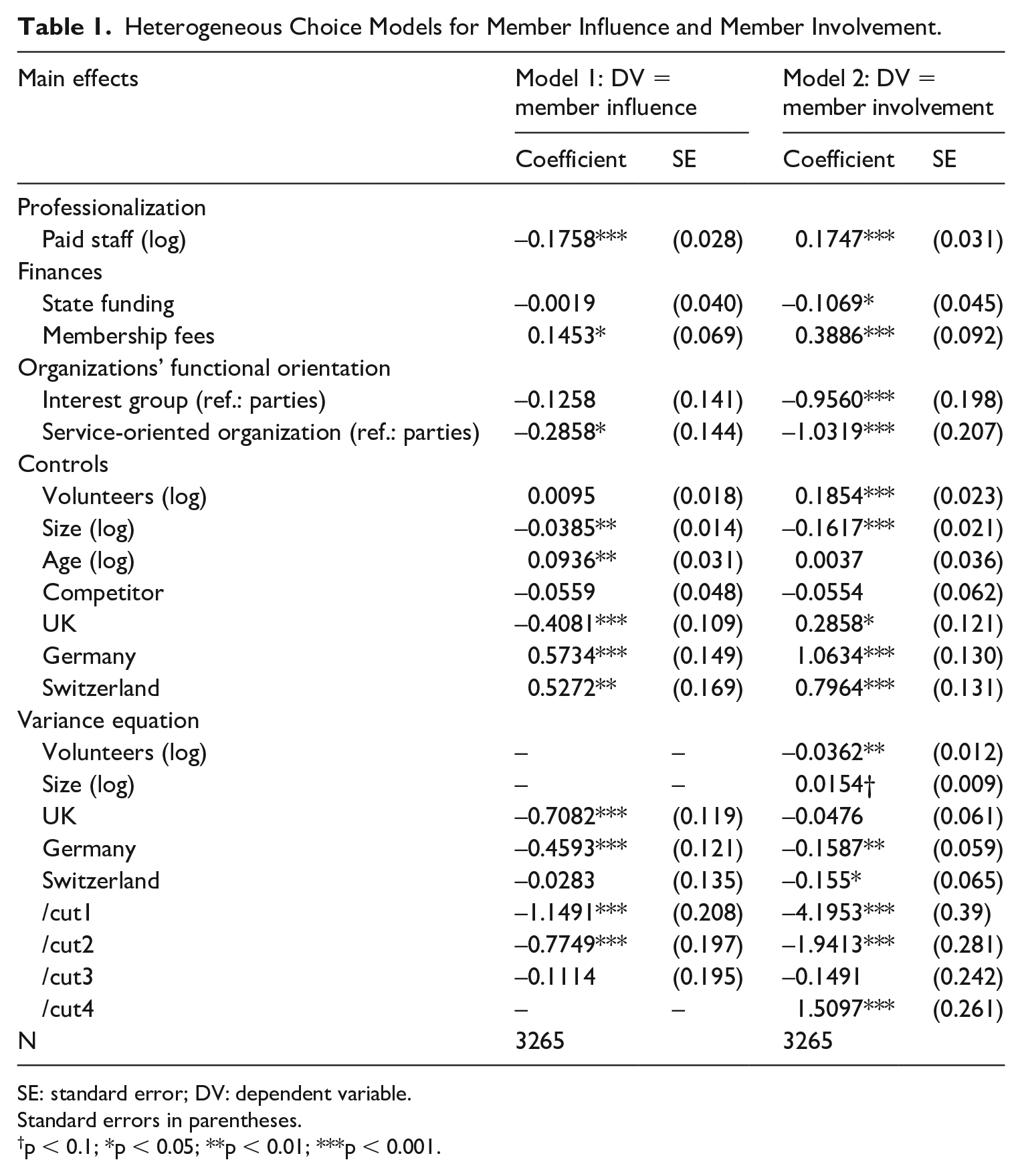
Table 1 shows the results. Model 1 shows the results for our member influence model, and Model 2 shows the results for our member involvement model. 20
Heterogeneous Choice Models for Member Influence and Member Involvement.
SE: standard error; DV: dependent variable.
Standard errors in parentheses.
p < 0.1; *p < 0.05; **p < 0.01; ***p < 0.001.
Starting with the influence of central resources available to an organization, as theoretically expected, reliance on paid staff affects member influence and involvement in opposite ways. 21 More specifically, we find a Professionalization–Member Influence Trade-off (H1.1): the more professionalized and staff-driven organizations are, the less influence over core areas of decision-making members have. Professional staff who are strongly focused on the effective running and maintenance of their organization are more willing than members to compromise organizational values and to adapt core priorities to gain external support beyond its membership and to access institutional resources. This sustains previous studies indicating the willingness of organizational leaders able to rely on staff to expand their control over the organization, centralize the organization and, as a result, restrict the influence of their members (Jordan and Maloney, 2007: 113–119; Kreutzer and Jäger, 2011). Indeed, for a one-unit increase in the log of the number of paid staff, the log odds of having a higher level of member influence over core areas of decision-making in the organization will decrease by 0.18, holding all other variables constant. The upper plots in Figure 1 illustrate the predicted probabilities of members having the maximum level of influence in an organization in relation to the number of paid staff in each of the four countries analysed. All four countries follow a similar pattern in which members in organizations with no paid staff at all have much higher probabilities of having a maximum level of influence than in those with higher numbers of paid staff.
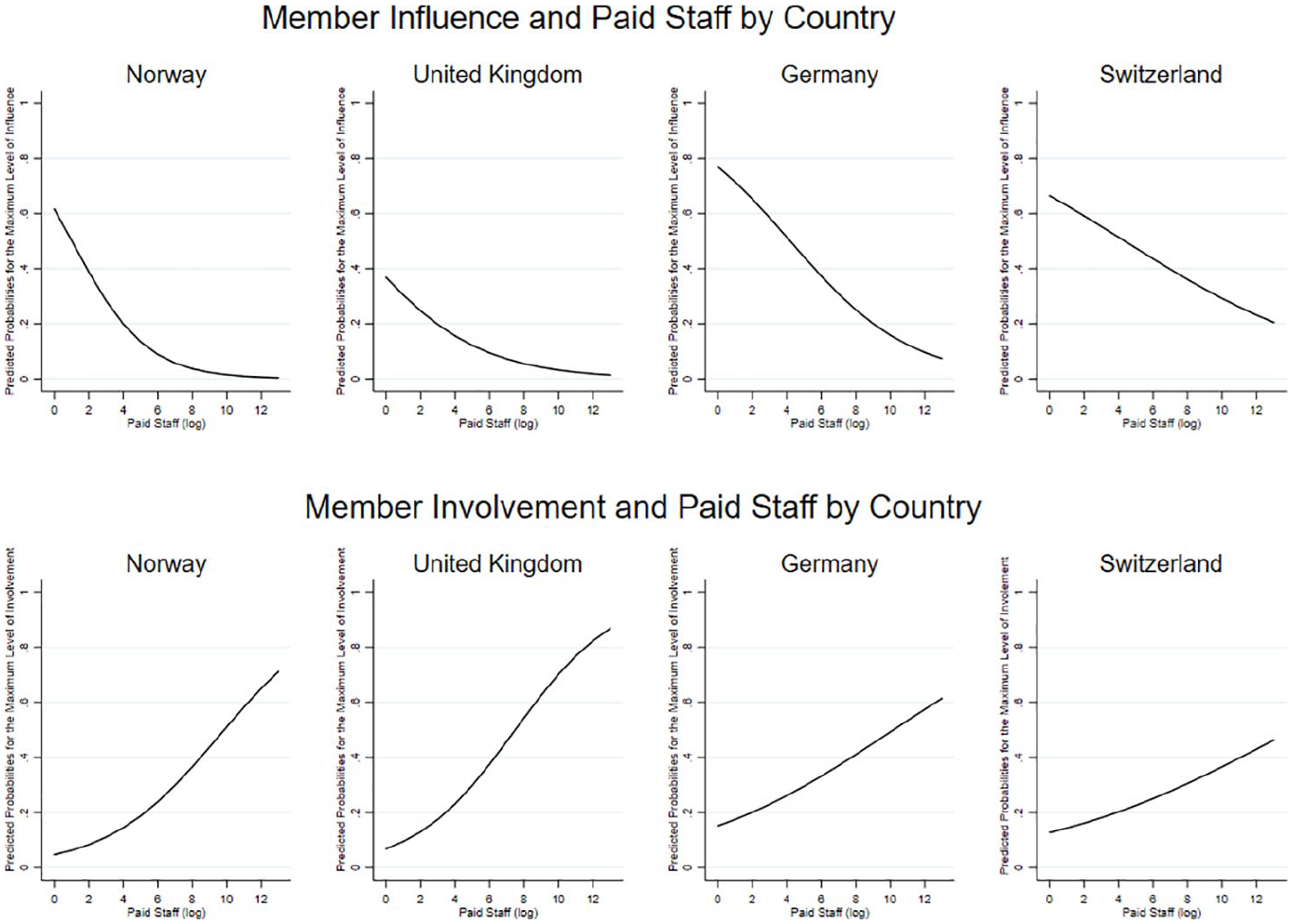
Probability of Member Influence and Member Involvement in Relation to the Number of Paid Staff by Country.
In contrast, our member involvement model shows a positive significant relationship between professionalization and member involvement. This substantiates our Professionalization–Member Involvement Hypothesis (H1.2) that expected more staff-driven organizations to have more involved members, echoing our broader claim that member involvement is closely tied to factors enhancing organizational capacity (Maloney and Rossteutscher, 2005). Concretely, a one-unit increase in the number of paid staff (in its logarithmic form) is associated with a 0.17 increase in the log odds of members having higher levels of involvement, holding other variables constant. This is further illustrated by the lower plots in Figure 1 which show that the probability of members being extremely involved in an organization grows as the number of paid staff increases in our four countries. In contrast, the probability of organizations without any paid staff to have an extremely involved membership is lower than 0.2 in all countries.
In that context, it is insightful to have a look at the country differences revealed by the analysis displayed in Table 1. That Norway shows lower involvement levels than the other countries echoes our conceptualization of member involvement as a resource: In a social democratic voluntary sector regime where services are provided by government directly, voluntary organizations are freed from the latter (e.g. Salamon and Anheier, 1998), suggesting the cultivation of member involvement becomes less necessary. In contrast, member influence is lower in the UK as liberal voluntary sector regime, which is in line with research pointing to an increasingly constraining approach of the UK government towards voluntary organizations. The latter have neither the status of central cooperation partners in service delivery (as in corporatist regimes) nor are freed from the latter (as in social democratic regimes), making external pressures particularly difficult to reconcile with intra-organizational demands and priorities (e.g. Bolleyer, 2018; Lewis, 1999).
Moving to sources of finance, we find a significant negative relationship between an organization’s dependency on state funding and member involvement (H1.4). For those organizations for which state funding is an important source of income, the log odds of having higher levels of member involvement will decrease by 0.11, holding other variables constant. Reliance on state funding changes the type of work essential to maintain an organization, putting an emphasis on administrative and more technical tasks (e.g. related to government reporting) which are more difficult to delegate to amateur rank-and-file members (Bloodgood and Tremblay-Boire, 2017: 404–405; Cornforth, 2003; Hustinx, 2014). Interestingly, state funding does not have a significant effect on member influence; hence, we do not find a State Funding–Member Influence Trade-off (H1.3), a finding that challenges previous party and group research alike that suggested that organizational dependency on state funds invites lower levels of member influence (Bosso, 1995, 2003; Katz and Mair, 1995; Walker, 1983). At the same time, we find a positive effect of an organization’s reliance on membership fees in line with our Membership Fees–Member Involvement Hypothesis (H1.5). For those organizations in which membership fees are an important source of income, the log odds of a higher level of member involvement will increase by 0.39, holding other variables constant. Reflecting organizational attempts to reduce uncertainty (Nienhüser, 2008: 20), organizational leaders relying on membership fees are incentivized to cultivate the involvement of their members to strengthen member ties to the organization. The significant positive effect of membership fees on member influence in the main model is (in contrast to its effect on involvement) not robust across all model specifications (see Online Appendix D for details). In that sense, the financial contributions of members to an organization’s budget as such do not play a role for levels of member influence. This is because citizens with conservative or authoritarian values (prioritizing strong leadership over member participation) are more likely to be recruited by and join organizations holding similar values (Wilson, 1973), organizations that are unlikely to allow for or encourage the direct influence of members on organizational decisions. 22
Finally, the organization’s functional orientation is relevant for member involvement by shaping the relevance of specific resources for sustaining the continuity of the organization’ central activities. Taking political parties as reference category, we find a negative significant relationship between the type of organization and the level of member involvement, indicating members of interest groups and service-oriented organizations are less involved than party members. This is in line with our Functional Orientation–Member Involvement Hypothesis (H2.2), arguing that the pressure of regular elections makes mobilization of party grassroots on a continuous basis essential for parties (Panagopoulos, 2016). This, in turn, generates stronger incentives for party leaders to involve their members than for interest groups, which enjoy more flexibility as they have control over the frequency and timing of campaigning, fundraising and other types of activities that can benefit from involving their broader membership (Holoyke, 2013b). In comparison with parties, service-oriented organizations profit least from such member involvement, as rank-and-file members are amateurs and lack the expertise organizations focused on efficient service-provision increasingly require, discouraging leaders’ efforts to enhance such involvement (Hustinx, 2014; Kreutzer and Jäger, 2011). In contrast, the expectation that organizational type – for normative rather than functional reasons – matters for member influence (H2.1) (assuming that parties face particularly strong external pressure to replicate democratic norms within their organization (Katz, 1990)) has only received partial support: while the main model suggests that members in service-oriented organizations have significantly less influence than party members, this finding is not robust across all model specifications (see Online Appendix D for details).
Conclusion and Discussion
The question about the intra-organizational drivers of member involvement and influence – two qualitatively distinct forms of member activism – is a fundamental one. This is the case not only because forms of member engagement in organizations have been associated with a range of important political and social benefits (e.g. Dekker, 2009; Hustinx et al., 2010; Maloney, 2009; Van Haute and Gauja, 2015), but also because the question is applicable to membership-based voluntary organizations generally, irrespective of their political or social functions. Conceptualizing the distinction between member involvement and influence – that a range of literatures has touched upon without explicitly developing it – was a core purpose of this article.
Applying this distinction not only to membership-based voluntary organizations that are unambiguously ‘partisan’ or ‘political’ such as parties and interest groups but also to social ones such as predominantly service-oriented organizations highlighted that political (rather than social) benefits of member activism can be specified from two perspectives, one stressing voluntary organizations’ functional orientation (whatever members’ specific role in intra-organizational life) and the other stressing the nature of member participation in intra-organizational politics (whatever an organization’s function). If the organization in which participation takes place is ‘political’, as the case with political parties and interest groups, strengthening an organization – by default – strengthens its role in the democratic process. This rationale does not necessarily apply to participation in social or service-oriented membership-based organizations. Here, the political benefits of member activism can be attributed most unambiguously when democratic decision-making is emulated intra-organizationally, that is, members engage in collective agency and hold organizational leaders accountable. 23 The latter presupposes that members play a particular role inside their organization (i.e. they exercise influence over decisions), which is neither necessarily the case in parties nor in groups (e.g. Cross and Blais, 2012; Evers, 2014; Hazan and Rahat, 2010; Jordan and Maloney, 1997; Maloney, 2012; Scarrow, 1996; Schlozman et al., 2015; Skocpol, 2003; Van Haute and Gauja, 2015).
Given their relevance across the full spectrum of membership-based organizations, we formulated hypotheses on the distinct drivers of member involvement and influence integrating existing research on parties, interest groups and service-oriented organizations. Linking incentive-theoretical arguments with resource dependency theory allowed us to generate broader insights into the roles of members in civil society organizations relevant across disciplinary boundaries. This, however, does not mean that the type of organization as defined by its functional orientation does not matter: what organizations mainly do affects how ‘critical’ the generation of member influence or involvement is for sustaining an organization’s central activities. We found that party members tend to be more involved than group members. This challenges arguments that the consequences of party decline – by some considered as outdated venues of participation – might be compensated for by citizen involvement in alternative, more issue-specific organizations (e.g. Lawson and Merkl, 1988; Norris, 2002). This is particularly important as involvement in parties (as compared to service-oriented groups) is not only by definition politically directed given parties’ central role in elections, it also generates the social benefits associated with involvement generally such as the enhancement of well-being and human capital (Hustinx et al., 2010).
Underscoring the qualitative difference between member influence and involvement, we found that reliance on paid staff affects the former negatively and the latter positively. This opposite effect highlights the need to develop a nuanced approach towards how paid staff shape organizational life as called for in recent research on party professionalization (Karlsen and Saglie, 2017: 1332). Simultaneously, it contrasts with works generally problematizing reliance on paid staff as a major step towards ‘hybridization’, a process through which voluntary associations run by citizens transform into staff-driven ‘voluntary agencies’ (e.g. Billis, 2010; Mair et al., 2004). Though from a political perspective member involvement might be associated with notions of ‘thin participation’ (e.g. Maloney, 2009; Skocpol, 2003), once considering the benefits of social interaction in group settings, the positive contribution of paid staff to involvement has as important implications for the benefits organized civil society can generate as its negative effects on influence.
Future research needs to put our findings on a broader empirical foundation. Several avenues to do so seem particularly fruitful. First, having tested our framework across four European liberal democracies using a most different system design, we can reasonably expect our findings to hold across long-lived fully consolidated democracies. However, the extent to which our findings travel to newer democracies such as in Central Eastern Europe is less clear. Research on the latter has argued that new democracies suffer from a ‘civil society deficit’, displaying lower organizational membership, lower party membership, lower participation rates and less engagement of citizens in unpaid voluntary work than long-lived democracies (Lane, 2010: 304–306). These societal differences might well reduce the relevance of membership fees for patterns of member activism in new democracies. In contrast, the reliance on state funding or staff might have stronger effects when organizations’ societal underpinnings are weaker. This also stresses the importance to engage in more contextually driven, in-depth analyses on the complex interplay between systemic factors and organizational behaviour in both new and old democracies – instead of ‘controlling’ for country context to isolate basic links between organizational characteristics and forms of activism as the strategy adopted here. Second, complementing our organization-centred perspective, future research taking an individual-level approach of forms of activism able to explore the motivations of members to seek influence as compared to involvement would be crucial to validate and expand our findings.
Theorizing and examining different types of member activism in democratic settings have important normative repercussions as recent studies point to the declining number of organizations composed of members on the one hand (e.g. Schlozman et al., 2015) and the increasing number of members being content not to be actively involved in their organization’s internal life on the other (e.g. Maloney, 2009; Skocpol, 2003). These debates stress the declining relevance of members to organizations alongside members’ increasing passivity. Distinguishing between member influence (closely associated with notions of intra-organizational democracy) and member involvement (compatible with organizations of any ideological disposition) as two ways in which members can be active in organizational life provides the foundation for a differentiated debate on the distinct roles members can play in organized civil society and on the consequences for democratic civil societies if members stay away or become increasingly passive and disengaged. This is important as – depending on the normative yardstick applied – declining member involvement has very different implications than a decline in member influence.
Supplemental Material
sj-pdf-1-psx-10.1177_0032321720968018 – Supplemental material for Member Influence and Involvement in Civil Society Organizations: A Resource Dependency Perspective on Groups and Parties
Supplemental material, sj-pdf-1-psx-10.1177_0032321720968018 for Member Influence and Involvement in Civil Society Organizations: A Resource Dependency Perspective on Groups and Parties by Nicole Bolleyer and Patricia Correa in Political Studies
Footnotes
Acknowledgements
We thank all participants in the respective panels at the 24th International Conference of Europeanists 2017 in Glasgow, UK, and the ECPR General Conference September 2017 in Oslo, Norway, who commented on an early version of this paper, especially Gabriela Borz and William Maloney. We also thank Gabriel Katz who gave feedback on various draft versions and the participants of the research seminar of the Department of Politics and International Relations, Brunel University, including Justin Fisher and Matthew Hughes for their invaluable comments. The usual disclaimer applies.
Declaration of Conflicting Interests
The author(s) declared no potential conflicts of interest with respect to the research, authorship, and/or publication of this article.
Funding
The author(s) disclosed receipt of the following financial support for the research, authorship, and/or publication of this article: This research has received funding from the European Research Council under the European Union’s Seventh Framework Programme (FP7/2007–13)/ERC grant agreement (335890 STATORG). This support is gratefully acknowledged.

Supplementary Information
Additional Supplementary Information may be found with the online version of this article.
Appendix A. Supplementary Information on Country Selection for the Four Surveys.
Table A1. Macro Characteristics of Long-lived Democracies and Case Selection for Surveys.
Appendix B. Summary Statistics and Correlation Table.
Table B1. Distribution of Proportions of Components of ‘Member Influence’.
Table B2. Distribution of Proportions of ‘Member Involvement’.
Table B3. Summary Statistics of ‘Paid Staff’.
Table B4. Distribution of Proportions of Components of ‘State Funding’.
Table B5. Distribution of Proportions of ‘Membership Fees’.
Table B6. Distribution of Proportions of ‘Organizations’ Functional Orientation’.
Table B7. Summary Statistics of ‘Volunteers’.
Table B8. Summary Statistics of ‘Size’.
Table B9. Summary Statistics of ‘Age’.
Table B10. Distribution of Proportions of ‘Competitor’.
Table B11. Correlations between the Independent Variables and Variance Inflation Factors (VIF).
Appendix C. Relationship between Member Influence and Member Involvement.
Figure C1. Relationship between Member Influence and Member Involvement.
Figure C2. Distribution of Member Influence across Organizational Type.
Figure C3. Distribution of Member Involvement across Organizational Type.
Appendix D. Robustness Checks.
Table D1. Robustness Check 1. Heterogeneous Choice Models with Listwise Deletion.
Table D2. Robustness Check 2. Heterogeneous Choice Models with an Alternative Measure for Professionalization.
Table D3. Robustness Check 3. Heterogeneous Choice Models without Outliers.
Table D4. Robustness Check 4. Heterogeneous Choice Model for Member Influence with the Additional Measure Member Focus.
Table D5. Robustness Check 5. Heterogeneous Choice Model for Member Influence with the Additional Measure Change to Direct Member Decision-Making.
Table D6. Robustness Check 6. Heterogeneous Choice Models with the Additional Measure Individual Membership.
Table D7. Robustness Check 7. Heterogeneous Choice Models with an Alternative Measure of State Funding.
Notes
Author Biographies
References
Supplementary Material
Please find the following supplemental material available below.
For Open Access articles published under a Creative Commons License, all supplemental material carries the same license as the article it is associated with.
For non-Open Access articles published, all supplemental material carries a non-exclusive license, and permission requests for re-use of supplemental material or any part of supplemental material shall be sent directly to the copyright owner as specified in the copyright notice associated with the article.
