




Abstract
What do people think about unauthorised migrants reaching their shores? This article examines ethnographically what and how Maltese citizens think about recent migrant arrivals from northern Africa. This case study adds to research on public opinion formation in migrant-receiving societies in the European Union, offering perspectives from a small state tasked with enforcing the European Union’s external border in which migration is viewed critically. Embedding our research within constructivist institutionalism – which assumes that self-interest is not pre-determined but rather constructed – we are the first authors to take up Colin Hay’s call for ethnographic analysis in this field. We suggest that criticism of migration to Malta was grounded in fears and beliefs associated with unorderliness of migration management, perceived unfairness of EU requirements, uncertainty of the future, and a loss of control of being able to determine one’s own cultural identity.
Introduction
In recent years, unauthorised migration 1 towards the European Union (EU) has become a politically contentious topic. Its present societal and academic relevance is greater than ever (Heath et al., 2020: 475), as anti-migrant sentiments are on the rise throughout EU, migrant arrivals transform former emigration to immigration countries, and ensuing political repercussions are widespread. Citizens and the public, however, vary in their views on migration (Meuleman et al., 2009), making research on their attitudes towards migrants vital. Where do the ideas which inform views on migration come from? Which dynamics are important in shaping beliefs about ‘strangers’? And how do actors understand their own interests on the issue of unauthorised migration? Our article contributes to scholarship on public opinion in societies receiving migrants by focusing our case study on a small state: Malta. We examine this phenomenon by studying ethnographically how people on the ground developed their perspectives, especially on the arrival of unauthorised migrants.
Since research on public opinion entails the examination of collectively held ideas and beliefs, it is also closely linked to ideational analysis, which studies the impact ideas have on political outcomes. Constructivist institutionalism (CI), in particular, places an emphasis on the significance of ideas in the formulation of agents’ interests, highlighting the role perception plays in this process. CI’s foremost proponent, Colin Hay (2011), issued a call to employ ethnographic methods to study interest construction. We embed our analysis herein and are the first authors to take Hay up on his call; our case study thus demonstrates the process by which ‘public sentiments’ (Campbell, 2004) emerged in response to migration to Malta.
We proceed as follows: First, we provide an overview of migration to Malta, its historical and contemporary developments and how this relates to larger European dynamics. Second, we outline the development of institutionalist analysis as it relates to Hay’s (2011) call, further cementing the value of ethnographically oriented approaches for ideas research. Third, we focus on the beliefs and ideas expressed by actors in a case study on Malta with whom we conducted fieldwork between 2013 and 2018. Fourth, we analyse the perception of actors’ interests and how these came about. We specifically emphasise – in line with CI – that these interests are contingent and adventitious. Fifth, we conclude in outlining a brief agenda for future ethnographic research within CI.
Setting the Scene: Migration to Malta and the European Union
One of the most significant changes the Maltese island-state has undergone following accession to the EU in 2004 concerned the movement of people to the island. Since 2002, more than 100,000 persons have moved to the EU’s smallest member state of whom roughly 18,000 were unauthorised migrants typically arriving by boat from Libya who applied for asylum. Migration to Malta has been viewed controversially, especially considering that its population made up only 440,971 persons in January 2020. Yet scepticism towards unauthorised migrants has been juxtaposed against a welcoming attitude that coincides with a booming tourism industry. The number of annual tourists has more than doubled in only 9 years (Galea, 2019), playing a key role in the country’s economic development and attracting workforce from abroad. Having become an EU member and a signatory to the Schengen Agreement, however, has an impact on all of the aforementioned groups: the EU’s guarantee of the free movement of persons as one of the Four Freedoms has implied that economic migrants with EU citizenship are allowed to work lawfully in Malta; bureaucratic entry processes for EU tourists have diminished; and through its accession, Malta has become part of the external European border and is thus subject to EU law on migration management. Malta’s government also has to abide by the Dublin Regulation, which stipulates that the country in which asylum seekers first touch EU ground is responsible for their reception and asylum application.
From Emigration to Immigration
These developments constitute a significant shift from Malta’s history of emigration to its present status as a country of immigration (Ciappara, 2013), which has been acknowledged in the literature as the ‘migration transition’ (Okolski, 2012). Many of its citizens left in the years prior to its independence from Britain in 1964 for primarily economic reasons. Between 1948 and 1967, almost one-third of the population emigrated (Grigg, 1980: 252). In contrast, the 1970s saw an influx of people coming to Malta for the first time when the Maltese government agreed to temporarily house Asian refugees from Uganda who had been expelled under Idi Amin’s regime in November 1972. In the early 1990s, Malta served as a country of transit for refugees from Kuwait and Iraq who were fleeing the Gulf War and of whom many were later resettled in North America. Later in the decade, 110 Kosovar-Albanians arrived after the Maltese government agreed to temporarily house them through a United Nations High Commissioner for Refugees (UNHCR) programme (Amore, 2016: 242). These refugees were viewed as unique, one-time phenomena, and their reception conditions had been clarified prior to their arrival. Malta thus largely experienced mostly organised, authorised migration. A different form began taking place in the 1990s when boats from Africa began arriving. Whereas people from Uganda and the Kosovo had been granted temporary refuge and were expected to return, these unauthorised migrants in recent cases did not seek a return.
Public Opinion and Migration
These historical and contemporary developments have been captured in academic research, and unauthorised migration to Malta has received increased attention of late (Baldacchino, 2009; Falzon, 2012; King, 2009; Mainwaring, 2014, 2019; Mountz and Lloyd, 2014; Otto et al., 2019). Yet studies on public opinion on migration still tend to overlook small states like Malta. A recent survey, however, hints at the extent to which Maltese respondents viewed migration negatively: 63% identified it as a problem; less than one-third of respondents viewed it as culturally enriching, 79% of survey respondents believed that migrants worsen the crime problem, and Maltese society is the least willing of all EU societies to interact with them (Debono, 2018).
While certain of these dynamics highlighted above are replicable across Europe, it is nevertheless the case that European publics are heterogeneous. Underlying anti-migration sentiments in the EU are common but not uniform (Heath et al., 2020) and are often related to the presence or absence of national frameworks on how to deal with unauthorised migrants (Calavita, 2005; Collyer et al., 2019). Indeed, national context matters in how migration is interpreted (Heath and Richards, 2020). Former emigration countries, such as Greece, Cyprus, and Malta, take on a special role in that they often did not possess their own laws historically to regulate immigration sufficiently, and then come under a new institutional arrangement (e.g. EU regulations).
Unauthorised migration across the EU has been understood as a problem to be managed, wherein securitisation of the external border plays a decisive role (Lazaridis and Wadia, 2015). ‘Management’ occurs through policies, regulations and by discursive means, often representing unauthorised migrants as ‘others’ which typically entails two different approaches: humanitarianism where they are viewed as victims versus criminalisation where they are viewed as illegal villains (Andersson, 2014; Bonjour et al., 2011; Ferreira, 2019; Mainwaring, 2019; Triandafyllidou, 2010). Moreover, political processes and mass media representations have not left public opinion unaffected; indeed, migration constitutes the greatest concern to EU citizens (Batsaikhan et al., 2018; Wallaschek, 2020). While cross-sectional analyses of various EU countries highlight an overarching anti-migrant agenda, recent research has examined these developments more closely: ‘unskilled’ migrants tend to be much less accepted than migrants with labour market qualifications (Ford and Mellon, 2020); social distance to local populations, that is, migrants living in peripheral housing facilities, creates increased anti-migration sentiments (Heath et al., 2020); the actual number of migrants is overestimated by local populations in all EU countries (Gorodzeisky and Semyonov, 2020); and the greater the symbolic threat – that is, loss of cultural homogeneity, in-group values, and national identity – is perceived and ascribed, the more likely individuals oppose migration (Davidov et al., 2020). This divergence of public opinion makes the study of individual cases all the more important. As Mainwaring (2019: 16) notes, ‘[a]lthough the literature on other Southern EU countries, such as Spain, Italy, and Greece is plentiful and provides comparisons, the relevant and academic discussions have largely neglected Malta and other small states’ despite the increase in numbers of small states in the EU’s 2004 accession round.
Theoretical Background and Methodology
That ideas – and for that matter normative beliefs – carry weight in social science research has become broadly accepted in the preceding decades. Turning to Hay’s (2011) call for advocating ethnography to better understand how interests are perceived in ideational analysis is noteworthy because it came at a time at which the future direction of ideational research was unclear. Part of the constructivist challenge to historical institutionalism at this point had consisted of contesting exclusively exogenous factors as important in explaining institutional change, highlighting the role endogenous factors play instead (Blyth, 2002; Campbell, 1998; Dabrowska and Zweynert, 2015; Hay, 2006). Yet in spite of this ‘opening up’ of research to include endogenous facets, Hay’s (2011: 81) exhortation that
the future of constructivist institutionalism analysis surely lies in detailed ethnographic research that maps and charts the development and redevelopment of interest perceptions rather than the abstract and deductive derivation from stylized assumptions of the ‘real’ interests of institutionally embedded actors
largely went unheard. Of the 283 citations his book chapter attracted via Google Scholar as of January 2020, none had picked up on his proposal for ideational analysis in CI. That is not to imply that the field remained static. Scholarship placed new emphases, most notably by examining the relationship (and hence interaction) between material and ideational factors (Bell, 2011; Lieberman, 2002; Marsh, 2009; Parsons, 2016), as well in focusing on establishing how ideas mattered and how their impact was demonstrable in social science research (Béland, 2010; Béland et al., 2016; Carstensen and Schmidt, 2016; Widmaier, 2016b). While the former stream distinguished between ‘thick’ and ‘thin’ constructivism centring on the question concerning the degree to which material factors impact the ideational level (Marsh, 2009) 2 , the latter’s focus is on how ideas are combined with power to become important and impact policy or institutional change. But Hay’s call to examine the process of interest formulation as a stepping-stone to understanding the interplay of ideas and the construction of interests, it is fair to say, was bypassed.
While the question of interest construction Hay raises is related hereto, it is nevertheless analytically distinct from these aforementioned dynamics. It assumes that interests are important, but it does not claim anything about how these interests are translated into other processes, for example, how legislative or societal change is effected. In other words, instead of examining how ideas become efficacious (or how they are made efficacious by agents), the examination here goes no further initially than suggesting that – in line with CI – it is ideas themselves which have an impact on interest construction. Perceived interests certainly inform and motivate behaviour. What occurs specifically with these interests at a subsequent point in time and how they translate into behaviour – that is, how they may be actualised in democratic processes or how certain actors may engage in entrepreneurial behaviour to make these ideas efficacious – is undoubtedly of significant interest; yet processes of interest construction are nevertheless analytically separate from processes of interest effectuation.
Furthermore, one of the problems much research has faced in institutionalist approaches employing constructivist thought is that it has typically focused exclusively on decision-making and action by elites. This applies to work with foci on individual leaders at the highest echelons of government (e.g. Matthijs, 2011; Schmidt, 2017; Widmaier, 2016a). There is nothing wrong with this approach and much to learn from each of the cases analysed. But much like other fields which have gravitated towards taking seriously ‘everyday politics’ (Hobson and Seabrooke, 2007; LeBaron, 2010; Seabrooke and Elias, 2010), CI would benefit from opening up its scope of analysis to include perspectives that focus on ‘ordinary people’. It is certainly the case that select scholars working at the intersection of ideas and institutions acknowledge the manner in which ideas held by the public, that is, ‘public sentiments’, are important (Campbell, 1998, 2004). Yet, there are different ways through which ideas held by the public can be studied. By taking agents in their ‘everyday life’ seriously, the promise in this approach lies in offering fundamentally new perspectives that emanate from the intense proximity researchers have with their research participants. And what better way is there to demonstrate the importance of ‘everyday life’ than through research methodologies – as applied for ethnography – which literally focus on everyday life?
It is important to highlight that this genuinely interdisciplinary article is essentially one that offers theoretical advancement through methodological innovation. If, as Blyth (2016) claims, the future of ideational analysis lies in pluralism, this certainly also applies to methodology. Methodological infusion of ethnography in institutionalism in general, and CI in particular, has been absent to date, and bringing together these perspectives implies that this article is inherently different from articles within the confines of a monodisciplinary approach. Simultaneously, this article is also not entirely based in ethnographic analysis, as one typically finds in ethnographic ‘thick descriptions’ (Geertz, 1973). This is an unavoidable trade-off in interdisciplinary work, but one which need not represent an obstacle for our present purpose to illustrate how interest construction can be traced, depicted, and analysed.
Ethnography as a Tool for Institutionalist Analysis
Ethnography, put simply, implies studying people in their surroundings. To this end, ethnographers employ different methods, for example, participant observation, narrative and guided interviews, informal talks, and so on. It is the task of the ethnographer to choose from various methods at one’s disposal in a manner commensurate with the research question (Breidenstein et al., 2013). We suggest that ethnographic methods are well suited for the future of CI and can provide enriching perspectives other methodologies cannot achieve. Ethnographic approaches are particularly promising in that area concerning the dissolution of the strict dichotomy between ideas and interests, thereby cementing the proposition that research must focus on the interplay thereof, which has become commonplace in the field. It can thus support constructivists’ perspective that ‘[i]nterests do not exist, but constructions of interest do’ (Hay, 2011: 79). How individual agents understand their interests, why they believe what they do, and how ideas agents hold are dependent on contingent circumstances are questions best answered through ethnographic study. If, as constructivists assume, individual action relies on interests which are not given or pre-determined but are rather the result of a cognitive process, ethnographic accounts are particularly promising because of their emphasis on ‘tracing’ and ‘tracking’ (Marcus, 1995) the lived realities of their interlocutors, thereby contributing to empirically founded theoretical development.
Three points stand out in terms of the value that ethnographic approaches can add to institutionalist analysis. First, they predominantly rely on inductive – not deductive – approaches. Especially ethnography’s methodological concern with not imposing on research subjects is important, as is allowing for the emergence of subjects’ insights vis-à-vis their beliefs and values. This meshes with a methodologically defensible constructivist perspective in that it enables the researcher to detect others’ beliefs as a documentarian and interpreter, in contrast to presuming impetuously the content or motivation of people’s thought. Ethnographers do not adopt an approach in which they attempt to steer a conversation in a particular direction, but allow their interlocutors’ perspectives to unfold (Spradley, 1979), whereby one seeks to detect the underlying foundation of individuals’ beliefs and suppositions. Especially the understanding that values are malleable, contingent and can be discontinuous makes ethnographic accounts attractive for CI as ethnography is carried out in situ.
Second, this process generates qualitatively different data. Since ethnographers conduct their studies on the ground, they develop an understanding which enables the consideration of context-specific factors that are often impossible to ascertain with survey questionnaires or standardised interviews. The insights created through ‘following’ (Marcus, 1995) allow for intense proximity and a closer examination of what people believe and articulate about themselves, others, and larger political configurations. This approach ‘can foreground the perspectives and experiences of those actors that often remain hidden in other forms of rapid data collection’ (Dilger and Dohrn, 2016: 17). With regard to research on Europe, for example, this implies that predominant perspectives of equating Europe with EU institutions or EU elites has led to a bias in underrepresenting actors from ‘everyday life’ (Mainwaring, 2019: 12).
Third, ethnography’s actor-centred approach is particularly relevant for considering the impact of how agents perceive their interests. This enables perspectives through which it is possible to examine the mutually dependent relationships of how materialist structure, individuals, and their process of sense-making are entangled. By considering the relationship between meta-level ideas and on the ground idea-making, it becomes possible to discover how individuals perceive interests in light of the structural factors they encounter. This specific relationship enables researchers to consider the role contingency plays in individuals’ make-up and perception of their beliefs. It furthermore allows for an improved understanding of the dynamics underpinning the results generated through survey data and questionnaires.
Methodology and Interdisciplinary Venture
The material presented here came about through an interdisciplinary collaboration between Author 1 whose disciplinary background is in political economy and institutionalism and Author 2 whose background is in cultural anthropology and who carried out a larger project on unauthorised migration in Malta. Fieldwork by Author 2 occurred from 2013 to 2018 and was designed as a long-term study, with a 7-month research stint in 2013 followed by revisits (Welz, 2013) in 2015, 2016 and 2018. Author 2 established contact with and generated data from 118 people. These included 65 migrants from sub-Sahara Africa, 29 actors who held vocational positions within migration management, and 23 Maltese citizens who were not actively or directly engaged with these management processes but with whom Author 2 came into contact on the issue; all interlocutors were aware of Author 2’s research and the documentation of their contributions. Narrative interviews were also conducted, mainly with institutional actors. This multi-faceted type of data collection is typical for ethnographic research, and the research design is a dynamic process which evolves over time. This does not imply that the actors who became part of this study represent a cross-section of Maltese society; rather, as is common for this form of methodology, the inherent subjectivism of the researcher’s process leads to unique outcomes.
For our case, the analysis of informal talks appeared most suitable in detecting the interplay of ideas and interests. These are a substantial part of the ethnographic toolkit, and it is the ethnographer’s task to document these conversations verbatim (or as closely as possible). Like interviews, informal talks were analysed by coding and building categories in line with grounded theory. It is important to note that based on the inductive approach of Author 2’s study, the process of collecting and analysing material implies that the perspective in this article emerged, as interlocutors repeatedly voiced how they felt about unauthorised migration, which is highlighted in an ethnographic vignette in the subsequent section; an analysis follows thereafter.
Narratives of Change When the ‘Stranger’ Arrives
Culture under Threat
The need to protect the local, Maltese culture was repeatedly mentioned during the conversations held during fieldwork, irrespective of whether our interlocutors were involved in professional work with migrants. The significance of the fear of a loss of culture became particularly clear in a conversation with Albert Partridge, a retired Maltese citizen, and his friends. We met at a bar in the small town of Birkirkara where he was enjoying the company of his fellow retirees Luke Azzopardi and Nicolas Zerafa. The group meets every day (except for Sundays) for Cisk beers, Maltese Ftira bread and conversation (PO
3
October 2018). Most interlocutors, however, were themselves insecure about how to define Maltese culture and – like Alessandro Garzia, a bartender at the bar where the retirees gathered – stated, ‘Maltese culture is everything to us. You are born into it’ (IT, October 2018). They were unanimous in identifying Roman Catholicism as a part of Maltese culture: ‘I do not go to mass every day. I am flexible, but Christian’, Nicolas reported (IT, October 2018). Respecting their religion and the Holy Mary nevertheless remained important to them, and when Nicolas talked about a friend’s experience on the bus, the group agreed that this was a good example of how unauthorised migrants ignored Maltese culture:
My friend recently took the public bus. They came along a statue of Holy Mary. Of course, he made the sign of a cross. Because that is our culture. But the Muslim next to him did not like it and felt offended. And he told my friend to stop. They come here to change our culture and to dictate us. When I travelled to Egypt I wanted to see a mosque and took my shoes off. But they come here, and they are not interested in our culture. Even sometimes I can see them praying in public. And hear the noises of their mosque. But I do not want that here. They can do it where they came from. But here, no. I want them to integrate more (IT, October 2018).
Islam was cited repeatedly as the reason why unauthorised migrants did not fit in Malta, and certain fears of the future were associated with it. ‘Imagine one of them does something like in Berlin, a terrorist attack, [. . .]’ Albert said (IT, October 2018). While we were talking, a man in his mid-30s passed, and Luke, Albert and Nicolas said that he and his wife had moved to the town two years ago. According to the trio, he worked for the mosque and the wife took care of the children. Luke articulated by hiding his face with his hands and just showing his eyes that she wore a full-body veil. ‘When they go somewhere, he brings the car first, parks it in the second row, and brings the wife out. We never see her, we can never talk to her. She is a prisoner in her own home. And we do not want this for Maltese women. I do not even know where my wife is now. Normal, ta’?, Nicolas remarked, suggesting that his new neighbours from Libya had not integrated (IT, PO October 2018).
However, they were not only concerned that migrants from different African countries would not integrate sufficiently, but they also articulated that Malta would become less secure as their migration increased; indeed, Luke equated ‘Maltese identity’ with security, which was now eroding:
Twenty years ago, we left our key in the door. Nothing happened. These times are history. That is no longer possible because these people arrive, and they have different values, so it is not safe. I have friends in Marsa, the city where they put the centre for migrants, and, mind you, they do not let their children play in the streets any longer. Because migration has changed the identity of the place, and it also has an impact on our identity and culture (IT, October 2018).
Apart from this increase in danger they perceived, the three retirees were also concerned that Maltese nationals should continue to be the majority on the island. They recounted their experiences in other European countries and feared becoming a multi-cultural, multi-religious and multi-lingual place: ‘When you look at Paris and Berlin you find neighbourhoods where are more immigrants than locals. When I see that I ask myself “Do you want Malta to be like that”? My answer is: “No.” I don’t want that here’, Luke noted further.
For Nicolas, culture and religion were tied to certain geographical places, attesting that the Libyan couple had failed to integrate, whereas Luke was afraid of intercultural marriage and how that would change society: ‘Imagine, in twenty years’ time, even black people will be Maltese because our women marry black men. Do we want blacks to say “I am Maltese”? No. Blacks in the national team? No. Because we Maltese are not coloured’ (IT, October 2018). Visible societal change was also central in conversation with Charles Buttigieg, who worked in the Emigrants’ Commission, an NGO that had initially been set up to assist Maltese emigrants and is now charged with issues pertaining to immigration, and who later became the country’s first Refugee Commissioner. Although he was not personally troubled by such change, he stressed that others were concerned about what this might entail. Recalling that having migrants in Malta was not new he noted: ‘The Iraqis [who arrived during the Gulf War] were less of a problem because you cannot recognise them in the streets because they look like us. But when the Somalis come, everybody can see that they are different’ (I, October 2018).
Unauthorised Migrants: Welfare Abusers?
Irregular migrants were not only seen as a threat to ‘Maltese’ culture and identity, but also as abusers of the welfare system. Some interlocutors articulated that in their understanding many of them refused to work, wishing to live off welfare instead. Eva Magri, a former manager of a centre housing young migrants, expressed: ‘All they want to do is sleep long. They have no interest in education, or in working’ (IT, May 2013). While she viewed them as lazy, the four men at the bar in Birkirkara were happy to see unauthorised migrants work in certain jobs like garbage collection or as bus drivers (IT, October 2018). But they became suspicious if they thrived with their own businesses: ‘I live in Hamrun’, Alessandro recounted, ‘and there you can see that they are successful. They open mini markets, and barber shops. How is that possible? When Maltese want to start a business, it is difficult and they must go through the bureaucracy. But they just start their business, whilst we have to fulfil criteria. And where do they have the money from to start a company?’ (IT, October 2018). As long as unauthorised migrants took so-called ‘rubbish jobs’, they were seen with much less suspicion, Nina Cortis, who worked for a government ministry, said (I, July 2015).
This perspective was contrasted by the perceived need of migrant workers, Charles Buttigieg (I, October 2018) noted. With the growing tourist economy, there is now a more pronounced need for hotels and infrastructure, so migrants often work in construction. Many formerly irregular migrants received a status of protection after arrival and work legally, but in Albert’s understanding they were still klandestini, illegals. ‘They come here, and they do not have a place to sleep. Just last week the police caught eight of them sleeping outside’, Luke said (IT, October 2018). He was concerned that unauthorised migrants would disturb the social order by sleeping in the streets and he distinguished between unauthorised migrants and migrant workers with EU citizenship: ‘They [EU nationals] come here, and they have a job and a place to sleep. Like the tourists. They only come when they know where to stay’ (IT, October 2018).
EU Accession and Public Opinion
While Luke, Alessandro, Albert and Nicolas mostly talked about the contemporary phenomenon of unauthorised migration and communicated their concerns regarding the country’s future, Charles provided insights into his occupation as Refugee Commissioner and reflected on how the understanding of migrants had changed. He identified 2002 as a watershed moment:
In the 1970s the Maltese were generous and hospitable. They donated a lot. But, mind you, the Maltese also knew that these people only stayed temporarily. The Ugandans stayed for a while, the Albanians for a bit, and also the Iraqis went back eventually, except a few who married here. There were agreements about their stay. But when the Africans arrived in big numbers, there were no agreements. Nobody knew how long they will stay (I, October 2018).
Charles demonstrated here that the treatment of migrants was also dependent on how much Maltese society knew about them and the conditions of their stay. The arrival of Ugandans and Iraqis was financed by UNHCR, and it was organised upon their arrival where they would be housed. Individuals who arrived unannounced in between these arranged arrivals, he reported, did not cause much negative public attention because the Emigrants’ Commission immediately took care of them. Information existed about where they were housed, what they had suffered from, who was responsible for them, and that the Maltese government’s commitment to accommodate them was temporary:
Between the 1970s, 1980s, and during the 1990s, people also arrived by boat. Mostly individuals. But, as I said, one by one and not boats with 100 or 200 people per day. The founder of this organisation [Emigrants’ Commission] was always very well connected and when people arrived, he got on the phone and asked other people to help them. Shelter was found for them. We did not have the infrastructure, but we managed to help (I, October 2018).
While some actors understood migrants not as subjects worthy of integration, others imagined them as people in need of help and support, Charles stated in reviewing the case of Kosovars: ‘When they left, we had to arrange another plane for them. Because the Maltese people gave them so many things. Not everything fit. So we arranged a bigger plane for them’ (I, October 2018). When they arrived, many Maltese decided to make available clothes and toys. We were informed that individuals provided them with support and assistance that institutions had failed to make available. After 2002, however, the perceived hospitality diminished. Many people now believe that the responsibility does not lie with Maltese people, but that the EU should take care of unauthorised migrants. Antonia Oliver (I, July 2015), who worked for an NGO, reported that they still received donations, but that the donors generally wished to remain anonymous, as they feared rejection by family and friends.
Charles further highlighted that prior to EU accession Maltese authorities had been quite successful in arranging bilateral agreements with countries like Canada, the United States, and Australia:
The migrants did not want to stay here. It was not their plan to come to Malta. And the Maltese were also happy when they left again. So we had these agreements, fine. And then we joined the EU and received boatloads of Africans. With joining the EU, the funding started. But the other European countries did not necessarily offer help to us in taking refugees from here. And also the US, Canada and Australia stopped taking migrants because they told us ‘now, you are part of the EU, so ask them’. It’s the cornerstone of the international community: solidarity. Solidarity is not only between individuals in my opinion, but also among nations. Many people talk about burden-sharing. What I think is more accurate is responsibility-sharing. We did not necessarily experience that (I, October 2018).
By acceding to EU membership, Malta also accepted the Dublin Regulation. Dom Fenek, who worked for the national security ministry, opined that the Dublin Regulation transformed Malta from a place of transit into a place of settlement, as it impacts movement tremendously. ‘People who are granted protection [in Malta] are issued a document [. . .]; it allows them to travel to another EU member state for a period of up to three months. [. . .] so they have to remain in Malta by legal means’ (I, July 2015).
While being able to cope with individual arrivals or with the arranged arrivals prior to 2002, Charles commented that ‘immigration since 2002 is the biggest challenge Malta faces post-World War II’ (I, October 2018). The infrastructure for managing as many as 1500 migrants per year was not given. Police and the army were over-burdened in Charles’ recollection, and it took a long time for a small team to determine the asylum applications. This new phenomenon of migration also evoked old fears:
The Maltese felt that in the early 2000s just too many people arrived. We did not have enough infrastructure, and we also lacked interpreters. And, mind you, Malta experienced emigration until the 1970s, and we were just recovering from that. So many people asked themselves if they have to leave again when new people come. Would there be enough jobs? And the Maltese did not like that idea of emigration again (I, October 2018).
That some Maltese were afraid of having to leave (again) was related to their fear of losing out in competing for limited jobs on the one hand and overpopulation (and consequently spatial displacement) on the other. That Malta ‘is too small to long term integrate all the people’ (I, June 2013) was not only stated by Emanuel Grech, who also worked for the Refugee Commission, but by many other interlocutors as well.
Smallness and Migration
During fieldwork, the question of how and why unauthorised migrants should be integrated in Malta came up repeatedly. In almost all interviews and conversations, the country’s smallness was used as an argument against settling them. ‘For a country as small as Malta and a population of only about 450,000, the arrival of 2,000 Africans is a lot. In spatial terms, it is a lot, and even in numbers’ (I, July 2015), was Nina’s opinion, who worked for a government ministry. Nicolas and Luke added that the island was already suffering from the construction boom, pointing out: ‘We do not even have space for ourselves. So where to put new people? We have no space for them’ (IT, October 2018). The rapid change through real estate development and construction also left a mark on Charles’ perception: ‘When I was younger, I knew every road, every stone. But now, even I am sometimes lost. When I drive, I sometimes don’t even know where I am’ (I, October 2018). Another important factor here is that many interlocutors often misjudged the actual figures of how many people would come to Europe. Albert expressed: ‘Now, they start coming, let’s say with one million per year. And then two, and four, and then six million. Africans will take over Europe and the world, and they will start with Malta, because we are close to them’ (IT, October 2018).
As Malta was perceived as being too small to integrate irregular migrants, they were often seen as being sojourners rather than settlers, as Silvio Zammit, who worked for the social welfare ministry, stated:
I would say that for a good part of the last fifteen years the thinking was that migrants come, they stay a bit, hopefully they stay not too long, and then they go and we will live like before. [. . .] The hope is that they go out [. . .] and the country is preserved. [. . .] Therefore there was no investment in integration. [. . .] When some work started to happen it was mostly preparation for the migrants to leave (I, July 2015).
Questions of (Un)orderliness, (Un)fairness, and (Un)certainty
The preceding narratives hint at scepticism by Maltese people in the context of unauthorised migration. This is grounded in powerful imaginaries as to what they believe their own interests to be, and what they perceive the impact of external circumstances’ constraints to imply. In this section, we analyse the articulated sentiments and offer interpretive conclusions on our ethnographic material. We emphasise the role that perceptions of (external) circumstances play in specifying interests and developing perspectives on migration. This coincides with the schematic outlined by Hay (2011: 74) that interests are perceived, and that behaviour is fundamentally dependent on actors’ cognition of these perceived interests.
Four points stand out which highlight how our interlocutors conceived of their own interests in response to unauthorised migration as citizens as sense-makers (Van Wessel, 2017). We note thereby that there is indeed a mixture of socio-cultural, political and economic factors (i.e. materialist/structural level) which has influenced the perception of their interests (i.e. ideational level). This corroborates on the one hand the need to examine the interplay of material and ideational facets (Bell, 2011; Lieberman, 2002; Marsh, 2009; Parsons, 2016), mirroring and advancing contemporary research on public opinion in the context of migration on the other (Bonjour et al., 2011; Davidov et al., 2020; Gorodzeisky and Semyonov, 2020; Heath et al., 2020).
Smallness and Unorderliness
First, most interlocutors emphasised Malta’s geographical smallness. While smallness has been understood as an important analytical category for political outcomes (Veenendaal, 2019), the geographical smallness of states in dealing with migration has been understudied in the academy to date (Mainwaring, 2019). And yet our analysis of this case suggests that it is not smallness itself which produces these concerns. It certainly was the case that fear emerged among our interlocutors that the country was bursting at its seams. Yet strikingly, it is tourists and migrants with EU citizenship who make up the majority of newcomers and thereby most directly contribute to making Malta more crowded. At the same time, the majority of our research participants identified unauthorised migrants as the main factor of overpopulation, corroborating findings in other contexts wherein an overestimation of the number of migrants takes place (Gorodzeisky and Semyonov, 2020). This highlights the importance that perception plays in how our interlocutors thought about migration. It became clear that while everyone stressed Malta’s dense population and the country’s relative smallness, an underlying fear motivated this concern. What we discovered is that in voicing Malta’s crowdedness, our interlocutors actually feared the un-orderliness of the country’s (economic) transformation. In discussing changes that had arisen due to regulated migration and an influx in tourism, they stressed that these types of movement towards Malta were manageable, and that people who arrived did so in controllable means. The lack of governmental infrastructure to process unauthorised migration beginning in 2002 signifies the dissatisfaction Maltese people perceived with an unorderly process.
The EU and Unfairness
Second, Malta’s EU accession also changed the understanding of responsibility and solidarity. While between 1970 and 2000 only few people arrived, Maltese society felt responsible for them and was willing to donate personal items. But a shift occurred by joining the EU. Many understood Malta’s EU accession to imply a system of shared responsibility and solidarity. The claim that solidarity extends beyond interpersonal practices to the level of nation-states underscores the prevailing belief people had that the EU would assist the Maltese government in handling irregular migrants. It was not expected that while the island-state would become part of the EU’s external border, ‘it would be let down’ in the redistribution of these migrants to other member states. While the Maltese government did receive EU-funding for their management, the concept of solidarity seemed absent to the Maltese in terms of redistribution. Instead of being placed at the centre of this European problem, our interlocutors perceived that they were intentionally maintained as a peripheral state (Cabot, 2014) not worthy of the type of assistance they believed they deserved. This interpretation of being left unsupported elicited a sentiment of unfairness. That many unauthorised migrants did not want to arrive or remain in Malta only underscores the absurdity many Maltese interlocutors experienced; we encountered repeatedly – both among Maltese research participants and among unauthorised migrants – that they wished for permission for the latter to depart the island and move elsewhere permanently.
Past Experiences and Uncertainty of the Future
Third, this perceived unfairness also produced a certain tension. While it was understood that irregular migrants are legally prohibited from settling elsewhere in the EU, there was also an expectation that most of them were nevertheless still sojourners. This belief is rooted in past experiences. (Forced) migration to Malta in previous decades was understood as a temporary phenomenon; it was expected that people would return once the conflict in their home countries had ceased, or that they would be transferred to another country if the conflict remained unsolved. Unauthorised migrants who have arrived following EU accession, however, are likely to remain in Malta, as their countries of origin are not considered to be safe places of return and because of the stipulations inherent to the Dublin Regulation. This tension was an ever-recurring phenomenon during fieldwork; there was not merely concern about the here and now. In contrast to the un-orderliness described above, what we discover here is that the uncertainty of the future alarms many Maltese citizens. This fear is associated much more directly with the arrival of unauthorised migrants in contrast to regulated migrant workers who often already have a job, a place to stay, and who do not generally depend on social welfare and are therefore not understood as a ‘burden’. The unregulated nature of unauthorised migration, however, raised questions to which there were less clear answers: How many more migrants will arrive? Will they remain in Malta forever? Will the government be prepared for more unregulated arrivals? And who will pay for their care and for how long?
Culture and Loss of Control
The uncertainty described above also has an impact on an associated fourth point. Uncertainty of the future does not merely concern questions of spatiality and resource provision, but also has an impact on social and cultural questions. Many interlocutors feared a loss of a unique ‘Maltese’ identity. While most conversation partners had vague ideas about what culture and identity are, ‘whiteness’ and Roman Catholicism were integral parts hereof. Influences owing to ‘Africanisation’ and ‘Islamisation’ were not viewed as belonging to Malta, nor should it contribute to identity perception in the future. Charles’ observation that Iraqi refugees – because they were indistinguishable from Maltese people on the street – did not elicit the same reaction as African migrants suggests that differences in phenotype also play a role in what is viewed in constituting one’s own heritage. Luke’s unambiguous reply to his own question that black people should not be able to identify as Maltese reveals that he had an interest in maintaining a stationary view of Maltese culture which should not change optically due to intercultural marriage or the presence of ‘non-Maltese-looking’ people. The ‘defence of culture’ also applied to cultural practices. Nicolas’ comment that a friend had been told by a man they identified as Muslim to stop praying revealed the concern they had about themselves not being able to determine their own cultural and religious practices in public. Many of our interlocutors believed that whereas it had previously been possible to control one’s own (cultural and national) destiny, there was now a concern that this ability no longer existed – that a loss of control had occurred over the dynamics which impacted their everyday lives (Table 1).
Expressions on the Ground and Interpretive Conclusions.
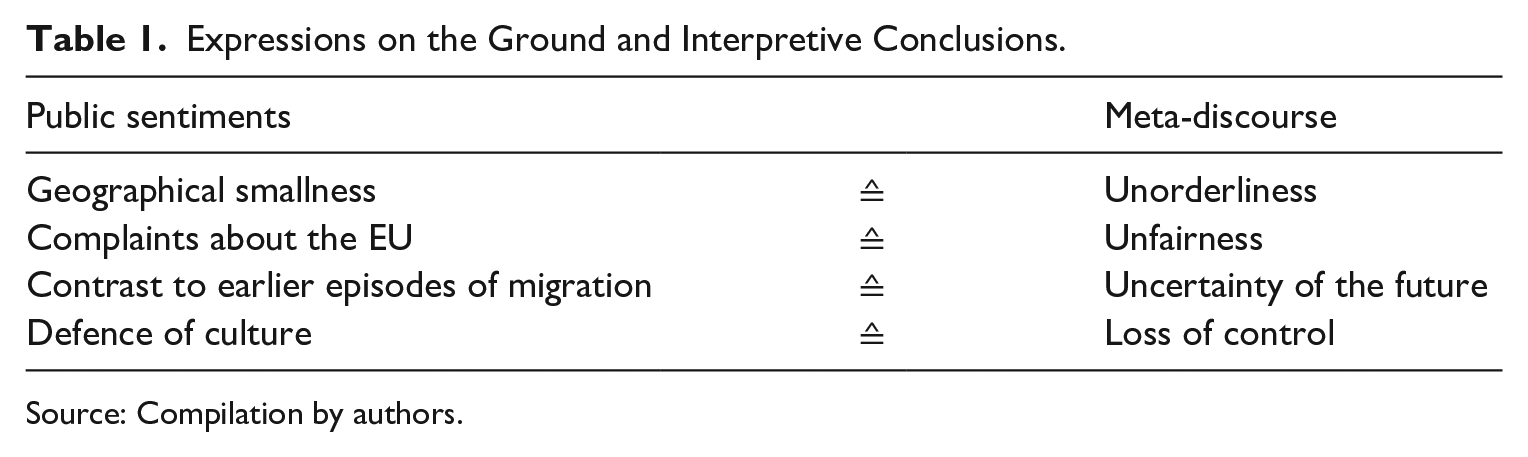
Source: Compilation by authors.
Idea-Making on the Ground
Ethnography excels in particular in highlighting the everyday; thus, while there are different perspectives on the relationship between materialism and the ideational (and which, if any, of these concepts deserves primacy), this says little about the ways in which ideas spread, find acceptance or are rejected, and become efficacious. There are two predominant ways in which this is important: To date, there has already been significant focus on how ideas become powerful in terms of the public policy process and among (governing) elites (Matthijs, 2011; Schmidt, 2017; Widmaier, 2016a). Moreover, there has been progress in establishing specifically the ways through which ideas – and actors wielding ideas – contribute to political change (Béland, 2010; Béland and Cox, 2016; Béland et al., 2016; Carstensen and Schmidt, 2016; Parsons, 2016; Widmaier, 2016b). We do not intend to dispute that ideas in this sense are employed as instruments in the hands of actors (Blyth et al., 2016), but it is meant to suggest that beyond or in addition to this perspective, there is also a methodological approach focusing on societal interaction on the ground that is (largely, even if not exclusively) analytically independent of what is occurring in the public policy process.
By allowing for a focus on idea-making on the ground, one approaches new terrain beyond what emanates from official policy or elite decision-making in national capitals. Consider examples of ‘public sentiments’ (Campbell, 1998, 2004) from our field material: That Luke, Nicolas and Albert were concerned that an increase of migration from Africa could lead to prohibitions concerning displays of Christianity in public, or that they feared that women might not be allowed to be in public on their own without accompaniment by men, is based not on ideas handed down from governing elites, but stemming primarily from their own experiences. That their experiences – and the way in which they perceive their own experiences in particular – are necessarily coloured by larger phenomena such as discursive elements and mass media representations is undoubtedly true; yet the experiences individual actors derive from their own societal interactions nevertheless constitute one side of a dialectical process through which agents perceive and make sense of their surroundings.
Our analysis lends itself to a constructivist interpretive framework because the role of contingency is abundantly apparent. As the description above has shown, migration to Malta is not a completely new phenomenon. How individual actors developed their views on people arriving in Malta is highly dependent on how they perceive their own interests. Shifting circumstances, both by external factors and by incremental societal change, alters the way in which people view their interests. That materialist/structuralist factors impact the ideational level suggests that the relationship between these levels is important. For example, since the disappointment associated with migration management following Malta’s EU accession was particularly pronounced, scepticism about irregular migrants is also rooted in part in the perceived absence of solidarity they expected from other member states. Similarly, Malta’s change from a country with net emigration to a country of net immigration has an impact on how Maltese people consider their interests. Because they are now concerned with the crowdedness they feel, many have developed ideas that they believe takes Malta’s relative smallness into account and intends to guarantee the realisation of interests as they understand them.
Conclusion
This article has made two contributions: first, our case study on Malta has provided ethnographic insights into how public opinion in migrant-receiving societies in the EU is formed. Thereby, we have addressed an empirical lacuna by focusing our research on a small state at Europe’s external border. While scepticism towards migration in Malta is quite pronounced based on survey data with more than two-thirds of survey recipients viewing migration as problematic, our findings provide a more nuanced assessment pertaining to the motivating factors undergirding recent ideational change. Second, by taking up Hay’s (2011) call to illustrate the process of interest construction ethnographically in CI, we emphasised the importance that perception and interpretation play in this process of public opinion formation. The absence of ethnographic methods in CI to date has implied that a certain type of data has not been considered in the field. Operationalising ethnographic methods for CI promises to generate a new type of data relying on lived experiences distinct from empirical material generated through other qualitative research methodologies. In particular, this approach enables taking seriously views ‘on the ground’ whereby actors do not respond to given prompts, but rather articulate their views freely. Our case study offers an example of how individuals perceive their own interests and illustrates why people have the convictions they hold. In our case, this implied that the ideational change that came about coinciding with Malta’s accession to the EU was grounded in specific concerns or fears: namely, unorderliness, unfairness, uncertainty of the future, and a loss of control of determining one’s own destiny.
These convictions and what people perceive to constitute their interests are contingent on the circumstances within which they find themselves. This contingency meshes well with ethnographic approaches because ethnography does not purport to achieve a comprehensive and holistic examination of collective entities; rather, ethnographic research reveals insights that are necessarily in situ, embedded, situated, actor- and context-specific.
In more general terms, ethnographic approaches are promising for CI because they enable insights at two levels. It is possible to employ ethnographic methods among elites, political decision-makers, and law enforcement agents whose ‘everyday-ness’ is examined. How interests are constructed and – subsequently – how interests motivate behaviour can be traced in this manner. This elite-driven focus is the more predominant subject of research in institutionalism to date; yet, a new methodology nevertheless promises new insights. On the other hand, it is possible, as this case study has, to study ‘everyday actors’ – those who are not involved in policy formulation and who do not bring about instantaneous political change. Ideas among the public are similarly relevant in democratic polities, not because individuals typically become ‘change agents’ – they do not – but because these constructed interests also impact their (voting) behaviour. In this sense, the ideas a public holds constrains or enables political action.
A few final caveats for social scientists interested in the future of ethnographic research within institutionalism: Ethnographic research properly carried out cannot occur haphazardly as it relies on a certain set of methods which must be applied contextually to respective cases. This contextualisation is linked with analysis of larger political discourses and circumstances on the ground. Only when one grasps the significance of contingent factors can we identify what motivates people and why. Finally, ethnographic research takes time. A ‘one-and-done attitude’ of the researcher does not do justice to the complexity every individual case exhibits. But when ethnographic research is carried out carefully, thoroughly and responsibly, it can enhance our understanding of how interests are constructed and perceived. In these cases, collaboration between ethnographers and social scientists can facilitate theoretical development by introducing novel methods and thereby provide truly enriching interdisciplinary research.
Footnotes
Acknowledgements
We wish to thank all those who agreed on participating in our research, and our special thanks in this regard goes to Charles Buttigieg. Our sincere appreciation for comments on previous versions of this paper goes to Cetta Mainwaring, Mark-Anthony Falzon, and Joachim Zweynert.
Declaration of Conflicting Interests
The author(s) declared no potential conflicts of interest with respect to the research, authorship, and/or publication of this article.
Funding
The author(s) received no financial support for the research, authorship, and/or publication of this article.
