




Abstract
Western democracies are increasingly defined by identity politics, where politics appeals to both political and other social identities. Consequently, political information processing should depend not just on political identity, but also on other identities, such as gender, race, or sexuality. For any given issue, we argue that the extent to which reasoning is motivated by one’s political identity depends on citizens’ group status in other relevant identities, that is, that political identity more strongly motivates high-status group members than low-status group members for issues of identity politics. A survey experiment (N = 1012) concerning a gender quota policy shows that political identity motivates men more strongly than women, leading to political polarization between left-wing and right-wing men, but not women. This suggests that political motivated reasoning should be addressed differently in situations of identity politics, and urges the consideration of group status as a conditional factor of motivated reasoning.
With the rise of identity-based grass-roots movements (De Benedictis et al., 2019; Yang, 2016) and right-wing populism (Rooduijn et al., 2019), identity politics seems to have become increasingly important in many democracies. Yet, research on information processing and political attitude formation has had a strong focus on partisan or ideological identifications. Such research on “motivated reasoning” has shown that partisan identification causes asymmetrical reasoning patterns and polarization between partisan groups (e.g. Kahan, 2013; Slothuus and De Vreese, 2010; Taber and Lodge, 2006). However, we are not just partisans. In fact, our self-conceptions consist of multiple social identities that influence our thought and behavior (Tajfel and Turner, 1986). As such, other social groups, like gender, race, or religious groups, can cause similar motivated reasoning effects as political groups (e.g. Kahan et al., 2007; Landrum et al., 2017). The current surge of identity politics therefore undermines traditional understanding of political motivated reasoning: how important are political identities 1 in the processing of information regarding identity politics?
We argue that many political issues bear relevance for both political and alternative social identities and that they should be investigated as such (see also Feldman and Huddy, 2018). To predict how strongly political identity motivates citizens’ reasoning at a given time, we suggest to further investigate one component of Social Identity Theory that has not yet received much attention in the motivated reasoning literature: group status. Tajfel and Turner (1986) predicted that certain lower-status groups will adopt a “social change mindset” when threatened, to protect their groups’ position. In other words, citizens of lower-status groups—like women or racial minorities—have a larger stake in protecting that identity group and are thus less strongly motivated by their political identity than high-status group members, for issues of identity politics.
We test this hypothesis for the case of a recently instated gender quota policy for corporate supervisory boards in Austria (N = 1021). Gender quotas are a gendered issue that is also strongly incorporated in the left/right ideological party structure (Terjesen et al., 2015). As there is a clear group status difference, where men enjoy more status and power in society than women, we expect that men will be more strongly motivated by their political identity than women. By exposing participants to a news article that argues either in favor or against the gender quota, compared with an unrelated control condition, we confirm this expectation. Thereby, we show that political motivated reasoning in response to identity politics is not universal, but rather depends on the societal status of the group that citizens belong to. This questions the way we think about the processing of political information that bears relevance for gender, race, and other social identities.
Social Identification in Motivated Reasoning Research
What motivates political reasoning? As reasoning seems to play a crucial role in the formation of political attitudes (Taber and Lodge, 2006), this question lies at the heart of political science. Besides the motivation to hold accurate beliefs, citizens also have directional motivations, or motivations to reach a certain predetermined belief. Directional motivations can stem from the desire to uphold prior attitudes (Taber and Lodge, 2006) or from the desire to keep a favorable view on the political party one identifies with (Slothuus and De Vreese, 2010). Congruently, citizens often process information in such a way that makes it possible to reach a predetermined outcome, which is often associated with an increase in political polarization (Taber and Lodge, 2006). According to Kunda (1990: 440), such directional motivations can be “any wish, desire or preference that concerns the outcome of a given reasoning task.” The question is, what are citizens’ “wishes, desires or preferences” regarding the outcome of political reasoning?
Many scholars agree that the motivations that underlie asymmetric political reasoning are often based on social identification and have studied reasoning as motivated by political groups. Identifying with a group is a basic form of human motivation (Baumeister and Leary, 1995), and party identification can drive persuasion more strongly than a policy’s content (Cohen, 2003). Especially in the United States, identification with either the Democratic or the Republican party is one of the most important predictors of political attitudes (Goren, 2005). As such, partisan-motivated reasoning is thought to be caused by the directional motivation of reaffirming one’s partisan group’s values, ideas, or position, instead of one’s own prior attitudes (Leeper and Slothuus, 2014; Petersen et al., 2013). Further support for this thesis includes the findings that asymmetric reasoning increases in the face of party cues (Slothuus and De Vreese, 2010), and an ingroup–outgroup dichotomy (Republican / Democratic) of social identification (Bolsen et al., 2014).
Evidence of partisan-motivated reasoning in multi-party systems is scarce. Apart from the methodological challenges that such an endeavor entails, this might also be caused by the self-structuring of political parties in the larger left/right spectrum (Van Der Brug and Van Spanje, 2009). In a Western European context, parties enjoy less continuing support from their electorate than in the United States. However, European voters generally remain within their “block” of parties on either the left-wing or right-wing side of the spectrum (Van der Meer et al., 2015). Their ideological identity thus seems more important than their party identity. For the aim of this study, it suffices to state that both identities are political identities, that is, they signal membership in a group that exists predominantly of political considerations.
But citizens identify with more than just political groups. Since citizens’ identities consist of many group affiliations, like their race, nationality, or gender (Tajfel and Turner, 1986), scholars have also investigated motivated reasoning effects of such other groups. Citizens trust information sources more if they are part of their ingroup (Mackie et al., 1992) and are more skeptical of counter-attitudinal information when it is put forward by a racial outgroup (Shoda et al., 2014). White men engage in motivated reasoning, upholding their group beliefs by perceiving fewer risks of guns, environmental issues, and abortion (Kahan et al., 2007). Moreover, such risk perception values that relate to social identities cause the same information about nanotechnology to lead to polarization between men and women, as well as between white Americans and nonwhite Americans (Kahan et al., 2008). Finally, racially motivated reasoning can lead white people to accept evidence of reverse discrimination, but not discrimination (Feldman and Huddy, 2018). In short, and similar to the effects of partisan identification, citizens are more critical toward information that threatens their social identity, which leads to the preservation or strengthening of group-consonant beliefs.
Because directional motivations can stem from each of the aforementioned identities (and others), the identities that play a role in the processing of a specific piece of political information are highly dependent on the issue at hand. Since parties adopt many issues in the unidimensional Liberal/Conservative or Left/Right divide (Van Der Brug and Van Spanje, 2009), political identities are likely to be activated for many who receive information about policies. It is then likely that citizens adopt the stance of their fellow group members and that their political identity guides the processing of the information through motivated reasoning. In this article, we study news regarding a newly instated gender quota for supervisory boards in Austria. Gender quotas are associated with the left of the political spectrum (Terjesen et al., 2015). Therefore, we expect that right-wing citizens reason against news that is in favor of the quota more strongly than left-wing citizens do, and that left-wing citizens reason against news that is opposed to the quota more strongly than right-wing citizens do. As a consequence, we expect issue polarization between left-wing and right-wing citizens.
But policies nearly always benefit certain groups over others (Weeden and Kurzban, 2017). And therefore, there are often alternative social identities that might also cause motivated reasoning effects. Needless to say, gender quotas are a gender issue. Gender is a particularly influential social identity, as it is a social construct that socializes citizens into roles and expectations from birth onward (Burns and Kinder, 2012). A gender quota for supervisory boards is meant to benefit women more than men. Therefore, we would expect that men reason against news that is in favor of the quota more strongly than women do, and that women reason against news that is opposed to the quota more strongly than men. Again, as a consequence, we expect issue polarization between men and women. 2
Group Status in Political Motivated Reasoning
Although political identities increasingly overlap with other identities, such as gender and race (Mason, 2018), when two or more social identities determine citizens’ directional motivations at the same time, some citizens might be faced with an internal conflict. Concerning the gender quota policy in question, for left-wing women and right-wing men, the directional motivations of political identity and gender are the same. However, for right-wing women and left-wing men, the expected motivations contradict each other. In other words, in some cases, one social identity might have to guide information processing more strongly than the other. Looking back at Kunda’s (1990: 440) statement that motivations can be “any wish, desire or preference that concerns the outcome of a given reasoning task,” predicting reasoning and attitude change from two social identifications boils down to which group affiliation guides each citizen in the processing of a piece of political information. Is it citizens’ political identity or their alternative social identity that is activated by the same piece of information? Or both?
In a recent study, Westwood et al. (2018) find that party identification exceeds identification with other groups. If this is true, then political identity might dominate motivated reasoning altogether. However, Westwood et al. acknowledge that their measure of identity strength (i.e. willingness to derogate the outgroup) has a different meaning for voluntary groups (i.e. political identities) than for involuntary groups (e.g. race). In contrast, (Boyer & Lecheler, 2018) simply asked respondents to describe themselves. Without priming any social identity, citizens often mention their gender (35%) and age (18%), but not a single respondent mentioned a political party, ideology, or any reference to the political left or right. There might thus still be room for other social identities to guide citizens’ reasoning.
What is more, there are signs that Western democracies are increasingly defined by identity politics, stressing all sorts of social identities in the political realm. First of all, recent times have seen multiple large-scale online movements that address issues of gender or racial inequality (De Benedictis et al., 2019; Yang, 2016). Moreover, a wave of right-wing populist parties emphasizes national or ethnic identification to garner electoral support (Mudde, 2007; Rooduijn et al., 2019). Social identities other than political identities are thus becoming more important in the political information environment, stressing the importance of investigating their interaction in information processing. There are few studies that investigate motivated reasoning of multiple social identities on a psychological level. As discussed above, Kahan et al. (2007, 2008) find motivated reasoning effects along multiple group lines, including gender, race, and cultural orientation. On the other hand, Li et al. (2016) find that political identities tend to motivate reasoning under cross-pressures: when the Pope supports claims of human-induced climate change, conservative Catholics rather devaluate the Pope’s credibility on climate change, than change their conservative views. However, these studies assume that the influence of these social identities on citizens’ directional motivations is universal.
Yet, Social Identity Theory has specific expectations of when a social identity influences thought and behavior, specifically among low-status group members (Tajfel and Turner, 1986). Low-status group members in groups from which they might be able to leave (e.g. ideology, political groups) are more likely to employ a “social mobility mindset” and momentarily reduce the importance of their group to their self-concept in situations that threaten their group. In contrast, those in groups with relatively impermeable boundaries (e.g. race, gender 3 ) will adopt a “social change mindset” and increase identification to protect their group’s status. This has been found to impact identification with various groups after political news in which these groups are primed (Boyer and Lecheler, 2018).
Building upon the work in Social Identity Theory, we would therefore expect that those citizens who experience threat to their involuntary low-status group are forced to adhere more importance to that social identity, compared with their political identity, than citizens who experience threat to their high-status group. Looking at gender and political identity in the case of a newly instated gender quota, women form the low-status group compared with men. Since gender groups have relatively impermeable boundaries (see Note 3), we would thus expect that women are less strongly motivated by their political identity than men.
Method
Case Selection and Experimental Design
We test the proposed hypotheses in the context of Austria, where the national government has recently introduced a new gender quota policy for corporate supervisory boards. The policy entails that each empty seat in a supervisory board of a subset of the largest Austrian companies has to be filled with a woman until the board reaches a threshold of 30% female membership. Although this measure was accepted in parliament without much resistance, it was both endorsed and opposed in the media, and public opinion was divided.
In an online survey experiment, we expose participants to a news article, which either argues in favor of the gender quota, or against it. 4 A control condition received an article about the slowly growing Austrian economy and did not mention the quota, gender, or any partisan cues or issues. A varied sample of 1021 Austrian participants was collected by a panel agency on behalf of the Austrian Platform for Surveys, Methods and Empirical Analyses (PUMA) in October 2018. First, participants answered a battery of survey questions, among which were questions regarding their gender and their political identity. After exposure to one of the manipulated news articles, they participated in a thought-listing exercise and answered questions about the argument strength and credibility of the article as well as their attitudes toward the gender quota. The data used for this experiment is publicly available at the Open Science Framework repository. 5
To ensure commensurability between the conditions, the stimulus material was composed by the researchers. However, to ensure a certain amount of experimental realism, all arguments were based on those made in Austrian legacy media. The articles are comparable in layout 6 and length (400 ± 40 words). The pro-quota article argues that women are the victims of professional discrimination, and that the gender quota helps to reduce it. It describes how supervisory boards used to be filled by nepotism among men, and that it increases the quality of boards by forcing the installment of better qualified women. In contrast, the contra-quota article argues that men are the victims of professional discrimination, caused by the gender quota. It describes how the gender quota denies men positions on supervisory boards, even when they are more qualified, and how the quota decreases the quality of boards by denying companies to select the best candidate for the job.
Measures
Pretest
As is common in the European context, political identity is operationalized as self-placement on a left-to-right scale from 0 through 10, which was recoded to a scale from 0 through 1, on which higher scores mean more right-wing identification. On average, participants scored .49 (SD = .21). Gender is measured by asking respondents whether they identify as male or female. Representative of the Austrian population, 50.7% of the sample identified as female.
Motivated Reasoning
The measure of motivated reasoning is composed out of three indicators of reasoning against the article that a participant read. These indicators have frequently been used in previous studies concerning motivated reasoning: the perceived argument strength of the article (Taber and Lodge, 2006), the perceived credibility of the article (Feldman and Huddy, 2018), and a score on a thought-listing exercise (Taber and Lodge, 2006). The perceived argument strength and credibility of the article indicate the extent to which participants scrutinized the content and the source of the article, respectively, while the thought-listing exercise measures the amount of counterarguing a participant engages in. Participants rated how strong they found the argumentation of the article they read on a Likert-type scale from 1 (very weak) through 9 (very strong). The scale is recoded, such that a higher score means less perceived argument strength, and thus more reasoning against the article (M = 5.27, SD = 1.87).
Second, participants rated the article they read on credibility, using eight nine-point semantic differentials for understandability, bias, telling the whole story, believability, correctness, trustworthiness, fairness, and timeliness. The items formed one factor (loadings > .56, eigenvalue = 4.26) and a highly reliable scale (Cronbach’s alpha = .90). The items are recoded and averaged, such that higher scores mean less perceived credibility, and thus more reasoning against the article (M = 4.73, SD = 1.37).
Third, respondents listed up to 10 thoughts that they had while reading, in an open-ended exercise. On average, they listed 2.35 thoughts (SD = 2.00) per participant, which amounts up to a total of 1915 thoughts in the experimental conditions. Two coders rated these thoughts on whether they argue along with (a part of) the argument in the article, argue against (a part of) the argument in the article, or be neutral/unrelated. 7 This led to a counterarguing scale from −10 (ten thoughts arguing along with the article) through +10 (ten counterarguments), on which participants scored an average of −.17 (SD = 1.94). A higher score thus indicates more reasoning against the article. All three indicators, although clearly distinct forms of reasoning, measure the same construct: reasoning against the article that one was exposed to. Therefore, we standardized the three indicators and use the mean score as a latent measure of reasoning against the article. 8
Attitudes Toward the Gender Quota
Participants rated the gender quota on seven items, using a Likert-type scale from 1 (completely disagree) through 9 (completely agree). The scale consisted of items like “In general, it is a good thing that the gender quota has been introduced,” “The gender quota can force companies to hire less suitable candidates,” and “The gender quota improves the quality of supervisory boards in Austria.” The statements are formulated in favor as well as against the gender quota, and the order is randomized. An exploratory factor analysis indicated that the seven statements formed two factors: one for the positively formulated statements (loadings > .57, eigenvalue = 2.55) and one for the negatively formulated statements (loadings > .43, eigenvalue = .82). Altogether, the items formed a reliable scale (Cronbach’s alpha = .77), which is coded in such a way that higher scores mean more positive attitudes toward the gender quota. Participants’ average score on this variable is 4.93 (SD = 1.46). All items of this scale can be found in Online Appendix B in the online supplementary material.
Perceived Male Dominance
In the pretest questionnaire, we asked participants to rate to what extent one of two groups had more status in society than another. They rated on a nine-point semantic differential scale the status hierarchies between working-class and middle-class people, people born in Austria and people with a migration background, younger and older employees, and between men and women. In this variable, a lower score means women enjoy more status than men, and a higher score means that men enjoy more status than women. A middle score (5) means that both groups enjoy equal status in society. On average, participants scored 5.85 (SD = 1.66).
Results
As our main premise is that political reasoning depends on group status differences, we first check whether men are actually perceived as having more status in society than women do. By testing the average score of the item for perceived male dominance against its middle score, we find that men are indeed perceived to have more status in society than women, M = 5.85, z = 27.26, p < .001. Regression analysis indicates that women perceive more male dominance than men, b = .45, SE = .10, p < .001, and right-wing citizens perceive less male dominance than left-wing citizens, b = -.86, SE = .25, p < .001. However, even for men on the right-wing end of the political ideology scale, the predicted score for perceived male dominance stays above the middle score (5.19), signaling that Austrian citizens generally acknowledge that men enjoy more status in society than women do.
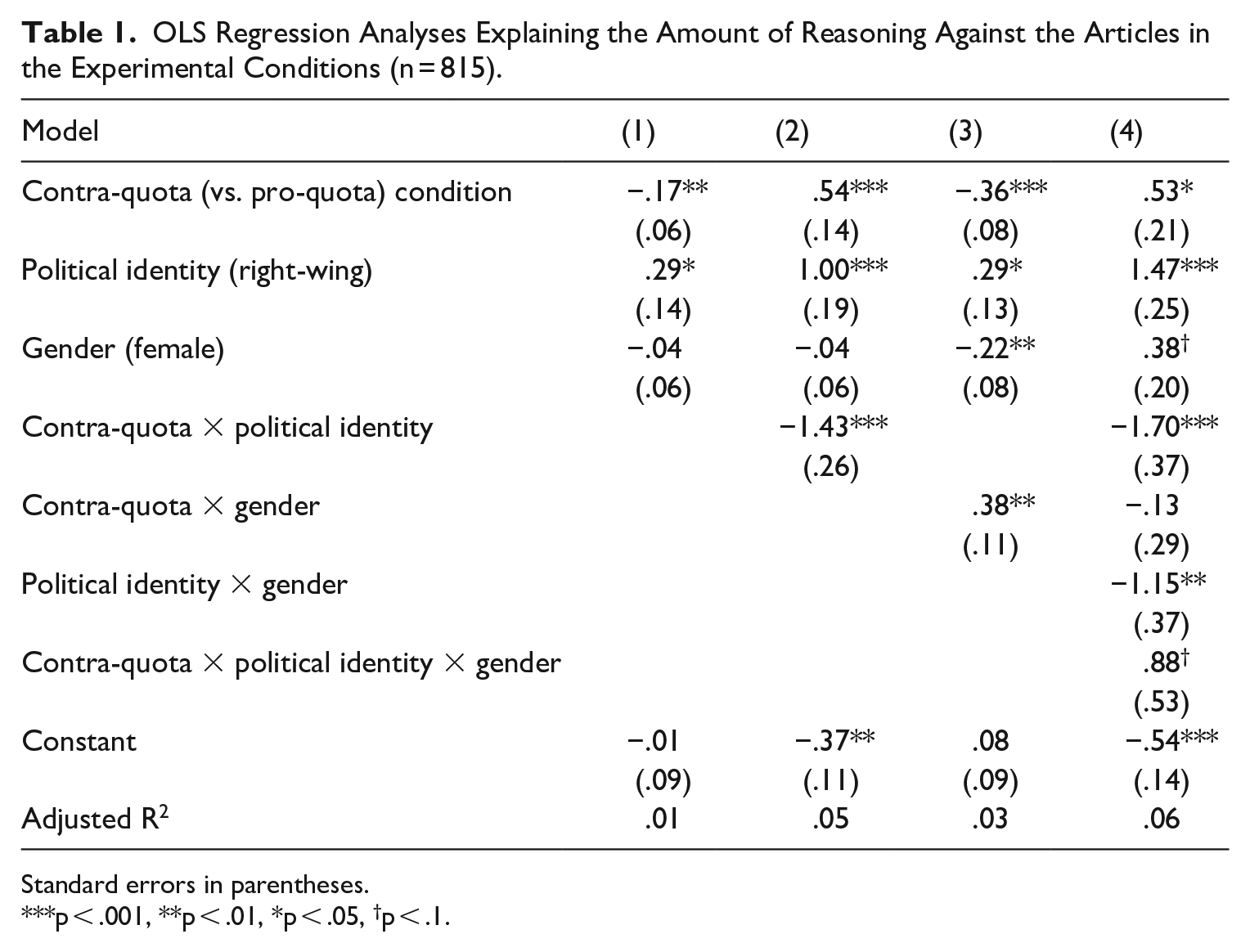
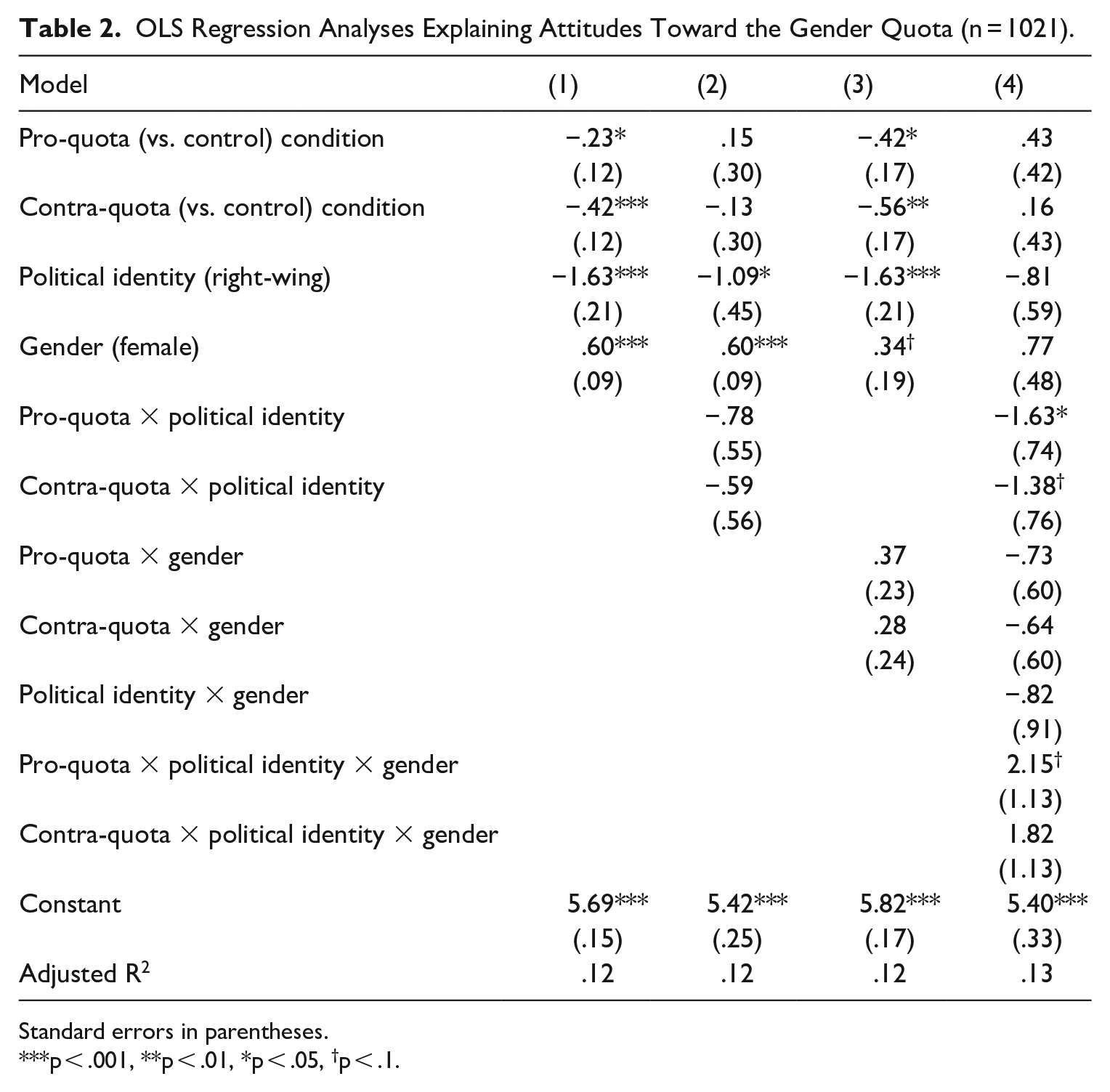
To test our hypotheses, we perform a series of ordinary least squares (OLS) regression analyses in which we explain respondents’ reasoning against the stimulus material and attitudes toward the gender quota with the experimental manipulation, as well as with participants’ political identity and gender. In terms of citizens’ reasoning patterns, we are only interested in the two experimental conditions and contrast the contra-quota condition to the pro-quota condition (n = 815; see Table 1 for the full regression models). When we explain citizens’ attitude change, we compare the pro-quota and contra-quota conditions to the control condition (n = 1021; see Table 2 for the full regression models). The raw means of both variables for men and women with different political ideologies are depicted in Figure 1.
OLS Regression Analyses Explaining the Amount of Reasoning Against the Articles in the Experimental Conditions (n = 815).
Standard errors in parentheses.
p < .001, **p < .01, *p < .05, †p < .1.
OLS Regression Analyses Explaining Attitudes Toward the Gender Quota (n = 1021).
Standard errors in parentheses.
p < .001, **p < .01, *p < .05, †p < .1.
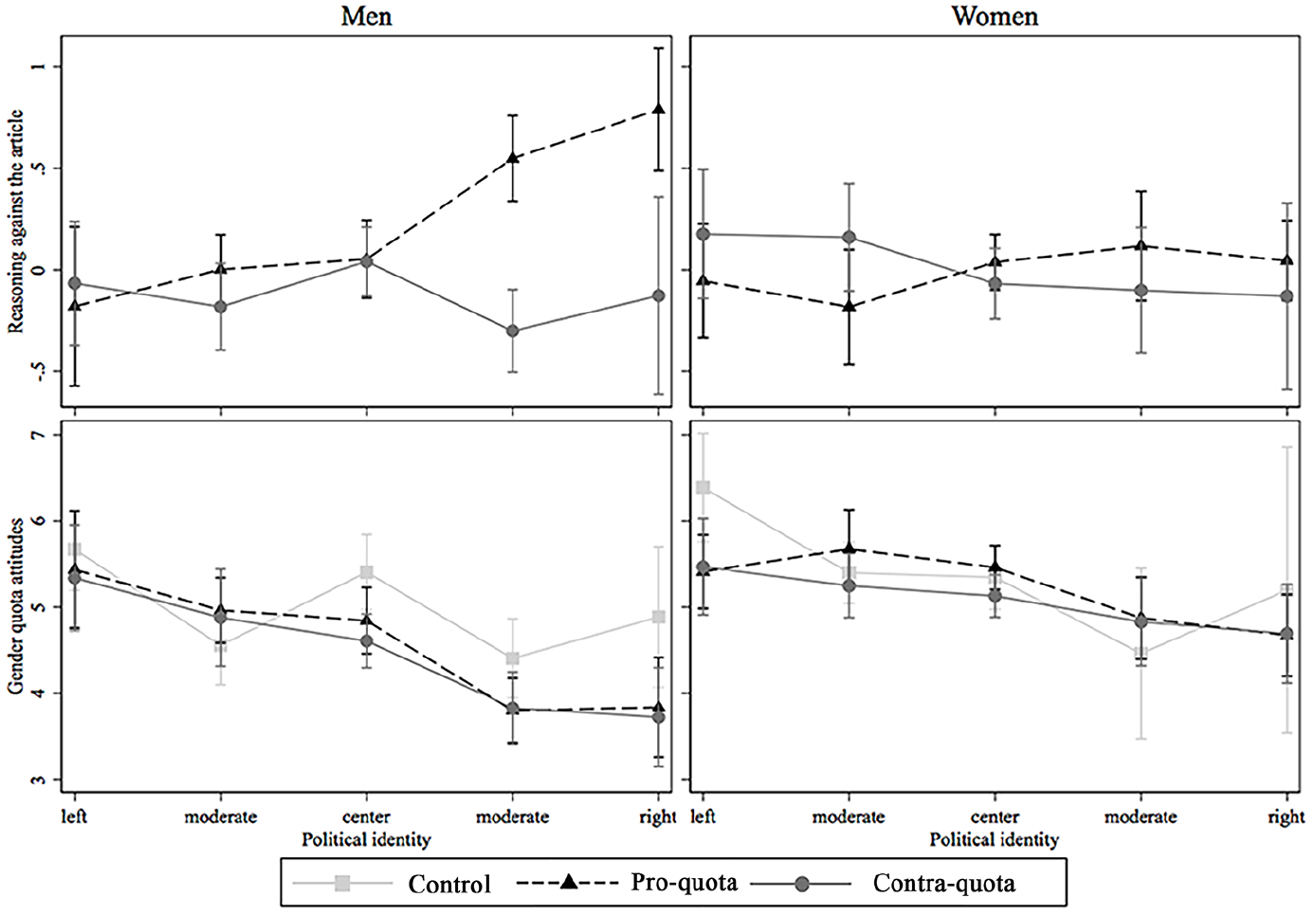
Raw Means with 95% Confidence Intervals of the Amount of Reasoning Against the Articles and Attitudes Toward the Gender Quota for Men and Women with Different Political Identities.
Our results show that, in general, the contra-quota article led to less reasoning against the article than the pro-quota article, b = −.17, SE = .06, p = .003 (Table 1—model 1). In support of our hypothesis that political identity causes asymmetric reasoning in response to gender-relevant news (H1a), we find a two-way interaction effect of the experimental manipulation and political identity on reasoning against the article, b = −1.43, SE = .26, p < .001 (Table 1—model 2). In other words, citizens more strongly reason against an article that threatens their political identity than an article that bolsters it. We also find support for Hypothesis 1b. Results show a significant interaction effect of the experimental manipulation and gender on reasoning against the article, b = .38, SE = .11, p = .001 (Table 1—model 3). In addition to their political identity, citizens also reason more strongly against information that threatens their gender group than information that bolsters their gender group.
Compared with the control condition, we find that, in general, participants’ attitudes toward the gender quota became more negative after exposure to the pro-quota article, b = .23, SE = .12, p = .046, as well as after exposure to the contra-quota article, b = −.42, SE = .12, p < .001 (Table 2—model 1). However, we find no significant interaction effect of the pro-quota article and political identity, b = −.78, SE = .55, p = .158, nor of the contra-quota article and political identity, b = −.59, SE = .56), p = .289 (Table 2—model 2). Similarly, we find no significant differences between men and women in terms of attitude change after the pro-quota article, b = .37, SE = .23, p = .119, nor after the contra-quota article, b = .28, SE = .24, p = .227 (Table 2—model 3). However, as can be seen in Online Appendix D, Figure A1 and A2, the marginal effects show that both right-wing citizens and men became more negative about the gender quota, in either experimental condition, while left-wing citizens and women did not. Although the interaction effects are not statistically significant, we see trends of the hypothesized issue polarization between left-wing and right-wing citizens (H2a) as well as between men and women (H2b).
Finally, we find support for our expectation that political identity motivates men’s reasoning more strongly than women’s reasoning (H3). The three-way interaction effect between the experimental manipulation, political identity, and gender on reasoning against the article shows one-sided statistical significance, b = .88, SE = .53, p = .098 (Table 1—model 4). As depicted in the marginal effects in Figure 2, there is a statistically significant political motivated reasoning effect for both men and women. However, the difference in reasoning against the pro-quota and contra-quota is only significant for extremely left-wing women. In contrast, the effect seems stronger for men. Especially right-wing men reasoned against the contra-quota article much less than the pro-quota article. Under gender-based cross-pressures, men’s political identity therefore seems to be a better predictor of motivated reasoning than women’s political identity.
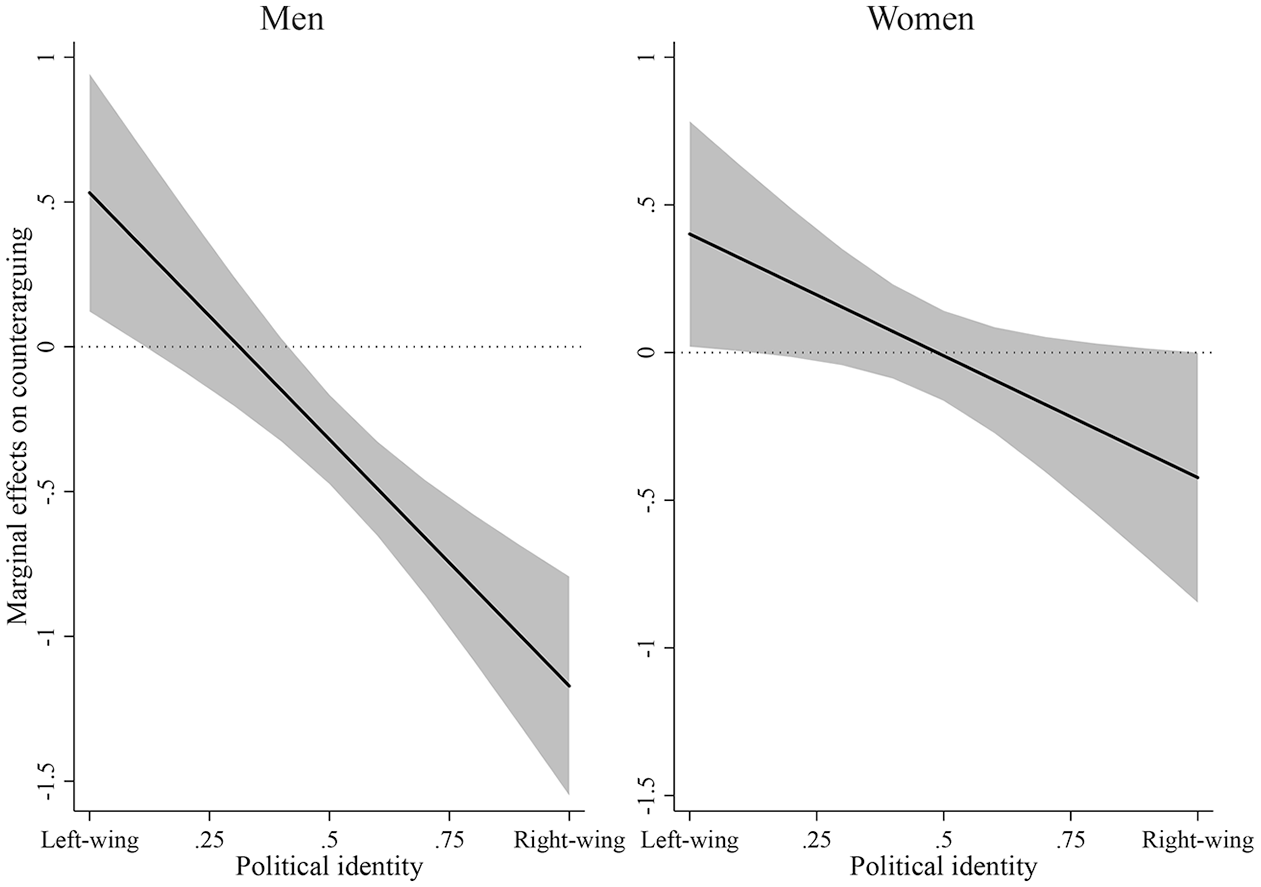
Marginal Effects with 95% Confidence Intervals of the Contra-Quota Condition (vs the Pro-Quota Condition) on Reasoning Against the Article, for Men and Women with Different Political Identities.
What is more, we find a marginally significant interaction effect of the pro-quota article, political identity, and gender on attitudes toward the gender quota, b = 2.15, SE = 1.13, p = .056 (Table 2—model 4). The corresponding three-way interaction for the contra-quota condition is not significant but is in the same direction, b = 1.82, SE = 1.13, p = .107. As depicted in the marginal effects in Figure 3, political identity seems a good predictor of men’s attitude change, but not of women’s attitude change. Right-wing men become more negative about the gender quota after reading either article, while women and left-wing men do not change their attitudes at all. In sum, we find support for the hypotheses that both political identity and citizens’ gender motivate reasoning in response to gender-relevant news. More importantly, we find evidence that the political motivated reasoning effect is stronger for citizens in high-status groups than those in low-status groups.
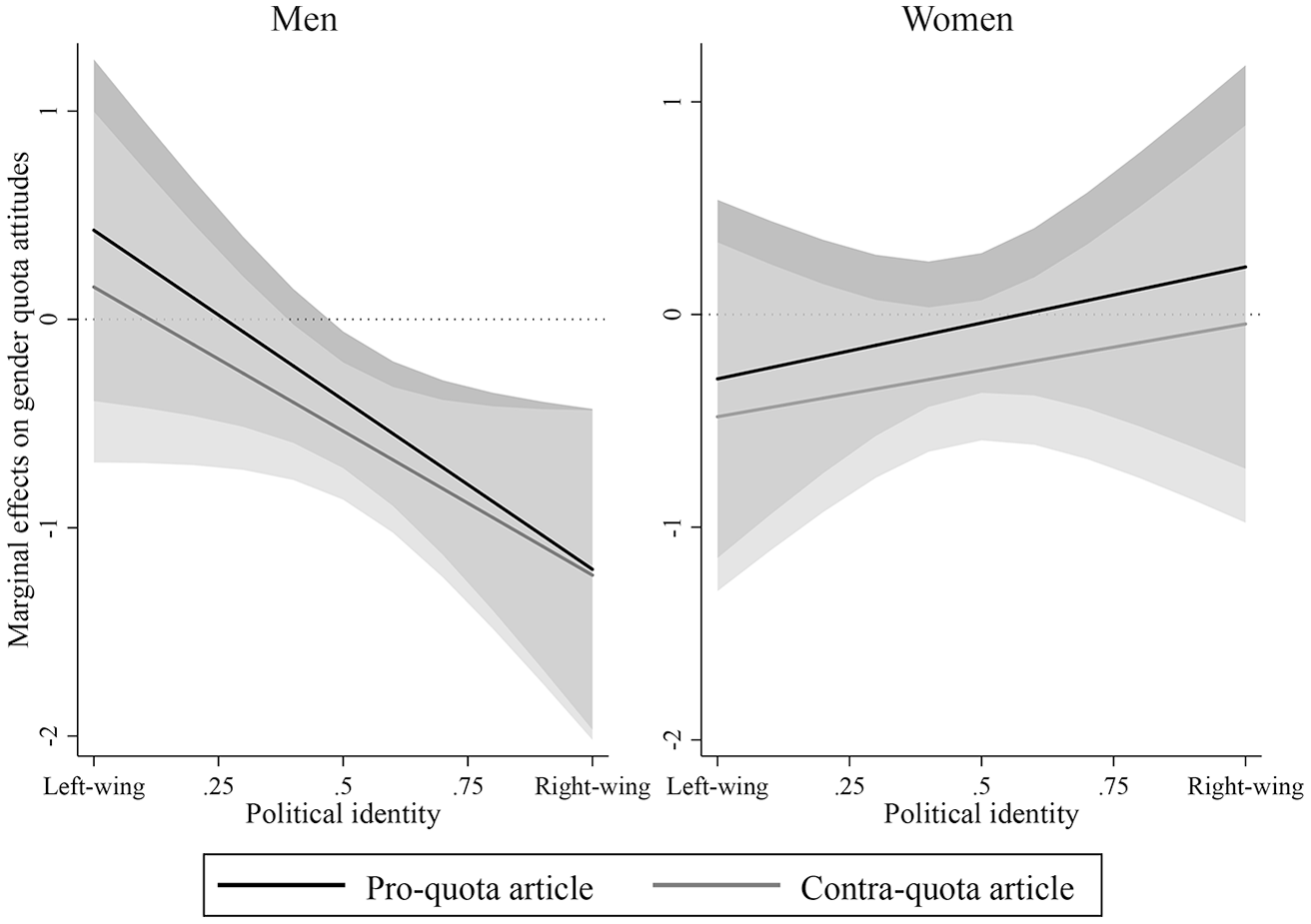
Marginal Effects of the Pro-Quota and Contra-Quota Conditions (vs the Control Condition) on Gender Quota Attitudes, for Men and Women with Different Political Identities.
Discussion
This study set out to investigate how different social identities interact when citizens consume news that is relevant to both their political identity and another social identity. In the case of a new gender quota law, we show that political motivated reasoning effects can indeed differ between the high-status and low-status group, in response to the same information. More specifically, when they are exposed to news about emancipation, men seem to rely on their political identity more strongly than women to form their motivation in processing this information. These asymmetric reasoning patterns cause issue polarization between left-wing and right-wing men, but not between left-wing and right-wing women. This shows that identity politics has a different meaning to low-status group members than to high-status group members, where low-status group members are more likely to adopt a “social change mindset” referring to their involuntary and disadvantaged group, while high-status group members are more free to reason from their voluntary political group. In the face of an increase in identity politics world-wide, these results have at least two important implications.
First, these findings show that whether and how strongly citizens engage in political motivated reasoning is dependent on the relevance of the specific topic to other parts of their identity. Being part of a low-status group might increase the threat that one feels when issues regarding the group are discussed, which causes directional motivations in the interest of this group. In contrast, being in the relatively safe position of the dominant group, citizens have more freedom to argue in terms of the values of other, voluntary groups, like one’s ideological or partisan group. When identity politics leads to cross-pressures between citizens’ political identity and another identity, political motivated reasoning seems to be dependent on citizens’ group status in that second identity. This should not be interpreted, though, as a lack of rationality of low-status group members. Instead, their reliance on their involuntary group should be seen as political reasoning, motivated by the collective grievances that low-status groups can hold (Huddy, 2018).
This finding has profound consequences for research on partisan or ideologically motivated reasoning, because the effect that one finds may be much stronger for one subset of the population than another. Especially in times of identity politics, political issues might more often bear relevance for more than just political groups. But one can also imagine that more common political issues bear such relevance. News about the economy may cause directional motivations based on social class groups, and information about gun control laws may trigger racially based directionally motivations. Without investigating the role of group status in the processing of such political information, we assume that political motivated reasoning is universal and underestimate it for dominant groups while overestimating it for low-status groups. This underlines the importance of research in which the intersection of political identities with other important social identities is systematically investigated.
However, while our findings clearly show that women reasoned less in line with their political identity than men did, they were not conclusive about whether women based their motivation on their gender identity. Instead, the results indicated that women hardly had a reasoning asymmetry and did not change their minds at all. As a possible explanation, women’s attitudes about gender issues could simply be more crystallized than men’s attitudes are. This also explains the net negative effect of the news about a gender quota on support for it: while right-wing men’s attitudes became more negative about the gender quota, women were not affected at all. Therefore, future research could focus more structurally on the mechanism behind the reduced political motivations of low-status group members.
Second, our results underline the importance of political identities in citizens’ reasoning about politics (Westwood et al., 2018). Although there were differences between men and women in their reasoning patterns, both groups showed patterns of motivated reasoning based on their political identity. However, the results do emphasize that this effect can be moderated by other relevant identities. Especially low-status group members might additionally be motivated by alternative social identifications. This is important for two reasons. First of all, alternative social identities may be especially important when issues are not (yet) fully integrated in partisan discourse or the Left/Right dichotomy. This may happen because they transcend partisan politics, as could happen with matters of national security, or because they are new and not yet adopted by the political establishment. Second of all, we live in a time when large-scale online movements address issues of gender or racial inequality (De Benedictis et al., 2019; Yang, 2016), and when a rising right-wing populist trend emphasizes national or ethnic identification (Mudde, 2007; Rooduijn et al., 2019). Identity-politics seems to become increasingly important in general, which means that social identities beyond political identities might become even more important in the processing of political information in the years to come.
This study has four important limitations. First, the analyses in this study used one’s perceived membership in a gender group as a measure of identification. Although this is a prerequisite of citizens’ identification with their gender, it does not mean that all citizens who accept their membership in a gender group also identify with this group equally strong. However, gender is arguably (one of) the most ubiquitous identities humans possess. As a social construct, gender roles and expectations are socialized from birth onward through social interactions, popular culture, and even everyday language (Burns and Kinder, 2012). What is more, gendered issues have gotten a lot of media attention through the #MeToo movement and other large-scale movements that have garnered large amounts of media attention (De Benedictis et al., 2019). In short, both the relative importance of gender to most citizens and the contemporary information environment make it likely that gender identities are easily activated by gender-relevant news, regardless of the individual strength of identification. Therefore, it is important that studies investigating the intersection between political and other social identities in political attitude formation take the current information environment, as well as the properties of the specific social identity under study into account.
Relatedly, this study relied on a single shot experiment to investigate how different social identities interact to form directional motivations. Therefore, the fact that we find that women form gender-based directional motivations might not be transferrable to other situations, topics, or countries. Let alone to other low-status groups like ethnic or sexual minorities. On the other hand, this study shows that political motivated reasoning can be moderated by group status in response to identity politics. The goal of this experiment was thus not to be generalized to all circumstances, but rather to demonstrate that the hypothesized effect takes place in certain circumstances (for more theory on generalizability of social science experiments, see Druckman and Kam, 2011).
Third, as with much experimental work into political information processing, more research is necessary to conclusively test the mechanism behind the effects that we observe. It is important to note that accuracy motivations could lead to the same effects as directional motivations, if the perception of what is accurate information differs between groups as well (Druckman and McGrath, 2019). However, there is also evidence that prompting accuracy motivation leads to less asymmetrical reasoning (Bolsen et al., 2014; Redlawsk, 2002), which supports the idea of directional motivations being the main driver in asymmetrical reasoning processes.
Relatedly, we need additional research to conclusively determine whether the differences that we find between men and women exist because of group status differences, or whether they are a result of other differences between men and women, for instance, the different levels of importance that group members adhere to their group membership. However, we found that both men and women acknowledged the status difference between their groups. In this societal context, group importance and group status are also inherently intertwined and often coexist. Therefore, it is important to note that we did determine that asymmetrical reasoning patterns can differ between groups of different status in the face of identity politics. However, to phase out the exact mechanism, future research could focus on social groups, for which group membership is more important for the members of the high-status group than for their low-status equivalents.
Finally, the concept of motivated reasoning is not uncontested in itself. Although the mechanism has seen many replications, there has also been attention to factors that limit motivated reasoning, like repeated exposure to counter-attitudinal information (Redlawsk et al., 2010) or feelings of anxiousness, in contrast to anger (Vasilopoulos et al., 2018; Weeks, 2015). Furthermore research has found that political polarization can be caused by other mechanisms entirely, like self-stereotyping after ingroup cues (e.g. Han and Federico, 2018). Therefore, even though our results make a strong case for motivated reasoning, it is important to keep an open mind to other mechanisms that might lead to the same effects. However, the findings in this article indicate that, at least in certain circumstances, reasoning on the basis of a political identity is more prevalent among high-status groups, while low-status group members tend to cognitively defend their marginalized social identity and give less importance to their political identities. In a time when identity politics seems to become increasingly important, political information processing might be more and more based on multiple social identity-related motivations. And understanding how and when we are motivated by different social identities is therefore an integral part of understanding political information processing.
Supplemental Material
sj-docx-1-psx-10.1177_0032321720964667 – Supplemental material for Motivated Reasoning in Identity Politics: Group Status as a Moderator of Political Motivations
Supplemental material, sj-docx-1-psx-10.1177_0032321720964667 for Motivated Reasoning in Identity Politics: Group Status as a Moderator of Political Motivations by Ming M Boyer, Loes Aaldering and Sophie Lecheler in Political Studies
Footnotes
Acknowledgements
We thank the participants of the workshop at the ISPP Annual Meeting 2019 in Lisbon, and the participants of the VieCER PhD Club of the University of Vienna, for their insightful suggestions. We are also very grateful to Bert Bakker and the two anonymous reviewers for comments on previous drafts.
Declaration of Conflicting Interest
The author(s) declared no potential conflicts of interest with respect to the research, authorship, and/or publication of this article.
Funding
The author(s) disclosed receipt of the following financial support for the research, authorship, and/or publication of this article: This study was funded by the Austrian Platform for Surveys, Methods and Empirical Analyses.

Supplementary Information
Additional supplementary information may be found with the online version of this article.
Notes
Author Biographies
References
Supplementary Material
Please find the following supplemental material available below.
For Open Access articles published under a Creative Commons License, all supplemental material carries the same license as the article it is associated with.
For non-Open Access articles published, all supplemental material carries a non-exclusive license, and permission requests for re-use of supplemental material or any part of supplemental material shall be sent directly to the copyright owner as specified in the copyright notice associated with the article.
