




Abstract
This article aims to establish the connection between people’s voice at work and their political voice. We theorize and model a spillover mechanism from supervisors’ responses to workplace voice to political participation. Applying structural equation modeling on a unique dataset (N = 3129), we find that while support and suppression of workplace voice both affect political participation, they do so through different mechanisms. In addition, we find that supervisors’ suppressive responses to employees’ voice can trigger both positive and negative effects on different forms of political participation. Thereby, we contribute to the understanding of the link between participation at work and participation in politics.
Keywords
Introduction
This article aims to establish the theoretical–empirical connection between people’s voice expression at work and their political voice. The recent deterioration of important labor market institutions, such as more relaxed employment protection regulation and the weakened power of trade unions, has fundamentally changed the position of employees vis-à-vis management. Traditional vehicles for collective expressions of worker discontent, such as strikes, have declined, leaving many workers no other option than using individual voice (Akkerman, 2017; Budd et al., 2010; Sluiter et al., 2020). Because work is important for political socialization (Greenberg et al., 1996; Jian and Jeffres, 2008), changes in workplace relations potentially have significant consequences for political participation. In this article, we examine how experiences with workplace voice expression affect political efficacy and political participation.
The workplace, like family and school, is considered one of the agents of political socialization (Greenberg et al., 1996; Niemi and Sobieszek, 1977). Work is central in people’s lives, and many workplaces resemble the authority structure of political institutions (Greenberg et al., 1996; Pateman, 1970; Peterson, 1992). Political socialization theory argues that the workplace is an environment in which people learn political skills and that certain workplace interactions enhance the feeling that one can influence decision making through political action (Bandura, 1994; Campbell et al., 1954). In particular, the involvement in decision making in the workplace can have a learning effect that enhances political skills and the desire to participate politically (Carter, 2006; Greenberg et al., 1996). Although political socialization theory acknowledges that the workplace can be an important agent for training political skills, our understanding of the effect of workplace training for political behavior remains rather limited for three reasons. First, previous studies address (nowadays) uncommon structures, such as worker cooperatives (e.g. Elden, 1981; Greenberg, 1981, 1986; Pateman, 1970), or focus on more general work characteristics such as job autonomy rather than on specific participative interactions (Adman, 2008; Budd et al., 2018; Jian and Jeffres, 2008; Lopes et al., 2014). Nevertheless, more common day-to-day experiences at work are also expected to enhance civic or political skills (Burns et al., 2001; Verba et al., 1995) but are understudied when linking the workplace to political participation. Second, the proposed positive effect of workplace participation on political participation is based on the implicit theoretical assumption that the political arena at work mimics an ideal liberal democracy. While this may be true in some organizations, it is doubtful whether this is a universal characteristic of all organizations and workplaces. Finally, the empirical evidence for the proposed positive effect of workplace participation on political efficacy is mixed (Adman, 2008; Carter, 2006; Jian and Jeffres, 2008), suggesting that the spillover mechanism is more complex than presently understood.
This article contributes to understanding the link between people’s working lives and their political lives in three ways. First, we theorize and test the effect of the more common, day-to-day interactions at work that may constitute a learning effect for political action: voicing work-related issues to one’s supervisor. We address the effect of supervisor’s responses to workplace voice. While some studies have addressed supervisor’s attitudes toward the voice of employees (e.g. Burris, 2012; Fast et al., 2014), the effect of the supervisor’s behavior (i.e. their responses to workplace voice) is understudied (see Bashshur and Oc, 2015; Morrison, 2014). 1 Second, we argue that employees can be successful at voicing problems but can also experience negative responses, for instance, when their voice is ignored or encountered by retaliation. Greenberg et al. (1996) propose that the effect of workplace participation on political participation is dependent on whether the experience in the workplace is a positive or negative experience. Therefore, we address and empirically test the effect of both the positive and negative responses to voice expression at work. Previous studies addressing negative responses to voice in the workplace are confined to individual- or organizational-level effects and do not address the effects on political behavior (e.g. Burris et al., 2013; McClean et al., 2013; Seibert et al., 2001). Thereby, we connect the research on workplace voice with the research on political socialization (as suggested by Milliken et al., 2015). Third, we build on previous studies, arguing that the link between experiences at work and political participation is mediated by workplace efficacy (e.g. Elden, 1981; Greenberg et al., 1996), but elaborate the spillover mechanism by separating an internal and external dimension of workplace efficacy, mirroring established measurements of political efficacy. By testing these innovations using structural equation models with original and unique survey data on 3129 workers in the Dutch labor force, we provide an innovative theoretical–empirical connection between people’s voice at work and their political voice, offering a partly new and original explanation for political participation.
Theory
Workplace Voice as Training for Political Skills
We define workplace voice as any activity of an employee directed to the supervisor intended to voice communication in order to improve either personal work conditions or the work conditions of an entire group of employees. While previous studies argued that employee voice has “the intent to improve organizational or unit functions” (Morrison, 2011: 375; for example, Detert and Burris, 2007; Hirschman, 1970; Morrison and Milliken, 2000; Tangirala and Ramanujam, 2008; Van Dyne and LePine, 1998), our definition of workplace voice does allow for more individual concerns and is thereby not necessarily constructive. Workplace voice in this study is related to the concept of “complaining” (Kowalski, 1996). However, our definition is confined to problems in the workplace and does not include expression of dissatisfaction in general. In addition, workplace voice relates to the employee dissent model (Kassing, 1997), but focuses more on individual dissatisfaction and not on contradictory opinions in the workplace (i.e. management might have been unaware of the issues this study focuses on; Kassing, 2000). 2 Workplace issues fitting our definition of workplace voice include contract violations, dissatisfaction with wages, high work pressure, lacking career opportunities, or workplace bullying.
We argue that expressing voice at work prepares individuals for political participation by training political skills, such as articulating interests and speaking up, and strategies, such as the mobilization of others, negotiation, and compromise. While previous research mainly focused on participation in workplace decisions (Greenberg et al., 1996; Jian and Jeffres, 2008; Sobel, 1993; Verba et al., 1995), we argue that the preparation for political action lies not only in the mere training of the expression of issues and interests but also in the feedback that supervisors give by way of their responses to workplace voice. An employee who voices an issue at work can meet a variety of responses by its supervisor (Kassing, 2009; Stanojevic et al., 2020). Supportive responses, such as helping to solve the problem or rewarding the employee, constitute positive feedback on voice expression in the workplace. However, if the supervisor punishes the employee after voicing (e.g. by criticizing or intimidating the employee) or silences the employee after voicing (e.g. by ignoring or refusing to talk about it), an employee receives negative feedback on using voice at the workplace.
Political and Workplace Efficacy
The mechanism proposed by political socialization theory for the spillover from workplace participation to political participation is that the experiences at the workplace improve people’s feeling of political efficacy (Pateman, 1970). Political efficacy is the feeling that one can influence decision making through political action (Bandura, 1994; Campbell et al., 1954) and is developed through a process of social–political learning via political interaction and observation (Beaumont, 2011). Involvement in decision making in the workplace has a learning effect that enhances political skills and the desire to participate politically (Carter, 2006; Greenberg et al., 1996): people generalize problem-solving techniques and civic skills, developed and practiced in the workplace, and use them in other spheres of life, particularly in political life (Kitschelt and Rehm, 2014; Verba et al., 1995). Furthermore, participation in the non-political setting of the workplace exposes employees to political stimuli by engaging in discussions or by attending meetings in the workplace (Verba et al., 1995). Moreover, employees involved in a firm’s decision making develop a “thirst” for participation that spills over to civic and political behavior (Elden, 1981; Pateman, 1970). Thereby, experiences that people have in other spheres of life, especially those to which they devote most of their lives, are likely to affect political behavior (Almond and Verba, 1963; Eckstein, 1961). Thus, previous studies expect that workplace participation affects political efficacy and the desire to participate in civic and political participation (Carter, 2006).
Studies addressing political efficacy commonly distinguish two dimensions: internal efficacy and external efficacy (Geurkink et al., 2020; Valentino et al., 2009). These two types of efficacy constitute different dimensions of a person’s political efficacy (Balch, 1974; Craig et al., 1990). Internal political efficacy (IPE) refers to the confidence in one’s own personal skills and resources to express political voice and influence political decision making. External political efficacy (EPE) concerns the trust an individual has in the responsiveness of political actors to listen and care about citizens’ wants and needs (Craig and Maggiotto, 1982). These types of efficacy are distinct: one might feel confident about their ability to express political voice, but might lack the feeling that the voice is heard by politicians and vice versa (Wolak, 2018).
We use workplace efficacy as a mediator between workplace voice and political efficacy. In line with Greenberg et al. (1996) and in order to better understand the connection between work and politics, we argue that it is useful to explicitly distinguish the efficacy of voicing problems at work as an element in the spillover mechanism. We label this ability workplace efficacy: the feeling that one can address and influence situations in the workplace through voice. This concept parallels political efficacy but is confined to the workplace. We label confidence in one’s personal skills to have an influence in the workplace as internal workplace efficacy (IWE) and label trust in the responsiveness of the supervisor (or other authority figures in the workplace) as external workplace efficacy (EWE). 3
Hypotheses
Workplace Efficacy
We expect that IWE is dependent on the “experience of mastery arising from effective performance” (Bandura, 1977: 191) at the workplace. Almond and Verba (1963) argue that interactions with authority at work can affect an individual sense of competence. Thereby, positive experiences with expressing voice at work may induce the employee’s confidence in its ability to successfully address issues and interest (Kish-Gephart et al., 2009). A supportive response of the supervisor toward voice of the employee will enhance the employee’s feeling of being effective in voicing their discontent, which likely boosts their confidence in expressing voice at the workplace. Therefore, we hypothesize the following:
It is likely that suppressive responses of the supervisor to workplace voice are disappointing and harmful experiences that negatively affect people’s confidence in their skills to address and improve issues at work (Greenberg et al., 1996). Because employees may attribute negative experiences with voice expression at work to a personal lack of skills and competencies (Almond and Verba, 1963), we expect that negative experiences with voice expression reduce workers’ confidence in their ability to express voice at work effectively. Supervisors’ suppression may result in the feeling among employees that they are not able to speak up about problems they have at work, whereby they start to see themselves as lacking the capacity to have an influence in the workplace (Milliken et al., 2015). Therefore, our hypothesis is as follows:
Next, individuals may attribute positive experiences with workplace voice expression to the responsiveness of their boss, enhancing their EWE. A supportive response of the supervisor to the employee will give the employee the feeling that the supervisor cares about the problems of the employee. This positive experience with workplace voice is likely to increase the employee’s feeling that the supervisor is responsive to the employee’s needs. We thus expect the following:
Furthermore, experiences with supervisors who suppress the voice expressions of their employees are likely to reduce workers’ EWE. Employees might learn that it is futile to express their voice to the supervisor if this supervisor either does not want to hear the negative feedback or does not act on it (Milliken et al., 2015). Suppression of voice expression thereby may result in the feeling that supervisors are not responsive to or do not care about the employees’ interests. Therefore, we hypothesize the following:
Political Efficacy
We argue that workplace efficacy is being generalized to other spheres of life, such as people’s political lives (Almond and Verba, 1963). Experiences with voice at work change people’s political efficacy through the generalization of their workplace efficacy (see Mutz, 2009). Suppression will reduce workplace efficacy, which is generalized to lower political efficacy. Alternatively, being supported by the supervisor is expected to induce political efficacy through the generalization of workplace efficacy.
For IWE, the confidence in having the skills necessary to have an influence in the workplace is generalized into the confidence in one’s ability to influence political processes. We expect that the workplace voice skills and confidence in it are skills that are transferable to the political environment and represent those skills that are necessary to participate politically (e.g. understanding politics and pursuing political interests; Verba et al., 1995). Experiences in the workplace are expected to be generalized to the political sphere, because the formal authority structure in the workplace is similar to that of the political authority structures. Therefore, the workplace is crucial for the formation of political competence (Almond and Verba, 1963; Greenberg et al., 1996). Therefore, we hypothesize the following:
The generalization of EWE operates through the individual’s generalization of the confidence and ideas about the responsiveness of the supervisor in the workplace and extends to ideas about the responsiveness of political actors. We expect this generalization because the supervisor in the workplace is an authority figure who has the power to make decisions that affect the workplace situation. For workers to voice issues effectively (i.e. impose change), they are dependent on the responsiveness of the supervisor. In the political realm, citizens are dependent on the political actors’ responsiveness to influence political decision making. The similarity between the supervisor and political actors with regard to power and authority is likely to evoke a generalization of responsiveness. Therefore, we expect the following:
Political Participation
The relationship between political efficacy and political participation is well established (Campbell et al., 1954; Cohen et al., 2001; Paulsen, 1991; Valentino et al., 2009). An individual with a stronger feeling that political action does have or can have an impact on the political process is more likely to participate politically (Campbell, 1960; Campbell et al., 1954; Craig and Maggiotto, 1982). In other words, those who have a lower political efficacy are less likely to participate politically (e.g. vote, write letters to local politicians, or participate in political campaigns). IPE is especially expected to positively affect individuals’ political participation (Gastil and Xenos, 2010; Valentino et al., 2009), while the results for EPE are less decisive (Abramson and Aldrich, 1982; Finkel, 1987; Rosenstone and Hansen, 1993; Shaffer, 1981). In addition to differences in the empirical findings, the theoretical mechanisms are also different for the impacts of both types of political efficacy on participation.
For IPE, it is expected that people with a lower political efficacy have the feeling that they are not qualified to take part in politics or have the feeling that others with more political competence will perform better (Wolak, 2018). Therefore, those with a lower IPE will be less likely to participate in politics. We hypothesize the following:
EPE embraces the belief that if a government is highly responsive, the subjective utility gained from voting, as well as from other types of participation, is larger (Abramson and Aldrich, 1982). Political participation is expected to involve some sense that the cause is not hopeless (Rosenstone and Hansen, 1993). If a person thinks that engaging in a political activity would make no difference, getting involved in political participation seems to be a waste of time. Compared to people with lower EPE, individuals with a higher EPE have the feeling that political actors are more responsive. Therefore, the expectation is that people with higher EPE will participate more in politics:
From Workplace Voice to Political Participation
The above-presented hypotheses represent a spillover mechanism that links experiences with participation in the workplace to political participation, via workplace efficacy and political efficacy. Figure 1 illustrates the expected pathway that we propose in this article.
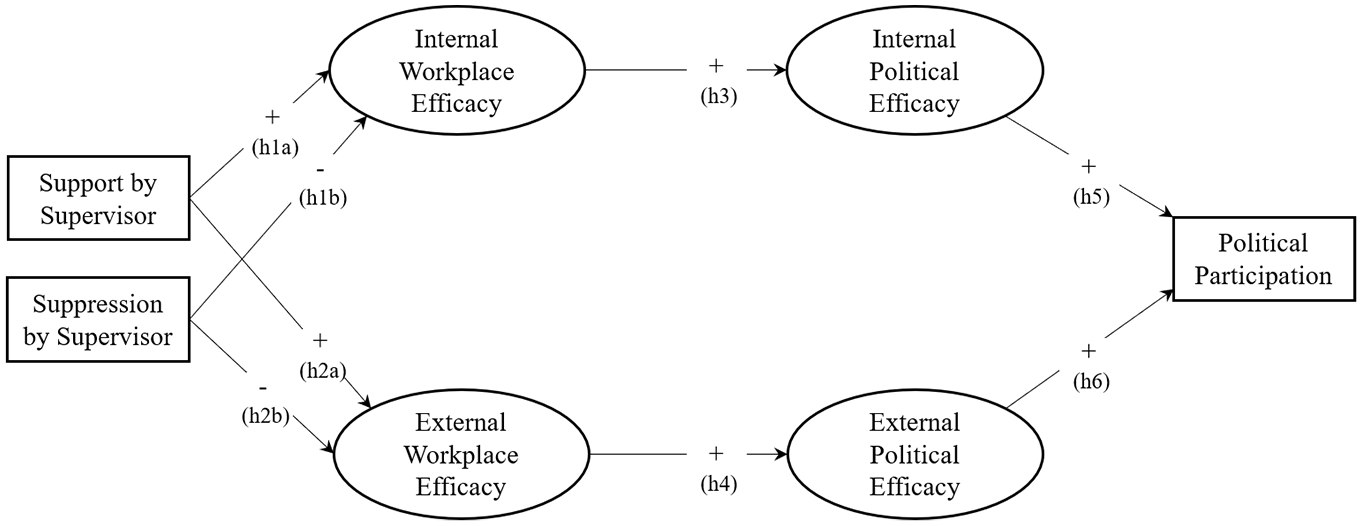
Spillover Mechanism from Supervisor’s Responses to Workplace Voice to Political Participation.
Methodology
Data
In order to investigate the relationship between experiences with voice at work and political participation, we use data from the Work and Politics 2017 Survey (Akkerman et al., 2017). This dataset is an original and rich source of data about individual’s behavior at work and in politics. The data consist of 7599 respondents from the Dutch labor force. The data were collected using the TNS NIPObase, consisting of about 235,000 respondents from the Netherlands, from which our respondents were selected. Respondents received a small reimbursement for completing the online survey. The data were collected between July and September 2017, with a response rate of 64%. The sample is representative for the Dutch labor force in 2017, with regard to gender, age, education, and work situation. For the analyses presented in the present study, we selected those respondents who (1) work currently or had a job in the past 3 years (N = 6889), (2) had an issue at work in the previous 3 years (N = 4242), and (3) had either voiced their issue to their supervisor or whose supervisor was aware of the employee having voiced the issue. The final models include 3129 respondents. 4
Measurements
The dependent variable in this study is political participation. Verba and Nie (1972: 2) define political participation as “those activities by private citizens that are more or less directly aimed at influencing the selection of governmental personnel and/or the actions they take.” Relying on this definition, political participation is a broad concept that includes a wide variety of behavior by individuals, such as voting, contacting a politician, and protesting. We asked respondents the question, “Which of the following did you do during the last 12 months?” followed by a list of 13 possible types of political participation. In line with Teorell et al. (2007), we operationalize political participation as a multi-dimensional concept. We differentiate between modes of political participation, with, for each mode, a higher value indicating more of a given mode of participation. We follow Adman (2008) and differentiate between voting, party activities, contacting, and protest activities. 5
For the experiences with voice at work, we asked respondents the following question: “After you voiced an issue, did that result in one of the following responses by your supervisor?” Respondents could select more than one response and were able to add responses to the list. 6 We categorized each of the supervisor’s responses into four categories: punishing, silencing, supportive, and passive responses. 7 We recoded the categories into three dummy variables, with “1” indicating “punished by supervisor” and “0” indicating “not punished by the supervisor” for the punishment by supervisor variable, ‘1” indicating “silenced by the supervisor” and “0” indicating “not silenced by the supervisor” for the silencing by supervisor variable, and “1” indicating “supported by the supervisor” and “0” indicating “not supported by the supervisor” for the support by supervisor variable. We consider both punishment and silencing by supervisor as suppressive responses. Respondents with both a suppressive and supportive response by the supervisor were excluded from further analyses. 8 Since we do not have expectations about the effect of passive responses, we do not include a dummy for that category.
To measure workplace efficacy and political efficacy, a range of items regarding confidence in skills and confidence in the responsiveness of authority for both the workplace and the political sphere were presented. For each of the items, respondents were asked to indicate the extent to which they agreed with it on a 5-point scale ranging from 1 (strongly disagree) to 5 (strongly agree). If needed, scores were reversed so that a score on the item corresponds with a higher efficacy score.
For the political efficacy scales, we combined items from Craig and Maggiotto (1982) and Craig et al. (1990). Some items were slightly adjusted to be applicable to the Dutch context. For IPE, we relied on the following items: Politics is so complicated that I cannot really understand what is going on
9
(COMPL). I consider myself well qualified to participate in politics (QUALIFY). I am at least as able to understand complicated issues as others are (ABLE).
The EPE scale consists of two items: Politicians do not care about what people like me think
9
(CARE). Politicians are only interested in people’s votes but not in their opinions
9
(VOTE).
For both of the workplace efficacy measures, we adapted political efficacy measures for the workplace environment. Our measurement of IWE consists of four items: I will immediately recognize a violation of my labor contract (VIOLATE). Employees like me are very capable of pursuing their interests as workers (INTEREST). Employees like me are very capable of contributing to important organizational decisions (DECIDE). It is worth listening to the opinion of employees like me about labor conditions (OPINION).
Two items were used to measure the EWE score of individuals: 10
Generally speaking, my supervisor does not really care about my interests
9
(NOCARE). Generally speaking, my supervisor listens to the problems of employees like me (LISTEN).
We control our model for political interest (Do you keep yourself informed about what happens in politics?) (yes = 1), gender (male = 1), age (15 years = 0), age-squared, education (middle or higher educated compared to lower educated), ethnic background (Western or non-Western migrants compared to Dutch natives), contract type (temporary with prospect, temporary without prospect, or solo self-employed 11 compared to permanent), having flexible arrangement in the contract (having a payroll contract, work as agency worker, work on call/secondment, or having a zero-hours contract compared to having a contract without such arrangements), and being a supervisor (supervisor = 1). 12
Method
To address the question of how experiences with voice expression at work affect political participation via workplace efficacy and political efficacy, we use structural equation modeling (SEM). This allows us to test the entire spillover mechanism instead of separate effects of parts of the spillover mechanism (Kline, 2011). We start by applying confirmatory factor analysis, using maximum likelihood estimation, to show whether the items we use to measure workplace efficacy and political efficacy result in four different factors and have sufficient convergent and discriminant validity. Second, we include these factors in a structural regression model. This structural regression model allows us to simultaneously estimate regression equations in order to test our hypotheses and the entire spillover mechanism. We use WLSMV estimation (weighted least squares means and variance adjusted), which uses diagonally weighted least squares (DWLS) to estimate model parameters and a probit link function. All of our analyses are estimated with R (version 4.0.1) using the Lavaan package (Rosseel, 2012).
Analyses
Measurement Model
In order to assess the validity of the measurement of our constructs, we used confirmatory factor analysis to determine the loading of indicators on the constructs and the relation between our constructs. This process resulted in one refinement to the original model: we added a residual correlation between VIOLATE and DECIDE. Although we did not expect any residual correlations a priori, this negative correlation intuitively makes sense. The first item refers to the tendency of being suspicious at work, while the latter taps into the ability to contribute constructively to the firm: two tendencies that may be negatively related. The chi-square difference test and the comparison of the Akaike information criterion (AIC) and Bayesian information criterion (BIC) indicate that this adjustment improved our model substantially (compare Model 1 and Model 2 in Table 1).
Values of Selected Fit Statistics for Two-Step Testing of a Structural Regression Model (N = 3129).
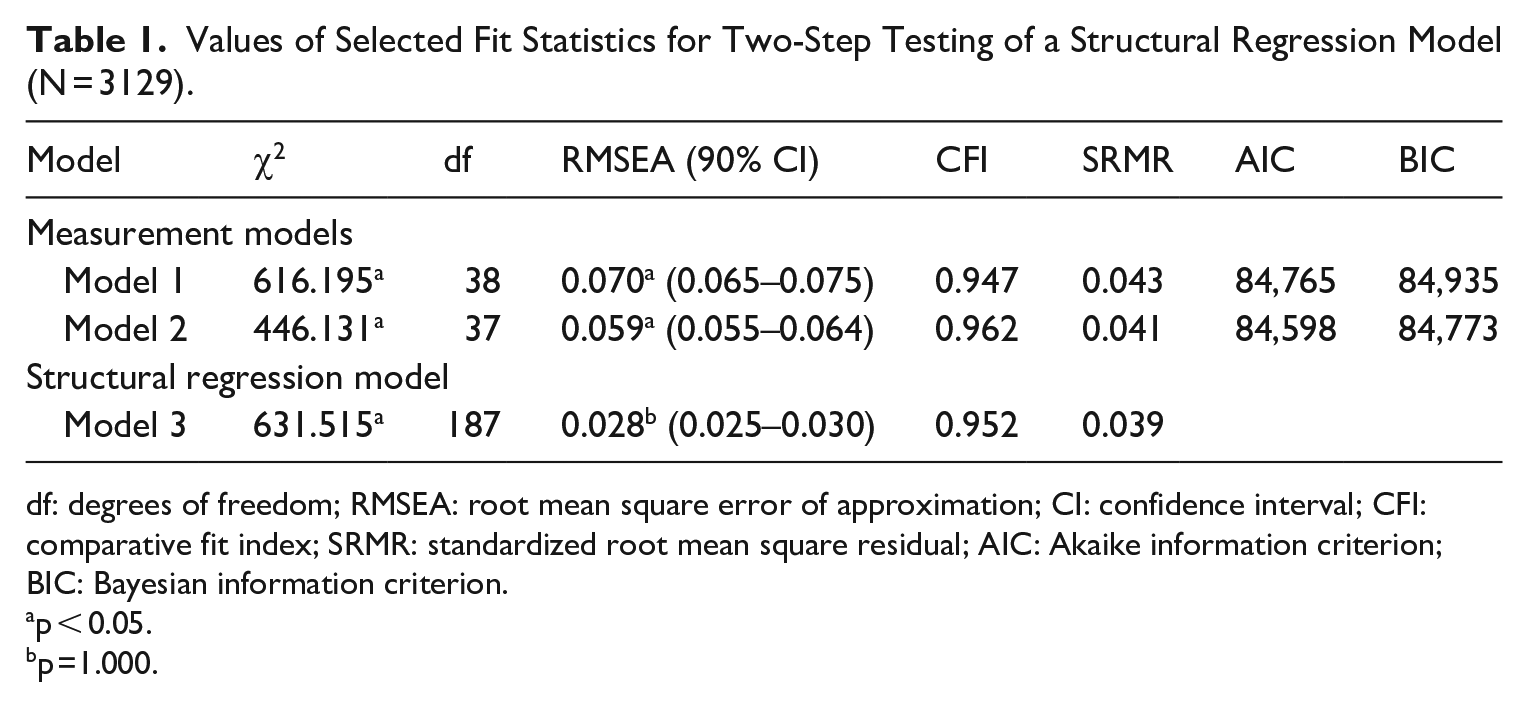
df: degrees of freedom; RMSEA: root mean square error of approximation; CI: confidence interval; CFI: comparative fit index; SRMR: standardized root mean square residual; AIC: Akaike information criterion; BIC: Bayesian information criterion.
p < 0.05.
p =1.000.
The standardized loadings of each item in the full model as presented in Table 2 are well above 0.4 (ranging from 0.542 to 0.964), showing that the items are good indicators for our constructs (Saris et al., 2009). The McDonald’s Omega (McDonald, 1999), used to identify factor reliability, indicates sufficient internal consistency within the factors, with all reliabilities exceeding 0.7 (IWE = 0.802, EWE = 0.745, IPE = 0.775, EPE = 0.880). 13 Furthermore, the discriminant validity (i.e. the determination of whether the factors are different constructs) is sufficient with factor intercorrelations ranging between 0.063 and 0.326. 14
Maximum Likelihood Estimates of Factor Loadings for the Measurement Model (N = 3129).
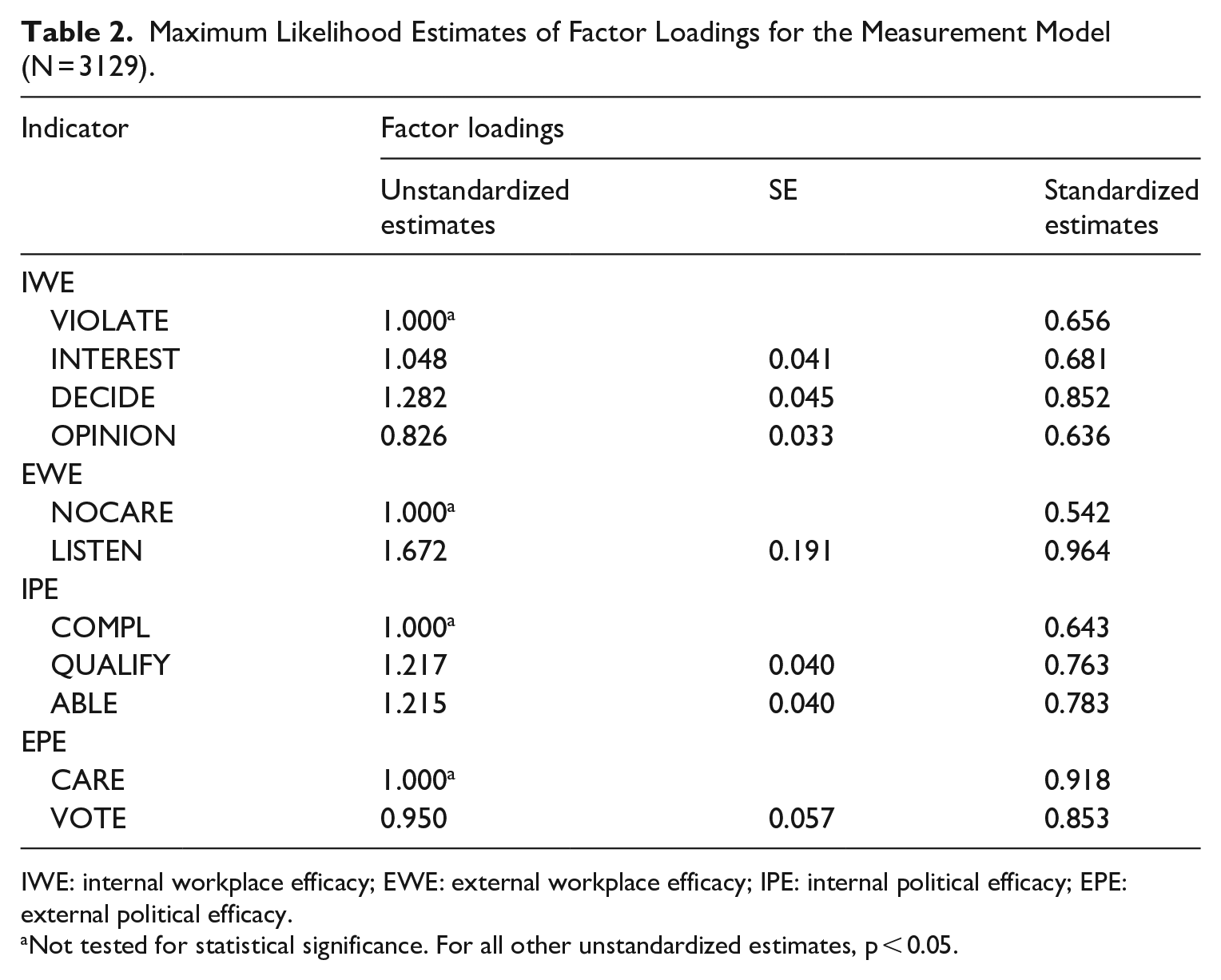
IWE: internal workplace efficacy; EWE: external workplace efficacy; IPE: internal political efficacy; EPE: external political efficacy.
Not tested for statistical significance. For all other unstandardized estimates, p < 0.05.
We assessed the fit of Model 2 using several fit statistics (see Table 1). The chi-square measures the discrepancy between the covariance matrices of the model and the data. The ratio between the chi-square statistic and the degrees of freedom of the model indicates how well the data fit the model. However, since this chi-square statistic is largely dependent on the sample size (Bentler and Bonett, 1980; Hoe, 2008; Kline, 2011) and our sample is large (N = 3129), the chi-square test is not suitable for our models (Mueller, 1997; Raykov and Marcoulides, 2012). 15 The root mean square error of approximation (RMSEA), a fit statistic that does control for sample size, indicates adequate fit. Other fit statistics also indicate that the measurement model fits the data well (comparative fit index (CFI) > 0.95, standardized root mean square residual (SRMR) < 0.06; Hu and Bentler, 1999). We thus conclude that both IWE and EWE are coherent constructs that are different from both political efficacy constructs.
Structural Regression Model Fit
After establishing the validity of our measurement model, we analyze the structural regression model. This allows us to simultaneously test theoretical pathways and to include latent variables in the analysis. The fit statistics of the full model are presented in Table 1 (Model 3). The CFI is unreliable to evaluate DWLS models (Nye and Drasgow, 2011), but the RMSEA (<0.08) and the SRMR (<0.06), the most robust fit index to evaluate model fit (Shi and Maydeu-Olivares, 2020), show that our structural regression model provides a good fit. In conclusion, our measurement models and the structural regression model provide an indication that our data fit our theoretical model well.
Test of the Hypotheses
Estimates for the structural regression model are presented in Table 3. Figure 2 is a graphical presentation of the structural regression model with standardized effects. 16 H1a predicts a positive effect of the support by supervisor on IWE. Table 3 shows that this effect is indeed positive (0.08) and significant. This suggests that H1a is corroborated: individuals whose voice expression is supported by their supervisor have a higher IWE compared to individuals whose voice expression was not supported. Next, we see that the effects of both silencing and punishment by supervisor on IWE are insignificant. We thus reject H1b, which predicted a negative relationship between the supervisor’s suppression and IWE.
Coefficients and the Explained Variance of the Structural Regression Model (N = 3129).
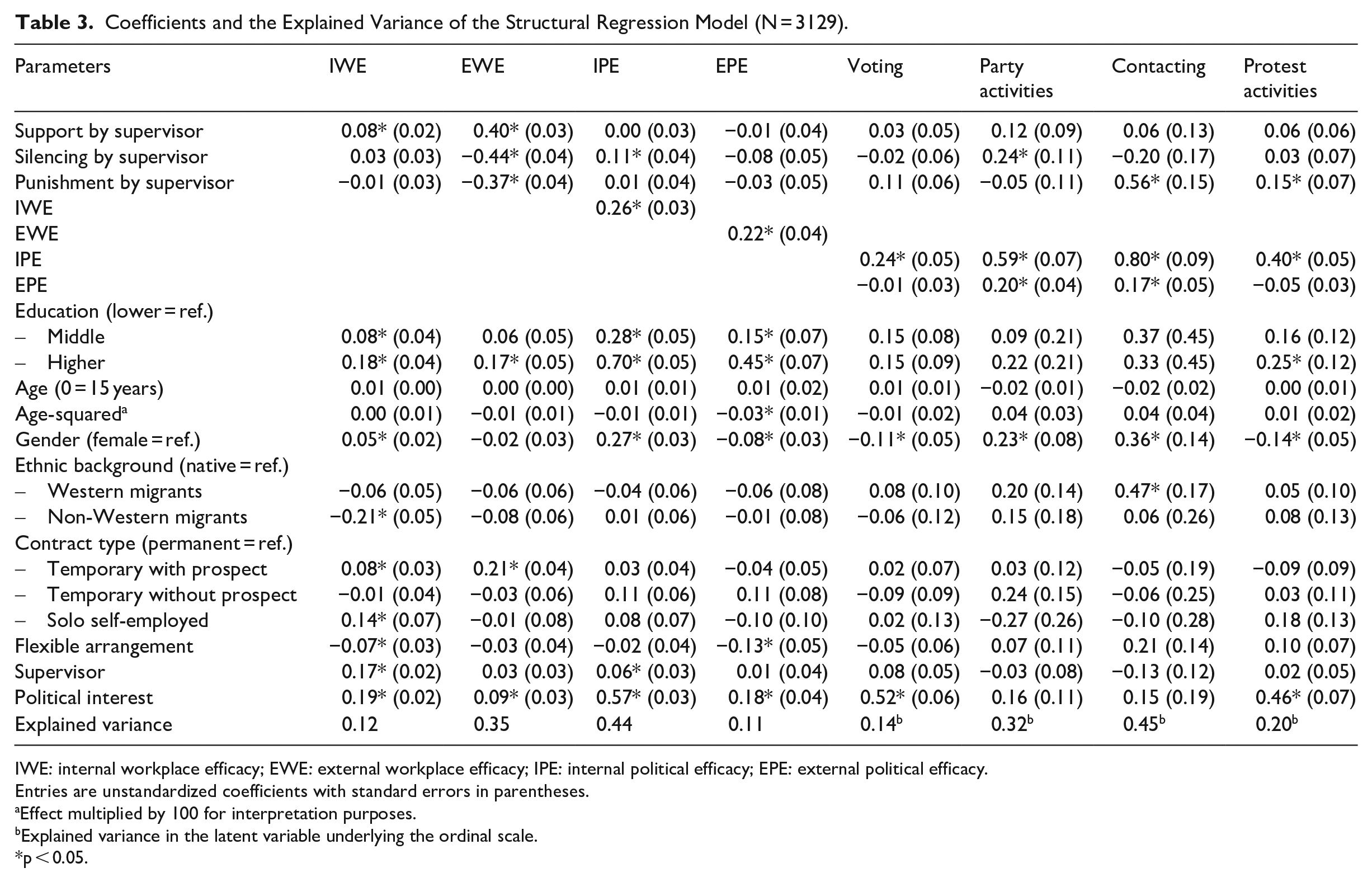
IWE: internal workplace efficacy; EWE: external workplace efficacy; IPE: internal political efficacy; EPE: external political efficacy.
Entries are unstandardized coefficients with standard errors in parentheses.
Effect multiplied by 100 for interpretation purposes.
Explained variance in the latent variable underlying the ordinal scale.
p < 0.05.
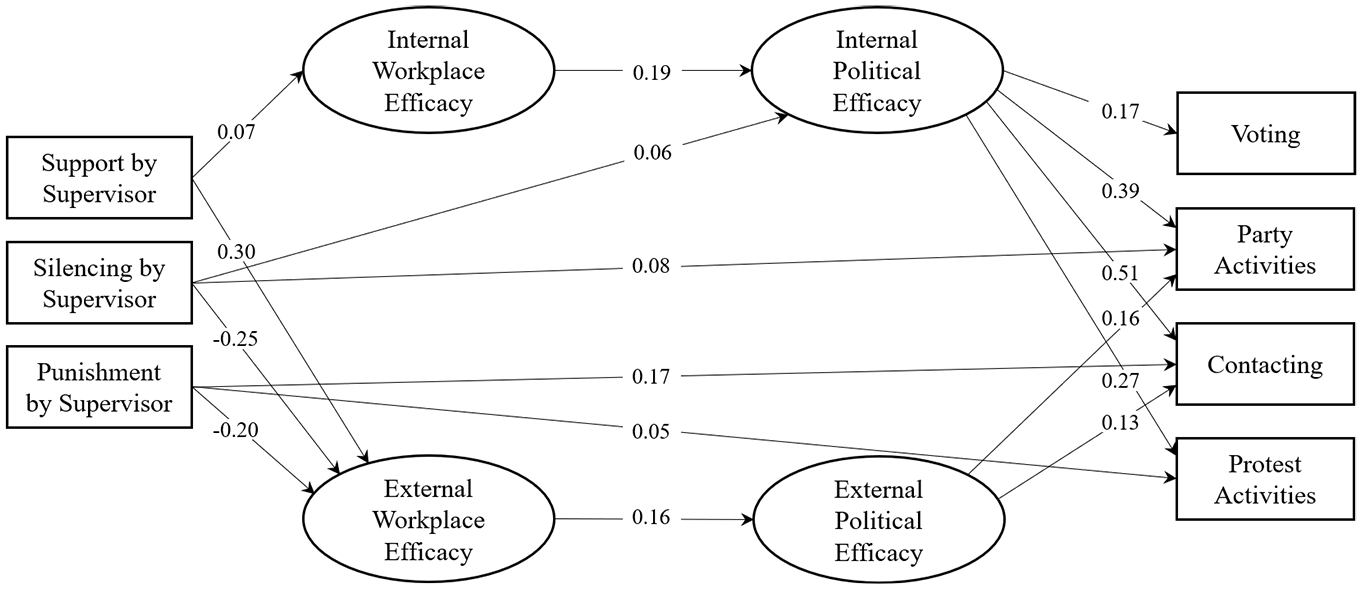
Structural Equation Model of the Spillover Mechanism from Supervisor’s Responses to Workplace Voice to Political Participation.
The effect of support by supervisor on EWE is positive and significant (0.40); individuals whose voice expression was supported have a higher EWE compared to individuals whose voice expression was not supported (H2a). The expected negative relationship between the supervisor’s suppression and EWE (H2b) also turns out to be significant for both silencing (–0.44) and punishment by supervisor (–0.37). This indicates that individuals whose voice was suppressed have a lower EWE compared to individuals whose voice was not suppressed. Thus, we find support for both H2a and H2b. The effect of IWE on IPE is positive and significant. Thereby, we corroborate H3. For the spillover of EWE to EPE, we hypothesized a positive relationship (H4). The result in Table 3 shows a positive relationship (0.22), by which we also corroborate H4. Thus, there is a positive relationship between workplace efficacy and political efficacy.
The link between IPE and political participation is significant and positive for all modes of political participation with standardized effects ranging from 0.17 (for voting) to 0.51 (for contacting). These findings corroborate H5. The expected positive relationship between EPE and political participation (H6) also turns out to be significant, but the effect is not significant on all modes of political participation. The link between EPE is positive and significant for party activities and contacting, with standardized effects of, respectively, 0.16 and 0.13. However, no significant relations are observed for voting and protest activities. So, individuals with higher levels of EPE are not more likely to vote or to protest. Protest activities therefore attract both individuals with stronger and weaker levels of EPE and voting is a common mode of participation; individuals apparently vote regardless of their feeling of responsiveness of political elites.
In our model, we also added effects between the supervisor responses to workplace voice and political efficacy. We added these direct effects because these effects have been often hypothesized and tested in previous studies (e.g. Carter, 2006; Jian and Jeffres, 2008; Pateman, 1970). Our model indicates that for IPE, the effect of support by supervisor is mediated by IWE, while the effect of a silencing by supervisor does directly affect IPE, but, counterintuitive, the effect is positive. Although the effect is small, this finding means that people whose voice expression was silenced by their supervisor have a higher IPE than people whose voice was not silenced. A possible explanation for this positive relationship is that being silenced at work teaches employees how not to voice effectively, which fosters their IWE. Perhaps individuals learn from both positive and negative responses. For EPE, our model shows that the effects of responses of supervisors to voice expression are fully mediated by EWE. Thus, after including EWE, there is no direct significant effect of the responses of supervisors on EPE. These empirical findings suggest that our theoretical model offers an important contribution to a better understanding of the relationship between experiences with voice at work and different modes of political participation.
Furthermore, we tested the direct relationship between supervisor’s responses and different modes of political participation. We find positive significant effects between supervisor’s suppression and three modes of political participation. Individuals who experienced silencing by their supervisor are more active in party activities and those who are punished by their supervisor are more active in contacting and in protest activities. Especially the effect of punishment by the supervisor on contacting is substantial, outperforming the effect of EPE in terms of size of the standardized effect. This observation may be explained by a similar observation in strike research: restrictions to the right to strike are followed by an increase in alternative protests (Hebdon, 2005). This suggests that when the roads to successful workplace voice are closed, workers may seek alternative outlets for their discontent, for example, political action. So, the effect of punishment by supervisor on contacting is negative via one of the hypothesized efficacy effects (i.e. via EWE), but, at the same time, there is a positive direct effect of punishment by supervisor on contacting. This finding indicates that the effects of punishment by supervisor on political participation are not fully captured by the efficacy mechanism and that an additional “compensation” effect applies. Alternatively, since we use cross-sectional data, we cannot exclude the possibility that individuals who are more likely to participate in politics are more likely to induce suppressive responses by their supervisors. Either way, more research is needed to address this positive relationship.
With regard to our control variables, we find that higher educated individuals have higher levels of workplace efficacy and political efficacy, and are more likely to participate in protest activities compared to lower educated individuals. Furthermore, we find a curvilinear relationship between age and EPE, with employees having increasingly higher levels of EPE until they are 34, after which it drops. With regard to gender, we find that men have higher levels of IWE and IPE, but lower levels of EPE compared to women. In addition, women are more likely to vote and to protest, but less likely to participate in party activities and contacting. Non-Western migrants have lower levels of IWE compared to natives, while Western migrants are more likely to participate in contacting types of political participation than natives. Our results show that, compared to permanent employees, individuals with a temporary contract with prospect of a permanent contract have higher levels of workplace efficacy and those who are solo self-employed have higher levels of IWE. Apparently, individuals with a prospect of a permanent contract have higher levels of workplace efficacy compared to individuals who already have a permanent contract. Furthermore, individuals with a flexible arrangement in their contract have lower levels of IWE and EPE and individuals who are themselves supervisors have higher levels of IWE and IPE. Finally, those who are interested in politics have higher levels of all types of efficacy and are more likely to vote and protest.
Overall, our findings indicate a substantial effect of experiences with voice expression at work on political participation, via workplace efficacy and political efficacy. Supervisor’s suppression has an effect on both IPE and EPE, and for the latter, this effect is fully mediated by EWE. The findings for the effect of supervisor’s support show that the effects on both IPE and EPE are mediated by their workplace efficacy counterparts. In line with previous research, both IPE and EPE turn out to have a significant positive effect on political participation, though EPE is not related to voting and protest activities. Furthermore, there turns out to be a direct positive relationship between supervisor’s suppression and some modes of political participation, suggesting a compensation effect in addition to our hypothesized spillover mechanism.
Conclusion
The recent deterioration of traditional labor market institutions, such as the declining power of trade unions and the increasing popularity of temporary work, has made employees more vulnerable to retaliation and silencing when attempting to address issues they have at work. Given that the workplace is expected to be an important agent for political socialization into political participation (Greenberg et al., 1996; Jian and Jeffres, 2008), changes in workplace relations are likely to affect political participation. Our study finds a clear connection between workplace voice and political voice, and adds an explanation to changes in political participation (Blais et al., 2004; Bovens and Wille, 2017; Dalton, 2008). Previous research shows that especially individuals in atypical work arrangements (e.g. temporary contracts) and those with high levels of job insecurity are less likely to be supported and more likely to be suppressed by their supervisor (Sluiter et al., 2020). Given that individuals who are already less likely to participate politically more often work in such atypical forms of employment and have lower job security (e.g. lower educated; Macmillan and Azzollini, 2020; Van Gaalen et al., 2013), linking experiences in the workplace to political participation offers new insights in increasing political inequalities (see Bovens and Wille, 2017).
We contribute to the existing research on the impact of experiences with participation at work on political participation in three ways. First, most studies focus on experiences at the workplace within rare workplace structures, such as worker cooperatives (e.g. Pateman, 1970), or do not directly test the effects of more common interactions in the workplace on political participation (see for an exception Stanojevic et al., 2020). In this study, we address more common experiences at work by focusing on responses of supervisors to workplace voice. Second, existing research commonly theorizes positive effects of workplace experiences on political participation but mostly neglects the effects of negative experiences (but see Greenberg et al., 1996). We build upon these studies by also theorizing a negative spillover between work and politics. Specifically, we address how both positive and negative responses to voice in the workplace affect political participation. Thereby, we relax the implicit idea in previous studies that the workplace mimics an ideal liberal democracy per se. Third, we build on existing research suggesting that the relationship between workplace experiences and political efficacy is indirect rather than direct. We propose a mechanism in which workplace efficacy mediates the relationship between experiences in the workplace and political efficacy by introducing and separating workplace efficacy’s internal and external dimensions, following established measurements of political efficacy. In short, we show how experiences with voice expression at work affect political efficacy and political participation. In addition, we find that there are still other mechanisms at play between workplace participation and political participation, as we find direct effects between suppression of voice and political participation. Hence, our findings add to existing theory by connecting people’s working lives and their political lives.
Our measurements of workplace efficacy appear coherent constructs that partly mediate the effect of supervisor’s responses to voice at work on political efficacy. Furthermore, we find that positive experiences with participation at work—as suggested by previous work—positively affect both IWE and EWE. Our results indicate that supervisor’s suppression indirectly affects political participation via EWE and EPE. We did not find an effect of supervisor’s suppression on IWE. These findings imply that negative experiences with voice at work only affect people’s view of how responsive workplace authority is and do not affect the confidence in their own voice capabilities. These findings indicate that positive and negative experiences with voice at work trigger different mechanisms. In addition, we find a positive direct effect between supervisor suppression and political participation: silencing responses increase the likelihood of engaging in party activities, and punishing responses increase contacting political actors and protest participation. Suppression lowers efficacy but seems to stimulate people to look for alternative outlets, that is, political action, suggesting a combined effect of the hypothesized spillover mechanism and a compensation effect. Thereby, suppressive responses of supervisors can trigger both positive and negative effects on political participation. Finally, we find that individuals with stronger feelings of political efficacy are more likely to be active in all modes of political participation, with the exception of EPE for which we did not find an effect on voting and protest activities. These absent effects of EPE on voting and protesting are in line with findings of some previous research (e.g. Finkel, 1987).
Our study focuses on how supervisor’s responses to workplace voice affect political participation in the Netherlands. The measurements that we developed facilitate comparative research, which would test the generalizability of our findings to other countries. Further research may find interesting cross-country differences in the effect of workplace voice on political participation, for example, depending on certain labor market characteristics or on different political systems. Second, in our study, we focus on political socialization experiences in the workplace. However, political socialization experiences in other environment (e.g. civic associations) may also affect levels of political participation. We welcome further research to apply the mechanisms as proposed in this article in other environments and, even more interesting, compare the relative impact of experiences on political participation between different environments. Third, next to the spillover mechanism via political efficacy, we find an alternative mechanism linking experiences with voice at work and political participation. Further research could identify possible explanations for this positive relationship between suppression of voice and some modes of political participation (e.g. a compensation effect). Finally, we base our findings on cross-sectional data. Therefore, the causal effects that we assume are supported by theory only. Previous work suggests that the effect of political efficacy on political participation is stronger than the other way around (e.g. Finkel, 1985) or that political participation may also influence workplace participation (e.g. Cohen and Vigoda, 1999). Further research could identify the reciprocal links between efficacy and participation and between participation in the workplace and participation in politics to get a better understanding of the direction of the effects, using panel data.
Supplemental Material
sj-pdf-1-psx-10.1177_0032321720960969 – Supplemental material for Political Participation and Workplace Voice: The Spillover of Suppression by Supervisors
Supplemental material, sj-pdf-1-psx-10.1177_0032321720960969 for Political Participation and Workplace Voice: The Spillover of Suppression by Supervisors by Bram Geurkink, Agnes Akkerman and Roderick Sluiter in Political Studies
Footnotes
Acknowledgements
We would like to thank the anonymous reviewers and the journal editors for their helpful comments and suggestions. Furthermore, we are grateful to Alex Lehr, Monique Leyenaar, Ulrich Schroeders, and Andrej Zaslove for feedback on earlier versions of the manuscript.
Declaration of Conflicting Interests
The author(s) declared no potential conflicts of interest with respect to the research, authorship, and/or publication of this article.
Funding
The author(s) disclosed receipt of the following financial support for the research, authorship, and/or publication of this article: This work was supported by the Netherlands Organization for Scientific Research (grant number 453-15-001).

Supplementary Information
Additional Supplementary Information may be found with the online version of this article.
Contents
Appendix 1. Types, Frequency and Modes of Political Participation Appendix 2. Supervisors’ Responses to Voice Appendix 3. Descriptives of Observed Variables in Analyses Appendix 4. Pearson’s r Correlation Matrix Appendix 5. Maximum Likelihood Estimates of Factor Variances and Covariances and Error Covariance for the Measurement Model Appendix 6. Standardized Coefficients of the Structural Regression Model
Notes
Author Biographies
References
Supplementary Material
Please find the following supplemental material available below.
For Open Access articles published under a Creative Commons License, all supplemental material carries the same license as the article it is associated with.
For non-Open Access articles published, all supplemental material carries a non-exclusive license, and permission requests for re-use of supplemental material or any part of supplemental material shall be sent directly to the copyright owner as specified in the copyright notice associated with the article.
