




Abstract
What shapes legislators’ incentives for personal vote-seeking in parliament? Recent work suggests that partisanship among voters deters personal vote-seeking, by limiting its effectiveness. This has potentially significant implications for policy-making, election results and patterns of accountability. However, empirical tests of this argument remain few in number and have several limitations. This article thus offers a new test of the relationship between partisanship and personal vote-seeking. Using legislators’ bill proposals as an indicator of their personal vote-seeking activity, I analyse legislative behaviour in the UK House of Commons between 1964 and 2017. I find that members of parliament make more legislative proposals when voters are less partisan. Moreover, partisanship appears to moderate the influence of other drivers of personal vote-seeking: electorally vulnerable legislators make more legislative proposals, but only at low levels of partisanship. These findings provide new evidence that voters’ relationships with political parties affect legislators’ electoral strategies and parliamentary behaviour.
Keywords
A large body of scholarship suggests that legislators use parliamentary behaviour to cultivate a personal vote. By treating parliament as an arena for signalling their individual qualities, positions and achievements, they can generate personal electoral support, beyond the votes attracted by their party label (Mayhew, 1974). This personal vote-seeking has a number of important consequences. It can produce more particularistic policy-making (Ames, 1995; Golden, 2003), and can dilute the coherence and popularity of parties’ brands (Cox and McCubbins, 2005; Greene and Haber, 2015). Moreover, it might undermine the role of elections as tools for ensuring the accountability of parties, by directing voters’ attention to individual candidates. However, the extent of personal vote-seeking behaviour varies widely, both within and across parliaments.
Existing explanations of variation in personal vote-seeking give strikingly little consideration to its intended audience: voters. Instead, they focus predominantly on electoral institutions (Carey and Shugart, 1995) or features of individual legislators such as electoral vulnerability (Kellermann, 2016), gender (Lazarus and Steigerwalt, 2018) or local constituency ties (Tavits, 2009). This oversight is surprising. It seems intuitive that legislators’ electoral strategies should respond to the characteristics of those whose support they want to attract. In particular, the relative effectiveness of party-based and candidate-based electoral appeals should depend on voters’ partisanship. This article therefore explores the relationship between partisanship among voters and personal vote-seeking by their representatives.
Some recent scholarship has argued that members of parliament (MPs) engage in more personal vote-seeking when voters are less partisan. In particular, Kam (2009) suggests that voters with weaker partisan loyalties are more responsive to the merits of individual MPs. Weaker partisanship among voters therefore increases the effectiveness of personal vote-seeking, making it a more attractive strategy for MPs. In line with this argument, recent studies indicate that legislators facing less partisan electorates vote more rebelliously (André et al., 2015a; Kam, 2009), ask more constituency-focused questions (Zittel et al., 2019) and engage in less corruption (Eggers, 2014). Faced with less partisan voters, legislators appear more concerned about their individual reputation. Given the well-documented decline of partisanship across advanced democracies (Dalton, 2000), this has significant implications for the ongoing viability of political parties inside parliaments.
However, existing attempts to empirically link partisanship and personal vote-seeking have several limitations. First, they focus predominantly on one type of legislative behaviour: rebellious voting (André et al., 2015a; Kam, 2009). This focus has a number of advantages – voting dissent can be a very high-profile form of personal vote-seeking, with direct consequences for policy outcomes and government survival. However, dissent is relatively rare, and many other kinds of behaviour can be tools for personal vote-seeking, including bill proposals (Bowler, 2010), questions (Kellermann, 2016), speeches (Proksch and Slapin, 2015) and committee work (Martin, 2011). Given this, existing work may have captured only a small portion of partisanship’s consequences for legislative behaviour.
Second, existing work has not explored how partisanship interacts with other drivers of personal vote-seeking. If high partisanship limits the effectiveness of personal vote-seeking, it should limit MPs’ desire to engage in it, regardless of their other incentives for doing so. Conversely, the influence of other factors should be stronger when lower partisanship makes personal vote-seeking a more viable strategy. Existing work has not explored this possibility, despite recent studies suggesting that different drivers of personal vote-seeking interact with each other (André et al., 2015b; Shomer, 2017; Sieberer and Ohmura, 2019). Partisanship’s consequences for personal vote-seeking may thus be more complicated than previously argued.
Third, very little existing work has actually tested partisanship’s consequences for the legislative behaviour of individual MPs. Previous studies have instead analysed party-level cohesion (Kam, 2009), survey responses (André et al., 2015a) and non-legislative behaviour (corruption) (Eggers, 2014). Only one study has empirically linked voters’ partisanship to the parliamentary behaviour of individual MPs – Zittel et al. (2019) show that German MPs facing less partisan electorates ask more constituency-focused parliamentary questions. This article thus contributes to an emerging, but incomplete, body of literature.
The central argument of the article is simple. Personal vote-seeking relies on voters taking account of individual legislators’ record in office, but not all voters do so. In particular, voters with strong loyalties to a party will almost always support its candidates, and oppose those of rival parties, regardless of the candidates’ personal qualities. By contrast, voters with weaker party loyalties are more likely to be influenced by the qualities of individual candidates. As a consequence, MPs should engage in more extensive personal vote-seeking when faced with less partisan voters. Partisanship should also moderate the effects of other drivers of personal vote-seeking, by limiting its effectiveness. For example, electorally vulnerable MPs have greater incentives to cultivate a personal vote. But even very marginal MPs should have few incentives to do so in contexts where widespread partisanship renders it ineffective.
The article tests this argument by analysing legislative behaviour in the UK House of Commons between 1964 and 2017. I use MPs’ bill proposal activity as an indicator of their personal vote-seeking and measure partisanship as the proportion of the electorate identifying ‘very strongly’ with a political party. I find that MPs make more legislative proposals when voters’ partisanship is weaker. Furthermore, partisanship moderates the negative relationship between MPs’ electoral security and their bill proposal activity. Of course, this is purely observational evidence, and partisanship – especially when measured at a national level – may be correlated with other variables that also affect MPs’ personal vote-seeking. I thus address a number of alternative explanations for these findings, by controlling for potential confounders and by exploring the consequences of a sudden drop in partisanship in the 1970s.
The key empirical contribution of this article is to offer new evidence suggesting that partisanship among voters shapes legislators’ personal vote-seeking behaviour. Unlike most previous work, it shows this at the level of individual legislative behaviour, and for a type of behaviour other than rebellious voting. The article also makes a theoretical contribution, by highlighting how partisanship moderates the influence of other drivers of personal vote-seeking. These findings have implications for a number of broader debates in political science, regarding dealignment’s consequences for legislative politics (Bowler, 2000; Kam, 2009; Thies, 2000), the electoral basis of legislative behaviour (André et al., 2014), the relationship between accountability and partisanship (Eggers, 2014; Kayser and Wlezien, 2011), and the political conditions that encourage ‘valence’ politics (Green, 2007; Pardos-Prado, 2012; Rudolph and Däubler, 2016).
The rest of the article proceeds as follows. The following section sets out the theoretical argument and hypotheses. I then describe the research design and data. The next section presents the analysis, before I conclude by summarising the article’s argument, findings and implications.
Partisanship and Personal Vote-Seeking
The theory tested here begins with the argument that strong party loyalties can crowd out other influences on citizens’ voting behaviour. If a voter has a strong attachment to a party, they will be highly likely to vote for it. This leaves little room for other considerations to affect their vote choice. Because non-partisan voters are free from this influence, they are more open to the influence of other factors. This alters how they choose between parties: less partisan voters rely more on ‘valence’ judgements about parties’ records (Kayser and Wlezien, 2011; Lupu, 2016). But less partisan voters may also be more inclined to look beyond parties and consider the qualities of individual candidates. While strongly partisan voters will support their party regardless of the merits of individual candidates, non-partisan voters are more likely to reward ‘good’ candidates and less likely to support ‘bad’ ones (Eggers, 2014; Kam, 2009). Voters who identify with a party, but not strongly, lie between these two poles. The stronger a voter’s partisanship, the more likely they are to instinctively support their party and the less likely they are to consider the merits of specific candidates.
MPs should respond to this, because their primary goal is achieving re-election, either for its own sake or, more often, as a necessary pre-condition for attaining their various policy-seeking and office-seeking objectives (Mayhew, 1974; Strøm, 1997). The key strategic decision facing legislators is how far to cultivate their own individual electoral support – a personal vote – rather than relying solely on their association with a party label (Cain et al., 1987; Carey and Shugart, 1995). Voters’ partisanship should affect this decision: if voters with weaker party ties are more influenced by individual candidates’ qualities, they should be more receptive to personal vote-seeking. MPs can detect the level of partisanship among voters because it has clear and important political consequences, influencing turnout, electoral volatility and party system fragmentation (Dalton et al., 2000; Fieldhouse et al., 2020; Heath, 2007). Lower levels of partisanship in the electorate thus make personal vote-seeking a more viable, and so a more attractive, re-election strategy for legislators.
Legislative behaviour is an important tool for personal vote-seeking. It allows legislators to signal individual characteristics, policy positions and achievements which are attractive to voters (what Mayhew (1974) dubs ‘advertising’, ‘position-taking’ and ‘credit-claiming’). Although existing work linking partisanship and personal vote-seeking focuses chiefly on the position-taking potential of rebellious votes, the broader literature on personal vote-seeking suggests that it can be pursued through a wide range of parliamentary activities, including bill proposals (Bowler, 2010), questions (Kellermann, 2016), speeches (Proksch and Slapin, 2015) and committee work (Martin, 2011). As a result, legislators facing less partisan voters should have stronger incentives to engage in any legislative behaviour suitable for personal vote-seeking.
Party leaders have an incentive to limit personal vote-seeking, in order to protect their party’s reputation with voters. This is especially true of voting dissent, which can undermine parties’ ability to pursue coherent policies and to take or hold office. But individualistic speeches, bill proposals and questions can also contradict a party’s brand. Even if they do not, they may still dilute that brand, by increasing the range of messages voters receive. At a minimum, personal vote-seeking carries an opportunity cost for parties – time spent promoting an MP’s individual reputation is not spent promoting the party’s collective message. Party leaders have a range of tools for deterring, blocking and punishing attempts at personal vote-seeking. In particular, they can use their control over various executive and legislative offices to threaten legislators’ future access to these sources of prestige, policy influence and electoral resources (Kam, 2009; Martin, 2014). They may also be able to prevent speeches from MPs who do not toe the party line (Proksch and Slapin, 2015), and – if in government – prevent discussion of proposals that divide their party (Cox and McCubbins, 2005).
However, party leaders may still tolerate, or even encourage, a limited amount of personal vote-seeking, calculating that electoral gains for some MPs might outweigh the collective downsides for the party (Proksch and Slapin, 2015). This is because their motivation for protecting the party brand is primarily electoral – they want to maximise their party’s seat share and thus their own chances of holding office (Cox and McCubbins, 2005). If personal vote-seeking helps particular MPs win re-election, it contributes to this goal. It only threatens that goal when the electoral consequences of damaging the party’s collective brand outweigh the electoral advantages for certain candidates. Leaders should thus allow personal vote-seeking up to the point where it ceases to provide a net electoral benefit to the party (Proksch and Slapin, 2015). This suggests that parties will tolerate a greater amount of personal vote-seeking when they expect it to be more effective.
Party leaders thus respond to the same electoral incentives as their MPs. As a result, lower partisanship should simultaneously increase MPs’ desire to engage in personal vote-seeking and party leaders’ willingness to tolerate it. This produces the following expectation.
Hypothesis 1: Legislators engage in more extensive personal vote-seeking when voters are less partisan.
Partisanship’s effects should also interact with other drivers of personal vote-seeking. Even MPs who would otherwise have strong incentives to seek a personal vote will not do so if widespread partisanship renders it ineffective. One prominent source of personal vote-seeking incentives is MPs’ electoral (in)security. MPs who win their seat comfortably at one election are less likely to fear losing it at the next, so invest less time and resources into securing re-election. 1 Again, MPs’ incentives align with those of their party leaders. Leaders should be particularly tolerant of personal vote-seeking by MPs from marginal constituencies, where small amounts of personal vote-seeking can have nonetheless important benefits for the party’s overall seat share. Consequently, a widespread finding in legislative studies is that electorally vulnerable MPs engage more extensively in activities that can be used for personal vote-seeking (see, for example, Bowler, 2010; Kellermann, 2016). If partisanship shapes the effectiveness of personal vote-seeking, this relationship should be conditional – electoral insecurity should only incentivise personal vote-seeking when partisanship is low enough to make it worthwhile.
Hypothesis 2: Electoral security has a stronger negative effect on the extent of personal vote-seeking when voters are less partisan.
These arguments rely on voters being able to indicate a preference among candidates. Without such a mechanism, MPs cannot be individually rewarded for personal vote-seeking, regardless of voters’ partisanship. Electoral systems therefore constitute an important scope condition – the effect of partisanship on legislative behaviour should be clearest under candidate-centred electoral systems, where it is easiest for voters to reward personal vote-seeking. 2
Research Design and Data
Case Selection
I test these hypotheses by examining legislative behaviour in the UK House of Commons between 1964 and 2017. The United Kingdom provides a good case for testing this theory, for several reasons. First, it fits the scope condition described above – British MPs are elected under a single-member district plurality system, so can be individually rewarded for personal vote-seeking. Second, previous work has already shown an electoral component to British MPs’ parliamentary behaviour (Bowler, 2010; Kam, 2009; Kellermann, 2016). Third, a process of partisan dealignment has significantly weakened British voters’ party loyalties since the 1970s, producing substantial variation in my key independent variable (Fieldhouse et al., 2020). Finally, the UK parliament is organised along similar lines to those of other countries influenced by the so-called ‘Westminster model’ of democracy, increasing the potential generalisability of any findings.
Dependent Variable
I focus on one widely used indicator of MPs’ interest in personal vote-seeking – their legislative proposals. Most legislatures provide opportunities for individual MPs to propose legislation, and existing work suggests that doing so increases MPs’ personal vote. In parliamentary systems, procedural restrictions mean such bills rarely pass (Cox and McCubbins, 2011; Mattson, 1995). This limits their capacity to serve particularistic credit-claiming strategies. However, the simple act of proposing legislation allows MPs to send a signal about their effort (advertising) and priorities (position-taking), even when the legislation does not pass. Irrespective of legislative proposals’ content, importance or successful passage, initiating them signals to constituents that the MP is making efforts on their behalf (Bowler, 2010; Bräuninger et al., 2012). The content of proposals can also matter, associating MPs with a locally popular view or cause (Williams and Indridason, 2018). Of course, MPs might also use bill proposals to promote their party’s collective message. But they are particularly well-suited for personal vote-seeking, because they are an activity that MPs undertake as an individual.
The idea that bill initiation can be used as a tool for personal vote-seeking has considerable empirical support. Evidence from a range of countries, including the United Kingdom, shows that legislators with the greatest incentive to cultivate a personal vote are those who propose the most legislation (Bowler, 2010; Bräuninger et al., 2012; Williams and Indridason, 2018). This behaviour also appears to yield electoral returns, with higher bill proposal rates being linked to higher levels of name recognition, better approval ratings and greater electoral support (Bowler, 2010; Däubler et al., 2016; Loewen et al., 2014; Williams and Indridason, 2018). MPs’ efforts at proposing legislation therefore constitute a good indicator of their personal vote-seeking activity.
In the UK House of Commons, legislative proposals by ordinary backbench MPs are called private members’ bills (PMBs). There are three different procedures for introducing PMBs – the ballot, presentation and the Ten Minute Rule. 3 First, members may enter a random ballot for the right to introduce their bills on one of the Friday sittings set aside in each session for discussing PMBs. These bills receive priority over others proposed by backbenchers, so are more likely to actually pass into law (Marsh and Read, 1988: 23). Second, any MP can propose a bill simply by presenting it to the House. Such bills are automatically deemed to have had their ‘first reading’ and are scheduled for their ‘second reading’ at a later date. Third, two MPs a week can propose bills under the so-called Ten Minute Rule. Unlike the presentation procedure, this allows a short speech to be given in favour of the bill, and if the bill is opposed, there can be a vote on the first reading, rather than it being granted automatically. 4
My main dependent variable is the total number of PMBs proposed by each MP in a given parliament (the period between two general elections). I have calculated this for all MPs in each of the 14 parliaments between 1964 and 2017, using data described in Online Supplemental Appendix A. In total, this covers 5198 bill proposals over a period of 53 years. This measure combines bills proposed under all three procedures described above. This is because the procedures are not all equally accessible – while there are no restrictions on the presentation procedure, not all MPs can win the ballot, and Ten Minute Rule speeches are limited to two a week. Analysing any single procedure on its own would ignore the possibility that MPs may draw more heavily on a particular procedure when they are unsuccessful in using others. In particular, they may draw more on the presentation procedure when they are less successful in the other two, more constrained, routes (and vice versa). Combining these counts therefore ensures that my measure captures MPs’ actual preferences over how many bills to propose and thus indicates their interest in personal vote-seeking. Moreover, party whips play an informal role in allocating the two weekly slots for Ten Minute Rule bills among interested MPs (Blackburn et al., 2003: 545). Analysing these bills separately thus offers a further test of my argument that party leaders should actively encourage and facilitate personal vote-seeking when they expect it to bring electoral benefits.
Independent Variables
To test my hypotheses, I use two independent variables – partisanship and electoral security – and the interaction between them. Partisanship is measured as the percentage of respondents reporting a ‘very strong’ party identification in the British Election Study for the general election prior to each parliament. 5 Figure 1 shows how partisanship developed over the period covered by this article.
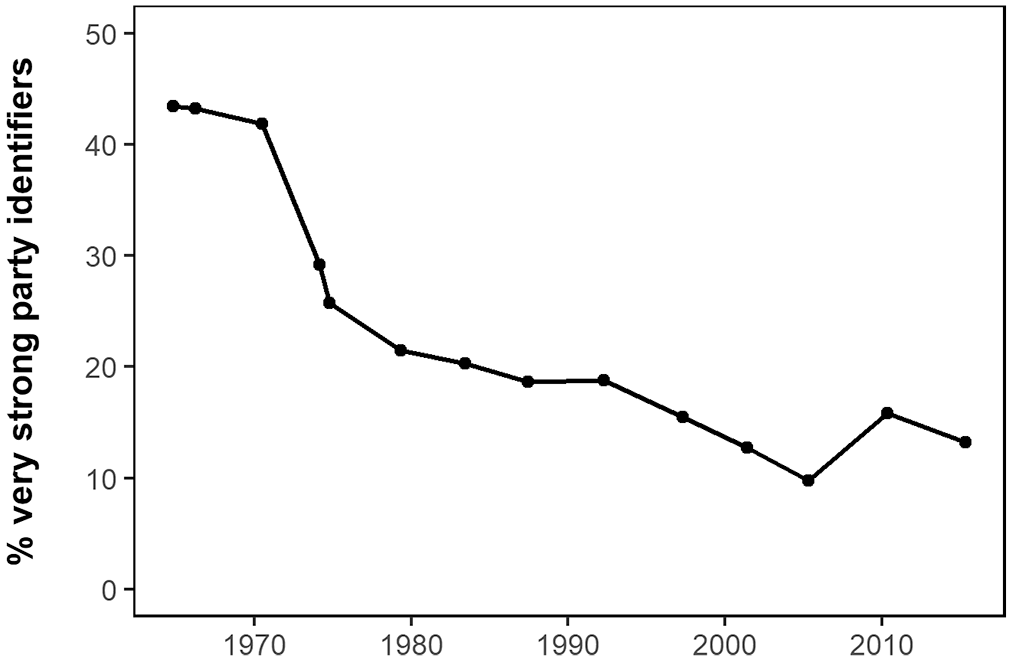
Evolution of Partisanship in Britain, 1964–2015.
Measuring partisanship directly at the national level rather than the constituency level has both a theoretical and empirical justification. Theoretically, changes in national-level partisanship should be easier for MPs to detect. My theory suggests that MPs gauge the level of partisanship among voters from its visible consequences for turnout, electoral volatility and party system fragmentation. All of these should be more obvious at the national level. Empirically, my approach avoids a number of difficulties associated with measuring partisanship at the level of individual constituencies. Disaggregating national-level survey data on partisanship only produces very small, unrepresentative samples of voters for each constituency. 6 Some work instead addresses this problem by using a proxy variable that is theoretically (negatively) related to partisanship and easy to calculate for individual constituencies: electoral volatility (André et al., 2015a; Zittel et al., 2019). However, this approach has a number of downsides. First, net electoral volatility obscures the extent of individual-level vote switching, so provides only a lower bound for the overall level of volatility. Second, electoral volatility can be driven not only by demand (exogenous changes in voters’ preferences) but also by supply (the ‘menu’ of parties available at a given election). Third, even among ‘demand-side’ explanations, partisan dealignment may be only one of several causes of electoral volatility. 7 Given these considerations, it seems preferable to measure partisanship directly, using national-level data.
Electoral security is measured as an MP’s seat margin – the difference in vote share between the winning MP and the second-placed candidate in their constituency at the most recent general election. This was calculated using the Constituency-Level Election Archive (Kollman et al., 2017). 8
Control Variables
The following analyses also include a range of control variables. How these variables are included depends on the justification for their inclusion. One – polarisation – is included because it is a potential confounder, correlated with both partisanship and MPs’ personal vote-seeking. Policy convergence by political parties can both follow and cause partisan dealignment (Green, 2007; Lupu, 2016). Moreover, if party convergence increases the importance of valence concerns (Green, 2007), this could include the qualities of individual candidates and so incentivise greater personal vote-seeking. This control variable therefore ensures that any findings of a relationship between partisanship and my dependent variable are not simply driven by their shared link with polarisation. Given this, I include polarisation in my models in the same manner as I include partisanship – both on its own and as an interaction with electoral security. It is measured as the absolute difference between the Conservative and Labour parties’ scores on the log scaling of the Manifesto Project’s Right-Left measure (Volkens et al., 2019) proposed by Lowe et al. (2011).
A second control variable – a proxy for how far MPs are career politicians – is included for similar reasons. The decline in British voters’ partisanship has coincided with an increase in the number of MPs for whom politics is first and foremost a career (King, 1981). Such politicians might propose greater numbers of PMBs, as they are generally more active and assertive (King, 1981). They may also be more likely to tailor their behaviour to their electoral context, given the importance of re-election for their career prospects (O’Grady, 2019). This variable is thus included on its own and in interaction with electoral security. In the absence of data identifying career politicians across this whole period, I rely on a proxy used in earlier work – the age at which an MP first entered parliament. MPs who enter parliament at a younger age are more likely to view politics primarily as a career (Kam, 2006; King, 1981).
Other control variables are included not because they are correlated with partisanship, but because they should influence MPs’ bill proposal activity. These variables are not interacted with electoral security. First, I control for the number of sitting days in a parliament, expecting more proposals in longer parliaments. Second, I control for MPs being members of the governing party, which typically leads to lower bill proposal rates (Bräuninger et al., 2012; Williams and Indridason, 2018). Third, an indicator of whether MPs stood again at the next general election accounts for impending retirement altering legislators’ behaviour by removing their need to appeal to voters (Zupan, 1990). Finally, I include a binary indicator of whether MPs’ second-placed challenger came from a ‘third’ party (i.e. not the Labour or Conservative parties). Eggers (2014) suggests voters’ preferences between these parties and the main two parties are weaker than their preferences between the main two parties themselves. This incentivises MPs facing third party challengers to care more about their individual reputation. Sources of data for all these control variables are described in Online Supplemental Appendix A.
These variables allow me to explore the relationship between partisanship and bill proposals between 1964 and 2017, testing Hypothesis 1. They also allow me to explore how partisanship affected the relationship between electoral security and bill proposals, testing Hypothesis 2. Of course, in an observational study of this kind, the results may be biased due to confounding variables: the consequences I attribute to partisanship may in fact be due to some other correlated variable. I address this possibility in two ways. First, I include plausible control variables in my analysis, as described above. Second, I conduct a further test of Hypothesis 2 by focusing on a particularly sudden and sizable drop in partisanship in the 1970s, and probing whether this strengthened the relationship between electoral security and bill proposals. Focusing on this narrow window makes it easier to identify and test alternative explanations for any such patterns.
Analysis
Main Results
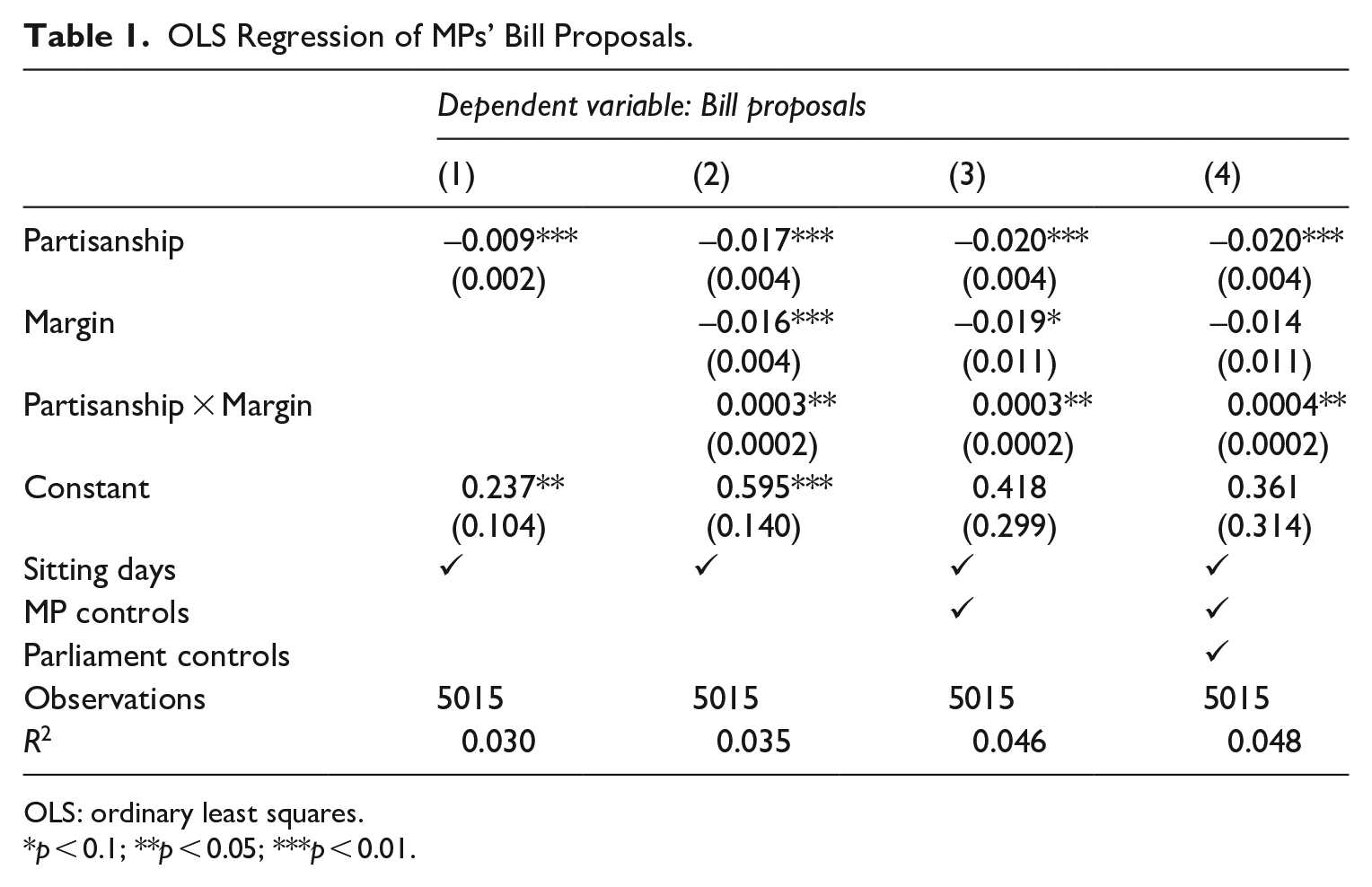
Table 1 presents a series of ordinary least squares (OLS) regression models of bill proposal activity in the House of Commons between 1964 and 2017. The unit of analysis is MP-parliament pairs. The analysis covers all backbench MPs who sat for one of the main two parties (Labour and Conservative) during this period. 9 The first two models include only the independent variables, their interaction and a control for the number of sitting days in each parliament. The third model adds MP-level control variables – government/opposition status, standing for re-election, facing a third party challenger, the age at which MPs first entered parliament and the latter variable’s interaction with electoral security. The fourth model adds parliament-level control variables – polarisation and its interaction with electoral security.
OLS Regression of MPs’ Bill Proposals.
OLS: ordinary least squares.
p < 0.1; **p < 0.05; ***p < 0.01.
The results offer support for both hypotheses. As per Hypothesis 1, there is a significant negative relationship between partisanship and bill proposal activity; holding other variables constant, MPs propose fewer bills when voters are more partisan. As per Hypothesis 2, partisanship appears to condition the relationship between MPs’ seat margin and their bill proposal activity. The main coefficient of MPs’ seat margin is negative (though not consistently statistically significant) – ‘safer’ MPs propose fewer bills. But the interaction between partisanship and seat margin is positive, suggesting that any negative effect of MPs’ seat margin is weaker when partisanship is higher. While the substantive magnitude of the coefficients is relatively small, they nonetheless suggest the expected patterns in MPs’ interest in personal vote-seeking.
To clarify interpretation of the interaction term in these models, Figure 2 shows an MP’s predicted number of bill proposals as a function of their electoral security, at two different levels of partisanship. The left panel shows the relationship between electoral security and bill proposals at a standard deviation above the mean level of partisanship; the right panel shows it at a standard deviation below the mean. The comparison between the two panels shows further support for Hypothesis 2. At high levels of partisanship, an MP’s electoral margin has only a weak relationship with their bill proposal activity – MPs from marginal seats are slightly more active than those from safe seats. When partisanship is low, however, electoral security matters more – there is a clear negative relationship between an MP’s seat margin and their predicted bill proposals. This suggests that the relationship between electoral security and my indicator of personal vote-seeking is conditional on the extent of partisanship, as expected.
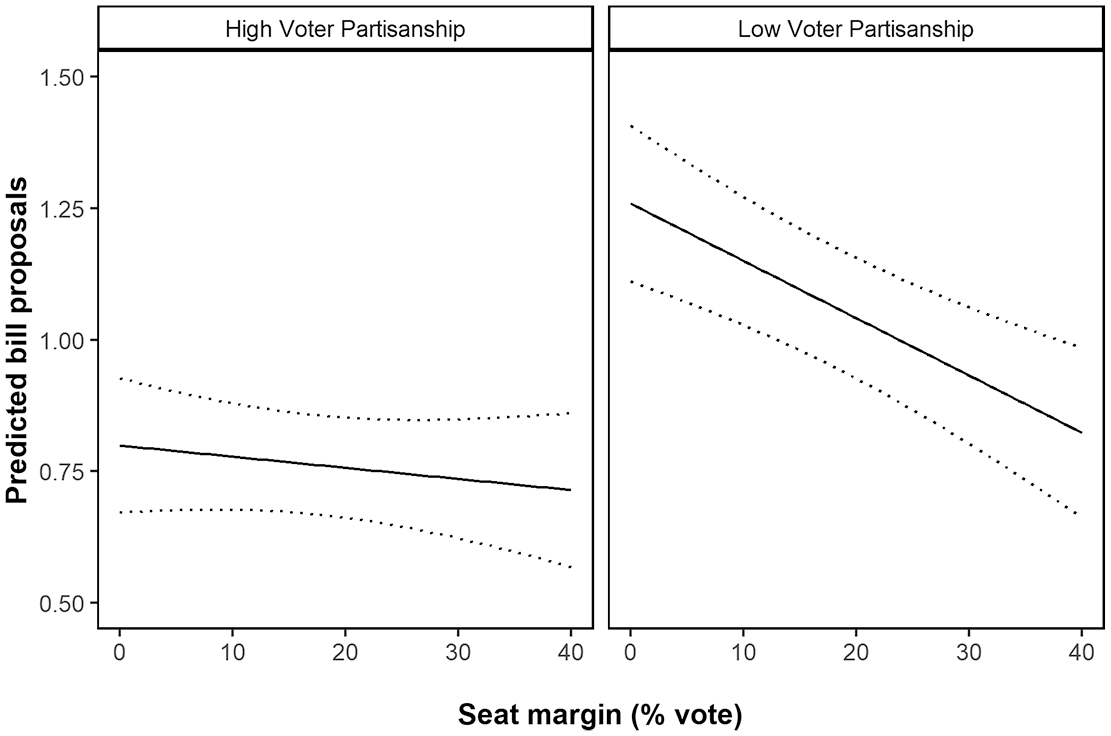
Conditional Relationship between Electoral Security and Bill Proposals.
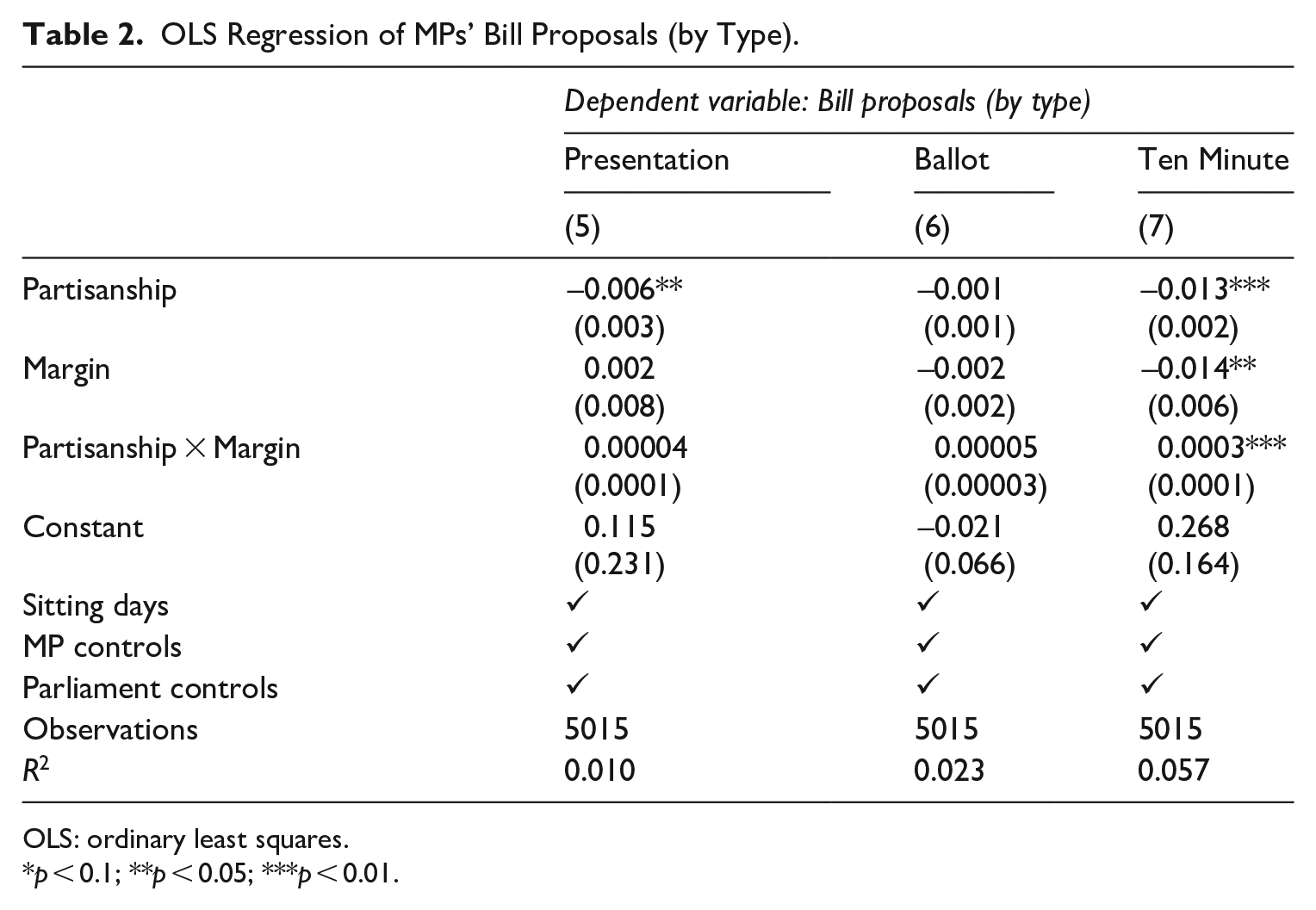
The analysis so far combines bills proposed across three different procedures. The justification for this was discussed above. Even so, these procedures vary in potentially relevant ways. In particular, the higher passage rates of ballot bills, and the speaking opportunities associated with Ten Minute Rule bills, may make them better avenues for credit-claiming and advertising, respectively. Furthermore, parties play a gatekeeping role in allocating opportunities to propose Ten Minute Rule bills. Different types of bill may therefore be driven by different dynamics. Table 2 explores this possibility, repeating the full model from Table 1, but separately for each bill type. The results clearly do differ across types of bill proposal. Partisanship has the expected relationship with presentation bills and Ten Minute Rule bills, but not with ballot bills. Seat margin and its interaction with partisanship only have the expected relationships with Ten Minute Rule bills. Thus, while patterns of presentation bills partially support my expectations, the strongest evidence for my hypotheses comes from Ten Minute Rule bills. Given that party whips play a role in allocating opportunities to propose Ten Minute Rule bills, this finding supports my argument that parties encourage personal vote-seeking when they expect it to bring electoral benefits.
OLS Regression of MPs’ Bill Proposals (by Type).
OLS: ordinary least squares.
p < 0.1; **p < 0.05; ***p < 0.01.
These analyses are robust in a number of ways. They were estimated here using OLS regression, as interpreting OLS coefficients is simpler and more intuitive than those from alternative modelling approaches. However, my findings are not overly dependent on this modelling decision – re-estimating these regressions with models designed for count outcomes yields similar results. 10 The same is true when broadening the analysis to include backbench MPs from parties other than Labour and the Conservatives, when including ‘fairly strong’ partisans in my measure of partisanship and when including a number of further control variables. 11 The results are also similar when using a simple logistic regression, estimating the probability of MPs proposing at least one bill. This reduces the likelihood that these findings are driven by a few outlying MPs proposing very high numbers of bills. Adopting a multi-level approach, with random intercepts for each parliament and random coefficients for electoral security, produces slightly more mixed results. When modelling all bills, the coefficients of the independent variables are in the expected directions, but only partisanship and seat margin are significantly so. As before, Ten Minute Rule bills offer the most supportive evidence – both independent variables, and their interaction, remain significant and in the expected direction. As a further check, I obtain almost identical results when clustering standard errors within each MP to account for the non-independence of observations. Finally, I also obtain similar results when repeating these models but including a linear time trend and its interaction with MPs’ electoral security. 12 This suggests that my findings are not driven simply by a spurious over-time relationship between voters’ partisanship and MPs’ parliamentary behaviour. For the results of all these alternative model specifications, see Online Supplemental Appendix B.
Focus on the 1970s
Are these findings really due to changes in partisanship? Including control variables in the above analyses reduces, but cannot entirely eliminate, the possibility that they are due instead to changes in some other correlated variable. A further way to address this concern is to explore the consequences of a sudden large change in partisanship. Doing so makes it easier to identify and probe alternative explanations for these consequences. The 1970s offers a change of this kind – as Figure 1 shows, the number of ‘very strong’ partisans almost halved between the 1970 general election and the two 1974 general elections. 13 Hypothesis 2 suggests that this drop in partisanship should have strengthened the negative relationship between MPs’ electoral security and their bill proposal activity.
Figure 3 offers some support for this expectation, showing how the bivariate relationship between MPs’ electoral security and bill proposal activity evolved in the decade before and after 1974. It plots the coefficients from a series of OLS models estimated separately for each parliament between the 1964 and 1983 general elections (excluding the very short 1974 parliament). For the three parliaments prior to 1974, the coefficient is close to zero and statistically insignificant. However, a negative relationship emerged in the 1974–1979 parliament and became even clearer in the subsequent 1979–1983 parliament. Immediately before 1974, MPs’ electoral security was unrelated to their bill proposal activity. Immediately after 1974, MPs elected by larger margins proposed fewer bills. 14
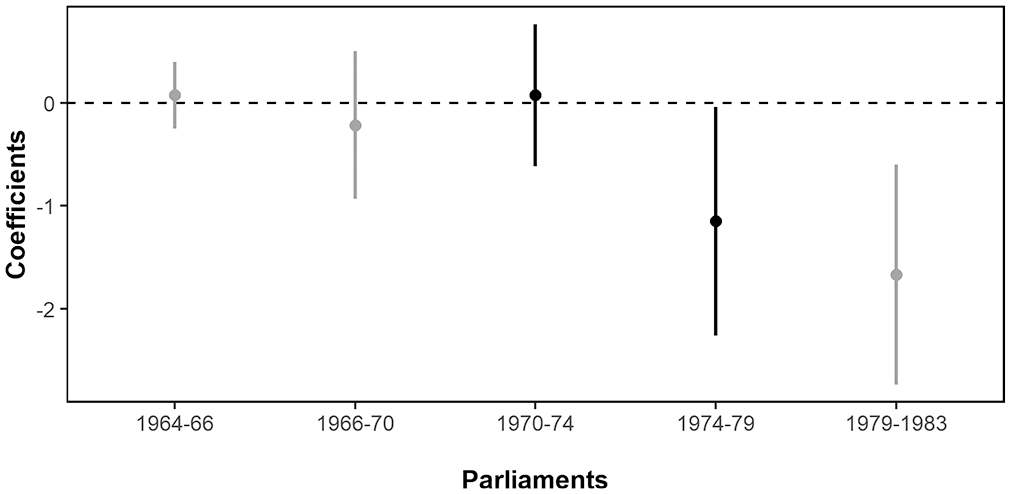
Relationship between Electoral Security and Bill Proposals, 1964–1983.
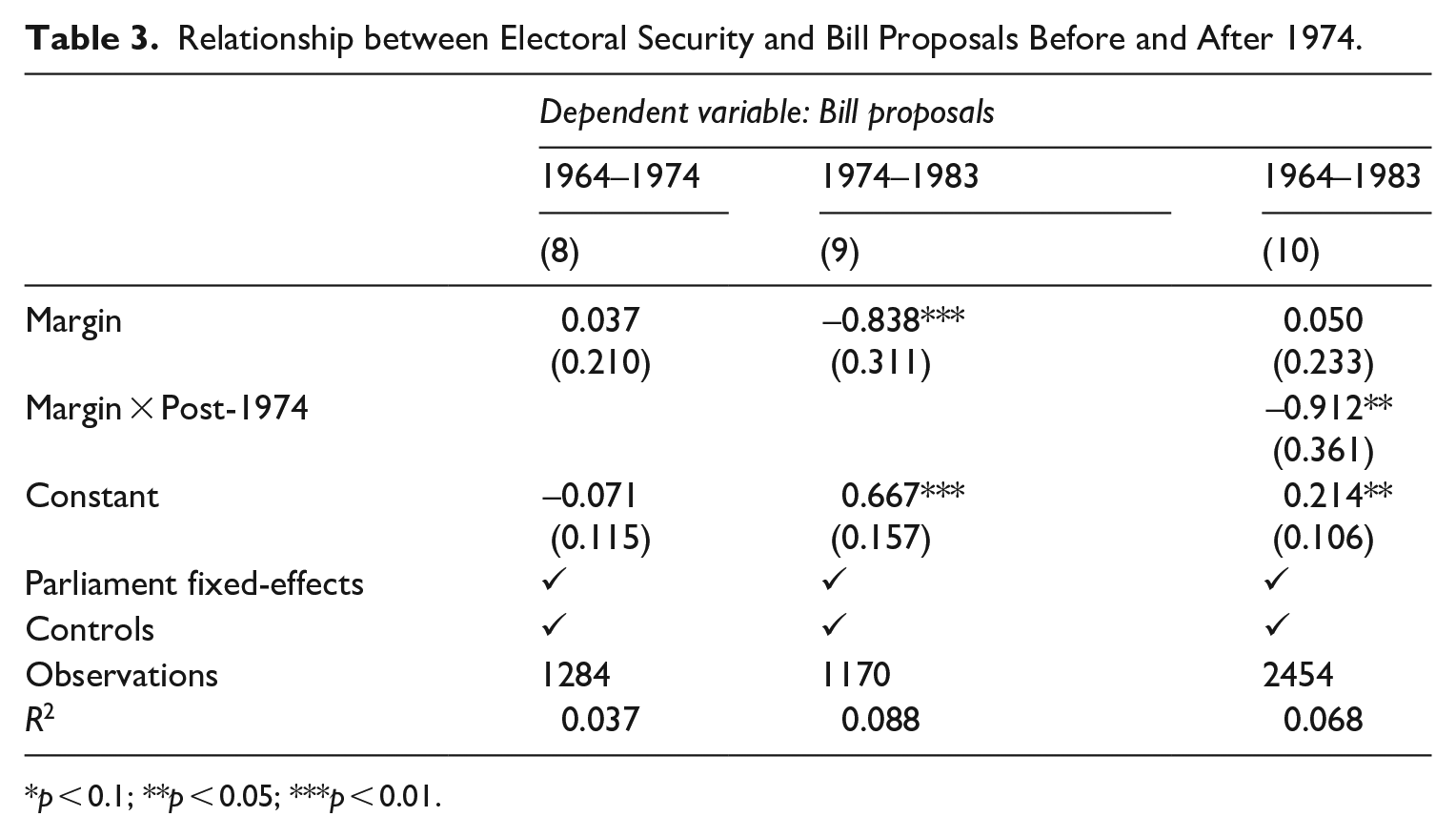
Table 3 provides further evidence of this pattern. It reports the results of three models. The first two model bill proposals in the decade immediately before, and the decade immediately after, 1974. The third combines both periods, but interacts marginality with a binary indicator for the post-1974 period. All three models control for government/opposition status and whether MPs subsequently sought re-election, and include parliament fixed-effects. The results show that the relationship between MPs’ seat margin and their bill proposal activity was statistically insignificant before 1974, but negative and clearly significant after 1974. The significant interaction term in the third model suggests that this difference is statistically significant. Taken together, this provides further suggestive evidence to support Hypothesis 2. The sudden and sizable drop in voters’ partisanship in the mid-1970s immediately preceded the emergence of a negative relationship between an MP’s electoral security and my indicator of their personal vote-seeking.
Relationship between Electoral Security and Bill Proposals Before and After 1974.
p < 0.1; **p < 0.05; ***p < 0.01.
Alternative Explanations
What else might explain this pattern? Most importantly, could it simply be another result of whatever caused partisanship to decline? If this were the case, falling partisanship would merely coincide with the changing patterns of bill initiation, rather than explaining them. However, this does not seem to be the case. Studies have highlighted three main explanations for this fall in partisanship: Conservative partisans’ disillusionment with the crisis conditions surrounding the February 1974 election, Labour partisans’ hostility to the power of trade unions in the party and a longer-term erosion of class-party ties (Crewe et al., 1977). Existing literature offers no clear reason why these factors should increase marginal MPs’ personal vote-seeking incentives, other than by reducing voters’ partisanship. As a result, they do not seem to explain the patterns I have shown.
Given this, several other alternative explanations might account for the changing relationship between MPs’ electoral security and their bill proposals. First, it could be a consequence of the growing success of the Liberal Party, who more than doubled their vote share and seat share at the 1974 elections (Butler and Kavanagh, 1974). As discussed above, MPs facing Liberal challengers may have greater incentives for personal vote-seeking, due to voters’ weaker partisan preferences (Eggers, 2014). The changing relationship between electoral security and bill proposal activity in the 1970s could therefore be due to increasing numbers of MPs facing Liberal challengers. If this were the case, the post-1974 relationship between MPs’ seat margin and their bill proposals should be particularly strong for those MPs with a Liberal challenger. I have tested this by repeating the post-1974 model from Table 3, with and without control variables, and adding an interaction between MPs’ seat margin and an indicator of whether they faced a Liberal challenger. However, both the direct coefficient of facing a Liberal challenger and its interaction with seat margin are statistically insignificant (see Online Supplemental Appendix D).
A second potential alternative explanation looks to the role of polarisation between parties. As discussed above, MPs may have greater incentives for personal vote-seeking when parties’ positions are less polarised, if this leads voters to make more use of valence judgements (Green, 2007). My findings might therefore be due to changes in polarisation, rather than changes in partisanship, if the positions of the main parties were substantially closer together in the decade after 1974 than in the decade before it. However, historical accounts of British politics typically argue the opposite, with the 1960s seen as the high point of a post-war consensus between the main two parties (see Kavanagh, 1992). A quantitative measure of parties’ positions, shown in Figure 4, is similarly unsupportive. This measure suggests the parties were very close together between 1964 and 1970, and if anything the gap between their positions slightly widened in the decade after 1974. A similar picture emerges from alternative measures of polarisation (Goet, 2019; Peterson and Spirling, 2018) (see Online Supplemental Appendix D). 15 It thus seems implausible to suggest that the negative relationship between seat margin and bill proposal activity emerged after 1974 due to lower levels of polarisation.
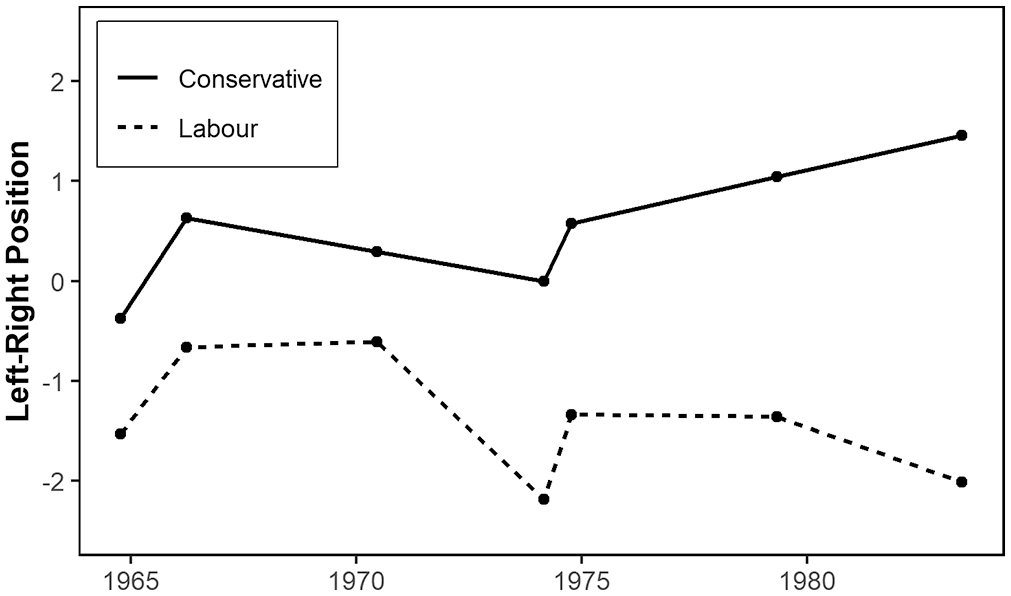
Evolution of Party Positions, 1964–1983.
A third potential alternative explanation relates to the increasing prevalence of career politicians in the House of Commons. King (1981, 280) highlighted an increase in such politicians during this period and suggested that it could explain parties’ declining cohesion in the voting lobbies. The patterns shown above might thus be explained by an influx of politicians who saw politics principally as a career, so were more sensitive to their electoral (in)security (O’Grady, 2019). However, this alternative explanation does not seem plausible, for several reasons. First, existing research suggests that career politicians are typically promoted from the backbenchers very quickly, to become (shadow) ministers (Allen, 2013). It thus seems unlikely that such politicians would drive these results, as proposing PMBs is an exclusively backbench activity. Second, it is not obvious that there was any sharp increase in career politicians in the Commons between 1970 and 1974. Figure 5 shows the ages of newly elected MPs – an established proxy for their likelihood of being career politicians (Kam, 2006; King, 1981) – between 1964 and 1983. The clear stability in the age of new MPs casts doubt on the idea that the Commons saw a sudden upsurge in career politicians in the 1970s. 16 Third, recent work covering a later period (1987–2007) has categorised 201 Labour MPs as to whether or not they were career politicians (O’Grady, 2019) Combining my data with this coding provides no evidence that electoral margins matter more for the bill proposal activity of career politicians than other MPs (see Online Supplemental Appendix D).
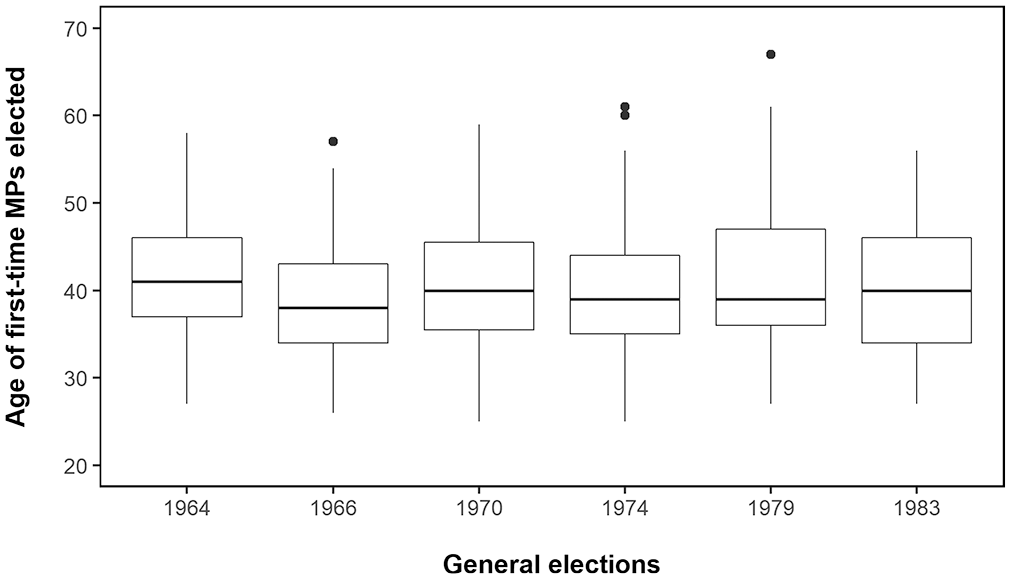
Age of Newly Elected Members of Parliament, 1964–1983.
Fourth, the absence of a significant relationship between MPs’ electoral margin and bill proposal activity before 1974 could be simply a mechanical consequence of either variable varying too little for any relationship to be statistically significant. However, this concern can be easily assuaged. Neither MPs’ bill proposal rates nor their seat margins varied substantially more in the post-1974 decade than the pre-1974 decade. 17 This lends further credibility to the argument that changing patterns of legislative behaviour in the 1970s can be traced to a decline in voters’ partisanship, rather than the alternative explanations discussed here. 18
A fifth potential alternative explanation is that the professionalisation of MPs in this period provided them with greater administrative resources, making it easier for them to draft PMBs. This explanation has some plausibility, as a secretarial allowance was introduced for MPs in 1969 for the first time. However, this development struggles to explain the pattern I have shown. This is because there is little sign that the overall number of PMBs increased in this period, as we would expect if enhanced office resources made it easier for MPs to propose them. Figure D3 in the Online Supplemental Appendix shows the number of PMBs proposed per sitting day for each of the parliaments covered by my analysis. The first parliament following the introduction of this allowance, from 1970 to 1974, actually saw a slight drop in the daily rate of PMB proposals. The subsequent 1974–1979 parliament saw an increase, but only back to roughly the levels seen in the 1966–1970 parliament.
Finally, it should be noted that a number of other potentially relevant factors cannot explain these findings. The first is changes in parliamentary rules around bill initiation, which might alter MPs’ ability to propose PMBs. As mentioned above, the rules governing PMBs remained unchanged in my period of study. The second is the party composition of government, which might matter if MPs behave differently depending on whether their party is in government or opposition. But while the 1974 elections did see Labour return to office, they had also governed between 1964 and 1970, and returned to opposition in 1979. This is thus not something which clearly distinguishes the decade before and after 1974. Finally, the same can be said for the majority/minority status of the government. Labour did rule without a parliamentary majority during 1974 and from 1976 to 1979. But Figure 3 showed that marginal MPs were still less likely to propose PMBs in the 1979–1983 parliament, after the return of majority government.
Conclusion
Personal vote-seeking by legislators has important implications for policy-making, election results and accountability, yet varies extensively. Existing explanations of this variation focus overwhelmingly on the effects of institutions or characteristics of individual MPs. They pay much less attention to the intended audience of personal vote-seeking: voters. This is surprising, as the relative effectiveness of party-based and candidate-based electoral appeals may depend on voters’ partisanship. Consequently, some scholars have asked how voters’ partisanship affects legislators’ personal vote-seeking. However, this body of literature remains very small, and – partly as a result – has a number of empirical and theoretical limitations. This article thus set out to test the relationship between partisanship and personal vote-seeking in a way that addresses these limitations.
In common with previous literature, I have argued that legislators’ personal vote-seeking is negatively related to voters’ partisanship. When voters are more partisan, they are less responsive to the qualities of individual candidates, reducing MPs’ incentives for personal vote-seeking. When voters are less partisan, personal vote-seeking is more effective and thus more attractive to legislators. Going beyond existing literature, I have also argued that partisanship conditions the impact of other drivers of personal vote-seeking. In particular, I suggest partisanship should condition the negative relationship between MPs’ electoral security and their personal vote-seeking. If partisanship is high, even very vulnerable MPs have little to gain from personal vote-seeking.
Analysis of legislative behaviour in the UK House of Commons from 1964 to 2017 supported both these arguments. During this period, British MPs made more legislative proposals when voters were less partisan. Electoral security had a negative relationship with bill proposal activity, but this was stronger at lower levels of partisanship. While these results stem from solely observational data, there are grounds for believing they are not simply driven by confounding variables. First, the longitudinal analysis controlled for a number of plausible confounders. Second, the emergence of a negative relationship between electoral security and bill proposals in the 1970s followed a drop in voters’ partisanship. Third, considering alternative explanations showed they struggle to account for this development. The article thus offers new evidence suggesting that voters’ partisanship shapes legislators’ personal vote-seeking behaviour.
These findings have implications for a number of wider debates in political science. First, they provide further evidence of partisan dealignment’s consequences for parliamentary politics. Dealignment’s implications for voter behaviour and party organisation have been well-documented (e.g. Dalton et al., 2000). This article’s findings contribute to a much smaller literature debating whether dealignment also poses a challenge to parties in the legislative arena (André et al., 2015a; Bowler, 2000; Fleming, 2019; Kam, 2009; Thies, 2000). Second, they add to a burgeoning literature highlighting the importance of electoral incentives in shaping legislative behaviour (see André et al., 2014). Like other recent contributions to this literature (André et al., 2015b; Shomer, 2017; Sieberer and Ohmura, 2019), these findings highlight the importance of considering how multiple drivers of personal vote-seeking may interact. Third, this research contributes to a broader debate about the relationship between partisanship and accountability. Earlier work has argued that partisanship can hinder accountability by weakening the link between politicians’ performance and their electoral success (Eggers, 2014; Kayser and Wlezien, 2011; Lupu, 2016). The results presented here provide further, indirect, evidence of this, by suggesting that legislators are more concerned about their personal reputation when voters are less partisan. This therefore also contributes to debates about the drivers of valence politics more generally. Previous work has argued that the importance of valence politics is shaped by the positions of parties (Green, 2007; cf. Pardos-Prado, 2012). This article offers further evidence that it can be shaped by the strength of parties’ ties to voters.
In sum, legislative scholarship typically argues that the parliamentary behaviour of elected representatives can be traced to their personal characteristics and to the institutional settings in which they compete for votes. This article adds to a much smaller body of literature suggesting legislative behaviour may also be shaped by voters’ partisanship. It provides new evidence that partisanship among voters discourages personal vote-seeking by legislators but also suggests this relationship may be more complicated than previously argued. It thus contributes to our understanding of the link between how voters think about politics and how politicians conduct it.
Supplemental Material
953506_Appendix – Supplemental material for Partisan Dealignment and Personal Vote-Seeking in Parliamentary Behaviour
Supplemental material, 953506_Appendix for Partisan Dealignment and Personal Vote-Seeking in Parliamentary Behaviour by Thomas G Fleming in Political Studies
Footnotes
Acknowledgements
Previous versions of this work were presented at the 2019 PSA Annual Conference, Nottingham Trent University; the 2019 Oxford-LSE Graduate Student Conference, University of Oxford; and the 2019 5th Conference of the ECPR Standing Group on Parliaments, Leiden University. I would like to thank the participants at all of these events for various helpful comments and suggestions. I am also grateful to Radoslaw Zubek, Andy Eggers and Jane Green, as well as two anonymous reviewers, for comments on earlier versions of this work.
Declaration of Conflicting Interests
The author(s) declared no potential conflicts of interest with respect to the research, authorship and/or publication of this article.
Funding
The author(s) disclosed receipt of the following financial support for the research, authorship and/or publication of this article: This research was supported by an ESRC/Nuffield College doctoral studentship.

Supplemental Material
Additional supplementary information may be found with the online version of this article.
Notes
Author Biography
References
Supplementary Material
Please find the following supplemental material available below.
For Open Access articles published under a Creative Commons License, all supplemental material carries the same license as the article it is associated with.
For non-Open Access articles published, all supplemental material carries a non-exclusive license, and permission requests for re-use of supplemental material or any part of supplemental material shall be sent directly to the copyright owner as specified in the copyright notice associated with the article.
