




Abstract
Interpretations of Russia’s military intervention in Syria overwhelmingly focus on Russia’s political motivations. An alternative view foregrounds Russia’s economic motivations, namely, the construction of a multi-billion-dollar gas pipeline traversing Iran, Iraq and Syria. This article examines the salience of Russia’s economic motivations and considers two related aspects: First, if Russian intervention aims to secure areas of strategic importance for the proposed pipeline. Second, if Russian intervention realises longer term political and commercial interests that include proposed future pipeline projects. The evidence suggests Russian military policies towards Syria are unlikely to be motivated primarily by the prospect of a proposed gas pipeline, but that regime consolidation is a more immediate policy goal. This article then posits that Russian intervention has a distinct ‘dual logic’ aimed at integrating the interests of key regional actors into a transnational energy network, while stabilising Russia’s regional dominance within this network.
Introduction
This article explores Russia’s motivations to militarily intervene in Syria. Hitherto, explanations have focussed on the political incentives for Russia’s support of the Syrian government, particularly Russian attempts to consolidate the Syrian regime for reasons of regional stability and global power considerations. The potential impact of economic motivations has been largely overlooked in scholarly analyses. However, an emerging narrative has foregrounded the importance of economic incentives related to natural resources. More specifically, this narrative has focussed on competing multi-billion-dollar gas pipeline projects that are planned to traverse Syria, namely, a Russian-backed Iranian pipeline (known as the Islamic Pipeline) vis-à-vis a US-backed Qatari pipeline, both planned to transport gas to lucrative European markets.
This economic narrative is largely limited to speculative opinion pieces (albeit from respectable sources) and is yet to be subjected to rigorous academic investigation. As such, this article aims to contribute to the debate by investigating the salience of Russia’s economic motivations in Syria and unpacking how these motivations can interact with Russia’s political goals. By combining disaggregate-level data on Russian airstrikes with documentary evidence and conceptual arguments, we first aim to expand on the current literature by exploring if Russia has intervened to secure short-term economic gains, namely to secure a corridor for the construction of a particular pipeline. The evidence suggests that Russia has not primarily intervened to secure the construction of the Islamic Pipeline, and therefore, suggests that accounts foregrounding the importance of gas pipelines are too economically reductionist to fully appreciate Russia’s motivations in Syria. Nevertheless, we argue that long-term economic explanations cannot be separated from political factors that have figured prominently in the majority of analyses of Russian intervention. To shed light on the nexus between political factors and long-term economic interests, we argue that regime consolidation can be linked to an economic logic and that a more nuanced understanding of the interplay between Russia’s political and long-term economic motivations provides insights into Russia’s key motivating factors leading to military intervention.
This article, therefore, argues that regime consolidation is integral to Russia’s longer term political and commercial interests that have as much to do with regional pipeline security as with structural energy dynamics on a regional and global level. To further develop this argument, this article draws on Doug Stokes’ concept of a ‘dual logic’ applied to US foreign policy. This concept demonstrates how US military interventions in oil-rich countries can serve both US national interests and, at the same time, transnationalise those interests by securing oil supplies for the US-led, liberal global economy more generally. In this article, we aim to further contribute to the debate by arguing that Russia’s intervention in Syria serves a similar but distinct ‘dual logic’. While providing specific insights into the nexus between Russian foreign policy, energy interests and military intervention, this article also contributes to broader theoretical and conceptual debates within politics and international relations (IR) that are currently understudied. More specifically, the analysis hopes to nuance IR debates about global ‘hegemony’ by focussing on decentred ‘transnationalisation’ practices relating to politico-economic interests that also take place at the inter-regional level.
By consolidating the Syrian regime, Russia’s goals serve the interests of other actors in the region that are not aligned to the US-led liberal global order (in this instance, Syria and Iran), while simultaneously bolstering Russia’s national interests as a leading supplier of global energy. Russia’s intervention in Syria provides Russian influence and oversight of the supply of energy to the EU and facilitates Russia’s position as a dominant energy supplier that also controls distribution networks. In the Syrian context, Russian intervention is, therefore, conducive to longer term political and commercial interests that may include, inter alia, proposed future pipeline projects.
Explanations of Russian Intervention in Syria
From the onset of Syria’s armed conflict in 2011, Russia has provided active diplomatic and political support for president Bashar al-Assad’s government and power infrastructure, voting down any resolution in the UN Security Council that could be construed to justify a military intervention of Assad’s external opponents, and sending advisers to Damascus to counsel the Syrian authorities on policy planning (Trenin, 2018). On 30 September 2015, the Russian air force then started to provide cover for Syrian regime forces and Hezbollah to retake previously held opposition areas at a time when Assad’s forces were on the defensive (Oweis, 2016: 3). Explanations of Russian intervention have focussed on numerous factors but have nevertheless concentrated on political motives. Various scholarly work foregrounds the instrumentality of Syria in a broader Russian attempt to re-define its role as a global actor and co-equal of the United States, as well as Russia’s foreign policy towards Syria in the wider systemic context of global order (Averre and Davies, 2015; Charap, 2013; Pieper, 2019; Stent, 2016; Trenin, 2013, 2015; Tsygankov, 2015).
Importantly, this scholarship has extrapolated from likely country-specific explanations for Russian policies towards Syria to the ‘bigger picture’ of global politics without which an isolated in-country analysis risks becoming ahistorical. Trenin (2013) and Pieper (2019) have argued that such a position is not to be mistaken for principled obstructionism, but is seen as a policy to indicate the inevitability of Russia as a dialogue partner of the West in wider questions of security governance. Averre and Davies (2015) strike a similar chord, explaining Russia’s diplomatic and political cover for the Syrian regime as motivated by Russian concerns over the erosion of bedrock principles of international law. Their analysis focusses on Russia’s stance on humanitarian interventions and the ‘Responsibility to Protect’ (R2P) in particular, which Moscow reads as a potentially dangerous pretext to violate the principle of sovereign equality among states. Yet, they point out that Russia’s resistance to the invocation of ‘R2P’ on a UN level in the Syrian case is not due to its opposition to the idea of humanitarian assistance per se, but due to substantive reservations regarding its implementation (Averre and Davies, 2015: 814). Krickovic and Weber (2018) interpret Russia’s intervention in Syria as an illustration of a ‘bargaining problem’ over the future of the international order and Moscow’s willingness to assert its status as an influential great power.
With varying degrees of support for the idea that strong partnerships with states in the Middle East have intrinsic value for the Russian government, a number of other Russia observers share the assessment that Russia’s involvement in Syria can be explained by an ambition to re-confirm Russia’s power standing on par with the Unites States, especially in the wake of attempts by Western governments to isolate Russia for its role in the Ukraine crisis of 2014 (Karaganov, 2013; Kozhanov, 2016). Baev (2015: 8) interprets Russia’s greater involvement in Middle Eastern affairs as an effort not only to send policy signals to the West, and the United States in particular, but as a pronounced desire to ‘prove its value to China as a strategic partner’. According to this perspective, Russia’s ‘return’ to the Middle East, following its retreat from the region after the implosion of the Soviet Union, would also signal a new willingness to shape future regional orders at a time when the United States has begun a gradual retreat from the Middle East.
Others have focussed on questions of regional order. By protecting the Syrian government from opposing armed forces, this would, for example, avoid the emergence of radical Islamists, which in turn would create a vacuum of instability south of the Caucasus (Souleimanov, 2016: 112; Treisman, 2012). There is an inherent contradiction in this argument, however, as Russia’s intervention arguably served to radicalise also the Russian and Central Asian ‘foreign fighters’ who had flocked to Syria (Ratelle, 2016). In this light, in contrast to Russia’s self-proclaimed aim of fighting terrorism in Syria, the core motivation for Russian intervention is argued to be its pursuit of protecting (both politically and militarily) its key ally in the region at all costs, with Russia targeting not only those groups considered terrorist, but also the more moderate rebels (Hill, 2013; Notte, 2016). Regime consolidation is, therefore, considered to be the core reason explaining why Russia has taken military action in Syria, protecting the then embattled Syrian regime from falling to armed opposition. Relatedly, Allison (2013) has made the argument that an externally enforced regime change in Syria would have sent negative signals for political stability even within Russia domestically. Finally, Freire and Heller (2018) have analysed the international and domestic signalling effects of Russian victories abroad in the pursuit of Russian ‘status-seeking’, likewise arguing that both internal and external dynamics led Russia to use coercion as a way of improving its international status. Connolly (2016) further notes that Russia’s use of counter-sanctions and import substitution strategies in the wake of the Ukraine crisis led to an overall ‘securitisation’ of economic policy in Russia. The Syrian intervention has further accentuated the link between Russia’s foreign policy and perceptions of domestic economic performance (Wasser, 2019: 2).
Gas and Gas Pipelines
Notwithstanding Russia’s domestic economic issues, what is largely missing from this body of literature is an appreciation of possible economic motives that underlay Russia’s decision to intervene militarily in Syria. The significance of the Tartus naval facility in Syria, while Russia’s only port access outside of the borders of the Russian Federation, lay in its usefulness for troop supplies, yet does not on its own constitute a sufficient reason to intervene militarily (Allison, 2013: 807). An emerging narrative has instead focussed on the issue of proposed gas pipelines in Syria as a way of understanding foreign intervention in the country, which has been developed in addition to the literature discussed above, but has lacked thorough empirical testing, as we will explore further below. News outlets such as Al Jazeera and the UK Guardian have carried stories that oil and gas interests are central factors for understanding foreign intervention in Syria (Ahmed, 2013; Escobar, 2012). Similarly, think tanks, including the Washington Institute, as well as opinion pieces from outlets such as Foreign Affairs, Politico and The Globe and Mail, have foregrounded the centrality of natural resources and the related infrastructure to understanding Russian policy and intervention in Syria (Gordon, 2017; Kennedy, 2016; Koduvayur and Everett, 2019; Orenstein and Romer, 2015; Sogoloff, 2017).
Central to such narratives is the importance of natural gas and gas-related infrastructure in Syria, more specifically, the planned future construction of a US$10 billion gas pipeline traversing Iran, Iraq and Syria. If built, this pipeline (commonly referred to as the Islamic Pipeline) would run from the Iranian Port Asalouyeh near the South Pars gas field in the Persian Gulf, then traverse Iraq and cross Syria through the governorates of (east to west) Deir ez-Zor, Homs and Tartus. The pipeline would make Syria the centre of assembly and production, before gas would be transported to the market via Lebanon as well as Baniyas, Syria. An agreement between the governments of Syria, Iran and Iraq to build the pipeline was signed in July 2011, shortly after the outbreak of Syria’s civil war (Hafidh and Faucon, 2011). This was largely unnoticed by international observers as the Saudi, Qatari and Western governments had begun to join efforts to remove Assad from power at that time. The Islamic Pipeline challenges a previous gas pipeline project that was proposed by the Qatari government in 2009. 1
This pipeline, purportedly rejected by the Assad government in the interests of its Russian ally, would run from Qatar’s North Field through Syrian territory to Turkey for further exportation into the EU. This gas pipeline narrative further focusses on Russia’s preference for the Islamic Pipeline when compared with the Qatari-proposed project, given Russia’s more favourable links with Iran when compared with Qatar. This could be instrumental for Russia to control gas exports to Europe from the region, where Russia is the primary supplier of solid fuels, crude oil and natural gas to lucrative EU markets.
In this light, this article argues that while Syria is not a major global producer of oil and gas, it is nevertheless strategically important for future supplies to EU markets, which will remain Russia’s core energy export market for the foreseeable future. This is particularly important given that, although Russia’s ‘turn to the East’ (povorot na Vostok) has forged new energy links with China, the obstacles facing Sino-Russian energy relations relating to logistics as much as commercial preferences (Baev, 2016) mean that Russia is unlikely to be able to replace the crucial EU markets with Chinese customers as part of its energy diversification strategies. It is, therefore, safe to presume that Russia will continue to view its EU markets as both politically and economically crucial to its wider energy security policies. This includes issues relating to the supply of resources to EU markets, including the construction of key infrastructure, such as the Islamic Pipeline, with clear signs, according to some sources, that by 2019 the pipeline was going ahead (Watkins, 2019). Investing political, military and financial capital in Syria’s energy infrastructure, in this light, is a policy to preserve Russia’s imprint on any future regional energy distribution network, even if this will remain largely geared towards European markets.
Has Russia Intervened Militarily to Secure Pipeline Construction?
A key point to first discuss is how central the issue of gas pipelines is in the Syrian case and to discuss if Russian intervention is primarily linked to the Islamic Pipeline plans announced in 2011. What is largely missing from this narrative is that it is feasible – in fact, it is rather common – for natural resource extraction and transportation to occur in conflict zones, including the initiation and completion of major infrastructure projects during protracted armed conflicts such as civil wars. In this light, rather than securing an entire country, it is common for armed actors to secure and stabilise particular areas of strategic importance within a country to enable the development of major infrastructural projects, such as oil and gas pipelines. For example, by targeting rebel groups (and often civilians) in areas of strategic importance, governments and pro-government militias are able to protect both existing and proposed pipeline infrastructure from the instability of, say, rebel attacks. By expanding territorial control, military action creates ‘buffer zones’ to protect existing infrastructure and enables the construction of major infrastructural projects during armed conflict. Furthermore, overall levels of violence within civil wars typically increase during this period of territorial expansion, particularly as opposed armed groups intensify their own military campaigns to challenge this territorial expansion. However, armed actors sympathetic to oil and gas interests push the violence away from areas of strategic importance and provide a particular form a ‘stability’ and ‘security’ in areas of economic interest (Maher, 2018; see also Stokes and Raphael, 2010). This includes providing security for existing infrastructure and also for the construction of major new infrastructural projects linked to the extractive industries (e.g. Maher, 2018). Relatedly, there is a common observation that many natural resource extracting firms enter civil war economies as security and stability can be provided for their interests. As FitzGerald (2001: 209) notes, some transnational corporations (TNCs) are established investors in countries with conflicts and ‘operating in conflict situations could be said to be an integral part of corporate culture for natural resource firms’. Moreover, Luciani’s (2011) research suggests that oil and gas installations are more resilient to armed conflict than is commonly assumed, with major damage to infrastructure a rare occurrence.
With these points in mind, disaggregated conflict data – as the analysis below employs – can provide a better understanding of the dynamics of a particular conflict and the political and economic consequences of violence. In the Syrian case, if the construction of the Islamic Pipeline is the primary motivation for Russian intervention in Syria, we should expect to see Russian airstrikes to secure and ‘clear’ these areas of threats to the proposed pipeline. However, if Russian intervention is aimed at regime consolidation, we should expect airstrikes to target areas in which the Syrian government faces its toughest challenges from armed actors, regardless of whether these areas are strategically important for the Islamic Pipeline.
There is little evidence to suggest that Russian intervention is specifically designed to secure territorial control in areas of strategic importance for the proposed oil pipeline. The first observation to note is the timing of Russian intervention such as airstrikes. With the announcement of the Islamic Pipeline in July 2011, it is unclear why Russia would wait until 30 September 2015 to begin airstrikes in Syria if the proposed pipeline was its central concern. As Figure 1 shows, Russia embarked on an intensive campaign of airstrikes between October 2015 and February 2016 (for information on this data and the timeframe analysed, see Appendix 1). Furthermore, the intensity of Russian strikes peaked in January 2016 and February 2016. This represents an increased military effort before the Russian government publicly announced its first withdrawal order in March 2016 (Kozhanov, 2016). The strengthening of the Syrian government’s control over previously contested areas was therefore given as a rationale for Putin ordering the retreat of the Russian armed forces beginning on 15 March 2016 (Russian Foreign Ministry, 2016).
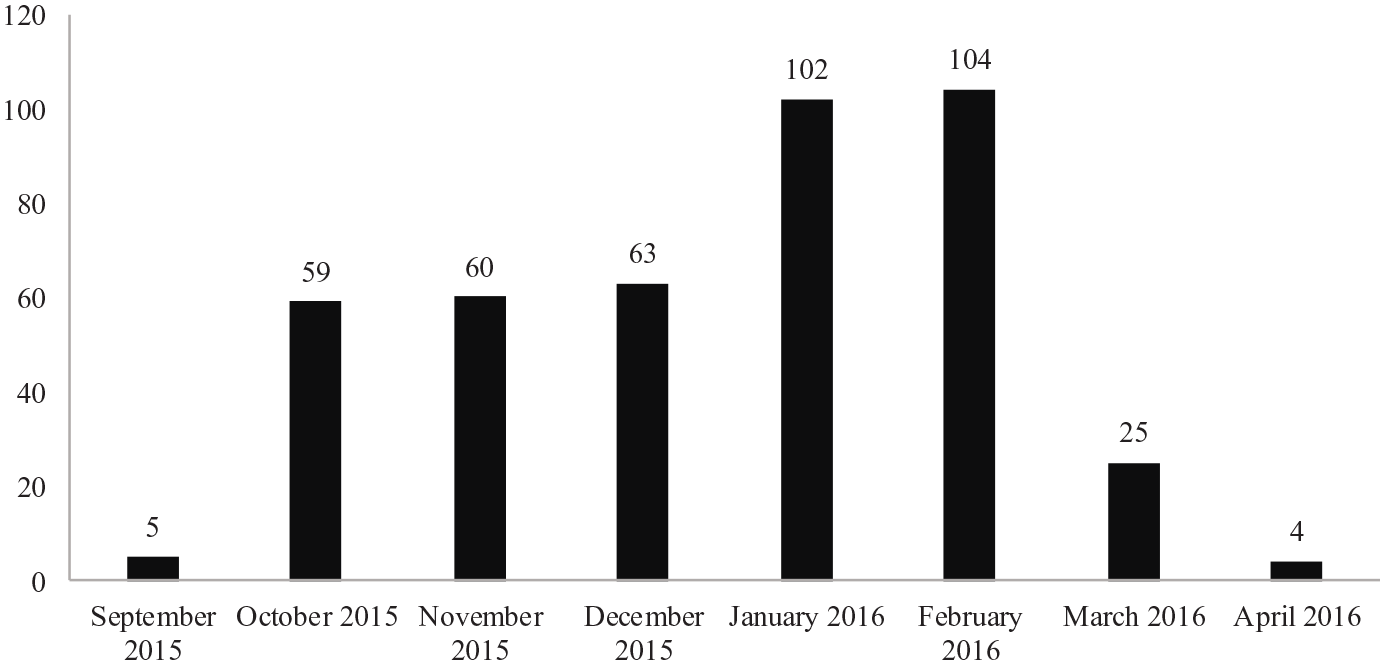
Russian airstrikes (with ‘fair’ level of reporting), September 2015 to April 2016.
The second observation is that Russian airstrikes do not coincide with the trajectory of the proposed pipeline, which would run from east to west, via Deir ez-Zor, Homs and Tartus. As noted, if Russian airstrikes were primarily concerned with stabilising and securing particular regions of Syria to facilitate the construction of the Islamic Pipeline, we would expect to see high levels of airstrikes target these areas. However, as Figure 2 shows, while it is true that the data show Deir ez-Zor (13% of total airstrikes) and Homs (13%) recorded the third and fourth highest levels of airstrikes, it is nevertheless Aleppo (44%) and Idlib (15%) that experienced the highest numbers of airstrikes between September 2015 and April 2016. Rather than representing areas of strategic importance for the gas pipeline, both Aleppo (44%) and Idlib (15%) were strongholds of anti-Assad forces posing a significant and direct challenge to the Assad government. In terms of location, these four governorates (Aleppo, Idlib, Deir ez-Zor and Homs) constitute 85% of total Russian airstrikes between September 2015 and April 2016.
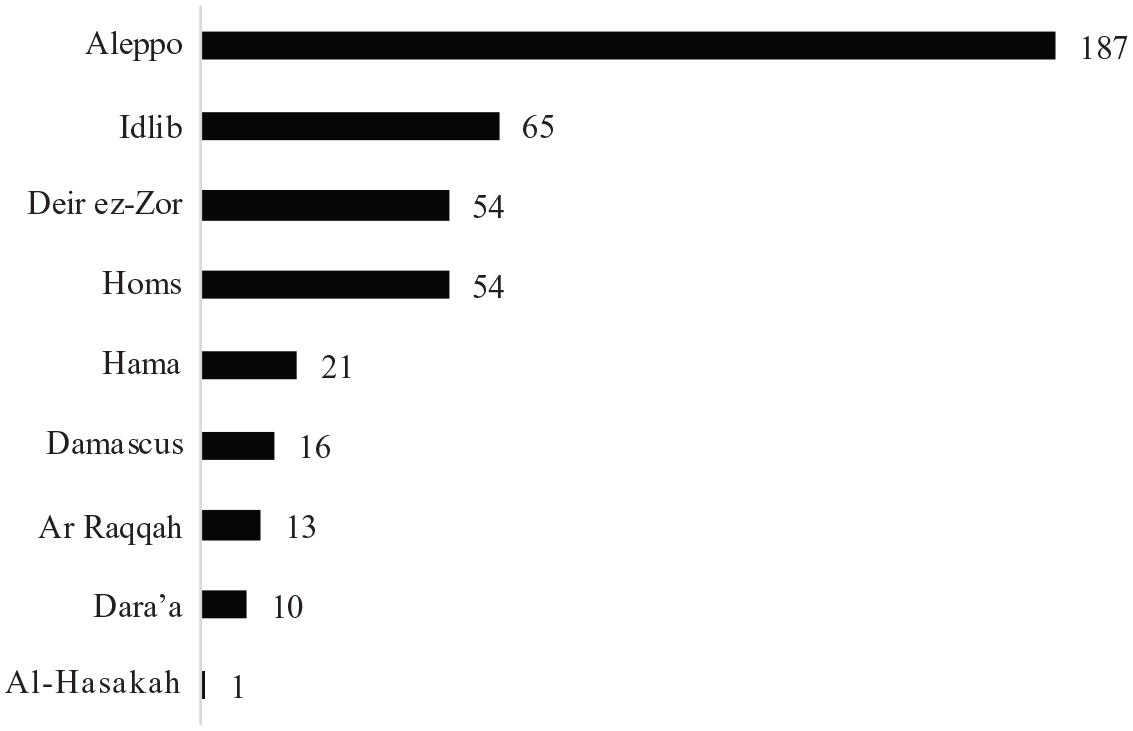
Russian airstrikes (with ‘fair’ level of reporting) by governorate, September 2015 to April 2016.
Russian Support for Regime Consolidation
Figure 3 and Table 1 further suggest that Russian airstrikes were aimed at consolidation of the Syrian regime. Russian airstrikes heavily targeted Aleppo between October 2015 and March 2016, with Russian airstrikes in Aleppo intensifying in January and February 2016, targeting a number of opposition forces regardless of their proximity to proposed gas pipelines. While Russian intervention was broadly criticised for largely targeting non-Islamic State (IS) opposition groups, the airstrikes during January and February 2016 increasingly targeted IS (e.g. Casagrande, 2016; The Carter Center, 2016: 3). Indeed, between 25 January 2016 and 7 February 2016, Russian intervention systematically targeted numerous opposition forces in Aleppo, including Russian military action targeted at IS controlled territory in North-eastern Aleppo and east of Aleppo City (Casagrande, 2016: n.p.; The Carter Center, 2016: 3). This included significant victories for the Assad government in Aleppo, situating the government in a strong negotiating position at the UN-sponsored Geneva Talks aimed at ending the Syrian conflict (Casagrande, 2016: n.p.).
Number of Russian Airstrikes (with ‘Fair’ Level of Reporting) by Month in Aleppo, Idlib, Homs and Deir ez-Zor.
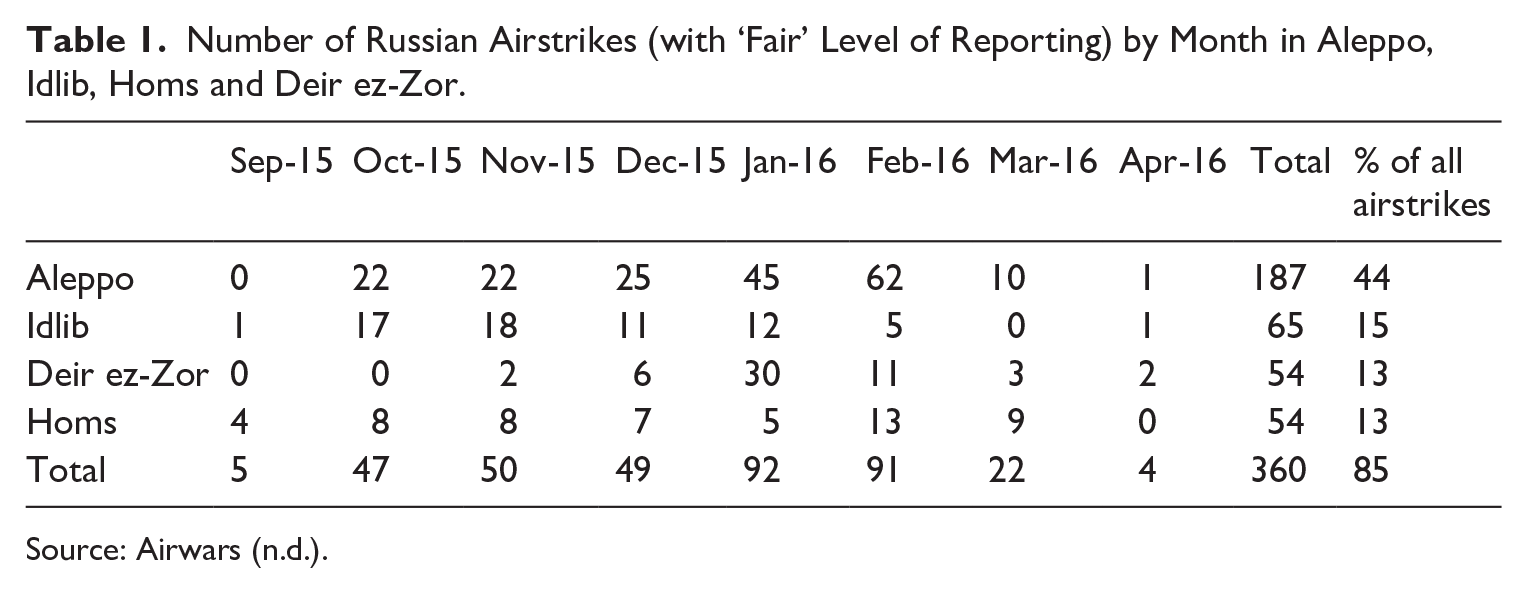
Source: Airwars (n.d.).
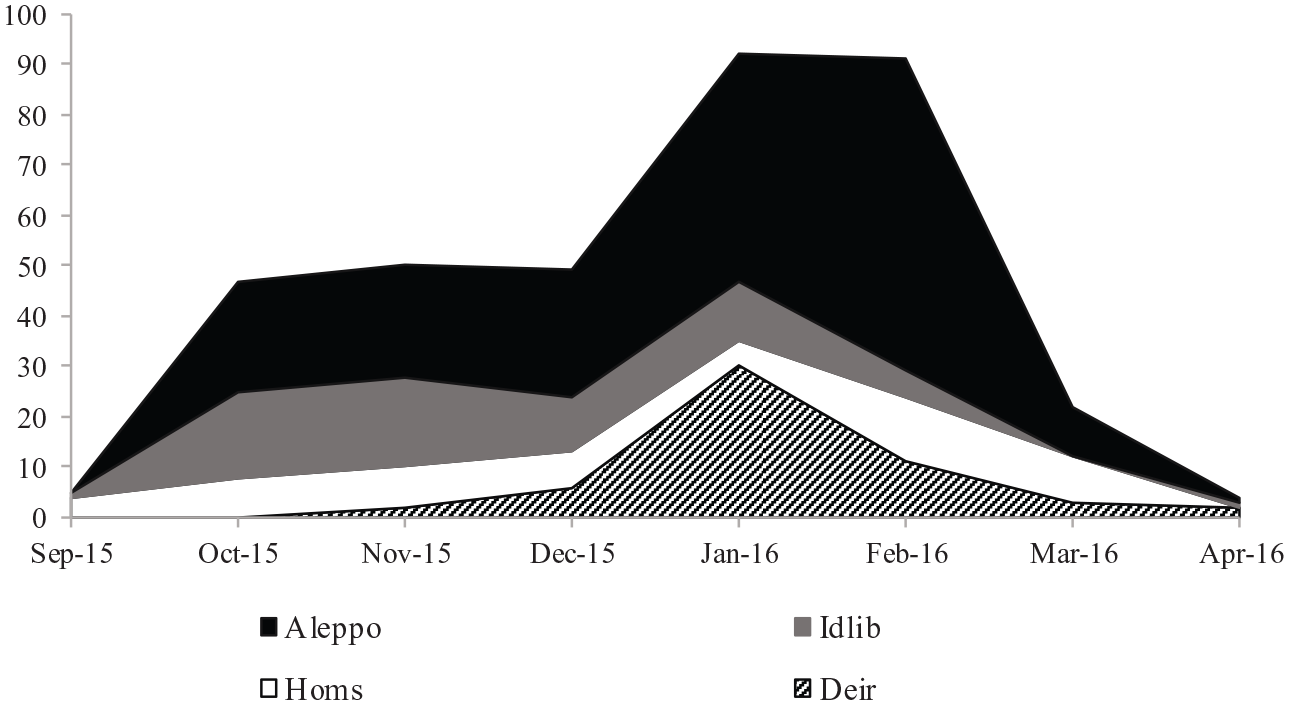
Number of Russian airstrikes (with ‘fair’ level of reporting) by month in Aleppo, Idlib, Homs and Deir ez-Zor.
During this period, Russian airstrikes also focussed on opposition-held territory in north-western Aleppo Province to support the Syrian government’s offensive to disrupt the primary opposition ground line of communication from Aleppo to the Syrian–Turkish border (Casagrande, 2016: n.p.). During January 2016, Russian airstrikes also hit a number of targets in southern Aleppo, coinciding with a pro-government ground offensive to retake Aleppo City, which succeeded on 26 January 2016 (The Carter Center, 2016: 2). Russian airstrikes also bolstered Kurdish forces in Aleppo, including the US-backed Syrian Democratic Forces (an alliance made of Kurdish People’s Protection Units, or YPG, and other armed rebel groups), who were able to take control of at least three villages near the rebel-held border town of Azaz. Furthermore, what has been referred to as the ‘Northern Aleppo Offensive’ (Tokmajyan, 2016) began on 1 February 2016 and involved intensive Russian airstrikes to support the Syrian army and its allies (namely, Hezbollah, as well as Iraqi and Afghan Shia militias) to advance in northern Aleppo towards the towns of Nubbul and al-Zahra, facing opposition from the Islamic Front, Jabhat al-Shamiyah (The Levant Front) and Fatah Halab. It is estimated to have taken 3 days for the Syrian government to gain control of those towns, with the fighting continuing until 15 February as the regime consolidated its gains (Tokmajyan, 2016).
Russian airstrikes during January and February 2016 further aimed to sever one of two key opposition supply lines into Aleppo City from the Turkish border and encircle opposition-held sections of Aleppo City (Casagrande, 2016: n.p). In Aleppo, Russian airstrikes have also enabled pro-government forces to expand their territorial control in southern Aleppo, as well as eastern Aleppo and areas surrounding the besieged Kuweiris military airbase which the Syrian government aimed to relieve (The Carter Center, 2016: 4) . Airstrikes resumed in September 2016 to aid the Assad government in its offensive on Aleppo (BBC, 2016b) and, by December 2016, Assad was able to pronounce the ‘liberation’ of Aleppo thanks to intensive Russian military aerial support. 2
Furthermore, rebel gains in the Idlib, Hama and Latakia governorates had threatened to cut off Damascus (Assad’s seat of government) from the coast. With the help of Russian firepower, as well as ground support from Iran and Hezbollah, Assad’s forces managed to seal off rebel areas in Idlib, Aleppo and Hama. In late December 2015, a Syrian ground offensive backed by Russian airstrikes made territorial gains in the Dara’a governorate in the South after previous assaults had targeted mostly northern governorates (Reuters, 2015). Russia’s bombing campaign, in addition, helped disperse rebel groups from the Latakia region in early 2016 (BBC, 2016a). Russian airstrikes have thus fought anti-Assad forces in the Idlib, Homs, Hama and Aleppo governorates, and also in the South (Dara’a) and the East (Deir ez-Zor, al-Hasakah).
Figure 3 and Table 1 also show the increased targeting of Idlib in October and November 2015. This was strategically relevant for the Syrian government, as the loss of Idlib to a rebel offensive in the first half of 2015 had been considered a strategic defeat for Assad (Al Jazeera, 2015). Before September 2015, Assad had been on the defensive due to advances by the Western-backed Free Syrian Army (FSA) and the Army of Conquest. Russian airstrikes in the Idlib governorate in late November 2015 were intended to turn the tables in favour of Assad’s ground forces to retake towns like Ariha, which had fallen to the Army of Conquest 6 months before (Al Jazeera, 2015).
To our knowledge, there are no other available datasets that can be used to corroborate the disaggregated Airwars data during the September 2015–April 2016 period. However, the Armed Conflict Location and Event Data Project (ACLED) dataset (Raleigh et al., 2010) records data on Russian intervention in Syria between 2017 and 2019 (see Appendix 2). The data support the observations above, suggesting that Russian airstrikes were employed to consolidate the position of the Syrian government. As Figure 4 shows, the majority of air/drone strikes with Russian involvement occurred in Idlib (51% of the total), followed by Hama (25%) and Aleppo (9%). According to ACLED’s data, while neither Idlib nor Hama are strategically important for the Islamic Pipeline, the majority (85%) of airstrikes/drone attacks involving the Russian government occurred in these governorates (Figure 4).
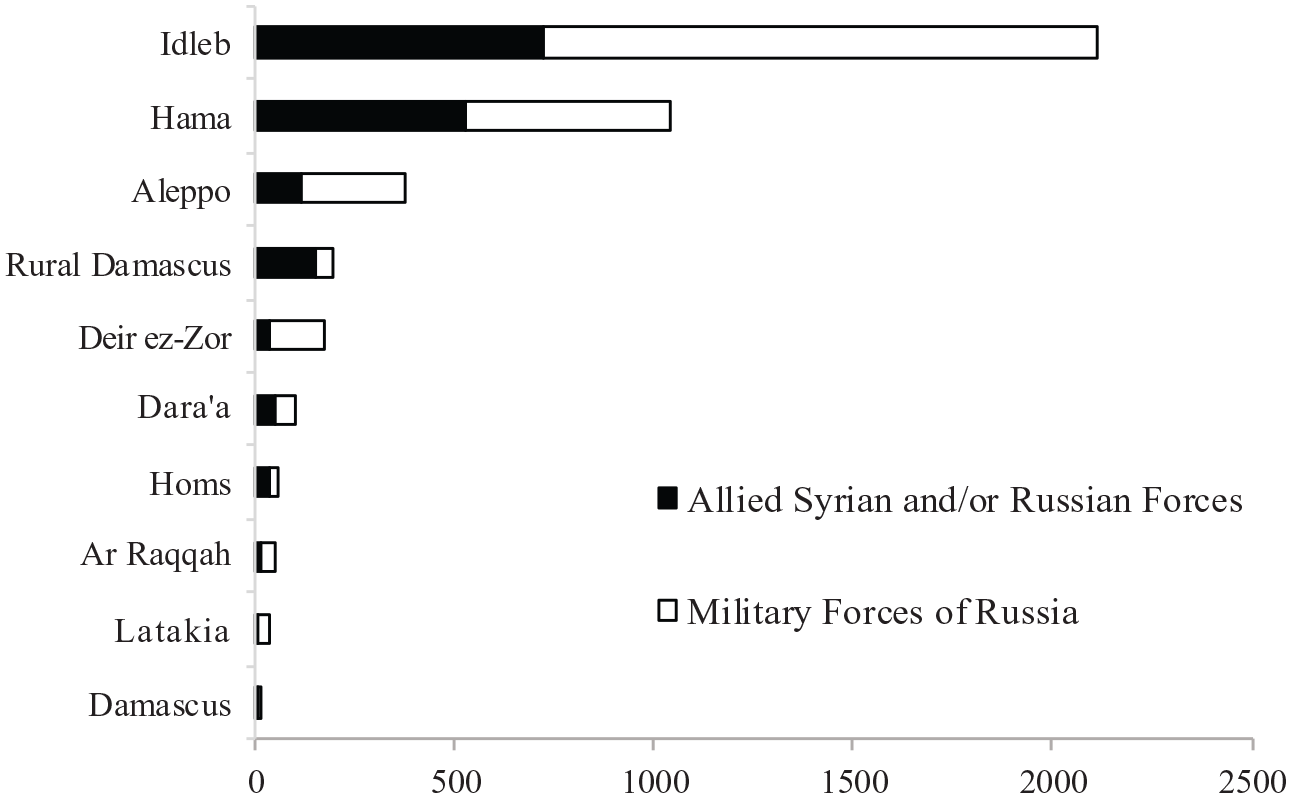
Count of air/drone strikes with Russian involvement in Syria, 2017–2019.
To summarise, the majority of Russian airstrikes between September 2015 and April 2016 were targeted at Aleppo, followed by Idlib, indicating that Russia’s motivation to fly airstrikes in support of an Assad government retaking territory previously lost to rebel factions. Between 2017 and 2019, ACLED’s data similarly suggest that Russia targeted regions where rebel groups had previously made military gains, with the highest count of air/drone strikes recorded in the governorates of Idlib and Hama. Russian air forces have struck in those areas where anti-Assad forces had made significant territorial gains and posed a significant challenge to the Syrian government prior to Russia’s intervention. While Russia was claiming to be waging an anti-IS campaign (TASS, 2015), Russian airstrikes have targeted any anti-Assad group that posed a broader threat to the Syrian state rather than targeting groups threatening strategically important areas for the proposed Islamic Pipeline. This includes targeting groups, such as IS, the al-Nusra front (later rebranded to Jabhat Fateh al-Sham), the Islamic Front’s Jaysh al-Islam, Liwa al-Haqq, the ‘Chechen fighters’ to the Saudi- and Turkish-backed ‘Army of Conquest’ (Jaysh al-Fatah) and the FSA. Russian airstrikes have also provided the aerial support for regime forces and Hezbollah on the ground to regain territorial control over those areas where Assad had been on the back foot (Oweis, 2016: 3). Russian airstrikes have proved to be a game-changer in favour of the Syrian government. With Assad firmly back in the saddle, Russia’s policy goal of regime consolidation has been largely achieved.
Understanding Russian Intervention through a ‘Dual Logic’ Lens
While the evidence above suggests avoiding economically reductionist accounts of Russian foreign policy towards Syria, Russia’s pursuit of regime consolidation nevertheless has both political and economic motivations. To investigate the interplay between these motivations, we draw on the work of Stokes (2007) and Stokes and Raphael (2010), arguing that the lens of a ‘dual logic’ that has been applied to US foreign intervention in resource-rich areas can serve as a useful analogy to understand Russian intervention in Syria. Stokes (2007) argues that US intervention is underpinned by a ‘dual logic’, whereby: (i) US primacy in oil-rich regions stabilises energy supplies for global capitalism within the US-led, liberal, open market global political economy, benefitting other core powers and (ii) US intervention simultaneously maintains US primacy over these same core powers. Thus, the dual logic is based on (i) a transnational logic whereby the US government has aimed to maintain an open global economy that enables core powers and actors of globalised capital (for instance, TNCs) to participate while (ii) the US government has simultaneously aimed to pursue and secure its own national interests (Stokes and Raphael, 2010: 15). In this light, the US government’s strategy to transnationalise the oil-rich Global South is in fact a strategy to further cement the US’ global hegemony (Stokes and Raphael, 2010: 2).
The United States further consolidates this position by acting as the ‘ultimate guarantor of global energy security’, with US foreign policy aimed at maintaining and defending an economically liberal international system that is conducive to capital penetration and circulation (Stokes and Raphael, 2010: 2). The United States derives enormous structural power through its role of playing the ‘cop on the beat’ where social forces (e.g. democratic, nationalist or Islamist) pose a threat to the stability of generic interests of core powers (Stokes, 2007: 252). Thus, the US state has tried to ‘armour’ processes of transnationalisation and globalisation using coercive statecraft (Stokes and Raphael, 2010: 2–3). President Trump’s comments that he left behind US troops in Syria ‘only for the oil’ and that the US was ‘keeping the oil’ following his earlier withdrawal announcement on 6 October 2019 serve as an unvarnished illustration of this reading – as a blunt demonstration of US global interests in the energy security nexus, stripped of the discursive edifice that critical IR scholarship has been working to deconstruct for decades (Borger, 2019).
While the United States and other core states benefit from a global political economy consisting of more players in each market and competitive pricing – and while having diversity of supply and a competitive landscape where suppliers compete with one another is in the interest of resource importing countries – the story is different for resource exporting countries. In contrast, resource exporting countries often complain that the trading system is biased against them: as the exports these countries sell on the international market are priced at highly competitive rates, the goods that these countries import are commonly sold in oligopolistic markets, resulting in unfavourable terms of trade (Jaffe and Soligo, 2009: 112–113).
Since the 2000s, Russia has increasingly challenged the US dual logic outlined above. While the 1990s saw privatisations in Russia’s own energy sector, the 2000s saw a renationalisation of key sections of the energy sector (Jaffe and Soligo, 2009: 123). In terms of gas, state-owned Gazprom enjoys a quasi-monopoly in the production and transport of gas and, with the exception of the Azerbaijan to Turkey BTC pipeline, Russia controls access of Caspian resources to export markets due to Russia’s lock on regional pipeline networks (Jaffe and Soligo, 2009: 119). As a large state-owned company, Gazprom thus increases Russia’s relative state power ‘based on proportion of world reserves, production, and imports into Europe’ (Barkonov, 2018: 138).
The following section will expand on the argument that Russian intervention – like that of the United States – is underpinned by a distinct dual logic that is underpinned by (1) a transnational logic aimed at securing the interests of states not aligned to the US-led liberal order (in this case, Syria and Iran) but which (2) has Russia’s own national (and energy security) interests at its core. In this way, Russian foreign policy in Syria is less about protecting an ally from terrorist groups (although, Russian intervention has clearly had this effect) and more about securing Russian foreign policy interests underpinned by a political and economic rationale that is based on both transnational and national motives.
Regime Consolidation and Russia’s Economic Benefits
While there is little evidence to support the argument that Russian intervention is primarily about gas pipelines in Syria, an economic logic must not be overlooked and can be linked to political motivations such as regime consolidation. This includes the idea that future gas pipelines in Syria provide some explanatory power, but only when Russia’s longer term strategies are considered.
Russian intervention in Syria helps pave the ground for post-war dividends that should provide both short- and long-term commercial opportunities. 3 This may include having future gas transportation through potential Syrian pipelines being firmly under the auspices and influence of the Russian state. Russia’s political alliance with the Assad regime and its military support for it is also likely to translate into revenues for the Russian state as Russia’s energy firms invest in Syria, such as Gazprom’s investments in new Syrian gas fields: Following Assad’s significant gains with the decisive help of Russian intervention, Russia’s energy companies hope to renew and expand their investments in Syria’s energy sector, particularly to rebuild and operate Syrian oil and gas infrastructure, with the hope to ‘control significant portions of pipelines, liquefaction facilities, refineries, and terminals’ and, therefore, ‘capitalizing on Syria’s potential as a transit hub for regional oil and gas heading to Europe’ (Sogoloff, 2017: n.p.). In January 2018, Russian and Syrian agencies signed a 2-year roadmap for cooperation on energy power. The agreement envisages Russia rebuilding energy facilities in Syria, and also the construction of new facilities based on an agreement that grants Russia exclusive rights for oil and gas extraction in Syria for the next 49 years (Mamedov and Shmeleva, 2019: 16–17, 20–21). Relatedly, others have pointed to Russia’s hope of absorbing a sizable percentage of the estimated US$350 billion needed for Syria’s reconstruction (Vohra, 2019).
Russia’s considerable investment of capital (political, diplomatic, military, reputational and otherwise) in the future of Syrian politics acquires a tangible economic dimension to further augment revenues to compensate for Russia’s military expenditure in Syria and realise longer term economic opportunities: Gas prices on a global level are in large part determined by the amount of energy released onto the world market, but deliveries are highly dependent on existing pipelines between suppliers and customers (Weber, 2018: 103). Russia’s continued ties to Syrian state structures secure it leverage power over these dynamics if Russian companies were to have assets in the exploration and operation of Syrian gas fields. Russian politicians are reportedly expecting economic rewards for Russia’s intervention in support of the Assad government. For instance, Russian Deputy Prime Minister Dmitry Rogozin noted that Russia had ‘a moral right to expect financial returns from its efforts to liberate Syria from terrorists’, adding that ‘the Syrian authorities want to work with Russia, and Russia alone, to re-establish all of the country’s energy capacities’ (Khatib and Sinjab, 2018: 24). Furthermore, according to Khatib and Sinjab (2018: 21), Russia is ‘seeking to reshape Syrian state institutions to guarantee long-lasting loyalty to Moscow’, with Russia holding the ‘upper hand in its relationship with Syria’ following Russian military intervention, without which the Syrian government would have been unable to regain its military ascendancy in the country. In a similar light, Russia’s support for the Assad government – which has evolved from political and non-military means such as vetoing numerous UN Security Council resolutions deemed inimical to the Syrian government, to supplying war material, to direct military intervention – has served to ‘bound Syria closely to Moscow’s agenda’, with the Syrian government, while not exclusively obeying Russian orders, nevertheless finding itself ‘in no position to roll back Russia’s increasing military influence over the Syrian state’ (Khatib and Sinjab, 2018: 21). Russian (as well as Iranian) influence has led to a ‘hollowing out of the Syrian state’ with Russia’s strategy focussed on keeping Syria’s state institutions strong but loyal Russia, even if this requires reshaping those institutions (Khatib and Sinjab, 2018: 23). The evidence of this is becoming apparent. For example, in 2019, Syria’s parliament approved contracts for two Russian firms (identified as Mercury LLC and Velada LLC) to explore for oil and gas exploration in three blocs (Reuters, 2019). According to Ali Ghanem – Syria’s Minister of Petroleum and Mineral Resources – giving the contracts to these firms was in line with Syria’s strategy ‘towards friendly states that stood by Syria, with Russia and Iran at the forefront’ (Reuters, 2019: n.p.). The Syrian government also reportedly granted Russian companies participating in energy projects in Syria a ‘most favoured nation’ status that includes favourable tax and customs exemptions (Mamedov and Shmeleva, 2019: 17).
In addition, Russian-sponsored Syrian government forces, as well as the presence of privately contracted Russian mercenaries, see to the physical protection of these interests. It has been reported that Russian mercenaries, hired by a private military contractor known as Wagner, are fighting alongside official Syrian government forces (Vasilyeva, 2017). Their presence has been debated more publicly following the death of Russian irregular fighters by US airstrikes near Deir ez-Zor in February 2018 (Murtasin, 2018). And even though difficult to authenticate, media reports have circulated a contract according to which a Moscow-registered front company for mercenary operations in Syria ‘would receive 25 percent of the proceeds from oil and gas production at fields its contractors capture and secure from Islamic State militants’ (Vasilyeva, 2017; see also Marten, 2019: 191). Raphael and Stokes (2011: 915) have found a similar logic at play when analysing US policies towards West African oil, where the sponsorship of infrastructure projects and the establishment of ‘forward operating locations’ (FOLs) constitutes a combination of economic and military policies to pacify potential competitors by acting as a ‘hegemonic stabiliser’. In the Syrian case, Russian companies would thus be in an advantageous position regarding the reconstruction of Syrian energy facilities. The presence of big state-owned Russian energy companies translates into leverage for the Russian government in Syria’s political environment. This, of course, will be preconditioned on the post-war reconstruction of Syria’s infrastructure, to which President Putin has been urging European governments to contribute (Ramani, 2019). Especially given Russian budgetary constraints, the market entry of Russian companies is conditioned on foreign direct investments in Syria.
Transnationalising Energy Interests
If Russian intervention can contribute to the moulding of Syrian policies, then support for Assad translates into a structural benefit for the Russian state. The long-term paradox that arises from Russian support of a proposed pipeline sponsored by Iran, an energy competitor, can be understood in terms of, on one hand, the positive-sum nature of this support for the stability of regional gas exploration while, on the other hand, this support has Russian interests at its core. The construction of either pipeline – including the Islamic Pipeline – would represent additional competition for Europe-bound Russian gas, so it appears counter-intuitive that the realisation of any of these projects should be in Russia’s interests.
With few resources to invest in energy exploration, Iran has suffered from years of international sanctions regimes imposed over its nuclear dispute. The conclusion of the Joint Comprehensive Plan of Action (JCPOA, the nuclear accord of July 2015) and the beginning of the implementation phase from January 2016, opened the way for Iran’s return to the international energy markets, as UN-mandated sanctions were lifted. In this light, while Iran represents a partner for Russia to challenge US order conceptions for the region, it is also true that Iran’s return to global energy markets increases the competition for the same (European) markets. Nevertheless, besides Russia’s structural leverage via control over energy distribution networks, Moscow knows that European companies tend to ‘over-comply’ with US financial sanctions that remain in place (Pieper, 2016). Iran’s rise as an energy competitor is, therefore, far from realistic.
Five years earlier, the Iranian project had to be put into perspective of the rival Qatari pipeline projects, as well as shareholder dynamics: Russia’s preference for the Iranian-sponsored gas pipeline was one that pits an informal gas alliance of Russia, Iran, Iraq and Syria against an informal rival gas consortium between Qatar, Saudi Arabia, Turkey and the United States. Indeed, a senator in the Russian Federation Council and member of the Committee for International Affairs stated that the Iran pipeline project would be more favourable for Russia, but the economic considerations are rendered secondary by the ongoing war. 4 A Russian energy alignment (however informal and despite potential rivalry in other economic sectors) with Iran, Iraq and Syria, bolstered with active military support since 2015, would have helped to transnationalise Russian energy interests.
By forcibly preserving its military presence in Syria while contributing to a political consolidation which enhances regional (energy) interconnections at the same time, Russia’s political and economic support in the region, including military intervention that has been crucial to the survival of the Syrian government, enables Russia to take a leading role in regional energy politics. This bolsters Russian primacy within the aforementioned informal energy alliance in the region. Investing in new gas pipelines in which Russian state-owned energy companies might hold shares, in this context, also becomes a policy to bolster Russia’s infrastructural predominance in a sector of the global energy market which heavily depends on physical pipeline networks, and on which Russia has more economic resources to spend than Syria, Iraq, or Iran (despite the United States and EU sanction regimes against Russia in other sectors). 5 While Iran so far has signed agreements to invest in Syria’s communications, real estate and agricultural sector, Russia is in a more advantageous position to target Syria’s energy sector (Sinjab, 2018).
The interest of Russian energy companies to secure contracts in Syria’s energy infrastructure as described in the previous section would serve to work towards Russia’s objective, as outlined by Prime Minster Medvedev (2016), of preserving Russia’s leading position in the global energy sector (Financial Times (FT), 2018). The preferential treatment of Russian companies promised by Syrian President Assad suggests that Russia’s investment in the consolidation of the Syrian regime is likely to pay off (RT, 2018). Statements from Russian government officials and companies suggest that Russian actors are eyeing investments in the phosphate sector, for instance (FT, 2019). The development of Syrian phosphate deposits has been contracted to Stroytransgaz Logistika, a company majority-owned by Putin confidant Gennady Timchenko (Mamedov and Shmeleva, 2019: 20). The likelihood of Russian investments in the Syrian oil and gas sector has also been underlined by President Assad himself: ‘We are not waiting for Western companies here, especially in the oil and gas sphere. I spoke about that with President Vladimir Putin in Sochi. We want Russian companies to work here, and we expect their fast market entry’ (RT, 2018). However, from a structural perspective, Russia is acting with regional players to form a Russian-led quasi-alliance that challenges US-led energy alliances in the region. This transnationalisation of Russian energy interests is a reflection of the government’s reading of global energy trends: The Energy Research Institute of the Russian Academy of Sciences, in its ‘Global and Russian energy outlook to 2040’ – the authors of which have also been involved in the preparation of Russia’s official energy strategy to 2035 – has assessed key factors impacting Russia’s position as a leading energy provider. According to the authors, these factors are (a) global energy consumption, (b) sectoral shifts between the coal, gas, oil, nuclear and renewable energy markets and (c) production levels of competing energy-producing countries. Noting that ‘Iran’s large-scale emergence on global oil and gas markets’ (Energy Research Institute of the Russian Academy of Sciences, 2014: 3) is a long-term probability (pending the lifting of economic sanctions), they write: ‘The emergence of new gas suppliers could reduce prices on the European and Asian markets by $50–60 per thousand cubic metres and also replace significant volumes of Russian (70 bcm) and potential American exports (45 bcm)’ (Energy Research Institute of the Russian Academy of Sciences, 2014: 3). Iraq, the authors continue, may become a relevant ‘swing producer’ in the Organization of the Petroleum Exporting Countries (OPEC), ‘providing Iraq with an exponential increase in revenues from exports, [which] could also give the country extra muscle in the geopolitical arena’ (Energy Research Institute of the Russian Academy of Sciences, 2014: 87). Recognising that Iran and Iraq may become more important gas suppliers in the future, Russia’s transnationalisation logic thus becomes a strategy to exert influence over the energy market by securing Russia a direct say in regional pipeline plans that involve Iran, Iraq and Syria (see also the discussion above regarding Iran’s and Qatar’s large gas reserves with relatively low gas production levels; cf. also Kommersant, 2019).
Against this background, Russia’s intervention in Syria might have stabilised its own relative predominance in regional energy affairs in the long term. Acting as what Raphael and Stokes have called a ‘hegemonic stabiliser’ to secure logistical energy infrastructure that benefits potential Middle Eastern competitors becomes less of a paradox when viewed in light of global production trends. ‘After 2020’, the aforementioned report acknowledges, ‘Russian oil supplies will start to concede their market niche to Middle East market suppliers with their cheaper resources’, and that Russia will gradually recover its position only after 2035. Leaving aside future changes in global energy consumption and shifts towards non-fossil energy markets, Russian policies and strategies suggest that its government is interested in securing an advantageous position in the potential future arena for energy-producing countries to compete over prices and production levels – for which its military intervention in Syria may just have provided the groundwork.
Russia’s ‘systems-maintaining’ role, however, differs significantly from that of the United States and is instead aimed at garnering influence and control of the system of resource supplies to core powers within the global, liberal economy, of which the United States is the preponderant power but whereby Russia is one of the world’s key energy suppliers. Thus, in terms of energy supplies, while it may appear counter-intuitive for Russia to protect the Syrian government from rebelling forces – a government which has signed an agreement with Iran to build a gas pipeline, increasing supplies of gas to Europe and thus representing additional competition for Gazprom in European markets – Russian intervention ultimately pursues Russia’s own energy interests by securing it leverage and influence over future gas pipelines in the region. This includes influence over the proposed Islamic Pipeline which, if built and traversing through Syria with Assad in power, would also preclude the construction of the Qatari pipeline. For Russia, these dynamics would affect its own future gas exports to Europe given that, as noted above, Iran and Qatar have the world’s second and third largest proved gas reserves yet currently lag behind both the United States and Russia in terms of levels of gas production.
Thus, while Russia itself exhibits a similar dual logic that, on the one hand, aims to benefit what it would consider as core players that attempt to counterbalance US hegemony in the Middle East (for instance, Iran as well as Syria). On the other hand, as a key global energy supplier, Russia has its own national interests at heart. In this light, Russia’s dual logic is underpinned by more direct benefits that it pursues through military intervention (e.g. the potential to realise opportunities in Syria’s oil and gas industries) when compared to the US’ dual logic, whereby even if the US TNCs do not directly benefit from US intervention, the United States nevertheless benefits from greater supplies of resources to all core industrial powers within the global capitalist system in which the United States remains the preponderant economic power.
Russia’s support for general Haftar in the Libyan conflict supports this conclusion, as Russian companies like Rosneft have already signed contracts for future oil exploration (Neftegaz, 2017). Examining to what extent a ‘dual logic’ applies in other conflicts like Libya could be the subject of future research, yet identifying important structural differences to the Syrian case (such as the absence of regional energy competitors in Libya) are beyond the scope of this article. Finally, the volatile nature of the energy price market and the growing political leverage of OPEC members such as Saudi Arabia are centrifugal forces that pull at Russia’s claim to be a hegemonic stabiliser on the energy market. This has been made even clearer with the Saudi-Russian oil price war of March 2020.
Conclusion
This article posits that, similar to what Stokes (2007) has argued regarding US intervention in Iraq, Russia exhibits a distinct dual logic that underpins its intervention in Syria, a logic that has a transnational aspect (securing the interests of states not aligned to the US-led liberal order), while simultaneously placing Russia’s interests at the core of its intervention. We have argued that Russia has not primarily intervened in Syria to secure the construction of the Islamic Pipeline. Instead, by targeting anti-Assad forces wherever their strongholds were, Russia’s military activities in Syria are aimed at the survival of the Assad regime and further regime consolidation in Syria. This is an observation that has also been made by analysts focussing on the instrumental value of Russia’s Syria intervention for Russian foreign policy identity at a time of difficult Russian–Western relations.
However, while Russian intervention has primarily focussed on regime consolidation, economic factors – including the proposed gas pipelines – should be considered. Indeed, Russian intervention will secure the Kremlin a crucial level of influence and leverage when considering natural resource extraction, transportation and exportation – especially in gas – in the Middle East. This is particularly relevant with regard to any proposed future gas pipelines traversing Syria that will increase the supply of gas to lucrative EU markets, of which Russia is a leading supplier. Statements of intent on the part of companies, as well as Russian and Syrian state actors, indicate that short-term rewards for Russia’s defence of the Assad regime are likely to be contracts for Russian companies in Syria.
Regardless of the speculative nature of the pipeline project, Russia’s continued ties to Syrian state structures are also likely to secure it leverage power in the long-term over any future energy negotiations that link Syria and Iran. The sponsorship of (future) infrastructure projects, together with the continued presence of Russian (irregular) forces on the ground, constitutes a combination of economic and military policies to pacify potential competitors by contributing to political and territorial consolidation and thus to an environment conducive to new investment opportunities. Here, Russian policies serve to further the perception of a ‘hegemonic stabiliser’ (Raphael and Stokes, 2011: 915). In addition, Russia’s Syria campaign has been analysed here as part of a long-term process to transnationalise Russian energy interests, where its forcible contribution to political consolidation can give Russia a structural advantage over the definition of regional energy interconnections at the same time – regardless of the political instability (Iraq and Syria) or financial uncertainties (Iran in a troubled sanctions environment) of some of its partner countries.
Finally, the ‘dual logic’ lens employed in the analysis can provide insights into Russian intervention in other theatres of combat such as Libya. However, a more detailed analysis of the core themes presented in this article – including the application of the ‘dual logic’ concept – requires more empirical testing not only in the Syrian case looking forward, where it appears that Russia has long-term plans to deepen its political and economic influence in the country, but also in other cases where the framework presented in this article may provide utility in understanding Russia’s foreign policy decisions. This article has also primarily focussed on the reasons for Russia’s decision to militarily intervene in Syria. As such, Russia’s changing relationships with other keys states (including Qatar and Saudi Arabia), since it has conducted its military campaign in Syria do not fit the scope of this article. Russia’s relationship with Qatar is a case in point, which, while historically turbulent, has improved in recent years (e.g. see Frolovskiy, 2019). These issues may impact future energy developments in the Middle East more generally, which makes them a promising area for further research.
Footnotes
Appendix 1
Appendix 2
Declaration of Conflicting Interests
The author(s) declared no potential conflicts of interest with respect to the research, authorship and/or publication of this article.
Funding
The author(s) received no financial support for the research, authorship and/or publication of this article.
