




Abstract
Previous studies aimed at explaining populist support emphasize the crucial role of populist attitudes and ideology among the general population. With respect to the role of discontent and grievances as drivers of populist support—often at the heart of theoretical work on populism—however, empirical results are rather mixed. We argue that the apparent contradictions are partly due to insufficient conceptualization of discontent. We distinguish between societal-centered discontent, which is more based on a general, negative subjective assessment of society, and self-centered discontent that expresses a negative assessment of one’s personal situation. In line with our expectations, regression results for Germany confirm that society-centered discontent, but not self-centered discontent, is important for populist party support. Moreover, we find that society-centered discontent also moderates the relation between populist attitudes and populist support. We conclude that beyond ideologies, populism capitalizes on the cultivation of collective—but not individual—discontent.
Keywords
Populist support can be understood as an expression of protest or motivation for political change in response to a negative or negatively perceived status quo. It relates to what you yourself or “people like us” deserve—in comparison with the “ideal” society or to a “glorious” past (e.g. Gest et al., 2018; Kriesi and Pappas, 2015; Rooduijn et al., 2016; Van Der Bles et al., 2018). Feeling less well off than one deserves creates discontent. The notion of such discontent being important for populist support ties in with many reports of populism and its success in the last decades ranging from Taggart’s (2004) concept of the “sense of crisis” to the “losers of modernization” thesis (Kriesi et al., 2006; Lengfeld, 2017b; Rippl and Seipel, 2018; Rooduijn, 2015) and arguments regarding democratic disappointments (Canovan, 1999; Laclau, 2005).
Despite the high interest in discontent in populism research, previous studies remain rather unspecific and undecided concerning the nature and focus of this discontent (Rico and Anduiza, 2019; Van Der Bles et al., 2018). The present article addresses the question of the focus of discontent and distinguishes between society-centered and self-centered discontent. By the term society-centered discontent, we refer to a group-centered evaluation that concerns the society as a whole and relates strongly to Elchardus and Spruyt’s (2016) concept of declinism as well as notions of societal pessimism (Steenvoorden and Harteveld, 2018), collective nostalgia (Cheung et al., 2017; Mols and Jetten, 2014), the zeitgeist of collective discontent (Van Der Bles et al., 2015, 2018), and group-based relative deprivation (Abrams and Grant, 2012; Smith et al., 2012). Self-centered discontent, by contrast, reflects dissatisfaction with one’s personal situation and taps into concepts such as individual relative deprivation (Smith et al., 2012) and fear of downward social mobility (Bornschier and Kriesi, 2013; Inglehart and Norris, 2016; Jetten et al., 2015; Mutz, 2018).
According to the ideational approach, populist ideology creates a collective identity (“the people”), fosters strong negative emotions against outgroups (especially “the elite”) and justifies its ideology with a concrete group-based goal: the implementation of the will of the people in defense against elite interests (Anduiza et al., 2019). Expanding on this line of reasoning, we propose that populist support is primarily driven by sociotropic concerns about “the people” and much less so by self-centered discontent. In addition, we argue that the consideration of society-centered discontent helps to better understand the relationship of populist attitudes (PA), on the one hand, and populist party support, on the other hand. Previous studies that draw on the ideational framework (Hawkins and Kaltwasser, 2018; Mudde, 2004, 2017) have focused on the interplay of PA and host ideologies (Loew and Faas, 2019; Van Hauwaert and Van Kessel, 2018). We expand this perspective by considering discontent as an additional driver of populist party support. We expect that discontent increases the likelihood of populist party support both directly and indirectly, as a powerful moderator. More precisely, we expect that PA need to fall on the fertile soil of society-centered discontent to elicit populist party support.
We test these arguments using data from an online survey that is representative for the German population. In line with our expectations, our results stress the notion that populism is inherently linked to a perceived crisis. This sense of crisis, however, does not refer to individual, but only to society-centered discontent. Second, our findings confirm that society-centered discontent, and only this kind of discontent, strengthens the relation between PA and populist party support. This leads to the conclusion that a closer examination of collective grievances and drivers of societal pessimism should provide important insights into why populism has been so successful in the last two decades in virtually all regions of the world.
Populism and Its Demand-Side Determinants: The Role of Discontent
According to the ideational approach (Hawkins and Kaltwasser, 2018; Mudde, 2004, 2017), populism may be understood as a “thin ideology” based on the perceived antagonism between corrupt, liberal elites, on the one hand, and the homogeneous, good, and honest people, on the other hand. The elites, representative democracy, and its institutions are blamed for the deterioration of society because they prevent the implementation of the (supposed) will of the people (Hameleers et al., 2017). This leads to a call for (more) popular sovereignty, for example, by means of direct democracy such as referenda.
The success of populist movements and parties largely depends on whether their discourse and communicative strategies can be linked to the experiences and attitudes of their target groups. Without corresponding attitudes among the population, populist actors will not find the resonance and support they need to pursue their political goals (Bonikowski, 2017). Prominent explanations for populist party support therefore take a demand-side perspective and focus on citizens’ experiences and attitudes. Evidently, much research has been dedicated to PA—conceptualized as the tripartite combination of anti-elitism, homogeneous perceptions of “the people,” and demand for sovereignty (Akkerman et al., 2014; Schulz et al., 2017). However, populist actors do capitalize not only on the antagonism between “the people” and “the elite” but also on the proclamation of a societal crisis (Rooduijn, 2014). This raises the question of whether individual experiences of discontent can account for the success of populist movements above and beyond PA.
Discontent plays a key role in many theoretical reports on populism, ranging from Taggart’s notion of the “sense of crisis” to the “losers of modernization/globalization” thesis (Betz and Immerfall, 1998; Kriesi et al., 2006; Lengfeld, 2017b; Rippl and Seipel, 2018; Rooduijn, 2015; Taggart, 2004) and arguments regarding democratic disappointments (Canovan, 1999; Laclau, 2005). Within theoretical accounts of populism, there is a broad consensus that the attractiveness of populist parties originates in or is fostered by various shortcomings of liberal ideas of democracy or their current practice in modern western societies. Mouffe (2005), for example, refers to an “end of politics” zeitgeist to stress a lack of democratic debates about possible alternatives to liberal democracy, while Mudde’s (2004) conception of populism strongly links the populist critique to dissatisfaction with the performance of representative democracy. Canovan (1999) argues that an increasing gap between promise and performance promotes the public’s political alienation and grievances. Similarly, Laclau (2005) sees a lack of representation as an unfulfilled demand for democracy and populism as a logical consequence of people’s unfulfilled wishes.
While these works are mainly theoretical and concerned with a populist critique of and dissatisfaction with liberal democracy, Taggart (2004) expands the scope of dissatisfaction beyond the political sphere. He introduces the concept of “sense of crisis,” which describes the feeling that relevant aspects of society are malfunctioning or are about to break down. The notion of societal crisis as a core element of populism is supported by empirical findings on populist discursive strategies. Mols and Jetten (2014) show how populist right-wing actors nurture feelings of fear and discontent by instilling ideas of a declining society with a dismal future. Similarly, Rooduijn (2014) sees the proclamation of crisis as a core characteristic of populist communication independent of time and space.
On the demand side, discontent beyond the political sphere also plays a key role in grievance mobilization models. Grievances may arise not only from corruption and political elitism but also from economic downturns and immigration (Ivarsflaten, 2008) or transnational developments such as globalization (Swank and Betz, 2003). In line with this reasoning, supporters of right-wing populist parties are often referred to as “losers of globalization” which encapsulates a wide array of disadvantages and grievances (Kriesi et al., 2006). The process of globalization is assumed to produce economically, culturally, and socially disadvantaged groups of so-called “losers of modernization”—or at least the perception of being disadvantaged. These individuals are in turn inclined to support right-wing populist parties in order to cope with their frustrations and voice protest (Spruyt et al., 2016). Linking structural changes to the emergence of rather general and abstract grievances, the “losers of globalization” thesis offers a promising framework for understanding the rise of populism over the last decades. Nonetheless, it has an important shortcoming. Albeit implicitly assuming that the “losers of globalization” are frustrated and dissatisfied with the functioning of society in general, most empirical tests up to today focus on objective indicators of economic, political, and cultural hardship rather than subjective experiences and perceptions of society itself (Ivarsflaten, 2008; Oesch, 2008). However, subjective perceptions are powerful in shaping opinions as well as attitudes, or even influence behavior—especially in those realms of politics where “truth” always depends on interpretation and mobilization (Zaller, 1992). Hence, we propose shifting the focus to subjective experiences of grievances.
In order to explain the appeal of populist parties, it is crucial to focus on the experiences of individuals and consider their needs and motives. While satisfaction of needs leads to well-being and optimal functioning, frustration of needs diminishes life satisfaction and increases the risks of defensiveness and psychopathology (Vansteenkiste and Ryan, 2013). Individuals are therefore inclined to react to need frustrations by seeking control and provoking opposition. In the sense that populism capitalizes on promises for more control, that is, popular sovereignty, and deliberate transgressions of norms and taboos, support for populist parties may be a prominent strategy for dealing with need frustrations. However, the frustration and satisfaction of needs are rather poorly reflected in contextual, objective features such as economic welfare (Mols and Jetten, 2016; Rooduijn and Burgoon, 2018). As a result of this potential mismatch between objective indicators and individual consequences for the satisfaction of needs, support for populist parties may depend on subjective experiences.
Populist parties have gained in power in various societies with different characteristics, ranging from prosperous economies to countries suffering from an economic crisis, from countries with high to countries with low immigration inflows, and from countries with high and low levels of corruption (for a neat interactive presentation, see Henley, 2018). Especially the highly plausible assumption that populist parties would gain power in times of economic hardship received surprisingly little empirical support (Mols and Jetten, 2016). The relatively weak predictive power of contextual features may partly result from the fact that the very same objective situation may have different consequences for different individuals, or at least be perceived differently, depending on other contextual factors but also on individual differences. For example, Rooduijn and Burgoon (2018) find that people who are less well-off are especially likely to vote for populist parties when the overall economic situation is favorable. Looking at Trump voters in the 2016 presidential election, Mutz (2018) points out that anxiety of losing in (economic) status was a key factor, while others pointed out that populist party support could be mainly driven by relative and not absolute individual conditions (Jetten et al., 2015). This links very well to the argument that populist leaders stress certain issues irrespective of objective levels of risks and grievances (Rooduijn, 2014). As Mols and Jetten (2016: 275) point out, populist leaders are “crafty identity entrepreneurs who are able to turn objective relative gratification into perceived relative deprivation.”
In summary, while different notions of discontent play a prominent role in various theoretical accounts of populism, few studies have investigated the role of discontent empirically (Elchardus and Spruyt, 2016; Mols and Jetten, 2014; Van Der Bles et al., 2018). We expand on this emerging line of research by employing a theoretical conceptualization of discontent whose empirical relevance is yet to be shown, by assuming that subjective discontent is a key variable in explaining populist party support, and by focusing on its consequences on populist party preferences (i.e. the propensity to vote (PTV) for a populist party) rather than PA (cf. Elchardus and Spruyt, 2016). In line with this reasoning, we propose discontent in the sense of subjective perceptions of crisis and hardship as an important predictor of populist party preferences:
H1. Discontent drives populist party preferences.
The Focus of Discontent: Self-Centered or Society-Centered?
According to the ideational approach, the antagonism between “the people” and “the elite” is at the center of PA. Expanding on this line of reasoning, we propose that populist party preferences are primarily driven by society-centered concerns about “the people” and much less so by self-centered discontent. Up to now, the empirical literature is not specific regarding the question of whether frustrations and grievances refer to people’s individual situation or collective circumstances (Lengfeld, 2017b; Oesch, 2008). Basic psychological needs may be threatened by both adverse individual circumstances such as unemployment and social isolation (Paul et al., 2009) and by adverse societal circumstances such as economic crisis, large-scale immigration, or increasing crime rates (Teymoori et al., 2016). Accordingly, individuals may be discontent with their personal situation (self-centered discontent) but also with the state of society or, put differently, the situation of the “the people” (society-centered discontent). This distinction may be particularly important for explaining populist party support since people-centrism is a central element of populism. Mobilization for populist parties may therefore stem from collectively rather than individually experienced grievances.
While a number of studies show that discontent fuels support for populist parties (Lengfeld, 2017b; Spruyt et al., 2016; Steenvoorden and Harteveld, 2018), they often concentrate on political dissatisfaction on an attitudinal level (Geurkink et al., 2019) and thereby run at risk of being somewhat tautological when considering how populism is defined in most studies (Ivarsflaten, 2008; Oesch, 2008). Other studies remain rather unspecific concerning the focus of discontent or do not allow for systematic comparisons regarding the relative effects of self-centered and society-centered discontent (Rico and Anduiza, 2019; Van Der Bles et al., 2018). Moreover, research focusing on individual grievances and populism is mostly restricted to perceptions of social status (Gidron and Hall, 2017) or risk of unemployment (Lengfeld, 2017a), neglecting the extent to which individuals evaluate their situation as either desirable or distressing. Studies that do compare the effects of self-centered and society-centered evaluations on the support of populist parties, however, are often limited to economic issues. Weyland (2003) and Havlík and Voda (2018) provide empirical evidence from contexts with rather different forms of populist supply (left-wing populism in Chile and centrist populism in the Czech Republic), but their findings on the relative importance of self-centered and society-centered evaluations are inconclusive. In a similar vein, Schmitt-Beck (2017) looks at both forms of economic discontent in Germany. He finds a strong effect of society-centered evaluations but no effect of personal economic evaluations on the probability to vote for the Alternative for Germany (AfD). Applying a broader measure of discontent that captures different domains, Elchardus and Spruyt (2016) show that PA are related to negative views about the state of society and to the perception of belonging to an unfairly treated group but not to individual concerns such as dissatisfaction with life and uncertain economic position (see also Spruyt et al., 2016). Van Der Bles et al. (2018) find that collective discontent, that is, the perceived prevalence of societal problems such as crime and institutional deficits, but not personal discontent, that is, personal experiences with the just mentioned societal problems, predicts voting for extreme parties.
These empirical studies illustrate how discontent—broadly defined as perceptions of crisis and hardship—can be conceptualized in quite different ways. All in all, there is some preliminary evidence that society-centered discontent and conceptualizations beyond mere economic issues are most promising in the context of populism. Building on this verdict, we understand self-centered discontent as dissatisfaction with life. For our conception of society-centered discontent, we adopt Taggart’s sense of crisis, which includes the perception that various relevant aspects of society are about to break down. Albeit being conceptualized quite differently, our measures of self-centered and society-centered discontent are comparable in the sense that both are abstract and general reflections of discontent.
To shed further light on the different dimensions of populism, we systematically compare the effects of self-centered and society-centered discontent. Since the ideational approach places antagonistic group relations (we, the people vs them, the elites) at the heart of populism and since this view received empirical support (Elchardus and Spruyt, 2016; Van Der Bles et al., 2018), we argue that dissatisfaction with systemic factors concerning the situation of “the populist people” as a whole is more important for explaining populist party preferences than self-centered discontent focusing on subjective well-being or personal economic situation:
H2. Society-centered discontent drives populist party preferences more strongly than self-centered discontent does.
Amplifying PA: The Moderating Role of Society-Centered Discontent
Up to this point, we have discussed direct effects of discontent on populist party preferences. However, by doing so, we have ignored the role of PA, which are one of the core predictors of populist party preferences. According to Castanho Silva et al. (2019), current measurement instrument of PA virtually all build on Mudde’s definition of populism (Mudde, 2004: 543) and highlight two aspects: individuals’ preference for popular sovereignty—claiming that “the will of the people” should be the highest principle in society—and anti-elitism, in the sense of opposition toward the elite. Importantly, however, there is no clear definition of who constitutes the elite. People with PA are instead assumed to perceive that powerful “others” who are not “ordinary people” form the elite. Since this definition of elites applies in most cases to the political establishment, virtually all measures of PA include items on attitudes toward politicians. This is also true for the popular and widely used PA scale that was developed by Akkerman et al. (2014). Their PA scale comprises items on attitudes toward political elites, popular sovereignty and a Manichean worldview. The latter measures the degree to which people perceive the antagonism between the people and the elite in a simplified way as a matter of “right vs. wrong” and “good vs. evil.”
While Hawkins et al. (2012: 2) have argued for a model that views PA as “a latent disposition activated by political context,” we argue that PA are more on the “nurture” side (i.e. they are more a consequence of the environment than of genetic disposition). At the same time, however, we are convinced that there are certain individual characteristics, cognitive styles, and personality traits that make it particularly likely for some people to develop populist views in response to their environment (i.e. ranging from family and work to media and politics or society and global developments). In line with this reasoning, recent studies confirm a relationship between PA and personality traits—but stress that this relation varies between countries and that personality traits can hardly explain changes in PA over time (Fatke, 2019). Moreover, among the sub-dimensions of the aforementioned PA scale by Akkerman et al. (2014), all dimensions are too specific and context dependent to be determined by genes. Even the Manichean-view items make it difficult to think of them as measuring a nature-like concept, because the items translate the rather broad idea of simplified rigid dichotomous evaluation tendencies into very specific politics-related evaluations.
While research from the ideational approach assumes that the likelihood of voting for populist parties increases with PA, previous research strongly suggests that PA do not automatically result in populist party support. While the majority of citizens in nine European countries display moderate or strong PA (Rico and Anduiza, 2019), support for populist parties is much lower in all countries and also rather unequal across countries (Hawkins and Kaltwasser, 2018; Steenvoorden and Harteveld, 2018). Likewise, while PA are positively correlated with populist party preferences in most countries, the strength of this relation varies considerably between countries (Wettstein et al., 2019). In sum, although there is a substantive correlation between PA and populist party support, this relationship is not deterministic.
In an attempt to close this gap between PA, on the one hand, and populist party support, on the other hand, a promising line of research shifted its focus to identifying particular conditions under which PA actually promote support for populist parties. While there is a broad consensus regarding the importance of an ideological fit between political actors and their supporters above and beyond populist ideas (Hawkins et al., 2020; Van Hauwaert and Van Kessel, 2018), empirical evidence on the role of different individual and contextual features (e.g. the economic situation, the political system, and immigration) is rather mixed (Arzheimer, 2009; Kriesi et al., 2006; Rooduijn, 2018).
Following the reasoning that subjective experiences are more relevant to political behavior than objective indicators, the consideration of discontent may further contribute to understanding the role of PA. As we outlined before, discontent in general and society-centered discontent in particular play a prominent role in various theoretical accounts of populism. Just like PA, society-centered discontent is a concept that is much closer to “nurture” than to “nature,” because it specifically applies to the evaluation of the society.
While society-centered discontent and PA are distinct concepts, they are very likely correlated and, most importantly, mutually reinforcing with respect to people’s stances toward populist parties. To put it differently, high levels of people-centrism and anti-elitism may not suffice to elicit populist party preferences for people who are highly satisfied with the status quo of society, that is, when there is no need for change. Likewise, discontent might only weakly correlate with populist party preferences for people who are discontent with society but low in PA, because they might doubt that the implementation of the “will of the people” will solve societal problems. However, discontented people who hold the current elites accountable for society’s prejudicial situation are likely to view populist parties positively, because they see ample scope and need for action and they might think that populist parties are willing and able to solve the pressing problems. For this reason, we expect populist party preferences to increase disproportionally when PA and society-centered discontent fall together. Consequently, our third and last hypothesis focuses on the interplay between PA and dissatisfaction to explain populist party support. Since we expect society-centered discontent to be a stronger driver of populist party preferences than self-centered discontent (see H2), we suggest that PA unfold their full force when they fall on the fertile ground of society-centered dissatisfaction: 1
H3. The positive relation between PA and populist party preferences is amplified by society-centered discontent.
Data, Measurement, and Method
We test our theoretical arguments relying on data from an online survey conducted in Germany in December 2017. In collaboration with YouGov, a private survey company, we collected data for more than 2000 respondents using quota-sampling as well as over-sampling for East German citizens. All analyses apply post-stratification weights to ensure even better representativeness. The questionnaire includes a large set of relevant items not only to operationalize our core concepts but also to control for potential confounding factors.²
While being a late-bloomer in terms of successful populist and especially right-wing parties (Arzheimer, 2015), the AfD with its rise provides us with a very clear-cut test case, as there is no doubt that the AfD is a typical populist party (Lewandowsky et al., 2016). There has been some debate on whether the (post-)socialist party Die Linke (The Left) also constitutes a populist party. While there is some evidence in favor of describing the party as populist—for example, the PopuList team classifies The Left as populist (Rooduijn et al., 2019)—empirical research raises doubts about this verdict. At the very least, it seems clear that the party is much less populist than the AfD (Fawzi et al., 2016; Lewandowsky et al., 2016) and that its voters are also less clearly driven by PA (Giebler and Wagner, 2019). Looking at the data used for the present study, we find no significant correlation between PA and the PTV for The Left, while there is a strong positive correlation for the AfD and significant and negative correlations for all other major parties. 3 This clearly suggests that The Left currently is, if at all, something between a populist and a non-populist party. Hence, in this article, we focus solely on the AfD as the only uncontested populist party in Germany.
As our dependent variable, we use the PTV for the AfD as developed by Van Der Eijk et al. (2006). In contrast to vote choice, PTV has several advantages including being a continuous measure and not referring to reported, discrete choices. Voting decisions are also influenced by many additional issues (e.g. strategic voting), while the PTV is referring to the benefits of voting for a party before these factors are considered by citizens. Finally, the nature of the measure also allows us to include non-voters, which seem especially important as these citizens also often hold strong PA (e.g. Giebler and Wagner, 2019). Hence, this measure constitutes an ideal way to operationalize party support—in this case for the AfD. 4 The indicator ranges from 1 (very low) to 11 (very high probability to vote for the AfD). Table A1 provides further information on the dependent variable as well as the variables used in the main analyses of this article.
There are three scales constituting our main independent variables: first, we use the measurement of Akkerman et al. (2014) as our operationalization of PA. The six items of the PA scale focus on three core features of populism: the pursuit of popular sovereignty, anti-elitism, and a Manichean worldview (Cronbach’s α = 0.81). This measure is widely used in various studies and proves to be a valid predictor of populist party support with good content validity (Castanho Silva et al., 2019). Second, to measure society-centered discontent, we focus on different potential crises the German society may face if nothing is done to prevent them. This links very well to arguments on the relevance of (perceived) crisis (Taggart, 2004) for the success of populism but also to Canovan (1999) or Laclau (2005), as outlined above in the theoretical section. To our knowledge, there is no established instrument in the literature measuring a sense of crisis. Inspired by the concept of declinism (Elchardus and Spruyt, 2016), we developed our own measure of society-centered discontent (SOC; Cronbach’s α = 0.79). The measure consists of four highly correlated items that cover the main domains of potential societal decay, namely economy, security, and culture (see Table A1 and the Supplementary Material). Third and finally, we take into account the idea that individuals’ discontent with their personal situation may also play a role. We therefore draw on the well-established satisfaction with life scale (Diener et al., 1985). Our measure of SELF (Cronbach’s α = 0.84) consists of three statements which derive satisfaction with one’s life in general (with reversed scores) from the original five-item scale.
All items were measured on a 7-point scale, referring to which degree the respondent agrees with the respective statement. We then used three confirmatory factor analyses with imputation to extract manifest scores for each scale. 5 As a result, high values on the PA scale represent strong PA and high values on the SOC and the SELF scales represent high levels of society-centered and self-centered discontent, respectively.
The empirical models also include various variables used in similar studies (see Table A2). We control for several socio-demographics: age (in years), educational level (low, medium, and high), gender, residential area (urban, suburban, and rural), geographical region (former East Germany vs West Germany), religiousness (1 = not at all religious to 7 = very religious), and subjective standard of living (1 = poor household to 7 = rich household).
We have also added measures of external efficacy (mean score of two items measured on a 7-point scale with high values indicating low efficacy). While low efficacy is often linked to populist support, following the ideational approach, populism more or less always mobilizes with the help of a host ideology (e.g. Mudde, 2004). Hence, issue positions become an important aspect to control for when presenting a novel explanation for populist party support. With the most relevant dimensions of political conflict along which policy positions are aligned in mind, we incorporate socio-economic, socio-cultural, and issue positions regarding the European Union (EU; Kriesi et al., 2012). In line with findings regarding the drivers of right-wing populist success, the socio-cultural dimension focuses on issues of immigration and integration. We construct three scales from a set of respondent’s issue positions, with high values indicating socio-economically right-wing, socio-culturally authoritarian and anti-EU positions. 6
We estimate several linear regression models with post-stratification weights, keeping the number of observations and control variables constant. All continuous variables are standardized using Gelman’s (2008) approach, allowing us to directly compare effect sizes even with categorical variables. To test our Hypotheses 1 and 2, we ran a first model with our core predictors and the controls. Model 2 then introduces the interaction of PA and society-centered discontent, while Model 3 presents results for the interaction of PA and self-centered discontent. The two latter models evaluate Hypothesis 3. Finally, we ran several additional models as robustness checks.
Empirical Results
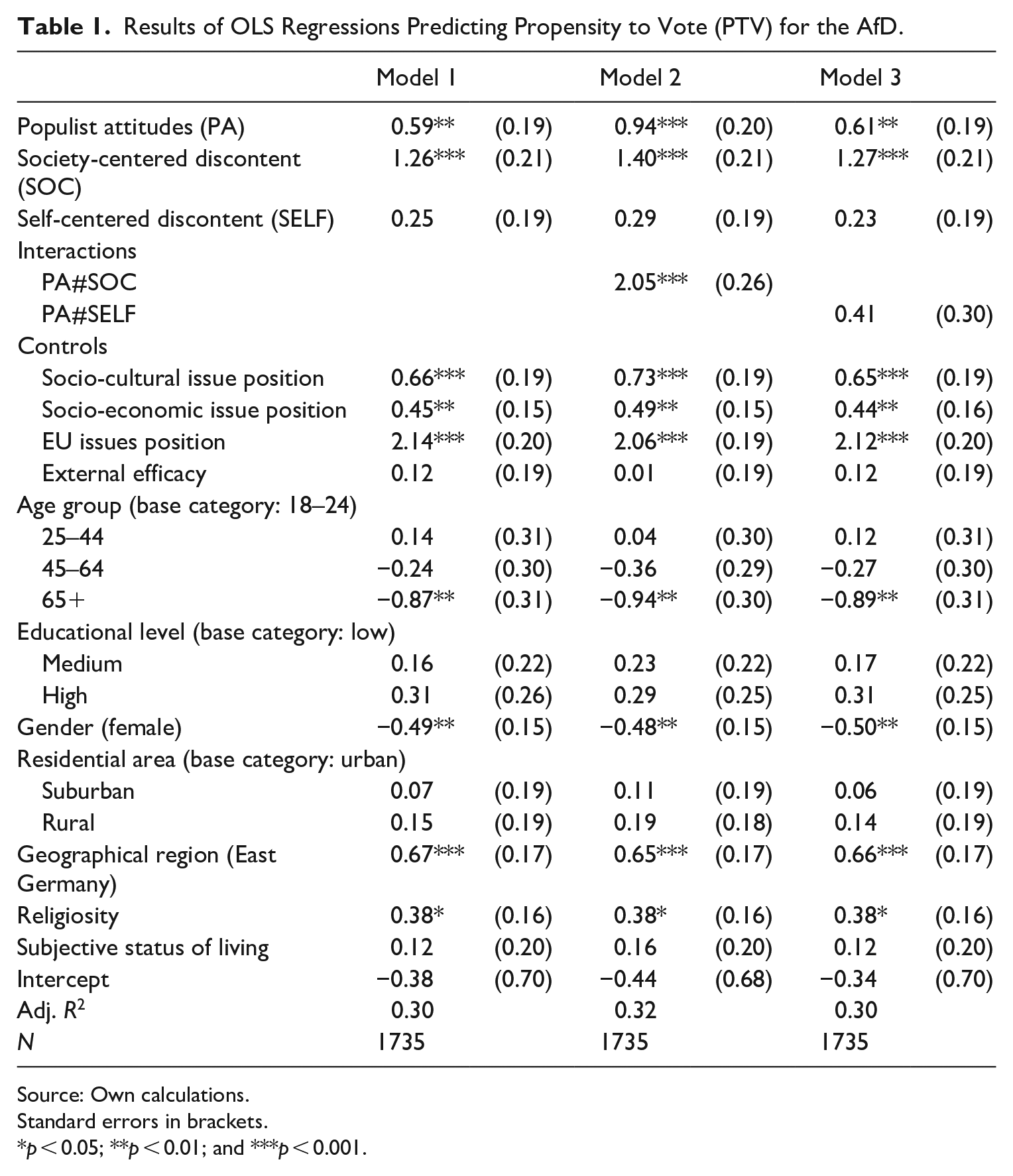
Does discontent play an important role in explaining populist party preferences? And, is there the expected difference between society-centered and self-centered discontent? Finally, can society-centered discontent help us understand how PA translate into supporting a populist party? Table 1 presents the results of three regression models estimated to test our hypotheses. The number of cases is fixed for all models and due to standardization we can directly compare all coefficients.
Results of OLS Regressions Predicting Propensity to Vote (PTV) for the AfD.
Source: Own calculations.
Standard errors in brackets.
*p < 0.05; **p < 0.01; and ***p < 0.001.
We start with some general observations. Regarding the socio-demographic controls, we see that senior citizens (over the age of 65 compared to young citizens) and women are less willing to ever vote for the AfD, while people living in East Germany and more religious people evaluate the AfD more positively. While external efficacy proves to be irrelevant, we find that issue positions have a strong impact—authoritarian, economically more right-wing and people with a negative view on the EU have a higher PTV for the AfD.
Taking a closer look at Model 1, we see that our first two hypotheses are confirmed. Discontent has a positive and strong effect on populist party preferences—in this case, on the PTV for the AfD. However, this is only the case for society-centered discontent. In line with Hypotheses 2, we find that respondents’ evaluation of their own situation (self-centered discontent) can be ignored while their perception of a potential crisis (society-centered discontent) turns out to be very influential. If we compare the impact of society-centered discontent to the effect of PA, we find that the former is even more important than the latter for predicting populist party preferences. In fact, solely the coefficient of attitudes toward the EU is stronger than the coefficient of society-centered discontent. We can conclude that society-centered discontent not only has a significant effect, but also that this effect is substantive.
As we are also interested in moderation effects, a graphical representation of the results is easier to interpret than regression tables. Figure 1 shows the effect of PA on AfD support based on different levels of society-centered (left panel and based on Model 2) and self-centered (right panel and based on Model 3) discontent. In the figure, we distinguish between respondents with low levels of discontent (mean − 1 standard deviation), average levels of discontent (mean), and high levels of discontent (mean + 1 standard deviation). With the exception of low levels of society-centered discontent, the two graphs show that having stronger PA increases respondents’ PTV for the AfD, which is fully in line with the literature. However, we see that the effect of PA on the dependent variable becomes stronger if a respondent is also rather dissatisfied. While this is only a gradual difference with respect to the graph on the right-hand side—meaning that statistically speaking there is no difference in the effects—there are substantive differences when PA are linked to society-centered discontent. Slightly above the scale midpoint, PA play a much greater statistical role when a person is also dissatisfied from a society-centered perspective. In numerical terms, the predicted PTV for the AfD is slightly above two if a respondent has strong PA but low levels of society-centered discontent. The predicted value increases to almost 4 with average and more than 5 with high discontent. Hence, we can confirm Hypothesis 3: society-centered discontent is an important moderator explaining under which circumstances PA actually translate into populist support. Again, we find no similar effect for self-centered discontent, underlining once more that—in line with Hypothesis 2—populist party support is mobilized by a collectivist rather than an individualistic perspective.
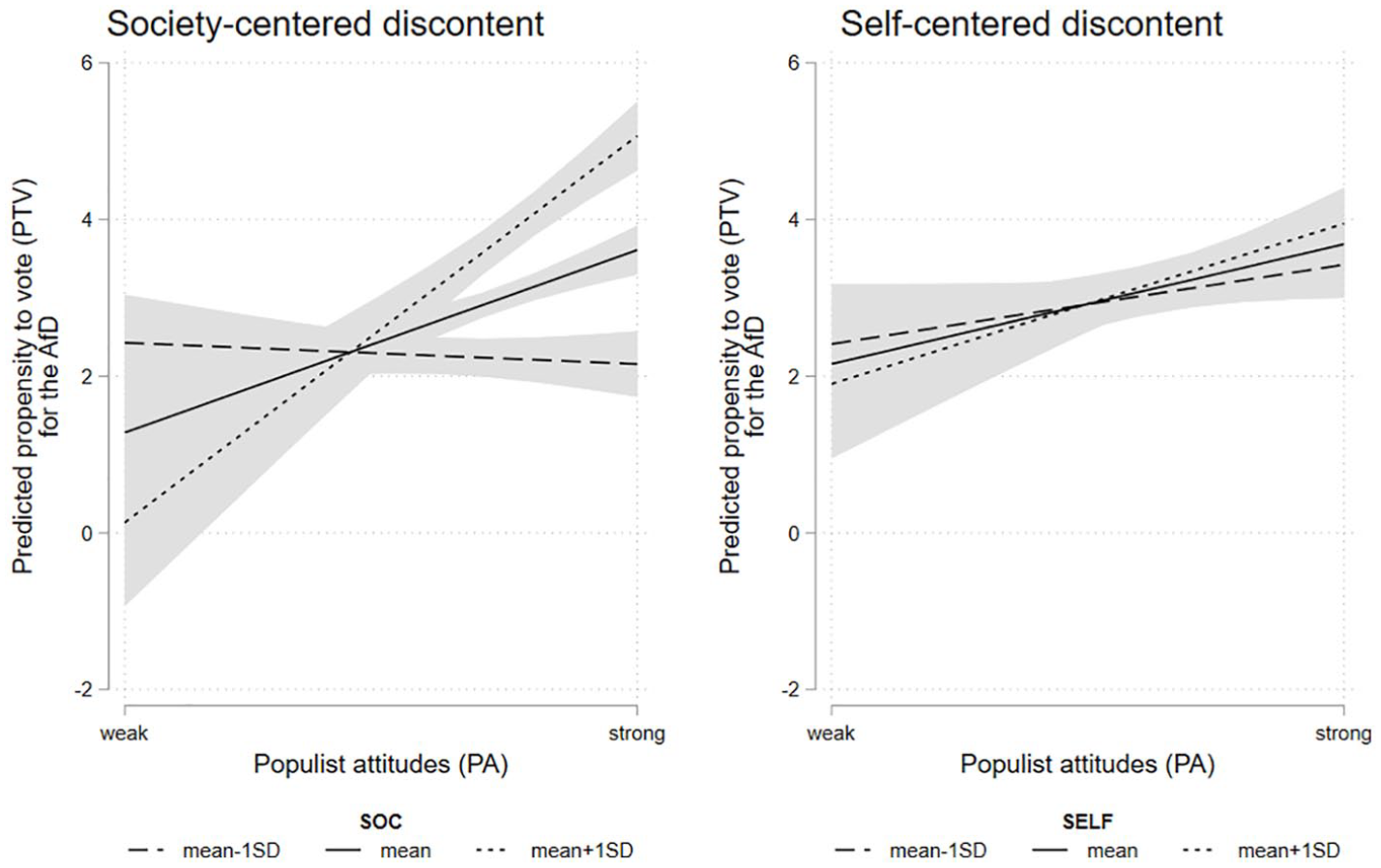
Moderating Effect of Discontent.
Finally, we can also look at Hypothesis 3 from a different angle by calculating the average marginal effect (AME) of PA on the PTV for the AfD at different levels of discontent. The results are shown in Figure 2. The point estimates represent the change in the dependent variable if PA increase by 1 unit (i.e. 2 standard deviations), depending on the degree of discontent. Again, we find that PA do not matter for populist support if there is only weak society-centered discontent. Here, we also see that this is the case for self-centered discontent. If society-centered dissatisfaction is average or even strong, the effects become much greater and differ significantly from one another. On the right side of the figure, there is no such pattern: it hardly matters whether self-centered discontent is average or high.
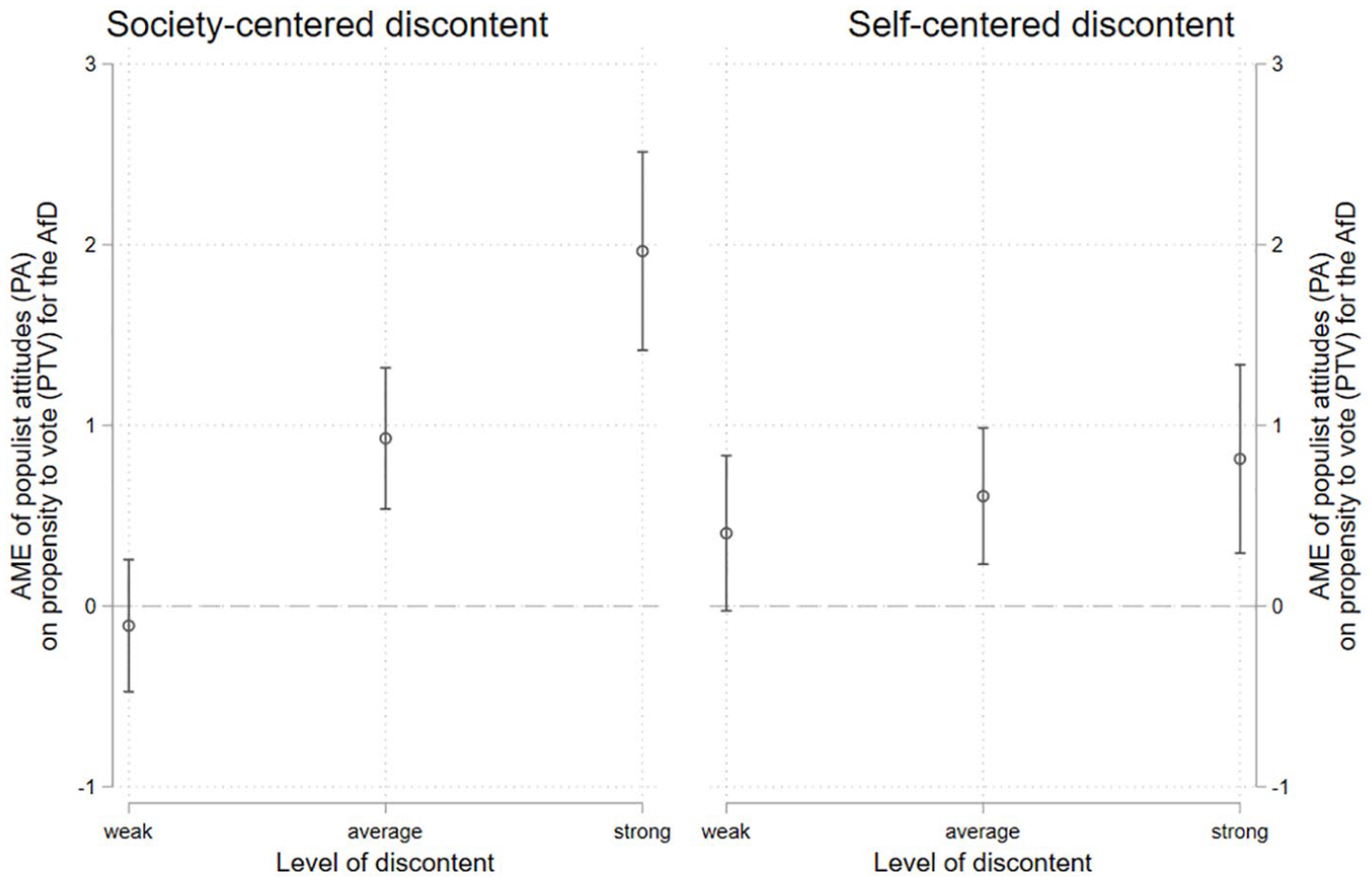
AME of Populist Attitudes for Different Levels of Discontent.
In the Supplementary Material, we present several robustness checks that support our findings. For example, one might argue that there is a relevant and potentially problematic relationship between the two measures of discontent. Jetten et al. (2017) find that economic instability at the societal level increases fears, especially among citizens who are individually well-off. Similarly, Rooduijn and Burgoon (2018) report that economic suffering fosters radical voting primarily when the state of society is favorable. Since such interactions between self-centered and society-centered discontent could distort our results, we also estimate a three-way interaction between PA and the two forms of discontent. However, there is no significant interaction effect and the interpretation of our results does not change when using this more complex set-up (Table S2 and Figure S1).
We have also re-evaluated our main models using a different measure of society-centered discontent. There are 11 additional items in the survey that deal with potential crises in different areas and regarding different aspects (see Supplement B of the Supplementary Material). However, these additional items were only asked for subsets of the respondents. More precisely, each respondent answered four core items and two additional items which were randomly assigned. Therefore, we decided to use this information only as a robustness check and to rely on the four items given to each respondent. However, in total 15 items cover an even broader scope of issues, which further decreases the chance of a problematic bias. 7 Running the analyses while using this variation of our measure of society-centered discontent has no effect on our findings (see Table S4 and Figure S2).
The results are also robust when we apply a different measure of SELF which focuses more on economic grievances (see Table S5 and Figure S3). The latter combines the standard of living of respondents’ families and respondents’ evaluation of their own economic situation—assuming that a bad economic situation translates to higher levels of self-centered discontent. Again, and in accordance with our hypotheses, there is no significant relationship between this measure of self-centered discontent and populist party preferences. The results also hardly change when using simple mean values for all constructs instead of factors scores extracted from confirmatory factor analyses (see Table S6).
The dataset at hand also includes information on party choice in the 2017 federal election. While we are mainly interested in more general populist party preferences, this allows us to run similar models using vote choice for the AfD instead of the PTV for the AfD as the dependent variable. This makes it necessary to discard all respondents who did not vote in this election and to estimate a logistic regression model as the dependent variable becomes binary (1 = voted for the AfD; 0 = voted for any other party). The results of this test are inconclusive and we discuss this in detail in Supplement C of the Supplementary Material. Whether the fact that the results of the propensity-to-vote models do not fully translate to vote-choice models is caused by missing covariates responsible for the translation of preferences in party choice or some peculiarities of comparing estimates in a linear to non-linear set-up seems hard to tell. However, this clearly means that we cannot generalize our findings to party choice at this point.
Conclusion
We started this article with the observation that populist parties are gaining power in many Western societies. A large and ever-growing number of empirical studies seek to explain this development. While many studies focus on aspects such as PA or issue positions as drivers of populist party support, we focus on discontent—because discontent is inherently related to several definitions of populism, ranging from the ideational to the discursive approach. Although some studies examine the relationship between discontent and populist support, their results are rather mixed and they differ in their understanding of the nature and focus of discontent. Since populism is very strongly focused on “the people,” we suggest that particularly society-centered discontent predicts populist party support. Moreover, we propose that high levels of society-centered discontent condition the relation between PA and political behavior.
We test our assumptions drawing on a representative sample of German citizens. Results support our main hypotheses. First, discontent is indeed an important predictor of the PTV for the populist AfD. This finding can be further specified: there is an important difference between society-centered and self-centered discontent. While society-centered discontent is a strong predictor of the PTV for the AfD, self-centered discontent is unrelated to populist party preferences. Second, higher levels of society-centered discontent strongly increase the positive correlation between PA and populist preferences. Having PA without being at the same time dissatisfied with the state of society is not associated with a high PTV for the populist right.
Additional tests indicate that these results are very robust, but there are nevertheless limitations to our study. While we use well-established instruments or, in the case of society-centered discontent, carefully deduced items, we are nevertheless left with only one country and one party to test our hypotheses for. The AfD is a prototype right-wing populist party, but we cannot examine whether our hypotheses hold for populist parties in general, as our framework argues. For example, it would be worthwhile to apply our model to populist parties that are more established and older than the AfD—for example, the populist parties of Austria or the Netherlands. Moreover, having data for Greece, Spain, or Italy would allow us to examine the role of society-centered discontent beyond a right-wing populist party. As we locate our research within the ideational approach, there is in principle no need to assume any difference depending on the host ideology. However, to be able to show this empirically would greatly help us to establish generalizability and we plan to continue working in this direction.
Despite these limitations, our study not only has important implications for research of populist party success, but perhaps also of populism in general. We do not assume that the fact that society-centered discontent plays such an important role for populist party support is a sign that altruism is at work. Rather, populist entrepreneurs and movements seem to have succeeded in creating or at least activating collective identities and benefiting from a discourse about collective grievances. Anxieties and concerns are collectivized and related to (groups of) society. This matches very well with the populist idea of “the people” as a homogeneous group with a shared identity that supposedly needs to be defended.
In recent years, scientific research has raised some doubts about globalization and modernization as the sole drivers of populist success. Looking at our findings, this could be both true and false: defining the “loser of globalization” or the “modernization sceptic” based on discontent with one’s individual situation might be misleading. Developments of this magnitude always affect the social order and could shake up the status position, role conceptions, and identity of societal groups. In combination with the massive effects of globalization and modernization in general, this can result in increasing insecurity and discontent. This analytical perspective perfectly allows incorporating actual as well as perceived grievances—with the latter often defined in relative terms or concerned with status or status quo protection. However, the focus of this dissatisfaction is on the society or specific (in-)groups within society and is therefore society-centered and not self-centered in nature.
The thin-centered populist ideology and thus the communication and mobilization by populist actors build their success on the cultivation of collective grievances. Investigating these collective grievances more carefully should provide important insights into why populism has had such a strong revival and success in the last two decades in more or less all regions of the world. At the same time, competing political parties might be more successful in winning voters (back) by focusing less on the policy portfolio of populists and more on countering the work of populist identity entrepreneurs. It is obviously not easy to alleviate collective grievances and society-centered discontent, especially as some of the populist claims contradict certain values of open and democratic societies. Acknowledging that populist support is driven primarily by collective rather than individual factors, however, is suitable both for theoretical conceptualizations of populism and for providing new ideas for dealing with it.
Supplemental Material
PSX_932115_Giebler_Online_Supplementary_Material – Supplemental material for Discontent With What? Linking Self-Centered and Society-Centered Discontent to Populist Party Support
Supplemental material, PSX_932115_Giebler_Online_Supplementary_Material for Discontent With What? Linking Self-Centered and Society-Centered Discontent to Populist Party Support by Heiko Giebler, Magdalena Hirsch, Benjamin Schürmann and Susanne Veit in Political Studies
Footnotes
Appendix 1
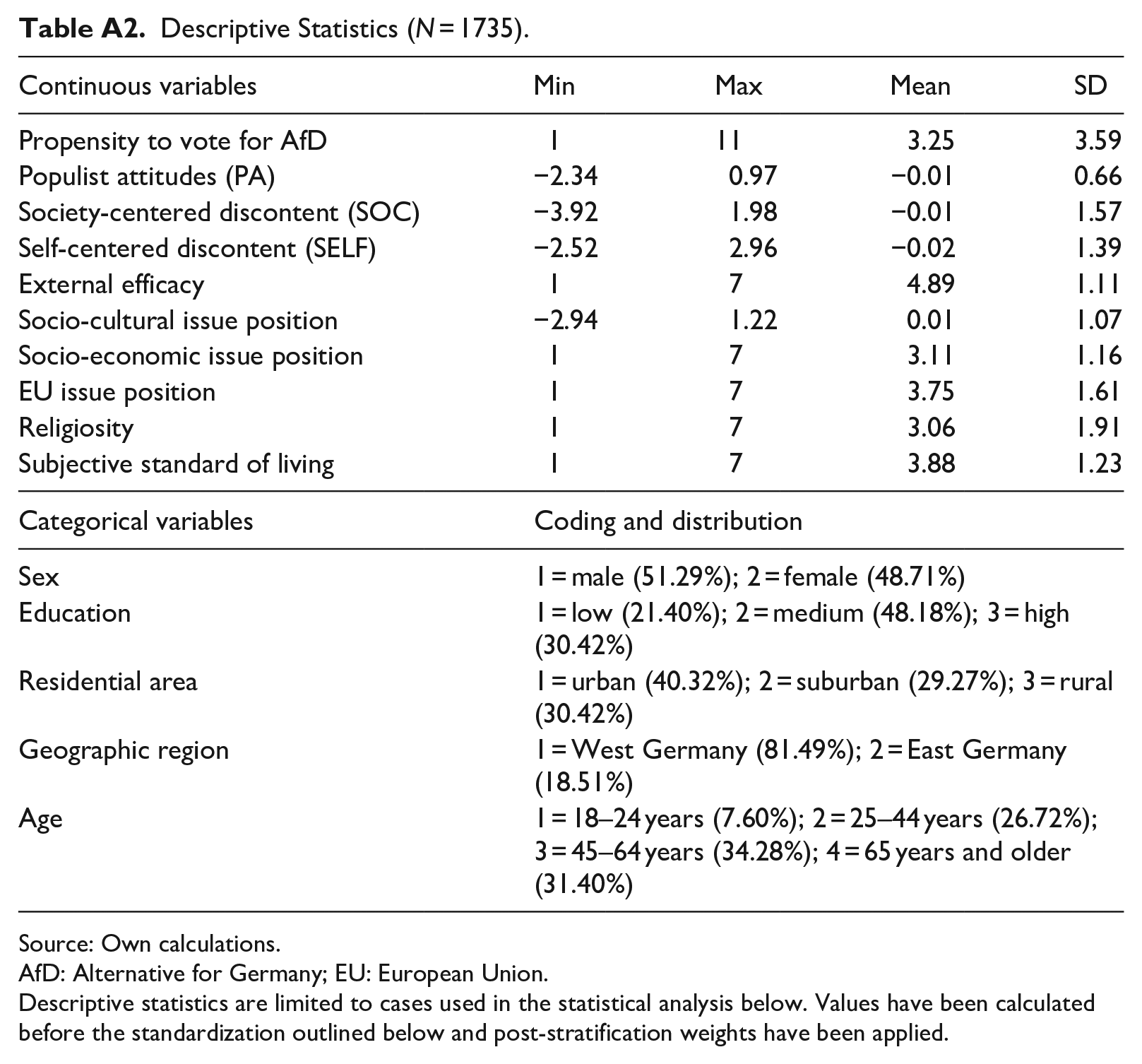
Descriptive Statistics (N = 1735).
| Continuous variables | Min | Max | Mean | SD |
|---|---|---|---|---|
| Propensity to vote for AfD | 1 | 11 | 3.25 | 3.59 |
| Populist attitudes (PA) | −2.34 | 0.97 | −0.01 | 0.66 |
| Society-centered discontent (SOC) | −3.92 | 1.98 | −0.01 | 1.57 |
| Self-centered discontent (SELF) | −2.52 | 2.96 | −0.02 | 1.39 |
| External efficacy | 1 | 7 | 4.89 | 1.11 |
| Socio-cultural issue position | −2.94 | 1.22 | 0.01 | 1.07 |
| Socio-economic issue position | 1 | 7 | 3.11 | 1.16 |
| EU issue position | 1 | 7 | 3.75 | 1.61 |
| Religiosity | 1 | 7 | 3.06 | 1.91 |
| Subjective standard of living | 1 | 7 | 3.88 | 1.23 |
| Categorical variables | Coding and distribution | |||
| Sex | 1 = male (51.29%); 2 = female (48.71%) | |||
| Education | 1 = low (21.40%); 2 = medium (48.18%); 3 = high (30.42%) | |||
| Residential area | 1 = urban (40.32%); 2 = suburban (29.27%); 3 = rural (30.42%) | |||
| Geographic region | 1 = West Germany (81.49%); 2 = East Germany (18.51%) | |||
| Age | 1 = 18–24 years (7.60%); 2 = 25–44 years (26.72%); 3 = 45–64 years (34.28%); 4 = 65 years and older (31.40%) | |||
Source: Own calculations.
AfD: Alternative for Germany; EU: European Union.
Descriptive statistics are limited to cases used in the statistical analysis below. Values have been calculated before the standardization outlined below and post-stratification weights have been applied.
Acknowledgements
We would like to thank the participants of the 2018 EPSA conference as well as of workshops at the University of Bamberg and at the WZB Berlin Social Science Center for their helpful comments on earlier versions of this manuscript. Special thanks go to Niklas Stoll and Arne Carstens for their help with preparing the analyses and the manuscript as well as Ekpenyong Ani for copyediting. Finally, we would also like to thank the reviewers and the editors for their very insightful and fair comments during the review process.
Declaration of Conflicting Interests
The author(s) declared no potential conflicts of interest with respect to the research, authorship, and/or publication of this article.
Funding
The author(s) received no financial support for the research, authorship, and/or publication of this article.

Supplemental Material
Additional supplementary information may be found with the online version of this article.
A. Additional Tables and Figures. Table S1. Results of Confirmatory Factor Analyses. Table S2. Three-Way Interaction Model. Table S3. Party Support and Populist Attitudes (Correlation Coefficients). Table S4. Models with Alternative Measure of Society-Centered Discontent (SOC). Table S5. Models with Alternative Measure of Self-Centered Discontent (SELF). Table S6. Models with Mean Values Instead of Factor Scores. Figure S1. Predicted PTV for the AfD with Three-Way Interactions. Figure S2. Predicted PTV for the AfD with Alternative Measure of SOC. Figure S3. Predicted PTV for the AfD with Alternative Measure of SELF. Figure S4. Predicted PTV for the AfD with Alternative Measurement of Constructs. B. Items Used to Measure Society-Centered Discontent (SOC). C. Additional Analysis Using Vote Choice as the Dependent Variable. Table S7. Logit Model Predicting Vote Choice for the AfD. Figure S5. Predicted Probability to Vote for the AfD (Vote Choice). Figure S6. Interaction of Self-Centered Discontent and Populist Attitudes (Ai and Norton Approach).
Notes
Author Biographies
References
Supplementary Material
Please find the following supplemental material available below.
For Open Access articles published under a Creative Commons License, all supplemental material carries the same license as the article it is associated with.
For non-Open Access articles published, all supplemental material carries a non-exclusive license, and permission requests for re-use of supplemental material or any part of supplemental material shall be sent directly to the copyright owner as specified in the copyright notice associated with the article.
