




Abstract
While some consider populist parties to be a threat to liberal democracy, others have argued that populist parties may positively affect the quality of democracy by increasing political participation of citizens. This supposition, however, has hitherto not been subjected to rigorous empirical tests. The voter turnout literature, moreover, has primarily focused on stable institutional and party system characteristics – ignoring more dynamic determinants of voter turnout related to party competition. To fill this double gap in the literature, we examine the effect of populist parties, both left and right, on aggregate-level turnout in Western and Eastern European parliamentary elections. Based on a dataset on 315 elections in 31 European democracies since 1970s, we find that turnout is higher when populist parties are represented in parliament prior to an election in Eastern Europe, but not in Western Europe. These findings further our understanding of the relationship between populism, political participation and democracy.
Keywords
Introduction
Since the late 1990s onward, the number of politically relevant populist political parties in Europe has increased considerably. With varying degrees of success, populist (radical) right and populist (radical) left parties have established themselves as important players in European democracies (March, 2011; March and Keith, 2016; Mudde, 2007; Van Kessel, 2015).
As populist parties have gained electoral success and, in some cases, have been able to form government coalitions, political scientists have turned to the question what the ascendancy of populism means for the quality of liberal democracy. More often than not, populist parties are considered to be a threat to the stability of liberal democracies. Given that populists regard ‘the people’ as a pure and homogeneous entity sharing one ‘general will’ (Mudde, 2004) that needs to be translated into policy, populism is considered to be antithetical to democratic pluralism and the rule of law. Therefore, authors such as Müller (2016: 3) conclude that ‘populism tends to pose a danger to democracy’ – see also Abts and Rummens (2007). And, indeed, Huber and Schimpf (2017), Houle and Kenny (2018), Ruth (2018) and Kenny (2019) find that populist leaders and parties can have a negative impact on the separation of powers, the rule of law and minority rights.
Notwithstanding such widespread fears about populist politics, Mudde and Rovira Kaltwasser (2017) stress potential positive effects of populism. They argue that populist parties can also be a ‘corrective for democracy’. According to Mudde and Rovira Kaltwasser (2017: 83), ‘populism tends to favor political participation’. Populist movements and parties are postulated to voice the concerns of citizens who have been previously mis- or underrepresented by the political establishment. Populist parties are thus considered to be capable of mobilizing previously underrepresented citizens. Mudde and Rovira Kaltwasser (2017) hypothesize therefore that populist parties can increase voter turnout in national elections. The existing evidence, however, on the effects of populist parties on turnout is inconclusive (Houle and Kenny, 2018; Huber and Ruth, 2017; Spittler, 2018).
At the same time, the literature on voter turnout often focused on institutional and party system-related determinants (Blais, 2006; Cancela and Geys, 2016; Geys, 2006; Stockemer, 2017). Regarding political parties, the turnout literature has primarily focused on variables such as the (effective) number of parties and the competitiveness of elections, thereby neglecting more dynamic party competition determinants of voter turnout (see Blais, 2006; Stockemer, 2017).
As the limited extant research on the relationship between populist parties and political participation has come to divergent conclusions (Houle and Kenny, 2018; Huber and Ruth, 2017; Spittler, 2018), our study assesses the effect of populist parties on voter turnout for a variety of operationalizations and model specifications. Specifically, we ask the question: Do populist parties increase turnout in parliamentary elections?
Given that individual-level voter turnout data suffer from problems related to social desirability and recall bias (Holbrook and Krosnick, 2010; Karp and Brockington, 2005; Smets and Van Ham, 2013), this study focuses on the aggregate-level turnout in national elections, with an election in a given country as our unit of analysis. Studying aggregated voting behaviour is important because ‘individual idiosyncrasies cancel each other and allow the estimation of models with greater explanatory power’ (Matsusaka and Palda, 1999: 442).
To examine whether populist parties affect aggregate-level turnout, we have compiled a dataset of 329 national parliamentary elections in European democracies since 1970 from the ParlGov database (Döring and Manow, 2016), the Comparative Political Data Set (CPDS) (Armingeon et al., 2016) and further sources.
Populist parties may also affect newer democracies differently than established democracies (Mudde and Rovira Kaltwasser, 2017) – particularly given that political participation is less stable in transitional democracies (Kostadinova and Power, 2007; Kostelka, 2017). In our analysis, we therefore also distinguish between Western European (WE) and Central and Eastern European (CEE) democracies. Given that left-wing and right-wing populist parties couple their populism with entirely different host ideologies and attract different voters (Rooduijn et al., 2017), we also assess whether the results are driven by left-wing or right-wing populist parties.
Our time-series cross-sectional analyses reveal that populist parties, however operationalized, do not affect voter turnout in West European democracies. These are sobering findings to those who claim populist parties have a participatory effect on West European democracies. In Central and Eastern Europe, on the other hand, we find robust evidence that parliamentary representation of populist parties does affect voter turnout. This finding qualifies from previous findings (Houle and Kenny, 2018; Huber and Ruth, 2017), which found no effect of populist party supply on voter turnout, and points to the importance of carefully assessing multiple possible operationalizations as well as model specifications.
Theory
The Ramifications of Populism for Liberal Democracy
Increasingly, political parties characterized as ‘populist’ have achieved democratic representation. While some define populism as a political strategy (Kenny, 2019; Weyland, 2001) or a political style (Moffitt and Tormey, 2014), we regard populism as a set of ideas (see Hawkins et al., 2018). The ideational approach considers populism to be a discourse or ideology that sees politics as a moral struggle between two juxtaposed homogeneous groups, ‘the pure people’ versus ‘the corrupt elite’, and as an expression of the general will of the people (Canovan, 1999; Hawkins, 2009; Meléndez and Rovira Kaltwasser, 2017; Mudde, 2004). Applications of the ideational approach have established empirically that populist ideas are present in party communication and ideology (Hawkins, 2009; Rooduijn et al., 2014) and in citizens’ attitudes (Akkerman et al., 2014; Geurkink et al., 2019).
Populism comes in many different guises (Huber and Schimpf, 2017; Van Hauwaert and Van Kessel, 2018). Populist radical right parties combine populism with nativism and authoritarianism. Nativism considers non-native elements in society, such as people and ideas, a threat to the nation. Authoritarianism denotes the belief that society should be strictly ordered by means of punitive measures (Mudde, 2007). The populist radical right usually defines ‘the pure people’ in ethnic or cultural terms and considers the ‘liberal political establishment’ as the ‘corrupt elites’. By contrast, the populist radical left combines populism with a fundamental critique of market-liberalism and new public management (March, 2011; Ramiro and Gomez, 2017). For the populist radical left, ‘the people’ are an amalgam of ordinary citizens threatened by corporations and neoliberal elites.
More often than not, populist parties have been characterized as a danger to the functioning of democracy (see, for instance, Abts and Rummens, 2007; Downs, 2012). Key components of the ideational definition of populism are at odds with pluralist conceptions of society. It is antithetical to the idea of representative democracy which gives primacy to pluralist political contestation and, as such, poses a challenge to party government as a pillar of representative democracy (Caramani, 2017). Populists’ Manichean conception of politics between the good people and the evil elite indicates an intrinsic antithesis between populism and pluralism that is apparent in all populist parties (Mudde and Rovira Kaltwasser, 2017: 83). Nevertheless, ethnic conceptions of ‘the people’ and disdain for minority rights voiced by populist radical right parties are particularly at odds with pluralist values in liberal democracy (Mudde, 2007).
In recent years, the relationship between populism and liberal democracy has been subjected to empirical scrutiny. Examining the link between populism and horizontal accountability in Latin America, Ruth (2018) shows that populist presidents have eroded checks and constraints on the executive (see also Houle and Kenny, 2018). This is in line with the populist conception that the people’s will should be translated into politics (by the populist leader) in an unmediated, undistorted fashion. Relying on Weyland’s (2001) definition of populism, Kenny’s (2019) analysis of 91 countries shows that populist government rule is associated with the erosion of media freedom. As populist chief executives are less concerned with the longevity of their party beyond their rule, they are not incentivised to safeguard the rules of the game that would facilitate re-election when in opposition.
Focusing on Europe, Huber and Schimpf (2017) find that the presence of right-wing populist parties is associated with a decline in minority rights, while left-wing populist presence is associated with higher levels of minority rights. In addition, Huber and Schimpf (2017) find that populist presence is associated with lower levels of mutual constraints. Developments of democratic backsliding attested in Hungary and Poland under the populist Fidesz and PiS governments give further case-level evidence of the negative effects of populism on liberal democracy (Rupnik, 2016).
Despite the detrimental effects of populism on democracy, some argue that populism may also exert positive effects on the quality of democracy (Mudde and Rovira Kaltwasser, 2017: 83). The positive potential of populism resides in two interrelated factors: voicing underrepresented political concerns and mobilizing political participation. Populism can function as a ‘democratic corrective’ since populist parties can give a voice to societal groups previously excluded from or underrepresented in politics. While some scholars argue that populism therefore is a response to the growing distrust in politics (Betz, 1994; Dalton and Wattenberg, 2000), others argue that populism is a response to excessive depoliticized decision-making – produced by European integration and the collusion of mainstream parties (Mair, 2007). Huber and Ruth (2017) find that populist parties increase the equality of participation as the gap between voters with higher and lower socio-economic status decreases. Yet, as the distribution of turnout can vary independently of overall levels of participation, the question whether populist parties mobilize the electorate remains open.
Populism and Voter Turnout
The voter turnout literature has primarily focused on rather stable country and party system feature. Meta-analyses of aggregate-level voter turnout studies crystallized the most important determinants of turnout (Blais, 2006; Cancela and Geys, 2016; Geys, 2006; Stockemer, 2017). Institutional characteristics such as compulsory voting and the co-occurrence of concurrent elections positively affect turnout. The importance of elections, determined by the type of election (first-order vs second-order elections) and the decisiveness of an election (i.e. the number of seats or posts filled in one election) also positively affect turnout. Mandatory registration requirements negatively affect turnout. Evidence on the participatory effect of proportional representation (PR) systems or majoritarian electoral systems, however, is mixed (cf. Cancela and Geys, 2016; Stockemer, 2017). With respect to socio-economic factors, extant research has established that countries with smaller populations tend to have a higher turnout (Stockemer, 2017).
Stockemer’s (2017) meta-analysis of 135 studies finds that election-specific variables are often neglected in macro-level turnout studies. In particular, the literature has so far scarcely examined the ways in which party-political factors affect voter turnout (but see Anderson and Beramendi, 2012). Hence, our focus on the supply-side effects of party politics on turnout fills an important gap in this literature.
There is some evidence, however, that political supply factors can affect turnout. Meta-analyses show that increased campaign expenditures by political parties induce higher voter turnout (Cancela and Geys, 2016; Geys, 2006). Research suggests that when election outcomes are very close, turnout tends to be higher (but see Cancela and Geys, 2016; Stockemer, 2017). Political fragmentation also is argued to affect turnout as a higher number of parties is to boost turnout because it broadens voters’ choice palettes. 1 Yet, the empirical evidence that a higher number of parties affects turnout is mixed (Cancela and Geys, 2016; Stockemer, 2017). These studies of political supply determinants of turnout share the central assumption that voters are more likely to be drawn to the polling booth when party competition makes elections meaningful. In other words, voters are more incentivised to vote when the stakes are higher.
Applying these conclusions from the turnout literature to the case of populist parties, populist parties arguably increase the urgency of elections – both for potential populist voters and for their opponents. Indeed, populist parties may increase the clarity of choice in an election as they emphasize previously ignored issues and adopt a clear position on that issue. Theoretical support for this mechanism comes from issue competition theory, which predicts electoral benefits for parties that emphasize publicly salient issues that were previously ignored by other competitors (Carmines and Stimson, 1986; Meguid, 2008).
De Vries and Hobolt (2012) have found that parties which advanced a previously depoliticized issue, the issue of European integration, tend to benefit electorally. While selective issue emphasis might motivate voters to change their vote, it can also increase the probability of non-voters to turn out to vote (Geys, 2012).
Non-voters are hard to reach as they experience low external political efficacy (Dyck and Lascher, 2009), are less interested in politics (Denny and Doyle, 2008) and are less satisfied with democracy (Rich and Treece, 2018). This suggests that only remarkable political circumstances likely motivate non-voters to vote. Yet, populist parties’ candidates are said to be ‘charismatic’, make emotional appeals to ‘true people’ and do not shy away from using unconventional communication strategies (Moffitt and Tormey, 2014). Their distinctive communication style likely increases their news value. And indeed, media coverage of populist parties has been shown to increase their electoral support (Murphy and Devine, 2018). Moreover, populist parties are found to use less complex language, which increases voter comprehension about their policy stances (Bischof and Senninger, 2018). Hence, populist are arguably the most likely political actor to stimulate previous non-voters to turn out.
Populist parties may also spur political participation by invoking forms of ‘counter-mobilization’ – drawing ‘anti-populist’ non-voters to the polling booth. In their individual-level study of radical right populism and reported voting, Immerzeel and Pickup (2015) show that radical right populist parties in Western Europe motivate highly educated and politically interested citizens to vote – voters likely to be opponents of (radical right) populist parties.
All in all, we therefore hypothesize that the supply of populist parties in a given parliamentary election positively affects aggregate-level voter turnout.
In recent years, a number of studies have also turned to the relationship between populism and electoral participation. Yet, the existing evidence on the impact of populist parties on turnout remains inconclusive. Examining 19 Latin American countries from 1982 to 2012, Houle and Kenny (2018) find no effect of populists in government or populists winning the election on turnout. Turning to the European case, Huber and Ruth (2017) examine the effect of electoral participation, incumbency and parliamentary presence of populist parties on voter turnout in 31 European countries from 1990 to 2014. Huber and Ruth find no effect of populism on electoral participation, incumbency or parliamentary presence of populist parties on turnout. Also no effect on average is found when distinguishing between left-wing, centrist, and right-wing populist parties. Spittler (2018) studies 30 European countries in the same time period from 1990 to 2014 but limits his study to right-wing populist parties. By contrast, Spittler (2018) finds a positive effect of the seat share of populist right-wing parties on representation. Yet, Spittler’s measure of participation includes items related to the equality of participation – conflating voter turnout and equality of representation.
Specifying the Effect of Populist Parties on Turnout
While these studies have made important steps in examining the relationship between turnout and populism, a lot of country- and party-level variation is left unexplored. While we do not formulate distinct hypotheses, we acknowledge that average effects can mask differential effects in terms of geographical context and in terms of party type.
It is possible that the relationship between the presence of populism and turnout is different in WE countries and in CEE countries. Scholars have noted the relatively high levels of turnout in CEE countries in the first election following the transition to democracy (Kostadinova and Power, 2007; Kostelka, 2017).
While turnout in most transition democracies fell to levels similar to the ‘standard turnout rate’ in established democracies, turnout in post-communist democracies dropped significantly below this standard turnout rate in subsequent elections in the period of democratic consolidation (Kostelka, 2017). Falling turnout in the consolidation period can be explained by disillusion over the benefits of democratization.
This might be especially the case considering that citizens hold democracy in lower esteem as they have been socialized in authoritarian ways of thinking (Neundorf et al., 2017). Disillusion with democracy in the consolidation period arguably enhances the mobilization potential of populist parties. Populists attack the political establishment that does not take the interests of the true people to heart. In addition, populists convey less pluralist notions of political representation in their supposition that true people share a single general will that is best expressed by one vox populi: the populist party in question.
In addition, CEE countries have been noted to suffer from party system instability as well as electoral volatility (Tavits, 2008). Tavits finds that volatility in CEE countries is a response to changes in the supply of political parties, rather than the other way around. In other words, changes in the supply of parties affects, on average, voter behaviour. Hence, it is possible that changes in populist party supply also affect average voter behaviour in terms of turnout. What is more, Rohrschneider and Whitefield (2009) find that in many post-communist democracies, the support for democracy is an important issue both in terms of positions and issue salience. Such contestation over democracy may be another reason why populist parties contesting the newly democratized political establishment may affect turnout. After all, populism can be seen as an alternative form of representation that stands in contrast with party government (Caramani, 2017). For these reasons, we assess the differential effect of populist parties on turnout in WE and CEE countries.
On the party-level, the ideology of the populist party may affect its propensity to enhance voter turnout. Populism is often seen as a thin-centred ideology that parties combine with different attaching or host ideologies (Mudde, 2004). The host ideology determines whether the nature of the populists’ people is construed in cultural or ethnic terms, as is the case with right-wing populist parties, or whether the people are imagined in socio-economic terms, as is the case with left-wing populists. Research shows that left-wing and right-wing populist parties mobilize different types of voters on the basis of different political claims (Van Hauwaert and Van Kessel, 2018). As left-wing populists’ non-ethnic notion of the people is more inclusive of nature, Huber and Ruth (2017) argue, but find no evidence for the supposition, that left-wing populist parties are more inclined to boost turnout as they may appeal to a greater segment of the population. Yet, it can also be argued that right-wing populist parties are more likely to boost turnout, because they have addressed issues that have been previously ignored, such as migration. Populist left parties, by contrast, compete predominantly on the left-right dimension (March, 2011). Therefore, our analysis also examines the effect of left- and right-wing populist parties separately. This will also allow us to disentangle the effect of parties’ populism from their host ideology.
Operationalizing the Effect of Populist Parties
While operationalizing the effect of populist parties on election turnout might seem straightforward, there are many different ways in which the effect of populism can be conceptualized. Indeed, existing studies examining the effect of populism on turnout rely on different operationalizations. In their analysis of Latin American democracies, Houle and Kenny (2018) estimate the presence of a governing populist party concurrent with the election as well as the concurrent presence of a populist party that wins the election. The (mere) participation of populist parties is not taken into account. Spittler (2018) examines the effect of the total seat share of populist parties prior to the election. Huber and Ruth (2017) analyse the participation of populist parties in the election and code whether the populist party is in government, in the opposition or a new party. As these studies employ differing operationalizations with mixed results, we consider here a more comprehensive range of operationalizations of populist party supply.
Arguably, in its simplest form, the expectation of a positive effect of populist parties on turnout denotes the hypothesis that the electoral participation of a populist party in parliamentary elections increases voter turnout. After all, the fact that a populist party is on the ballot might motivate previously disenfranchised non-voters to cast their vote. In this vein, the option of voting for a populist is sufficient for mobilizing hitherto disengaged citizens to participate, or for inviting counter-mobilization.
The participatory effect of populist parties may be a function of their novelty in the party system – and not only its populist ideology. Argued this way, only newly established populist parties can produce the supposed participatory effect. In this version of the hypothesis, it can be postulated that the electoral participation of a new populist party leads to increases in aggregate-level voter turnout.
However, the fact that a populist party participates in parliamentary elections does not necessarily mean it can viably affect the political agenda. One can argue therefore that when a populist party achieves parliamentary representation, it has better chances of affecting voter turnout. Dinas et al. (2015) argue that entering parliament is a key resource for the electoral survival of new parties. When entering parliament, a (populist) party receives public funding, more media attention and attains a stake in policy-making (Dinas et al. 2015). Parliamentary representation signals to voters the electoral viability of the party – making it more likely to affect policy in the long term. These resources are important for subsequent elections as they likely receive more media exposure. Parliamentary representation is linked to institutional advantages such as media exposure on public broadcasting services. In the Netherlands, for instance, only parties represented in the lower or upper house receive broadcasting time for political advertisement during election campaigns. Parliamentary presence also likely affects the professionalization of a populist party’s campaign as the party matures as an organization. An alternative formulation of the hypothesis is therefore that the parliamentary presence of a populist party prior to the election spurs aggregate-level voter turnout. Dinas et al. (2015) also find that entering parliament is particularly important for new parties in newly democratized countries as party branding is weak and need for signalling is high. This might suggest that especially in CEE countries, the representation of populist parties will affect turnout.
While the above operationalizations are all dichotomous, it is also possible that a populist party’s effect on turnout depends on their size. After all, the size of a party signals the political weight of a party to the voters. Hence, a populist party’s vote share is the continuous counterpart of the participation-based operationalization. The ensuing hypothesis stipulates that the higher the vote share a populist party prior to the election, the higher aggregate-level voter turnout. A continuous variable that corresponds to a party’s parliamentary representation is a populist party’s seat share. The corresponding hypothesis then is that the greater the seat share of a populist party, the higher aggregate-level turnout.
These various operationalizations of the populist party effect rely on slightly different theoretical assumptions about the relationship between the supply of political parties and voter turnout. As these assumptions concerning political supply and turnout have not been tested previously, we argue that it is important to test them all – in conjunction with the above-mentioned country-level and party-level variation.
Research Design
To test these expectations, we constructed a dataset of all national parliamentary elections (to the lower house) in European democracies from 1970 until 2017. 2 We have chosen a time frame that includes all relevant populist parties in Western Europe and allows for the observation of elections without populist parties for all countries while maintaining a balance of sample sizes between Western and Central and Eastern Europe, where we observe democratic elections from 1990 onwards. To ensure that the chosen time frame does not drive the results, we also replicate our analyses for the period 1990–2017 with similar results. 3 The data on election results come from the ParlGov database (Döring and Manow, 2016), which provides information on which parties ran in national parliamentary elections and their results for many European countries.
For each election and party competing in it, we coded whether a party in that election should be considered populist based on the literature. We classify populist parties using the ideational definition of populism (Hawkins et al., 2018). Our coding is based primarily on the classifications provided by Van Kessel (2015) as well as from Mudde (2007) and March (2011). In addition, we consider, on the left, the Workers’ Party of Belgium (PVDA-PTB) (Pauwels, 2014) and the Spanish party Podemos (Ramiro and Gomez, 2017) to be populist parties. As populism can be associated with different host ideologies, we distinguish between populist left and right parties based on the party family categorization provided by ParlGov. For a full overview of parties, which we have coded as populist see Table A.2 in the Online Appendix.
Note that we do not simply make a binary distinction between populist and non-populist parties but that we consider for each election whether a party based on its profile at that time should be considered populist. For instance, the Freedom Party of Austria has competed elections since the 1950s but only is considered to be populist since Jörg Haider took over the party leadership in 1986, and thus was coded by us accordingly.
We aggregate to the election-level to obtain various operationalizations of populist party supply at the aggregate level, as discussed in the theory section. The variable Populist Participation is a dummy variable indicating whether at least one populist party competed in a given election. The variable New Populist Party captures whether at least one new populist party competed in an election for the first time. This operationalization would be able to capture a novelty effect if such an effect exists. The variable Populist Representation captures whether at least one populist party held a seat in parliament at the time of the election. The variable Populist Vote Share measures the percentage of the vote that all populist parties combined received in the previous election and the variable Populist Seat Share measures the fraction of seats all populist parties combined hold after the previous election.
Our dependent variable,
Research has shown that
Unemployment is a strong predictor of turnout both on the individual and the aggregate level cross-sectionally; unemployment increases are associated with an increase in turnout (Burden and Wichowsky, 2014). While radical right voters are not more likely to be unemployed than mainstream votes, left populist parties tend to attract unemployed citizens (Rooduijn et al., 2017). Thus, if we were to omit unemployment from the specification, this would potentially lead to overestimation of the effect of populist parties on turnout. The national unemployment rate is measured as the percentage of the civilian labour force, obtained from the European Commission’s macroeconomic database AMECO.
The variable Effective Number of Political Parties (ENPP) counts the number of parties that make up a party system taking into account their relative sizes (Laakso and Taagepera, 1979). A greater choice of parties is associated with higher turnout. At the same time, a greater number of available parties should also make it harder for newcomers, including populist parties, to make a successful début. Such a relationship would induce a negative bias if we were to omit ENPP. At the same time, a populist party obtaining parliamentary representation increases the number of political parties. In that setting, failing to control for ENPP would induce a positive bias in our estimates. We calculate the ENPP on the basis of seat shares as apparent in the ParlGov data because we are interested in the number of electorally viable parties.
Moreover, another important variable in the turnout literature is the closeness or competitiveness of a given election. When elections are particularly close, turnout is hypothesized to be higher. Yet, as Stockemer (2017) reports, the evidence for this hypothesis is mixed. We measure the
In addition, we control for a country’s
We also include variables pertaining to institutional constraints. The aggregate-level turnout literature has particularly examined institutional variables pertaining to the electoral system. While it is often hypothesized that PR boosts turnout, Stockemer’s (2017) meta-analysis shows that the existing evidence is mixed. Nevertheless, we include a dummy variable measuring whether a country has a
While some between-country differences in turnout may indeed be due to populist parties, we take a more conservative approach by using fixed effects to minimize the possibility of bias through unobserved confounders as far as possible. We estimate country fixed effects via the within-transformation. All time-varying variables are thus estimated relative to the country mean, and variables that do not change over time are also controlled for. Substantively, what we are interested in is the difference that a populist party makes for turnout for a given election. For instance, we ask, how much lower or higher turnout would have been without any populist party competing the election. Given the structure of our data, fixed effects and first-differences estimation are best suited to address these causal questions.
First-differences models also effectively cancel out all, both observable and unobservable, time-constant confounders. Calculating first differences removes considerable variance in the dependent and independent variables. While this reduces the risk of Type 1 Error due to too small standard errors, first differencing also implies a change in focus. Substantively, what we estimate with Δ
We also control for time trends in all models since there is a clear time trend in both our dependent and key independent variable: a negative trend in turnout and a positive trend in presence and success of populist parties. 5 If we were to ignore these trends, this would leave us with a negative bias. In the models presented in Table 1 and corresponding tables in the Online Appendix, we included temporal dummies, one for every 5-year period which roughly corresponds to the average term length in Europe. In the Online Appendix, we also present models with yearly fixed effects which allow for more fine-grained temporal shocks at the expense of efficiency in estimation.
OLS Regressions of Turnout on Populist Participation, Populist Representation, New Populist Party, Populist Vote Share and Populist Seat Share.
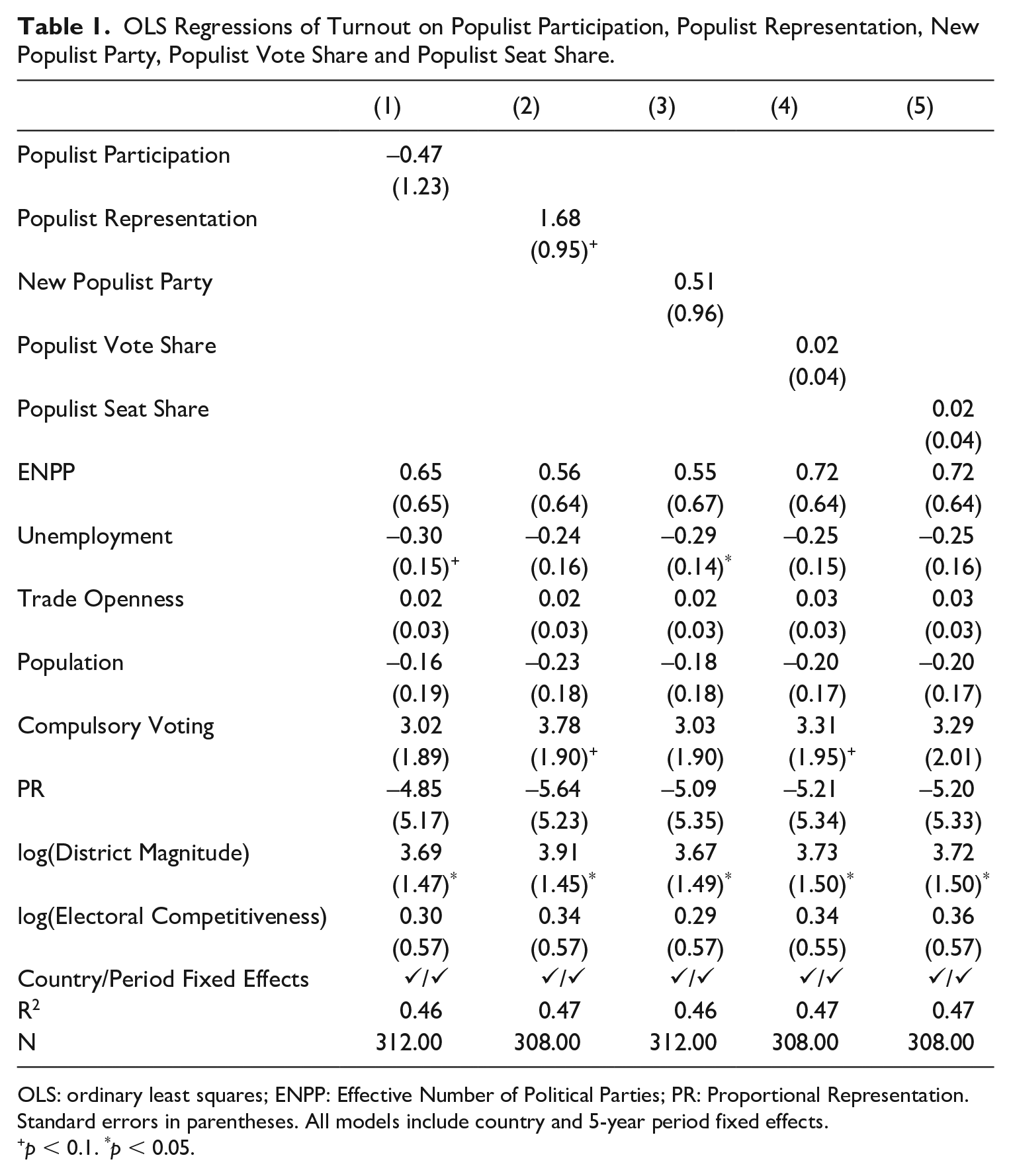
OLS: ordinary least squares; ENPP: Effective Number of Political Parties; PR: Proportional Representation.
Standard errors in parentheses. All models include country and 5-year period fixed effects.
p < 0.1. *p < 0.05.
As discussed, we also conduct additional subgroup analyses accounting for heterogeneity on the country- and party level. We include separate analyses for WE and CEE countries. Assessing these regions separately facilitates interpretation and provides for a more conservative estimate of the effect of populism in CEE countries, where we simply cannot draw on many observations.
Finally, we also distinguish between populist left and populist right parties. Using
To summarize, we test whether populist parties exert an effect on turnout on a time-series cross-sectional dataset of 315 elections between 1970 and 2016 in 31 European countries using multiple operationalizations of the populist party variable and employing multiple model specification strategies. We present the results of our analyses in the next section.
Results
Table 1 displays the results for five operationalizations of our key independent variables: Populist Participation, Populist Representation, New Populist Party, Populist Vote Share and Populist Seat Share. All models include election-specific control variables. The models also include country fixed effects and 5-year period fixed effects. The 5-year period fixed effects make sure we control for potentially important contextual factors such as political or economic crises.
Model 1 shows the effect of Populist Participation in a given election with aggregate-level turnout in that election. This variable signifies that at least one populist party was on the ballot in a given election. The estimate shows that Populist Participation has no statistically significant effect on aggregate-level voter turnout. Model 1 echoes the findings of Huber and Ruth (2017), who also did not find a significant effect of populist parties participating in election.
Model 2 assess the effect of Populist Representation on turnout. Populist Representation denotes that at least one populist party had achieved parliamentary representation prior to the election. The results indicate a positive effect of populist parties represented in parliament prior to the election that is statistically significant at the 0.1 level. Substantively, Populist Representation increases aggregate-level turnout by 1.7 percentage points.
Model 3 analyses the effect of the presence of a New Populist Party on voter turnout. The variable measures whether a populist party participated in the elections for the first time. The estimate shows a non-significant positive effect on turnout. Finally, Models 4 and 5 show the effect of Populist Vote Share and Populist Seat Share, respectively. These variables assess the effect of the sum of votes/seats won in the previous election. Both estimates display a very small coefficient size and are not statistically significant. The finding that the variable Populist Representation has a substantial and significant effect on turnout but Populist Seat Share does not, suggests that passing the threshold of achieving parliamentary representation is decisive, not the number of seats. Arguably, the benefits of parliamentary representation for a populist party are not proportional to the parties’ strength in terms of seat shares.
In short, while populist parties simply participating in an election seems to have no effect on turnout, the findings imply that populist parties being represented in parliament prior to the election substantially affects turnout. Yet, to what extent are these findings robust to different model specifications? What is more, do these average effects mask differences between WE countries and CEE countries and in the effect of populist left and populist right parties? To answer those questions, we plot the coefficients of our key independent variables in Figures 1–3.
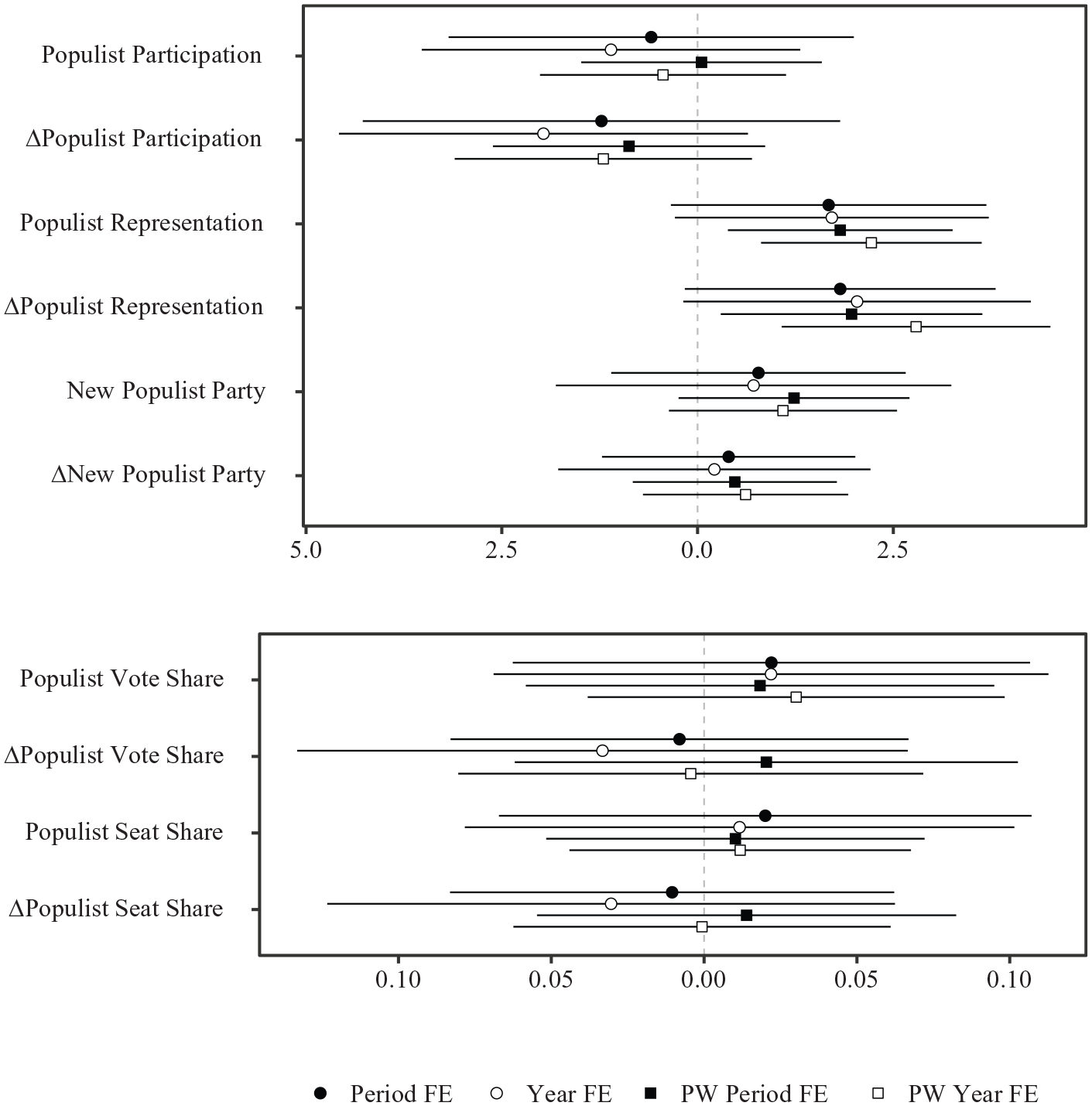
Coefficients for (Δ) Populist Participation, (Δ) Populist Representation, (Δ) New Populist Party, (Δ) Populist Vote Share and (Δ) Populist Seat Share from fixed effects models (levels) and first differences (Δ). OLS estimation with period fixed effects. Horizontal lines are 95% confidence intervals.
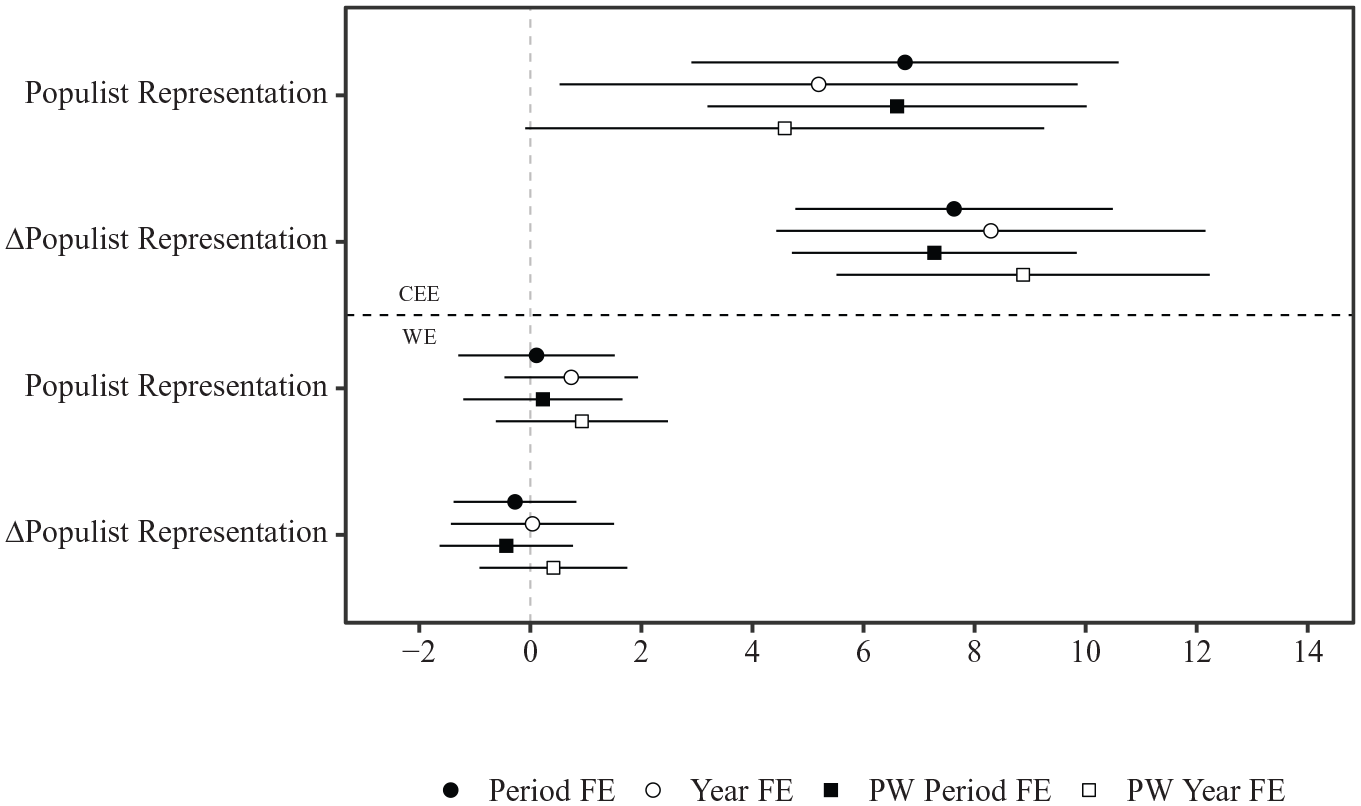
Coefficients for Populist Representation and Δ Populist Representation estimated on Central and Eastern European (CEE) and Western European (WE) sub-samples in four different model specifications: OLS estimation with period or year fixed effects and Prais–Winsten regressions with period or year fixed effects. Horizontal lines are 95% confidence intervals.
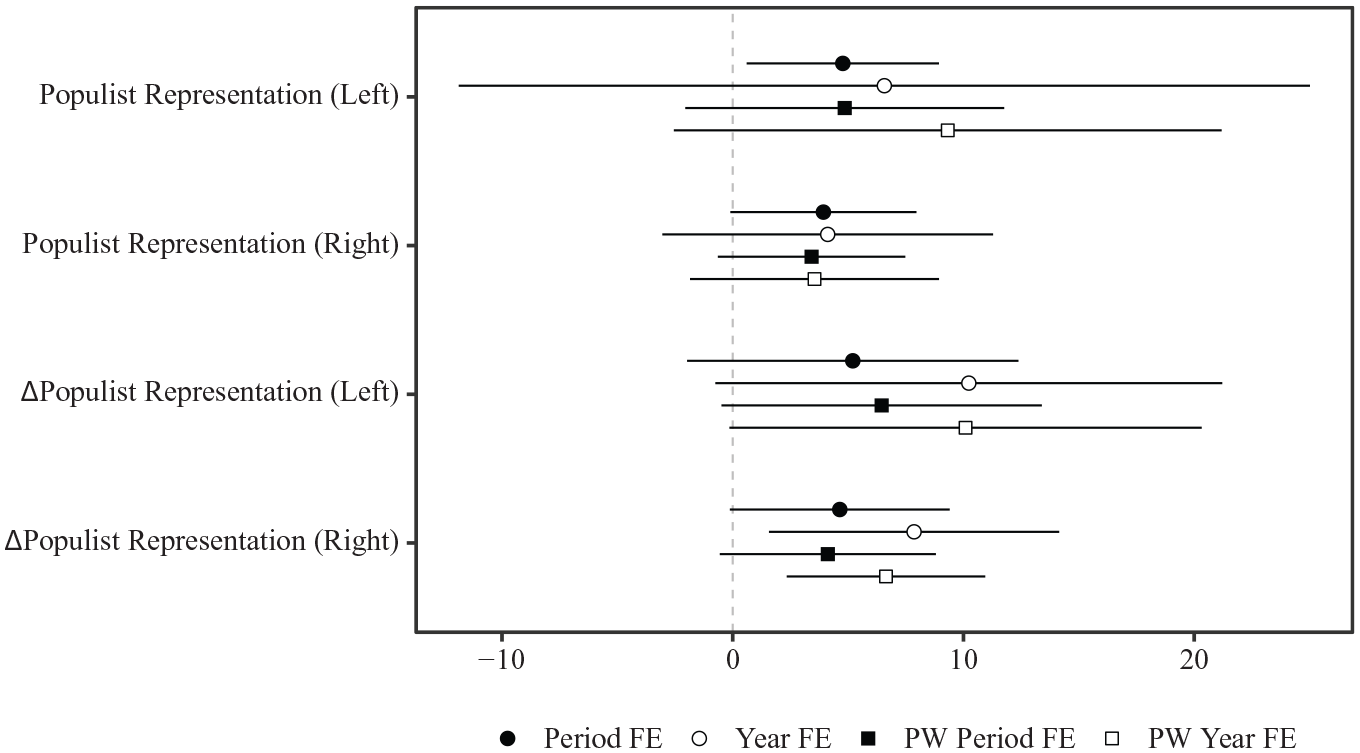
Coefficients for Populist Representation (Left), Populist Representation (Right), Δ Populist Representation (Left) and Δ Populist Representation (Right) estimated on Central and Eastern European (CEE) sample in four different model specifications: OLS estimation with period or year fixed effects and Prais–Winsten regressions with period or year fixed effects. Horizontal lines are 95% confidence intervals.
Figure 1 shows the coefficients of our five key variables of interest for different model specifications. We report both the OLS models and the first-differences models. The variables preceded by the Δ sign show the effect of change in the independent variable on change in the dependent variable. In addition, we report four different model specifications of these variables. The coefficients labelled ‘Period FE’ graphically depict the results measured with period fixed effects shown in Table 1. The label ‘Year FE’ replicates this model with more stringent yearly fixed effects. We also estimate pooled OLS regression models with Prais–Winsten transformation to account for serial correlation. While uncertainty in the estimates is smaller when using the Prais–Winsten transformation (as indicated by the 95% confidence intervals) the point estimates (denoted by dots) are substantively similar across models.
As the coefficients for
Figure 2 replicates the previous analyses for
In light of these results, we explore whether left-wing or right-wing populist parties account for the positive effect of prior parliamentary representation on turnout in CEE in Figure 3. To do so, we replace our original
All in all, these results then allow us to accept the hypothesis that the prior parliamentary representation of populist parties positively affects turnout in CEE countries.
Conclusion
The ascendance of populist political parties has been characterized by many political scientists and commentators as a veritable threat to representative democracy (Abts and Rummens, 2007). Research has found that populist politicians and parties can indeed put free and open political contestation into jeopardy (Houle and Kenny, 2018; Huber and Schimpf, 2017; Kenny, 2019; Ruth, 2018). While not explicitly contradicting such alarming claims, some authors, such as Mudde and Rovira Kaltwasser (2017), posit that populism may also have some positive effects on liberal democracy. Populist parties can articulate grievances of underrepresented segments of society and they can increase democratic accountability by politicizing issues that were kept off the political agenda by established political actors (Mudde and Rovira Kaltwasser, 2017: 80–86). Above all, populist parties are said to foster greater political participation by bringing previous non-voters to the polling booths.
This contribution has taken the assertion that populist parties can be a ‘corrective for democracy’ seriously. While many scholars have suggested a positive link between populist politics and increased political participation (Betz, 1994; Dalton and Wattenberg, 2000; Mair, 2007; Meny and Surel, 2002; Mouffem 2005; Mudde and Rovira Kaltwasser, 2017), the scarce existing research on this topic has produced mixed findings (Houle and Kenny, 2018; Huber and Ruth, 2017; Spittler, 2018). Using a variety of time-series cross-sectional regression modelling techniques, we estimated the effect of populist parties on the aggregate level of voter turnout for 315 national parliamentary elections between 1970 and 2016 in 31 European countries.
We find that a populist party participating in a given election does not affect the average level of voter turnout in that election. Neither did we find a significant effect of a new populist party participating in an election on turnout, or an effect of populist vote or seat share. We do, however, find robust empirical support for a positive effect of the parliamentary presence of populist parties on turnout in CEE countries. No effect of populism on turnout was established for WE countries. These results qualify the conclusions of Huber and Ruth (2017) who argue that populist party support does not affect electoral participation.
Our findings strongly suggest that scholars of populism should take into account multiple operationalizations of populist party supply in future research. Furthermore, it is important to be attentive to context. In line with Mudde and Rovira Kaltwasser (2017), our results suggest that the effect of populism on democracy is strongly contingent on contextual factors. Arguably, the positive effects of populist parties on turnout in CEE countries in the period from 1990 until 2017 suggest that voters in nascent democracies are more susceptible to supply-side factors.
Research on voter turnout in the CEE region has put forward the hypothesis that voters during the democratic consolidation period were disillusioned by the efficacy of democratic rule (Kostadinova and Power, 2007; Kostelka, 2017). Mudde and Rovira Kaltwasser (2017) also argue that populism may particularly have positive effects on democracy during the transition period from authoritarian rule to democracy. The people-centred appeal of populist parties can motivate non-voters to partake in the electoral process. Our findings then are also important for the literature on democratization and democratic consolidation (see, for example, Rovira Kaltwasser, 2012).
But to what extent are these findings for CEE generalizable? The participatory effect of populism could well apply to other nascent democracies in Latin America and South-East Asia. Party system instability, high volatility, a lack of experience with party government, and so-called polity contestation over regime types are conducive to a populist mobilization effect. Yet, initial evidence suggests that populists did not have a participatory effect in Latin America (Houle and Kenny, 2018). Moreover, Kostelka (2017) argues that only in post-Communist democracies turnout might have dropped because of voters’ disillusionment with democracy. This suggests that the post-Communist experience in the period of democratic consolidation might have been particularly conducive to a populist mobilization effect. Future individual-level research should therefore explore the relationship between democratic disillusionment and voter turnout in new democracies in Europe, Latin America, and South-East Asia.
The fact that the participation of a populist party does not affect the propensity of non-voters to go to the polling booths in CEE countries but that their prior presence in parliament does suggests that only when populist parties pose a credible electoral threat to the political establishment, a higher number of voters in CEE countries are prepared to cast their ballot. One could argue that this is surprising given that the theoretical arguments in the literature on the participatory effect of populist parties are based on the premise that populist parties, in fact, can give voice to underrepresented segments of society and that they then can actually politicize issues which have been kept off the agenda. However, this finding is in line with recent research highlighting the importance of parliamentary presence of populist parties for the dynamics of party competition (Abou-Chadi and Krause, 2018; Dinas et al., 2015). Parliamentary representation endows nascent parties with crucial additional resources necessary for campaigning and, perhaps most importantly, with increased media exposure that ensures their future political survival.
In addition, the finding that newly participating populist parties did not affect turnout suggests that the effect of populism, in CEE countries, is not a function of the populist parties’ newness. In addition, our finding that both left and right populist parties contribute to the participatory effect suggest that the effect is not driven by the populist parties’ host ideologies pertaining to nativism or re-distributional politics.
In short, our findings demonstrate a positive effect of parliamentary representation of populist parties on voter turnout at the country-level in CEE countries. This is an important finding for the literature of populism as it shows that the success of populist parties can have system-wide effects beyond the party system. The literature on populism has focused a long time on conceptualizing and explaining populist parties and their support. These findings fit in the growing research agenda that examines the consequences of populist politics for the functioning of representative democracy (Hawkins et al., 2012; Mudde and Rovira Kaltwasser, 2017; Rooduijn et al., 2014). And while higher levels of political participation are arguably desirable for a well-functioning representative democracy, it is not clear that increased turnout due to populist success is a signal for a healthy democracy (see Huber and Schimpf, 2016). Increased turnout due to more politically disenchanted voters in the booths might also signal crucial challenges for Europe’s representative democracies.
It remains unclear, however, whether the effects found point to the fact that more non-voters go to the polling booth when populist parties have been successful because they vote for such populist parties, or whether voters that oppose populist parties choose to come out and vote due to the increased stakes of the election. After all, our measure of voter turnout is aggregated at the country-election level. This does not allow us to examine the specific motivations of individual voters. While this is a strong limitation of this study, it is important to emphasize that individual-level turnout studies relying on survey data with self-reported turnout levels suffer from severe validity problems (see Immerzeel and Pickup, 2015). Recall bias and social desirability issues lead respondents to over-report their election turnout in great numbers. Hence, it is not feasible to address the question of individual-level turnout on the basis of standard voter and election surveys. Validated voter surveys, which are based on official voting records, are a potential solution to the problem of response bias, yet these data are costly to collect and therefore only scarcely available.
Our finding that populist parties can, in fact, increase general levels of turnout is an important first step in disentangling the relationship between the supply of populist politics and electoral participation of citizens. Due to the nature of our data, it was not feasible to draw conclusions about differential effects of populism on turnout in different countries. A next step to examine the populism-turnout nexus further would, therefore, be to examine the variation in the supply of populist candidates as well as in turnout at sub-national units within countries. Such analyses could also assess the impact of candidate-level determinants of turnout. In addition, future research of populism and turnout in CEE countries should examine whether boosts in turnout also affected populist voting. Such evidence would bolster claims that populists attract previously disenfranchised voters – rather than inviting counter-mobilization.
Supplemental Material
populistturnout_appendix_v4 – Supplemental material for Do Populist Parties Increase Voter Turnout? Evidence From Over 40 Years of Electoral History in 31 European Democracies
Supplemental material, populistturnout_appendix_v4 for Do Populist Parties Increase Voter Turnout? Evidence From Over 40 Years of Electoral History in 31 European Democracies by Arndt Leininger and Maurits J Meijers in Political Studies
Footnotes
Acknowledgements
This paper has been previously presented at the annual conference of the Elections, Public Opinion and Parties (EPOP) specialist group of the PSA at the University of Nottingham, 8–10 September 2017; Radboud University PoliSci Seminar, 7 November 2017; the 76th Annual Midwest Political Science Association Conference in Chicago, 5–8 April 2018; and at the Haifa Centre for German and European Studies at the University of Haifa, 14 March 2019. We would like to thank all participants for their feedback. In particular, we would like to thank Øyvind Skorge and Andrej Zaslove for their comments. We would also like to thank the two anonymous reviewers and the editor for their constructive feedback. In addition, we thank our research assistants for their support in this project: Jette Bergen, Anton Könneke, Lars Stevenson and Benthe van Wanrooij.
Declaration of Conflicting Interests
The author(s) declared no potential conflicts of interest with respect to the research, authorship and/or publication of this article.
Funding
The author(s) disclosed receipt of the following financial support for the research, authorship and/or publication of this article: Maurits Meijers gratefully acknowledges financial support from the Dutch Organization for Sciences (NWO Veni Grant VI. Veni.191R.018, ‘The Reputational Cost of Party Policy Change’).

Supplemental Material
Replication materials for this article are available on the Harvard Dataverse, DOI: 10.7910/DVN/KHBJVZ.
Notes
Author Biographies
References
Supplementary Material
Please find the following supplemental material available below.
For Open Access articles published under a Creative Commons License, all supplemental material carries the same license as the article it is associated with.
For non-Open Access articles published, all supplemental material carries a non-exclusive license, and permission requests for re-use of supplemental material or any part of supplemental material shall be sent directly to the copyright owner as specified in the copyright notice associated with the article.
