




Abstract
Although educational attainment is one of the strongest correlates of mass political participation, researchers disagree about whether it has a causal impact on voter turnout. One prominent theory proposes the observed correlation between higher educational attainment and political participation is spurious, largely reflecting early-life factors such as genetics, family resources, and parental values. To test this claim we analyze siblings in a longitudinal survey to control for the pre-adult environmental effects on official measures of turnout among older adults. We find some support for spurious effects of education, particularly in a midterm election where the most politically engaged individuals are mobilized. Because patterns of political engagement are formed in childhood, early-life experiences may be more influential in midterm elections where fewer stimuli and resources are present to mobilize voters.
Introduction
Educational attainment is perhaps the most robust individual-level correlate of individual voter turnout, but its causal impact is far from settled. Kam and Palmer (2008) propose the effects on education are overstated because measures of educational attainment are capturing otherwise unobserved early-life factors. Other scholars have questioned both Kam and Palmer’s empirical techniques, leaving unresolved how much education boosts voter participation.
We test Kam and Palmer’s conjecture with unique data that allow for sibling family fixed-effect models, a powerful but seldom-used technique to capture early-life factors such as socialization, parental resources, and even, partially, genetics. These data further allow us to address within-family heterogeneity in personality and intelligence. In standard cross-sectional models that do not include within-siblings analysis, education often predicts turnout among older adults, but the inclusion of family fixed effects presented here weakens the observed effect of higher education, thereby offering evidence for the importance of early-life factors.
Education and voter turnout
The causal impact of education on turnout remains uncertain mainly because of unmeasured factors from early life that may induce a spurious relationship. In the most direct critique of education’s causal importance, Kam and Palmer argue that education reflects early-life unmeasured factors including the transmission of values from parents, genetic predispositions, social learning, and facilitation of skills through home environments. To test this argument, they focus on higher education, where most of the variation in the United States (US) occurs, and apply propensity-score matching to two national panel surveys using many covariates to facilitate matching analysis. They find no significant differences in turnout or other forms of participation due to education, concluding that, “preadult processes, not higher education per se, account for political participation in the adult years” (627).
Subsequent analyses have challenged these findings. Propensity matching, much like standard regression models, relies on a proper accounting of all relevant characteristics that differ between the groups. Studies have since found evidence that the treatment and control groups in the original Kam and Palmer study display differences that confound the analysis (Henderson and Chatfield, 2011; Mayer, 2011). One study using the same data employed a different propensity score approach and came to the opposite conclusion (Ning et al., 2020). Other studies have used clever research designs such as natural experiments and randomized field studies, but they have unfortunately produced equally inconsistent results (Berinsky and Lenz, 2011; Dee, 2004; Milligan et al., 2004; Tenn, 2007; Sondheimer and Green, 2010).
Because researchers cannot measure all early-life factors, we take a different approach, capturing the entirety of effects stemming the early-life environment by using a within-family analysis that relies on data from siblings. This approach nets out pre-adult confounders by comparing between siblings to observe the effects of education while holding environmental and biological variables constant. Using a similar approach, Gidengil and colleagues (2019) found that sibling models accounted for some, but not all, of the association between education and turnout in a Finnish parliamentary election.
Data and methods
The Wisconsin Longitudinal Study (WLS) provides a unique opportunity to examine the question at hand. The WLS has tracked respondents over nearly 60 years of their lives and can provide evidence on how education and early-life experiences affect political behavior decades later. The WLS has two distinct benefits. First, it includes objective measures of turnout based on public records, thus avoiding the problem of misreporting that could be correlated with education (e.g., Bernstein et al., 2001). Second, the data include parallel information about siblings. 1 This facilitates the use of family fixed effects that substantially account for factors such as family resources, neighborhood influences, school-specific influences, and even, partially, genetic predispositions that might produce a spurious relationship between education and turnout. The data also include key measures of within-family factors, specifically IQ and personality, which might influence both educational attainment and political participation.
The original WLS sample includes 10,317 Wisconsin high school graduates surveyed repeatedly between 1957 and 2011. The sample is representative of white, non-Hispanic high school graduates across the US. Although the foundational sample of high school graduates offers little variation in age, the inclusion of siblings widens the age range of the sample to between 40 and 104 years old. Although the WLS has experienced sample attrition over time, most of it due to mortality, the survey has a better retention rate than most longitudinal surveys. 2 At the same time, selective attrition and focusing on matched pairs of siblings probably limits variability on some variables. Our analysis is limited to 3784 individuals whose siblings were also surveyed and for whom none of the variables in the analysis is missing.
As with Kam and Palmer (2008), our key explanatory variable is attainment of a college degree. Our outcome variable is voter turnout, collected from public records for the 2008, 2010, and 2012 election cycles for which there is reliable information about voter participation across the county. The richness of WLS participant data enables a nearly perfect match with official voting records. Because voter turnout is measured in later life, our analysis is a hard test for demonstrating the effect of education over time (Plutzer, 2002).
Beyond sibling fixed effects, we control for additional covariates that are plausible confounds or mechanisms to explain the influence of education on turnout. These include a measure of intelligence, collected from school records, an important potential confounder between educational attainment and participation that few studies have considered. We control for the “Big Five” personality measures (agreeableness, conscientiousness, extraversion, openness, and neuroticism) that have been shown to predict both education and voting. We also control for age and gender, in part because women have greater longevity.
Following research showing that people with more intense political preferences are more likely to participate, we control for ideological and partisan extremity. For political ideology and partisanship, respondents placed themselves on five-point scales in 2004 and 2011. Both the ideology and partisanship variables are “folded” so that higher values represent more extreme positions that correspond to higher levels of voter participation. Because these attitudinal indicators might plausibly develop in part as a result of education, and may thus be post-treatment, we report separate models with and without them.
Results
We estimate linear probability models to explain voter turnout in the 2008, 2010, and 2012 elections. Figure 1 summarizes the full tabular results that appear in Table 1, with dots representing point estimate and horizontal lines representing 95% confidence intervals. Models 1 and 2 are those without party and ideology whereas models 3 and 4 include them. More importantly, to illustrate the value of fixed effects in screening out unmeasured early-life factors, we include versions of each model with and without sibling fixed effects. The fixed effects allow us to observe the effects of college education holding constant the pre-adult influences that are common within households. Using the root mean square error as a metric, we tested for differences between the fits of the models and with and without fixed effects using a 10-fold cross-validation and found that in each case the model fit was significantly better with fixed effects included. This indicates that accounting for early-life factors is helpful in explaining later life political participation.
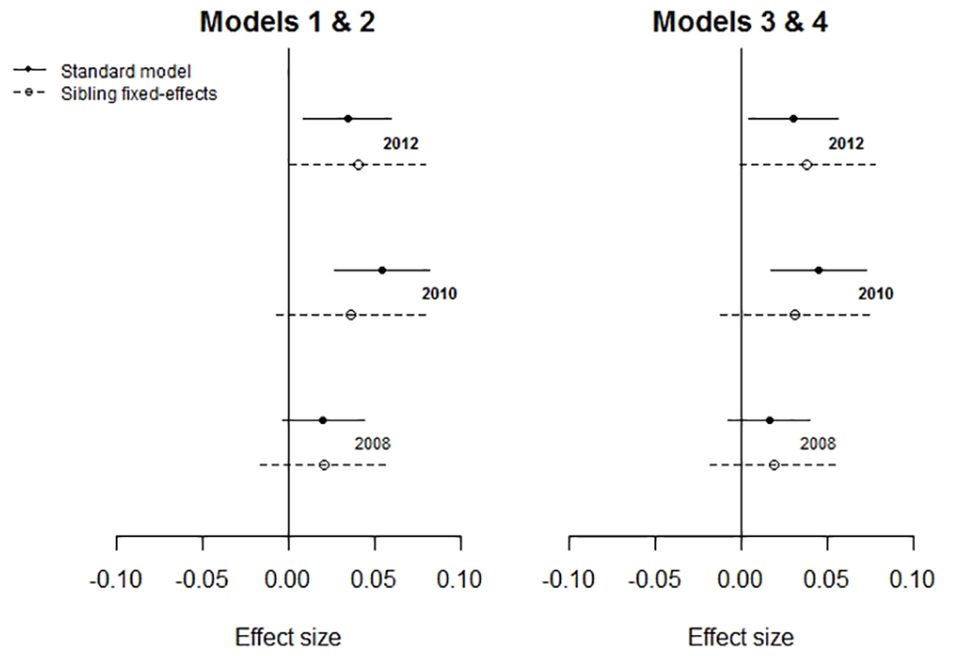
Impact of college education on turnout with and without sibling fixed effects.
Models of voter turnout in the 2008, 2010, and 2012 elections.
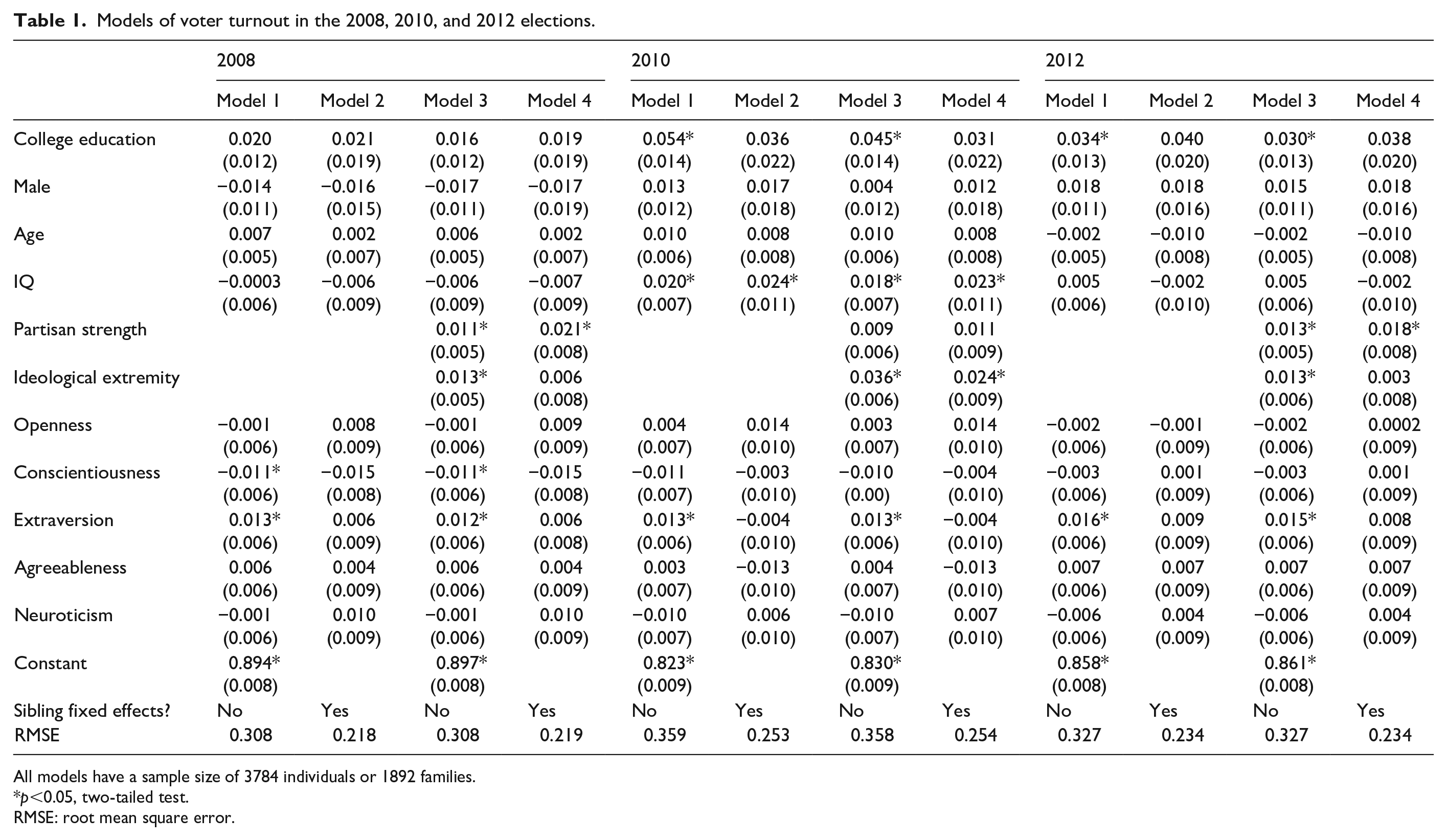
All models have a sample size of 3784 individuals or 1892 families.
p<0.05, two-tailed test.
RMSE: root mean square error.
None of the models with fixed effects shows convincing evidence that education strongly affects turnout. And the point estimates of 2–5% across the models are smaller effects than are normally obtained in observational data, likely due to the attenuation in effects arising from an older sample, more limited variation within families, and from using real voter records rather than self-reports. In four of the six models the standard errors increase enough so that the effect of education becomes statistically insignificant when fixed effects are included. Although the 2010 and 2012 models produce effects that are of borderline statistical significance with fixed effects included, there was little evidence that education had a meaningful influence on turnout in 2008. As the highest turnout election in our analysis, especially in the states where most of our respondents reside, the limited variation in the outcome may limit the ability to observe educational effects, especially if they are small.
In the Online Appendix we provide a pooled regression analysis that includes data from all three elections in one model. This approach comes with some methodological complications because respondents are observed three times, thus violating assumptions about independent observations, and because the two high turnout presidential elections and the less salient midterm election are likely to have different data-generating processes that warn against a single specification. Keeping these concerns in mind, the pooled model similarly shows no clear evidence that education influences voter participation after accounting for early-life factors.
Conclusion
Testing Kam and Palmer’s conjecture that pre-adult factors explain the spurious relationship between education and turnout, we have circumvented the ongoing debate about the appropriateness of statistical matching, relying instead on a unique dataset that allows for analysis of educational effects within families through the comparison of siblings. The relationship between educational attainment and voter participation weakens when early-life influences were included in the form of within-family fixed effects.
The analysis thus provides new evidence on the importance of early-life factors on voter turnout, but it comes with limitations. The most obvious is that we study a relatively homogenous sample. However, this constraint also provides some benefits as it can help rule out unobserved variables correlated with both education and voting that could bias the estimates. Yet the mostly elderly respondents we study are likely to show weaker evidence of education acquired decades before their voting activity was measured. Younger individuals’ participation might well depend more heavily on educational experiences, or in environments where overall turnout rates are lower. Given the cohort nature of the sample, we cannot definitively address the cohort, age, and generational effects. Using our approach on other datasets, subsequent research could examine whether the returns from education differ over the lifespan or from one cohort to the next. Even with these limitations, the analysis provides a straightforward and distinct test of the relationship between education and political participation, and strengthens the case for paying closer attention to early-life factors that when ignored may lead to faulty conclusions about the important of education on voter turnout.
Supplemental Material
Table_A1 – Supplemental material for Education, early life, and political participation: New evidence from a sibling model
Supplemental material, Table_A1 for Education, early life, and political participation: New evidence from a sibling model by Barry C. Burden, Pamela Herd, Bradley M. Jones and Donald P. Moynihan in Research & Politics
Footnotes
Acknowledgements
We thank Joe Savard and Carol Roan at the WLS for administrative support, Adam Bonica and the Federal Elections Commission for sharing federal campaign contribution data, and Evan Crawford and Michael Wagner for helpful comments. Authors are listed alphabetically.
Declaration of conflicting interests
The author(s) declared no potential conflicts of interest with respect to the research, authorship, and/or publication of this article.
Funding
The author(s) received no financial support for the research, authorship, and/or publication of this article.

Supplemental materials
Notes
Carnegie Corporation of New York Grant
This publication was made possible (in part) by a grant from the Carnegie Corporation of New York. The statements made and views expressed are solely the responsibility of the author.
References
Supplementary Material
Please find the following supplemental material available below.
For Open Access articles published under a Creative Commons License, all supplemental material carries the same license as the article it is associated with.
For non-Open Access articles published, all supplemental material carries a non-exclusive license, and permission requests for re-use of supplemental material or any part of supplemental material shall be sent directly to the copyright owner as specified in the copyright notice associated with the article.
