




Abstract
The article investigates how justifications used by politicians to explain their positions on policies of regional integration shape public opinion about these policies. I argue that support for a policy position increases when politicians tailor their justifications to the expectations of their audience, and I suggest that this happens even when party cues offer a less effortful way of forming opinions. I test my theoretical expectations in laboratory experiments with diverse samples, which manipulate party cues and justifications for a policy of European integration. I find that citizens use justifications and cues to form opinions. The relative importance of the two factors depends on individual dispositions and political context. In a non-competitive context (study 1), politically invested citizens use cues, while uninvested citizens use justifications. In a competitive context (study 2), the opinions of politically invested citizens are shaped by both factors, while the opinions of uninvested citizens become erratic.
Introduction
Regional integration has evolved from a concern of technocrats into a highly politicized issue. Not only have citizens abandoned the permissive consensus that previously allowed bureaucrats and politicians to pursue integration shielded from the vagaries of mass politics (Hooghe and Marks, 2009). Regional integration and the broader package of issues to which it belongs, including migration, trade, and globalization, are in contention to replace the perennial left-right cleavage as the new fundamental dividing line of party systems and electoral politics (Hooghe and Marks, 2018; Koopmans and Zürn, 2019; Kriesi et al., 2012).
The greater significance of regional integration for political competition stems from the growing intensity of public debate about the issue (Grande and Hutter, 2016). Politicians have contributed to this development by stating and justifying their views of regional integration with increasing frequency, sometimes in response to public pressure and sometimes in voluntary attempts to change people’s minds. This article investigates what politicians say to justify their positions on European integration, and whether their justifications have an effect on public opinion about the issue. Now that regional integration has been successfully politicized, the further pursuit (or the reversal) of integration depends on the ability of politicians to offer justifications for integration policies that are effective in shaping public opinion and mobilizing public support.
Justifications constitute a ubiquitous explanatory strategy (Bennett, 1980; McGraw, 2002). They are based on the claim that a position, for example, support for a policy of regional integration, is desirable because it is motivated by a worthy norm, most importantly a positive impact of the policy on a desirable goal. In this article, I develop a theory of the rhetoric of justification that details the mechanisms through which justifications shape public opinion. I argue that the persuasive success of justifications depends on the extent to which they are tailored to the expectations of their audience, specifically people’s views about the goal that is invoked to justify the policy. I also suggest that the capacity of goal-tailoring to manufacture policy support is limited by people’s existing opinions about similar policies. My model of the rhetoric of justification thus delineates how variation in the content of justifications affects public opinion. It builds on existing research, which investigates attitudinal consequences of the act of explaining (Esaiasson et al., 2017; Fenno, 1978; Jacobs and Shapiro, 2000) and of variation between functional categories of explanations (McGraw, 1991; McGraw et al., 1995; Smith et al., 2005; Traber et al., 2020).
The article places the rhetoric of justification in its environment of partisan politics by contrasting the impact of justifications on public opinion to the impact of party cueing. This is the second major tool that politicians can use to shape attitudes about regional integration. Successful party cueing takes place when citizens rely on the signal offered by the party affiliation of a politician to form opinions about his or her policies. In contrast to the systematic processing of information contained in policy justifications, party cues offer a heuristic and potentially effortless shortcut to opinion formation (Petersen et al., 2013; Rahn, 1993). Prior research on public opinion about regional integration has studied either party cueing (Anderson, 1998; Down and Wilson, 2010; Gabel and Scheve, 2007; Gabel, 1998; Hobolt, 2007; Hooghe and Marks, 2005; Ray, 2003; Steenbergen et al., 2007; Stoeckel, 2013; Stoeckel and Kuhn, 2018; Van der Eijk and Franklin, 1996; Wessels, 1995) or political messages, including media content (Bruter, 2003; Carey and Burton, 2004; Maier and Rittberger, 2008; Vliegenthart et al., 2008), neutral political information (De Vries et al., 2011; Hobolt, 2005; Tilley and Wlezien, 2008), and political explanations (Vössing, 2015). However, when addressing a politicized issue such as regional integration, politicians will always (deliberately or not) deploy party cues and political messages (such as policy justifications) at the same time.
This article elaborates on existing studies by jointly considering both mechanisms of opinion formation. This paints a realistic picture of issue debates, and it facilitates a comparison of the two mechanisms and their effects. Most importantly, it makes it possible to determine whether the availability of easily accessible party cues prevents the systematic processing of policy justifications. That citizens are willing to consider policy justifications instead of simply following the party line is clearly important for the prospects of rational democratic discourse. The article also investigates which kinds of citizens are more or less likely to rely on party cues rather than justifications. I develop competing expectations about the conditioning function of important individual dispositions (political sophistication, need for cognition, and opinions about the importance of an issue) to test whether “politically invested citizens” (above average scores on these variables) or “politically uninvested citizens” (below average scores) are more likely to rely on cues or justifications.
I test my theoretical expectations about the impact of justifications and party cues on public opinion using laboratory experiments. My experimental designs randomly vary the party affiliation of politicians and the content of justifications they use for their decisions to support or reject the Euro-tax, a controversial policy that would increase the authority of the European Union (EU) over its member states by giving the EU an independent source of revenue. The first study simulates a non-competitive political context in which one politician justifies his support for the policy. The second study features a competitive political context with two politicians from different political parties offering opposing views (support and rejection of the policy) as well as separate justifications. This setup makes it possible to investigate whether the direct and conditional effects of justifications and cues vary according to political context. The experimental approach and the fact that the studies are carried out in the laboratory facilitate an exceptionally high degree of internal validity, which means that we can be confident that the observed effects are truly causal and working in the predicted direction. At the same time, in contrast to highly stylized experiments and samples composed exclusively of undergraduate students, the experiments also emphasize external validity, meaning a wide generalizability of results, by using diverse groups of participants, real political parties, and a real policy.
The empirical analysis corroborates the key expectations of my model, which stipulate that support for a justified policy depends on the popularity of similar policies and the goal that is invoked to justify the policy. I also find evidence for the effectiveness of party cues. The relative importance of the two types of elite influence depends on the combination of contextual and dispositional factors. I show that the archetypical “politically invested citizen” is more prone to rely on party cues, while the archetypical “uninvested citizen” is less likely to follow the party line and more likely to take into account a politician’s rhetoric of justification. However, this conclusion only holds in non-competitive contexts featuring one-sided communication. When competitiveness increases, “politically invested citizens” are able to grasp and process both types of elite influence at the same time, so that their opinions about regional integration become more predictable, while the opinions of “uninvested citizens” become erratic and unpredictable.
Public Opinion and the Rhetoric of Justification
Justifying an action entails two interrelated normative statements (Bennett, 1980; McGraw, 2002). The first statement refers to the action itself, and it claims that the action is desirable. The second statement invokes a worthy norm to justify the action, and it claims that the norm is advanced by the action. This alleged positive effect of a desirable action on a worthy norm constitutes the core of the act of justification. In debates about political issues, politicians typically justify their actions (including their positions) by claiming that the worthy norm advanced by a policy is a desirable goal on which the policy has a positive impact (as shown in Figure 1).
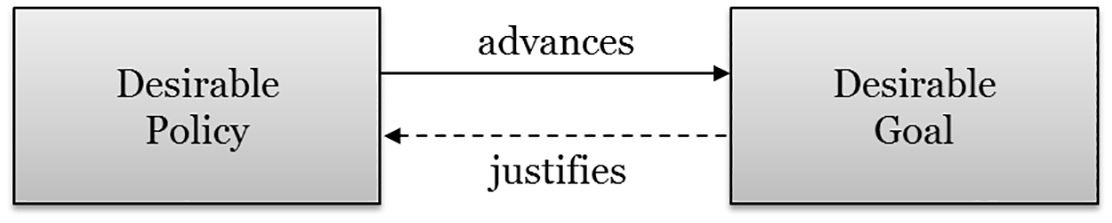
Policy justification.
In contrast to justifications, the other available explanatory strategy—the excuse—entails the at least implicit admission that the explained action is not fully desirable (McGraw, 2002). For that reason, the second statement in an excuse does not invoke a worthy norm justifying the action, but instead an unfortunate external circumstance excusing it. For instance, someone who uses an excuse to explain passing a red light could say that the sun blinded him (an unfortunate circumstance), while someone justifying the same action could say that she was racing to the hospital to save the life of her critically injured friend (a worthy norm). Compared to excuses, justifications are not only more common in debates about political issues. They are also normatively superior, because they emphasize political agency and democratic responsibility.
Existing studies of explanations in social relations (Benoit, 1995; Gonzales et al., 1995; Hareli, 2005; Schönbach, 1990) and politics (Bennett, 1980; Grose et al., 2015; Fenno, 1978; Hinterleitner and Sager, 2017; McGraw, 2002; Smith et al., 2005; Traber et al., 2020) conceive of the explanation primarily as an act of defense against reproaches and mounting outside pressure. By contrast, I propose that explanations can be used to play both defense and offense. For instance, it is true that politicians now frequently have to defend their views of regional integration in response to inquisitive media and increasingly skeptical voters. But on many occasions, politicians also go on the offense by actively advertising and explaining their positions without being forced to do so, out of habit, heartfelt conviction, or even strategic intent. Justifications are particularly well suited for playing offense, because they portray policies as capable of bringing about positive change.
Moreover, existing research looks at the effects of explanations on the reputation of the explainer, while I investigate their effects on attitudes about the explained policy. In some instances, policy justifications will have the same positive or negative effect on attitudes about both the justified policy and the justifying politician. But on many occasions, the same justification will have varying effects. This is the case, because the impact of a justification on policy attitudes depends on its ability to convince the audience that the policy is worth supporting, while its reputational consequences depend on the extent to which an audience believes that the justification reveals some desirable personal feature of the politician. For example, a continuous record of justifying policies by invoking unpopular goals might have long-term reputational benefits, as this evokes impressions of desirable traits such as consistency and conviction, while the approval ratings of a politician who uses a popular goal to justify his policies might suffer in situations in which he started invoking that goal only recently and in response to external pressure, as this might evoke impressions of fickleness and inconsistency.
Compared to raising a politician’s approval ratings, raising policy support through justifications depends more unequivocally on invoking popular goals. The practice of selecting goals for policy justifications based on their popularity can be called goal-tailoring, because it consists of tailoring the goals that are presumably achieved by a policy to the opinions of the targeted audience. Goal-tailoring is similar to previously studied forms of tailoring, including “position-tailoring” (Grose et al., 2015), in which politicians talk about their political record to change the perceptions of their policy positions in the electorate. However, position-tailoring and other previously studied forms of tailoring aim to change views about the nature of a politician’s policy positions, while goal-tailoring aims to change people’s views about the desirability of their positions. Goal-tailoring allows politicians to convince citizens of the virtues of a policy, which in turn might help them achieve related objectives, such as bringing citizen views in line with their policy agenda (Fenno, 1978).
Goal-tailoring should raise policy support because the more someone favors a goal that is invoked to justify a policy, the more should that person support the justified policy (hypothesis 1). This is the case because policy justifications portray the achievement of a goal as a consequence of a policy. If someone likes the goal that is attained by a policy, he or she should also like the policy that helps to attain the goal. Vice versa, a person that does not like the goal should reject the policy, because implementing the policy would contribute to advance the disliked goal. For instance, when a politician justifies his support for the introduction of a Euro-tax by claiming that the policy helps to break down market barriers, then individuals in favor of free markets should be more likely to support the policy than people who are opposed to the free market goal.
The claim that a policy advances a desirable goal lies at the heart of a policy justification, and transferring the popularity of that goal into support for the justified policy constitutes the core of its persuasive power. To maximize this power, politicians are generally at liberty to select any goal they want in order to justify a policy they decided to endorse. However, the potential impact of goal-tailoring on public opinion is limited by the extent to which the endorsed policy in and of itself resonates with public opinion. I would expect that people support a justified policy the more they already like similar policies from the same issue dimension (hypothesis 2). This effect can be conceived of as a corridor of persuasion that comes into existence once a politician decides to endorse a policy. Clever goal-tailoring can persuade people to support the policy, but the size of the effect is likely to be constrained by the boundaries of this corridor.
The expectation that support for a new policy depends on people’s opinions about similar policies is consistent with existing research about political explanations, which finds that policy support depends on people’s prior views about the policy (McGraw et al., 1995) and the values it entails (Kam, 2005). The impact of existing policy views on support for a new policy from the same issue dimension is a case of ideological constraint (Converse, 1964). It is indicative of a constrained structure of attitudes when people form opinions about new policies that make sense in light of the opinions they already hold. Existing empirical studies are conflicted about the extent to which people really are ideologically constrained. 1 However, there is good reason to expect a meaningful amount of constraint in the issue domain of regional integration. The cognitive step from prior views about regional integration to a related opinion about a new integration policy is concrete and therefore less demanding than general ideological constraint, which requires people to link a wide range of policies to abstract dividing lines, such as left versus right or liberal versus conservative.
The model I suggest conceives of policy justifications as a persuasive communication (McGuire, 1985; Zaller, 1992) that activates existing views of policies and goals, and then transfers them into judgments of new policies. The model emphasizes the impact of political elites on public opinion (Zaller, 1992), but it also portrays policy justifications and their effects as rational acts of preference formation, which predictably connect people’s dispositions to their opinions about new policies (McGuire, 1985). This approach constitutes a counterpoint to more skeptical views, such as Bennett (1980), who suggests that the validity and credibility of political explanations is largely irrelevant for their effectiveness. My argument also entails a more positive view of tailoring than the existing critical perspectives, which propose that tailoring merely simulates responsiveness (Jacobs and Shapiro, 2000) or even obfuscates policy problems (Edelman, 1977). I would emphasize that goal-tailoring requires politicians to learn about their constituents and their preferences, and then connect what they learned to the policies they are considering, which constitutes an actual act of responsiveness as well as a publicly expressed commitment to the pursuit of a particular political goal.
Party Cues
Policy justifications always occur in an environment of partisan politics. This is why the utility and realism of a model of the rhetoric of justification as well as the rigor of its empirical investigation benefit from a joint consideration of policy justifications and their partisan environment. By integrating the study of policy justifications and party cues—signals provided by the environment of partisan politics that voters can use to form issue preferences—the article elaborates on existing research, which does not establish this connection. Research on political explanations does not consider party cues, prior studies of public opinion about regional integration examine either political messages or party cues, and comparative studies of cues and messages investigate issues besides regional integration as well as messages other than political explanations (Arceneaux, 2008; Boudreau and MacKenzie, 2014; Bullock, 2011; Ciuk and Yost, 2016; Cohen, 2003; Kam, 2005; Mérola and Hitt, 2016; Mullinix, 2016; Nicholson, 2011; Petersen et al., 2013; Rahn, 1993; Riggle et al., 1992).
I follow prior research by conceiving of party cues as a shortcut to opinion formation that has the capacity to prevent citizens from processing political messages such as policy justifications. During the act of justifying their policies of regional integration, politicians convey party cues simply by being associated with the name of their party. Successful party cueing occurs when people form opinions about the justified policy based on their preconceived level of identification with the party that is endorsing the policy. In this process, the party name functions as a “stereotype label” that allows people to make “a quick affective judgment” (Rahn, 1993: 483) of the affiliated politician (Rahn, 1993) as well as the policy endorsed by the politician (Kam, 2005; Petersen et al., 2013). 2 Party cues thus allow citizens to transfer the preconceptions they have about the party into an effortless judgment about the policy. More specifically, people express an opinion about the policy based on the extent to which they identify with the party endorsing it. The more positive the preconceived degree of party identification that is activated by the mentioning of a party label, the more positive the opinions about a policy endorsed by the party (hypothesis 3). Greater levels of party identification should increase support for the policy, and lower levels of identification should reduce policy support.
Prior studies have shown consistently that party cueing is effective in shaping opinions about conventional issues of domestic politics, such as welfare (Cohen, 2003), education (Petersen et al., 2013), and health policies (Kam, 2005). In the domain of regional integration, existing research also finds evidence of party cueing effects (Anderson, 1998; Down and Wilson, 2010; Gabel, 1998; Van der Eijk and Franklin, 1996; Hobolt, 2007; Hooghe and Marks, 2005; Steenbergen et al., 2007; Wessels, 1995). However, compared to other issues, the record of the effectiveness of party cues is more mixed for attitudes about regional integration. This is the case for two main reasons. First, prior studies show that party cueing effects in regional integration depend more strongly on favorable conditions, including the presence of proportional representation (Steenbergen et al., 2007), high issue salience (Ray, 2003; Steenbergen et al., 2007), and greater party polarization (Down and Wilson, 2010; Gabel and Scheve, 2007; Hooghe and Marks, 2005; Ray, 2003).
Second, only one experimental study (Stoeckel and Kuhn, 2018) has so far corroborated the effectiveness of party cueing in regional integration. Some observational studies (Carrubba, 2001; Ray, 2003; Steenbergen et al., 2007; Wessels, 1995) have devised ingenious research designs to isolate the top-down effect of party cues on public opinion from the bottom-up effect of political pandering, in which parties follow voters’ views. The experimental analysis of party cues in regional integration productively complements prior observational studies because of the particular ability of experiments to demonstrate whether statistical associations between voters and parties are the result of a top-down rather than a bottom-up process.
The Conditioning Function of Political Investment
The relative importance of justifications and party cues for opinions about regional integration should be conditioned by individual dispositions. Existing studies suggest that the impact of political messages and party cues on public opinion is conditioned specifically by political sophistication (Arceneaux, 2008; Green et al., 2002; Hellwig and Kweon, 2016; Jessee, 2010; Kam, 2005; Slothuus and de Vreese, 2010), need for cognition, which identifies how motivated people are to think (Bullock, 2011; Holbrook, 2006; Kam, 2005; Mérola and Hitt, 2016), and judgments of issue importance (Arceneaux, 2008; Ciuk and Yost, 2016; Leeper, 2014).
The dispositions considered in prior research describe a multi-faceted image of individual differences between citizens. However, the opposing traits on these variables also point in two clear-cut directions indicating different degrees of political investment (the most fundamental distinction in the portrayal of citizens made by research on democracy and political behavior). 3 The politically invested citizen is politically sophisticated, cares about political issues, and enjoys thinking (about politics). In other words, he or she has above average values on the three previously investigated dispositional variables. With below average values on these variables, the politically uninvested citizen is not politically sophisticated, cares less about political issues, and does not enjoy thinking about politics.
Existing research features conflicting expectations about whether politically invested or politically uninvested citizens are more likely to rely on policy justifications to form opinions instead of following the shortcut of party cues. First, one point of view suggests that the opinions of
Second, the opposite point of view suggests the alternative expectation that the opinions of
Research Design
I developed two experimental research designs to test my theoretical expectations. Both experiments randomly assign participants to different party cues (party treatment) and different policy justifications (justification treatment), in a non-competitive (study 1) and a competitive political context (study 2). 5 The experimental treatments are administered in both studies through mock newspaper articles about a vote in the European Parliament (EP) on a resolution demanding the introduction of a Euro-tax. This is a controversial policy that would give the EU its own source of revenue independent of the control of its member states. The studies avoid confounds and increase validity by making sure that the policy is representative of the broader issue of the desirability of regional integration (and no other issue). To this end, the treatment articles describe the Euro-tax as a measure that would not result in higher levels of taxation and greater government intervention in the economy, but only the shifting of fiscal authority from the national level to the EU. Empirical analysis shows that participants did indeed perceive the policy as intended: policy support for the Euro-tax is uncorrelated with support for government intervention in the economy in study 1 (r = 0.07, p > 0.1) and study 2 (r = 0.04; p > 0.1).
In the first study, after describing the issue at stake and the vote that had just occurred in the EP, the treatment article states that Herbert Brueckner, a Member of the European Parliament (MEP), voted in favor of introducing the Euro-tax. The article then offers a verbatim quote in which Brueckner justifies his decision. He claims in his statement that he supported the Euro-tax because the policy will help to accomplish an important goal. To manipulate variation in the content of policy justifications, the experiment then randomly varies the goal that the MEP claims is achieved by the Euro-tax between European identity, free markets, social justice, national economic benefits, and European economic benefits. To manipulate party cues, the experiment varies the MEP’s party affiliation by randomly adding the label of one of the four parties represented in the German parliament in parentheses behind the politician’s name: the christian democratic CDU; the social democratic SPD; the eco-libertarian Greens; or the socialist Left Party. The first study simulates a non-competitive political context, because participants are exposed to Brueckner and his statement only, without any opposing point of view. The scenario is created using a newspaper article, but it is functionally equivalent to other examples of non-competitive political communication such as a campaign speech, a party pamphlet or echo chambers in social media.
In the second study, the treatment article still states that Brueckner voted in favor of the Euro-tax, but the article now also introduces a second MEP, called Frank Wilmers, and it states that Wilmers voted against the policy. Study 2 manipulates the content of the policy justifications communicated by the two politicians in separate verbatim quotes. Herbert Brueckner claims that he supported the Euro-tax because it advances an important goal, and the study randomly varies the goal he invokes between European identity, free markets, and economic benefits as well as a fourth condition in which only the policy position is announced. 6 Frank Wilmers claims that he rejected the Euro-tax because it fails to advance an important goal, and the study randomly varies the goal he invokes between the same four options. To manipulate party cues, the study randomly varies the same four party labels that were used for the first study, in such a way that the two politicians will not belong to the same party. 7 The study simulates a competitive political context by exposing participants to the voices of two competing actors with opposing views. This scenario resembles not only the typical kind of news report. It comes closest to capturing the very nature of people’s political memory, as it emerges from the accumulation of competing considerations over time (Zaller, 1992).
A manipulation check was conducted to determine whether the articles and the treatments they contain were successfully delivered. After reading an article, participants were asked to identify the function(s) of the politician(s) mentioned in it. The vast majority of participants were able to do this (97.2% for Brueckner in study 1, 77.7% for Brueckner and 74.3% for Wilmers in study 2), which shows that the treatment was successfully delivered. Additional analysis of participant behavior in study 2 provides further evidence that all participants (even those who failed to give a correct answer to the recall question) were successfully exposed to the article. Data about the time participants spent reading the treatment article (on-screen) show that only three participants simply clicked through the page without paying attention. Moreover, the fact that recall rates are lower in study 2 shows that the competitiveness and complexity of the political context vary as intended between studies 1 and 2.
Experimental Protocols and Sample Composition
The two studies were conducted in the experimental laboratory at the Institute of Social and Political Sciences at Humboldt University Berlin. Participants entered the lab and were directed to computer stations, where they completed the study on-screen. In both experiments, participants first answered a range of pre-treatment questions. After that, they read the treatment article, received manipulation checks, and then answered questions measuring the dependent variable of both studies (policy support, for the Euro-tax). In the last part of the experiments, some questions were asked that could not possibly be affected by the experimental treatment (such as knowledge questions measuring political sophistication). The experiments took around 20 minutes to complete. Informed consent was solicited before the beginning of a study, and the protection of participants, including a full debriefing, was guaranteed in accordance with local regulations as well as the guidelines prescribed by a typical Institutional Review Board (IRB). 8
The experiments were carried out during the fourth quarter of 2015 (study 1) and the first quarter of 2016 (study 2), with comprehensive groups of participants (302 in study 1 and 316 in study 2). One hundred and twenty-nine participants in study 1 (174 in study 2) are students recruited from a participant pool database. The remaining participants (173 in study 1 and 142 in study 2) are recruited from the general population through a database of different clubs and associations as well as classified ads. 9 The samples are not representative, but they reflect the entire diversity of the German electorate, given that they include adequately large and balanced sub-groups of varying age cohorts, gender categories, and social classes as well as meaningful variation in key political orientations and cognitive inclinations, such as political sophistication, political interest, left-right position, political trust, political efficacy, need for cognition, and need for evaluation. 10
Moreover, all participant characteristics noted above are equally distributed across the treatment conditions of both experimental manipulations: F-tests (as well as pairwise t-tests for the dichotomous gender variable) show that neither justification conditions nor party conditions exhibit significant differences on any of these variables. 11 This means that no extraneous factor confounded the treatments, and it shows that the randomization procedure was successful in creating homogeneous groups for a valid analysis of treatment effects. The diverse and comprehensive sample considerably increases the external validity of the experiments, while the laboratory location and the confound-free treatments guarantee an optimum of internal validity.
Treatments and Measures
The dependent variable of both studies, policy support (for the Euro-tax), is measured using a thermometer scale from 0 to 100. As explained above, the party treatment in both studies consists of randomly varying the party affiliation of the MEP(s) quoted in the treatment article between the four parties represented in the German parliament. The parties used in the experiments are real political parties, which significantly increases the external validity of the experiment. It is entirely plausible to assign both positive and negative views of European integration to the parties used in the experiments. This is the case because they harbor considerable internal conflict over the issue of regional integration, so that voters are highly uncertain about party positions. 12 The level of party identification activated by the randomly assigned party cue constitutes the predictor of policy support suggested by hypothesis 3. Party identification is measured in study 1 by asking participants, pre-treatment, about the extent to which they identify with the party that appears in their treatment condition, on a thermometer scale. In study 2, the overall level of partisanship pushing participants toward supporting the Euro-tax is measured by subtracting the identification score for the party positioned against the Euro-tax from the identification score for the party favoring the Euro-tax.
The justification treatment manipulates the content of the policy justifications used by the MEP(s) by varying the goals the MEP(s) invoke(s) to justify their policy positions. The key predictors of policy support suggested by my model of the rhetoric of justification are prior policy support (hypothesis 2) and prior goal support (hypothesis 1). 13 Prior policy support (for similar policies) is measured, pre-treatment, by identifying the positivity of people’s assessment of the EU. 14 In the first study, prior goal support (for the goal allegedly advanced by the policy) is measured in reference to the one goal a participant was exposed to, by creating an index from three or four Likert-style questions. 15 In study 2, for conditions with only one justification, the score for prior goal support is determined on the basis of participants’ support for the one goal invoked in that justification. 16 In conditions with two (or no) justifications, the level of support for the goal invoked by the politician to justify policy rejection is subtracted from the level of support for the goal that is invoked to justify policy approval. 17 The dispositional variables that are hypothesized to condition the effects of justifications and cues (political sophistication, need for cognition, and judgments of issue importance) are constructed by dividing participants into two groups based on the respective mean values of the underlying continuous scales. 18
Empirical Analysis
The experimental studies allow me to test my hypotheses about the direct effects of prior goal support (for the goal invoked to justify a policy), prior policy support (for policies similar to the justified policy), and party identification (for the parties of the politicians justifying their policy positions) on policy support (for the justified policy) in non-competitive (study 1) and competitive political contexts (study 2). I estimated the effects of the three variables (0–1 scales) on policy support (0–100 scale) using ordinary least squares (OLS) regression in full samples of participants of each study. The coefficient estimates with 95% confidence intervals are shown in Figure 2 (model 1.1, study 1) and Figure 3 (model 2.1, study 2). 19
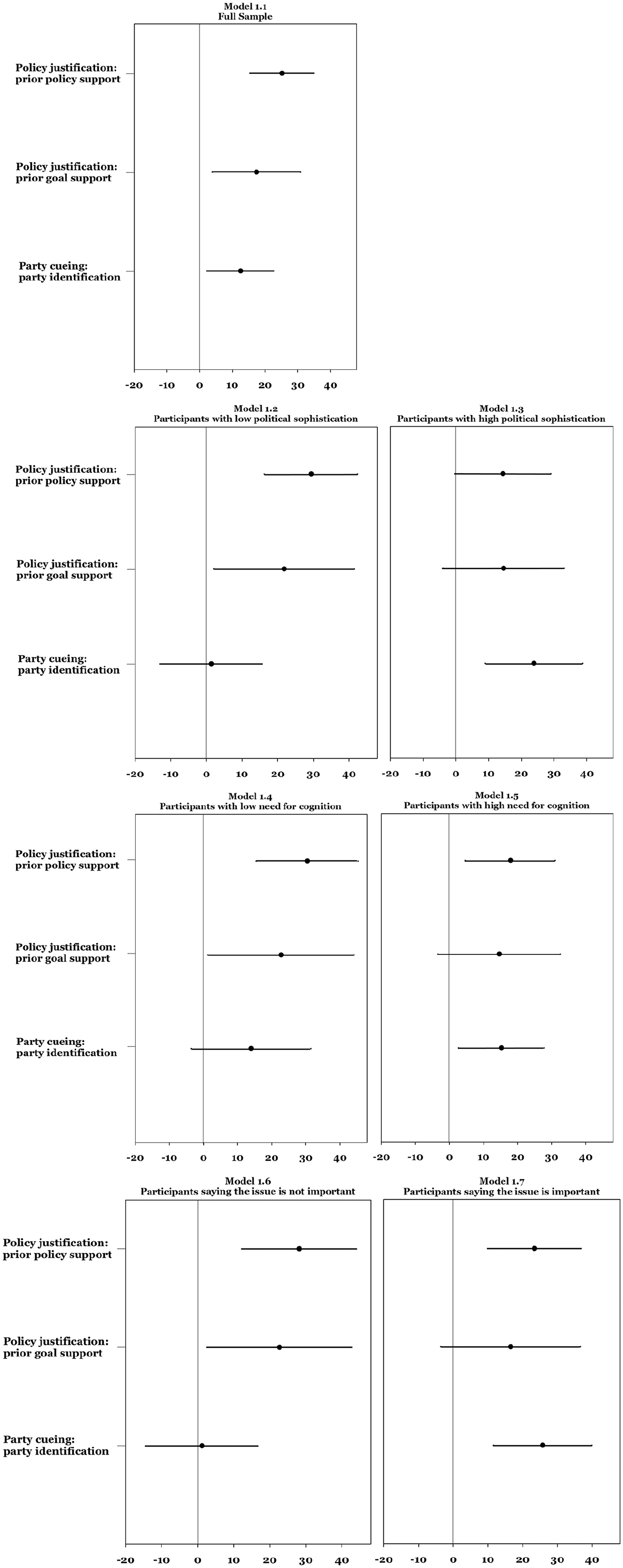
Determinants of policy support (study 1, non-competitive context).
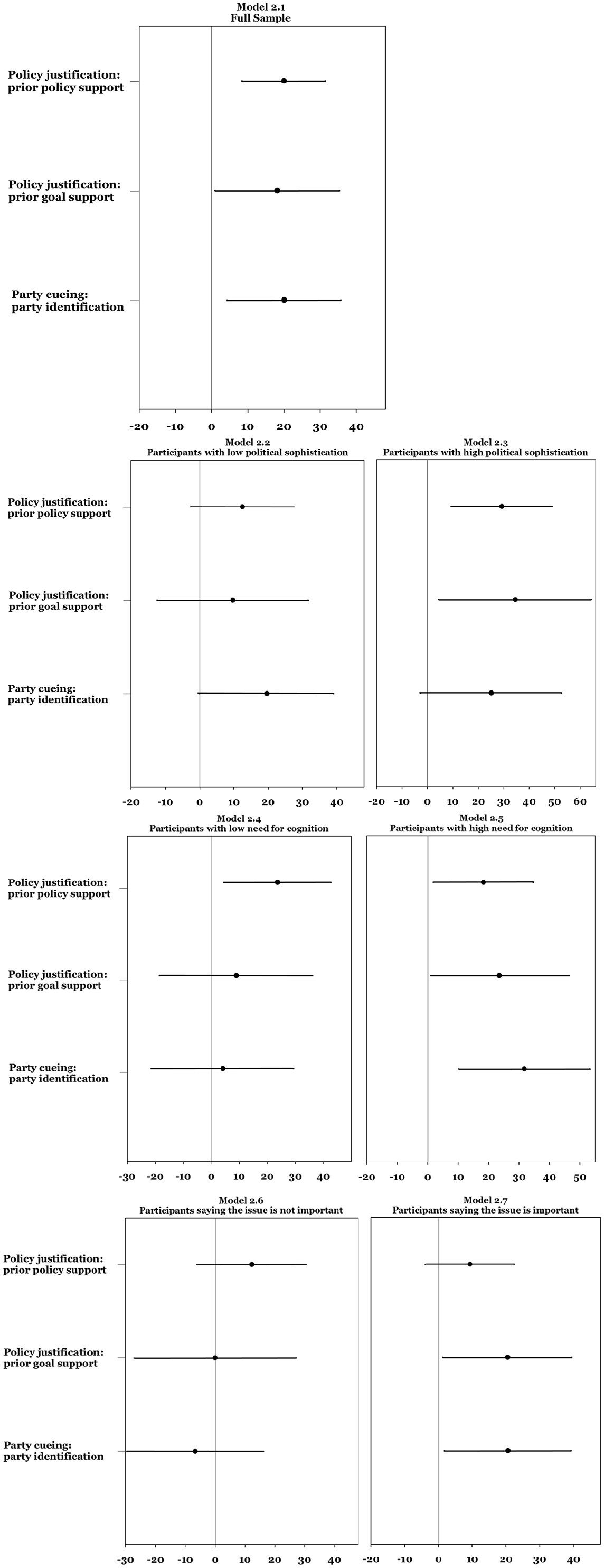
Determinants of policy support (study 2, competitive context).
First, according to hypothesis 2, policy justifications shape support for the justified policy by activating people’s existing degree of support for similar policies from the same issue domain. Empirical analysis of the two experimental studies corroborates this expectation. The coefficient estimates of models 1.1 and 2.1 show that prior policy support is a strong and statistically significant predictor of support for the Euro-tax in study 1 (b = 25.1, SE = 4.9) and study 2 (b = 20.0, SE = 5.9). The effect sizes reveal a reasonable degree of constraint in citizen views about regional integration, but they also show that most opinions are not entirely and not even predominantly determined by underlying belief systems.
Second, empirical analysis provides evidence that goal-tailoring is an effective tool for shaping public opinion about regional integration. As predicted by hypothesis 1, the popularity of the goal a politician invokes to justify a policy (prior goal support) determines opinions about the justified policy. Prior goal support has a sizable and statistically significant effect on support for the justified policy in study 1 (b = 17.3, SE = 6.9) and study 2 (b = 18.1, SE = 8.7). Citizens are clearly more willing to support a policy when it is portrayed as a tributary to a political goal they favor, while negative views of the goal diminish policy support. Policy justifications are able to translate public support for a political goal into support for a policy which allegedly advances that goal.
Third, as predicted by hypothesis 3, models 1.1 and 2.1 demonstrate that party cues shape public opinion in non-competitive (study 1) and competitive political contexts (study 2). The net positivity of identification with the party endorsing the Euro-tax exercises a considerable effect on support for the policy in study 1 (b = 12.5, SE = 5.1) and study 2 (b = 20.0, SE = 8.0). The experiments show that citizens transfer their preconceived level of identification with a party endorsing a policy of regional integration into an according level of support for the policy irrespective of political context. Prior research had produced contradictory findings about the extent to which public opinion about regional integration is shaped by party cues. Providing experimental evidence of successful party cueing in regional integration is significant because the statistical associations between party positions and attitudes revealed by existing observational studies might indicate politicians’ pandering to voter positions rather than party cueing, where the causal arrow is reversed.
The Conditioning Function of Political Investment
I replicated the baseline models, which were tested on all participants of study 1 and study 2, for different sub-groups of people. The composition of sub-groups is based on whether participants have high or low scores on the three variables identifying variation in political investment (political sophistication, need for cognition, and judgments of issue importance). This procedure allows me to test the competing hypotheses 4a and 4b about the conditioning function of political investment in non-competitive (study 1) and competitive political contexts (study 2). The coefficient estimates with 95% confidence intervals are shown in Figure 2 for models 1.2 to 1.7 (study 1) and Figure 3 for models 2.2 to 2.7 (study 2).
Study 1 finds strong evidence in support of hypothesis 4b, which proposed that policy justifications have a greater impact than party cues on the opinions of politically uninvested citizens. In the non-competitive context modeled in study 1, the views of regional integration expressed by the politically invested are strongly driven by party cues, as evidenced by large and statistically significant effects of party identification on policy support for people who are politically sophisticated (b = 23.8, SE = 7.5), high in need for cognition (b = 15.2, SE = 6.4), and convinced that the issue is important (b = 25.7, SE = 7.1). The opinions of these politically invested people are not at all shaped by the policy justifications they receive. Goal-tailoring (identified by the prior goal support variable) is the key mechanism of policy justifications. It has no significant effect on the extent to which the justified policy is supported by politically invested citizens. The politically uninvested, by contrast, rely exclusively on policy justifications to evaluate the Euro-tax, while they ignore party cues. This is evidenced by large and significant effects of prior goal support (and no effects of party identification) on the opinions of people who are politically unsophisticated, low in need for cognition, and uninterested in the issue.
Only the prior policy support variable does not conform to the expectations of hypothesis 4b on all relevant indicators. People’s existing views of similar policies have smaller (as expected by hypothesis 4b) but still significant effects (not expected) on participants with greater need for cognition and participants who find the issue important. That minor caveat aside, models 1.2 to 1.7 offer solid support for hypothesis 4b. In a non-competitive political context, greater political investment favors the impact of party cues on public opinion about regional integration, while low political investment favors the impact of policy justifications. This means that in the absence of political competition, being politically invested does not increase the likelihood of engaging justifications for policies of regional integration. It makes people more likely to judge policies based on their partisan preconceptions.
Study 2 tests the diverging expectations of hypotheses 4a and 4b in a political context with competing voices, parties, and arguments. In this study, neither one of the two alternative explanations makes reasonably accurate predictions. Out of 36 indicators capturing the relative size and direction of the coefficient estimates of models 2.2 to 2.7, only 19 are consistent with hypothesis 4a, and only 17 are consistent with hypothesis 4b. 20 Specifically, study 2 finds that in a competitive context justifications play a greater role for the politically invested and a smaller role for the uninvested, which offers support for hypothesis 4a. However, it also finds that party cues do not play a smaller role for the politically invested nor a greater role for the uninvested, which contradicts hypothesis 4a and supports hypothesis 4b.
In the non-competitive context of study 1, each group of people relied on one form of elite influence (in a way that was predicted by hypothesis 4b) to form opinions, either party cues (the politically invested) or policy justifications (the politically uninvested). In the competitive context of study 2, no such pattern of alternating sources of opinion formation for the invested and uninvested can be observed (neither the one predicted by hypothesis 4a nor the one predicted by hypothesis 4b). Instead, only politically invested people are able to make sense of the more complex and demanding canon of voices, parties, and arguments in study 2. The coefficients produced by models 2.2 to 2.7 consistently reveal effects of cues and justifications for invested people that are positive (in 7 of 9 cases) and larger than for uninvested people (in 7 of 9 cases). By contrast, people who are not invested in the issue fail to make sense of both types of elite influence in the more competitive context. The coefficients of models 2.2 to 2.7 show no effects for people with low political investment (in 8 of 9 cases) and smaller effect sizes (in 8 of 9 cases) compared to their invested counterparts.
In the competitive context simulated by study 2, 30 out of 36 indicators capturing the size and direction of coefficients are consistent with the expectation that greater political investment is conducive to the effects of both party cues and policy justifications, while low investment inhibits these effects. Considering only the coefficients for party identification and prior goal support (the key mechanism through which policy justifications shape opinions), the expectation that high political investment favors both types of elite influence while low investment inhibits them, is supported by 23 out of 24 indicators for the size and direction of the estimated coefficients. When competitiveness increases, politically uninvested people fail to make sense of any type of elite input, while the politically invested rely on both party cues and policy justifications to form opinions about a new policy of regional integration.
Conclusion and Discussion
Whether public opinion about policies of regional integration is responsive to policy justifications or party cues is a key concern for democratic political competition as well as the prospects of regional integration. Because of the politicization of the issue, policies of regional integration now require public support and the ability of politicians to mobilize that support. The way in which politicians talk about the still evolving issue of regional integration and whether they are willing to throw the weight of their party behind it also has long-term ramifications for the structure of political debate about regional integration and related issues, such as trade, migration, and globalization.
This article finds that both party cues and the justifications politicians use for policies of regional integration shape public support for these policies, even when they are deployed at the same time, vying for people’s attention, as is usually the case in democratic politics. I developed a model of the rhetoric of justification that outlines how variation in the content of policy justifications affects public opinion. I suggested that politicians can tailor their justifications to the expectations of their audience by claiming that a policy of regional integration advances goals that are popular in the targeted group. However, the potential positive effect of goal-tailoring on support for the justified policy is limited by the boundaries established through people’s existing views of similar policies. The article placed this model of policy justifications in the environment of partisan politics by jointly considering the effects of policy justifications and of party cues on public opinion about regional integration.
I find that citizens, on average, rely on both justifications and cues to form opinions about a policy of regional integration. However, the relative importance of the two factors is conditioned by contextual and dispositional factors. In non-competitive contexts, politically invested citizens are more prone to rely on cues, while uninvested citizens are more likely to rely on justifications. In competitive contexts, the opinions of politically invested citizens are shaped by both types of elite influence, while the opinions of uninvested citizens become erratic and unpredictable. It is a cause of concern for the potential of wide democratic deliberation over the issue of regional integration that only the most politically invested citizens are able to process both party cues and policy justifications for regional integration in the (most common) case of a political context that is competitive. It is equally concerning that the same politically invested people will ignore policy justifications when competitiveness disappears and simply reproduce their partisan preconceptions. However, politicians do have a real opportunity to reach and convince even less politically invested citizens with their rhetoric of justification, as long as they manage to speak to them without interference from their political competitors.
Supplemental Material
sj-pdf-1-psx-10.1177_0032321720905130 – Supplemental material for Shaping Public Opinion about Regional Integration: The Rhetoric of Justification and Party Cues
Supplemental material, sj-pdf-1-psx-10.1177_0032321720905130 for Shaping Public Opinion about Regional Integration: The Rhetoric of Justification and Party Cues by Konstantin Vössing in Political Studies
Footnotes
Acknowledgements
I am grateful for the opportunity to present earlier versions of this research at the Comparative Politics Colloquium at Humboldt University Berlin, the European Union Program at Princeton University, the Berlin Summer School of Social Sciences, the Annual Conference of the MPSA, the EUI Political Behavior Colloquium, the Boston Chapter of the American Council on Germany, the New Research on Europe Workshop at the Center for European Studies at Harvard University, the Dreiländertagung of Political Science Associations from Austria (ÖGPW), Germany (DVPW), and Switzerland (SVPW), and the RSCAS Seminar Series at the European University Institute. For very helpful comments and feedback, I would like to express my sincere gratitude to the anonymous reviewers and the editors of this journal as well as Diana Burlacu, Peter Esaiasson, Philipp Genschel, Swen Hutter, Ellen Immergut, Brigid Laffan, Tobias Lenz, Sophie Meunier, Andy Moravcsik, Richard Rose, Carina Schmitt, Lora Viola, Till Weber, and Bernhard Wessels. I would like to thank Thomas Maruhn, Marcel Skaun, Friederike Talbot, and Dominik Vent for excellent research assistance and feedback. I gratefully acknowledge support from the Deutsche Forschungsgemeinschaft (German research foundation), grant number VO 1990/1-1. Data and online appendices are available at dataverse.harvard.edu/dataverse/vossing and  .
.
Declaration of Conflicting Interests
The author(s) declared no potential conflicts of interest with respect to the research, authorship, and/or publication of this article.
Funding
The author(s) disclosed receipt of the following financial support for the research, authorship, and/or publication of this article: A grant from Deutsche Forschungsgemeinschaft (German research foundation), grant number VO 1990/1-1.
Supplementary Information
Additional supplementary information may be found with the online version of this article.
Contents Study 1 Appendix 1.1: Experimental treatment materials Appendix 1.2: Measurement of variables Appendix 1.3: Sample composition and homogeneity of treatment groups Appendix 1.4: Supporting information for figure 2 Appendix 1.5: Analysis by sub-samples Appendix 1.6: Debriefing note Study 2 Appendix 2.1: Experimental treatment materials Appendix 2.2: Measurement of variables Appendix 2.3: Sample composition and homogeneity of treatment groups Appendix 2.4: Supporting information for figure 3 Appendix 2.5: Analysis by sub-samples Appendix 2.6: Debriefing note Miscellaneous Appendix 3: Works cited in online appendix
Notes
Author Biography
References
Supplementary Material
Please find the following supplemental material available below.
For Open Access articles published under a Creative Commons License, all supplemental material carries the same license as the article it is associated with.
For non-Open Access articles published, all supplemental material carries a non-exclusive license, and permission requests for re-use of supplemental material or any part of supplemental material shall be sent directly to the copyright owner as specified in the copyright notice associated with the article.
