




Abstract
Drawing on survey data on the members of six British parties gathered in the immediate aftermath of the general election of 2015, this article addresses the question of what members do for their parties during campaigns. It identifies a key distinction between traditional forms of activity and more recent forms of online campaign participation. While the well-established general incentives theory of participation continues to offer a useful basis for explaining both types of campaign activism, we find that our understanding is significantly enhanced by considering the impact of national and local political contexts. Whereas the former chiefly adds explanatory value to the model of online participation by party members, the latter considerably improves the model of offline participation.
There is a small but nonetheless significant association between parties’ activity and their electoral performance (André and Depauw, 2016; Fisher and Denver, 2009; Johnston and Pattie, 2003; Karp et al., 2008) Research also suggests that party members in particular make a difference (Seyd and Whiteley, 1992: 195–200) – not surprisingly, perhaps, since it is they who provide a good deal (although not necessarily the bulk (see Fisher et al., 2014; Scarrow, 2014: 103–109; Webb et al., 2017)) of the voluntary workers who run phone banks, deliver leaflets, and canvass door-to-door in the run-up to the election, and then remind people to vote and even help them get to the polling stations on election day itself. Indeed, it is these campaign activities – along with contributing funds, playing some role in policy formation, being ‘ambassadors in the community’, providing a pool of recruits for elected office and providing a degree of legitimacy for what would otherwise be transparently hollow organizations – that are at the heart of what members supposedly do for their parties (Scarrow, 1994).
If members are central to these campaign efforts, then we clearly need to understand what drives their willingness to engage in such activity. That is the aim of this article. As part of a wider project on contemporary party membership in the United Kingdom, we made a point of surveying members within a week or so of the general election in the hope that respondents’ recall of what they did during the campaign would be accurate. In this article, we describe what members do for their parties during the heat of battle and explain what might drive the range of activities they undertake. In particular, we seek to add value to the best-known specific model of activism among party members, the ‘General Incentives Model’ (GIM), first introduced in the pioneering work of Patrick Seyd and Paul Whiteley (Seyd and Whiteley, 1992; Whiteley et al., 1994, 2005; Whiteley and Seyd, 1998) by testing how the model performs with new modes of online campaigning, as well as with more traditional campaign activities. We show that, while still valuable, the GIM is no longer fully serviceable in an era of social media communication and campaigning. We proceed to reveal how different types of activity are rooted in local and national contexts. Specifically, we demonstrate that it is necessary to distinguish between ‘online’ and ‘offline’ forms of campaign activism, since – over and above general incentives – campaigning ‘in real life’ is driven to a significant extent by local party and constituency factors, whereas online campaigning is not.
Theoretical Approach
In attempting to describe and explain the range of campaign activity of British party members, we start by briefly describing the GIM. Introduced by Seyd and Whiteley (1992) a generation ago, it covered (but was not confined to) campaign activity, and was grounded in the assumption that participation occurs in response to different kinds of incentives. While this model has widely been found to be useful in explaining the decision to join a party (Poletti et al., 2018) and to be active within it – and indeed we will confirm the continuing value of most of its elements in our own data in due course – we would nevertheless argue that we need to go beyond general incentives to gain a fuller understanding of what motivates party members’ campaign activism today. In the second decade of the twenty-first century, social media is part and parcel of the repertoire of contemporary political participation, along with more traditional party campaign activities. The use of Twitter, Facebook, Tumblr, Reddit, Instagram and other forms of digital communication mean that it has become increasingly common for citizens to publicize political information and messages on behalf of and about candidates and parties – and of course to discuss them. In this way, they can participate in campaigns in a meaningful way even if the full extent of the effects of online participation remains unclear at present (Di Gennaro and Dutton, 2006; Freezel, 2016; Visser and Stolle, 2014). On one hand, this development leads us to wonder whether the GIM is still a valid tool for capturing the incentives that lead members to participate in modern forms of online campaign as well as in more traditional ones. On the other hand, it gives us the chance to better understand the influence of a geographical dimension linked to different types of party experience which might affect these two types of political campaigning.
In comparing offline and online behaviour, it is likely that the GIM does not directly capture the fact that party members who participate in the types of ‘offline’ participation that have traditionally typified campaigning activity – leafletting, attending meetings and hustings, canvassing and so on – are more likely to be influenced by what happens in their local party and constituency (as opposed to the national party) than those members who only participate online. Of course, those whose experience of party membership brings them into direct, face-to-face contact with other members will be aware of events that the national party and leadership are involved in, but for the most part they directly experience membership as a local phenomenon. Online participation works in a different way. Since it is possible for individuals to restrict their political participation – even if they are party members – to online activity without undertaking any further forms of engagement, it follows that social media users may generally be less susceptible to the influence of the local political context, and correspondingly be more conditioned by national political factors. The two activities are of course not mutually exclusive, as members who participate offline are most likely to participate online as well. But the opposite is not necessarily the case, so we investigate these two modes of participation separately.
Our general expectation, then, is that local factors will prove to be stronger predictors of offline activism while national factors will be stronger predictors of online activism. After outlining our expectations in more detail and presenting our data, we test this idea first by showing, through principal components analysis (PCA) that there are indeed two distinct types of activism for party members – the online and offline variants – before proceeding to test the predictors of these two types of activism in a series of explanatory models.
Modelling Campaign Activism: Hypotheses
Our intention here is to test three groups of predictors in relation to current British party members, derived, in turn, from the GIM, from national political factors and from local political factors, while controlling for party affiliation and demographic background. Although we do not think of these as alternatives but rather as complements to each other, we will in the first instance examine their respective performances separately. In broad terms, the first key question that we address here is whether the GIM is still able to explain campaign activism in the twenty-first century, both offline and online. A second key question is whether, over and above the GIM, national and local factors are able to help explain activism, and whether the results differ significantly for online and offline types.
GIM
The GIM, a seminal approach to explaining political participation, covered (but was not confined to) campaign activity and was ‘grounded in the assumption that participation occurs in response to different kinds of incentives … but it goes beyond a narrowly cast economic analysis of incentives to include emotional attachments to the party, moral concerns, and social norms, variables which lie outside the standard cost-benefit approach to decision-making’ (Whiteley et al., 1994: 109).
Thus, the model includes incentives for activism such as group efficacy (the respondent’s perception of the probability that his or her participation in group activity through the party will achieve a desired collective outcome), selective outcome and process incentives, collective incentives (i.e. desired collective policy outcomes), expressive (or affective) incentives, altruism, the impact of social norms and the perceived costs of activism (the last of these being a disincentive, properly speaking; Seyd and Whiteley, 1992: 112). Since each of these incentives was shown to be a significant influence on activism in studies of the Labour (Seyd and Whiteley, 1992), Conservative (Whiteley et al., 1994) and Liberal Democrat parties (Whiteley et al., 2005) in the 1990s, our starting point is to hypothesize that the same thing will still hold today for both offline and online participation. However, given that online participation is presumably less costly in terms of time and effort than more traditional offline activities, we also expect that costs of activism will not be a disincentive in participating online.
(H1) A positive relationship exists between the various incentives to participate and campaign activity, and, in the case of offline activities, a negative relationship for the costs of activism.
The National Factors Model
After testing the GIM for different types of activism in the twenty-first century, we introduce the national and local factors models, in the expectation that members might be impacted by factors related to their perceptions and experience of the party at national level, and by factors related to their impressions and experience of the party at local level. What is more, these national and local factors might be expected to impact differently on online and offline forms of participation. Starting with national factors, we particularly focus on three aspects: (a) perceived ideological (in)congruence with the national party, (b) personal impressions of the party at national level and (c) mobilization by the national party.
The first of these is perceived ideological incongruence. Does it matter if a member regards himself/herself as ideologically distant from the national party, and if so, how (Van Haute and Carty, 2012; see also Kölln and Polk, 2017)? Specifically, we take a cue from John May’s (1973) ‘law’ of curvilinear disparity, which suggests that the most active members of parties are strongly motivated by ideological concerns and are likely to be more radical than national party leaders or voters. Although this idea has found (at best) mixed support in the literature (e.g. Norris, 1995; Van Holsteyn et al., 2017), it nevertheless generates the expectation that the more ideologically radical a member sees himself/herself as being with respect to the national party leadership, the more active he or she will be.
(H2a) The more radical a member feels with respect to his or her national party in left-right terms, the more likely he or she is to participate in campaign activity (the ‘national party May’s Law hypothesis’).
Beyond ideological radicalism, we would hypothesize that there are also impressions of the national leadership that might impact on the activism of party members. In essence, our argument here is that the more positive an impression a member has of his or her national leader, the more likely he or she is to be a willing activist on behalf of the party. Specifically:
(H2b) The more positively a member feels about the national party leadership’s relationship with the membership, the more willing he or she will be to play an active part in the party’s campaign.
The third factor we take into account is mobilization by the national party. We hypothesize that if members are recruited directly by the national party, it might help to mobilize their involvement in the campaign – but only in so far as online activism is concerned. This rests on the logic that those who are recruited directly by the party headquarters (HQ) usually first establish contact via the Internet nowadays (e.g. the party’s national website). However, they might lack contact with a face-to-face local network that will motivate them to undertake more traditional types of campaign activity.
(H2c) If a member has been recruited directly by the national party, he or she is less likely to participate in offline activities, and more likely to participate in online activities.
The Local Factors Model
The local factors model is essentially the local counterpart of the national factors model, with similar elements of ideological congruence, impressions of local party and recruitment by local party. In addition, however, we incorporate a fourth element that takes into account the characteristics of the constituency electoral context.
We start by returning to the matter of left-right ideology. While H2a above hypothesized that the more radical members perceive themselves to be relative to their national parties in left-right terms, the more likely they are to participate in campaign activity, this will not necessarily hold in respect of members’ views of their local party, since the local party can be expected to consist of other active members who will be similarly ideologically radical, at least according to May’s Law. We might, therefore, expect a greater sense of left-right proximity to (i.e. ideological congruence with) the local party among the most active members. This will not necessarily apply to any model of online activity, however, since direct engagement with local party members is not required for the latter. This leads to the following hypothesis regarding offline activism:
(H3a) The closer a member feels to his or her local party in ideological left-right terms, the more likely he or she is to participate in offline campaign activity (the ‘local party ideological congruence hypothesis’).
As a counterpart to the national factors hypothesis H2b above, we would also expect that the more positive members’ impressions of their local party experiences are, the more likely they will be to participate in the campaign. However, once again this would not necessarily be a predictor of online activism, since the latter does not require any direct engagement with the local party membership.
(H3b) The more positively a member feels about his or her local party, the more willing he or she will be to participate in offline campaign activity.
Moreover, we assume that those who are recruited directly by the local party will be more likely to become embedded in local party activity from the outset. They will, therefore, be more likely to experience traditional offline activities such as attending meetings, leafletting and canvassing; again, however, this does not necessarily apply to online activities.
(H3c) If a member has been recruited directly by the local party, he or she is more likely to participate in offline activities.
In terms of local factors, it is also important to take into account one potentially important contextual factor, that of constituency marginality. We know that turnout will generally be the highest when ‘electoral competition is greatest’ (Franklin, 2004: 57), even though the probability of a single vote being decisive, or pivotal, in a large election is very low. Moreover, voting can be seen as a ‘low cost-low benefit’ activity (Aldrich, 1993), meaning that even small changes in this probability might have an effect on incentives to participate in an election. Notwithstanding some evidence that the usual relationship between marginality and turnout was less strong than usual in 2015 (Denver, 2015: 22), we assume that marginality matters for campaigning because the lower the probability that a party member’s political action will affect the electoral outcome at constituency level, the less likely it is that a rational member living in that constituency would campaign (Denver and Hands, 1985; Matsusaka and Palda, 1993; Pattie and Johnston, 2005). This is a logic that, again, probably only applies to offline campaigning, since it seems likely (at least in the absence of further empirical research on the matter) that the bulk of online activity will focus on national rather than local politics. In our case, looking at post-2015 general electoral campaign data, this logic can be expected to apply only to members of those parties that finished first or second in a constituency in 2010 and which would, therefore, have been afforded a reasonable chance of winning it in 2015. Since Labour and the Conservatives came in the top two places far more often than any of the other parties in 2010, this marginality effect is more likely to be significant for the major two parties than for the smaller parties.
(H3d) For the two major parties, the smaller the majority of the local MP in a constituency in the previous general election, the more effort party members will put into the next electoral campaign offline.
Finally, we would add a general expectation that national factors will be a strong predictor of online activism, whereas local factors will prove to be a stronger predictor of offline activism. This is because those who participate in traditional offline campaigning tend to experience the party at the local level, while those who campaign online are likely to focus more on the party at national level given the national nature of most of the political material available on the Internet.
(H4) National factors will be stronger in predicting online participation, whereas local factors will be more useful in predicting offline participation
In addition to these variables designed to test the hypotheses we add a number of standard demographic and party controls, although we are not substantively interested in such effects in this article. 1
Data and Measures
We surveyed 5696 members of six British parties just after the general election in May 2015. The survey was conducted by YouGov using an online panel and was funded by the Economic and Social Research Council (ESRC) as part on an ongoing project on party membership in the United Kingdom. 2
In order to construct the dependent variables for offline and online campaign activism, we first seek to justify the premise that online and offline activism are different from each other and potentially driven by different motives. In order to verify this we run a PCA of the nine campaign activities used in our survey: liking a party or candidate on Facebook, tweeting something positive for or about the party or candidate, displaying a poster, delivering party leaflets, attending public meetings, canvassing voters, helping to run a party committee room, driving voters to polling stations and standing as a candidate at national or local level. 3 We find that two latent factors do indeed exist and are clearly distinguished from each other: one includes campaign activity on Facebook and Twitter (the ‘online activity factor’), and the other includes all the other campaign activities (the ‘offline activity factor’). 4 We then construct an additive scale for each set of activities running from ‘no activity during the election campaign’ to ‘maximal activity during the campaign’, these capturing the intensity of party members’ offline (0–7) and online (0–2) political campaigning at the 2015 general election, respectively. 5 We treat these as count variables and we use them as dependent variables in negative binomial and Poisson regression analyses (Long, 1997). 6 In both cases, we use robust clustered standard errors at the constituency level.
The complete list of wording and coding of the independent variables can be found in the Appendix. 7 The GIM includes a measure of group efficacy, and additive indices capturing incentives for selective outcomes and processes, collective outcomes, expressive motivations, altruism, social norms and the costs of activism.
The national factors model includes a number of variables, including one that captures the extent to which a respondent is ideologically radical compared to his or her own party. We calculate this by taking the difference between each individual member’s left-right self-location and the average perceived left-right location of their national party. From this, we construct a single variable measuring proximity to the party’s ideological extremity, which takes positive values for positions to the left of the national party average for left-of-centre parties in 2015 (Labour, Greens, Liberal Democrat, SNP) and to the right of the national party average for right-of-centre parties (Conservatives and UKIP). Negative values indicate instead more centrist positions. The national factors model also includes indicators of whether members were approached by the national party at the time of joining and their attitude towards the party leadership (a scale created from variables tapping whether or not members feel ‘respected by’ and ‘paid attention to’ by the national leadership).
The local factors model includes variables that capture the degree of ideological congruence with the party at the local level (a measure of perceived distance between the member’s left-right ideology and that which they ascribe to their local party meetings, regardless of the direction) and the image of the party at local level (a scale including perceptions of meetings as ‘united’, ‘friendly’ and ‘interesting’). A measure of constituency marginality (the difference between the vote share of the first and second party within each constituency) is also included in this local factors model; specifically, we include an interaction term between constituency marginality and a dichotomous variable indicating whether a respondent is a member of one of the major two parties (Labour/Conservative) or not.
Finally, the model testing for online campaign predictors also controls for offline participation, since we expect those engaged in traditional offline activities to be more likely also to use social media as a means of expressing their political preferences.
Data Analysis: Key Descriptives
Not surprisingly, perhaps, Table 1 shows us that the campaign activities that are least costly to members in terms of time and effort are those most likely to be reported. This is consistent with previous research on the difference between low- and high-intensity political participation (Whiteley and Seyd, 2002). ‘Liking’ a post on Facebook, tweeting on Twitter, and displaying party posters in the window are easily done, and roughly a third to a half of all respondents did these things in the 2015 election. Attending public meetings and delivering leaflets on behalf of a candidate both take more effort since they involve actually leaving the house, but they do not necessarily require any ongoing commitment, and overall between 40% and 45% of our respondents report having done these things. Heavier commitments, like standing for elective office (locally or nationally), running party committee rooms, or ‘knocking-up’ and driving voters to the polls on election day, attracted far fewer participants, however: under 10% engaged in these activities. Finally, about one-sixth of members (16.3%) admitted to having done nothing at all for their parties during the campaign. 8
Which of the Following Things Did You Do for the Party During the 2015 Election Campaign?
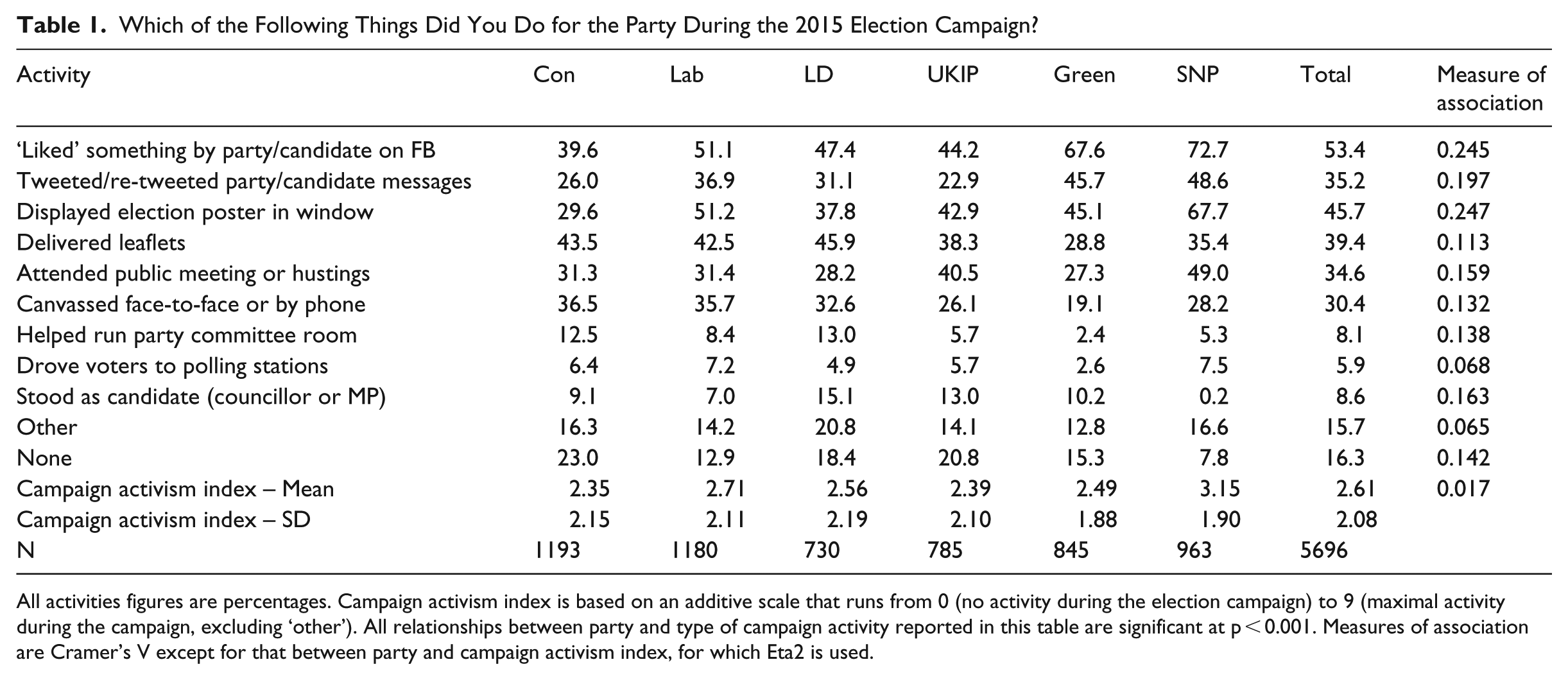
All activities figures are percentages. Campaign activism index is based on an additive scale that runs from 0 (no activity during the election campaign) to 9 (maximal activity during the campaign, excluding ‘other’). All relationships between party and type of campaign activity reported in this table are significant at p < 0.001. Measures of association are Cramer’s V except for that between party and campaign activism index, for which Eta2 is used.
These are the general patterns of campaign activism, but there are of course some variations by party. With respect to non-participation, there seems to be something of a left-right split, with Conservative (23%) and UKIP (21%) members being significantly more likely to admit having done nothing for their parties, while – at the other end of the scale – the extraordinary surge of enthusiasm around the SNP in 2014–2015 seems to have driven more than 90% of its membership to do at least something for the party during the campaign. This willingness to engage on the part of SNP members is reflected in well-above average tendencies to display the party’s posters, attend hustings and be active on social media – testament to the activity of the infamous ‘cybernats’ perhaps (see McKirdy and Jones, 2014). But these, of course, are relatively ‘low-cost’ activities; SNP members are no more likely (indeed, perhaps even less likely) than their counterparts in other parties to have taken part in canvassing or to have stood for office.
In fact, the ‘minor’ parties generally return higher percentages of members who are willing to stand for elective office, although this may of course be a simple function of size: if the smaller parties run anything like the same number of candidates as their larger counterparts, then a greater proportion of their members are bound to be called upon. The fact that, the SNP aside, they often stand no chance of actually winning may even help persuade members to volunteer in that it reduces the risk that anyone doing so simply as a favour to their party will be required actually to serve as an elected representative. Not altogether surprisingly, members of the parties with the oldest members (UKIP and the Conservatives) show least inclination to engage on social media, while members of the party with the youngest members (the Greens) are second only to SNP members in their enthusiasm for such activity. The oldest and perhaps most institutionalized parties (Labour, Conservatives and Liberal Democrats) are still the ones most likely to find members willing to undertake the crucial organizational tasks of running party committees and canvassing electors. It may be the case, then, that, while parties like the SNP, UKIP and the Greens enjoyed a surge in membership prior to the 2015 election, the ‘institutionalized’ commitment of their members did not yet run as deep as in the older, more established parties.
The detail of Table 1 is interesting, but it is a little hard to take in at a glance. Therefore, the penultimate row of the same table presents a simple additive index, ordered by party, which summarizes the overall level of activism among respondents during the election. This simply ascribes a score of 1 for each of the 9 activities referred in the table (with the exclusion of the vague category of ‘other activities’), and thus runs from a minimum of 0 (for people who do nothing) to 9 (for those who do everything listed). There is actually relatively little variation around the overall sample mean of 2.61. Conservative members score the lowest, but even they fall within 0.26 of the overall mean on the scale. The one outlier is the SNP: its members are fully 0.54 above the overall mean – a striking symbol of the surge that enabled the party to take 56 of the 59 Scottish seats at Westminster in 2015 (Mitchell, 2015).
So far, we have seen that, as reported in previous studies of political participation, the activities that require most of people in terms of time and effort are the things they are generally least likely to do (Whiteley et al., 1994: 74–75), and that the older, larger and more institutionalized parties have something of an advantage over the smaller parties in these high-cost activities. It is now time to consider the underlying factors that might have driven the patterns of activism that we have recorded.
Model Results
We start by running the GIM first for offline and then for online participation. For each of our dependent variables we then run (1) the national factors model, (2) the local factors model and (3) a model including both national and local factors.
Tables 2 and 3 report odds ratio (OR) predictors of offline and online participation for each of the models tested. Coefficients above 1 indicate positive relationships between the independent and dependent variables, whereas those below 1 indicate negative relationships. In respect of the GIM, we can see that predictions (Table 2) are almost completely verified for offline campaigning (model 1a): those respondents who have high group efficacy, high selective outcome and process incentives, high social norm pressures and strong expressive motivations show the greatest breadth of campaign activity. Moreover, as expected, the perception of costs of activism is a significant disincentive for offline campaigning. That said, collective and altruistic incentives do not appear to play a significant role in accounting for the breadth of members’ participation offline. This is perhaps not too surprising if we consider that Western societies have become increasingly individualized in the past few decades (Baumann, 2000), so collective and altruistic incentives might play a lesser role than hitherto.
The General Incentives Model: Offline and Online Political Activism During the Electoral Campaign (All Parties).
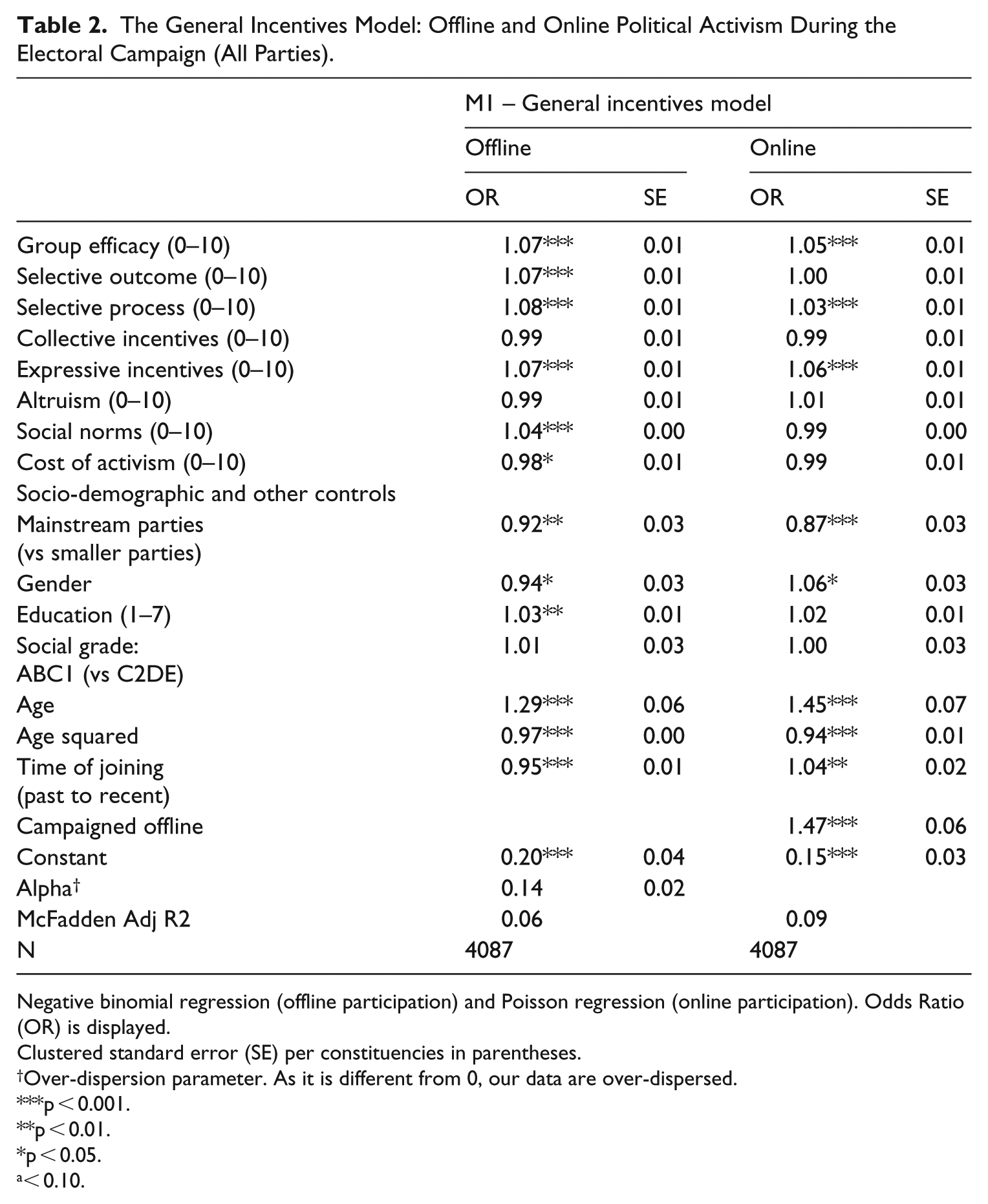
Negative binomial regression (offline participation) and Poisson regression (online participation). Odds Ratio (OR) is displayed.
Clustered standard error (SE) per constituencies in parentheses.
Over-dispersion parameter. As it is different from 0, our data are over-dispersed.
p < 0.001.
p < 0.01.
p < 0.05.
< 0.10.
The National and Local Factors Models: Offline and Online Political Activism During the Electoral Campaign (All Parties).
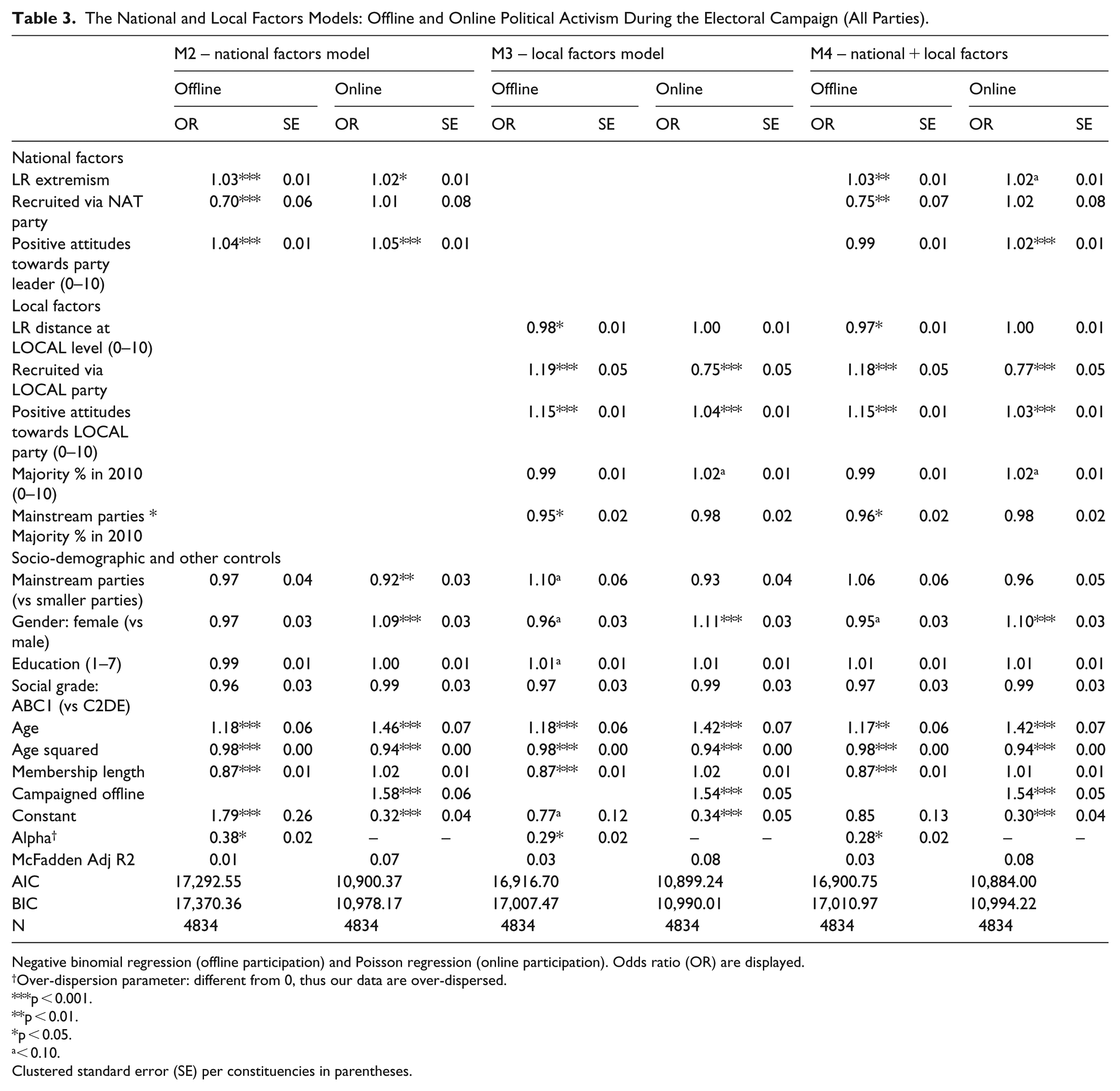
Negative binomial regression (offline participation) and Poisson regression (online participation). Odds ratio (OR) are displayed.
Over-dispersion parameter: different from 0, thus our data are over-dispersed.
p < 0.001.
p < 0.01.
p < 0.05.
< 0.10.
Clustered standard error (SE) per constituencies in parentheses.
When it comes to online participation (Model 1b), however, a slightly different picture emerges. As expected, after controlling for members who also participate offline, the perception of costs of activism is no longer significant. For most people, the cost of online activism is trivial and activities such as liking something from the party on Facebook can be carried out very quickly and easily. As with offline participation, collective incentives and altruism are not significant, but we also find that selective outcome incentives and social norms are not significant. In other words, only group efficacy, selective process and expressive incentives seem to be helpful predictors of more online participation. So, online activity helps people express their political identities, a process that helps them to feel they are engaging with like-minded people, albeit ‘only’ via social media, and encourages the belief that they might be contributing effectively to a collective effort in communicating messages favourable to their preferred parties. Thus, although we can largely confirm H1 for offline participation, this is somewhat less true for online participation. This is perhaps unsurprising, given that the GIM was developed before the advent of the Internet and political communication via social media, so it is less able to capture the incentives for new types of party activism. Even so, elements of it remain useful.
Looking at demographic controls, we can also see that being middle aged is a predictor of more activism, regardless of whether this is carried out offline or online. Interestingly, however, whereas offline activism is still mainly characterized by highly educated, high social grade males who have joined the party some time ago, online activism (once we control for those who also participate offline) is characterized by females who joined the party more recently.
Moving to the innovative models we introduce in this article (Table 3), the national factors model (Model 2) reveals that self-perceived ideological radicalism relative to the national party – for left-leaning parties and right-leaning parties – increases both online and offline campaign activity. In other words, those who participate in election campaigns tend to see themselves as more ideologically radical than their national parties than those who do not. Thus, our ‘May’s Law’ hypothesis (H2a) can be accepted. A positive view of the membership’s relationship with the national party leadership is also important for both offline and online campaigning (confirming H2b). Finally, joining the party after being approached by the national party reduces the likelihood of participation in offline campaigning compared to members who joined either on their own initiative or after being prompted by a local party. While this is consistent with H2c, the fact that recruitment by the national party does not affect online campaigning is a null finding.
All our expectations of the local factors model (Model 3) relate to offline campaigning. We find that, as expected, the closer a member feels to their local party in left-right terms, the more likely he or she is to participate in offline campaigning (H3a accepted). Offline participation is also more likely if the member has a positive impression (i.e. as united, friendly and interesting) of the local party (H3b confirmed). Moreover, offline campaign activity is spurred if a member has been recruited directly by the local party (H3c confirmed), as opposed to the national party or joining on one’s own initiative. Finally, as hypothesized, constituency marginality does play an important role for major parties: all else being equal, the smaller the majority achieved by their local MP in 2010, the more members of the Labour and Conservative parties did in terms of offline activity during the 2015 campaign. The marginality effect is not significant for smaller parties (H2d confirmed).
In so far as online participation is concerned (Model 3b), we can see that, as expected, after controlling for demographic effects and offline participation, these local factors do not exert the same impact as they do on offline participation. Their influence is either non-significant (in the case of ideological congruence with the local party or constituency marginality), or (in the case of having been recruited by the local party) negative. The only exception is that a positive impression of the local party has a positive impact on online activism.
Finally, when we run the national and local factors together, we find that offline participation (Model 4a) is significantly enhanced by the following: self-positioning as an ideological radical compared with the national party, while retaining a sense of proximity to the local party, being recruited via the local party, having positive attitudes towards the local party and living in a competitive constituency if one is a member of one of the two biggest parties. Thus, the only difference from previous models is that, once we include local factors in the model, the view of the national leadership is no longer a significant driver of campaign participation. For online participation, previous findings are confirmed: self-perceived ideological radicalism, not being recruited via the local party, positive attitudes towards the local party and positive attitudes towards the party leader are all factors that tend to increase a member’s participation online.
H4 states that ‘National Factors will be stronger in predicting online participation, whereas the Local Factors will be more useful in predicting offline participation’. Is this true? Not completely. For offline campaigning, two of the three national factor predictors have the expected effects, but the same can be said for online campaigning. The picture is clearer once we look at local factors, since all four of these are significant drivers of offline activity, but only two of them are significant drivers of online activity. We can, therefore, partially accept – or rather redefine – H4: whereas local factors play a bigger role in explaining offline participation, national factors play an important role in explaining both online and offline participation. 9
Conclusion
At the outset of this article, we set out two key questions to be addressed: How well does the GIM perform in the twenty-first century in predicting campaign activity both offline and, more innovatively, online? Over and above the GIM, do national and local factors further help explain activism, and if so, do the effects differ significantly for online and offline activism? We are now in a position to answer these questions.
With respect to the former question, our models suggest that General Incentives theory should remain central to our understanding of offline participation, although the fact that collective incentives and altruism are no longer significant might invite further reflection on the changes that have impacted on party membership in the past few decades. In this regard, the general trend towards the individualization of society remarked on by sociologists such as Baumann (2000), has found a certain counterpart in the organizational evolution of parties (Faucher, 2015), including the British Labour Party, which has gradually shifted from a long-standing model of collective delegatory democracy to individual representation (Watts, 2017). With respect to online participation, only a few of the factors included in the original GIM actually help to predict activism. This suggests the need for research into the causes of online participation that goes beyond what we have been able to investigate here with limited data.
Our article also shows that, on one hand, factors associated with the national parties improve our understanding of participation by party members both offline and online. On the other hand, local party and constituency contextual factors add significant value to explanations of traditional offline activism. If an individual is recruited by his or her local party, becomes embedded within it as a social network, forms a positive impression of the way it conducts its business and feels comfortable with its general ideological outlook, he or she will be significantly more likely to campaign for it at election time – all the more so if this all happens to occur in a marginal constituency and he or she is a member of one of the major two parties. National party factors also seem to bear upon offline activism: being recruited via the national party disincentivizes offline participation, whereas feeling ideologically radical compared to the national party incentivizes it.
We can also confirm that, as with the GIM, the national and local factor effects do indeed differ in certain key respects for offline and online activism. In particular, the local factors that matter for offline participation – such as a sense of ideological proximity to the local party and the electoral marginality of the constituency – do not carry any significant weight for online participation, whereas being recruited at the local level enhances offline but weakens online participation.
The last point provides a fascinating cue for future research, namely the need to explore the impact of local contextual factors on members’ involvement in their party’s campaigns, both at election times and between them – something that could profitably be investigated through qualitative as well as quantitative methods (Garland, 2016a, 2016b). We also need to know more, particularly in this increasingly digital age, about the quality, scope and, indeed, the effect of members’ involvement in their parties’ online campaigns (see, for example, Ridge-Newman, 2014). Certainly, more traditional offline campaign activities are by no means a thing of the past – and our research suggests that if parties want members to get involved in such activities, then they need to think very carefully before rushing into making recruitment and participation more national and more digital. How to get party members to support and complement their own, often centralized, capital-intensive and carefully controlled online efforts – something that the British Labour Party seemed able to do in 2017 – will be something on which parties have to reflect carefully too.
Supplemental Material
PSX794740_supplemental_material – Supplemental material for Participating Locally and Nationally: Explaining the Offline and Online Activism of British Party Members
Supplemental material, PSX794740_supplemental_material for Participating Locally and Nationally: Explaining the Offline and Online Activism of British Party Members by Tim Bale, Paul Webb and Monica Poletti in Political Studies
Footnotes
Funding
The author(s) disclosed receipt of the following financial support for the research, authorship, and/or publication of this article: The authors gratefully acknowledge the financial assistance for this research by the Economic and Social Research Council [Grant ES/M007537/1].
Supplementary information
Additional supplementary information may be found with the online version of this article.
Notes
Author Biographies
 ).
).
References
Supplementary Material
Please find the following supplemental material available below.
For Open Access articles published under a Creative Commons License, all supplemental material carries the same license as the article it is associated with.
For non-Open Access articles published, all supplemental material carries a non-exclusive license, and permission requests for re-use of supplemental material or any part of supplemental material shall be sent directly to the copyright owner as specified in the copyright notice associated with the article.
