




Abstract
This article analyses how populist parties wage opposition in parliament. We conceptualise opposition behaviour in terms of two independent dimensions: scrutiny (monitoring and criticising government actions) and policy-making (participating in or directly influencing legislative production). In line with the conceptualisation of populism as an opposition to the ruling elite in name of ‘the people’, our hypothesis is that populist opposition parties are more likely to use scrutiny and less likely to use policy-making tools than non-populist opposition parties. We study the Netherlands between 1998 and 2017 as a typical example of a consensus democracy, where populist parties have a greater opportunity to win representation and use parliamentary tools (compared to majoritarian democracies). Our findings indicate that populist opposition parties are particularly less likely to engage in policy-making behaviour and somewhat more likely to engage in scrutiny behaviour.
Introduction
Political opposition is a vital characteristic of democracy, but the way in which opposition politics is organised varies greatly between countries (Dahl, 1966). In the last quarter century, populist parties have developed and thrived in Western democracies. A key element of populism is their opposition to the ruling elite (Mudde, 2007). While populism has enjoyed great scholarly attention in the past decade, the relationship between populism and parliamentary opposition behaviour has not been analysed in detail. 1
Our aim is to study the relationship between populism and the choice for a particular type of parliamentary opposition behaviour. We develop a two-dimensional typology of opposition party behaviour based on Mair’s (2009, 2011) distinction between responsible and responsive politics. On the one side, there are parties that take responsibility for government policy and cooperate with others to shape it. On the other side, there are parties that focus on representing the interests of voters but do so without taking responsibility. These parties tend to voice opposition against unpopular policies and will try to signal voters that they care for their concerns. On basis of this characterisation, we see opposition party behaviour as two-dimensional: first, there is a dimension that taps into the willingness of parties to engage in policy-making, reflecting Mair’s responsible approach to politics. The second dimension, scrutiny, taps into the extent to which parties voice opposition to policies and scrutinise decision-makers. We argue that this reflects Mair’s representative approach to politics. In line with the conceptualisation of populism as an opposition to the ruling elite in name of ‘the people’, we propose that populist parties are likely to engage in continuous and outspoken scrutiny of the government and are less likely to use policy-making tools than non-populist parties.
Our empirical analysis focuses on the Netherlands because it combines three elements: a consensus democracy, a left-wing populist party and a right-wing populist party. The Netherlands is unique in Western Europe because both left-wing and right-wing populist parties have been in parliament for more than a decade. This makes it an important case to study parliamentary behaviour of populist parties, as it allows us to examine their behaviour independent of their ideological orientation. As we will discuss in greater detail below, in consensus systems, populist parties have a greater chance to win significant and continued representation in parliament and to use parliamentary tools compared to majoritarian systems. The open electoral system has allowed for the persistent presence of left-wing and right-wing populist parties in the Netherlands: in 1994, the Socialist Party (the ‘Against-party’), entered parliament in 1994. It was followed in 2002 by the ‘citizens’ revolt’ of the right-wing populist List Pim Fortuyn (De Vries and Van der Lubben, 2005). Since 2002, the lower House of the Dutch Parliament ‘has never been calm again’. 2 Studying opposition parties’ use of parliamentary instruments between 1998 and 2017 offers substantial variation in the presence and size of populist parties. As a ‘typical’ case, we argue that our study of the Netherlands is informative of general patterns of opposition behaviour in many Western European parliaments, which have seen a similar rise of populist parties and provide opposition parties with a wide range of parliamentary tools.
Below we will first outline our conceptualisation of opposition behaviour and discuss how it relates to populism. We then argue in greater detail why we select the Dutch case and what its relevance is in the broader literature. Our expectations are tested using a range of behavioural data from the Dutch lower house. As our findings show that populist parties indeed prefer a ‘critical opposition’ style that favours scrutiny over policy-making, we will discuss the comparative implications of our study in the conclusion.
Opposition Behaviour: Scrutiny and Policy-Making
Our study focuses on opposition party behaviour within the parliamentary arena and specifically the use of parliamentary tools. We analyse opposition activity in parliament using two independent dimensions: scrutiny and policy-making. As indicated above, these dimensions are derived from Mair’s (2011: 14) observation that in European party systems, there is a growing division ‘between parties which claim to represent, but don’t deliver, and those which deliver, but are no longer seen to represent’. Some opposition parties may use parliament primarily as an amplifier to express their opposition to the governing majority. These parties focus on their ability to represent the voices of the voters in parliament (Mair 2011). Their behaviour would fit best in what is called a talking parliament (Polsby, 1975): expressing concerns and criticising those in power are much more important than deliberative contributions to policy making. Such parties will strongly voice their opposition to policies that are unpopular and will attempt to signal to voters that they care for their concerns. This is what Auel (2007: 500) calls political scrutiny: ‘assessment of and political judgement on the appropriateness of [government action]’. According to Mair (2011), this function of political parties has mainly been taken up by a new kind of opposition party that does not seek responsibility but focuses on responsiveness to voters’ demands. This means that these parties will scrutinise the government and will use the right of parliament to obtain information, to show that the government makes mistakes or ignores important societal problems. Moreover, they may voice their opposition by voting against legislation that the government produces.
Opposition parties can also focus on policy-making, using parliament as a market place for finding new majorities for their own policy initiatives. In this orientation, opposition parties behave in a way that fits the legislature as a working or transformative parliament (Polsby, 1975), in which political representatives with different policy agendas collectively try to formulate legislation. Despite their opposition status, these parties want to deliver policies and convince the governing majority (or parties within it) to change their proposed policies. To this end, opposition parties may use legislative initiatives, amendments and motions that call for some new and specific policy task to the government when adopted.
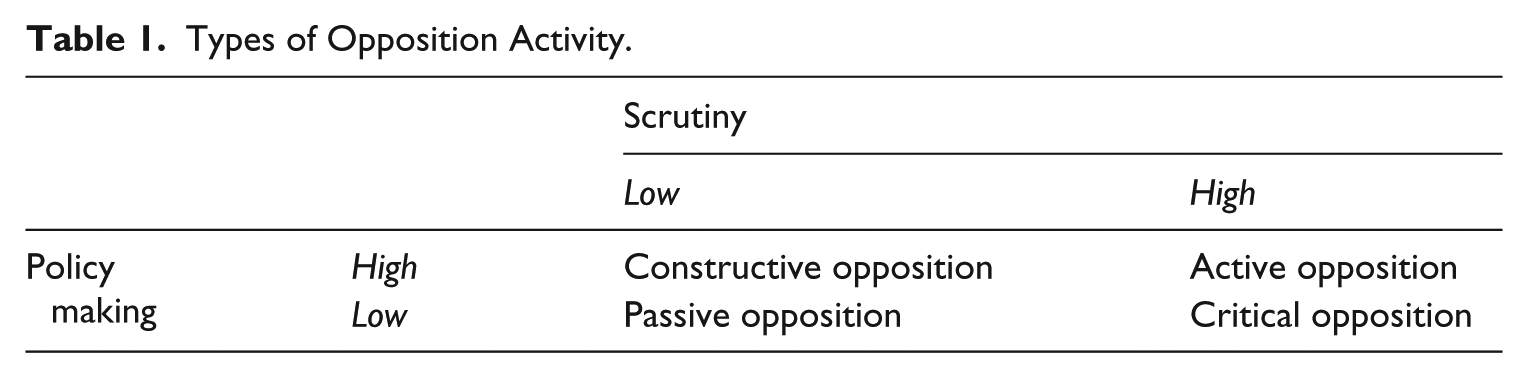
Scrutiny and policy-making can be used complementary to each other. Parties can ask questions to scrutinise government actions and propose amendments to change policies. Opposition parties also can refrain from one or both types of activity. This leads to a fourfold typology of opposition activity visualised in Table 1. Constructive parties choose to focus on policy-making and leave the scrutiny activity to other parties. They seek to change new policies instead of highlighting government failure. They seek to deliver policies despite their opposition status and for that they need the support of (part of the) government coalition. Conversely, critical opposition parties choose to focus on scrutinising the government and leave policy-making to other parties. These parties do not seek a role of constructive opposition, but they just want to expose failures and limitations of the incumbents. While in most Westminster-style systems, this critical role is seen as the default stance for the opposition (as their policy making options are very limited), in consensus democracies like the Netherlands opposition parties are not necessarily restricted to being ‘critical’. Active opposition parties choose to both scrutinise the government and formulate alternative policies. These parties point out what is wrong and offer policy alternatives. The converse is a passive opposition, parties that are relatively uninterested in scrutiny and policy-making. As we will see later, mainly larger parties with previous government experience fall into this category: they will wait out their stint in opposition without much activity.
Types of Opposition Activity.
Populism and Opposition Behaviour
We expect that populist parties approach opposition differently from non-populist parties. Populism is conceptualised here with reference to two claims (Albertazzi and McDonnell, 2008; Jagers and Walgrave, 2007; Mudde, 2004, 2007; Taggart, 2000). First, the actions of government should reflect the general will of the people. The people are considered by populist to be virtuous, pure and homogeneous (Taggart, 2000). Second, the current ruling elite deprive the people of their right to rule. They no longer represent the people. Populists seek to ‘give back the government’ to the people (Taggart, 2000). Populism has a chameleonic quality (Taggart, 2000), which means that it can be combined with both left-wing and right-wing ideas.
While populism often is regarded as a binary characteristic that parties can either have or lack (Rooduijn, 2014), we think of populism in terms of degrees (Jagers and Walgrave, 2007; Rooduijn and Pauwels, 2011). Populism is not necessarily limited to new challenger parties; old parties might also partly adopt some level of populist rhetoric. Moreover, some parties might increase or weaken their populism over time.
Finally, some parties might be more outspoken in their populist stances than others. Because of their anti-elitism we expect populist parties to focus on scrutiny: bringing to light the failings of the incumbent government. We expect that they focus less on policy-oriented activity: in the dichotomy of representing and delivering, these parties tend to focus on representation. After all, one of the central arguments of populism is that the existing elites fail to represent the people. They will generally focus on issues that established parties (in their view) ignore. Policy-making is not expected to be a central concern for populists, as participating in a working relationship with other parties would only legitimise the current institutional framework and the existing parties. Populists resist the image of backroom dealing and compromising with the elite cartel and claim to express the ‘will of the people’ (Mudde, 2004). This leads us to the following hypotheses:
Populism-scrutiny hypothesis: The more populist an opposition party is, the more it will use scrutiny tools.
Populism-policy hypothesis: The more populist an opposition party is, the less it will use policy-making tools.
Case Selection
This article examines populist behaviour in parliament in a consensus democracy. Consensus democracies are characterised by a number of features, including open electoral systems and relatively powerful parliaments compared to majoritarian democracies whose parliaments are dominated by their single party governments and which use closed electoral systems (Lijphart, 1999). These affect the ability of populist parties to wage opposition. The relatively open electoral systems allow populist parties to gain representation. In majoritarian countries that have seen populist parties play a significant electoral role, like France and the United Kingdom, the single member district electoral system prevents non-mainstream parties from winning a substantial representation: for instance, in the French 2017 legislative election, the Front National (National Front, FN) won 13% of the votes and eight seats (out of 577) and in the 2015 UK parliamentary election, the United Kingdom Independence Party (UKIP) won 13% of the vote and one seat (out of 650). This was only the second time in its history that UKIP actually won a seat in the UK parliament (the previous seat was won in a 2014 by-election). Under proportional representation, these parties would have won many more parliamentary seats.
Even when parties win parliamentary seats, the rights and position of opposition parties differ from system to system. A key element of a consensus democracy is that in parliament, government parties are not, or at least not strongly, privileged. Both opposition and government parties have the same tools at their disposal, in terms of the ability to influence the agenda, make substantial proposals or use scrutiny tools. In many majoritarian systems, opposition parties do not have the same tools at their disposal as government parties and their ability to determine the agenda or make substantial policy proposals is limited. The power of parliament to set its own agenda is strongly conceptually and empirically correlated with the level of consensus democracy in a country (Tsebelis, 2002: 109–111). The power of the government over the legislature is so strong in France, for instance, that the government can decide on which bills amendments can and cannot be introduced (Döring, 2004; Tsebelis, 2002: 99). In the United Kingdom, the opportunity to discuss bills or motions introduced by the opposition is limited to opposition days and the largest opposition party (the official opposition party) gets the lion’s share of these days. In contrast, there is no relationship between consensus democracy and the opportunity for the opposition to ask questions (Russo and Wiberg, 2010). It is not the case that in more independent parliaments, the right of MPs to information is stronger. Finally, electoral openness and parliamentary rules interact: for instance, in France, the parliamentary rules privilege MPs that are a member of parliamentary party groups over MPs that are not. Since 1988, the FN contingent has always been too small to form a group.
Andeweg et al. (2008) argue that the relationship between consensus democracy and populist opposition goes even deeper: in their view, traditionally consensus democracies were characterised by the absence of real opposition (Andeweg et al., 2008; Daalder, 1966). The institutions of consensus democracy were historically combined with a strongly segmented society, for instance, along religious lines. In these systems, opposition used to be absent: many consensus democracies have a tradition of multiparty coalition governments, specifically oversized coalitions or Grand Coalitions between the largest parties of the left and the right (Lijphart, 1999: chapter 6). Even when segments of society are in opposition, they are likely to be involved in the broader policy making process: the parties could be in government at the subnational level (Lijphart, 1999: chapter 10) or representatives of interest groups with close ties to opposition parties participate in corporatist decision-making (Lijphart, 1999: chapter 9). In many consensus democracies, the strong societal cleavages waned at the mass level, but the consensual rules of the game at the elite-level remained (Andeweg, 2001; Lijphart, 1968). The continued tradition of cooperation and accommodation led to the cartelisation of politics. As elite cooperation was no longer necessary to overcome significant societal heterogeneity, it increasingly closed off the political arena, risking lower responsiveness to voters’ demands (Andeweg, 2001; Katz and Mair, 1995; but see Kitschelt, 2000). Therefore, as Andeweg (2001) suggests, these cartel democracies fostered the rise of populist parties that sought a power shift away from the elite and towards the people. This provides another explanation, in addition to the electoral system, why populist parties have better representation in consensus democracies compared to majoritarian democracies (Hakhverdian and Koop, 2007).
We select the Netherlands because it is a consensus democracy that has both left-wing and right-wing populist parties in their parliament. There are five West European consensus democracies: Austria, Belgium, Germany, the Netherlands and Switzerland. 3 Appendix A gives a complete overview of populist parties and democracy types in West Europe. Four out of five West European consensus democracies have both left-wing and right-wing populist parties in their parliament (Otjes and Louwerse, 2015): Austria has the Austrian Freedom Party (Freiheitliche Partei Österreichs, FPÖ) on the right and historically Alliance Future Austria (Bündis Zukunft Österreich, BZÖ) and Team Stronach as well and the recent addition of the Pilz List (Liste Pilz) on the left (Eberl et al., 2017). 4 Belgium has the Flemish Bloc/Flemish Interest (Vlaams Blok/Vlaams Belang, VB) on the right as well as the National Front (Front National, FN), which was inspired by but distinct from the French FN discussed above, and the Labour Party (Partij van de Arbeid/Parti du Travail de Belgique, PvdA/PTB) on the left. Germany has had The Left (Die Linke, DL) and the recent addition of the Alternative for Germany (Alternative für Deutschland, AfD) in 2017 on the right (Arzheimer, 2015). The Netherlands has had the Socialist Party (Socialistische Partij, SP) on the left since 1994 and a number of parties on the populist right: the Centre Party (Centrumpartij, CP), Centre Democrats (Centrum-Democraten, CD), List Pim Fortuyn (Lijst Pim Fortuyn, LPF), Freedom Party (Partij voor de Vrijheid, PVV) and Forum voor Democratie (Forum voor Democratie, FvD) since 2017. Out of these only in the Netherlands have left- and right-wing populist parties been in parliament together for more than one parliamentary term. This case offers an important advantage: it allows one to examine how populists behave independent of their ideological orientation (Otjes and Louwerse, 2015); if one examines only left- or right-wing populist parties, it may be difficult to separate their populism from their policy position.
We argue that the Netherlands is a typical case of consensus democracy with a populist opposition. Populist parties can win parliamentary representation and have access to the full range parliamentary tools without strong restrictions on the use of parliamentary tools by the government or governing parliamentary majority. The choice of country affects the generalizability of the results. The results of our analysis certainly speak to other consensus democracies. The extent to which results are likely to be relevant for majoritarian democracies depends on the institutional context and will be discussed in the conclusion.
Populism and Consensus Politics in the Netherlands
The Netherlands is a prototypical consensus democracy. Historically, its society was segmented into different subcultures, named pillars, formed tightly knit-networks of parties and social organisations that encapsulated citizens from cradle to grave. It had many of the institutional features of a consensus democracy: a tendency for oversized coalition cabinets, allowing multiple parties to participate in government. Even opposition MPs could be influential in the Dutch ‘transformative parliament’ where expertise counts as much as political affiliation (Andeweg et al., 2008) and the minority has considerable influence over the parliamentary agenda (Döring, 1995). In the Dutch consensus systems, there traditionally was little place for an adversarial, Westminster-style opposition that opposes the government of the day and presents itself as an alternative administration. In parliament, opposition parties traditionally operate in a constructive way, offering not just criticism of the government, but also policy alternatives. The more adversarial oppositional voices were left to the smaller parties in the system (Daalder, 1966). They tended to represent either smaller, more extreme versions of the established parties, such as communists and conservative Christians, or small one-day fly parties. Like in many other consensus democracies, between the 1960s and the 1980s, the segmented structure of Dutch society dissolved, but the elite ‘rules of the game’ stayed mostly in place (Van Praag, 1993). Society became more homogeneous, but the major parties that existed under the segmented system formed the core of every government.
Since 1994 and 2017, populist opposition parties have consistently won representation in parliament. The year 1994 saw the election of the left-wing populist SP to the Second Chamber: a party that voiced a left-wing critique of the existing consensual political system with clear elements of populism (Voerman, 2011). In 2002, the right-wing populist LPF was elected into parliament. With the LPF, the Netherlands now also had a permanent and sizable right-wing populist critic of the consensual political system. The LPF was immediately invited to form a government with Christian-Democrats and the Liberals. After its short-lived adventure as a government party, it declined electorally. In 2006, it was succeeded by the PVV as the parliamentary representative of radical right-wing populism.
Research Design
We conduct an observational study of opposition party behaviour in the Netherlands between the 1998 and 2017 elections. While the time frame is constrained by data availability, this period goes back to 4 years before the 2002 ‘Fortuyn revolution’ and covers all completed parliamentary terms since then. Moreover, as we will see, the degree of populism has increased markedly over this time period, allowing us to study differences between populist and non-populist parties.
Dependent Variables
We operationalise scrutiny by constructing a scale based on the number of oral questions tabled by a party, the number of written questions and how often it voted against bills. Parliamentary questions are increasingly used. Between 1998 and 2017, 55,919 written questions were asked (20 per MP per year). Every week the Dutch parliament holds a televised Question Hour in which ministers and junior ministers can be asked questions. The Speaker of the House determines which questions can be asked on basis of questions submitted by MPs. There are no specific slots for specific parties; instead, the Speaker uses criteria like whether the issue has not been debated in parliament in the last weeks or will not be debated in upcoming weeks, whether it is the first proposal to debate the issue on that day and whether it concerns facts that have recently become known. 5 About a fifth of the submitted questions can be asked during Question Hour. Between 1998 and 2017, 2083 oral questions were asked, which is just below one question per MP per year. The final scrutiny tool parties have at their disposal are legislative votes. In the Netherlands, MPs very sparingly vote against bills (Andeweg and Irwin, 2009), most of which are government-initiated. Most bills are package deals including at least some measures that both coalition and opposition parties favour. Governmental budget bills are an example of this. Furthermore, laws often are technical in nature and involve small changes to existing policy. Voting against a bill is less an act to influence policy and more a sign of defiance of the norms of consensus government. No-votes also occur when a party strongly disagrees with the policy and uses negative voting as a means of expressing this. 6
Policy-making is measured as a combination of the number of legislative initiatives, amendments and motions proposed. Only a limited number of the laws proposed are MP-initiated. We have 179 legislative initiatives in our data, which indicates that every year, 9 out of 150 MPs write such a piece of legislation. Less than 2% of all bills are initiated by MPs, all others are initiated by the government. 7 Legislative initiatives do not necessarily result in changes in the law: out of the 179 laws proposed by MPs between 1998 and 2017, 49% has not been put to a vote. Some bills that remain in legislative limbo are perhaps primarily meant as long press releases than as an actual change in policy. MPs are more active in proposing amendments: between 1998 and 2017, 8401 amendments were handed in (3 per MP per year). This is a way in which opposition MPs can influence policy: they examine a law proposed by the government and try to build a majority to alter it on a specific point. MPs can also propose motions; these are generally substantive in nature, just as ‘resolutions’ would be in other parliaments. Even when a parliamentary majority carries them, they are non-binding expressions of the opinion of parliament; they are meant to persuade the government to engage in policy-making activity. Motions are used frequently, which has led some scholars to question their power (Bakema, 1988). Between 1998 and 2017, 28,093 motions were handed in (10 per MP per year). Still, a motion that is adopted, can have some policy impact: ministers are expected to address these motions, for example, by initiating the proposed policy under their own responsibility and have it implemented. Many government bills explicitly mention motions as one of the reasons for the bill.
We have collected the motions, written questions and amendments by using purpose written scripts on the digital archives of the Dutch parliament (Louwerse et al., 2018). We have also collected parliamentary votes automatically with purpose-written scripts that examine the parliamentary minutes to identify when a vote is held. We have collected all votes (on bills, amendments and motions) but limited our analysis here to votes on bills. The data for oral questions have been obtained from Timmermans and Breeman (2010) for the period until 2010, and the digital archives of the Tweede Kamer for the period 2010–2017 and data on legislative initiatives was obtained from the Eerste Kamer.
In order to examine these data in a comparable way, we look at the number of motions, amendments, oral and written questions per MP per year. This means that the number of motions is calculated for each party for each parliamentary period and then divided by the number of MPs each party had times the number of years that that parliamentary period lasted. This means that we have a measure that we can compare better across time (longer and shorter parliamentary periods) and across larger and smaller parliamentary parties. We look at all sponsors of motions, amendments and bills, so a party is regarded as a sponsor even when it was only the fifth to sign. We disregard parliamentary parties that were formed during the parliamentary term. 8
We create two scales of parliamentary behaviour: scrutiny and policy-making. We first normalise all of the indicators discussed above so that all the minima are 0 and all their maxima are 1. As a result, each indicator contributes equally to the scale. The scale is calculated by summing the three indicators and rescaling the indices to run between a theoretical minimum of 0 to a maximum of 10. The items for each scale are positively correlated (Cronbach’s alpha = .63 and .60 respectively). 9 We also create a ‘Scrutiny vs Policy-Making’ variable calculated as scrutiny minus policy-making. This captures whether parties prioritise one over another. Parties that use scrutiny extensively and exclusively will receive scores well above zero; parties that use policy-making more often than scrutiny will score below zero.
Independent Variable
Populism is operationalised by means of an automated measure of content analysis developed by Pauwels (2011). This technique measures populism by the use of list of 24 words that measure anti-elitism. We applied this measure on all Dutch party manifestos published between 1998 and 2012. We look at the number of anti-elitist words per a thousand, which in our dataset ranges from 0 to 6. 10
Control Variables
Our analysis takes into account a number of control variables. First, we control for the policy distance between the opposition party and the government parties. 11 If an opposition party has a policy position that is hugely different from the government’s, it is more likely that they will engage in active opposition, either scrutiny or policy-making. As populist parties are usually more outspoken in terms of policy, we need to control for this. Using Chapel Hill Expert Survey policy position estimates on the left-right scale (Bakker et al., 2015), we calculate policy distance as the absolute difference between the position of the government and the position of each opposition party. We measure the government position by calculating the mean position of its constituent parties, weighted by coalition seat share. 12
We need to control for party size for two reasons. First, our measures of opposition behaviour are normalised by MP, but it is not entirely reasonable to expect that a party with 30 MPs produces 30 times more parliamentary output than a party with a single MP. This is particularly true for amendments and motions, which a party typically signs only once – and there is a limit to the number of detailed proposals a party can put forward. Moreover, the size of a party may inform its expectations about the future. Larger parties may have the reasonable expectation to enter government, after the elections, if the existing government loses its majority. As the Dutch cabinet formation is characterised by partial alternation (Mair, 1997), opposition parties might very well have to work together in the future with current government parties. Therefore, larger parties may choose to tone down populist rhetoric, limit their policy-making activity and refrain from parliamentary scrutiny. We measure size as the log of the number of MPs a party had at the beginning of the parliamentary term. 13
The argument made for size above, also applies for a history of government participation. A key predictor of whether a party expects to be in government is whether it has been in government previously. Similarly, parties that have been in government before can be expected to take a less populist stance as well as to display more passive parliamentary behaviour. We use government history: the percentage of days a party has governed out of the total number of years, it has existed before the beginning of the term. This differs between 0 (for parties that have always been in opposition) and 1 (for the LPF which in the 2003–2006 term had only been a government party while in parliament). Here, we disregard the government history of parties that have merged.
Finally, we control for the trend of increased use of parliamentary instruments over time, motions and questions in particular. While ideally we would control for the factors underlying this trend, a lack of available data drives us to using a time proxy. The trend variable indicates the time between the beginning of the 1998–2002 term and the median day in the term of interest (in years).
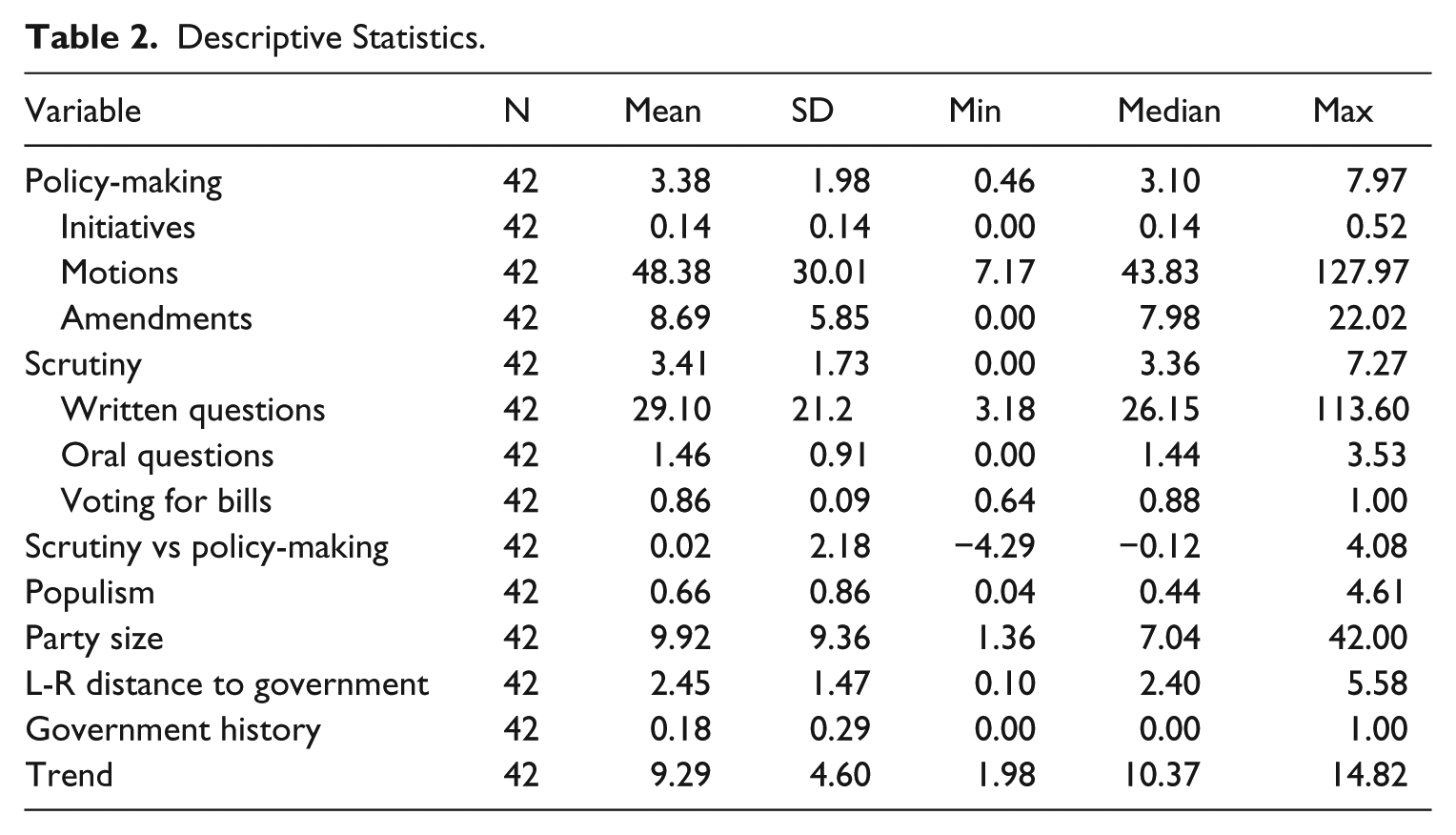
Table 2 provides descriptive statistics for our variables. Given the fact that our variables are measured at the interval level and show no large deviations from normality, which is important due to the small sample size, we employ ordinary least squares regression. As our data have an unbalanced panel structure (largely the same parties in different parliamentary periods over time), we use clustered standard errors (per party).
Descriptive Statistics.
Patterns of Opposition Behaviour in the Netherlands
Figure 1 shows opposition party scores on our two dimensions: scrutiny and policy activity. We can distinguish between four clusters of parties: first, there is the passive opposition, parties showing relatively low levels of activity on either dimension. The Liberal Party (Volkspartij voor Vrijheid en Democratie, VVD), the Labour Party (Partij van de Arbeid, PvdA) and the Christian-Democratic Appeal (Christen-Democratisch Appèl, CDA), the large parties with a history of government participation, tend to be found in this category. They do not scrutinise the government excessively nor do they offer many policy alternatives. As we shall see below, part of this effect may be explained by their size. The LPF that was present in our data only in one term, also is in this category.
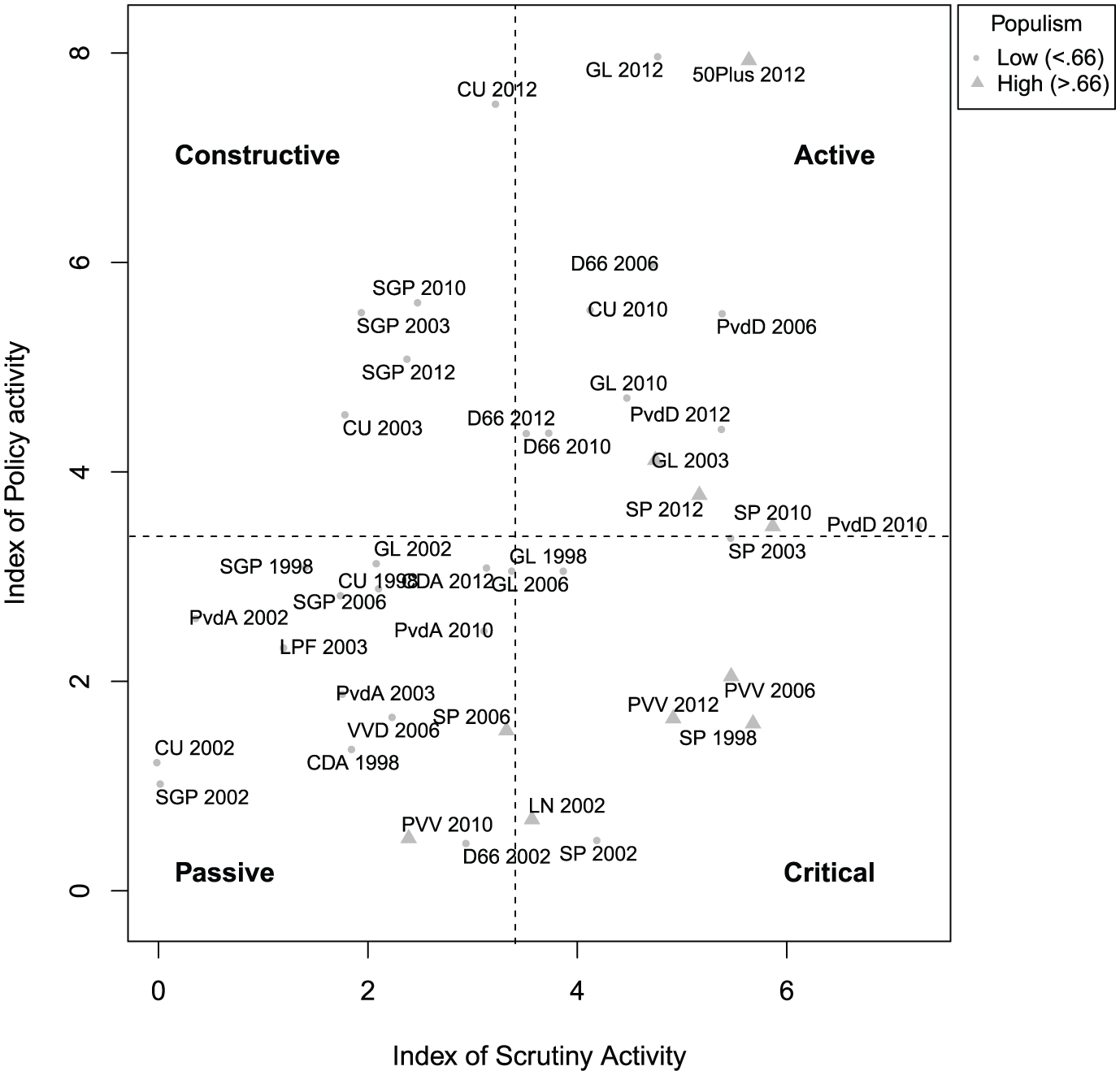
Scrutiny and Policy-Making Among Dutch Opposition Parties (1998–2017)
Second, the constructive opposition, which focuses on policy activity instead of scrutiny activity. These parties propose motions, amendments and initiatives but do not ask many questions nor do they often vote against bills. The conservative Christian parties Political Reformed Party (Staatkundig Gereformeerde Partij, SGP) and ChristianUnion (ChristenUnie, CU) can mainly be found in this category. These parties are known for their ‘governmental’ orientation. This means that despite not being part of the governing coalition, they approach it with goodwill. For the CU especially we can see a general increase in activity on both dimensions: this means that it has moved through the constructive opposition category, starting as a more passive opposition party and ending up as more active opposition party.
Third, there is a group of parties that makes frequent use of all of the available tools. These parties are the active opposition. These are GreenLeft (GroenLinks, GL), Democrats 66 (Democraten 66, D66), the pensioners’ party 50PLUS and the Party for the Animals (Partij voor de Dieren, PvdD). The two-woman PvdD parliamentary party is known for its exceptional activity in both offering policy alternatives and scrutinising the government, almost exclusively in the domain of animal welfare (Otjes, 2014).
In the final quadrant, we find the critical opposition, which excels in asking questions and voting against government bills. The SP and the PVV mainly fall into this category: one should note here that the populism of the SP has waxed and waned over time, as is evident from the scale we use. Interestingly, in the periods that the party was most populist in its election manifesto (1998 and 2010), it also was more extreme in its use of scrutiny tools compared to the periods when it was less populist in its election manifesto. The PVV is also located mostly in the critical quadrant. An exception is in 2010, when a minority government was formed with support of the PVV, the party moved into the passive opposition mode, which is to be expected for a party that falls between the ‘government’ and ‘opposition’ categories. Still, it was about as high on our scrutiny dimensions as the opposition parties SGP and PvdA in that same period. After a majority cabinet was formed in 2012, the PVV has shown its oppositional side once more. Liveable Nederland (Leefbaar Nederland, LN), a minor centrist populist party in parliament between 2002 and 2003 also falls in this category.
The Effect of Populism on Opposition Party Behaviour
To determine the relationship between populism and the type of opposition party behaviour, we assess our two dimensions separately (see Table 3). We find a strong and significant effect of populism on opposition party policy-making activity (p < 0.001). For a unit increase on the populism measure, our model predicts a 0.66 decrease on the 10-point policy-making scale. This means that the predicted value for the most populist party (4.6) in our dataset is 3 points lower than for the least populist party (0.04). Given that the scale theoretically ranges from 0 to 10, this is a substantively large effect. In line with our expectations, we find that populist parties do use policy-making instruments less often than other parties. We also find a significant effect for one of our control variables, size, indicating that larger parties use policy-making instruments less. This may be explained by two mechanisms: we employ a pro capita measure of policy-making. It is, however, unlikely that there is a linear relationship between the number of MPs and the activity of a parliamentary party, because there is only a limited number of issues on the agenda a party can make proposals on. As parties grow bigger, they may become more active in absolute terms, but not in relative terms, with average activity per MP dropping. Moreover, parties may have the reasonable expectation of taking up government office in the future and therefore not needing to realise policy goals while in opposition. Opposition then may be an intermezzo to being a member of government for large opposition parties. Waiting for the next chance for incumbency takes away the sense of urgency to realise policy goals when in opposition. Our government history control variable is not significant. This indicates that the effect of party size is likely mainly to be due to our pro capita measure of policy-making, rather than the expectation of future government participation, as this would also apply to the actual history of government participation.
Regression Models of Opposition Activity.
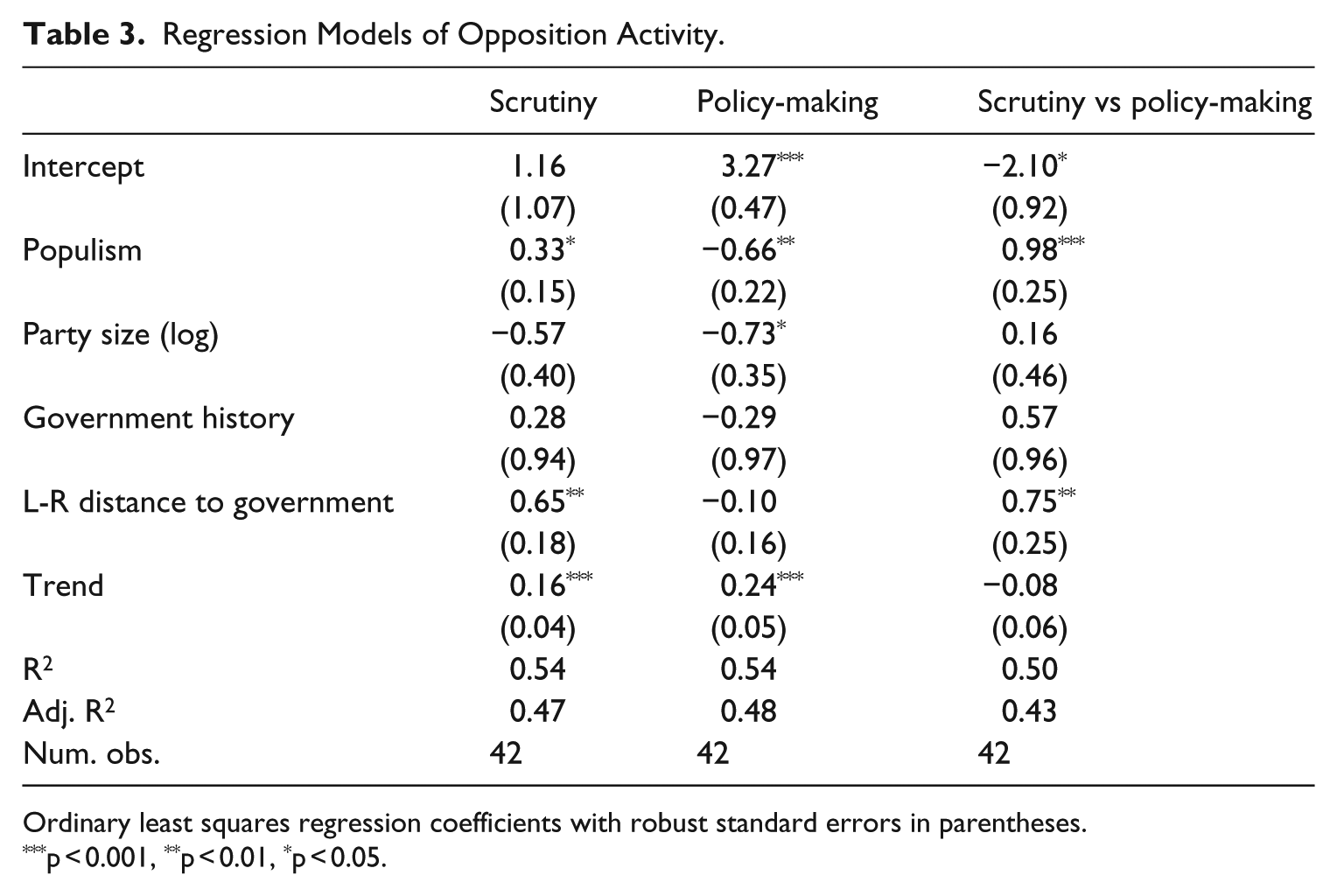
Ordinary least squares regression coefficients with robust standard errors in parentheses.
p < 0.001, **p < 0.01, *p < 0.05.
When we look at scrutiny, we find that the coefficient runs in the hypothesised direction and significant, but is substantially smaller than for policy-making (b = 0.33). 14 This amounts to a difference of 1.5 points on our scrutiny scale between the most and least populist party, if we keep all other variables constant. Upon closer inspection of the data, we find that while populist parties (PVV, 50PLUS, LN, SP) generally show higher scrutiny values, a number of non-populist parties show similarly high levels of scrutiny (PvdD and GL). These are parties that like the populists generally are quite distant from the government in terms of policy. This is confirmed by the coefficient for Left-Right Distance to the Government achieving significance (p < 0.001): the coefficient of 0.65 implies that the parties that are most distant from the government in terms of policy (5.6) score about 3.5 points higher on scrutiny, according to our model. All in all, policy differences play a more important role than populism in itself in explaining how active opposition parties are in terms of scrutiny.
In our third model, we look at the trade-off between scrutiny and policy-making. This captures the extent to which parties prioritise scrutiny over policy-making, which should help us to better distinguish critical opposition parties from active opposition parties on the scrutiny dimension and from passive opposition parties on the policy-making dimension. The variable ‘Scrutiny vs Policy-Making’ captures whether parties prioritise scrutiny over policy-making. Here, we find a strong and significant effect of populism (b = 0.98, p < 0.001). Populist parties focus on scrutiny more than on policy-making, in line with our expectations. This effect is substantively meaningful: about 4.5 points on a scale that effectively runs from −4.3 (most policy-making oriented) to 4.1 (most scrutiny oriented).
In summary, we find support for our expectation that populist parties behave differently in parliament from non-populist parties. The effect is most visible for policy-making activities, which populist parties employ less often compared to the other opposition parties. We find a smaller effect for scrutiny activities: populist parties use these somewhat more often than non-populists. When we look at the priorities set by parties, populist parties are clearly oriented more towards scrutiny, and less towards policy contributions. Thus, populism is an important predictor of the type of opposition behaviour.
Conclusion
This article analysed how populist parties actually behave as opposition parties. We studied opposition party behaviour distinguishing two dimensions: scrutiny and policy-making. As hypothesised, we found that populist parties use policy-making tools less often and scrutiny tools more, although the effect of populism on policy-making is clearly stronger. This means that populist parties pair the anti-elite rhetoric with their own repertoire of opposition activity, which we qualify as ‘critical’ opposition. The rise of populist parties came with the rise of this more confrontational kind of opposition, characterised by scrutiny rather than policy-making.
In the theory section, we proposed a mirrored effect of populism on scrutiny and policy-making: populist parties exemplify a kind of representative politics, which favours critiquing the government over taking responsibility for making government policy. We expected that populist parties use more scrutiny tools and make less use of policy-making tools. If there would be a difference, given that populist parties are characterised by anti-elitism, one would expect them to excel in scrutiny. We find, however, that the effect of populism on scrutiny is weaker than the effect of populism on policy-making. Thus, populists are not exceptionally more likely to be critical of the government compared to other opposition parties, in particular small green and social-liberal parties that also ask written and oral questions to focus public attention on mistakes the government made or articulate public concerns. They do differ in their willingness to work hard to propose detailed policy compromises that other parties may agree to. This is reasonable given their antagonism to compromises of the elite cartel. It does, however, have implications to the way we think about populists in parliament. In his respect, they do differ significantly from other opposition parties in particular the smaller green, social-liberal and Christian parties.
These smaller, non-populist opposition parties follow a tradition of consensus politics: parliament is a working legislature where MPs try to build coalitions for new policies. Our findings show that these smaller opposition parties are more inclined to present policy alternatives in parliament, through the use of initiatives, amendments and motions. Particularly interesting from the perspective of consensus democracy are the small Christian parties SGP and the CU, which focus more on policy-making than scrutiny tools, as they follow a constructive opposition strategy. These parties used to be more oppositional in their orientation, as they have their roots in the permanent small opposition parties. All in all, the cartelised democracy in the Netherlands, with its relatively homogeneous population, a declined meaning of old societal cleavages and continued elite cooperation has sparked a differentiation of types of parliamentary opposition. We have observed critical opposition focusing on scrutiny activity by populist parties, cooperative opposition by small, centrist opposition parties, and a relatively passive opposition by the largest parties, particularly in policy-making activity.
The Netherlands was picked as a representative case of a consensus democracy. These systems give populist parties the opportunity to win seats in parliament and the parliamentary tools to actually wage opposition. The extent to which this two-dimensional approach can be applied to other parliaments, depends on whether not using certain tools is a sign of choice of the party’s MP and not just the parliament’s rules that limits MPs use of parliamentary tools. The patterns we see here may be translated to other consensus democracies with populist parties such as Austria, Belgium and Germany. In the combination of populist opposition from the left and right in parliament this case may be particularly interesting for those interested in how parliamentary politics may develop in the Bundestag after the entry of Alternative für Deutschland. Where it comes to more majoritarian parliaments, patterns may be different. For one, populist parties are less likely to win representation here or to win sufficient representation to form a parliamentary party group and to be able to use all parliamentary tools. Second, in those systems, opposition parties are constrained in their ability to propose alternative policies. While populist opposition parties may have the same preferences for tools in both consensus and majoritarian democracies, the ability of parties to actually use them strongly depends on the parliamentary rules. If all opposition parties are restricted in their ability to initiate legislation, propose amendments and formulate motions, the differences between populist and non-populist opposition parties in their use of these tools may be smaller, simply because of these institutional constraints. As a result, one might expect that in majoritarian democracies non-populist parties are more likely to be similar to populist parties in not proposing that many alternative policies. In terms of the opportunity to use scrutiny tools there is no difference between consensus and majoritarian democracies, and therefore, we expect the populist preference for these to be visible in majoritarian democracies as well. All in all, we might expect that in majoritarian democracies, many opposition parties can be characterised as ‘critical opposition’, not only populist opposition parties. Further research is warranted to determine to what extent the typology of opposition party behaviour developed here can be extended to other types of democracies, including parliaments in more majoritarian systems and to what extent the relationship between populism and opposition party behaviour found here, holds there.
Supplemental Material
PSX774717_supplementary_material – Supplemental material for How Populists Wage Opposition: Parliamentary Opposition Behaviour and Populism in Netherlands
Supplemental material, PSX774717_supplementary_material for How Populists Wage Opposition: Parliamentary Opposition Behaviour and Populism in Netherlands by Tom Louwerse and Simon Otjes in Political Studies
Footnotes
Acknowledgements
Previous versions of this paper have been presented at the Conference of the Council of European Studies in Paris in 2015, and at the ECPR Standing Group Conference on Parliaments in Basel in 2017. We are grateful to Arco Timmermans for sharing the data on oral questions and his substantive contributions to the article. We would like to thank the two anonymous reviewers of Political Studies, as well as Elisabetta de Giorgi and Gabriella Ilonszki for their useful comments and suggestions.
Funding
The author(s) received no financial support for the research, authorship, and/or publication of this article.
Supplementary Information
Additional supplementary information may be found with the online version of this article.
Appendix A: Country selection Appendix B: Alternative Model Specifications Table B1: Alternative Regression Models of Opposition Activity
Notes
Author Biographies
References
Supplementary Material
Please find the following supplemental material available below.
For Open Access articles published under a Creative Commons License, all supplemental material carries the same license as the article it is associated with.
For non-Open Access articles published, all supplemental material carries a non-exclusive license, and permission requests for re-use of supplemental material or any part of supplemental material shall be sent directly to the copyright owner as specified in the copyright notice associated with the article.
