




Abstract
District magnitude and list type shape the incentives for politicians to develop a personal vote. If voters also react to these strategies, their knowledge about candidates should be influenced by these features of the electoral system. This article directly tests the responsiveness of voters by employing individual-level survey data from the Comparative Study of Electoral Systems. As district magnitude increases, more people remember at least one candidate in closed list systems, but there is no such effect in open list systems. These influences are also larger for non-voters than for voters. A measure of political contact is not affected in this way. The differential effect of district magnitude can be explained by a different campaign focus.
Introduction
For democracies to function properly, knowledgeable voters should collect information about their representatives and hold them accountable at elections. Do electoral systems influence what people know about candidates and therefore who they vote for? Are voters responsive to the attempts of politicians seeking a personal vote? This article presents an original empirical test for the voters’ side of an old argument in the personal vote literature. If electoral systems incentivise politicians to seek a personal vote, we should also find that voters are influenced by their attempts. Voter responsiveness should therefore vary with electoral systems, influencing what people know about candidates and arguably who they vote for. Electoral systems with some choice over candidates within parties (open list systems) incentivise politicians to target voters individually and draw out the personal vote (Carey and Shugart, 1995; Crisp et al., 2004; Hallerberg and Marier, 2004). Yet, the effect of the number of seats up for election in a constituency or district magnitude on personal vote-seeking can vary across open and closed list systems. John M Carey and Matthew S Shugart (1995) argued that increasing the district magnitude will increase intra-party competition in open list systems but decrease competition between party candidates in closed list systems. Only in open list systems where intra-party competition increases with district magnitude might candidates influence their own electoral prospects by drawing out personal votes. This article focuses on this interaction effect between district magnitude and the list type of an electoral system on voter candidate recognition (CR).
In comparing real elections held under different electoral systems (short of conducting experiments, see Blumenau et al., 2016 and Laslier et al., 2015), we cannot directly compare the use of the preference vote (a measure of a personal vote) because voters cannot give a preference to candidates in closed list systems. Instead, this article uses individual name recognition data from voters to assess how the electoral system has affected their information processing about individual candidates, using information from the first wave of the Comparative Study of Electoral Systems (CSES). The processing of information about candidates precedes the decision to vote and can be studied for all individuals across all types of electoral systems. Unsurprisingly, and in line with the predictions of the personal vote theory, voters in open list electoral systems are more likely to remember a candidate name than in closed list systems (see also Curtice and Shively, 2009; Norris, 2004). Arguably, this results from the intra-party competition whereby individual politicians compete for voters’ attention. The main result of the article is an interaction effect between district magnitude and list type on CR; under closed list systems without choice over candidates, larger districts are associated with more candidate name recognition. There is no such effect of district magnitude under electoral systems with choice over candidates.
I hypothesise that the nature of the electoral campaign explains this interaction effect. The extent to which politicians present individual messages in their campaigns is likely to vary with district magnitude and list system (Bowler and Farrell, 2011). While more (famous) candidates will run in larger districts, whether voters will remember any of these candidates depends on the nature of the electoral campaign.
To lend support to this interpretation in absence of detailed media and campaign data for this time period, I conduct several additional analyses on the survey data that are available. I point to a three-way interaction effect with whether the respondent indicated to have voted or not. The interaction effect of list type and district magnitude is clearly attenuated for voters. 1 Additional analyses lend further support to the campaign-focus interpretation; the Herfindahl index of concentration of names mentioned by voters in a district shows that more names are mentioned in larger districts in open list systems, consistent with more individual campaign messages, though this diffuse campaign does not further boost overall CR probabilities. Finally, long-term reputational advantages (measured by political contact (PC)) cannot explain these differences in CR, again pointing to the campaign linking personal vote appeals to the personal voting response.
The interaction of district magnitude with list type is a crucial element linking voters reacting to personal vote-seeking in elections (Canache et al., 2000; Carey and Shugart, 1995; Grimmer et al., 2012), to politicians’ identities (Shugart et al., 2005) and behaviour in parliament (André and Depauw, 2013; André et al., 2014; Chang and Golden, 2006; Crisp et al., 2004; Däubler et al., 2016; Stratmann and Baur, 2002), to ultimately holding legislators to account (Mitchell, 2000). Understanding the effect of district magnitude on voters’ information is crucial, as it affects strategic voting (Cox, 1997; Gschwend, 2009; Lachat et al., 2015), as well as which parties receive more support (Blumenau et al., 2016) and satisfaction with democracy (Curtice and Shively, 2009; Farrell and Mcallister, 2006). The results of this article support the idea that voters are responsive to personal vote-seeking by politicians. Institutional features that promote emphasising personal characteristics over party reputation in the campaign affect what people know about individual politicians and arguably how they evaluate them.
Literature and Theoretical Expectations
Electoral rules may affect political outcomes through a variety of channels. Electoral rules determine whether and how voters (principals) can hold their representatives (agents) accountable (Mitchell, 2000). Voters are typically less informed than their political representatives. For voters to hold their representatives accountable, they need to first know who they are and remember them, that is, they need to process information about specific candidates. Politicians can aim to cultivate personal votes, or rely on the overall party reputation for their election. Carey and Shugart (1995) developed a theoretical classification of electoral systems according to the incentives they create for politicians to cultivate a personal vote. As district magnitude increases, intra-party competition between candidates of the same party and the cultivation of personal votes is thought to decline in closed list systems, but to increase in open list systems. Voters are also expected to respond to these differential personal vote cultivation attempts of politicians. Shugart et al. (2005) suggested that rational voters do not process all information available to them but use heuristic shortcuts instead. The information processing demands and hence the use of person-specific shortcuts will be higher in open list systems as the district magnitude rises and lower in closed list systems as the district magnitude declines. They find support for this theory based on an overall association of district magnitude and list type with the number of local politicians (i.e. who were born in their electoral districts).
This article aims to open the black box of personal voting on the voters’ side. If district magnitude and list type affect political outcomes through voting behaviour, these institutions should be found to affect information processing. There are essentially two ways in which politicians can supply information to voters. The personal vote literature emphasises the development of long-term relationships through constituency work and PC. However, politicians can also supply short-term information in electoral campaigns. To assess whether electoral rules affect information processing, this article focuses on short-term campaign effects on CR. Long-term personal vote cultivation and relationship building by politicians that could affect CR is discussed later.
The focus of the electoral campaign, and the number of personalised messages sent to voters, will differ by electoral systems (Bowler and Farrell, 2011). More specifically, we should expect voters in open list systems to be more likely to remember a candidate than in closed list systems. If politicians seek to cultivate the personal vote in open list systems to a greater extent than in closed list systems, we should expect candidates to supply more person-specific information in open list systems. As a result, voters should on average be more likely to remember a candidate in open than in closed list systems (H1). We should also expect district magnitude to affect information processing differently according to list type. In closed list systems as the district magnitude increases, there are few incentives for candidates to emphasise person-specific information. Hence, the campaign can be focused on a famous politician in the top ranks or on a smaller number of candidates from a larger selection pool when district magnitude is larger. With increasing district magnitude, the probability that a well-known politician (e.g. a minister) runs, as well as the overall number of candidates, increases (H2). Intuitively, while it could be acceptable that no minister is appointed from among the legislators elected from small districts, it may not be acceptable that there is no cabinet minister from a large (urban) district, for instance. This is one example of why we would expect more famous politicians to run in larger districts. Another argument for H2 is that the race in larger districts is likely to receive more attention from the national media. In larger districts with more candidates up for election, we can then expect intense campaign attention for a few (well-known) individuals, which makes respondents more likely to remember these politicians. However, we can expect the relation with district magnitude to differ by list type. In closed list systems, more (famous) candidates running as district magnitude increases implies that the campaign can be focused on a few (well-known) individuals, increasing CR. In open list systems, an increased number of candidates as the district magnitude increases along with more intense competition among them implies that voters will be overwhelmed with candidate-specific information in open list systems. As a result of this intense intra-party competition, voters use more informational shortcuts as district magnitude increases in open list systems, but not in closed list systems (Shugart et al., 2005). For CR, this implies that the sign of the total effect of district magnitude in open list systems depends on the relative strength of these two channels (H2 and more noise from increased individual vote appeals) and is a priori ambiguous. Therefore, we expect a positive effect of district magnitude on CR in closed list systems (H2a), but we cannot be sure about the total effect of district magnitude in open list systems (H2b).
Hypotheses
List Type and District Magnitude
H1 (list type). In open list systems, intra-party competition among candidates is higher than in closed list systems, which leads to more personal vote appeals. Therefore, voters are more likely to remember a representative in open list systems.
H2 (district magnitude). As district magnitude increases, the number of candidates and the probability of a famous candidate among them increases. Therefore, voters are more likely to remember a representative in districts of larger size.
The Interaction Effect between List Type and District Magnitude
H2a (district magnitude in closed list systems). As district magnitude increases, the number of candidates increases and the probability of a famous candidate among them increases (i.e. H2, the main effect of district magnitude). In closed list systems, the candidates can co-ordinate their campaign on the famous politician (i.e. the interaction effect of district magnitude in closed list systems). Therefore, the total effect of rising district magnitude is to increase CR (i.e. the total effect of district magnitude in closed list systems).
H2b (district magnitude in open list systems): As district magnitude increases, the number of candidates increases and the probability of a famous candidate among them increases (i.e. H2, the main effect of district magnitude). In open list systems, these candidates increase their personal vote appeals and voters become overwhelmed with candidate-specific information (i.e. the interaction effect of district magnitude in open list systems). Therefore, the total effect of rising district magnitude on CR is ambiguous and could be positive or negative (i.e. the total effect of district magnitude in open list systems).
Data and Methods
From the first module of the CSES, responses to a question about CR are available for 11 elections between 1996 and 2001 with multi-member constituencies in European countries (see Table 1). This selection ensures that respondents were presented with a choice of candidates from the same party. 2 The article only includes information from the first wave of the CSES survey data because this wave includes a question on CR that can be employed as a proxy for what voters know about individual candidates. Six countries are identified in the CSES data to employ preferential or open party list systems. While there are important differences between these systems as to whether extending a personal preference can influence the order in which candidates are elected, the open systems are similar in that they present the voter with minimal incentives to engage with candidates’ names, as compared to systems that do not present such incentives at all. A dummy open is one for countries where voters have the option to extend a personal preference for one or more particular candidate(s). However, the analysis presented below is not driven by any particular country, as the results are robust to excluding any one of the open list countries from the analysis at a time. 3 I consider CR as a proxy for what voters know about individual candidates. 4 A dummy CR indicates whether a respondent remembered at least one candidate’s name. 5 A second dummy PC is one when a respondent had been in touch with a politician over the last 12 months before the election. PC is a proxy for the effort invested by politicians in constituency work, conducted over a longer period of time. The question is phrased in such a way that the reported contact could reflect that respondents initiated the contact with the politician as well as the other way around. Nevertheless, what matters most to the argument here is that PC is a reasonable proxy for long-term, personal contact between voters and politicians, regardless of who initiated it, and hence of strategies of contact, rather than of strategies of message. Table 1 summarises the proportions of CR and PC for the 11 elections under investigation. CR and PC are higher on average in open list systems than in closed list systems. The mean of district magnitude is similar across both types of lists.
Elections and Candidate Recognition, Political Contact.
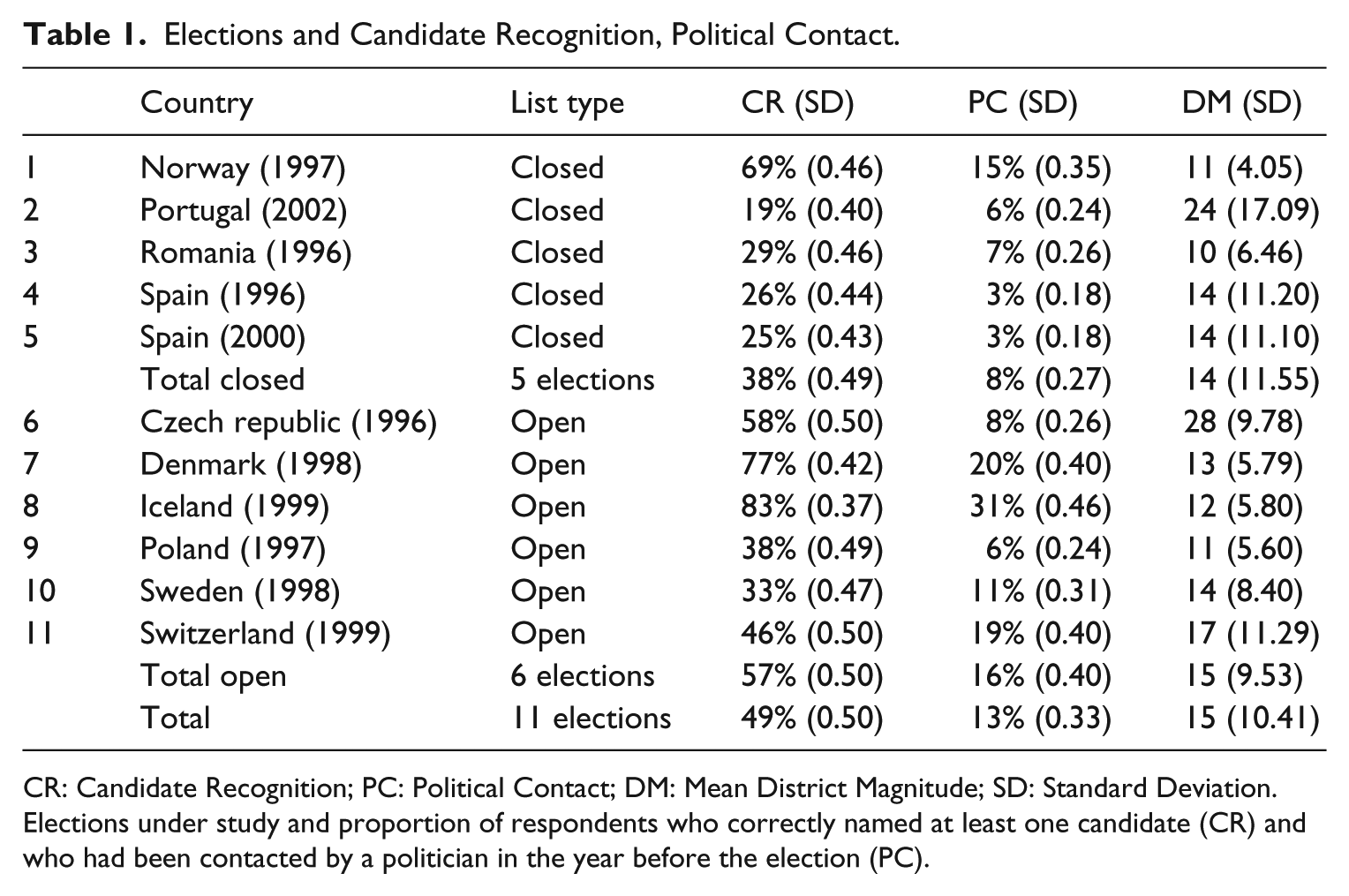
CR: Candidate Recognition; PC: Political Contact; DM: Mean District Magnitude; SD: Standard Deviation.
Elections under study and proportion of respondents who correctly named at least one candidate (CR) and who had been contacted by a politician in the year before the election (PC).
District magnitude varies across list type, but the mean and range of district magnitude are similar across both types of lists (see Table 2 in the Appendix 1). However, the district magnitude variable is not approximately normally distributed across both types of lists. The log transformation of district magnitude more closely approximates this ideal, and it has the advantage that a change in this variable can conveniently be interpreted as a proportional change in district magnitude. Especially when studying recognition, we expect that an increase of one on the scale of district magnitude for a constituency with, for example, two to three elected members is much more important than a change for a constituency with say 25 to 26 elected members. Therefore, I present the results for the natural logarithm of district magnitude, lnDM. 6 Control variables include a dummy variable urban which is 1 if a respondent reported to live in (suburbs of) a large town or city, and 0 if they reported to live in a small or middle-sized town or a rural area or village. Education and income are measured on a scale of 8-points and 5-points, respectively, and will be interacted with election dummies in the analysis, to account for potential different measurement procedures across countries. Time elapsed refers to the number of days between the election and the moment when the survey was taken. 7 The CSES also provides questions which assess the political interest or knowledge of individuals, as well as their partisan identification. In separate analyses, I control for political knowledge, party identification and political interest. 8
The relationship between district magnitude, list type and CR is modelled in the following manner.

where i refers to an individual respondent from district d and election e. The explanatory variables of interest are lnDM and open. 9 These variables can be considered to be pre-determined to the level of individual CR and unrelated to the individual control variables, included in equation (1) as a vector X. I also estimate equation (1) with election fixed effects. Finally, standard errors are clustered at the district level, and appropriate survey weights are applied. In short, this estimation strategy takes the survey structure of the data into account by introducing election fixed effects, weighting and calculating clustered standard errors at the district level. Alternatively, we could estimate district averages, or a multilevel random effects model (with random effects introduced at country and district level) to deal with the complex survey structure. The results from these robustness checks confirm the results discussed in this article and can be found in Tables 8 and 9 in the Appendix 1. In the next section, I will present and interpret the results.
Results
Politicians can be expected to seek to cultivate the personal vote in open list systems. As a result, voters should on average be more likely to remember a candidate in open than in closed list systems, which is confirmed by the higher intercept of the predicted probabilities of CR in open list systems in Figure 1 (correspondingly, the estimate of the dummy open is positive and significant as can be seen in Table 3 in the Appendix 1). However, as district magnitude rises, people become more likely to recognise a candidate in closed list systems only, the predicted probability of recognising a candidate name increases along with district magnitude (see Figure 1). The total effect of district magnitude is found to be slightly negative in open list systems (though not statistically significant). Doubling the district magnitude (or an increase by 172%) leads to no significant change in the odds of recognising a candidate in open list systems, but is associated with a predicted increase of 76% in the odds of recognising a candidate in closed list systems. 10 Therefore, there is a clear interaction effect between district magnitude and list type on CR (in support of H2a and H2b), along the lines predicted by Carey and Shugart (1995) if the underlying mechanism is intra-party competition influencing personal vote-seeking in campaigns and short-term information processing. In the next section, I will provide additional support to the idea that individual campaign messages are driving these differences in CR, rather than differences in long-term personal vote cultivation.
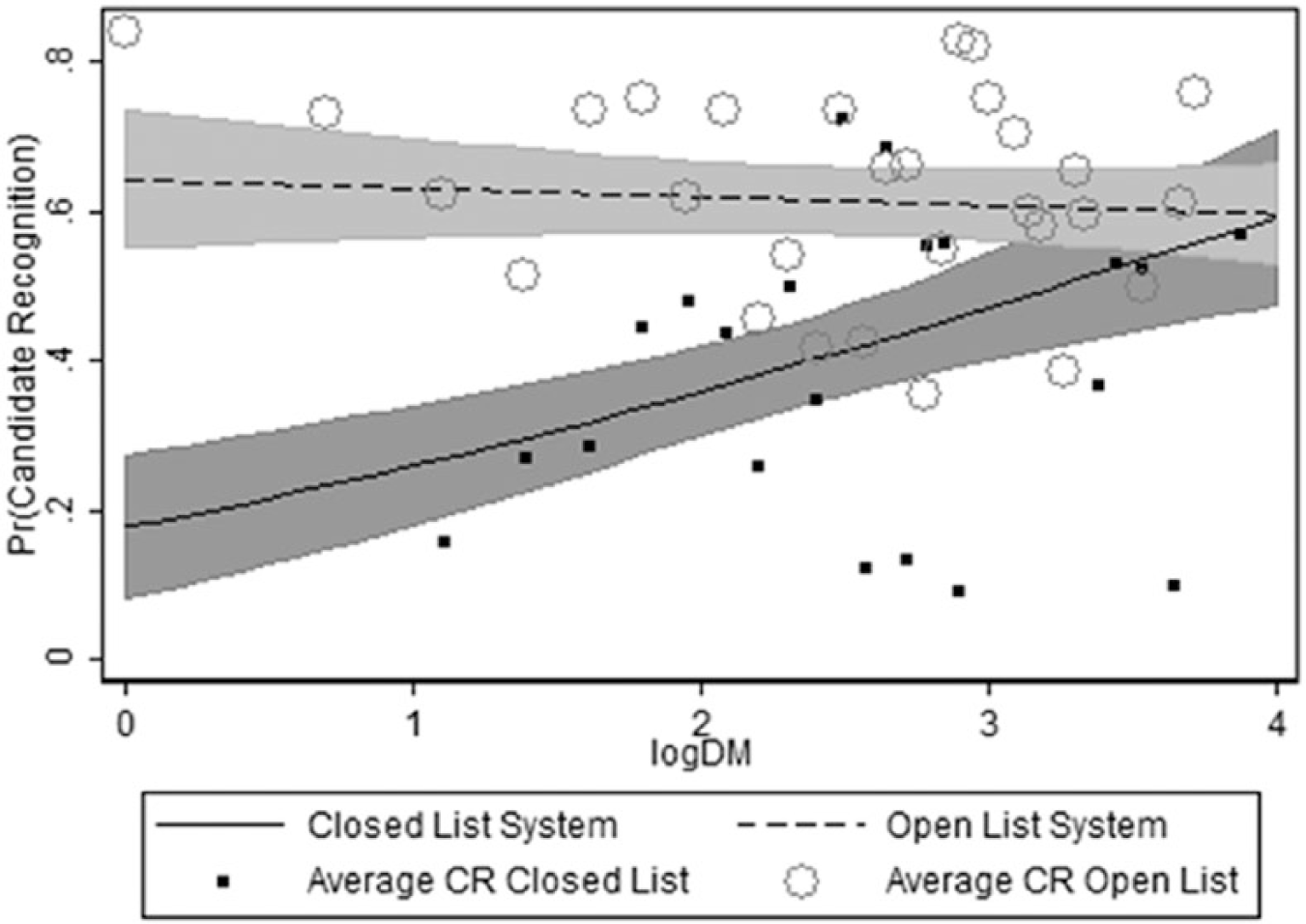
Fitted Probabilities of Individual Candidate Recognition for a Voter.
Interpretation
The interaction effect on CR becomes comprehensible if the explanatory mechanism is a differentially focused campaign. This interpretation is also in line with evidence about campaigning by Bowler and Farrell (2011). They find that there is no effect of list type or average district magnitude on the effort Members of the European Parliament (MEPs) put into campaigning. However, they do find a statistically significant difference between MEPs in terms of their perceived goal of the campaign: fewer of the MEPs elected through closed list systems reply that maximising their own personal votes is the purpose of their campaign as compared to MEPs elected in open list systems. The authors therefore suggest distinguishing between campaign efforts and campaign aims. To further support the idea that a differentially focused campaign drives the results on CR, I consider an alternative mechanism (long-term PC), analyse the differences between voters and non-voters, and conduct a district-level investigation of the names remembered.
Long-Term Contact
Instead of a differentially focused campaign, candidates could differentially invest in long-term personal vote cultivation or reputational effects. If long-term personal vote cultivation explains this relation with CR, we should find similar effects of the electoral system features on PC. Therefore, similar tests were conducted for the effect of district magnitude and list type on long-term personal vote cultivation presented in Figure 2 (corresponding to Table 5 in the Appendix 1). Open lists are associated with more PC overall. However, increasing the district magnitude is estimated to result in less PC across both list systems. This effect of lnDM does not differ significantly across list type. Long-term personal vote cultivation is therefore unlikely to explain the differential effect of district magnitude depending on list type on CR.
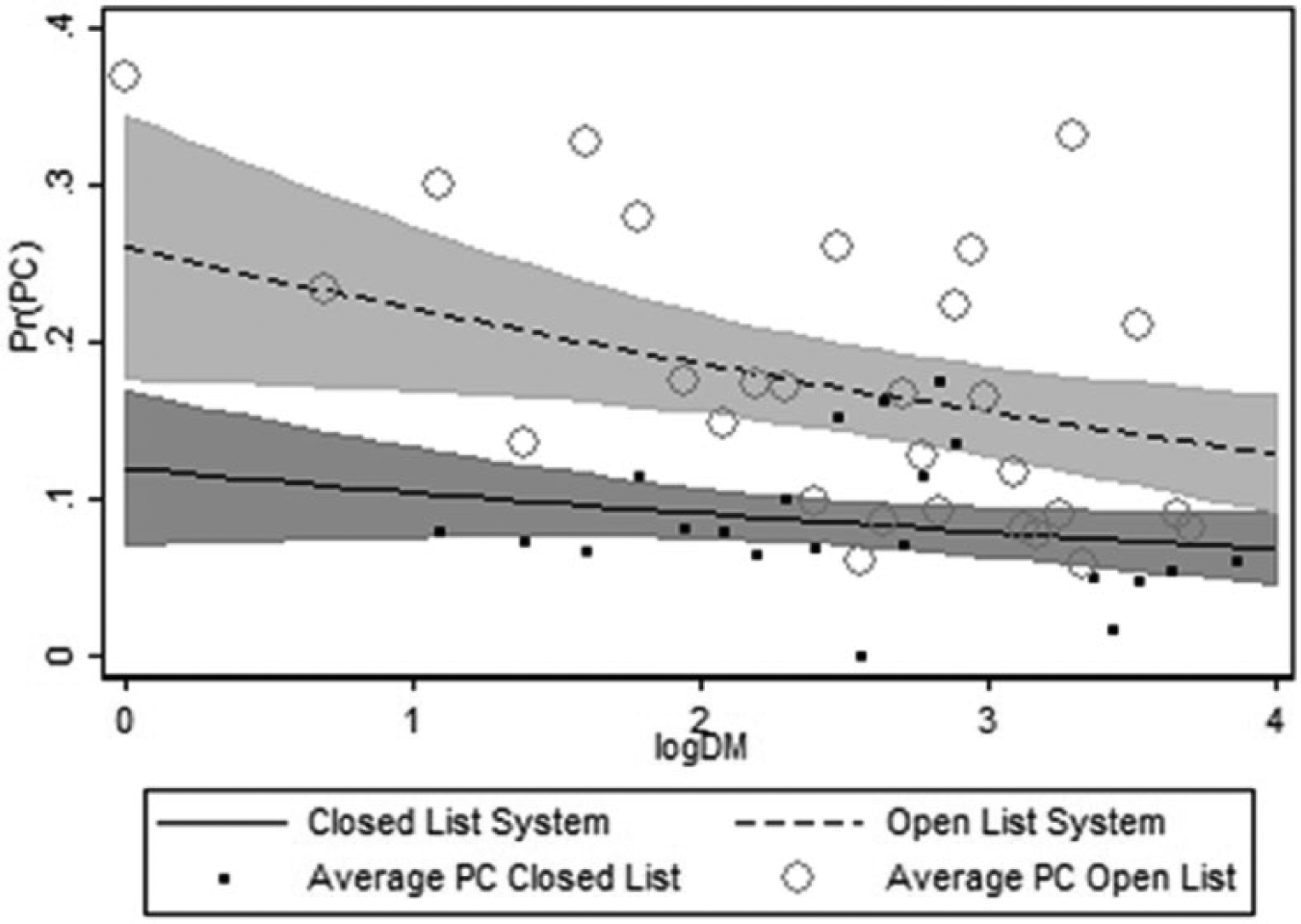
Fitted Probabilities of Individual Political Contact for a Voter.
The Act of Voting
In open list systems, we found no effect of increasing district magnitude and argued that this was due to voters becoming overwhelmed with candidate-specific information. An alternative explanation for why increasing district magnitude does not boost CR in open list system relies on the act of voting itself. Once a person has voted for an individual candidate, they should be able to remember that name, and CR can simply not be further boosted if there are more (famous) candidates running in larger districts. To address this concern, I conduct two additional analyses. Many studies of survey data concerned with vote choice disregard respondents who report not to have voted in the election. However, non-voters are of interest here, as they will have been subject to the same campaign messages, but they may have been less motivated to process the information consciously. The corresponding specifications allow district magnitude and list type to have a differential effect on CR for voters and non-voters, by adding interaction terms. Figure 3 provides a graphical representation of predicted probabilities from an estimation that allows for a differential effect of district magnitude and list type for voters and non-voters (the results from a regression including this three-way interaction can be found in Table 4 in the Appendix 1). CR clearly rises with district magnitude in closed list systems (left panel) but declines in open list systems (right panel). This is particularly clear in the case of non-voters (full lines). Overall, voters are more likely to recognise a candidate than non-voters, but the effect of increasing the district magnitude according to list type is attenuated for voters (dashed lines). Therefore, in both list type systems, the campaign or the supply of information affects passive recipients (non-voters) more than active ones (voters). Voting, or consciously processing information, seems to attenuate the biases encouraged by the electoral system. Non-voters, in contrast, seem to be overwhelmed with candidate-specific information and become less likely to recognise a candidate in open list systems only.
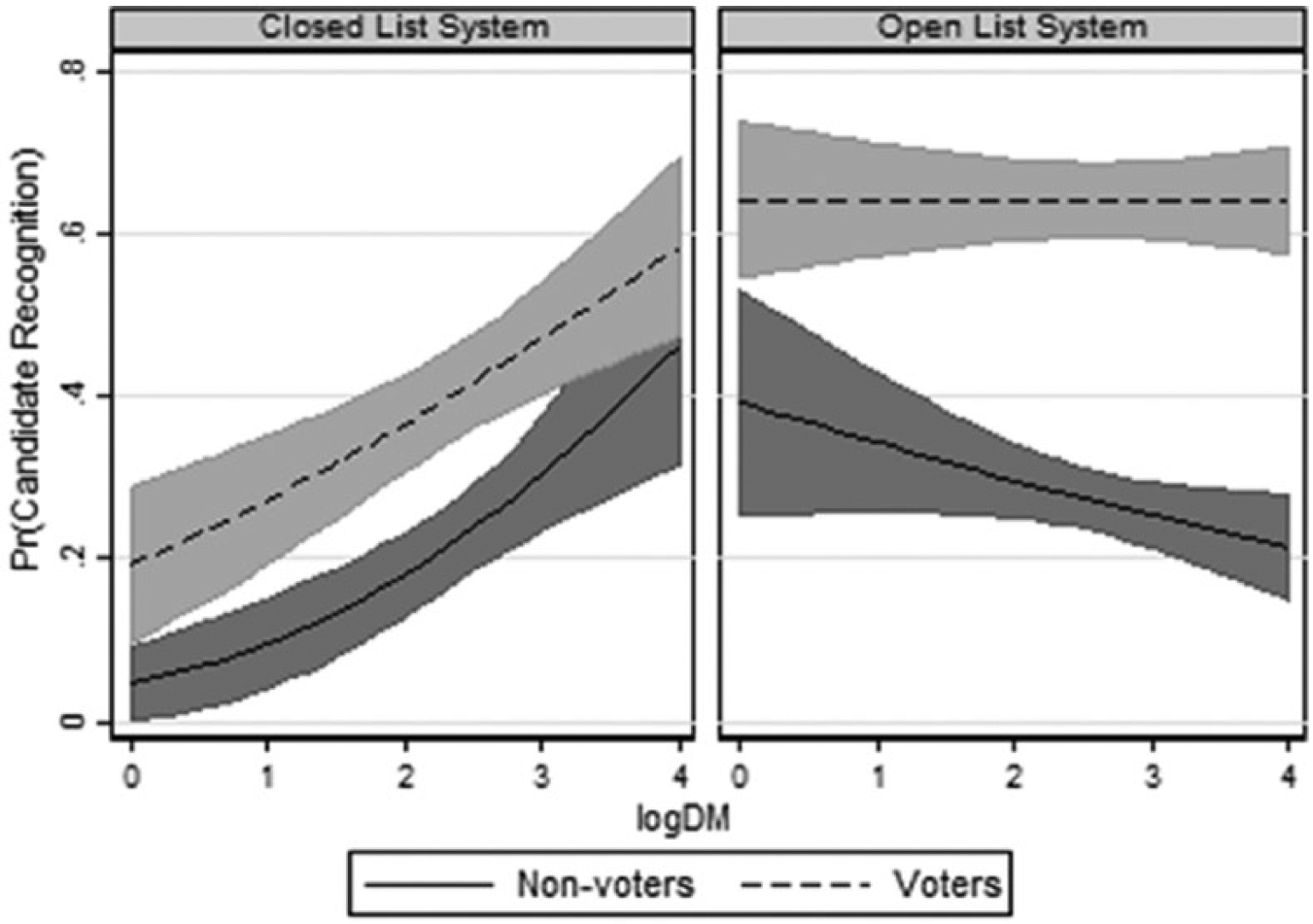
Fitted Probabilities of Individual Candidate Recognition by Voting.
Concentration of Names
Finally, I conduct one more analysis at the party-district level to gather additional support for the idea that a different campaign focus is the mechanism linking district magnitude and list type to CR. The CSES reports and codes up to three candidate names mentioned by the respondent. 11 Individuals for whom the correctly identified candidate name and their party were not reported are dropped from this particular analysis. For each party list from which candidates were mentioned, I calculate the following normalised Herfindahl concentration index to describe to what extent mostly the same names were mentioned in a district.

where
For example, among the open list systems, in the 1999 Iceland election and in the district of Reykjavik with a larger than average district magnitude of 19, the value of the concentration index for the Independence Party is 0.43 (a little less than its mean value). Here, one of the names mentioned was Davíð Oddsson, the leader of the Independence Party and incumbent prime minister. 12 Yet, even the name of the prime minister was far from dominant among those listed from the Independence Party in this large, open list district. In the 2002 Portuguese election in the district of Lisboa (district magnitude of 48), we find a concentration index of 0.86, almost entirely driven by José Manuel Barossa, leader of the Social Democratic Party, and previous minister.
Figure 4 (based on results from Table 6 in the Appendix 1) shows the results of a district-party level analysis of the concentration of names remembered. Respondents from districts of larger district magnitudes are less likely to mention the same names than respondents from smaller districts, in open list systems only. In contrast, in closed list systems, the estimated effect is positive which is significantly different from the effect for open list systems. In other words, while increasing the district magnitude leads to no less concentration in names mentioned in closed list systems, it does lead to less concentration in open list systems. Again, this supports the idea that campaigns are more focused in closed list systems and overwhelm voters with candidate-specific information in open list systems. Therefore, I argue that this article’s positive effect of district magnitude on CR in closed list systems only, is consistent with a more focused campaign in closed list systems. In contrast, the absence of an increase in overall CR with district magnitude in open list systems, together with a larger variety of names mentioned in larger districts, points to a more competitive campaign in these districts as candidates emphasise personal information. Moreover, voting was found to attenuate the differential effect of district magnitude. The effect in open list systems is unlikely to be solely a mechanical consequence of the fact that voters who extended a preference vote are more likely to remember a candidate name. In open list systems, district magnitude was found to have a statistically significantly negative effect for non-voters.
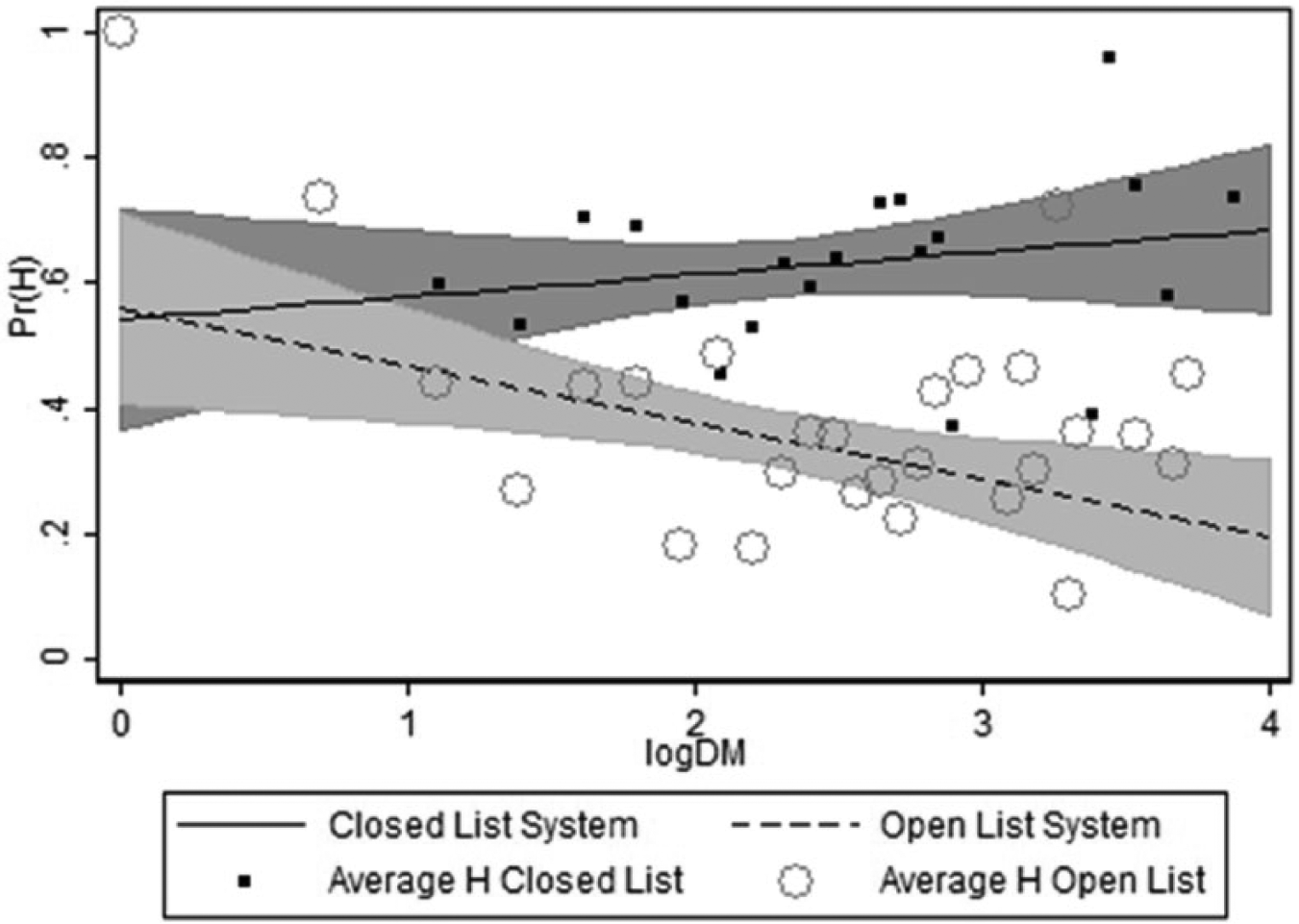
Fitted Probabilities of the H Name Concentration Index.
Alternative Interpretations: A Ceiling to the Effect in Open List Systems?
One potential concern with this interpretation of the results is related to the dichotomous coding of the CR variable. Perhaps everyone who might potentially remember a name in open list systems already does. Therefore, CR can simply not be further boosted by campaign differentials across districts. If there are such ceiling effects, employing a continuous measure instead should still show a positive effect of district magnitude on (continuous) name recognition even in open list systems. The CSES does not provide a continuous measure, but some additional results help assuage ceiling concerns. Table 1 shows that average CR in open list systems is only 57%. Figure 1 which depicts predicted probabilities for a respondent who voted also does not offer strong support for this alternative interpretation. While the estimated probability of recognising a candidate is much higher in open list systems than in closed list systems, the predictions remain stable around 60% regardless of district magnitude. Moreover, lacking a continuous measure, we can nevertheless consider the original coding of the variable in three categories (i.e. whether a respondent remembered zero, one, or two or more names correctly). We then observe that the proportions in each answer category for respondents who have voted and therefore are the most likely to remember names in open list (closed list) systems are 35% (57%) for no correct names, 20% (17%) for one correct name and 45% (26%) for two or more correct names. Therefore, it is not the case that the proportion remembering at least one candidate is already so high in the open list systems that increasing district magnitude cannot further boost the recognition. Finally, I confirm that CR does not increase with district magnitude in open list systems in a multinomial logistic regression: Respondents are not more likely to recognise two or more rather than one name correctly in open list systems as district magnitude increases (Figure 5 and Table 7 in the Appendix 1).
Conclusion
Employing survey data from the first wave of the CSES, I found that district magnitude affects CR according to the list type of the electoral system. This result is in line with predictions from the personal vote literature (Carey and Shugart, 1995) if CR is driven by heuristics and short-term information processing (Shugart et al., 2005), in response to increased intra-party competition and a differentially focused campaign (Bowler and Farrell, 2011). As the district magnitude increases, more people remember at least one candidate’s name in closed list systems. This positive effect is consistent with the idea that in larger districts with more candidates up for election, the party campaign can be more focused on a few (famous) candidates in the top ranks of the list. However, no effect of district magnitude on CR was found in open list systems. This latter result is consistent with more candidate-specific information provided in open list systems as the district magnitude and the number of candidates promoting their individual campaign messages increases.
Additional results for the variety of names remembered by the respondents also further supported this interpretation. No evidence was found for similar effects on PC, a measure of long-term effort. Moreover, voting was found to attenuate the influences of district magnitude and list type.
These results reconfirm the relevance of electoral systems for voting behaviour. As a result of the intra-party competition created by electoral rules, citizens of different countries have been confronted with different campaigns and responded differently to these personal vote-seeking attempts. Hence, district magnitude affects what people remember about who runs to be their representative, and therefore arguably also whether and how they can hold them to account.
This article tied the personal vote-seeking attempts of politicians more closely to the personal voting response, by analysing information processing. Knowing that electoral systems not only affect outcomes by incentivising politicians but also affect how voters process campaign information is very important to assess accountability under different electoral systems. For example, John M Carey and Simon Hix (2011) argued that middle-sized districts provide an ideal trade-off between disproportionality and accountability; this article highlights how list type still changes how two citizens of similar, ideally sized districts process information about candidates differently under different electoral systems. In general, this article therefore further underlines the importance of studying interaction effects of district magnitude with other electoral system features.
Footnotes
Appendix 1
Funding
The author(s) received no financial support for the research, authorship, and/or publication of this article.