




Abstract
Little research has focused on how legislative candidates’ personal electoral support develops over time and why. This study examines the vote trajectories of individual candidates and how they vary according to candidates’ personal vote-earning attributes. Longitudinal data on over 1700 candidates who between 1999 and 2019 participated in two or more parliamentary elections in the Finnish open-list proportional representation system are analysed. The findings show that the average legislative candidate’s personal support increases more rapidly in the beginning of his or her electoral career and then slows down gradually over time. However, there is large heterogeneity in vote trajectories depending on candidates’ socio-demographic characteristics and personal vote-earning attributes. Some candidates enjoy instant success (local councillors and celebrity candidates), while others do not win more votes initially but manage to build loyal personal followings in their district and receive positive returns from repeated candidacy (young, women, and locally rooted candidates).
Introduction
This study focuses on how returning legislative candidates’ personal electoral support develops over time under open-list proportional representation with intense intraparty competition between candidates. To understand who is able to both launch and sustain a successful electoral career—which by extension determines descriptive representation or the composition of the legislature—we should study the development of personal support for candidates over a series of elections. While there has been an expanding scholarly interest in intraparty competition and how individual characteristics impact vote earning, most of these studies have applied a cross-sectional approach (e.g., Put and Maddens, 2015; Shugart et al., 2005; Von Schoultz and Papageorgiou, 2021). There are few longitudinal studies on variations in the size of the personal vote, and those tend to focus on MPs (Coates, 1995; Norris and Lovenduski, 1995; Norton and Wood, 1990). Therefore, we know little about the trends in personal vote earnings over time and the extent to which the vote trajectories of legislative candidates vary systematically across types of candidates. By longitudinally analysing the correlates of candidate success, we aim to provide a deeper understanding of the personal vote (Cain et al., 1987), here operationalised as the share of intraparty preference votes for individual candidates under open-list PR. This study is also relevant for the rapidly expanding literature on competition within parties, by delineating how the competitiveness of different types of candidates develops over time.
This contribution focuses on the electoral stage of intraparty competition and lies in the intersection of how politicians and voters act. As highlighted in the symposium’s introduction, candidates campaign for personal votes and voters discriminate between candidates based on the their socio-demographic characteristics and personal vote-earning attributes. In terms of specific contributions, our study first adds to the literature by longitudinally examining the shape and magnitude of the average vote trajectory among returning candidates in multi-member districts. As candidates gain campaign experience from contesting elections (Eder et al., 2015), and they cultivate a personal relation with groups of voters (Giebler and Weßels, 2017), we expect increasing returns of repeated candidacy. The marginal returns of such experience can, however, be expected to decrease over time (Put et al., 2021) and even start to wear off as new competitors enter the competition and start building electoral capital. In addition, our study offers novel insights into which candidate characteristics matter for developing successful electoral (and thus legislative) careers in both the short and long term. We test various sociodemographic traits and personal vote-earning attributes (PVEAs) (see Nemoto and Shugart, 2013; Tavits, 2010). We focus on certain candidate characteristics: age, gender, local birthplace, representative experience at the local level, and celebrity status.
The longitudinal data set consists of observations of over 1700 candidates who participated in two or more Finnish parliamentary elections between 1999 and 2019. Finland has a highly candidate-centred electoral system: it is mandatory for voters to cast a single preference vote for an individual candidate, and the number of preference votes determines which candidates from the party list gain a seat. Competition for seats within parties is as fierce as competition for seats between parties (Karvonen, 2014). Therefore, legislative candidates have strong incentives to build personal reputations in their electoral districts to advance their electoral careers. The results reveal that the average legislative candidate’s personal support increases more rapidly in the beginning of their electoral career, but then plateaus. Further, there is systematic variation in vote trajectories across different types of candidates. Young, women, and locally rooted candidates are better able to build loyal personal followings in their district and receive positive returns from repeated candidacy, while celebrity candidates enjoy instant success but are not as able to expand their support over the long term. These results, although based on a single country study, are likely to apply to other proportional representation systems that feature preference voting for individual candidates (flexible-list or open-list PR).
Vote trajectories under open-list proportional representation
The positive effect of repeated candidacy
Building a political career takes time. Most European countries have proportional electoral systems with closed (CLPR) or flexible (FLPR) lists, where the development of a particular candidate’s political career lies in the hands of the party. In proportional electoral systems with open lists (OLPR), the role of the party is limited to that of a gatekeeper in the nomination phase (Gallagher and Marsh, 1988; Norris and Lovenduski, 1995). The power to determine the fate of candidates lies in the hands of the voters since the number of preference votes decides which candidates are elected and who develops a successful political career in the long run (Carey and Shugart, 1995).
In electoral systems where candidates compete with co-partisans for preference votes, the literature informs us that candidates need to cultivate a personal vote in order to be successful (Carey and Shugart, 1995). Cain et al. (1987) established the concept of the personal vote, which refers to the portion of the vote derived from a politician’s personal characteristics, experience, or activities. The personal vote is expected to develop over time as the candidate establishes a record of accomplishment (e.g., achievements in local politics) and becomes more well-known thorough campaigning activities. This should lead to positive returns from repeated candidacy; that is, candidates who run in a series of elections expand their electoral support.
Previous research on the topic of accumulation of personal votes over time is relatively modest in scope and focuses almost exclusively on incumbent politicians in single-member district systems. Norris and Lovenduski (1995) found that electoral support for incumbents did not increase in a linear fashion according to their accumulated years in the British House of Commons. Coates (1995) detected a curvilinear relationship between tenure and total vote share in US congressional elections. Instead of rising monotonically over time, the growth in total vote share eventually stagnated. Studies of the incumbency advantage in single-member districts demonstrate that there is a sharp increase in a candidate’s vote share in their first election as an incumbent. After this “sophomore surge”, incumbents are unlikely to see additional substantial increases in electoral support as tenure increases (Holbrook and Tidmarch, 1991; Lockerbie, 1994). Studies on vote winning for MPs indicate a positive vote trajectory, but one where the marginal return of repeated candidacy decreases over time. But can we expect a similar a development in vote-earning for the average returning legislative candidate? We believe that we can.
The mechanism behind the expectation of a positive return from repeated candidacy is two-fold. The first part has to do with gained campaigning experience from previous races. Relative to their co-partisans, returning legislative candidates should increase their personal support over time as they amass political experience and public visibility. Such experiences are likely to be valued by the party that is in control of nominations (Put et al., 2021), and it is likely to benefit the individual candidate when planning and executing the actual campaign (Haime et al., 2022). Experience from previous races might also imply that a campaign team is already in place and ready to be activated (Eder et al., 2015). Secondly, repeated candidacy should be beneficial because of the development of personal relationships between candidates and voters. A returning candidate has had a longer time to cultivate a personal reputation and a distinctiveness, which allows them to appeal to specific subgroups of followers (Shugart et al., 2005), for example, by being elected at the local level or acting as a party representative in another context.
For the average legislative candidate, however, the returns from repeated candidacy come at a diminishing rate, and finally vanish. After a certain number of elections, candidates can be expected to have reached their full potential. By then, they are well-known to most voters, and new challenger candidates are likely to have appeared. Also, the promise that voters see in a candidate is expected to wear off after a number of elections, particularly if a candidate fails to get elected. This expectation is supported by a recent study on candidate experience and list positions in Belgium, demonstrating that experience tends to lead to better list positions, but only up until a certain point if candidates are unable to get elected (Put et al., 2021). A curvilinear trajectory also resonates with Fenno’s (1978) two phases in a congressional career: an expansionist stage and a protectionist stage. First, during the early—or expansionist—stage, politicians seek to establish a broader electoral support base in the district to secure (re)election goals. This stage includes time before ever getting elected to office as well as the early terms in office. To connect with constituents and build trust, incumbents may spend time in their districts communicating and responding to local concerns, delivering constituency services, and providing pork-barrel spending. Second, during the protectionist phase (after the two initial terms), incumbents become more concerned about maintaining the core of strong support that they have already attained rather than cultivating support from additional groups within the district. Hence, as members of parliament evolve from an expansionist to a protectionist career stage, their vote trajectories should start to flatten out.
Furthermore, the decision of experienced candidates to run (again) tends to be strategic (Carson and Roberts, 2005). They consider the current level of competition and other conditions that might impact their possibilities, and then evaluate their chances of success in a particular election. If the prospects are negative, it is likely that a senior candidate will opt for exit rather than facing failure. Alternatively, they might fail to get nominated if party selectorates no longer view them as an asset when considering the overall composition of the party list. Based on the discussion above, our first hypothesis is:
The vote trajectory for returning candidates is positive, but the marginal return of repeated candidacy is larger early in a candidate’s electoral career.
Variations in vote trajectories between candidates
Previous research shows that sociodemographic characteristics and so-called personal vote-earning attributes (PVEA) are relevant for the electoral prospects of legislative candidates under high levels of intraparty competition. PVEAs are easily available information (e.g., political experience, name recognition, and local ties) and function as decision-making cues for voters (Lau and Redlawsk, 2006), especially if they are confronted with a large selection of candidates (Tavits, 2010). In this study, we expect that sociodemographic characteristics and personal vote-earning attributes influence not only the vote shares of legislative candidates, but also the returns they could expect from repeated candidacy and, hence, how their electoral support would develop over time. We focus on five distinct candidate characteristics, of which three are typical vote-earning attributes, namely local birthplace, political experience at the local level, and celebrity status. The other two are the sociodemographic characteristics age and gender, generally considered particularly valuable in list systems since they can be used for balancing the list and reaching out to different groups of voters (Valdini, 2012). 1
Age
Age is a significant factor in vote-earning, and previous research leads us to believe that the time at which candidates make their debut as a candidate can influence the development of their vote trajectory. First, we note that voters appear to prefer middle aged candidates (Bengtsson, 2016; Horiuchi et al., 2020). A candidate who runs for office at a young age has the potential to become more popular as they age (and gain experience), while older debuting candidates are less likely to benefit from a corresponding age boost. Also, those entering politics at an older age are likely to have established themselves in society, which makes them more likely to peak early in terms of electoral support. Such a pattern might also be reinforced by the political ambitions of candidates. Research on political careers of MPs has found that the time of entry affects how career oriented politicians are. Those elected in their 30s or early 40s tend to be the most committed to politics as a profession (King 1981), while those who enter parliament at older ages are less oriented towards a political career (Narud, 2011; Binderkrantz et al., 2020). This leads us to our second hypothesis:
The return of repeated candidacy is higher for legislative candidates who launch their careers early in life than for those who make their debut at an older age.
Gender
Research has demonstrated that women and men candidates compete on different terms in politics due to gender stereotypes (Dolan, 2014), that women candidates tend to be outnumbered by men candidates (Lawless and Fox, 2005), and that women are underrepresented in parliament in most countries around the world (Schwindt-Bayer, 2005). Voters do not, however, necessarily discriminate against women candidates. There is even evidence pointing towards a slight electoral advantage for women over men candidates when accounting for influential personal vote-earning attributes unrelated to gender (Black and Erickson, 2003; Schwarz and Coppock, 2022). Instead, the underrepresentation of women in politics appears to be due to a higher threshold for women to be nominated by parties who act as gatekeepers (McElroy and Marsh, 2010; Norris and Lovenduski, 1995) and due to women being more election averse than men (Kanthak and Woon, 2015). Women also tend to shy away from competitive situations, which might make them more likely to retire when facing a challenging contest further on in their political career (Niederle and Vesterlund, 2007). The tendency for women to evaluate their chances of success more carefully indicate that women candidates are, on average more ambitious and have a larger electoral growth potential, which leads us to our third hypothesis:
The return of repeated candidacy is higher for women legislative candidates than for men legislative candidates.
Local ties
Being born in a particular locality or serving on a local council has repeatedly been found to be valuable for legislative candidates (Nemoto and Shugart, 2013; Shugart et al., 2005; Tavits, 2010). Candidates receive more votes in, or near, their hometowns (Fiva and Smith, 2017). There are many possible explanations for why local candidates enjoy an electoral advantage. Local voters may vote for a local candidate because they know them personally or share the same personal networks or because it is easier to gather information about local candidates who get coverage in local media and who mainly campaign on their home turf (Van Erkel, 2019). Most importantly, local ties are considered a proxy for “knowing the area and its interest” (Shugart et al., 2005), the expectation being that local candidates will act on these interests (Campbell et al., 2019). Having served in local elective office should, in particular, contribute to greater name recognition (Put and Maddens, 2015) and signal familiarity with local issues and problems (Tavits, 2010). Local ties give candidates instant name recognition at the local level, which can contribute to early success and provide a platform from which, over time, the candidate can expand their support throughout the district. This leads us to the following expectation:
The return of repeated candidacy is higher for legislative candidates with local ties than for the average legislative candidate.
Celebrity
In personalised electoral systems, national celebrity status enjoyed by, for example, movie stars, athletes, or highly visible journalists can translate into valuable political capital (Carey and Shugart, 1995). Celebrity status entails name recognition that expands beyond traditional political circles, which tends to make such candidates highly sought after by parties aiming at attracting non-partisan voters to their party list (Arter, 2014). The virtues of a celebrity candidate primarily lie in the media attention they are likely to attract, and the potential new votes that can be added to the vote total of the party, but also in the fact that such candidates can profile themselves as “political outsiders”, untainted by previous political compromises or “games” (Marsh et al., 2010). Celebrities’ name recognition and appeal tend to bring them electoral success right from the beginning. This has been confirmed in empirical studies in the US (Canon, 1990; Knecht and Rosentrater, 2021) as well as in proportional electoral systems with open lists (Arter, 2014). While celebrity candidates, as other legislative candidates, gain campaigning experience, it is less likely that campaigning helps them cultivate a stronger personal relationship with voters, compared to where they started off. Due to the generally higher baseline support level for celebrity candidates, and that their reputation earned outside of politics tends to fade over their time spent in politics, we expect the vote trajectory for celebrity candidates to deviate from the general pattern.
The return of repeated candidacy is weaker for celebrity candidates than for the average candidate.
Setting the context: the case of Finland
Our study is situated in the Finnish open-list proportional electoral system (OLPR). The 200 seats in the Finnish Parliament (Eduskunta in Finnish) are distributed within districts using the D’Hondt highest average method, and there is no fixed electoral threshold. During the period 1999–2019, the number of districts on the mainland 2 varied between 12 and 14, with a district magnitude (M) ranging from 6 to 36. The distribution of seats over electoral districts is proportional to the number of Finnish citizens residing in each district 6 months before the election. Nomination procedures are regulated by law and decentralised (Karvonen, 2014). Parties are allowed to nominate a maximum of 14 candidates or, if M exceeds 14, as many as the number of representatives to be elected. Parties are incentivised to field full lists since each individual vote adds to the party total, and the distribution of votes within the party list has no impact on seat distribution. In the largest constituency, Uusimaa, the total number of candidates in the 2019 election amounted to 492. The large number of candidates and the individualised style of campaigning makes the system relatively demanding for voters to navigate. It provides a competitive advantage for well-known candidates, incumbents, and candidates with a strong local base (Arter, 2014; Karvonen, 2010).
The Finnish OLPR electoral system is suitable for studying the development of personal vote for individual candidates due to its relative straight forwardness—the “pureness” of the system. Most parties present their candidates in alphabetical order, leaving voters without guidance or indicative shortcuts from parties regarding their preferences. Thus, most parties are not able to guarantee election of any individual candidate at the district level. Each voter has a single preference vote. While that vote is cast for a specific candidate, it also counts as a list vote. Within each district, candidate votes are pooled at the party level and seats are allocated proportionally. Candidates on each party list are ranked according to the total number of votes they receive. They are elected to parliament as a function of both their position on the party list and the number of seats their party is entitled to. These features make the Finnish OLPR electoral system highly competitive on the intra-party dimension (Carey and Shugart, 1995) and very personalised. The high level of personalisation does not, however, imply that parties are irrelevant in Finnish politics. Despite increasing levels of voter volatility and fluctuations in party support, parties are strong and cohesive actors (Karvonen, 2014). 3
Data, variables, and method
Data
We use data from six Finnish parliamentary elections (1999–2019). The population consists of 8902 unique candidates and 12,955 candidate-election observations. The estimation sample is much smaller: panel data preparation tends to reduce the number of cases because only those persons who can potentially experience a treatment, or change in condition, are included (see Brüderl and Volker, 2015). We have a set of criteria for inclusion. First, the candidate had to have run in at least two consecutive elections. Second, the first two elections the candidate participated in had to have been consecutive elections. Later breaks between elections are allowed as long as the break is no more than one election at a time. Third, the candidate had to have participated for the first time in parliamentary elections in 1999 or later because the truly first election in a sequence of consecutive elections is needed as a baseline. Each candidate is assigned a unique identification number and forms a separate panel. The observations of each candidate are ordered chronologically, from first to last in the sequence of elections. A total of 1772 candidates and 4398 candidate-election observations are included in the estimation sample. 63% of the candidates participated in two consecutive elections, 21% in three elections, 11% in four elections, and the remaining 5% in five or six elections (see the online appendix, Table OA1).
Variables
The dependent variable used is intraparty preference vote, which is each candidate’s share of preference votes within their party list. This is an ideal measure of a candidate’s personal support because each voter cast a single preference vote. Since the dependent variable measures the number of votes relative to co-partisans, it is not affected by partisan tides and national circumstances. The dependent variable is highly skewed to the left and is therefore log-transformed using the natural logarithm to achieve a normal distribution. Descriptive statistics of the dependent variable, and the independent variables, are presented in the online appendix, Table OA2.
Time indicates the election sequence that counts each successive election from a candidate’s first election. The count variable is scored 1 for each candidate’s first election, 2 for the second election, 3 for the third election, and so on. If a candidate took a break in running for office, the metric continues to climb as if he or she had participated in that election. Finnish parliamentary elections were held every fourth year between 1999 and 2019. The coefficient for time represents the common rate of change for the whole sample of candidates.
Two sociodemographic traits and three personal vote-earning attributes are included as covariates. Woman is coded 1 for women candidates and 0 for men candidates. Age is modelled as a time-invariant covariate (i.e., age at baseline or time 1) because the increase in the age of a candidate across elections is perfectly correlated with the time variable. The variable measures how candidates differed in age when they participated in their first election. It is converted to a categorical variable by dividing the variable into three age groups: 18–34, 35–49 and 50–79. Local birthplace is coded 1 for candidates who were born in their current home municipality, 0 otherwise. Local councillor is coded 1 for candidates who were elected councillor in the previous municipal election and still lived in the same municipality as when elected, 0 otherwise. Celebrity is coded 1 for celebrity candidates known from media, music, sports, or a similar outlet, 0 otherwise.
Given that the local birthplace and local councillor variables are time-varying, we account for possible changes from the second elections and onwards. Moved (from local birthplace) is coded 1 if there is a change in the initial value (from 1 to 0) for local birthplace, 0 otherwise. Since no candidate moved to the municipality where they were born later in their electoral career, no dummy variable is needed. Ex local councillor is coded 1 if there is a change in the initial level of local councillor (from 1 to 0), 0 otherwise. New local councillor is coded 1 if the change was in the opposite direction (from 0 to 1), 0 otherwise.
Finally, we have a number of control variables. Number of candidates (log-transformed) is included to control for the simple fact that candidates on lists with fewer candidates win on average a larger share of the preference votes compared to candidates on lists with many candidates. Incumbent (i.e., elected in the previous election) controls for the electoral advantage typically enjoyed by current office-holders. Incumbent’s time measures the number of elections in a sequence of elections once first elected to office. This second time variable is meant to check for a possible discontinuity in slope (i.e., a greater rate of change in preference votes) once candidates had been elected to office. The variable is scored 0 for non-incumbents and 1 when first-term incumbents ran for their first re-election. Its values continue to climb (2, 3, 4, and 5) for subsequent elections. Four dichotomous control variables account for likely drops in preference vote shares: if the candidate took a one-election break (post-break), if they joined an electoral alliance between two or more parties (electoral alliance), if they switched to another party (party shift), or if they ran in a different electoral district than previously (district change). Ballot position and ballot position squared are included because candidates whose names are located towards the top (or the bottom) of the ballot paper tend to have a distinct advantage over their co-partisan rivals. Municipality size accounts for “growth potential”; candidates who live in larger municipalities are in a better position to expand their personal support.
Statistical model
The growth-curve models are fit using multilevel mixed-effects linear regression. Longitudinal data can be viewed as clustered data because multiple observations over time are nested within observational units (Rabe Hesketh and Skrondal, 2012). Repeated measures of preference votes in two or more elections (level-1 units) are nested in individual candidates (level-2 units). Mixed models can handle unbalanced datasets (Singer and Willett, 2003: 12), and therefore it is of no concern that the candidates participated in a different number of elections. A series of random intercept and random slope models are run. Time is not only included as a fixed effect, but also as a random slope, which allows each candidate to have their own slopes for the two-time variables (Hoffman, 2015).
Due to relatively few time points per candidate, we fit linear models with stricter assumptions to generate more reliable statistical models (Singer and Willett, 2003). Many longitudinal studies actually fit linear models to log-transformed variables. If a trajectory displays curvature on the original scale, it will be a straight line on the log-transformed time scale. As Gueorguivea (2018: 64) points out, “Log-transforming time and then fitting a linear model may appear unnatural but it does in fact describe reality reasonably well in many longitudinal studies…where there might be an initial fast change in outcome and then slowing down as response/remission status is reached or further improvement is not likely/possible”. In addition to modelling the general growth trajectory, we examine group-specific growth trajectories, or mean trajectories for different clusters of candidates. The time variable is interacted with our independent variables of interest to allow different types of candidates to have different time slopes (see Hoffman, 2015). We interact time with the time-invariant initial value of each independent variable. This so-called “baseline” occasion is the candidate’s first election. These models allow us to assess how many personal votes candidates with certain starting values won in their first election and then see how their vote trajectories developed. Our time-varying variables account for deviations from the baseline (see Hoffman, 2015; Singer and Willett, 2003). 4
Results
Longitudinal models of candidate support.
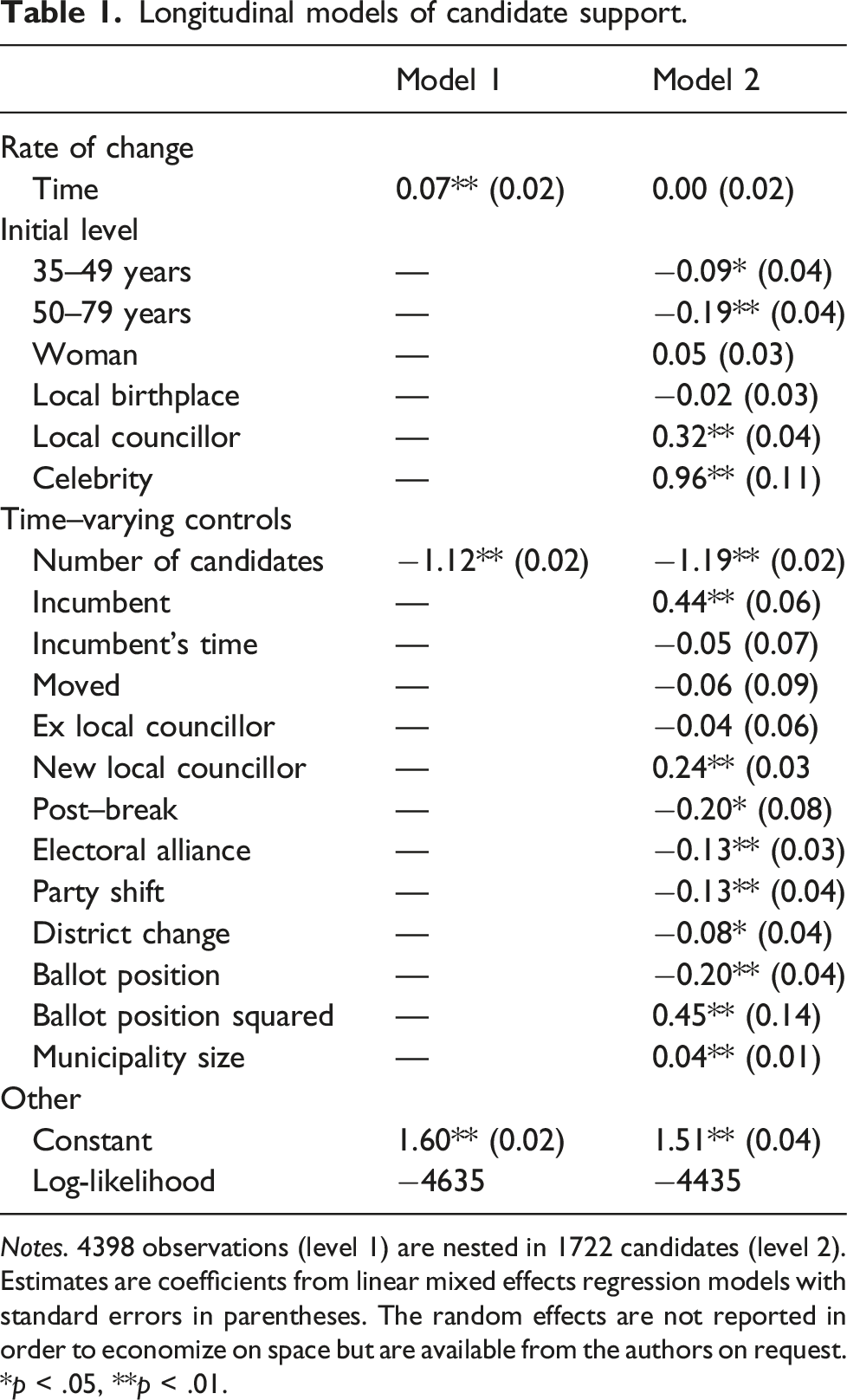
Notes. 4398 observations (level 1) are nested in 1722 candidates (level 2). Estimates are coefficients from linear mixed effects regression models with standard errors in parentheses. The random effects are not reported in order to economize on space but are available from the authors on request.
*p < .05, **p < .01.
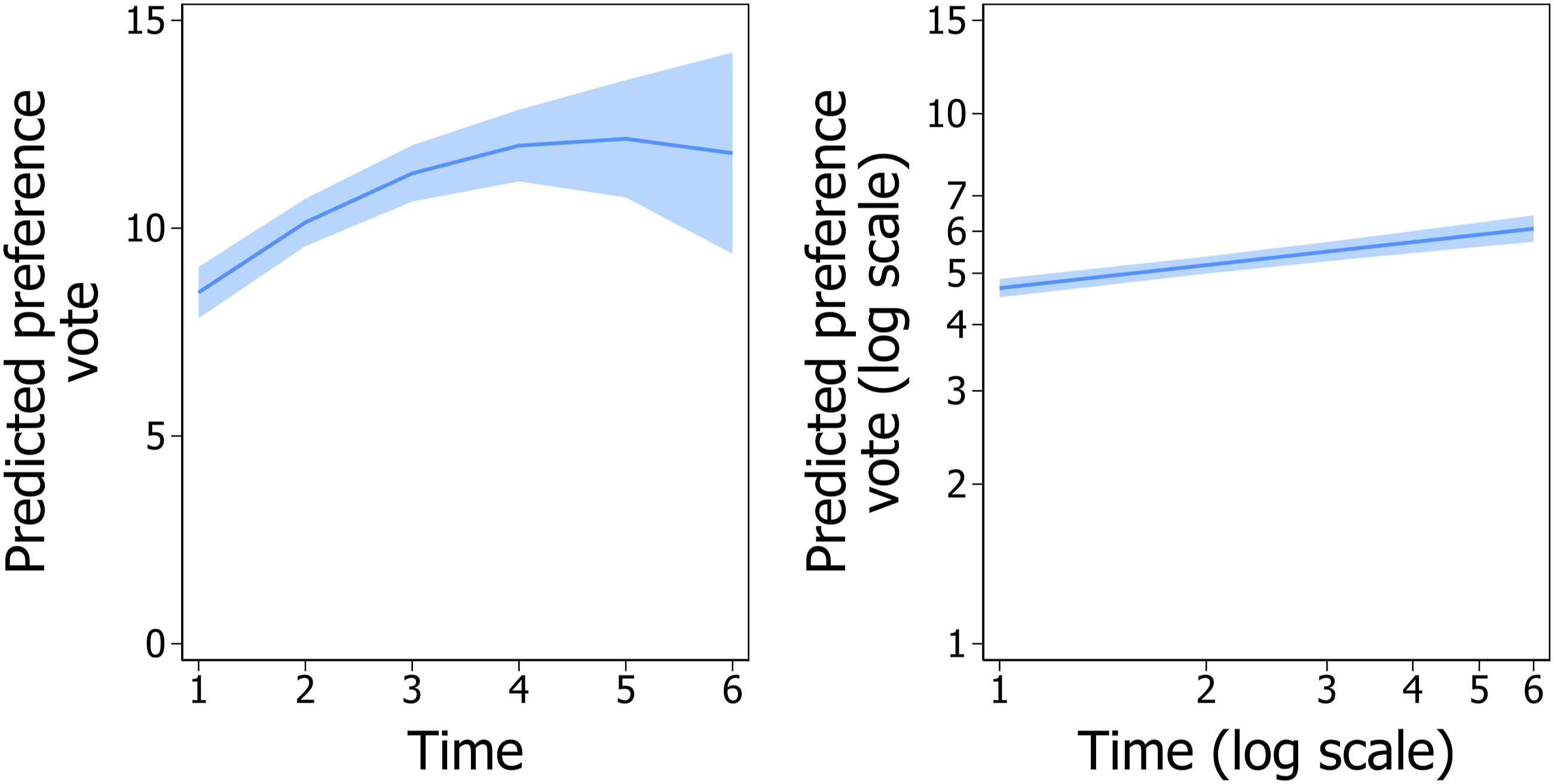
Average predictive margins (with 95% CIs) with untransformed and log-transformed variables. In the left panel, the coefficient on time is 1.94 (p < 0.01) and on time squared -0.25 (p < .01). In the right panel, the coefficient on time (log scale) is 0.07 (p < .01).
Model 2 adds the independent variables—the starting values for age, gender, local birthplace, local councillor, and celebrity status—and the time-varying control variables. All observed effects are logical and largely corroborate previous research. The model fit is significantly better judging from the decrease in the log likelihood statistics. The coefficient for time is zero, which suggests that there was no average growth in preference votes once all independent and control variables were included.
Interaction models.
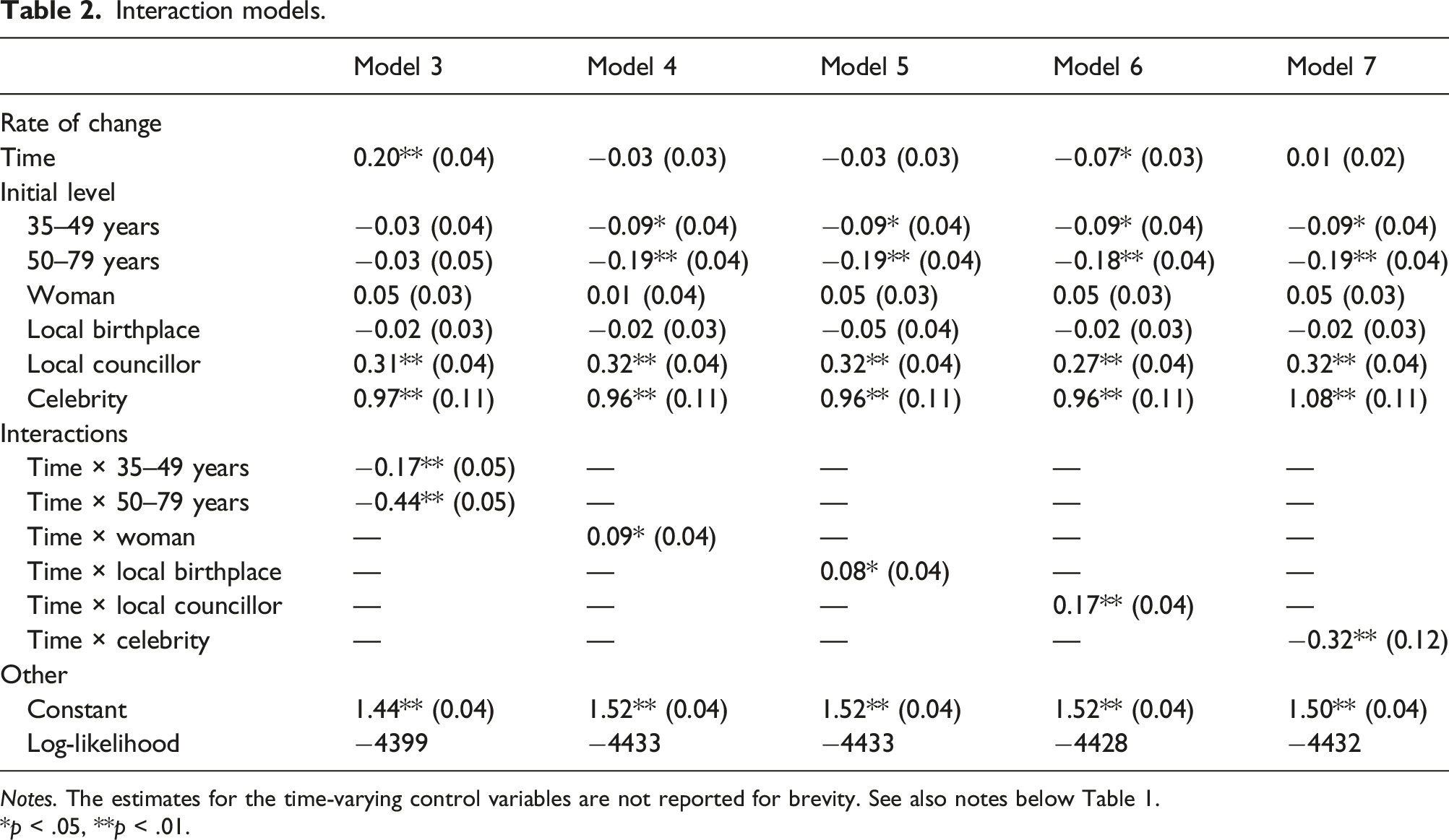
Notes. The estimates for the time-varying control variables are not reported for brevity. See also notes below Table 1.
*p < .05, **p < .01.
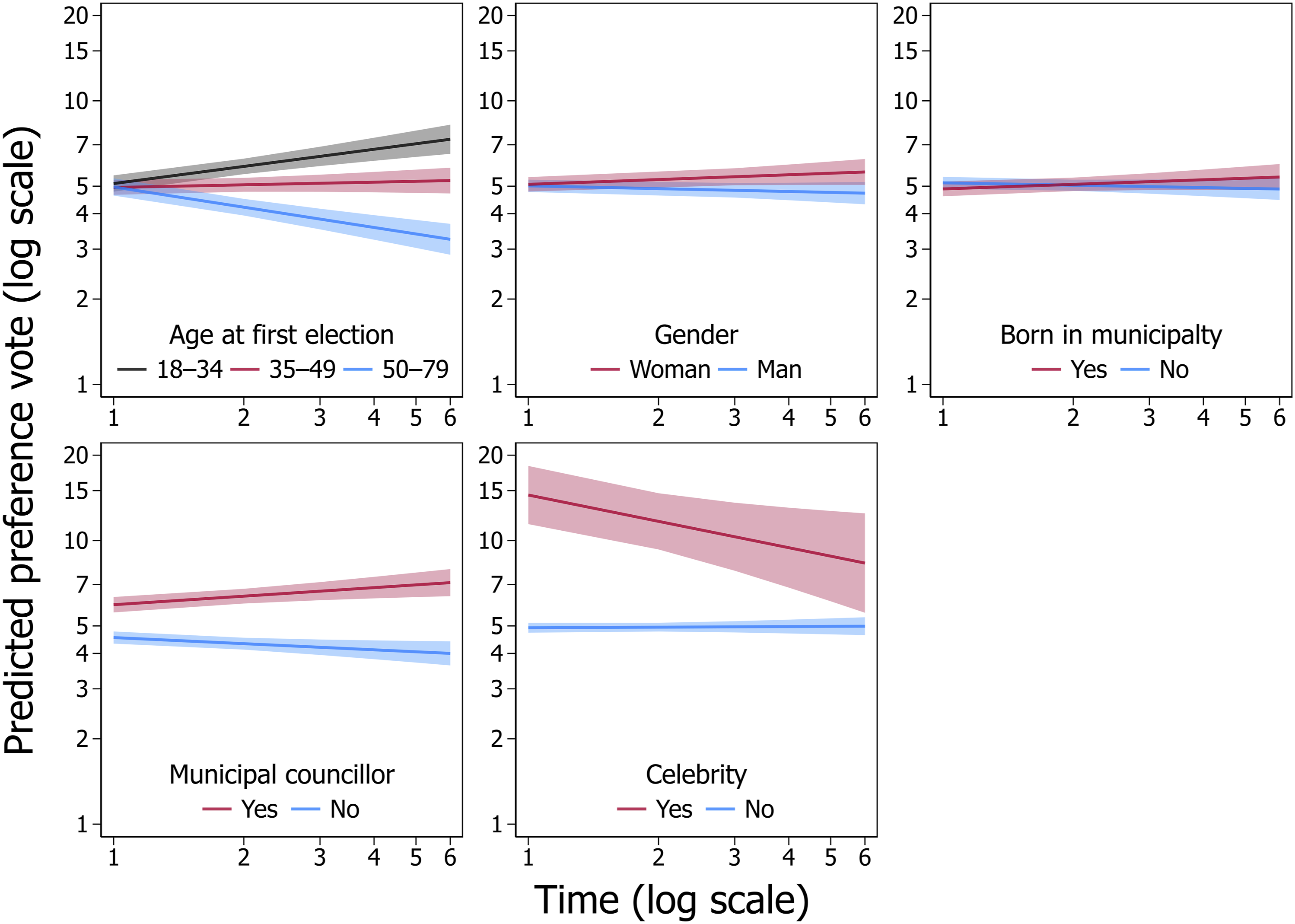
Predictive margins of the interaction effects (with 95% CIs).
We find support for Hypothesis 2 as legislative candidates who participated in their first national election earlier in life have had more prosperous electoral careers. Initially, there are no differences between the age groups: first-time candidates won roughly the same amount of preference votes irrespective of age. But we can observe large differences in the growth trajectories depending on whether candidates were young or old when they participated in their first parliamentary election. The intraparty preference vote share increases more sharply among 18–34-year-olds (+15% when doubling time) than among and 35–49-year-olds (+2%). Late debutants, those who entered as a legislative candidate when they were 50 years or older, peaked in their first election and then saw their electoral support decrease in later elections (−15%). We also perform a sensitivity test by including five age groups (18–29, 30–39, 40–49, 50–59, and 60–79). The estimates are presented in the online appendix, Table OA3. The starting value is somewhat higher for the 30–39 age group than for the other age groups. More importantly, the results confirm that younger candidates have positive vote trajectories while older candidates lost votes over time.
There is weak support for Hypothesis 3, which predicted that the return of repeated candidacy would be higher for women candidates. In Model 4, the coefficient for the interaction term is positive but relatively small, although statistically different from zero. Thus, while no vote gap between men and women when they ran for national office for the first time can be observed, women legislative candidates won somewhat more preference votes over time (+4% when doubling time) while men candidates did not.
To test Hypothesis 4, we use two indicators: local birthplace and municipality councillor. In terms of the first indicator, the growth trajectories do not differ that much between legislative candidates who were born in the municipality of residence and those who were born in another municipality. Once again, the initial preference vote share does not significantly differ between locals and non-locals (Model 5). The rate of change is slightly positive for those who were born in the municipality of residence (+4% when doubling time) and slightly negative for those who were not. The second indicator for localness is a stronger predictor, lending support to the hypothesis that the return of repeated candidacy is higher for legislative candidates with local ties. There are substantively large differences between local councillors and non-councillors both regarding the baseline vote and the returns they got from repeated candidacy (Model 6). Initially, local councillors won more votes (+21%) than non-local councillors. In subsequent elections the gap widened as local councillors increased their vote share (+7% when doubling time), while non-local councillors lost support (−5 percent).
Hypothesis 5 predicted that the return of repeated candidacy would be weaker for celebrity candidates than for the average candidate. As expected, the baseline support for celebrity candidates was high. Model 7 reveals that celebrity candidates initially won 111% more preference votes. Although the number of celebrity candidates has been relatively small, 46 on average in each election, the instant impact of celebrity on personal votes is sizeable. Over time, the gap between celebrity and non-celebrity candidates has narrowed; celebrities saw their electoral support shrink over time (−20% when doubling time).
We perform a sensitivity check by being more liberal in terms of which candidates are included. Close to 500 additional candidate-election observations become available by relaxing the criteria for inclusion (i.e., the two first elections do not have to be consecutive and longer breaks between elections are allowed) and by allowing the time variable to climb despite election breaks. The estimates in the online appendix, Tables OA4 and OA5, do not differ in any substantial way from those presented above.
Discussion
Previous research has extensively studied which personal attributes voters look for in political candidates and which types of candidates are more successful in winning personal votes. These studies have mostly examined cross-sectional variations in electoral support. Much less is known about how the number of personal votes develops over candidates’ electoral careers. To fill this research gap, we sought to longitudinally assess and explain the vote trajectories of individual candidates in multi-member districts. Although our findings are based on single-country data—data on candidates in six parliamentary elections in Finland—we deem the results relevant for, and generalisable to, other proportional representation systems that feature preference voting for individual candidates (flexible-list or open-list PR). This study thus improves our understanding of which types of candidates win more personal votes, not only in single elections, but in the long term, and hence adds to the growing research on competition within parties. In a wider perspective, it contributes insight into why certain groups in society are better or worse represented in legislatures.
Two general conclusions emerged from the results. First, our study demonstrates that the shape of the average vote trajectory is curvilinear: growth is initially steeper, then candidates experience diminishing marginal returns of repeated candidacy and reach a plateau. An initial positive vote trajectory was theorised to arise from increased campaign experience and personal-vote cultivation. Eventually the effects of accumulated campaign experience reached a ceiling, and the pool of personal followers reached its full potential. This curvilinear finding from an OLPR system is in line with several studies of parliamentarians in single-member district systems.
Second, the vote trajectories varied between different types of candidates. While initial success was not dependent on starting age (after controlling for other personal attributes, which also account for an electoral advantage of older candidates), age mattered a great deal in the long term. Those who were young—in their 20s or early 30s—in their first national election were more likely to have more successful electoral careers and thus establish themselves as professional politicians. Elderly candidates who launched their national electoral careers late saw their electoral fortunes diminish rather than improve with every election (see also King 1981). Local municipality councillors not only won substantially more votes in their first election, they also experienced a more positive trajectory over time than those who did not hold local political office. Politicians with local ties and experience tend to have mobilisational advantages in national elections (see Horiuchi et al., 2020; Tavits 2010; Van Erkel 2019). With this study, we found that local politicians are also better able to expand their electoral base, perhaps not only by mobilising local voters but also by broadening their support in the whole district beyond their home municipality. As expected, celebrity candidates enjoyed higher levels of name recognition and visibility right from the start, and could even capitalise on being political outsiders (see Knecht and Rosentrater 2021), but in the next elections they were more likely to see their support shrink over time. Despite this, it is understandable why parties in an open-list proportional representation system nominate celebrity candidates; they bring in extra votes for the parties and, at best, ensure at least one more seat at the district level (see Arter 2014). Women candidates had only marginally more positive vote trajectories than men candidates.
This study’s findings are limited in the sense that there are potentially other qualities that systematically contribute to candidates’ electoral success but that were not accounted for in this study. Further, this analysis could not pinpoint the true underlying causal mechanisms involved. For instance, what were the qualities that got candidates elected to local office in the first place? Did these qualities then bring success in national elections as well? Or did being a local councillor signal credibility and ability to serve local interests, which then translated into personal votes in national parliamentary elections? To answer these questions, we need to conduct longitudinal studies or experimentation that include and/or control for multiple variables in the causal chain.
Footnotes
Declaration of conflicting interests
The author(s) declared no potential conflicts of interest with respect to the research, authorship, and/or publication of this article.
Funding
The author(s) received no financial support for the research, authorship, and/or publication of this article.
