




Abstract
This article addresses an important but understudied aspect of the recent Great Recession in Europe: the institutional strategies political elites deployed to learn from past policy failures and address accountability, more specifically, truth commissions. We raise two overlapping puzzles. The first concerns the timing of the decision to adopt an economic truth commission: while Iceland established a truth commission at an early stage of the crisis, Greece and Ireland did so much later. What accounts for ‘early’ versus ‘delayed’ truth seekers? The second concerns variations in learning outcomes. Iceland’s commission paved the way for learning institutional lessons, but truth commissions in Greece and Ireland became overtly politicised. What accounts for these divergences? This article compares truth commissions in Iceland, Greece and Ireland and identifies two types of political learning – institutional and instrumental – related to the establishment of a truth commission. It argues that political elites in countries with higher pre-crisis levels of trust in institutions and public transparency are more likely to establish economic truth commissions quickly; this is the ‘institutional logic’ of learning. The ‘instrumental logic’ of learning, in contrast, leads governments interested in apportioning blame to their predecessors to establish commissions at a later date, usually proximal to critical elections.
The recent Great Recession in Europe provides an excellent avenue to explore how political elites use institutions to learn from policy failures. Of special relevance in this case are the truth commissions (TCs) established by several countries to identify the causes of their economic meltdowns. Their goal was to document institutional, political and/or individual failures and publish reports offering guidelines for institutional, policy and regulatory reforms. These particular TCs constitute an institutional innovation. Their sudden appearance, coupled with differences across countries, prompts numerous questions, two of which we seek to answer here. First, what explains the decision to set up a TC after an economic crisis? Is there a uniform explanation for their establishment or does this vary? Second, why in certain countries did political elites attempt to use TCs for political gain, while in others, they favoured restoring trust to state institutions over partisan considerations?
This article addresses these questions by looking at three economic TCs: the Icelandic Special Investigation Committee (SIC), established in 2008; the Greek Committee on Public Debt, established in 2015; and Ireland’s Parliamentary Banking Inquiry (BI), established in 2014. From the comparison, we identify two types of political learning displayed by political elites related to the establishment of a TC. The first, institutional learning, applies to countries where rebuilding trust after a major economic crisis is important for political elites: here, levels of public transparency and trust in institutions were already high in pre-crisis periods, and a TC appeared in the early stages of the crisis. The second, instrumental learning, applies to countries where newly elected governments had no direct involvement with the arrival or immediate (mis)management of the crisis. Here, TCs were only established when seen as expedient, usually before or after critical political events such as elections or International Monetary Fund (IMF) bailout negotiations. In effect, they were useful devices to blame predecessors and gain electoral spoils.
This article is divided into seven sections. The section ‘TCs, Transitional Justice and Economic Crises’ defines TCs and explains why the term can be used to describe the institutions under study. The section ‘The “Blind Spot” of Political Learning’ shows how the concept of political learning can help us understand the decision to adopt TCs. The section ‘Puzzles and Research Design’, discusses the research methodology and design, while the following section, ‘Alternative Explanations’ considers several alternative, albeit unsatisfactory, hypotheses as to why governments adopt economic TCs. The section ‘Institutional versus Instrumental Learning’ develops a new theoretical framework to explain the adoption of TCs by governments at either early or late stages: institutional learning for early adopters and instrumental learning for late adopters. The final two sections explore each type of learning in turn, with case studies of institutional learning (Iceland) and instrumental learning (Ireland and Greece). The article concludes by evaluating the success of these mechanisms and identifying their flaws. As will be shown, the instrumental approach to learning can backfire on governments, downplaying instead of highlighting the role their predecessors played in the crisis.
TCs, Transitional Justice and Economic Crises
Transitional justice is a framework usually associated with dealing with the past in post-conflict societies (Kritz, 1995). It points to the importance of learning from the past and explores the impact of different policies of formal acknowledgement of wrongdoing, including prosecutions (Sikkink, 2011), TCs (Wiebelhaus-Brahm, 2010) and amnesties or partial impunity (McEvoy and Mallinder, 2012) on the quality of the emerging political institutions.
TCs are independent, officially sanctioned, fact-finding mechanisms tasked to investigate and document patterns of past human rights violations, often following a political transition from conflict to peace or from authoritarianism to democracy (see Freeman, 2006; Hayner, 1994; Wiebelhaus-Brahm, 2010). They are usually vested with investigative powers, ranging from subpoenaing and taking testimonies from victims to overseeing forensic investigations. They prepare a final report with their findings and offer recommendations to improve the quality of human rights. The first TCs were established in Latin America in an effort to shed light on clandestine patterns of crimes, such as finding the whereabouts of the disappeared: those persons kidnapped and secretly buried by authoritarian regimes (Kovras, 2017). Since then, particularly after the global prominence of the post-apartheid South African Truth and Reconciliation Commission (TRC), TCs have diffused globally. While TCs have historically been associated with the study of violence and political change, their use has become more mainstream, used, for example, to analyse economic and social change, both of which have a powerful impact on citizens’ lives (Michalowski, 2014).
The transitional justice framework – TCs in particular – is relevant to this study for three reasons. First, transitional justice is conceptually based on the assumption that transitions are ‘critical junctures’ and decisions have long-term potential to determine the quality of the emerging democracy (Olsen et al., 2010; Sikkink, 2011). Thus, it implicitly considers learning from the past to be an instrument of political and institutional reform. The intuitive question in most ‘transitions’ is whether societies which do not deal with past policy failures or look for the causes of a crisis are condemned to repeat their mistakes, including in the economic sphere. To give a comparative example, on one hand, despite dealing proactively with the human rights abuses of the ‘dirty war’ (1976–1983; Sikkink, 2011), Argentina has not addressed the causes of its economic collapse in the early 2000s (Panizza, 2014). On the other hand, following the Great Depression of the 1930s, the US Senate mandated the Pecora Commission to identify the causes of the 1929 Wall Street Crash. In addition to analysing the preconditions, Pecora suggested innovative institutional reforms, resulting in the Glass-Steagall Act; this led to the separation of commercial from investment banking which ultimately protected markets from a financial crisis for several decades.
Second, in the aftermath of gross human rights violations and also after economic meltdown, state institutions are severely weakened and state-society relations fractured. The examination of transitional justice in general and TCs in particular can be useful to determine how and why political elites deploy (or refrain from using) institutional mechanisms to restore trust in the state.
Third, and most importantly, TCs and other truth recovery initiatives are mandated to uncover and publicly acknowledge something ‘hidden’ in the past, for example, the above-mentioned disappearances in Latin America. Contemporary financial crises are equally hidden. They are complex and technical, often occurring in distant or virtual locations, enabling only a minority of experts to understand their root causes (see Helleiner and Pagliari, 2011; Palan, 2006). Economic TCs, like their sister commissions in Latin America, have the capacity to ‘uncover’ complicated processes unseen by most citizens but affecting their daily lives.
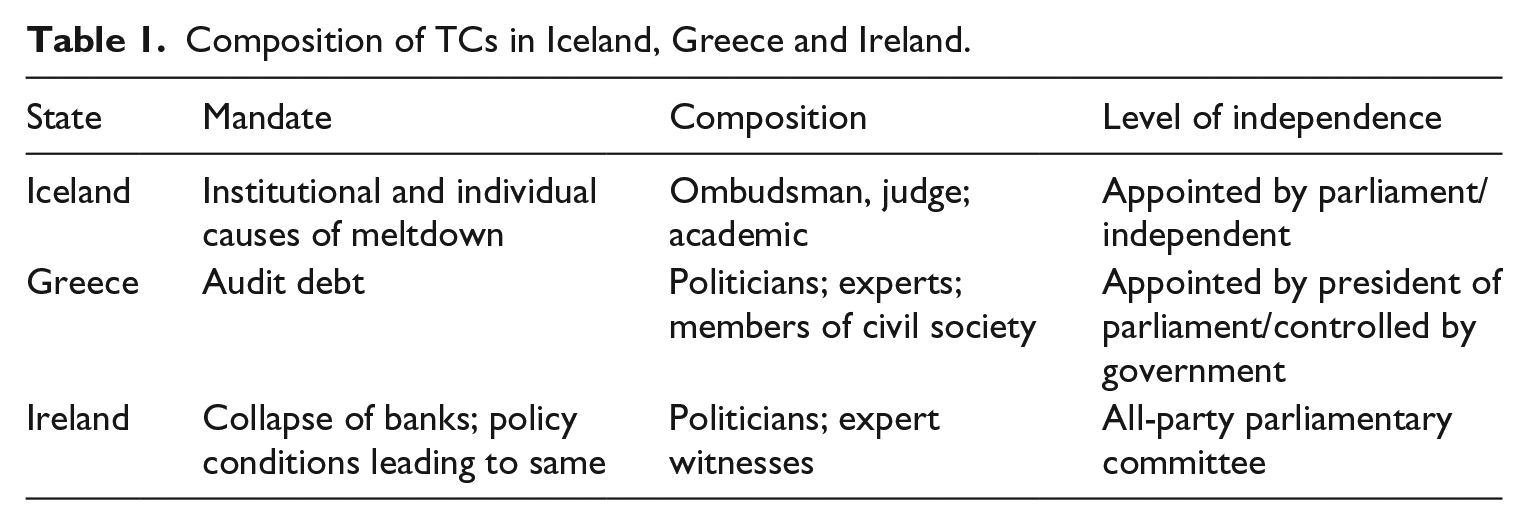
TCs are recognised as establishing simplified, yet authoritative, narratives of the causes of crisis that can be easily understood by the general public. These backward-looking mechanisms document patterns of political, economic or institutional failure; their mandate is restricted temporally, and they are assigned investigative powers. The economic commissions discussed here (Iceland, Ireland and Greece) exemplify this format. Table 1 summarises the composition, mandate and independence of each.
Composition of TCs in Iceland, Greece and Ireland.
TCs usually include experts, including judicial authorities, academics and public administrators; their concern is identifying broad patterns of political, legal and institutional failure. The key objective of their final report is to convert these failures into policy recommendations. Fact-finding commissions have been mushrooming around the world; however, we need to distinguish between TCs and other truth recovery bodies. Otherwise we risk defining all such mechanisms as TCs and devaluing their unique qualities.
TCs usually differ from technical commissions or parliamentary inquiries in their investigative scope, composition and the periods under scrutiny. In the economic realm, technical reports ordered by politicians or independent authorities tend to focus on specific aspects of crises, such as the collapse of a single bank or the role of regulators. For example, the UK Financial Services Authority (FSA, 2008, 2011) prepared reports on the Northern Rock and the Royal Bank of Scotland fiascos. As the mandate and scope of these investigations remained narrow and particular, they cannot be considered TCs. The ‘Turner Review’, tasked to identify flaws in the UK banking system, had a more expansive target of investigation (FSA, 2009). Still, it was primarily a ‘review’ of existing regulatory practices, not a broader narrative of what went wrong. The truth recovery initiatives under scrutiny in this article were asked to critique the established institutional framework, hence their categorisation as TCs. Also common to the three cases is the (theoretical) authority vested in them by national parliaments, another factor separating TCs from other report-producing bodies serving similar functions (Hayner, 1994: 604).
The ‘Blind Spot’ of Political Learning
Political learning has been studied by many scholars in many ways, some considering individuals and others focusing on institutions (Bermeo, 1992; Mishler and Rose, 2007; Soss, 1999). For Nancy Bermeo (1992), political learning is a process whereby beliefs and tactics are modified following ‘severe crises, frustrations, and dramatic changes in environment’ (p. 274). Such events force re-evaluation of the ideas informing past actions.
Political economists have already explored learning processes after major crises. Many have convincingly illustrated how an economic meltdown can challenge economic orthodoxy and engender new ideas in policymaking (Blyth, 2001; Chwieroth, 2010; Culpepper, 2008; Hall, 1986). And many studies consider the long-term consequences of ideational shifts, for example, attitudes to former political regimes. However, although it is now common wisdom that crises stimulate political learning, we have limited knowledge of the institutional mechanisms guiding this process.
Some say that despite the impact of crises, opportunities for learning and reform are fewer than often thought (Boin and ‘t Hart, 2003). Arjen Boin et al. (2008) contend that while one would expect ‘political learning to get to the heart of “what went wrong” and ensure that “the facts” become available’ to inform future policy decisions, such an outcome is by no means ‘the norm’ (pp. 14–15). They suggest investigations into crises rarely produce clear lessons, with some notable exceptions, such as the Hillsborough stadium disaster or the unsafe convictions of the ‘Birmingham six’ in the United Kingdom. Indeed, they say such investigative mechanisms are often themselves sites of contestation and politicised wrangling.
Such argumentation draws a strict dividing line in the debate on political learning: either crises provide valuable opportunities to learn lessons from past mistakes or their potential to drive such processes is limited. But is it not also possible that different types of learning occur during crises, and that these are shaped, at least partially, by the institutional mechanisms established to drive the process? In effect, studying the institutional mechanisms set up to deal with the crisis can reveal a lot about whether and how political elites learn from the past and what type of lessons they glean from past policy failure. This is something the literature on political learning has not adequately explored.
Bermeo offers a useful way to examine these themes. Crises, as she puts it:
force people to re-evaluate the ideas that they have used as guides to action in the past, failures in economic policy act as turning points that frequently lead to changes in the priorities, tactics and strategies deployed by a ‘critical mass’ of learners (Bermeo, 1992: 276; emphasis added).
This allows us to address a blind spot in the literature, the ‘politics’ of political learning: whether and to what extent tactical manoeuvrings are driven by genuine imperatives of lesson learning (institutional learning) or by political considerations (instrumental learning), or occasionally both.
Political learning is neither homogeneous nor linear. It takes different trajectories, shaped by endogenous political realities, including electoral, ideological and symbolic politics. Crises may provide opportunities for reform. But they are also ripe moments for apportioning blame or seeking electoral gains (Boin et al., 2008; Boin and ‘t Hart, 2003). In the latter instance, learning is driven (or thwarted) by political actors’ need to legitimise favourable discourses (or contest hegemonic narratives) about the origins of crisis: in other words, they play the blame game (Hood, 2010).
A final caveat is how to conceptualise learning. Scholars have explored different levels of learning, including but not limited to ideas, policies and institutions. In this article, we focus on the latter, exploring the institutional mechanisms that convert past failures into lessons (for a more detailed operationalisation, see below). Given the temporal proximity of the economic crises and the commissions under investigation, it is impossible to trace their full impact on policy or to define major ideational shifts. Although we acknowledge that the three levels of learning occasionally overlap, we focus on institutions, believing that the institutional mechanics of learning can reveal a great deal about the other two by illuminating the political drivers shaping policy responses.
Puzzles and Research Design
To understand the institutional strategies political elites deploy to deal with accountability and learning from crises, we address two overlapping, puzzling questions. The first concerns the timing of the decision to adopt an economic TC: while Iceland established a TC at an early stage of the crisis, Greece and Ireland did so much later. What accounts for ‘early’ versus ‘delayed’ truth seekers? The second concerns variations in learning outcomes. Iceland’s commission paved the way for learning institutional lessons, but TCs in Greece and Ireland became overtly politicised. What accounts for these divergences?
Our questions call for a comparative research design (Lijphart, 1971). While difficult to generalise conclusions from single-case studies, large-n quantitative analyses are frequently based on ‘conceptual stretching’ (Sartori, 1970). Small-n comparisons inspire more confidence in the accurate measurement of the chosen concepts, a key element in theory development (George and Bennett, 2005). We draw on ‘comparable cases’ that are puzzling in their outcomes (Lijphart, 1971; Przeworski and Teune, 1970). More precisely, we compare cases with similar background conditions but slightly different policy responses. To understand the decision to adopt TCs and the timing, we carry out process tracing for our three case studies based on qualitative interviews with politicians and policy-makers who established or participated in the commissions and on the archived proceedings of the TCs (George and Bennett, 2005). 1 We draw extensively on official publications of the commissions, including interim or final reports, minutes from their meetings, press releases and witness statements to the TCs by current and former political leaders in the chosen countries, as the most reliable sources to understand both the rationale for their original adoption and the scope of their investigation. This is triangulated with references to mainstream national newspapers – excluding tabloids – where appropriate. Our objective is to trace the learning process by focusing on the reports of the commissions, hence the focus on their proceedings. Such evidence includes the testimony of key political figures in power during the crises, as well as those in opposition who won subsequent critical elections. This allows us to observe whether, and to what extent, politicians sought to use the TCs instrumentally as a partisan blame game or as a non-partisan tool for learning lessons.
We acknowledge that the small number of cases increases the potential for the problem of ‘too few cases, too many variables’ (Collier, 1993). This is not determined by our research design but by the fact that the universe of cases is small. Economic TCs are relatively novel. Hence, we are analysing a fluid and emerging phenomenon which remains open to future refinement of our hypotheses with the emergence of new cases. To minimise the impact of this methodological reality, we compare three of the most prominent cases while ruling out several alternative explanatory hypotheses.
Alternative Explanations
The type of crisis may explain why an economic TC is set up. Greece had a debt crisis, while Iceland and Ireland had banking crises, possibly making it easier for the former to look for individual culprits and for the latter to evade responsibility by pointing to ‘reckless’ bankers. This hypothesis does not hold, as all three countries established TCs.
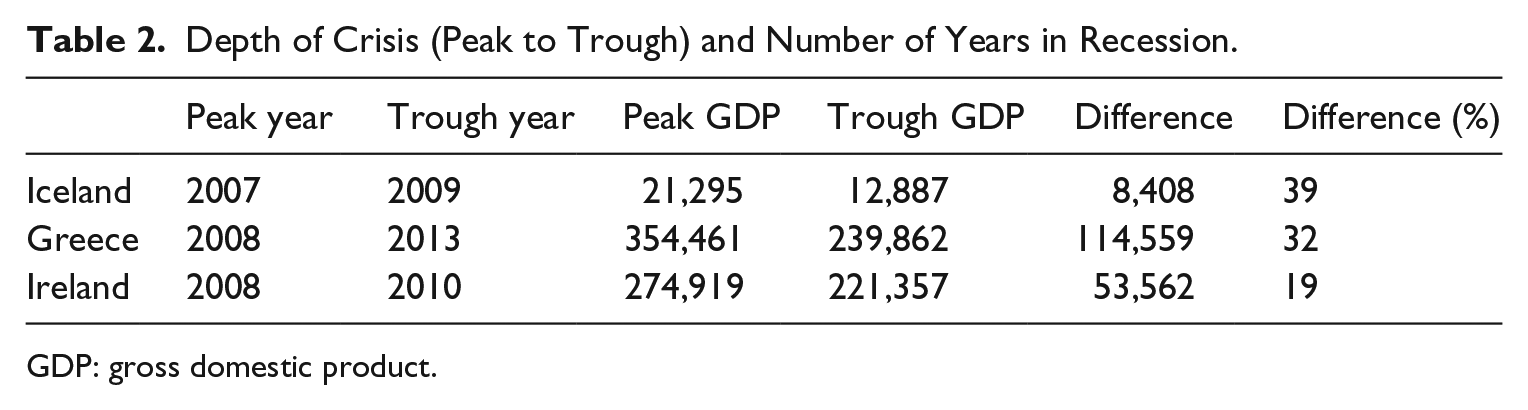
Structural and political explanations might be more useful. Perhaps it is not solely the type or depth of crisis but its political management that matters. As Table 2 shows, in countries where leaders negotiated IMF programmes, the consequences of the crisis were mitigated or spread over a longer period. However, in countries suffering banking-sector collapses before emergency financing was agreed upon, the popular pressure to establish a TC to ascertain the causes is evident, as in Iceland. But this fails to account for the decision of countries already in IMF programmes to adopt TCs, such as Greece and Ireland. Clearly, the situation is complicated, and a single explanation is inadequate.
Depth of Crisis (Peak to Trough) and Number of Years in Recession.
GDP: gross domestic product.
Institutional vs. Instrumental Learning
A common thread linking all countries experiencing economic crises is the challenge to political and judicial institutions. Economic shocks raise questions about accountability, responsibility and learning from policy failures. Questions such as ‘whose fault was it?’, ‘what went wrong?’ or ‘how did our institutions not prevent the disaster?’ are commonly asked. The response of political elites and institutions varies according to the expectations of the public in different countries.
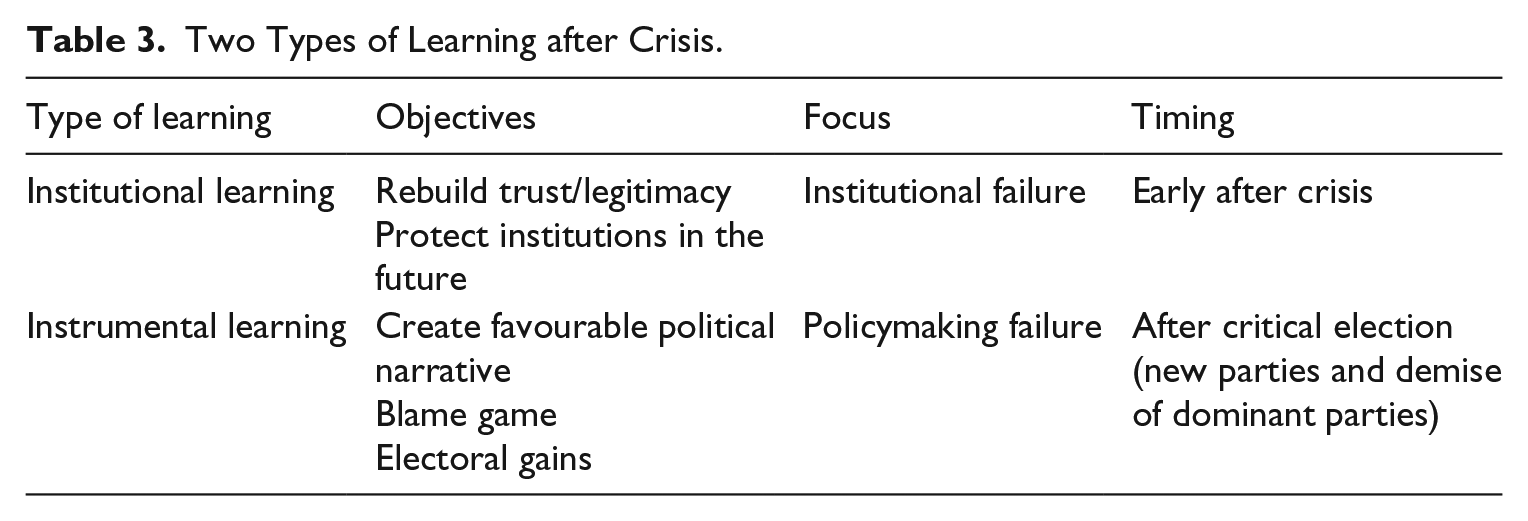
We hypothesise that political leaders in countries with high pre-crisis levels of trust in institutions, such as Iceland, will be more responsive to popular calls for accountability (Table 3). An institutional logic will drive learning from policy failures, largely independently of political considerations or ideology. Here, TCs are useful mechanisms to convert failures into lessons to prevent future crises. The logic of institutional learning and the need to rebuild trust in institutions are expressed by elites across the political spectrum. Thus, we expect an economic TC to be established early in the crisis, irrespective of the ideological orientation or the degree of culpability of the incumbent government. Similarly, we expect cross-party support for such an endeavour. Institutional learning is premised on securing the long-term legitimacy of the democratic regime and trumps short-term party-political considerations. Therefore, political elites will establish a TC even if the final report risks putting political blame on them, not least because the electoral and legitimacy cost of inaction would be much higher. Responsiveness to public calls for accountability and learning from one’s own policy failures to strengthen institutions are twin features of institutional learning.
Two Types of Learning after Crisis.
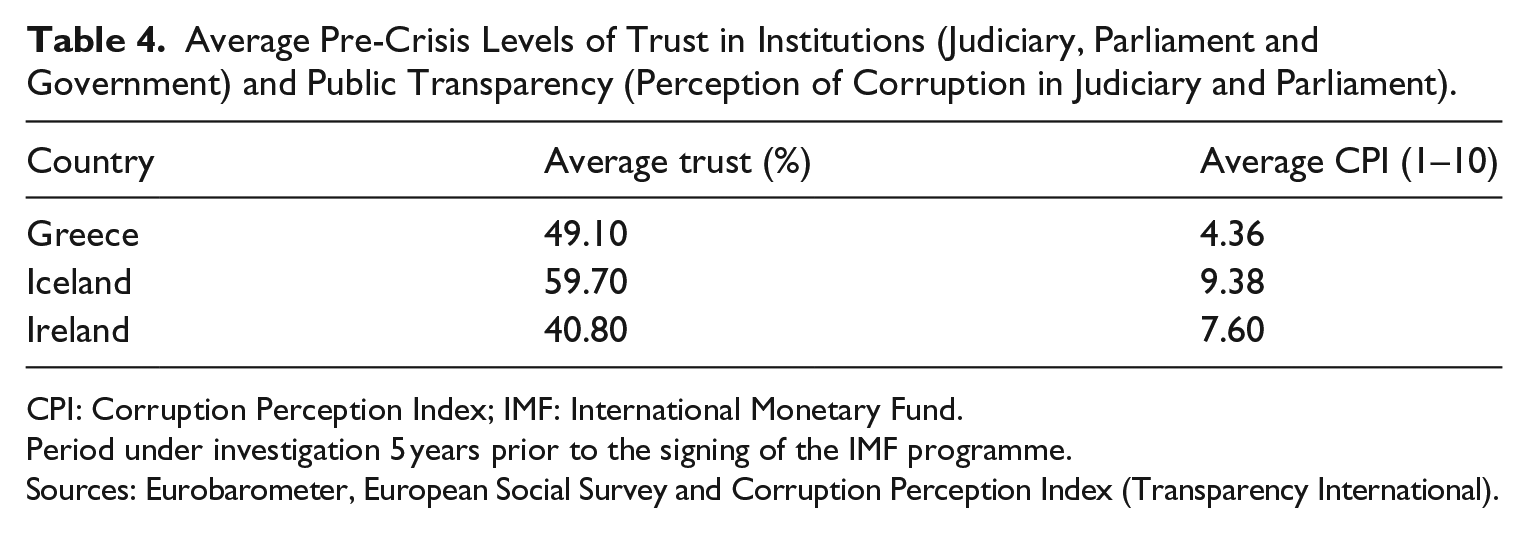
This hypothesis is supported by empirical evidence. Table 4 summarises average levels of trust in central political institutions (national parliament, government and judiciary) across our cases in the five pre-crisis years, defined here as the signing of an IMF programme. To measure perceptions of public transparency, we consider the average perception of corruption (in parliament and the judiciary) for the same periods, with the most common indicators and sources (Eurobarometer, European Social Survey and Corruption Perception Index) used to measure trust and transparency. While sometimes contentious, these metrics are useful for mapping political trends. A glance at the table shows that Iceland is an outlier, with considerably higher levels of trust and transparency. In this case, high public expectations of ascertaining responsibility for past failure locked political leaders into a logic of institutional learning; this explains why Iceland’s political elites established a commission almost immediately and why it was the incumbent government which did so.
Average Pre-Crisis Levels of Trust in Institutions (Judiciary, Parliament and Government) and Public Transparency (Perception of Corruption in Judiciary and Parliament).
CPI: Corruption Perception Index; IMF: International Monetary Fund.
Period under investigation 5 years prior to the signing of the IMF programme.
Sources: Eurobarometer, European Social Survey and Corruption Perception Index (Transparency International).
This does not explain the decision to adopt a TC in Greece and Ireland. Here, we see a second type of learning, instrumental learning. In both countries, there is a minimum level of trust in public institutions but it is insufficient to lead to the outcome seen in Iceland. Instead, TCs emerged as a result of political elites’ decision to play the blame game, with the post-crisis government hoping to create authoritative public (and finger-pointing) narratives of the causes of the crisis to suit its own interests. Learning from the past, then, is instrumental, geared towards ideological and policymaking critiques of previous governments, not a bid to highlight institutional failures. Simply stated, such TCs are a convenient mechanism to instrumentally use past policy failures to perpetuate the new governing party’s discourse of blame, and the timing of their adoption depends on a critical election leading to the demise of one party and the rise to power of another.
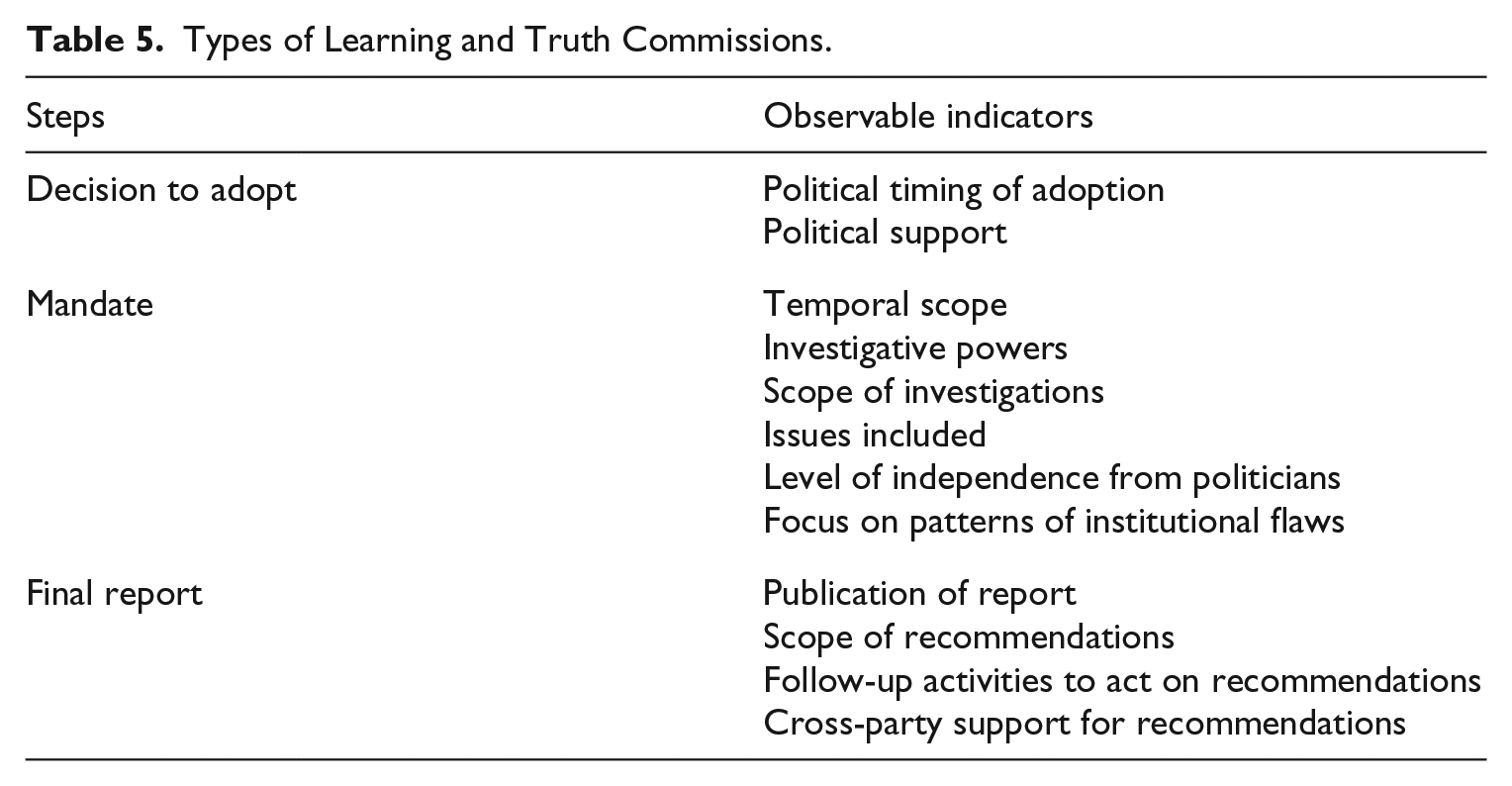
Two caveats are in order. First, there is a relative dearth of knowledge of the operationalisation of the concept of learning. Learning means different things to different scholars. To explain what learning entails in the contexts of TCs and to support our theoretical framework with observable empirical phenomena, we establish three sets of indicators to determine the instrumental or institutional pathway of learning, focusing on the three key stages in the life of TCs: the ‘decision to adopt’, the ‘mandate’ and the ‘report’.
The decision to adopt is crucial, with the potential to explain the timing and political dynamics that paved the way for the establishment of the commission in the first instance. When a commission is set up or whether there is cross-party consensus can reveal a lot about the instrumental or institutional logic behind it. As the existing literature on TCs explains, the specific mandate is critical in shaping the boundaries of learning (Chapman and Ball, 2001). What is the temporal scope of the investigation? Which issues are included or sidelined from its mandate? Does it focus narrowly on bad decision-making of individuals or on broader patterns of institutional failure? What is its level of independence from power-holders? These critical questions shape the type of learning. Finally, the afterlife of the commission is pivotal. Does the TC publish a report, and if it does, what type of recommendations does it offer? More importantly, is there a follow-up to implement the recommendations or not? These observable indicators can determine whether a particular commission is driven by institutional or instrumental learning (Table 5).
Types of Learning and Truth Commissions.
Second, the two types of learning are not mutually exclusive; as will be seen, the two logics often co-exist, creating a dynamic explanatory framework. In effect, it is not exclusively the logic of principles that guides political elites to follow the institutional learning pathway; rather, the institutional framework raises the electoral cost of inertia or partisanship. Equally, it may not be avarice alone that leads new governments to follow an instrumental pathway, especially as the instrumental approach often delivers sub-optimal outcomes for them, as our case studies demonstrate.
Institutional Learning
Iceland’s Special Investigation Commission
In October 2008, Iceland’s three major banks collapsed within a week, taking 97% of the country’s banking system with them: estimated at US$180 billion, this was the third largest corporate bankruptcy on record (Johnsen, 2014). The crash ended an unprecedented period of growth, facilitated by cheap credit and exponential banking-sector growth, from 174% of gross domestic product (GDP) at the end of 2003 to about 1000% when it unravelled in 2008 (Benediktsdottir et al., 2011). While the nation was still in shock, and before any protest demands arose, Icelandic political elites moved quickly and pre-emptively, announcing that the causes of the crash would be investigated. Iceland’s Special Investigation Commission (SIC; henceforth also TC) was established, the first of its kind in Europe. The process paving the way for the commission, its mandate and scope were all shaped by the institutional logic of learning.
The decision to establish this TC was made by the incumbent government, led by the right-wing Independence Party (IP). IP had held power for 18 consecutive years and was perceived responsible for the creation and (mis)management of the crisis. The only reason for political elites to set up mechanisms that could potentially incriminate them was the fear that the political costs of inaction or a cover up might be even greater. As noted above, this is arguably more common in countries with established cultures of transparency, accountability and trust in institutions. Guided by this logic, only 3 days after the banking-sector collapse, Prime Minister Geir Haarde announced that an investigative mechanism would be established to ‘be clear what happened and why’ (Morgunbladid, 12 October 2008: 10–11). The most senior political advisor to the leader of the Social Democratic Alliance (IP’s coalition partner) said, ‘It was just the right thing to do; we owed the nation an explanation of what went wrong and what needed to be fixed’ (interview, Kristrún Heimisdóttir, Reykjavik, 26 May 2015). Notably, the commission had cross-party consensus, highlighting the priority of reinstating the legitimacy of the political system. An opposition leader argued, ‘Geir Haarde showed considerable maturity and realised this needed to be done. The events were of such magnitude that there would never be any agreement or reconciliation unless they were thoroughly investigated’ (interview, Steingrímur J. Sigfusson, leader, Left-Green Movement (LGM), Reykjavik, 2 December 2015).
The Icelandic TC’s design and mandate illustrate the institutional logic of learning. For one thing, the appointed commissioners reflect the key investigative institutions of the country: a Supreme Court Judge, the Parliamentary Ombudsman and an Icelandic-born Yale economist with banking expertise. According to the Speaker of Parliament, a member of IP who tabled the bill establishing the TC, it was thought necessary that it be headed by ‘irreproachable professionals that were outside of the daily grind of politics’ (interview, Sturla Böðvarsson, Reykjavik, 1 December 2015). Efforts were also made to insulate the commission from party politics and reinforce its independence to ensure genuine lesson learning.
As the TC’s primary objective was to reinstate trust in state institutions fractured by the crisis, its mandate and scope were correspondingly broad, namely, to:
[S]eek the truth behind the events leading to, and the causes of, the downfall of the Icelandic banks in October 2008, and related events, [to] assess whether mistakes or negligence occurred in the course of the implementation of the laws and other rules regulating and providing for control of the Icelandic financial sector [and to determine] what persons may be responsible (Althingi, 2008).
Political leaders understood its open-ended scope to be central in regaining citizens’ trust. According to LGM’s leader and later Minister of Finance, ‘politicians realised that this (the SIC) could not be a compromise; this needed to be for real – otherwise there would be no trust’ (interview, Steingrimur J. Sigfusson, Reykjavik, 2 December 2015).
To carry out the demanding investigative task, the commissioners were given exceptional investigative powers, including but not limited to subpoenaing witnesses, seizing evidence and searching premises. Obstructing the investigation was punishable by up to 2 years’ imprisonment. Ultimately, the TC interviewed 147 witnesses.
To increase the potential for learning, the proceedings took place behind closed doors, and witnesses were given guarantees that statements made to the commission could not be used against them before any courts. This was to make participants feel comfortable enough to share their knowledge and at the same time to ‘avoid rehearsed, standardised responses that are designed for media headlines and shifting responsibility on to others’ (anonymous interview, SIC researcher, Reykjavik, 30 November 2015). In some cases, when the microphones were turned off and the official interview was over, witnesses were encouraged to talk ‘off the record’. In short, identifying failures and learning from them seems to have been the genuine guiding principle.
Finally, the institutional logic of learning is evidenced in the follow-up activities. In response to the commission’s report, the new left-wing government appointed a special working group of legal and public administration academics; this group made further recommendations on how the cabinet and individual governmental institutions should respond (Forsaetisraduneytid, 2010). Over and above the executive’s initial response, Parliament established a cross-party parliamentary committee to ‘draw lessons from the SIC report and point to ways for reform’. In September 2010, 5 months after the commission delivered its findings, the all-party committee published a 265-page report distilling the findings and noting the lessons to be learned. Based on this report, Parliament unanimously passed a resolution setting out a legislative reform agenda. ‘It is important that the SIC report continues to be a guiding light’, it said. Furthermore, ‘it is important that everyone looks critically at their own actions and uses the opportunity that the report offers to improve society’ (Althingi, 2010).
The Icelandic TC is the only mechanism in our cases to be guided by the institutional logic of learning and honouring the need to rebuild the trust of the public in institutions. In sharp contrast to the other two examples, it was swiftly established, largely independent and legitimised by ongoing cross-party consensus.
Instrumental Learning
Greece’s Debt Audit Committee
The economic crisis radically restructured Greece’s political system (Kalyvas, 2015; Kovras and Loizides, 2014; Pappas, 2014). Support for the dominant parties, socialist PASOK and conservative New Democracy (ND), nosedived. Political polarisation was reflected in violent street protests, riots and the electoral rise of the far right (Ellinas, 2013; Ellinas and Lamprianou, 2014). The most important political development was the transformation of the Coalition of the Radical Left (SYRIZA) from a fringe party into a dominant one. The creation of Greece’s TC reflects SYRIZA’s rise, lending credence to our proposed theoretical framework of learning.
Despite deep recession, skyrocketing unemployment, vocal calls for accountability and violent street protests during the first 4 years of the crisis (2010–2014), attempts to investigate the causes were blocked by the dominant parties amid the pressing need to implement a harsh austerity programme. During these years, ND and PASOK, seen as responsible for creating the exorbitant Greek debt, became coalition partners, with little incentive to investigate their own policy failures. However, SYRIZA was keen to apportion blame to ND and PASOK and create a new (politically favourable) narrative to bolster its legitimacy. Accordingly, 3 months after gaining power (April 2015), SYRIZA established a debt audit committee (henceforth the TC).
Such a move is not unique to Greece. Many leaders create mechanisms to settle old scores against competing political elites. What is exceptional in the Greek case is its extension of the blame game to include external actors, by challenging the legitimacy of Greek debt and seeking to negotiate a new programme with its creditors. SYRIZA’s logic is best expressed by former Speaker of Parliament Zoe Konstantopoulou, the politician who created the TC:
The current government is the first in decades that did not contribute to the creation of the public debt … [T]he government is legitimised to use all available tools and arguments in order to challenge and write off the debt, or at least to stop repaying it for so long as it threatens the survival and the civil and economic rights of the Greek people.
The instrumental drive of the commission is evident in its (ideological) origins. According to a leading member of the commission, it emphasised the international systemic causes of the crisis, such as the external conditionality imposed by the creditors and its impact on national sovereignty, and played up the human rights of the Greek people (interview, London, 12 December 2015).
In short, Greek ideological instrumentalism was expressed in the effort to establish a narrative supporting the view that since the debt was created by systemic international influences, it was illegal. If this narrative were established, it could be used as leverage in ongoing negotiations with creditors to forgive the debt. To this end, the commission was mandated to:
[G]ather all information relevant to the emergence and disproportionate increase in public debt, and to subject the data to scientific scrutiny in order to determine which part of the debt can be identified as illegitimate and illegal, odious or unsustainable, during the bailout period, from May 2010 to January 2015 as well as in the preceding years (Greek Debt Committee, 2015).
The Greek TC was established in April 2015, shortly after SYRIZA’s victory, as a special independent commission of Parliament. Its opening session was a highly visible event addressed by the President of the Republic and attended by the Prime Minister. In sharp contrast to other TCs staffed by experts or politicians, the Greek commission included anyone who might be interested, from international civil society organisations to a folk singer. A key feature was its exclusive focus on the public debt and its exclusion of broader issues of domestic institutional failure. The narrow temporal scope, the ‘bailout’ period (2010–2015), is equally noteworthy. The Greek problem was framed as one created after the imposition of external conditionality in 2010, thereby excluding from scrutiny any endogenous institutional failures (i.e. corruption, tax evasion and party patronage) contributing to the debt in preceding decades.
Guided by this instrumental logic, the TC became a political tool to hit two targets at once. First, it was intended to strengthen the position of the Greek government in renegotiating the terms of previous Troika (IMF-EU-ECB) programmes. It had a predetermined conclusion, evident in its slogan: ‘Audit the debt, write it off’. As the lead expert of the commission, Eric Toussaint, unambiguously stated, it could:
arm the Greek government with legal arguments on the matter of partial debt abolition during the negotiations in relation to this matter … we will determine which part of the debt can be qualified as illegitimate, illegal, odious, or unsustainable (cited in Papagiannis, 2015).
Auditing Greek public debt over three decades was a Herculean task. Nevertheless, the commission published its preliminary findings 2 months (June 2015) after its first meeting and only 2 weeks before the Greek government called a referendum on the terms of the new Troika programme. The timing highlights its politicised role. Not surprisingly, given the TC’s ideological origins, the preliminary report concluded Greece was ‘a victim of an attack premeditated and organised by the IMF, the ECB and the European Commission’ (Greek Debt Committee, 2015: 2).
Second, the commission took aim at opposing domestic political elites. Although the debt was a ‘premeditated’ international plan, the report found ‘Greek authorities conspired’ to protect domestic and international financial institutions (Greek Debt Committee, 2015: 1). Greek politicians deemed responsible were not framed as incompetent or reckless policymakers but as conspirators in a consortium of foreign interests. This overlapped with a broader political narrative in which the government was (or should be) the guardian of national sovereignty. The leader of the populist right independent Greeks (ANEL), SYRIZA’s junior coalition partner, argued:
Certain politicians refrain from attending this commission, and most of them participated in (previous) governments that surrendered the country and its national sovereignty over the past few years. Was this unintentional or on purpose? The commission will prove that some of them benefitted from this policy (Greek Truth Committee Session, 5 April 2015).
Paradoxically, although Greece faced predominantly a domestic public debt problem and had most to learn from illuminating well-entrenched endogenous institutional flaws, the TC virtually ignored these. By limiting its analytical gaze to systemic and external failures, it forestalled lessons useful for domestic reforms. Endemic problems such as corruption were either sidelined or framed as externally driven.
The abrupt termination of the Greek TC best illustrates its instrumental nature. Within weeks of SYRIZA’s signing of a new Troika programme, in July 2015, the party withdrew its support from the TC. It did not even get to publish a final report. 2 After this volte face, the TC was irrelevant; in fact, continuing the investigation might have been perilous for SYRIZA. Several MPs perceived the leadership’s decision to agree to a new Troika programme in the summer of 2015 as capitulation. This led to a wave of MP defections, trimming the party’s power to pass bills necessary to receive the new loans. These bills passed with the support of opposition parties, making it impossible for the government to settle scores with the opposition while simultaneously depending on them. Moreover, any ongoing investigative mechanism could backfire; for example, it might highlight the mismanagement of the negotiations and the adverse impact of SYRIZA’s economic policy while in power, including the imposition of capital controls. For instance, members of the committee published an additional report showing the illegality of the memorandum signed by SYRIZA in July 2015. A leading figure of the commission is adamant: ‘The continuation of the truth commission would have exposed the role of the government’ (interview, London, 12 December 2015).
Ireland’s Banking Inquiry (BI) Commission
Irish attempts to learn lessons from its banking crisis were significantly delayed, but before entering the EU/IMF programme in November 2010, the incumbent government began investigating the crisis. Its investigations produced three technocratic reports on banking and regulatory failures (Oireachtas, 2010a, 2010b) and the failure of policy-makers to assess risks (Oireachtas, 2011). Such an approach, although potentially illuminating, was at odds with fuller lesson learning. It was not until after a critical election that a new government established a Banking Inquiry (henceforth the TC) to examine the factors leading to the Irish collapse from 1992 onwards.
The Irish TC took an instrumental approach to lesson learning. As in Greece, the economic crisis ruptured the party system. The dominant party, the centre-right Fianna Fáil (FF), was relegated to third place for the first time in its history (Hutcheson, 2011). In 2011, it was replaced by a coalition of the centre-right/conservative Fine Gael (FG) and social-democratic/centrist Irish Labour (Labour, 2011). This change in government spurred politicised attempts to establish accountability.
Following the election, proposals to strengthen the powers of parliamentary inquiries were advanced as part of the government’s coalition programme, requiring approval in a referendum. In a pre-emptive move, the coalition stated that the TC would begin once such powers were acquired (although the original plans to increase powers of investigation were unconnected to the crisis). The referendum in October 2011 was narrowly defeated. This stymied the government which had hoped to use the new powers to plan a ‘lengthy and detailed embarrassment of Fianna Fáil’s stewardship of economic and banking matters’ (Leahy, 2013).
Nevertheless, a TC was established by statute in late 2014, comprising politicians from all parties and independents (Oireachtas, 2015). Despite the ostensible motivation of truth-seeking, it displayed a combination of instrumental learning and adversarial politics, quickly undermining its credibility. For example, the government insisted on adding two of its parliamentarians to the committee to ensure a majority, enabling it to set the terms of reference – although the TC itself was technically independent.
The TC heard testimony from current and former Prime Ministers, civil servants, bankers and economists. Calling on key parliamentary figures to testify was part of an instrumental approach to learning and highlighted the ongoing antagonism between politicians. Members of the FF-led government, which presided over the initial Troika programme, understandably stressed their achievements before the crisis. Former FF Prime Minister, Brian Cowen (also a Finance Minister) mentioned the huge reductions in debt-to-GDP ratios during his tenure; he further argued there was no indication in any of the advice he received that Ireland was headed for catastrophe (Brian Cowen, BI: Witness Statement, 2 July 2015).
For his part, his predecessor, Bertie Ahern (BI: Witness Statement, 16 July 2015), expressed sorrow that the crisis occurred but claimed his governments had been fiscally responsible:
Those who say we squandered the boom forget that in my time as Taoiseach we actually recorded budget surpluses in 10 of our 11 budgets … As a result, Ireland paid over a billion euro less every year in interest payments.
When questioned more closely, Ahern (BI: Evidence, 16 July 2015) admitted 2008 levels of spending were too high but contended that had he listened to the opposition, he would have ‘spent three times more’. The implication was that any party in power would have had similar results – thus, by this logic, neither he nor his party was responsible for the crisis.
Those representing the coalition government (FG and Labour) behaved in a similar fashion, highlighting their pre-crash achievements and placing the blame for domestic failures at the door of FF-led administrations. Deputy Prime Minister Joan Burton (BI: Witness Statement, 23 July 2015; Labour) claimed the previous government was largely at fault, stressing her own role in warning against its policies:
[A] series of catastrophic economic policy decisions by the Fianna Fáil/Progressive Democrat Government created a huge distortion in the structure of the Irish economy … I warned time and again against the property–based tax breaks fuelling this bubble … Those responsible were the Fianna Fail led Government, the boards of the banks, the Central Bank and the Financial Regulator.
But this approach backfired. When the Labour Party’s policies in opposition were questioned at the TC, it transpired it had also suggested reducing taxes. Indeed, before the 2007 election, it also agreed on a joint platform with FG, advocating public spending increases. When this was put to FG leader Enda Kenny (BI: Evidence, 23 July 2015), he denied FG was anything like FF, referencing his party’s emphasis on competitiveness:
You make the point that, you know, we were advocating even for more public spending. Well, far from that, because a central focus of our opposition to Government was the massive waste and the inefficiency.
Kenny also claimed FG’s projections were based on figures from the Department of Finance or Economic and Social Research Institute (ESRI) – the same defence used by Ahern and Cowen. This shows the potentially counter-productive nature of the Irish approach. As independent parliamentarian Shane Ross (2015; an expert on banking) argued, ‘The conclusion is awkward. If Fine Gael swallowed the line from the ESRI and the Department of Finance, does that not let Fianna Fail off the hook?’ Even Kenny’s fellow party members who were on the TC grilled him and the Employment Minister over their policies in opposition. Some had voted against Kenny in a leadership challenge in 2010, and it has been suggested that they were only available for TC duties because they had no cabinet responsibilities (Enda Kenny and Richard Bruton, BI: Evidence, 23 July 2015). In other words, the instrumental nature of the TC went beyond fighting between different parties to encompass intra-party squabbles.
The Irish electoral system may help explain the fate of the country’s TC. The proportional representation by single transferable vote (PR-STV) system means electors vote for personalities, not parties (Kirby and Murphy, 2011), meaning members of the governing parties could use the TC to challenge the government at no necessary electoral cost to themselves. Thus, while the TC was a classic attempt at instrumental learning, its adversarial nature stopped it from becoming a simple witch-hunt of the previous government. The final report further supports our hypothesis of political culpability. While the coalition government attempted to use the TC instrumentally, the TC’s report shared responsibility among the parties:
All the main political parties, whether in opposition or in government, advocated pro-cyclical fiscal policies, including increasing expenditure and reducing taxation, in the years leading up to the crisis, as evidenced by their election manifestos in the 2002 general election and, especially, the 2007 general election (Oireachtas, 2016: vol. 1, p. 13).
Its recommendations vis-à-vis government included reforming the management of transaction-based taxes and providing parliamentarians with ‘training and support in technical content if they do not already possess the required skill set’ (Oireachtas, 2016: vol. 1, p. 14), sparing any single party or politician from censure. Even a report written by one of the independent members, while most critical of the FF-led government, allocates blame across the political establishment, reckless bankers and the ‘non-opposition’ rather than apportioning all the blame to the government presiding over the slide into crisis (Higgins, 2016). In the Irish case, then, the attempt to use a TC instrumentally backfired on those who sought to profit from it politically.
Conclusion: TCs and Omissions
To relieve economic stress, most economists focus on forward-looking policies to stimulate economic recovery. This study of three European countries, however, shows how difficult it is for politicians to resist delving into past policy failures. Under certain conditions, this can be beneficial. By shedding light on the causes of the 1929 crash, the Pecora Commission was able to recommend a number of institutional reforms that protected the US economy from another major crisis for decades. If they are properly designed, TCs have the potential to convert past policy failures into institutional lessons that could protect national economies from past failures.
Yet by seeking to understand what went wrong and to learn from past mistakes, a state accepts (tacitly at least) a role for itself in preventing future crises. This, in turn, implies new and innovative or additional forms of regulation in the spheres of capital and economic development, with obvious implications for the realms of taxation, regulation and state-led economic planning. Such as, for example, how to avoid pro-cyclical policies which can fuel the speculative ‘bubbles’ affecting the three case studies. How this can be done in an era of transnational capital flows has been the subject of considerable debate (see, for example, Helleiner, 2015; Piketty, 2014), and proposing solutions is beyond the scope of this article.
Nevertheless, it should be noted that the challenges faced by states are not merely economic – they are also inherently political. Those favouring a greater role for the state in economic and capital regulation may find themselves increasingly at odds with populist movements, nativist in outlook, which see more government as part of the problem (Canovan, 1999; Tope et al., 2015). The simplified narratives provided by TCs may struggle to compete with the even more simplified arguments of populists who seek to refashion the system in their own image, rather than refresh and reform it.
TCs should not automatically be viewed as universally positive mechanisms. They can be used instrumentally, as in Greece and Ireland, for party-political purposes; unfortunately, these can trim the perceived legitimacy of the existing political process and fuel the nativist and populist impulses which threaten the global and globalised economic system. That being said, the existence of an established culture of public transparency and pre-crisis trust in political institutions, as in Iceland, can lock political actors into a policy of delving into the past; in such cases, efforts to abstain or to cover up responsibility could be electorally costly. This type of broad political consensus on the need to scrutinise past policy failures guides institutional learning.
In our analysis of three different economic TCs, we have identified what we could term a learning paradox: although societies with weaker cultures of transparency could benefit most from learning institutional lessons from crises, institutional learning is most difficult in those particular countries. We also find tensions between political learning and realpolitik. The stated objective of TCs is to learn from past policy failures. Yet once they start highlighting complicated aspects of the truth, those most useful for lesson learning, they are frequently stymied by politicians interested in a simplified narrative which excludes inconvenient truths, as in Greece and Ireland. Contemporary financial crises are complex phenomena with technical, institutional, regulatory and individual decision-making flaws. Converting a complicated phenomenon into a simplified narrative is both the virtue and the vice of a TC – akin to truth recovery mechanisms. Commissioners are tasked with converting complex processes into a publicly accessible narrative while offering recommendations to prevent future disasters, the essence of political learning. However, because they have the ability to create meta-narratives about the crisis, TCs become ideal instruments of symbolic politics, or realpolitik, for politicians seeking to establish expedient narratives and settle old scores.
From our analysis, it is clear that new governments enjoying comfortable majorities after critical elections may use TCs instrumentally to apportion blame and capitalise on public discontent to achieve the ‘constant end’ of electoral success (Bermeo, 1992). Yet all parties acknowledge the pragmatic need to maintain governmental stability as a prerequisite of effective decision-making to overcome deep economic crises. In times of economic stress, effective governance often necessitates consensus with the opposition who may have skeletons in their closets and, thus, prefer to block backward-looking accountability mechanisms. Thus, it seems that realpolitik trumps learning initiatives in times of crisis. TCs lose their appeal and utility when they reveal inconvenient truths about the parties establishing them. In such contexts, political elites reframe their political narratives from backward-looking mechanisms of accountability to forward-looking policies aimed at resuscitating the economy. In the final analysis, the establishment of economic TCs for instrumental reasons, particularly in delayed cases, is merely a continuation of electoral politics by other means.
Footnotes
Acknowledgements
We are grateful to Amnon Aran, Tom Davies, Christopher Gandrud, Nadia Hilliard, Joe Hoover, Evan Liaras, Neo Loizides, Kieran McEvoy, Stefano Pagliari, Amin Samman and Sally Wheeler for invaluable comments on previous drafts of this article. We are also particularly indebted to the three anonymous reviewers for the insightful feedback that greatly benefited the quality of this article. The usual disclaimer applies.
Funding
The author(s) disclosed receipt of the following financial support for the research, authorship, and/or publication of this article: This article contains research which was generously funded by the ESRC as part of the ‘Truth, Accountability or Impunity? Transitional Justice and the Economic Crisis’ project (grant reference: ES/M011321/1).