




Abstract
Despite recognition that multi-agency collaboration is vital in missing child investigations, coordination challenges persist. This study explores mechanisms that facilitate or hinder such collaboration from police perspectives, addressing theoretical and empirical gaps in existing research. Through thematic analysis of 23 interviews, eight mechanisms were identified: understanding useful intelligence, terminology, technology, policies, role boundaries, risk aversion, dedicated resources, and research needs. By applying inter-team theories such as Transactive Memory and Knowledge Boundaries, the study advances understanding of knowledge sharing in high-risk contexts, offering actionable, theoryinformed insights to strengthen coordination, policy, and practice in safeguarding vulnerable children.
Introduction
In the UK, a person is defined as ‘missing’ when their whereabouts cannot be established and they remain so until located and their well-being confirmed (College of Policing [CoP], 2021). Police receive more than 330,000 missing person reports each year and over 60% of these relate to children under 18 (National Crime Agency [NCA], 2023). Children in local authority care are disproportionately represented, being more likely to be reported missing and to go missing repeatedly (Babuta and Sidebottom, 2018; Galiano López et al., 2023). Similar trends are observed in many other countries such as Canada, Australia, and across Europe, reflecting a shared global challenge in preventing and responding to missing children (Bricknell and Renshaw, 2016; DeCunto et al., 2025; Huey et al., 2020).
While Duty of care for preventing and responding to missing children belongs to multiple agencies, yet police often perceive the burden of responsibility to be primarily falling on them (Huey et al., 2020). However in theory, responses to missing children should typically involve collaboration between the police, children’s social care, local authorities, residential care providers, health services and education professionals who are all working together to safeguard the child (Monaghan et al., 2024). The resulting strain on police resources was estimated at £394-£509 million in 2018 (Babuta and Sidebottom, 2018), equivalent to £518-£669 million in 2025 when adjusted for inflation (Bank of England, 2025). This reactive, policing-led model has also faced criticism for leading to unnecessary police contact, with children in care at particular risk from this stigma (Colvin, 2018). Questions have been raised regarding whether police involvement is always appropriate given that most children return home within 24 hours, and only 2.4% disclose harm (NCA, 2022). However, as not all children disclose harm, the true level of risk is likely higher (Simon et al., 2016). A key challenge, therefore, lies in accurately predicting and assessing the risk of harm when children are reported missing, to better inform decisions about appropriate resourcing and response. Addressing this challenge requires more effective and theoretically informed multi-agency coordination, a key focus of the present study.
Existing evidence highlights the importance of effective multi-agency working for reducing missing child reports (Hayden and Shalev-Greene, 2018; Huey et al., 2020). However, public inquiries and national reviews repeatedly identify poor multi-agency working, including poor communication and inconsistent protocols (All-Party Parliamentary Group, 2012; London Assembly, 2023; Munro, 2011). Indeed, a recent national audit on group-based child sexual exploitation and abuse found that systemic failures in multi-agency working remain a key barrier to understanding risk and harm (Casey, 2025). These issues compromise ability to develop a shared and accurate understanding of risk and to take effective action to reduce this to protect vulnerable children. Despite widespread recognition of these problems, few studies have examined the specific mechanisms that facilitate or hinder multi-agency working in missing child investigations (Monaghan et al., 2024; Waring et al., 2023), resulting in limited empirical evidence to inform actionable strategies.
Similar challenges have been observed in other high-risk and uncertain environments, such as disaster response (Waring et al., 2018), emergency medicine (Lazzara et al., 2019), and terrorism (Powell and Lawerence, 2017) suggesting that barriers to collaboration in safeguarding contexts may reflect broader inter-organisational dynamics. However, unlike these domains, where theoretical frameworks have helped to explain how collaboration succeeds or fails under pressure, research on missing child investigations remains largely atheoretical. Accordingly, the following study seeks to leverage established theories developed in other contexts to explore police perspectives and experiences regarding what mechanisms shape inter-agency working within missing child investigations. Findings pose implications for cross-validating inter-team theories to other risky and uncertain environments and provides evidence-based recommendations for improving collaborative practice in the protection of vulnerable children. To situate this study within the broader evidence base, the remainder of the introduction examines existing research on multi-agency working in missing child investigations and explores two theoretical frameworks that offer insight into collaborative performance under conditions of uncertainty - Transactive Memory Systems and Knowledge Boundaries.
Multi-agency working
Within policing, there is growing discussion regarding whether incidents involving vulnerable populations always require a police response. In line with this dialogue, police are implementing policies such as the ‘Right Care, Right Person’ (RCRP) approach and ‘Missing from Care Framework’ that seek to ensure vulnerable people get the right support from the appropriate service. These approaches prompt police to encourage partner agencies to take more proactive responsibility in non-crime situations where care or health services may be better placed to respond (CoP, 2023; National Police Chiefs’ Council, 2023). In addition, police have introduced new processes to improve their access to information from partner agencies to better inform police risk assessments and approaches for locating a missing person. Examples include the Philomena protocol in England and Child Information Forms [CIFs] in Wales (Missing People, 2025; Social Care Wales, 2021).
However, while these approaches aim to improve collaboration, they are often demand driven and implemented without attention to organisational psychology theories that highlight what underlying mechanisms support genuine collaboration and why. In practice, this can foster a culture of performance or defensive behaviour, focused on meeting targets, completing paperwork, or reducing reporting statistics, commonly referred to as ‘cover your ass’ (CYA) practices (Huey et al., 2024). Such practices can detract from the behavioural processes that underpin effective collaboration, including trust, shared understanding, accountability, and joint decision-making, inadvertently reinforcing siloed working practices and creating surface level solutions that serve as further barriers to collaboration (Monaghan et al., 2024). To move beyond surface level solutions, there is a pressing need to examine the root causes and mechanisms that underpin effective multi-agency working in missing child investigations. Understanding these mechanisms (e.g., how collaboration develops, sustains, or breaks down in practice) is important to identifying what drives success in partnership working and how these processes can be strengthened and replicated across safeguarding contexts.
To date, only a small body of research has examined the mechanisms underpinning multi-agency working in missing child investigations (Monaghan et al., 2024; Waring et al., 2023). However, further in-depth, exploratory work is needed to address the methodological limitations of these studies. Both adopt a broad, system-wide perspective, identifying practical barriers to inter-agency working such as inadequate technology, lack of clarity in roles and policies, and inconsistent definitions and practices surrounding what constitutes ‘missing’. While these issues have been shown to impact effective information exchange and knowledge sharing across agencies, taking a broad perspective can obscure more nuanced, micro-level mechanism such as concrete behaviours, interactions, and processes that shape collaboration in practice. As such, these studies offer limited understanding of the specific mechanisms operating within single agencies, or how individual and organisational behaviours combine to facilitate or hinder effective multi-agency working. The existing literature also remains largely atheoretical, providing limited explanation of why these challenges emerge or how they might be addressed.
Conversely, the factors that facilitate or hinder collaboration have received considerably more attention in other high-risk and uncertain environments, including disaster response (Waring et al., 2018), military operations (DeCostanza et al., 2014), and medical emergencies (Lazzara et al., 2019). This body of research has informed the development of inter-team theories that help explain and improve collaborative working in extreme contexts. One such framework is Transactive Memory Systems (TMS) theory (Wegner, 1987), which explains how information sharing and coordination can be enhanced within and across teams. TMS theory proposes that team effectiveness depends on members’ collective awareness of who possesses what expertise (specialisation), confidence in the reliability of the knowledge they possess (credibility), and the ability to access and integrate it when required (coordination). When these components function effectively, teams can access information quickly and accurately, develop a shared understanding of the situation and associated risks, and tailor their actions accordingly (Waring et al., 2018).
Similarly, Knowledge Boundaries theory focuses on the challenges faced by different teams or disciplines trying to integrate knowledge in extreme environments (Kotlarsky et al., 2015). Barriers include differences in language and specialised terminology used by different roles and agencies (syntactic boundaries), differences in the meaning applied to the same words (semantic boundaries), and differences in priorities that affect what information people think is important (pragmatic boundaries) (Carlile, 2002). These boundaries can affect what information each party views as being relevant to share or pay attention to, along with their ability to correctly interpret this information, ultimately resulting in decisions and actions being taken across parties that can work against each other (Waring et al., 2018). Evidence highlights that even when policies are introduced to help address these challenges, their effectiveness depends on how consistently they are understood and enacted across agencies (Hudson et al., 2019). Such policies are filtered through the lens of local practices and norms, which can result in inconsistent implementation that can further complicate information sharing efforts.
Across both missing child investigations and other high-risk, uncertain contexts, a growing body of research indicates that similar mechanisms underpin effective collaboration, particularly in information sharing, trust, and boundary management (Monaghan et al., 2024; Waring et al., 2023). However, established inter-team theoretical frameworks that explain these mechanisms have not yet been systematically applied or empirically validated within the specific context of missing child investigations. This gap raises important questions about the transferability of these theories to safeguarding environments. Examining whether these frameworks can be cross validated within this domain presents a valuable opportunity to deepen understanding of the mechanisms that facilitate or hinder multi-agency working and to strengthen the theoretical foundations guiding practice in missing child investigations (Monaghan et al., 2024; Waring et al., 2023).
Current study
Public inquiries and national reports frequently highlight difficulties in multi-agency working between police and partner agencies during missing child investigations. However, few studies have been dedicated to identifying root causes and solutions. The little research that has been conducted often takes a broad, system-wide perspective, lacking theoretical frameworks for understanding these challenges and how they may be addressed. Further focus is needed to explore the underlying mechanisms that affect multi-agency working and why while attempting to cross-validate theories from more well known risky and uncertain contexts. Accordingly, the following study aims to identify the key mechanisms facilitating and hindering multi-agency work in missing child incidents and the conditions under which they operate via the perspectives and experiences of police officers and staff. Findings pose important implications for (i) developing an evidence-based framework to improve multi-agency working and (ii) cross-validating inter-team theories applied in other risky and uncertain contexts. In doing so, the study contributes not only to UK policing but also to global debates on how to strengthen collaborative practices in missing children’s investigations.
Methodology
This study employed a qualitative design, using semi-structured interviews to capture rich, in-depth data on perspectives and experiences of policing professionals regarding factors influencing multi-agency working in missing child investigations. The interview schedule was flexible, allowing participants to introduce topics they considered relevant to multi-agency working (DiCicco-Bloom & Crabtree, 2006). An inductive thematic analysis was employed to ensure methodological consistency and to allow themes to emerge directly from the data (Edmondson and McManus, 2007). Ethical approval was obtained from the University of Liverpool’s Ethics Committee.
Particular attention was given to ethical issues of confidentiality and anonymity due to the professional context of the participants. Some participants disclosed that they felt hesitant to discuss investigative practices due to concerns about organisational repercussions; therefore, participants were assured that all data would be anonymised and that neither individuals nor the participating police force would be identifiable in the reporting of findings. Participation was voluntary and informed consent was obtained both in written form and verbally prior to the interviews, and participants were offered the opportunity to review their interview transcripts and withdraw if they wanted to.
Participants and recruitment
Access to participants was facilitated by one UK police force and was negotiated through an established research collaboration with three police officers from the Public Protection Unit (PPU), who acted as gatekeepers. The force is described as a mixed urban -rural policing environment typical of many territorial forces in England and Wales. Gatekeepers identified a list of potential participants with relevant operational or strategic experience in missing children’s investigations and, with the approval of these individuals, sent their e-mail addresses to the research team. The research team contacted all potential participants outlining the purpose of the study and providing a copy of the information sheet. Officers and staff who were willing to participate contacted the research team via email to arrange participation and complete a consent form. Gatekeepers were not provided with details regarding who chose to participate.
Participant Information (N = 23).
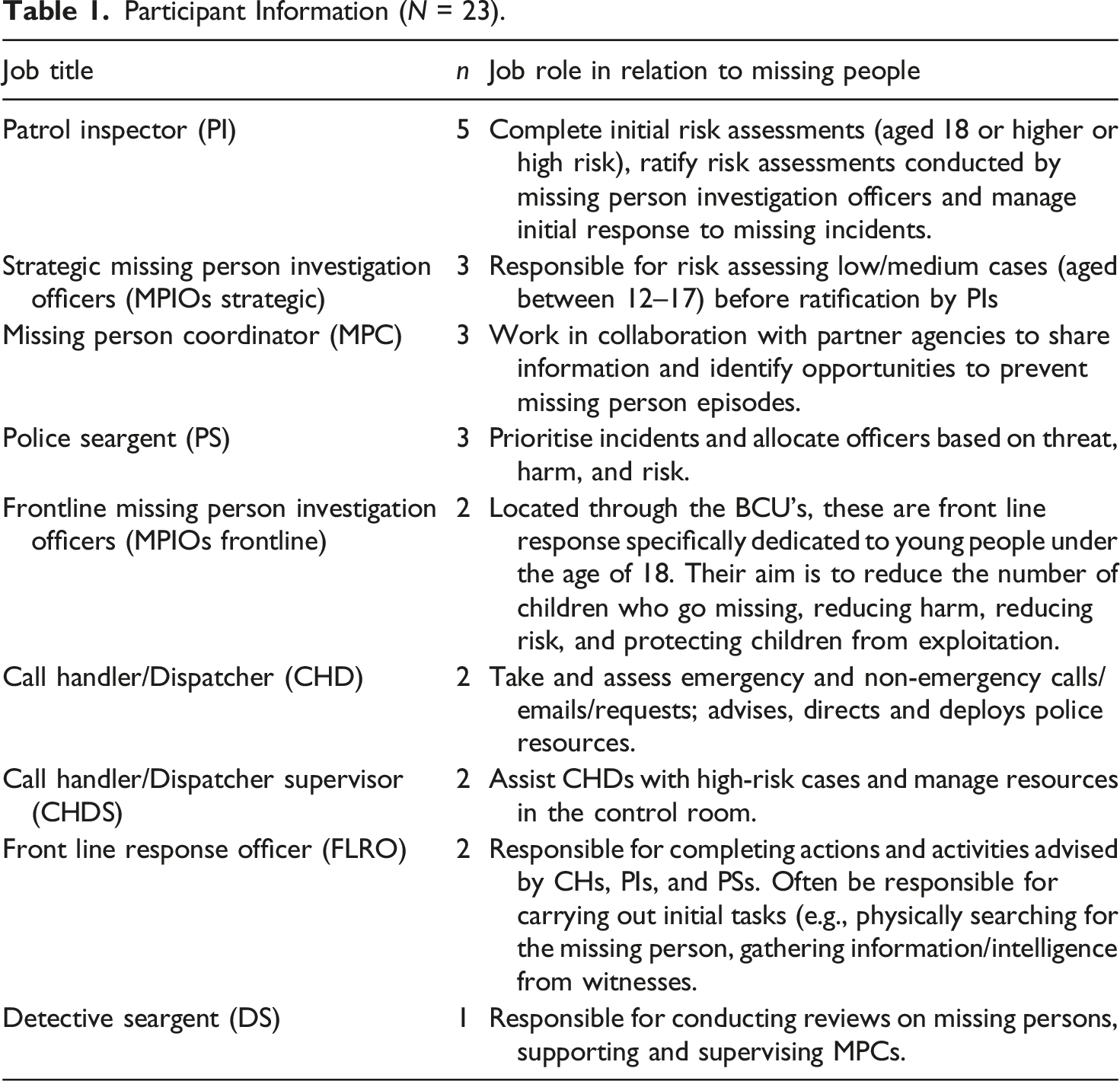
Materials and procedure
A qualitative approach was adopted to identify mechanisms facilitating and hindering multi-agency working and the conditions under which they operate (Bonell et al., 2022). As semi-structured interviews have been criticised for low validity and high risk of bias, steps were taken to improve trustworthiness (Whiting, 2008). The interview schedule was adapted from previous research (Waring et al., 2023) and developed in consultation with three experts from the force’s PPU, ensuring questions were relevant and would be understood as intended (Jacobson et al., 2005). Questions focused on understanding the broader context, including roles (e.g., What is your role in relation to missing person investigations?), the MPT and how this impacts multi-agency working (e.g., How does the Missing Persons Team impact working with other agencies?), what factors affect partnership working (e.g., What factors facilitate/hinder the ability of agencies to work together in the response to missing children?) and how it could be improved (e.g., Do you have any suggestions for how the multi-agency response to missing children could be improved?). During interviewing, the researchers also paraphrased key points and emerging codes to participants to check whether researcher interpretations reflected participants perspectives (Pessoa et al., 2019).
Interviews ranged from 45 to 94.3 minutes (M = 64.5, SD = 12.1) and were recorded using a Dictaphone. Interviews took place online (n = 17), via the telephone (n = 5), and via email (n = 1) to provide participants with flexibility.
Data analysis
Transcripts were manually transcribed and analysed using NVivo via inductive thematic analysis to facilitate a deep understanding of the data (Braun and Clarke, 2006). Given the lack of research focusing on mechanisms affecting multi-agency working in the context of missing people, thematic analysis was a good methodological fit as it is a flexible and applicable tool to derive meaning from datasets (Joffe, 2011). Thematic analysis followed the six phases outlined by Braun and Clarke (2006) and involved a systematic process of coding and theme development. Transcripts were firstly coded both semantically and latently to capture surface-level content and deeper causal mechanisms (Terry et al., 2017). Codes were grouped and iteratively refined and revised over four months to develop themes relevant to the research question.
An inter-code reliability check was conducted for robustness and external validity of qualitative findings (McHugh, 2012; O’Connor and Joffe, 2020). A second rater independently coded 10% of all quotes, codes, and themes, indicating an almost perfect level of agreement (κ = 0.937, p < .001; McHugh, 2012).
Results
Thematic analysis highlighted eight themes and six sub-themes: (i) Knowledge of what constitutes as useful intelligence; (ii) Terminology (semantic ambiguity, syntactic ambiguity, victim blaming language); (iii) Policies; (iv) Role demarcation; (v) Technology; (vi) Risk aversion; (vii) Having a dedicated resource (single point of contact, quality of risk assessment, service restructure); and (viii) The need for research.
Theme 1. knowledge of what constitutes as ‘useful intelligence’
Officers reported that multi-agency working was hindered by partner agencies limited understanding of what constitutes ‘useful intelligence’ for police purposes. As a result, information shared was frequently insufficient or excessive. For example, children were sometimes reported missing without basic information being provided (e.g., clothing at the time of missing, known medical conditions, behavioural concerns), making it difficult to assess risk and determine an appropriate response. In other cases, agencies provided irrelevant or outdated information. As a result, police needed to invest time and resources into processing all information to identify what was relevant, delaying decisions and actions.
I think there’s a difference between just sharing information, but sharing valuable information, information that we can use. Which I think they don’t always know.
They’ll tell us something of concern and I later find out after talking around that the suicide episode was years ago and isn’t even relevant for why she’s gone missing now.
Whilst the force had introduced tools such as CIFs to standardise the sharing of key details, awareness and use of CIFs varied across agencies. Officers highlighted the need to increase partner agencies understanding and consistent use of CIFs to ensure critical and relevant information is shared. And we have noticed with the CIF forms some better than others. There’s no consistency. I think a lot more understanding around the CIF because if they've got that sheet, it doesn't matter what you know or don’t know about that child, you'll have it what we need in front of you.
Theme 2. terminology
Participants frequently highlighted that inconsistencies in terminology hindered multi-agency working. Three distinct issues were identified: Semantic Ambiguity, Syntactic Ambiguity, and Victim-Blaming Language.
Semantic ambiguity
Participants described inconsistencies in how agencies defined ‘missing’, leading to confusion about when police intervention was required. While police tended to interpret ‘missing’ as behaviour that was out of character or concerning (despite ‘out of character’ no longer being part of the national definition), partner agencies often applied the term literally, reporting a child as missing whenever their whereabouts were unknown (including instances where children were marginally late returning to a local authority residence) regardless of risk or context. When I think of a missing child, I’m thinking it’s very concerning, you know its uncharacteristic, its unexpected and their disappearance is worrying […] but to other partner agencies it’s a tick box exercise. To them, it seems to be, like I said, a kind of tick box exercise when the kids in their care aren’t immediately where they are and that really frustrates us because there is no concern, no worry.
Participants also noted differing thresholds for defining ‘repeat missing’ children both within and between agencies. For some, a child was repeatedly missing if they had been reported missing more than once, whilst others would consider them repeatedly missing if they were reported more than three times. These discrepancies, often based on discretion rather than policy, have significant implications, as being identified as ‘repeat missing’ can trigger interventions to support the child. Police officers and staff suggested standardising definitions and thresholds across agencies to improve collaboration and ensure consistent access to support. I think 3 or more within a short period of time would be classed as frequent or a repeat misper, right? It can be difficult if one agency is seeing a repeating pattern and its concerning, whereas the other may not see the pattern. I think it would be great if we could all get together and really come to some sort of compromise and collectively develop a shared threshold on what it means to be missing.
Subtheme 2.2 syntactic ambiguity
Differences in specialist language also affected information sharing. Officers described delays and confusion arising from inconsistent terminology for key documents. For example, when police requested CIFs to aid risk assessment, some partners referred to CIFs by other names (e.g., STAR forms), leading to misunderstandings during information requests. Similarly, medical notes from general practitioners were often filled with technical jargon that officers struggled to interpret. This created inefficiencies, with police having to seek clarification on information they already possessed. Participants recommended building stronger relationships and engaging in more regular communication with partners to improve mutual understanding of one another’s terminologies and processes. Some people don't call them CIF forms, some call them STAR forms or whatever, so sometimes they’ll say they don’t have a CIF form. It's only later down the line they’ll realise they do have one. […] we go to GPs [...] but sometimes they just send the medical notes […] half of the things on there […] the illnesses, the issues, the ailments, the medication, […] I can’t make head nor tail of them. [...]we don’t know what any of it means, we have to often go back to the GP to try and make sense of it. we’re around them so often we pick up their lingo, they pick up ours so the issue with language only lasts so long. It’s common sense isn’t it, the longer you are around someone the more you kind of, you know, you assimilate to their way of speaking. [
Subtheme 2.3 victim-blaming language
Participants described efforts within policing to move away from victim-blaming language, particularly in relation to children who go missing regularly. Workshops encouraged avoiding terms such as ‘risky’, ‘repeat missing’, or ‘misper’, to reduce stigma. However, some officers reported this shift created uncertainty when communicating with partner agencies, feeling they had to carefully monitor their language to avoid causing offence. Several participants were concerned that strict monitoring of language could create additional tension in multi-agency contexts, particularly when officers felt they had to censor themselves. Police cautioned against excessive restriction and facilitating multi-agency discussions to standardise terms and promote self-reflection rather than censorship. So you’ll find you’re playing mental gymnastics trying to avoid using certain words as not to offend other agencies. It doesn’t necessarily change the way we think and sometimes that is worse because it can create tension between us and care homes or social workers when we slip up. We’re coming from a sense of being politically correct in a way […] We should be able to say and use words like ‘repeat misper’ without it meaning that it’s going to affect our risk assessment. […] It’s very strange because they are regularly going missing, so they are a regular misper. But we just can’t say it. I think some honest conversations need to take place between ourselves and wider agencies to comprehend how language is impacting us all.
Theme 3. policies
Participants also reported that conflicting policies across police, care homes, and social workers frequently hindered effective multi-agency working. There were discrepancies in procedures and thresholds for shifting responsibility making it difficult to coordinate action and resulting in delays and tension between agencies. Despite not officially used in missing investigations, officers described challenges enforcing the RCRP framework, which directed care home staff to conduct initial checks before reporting a child missing if the risk is deemed low. However, this contradicted lone working policies within care homes, prohibiting staff from leaving the premises, preventing both agencies from acting and delaying response. Similarly, officers noted that safety plan policies and rigid curfew rules created additional strain. Social workers were required to report children missing immediately after curfew breaches, even when no immediate risk was apparent. I said, “No, I’m not judging you. But sometimes I find it really difficult that you know this child is at risk. You’re their guardian. You're responsible for this and you just let them walk out the door at midnight.” […] and your excuse is “I’m lone working, it's my policy not to leave the premises”. It’s a waste of time trying to tell partner agencies they need to do what they can to locate the child, because it’s the same conversation “Oh I can’t I’m lone working tonight”. But they are robotic. They’ll say “Nope. Safety plan says if they're not back by 10 o’clock we’re to report him missing”.
Participants emphasised that frontline practitioners should play a greater role in shaping policies they are expected to implement, as they are best placed to identify practical challenges. Officers argued that top-down decision making often ignored operational realities, creating misalignment between policy intent and practice. I’d like for us to be part of the process to help develop decisions or at the very least be able to feed back some of the issues and have them change it, cause we’re the ones who put their decisions into practice. Sometimes a lot of these decisions are made by people a lot higher than me, and they’re not the ones on the ground, so they don’t see the teething problems.
Theme 4. role demarcation
Participants also reported a lack of clarity and shared understanding across agencies regarding police roles and responsibilities. This ambiguity often led to unrealistic expectations and tension across agencies. For example, call handlers described feeling undervalued or misunderstood by partner agencies, with their expertise not always recognised. A lack of appreciation negatively impacted motivation and willingness to collaborate. I’ve had it where care homes say to me, “Oh you’re just the call taker”. I’m not, I’m so much more than that […] they don’t value or appreciate my role. I don’t have a sense of urgency to want to work with them. It’s demoralising really.
A key frustration was also partnering agencies’ limited understanding of legal boundaries that govern police action. Officers were frequently criticised for not returning young people over 16 to care settings, despite having no legal authority to use force when the individual is deemed safe and unwilling to return. Such misunderstandings contributed to misplaced expectations and tensions. To address these issues, participants suggested developing standardised tools such as role maps to clarify powers and limitations of each agency during a missing child investigation to manage expectations. We will locate a juvenile, who is 17, and they are fine and appear safe, but they don’t want to come with us […] We don’t have the power to use that force. However, because care homes want that child back, they’ll automatically assume we’ve not done a good enough job. Years ago, a care home worker had like a document with people’s job titles and things she’d learnt about them in terms of what they could or couldn’t do. I wonder if we had a standardised template of that so we could refer to it.
Theme 5. technology
Participants reported that technology used to record and manage missing children’s cases often hindered information sharing and situational awareness within and between agencies. Officers reported having to navigate three separate systems - command-and-control system, a task management system for live incidents, and a records management database - all of which were seen as disjointed and not fit for purpose. These systems were described as holding incomplete or outdated information, frequently logging users out for updates, and failing to store information in a way that supported effective case management. As a result, officers had to cross reference all three systems to piece together a full situational assessment of a missing person, increasing the risk of key details being overlooked. Delays in retrieving or updating information within police systems had a direct knock-on effect, slowing down the flow of information to partner agencies and disrupting timely interventions. Police recommended streamlining processes by reducing the number of databases and enabling cross-agency database sharing to improve timely communication and a shared understanding of risk within- and between- agencies. Yeah, so if we’re having to scout across several systems and databases to look at information regarding a young person, especially when we’re strapped for time, […] we run the risk of missing important information […] I feel almost as if I’m waiting for something terrible to happen. When there’s delays with updating information, then that has a knock-on effect doesn’t it? You know there is a delay with passing that onto social workers. I definitely think that having everything on one place is a given for me. When it's on all these systems that's not helpful. So it'd be so helpful if, if I could just log on somewhere and see that myself.
Theme 6. risk aversion
Participants reported a culture of risk aversion, shaped by scrutiny from previous high profile child protection failures such as Victoria Climbié and Peter Connelly. Police believed this fear of scrutiny negatively impacted multi-agency working, with decisions often being guided by the need to avoid blame than by professional judgement. This resulted in defensive decision making and excessive documentation to manage such liability. Participants agreed that focusing on lessons learnt, rather than blame, would encourage practitioners to admit mistakes, promote confidence in decision making, and create more balanced approaches to managing risk. Thinking of cases like Victoria Climbié and Peter Connelly, I think it does make officers a little bit more wary We definitely do what we’re told do but again, it's ass covering, isn’t it? If we follow everything, do all the forms, then nothing can come back onto us. They [partner agencies] want to know our names, they want to speak to someone else, they’ll threaten us to say if something happens to the child it’s on our head, it’s our fault. We’ve had it all. Until you’re in a situation where you have to make a critical decision, you’ll never really understand how difficult it is. I think until that changes, until there is some sort of focus on lessons learnt, then we won’t be able to make more pragmatic decisions.
Theme 7. having a dedicated resource
All participants highlighted that having a dedicated MPT was vital to improving both intra-and inter-agency working. However, analysis revealed three mechanisms that either facilitated (single point of contacts [SPOCs], quality of risk assessments) or hindered effectiveness (service restructuring).
Subtheme 7.1 SPOC
The MPT provided a SPOC service to frontline officers, offering real time advice and support for managing missing person investigations. This improved intra-agency working by ensuring access to specialist expertise, reducing delays, and increasing officers’ confidence in navigating complex cases. Externally, the MPT also offered SPOC access to care homes that frequently reported missing incidents. While initial reports still had to go through the non-emergency reporting line (101), care homes were provided with a direct contact number for updates. This improved inter-agency working by streamlining communication, reducing waiting times and improving the accuracy of shared information. It’s great because you can have an in-person chat, […] It makes my job so much quicker when I have good understanding of who does what and why they do it. I’m not having to ring around to get help anymore. We've got a mobile phone in the office and a lot of our regular care homes are fully aware of our number […] if that person returns or they get further information instead of waiting on the phone to 101, they'll ring us and this has really improved the way we work together because we update the incident quicker.
Subtheme 7.2 quality of risk assessments
Responsibility for assessing missing children aged 12–17 had recently shifted from PIs to the MPT. Officers reported that PIs had previously struggled to complete detailed assessments due to competing operational demands, often resulting in risk assessments lacking depth and consistency. However, in contrast, the MPT had dedicated time, focus, and experience with responding to missing children, allowing for more detailed and timely assessments that strengthened safeguarding responses. The improved quality of assessments also enhanced communication with external agencies. I think we safeguard children a lot more than previously, and that’s not because the PIs weren't looking to safeguard the children, but they may not have been looking as in depth as what we do because they have didn’t have the time. It’s largely improved the quality of information of risk assessments. They [MPT] have the desk time to sit down and do this […] Patrol inspectors however have to do risk assessments among other roles which as you can imagine can impede the quality of information on that risk assessment. I think when we pick up the phone to make contact with the reporting person […] we're contacting them so quick after they’ve made that report. They know that somebody’s looking at that incident and so we have started to see improvements in the relationship between us […] [M
Although the shift in responsibility led to a rise in the number of children assessed as medium or high risk, this was viewed positively. Officers felt the specialism developed within the MPT enabled better identification of harm markers that may have previously been missed. While this increased demand on the service, it was seen as a necessary development to better safeguard vulnerable children. But that’s only something we’ve discovered [more medium and high-risk cases] since we’ve taken that on [doing risk assessments]. So, while it’s created more work for us, it is the right kind of work that the police need to deal with.
Subtheme 7.3 service restructure
However, frequent restructuring of the MPT was reported to have undermined the stability required for effective collaboration. In 3 years, the team had undergone two major restructures, creating uncertainty among officers and limiting the ability to embed consistent practice. Some officers perceived that some changes were driven by organisational ambition rather than operational need which reduced morale and ownership. This instability also disrupted relationship building with partner agencies. As soon as working relationships and communication channels were established, new changes would be introduced, creating ongoing confusion between roles, responsibilities and points of contact. This in turn made it harder to maintain trust and coordination between agencies. Participants consistently called for a period of organisational stability, which they felt was essential to embed good practice, strengthen internal processes, and develop effective working relationships with external partners. There’ll always be improvements tweaked along the way because someone’s after a promotion or something. That’s probably why the MPT aren’t getting comfortable. there’s no stability to develop a clear understanding of the team because the minute you do, it changes. Never mind trying to then develop those links with other agencies. because the team changes so frequently, I think sometimes we think what the point is developing relationships. Our roles, their roles, it could all change in a few months. it would probably be beneficial if the team was able to be stable for a while.
Theme 8. the need for research
Effectiveness in missing child responses was often measured through quantitative, demand-driven indicators, such as reductions in the number of missing child episodes, rather than through evidence of improved long-term outcomes for children. Officers expressed frustration that success was rarely measured in terms of multi-agency collaboration, and that little evidence existed to explain why certain approaches worked in practice. However, participants viewed the present study as a positive step towards addressing this evidence gap, shifting focus from counting incidents to understanding the behavioural and relational mechanisms underpinning effective multi-agency working. Interviewees welcomed continued collaboration between academics and practitioners in this field, believing that it would help to drive ongoing learning and improvements in multi-agency practice. ‘[…] it’s very demand-driven, it’s always how can we reduce the number of children going missing. We don’t look at the outcome for that child. For example, is that child better off now as a result of this framework and how can we evidence that? What is it that makes it work exactly? We never know that.’ It’s [this study’s findings] something tangible for me to say “Here, look at this independent research, we should be doing this, we should be doing that” to try and get us to work a bit better together. I’d be interested if you could keep me posted in this research because I can use this to evidence how we should be working with partner agencies for the better.
Discussion
This study explored the underlying mechanisms that facilitate and hinder multi-agency collaboration in missing child investigations, drawing on the perspectives of 23 policing professionals. Eight key mechanisms were identified: (i) knowledge of what constitutes ‘useful intelligence’; (ii) terminology; (iii) technology; (iv) policies; (v) role demarcation; (vi) risk aversion; (vii) the presence of dedicated resources; and (viii) the need for research. These findings align with previous studies on missing children (Monaghan et al., 2024; Waring et al., 2023) and with research conducted in other high-risk and uncertain environments (DeCostanza et al., 2014; Lazzara et al., 2019; Waring et al., 2018), suggesting that a core set of mechanisms consistently underpin effective multi-agency working across contexts. However, this study extends existing knowledge by providing a more nuanced understanding of the processes through which these mechanisms operate. Specifically, it moves beyond surface level explanations (e.g., ‘information was not shared’) to examine why such failures persist, even in settings where formal structures, definitions, and technological tools are already in place.
Understanding the mechanisms in multi-agency responses to missing children
Effective collaboration was found to depend on the timely exchange of relevant information (Waring et al., 2023). Consistent with studies conducted in other high-risk and uncertain environments (DeCostanza et al., 2014; Waring et al., 2018), the findings suggest that partner agencies often lack a shared understanding of what constitutes relevant information. This gap produced two contrasting challenges: either insufficient information, prompting time-consuming information seeking (Keller et al., 2020), or excessive, irrelevant detail that overwhelmed officers’ capacity to identify critical cues (Waring et al., 2018). Both patterns hindered timely risk assessment and decision-making (Waring et al., 2022).
These findings support TMS theory (Wegner, 1987), which emphasises that knowing ‘who knows what’ improves coordination. Findings also go further, emphasising the bi-directional nature of effective multi-agency communication - it is not just about knowing ‘who knows what,’ but also understanding ‘who needs what’. In effect, both knowing where to locate relevant information and what information would be relevant to share with others are important for enhancing access to timely, relevant information. Findings are the first to link inter-team theories to policing and safeguarding literature on missing children, offering a new conceptual lens for understanding persistent coordination challenges in missing children investigations. In doing so, this insight reframes much of the existing literature, often depicting knowledge sharing as a motivational failure (Kuo and Young, 2008), and instead frames it as a knowledge recognition one; a cognitive gap in understanding what is operationally useful to others.
However, effective collaboration is shaped not only by what information is shared, but also by how it is communicated. Drawing on Knowledge Boundaries theory, the findings highlight that language plays a crucial role in shaping mutual understanding. Consistent with previous research (Monaghan et al., 2024; Waring et al., 2023), discrepancies in how agencies defined key terms such as ‘missing’ or ‘repeat missing’ (semantic ambiguity; Boland and Tenkasi, 1995) resulted in fragmented responses and inconsistent thresholds for action, effectively creating a postcode lottery for service provision in which some children were perceived as ‘too risky, yet not risky enough’ (Fox et al., 2024). This was further compounded by using inaccessible, specialist language (syntactic ambiguity; Bechky, 2003), particularly medical or agency-specific terminology.
In contrast to other high-risk settings where specialist language produces disengagement (Waring et al., 2018, 2022), officers in this study reported over-engagement, spending excessive time clarifying information they already possessed. Without a shared language, agencies struggle to align their actions. Although the police had introduced inclusive-language workshops to promote shared understanding and reduce stigma (His Majesty’s Inspectorate of Constabulary and Fire & Rescue Services [HMICFRS], 2024), findings suggest that overly cautious language practices can actually lead professionals to censor themselves, making it harder to assess risk, or engage in honest dialogue, perpetuating the very issues they aimed to address (pragmatic ambiguity; Francesch and Payrató, 2024). This represents a novel contribution to the literature: previous studies have rarely considered how language reform efforts may unintentionally constrain professional dialogue. These findings therefore call for a more critical examination of the operational impact of language guidance in safeguarding contexts (Barnardos, 2024).
Taken together, these insights highlight the value of TMS and Knowledge Boundaries theories in explaining how inter-agency collaboration can be improved. Effective multi-agency working depends on both role awareness, such as knowing who possesses and who requires specific knowledge, and mutual interpretability, ensuring that information is framed in a way that is trusted, comprehensible, and actionable. Consistent with research from disaster response (Waring et al., 2018, 2022), these findings suggest that integrating multiple inter-team theories provides a more complete understanding of the barriers and enablers of collaboration in complex safeguarding environments.
Beyond communication, structural barriers such as policy misalignment were also found to undermine coordination. Agencies frequently operated under conflicting frameworks, leading to what Knaul et al. (2021, p.2) describe as ‘punt politics’, where policies are misused to deflect responsibility. Participants reported that this dynamic created confusion, delayed responses, and encouraged defensive, target-driven CYA practices (Huey et al., 2024). While risk aversion is often justified in high-stakes contexts (Heino et al., 2021), participants felt that in missing child cases it increased administrative burden without improving outcomes (Harnett, 2024). Specifically, the RCRP policy, originally developed for mental health crises (Department of Health and Social Care and Home Office, 2023), was sometimes invoked to justify inaction in lower risk missing cases, shifting responsibility to care providers. Importantly, this does not imply that all missing episodes require immediate police deployment, but rather that the scope and intent of the RCRP were perceived as being misunderstood or inconsistently applied in care settings. As the RCRP becomes more embedded in UK policing, its scope and application in missing investigations require urgent clarification to ensure alignment with safeguarding responsibilities.
Technological infrastructure also emerged as a structural barrier. Officers described needing to cross-reference multiple disconnected databases that rarely provided a reliable overview. While the intention of these systems is to improve information access and sharing, these systems often produced a ‘technology paradox’ (Powell and Casey, 2022), increasing cognitive load and procedural complexity. Technology, like language and policy, supports collaboration only when embedded in coherent, routine practice rather than adding friction to already strained processes.
Despite these constraints, dedicated resources such as SPOCs and the MPT structure were viewed as central enablers of collaboration. Aligning with TMS theory, these arrangements enhanced the visibility of expertise (‘who to ask’; Kotlarsky et al., 2015), facilitating more accurate and consistent risk assessments (Waring et al., 2023). While dedicated teams are often justified on cost-efficiency grounds (Greenhalgh and Shalev-Greene, 2021), participants emphasised that their value lay in the development of specialist knowledge and the ability to identify harm indicators that might otherwise be missed. Although this increased demand on police resources, officers regarded it as constructive demand, leading to earlier interventions and better aligned risk perceptions across agencies. However, the benefits of specialisation were undermined by organisational instability: frequent restructuring of MPTs disrupted relationships and eroded trust, as ‘who to ask’ was constantly changing. This finding mirrors broader research on policing culture, which links continual restructuring to reduced morale and a culture of career progression (Tyson and Charman, 2023) As such, without continuity, even effective mechanisms cannot embed.
Finally, participants expressed strong support for the present research, valuing its focus on frontline realities and actionable insights. Contrary to perceptions that police are resistant to evidence-based practice (Kuen et al., 2023; Palmer et al., 2019), officers described research engagement as an opportunity for learning and organisational improvement. This highlights the importance of sustained collaboration between researchers and practitioners to address systemic barriers and promote enduring improvements in multi-agency working.
Theoretical and practical contributions
Overall, the findings highlight the value of a mechanism focused analysis. Rather than identifying outcomes such as poor information sharing, this study explores why these issues persist, highlighting knowledge recognition gaps, misaligned policies, and ambiguous language as key underlying factors. Participants frequently advocated for greater standardisation through shared tools and benchmarks (e.g., common thresholds, joint training, CIFs, and interoperable databases) to reduce ambiguity. Similar proposals have been proposed more widely, with calls for a ‘benchmarking system’ to standardise information collected and exchanged between agencies (Coffey, 2014). However, these recommendations warrant caution: standardisation without contextual sensitivity risks oversimplifying complex safeguarding cases (Platt and Turney, 2014). Moreover, suggestions such as shared database access assume the existence of clean, complete data; an assumption this study challenges. Consequently, our understanding of how to improve multi-agency working in missing child investigations remains partial and as noted by Monaghan et al. (2024), often anecdotal. The key implication is that now the mechanisms underpinning collaboration challenges are better understood, future work must empirically test whether these mechanisms function as intended in real-world contexts by identifying what works, why, when, and under what conditions. By focusing on mechanisms and context, this study lays a foundation for developing, testing, and embedding more resilient partnership models for safeguarding practice.
Regarding theoretical implications, the findings support the value of TMS in explaining how information is managed and distributed across teams in missing child investigations. However, TMS assumes a baseline of shared understanding about what that information means and presumes that collaboration follows naturally once roles are clearly defined (Wegner, 1987). This study extends that theoretical perspective, demonstrating that even where role clarity exists, structural knowledge boundaries, including conflicting policies, incompatible technologies, and a lack of shared language, can still prevent effective information use (Carlile, 2002). In effect, TMS explains how information can be accessed, while Knowledge Boundaries theory explains why it is not always effectively interpreted or integrated across agencies. Together, these insights suggest that effective collaboration in missing child investigations requires attention not only to improving information sharing but also to addressing the structural and procedural barriers that prevent how such information is understood, trusted, and acted upon.
When considered alongside the wider literature on safeguarding partnerships, the findings suggest that the arrangements within the participating force reflect both progress and challenges. National inquiries and reviews consistently report persistent failures in multi-agency collaboration, including poor information sharing, unclear responsibilities, and fragmented decision making (Casey, 2025; London Assembly, 2023; Munro, 2011). While several of these challenges were also identified by participants in this study, officers described a number of active efforts to improve partnership working, including greater emphasis on information sharing and recognition of shared safeguarding responsibility. This suggests that, although the force faces many of the same systemic pressures documented nationally, there are indications that collaborative practices may be developing in a more proactive direction. Participants willingness to critically reflect on existing arrangements and their expressed desire to strengthen inter-agency working further suggests a level of organisational awareness that may place the force comparatively well in addressing these wider challenges. Taken together, these findings indicate that while many barriers to effective multi-agency working remain consistent with those identified nationally, there are also signs of emerging good practice within the participating force. This highlights the importance of continuing to examine how collaborative practices develop in operational contexts, as such insights may help inform wider improvements in multi-agency responses to missing children.
Practical recommendations for practitioners and policy makers
Findings from this study highlight that improving multi-agency collaboration in missing child investigations requires attention to both relational (e.g., information sharing, trust, and communication) and structural mechanisms (e.g., technology, policy alignment, and resource stability). The following recommendations are proposed for practitioners and policymakers:
Develop shared understanding of ‘useful intelligence’. Participants demonstrated uncertainty regarding what information other agencies found valuable, leading to both over- and under-sharing. National guidance should embed clearer standards for defining and communicating ‘useful intelligence’ across safeguarding agencies. Regular inter-agency workshops and reflective case reviews should be introduced to establish a shared understanding of what constitutes operationally relevant information. Training focused on ‘who needs what’ and ‘who knows what’ could also enhance efficiency of information exchange and risk assessment.
Create and maintain a common multi-agency language. Semantic and syntactic ambiguities generate inconsistent thresholds for action and fragmented responses. Language reform initiatives (e.g., HMICFRS, 2024; Barnardos, 2024) should be empirically reviewed to ensure that inclusive language policies do not inadvertently inhibit open dialogue or risk communication. A shared language of key safeguarding terms is needed (e.g., missing, repeat missing, risk, exploitation) that is co-produced by police, social care, and health professionals to improve mutual understanding, reduce interpretive drift, and support joint decision-making.
Enhance information systems to support coordination rather than compliance. Fragmented technological infrastructures were perceived to hinder, rather than support, collaboration. Investment should prioritise interoperability and user-centred designs, ensuring systems reduce cognitive load rather than add administrative burden. Existing databases should be integrated and designed around the workflow of safeguarding professionals to allow authorised, cross-agency visibility of key case information in real time.
Align policy frameworks and clarify responsibility boundaries. Policy misalignment led to ‘punt politics’ and defensive practices, where responsibility was shifted rather than shared. Policymakers should establish explicit protocols for when and how the RCRP applies to missing children, with input from frontline practitioners. Conducting an inter-departmental review of overlapping or conflicting policies would help to clarify operational boundaries between police, social care, and care providers.
Stabilise and sustain specialist multi-agency teams. Structural stability should be recognised as a prerequisite for effective collaboration, with funding and leadership commitment to long-term maintenance of dedicated resources such as MPTs and SPOCs. These roles enhance visibility of expertise, enable knowledge specialisation, and improve consistency in response.
Promote reflective, evidence-informed practice. Participants valued engagement with research as a route to practical improvement. Policymakers should invest in partnerships between academic institutions and police/social care agencies to generate and apply actionable evidence. Mechanisms for ongoing research-practice collaboration should be embedded to support knowledge translation and continuous learning, such as practitioner fellowships, embedded researchers, or joint learning forums.
Limitations, strengths, and future research
This study was conducted within a single UK police force, providing in-depth focus on police perspectives regarding what processes shape day-to-day multi-agency collaboration. Previous studies have taken a broader, system-wide approach that can overlook the detailed processes that influence how collaboration works in practice (Monaghan et al., 2024; Waring et al., 2023). That said, this study only captures part of the picture in focusing on the perspectives of police. As previously noted, multiple agencies are involved in the response to missing children and understanding what underlying mechanisms facilitate and hinder multi-agency working within this context also requires focus to be directed toward the views and experiences of these partner agencies. Accordingly, the research team is conducting a follow-up study with partner agencies to build a more complete understanding of how collaboration is experienced across roles. This matters because effective responses depend on alignment across all agencies in missing children’s investigations.
Another point to note is that mechanisms highlighted in this study to improve multi-agency approaches have not been tested for their effectiveness. Focus is now needed on testing whether these mechanisms improve multi-agency collaboration, evidencing their impact on key outcomes such as harm and demand (Monaghan et al., 2024).
Despite these limitations, the study also has several strengths. In particular, it provides direct insight into the experiences of police officers investigating missing children, offering valuable practitioner perspectives from a specialised and often difficult to access area of policing.
Conclusion
This study identified eight mechanisms shaping multi-agency collaboration in missing child investigations: (i) knowledge of what constitutes ‘useful intelligence’; (ii) terminology; (iii) technology; (iv) policies; (v) role demarcation; (vi) risk aversion; (vii) the presence of dedicated resources; and (viii) the need for continued research. While these mechanisms mirror challenges reported in other emergency and high-risk contexts, this study offers a more granular understanding of the specific processes through which they operate in safeguarding practice. The findings challenge assumptions that information-sharing failures arise primarily from a lack of effort or willingness; instead, they point to deeper cognitive, linguistic, and structural barriers that constrain effective collaboration. The integration of TMS and Knowledge Boundaries theories provides a valuable conceptual lens for understanding how collaboration can break down despite formal structures and shared intentions. Together, these insights offer a framework for advancing both research and practice, emphasising the need for clearer shared procedures, role mapping, standardised terminology, cross-agency learning opportunities, and better-aligned technological infrastructures. Future work should move beyond prescribing ‘best practice’ and instead empirically test how, why, and under what conditions specific mechanisms support or hinder collaboration. By doing so, researchers and practitioners can begin to develop more resilient, context-sensitive approaches to multi-agency safeguarding.
Footnotes

Funding
The authors disclosed receipt of the following financial support for the research, authorship, and/or publication of this article: This work was supported by the North West Social Science Doctoral Training Partnership (ES/P000665/1) which is contributing towards a PhD in Psychology from the University of Liverpool for PM who is supervised by SW, SG and FO.
Declaration of conflicting interests
The authors declared no potential conflicts of interest with respect to the research, authorship, and/or publication of this article.
Data Availability Statement
The data that support the findings of this study is anonymised, due to the agreement with the police force raw transcripts are not available.