



Abstract
Introduction
Missing persons cases have long been present in police work, with estimated annual rates per 100,000 population ranging from 140 in Australia (Bricknell and Renshaw, 2016), and 158 in the Netherlands (Lam and Kop, 2023) to 176 in the United States (FBI, 2020) and 435 in the United Kingdom (National Crime Agency, 2022). In an era of global austerity, the magnitude of these cases and the complex conditions contributing to them place considerable financial and operational pressure on the police. As a result, various police forces have developed a series of strategies to balance response efforts within finite resources (Greenhalgh and Shalev Greene, 2021). Yet, research into the approaches used by the police to investigate missing persons cases remains limited. Most empirical evidence is fragmented across various sources, hampering a cohesive understanding of what works for officers in managing these incidents effectively. Accordingly, the following scoping review seeks to critically summarise existing research and identify gaps in knowledge by adapting the EMMIE framework, a realist-inspired evaluation tool applied to crime prevention and security interventions (Bowers et al., 2018; Johnson et al., 2015). The aim is to provide a realistic assessment of what is currently known about the outcomes, causal chains (mechanisms), contexts (moderators), implementation considerations and economic costs of police approaches that have been used to improve missing persons investigations.
Police response to missing persons incidents
In the UK, the Professionalising Investigation Programme launched in 2003, marking a significant acceleration in the development of various policies and practices in missing persons investigations. Building on this foundation, the Association of Chief Police Officers (ACPO) published its official policy guidance in 2005, documenting standardised procedures for recording, managing and investigating missing persons cases. Following this publication, some police forces in other high-income countries (e.g., Australia and Canada) gradually developed similar standardised procedures, with this guidance — and its 2013 update — becoming a key reference point in UK and international literature (Ferguson and Huey, 2020; Garcia Barcelo et al., 2020; Halford, 2024; James et al., 2008).
In most developed countries, initial police response primarily aims to clarify the circumstances of disappearance and assess the risk of harm to or from the missing person (Ferguson and Sidebottom, 2022; Fyfe et al., 2015a; James et al., 2008). As investigations progress, officers may use various tools and technologies alongside standard investigative work (e.g., reviewing police data files, interviewing friends and families). These include, but not limited to, social media platforms for public engagement (Solymosi et al., 2020), police trained dogs, search and rescue teams (Ferguson et al., 2021; Woidtke et al., 2018), unmanned aerial vehicles (UAVs) and advanced DNA profiling methods (Ewers et al., 2023; Tillmar et al., 2021). However, according to Fyfe et al. (2015a), the effective implementation of these tools and tactics during the investigative and searching procedural workflow may be constrained by: (a) the subjective evaluation of the validity and reliability of the information provided; (b) the uncertainty around whether missing persons might return without notifying the police; (c) the pressure from families to pursue unconventional methods (e.g., psychics); (d) the presence of misinformation in public appeals; and (e) officers’ concerns about reputational risk, often resulting in a tendency to “wrap a case up [and] say I have done all I can” (p. 422).
At the end of investigations, officers conduct safe and well checks, and, in some cases, carry out more in-depth return home interviews to manage safeguarding risks, practices that are commonly followed in the UK [Harris, 2019; The Office for Standards in Education, Children’s Services and Skills (Ofsted), 2013]. It is worth noting that some UK forces have also established specialised teams aimed at enhancing risk assessment procedures and fostering productive collaboration with partner agencies (Waring et al., 2023). Notwithstanding these advancements, the circumstances under which these approaches succeed or fail and the mechanisms driving their effectiveness remain ambiguous.
In a first attempt to consolidate evidence on what works in police response to missing persons cases, Giles (2017) conducted a rapid evidence assessment focusing on police approaches to reducing harm to missing persons, mitigating the demand created by repeat episodes and lessening the impact of high-demand locations. However, this pioneering study relied on a single database, limiting the scope of its findings. More recently, Monaghan et al. (2024) conducted a comprehensive scoping review, specifically focusing on understanding what works in improving multiagency collaboration in the response to missing children. Despite these contributions, further work is needed to develop a comprehensive understanding of which policing approaches effectively address the needs of missing persons enquiries, under what circumstances and in what way. This fragmented evidence base makes it difficult for policymakers and the police to draw on evidence to inform strategic and operational planning.
Addressing this complex gap requires not only identifying effective police approaches but also explaining the factors that generate diverse outcomes in missing persons investigations. On most occasions, the outcomes of complex police interventions depend on the underlying mechanisms linking the events of these interventions and the context in which these causal relationships unfold (Pawson et al., 2005). Consequently, in selecting the most promising practices, police forces need to consider Context-Mechanism-Outcome (CMO) configurations to understand the core processes that drive change in the contexts they operate in (Bowers et al., 2018). Against this background, this scoping review adopts a realist approach to synthesise available evidence through the CMO philosophy (Pawson and Tilley, 1997), highlighting the conditions and circumstances police practices take place that help explain the observed effects in missing persons incidents.
Policymakers and police decision-makers may also wish to understand the resources required and associated costs. Accordingly, this scoping review operationalises the CMO philosophy through a realist Effect, Mechanism, Moderator, Implementation, and Economic costs (EMMIE) approach (Johnson et al., 2015). The EMMIE model seeks to help practitioners and policymakers gain a more structured and holistic knowledge of the quality of available evidence (Bowers et al., 2018), to make more informed decisions regarding whether the quality of evidence is sufficient for shaping policy and practice (Sidebottom and Tilley, 2022). Following the failure and termination of the Home Office Crime Reduction Programme in 2002, the UK Cabinet Office launched the What Works Centre for Crime Reduction in 2013, lodged in the College of Policing (CoP) (Tilley and Laycock, 2018). As part of this initiative, the academic consortium at the Jill Dando Institute of Crime Science, University College London developed the EMMIE model to initially evaluate literature reviews in the field of policing and crime reduction (Bowers et al., 2017; Sidebottom et al., 2017). Following the recommendations of the creators of EMMIE that the model could guide and inform the conduct of future primary and secondary studies (Johnson et al., 2015), it has since gained wider applicability across various domains (e.g., child social care, policy formulation) and research designs (e.g., scoping reviews) (Groci et al., 2022; Stabler et al., 2021). In our scoping review, the EMMIE model is adapted to comprehensively assess the evidence on police approaches in missing persons investigations as well as identify knowledge gaps.
Objective
The objective of this scoping review is to critically analyse and summarise the evidence related to police practices and policies used in missing persons investigations. Drawing upon the EMMIE framework, this review will address the following research question: What are the effects, mechanisms, contextual factors (moderators), implementation considerations, and costs of police approaches that have been used to improve missing persons investigations? The findings are expected to provide context-specific knowledge to aid policymaking discussions, identify key areas for improvement, and guide scholars and practitioners in determining where further research is needed to inform future practice in the field of missing persons.
Methods
The Preferred Reporting Items for Systematic Reviews and Meta-Analyses Extension for Scoping Reviews (PRISMA-ScR) reporting checklist and guidelines (Tricco et al., 2018) were adopted to ensure a comprehensive reporting of the methodological framework (Arksey and O’ Malley, 2005).
Protocol and registration
This scoping review was conducted following a publicly available protocol registered on the Open Science Framework (Chatzisymeonidis et al., 2024).
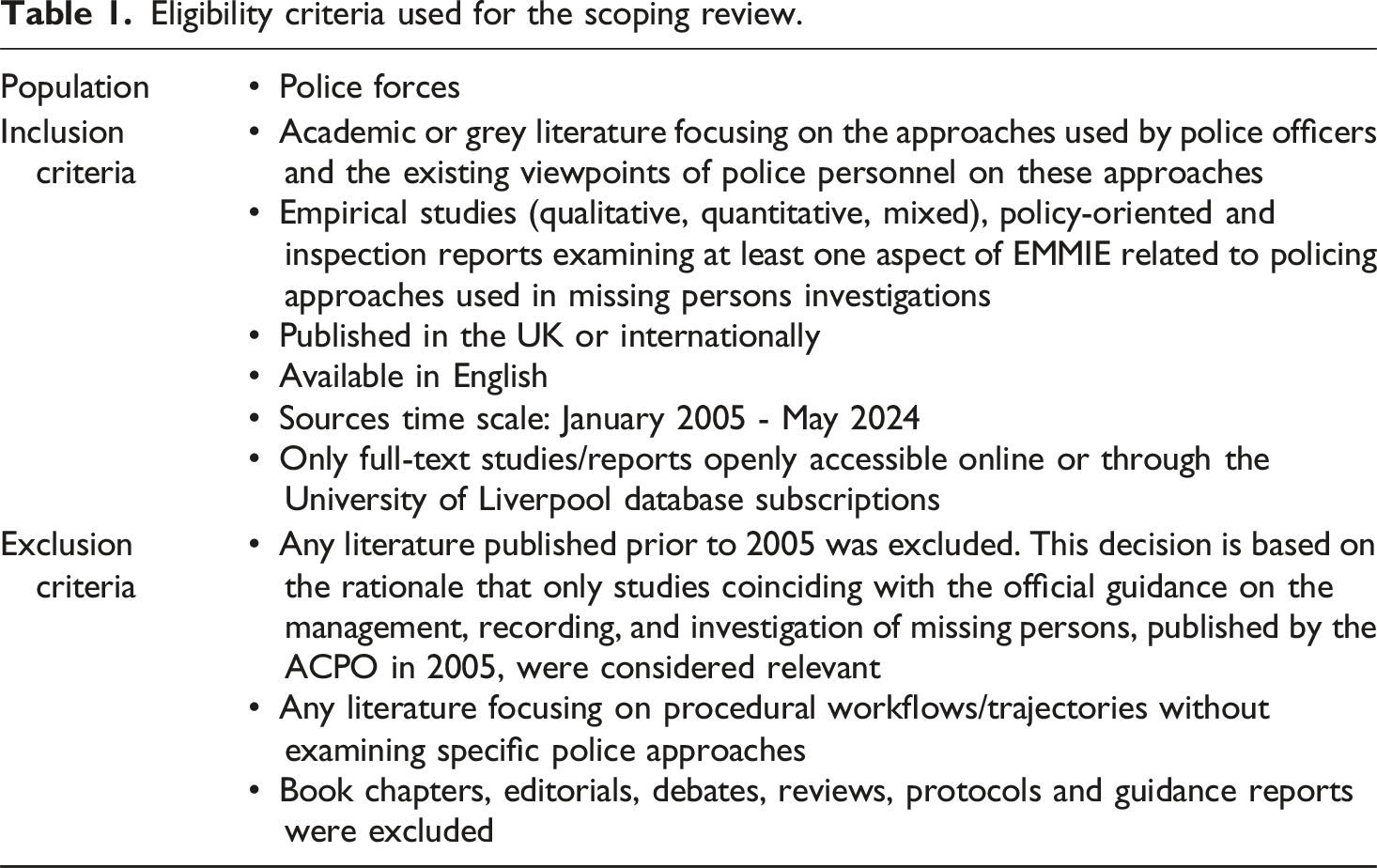
Eligibility criteria
Eligibility criteria used for the scoping review.
Information sources
Given the multidisciplinary nature of police strategies for missing persons enquiries (e.g., psychology, sociology, criminology, public policy), the following electronic databases were searched from January to May 2024: APA PsycInfo, Emerald Insight, Science Direct, Scopus and Web of Science. Grey literature sources were identified through relevant websites (Please see Supplemental Material 1). In addition to the above databases, four journals specialised in the study of law enforcement institutions were searched: Cambridge Journal of Evidence Based Policing, European Journal of Criminal Policy and Research, Journal of Search and Rescue and Police Journal: Theories, Practices and Principles. Reference lists of included papers were further reviewed for relevant sources.
Considering the limited research available on this subject and its implications for shaping police policy and operational strategies, formal Freedom of Information (FoI) requests were sent to Police Scotland and 39 police forces in England and Wales. This standard procedure allows access to publicly controlled data (Teixeira and Tsigaris, 2023), enables comparisons of evidence on a research subject across multiple public authorities, such as the police, and facilitates triangulation with evidence from other sources, thereby enhancing the validity of the findings (Savage and Hyde, 2012). Responses were received from Police Scotland and 35 forces (89.7% response rate). However, only Police Scotland provided relevant information following consultation with a police sergeant specialising in missing persons investigations. The remaining forces either did not possess the requested information or provided internal professional practice guidance reports, which did not meet the inclusion criteria for this study. Importantly, no police force provided relevant evidence concerning widely used protocols, such as the Herbert Protocol and the Philomena Protocol.
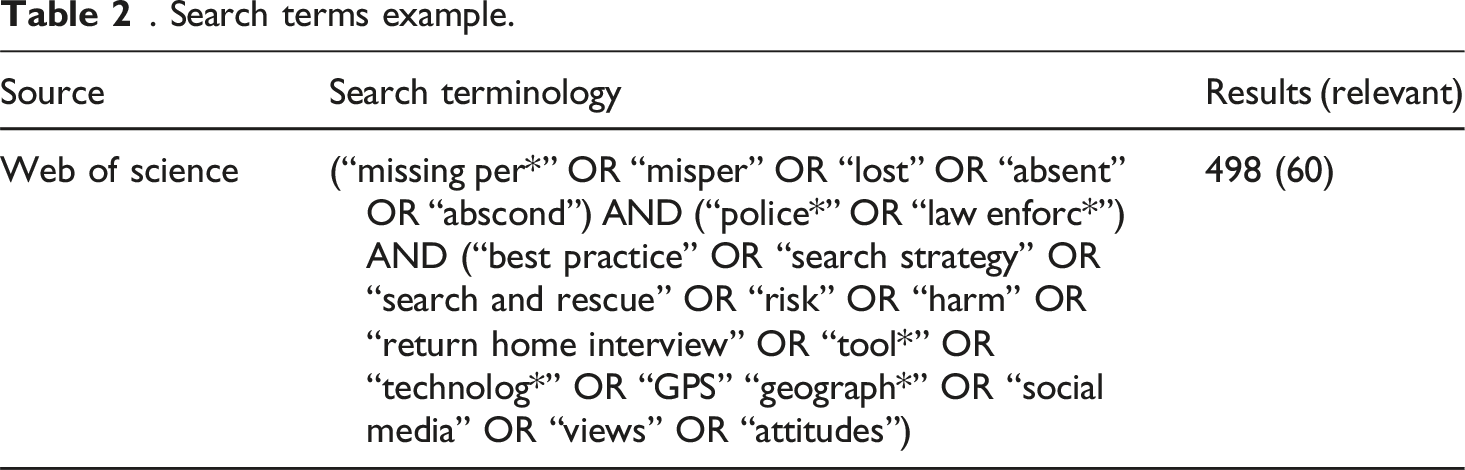
Search strategy
. Search terms example.
Selection of sources of evidence
Data extraction followed the guidance of Peters et al. (2020) for methodological transparency. The process was conducted in two stages. First, SC screened the titles and abstracts of retrieved studies. Papers primarily focused on police procedural workflows/case trajectories (e.g., Bennett and Ferguson, 2022; Fyfe et al., 2015a, 2015b; LePard et al., 2015) were excluded at this stage, as they did not examine specific strategies such as investigative methods and tools, search tactics, or safeguarding interventions. While these studies provided valuable insights into the cultural, structural, and organisational intricacies of missing persons investigations (e.g., decision-making processes, case trajectories, organisational challenges), they fell outside the scope of this review, which aimed to critically analyse and summarise specific policing approaches. Second, SC reviewed 36 papers that passed initial screening, assessing them against the eligibility checklist. Subsequently, SG independently evaluated these papers, resulting in 91.7% agreement with SC. Discrepancies in three academic sources were resolved through discussion and consensus among the authors, resulting in their exclusion due to their lack of focus on investigative implications.
Data extraction
Data was summarised into a charting table, organised under the following heading categories: (i) references, (ii) country, (iii) methods, (iv) study aims, (v) sample, (vi) EMMIE criteria and (vii) summary findings. For further details, please see Supplemental Material 3.
Critical appraisal of individual sources of evidence
Although critical appraisal is optional for scoping reviews (Tricco et al., 2018), the sources quality was assessed to ensure the value, trustworthiness, and the relevance of the evidence (Burls, 2015), analysed using the EMMIE dimensions. The review used the Mixed Methods Appraisal Tool (MMAT) version 2018 (Hong et al., 2018) to assess the robustness of evidence across academic sources, while the Authority, Accuracy, Coverage, Objectivity, Date, and Significance (AACODS) checklist (Tyndall, 2010) was applied to critically appraise grey literature, as both tools are designed for this purpose (Pluye and Hong, 2014; Tyndall, 2008) (Supplemental Material 4). No sources were excluded based on quality assessment; these tools were instead used to assess the strengths and limitations of the available evidence.
Synthesis of results
A sorting methodology was used to identify narrative review data themes. Each study was read, summarised, and finally sorted into seven inductive themes (Braun and Clarke, 2006) that reflect key approaches used by the police to handle missing persons incidents: (i) Adopting ‘missing’ and ‘absent’ in risk assessment for proportionate response, (ii) Risk assessment and management plans, (iii) Safeguarding measures at the point of location or return, (iv) Partnership working with local agencies and young people, (v.) Aid tools and search strategies, (vi) Establishing dedicated teams, and (vii) Legislative Acts & measures. EMMIE dimensions are discussed within each theme to organise the evidence in a more structured and holistic way. This method may help researchers and practitioners develop a comprehensive understanding of how and why interventions work in particular conditions, the resources required and their associated costs. To ensure the reliability of the thematic sorting process, an independent researcher sorted a sample of 10 papers into the identified themes, achieving 90% agreement with the primary reviewer, indicating strong consistency in classification.
Results
Selection of sources of evidence
A comprehensive overview of the numbers of records screened, assessed for eligibility and finally included in the scoping review is presented in the PRISMA flow chart (Figure 1). Prisma 2020 flow diagram illustrating the study selection process for databases, registers and other sources.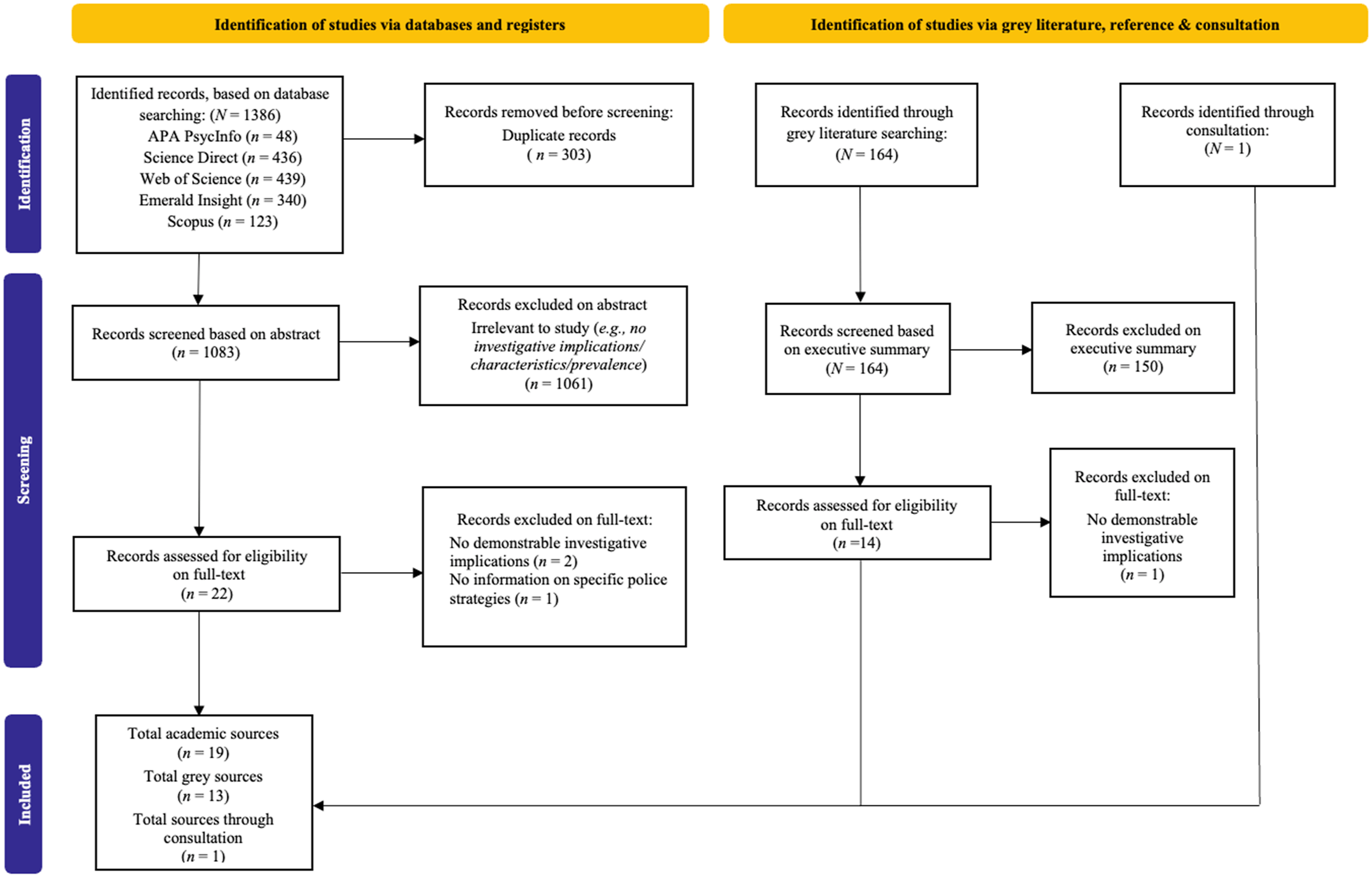
General characteristics of sources of evidence
A total of 33 papers met the eligibility criteria: 19 identified via databases, 13 via grey literature and one via consultation. Most studies were conducted in the UK (N = 23), followed by Canada (N = 4) and Europe (N = 4; Belgium, Germany, Sweden, The Netherlands), and one each from Australia and China. Data collected using quantitative (N = 11), qualitative (N = 9) and mixed methods (N = 13). When mapped onto the EMMIE framework, most studies focused on factors related to the implementation criterion (N = 26) followed by several studies reporting evidence for the effects (N = 16) and mechanisms (N = 12). Five studies produced information related to the moderators (N = 5), while only one study assessed the cost of a police approach to missing persons enquiries.
Adopting ‘missing' and ‘absent' in risk assessments for proportionate response
To ensure a more proportionate initial police response, the ACPO introduced the definition of ‘absent’ alongside ‘missing’ in the risk assessment process for missing persons cases, aiming to prevent the automatic deployment of officers to every incident. Nine sources examined the adoption of these definitions from different perspectives. One source reported positive outcomes, while the remaining eight raised implementation concerns—six of which focused exclusively on ‘absent’, one on ‘missing’, and another on both definitions.
In 2011, the CoP launched a pilot risk assessment scheme in three UK police forces. Based on an initial response model previously implemented by Sussex Police without formal evaluation but with positive feedback, this scheme introduced the terms ‘absent’ and ‘missing’ to re-determine urgency and optimise resource allocation. Bayliss and Quinton (2013) evaluated this scheme using a mixed-methods research design and found that adopting these definitions resulted in an 18% decrease in police responses (saving 200 shifts), despite public calls for service remaining the same or increasing over a 3-month period. Officers’ perceptions supported the positive effect, with many reporting more time for proactive patrols and managing high-risk cases.
The literature brings to light key factors that must be considered when classifying cases as ‘absent’. A mixed-methods study by Shalev Greene and Pakes (2013) identified training and supervisory support as critical facilitators for its effective implementation, but officers’ doubts about practicality hinder consistent application. McIver and Welch (2018) interviewed police officers in Scotland, who argued that the ‘absent’ category was underused, attributing the issue to local partners, while an online survey by Smith and Shalev Greene (2015) revealed that, in England and Wales, concerns over accountability for negative outcomes —stemming from perceived risks of harm managed by the police— limit its use. Reports from All-Party Parliamentary Group (APPG) and Her Majesty’s Inspectorate of Constabulary (HMIC) highlight further inconsistencies (APPG, 2012, 2016; HMIC, 2016). HMIC (2016) documented varying practices related to minors, such as limiting ‘absent’ to looked-after children, excluding younger children, or omitting the term due to unclear guidance (APPG, 2016). APPG (2012) also pointed out the lack of independent evaluations of relevant pilot programmes. APPG (2016) underscored troubling cases where children classified as ‘absent’ by some forces—such as those contactable by phone or frequently missing—were at risk of grooming or exploitation, while inconsistent time frames for applying ‘absence’ (ranging from six to 72 h) further complicate the issue. Mixed methods research by Sturrock and Holmes (2015) further noted that the police often misclassify children involved in gangs as ‘absent’, ignoring crime and exploitation risks.
HMIC (2016) identified inconsistency as a key barrier to implementing the ‘missing’ category, with 39 forces using the standard ACPO definition, one expanding it, and four not applying it at all. Similar inconsistencies were observed in defining ‘repeat missing’ and ‘long-term missing’, with some forces omitting these terms. Reflecting this lack of uniformity, a qualitative survey by Shalev Greene et al. (2019) revealed that some officers stressed the need for a clear time element in the definition. The study also indicated that officers’ geographical location influenced their views on the suitability of ‘missing’, with negative perceptions in Northern Ireland and England but with favourable views in Wales. This suggests that regional context may affect the acceptability of the term in practice.
Risk assessment & management plans
Nine sources examined the risk assessment process used by UK police forces to classify the potential harm and urgency of missing persons cases. Three of these sources documented the outcomes of this approach. One of them also explored how it produces its effects, while another two offered insight into both the observed effects and the moderators that may influence them. The remaining six sources discussed implementation considerations.
Analysing data from Lancashire Constabulary, Phoenix (2017) showed that risk classification significantly affects resolution time, with high-risk cases more likely to be resolved faster within 24 h compared to medium and low-risk cases. Nonetheless, after 24 h, medium-risk cases are resolved faster, highlighting time as a contextual factor in resolution speed. Using the same data, Phoenix and Francis (2023) suggested that the risk classification system of that force -based on the ACPO (2005) checklist-is effective at predicting harmful outcomes but requires improvement, as 2.9% of standard/medium risk classified cases resulted in harm. The authors also investigated how this process works in practice, demonstrating that age, gender and certain items of this checklist are strong predictors of both high-risk classifications and harmful outcomes. Similarly, Doyle and Barnes (2020) using data from Devon and Cornwall Police found that 11% of high-risk classified cases result in harm compared to 2.6% of medium/low risk classified cases. The authors also claimed that 59% of harmed missing people had been misclassified as medium/low risk (false negatives) instead of high risk, reinforcing the need for further refinement of this approach. The study further indicated that age and gender moderate the likelihood of harm.
As regards what may be liable to impede the implementation of risk assessments, in both surveys by Smith and Shalev Greene (2014, 2015), knowledge of risk definitions emerged as a key factor with many officers lacking an understanding of risk-related terminology. A thematic inspection report by Ofsted (2013) along with Smith and Shalev Greene (2014, 2015) identified several organisational barriers, including insufficient support from line managers, lack of consultation with senior officers on the operational application of risk assessment and inadequate training in risk-related decision-making. Smith and Shalev Greene (2014) also discussed that the lack of flexibility in updating risk assessments hindered the responsiveness of classification systems, with many officers failing to revise assessments as investigations progressed. Subjectivity in assessments also remains persistent, emphasising the need for a more structured and standardised approach as noted in APPG (2018), Smith and Shalev Greene (2014) and a mixed-methods study by Chetwynd and Pona (2017). Additional barriers included the absence of empirical validation for risk assessment questions (APPG, 2018), limited information sharing on missing persons’ vulnerabilities and agreed actions (Chetwynd and Pona, 2017; Ofsted, 2013) and inadequate awareness of prior victimisation or exploitation (Shalev Greene and Pakes, 2013). Nevertheless, certain measures could facilitate risk management. For instance, timely mental health consultations for missing persons who may suffer from mental health problems, already adopted by 22 UK forces, were noted as beneficial (APPG, 2018). The involvement of children (previously reported missing) in revising their risk assessments and management plans is accentuated by Ofsted (2013), ensuring that the process is aligned with their age and understanding. Standardised protocols, such as using specific questions by most call handlers, have also contributed to improving consistency in risk evaluations (Shalev Greene and Pakes, 2013).
Safeguarding measures at the point of location or return
In the UK, once the whereabouts of a missing person are established, officers proceed with certain safeguarding measures, namely safe and well checks (SWCs), return home interviews (RHIs), and return discussions (RDs). SWCs involve debriefing the missing person to determine if they have suffered harm, been a victim of crime, and to ensure their immediate safety and welfare. RHIs are more in-depth interviews designed to understand why the person went missing, identify their support needs, and consider measures to prevent future incidents. In Scotland, RDs, a specialised form of RHIs, involve an interagency approach to debrief missing persons with dementia and inform families about available support services. Across six sources examining these measures, one explored all EMMIE dimensions in relation to RHIs, another focused on the effects and mechanisms of RDs, and four discussed implementation considerations—three for RHIs and one for SWCs.
With respect to the effects of this police approach, the studies indicated positive outcomes depending on the specific safeguarding measure. Burgess et al. (2010) evaluated two pilot RHI models in Aberdeen and Elgin and found greater impact in these areas compared to the control area (Fraserburgh) particularly in terms of the quality and depth of information collected by Police Scotland. Additionally, a mixed-methods report by Petillo (2023) documented the positive impact of RDs in Edinburgh, with a decrease in missing episodes (from 104 to 92) and a 37.5% reduction in repeat episodes. However, the outcomes of SWCs are yet to be explored.
According to officers’ claims in Burgess et al. (2010), the positive impact of RHIs stems from their underlying mechanism: these interviews act as a gateway, helping the police establish direct communication with young missing persons, identify issues they may face, and refer them to social care if additional support is required. Although both models performed well, they encountered practical challenges due to pre-existing contextual variations between the two areas (size, resources, number of runaways and multiagency processes). Consequently, the report advocated that the overall success of these models depends on their adaptability to local circumstances rather than on their design alone.
Furthermore, the successful outcomes of RDs, as noted by Petillo (2023), were attributed to a data-sharing agreement between Police Scotland and Alzheimer Scotland, allowing dementia advisors to access police reports, arrange discussions with the involved families, debrief them, and update return discussion forms. These forms are then stored in the police’s vulnerable persons database for future reference and support. Notably, no evidence was found regarding the mechanisms and contextual factors associated with SWCs.
In terms of how SWCs and RHIs are implemented in practice, confusion in terminology was noted by APPG (2018). The report stressed that the terms ‘SWC’, ‘return interview’ and ‘prevention interview’ are often used interchangeably across forces, without clarity on the specific questions that should be asked or the intelligence-gathering practices to be followed. Simultaneously, RHIs are conducted under contradictory conditions: while UK legislation mandates interviews for all children within 72 h, current policy limits them to high-risk cases, as reported in a mixed-methods survey by Harris (2019). Both this survey and another conducted by Harris and Shalev Greene (2016) spotlight that officers receive insufficient training, with many being unaware of national missing persons policies, which undermines RHI implementation. Despite these ambiguities and challenges, APPG (2018) argued that the attendance of mental health practitioners in prevention interviews —if a person returning is suspected of having mental health problems— facilitates the safeguarding procedure for the police, as their expertise enables them to identify concerns and make appropriate referrals for further assessment.
Acceptability challenges of RHIs are identified in Harris (2019), where officers express their negativity toward relevant training and perceive missing persons as outside their remit, supporting recommendations by some English forces to shift responsibility to independent agencies (APPG, 2018). Critics of RHIs argue that they are ineffective for some adults and that children often disengage from the process, limiting their utility (Harris and Shalev Greene, 2016). As cited by Harris (2019), officers with such perceptions are less likely to prioritise RHIs for repeatedly missing children. The author identified considerable disparities in prioritisation with respect to officers’ gender, training, education, and experience. For instance, experienced officers in interviewing tend to prioritise first-time missing persons, while less experienced officers focus more on children. Nonetheless, Burgess et al. (2010) contend that police are best suited to conduct RHIs due to their role as first responders with rapid access to crucial information. This partially aligns with Harris and Shalev Greene (2016), who found that female officers prefer police-led RHIs, but male officers favour involvement from parents, guardians, or non-police workers such as NHS or social workers due to their healthcare expertise.
Beyond RHIs, SWCs also face implementation challenges. Ofsted (2013) documented that UK police forces frequently failed to adhere to statutory guidance related to these checks, with inadequate information sharing about their content and outcomes among relevant professionals. As a result, these checks rarely informed case planning. Furthermore, the report noted that many SWCs were either not completed or were not evident in case file records. In addition to these issues, concerns about the acceptability of this practice were reflected in divided views among police forces regarding its usefulness. These concerns were largely attributed to the lack of sensitivity and awareness of uniformed personnel assigned to this task.
Economic evidence is provided only in Burgess et al. (2010). The authors estimated RHIs costs drawn on the salaries of police officers and found that, in Elgin, the cost per RHI was £123.34 compared to £207.69 in Aberdeen. The notable difference is largely due to variations in stuffing and workload distribution. In Elgin, the interviews were conducted by several Community-Based Officers, whereas the Aberdeen model involved a dedicated team with two full-time interviewers and a coordinator, leading to higher staffing costs.
Partnership working with local agencies & young people
Across six sources, partnership working emerged as a crucial police strategy for safeguarding vulnerable children and young persons who go missing either once or repeatedly. Of these, two sources discussed effects, mechanisms and implementation considerations of this approach, one focused on both mechanisms and implementation, and three solely on implementation.
In their 2018 evaluation report, McIver and Welch indicated that a national partnership agreement between Police Scotland and local authorities in Edinburgh, Dundee and South Lanarkshire reduced the missing incidents from children’s homes participating in the pilot. Additionally, Ofsted (2013) found that an evaluation of an operational group in Hertfordshire—chaired by the police and involving social services—yielded successful effects. Specifically, 43% of high-risk missing incidents reviewed by the multi-agency action group did not result in repeat episodes, while 12% involved one repeat episode.
Collaborative work between the police, partner agencies and young people who go missing appears to hinge on underlying processes that work as causal chains leading to positive outcomes. For example, McIver and Welch (2018) concluded that the reduced frequency of missing reports was not only connected to improved collaborative relationships between the police and local agencies but also to a relationship-building mechanism established by officers with young people. This involved offering contact numbers and visiting children’s homes, thus strengthening ongoing engagement beyond formal meetings. Additionally, APPG (2012) noted that partnership working is mirrored in the Multi-Agency Safeguarding Hubs (MASH), where the police collaborate with professionals from partners agencies. These hubs operate through centralised case management, facilitating real-time information sharing and enabling prompt responses to prevent risks when vulnerable children go missing (APPG, 2012; Ofsted, 2013).
In relation to how partnership working is applied, the findings show several barriers and facilitators to success. Among the challenges, one officer in the mixed-methods report by Missing Children Europe (MCE, 2016) points out that MASH structures vary widely and are not available across all UK forces. Sturrock and Homes (2015) report that officers lack direct access to information previously recorded by social workers in local services, a problem further exacerbated when these services are closed, as no multi-agency system exists to allow real-time information sharing. This gap hinders officers’ ability to respond swiftly and accurately, particularly in cases involving missing children engaged in criminal activities. Ofsted (2013) identifies further structural problems, such as poor coordination and insufficient prioritisation of critical issues raised by missing children (e.g., in one case, recurring missing episodes were not effectively addressed in multi-agency meetings due to the absence of an updated risk management plan, inadequate follow-up, and a lack of targeted interventions).
Notwithstanding these barriers, police missing person coordinators have been a key facilitator of partnership working in the UK. Acting as local borough-based focal points of contact, they build rapport directly with young people and streamline information sharing between agencies (Harris, 2019), while reviewing daily information to identify trends or initiate referrals to social services (APPG, 2012; Sturrock and Holmes, 2015). The value of co-located agencies is highlighted by Ofsted (2013) which specifically notes that seconded social workers within UK police safeguarding units enhance real-time communication, expand capacity, and ensure timely responses. Furthermore, multi-agency training has been shown to improve officers’ understanding of the vulnerabilities and risks faced by looked-after children, foster adherence to cooperation protocols and strengthen the effectiveness of collaborative interventions (APPG, 2012; McIver and Welch, 2018). Lastly, MCE (2016) argues that cooperation protocols between the police and partner organisations, such as the 116,000 hotlines across Europe, bolster partnership working by offering clear guidelines on task allocation, information sharing, and care plans for cases involving migrant children.
Aid tools & search strategies
Eight sources shed light on the tools and search tactics that have advanced missing persons investigations. The focus is distributed as follows: two sources presented evidence on effects, mechanisms, and implementation; two explored effects, moderators, and implementation; one discussed both effects and mechanisms; one addressed mechanisms and implementation; one focused solely on implementation; and one exclusively on effects.
Tsoi et al. (2018) argue that media release through social media platforms may be a particularly effective strategy for police forces when searching for people with dementia who go missing. The authors analysed 199 original Twitter X posts using a retrospective case-control design and produced promising findings. Specifically, they found that the time to locate individuals with dementia was significantly shorter when the original tweets were posted by the police on the platform and included photos, especially for those aged 80 and above. Complementing these findings, police officers interviewed by Neubauer et al. (2021) in Ontario, Canada, suggest that police media releases may disclose a dementia diagnosis only after receiving family consent, which could act as a mechanism by generating public sympathy that mobilises more community members to assist in the search. The study also demonstrates barriers that should be considered when implementing this police strategy. Limited access to social media accounts at the local unit level, where some police services maintain only a single regional account, restricts timely posting of releases. In these situations, local traditional media outlets act as alternative facilitators to ensure public notification. Additionally, the implementation of this approach may vary depending on whether the police service is governed at a regional or provincial level. For instance, some regional police services enable multiple media police officers to issue releases directly via mobile platforms, whereas others require draft releases to be submitted to a centralised portal before provincial dissemination.
A descriptive case study by Tillmar et al. (2021) brings to light the effect of investigative genetic genealogy (IGG) in identifying long-missing criminals. The authors suggest that the success of identification depends on the mechanism of DNA analysis involving whole-genome sequencing and genotype imputation to produce detailed DNA datasets. These datasets are then compared against profiles in genealogy databases, namely GEDmatch and FamilyTreeDNA. Police investigators use these databases, along with case-specific investigative information, to complete the mapping work. This mechanism helped the Swedish Police identify a criminal who had been missing for 16 years after committing a double murder. The study identifies the availability of international genealogy databases and access to specialised DNA analysis expertise as key facilitators, while privacy concerns and ethical dilemmas related to the use of familial DNA profiles were noted as challenges.
The deployment of police dogs may also be effective in locating missing persons through scent tracking. In a randomised controlled trial (RCT) study by Woidtke et al. (2018) police-trained dogs from the Saxony Police, with prior experience in missing persons investigations, demonstrated superior performance compared to privately trained rescue dogs. The police dogs achieved an 82% success rate in correctly tracking individuals (vs 65% for private dogs) and a 97% success rate in correctly identifying the absence of an odour (vs 75% for private dogs). This success is attributed to several implementation-related factors including the use of standardised materials such as medical gauze swabs, a comprehensive two-and-a-half-year training program, regular skill maintenance, and experienced police dog handlers. Additionally, the superior scent-tracking abilities of the Bloodhound breed, which comprised most of the police dogs, contributed to the enhanced performance. The authors noted that while this approach was effective under specific weather conditions (outlined in the study), further examination is necessary.
Regarding police search strategies, an Australian survey by Whitehead et al. (2023) found that the search and rescue (SAR) operation programme of the Queensland Police was highly effective in locating missing persons, with success rates varying according to the strategy used: reflex – initial search (70%), theoretical (81%), statistical (96%), subjective (89%), and deductive (81%). The authors suggest this approach is grounded in a two-stage sequential mechanism: (a) officers initiate a reflex search for a quick response when they have information available, and if unsuccessful, (b) a formal search is conducted using the remaining strategies, which are distinct yet mutually inclusive, allowing the force to allocate resources proportionally. Meanwhile, the Dutch Police have the discretion to employ citizens in assisting with searches. As illustrated in a representative sample of 415 officers examined by Lam et al. (2023), the implementation of this practice is primarily facilitated by their positive stance, as they view citizen assistance as ‘extra eyes and ears during search’ (p. 1109).
In addition to conventional use of online and offline methods, UAVs have also been integrated into search efforts, with some police units collaborating with researchers to enhance the effectiveness of this approach. Martinez-Alpiste et al. (2021) and Ewers et al. (2023) worked with Police Scotland developing portable algorithmic models with notable outcomes. The measure of a convolutional neural network model developed by Martinez - Alpiste et al. (2021) revealed 94.73% accuracy in locating individuals when officers used a cost-efficient smartphone. For successful implementation, a few key factors are important: establishing secure communication between UAVs, operators, and smartphones for reliable data exchange; integrating machine learning models to enable high-accuracy human detection, even in challenging environments; and managing large datasets to ensure the system works effectively in real situations. The case study also emphasises pre-existing factors influencing real-time detection outcomes, such as geographic and environmental settings, lighting conditions, and person’s characteristics. Ewers et al. (2023) used psychological profile information to show that Police Scotland UAVs, when guided by a genetic algorithm (GA) model, can achieve higher detection rates (up to 73%) in shorter times, compared to the naïve approach of relying solely on the training and expertise of police operators. The computational simulation study highlighted technical mechanisms underpinning these advances, such as employing 2D point-mass models and quintic polynomial trajectories to enhance UAV navigation. It also discussed several practical and computing issues of implementing GAs in the real world, balancing between accuracy and computational efficiency.
Establishing dedicated teams
Some forces have established dedicated teams, such as SAR units in Canada and missing person team (MPT) units in the UK. While these teams may vary in size, structure and scope of operations, their primary aim is to provide a specialised response to missing persons enquiries. One source examined the effects, mechanisms and implementation aspects of MPT, while two focused on the implementation of SAR units.
Drawing on police records and interviews with police officers and local partner agencies, Waring et al. (2023) reported promising effects of an MPT in one UK police force for missing children. Specifically, the number of reported incidents decreased by roughly 50% within 6 months of the MPT’s establishment, accompanied by a significant improvement in data recording, including the proportion of cases correctly recorded with a risk classification rather than being left blank (pre-implementation: 63.9%, post-implementation: 0%). According to the authors, several change mechanisms appear to have driven the positive outcomes of this approach. First, the adoption of child-centred focus helped improve the relationship between the police and children in care and the overall data gathering and risk assessment process. Furthermore, social care services were better able to collaborate with the MPT due to increased access to relevant information, which helped alleviate some of the police demand. Lastly, enhanced communication strategies with children and partner agencies played a key role in shaping expectations about the police response and minimising the bureaucratic burden related to reporting and tracking children’s whereabouts.
With respect to the implementation barriers of this approach, Ferguson et al. (2021) explored the viewpoints of 34 officers and revealed that no Canadian police force has a dedicated unit focused on missing persons incidents as a primary duty. Instead, SAR officers are assigned multiple roles across various units, such as Community Foot Patrol and Emergency Response Unit, and are tasked with missing persons investigations when needed. Another challenge highlighted by Ferguson and Gaub (2021), is the lack of uniform training standards for SAR units in missing persons work. Training varies within and across forces, often relying on anecdotal in-house practices. Waring et al. (2023) further emphasise that inadequate information sharing may initially obscure the role and purpose of MPTs for partner agencies, creating uncertainty about the responsibilities involved in locating children or young people who go missing from their settings.
Legislative acts & measures
Within two sources, the adoption of legislative Acts and measures was noted as a key police approach in responding to missing persons enquiries. One source explored the effects, mechanisms and implementation considerations of the Missing Persons Act in British Columbia and Ontario, Canada, while the other focused on the effects and mechanisms of harbouring notices in the UK.
In a thematic analysis of 68 interviews with officers from 23 Canadian police services, Ferguson (2023) identified mixed effects of the Missing Persons Act in police work. Participants claimed that the statute has led to the reduction of discretion, bias, apathy and poor management of missing incidents, related to service quality and workload issues. According to the author, the positive impact is mainly driven by the appropriate conditions (e.g., additional investigative tools, structured and consistent processes) created by the Act, which explain how investigations are now diligent and accountable. Moving on to the negative outcomes, officers highlighted response delays due to excessive paperwork mandated by the Act, and increased workloads resulting from definitional modifications that capture additional calls under the ‘missing’ definition. In terms of how this Act is implemented in practice, main barriers included personnel being deterred from using the Act by their supervisors, hesitation to access information through the Act owing to this discouragement, and the overall perception of the Act as a bureaucratic hurdle.
In the UK, Ofsted (2013) suggests that specific legal orders, such as harbouring notices, are part of broader police interventions designed to prevent children from repeatedly going missing or running away from care or home. Two prominent examples illustrate the underlying processes that drive the success of this approach. In one case, the police used a harbouring notice with the looked-after young person’s family, coupled with the threat of media involvement and further notices to other relatives. This led to the gradual cessation of unauthorised returns of the young person to their family, while the sustained improvement stemmed from the careful engagement of both the child’s and the family’s viewpoints regarding their communication. As a result, following a thorough assessment, their contact is now managed in a more flexible and largely unsupervised manner. In another case, a police-issued harbouring notice successfully stopped a young girl from making overnight visits to an older man. This was supported by targeted work with the young girl’s parents, which significantly raised their awareness of grooming tactics, reframed their perception of the risks to their daughter, and assisted them in recognising the safeguarding concerns involved.
Discussion
Summary of evidence
The present scoping review employed the EMMIE framework to critically analyse and summarise the evidence available within 33 sources related to the police strategies used to investigate missing persons cases. Collectively, the findings reveal that while foundational investigative approaches (e.g., structured risk assessments, SAR search strategies, police dogs) remain central (Phoenix 2017; Whitehead et al., 2023; Woidtke et al., 2018), there has been a shift toward incorporating technology-driven interventions (e.g., Tsoi et al., 2018 - social media platforms; use of UAVs - Ewers et al., 2023; Martinez-Alpiste et al., 2021; Tillmar et al., 2021 - advances in DNA methods), leading to gradual improvement of police investigations in this area. Nonetheless, there is a notable lack of systematic focus, both in terms of practices, policies and tools, as well as in relation to the EMMIE dimensions for these approaches. It is worth noting that even when such focus does exist, the number of sources remains limited, and therefore the findings should be interpreted cautiously. This underscores the necessity for further research to build on the foundation laid by this review, providing a more comprehensive understanding of which approaches work, how they produce their effects under certain circumstances, the resources required, and their relevant economic costs.
The realist synthesis of evidence on the outcomes of police approaches in this field, identified in 16 sources across all themes, allows us to advocate that the current research is primarily exploratory. The focus is fragmented on descriptive effects rather than on quantifying the strength or size of causal relationships (effect sizes). This aligns with the conclusions of Giles (2017) arguing that the theoretical foundations of what works in policing to respond effectively to such incidents are in a developing stage. Consequently, some approaches may demonstrate promising outcomes initially but ultimately fail to deliver these in practice. For instance, the adoption of the ‘absent’ definition in the UK pilot risk assessment scheme, analysed in the first theme of this review, showed positive initial outcomes, such as reducing police resources required for investigating missing cases. However, this practice was withdrawn in 2017 (Phoenix and Francis, 2023) due to its practical inefficacy (APPG, 2016; HMIC, 2016; Smith and Shalev Greene, 2015; Sturrock and Holmes, 2015), revealing a disconnect between early descriptive results and real-world utility. This emphasises the importance of further systematic research with robust evaluation methods, such as RCTs and longitudinal studies to track long-term outcomes. Alternatively, the predominance of descriptive outcomes may stem from the type of data available in police records, which, as Canter and Alison (2003) note, is not collected for scientific research and lacks consistency, thus limiting analyses to descriptive rather than causal examinations. Scholars may play a key role in helping police forces improve the quality and consistency of data collection in their records, thereby enabling more comprehensive analyses that could better inform response strategies used for missing persons incidents.
Twelve sources examined how certain police practices work, with this information presented across five of the seven themes. Simultaneously, only five sources discuss contextual factors involved in outcomes for certain interventions, with this evidence identified within three of the seven themes. These findings further support the assumption of the developmental nature of this research field, where the evidence base on the mechanisms and moderators remains in its infancy. This is crucial, as policymakers and decision-makers need to know not only if a practice, policy or tool works, but also how, why and under what circumstances it may succeed or fail. These insights are essential for planning and implementing programmes at national, regional, or local levels (Pawson et al., 2005). Thus, this niche area of research would be beneficial to further focus on developing theories that explain the logic of how police practices in different contexts/circumstances achieve improvements in the management of missing person cases.
Twenty-six sources provide insights into how these practices are applied by the police to locate and safeguard missing persons, with evidence spanning all identified themes. This underscores the centrality of the implementation dimension of EMMIE in the existing literature, potentially driven by the need for policymakers and officers with administrative duties to understand the actions necessary to adopt these approaches (Thornton et al., 2018). The sources primarily address barriers and facilitators, with some attention to acceptability, suitability, and feasibility considerations, while significant evidence gaps persist regarding these aspects for certain practices and tools (legal orders, Twitter X, SAR operation programmes). At the same time, the review identified ad hoc training as the most common consideration on what needs to be done for most police approaches to work, which is consistent with previous research on response strategies used by the police and other emergency services (Giles, 2017; Monaghan et al., 2024; Waring et al., 2024). Yet, the evidence was once again descriptive rather than evaluative. This underscores the need for further research on the standard training content that should be included, along with delivery methods (modes, frequencies) necessary to effectively train personnel in handling missing persons cases.
In line with previous literature reviews on single crime reduction interventions (Thornton et al., 2018), the present scoping review highlights a striking dearth of economic evidence. Only one source within a theme estimates the explicit costs of implementing RHIs, based on police officers’ salaries (Burgess et al., 2010). This finding lends support to Groci et al. (2022) and Tompson et al. (2020), who concluded that the economic evaluations of policies and practices usually focus on direct costs, overlooking indirect costs. Considering that decision-makers in many forces have been operating under finite resources, and therefore, have an obvious interest in knowing both the direct and indirect costs alongside the benefits of police interventions, we advocate that this should be an avenue for future research. Future studies could provide comprehensive economic analyses that account for both costs and benefits, helping police decision-makers make sure that the net benefits of an intervention outweigh its net costs (Sidebottom and Tilley, 2022). Additionally, these analyses should consider who bears these costs and who receives the benefits, which has important implications for determining who should contribute to funding such initiatives. To support this, researchers examining police approaches in this field may benefit from using practitioner-informed, user-friendly data collection tools, such as the one developed by Manning et al. (2016), which are designed to facilitate the recording and calculation of direct, indirect, and marginal costs/benefits in policing.
Quality assessment & risk of bias
The methodological diversity evident across the reviewed studies—spanning qualitative, quantitative, and mixed-methods designs—reflects that police strategies for managing missing persons cases are now firmly on the research agenda, with researchers exploring the topic from multiple perspectives. However, the lack of consistent focus on any single practice, policy or tool limits the comparability of findings making it difficult to draw definitive conclusions. Simultaneously, studies have predominantly been descriptive providing a narrative on the key sources of success and failure in implementing these approaches alongside their descriptive effects, rather than empirically testing theories of change (mechanisms/moderators). While this is not uncommon in emerging research areas, this review argues that the next step is to move towards more detailed explanations of how police response strategies work, including an understanding of when, where, which specific missing populations they are applied to and at what cost (Johnson et al., 2015). This will provide police decision-makers with robust, context-driven evidence they need to determine whether to select or reject these approaches.
All academic studies generally exhibited commendable sample characteristics, contributing to the robustness of the findings. Qualitative studies met the MMAT criteria, demonstrating clear research questions, data collection methods, and well-supported findings with consistent interpretations. Quantitative studies varied in methodological rigour as outlined in the subsequent points; however, no divergence was found between their findings and the components of qualitative studies when integrated into mixed-methods research, sufficiently meeting the tool’s criteria. Power and sample size calculations were not consistently performed, but the evidence base does not appear to be compromised by underpowered studies. Certain limitations within three individual quantitative studies raise concerns about internal validity, reliability, and interpretation accuracy. Specifically, a single RCT exhibited issues with randomisation and baseline comparability, which may affect internal validity (Woidtke et al., 2018). A non-RCT study lacked clarity on whether unexpected changes in the exposure status (police Tweets) had occurred, compromising the reliability of their findings (Tsoi et al., 2018). Another non-RCT failed to account for confounders, undermining the trustworthiness of its conclusions (Doyle and Barnes, 2020). Additionally, the authors' interpretation in this study regarding the high false positive rates in their analysis, where 89% of cases classified as high risk by the police did not result in harm, was problematic. They appeared to interpret this result at face value, suggesting that this police practice is questionable. Nonetheless, this overlooks the broader implications of the high-risk classification, which may have triggered the immediate deployment of police resources, coordination with partner agencies, and relevant press/media strategies (CoP, 2023). Consequently, these efforts may have contributed to safeguarding individuals from harm, suggesting a positive impact beyond the mere statistical result. Focusing solely on the statistical role of false positives, research might overlook the potential indirect benefits of police approaches in real-world applications, such as how high-risk classifications can prevent harm through increased police action. This highlights the importance of adopting a more critical, holistic approach to evaluating such interventions, moving beyond face-value interpretations of statistical outcomes to fully understand their practical impact.
Turning to the grey literature, all sources were authored by reputable organisations or experts in the field, meeting the AACODS authority criterion. However, one reputable group responsible for the intellectual content was not recognised as an authority (APPG, 2012, 2016, 2018). The work of five sources could not be validated as representative (APPG, 2012, 2016; Shalev Greene and Pakes, 2013; Smith and Shalev Greene, 2014; Sturrock and Holmes, 2015), while the evidence of one source was not supported by documented references (Petillo, 2023), limiting compliance with the accuracy criterion of the appraisal tool. All evidence had easily discernible dates and were appraised to offer comprehensive coverage, objectivity, and significance to the research field.
Limitations of the review process
Despite the valuable insights, this scoping review has several limitations. This review specifically focused on a policing population, which meant that practices delivered by partner agencies without specifying police involvement or coordination (e.g., Boulton et al., 2022) were excluded. Future work could adopt the EMMIE framework to extend the evidence base by reviewing responses from partner agencies and multi-agency approaches, which represent an important and complementary strand of research.
Most sources are UK-based and non-English articles were excluded, limiting the generalisability of the findings. Given the international scope of missing persons incidents, future literature reviews should include non-English studies, while primary research could evaluate police practices, policies and tools in more countries where policing contexts might differ from the UK. This will ensure a more comprehensive understanding of the approaches used in this field.
Another key limitation relates to the accessibility and scope of the databases used. This scoping review drew on sources available through institutional subscriptions accessed via the university library, which may have constrained access to regionally published or specialist journals, particularly those outside of widely indexed, international databases. For example, Australian and Canadian journals with a regional or policing-specific focus may have published relevant work that was not captured in this review due to these limitations. Therefore, there is a risk that some valuable contributions from regionally published or specialist sources were inadvertently missed.
None of the FoI request responses from the police forces in England and Wales yielded evidence that met the inclusion criteria of the review, even after the refinement of the requests. This is an indication that field-based realist evaluations of current police practices in this area may be lacking, at least within the UK. To address this gap, researchers specialising in policing and missing persons could further collaborate with the police to conduct applied research that develops and tests theories about ‘what works, how, in what circumstances/contexts, in what respects, and at what costs.' By providing evidence-based insights, these collaborations would help ensure that police forces rely on verified and efficient practices in their response to missing persons enquiries.
Furthermore, the review incorporated empirical evidence up to a specific cut-off date and relied on a restricted selection of databases. Consequently, some recent studies may have been excluded, potentially narrowing the scope of the findings. For instance, the opportunity to assess and summarise evidence presented in the report by Allan et al. (2024), The Children Missing from Care Framework, was missed. This report evaluates a partnership working framework through which the police and partner agencies respond to missing incidents involving children in the care of the West Yorkshire local authority, highlighting key barriers and facilitators that stakeholders should consider if they want to implement this approach in other areas. Similarly, the recent study by Sidebottom and Davies (2025) was published outside our research timeframe. Their work developed and validated a statistical model for predicting harm in missing incidents using police records, providing insights into risk assessment practices that complement existing approaches.
Lastly, the EMMIE framework was adopted as a novel, realist evaluation tool to analyse and summarise the evidence in a more structured way, intended to benefit researchers and practitioners specialised in missing persons investigations. Despite its growing applicability beyond systematic reviews (Groci et al., 2022; Stabler et al., 2021), the lack of practical guidance on using this tool in scoping reviews may have led to inconsistencies in its application. Accordingly, future research could focus on developing guidelines for applying EMMIE in scoping reviews, ensuring robust methodological standards.
Conclusions
Unlike traditional reviews that focus exclusively on police intervention effects, this study adopted a more resource-intensive approach, adapting the EMMIE framework to provide a comprehensive understanding of the current evidence base. The findings showed that existing research is primarily exploration-oriented, focusing on descriptive evaluations and implementation considerations, without consistent attention to any single practice, policy and tool. This underscores the need for a shift in research. Future studies could prioritise evaluating the impact of specific police approaches and investigating how they deliver their outcomes, under what circumstances and at what costs. This kind of information could empirically support policymakers and police decision-makers in making informed decisions on which approaches are most effective, how they perform in real-world scenarios and the resources required for successful implementation.
Supplemental Material
Suppplemental Material - Mapping the evidence on What works for the police to effectively manage missing persons cases: A scoping review
Suppplemental Material for Mapping the evidence on What works for the police to effectively manage missing persons cases: A scoping review by Stavros Chatzisymeonidis, Susan Giles, Sara Waring, Louise Almond in The Police Journal
Supplemental Material
Suppplemental Material - Mapping the evidence on What works for the police to effectively manage missing persons cases: A scoping review
Suppplemental Material for Mapping the evidence on What works for the police to effectively manage missing persons cases: A scoping review by Stavros Chatzisymeonidis, Susan Giles, Sara Waring, Louise Almond in The Police Journal
Footnotes
Acknowledgements
The authors express special appreciation to Police Sergeant Andy Jack (Police Scotland) for his expert feedback and assistance in identifying a key source included in this review.

Funding
The authors acknowledge the following financial support for the research, writing, and publication of this article: This scoping review contributes to a PhD in Psychology at the University of Liverpool undertaken by the doctoral student SC, supervised by SG, SW and LA and funded by the Duncan Norman Scholarship Trust.
Declaration of conflicting interests
The authors declared no potential conflicts of interest with respect to the research, authorship, and/or publication of this article.
Data Availability Statement
Supplemental Material
Supplemental material for this article is available online.
References
Supplementary Material
Please find the following supplemental material available below.
For Open Access articles published under a Creative Commons License, all supplemental material carries the same license as the article it is associated with.
For non-Open Access articles published, all supplemental material carries a non-exclusive license, and permission requests for re-use of supplemental material or any part of supplemental material shall be sent directly to the copyright owner as specified in the copyright notice associated with the article.
