




Abstract
This study provides a comprehensive exploration of the multifaceted challenges encountered by investigators handling serial murder cases. Drawing upon insights gained from over 40 cases investigated by six seasoned professionals from the United States and Canada, the research employs a semi-structured interview methodology to understand the contextual dynamics at play. The results indicate that the primary hurdle confronting investigators is establishing a nexus between cases, often necessitating a probabilistic inference rather than absolute certainty. Once this connection is established, investigators grapple with a range of common obstacles, including securing adequate financial and personnel—related resources, high-risk missing persons, navigating evolving modus operandi, and effectively managing complex crime scenes. Notwithstanding these challenges, the study reveals that 75% of the cases that were discussed in detail were solved through the cultivation of an open-minded approach and the assimilation of insights from prior investigations. The study concludes by discussing the relevance of these findings and their practical implications for crime prevention and investigative strategies.
Introduction
Serial murder investigations present formidable challenges that extend over significant periods of time, deplete investigative resources, and contribute to team turnover. This timeframe not only jeopardizes the continuity of institutional knowledge but also hinders the accumulation of experiential wisdom within investigative teams. Notably, existing research focuses primarily on resolved cases, neglecting a comprehensive examination of the broader spectrum, including scenarios involving individuals charged but not convicted, suspects passing away, and instances of wrongful convictions (Chai et al., 2022; Eck and Rossmo, 2019; Rossmo, 2009, 2016, 2023). These less satisfying outcomes underline the intricate nature inherent in murder cases —a challenge that Rossmo (e.g., 2016, 2023) has attempted to address by exploring how the integrity of investigative processes can be maintained, especially upon reaching a dead end. He outlines three phases to every investigation: (1) evidence gathering, evaluation and analysis; (2) suspect generation, prioritization and assessment; and (3) using the evidence in court to identify the offender and prove their guilt (see Rossmo, 2021, p. 640). Closer examination reveals that serial murder investigations introduce additional complexities within each phase beyond the standard investigative process (U.S. Federal Bureau of Investigation, 2005).
Challenges to gathering evidence
No body, no crime? In typical investigations, the discovery of a victim’s body serves as a pivotal starting point for solving a murder. Law enforcement systematically collects evidence at crime scenes, establishing connections between the offender and the victim through interviews with family, friends, and witnesses (Rossmo, 2021). However, in serial homicide cases, where victims are often strangers, and assailants move their remains, this logical sequence is disrupted (Beauregard and Martineau, 2014; Chan et al., 2015; Meloy, 2000; Quinet, 2011). The disposal of human remains can cause delays in locating the victim’s body, leading to evidence being collected and discovered in an unpredictable order, which can complicate the management and identification of patterns (LePard, 2010; Rossmo, 2021).
Pattern emergence
In the absence of physical evidence, such as a body or crime scene, links between crimes may go unnoticed until a pattern persists long enough to exceed mere coincidence (LePard, 2010; LePard et al., 2015). For example, in the case of Robert Pickton, who murdered multiple women in British Columbia, there were no bodies or crime scenes to work with. It was not until the disappearances of women with similar demographics and geographic locations were connected, that police focused their search and identified other potential victims. Nevertheless, the recognition of that pattern took longer than expected, resulting in additional victims.
Opportunistic/arbitrary target selection
Gary Ridgway, known as the “Green River Killer,” evaded detection for decades, murdering at least 49 women. Although his primary targets were individuals involved in the sex trade, Ridgway later asserted that their victimization was more a consequence of them being “in the wrong place at the wrong time” than a result of specific victim characteristics (State of Washington v. Gary Leon Ridgway, 2003, p. 132). The arbitrary selection of specific victims within the targeted group introduces unpredictability, affecting the chances of establishing a direct link between the offender and each victim.
Vulnerable victims
According to Quinet (2011), victims at high risk, particularly those involved in the street-level sex trade, lead lifestyles that expose them to being taken into private spaces by strangers, making them susceptible targets for serial killers. The fact that a quarter of all victims of serial murderers are sex trade workers suggests that offenders may knowingly exploit the vulnerability and social and spatial isolation of these individuals, presenting an opportunity for easy access to them (Chai et al., 2022; Quinet, 2011; Reale and Beauregard, 2019).
The missing missing
When victims lead transient lifestyles, reports to police may be delayed, and police responses may be slower or non-existent, providing offenders with additional time to evade detection (Oppal, 2012; Quinet, 2007). Sex workers are at an elevated risk of going missing, some falling into the category termed “missing missing,” where their disappearance goes unreported to the police (Quinet, 2007). These delays can hinder the police’s ability to identify developing patterns in the chronological sequence of events (Rossmo, 2021) and risk the loss of perishable evidence (Beauregard and Martineau, 2014).
The unidentified victim
When the disappearance of a person goes unreported, as a homicide victim they may remain unidentified (Quinet, 2007). This complicates the investigative approach of working outward from the victim (e.g., exploring frequented places, last known whereabouts, known associates) (Rossmo, 2023), stalling the investigation. Unlike most homicides where perpetrators are known to the victim, sexual murderers may intentionally choose strangers, whose absence may go unnoticed for a long time (Quinet, 2007), and are more likely to travel during their crimes, making tracing through evidence challenging (Beauregard and Martineau, 2014; Martineau and Beauregard, 2016).
In the “Green River Killer” case, 10% of the victims remained unidentified even after the investigation concluded (Quinet, 2007). Ridgway’s case highlights how some serial murderers strategically exploit situational context, which creates challenges for evidence collection, attracts significant public attention, and adds to the chaos and public pressure surrounding these investigations (Rossmo, 2020).
Challenges to identifying a suspect
Evidence decay
Factors that hinder the evidence-gathering process also play a crucial role in identifying potential suspects in criminal investigations. For instance, the delayed discovery of a homicide victim diminishes the chances of acquiring forensic evidence necessary for the identification, apprehension, and conviction of the perpetrator (e.g., see Beauregard and Martineau, 2014). This delay allows for crime scenes to be compromised either by the offender’s actions or, over time, by the impact of weather and interactions with animals, thereby undermining the integrity of the crime scene (Skinner and Lazenby, 1983).
Case linkage and jurisdictional challenges
Case linkage involves connecting crimes based on offender behaviour, but offenders may change tactics and cross jurisdictional lines to hunt for victims (Beauregard, 2019; Davies, 1992). Crossing jurisdictional borders reduces the risk of detection by 13%, increasing to 20% with additional borders (Lammers and Bernasco, 2013, pp. 180-181). Effective communication between investigative teams and agencies becomes imperative. Recognizing this, databases such as the Violent Crime Linkage Analysis System (ViCLAS) in Canada and the Violent Criminal Apprehension Program (ViCAP) in the United States were developed to link crimes committed by the same person. However, the effectiveness of the linkage database is contingent upon law enforcement awareness of the crimes, the presence of consistent behaviours across incidents, and meticulous human data entry; a series of crimes may go undetected if these assumptions are not met and/or human errors occur (Snook et al., 2012).
Even if a serial murderer is identified, the actual victim count typically remains unknown (Quinet, 2011). For example, Robert Pickton, a prolific serial murderer targeting sex trade workers in Vancouver, Canada, was charged with the murders of 26 victims and convicted of six, but admitted to killing 49 (R v. Pickton, 2010). To further complicate matters, 33 victims were located through DNA found on his farm (Oppal, 2012).
Challenges to proving guilt
Time
Homicide investigations require immediate action within the critical first 48 h, as emphasized by law enforcement training and popularized by shows like The First 48 (Carter, 2013; Reale and Beauregard, 2019). The initial 48 h involve pivotal tasks such as crime scene management, identifying a suspect and pursuing leads, all of which provide investigators with a clearer understanding of the facts, evidence they require, and potential suspects (Carter, 2013).
Characteristic aspects of serial murders such as socially and spatially isolated victims, arbitrary victim selection, missing bodies, unclear crime scenes, and case linkages that are not immediately evident all favour the perpetrator by buying time. In essence, the timely and effective collection of evidence becomes pivotal not only for understanding the dynamics of the crime but also for establishing a solid foundation in the pursuit of justice.
Costs
Costs are another significant aspect to consider in serial homicide investigations, especially those involving sexual elements and strangers, which attract media attention and intensify pressure on investigators due to heightened public expectations and scrutiny (Rossmo, 2021). Compounded in complexity by the possibility that the murder may have occurred long before coming to police attention, they demand extensive resources and potentially prolonged effort (DeLisi et al., 2010), with substantial costs for public safety, resources, and budgets. DeLisi et al. (2010) estimated that sexual homicide costs exceed US$20 million per incident, reaching over US$150 million for prolific offenders. The Pickton investigation, which cost US$250 million (Royal Canadian Mounted Police, 2017, p.11), exemplifies the substantial investment and expertise required for such cases. Despite the significant investment, there is limited scrutiny on how investigations could be enhanced (Rossmo, 2021, 2023). Rossmo (2023) explains that developing and improving expertise depends on both experience and feedback, highlighting the need for learning from both successes and failures.
Research objective
Although authors such as Rossmo (e.g., 2016, 2021) emphasize the benefits of case reviews to ensure lessons are learned that can benefit future investigations, even these are hampered by characteristic aspects of serial homicides. Is there another body to be found that will extend the investigation? Is there other evidence to be found that could make proof and conviction more inevitable? Will there be appeals that will further extend the time required to finally resolve the case? Have the more senior officers typically involved in such cases begun retiring? Is there ever a clear “end” to the investigation where it is time to step back and take stock?
While serial homicide investigations are rare, there exist a select few who have experience in this area. This research has a dual objective: (1) to examine complexities and inconsistencies found in previous research on serial offences are mirrored in their experiences; and (2) uncover any issues that still need to be prioritized in the existing literature. The central question we posed is, “How do the officers who manage these investigations describe and understand their experience?” Through tapping into the insights of seasoned professionals, this research aspires to enrich the current literature on serial homicide investigations and offer guidance for future studies in the field.
Methods
Sample
Through a combination of criterion and snowball sampling, we began with a local contact and eventually were able to identify six investigators and profilers who had experience working on a total of more than 40 serial homicide investigations – both successful and unsuccessful -- during their careers and who were willing to share their experiences. Although the number of investigators interviewed is relatively small, the number of serial murder investigations in which our participants have been involved (>40) is substantial, allowing for robust conclusions. Further, Guest et al. (2006) have shown that as few as six interviews can be sufficient to identify primary themes in a set of data when multiple individuals with a common experience are being asked similar questions, as measured by the achievement of saturation in the analysis (see Palys and Atchison, 2021). That would appear to be the case here; when we expanded our sample from four to six at one point to both broaden the sample and include an international dimension, no new themes were identified.
Sample characteristics.
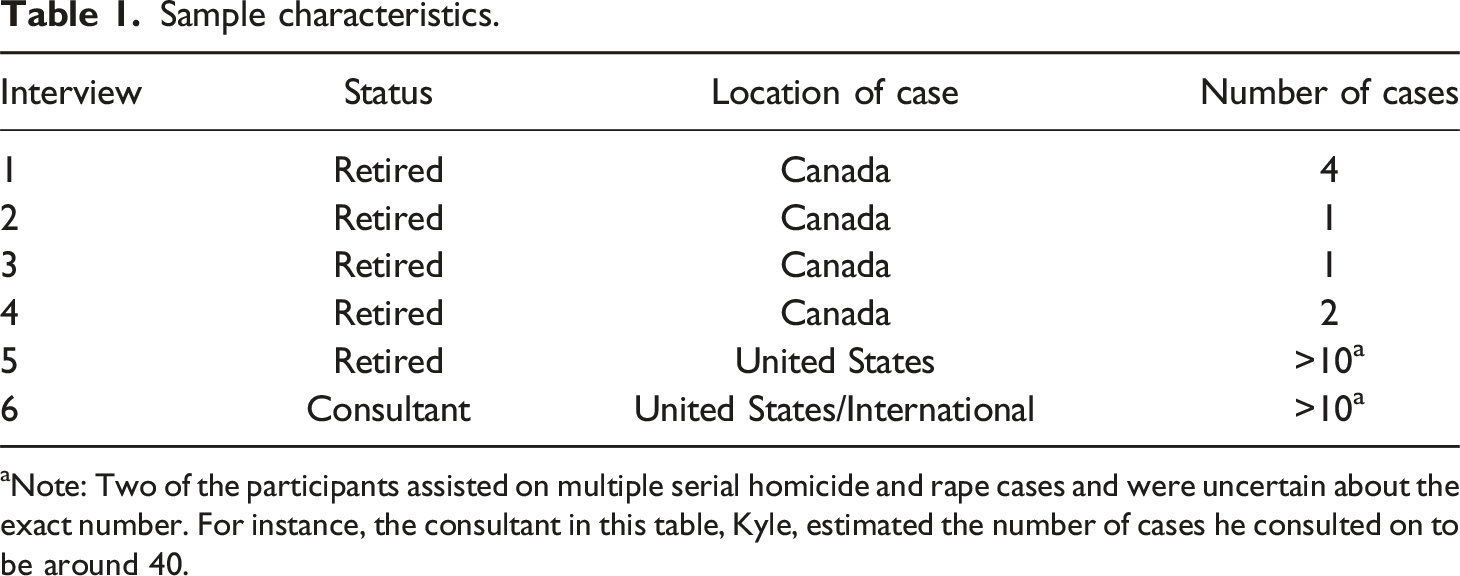
aNote: Two of the participants assisted on multiple serial homicide and rape cases and were uncertain about the exact number. For instance, the consultant in this table, Kyle, estimated the number of cases he consulted on to be around 40.
Participants collaborated on the same case in three instances, albeit in different roles, and two of the three had experience in other serial homicide investigations as well. A seventh individual from the United States preferred not to participate in an interview but contributed valuable perspectives on the shared challenges related to these cases through personal communications with another one of the interviewees. We have not quoted this individual in our findings but would note that their responses were consistent with and reaffirmed the other responses we received.
Interviews
Interviews lasting between one and a half to 2 hours were conducted in person or over Zoom by the first author. Each interview began by asking a few structured questions designed to ensure the participant met eligibility criteria, as well as other background information such as years of experience in homicide, the number of serial homicide investigations they had been involved in, and investigation outcomes (i.e., solved or unsolved). After collecting background information, participants were asked in a more semi-structured format to share their experiences and challenges during their investigations.
Interviews were audio recorded with participants’ permission, transcribed, and reviewed to identify emerging themes using an inductive approach to thematic analysis (Palys and Atchison, 2021). Next, we created descriptive codes relevant to the research question to capture the essence of the content and then grouped these into clusters based on their similarities to form themes (Braun and Clarke, 2023; Palys and Atchison, 2021). The themes were then aggregated into categories and further distilled into factors related to the three stages of investigative procedures that distinguish serial homicide investigation: (1) determining whether multiple homicides can be linked to a single murderer; (2) managing a more complex and open-ended investigation; and (3) the decision to lay charges. Combining deductive and inductive approaches ensured that issues appearing in the literature were addressed, while also creating the opportunity for new themes to emerge that had not yet been considered (Palys and Atchison, 2021).
Ethics approval was obtained for this study, with a specific condition to protect the identity of the participants, unless they chose to waive confidentiality. Accordingly, each participant was assigned a pseudonym, and all files were encrypted. Any information related to the case, location, or investigative details that could reveal the participant’s identity were removed unless approval was granted.
Results
Summary of categories and sub-themes.
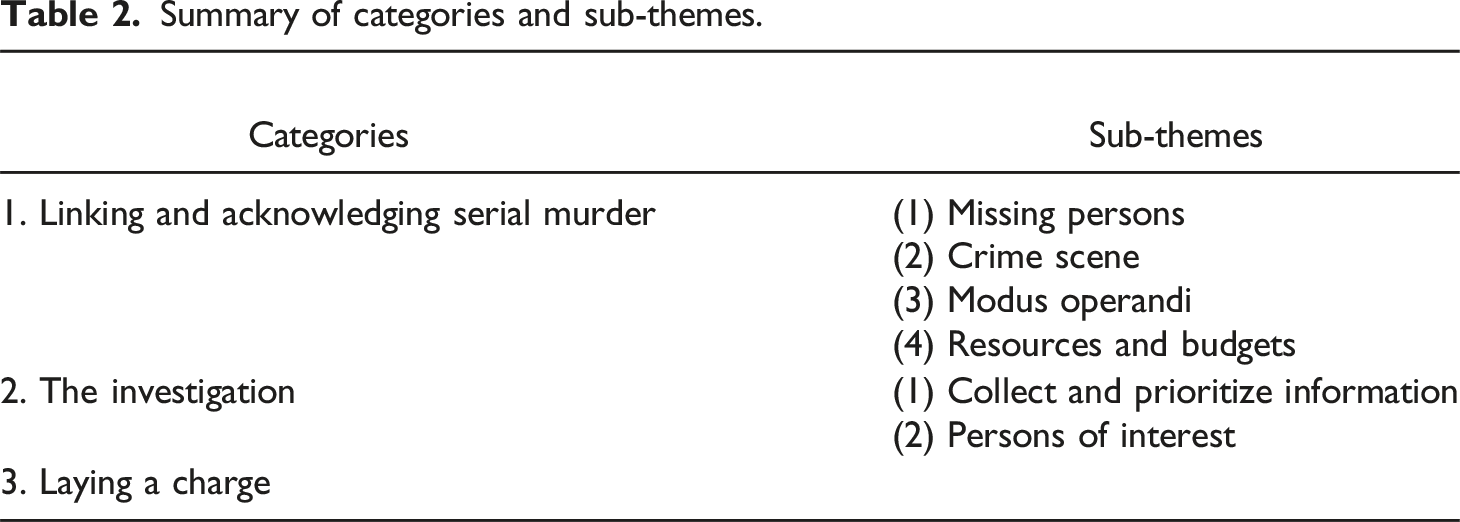
Linking and acknowledging serial murder
Before progressing to a serial homicide investigation, law enforcement faces the challenge of identifying the occurrence of a homicide and its connection to a series of similar incidents, often across multiple jurisdictions. Unfortunately, the process is hindered by a lack of communication between agencies and differing records management systems, making the acknowledgment of serial murder in North America slow and rare. In Tom’s words, “You don’t get a phone call at home saying “we’ve got a serial killer on the loose...it just doesn’t happen that way. Usually, that’s established long after.”
Illustrating this difficulty, Kyle gave the example of Joseph James DeAngelo, the Golden State Killer. DeAngelo was a former police officer who managed to avoid detection for decades. He initially gained recognition for a string of burglaries known as the “Visalia Ransacker,” transitioned to committing rapes while in Sacramento where he became known as the “East Area Rapist,” and eventually escalating to murder -- becoming known as the “Original Night Stalker” -- in Southern California. DeAngelo’s various criminal activities and labels made it difficult to link his distinct crimes, each of which was markedly different. Law enforcement is not specifically trained to handle the diversity present in serial homicide cases. Their training tends to prioritize explicit evidence or discernible patterns, potentially overlooking more subtle cues that could suggest connections between cases. DeAngelo was only connected to the crimes much later through DNA analysis, which placed him at the various scenes.
While all participants agreed that establishing connections between cases is more complicated than hindsight might suggest, linkages sometimes were more readily apparent. This was particularly noticeable in smaller geographic locations, which often involved high-risk victims, considered the most challenging to build a case around. Rohan recalled a colleague who said, “You didn’t need [name redacted] to tell us we had a serial killer…My kid in grade 10 could have told me that just by looking at it.” However, despite growing suspicion of the probability of a serial killer, the authorities in charge may lack the necessary experience to recognize the series or acknowledge its potential existence and may be hesitant to allocate resources based solely on probabilities.
In the numerous cases investigated, similarities were not always readily apparent. Perpetrators often change their behaviour during criminal activities, making patterns less obvious. Identifying a series can occur through various means, but the process is notably delayed when law enforcement face cases involving missing victims, which introduces uncertainty into the investigative process. Factors such as the absence of a body, an unknown crime scene, and an unclear modus operandi (MO) contribute to the difficulty in establishing links between crimes. Consequently, law enforcement, including profilers, face the daunting challenge of navigating these conditions without a distinct starting point to link the dots between the crimes.
Missing persons
It can be easy to view the disappearance of someone with a regular routine as suspicious, but it is less noticeable when the person leads an unpredictable lifestyle. As Shelley explained, “People with high-risk lifestyles often have a prior history of disappearing for extended periods of time, and having no contact with family members or close friends.” Therefore, their absence might be seen as a characteristic of their lifestyle by both their family and law enforcement. Further providing context, Tom added They're maybe drug addicts; they're part of the sex trade. They lead those kinds of lifestyles that they come, and they go, they go missing, and nobody questions it because that's just their lifestyle. The people that actually care about them, their family, they have minimal contact with their families. And so, by the time these people are even reported as being missing, they have maybe gone missing longer than what they normally would want.
On the other hand, some people willingly disappear. It was very common for us…to have a 14 year old runaway be reported missing like 15 times a month…where she runs away from her group home, and then you go find her, and two days later, she runs away again. A day later, she runs away again (Rohan).
In such circumstances, the victim may not be reported missing, or the report may be delayed for years. Shelley highlighted that this provides a perpetrator ample time to dispose of the victim and cover up their tracks. As a case in point, Jaycee told of a call from a family member reporting her sister missing 6 years after their last interaction. When Jaycee asked the reason for the delayed report, the sister explained, “She [originally] assumed that her sister had just gone off on her own. Hopefully gotten healthy. Had a different life.” With no missing person report filed, no investigative efforts were initiated to locate the missing woman. Even if her body had been found during that time, the police might have faced difficulties identifying her as she would not have been in their database. As Shelley explains, “Serial killers reduce their risk of being identified and apprehended for their crimes by choosing to target high-risk victims and strangers with whom they have had no relationship.”
In every police investigation, the development of a comprehensive victim profile serves as a framework for identifying potentially relevant information, guiding investigators on task prioritization, and eliminating theories or potential suspects. The conventional investigative process, as explained by the participants, typically begins by focusing on the victim and working outward to their family and associates. “When a victim [is] either high risk or a stranger to the perpetrator, the results rarely lead to the immediate identification of the perpetrator, and the investigation typically relies on forensic or biological evidence to solve the case” (Shelley)
During the critical initial 48 h of a homicide investigation, various personnel, including patrol officers, investigators, and crime analysts are assigned a comprehensive set of tasks. The lead homicide investigator coordinates these tasks to ensure seamless execution, documentation of evidence and leads, and integration of information. While the tasks are not strictly sequential, they are expected to be performed within an allotted interval (see Carter, 2013). However, when faced with an unknown victim and no apparent link to the perpetrator, investigators must deviate from the standard approach to gather details to establish a foundation for the tasks, which consumes valuable time.
As described by Kyle, just the process of determining which crimes are connected becomes a challenging task, extending beyond a single victim to a pool of potential ‘victims,' possibly numbering in the thousands. 1 Before investigators can initiate their usual tasks, substantial efforts and resources are dedicated to identifying the victim, which affects the investigation’s efficiency and contributing to an expanding list of missing persons, indicating potential additional murder victims.
Crime scene
In the late 1990s, a man reported the discovery of partial skeletal remains off a highway to the police. Despite entering the victim’s genetic profile into a national database, no DNA matches were found. Years later, while Rohan was working on a serial homicide case in a nearby city, his team discovered bone fragments matching the earlier victim. Despite the passage of time, the victim remains unidentified. The unsolved mystery continues to perplex Rohan, “I do not know where they are from. We can only presume that it was somebody from, God only knows where.”
The challenge of identifying victims in cold cases is underscored by the fact that merely locating remains in a particular location, such as along a highway, does not necessarily indicate the location of the murder. It is just one of the many locations to consider when assessing its relevance to a potential serial case. Not having the actual crime scene means that investigators are merely working with a theory of homicide, as Jaycee points out, “Like in the missing women of Vancouver, you had women living, and I say this respectfully, high-risk lifestyles, who were missing for sure and believed to have met with foul play but no crime scene.”
The absence of the actual crime scene hampers the investigative process by restricting the investigators’ capacity to gather crucial evidence and reconstruct the sequence of events. A crime scene provides: • valuable information about the circumstances of the crime, • the modus operandi of the perpetrator, and • potential clues that can aid in solving the case.
Without a crime scene, investigators may struggle to piece together the details surrounding the incident, limiting their ability to understand the crime comprehensively and strategically move forward. Patrick reaffirmed the importance of the crime scene when he stated When you get down to things, that, to me, stymies the serial killer investigations, crime scene is one of the ones at the very top…the ability to read a crime scene is huge. If you have a crime scene that is difficult to read, at the best of times, outside, it clearly complicates all the crime scenes.
The collection of evidence from the crime scene can provide valuable benefits in the form of evidence. Shelley explains, “It is important to consider exactly what the offender was comfortable doing, and conversely, what they had the opportunity to do but didn’t.” For example, in cases with multiple crime scenes, investigators may infer the perpetrator had access to a vehicle to move the victim, particularly if the body was disposed of elsewhere. This not only implies organization to avoid detection during the process but also a comfort level with handling a dead body.
Due to their willingness to travel between crime scenes, operate across different jurisdictions and even across the country, serial murderers can have an extensive reach. As the series of murders extend beyond conventional travel limits, linking them together becomes increasingly complex, especially if they also involve non-lethal crimes such as burglary and sexual assault. These non-lethal offences could indicate failed attempts to access the victim and recognizing this requires investigators to broaden the search for such events, resulting in numerous possibilities and dead-end leads. Moreover, the challenge is compounded by prolonged periods between crimes. Kyle illustrates this point by stating: Let's say there's a child murder in Kitsilano [a Vancouver neighbourhood], and then a week later, another child murder in Kitsilano. Police are going to connect these and likely be correct. However, if you have a child murder in Kitsilano yesterday and another one in Miami, Florida [United States], 20 years ago, you're not going to consider them linked. But some offenders are mobile.
Therefore, investigators must consider that a crime scene, especially in sexual homicides or high-risk victim cases, may not be an isolated incident. This necessitates a nuanced approach that goes beyond the assumptions that may be typical in domestic murders, which are more common. Despite the unanimous acknowledgment of this challenge among the participants, they explained that addressing it can be difficult as it necessitates navigating a balance of probabilities rather than relying on concrete evidence—an aspect not explicitly covered in police training.
Modus operandi
Analyzing crime scenes serve as a crucial starting point for comprehending the offender’s behaviour, motives, and modus operandi (MO). Identifying recurring patterns is instrumental in determining whether the same individual(s) committed multiple crimes. Despite being a valuable clue, Jaycee underscores the significant variability in MOs, noting “MOs can be anything – strangulation, duct tape, something the offender was heard saying. … You have to recognize an MO in the first place. Is it a one-off murder? Sometimes the offender can change the MO… it’s contextual.” Consequently, as Kyle adds, “The classic mistake is assuming that small differences mean a different offender. It’s often not the case. Again, going back to D'Angelo, he went from burglary to rape to murder. And you know, those are very different crimes.”
At the same time, recognizing a pattern does not necessarily imply the same perpetrator; instead, it signals the need to pose new questions. As Tom explained: If you have ten missing people along Highway 16, you could have ten murderers; you could have one murderer. So, in those cases, it really comes down to the bodies and trying to establish some sort of connection from one to the next.
In a crime series, there can be instances of failed attempts that the victim or law enforcement may misinterpret. Shelley encountered such incidents in sexual assault cases where victims reported an attempted theft after a male pulled them toward their vehicle by grabbing their purse, unaware that the person may have been attempting an assault. By looking beyond the legal classification of a crime, potential connections or leads can be established, particularly when biological evidence is unavailable. However, striking the right balance between comprehensiveness and efficiency is a nuanced process. Kyle explains, “The further you cast the net, the more inclusive you’ll be, but with more random noise. So, it is a trade-off. How do you minimize the noise while maximizing the signal?”
Resources and budgets
The recognition of a series triggers what is described by Rohan as a “massive undertaking” and by Patrick as a “logistical nightmare in terms of resourcing and the monies involved.” In cases involving serial murderers, the onus often rests on the investigative team or profilers to persuade the agency of their existence. Formulating a compelling case to justify the allocation of time and resources is imperative because, as Tom emphasizes, “Nobody wants to take responsibility because it is time-consuming, and it is expensive.” It significantly involves “taking skilled and experienced police officers away from other things that they’re working on” (Jaycee).
Developing such a case necessitates prior experience, established relationships, and credibility, a concept Rohan calls “baggage in the business” – the ability to articulate a strategy, manage multiple theories and be open to others. However, expertise in serial homicide investigations, or even sexual homicide, is scarce due to their rarity. Those with relevant experience may have retired before another series is detected, limiting the availability of skilled resources for agencies. As Rohan recalls We had upwards of 300 people working on the site at one time…police personnel, different teams doing different things, and you know 20-30 forensic ident guys [Crime Scene Investigator] and then all of those things collected on a weekly basis if not daily and put into the file…40 or 50 investigators working as well as about 20 contractors running machinery and over 100 civilians with forensic training helping with the search.
A case’s attention depends on its public support—high profile cases receive more resources, while lesser-known ones may not get enough. There are potential consequences when investigators are reassigned and dedicated to a serial homicide case, as other ongoing investigations may be delayed and other crimes occur. As a result, fewer resources may be available to handle the subsequent, unrelated cases, which are also important. This leads to a question: How many resources are ideal for effective investigations? The answer is not straightforward. Two participants highlighted the idea of diminishing returns, saying that too many people on a case can hinder an investigation. There is a point where adding more people does not help anymore. However, determining the optimal balance of resources is difficult due to the lack of systematic knowledge about what did and did not work in serial homicide investigations.
The investigation
In large teams, synthesizing, correlating, and analyzing extensive and intricate evidence forms the backbone of the investigation. However, the sheer volume of information can create bottlenecks and pose the risk of inefficient resource utilization.
Collect and prioritize information
Our interviews made clear that serial homicide investigations involve an overwhelming volume of evidence vying for the team’s attention. Each piece undergoes rigorous collection, vetting, cataloging, and prioritization. While the public is presented with a neatly packaged narrative, the reality is that crucial evidence exists within a vast sea of information before it is transformed into a meaningful component of the overall story. Rohan recalls: We used to have people come out and collect our notebooks at night, and they would go back, and those notebooks would be photocopied, PDF'd, and put in the file, and they would have to have them back for us the next morning…talk about an onerous task.
When a large team works on an investigation, each member is given a specific part of the case to investigate and document evidence for. However, since tasks are done in parallel and over an extended period, mistakes can happen if the team does not properly record, review, and comprehend their findings. As Shelley noted, “Cold case investigations are often hampered by incomplete or inaccurate documentation by investigators, who are often sleep-deprived and overworked.”
In cases with a lengthy investigation history managed by various teams, there could be thousands of documents to review. To ensure a comprehensive investigation, the new team must thoroughly review and piece the components together. In Tom’s case, the investigative team had to go through 27-29 boxes of files before renewing their case, an “enormously time-consuming” task.
Higher-profile cases often generate more tips than investigators can handle. Distinguishing between what is valuable can become tedious and daunting. For example, Kyle noted how, in one of his cases, they were receiving approximately 1000 tips per day at one point.
While the public’s intentions are well-meaning, tips may initially appear promising but later be errors or misinformation. The influx of information can burden the investigative team, leading to additional costs, time consumption, and potential risks to public safety. For instance, Rohan recalled a homicide case where he estimates “they spent millions and millions of US dollars” trying to find a vehicle, only to discover the description was incorrect. Unfortunately, as costly as it might be, a thorough investigation into every tip is vital to determine which information could be the lead that breaks the case or gets the team closer to solving it.
Various factors can influence witness accounts, and it is not uncommon for multiple people to describe the same person differently, as Kyle explains it: “depending on the lighting, the stress level of a victim, their sobriety, and whether the perpetrator is masked or covers the face of the victim, the descriptions may not be very accurate.” Additionally, when dealing with individuals who have been missing for extended periods, there may be few, if any, witnesses, and their memories may be vague at best.
Persons of interest
The “persons of interest” list includes individuals who are not yet suspects but whom police need to talk to for information. This list can become extensive, with some interviewees citing over 1000 persons of interest and, in one case, exceeding 3000 when combined with external agency collections. Investigators must strategically organize the list to prioritize tasks. Even with additional resources, targeting all persons of interest simultaneously is physically impossible, a point highlighted by Patrick: You take your sex offenders, and you take your violent sex offenders, and you drill down. And you try to limit the resources that are going to be taken up because I can’t interview 150 sex offenders in the spur of the moment.
Potential persons of interest can emerge quickly. In Rohan’s case, they found: People with modified vans driving around…they had the duct tape and the plastic bags and zip ties and all the handles off the inside of the doors and stuff like that. Driving around [location redacted], guys with a history. Do you say that guy is not a suspect? Well, yeah, you gotta look at them really closely and determine whether they were involved in the crime or not.
The challenge lies not in quickly identifying potential suspects but, in systematically organizing information and managing numerous theories simultaneously: What happens if you start targeting the wrong person on the person of interest list? Albeit they could be a very good target. A very serious bad guy. But not the one who's committing your serial offences. So, you're burning a lot of fuel and expanding resources but on the wrong person. Meanwhile, the real killer keeps going, which is an awful, awful feeling (Jaycee).
In cases involving high-risk victims, the list of persons of interest can be extensive due to the risk of encounters with individuals with a history of violence. Rohan recalled a homicide on which he had once worked: She's [the victim] in the business where she's dealing with bad people all the time, and so she had hooked up with like two or three real badasses in the day and a half before her body was found. So who's the right suspect to go after?
Having evidence to suggest a viable suspect is not enough; “If you can exclude certain suspects, you have to investigate every single one of them” (Tom) because, as Rohan explained, if you do not, “that’s when defence counsel comes in, shows the jury you have Joe Blow as another suspect out there and, boom, you have an acquittal because you didn’t fully eliminate someone as a suspect.”
Laying a Charge
The last stage in serial homicide investigations is in court. Every step of the investigation must be carefully documented and explained. This includes detailing the decisions, the strategies used, and the evidence that was (or was not) collected. The thorough documentation is crucial for presenting a compelling case to the authorities overseeing the legal proceedings to obtain charge approval.
In some locations -- including British Columbia, Quebec, and New Brunswick -- police do not have the authority to charge a suspect without approval. In British Columbia, criminal charges require meeting two pillars: (1) public interest; and (2) the substantial likelihood of conviction. The task is not only onerous but daunting for investigators who are responsible for presenting the information, often collected over many years. In Rohan’s words, “It’s got to be acceptable so that when you hit the disclosure button on the computer, it’s all there. God forbid an innocent mistake, and a killer walks free because of it.”
The investigation needs to be on solid footing. Otherwise, as Tom highlights, “Lawyers doing their job right? They take anything and turn it into a big issue.” Reliable witnesses to corroborate the physical findings and DNA to connect a suspect to a crime scene or victim might be desirable, however, supposedly “solid” evidence, such as DNA, may not be enough. In Jaycee’s words, “some people think it [DNA] stands for 'do not acquit.’ ” However, just because a case has DNA does not mean the DNA matches anybody, and if it does, it does not mean the person is guilty. Finding DNA on a victim of a sexual homicide is a lead, not a deciding factor. Jaycee explained, “In context, it means this guy’s got some explaining to do. Because with great respect…sex trade [workers]… may have different clients. That person may potentially have just been a client.” In these cases, witnesses can be valuable in guiding an investigation. However, the same level of importance may not be accepted when the person is required to testify under oath. The witness needs to be credible. Rohan explained, “You can’t put somebody on there who is so strung out they barely answer a question or carry out a thought. A good defence counsel will eat them alive and totally discredit them on the witness stand.”
Once the police have sufficient evidence, they submit the materials for charge consideration and the Crown’s reviews can take a considerable amount of time. As Jaycee points out, “The amount of information is unbelievable, unbelievable.” Jaycee goes on to explain that during this time: You can imagine police have a fear of destruction or movement of evidence yet known to police. Or the possibility that the offender could strike again. Police have to be all over that person in the absence of having grounds to arrest, charge, and hold.
Investigators may need to prioritize cases with a strong chance of conviction, potentially leaving other cases, particularly those where the victim is unidentified or the level of proof is weaker, without courtroom resolution. This situation can intensify pressure from friends and family seeking closure and justice for their loved ones. Striking a balance is crucial to avoid the risks of (a) extending the investigation; (b) undermining public safety; (c) failing to get charge approval; or (d) losing the conviction, after which charges cannot be reinstated. All of these would be a nightmare because the person suspected of committing the murders continues to roam free. Tom’s case illustrates the dilemma where the suspect, set to stand trial, had charges stayed due to an evidence issue as it “no longer stood a reasonable chance of conviction” shortly before court proceedings. In this case, the Crown prosecution took a calculated risk: releasing the potential murderer while running the risk of losing the trial, preventing the reinstatement of charges.
Sometimes the suspect passes away while the investigation is ongoing or waiting for charge approval, as occurred in two cases covered in this study. Not only will the victims and their families never see justice for their case, but they will never have a chance to see the murderer face any judicial consequences. As Patrick lamented, there always will be cases that “haunt ya.”
Discussion and conclusion
Serial homicide is distinct from other types of homicide, such as spousal murder, in that it often involves offenders and victims who are strangers to one another (Chan et al., 2015). Research has shown that situational factors can be especially salient in the case of serial sexual murder. These offenders tend to choose their targets based on certain characteristics or circumstances that increase their chances of success while minimizing the risk of being caught (Beauregard et al., 2007). As such, the inherent nature of serial homicide can present challenges for investigators.
High-risk and missing victims can be especially difficult to identify and connect to a series of murders, as police may become desensitized to repeated disappearances and, like loved ones, may not recognize the signs of foul play (LePard et al., 2015; Quinet, 2007, 2011). On the other hand, unreported missing victims may also be overlooked, underlining the vulnerability of this population to serial homicide and the importance of prioritizing their investigations (Beauregard and Martineau, 2014).
Biases like stereotyping can hinder investigations and make it challenging for law enforcement to assess situations objectively. For example, many cases of missing and murdered Indigenous women were dismissed as simple runaways (National Inquiry, 2019). Similarly, when sex trade workers started to go missing in Vancouver in the 1990s, law enforcement often assumed they were simply working elsewhere. While this might be true in some cases, some in law enforcement with good community ties were concerned for the women, while others did not see their disappearances as unusual (LePard 2010). The suspiciously high number of missing women went largely overlooked as senior officers failed to formally acknowledge the possibility of a serial killer. This oversight led to insufficient police resources, enabling the serial murderer to keep killing (see LePard 2010; Oppal 2012).
In cases where evidence was initially missed or where missing persons are not located, police rely on locating a victim’s body. From the interviewee’s perspective, the victims and the crime scenes play lead roles in any investigation of murder, not just serial homicide. The victim’s identity is crucial for identifying leads, such as information about their last known location, companions, or perishable evidence (e.g., video footage, memory decay). As such, crime scenes can be compromised by the offender or, in time, by weather and animals, leading to the destruction of forensic evidence and the dismantling of the scene (Skinner and Lazenby, 1983).
Serial killers can vary their methods across crimes, or evidence of consistency may have degraded with time (Beauregard, 2019; Beauregard and Martineau, 2014; Deepak and Ramdoss, 2021). Therefore, there should not be an overreliance on linking cases through behavioural consistencies. Instead, police agencies should communicate and pay attention to stranger-on-stranger homicides that are sexual and involve high-risk victims, even if the patterns vary. This foresight can help avoid challenges that may arise once a series has been detected, such as collating information, identifying possible witnesses, and collecting statements before memory decay sets in (LePard et al., 2015).
While existing literature provides valuable insights into the roles, behaviours, and external factors related to serial homicides (such as the offender or the investigation), there is an opportunity to redirect research focus toward the victim. Recognizing the crucial role of victims in serial homicides, exploring what they can reveal about these crimes and how to improve investigations could offer valuable perspectives for future research.
Quinet (2007, 2011), e.g., has done extraordinary work describing the vulnerability of those in the sex trade. Some serial murderers (e.g., Gary Ridgway) have shared their sentiments on how and why they targeted these victims, and many of those working in the sex trade have shared their experiences with investigators when they narrowly escaped danger. Understanding these perspectives can shape future research and safety measures.
As with all research into serial homicide, this exploratory study was not without its limitations. The study was limited to a specific and small sub-group of retired investigators within Canada and two profilers in the United States. Geographical, technological, financial, social, and experiential differences may exist across agencies, and further research may reveal themes and insights not raised in the six interviews conducted as part of the current study.
Future studies should include investigators still serving various police agencies in Canada and the United States. Moreover, the challenges in investigating serial homicide are not linear and may not be bound by an investigative phase. Therefore, future studies could benefit from looking at one aspect, such as managing suspect lists, and how it contributes to various investigation stages, providing insight into how police can overcome these challenges.
The current research identifies gaps in investigational practices that can result in undue hardship for investigators who are assigned to a serial homicide investigation. These findings provide police, researchers, and policymakers with a starting point for systematic improvements. Although there may never be a complete solution, the research demonstrates that lessons can be learned from each investigation, and as Rossmo (2021) states, provide “remedies for stalled or cold cases by highlighting specific problem areas” (p. 649). For example, only two of the 8 cases discussed explicitly during the interviews remain unsolved. In every other case, the investigative teams overcame obstacles with sufficient resourcing and support, allowing them to openly explore their investigative theories, even in cases where foul play was suspected but no bodies had been found.
While there is no one solution to detecting and preventing serial homicide, gaining knowledge from those who have investigated them – their ‘baggage in the business’ – we can enhance our understanding and improve strategies to mitigate these risks. As Meloy (2000) put it over 20 years ago, “It is unlikely, however, that, given the low base rate for this form of homicide, it will ever be able to be predicted; but with current understanding, and future research, the risk management of such individuals [sexual murderers] should greatly improve” (p. 19).
Footnotes
Acknowledgements
The authors would like to thank Dr. Curt Griffiths and Dr. Kim Rossmo for their comments on an earlier draft of this manuscript. Special thanks also go to John Cater and the two anonymous reviewers for their time and input. We also acknowledge and thank all the individuals who kindly agreed to be interviewed as part of this research project.
Declaration of conflicting interests
The author(s) declared no potential conflicts of interest with respect to the research, authorship, and/or publication of this article.
Funding
The author(s) received no financial support for the research, authorship, and/or publication of this article.
