



Abstract
This study examines the experiences of investigators of unsolved Swedish murder cases through qualitative interviews and thematic analysis. Focusing on the organisational context it highlights challenges in assembling and sustaining competent investigative teams. Using Resource Dependence Theory, the study shows that these teams rely heavily on external resources, prompting coping strategies that influence investigative practices. Findings suggest that resource allocation may depend on assessments of solvability, triaging, which can be problematic without a shared understanding of investigative success. A dynamic model is proposed to explain the interplay of aspects of the crime, organisational context and investigative actions.
Introduction
Criminal investigations and the effective prosecution of offenders are fundamental to upholding the laws and values of any society, particularly in cases involving serious violence. A substantial share of police work is devoted to criminal investigations. In Sweden, for example, the Police Authority estimates that investigative activities will consume about one-third of its resources in 2024 (Polismyndigheten, 2024). However, the actual cost is likely much higher as other operational activities, such as first-hand investigative actions by patrol officers, are directly related to investigative work. Despite its centrality, research on criminal investigation practices remains limited. Suggested explanations include confidentiality regulations (Fahsing and Ask, 2016), restricted access to specialised investigative units (Fassin, 2013), or a lack of interest among police in changing their methodology (Reyes, 2017). Additionally, differences in legislation, organisational structure, and resources make it difficult to generalise findings across countries and may reduce scholarly appeal. Existing studies tend to focus on murder cases (Prince et al., 2021), likely due to their severity and public visibility. However, as they are less susceptible to political or budgetary trends and typically involve comprehensive investigative tools they may also be particularly well suited for academic inquiry.
Criminal investigations are complex and shaped by multiple factors. A useful classification includes (1) aspects of the crime, (2) investigative actions, and (3) organisational context (Wellford et al., 2019). Aspects of the crime, such as modus operandi, witness availability, and evidence on scene, have received the most scholarly attention (Prince et al., 2021). This emphasis is partly due to the so-called RAND studies (see Chaiken, 1975; Chaiken et al., 1977; Greenwood et al., 1975; Greenwood and Petersilia, 1975) which concluded that “arrests and clearance rates reflect activities of patrol officers and members of the public more than they reflect activities of investigators” (Greenwood and Petersilia, 1975: 192). The notion that aspects of the crime outweigh investigative efforts has influenced both research and police practice leading to a focus on solvability triaging (Wellford et al., 2019). Triaging involves an early assessment of a crime’s characteristics to determine its investigative worth, similar to how medical professionals prioritise patients when resources are scarce. This has been found to be common in U.S. robbery cases (Lum et al., 2018) and in Swedish assault cases (Axnäs, 2024). While arguably necessary for less severe “everyday offences”, triaging can hinder investigative development and is questionable when applied to serious crimes like murder. In such cases society, and not least next of kin, should expect that all efforts are made to ensure a thorough investigation. In fact, it could be argued that cases with lower chances of solvability should be assigned more resources (as is done by e.g. Armstrong et al., 2013; Sturup et al., 2015). Moreover, investigative success involves more than prosecuting a case. As discussed by Brookman and Innes (2013) factors such as procedural rigor, community impact reduction and preventative effects must also be considered. Even when a suspect is not identified, a robust investigation can still contribute to public trust and harm reduction.
From a practitioner’s standpoint, aspects of the crime are largely beyond the control of investigative agencies and may offer limited guidance for improving efficiency. Greater attention should therefore be directed towards investigative actions, steps taken by authorities, and the organisational context in which investigations occur, including legal, economic, and structural frameworks. More recent studies (Lum et al., 2016; Scott et al., 2019; Vovak, 2016; Worral, 2016) show that certain investigative units within the U.S. consistently outperform others, suggesting that investigative organisations and their methods may have a greater impact than previously recognised. Although studies on investigative practices and organisational context have grown, further research is needed to understand how these elements mitigates, strengthens or weakens the effects of the aspects of the crime (Prince et al., 2021).
This inductive exploratory study is based on the unsolved murder cases held by the Cold Case Unit in Sweden’s South Police Region. By interviewing investigators who handled these cases before they went cold the investigators themselves were invited to shed light on the parts of the phenomenon which played the most important role in their realities. The interviews covered a wide range of topics, including aspects of crime, investigative actions and organisational context. However, the most prominent theme, and thus the focus of this article, was organisational factors, particularly the resourcing of investigations.
Theoretical framework: A resource dependence perspective
Organisational studies, far more discussed than research on investigative work, offer useful frameworks for understanding the phenomena observed in this study. To interpret the findings, this article applies Resource Dependence Theory (RDT) developed by Pfeffer and Salancik (1978). RDT:s central thesis is that to understand an organisation’s behaviour, one must understand the organisation’s context and ecosystem (Pfeffer and Salancik, 2003). Organisations are not self-sufficient but must rely on external resources to achieve their goals. This dependency creates asymmetric power relationships, where those controlling critical resources gain influence over those who depend on them. What is considered a critical resource varies, ranging from funding and expertise to staffing or materials. While RDT was primarily developed to explain interorganisational relations, it has also been used to examine internal power and resource distribution within organisations (Nienhueser, 2008). Departments and workgroups often depend on other units for resources such as staff, expertise or funding. When these are limited or unevenly distributed, power imbalances arise that affect how work can be carried out. This dynamic is especially relevant in complex bureaucratic organisations like the Swedish Police Authority where resources are centrally allocated by upper management and distributed across multiple branches. RDT holds that control over critical resources confers power. Those who manage access to vital resource can influence decisions, priorities and the operational scope of dependent actors (Pfeffer and Salancik, 1978), building on Emerson’s (1962) power-dependence theory. In this context, investigative leaders, despite having formal responsibility, may be partially constrained by other units within the police organisation if those control essential resources, such as experienced investigators. As a result, power within the organisation is shaped not only by hierarchy but also by resource control.
Another key principle is that actors who depended on others for resources, and who believe there is an uncertainty as to whether his need can be met over time, will find strategies to cope with this. The most obvious strategy is organisational compliance, where the dependent aligns with the expectations of the resource controller by demonstrating cost-efficiency and by aligning goals. While such adaptation may seem uncontroversial, the unit relinquishes its autonomy but also increases the likelihood of continued demands or attempts at influence. This occurs because others, affected by bounded rationality, may interpret past compliance as a predictor of future success (Nienhueser, 2008). Alternative strategies include mergers and joint ventures (Pfeffer and Salancik, 2003), though the use of such strategies are limited to internal units within public agencies. Instead the dependence may be influenced by trust-based relationships (as suggested by Coşkun and Öztürk, 2024). This in turn risks creating a dynamic where resources are distributed to solve conflicts within the organisation, rather than solving the actual problems.
Context: The Swedish investigative model
To contextualise the findings internationally, a brief overview of the Swedish investigative model is necessary. While several agencies in Sweden conduct criminal investigations, the centralised national Police Authority handles the vast majority of cases, including nearly all murder investigations. Specialised crimes, such as financial, customs or national security offenses are managed by other agencies, but are not addressed further. Between 2002 and 2024 Sweden recorded between 68 and 124 murders annually (BRÅ, 2025).The clearance rate was approximately 90% in 2015 (Sturup et al., 2015), although this is notoriously difficult to metric.
A criminal investigation prior to trial is formally termed a preliminary investigation (förundersökning). Its main purposes are to provide the prosecutor with sufficient grounds to file charges and to enable the planning of a coherent trial. The investigation is led by a preliminary investigation leader (förundersökningsledare), either a police officer or, in more complex cases, a prosecutor. Prosecutors belong to a separate agency, the Swedish Public Prosecution Authority, and although they formally lead the investigation, they rely on the Police Authority to carry out most investigative actions. Typically, the prosecutor assumes leadership once a suspect has been formally identified. Prior to this, in the pre-investigative phase (spaningsfasen) or the “reconnaissance phase”, a police officer lead the investigation unless specific circumstances, such as the need for coercive measures or international cooperation, necessitate the involvement of a prosecutor. Swedish law grants the preliminary investigation leader broad authority to independently approve many investigative measures, such as warrants and seizures, without prior court approval.
Swedish murder investigations follow the national framework Police Method Support for the Investigation of Serious Violent Crimes (Polisens metodstöd för utredning av grova våldsbrott), commonly known as PUG. This framework outlines both organisational structure and investigative procedures. Most murder cases are discovered by front-line units, typically under an incident commander (yttre befäl) who leads the initial phase and acts as preliminary investigation leader. The case is then transferred to a serious crime investigation unit, where the designated lead investigator reviews it. At this point, the prosecutor’s office is usually informed. A prosecutor may then take the role of preliminary investigation leader or remain in a supporting role, depending on the case status. The PUG describes how to form an investigative team but is intended to be “elastic and adaptable to the specific nature and requirements of the case”. The team usually includes a preliminary investigation leader (police or prosecutor), a lead investigator (utredningsledare) and roles such as head of internal operations (chef inre), lead interviewer (chef förhör), case officer (handläggare), and administrative coordinator (förundersökningsregistrator). Additional roles such as forensic specialists, financial investigators, analysts, and family liaison officers are added as needed. PUG identifies 20 such functions. The lead investigator, oversees daily operations, manages the team and implements directives from the preliminary investigation leader. PUG suggests that the lead investigator has prior experience leading investigations, proven competence in serious crime cases, alignment with police leadership criteria, and adherence to national leadership policies. The lead investigator is responsible for communicating resource and capability needs to senior leadership throughout the investigation.
If a case does not progress to prosecution and the lead investigator deems all reasonable investigative actions exhausted, it is transferred to the cold case unit. There, it remains under review in case new witnesses or forensic advances justify action. Upon transfer, the outgoing lead investigator must compile a start-up folder summarising key case information. However, due to competing priorities, this handover is often delayed. In several cases included in this study investigations remained inactive for years awaiting the completion of this folder.
According to the Police Authority there are approximately 800 cold cases in Sweden, with 160 belonging to the southern region (Head of the Southern Cold Case Unit, personal communication, 5 June 2025). Out of these cases the study includes cases spanning 2018–2022. During this period, the region experienced a surge in gun violence linked to criminal networks, particularly between 2016 and 2019 (BRÅ, 2024), placing exceptional strain on the local police organisation. In all but one case, investigators hypothesised a connection to organised crime, based on the victim’s criminal background, the method of killing (primarily firearms), and information about potential suspects. This aligns with previous research indicating that such murders tend to have lower clearance rates (Armstrong et al., 2013; Sturup et al., 2015).
Method
The study was conducted in collaboration with the Cold Case Unit of the Southern Region of the Swedish Police Authority. To access case files, the researcher was appointed as an unpaid consultant within the police organisation. While the unit acted as a stakeholder advisor, it had no influence over the analysis or presentation of the findings.
Overview of interviews and participants.
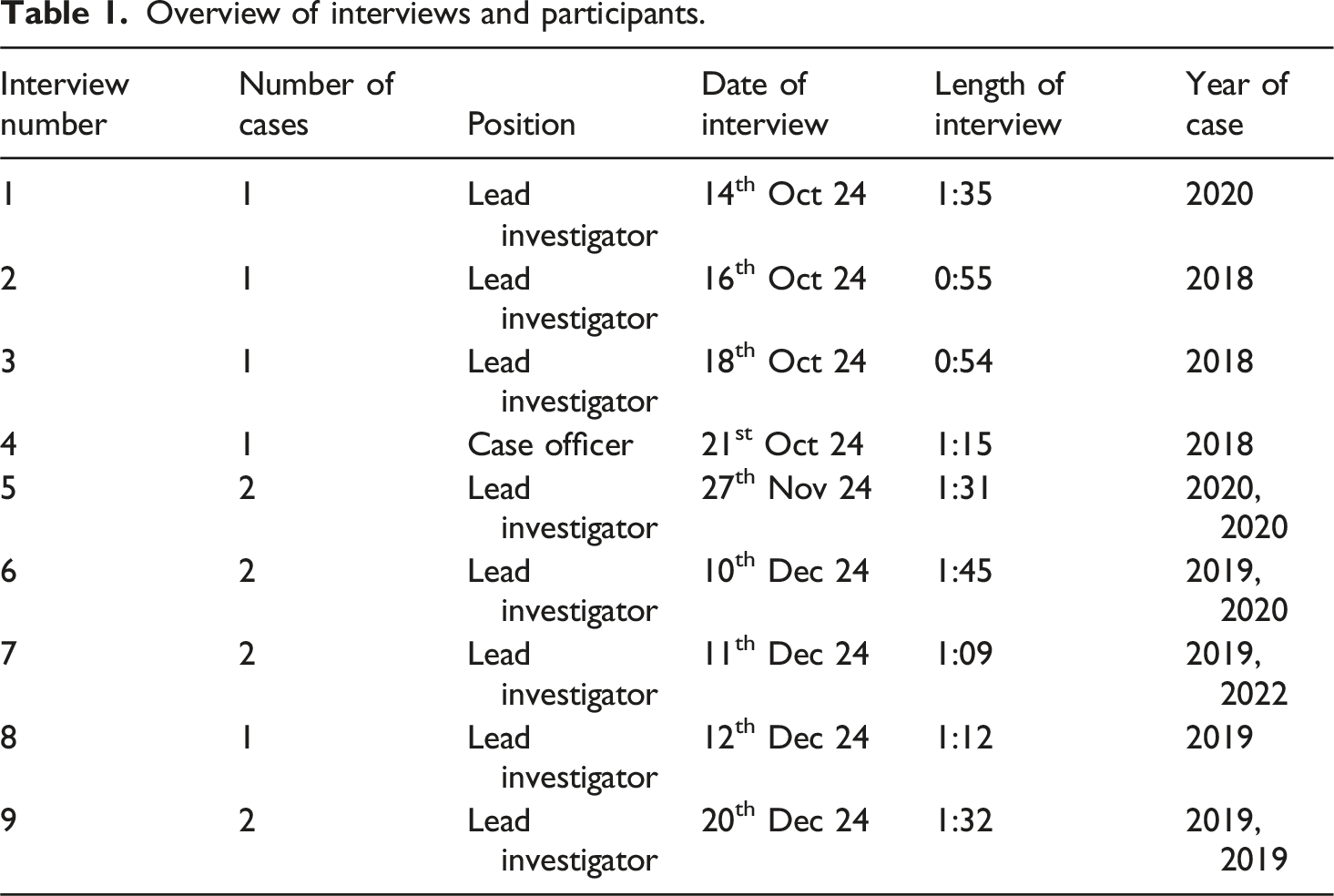
Participants were contacted by phone, received project information via email, and had the opportunity to ask questions at the start of the interview. Verbal informed consent was obtained beforehand, and no financial compensation was offered. As the interviews concerned sensitive personal information about those involved in the cases the study applied for and was granted approval from the Swedish Ethical Review Authority.
Participants’ accounts reveal both strengths and weaknesses in their investigations and offer insights into how similar cases might be better handled. This approach aggregates individual cases to draw broader conclusions about the class they represent (Brinkmann, 2023). Case selection was based on a traditional definition of success based in identification, charging, and conviction of a perpetrator as this determines whether a case is transferred to the Cold Case unit. However, as previously noted, investigative success extends beyond this. While qualitative methods are limited by their reliance on lived experience, which may not necessarily reflect best practice, they allow for a broader, more nuanced exploration. Unlike structured approaches, they are not constrained by predefined categories and can reveal unanticipated themes.
Following Bogner’s (2009) typology, this is an exploratory study and a semi-structured interview guide was used. A semi-structured approach offers flexibility to follow up on topics the interviewer deems significant, allowing the researcher to become an active, knowledge-producing participant in the process (Brinkmann, 2023). The interviews were conducted individually and inductively, without a predefined theoretical framework, but grounded in the researcher’s prior experience as a former prosecutor and police educator. Before each interview, the interviewer reviewed the start-up folder for the respective case. The interviewer’s background within criminal investigations have likely influenced the social dynamics of the interviews. Participants generally appeared open about investigative shortcomings and welcomed the opportunity to reflect on their work, possibly viewing the interviewer as a colleague or a partner with equal status (Bogner et al., 2009). However, this familiarity may also have introduced blind spots, as participants may have omitted tacit knowledge they assumed was already understood (see McNair et al., 2008). For instance, participant 8 remarked; Maybe I’m stating the obvious. You know this as well as I do.
A notable impression from the interview process was the participants’ willingness to take part. Only one officer declined; the rest made time despite vacations, retirement, or demanding schedules. At times the participants made certain remarks such as: I don’t know how many times I’ve nagged about it. I’ve got nothing to fear. I’ve quit. I’m hired by the hour. I can say what I’m thinking. But it still does not land (with management). (Participant 7) There are other cases that… You are recording this. Doesn’t matter. (Participant 6)
These comments suggest some hesitancy in criticising leadership. Nonetheless, the overall impression was that participants were candid and unreserved in their responses.
A key strength of this study is the rare access to sensitive case data combined with interviews with highly experienced investigators. Limitations include the relatively small number of interviews and the restriction to a single police region, which creates a risk that the accounts may not fully represent all police regions or other police organisations. Despite these limitations, the findings are likely to have a high degree of transferability, as they are discussed within a theoretical framework applicable to organisations in general.
The interviews were conducted in Swedish and transcribed in denaturalistic style (as described by Oliver et al., 2005) using AI-transcription software Klang.ai. Each transcript was then manually reviewed in full by the researcher, comparing the text against the original audio recordings to correct errors, ensure accurate rendering of speech and preserve participants’ intended meaning. Quotations have been translated into idiomatic English, with any details that might reveal case evidence or personal information redacted or replaced, indicated by brackets. AI-software ChatGPT has been used as a linguistic aid to refine English phrasing and structure of the article. No generation of original content was performed by the AI and all AI-assisted outputs were critically reviewed by the author.
The material was analysed using reflexive thematic analysis (Braun and Clarke, 2022) in NVivo15. Given the wide scope of the interviews many topics were discussed: leadership styles, strategies to address confirmation bias, the use of coercive measures versus relationship building, dealing with unwilling witnesses and cooperation with prosecutors, to name a few. Within the scope of this article focus will be on the identified themes relating to organisational context.
Results
Six themes related to organisational practices and resource dependence of particular importance were prominent and are presented below. (1) A new investigative team is put together for each case
In all cases a new investigative team was assembled after the case was transferred to the investigative department. According to the participants this is the standard practice in the region. Several described the process of forming a new team as burdensome. Participant 7 expressed this clearly: It’s not optimal to build new organisations. If you could have an investigative leadership; I’m thinking lead investigator, lead interviewer, head of internal operations, case officer, maybe administrative coordinator. If you could have a group that felt safe with each other, comfortable, that would have been an incredible strength. Because it takes some time to get to know one another. Maybe you don’t know each other’s competences. Some people work better than others together. It’s a drawback to build up a new organisation. Would it be a strength to have a more solid organisation? Absolutely! You could add the investigative staff, that is not as important, but the leadership should be the same.
While forming new teams can be time-consuming, some participants noted potential advantages. Participant 6 reflected: There is a danger to having the same group. You get rather comfortable. It’s not as enriching to sit in the same group and work in the same way. Us humans are lazy by nature. If you find a way that works, you work that way. If you get new staff every time, you get something extra with it. Even if we try to align our way of working so that everybody should work the same way, there’s always some news when there’s new people. And again, every case needs its own organisation adapted to its form and type.
The final point is particularly noteworthy. Carter and Carter (2016) found that agencies with high clearance rates often adopted a team-based approach, staffing investigations with individuals whose backgrounds matched the case’s specific needs, not just general experience with murder. Importantly, such flexibility could still be maintained with a pre-established structure of the core roles.
However, the feasibility of maintaining permanent core investigative leadership team is questioned. Participant 8 stated: In an ideal world, yes. I know that some are thinking in those lines. (…) In my small area you are everywhere, and you get a large narcotics crime here, a serious assault there, a murder there. That we should have some people that just wait for a murder? It’s an ideal world. But what would they do on an ordinary day?
No existing research has been found that specifically compares pre-established investigative teams with ad hoc ones. However, there is broad agreement that the initial days of an investigation are crucial to its outcome, even if the exact window remains debated (see e.g. BRÅ, 2023; Carter and Carter, 2016). Considering this, spending valuable early time assembling a new team may seem counterproductive when preexisting structures could provide an immediate operational response and reduce the risk of initial conflicts in regard to resourcing. (2) The staffing numbers varies greatly between cases
Investigators were generally unable to recall exact staffing levels, but most described the overall resourcing as acceptable. Still, nearly all shared experiences of past investigations marked by severe understaffing, and the size of investigative teams varied significantly. In one of the least resourced cases, Participant 2 stated: This case was severely mistreated for several reasons. Partly that I did not have the time to engage fully in it. We had a chief who was of the opinion that we should not work with gang related murders. So there were two investigators. I was a part of it in the outskirts. That’s my memory of it.
This contrasts sharply with Participant 3’s description: Every group, the pugs so to speak, have consisted of investigative people of about 20–30 persons. On top of that we had access to all of the surveillance units. We had a lot of resources. I believe that at times we were about 40–50 people in the investigation along with the surveillance groups. So, we had all the resources.
Although staffing numbers were often seen as sufficient, several investigators reported missing key roles when inquired further. A pragmatic attitude was common, as illustrated by Participant 8: I’m more like, alright this is the team I got. I’ve got to use it in the best possible way. Maybe you don’t get some things. Maybe you can’t have both lead interviewer and head of internal operations. Maybe you’ll have a double function. But maybe you can if it’s not that complicated a case.
Lead investigators generally expressed satisfaction with available resources, even when teams included members lacking experience in the crime type. As noted earlier, this “make-do attitude” may reflect a form of organisational compliance, where investigative teams adapt to managerial constraints rather than challenge them. (3) Staff is loaned from other parts of the organisation and often lacks relevant experience
There is no formal requirement for lead investigators to have completed a specific training program. Instead, the PUG emphasises experience and personal abilities. Most lead investigators in this study were seasoned officers from serious crime departments who had undergone varying internal training courses in leading investigations of serious crimes. However, two participants stood out in that they had no prior experience leading murder investigations and had not completed relevant courses, but were nevertheless appointed due to staffing shortages. Participant 1 explained: Spontaneously (I felt), there should be someone within the organisation that are better suited than me. But they said that my name was at the top of the list, and they’d prefer to see that I took it. And I felt that if it’s a murder investigation or if it’s a very complex narcotics investigation, it’s still a crime that’s been committed and that should be investigated. (…) I did not feel extremely uncomfortable in it, since it’s not me doing the investigation. I’m leading the staff.
Despite most participants finding overall staffing levels acceptable, nearly all raised concerns about competence. Positions outside the core leadership were often filled by officers from outside the serious crime units, frequently young or newly trained patrol officers are ordered to serve in the investigation for a period of time. Participant 7 rather frankly stated: We get to loan people to be with us for a while. And you’re supposed to get them up to speed with the case. It’s rubbish. I feel that generally a murder investigation is the most serious of crimes. And we can’t even have competent staff – we loan people and half train them during the investigation. It’s crazy (…) The resource question is a big problem I’d say, in the qualified investigations. It’s entirely unsatisfying the way we are doing it today. The way we gather people up. Could you be a murder investigator? Come on in! How do I review the content of a (seized) phone? We’ll show you! It’s entirely unsatisfying.
Participant 9 added; And I know we had some very, very new, young staff. And then when you don’t get staff and you still have tasks that need to be done, you move staff, even if it’s young and inexperienced staff, to do tasks that maybe should have been done by someone who is more experienced. (…) The mapping of the victim. Interviewing the family. And if you have not held a lot of interviews before, you’re not used to that type of interview. You don’t have the knowledge and competence, simply put. (…) -So you are saying that you sent young, newly baked police to interview next of kin…? -Yes (…)
The consequences of this are described by participant 8: There are too many re-interviews and that’s not good. An example, I wanted to interview [a witness about something relevant to the case]. Go back and interview her again, we forgot to ask about [details regarding the event]. It’s not good with too many follow-up interviews (which you get) if you have unexperienced staff. At the same time, you can’t leave a question hanging.(…) So it’s interview upon interview. (…) If you get Calle and Stina (random names), they’re straight from the patrol cars. They got hell of an ambition, but they’ve not held interviews. And because of this their interviews are rubbish. They learn as they go along, if they’re with me for three or four months, but the initial interviews are rubbish. And that’s not their fault.
Research on the impact of investigator experience is mixed. Some studies found no clear link to clearance rates (Chaiken et al., 1977; Puckett and Lundman, 2003) while others suggest that specific experience or training matters (Goodison, 2021). Fahsing and Ask (2016) demonstrated significant performance differences between British and Norwegian experienced and newly educated officers in hypothesis generation, indicating that training and organisational structure may be more important than experience alone. Interviews conducted by Swedish National Council for Crime Prevention BRÅ (2023) also emphasise the value of experience in investigative work. From the interviews of this study, it appears likely that inexperienced investigators risk overlooking important information, potentially harming solvability. Beyond this, there are clear ethical concerns and potential impacts on public trust by assigning inexperienced officers to conduct sensitive tasks, such as interviews. Again, solvability is not the sole measure of investigative success.
In addition to concerns about competence, several participants raised issues about continuity. Participant 5 explained: We had a gang of good interviewers that came from the patrol cars. And then they disappeared and got replaced. And it’s quite tough after half a year to catch up on a case when you come in as a replacement. And you need knowledge when you are interviewing. It’s names that are central and that you need to know. (…) But that’s understandable when you bring in officers from the patrol cars Participant 8 also noted the strain of even small team changes: It takes damn much power and energy. An example: you come to the meeting in the morning and you have 14 men that knows the case inside and out, as well as you do yourself. Then two more enter the room and says ´We’re supposed to be interview-patrols today and they said we should be here at eight.´ (Heavy sigh) (4) Much time is spent on issues related to staffing
The process of acquiring and retaining loaned personnel appears to demand significant time and energy from lead investigators. Participant 9 described the effort involved: You have to request the staff. And then again when the time is up. Because their initial placement, they want their staff back. And you get to request that I want this person to stay and supply a justification why. But it’s a constant, constant, as I recall it, constant tug (of war), the resource part.
Participant 8 elaborated on the logistical and administrative burdens: So you need to have physical meetings, you need this in the start-up to be successful. But there’s so damn much affecting it. People need to drive there, have access to the room, they need to get their equipment (…) It’s the hours that we actually work with the murder that makes the difference. (…) That’s the issue. We put so damn much time into organising, getting there and all that.
When estimating time spent on such tasks, Participant 9 said: I’d say (…) more than half (of my time). To get some sort of… Partly the staffing and to get a structure of who is doing what.
While structuring the investigative group is clearly essential, it raises concerns if the person with the best case-overview becomes primarily an administrator, rather than focusing on investigative direction. (5) Ending the investigation may sometimes be a matter of resources
While most lead investigators reported that all leads had been exhausted and the cases had reached a natural dead end, others also described decisions to close investigations as driven primarily by resource limitations.
Participant 3 responded as follows when asked about the reason the case remained unsolved: We were not given enough time. The investigations are limited by economy and time. We came from outside (the police district) and cost a lot of money for the Police Authority. There were more murders, and we only get a certain amount of time. We had to wrap it up.
This shows that the question of resources limited the scope of the investigation. The same participant further elaborated on the process: You noticed that they wanted us gone after a couple of weeks. But we kept the pressure up in the investigation and I think we got to stay three or four months. We were a good group with a very large knowledge of the local shootings and the criminal gangs that were there. The surveillance leaders and me together had a very firm grip of the town at that point. We had the trust of the leadership and got to stay on a bit longer than intended. (…) There’s a meeting every morning, I’m not sure if it’s every morning but several days a week, with the police leadership. I presented what we had, what we were doing and what’s left to do and somewhere we reach the conclusion that the leadership says you’re not getting any more resources, we have to close it down.
Participant 9 shared a similar experience: You have to explain yourself. And really request staff. And prioritising is done, simply put. And you can say that we reached a point where this investigation was no longer prioritised. (…) Bluntly put; it feels like shit. Because it’s not my call. It’s not me saying we’ve reached the end of the road. Or that we’ve extinguished all opportunities. This is more a matter of staff management. Which case is more important? You get my point.
Relating to previous cases participant 6 recalls; I’ve had other cases were you, as you said, where you barely had anybody where you (…) basically had to go against the directives from the superiors because you feel that we can’t just blow this off. You’ve had to work with the case in secret.
These accounts all illustrate the tension between investigative judgement and organisational constraints, highlighting the role of resource management as a part of the investigative reality. It also shows the importance of the lead investigator understanding the dependence structures to secure resources and avoid deprioritising. (6) There are indications that the police organisation has been using triaging when resourcing murder cases
As noted earlier, research shows that police organisations often triage resources, prioritising cases with higher solvability. While lead investigators do not control overall resourcing, several interview excerpts reflect this logic. Participant 2 recalled: ...We had a chief who was of the opinion that we should not work with gang related murders. (…) He (the chief) counted numbers a lot. And a murder in gang environment costs a lot of resources, takes long time and has a bad prognosis
This suggests that resourcing decisions were guided by clearance probabilities, effectively triaging out difficult cases. Contrast this to participant 3 who had a well-staffed team and noted: The surveillance leaders and me together had a very firm grip of the town at that point. We had the trust of the leadership and got to stay on a bit longer than intended.
Here, trust from leadership appears to have influenced resource allocation. In contrast, the newly appointed participant 9, who received far fewer resources, stated: I don’t know why (the case was poorly resourced). It’s the management that assigns resources. As a lead investigator I could scream until I’m sore for staff. I can’t do anything more than say that we need more staff.
This difference in accommodating the lead investigator raises the possibility that experience, status, and established relationships rather than objective investigative needs shape resourcing decisions. Participant 3’s “grip of the town” may have signalled broader operational benefits, such as gang disruption and weapon seizures, even though the murder itself remained unsolved. The lead investigators ability to communicate value beyond clearance likely contributed to extended support.
However, this creates a risk that resource allocation becomes dependent on an investigator’s ability to “play the game” rather than on case needs. In such a system, management may resolve internal resource conflicts rather than address the underlying investigative problems.
Discussion and conclusion
As previously noted, one reason for the limited research on investigative practices may be the difficulty of transferring findings across jurisdictions. While this study is confined to a single region in one country, it offers valuable insights into the everyday challenges lead investigator’s face in securing and maintaining resources for their operations. Although legal frameworks, resource allocation models and organisational structures differ internationally, the findings suggest that resource dependence profoundly shapes the lead investigators capacity to carry out effective investigations. Much time is devoted to staffing and administrative tasks, reflecting the investigation’s reliance on resources controlled by other units.
Returning to the three interdependent aspects of investigation, aspects of the crime, organisational context and investigative actions, this study proposes a dynamic model (see Figure 1): (1) The aspects of the crime, its characteristics and availability of evidence, motivates how a case is resourced and staffed. (2) These decisions shape the organisational context of the investigation. This enables or constrains what investigative actions can be taken and how. (3) The investigative actions uncover new information about the aspects of the crime, reshaping the perceptions of the solvability, strategic value or severity of the crime. The interplay of the aspects.
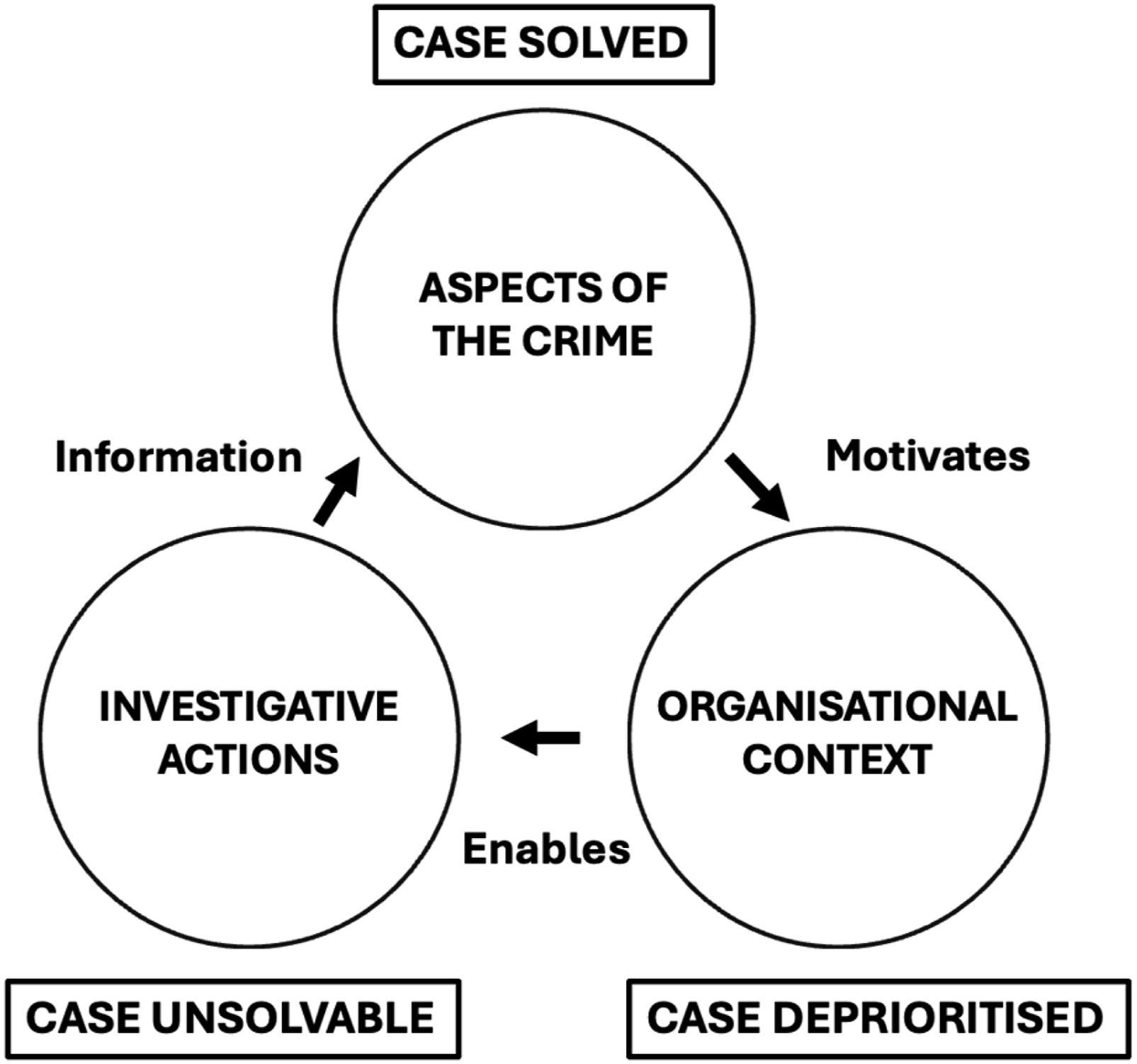
This cycle creates three potential phases during which an investigation can end. If all relevant aspects of the crime have been revealed the case is solved, leading to prosecution or dismissal. If there are no longer relevant actions to perform the case is deemed unsolvable. Finally, if the organisational prerequisites to motivate further investigative resources are no longer met the case is deprioritised. This final scenario is arguably more problematic than the others, as it risks prematurely ending investigations for administrative reasons. To prevent unjust de-prioritisation, lead investigators must not only understand but also effectively communicate which case aspects justify continued organisational support.
To better understand criminal investigation, further research is needed on how police organisations, facing a limited supply of competent investigators, prioritise resources between cases and how this affects the investigative actions taken. If triaging is to be accepted as a legitimate and necessary practice in serious crimes, it is essential to establish transparent principles grounded in a clear understanding of what constitutes investigative success. Primarily this would allow public debate and scrutiny necessary to maintain legitimacy, but from an investigative perspective it would also enable the lead investigators to communicate relevant aspects of the case to the administration and in doing so help prevent arbitrary resource distribution.
Footnotes
Acknowledgements
The author wishes to thank supervisors assistant professor Caroline Mellgren, Malmö University, and senior lecturers Simon Andersson, Stockholm University, and Lotta Wendel, Malmö University, for their valuable guidance in the design of the study and writing of the article. Appreciation is also extended to the Cold Case Unit in the Southern Region of the Swedish Police Authority for providing access to essential data.

Ethical approval
The study was approved by the Swedish Ethical Review Authority on the 4th of July 2024 (case number 2024-04012-01). Informed consent was obtained verbally before participation. The consent was audio-recorded.
Funding
The author received no financial support for the research, authorship, and/or publication of this article.
Declaration of conflicting interests
The author declared the following potential conflicts of interest with respect to the research, authorship, and/or publication of this article: The author has been granted an unpaid consultant position with the Swedish Police Authority in order to gain access to case files. The Police Authority has not had influence over the presented research results.
Data Availability Statement
As the data obtained in the study concerns criminal investigations, and as such are subject to Swedish laws of secrecy, data cannot be made available in public repositories.