



Abstract
Police first-line leaders (sergeants/team leaders/supervisors) have significant impact on the workforce, as such there is the need for leaders to be effectively developed for their role and engage in ongoing learning. This paper focuses on the professional development of police first-line leaders. Comparing and contrasting approaches to knowledge, understanding and skills development within both the classrooms and workplaces across the policing jurisdictions of Australia, England and Wales. The paper explores the part education and training plays within leadership development, approaches to formal educational recognition and challenges which may affect the adoption of national and standardised approaches to leadership development.
Keywords
Introduction
Leaders operate in a policing landscape which is constantly changing, often making decisions in environments which can be volatile, uncertain, complex and ambiguous (referred to as a ‘VUCA World’). Such complexity of a changing world means that approaches to leadership also need to continue to evolve in order to address contemporary challenges (Sekiguchi and De Cuyper, 2022). This requires leaders to be both agile and innovative in their responses (Bennis and Nanus, 2003). Although a respondent in research conducted by Davis and Bailey (2018) highlights how structured hierarchical rank systems can stifle innovation, creativity and attempts to do things differently.
United Nations Sustainability Goals 4 and 16 call for the promotion of lifelong learning and the building of effective, accountable and inclusive institutions supporting justice for all. As the workplace becomes more complex and challenging, embracing leadership development within public sector organisations continues to become even more crucial (Seidle et al., 2016).
In 2023, the national professional body for policing across England and Wales, The College of Policing, launched a National Centre for Police Leadership (NCPL). The NCPL aims to develop current and future leaders in policing through new national standards for leadership, the provision of workshops, networking and guidance, collaboration nationally and internationally, and provide opportunities for leadership learning and development across policing (College of Policing, 2023a). Some of the learning and development being delivered by police forces in-force, which are aligned to the College of Policing national curriculum, with other programmes of learning being delivered centrally by the College of Policing. Some aspects of leadership development being mandated for certain ranks, being set within police regulations.
In the 1960s the Australian Institute for Police Management (AIPM) was established to deliver education and development for police leaders and those from other public services across both Australia and regionally, which the AIPM have continued to do so successfully (Australian Institute for Police Management, n.d). A number of professional development opportunities for leaders being educationally recognised (ibid.). Yet attendance on such AIPM courses is not mandated and jurisdictions can deliver their own leadership development programmes.
Both the NCPL and AIPM have similar goals, aiming to contribute to leadership development for their respective police services utilising the strengths of professional learning and development in order to enhance policing. It is worth noting the majority of future senior police leaders for the next 20 years are already in the service (Roberts et al., 2016), as such the leadership development of current officers and first-line leaders (sergeants and supervisors) is crucial if policing leadership is to evolve enhancing services.
Whilst Green and Gates (2014) identify the recognition of policing as a profession is gaining pace, the path of processional recognition of policing as a profession continues to experience setbacks with criticisms of policing, police culture, police leaders and their training. The Baroness Casey Review (2023) highlighted a significant disconnect between frontline officers in the Metropolitan Police Service, the largest police force in the United Kingdom (UK) and their leaders, with many first-line leaders experiencing lengthy delays in accessing training. Reported failures by the United States (US) Capitol police leadership, including the lack of training provision, may have impacted on the storming of the US Capitol building (Report of Investigation, 2021). Criticisms of an embedded culture of workplace harassment within the Royal Canadian Mounted Police (RCMP, 2017), who identify that their leaders have limited opportunities for leadership development to assist in changing the culture to one expected of a professional force. The police service in Norway identified shortcomings in police leadership following terror attacks in 2011 (Filstad et al., 2020; Vanebo et al., 2015). Several inquiries in Australia and New Zealand also continue to highlight leadership failures and link poor organisational culture, training and supervision to the delivery of sub-optimal service delivery to the community (McMurdo, 2020; Richards, 2022; Victoria Equal Opportunity and Human Rights Commission, 2015).
This emphasises the criticality of leadership across policing and the importance of learning and development for leaders at all levels. Even more so as leaders influence organisational culture and change within VUCA environments, which importantly can provide opportunities (Barber, 1992). However, as agencies continue to implement change and strive to embody a professional culture, consideration should be given to the leadership development of those who directly impact on the organisational culture, the first-line leaders.
Methodology
Embracing the opportunity to record and discuss, at one moment in time, the state of professional development for police first line leaders on opposite sides of the world, the methodology adopted for this paper was a narrative literature review. Gregory and Robert-Denniss (2018) acknowledge narrative literature reviews have no formal process but suggest steps for an effective review should include defining the topic and intended readership, searching and re-searching literature, being critical, defining a structure and finally reviewing the work. Narrative reviews can be used to identify the need for further research by summarising findings, but are not necessarily a comprehensive evidence-based review.
The topic for this paper is a comparison of approaches to police leadership development in both Australia and England/Wales, achieved by critically discussing key aspects from the available research and professional evidence in order to provide insights to inform policy makers in policing leadership education and training.
The overall aim of the research is to compare, critically contrast and identify what can be learnt from the approaches taken in both nations to leadership development for their respective police services, as a result impacting on the enhancement of policing. This is particularly important as two national policing bodies, the NCPL and AIPM, aim to enhance leadership development in their respective nations utilising the strengths of professional learning through education and training. Whilst at the same time criticisms of policing, police leadership and its impact on communities continue to be extensively reported (Baroness Casey Review, 2023; HMICFRS, 2024; McMurdo, 2020; Richards, 2022; Victoria Equal Opportunity and Human Rights Commission, 2015).
The structure of the paper discusses training versus education then moves to set the context for policing in England/Wales and Australia, followed by discussing the professional development of police leaders. The paper then moves to compare and contrast leadership development pathways for first-line leaders as they transition from initial training to leadership roles. Such first-line leaders being instrumental in influencing the day-to-day culture of the workforce (Pepper et al., 2025).
Literature review and discussion
Vanebo et al. (2015) suggests that limited attention has been paid into how policing organisations evolve in to learning organisation. Developing the capacity for learning within an organisation which provides frontline policing services, through a hierarchical leadership structure, often operating in a VUCA world, requires specific attention (Vanebo et al., 2015). Herrington and Schafer (2019) suggest that policing organisations often struggle to sufficiently develop their constables to take on the first-line leadership roles expected of new sergeants. The formal appointment of an individual into a leadership role does also not inevitably equate to the provision of effective leadership as, for example, they may have not yet developed the required knowledge and skills (Smith, 2019). With first-line leaders requiring a range of skills including those described as technical (an understanding and proficiency in their work), human (the ability to work effectively with and co-ordinate people) and conceptual (working with concepts and ideas, solving problems) (Katz, 1974).
First-line police leaders are crucial to the development of the policing workforce, its culture and ongoing wellbeing (Phythian et al., 2022), along with the delivery of a high-quality service to the public. Whilst it is tempting for those leading on the frontline to try and deal with the current problems they face, leaders should not shy away from addressing new challenges and driving forward change (Pearson-Goff and Herrington, 2014). New leaders need to be professionally developed, equipping them with the appropriate knowledge, understanding and skills for their role. Although Filstad et al. (2020) highlights how the ability of leaders to transfer learning from the classroom to the workplace needs to be evolved. With officers reporting how much they value leaders who have experienced and understand front-line policing (Rowe, 2006). Society rightly demands exemplary standards of all those working within policing, but how are first-line leaders developed through lifelong learning for such influential, challenging and regularly demanding roles?
Training versus education
The concept of lifelong learning can be traced back to the 20th century, where learning can be described an ongoing process throughout life, where individuals acquire and update knowledge, understanding and skills, including through formal and non-formal education, as they become motivated self-directed learners (Tight, 1998). The merits of lifelong (or at the very least career-long) learning for all those in the evolving policing professions seem clear. Kratcoski (2023) suggests however that such learning need not be through formal educational programmes, but those in leadership roles need to remain aware of changes within policing, the challenges faced in the workplace, and possess skills to problem solve. Although a range of learning and development opportunities are available at all levels of policing organisations, a distinction needs to be made on what type of training and/or education occurs where within the organisation, at what time, for what length and in what depth. There should be the transferability of what can be argued as career-long learning to strengthening lifelong learning. As Jarvis et al. (2004) conclude, policy-makers, administrators and individuals need to adjust their thinking from a focus on vocational learning to lifelong learning related to the development of skills that go beyond just careers. It is essential in a VUCA world that graduates engage in lifelong learning as well as the learning required to achieve the current and future skills required of their careers (Ng and Law, 2024).
Although often used interchangeably and overlapping in meaning, simplistic definitions of training, education and learning are that ‘training’ is the acquisition of specific knowledge, skills and abilities in order to make short-term changes to behaviour as a result individuals are equipped to successfully and competently achieve specific required tasks. Whereas education is the broader development, shaping and acquisition of knowledge, understanding, behaviours and values for application in future life-long contexts. It is worth noting that in reality, training and education are intertwined, with ‘development’ being the learning journey through which individuals are developed for future organisational roles, and the term ‘learning’ being an overarching concept for the description of formal work focused education, training and development (Garavan, 1997).
Police officers need to maintain their level of operational competence through training of such technical operational skills (e.g. use of batons, arrest techniques). The introduction of new tools to assist frontline officers (e.g. conducted energy devices that deploy muscular disruption providing options for far less-lethal force) require ongoing upskilling of new and current officers. The introduction of new legislation and guidance also requires ongoing learning to maintain competence in order to ensure the application of skills safely and lawfully. These types of technical training focus on the development of hard motor skills that can be swiftly transferred to the workplace (Richter and Kauffeld, 2020). Whilst other forms of training, and one would suggest education, such as ‘leadership development’ focuses on the more human and conceptual attributes, developing interpersonal skills including communication, motivation and coaching that contribute to organisational performance success (Centre for Creative Leadership, 2016). Pepper et al., 2025 identifies the importance of first-line leaders applying new learning and development into their professional practice and championing the benefits, as a result encouraging others to develop and implement new ideas to solve problems and influence change (Sekiguchi and De Cuyper, 2022). Where, when and how such leadership learning and development is provided, is of great importance to multiple stakeholders.
Policing context in England/Wales and Australia
England and Wales
Across England and Wales, the Home Office (2024) detail how slightly in excess of 147,000 full-time equivalent regular police officers and 88,000 police staff (serving in both operational roles e.g. civilian investigators, and back-office roles e.g. human resources), provide policing to the 65 million people. The police service is further supported by 13,000 uniformed and non-uniformed volunteers (Home Office, 2024). Policing is provided across the approximate 59,500 square miles of England and Wales by 43 ‘territorially based’ Home Office police forces, such as the Metropolitan Police Service which has slightly over 35,000 officers and 11,000 staff (Home Office, 2024). In addition, there are several non-Home Office geographically based police forces and agencies, such as the British Transport Police, Civil Nuclear Constabulary, Ministry of Defence Police and National Crime Agency, within which several thousand police officers, staff and volunteers provide focused policing, investigation and security services (Home Office, 2023).
The College of Policing is an ‘arm’s length body’ of the Home Office, it is the national professional body for the police service across England and Wales. First established in 2012, the role of the College, is multi-faceted including setting expected standards for policing, providing training and development, evolving an evidence-base of what works, whilst sharing preferred practice across all those within the police service.
Australia
The Australian policing environment has similarities to that in England and Wales, as well as several variables that differentiate the policing context. While the land mass of Australia is much greater (an estimated 32 times bigger) than England and Wales (Australian Bureau of Statistics, 2024), with the population of in Australia of 27 million is less than half that of England and Wales (ibid.). However, with exception of Australian Federal Police who predominately have responsibility for policing commonwealth (federal) laws and being a conduit to overseas law enforcement efforts, policing is generally state and territory based across only eight jurisdictions with total of slightly under 80,000 operational and non-operational police officers and staff (Australian Government, 2024). This means that the size of police agencies by way of staff numbers and land mass coverage are comparatively large compared to that of England and Wales.
Despite the lower numbers of both police and population, Australia’s landscape is characterised by most of the population living in highly urbanised areas near the coastline, this urban focus and access to the coast being similar to that of the United Kingdom.
In a similar way to the College of Policing NCPL, the AIPM provides executive development, including leadership across levels, and operates separately under the direction of the Board represented by the eight Police Commissioners of Australian and New Zealand jurisdictions (Australian Institute of Police Management, 2017) This leadership development is extended beyond policing to public safety agencies and partners. However, unlike the College of Policing, the AIPM does not determine or issue policing standards. That role is undertaken by the Australia and New Zealand Policing Advisory Agency (ANZPAA) which was in 2007 established by the jurisdiction Commissioners (Australia New Zealand Policing Advisory Agency, 2023).
Developing police leaders
Leadership development in policing is not a new concept, Rowe (2006) discusses a number of ongoing initiatives to enhance the leadership training offered to the service. Garavan (1997) suggests that due to the complexities which exist within organisations, managers require extensive training, development and education at stages throughout their careers. However, to date the focus of such national learning and development has predominantly been on executives and upper levels of policing, often achieved through on the job learning and experience rather than formal training (Doyle, 2019). Rowe (2006) identifies earlier Home Office proposals to link the appointment of senior leaders with a requirement for the achievement of qualifications. There are definitely several higher education providers today which offer Masters level programmes specifically for senior and executive police leaders.
Schafer (2009) highlights that the failure of leadership development is often a catalyst for poor supervision and other organisational performance issues. Whilst it is tempting for those leading on the front line to deal with the now, they should not shy away from addressing new challenges and driving forward change (Pearson-Goff and Herrington, 2014). First-line leaders have significant influence on the policing workforce and the service delivered by those providing front line policing (Ingram, 2013; Pepper et al., 2025).
As such, it is crucial that the next phase in developing lifelong learning within the profession of policing must be focused towards first-line leaders (sergeants/team leaders/supervisors). This may involve embedding recognised and nationally accepted approaches to their development. It can be argued that public sector programmes which combine classroom study, coaching and mentoring, with experiential workplace learning, benefit leadership development (Herrington and Schafer, 2019; Seidle et al., 2016). Such programmes could also capitalise on the benefits of recognition and accreditation through higher education linked to work-based learning.
Roberts et al. (2016) identify the importance of education in developing tomorrow’s leaders. Continuing to suggest how education develops individuals who can generate and contribute to leadership through skilled critical and reflective thinking (ibid.). Reflective practices being important for police leaders to embrace (Filstad et al., 2020). In order to foster a culture of leadership, the RCMP (2017) recommend compulsory leadership development programs for all current and newly appointed leaders, including the considering appropriate university courses. Herrington and Colvin (2016) add the importance for police leaders to be both innovative and flexible in their approach. However, Zaher Omair Juma et al. (2022) suggests that the existing educational level of police leaders in Dubai had little impact on their ability as transformational leaders. López (2022) describes how across the European Union, law enforcement agencies are benefiting from formalising partnerships with higher education, utilising academic expertise in curriculum development, teaching, learning, research, and the development of new products.
A key role of leaders is the effective development of their staff (Phythian et al., 2022). If first-line leaders are to be effective, they must be further developed and equipped to deal with the complexities of leading within their own organisations, but also capable of tackling the complexities within society which affect crime (Herrington and Colvin, 2016). Meager and McLachlan (2014) suggest it is possible to learn and develop the traits, also described by Katz, 1974 as technical, human and conceptual skills, and as competencies by Grint (2007), expected for leadership. The ability to translate such traits, competencies etc., into successful leadership is however far more complex (Grint, 2007).
As Sugar (2023) points out there is no such thing a perfect leader, every leader makes mistakes along the way. It is also evident that leader’s impact on the behaviour of their team members (Ordon et al., 2019; RCMP, 2017). In their Norwegian police study, Hoel and Christensen (2020) found that new police officers often emulated the attitudes and actions of the experienced officers who mentored them, this was often to align with established workplace practices. This is the critical nature of good first-line leadership influencing the prevailing culture.
Learning pathways for police officers and first-line leaders in England/Wales and Australia
England/Wales
As with much of the world, an effective approach to the development of new police first-line leaders across England and Wales continues to be crucial and evolving. This standardised approach to a national first-line leader development builds upon the professional development of new police officers through the College of Policing developed and licensed, initial Police Constable Entry Routes (PCER). The majority of the PCERs offer graduate level education and workplace skills development for a significant number of new officers who follow a standardised National Policing curriculum (NPC).
The graduate level initial entry routes to policing were introduced in 2018 and are split between those who are already employed by the police service who do not hold a degree and complete a three-year level 6 Framework for Higher Education (FHEQ) Police Constable Degree Apprenticeship (PCDA), or the two-year level 6 Graduate Diploma Degree Holder Entry Programme (DHEP) if they are already a graduate. These programmes are co-created and delivered in contracted partnerships between police forces and their chosen higher education provider. Both programmes have a work-based learning (WBL) focus and are licensed by the College of Policing. It is also worthy to note that there is a knowledge focused, university only taught, three-year level 6 FHEQ Professional Policing degree (PPD) for those aspiring to join the police service but not yet employed but hope to achieve advancement once recruited by a force. The FHEQ being a national educational framework across England and Wales which, along with the national Regulated Qualifications Framework (RQF), is aligned internationally to the European Qualifications Framework (EQF). The EQF being reviewed in 2017 and viewed as an element of creating a new skills agenda for Europe, the EQF aims to improve the transparency, comparability and transferability of qualifications across international borders (European Commission, 2018).
Following a directive in November 2023 from the then Home Secretary, Priti Patel, there is also a non-graduate, non-credit bearing programme of learning for new officers. This Police Constable Entry Programme (PCEP) was first launched by the College of Policing in 2024. It is a two-year training programme taught in house within forces for any new police officer. Interestingly, a number of forces are already seeking educational recognition of their PCEP.
The current established process for the professional development of police officers to become first line leaders (sergeants) in England and Wales, the National Police Promotions Framework (NPPF), was first introduced in 2015. The NPPF process requires police officers to demonstrate their workplace competence. The demonstration of such competence learnt on the street Herrington and Schafer (2019) argue is adopted by the service as an important way for individuals to establish workplace credibility. Then applicants for promotion study for and complete a nationally set legal knowledge examination. Applicants are then assessed against rank specific competencies in force before being temporarily promoted and completing a work-based portfolio over a period of at least 12 months. Then, if successful, the temporarily promoted sergeants are confirmed in the rank. During the 12 months of temporary promotion, the newly promoted police officer first-line leaders are assessed against a number of education/training RQF modules developing their knowledge of their role and skills of supervision, management and leadership, this can lead to the award of an RQF level 4 certificate in police management.
In 2024, the College of Policing commenced a new programme of learning and development for new first-line leaders called the Sergeant and Inspectors Promotion and Progression process (SIPP). Currently in a testing phase with several police forces until 2026 (College of Policing, 2024), the aim is to create a less complex three stage process which is a fairer pathway to promotion which is more accessible. SIPP focuses on the development of underpinning leadership knowledge and skills, professional development, application in the workplace and the provision of evidence to support such an application. The modular based underpinning learning for SIPP is aligned to undergraduate level 6 on the FHEQ, with explorations ongoing with regards to options for formal academic recognition (College of Policing, 2023b).
In a similar approach to that advocated by Schafer (2010), in the test of SIPP, aspiring leaders are initially provided with foundation levels of learning, developing their knowledge and understanding prior to application for promotion. This is followed by application of their learning within their workplace demonstrating professional practice whilst further developing their knowledge and skills of leadership, with reflection and feedback enhancing their work-based application before finally being confirmed in post as a first line leader. Filstad et al. (2020) suggest that police leaders have a preference for experiential ‘hands-on’ learning, with these leaders being provided with opportunities to learn through application and reflection.
The learning for first-line leaders is across a number of broad and educationally levelled modules focusing on their own personal leadership, inclusive leadership, workplace leadership, leading within organisations, leading partnerships, coaching and mentoring. Successful completion of these learning modules do not however lead to an educational award at a national level.
Sekiguchi and De Cuyper (2022) add that public sector leaders should not shy away from addressing everyday challenges within society, they should lead and manage diversity and inclusion, dealing with inequality and injustice, they should be producers of new ways of addressing problems, leading effectively, creatively, innovatively whilst working within digital (and often worldwide) workplace environments. Herrington and Schafer (2019) also suggest skills which are needed at the rank of police sergeant (or first-line leader) include being able to plan and allocate workloads, motivate team members, coach, measure and value the performance of others and make challenging decisions. All of which are present within the new College of Policing first-line leader’s curriculum.
As Kratcoski (2023) highlights, it is important for leaders to be able to interpret problems, identify strategies which will work and/or collaborate with others to develop solutions. The new first-line leader curriculum development by the College of Policing achieves the educational level at which such leaders should be operating. Education development at this level expects learners to have developed skills such as problem solving, critically evaluating evidence, appreciate the limits of their knowledge, work autonomously to make decisions in complex environments and take responsibility (QAA, 2014). Echoing the above, the EQF continues, describing how learning and skills development at level 6 defines the ability of learners to manage complex professional activities in complex and unpredictable situations (European Commission, 2018).
Australia
Since the late 1980s in Australia there has also been considerable efforts to link policing and education as part of the drive towards professionalism (National Police Education Standards Council, 1993). Policing standards became nationally recognised, providing consistency and coherence in education and training programmes, promoting recognition and portability of professional qualifications and aiming to enhance national police cooperation and greater police mobility (ibid.). Links to commonwealth funding through tertiary education was a key driver for some jurisdictions to collaborate with universities for undergraduate study programmes. In such cases, students of policing would not become employed and be part-funded by the Commonwealth Grant Scheme until part-way through their studies when, having developed requisite knowledge and experience, they were attested as police officers (Green and Woolston, 2013).
The Australian Qualifications Framework (AQF) details a national framework for qualifications in post-compulsory education. The AQF providing national recognition of qualifications in vocational education (Australian Industry Standards, n.d). Alignment across Australian policing jurisdictions occurred in 2011 with establishment of a Diploma of Public Safety (Policing) for new officers. This AQF level 5 award (equivalent to a level 4 award on the FHEQ) has evolved through several versions. With the Australia New Zealand Policing Advisory Agency (2019) identifying that future changes to legislation may require jurisdictions to continually update their policing staff through involvement in education and training, resulting in continued currency.
However, recent internal discussions across jurisdictions have revealed how several, over time, have moved away from such national qualification alignment. Unlike in England and Wales, there is currently no consistency in higher education entry pathways across Australia. Over the preceding decades some states partnered with universities to provide pre-requisite and/or partial recruit training and current only two states (New South Wales and Tasmania) have a direct educational partnership.
In Australia, the development pathways for police officers to sergeant, and then further through the ranks, differs across jurisdictions and are not as structured nor linked to qualifications as that of England and Wales. Tasmania, one of the two states with tertiary education for police officer entry, has a clear and continuous educational development pathway in a formal collaboration between the Tasmania Police and their university partner, with new police officers studying for an Associate Degree (Pepper et al., 2025), such higher educational study being a required pre-requisite through several leadership tiers up to and including the commissioned officer rank of Inspector (Department of Police, Fire & Emergency Management, 2017). Other jurisdictions offer both internal and external courses with pre-requisites for promotion in only some of the jurisdictions. This is despite the Australia New Zealand Policing Advisory Agency (2019) highlighting a commitment to the development of leadership across organisations and levels, along with the importance of managing talent, there is no central curricula for leadership development across the Australian policing landscape. This presents a continued opportunity for consideration in the same way that links to education and training were identified in a commitment to professionalism in the early 1990s and the significant collective benefits as a much broader learning organisation that may be attained.
In a cursory review of leadership development programmes across many Australian jurisdictions it is evident that no singular curriculum is applied nor found. There are, however, some consistencies of focus including coverage of leadership styles and mentoring coupled with elements of skill development such as communication. The points at which these development offerings are provided vary greatly as do the duration, depth and levels of programmes.
Australian jurisdictions have not seen the need to standardise leadership development which has both benefits and limitations. In not having a standardised curriculum each of the jurisdictions have the freedom to tailor the design to the agency needs as well as being agile to changing requirements. It could be argued that innovative leadership will not be stifled by the inevitable bureaucracy that a standardised framework would entail. In evolving organically perhaps the ‘next police leadership theory’ may be derived.
The limitation of course is that although the AIPM offers a number of standardised leadership programmes, leadership development across Australian jurisdictions continues to evolve organically across the several jurisdictions in isolation which may involve duplication of effort and misalignment. Even if the ‘next police leadership theory’ is derived as suggested here there is no guarantee that this will be shared or leveraged across other jurisdictions.
Not having a standardisation agenda may also be missing the prioritisation of first-line leadership development as well as lacking the opportunities for recognition through qualification and transferability of learning between jurisdictions.
Final thoughts
The approach currently adopted across England and Wales, the NPPF, standardises the training of all new police officer first-line leaders (sergeants), blending knowledge development and understanding with work-based practice, aspects of which are mandated through police regulations and can be recognised through an RQF level 4 certificate. The new SIPP under test aims to create an education, training and work-based pathway to promotion that is less complex, fairer and accessible, with underpinning learning pitched at a higher educational level, which complements the existing initial entry routes for new police officers.
The importance of such practical leadership experience has a direct impact on a leader’s approach to managing and dealing with risk (Zaher Omair Juma et al., 2022). However, the strongest argument for not having a standardised approach comes from the difficulty in articulating curriculum content on something that is well recognised to be deeper than mere knowledge attainment and is somewhat of a personal journey, the ability to transfer learning to the workplace being crucial. Woodward (2017) contends that leadership is in fact a journey and not a destination, one derived from personal experience and personal values applied on a continuous path, in effect lifelong learning. Williams (2005) emphasises that leadership requires creativity and imagination rather than reliance on well-honed practices, with Goldsmith et al. (2012) extoling the value of reflective practice and the transformational nature of effective coaching enabling leadership behaviours to flourish.
Perhaps supporting a blend of the Australian and England/Wales approach, Meager and McLachlan (2014) describe how there is a need to develop the whole person as a leader, whilst providing much deeper understanding and the all-important time for reflection highlighted by Filstad et al. (2020). The new College of Policing SIPP programme of study is for all aspiring and new first-line leaders studying a police leadership curriculum pitched at undergraduate level 6 on the FHEQ, although, as in Australia, there is no formal national recognition by an educational award for the whole programme, although options for the recognition of the underpinning learning are being explored (College of Policing, 2023b). However, as Tight (1998) quite rightly highlights, lifelong learning need not be formally recognised.
In both England, Wales and Australia, the implementation of new learning programmes for police leaders continue to struggle with some of the challenges highlighted by Schafer (2010) including resource limitations, time available for learning, finances, and access to quality education and training.
Conclusion
The impact of police first-line leaders seems clear, as is the need for the leaders to be developed for their role and engage in some way in lifelong learning (Kratcoski, 2023). Although there is a spotlight on leadership, heightened due to recent inquiries, there is not a single approach shared between Australia, England/Wales to the standardisation of leadership development. This is in part due to the evidence-base to inform curricula as to what actually works in leadership practice across policing being somewhat limited and still evolving (Herrington and Schafer, 2019), with Seidle et al. (2016) adding the criticality of what works within leadership development being required to justify the benefits of future investment.
The concept of leaders requiring the development of technical, human and conceptual skills (Katz, 1974) is important across Australia, England and Wales and could probably be extended to other jurisdictions. Grint (2007) quite rightly highlights the importance of knowledge development in the classroom, but also the importance and challenges of transferring such knowledge in to professional practice, through which experiences of leadership can be reflected upon and developed (Filstad et al., 2020). Hoel and Christensen (2020) also found that new police officers learn best when pushed beyond their comfort zone. This isn’t difficult to extrapolate to the development of first-line leaders in policing across Australia, England/Wales as they continue on their journey as lifelong learners, having significant and impactful influence on the workforce delivering services within VUCA environments.
In Australia there is no standardised or mandated national approach to either recruit or leadership development, whereas in England and Wales, a significant number of aspiring and new first-line leaders (sergeants) will already be following the new leadership curricula, and those they are leading in their teams may have already completed the mandated PCER’s, the majority of which are educationally levelled awards aligned to the FHEQ level 6 and will be searching for further professional development and formal recognition as the next step in their career and learning journey.
In both England and Wales, and across Australia, it appears that study towards educational recognition through qualifications aligned to leadership development is not viewed as essential, as such formal recognition does not necessarily evidence effective workplace practice. However, such educationally recognised approaches may have significant benefits for individuals and their professional recognition, along with the engendering of lifelong learning and standardisation through external quality assurance of such workplace learning. This requires further research in order to demonstrate the impact and value (or otherwise) of educational recognition of learning on individuals, the police service and public. Such an evidence-base needs to be evolved much further using a range of research methodologies to inform what does and does not work for the career and lifelong development of police leaders, and although finances are limited, policy makers should look towards the horizon and invest in evolving the required evidence-base to inform future leadership learning and development.
Whether standardised and aligned to educational achievements or not, as Vanebo et al. (2015) suggest, for success, clarity on the direction of leadership development within the organisation is critical, in order though to establish clarity the standardisation of what good leadership looks like is imperative. With their leading positions in police leadership education and training, both the NCPL and AIPM should ensure discussions continue amongst policy makers with regards to nationally mandating all, some or no learning for leaders.
Police officer first-line leader development pathways.
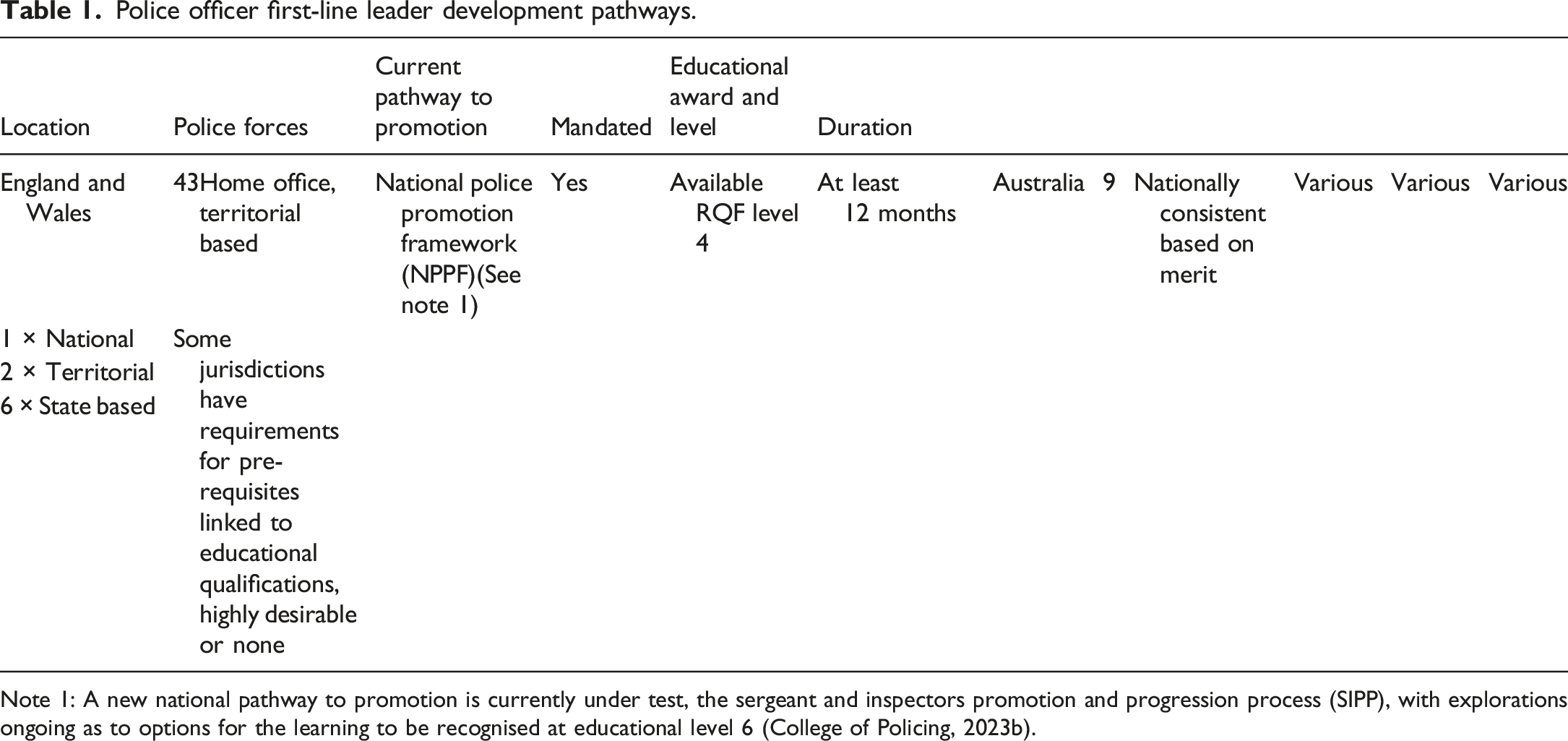
Note 1: A new national pathway to promotion is currently under test, the sergeant and inspectors promotion and progression process (SIPP), with explorations ongoing as to options for the learning to be recognised at educational level 6 (College of Policing, 2023b).
Footnotes
Declaration of conflicting interest
The author(s) declared no potential conflicts of interest with respect to the research, authorship, and/or publication of this article.
Funding
The author(s) received no financial support for the research, authorship, and/or publication of this article.
