




Abstract
Since its inception the College of Policing has promoted policing as a profession and it has established a code of ethics, a body of knowledge and graduate entry in pursuit of its ambition. The graduate entry programme has been the subject of criticism and in response a non-graduate entry route has been introduced. Graduate entry is fundamental to most professions and this change could undermine the professionalisation agenda. This article uses a series of focus groups to compare the views of probationary officers from graduate and non-graduate training programme to assess the impact of the graduate entry programme on student officers. While the research found many similarities between the cohorts. IPLDP students expressed a greater affinity with the role of police as crime fighters than their graduate peers. While the graduate students were concerned about limitations on their ability to use their discretion and the extent of their autonomy.
Keywords
Introduction
The College of Policing maintain that the police should be a recognised profession alongside medicine and the law (College of Policing, 2016). In pursuit of this claim it has introduced a code of ethics, developed an evidence-base for policing (Hough and Stanko, 2019), and in 2020, under the rubric of the Police Educational Quality Framework (PEQF) it mandated that all police recruits would have to complete a degree in policing (Leek, 2020; Turner, 2021; Wood, 2020a). These are traits found in many professions (Wilensky, 1964) and are seen as essential if the police are to achieve professional status (College of Policing, 2015; Holdaway, 2017).
However, since its introduction, the graduate entry scheme has faced criticism from police leaders (Clarke, 2023). The Home Secretary agreed with this criticism and called for the retention of a non-degree entry route (Home Office, 2022). In response the College of Policing have announced the development of a fourth non-degree entry route into policing (College of Policing, 2023).
The impact of this change on the professionalisation agenda is currently unknown, but it comes at a time when the police are the subject of renewed criticism. In her recently published report Baroness Casey accuses the Metropolitan police of being institutional racist, sexist, and homophobic. She points out that these accusations are not new and that previous inquiries into the police have raised the similar issues (Baroness Casey, 2023). She goes on to claim that the Metropolitan police needs, ‘a complete overhaul and a new approach to restore public trust and confidence and earn back consent from women, Black communities and the rest of London’ (Baroness Casey, 2023: p. 19).
The introduction of graduate entry and the wider changes envisaged by the professionalisation agenda might have provided the basis for such a change however the introduction of a non-degree entry route could undermine the entire process.
In the triumvirate of professional traits graduate entry is central as it inculcates the practitioner with a professional identity and the education and skills to utilize the knowledge base in an ethical manner. This research has two aims the first is to explore whether the PEQF curriculum has instilled a professional identity within the graduate recruits. It will do this by comparing the views of graduate recruits with the views of recruits who have completed a non-graduate entry route. Secondly by exploring the experiences of probationary officers it will provide an understanding into whether the current policing milieu will be supportive of the operational changes that will be required if the police are to achieve professional status.
Being a profession
There are potential benefits for policing in achieving recognised professional status. Modern professions are trusted as knowledge-based service occupations able to deal with the uncertainties of modern life through the application of complex knowledge and skills, obtained through a tertiary education (Evetts, 2013; Green and Gates, 2014). Due to the esoteric nature of this professional knowledge the public are not qualified to judge the competency of specific professional decisions. They therefore rely on the rigor of the application process as proof of professional competence. This normally begins with the successful completion of a degree-level university course accredited by the professional body (Hough and Stanko, 2019). A university education brings together two vital aspects of a profession. It provides access to esoteric professional knowledge, and develops the critical thinking and analytical skills needed for the complex problem solving commonly found in professional practice (Watkinson-Miley et al., 2022).
A profession’s knowledgebase provides the objective, defensible research evidence that informs decision-making. Reliance on a consensual basis for decision-making helps to legitimate a profession and gain and retain public trust (Hallenberg and Cockcroft, 2017). The medical profession is an exemplar in this regard, it has a stable body of specialist knowledge that underpins practice and is a source of legitimacy and trust amongst the public (Hough and Stanko, 2019). The complex and indeterminate nature of many professional problems means that the professional must use their judgement to apply the knowledgebase to specific circumstances (Christopher, 2015; Gundhus, 2013; Schon, 2016). This is a kind of experimenting in which technical knowledge, experience, and imagination are used to assess the situation and make rational choices between competing options (Schon, 2016; Wood, 2020b).
When making these judgements professionals must demonstrate they observe high ethical standards of practice and most professions publish a code of ethics to inform the public of their values and the minimum standards they should expect (Kleinig, 1997; Sonnerfeldt and Loft, 2018). However, such codes cannot provide detailed guidance for every situation (Westmarland, 2014), so they tend to set minimum standards that define the boundaries for malpractice. The collegiate nature of professions and the personal investment of practitioners encourages the development and internalisation of standards of excellence both personally and within their communities of practice. This professional environment motivates each practitioner to actively consider their response to specific situations. A process that involves a critical consideration of all aspects of the case, including policies and procedures which act as a guide but do not determine their professional decision-making (Wood, 2020b). This is often described as acting as a moral agent, the freedom to act in an autonomous manner which also carries a responsibility for the outcome and a necessity to be willing to be accountable and provide an explanation for decisions. This means that a moral practitioner cannot act subjectively or on a whim they are guided by their professional practice to act rationally in the best interests of their client, the profession and society (MacIntyre, 2004; Schon, 2016).
Adherence to this moral identity is recognised and celebrated by fellow practitioners as a valued internal good (Evetts, 2003; MacIntyre, 1981). This encourages individuals to reflect on their actions and avoid acting in a way that would be detrimental to the profession (Sonnerfeldt and Loft, 2018).
Cumulatively these aspects of a profession are mutually supportive and reliant on each of the others. Each is a necessary but not sufficient condition for a profession to practice and gain public trust. It is only in the interplay of accredited entry, robust knowledge, and ethical practice that an activity can lay claim to professional status and the status and public trust that ensues (Abbott, 1988).
Police professionalisation to date
The College of Policing has made progress in these key areas of professionalisation, it has introduced a code of ethics which recognises that personal values, beliefs and knowledge play a part in professional practice (College of Policing, 2014). It has promoted the development and application of evidence-based policing as a knowledgebase to inform police practices (College of Policing, 2019). The new graduate entry routes into policing were based on a curriculum mandated and accredited by the College of Policing, they are deemed to be functionally identical, and set a national standard for police recruit training (Belur et al., 2019; Watkinson-Miley et al., 2022). The curriculum provided students with a deeper understanding of their role and societal expectations (Wood, 2020a), equipped them to develop an evidence-based approach to policing practice, and promoted critical thinking and analysis (Pepper et al., 2022; Williams et al., 2019). As with other professional degree programmes it provides the basis for defensible professional practice and the potential for an increase in public trust in the police (Marsh, 2022).
Challenges to professionalisation
Since its introduction the graduate entry process has been criticised by a variety of stakeholders, including some Police and Crime Commissioners and Chief Constables. They have expressed concerns that the demands of graduate study was keeping student officers away from their operational duties, and that the requirement to undertake degree level study was deterring some candidates from applying to the police. They argued for a more flexible recruitment policy including a non-degree option (Police Oracle, 2022). The Home Secretary was supportive of these concerns, stating at a police summit in 2022 that, “our police force must be open to those who do not have a degree or want one” (Home Office, 2022). In response to these criticisms the College of Policing has abandoned its commitment to a graduate only entry recruitment process by announcing a permanent fourth non-graduate entry route that will award a non-accredited level 5 qualification (College of Policing, 2023).
The College of Policing and the National Police Chiefs Council have made little public comment on how this change will affect the professionalisation agenda. However, it is difficult to reconcile a permanent non-degree entry route with a claim to professional status due to the interconnected nature of the professional traits discussed above.
These criticisms arose within a police organisation that operates a command-and-control management approach which relies on decision making by managers and rarely engages in consultation with junior officers (Davis, 2020; Silvestri, 2007). This overreliance on managers leads to a general acceptance that authority figures are more capable and effective than others, encouraging subordinates to defer to them and see their own role as carrying out orders without question (Martin et al., 2017; Uhl-Bien et al., 2014). This undermines the professionalisation agenda as it fails to develop junior officers as critical thinkers and moral agents and encourages a reliance on the intuition and hunches of managers to inform decision-making rather than evidence-based practice (Hallenberg and Cockcroft, 2017).
Despite these issues achieving professional status would potentially benefit the police in several ways not least the public perception of the police as a profession grounded in a defensible body of knowledge employing a well-educated workforce that is engaged in continuous professional development and operating to ethical standards that go beyond those mandated by the law would provide the police the individual and general public trust experienced by other professions (Waddington, 2013; Sklansky, 2014).
Such a development could provide the impetus to change demanded by the Casey Report and envisaged by the College of Policing and the National Police Chiefs Council when they embarked on the professionalisation agenda.
This research considers these three separate but interconnected aspects of a profession, by exploring the lived experience of student officers. It considers whether claims to professional status could be validated by contemporary policing practices or if fundamental change is still needed for this ambition to be achieved. The research compares cohorts of student from pre and post the introduction of PEQF to assess the impact of the new curriculum especially in relation to officers’ self-perception as a professional.
Methodology
This research takes a pragmatic philosophical stance that rejects notions of objectivity and subjectivity and argues for an intersubjectivity in which individuals have a shared responsibility to consider alternatives, cooperate and develop mutually agreed understandings of the world (Bergman, 2010; Biesta, 2010). This intersubjectivity is expressed within communities of practice in which individuals develop, apply and assess esoteric knowledge allowing them to agree standards and work together to achieve common goals (Hothersall, 2018; Shields, 2003). To explore and make sense of the intersubjectivity and the community of practice experienced by probationer constables a series of focus groups were undertaken. The give and take in focus groups facilitates the discussion of topics and issues that are salient and significant to the participants (Barbour, 2018; Bryman, 2016; Morgan, 1998).
The relatively unstructured, interactive, qualitative approach of focus groups means that they are well suited to the exploration of a particular experience, such as policing (Bryman, 2016), and can provide insight into the complex and varying processes through which group norms and meanings are shaped, elaborated and applied (Bloor et al., 2001; Finch et al., 2014). When participants engage in the discussion as ‘members of a group’ privileging a particular identity, in this case a policing identity, it focuses the discussion in the context of their typical collective experience (Barbour, 2018; Kuzel, 1999) and often leads to a more realistic account of what people think and more rounded and reasoned responses (Barbour, 2018; Bryman, 2016). While the use of such pre-existing groups has been criticised for introducing existing hierarchies and leading to taken-for-granted assumptions not being verbalised (Morgan and Scannell, 1998). It is also claimed that participants feel more comfortable with people they know and a naturalistic setting for the discussion and sharing experiences can facilitate debate (Bloor et al., 2001; Finch et al., 2014). In this research the use of existing class cohorts and the use of a classroom provided a familiar environment in which the students could feel comfortable to give their opinions, such an atmosphere has been found to be beneficial in focus group work (Krueger and Casey, 2009).
The size of the group exceeded the optimum size traditionally proposed for obtaining in depth data from a focus group (Liamputtong, 2011), this limitation was recognised but involving all potential participants was viewed as beneficial to the research. The group size issue was to some degree mitigated using sub-groups and the creation of posters to encourage participation and provide a topic guide for the later discussion.
Participants
The participants were from two separate cohorts of student officers, one cohort was recruited in 2018 on the Initial Police Learning and Development Programme (IPLDP). The other cohort joined in 2020 on the Degree Holder Entry Programme (DHEP) the student officers in these cohorts were all taught by lecturers from the same partner university. So, they had a comparable learning experience. At the time of the focus groups the participants were all operational police officers from the same police force.
IPLDP cohorts
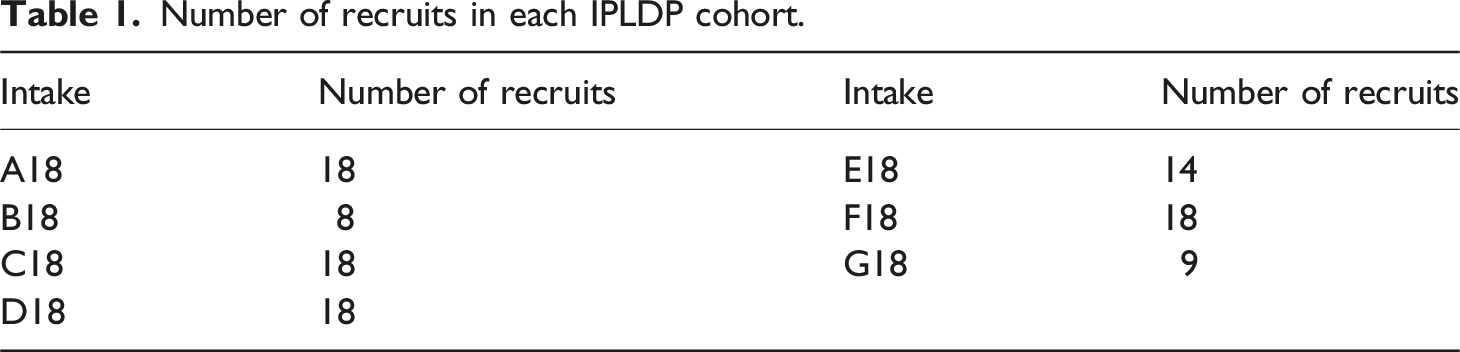
Number of recruits in each IPLDP cohort.
DHEP cohort
Number of recruits in each DHEP cohort.

All probationary officers in the cohorts were asked to participate in the research and all agreed to do so. They were not a random sample, and it is accepted that there will be differences and similarities between participants in both cohorts, but they were representative of police recruits in the force having passed the selection process. The sample was opportunistic and purposeful as they were readily available to the researcher and had the necessary knowledge and experience to participate in the research.
While student officers are likely to have very similar experiences during this phase of their training, they differ in that the PEQF students had benefited from a wider, educational initial course than the IPLDP cohort. As part of a review into the PEQF curriculum the College of Policing acknowledged that the IPLDP recruit training curriculum was outdated and did not prepare probationary for the demands of 21st century policing (College of Policing, 2020). They went on to claim that the PEQF curriculum would provide recruits with ‘skills in problem solving, critical thinking, and analysis, reflection, independent decision making and deploying effective evidence-based practice’ that would enable them to act with ‘a high degree of autonomy and accountability’ (College of Policing, 2020: p. 8). It is assumed that the differences in curriculum content will result in distinctions between the cohorts in relation to their view of policing, how they see themselves and their role. This would allow meaningful comparisons to be made between them (Barbour, 2018).
On both the IPLDP and the DHEP courses, student officers undertake a probationary period of 2 years, initially they complete a 22-week classroom-based course, which is followed by an operational training phase. During this operational phase police student officers return to the training centre to complete a series of short classroom-based courses. It was while undertaking one of these courses that the student officers were asked to participate in a focus group. While the timings of the training courses differ from cohort to cohort all the participants had at least 6 months experience of an independent patrol role and were within their 2-year probationary period.
The student officers return to the training centre in same cohort in which they originally joined the police. So, they all knew each other well prior to participation in the focus group. The participants were briefed that the purpose of the research, the professionalisation of the police was not raised during the briefing so as not to skew the responses in this direction as suggested by Hoggett et al. (2019).
Method
The focus group session was divided into two stages, the participants were asked to divide into sub-groups, and then discuss as a group, their experiences and produce two posters listing the positive and negative features of their role. This was done to achieve as wide a participation as possible and to provide the themes for the group discussion that was to follow. Once this initial phase was completed the posters were displayed, and participants were asked to discuss the topics that been raised either within their own groups or in other groups. This discussion was tape recorded and later transcribed by the researcher.
A thematic analysis approach was used to interpret the data from the posters and the focus group discussions. Thematic analysis is a natural fit with a pragmatic research philosophy as it is not tied to a particular theoretical framework and can be used with within different research perspectives (Braun and Clarke, 2022). The data was reviewed in an inductive manner to discover prevalent patterns of response. The prevalence of themes was established by their repetition in the responses of the participants. This is the most common criteria used for establishing patterns within data sets (Bryman, 2016). While there is no agreed figure that determines when a theme becomes prevalent (Braun and Clarke, 2006), those themes mentioned by 50 % of the subgroups were deemed to be salient themes across the cohorts. As the participants were not a representative sample this is not to claim these results are generalisable however they are illustrative of the concerns of these cohorts of officers (Bergman, 2010). It is acknowledged that the principal researcher (a police trainer with 15 years in the force) had an active role in identifying patterns and in deciding whether a pattern was important both to the research question and the participants (Braun and Clarke, 2006). The second author is not a police officer and independently coded the data.
In total nine focus groups were completed, seven IPLDP cohorts and two DHEP cohorts, there were six DHEP sub-groups and twenty -three IPLDP sub-groups. Each sub-group produce two posters, one containing negative issues, the other positive.
Results
Poster themes
A thematic analysis of the posters identified 14 distinct positive themes in the IPLDP cohorts A18 – G18, and 18 negative ones. In the DHEP cohorts C20 – E20 cohorts there were 9 positive themes and 13 negative themes. These themes are listed in Table 3 in the appendix.
The most prevalent themes reported were perhaps unsurprising related to the practicalities of everyday policing. Both cohorts found their colleagues were supportive, they also expressed concerns about a lack of staff and resources, and the inadequacies of the force’s I. T. systems. The IPLDP groups were critical of other agencies such as mental health services, while the DEHP groups were concerned about the lack of training available to them. Neither cohort made any specific reference to the professionalisation agenda either as a positive or a negative factor in their role. However, they did raise issues relevant to the professionalisation agenda as displayed in Figure 1. Positive and negative Poster themes relevant to professionalisation.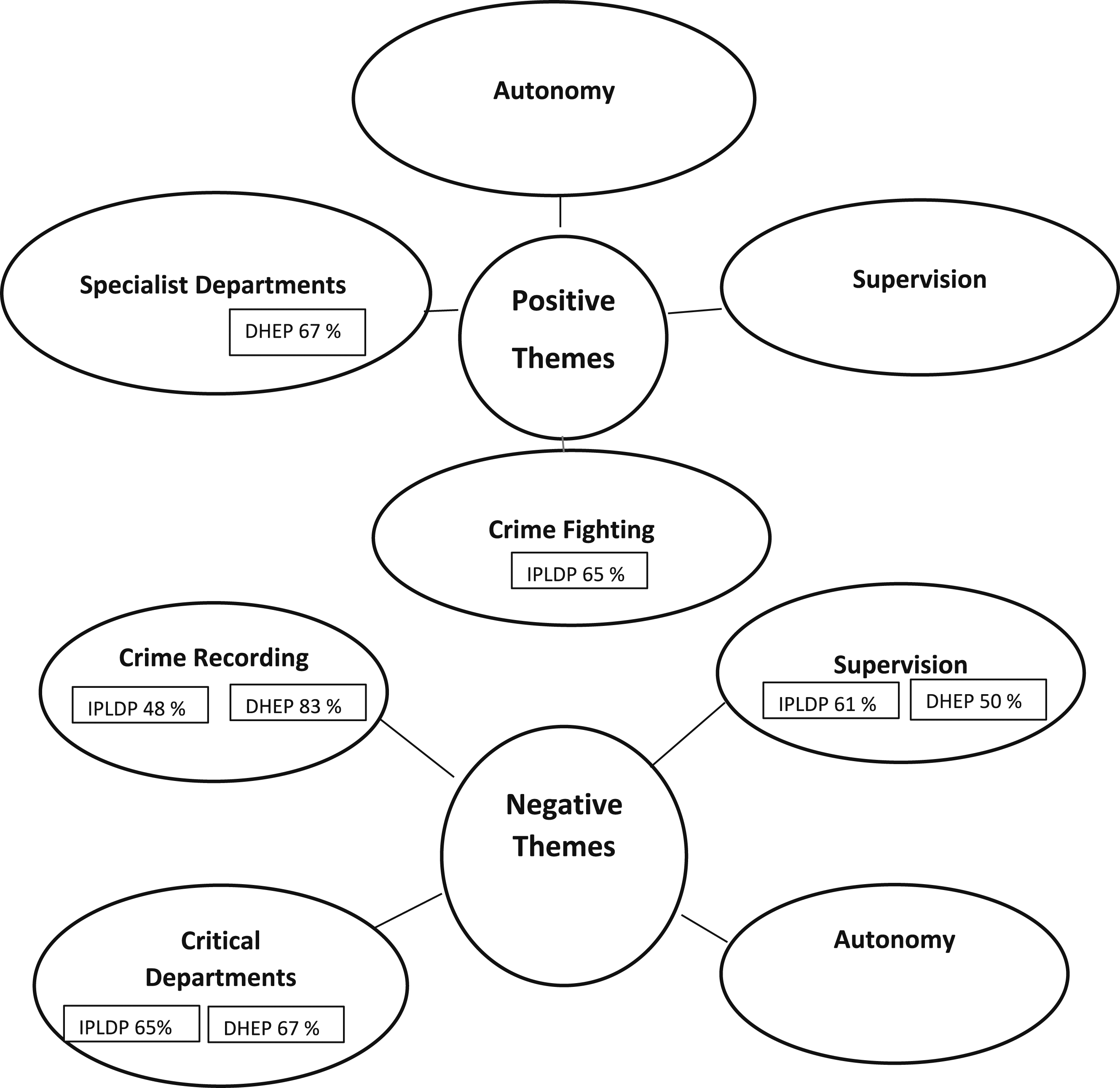
The fact that many of the themes are seen as both positives and negatives reflects the complexity of the experiences being discussed. There was widespread agreement amongst the IPLDP groups that their supervisors were supportive, as did the PEQF groups albeit to a lesser degree, “Supervisor happy to support” (C20, Group 1). There were also criticisms, both cohorts felt there was a lack of contact with their supervisors. While the IPLDP groups claimed that they received little appreciation “Not much praise” (E18, Group 2), the PEQF groups thought that their leaders were out of touch “In all honesty feels at time that senior officers are out of touch “(E20, Group 2).
The PEQF officers were much more positive about their autonomy than their IPLDP colleagues and the concept was framed into two distinct ways. One was in terms of the management of their individual workloads, “Left to own devices” (C20, Group 1), “Left alone to sort work and manage” (E18, Group 3), the other in terms of their autonomy to decide the outcome of a particular case, “Discretionary framework” (C20, Group 2). The latter conceptualisation accords with the professional notions of autonomy discussed above. At the same time some PEQF officers described a lack of autonomy as a negative aspect of their role while this was not a factor for IPLDP officers, “not left to own devices” (C20 Group 1).
While some departments such as Custody Investigation and policies, for example, street triage, joint patrols of metal health practitioners and police officers dealing with mental health incidents, were seen as beneficial, “Street triage - -enables us to deal with the ‘grey areas’ of mental health and which allows us to continue with our job” (E20, Group 1). Other departments especially the control room and the Crime Management and Support Unit (CMSU) and the associated polices were seen as undermining officers’ decision-making and led them to feel they were not trusted. “CMSU – removes power to make own decisions” (C20, Group 1). “Comms second-guessing us – different when we are on scene to the initial log” (D18, Group 2).
An interesting difference between the two cohorts is that a majority of IPLDP cohorts referred to the crime fighting aspects of the role as a positive, “getting arrests” (G18, Group 3) while this was not mentioned by either of the PEQF cohorts.
Focus group themes
The focus group discussion reflected the topics raised in the posters, both cohorts found their colleagues supportive and happy to give them advice and guidance both spontaneously and when requested. There were concerns about the lack of staff and heavy workloads. Issues were raised around a lack of resources and the inconsistency of specialist teams in providing support which was often seen as reliant on an individual’s attitude rather than policy.
The graduate entry scheme was raised by one of the IPLDP groups they argued that a degree was not needed to be a police officer and that the requirement might deter some people from applying. Good communication skills were seen as more important than qualifications, “ just because you have a degree doesn’t mean that you can speak to people” (F18). A discussion in the PEQF group C20 was more positive about graduate entry, their concern was a lack of support and understanding of the process amongst colleagues and supervisors.
Officers in the IPLDP cohorts were positive about their role especially when they were helping or protecting the public, they also described driving on blue lights and sirens and responding to emergency calls as exciting (A18, B18, C18, E18, F18,) “you get the blue lights and sirens on, the adrenaline kicks in” (A18). However, they expressed concerns that the role that the police were seen as the service of last resort. Other agencies especially mental health services were seen as often failing to provide support for people in need, leaving the police to fill in the gaps. (A18, C18, D18, E18, F18, G18) “We are police officers, nurses, mental health practitioners and social workers” (A18). Neither of these topics featured in the PEQF cohort discussions.
All the focus group discussions reflected the diversity of the uniformed response officer’s role. The role was seen as the public face of policing, they were often the first officers at most policing incidents and needed diverse knowledge and skills to deal with them. However, the generality of the role led to the role was not seen as a specialism within the organisation (D18, E18, C20). “It’s not viewed as a specialism response, which is an issue because it should be the number one specialism” (C20). “It’s not seen as a specialist area” (D18)
Subsequently the role had little authority or prestige, and managers failed to give the role the kudos and respect given to other departments such as CID or firearms “it’s not the same sort of kudos or gravitas” (D18). This lack of influence was manifested in the way that various policy and practices were implemented. These included the difficulties of applying a strictly imposed positive arrest policy in the complex area of domestic violence (F18, C20), the requirement that they had to have authorisation from a traffic officer before using their powers of vehicle seizure (E18). There were frustrations that the procedures for liaising with the NHS in relation to their powers under the Mental Health Act undermine their standing and placing them at a disadvantage with NHS staff (D18, E18, G18). A policy that required the arrest of a juvenile to be authorised by an Inspector was seen as a limitation on their inherent powers as a constable and a citizen. When it was suggested that this objection should be raised with supervisors there was general laughter in the room, “Do you want to the bravest person?” (C20). The appointment system for non-urgent calls to the police, known as the diary car, was widely criticised. The officers described frustration with the inflexibility imposed by the system, and decisions made by the control staff that limited their own options in defining whether a crime had been committed (A18, C18, D18, F18, G18, C20). There were similar criticisms of the introduction of new I.T. systems there was little consultation or training, and when they reported issues, they were informed it was due to ‘user issues’ rather than system problems, (A18, F18, C20, E20). “We have told them the issues and they do not listen” (E20). “I.T. systems are built and introduced without the advice of the people who are going to use the system” (A18).
The interrelated nature of policy and supervision led to conflicting views on supervisors amongst both IPLDP and PEQF student officers. Whether a supervisor was judged positively was dependent on their personal qualities. Some were seen as supportive (B18, C20, E20), “If you need some information they are always there” (C20). While others were seen as rude and belittled staff, insisting on the use of formal titles (E18, F18). Some supervisors adopted a micro-management approach (A18, D18) “my sergeant seems very vocal on the radio, they don’t leave you alone, lots of micro-management” (C20). While other relied on policies and bureaucracy to guide their decision making (A18, E18, C20).
The cohorts reported high levels of bureaucracy which meant that extensive and repetitive paperwork had to be submitted for virtually every incident. Officers were criticised for failing to complete their paperwork. They complained that the submissions were done for policy reasons, to satisfy the requirements of other departments and had little to do with practical policing. This created a culture of fear that if something went wrong, they would be criticised and would not be supported by the organisation (A18, E18, F18, C20). “We have created a culture of fear in case we missed something and it's always on the officer to negate you put your collar number. If it goes wrong, it's on yours. If you don't crime something and it comes back to bite. It's you, that said that” (C20).
The impotency to challenge the decisions of specialist departments was most keenly felt in officers’ interactions with the Crime Management and Support Unit (CMSU). The Home Office imposes detailed rules on the police on the recording of crime (Home Office, 2023). The participants acknowledged that the Constabulary was following this national guidance, and that the policy had genuine aims, but they were concerned that the way it was implemented by the CMSU undermined their autonomy and professionalism (C18, E18, F18, G18). “It is due to NCRS they have to put crimes on in 24 hours” (F18).
The policy relies on the content of the initial police log, based on information supplied by the caller, as establishing an accurate account of the incident (McFadzien and Phillips, 2019). Officers found that the account they obtained at the scene often differed from that on the police log, but they claimed that when they attempted to rebut this initial account and change crime recording decisions the process presented a series of hurdles that were often insurmountable. They argued that their accounts should have at least equal weight to the account obtained via the initial phone call. However, their accounts were rarely accepted, and they felt disbelieved by their colleagues and that their professionalism was undermined by the process (A18, B18, C18, D18, E18, C20, E20). “It is also like CSMU and the organisation having a bit more respect for what we do. I've been to the job. I saw it. I recorded the crimes that I saw, and sometimes the way our crimes are updated. It's almost as if they think we have gone to the job and wilfully ignored stuff” (C20). “It feels like our judgement isn’t trusted; we are the ones getting the information but were not allowed to make the decision it is someone else” (A18). “If they put an action on and say this should have been ‘crimed’ and then you explain why not, they often fire back asking for your supervision to check it, and it’s like I don’t need to be checked, I have told you cause I’ve gone there and that should be enough” (C18).
Furthermore, officers complained that they could be forced to work in the control room while this was not required of specialist officers (D18, E18, C20). Specialist department had the power to choose whether to participate in a specific incident and they often allocated tasks to response officers which they could not refuse nor reciprocate. (D18, E18, F18, G18 C20) “CAST don’t seem to take anything, then you have proactive and task force which don’t carry crimes so that comes back to response as well” (C20).
While officers identified these practices as limiting their discretion and autonomy, they were positive about their autonomy in managing their workloads which differed from their previous jobs (B18, E20). They were also happy with the discretionary framework which was seen as a common-sense approach to policing incidents that allowed them to use their discretion to resolve routine incidents, (B18, E20). “You’re encouraged to back yourself, to make decisions yourself on things with your arrests and with your VAs” (E20).
The fact that this led to a variety of different approaches in policing was accepted and seen as a positive factor in policing (A18, B18, F18).
Discussion
This research found that graduate and non-graduate recruits agreed that the response officer’s role was diverse and important to policing. It was described as the public face of the police and required a wide range of skills and knowledge. However, both cohorts claimed that the role had little kudos or influence within policing. Specialist departments were able to dictate the activities of response officers and overrule their decisions. This replicates findings in the Casey Report which found that specialist roles benefited from extra resources and were revered by mangers (Baroness Casey, 2023). These practices would make it difficult for graduate officers to influence policing towards a more professional approach regardless of their commitment to the project. Which is especially problematic because this research did not find a strong overt commitment to the professionalisation process amongst the graduate trainees. It was only mentioned by one of the DEHP groups in the context that the requirements of the programme were largely unknown amongst the existing work force. The single IPLDP group that referred to graduate entry were not supportive of the project expressing a preference for communication skills over graduate education. This suggests that the DHEP entry route is not inculcating a strong professional identity amongst the DHEP students, and furthermore, that the agenda is not popular within the organisation. This proposition is supported by research conducted amongst student officers by the College of Policing which found that the relevancy of degrees was questioned especially when compared to the efficacy of experienced officers without a degree (College of Policing, 2022). Despite this lack of overt commitment to a professional identity there were indications that a desire for professional autonomy was more prevalent in the DEHP cohort than in the IPLDP groups. The DEHP cohort were markedly more positive about their opportunities to act autonomously, and they were negative about restrictions imposed on their decision-making. This suggests that topics in the curriculum such as problem-solving and decision making are having a positive impact on the students.
The cohorts also differed in their view of the police role, the IPLDP cohort reported a strong affinity with the crime fighting aspects of the role, making arrests, and conducting searches. Furthermore, they were critical of other public bodies whose poor response to public demands for service necessitated police involvement. In contrast the DHEP groups made no reference to crime fighting and were supportive of innovations such as street triage which uses both police and National Health Service (NHS) resources to deal with mental health incidents. This suggests that IPLDP prepares recruits for an orthodox police role which is focused on crime fighting while the educational approach and wider graduate curriculum including vulnerability, critical thinking and problem solving has given the DHEP recruits a broader perspective on the role of the constable. This again accords with findings from the College of Policing which found graduates felt more prepared for the role and indicated a wider acceptance of the public service aspects of the role (College of Policing 2022).
Despite these differences the most significant barrier to professionalisation was identified by both cohorts. There was a widespread criticism of the implementation of policies that limited their discretion. The crime recording system, the diary car appointment system, and the policy on juvenile arrests were all cited as processes that are implemented by specialist departments and which routinely undermine or limit the officer’s decision making in ways that they cannot challenge. This leads to them feeling that their judgements are not trusted. It is a central ambition of graduate entry that the officers will be autonomous independent minded decisions makers able to operate without close supervision (College of Policing 2020). This research suggests that their opportunities to act in such a way might be limited and furthermore, such micromanagement is an anathema to being a professional or the development moral agency (MacIntyre, 2004).
This reflects the accepted view that a professional’s ability to act with autonomy is necessary for professional practice.
These research findings are limited as they are based on the views of officers from a single constabulary, but they do echo some of the findings of the Casey report. In both studies response officers felt undervalued, that their role lacked kudos and was not the basis of career development. Baroness Casey argues that the Metropolitan Police is inward looking, and that decision making is centred in hands of police managers, is driven by culture, defensiveness and lacks humility and a wider perspective.
Conclusion
Achieving professional status accrued benefits to nursing and teaching, including a well-educated professional and accredited workforce with a clear professional identity, lead to improved recruitment and retention, and enhanced their status and legitimacy in the community (Green and Gates, 2014).
The police could benefit in a similar way, but this research suggests that further work is needed in the education and training provided to the graduate recruits and in the managerial approach taken within policing. The recruits must be inculcated with a professional identity that embraces evidence-based policing, ethical practice and autonomous decision making based on critical thinking and manifested in the moral agency of the constable. If they are to be the change agents of the professionalisation process, they must be suitably equipped and aware of the task that they face. This research demonstrated that the internal police structure and the way that policies are implemented is unsuitable in the type of professional environment that has been articulated by the College of Policing and the National Police Chief Council.
While it is still unclear how it will impact on the process the introduction of a fourth entry route will be problematic. Organizational change often relies on a ‘tipping point’ when enough members of staff shift over to the new system. The fourth entry route can only slow down the time it takes for the police to achieve this. So, if the police chiefs are sincere in their ambition for recognised professional status the fourth entry route is a retrograde step.
Footnotes
Declaration of conflicting interests
The author(s) declared no potential conflicts of interest with respect to the research, authorship, and/or publication of this article.
Funding
The author(s) received no financial support for the research, authorship, and/or publication of this article.

Appendix
List of Poster Themes. .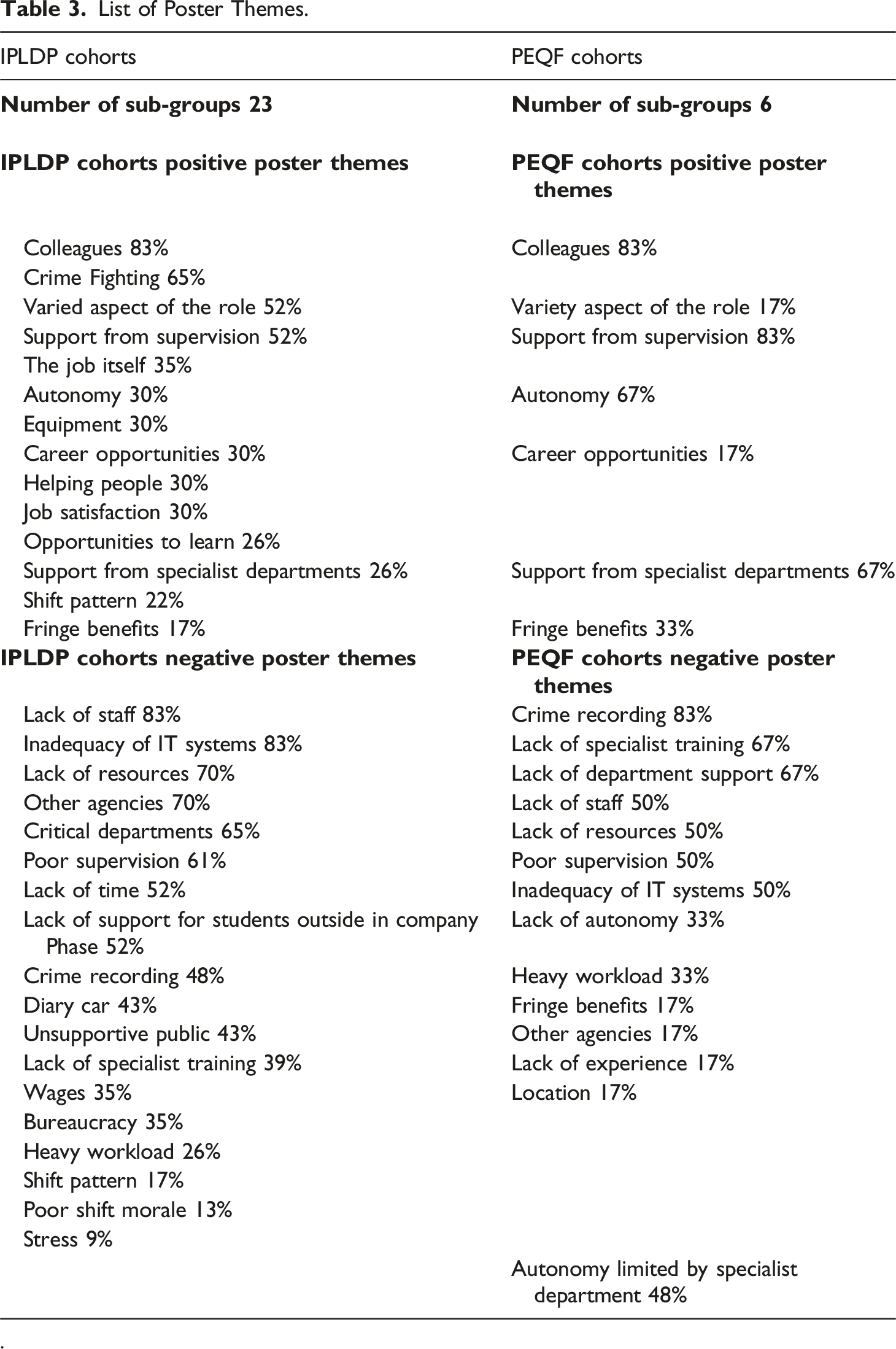
IPLDP cohorts
PEQF cohorts
Colleagues 83%
Colleagues 83%
Crime Fighting 65%
Varied aspect of the role 52%
Variety aspect of the role 17%
Support from supervision 52%
Support from supervision 83%
The job itself 35%
Autonomy 30%
Autonomy 67%
Equipment 30%
Career opportunities 30%
Career opportunities 17%
Helping people 30%
Job satisfaction 30%
Opportunities to learn 26%
Support from specialist departments 26%
Support from specialist departments 67%
Shift pattern 22%
Fringe benefits 17%
Fringe benefits 33%
Lack of staff 83%
Crime recording 83%
Inadequacy of IT systems 83%
Lack of specialist training 67%
Lack of resources 70%
Lack of department support 67%
Other agencies 70%
Lack of staff 50%
Critical departments 65%
Lack of resources 50%
Poor supervision 61%
Poor supervision 50%
Lack of time 52%
Inadequacy of IT systems 50%
Lack of support for students outside in company Phase 52%
Lack of autonomy 33%
Crime recording 48%
Heavy workload 33%
Diary car 43%
Fringe benefits 17%
Unsupportive public 43%
Other agencies 17%
Lack of specialist training 39%
Lack of experience 17%
Wages 35%
Location 17%
Bureaucracy 35%
Heavy workload 26%
Shift pattern 17%
Poor shift morale 13%
Stress 9%
Autonomy limited by specialist department 48%