



Abstract
In the past 30 years, the introduction of new providers of policing services has meant that the policing landscape in many countries has changed considerably. In the Netherlands, an important aspect of this ‘pluralization of policing’ is the introduction of municipal officers: new, public officials who are employed by Dutch municipalities. This article discusses how front-line professionals themselves view these changes and the division of labour between the regular police and municipal officers. By interpreting their views as strife and contestation over professional domains and by borrowing concepts from the sociology of professions, it adds a novel perspective to the current debate on plural policing. The article discerns four views, two of which highlight differences and two of which highlight similarities between these professions. In interpreting these views, the article states that officers define their professions mostly by referring to fundamental argumentations about professional core aspects and higher values. This implies the ‘professional projects’ of front-line workers might be as important as their orientation on outside (societal) needs and desires.
Keywords
Introduction
In recent years, the introduction of new uniformed workers outside the police has meant significant changes in the policing landscape in many countries. This also applies to the Netherlands: since the late 1980s, several ‘non-police providers of policing’ – commonly referred to as ‘plural policing’ – have entered onto Dutch streets. In this article, officers who are employed by Dutch municipalities are discussed, here called ‘municipal officers’.
The phenomenon of plural policing has received extensive scholarly attention. Mostly, three general explanations for the introduction of new officers are mentioned: a lack of police resources to address (fear of) crime and disorder; changes in the urban environment, with an ensuing decrease in the tolerance of antisocial behaviour; and a relocation and redefinition of police responsibilities towards alleged ‘more serious’ police work (Garland, 2001;
Jones and Newburn, 1999, 2007; Millie 2008; Newburn, 2001; Sleiman and Lippert 2010; Terpstra, 2010; Terpstra et al., 2013; Van Steden, 2007; Van Stokkom, 2013). Many studies also tell us more in detail about plural policing, such as relevant historic developments, the role of private security officers, how various forms of plural policing are regulated, governed or configured, or the differences between various countries on such matters (Bonnett et al., 2015; De Maillard and Zagrodzki, 2017; Jones et al., 2009; Terpstra et al., 2013; Van Steden, 2007).
These studies provide a lot of insight into plural policing, but are largely missing out on a specific perspective: that of front-line officers themselves. This is not to say there are no studies on front-line officers’ views and experiences (cf. Bervoets, 2013; Terpstra, 2012), but there is little idea of how various uniformed workers see the pluralization of policing itself, especially within a public context. This article adds to the current debate by studying plural policing as (the result of) a process of professionalization that is wrought with strife and negotiation among front-line actors. Thus, it aims to enhance our understanding of plural policing by using a theoretical perspective hitherto little used in this field: that of the sociology of professions (cf. Freidson, 2001; Larson, 1977). As such, this article points out that plural policing is, for an important part, defined through the ideas of front-line actors, who can be seen as active stakeholders with various, sometimes conflicting, views and interests.
The plural policing practice discussed in this article concerns officers who are employed by Dutch municipalities: municipal officers. These are relatively new officers who operate in parallel to the Dutch National Police. As such, these officers are similar to regular police officers because they are also public providers of policing. This will prove to be a valuable setting for studying the dynamics of relations between two policing professions, without being muddied by debates about privatization. As it turns out, this form of plural policing is truly an example of contestation over professional status and domains, and not over economic competition. Moreover, the Dutch case may provide insights that are applicable to other countries with similar developments in policing, such as Belgium or Austria (cf. Terpstra et al., 2013).
The approach is introduced in more detail below, but first I explain more about the Dutch context of municipal disorder policing and sketch the outline of this study, the research questions and methodology.
Dutch municipalities and disorder policing
To understand the context of the two public providers of policing in the Netherlands, several characteristics of Dutch local government and the (plural) policing landscape should first be noted.
First, Dutch municipalities represent relatively strong forms of local government. Municipalities have an elected council and a clear mandate over policy domains as diverse as social assistance, welfare and public safety. The 1990s in particular witnessed a stronger grip by Dutch local governments on the latter, under the header ‘integrated public safety management’ (Cachet and Ringeling, 2004; Ministry of the Interior, 1993). This term reflected an ambition to tackle issues as diverse as antisocial behaviour, neighbourhood decline and (petty) crime by involving a wide range of actors at the local level and with Dutch municipalities as the central coordinating actor. This was fuelled in part by growing concern about disorder in public spaces, such as dog fouling, illegally dumped household waste, cyclists in pedestrian areas, loitering youth, drunks and drug users (cf. Van Stokkom, 2013).
Second, it should be noted that the police in the Netherlands have been reorganized thoroughly over past decades, leading to a process of ‘creeping centralization’ (Terpstra and Kouwenhoven, 2004). This involved the replacement of Dutch municipal police by a system of 25 districts. Most recently, in 2013, a national police force was reintroduced. This has led to a further decrease in police involvement in local communities (Terpstra et al., 2016).
These changes have prompted Dutch municipalities to introduce their own ‘municipal officers’ (cf. Eikenaar, 2017; Terpstra et al., 2015). This started in the second half of the 1980s and 1990s with programmes for city wardens. Through these programmes, the long-term unemployed were given the opportunity to develop work experience as surveillance personnel. As such, city wardens had the same powers as ordinary citizens and were mostly used for general surveillance, to prevent so-called ‘petty crimes’, and for a range of alleged inferior policing chores, sometimes granting them the nickname of ‘the police’s mailmen’ (Hauber, 1994; Van Steden, 2012, 2017). In the beginning of the 21st century, a national plea for strict law enforcement led to the reorganization and professionalization of these city warden projects. The ensuing new ‘city surveillance agencies’ implied the gradual employment of new, trained and more professional personnel with the qualification of ‘Special Investigative Officer’, known as BOA in Dutch (an abbreviation of Buitengewoon Opsporingsambtenaar; Van Steden, 2017). 1
Currently, almost all officers who work in municipal city surveillance have BOA status (Eikenaar and Van Stokkom, 2014). This qualification enables them to deal with ‘minor annoyances, nuisance and other facts that affect the quality of life’ (Ministry of Justice, 2015: 10). Therefore, they have specific legal powers and the ability to impose fines for various forms of disorder and antisocial behaviour, such as littering, loitering and several traffic offences. This was backed by the introduction of administrative penal orders and administrative fines in 2009, and national requirements for examination. 2 Hence, this relatively new occupational group has professionalized considerably over the last 20 years.
As a result, two public policing providers now patrol Dutch streets. However, that does not imply that the police and municipal officers collaborate well. Although municipal officers are street-level bureaucrats resembling regular police officers, they have also developed largely independently (Bervoets, 2013; Bervoets and Rovers, 2016; Eikenaar and Van Stokkom, 2014; Terpstra, 2012). As such, they have a range of specific tasks and are informed by policy goals that set them apart from the police: addressing alleged ‘minor annoyances’, making sure public spaces are kept ‘clean, intact and safe’, and ensuring the ‘quality of life’ of public places. Both occupations seem to operate within the confines of their own work domains, even though various formal regulations prescribe otherwise (Bervoets, 2013; Eikenaar and Van Stokkom, 2014; Mein and Hartmann, 2013; Terpstra, 2012; Van Steden, 2012; Van Steden and Bron, 2012; Van Stokkom and Foekens, 2015). 3
Approach and research design
The lack of interaction between these two, closely related, professions does not tell us anything about how policing practitioners look upon their shared work domain, or perceive their differences. Conversely, the dynamics of the plural policing domain as seen through the eyes of front-line workers themselves may well provide an insight into the apparent rift between two professions that have much in common.
Therefore, the following explorative question leads in this article: How do municipal officers and police officers see the division of labour between their occupations and how can their views be interpreted?
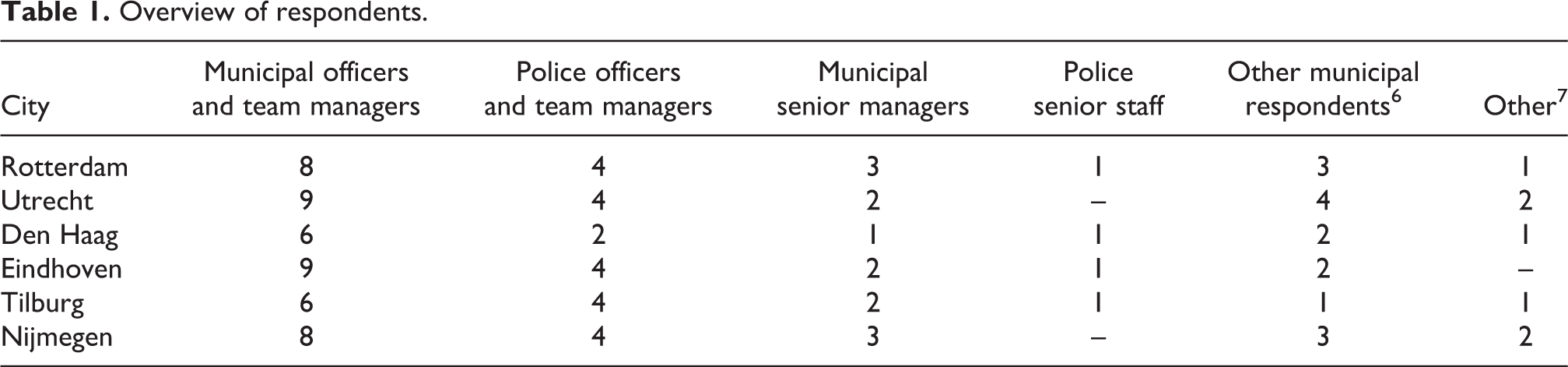
First, the main part of this article is devoted to the study of officers’ views. This demanded an exploratory, open approach with a qualitative research design (Silverman, 2011). 4 For this study, interviews were conducted with municipal officers and police officers in six large Dutch municipalities. 5 For obvious reasons, these interviews were for the most part aimed at the ‘front-line level’, thus involving officers who were actually involved with front-line work, walking beats, carrying out surveillance, etc. These were supplemented with interviews with (among others) senior managers from both police and municipal organizations, and respondents from other municipal departments, adding up to just over 100 interviews. Talking to these respondents provided an opportunity to deepen our understanding of the views and remarks of front-line officers, and to help interpret their ideas. Some characteristics of the respondents are summarized in Table 1.
Overview of respondents.
Interviews were conducted by using topic lists, and were mostly conducted in the respondents’ workplace, aiming for an atmosphere in which respondents could talk freely about their work. Results from interviews were analysed using a mix of inductive and deductive coding (Decorte, 2010). Therefore, several steps were taken. Each interview was recorded, transcribed, analysed and coded quickly after the interview by means of the qualitative analytical Atlas program (‘open coding’; cf. Boeije, 2010). Next, the material was analysed further by axial and selective coding to study the relations between various categories (Boeije, 2010). This provided the basis for the framework presented in the following section.
The second step in answering the central question of this article was taken by interpreting these views by tapping into concepts borrowed from the sociology of professions. This implied analysing plural policing by seeing municipal officers and police officers as ‘social actors’. By applying a Weberian-inspired approach, I regarded these occupations as ‘collectively conscious groups’ who share beliefs and specific interests (Macdonald, 1995; Van der Krogt, 1981). In particular, the sociological approach of professions elaborated by Freidson (2001) was used to clarify and analyse these various positions. This interpretation is elaborated in the section ‘Interpreting views’.
A division of labour: views of front-line professionals
Any professional domain is rich in argumentations, in which various views, interests, ideologies and experiences play a role. I have chosen to break down this complexity into a simpler question: what – in the eyes of these respondents – distinguishes police officers from municipal officers, and what unites them?
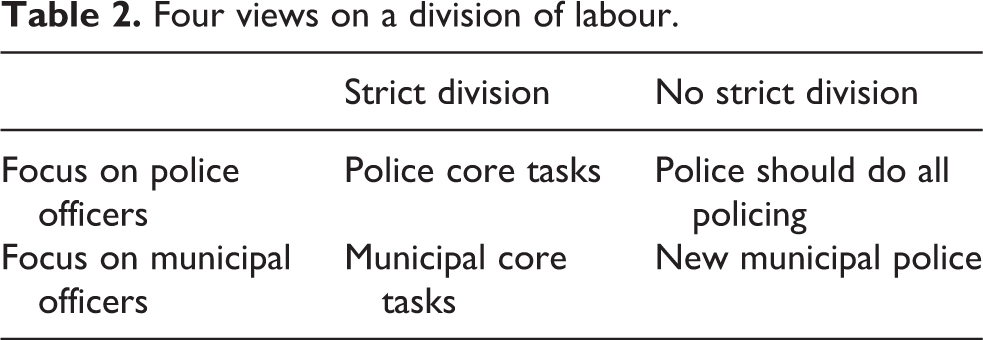
In this section, I categorize the answers to this question (and related questions) in four different ideas about the ‘division of labour’ between these officers. Two ideas stress the differences and two stress the similarities between these professionals.
Strict division: police core tasks and ‘catching crooks’
At first glance, both occupations are divided strictly due to the police’s essential set of tasks. This idea of the police having a strictly defined number of obligations is related to ‘the debate on the core tasks’: a recurring argument among the Dutch police about what are essential police tasks and what are not (cf. Terpstra et al., 2010) Although this ‘debate’ does not amount to official policy, it shows a strong tendency to move towards ever ‘more serious’ police work. As such, it also influences views on the distinction between municipal officers and police officers.
A frequently heard statement is that the police are legally required to deal with criminal investigations and have an obligation to address ‘serious crime’. More than just being a bureaucratic description of their tasks, it is also part of police rhetoric. With this statement, officers indicate these tasks are not only the police’s ultimate, but also their main responsibility: ‘catching crooks’ should be the sole focus of their attention (Van Stokkom, 2010). Moreover, this rhetoric enables respondents to oppose other tasks and to refer other issues, such as ‘minor annoyances’, to other organizations. As one police officer explained, ‘The real bastards, that’s what we’re here for’ [TPO-1]. 8
Thus, the ‘catching crooks’ phrase provides officers with an opportunity to assert that the police should not be involved with any other problem. From dog dirt to domestic violence, none of these issues concern ‘catching crooks’. Thus, officers both use this idea to rhetorically absolve the responsibilities of the police from various issues, and to indicate the police has gone astray in the past. Certain, seemingly apparent non-police tasks are mentioned to underline this argument, as is done by this police officer, Year after year, we have let the neighbourhood constable spread leaflets door to door. With all due respect, but a constable or a police officer should be catching crooks, not spreading brochures. That’s something someone else should do. [EPO-1]
With the division in major and minor tasks, officers paint a picture of police work as a special, distinctive job. Police officers see themselves as a carefully selected elite with a ‘mission’ and they should be given every opportunity to devote attention to this mission (cf. Reiner, 2010). Furthermore, they invoke legal distinctions between types of officers to support this distinctiveness. Municipal officers are lower down the hierarchy of law enforcement occupations as they have fewer powers than police officers. Many officers also highlight the ‘monopoly on violence’ to support this view, claiming that only the police have the legal mandate to use violence (ignoring municipal officers’ coercive means). This is further supported by assumptions about the professional quality of municipal officers. One police officer stated, ‘They haven’t got enough quality there’ [RPO-1]. Clearly, municipal officers’ reputation and history as city wardens have a large impact here.
Strict division: the ‘core tasks’ of municipal officers
The ‘core task debate’ is by now a well-known phenomenon among those acquainted with developments within the Dutch police over the past 30 years. Although not part of official regulations or policy, it defines many views on police work, and its distinctiveness. In this respect, municipal officers are typically seen as auxiliary officers. They are there so that police officers can devote themselves to their ‘vocation’.
However, by merely seeing the police as the dominant occupation that is willingly supported by others, one overlooks the agency of the municipal officers. These workers and (especially) their managers have been working arduously on their emancipation as a new policing profession. This has resulted in a parallel tendency to highlight alleged unique occupational characteristics, and an equal rhetorical creation of a quintessential prototype of ‘municipal officer’. It is a ‘core task’ vision that can be seen as a logical complement to the police’s purification endeavours, be it that the leading idea is that municipal officers should do less police-type work.
Municipal officers underscore their value by stressing that they have left behind their past as city wardens. As opposed to uniform carriers, municipal officers emphasize they are expected to write fines, and have certain coercive means and powers at their disposal. Moreover, they claim that they are more capable of addressing citizens who do not comply with the rules. Municipal officers state that they know how they can ‘make a difference’; using a typical example of their own rhetoric. City surveillance agencies have autonomously developed their occupation, characterized by particular work styles and a justification under the banner of ‘quality of life’ (leefbaarheid) issues. This phrase, ‘quality of life’, is an emblem they embrace fully and use to create priorities in their daily work. A municipal team manager explains how this works by referring to the interaction of municipal officers with street youth, When you come in parks where young people are causing a big mess, but who are in no way criminal, you could step up to these kids, have a chat, show your face. [So, youngsters know that] these are the people that deal with quality of life. [They realise] ‘Municipal officers can also fine us because we do not clean up our mess’. [DMO-1]
Overseeing these first two views, both police officers and municipal officers may be prone to highlighting their ‘core tasks’. Both state that there is a strict division between the two occupations, although both sides of this divide draw the line on different grounds. On the one hand, the police adhere to the mantra of catching crooks, thus legitimating priorities and defining their profession as one with a mission that deals with ‘perennial problems’ (Freidson, 2001). On the other hand, municipal officers identify with ‘quality of life’ issues to emphasize their uniqueness and to turn away police tasks. Hence, both sides of this perceived division in policing tasks are characterized by a certain obstinate attachment to principled definitions.
No strict division: a new municipal police
The first two views give the impression of a strictly divided policing domain with each profession highlighting its own particular core tasks. However, not all respondents are this principled. Others seem to be more pragmatic, and approach surveillance and law enforcement as a shared domain with tasks that can be assigned to various organizations. Thus, officers other than the police might concern themselves with, for instance, traffic controls, surveillance of suspected crack houses or detaining shoplifters.
Some police officers, for instance, appear less convinced of their essential tasks. Over the years, they have seen their organization change and new players enter the field. In their case, this has led to a relatively pragmatic idea of who is responsible for policing. Hence, they think municipal officers can replace the police in various areas. Some maintain there is no predefined limit, other than ‘that municipal officers should not be working on the criminal justice side of police work’, as a respondent states [TO-1]. Others think municipal officers can adopt police tasks that concern ‘all the things that happen on a daily basis’ such as the enforcement of traffic laws, minor traffic violations and traffic controls, a municipal team manager explains [TMO-2]. Quite a few respondents also think municipal officers are fit for neighbourhood work, such as walking beats and being in touch with local residents. Yet others picture municipal officers as temporary replacement when pressure on police capacity is mounting, for example, by running night shifts, or as ‘eyes and ears’ [UPO-1]. Also, their view on the professional status of municipal officers is fairly pragmatic. The only prerequisite is that municipal officers are well-trained. If that is the case, coercive means may well be expanded. In effect, some police officers use the term ‘municipal police’ to characterize what developments in municipal disorder policing have led to: these municipal officers can already be seen as the new, local municipal police force that was abolished in 1993.
Likewise, quite a few municipal officers and managers share the conviction more work can be done by municipal officers. However, their willingness appears to be grounded in more than pragmatism, as more ‘serious police-type’ work has the added value in that it helps prove their worth as policing officers. Thus, the wish for more tasks that border on police work is often strengthened by an (implicit) form of assertiveness and ambition to be taken seriously. Likewise, their wish for more powers is based on the observation that their limited mandate may well lead to a loss of credibility in the eyes of citizens. Especially where municipal officers are confronted with the limited legal possibilities given to BOAs to fine. They claim that they are sometimes very eager to intervene. For instance, a municipal officer states that when confronted with ‘people in their cars calling while driving. Then I’m itching to do something.’ [TMO-3].
Thus, municipal officers and police officers may well agree on a less strict division of labour between the two occupations, but do so on different grounds. This results in a temporary coalition in which overwrought police officers invite their eager municipal colleagues to take more work off their hands. Pragmatism is only part of the explanation here, as municipal officers are self-assertive and eager to prove their professional worth.
No strict division: one police for all disorder policing
The fourth and final view on a division of labour equally embraces the idea that there is no strict division, but instead amounts to an extension of police responsibilities.
A small, yet sizeable group of (mainly) police officers appears convinced that dealing with disorder is and should be a task best given to the police. It is only due to unfortunate choices made in the past that other officers have started to manifest themselves as fit for these tasks. These officers regret that their colleagues look down on policing alleged ‘minor issues’, as this is, in fact, part of the police’s job. Some claim that the core task idea has led to rigidness, the refusal to be managed by municipalities, but also the danger of losing the connection with everyday neighbourhood life; an officer summarizes the ideas of his colleagues, ‘because I deal with murder and homicide, not with those shitty rubbish bags’ [EPSS-2].
As a result, these respondents’ stance on municipal officers is characterized by ambivalence. On the one hand, the presence of municipal officers is regretted. They are perceived as doing a traditional police job, and are actually thought to have a negative impact on police officers’ position and legitimacy in neighbourhoods. A police officer in Nijmegen, for instance, voices his regrets on this matter, seeing it as a hollowing out of his work: We haven’t been doing […] part of the police job for a long, long time, because we didn’t have the time for it, and also because some of my colleagues see it as inferior work’. [NPO-1]
It is a view that is also informed by the aforementioned ‘core task’ debate, albeit in more pejorative terms. In the opinion of officers, the emphasis on core tasks has caused a loss of credibility. By focusing exclusively on criminal justice and less so on visibility and general surveillance in public spaces, this credibility might well erode further, these respondents claim. Likewise, outsourcing surveillance in public spaces to other officers is seen as harmful for the police’s status and position in society. As such, this last view on a division of labour is characterized by ambivalence: municipal officers may be doing the police’s job, but it is evident that ‘plural policing’ is a fact of life. Longing for the police to be ‘monopolistic guardians of law and order’ (Crawford, 2003) does not stand in the way of seeing municipal officers as serious policing colleagues who help out where they can.
These four ideas of a division of labour can be summarized by combining them in the following overview (Table 2).
Four views on a division of labour.
Interpreting views
The previous section has shown the Dutch plural policing domain of municipal and police officers is characterized by an abundance of views, motivations and ideas. By grouping these views into four positions, I have tried to create an overview of how officers perceive the distinction between occupations. However, these four positions show more. They demonstrate that front-line workers are not just workers ‘doing their job’, but that they are actors who engage with and strive over the definition of their occupations. This leaves us with the question of how such views should be interpreted. Here, I turn to the sociology of professions for assistance.
As in other professional domains, dividing work over various occupations (plural policing) implies that actors (re)define, secure or improve their positions, that they have their own ‘professional projects’ (Larson, 1977; Macdonald, 1995). The way front-line workers describe their work is characterized by various ideas and ideologies, and part of a constant strife over ‘the boundaries of [these] domains and the membership who belong within them’ (Macdonald, 1995: 8). As such, the dynamics described here, bring to mind the strife and negotiation among other professionals with closely related occupations, such as is the case in medicine or law.
Leaning on the work of Freidson (2001), the idea that actors may use various forms of ‘logic’ in their professional projects is of particular help here. These are the tacit argumentative structures that underlie the views described above and help define a profession. Freidson distinguishes between a market logic, a state logic and ‘professionalism’ as a ‘third logic’, the ‘primary tool available to disciplines for gaining the political and economic resources needed to establish and maintain their status’ (Freidson, 2001: 105).
All three forms of logic imply their own division of labour, and all three can, to a certain extent, be recognized in the views described here. A market logic, for instance, can be found in statements that claim that police work is a ‘product’ that may be provided by various suppliers; a vision that seems in part to be of relevance for the third view described above. Some respondents simply – and literally – state that the police do not have the monopoly over policing. As a result, the division between both occupations might be informed by unconstrained competition over policing work (Freidson 2001). Likewise, what Freidson calls a state logic and an associated ‘bureaucratic division of labour’ can be recognized in arguments that stress the hierarchical division between both types of officers. Following this logic, municipal officers take in a subordinate position, underscored by lesser powers and a lower professional status.
However, it is the third logic – that of professionalism itself – that seems most prominent among these professionals. This logic stresses fundamental considerations about the differences between the two professions. Here, such arguments amount to statements on what is ‘real’ police work and what is the ‘real’ work of municipal officers. It is a logic that highlights the alleged core aspects of both occupations, and might appeal to transcendent values that imbue tasks of both types of officers with a higher goal (Freidson, 2001). These ideas are voiced by police officers when they talk about their core tasks, which they see as a core discipline, that ‘bear[s] on issues of widespread interest and deep concerns on the part of the general population [and that] address[es] perennial problems that are of great importance to most of humanity’ (Freidson, 2001: 161). Municipal officers have equally developed an idea of what are their fundamental tasks. They defend the core aspects of their occupation, and create an autonomous status with connected transcendental values (cf. Freidson, 2001). Thus, these officers also draw boundaries on fundamental grounds, albeit with a different legitimation. They see themselves as newcomers who need to defend themselves against police dominance and the tendency of police officers to give municipal officers the chores they are reluctant to do (Freidson, 2001: 202).
As such, arguments that refer to higher values, to what it means to be a municipal officer or police officer are stronger than economic or bureaucratic divisions of labour. First, because the notion of ‘core tasks’ has a clear presence among the ideas of both types of officers; many officers stress that there is a clear distinction between the two occupations, and they do so on fundamental grounds. Second, officers who highlight the similarities between the two occupations often use moral and/or professional values. For instance, the conviction that municipal officers can do more police-type work is based on the idea (or wish) that municipal disorder policing is a serious policing occupation; again, a fundamental way of thinking about these professions. Third, those police officers who long for the days when they could do all forms of disorder policing, adhere to the fundamental view their ‘mission’ involves all types of policing tasks, and not only catching crooks. Thus, views may be opposite, but the arguments used to support those views often are of a similar, fundamental nature.
The dominance of this ‘third logic’ can also be seen as the prevalence of what Bourdieu (1986) would call cultural capital. As such, many of the views discussed here highlight the importance of symbolism. The near-sacred status of police officers can thus be seen as a ‘symbolic logic of distinction’, in which their emphasis on (for instance) the monopoly of violence, or extensive training grants them ‘material and symbolic profits’ (Bourdieu, 1986). Likewise, municipal officers’ emphasis on their own distinctiveness can, in part, be seen as their answer to this distinction made by police officers: they apply their resources to repair their damaged status as long-term unemployed good-for-nothing ‘city-strollers’. They do so, for instance, by highlighting their process of professionalization, their status as BOAs (‘Special Investigative Officer’) and the training they have received. It is a form of what Bourdieu calls the institutionalized state; where ‘one sees clearly the performative magic of the power of instituting, the power to show forth and secure belief or, in a word, to impose recognition’ (1986: 251). Hence, by highlighting the worth of their own education and training, municipal officers acquire their own cultural capital.
Conclusions
Developments in plural policing are often explained and interpreted by referring to (general) changes in the urban environment, decreased tolerance, or a reshuffling of traditional police organizations. Such interpretations provide interesting insights, but leave out the views of front-line actors. In this article, I have provided room for these perspectives by describing plural policing in the Netherlands through officers’ eyes. Therewith, it presented a way of looking at plural policing that gets little attention in most other studies. By looking at plural policing through the lens of professionalization and contestation between front-line actors, this article has shown that the policing domain is also shaped by the ‘professional projects’ of newcomers striving for ‘organized autonomy’ (Larson, 1977), and of established professions trying to maintain their status. Thus, police and municipal officers have been discussed as actors who actively engage in defining their occupations and strive over domains and responsibilities (Larson, 1977; Macdonald, 1995). The Dutch case in particular proved to be highly suitable for this endeavour: the emergence of municipal (and hence) public policing forces in the Netherlands, alongside the Dutch National Police, means that both forces are established through public means and both have a goal of defending the ‘public good’. Hence, there are no private interests involved, and questions about division between the two professions cannot be answered by a reference to ‘public versus private’.
In concluding, we should first note that these dynamics can only be understood against the background of municipal officers’ history as city wardens hailing from unemployment schemes. This history means that municipal officers started professionalization only recently, for a long time did not possess a ‘body of shared knowledge’ (Abbott, 1988), and still have a vulnerable reputation and self-image. They still appear to be eager to prove themselves as valuable policing officers, bringing to mind the ‘legitimation work’ of private security officers (Thumala et al., 2011). Moreover, these ‘professional projects’, as attempts to wrest control of an occupational domain (Larson, 1977), do not stand on their own. 9 They are fed by police officers’ own tendency to protect their status and ‘mission’ from alleged unprofessional uniform carriers (cf. Reiner, 2010). In terms of Bourdieu, they apply their cultural capital as a ‘symbolic logic of distinction’, and to sacralise their status as ‘monopolistic guardians of law and order’ (Crawford, 2003; cf. Bourdieu, 1986). In this sense, police officers seem to have their own ‘professional project’.
The existence of such professional projects invites reflection. On the one hand, these ‘projects’ bear witness to the strong inward focus of both occupational groups. They bring to mind two encampments, because these projects amount to so-called ‘social closure’, to actors that engage only with their professional counterpart when it serves their own agenda (Freidson, 2001). Thus, officers appear preoccupied with their own tasks, their own status and their own mission. In addition to, or instead of, responding to outside needs and demands (be they defined by the market, state or citizens), officers might be focused on their own professional habitus (to borrow again from Bourdieu). An evident consequence of this social closure is the risk that officers fail to acknowledge exactly those outside needs and demands that legitimate their profession (cf. Bittner, 1970). By contrast, from neighbourhood residents’ viewpoint, it might not be important to divide different tasks in surveillance and law enforcement, to distinguish ‘public safety’ issues from ‘quality of life issues’, or what exact professional training an officer has. Residents are bothered by pressing issues, and do not care whether these issues are called ‘quality of life’ or ‘public safety’: they just want them to be solved.
Moreover, by merely highlighting ‘catching crooks’, police officers might run the risk of losing credibility and legitimacy in the eyes of residents. The same applies to municipal officers, by focusing on only a predefined set of ‘quality of life issues’ and ignoring other vexatious annoyances, citizens might wonder what is the point of these new uniformed workers. Meanwhile, merely embracing more and allegedly more serious tasks to shed the status of ‘city strollers’ might stand in the way of professional performance and structural training. This seems especially relevant as recent developments point out that municipal officers are replacing police officers on an increasing range of other law enforcement issues, for example, during the night, and in relation to street youth (see also Eikenaar and Van Stokkom, 2014; Van Stokkom and Foekens, 2015).
On the other hand, the professional projects described here should not be discarded too easily as mere navel-gazing standing in the way of professional performance. On the contrary, the distinction described here also serves the formation of ‘a body of formal knowledge and skill, or discipline’ (Freidson, 2001: 202), and the ensuing ‘social closure is vital for the work of professions to survive as distinct disciplines’ (Freidson, 2001: 202). Thus, transcendent values in terms of ‘catching crooks’ or ‘quality of life tasks’ give meaning and legitimation to the work of these professionals. In this sense, any established occupation obviously needs time to adapt to the changes in its wider professional domain. The police need to accept that they are not the sole provider of public policing, that they will have to share their ‘mission’ with other officers. Likewise, new occupations need to develop their status and profession. Hence, municipal officers should be given time to organize their autonomy, and develop into a new and independent profession that is similar to the police, yet not the same.
In sum, the challenge is to balance these essential quests for organized autonomy with an orientation on outside needs. These alone are compelling reasons to follow this relatively new and strongly developing profession closely.
Footnotes
Declaration of conflicting interests
The author(s) declared no potential conflicts of interest with respect to the research, authorship, and/or publication of this article.
Funding
The author(s) disclosed receipt of the following financial support for the research, authorship and/or publication of this article: Part of the research for this article has been enabled by funding from Dutch research programma Politie & Wetenschap.
