




Abstract
The County Lines (CL) drug supply model is a rapidly increasing threat. Metropolitan Police Specialist Crime have developed a statistical formula, referred to as ‘Orochi impact formula’ for conservatively quantifying the quantity and monetary value of drugs sold per line. The novel formula, which uses known average daily consumption rates of Class A drug and customer demand telephony data, conservatively indicates deal line trade, systematically differentiating between deal lines to quantify the relative impact of each. This evidence-based approach has potential for supporting (i) prosecution of line holders, (ii) determining sentencing deterrents, and (iii) wider public information and knowledge exchange.
Introduction
In 2019, Dame Carol Black was commissioned by the UK Home Office and Department of Health and Social Care to undertake an independent review of drugs in the UK. The review concerned, among other things, understanding drugs supply, current trends, future risks, and the societal harm caused by drugs. Part one was published in 2020 in which County Lines drug supply was highlighted as a major factor associated with increasin levels of drug-related crime and the rapid growth in crack cocaine markets in the UK. County Lines (CL) is a term widely used to describe a drug supply model whereby illicit drugs are stored and transported from one area of the country to another, often by children and vulnerable adults believed to have been groomed and coerced into doing so by urban drugs gangs or out-of-town dealers (Atkinson-Sheppard, 2023; Black, 2020; Dando et al., 2022; NCA, 2018; Windle et al., 2020). However, it is becoming clear that many adults and children that fall outside of the traditional notion of ‘vulnerable’ are also being criminally exploited for CL purposes (Dando et al., 2022; Rodríguez-López, 2020), for example, university students (e.g. Hall et al., 2022).
Driven by declining drugs markets in urban areas and a recognition of untapped rural markets, drugs are typically transported from urban areas to smaller rural and/or coastal towns, or indeed any area where drugs are not readily accessible, facilitated by mobile phone technology. Dedicated mobile phone lines (referred to as deal lines from here on) allow rural users to easily access illegal drugs and enable line holders, that is, the person who runs the line, to advertise widely and efficiently to facilitate supply and distribution on demand. The CL drug supply model has evolved so rapidly in the UK in recent years that CL is acknowledged as a serious and ongoing national threat (National Crime Agency, 2018; UK Gov 2021a, 2021b). In 2016, the UK National Crime Agency (NCA) began collecting data from police forces in England and Wales concerning the prevalence of CL activity. Just 2 years later (2018), 100% of police forces reported CL activity, a trend that has continued despite the recent COVID-19 public health emergency (Public Health England, 2021). At the time of writing this article, there were believed to be over 2000 active deal lines operating in the UK with an annual profit of over 800 million GBP (Public Health England, 2021). However, the actual yearly profit and number of active deal lines is thought by many to be significantly higher, and in the time taken to prepare and publish this article, it is very likely the official figure will have increased. Nonetheless, official figures provide a stark indicator of the prevalence of CL organised crime in the UK and highlights the enduring and expanding nature of the CL business model.
Impact of County Lines
There is widespread agreement that the rapid and continued expansion of the CL drug supply and distribution market is linked to economic deprivation (Andell, 2019; McClean et al., 2020; National Crime Agency, 2018, Public Health England, 2019), associated with increased drug-related deaths (Public Health England, 2021), and elevated levels of violent crime (Black, 2020; Harding, 2020; McLean et al., 2020). Furthermore, because criminal exploitation and coercion of children and young adults is often a key feature of the CL organised crime business model (Atkinson-Sheppard et al., 2023; Dando et al., 2022; Spicer, 2019: 2021; Wroe, 2021) children and thier families experiance serious and enduring physical and emotional harm into adulthood, and beyond.
The financial cost of drug-related crime in England and Wales is accepted as substantial. For example, in 2017–2018, the cost to the criminal justice system was reportedly 733 million GBP, with drug-related enforcement costing a further 680 million GBP (Black, 2020). Although the proportion of this figure accounted for by CL organised crime is unclear, CL activity clearly contributes to this cost, and given the increase in CL activity it is sensible to assume the financial cost has increased accordingly in the past 6 years. Drug-related deaths in the UK have increased year on year since 2017, likewise premature mortality among users. In 2018, for example, the number of drug-related deaths in England and Wales was the highest on record with most police force areas reporting young people were increasingly involved in committing ultra-violent and savage attacks involving knives and firearms (Densley et al., 2020; Frater and Gamman, 2020; O’Hagan and Edmundson, 2021). This upwards trend has continued, with approaching 5000 drug-related deaths reported in 2021, 6.2% higher than in 2020 (ONS, 2021). In 2018, police reported that victims of violent and ultra-violent attacks were younger than ever before, likewise the perpetrators. Again, this upwards trend of violent crime and drug-related deaths among young people has continued and remains stubbornly high (Gray, 2023; ONS, 2021) despite a series of national lockdowns in the UK imposed in 2020 and 2021 to reduce the spread of COVID-19.
The success of the CL business model relies heavily on criminal exploitation of children (sometimes as young as 8 years of age) and young and vulnerable adults. There is evidence of systematic targeting of these groups, who are key to maximising profit because they provide an easily accessible workforce, are considered a commodity (Dando et al., 2022; Windle et al., 2020), are easy to recruit and control, can be quickly replaced, and are cheap to incentivise and reward (Coomber and Moyle, 2018; Spicer, 2019, 2021). Research highlights the ways young people are exploited, ranging from debt bondage to violence, sexual violence, weapon-related incidents, and psychological coercion and control (Dando et al., 2022; Robinson et al., 2019). Psychologically controlling and manipulative techniques combined with violence and threats of violence enforces and reinforces continued compliance (e.g. Baldwin et al., 2015; Hodge, 2014; Iglesias-Rios et al., 2018) and so victims soon become disempowered and disconnected. Free will becomes diminished, replaced by learned helplessness (Bales, 2000).
The prevailing narrative regarding the involvement of children in CL is centred on child criminal exploitation (CCE). However, researchers have begun to argue that despite the violence and intimidation associated with CL, some young people see CL as way of generating income, and so may choose to become involved and to remain involved, albeit very often through constrained choice (Moyle, 2019). Indeed, it has long been reported that children and young people initially groomed to transport and sell drugs do move to become line holders, and that many firmly reject the victim status when questioned, emphasising the positives of involvement in CL despite being aware of being used (e.g. Middleton and Dorahy, 2017; Robinson et al., 2019; Windle et al., 2020). It is suggested that CL can be viewed as a natural progression of street gangs (Harding, 2020) because of enduring factors that ‘push’ some young people to become ‘reluctant gangsters’ (Pitts, 2020). For example, marginalisation, poverty, and adverse childhood experiences of violence or abuse (Harris and Johns, 2021). Likewise, enduring ‘pull’ factors exist, such as status, respect, social inclusion, solidarity, money, and protection (Harris and Johns. 2021). Nonetheless, the efficacy of the CCE exploitation ‘process’ and coercion and control techniques, combined with the organised nature of the distribution model means that CL is a significant and ongoing threat to society.
Towards tackling County Lines
One important factor in tackling CL is the identification and prosecution of line holders and ensuring they receive appropriate and proportionate punishment. However, given the rapidly emerging nature of CL organised crime, it is perhaps unsurprising that line holder prosecutions have been low. Some have argued this is because until recently enforcement had been ‘symbolic’ in nature (Coomber and Moyle, 2018; Pitts, 2019) whereby major crackdowns resulted in numerous highly publicised arrests, which did not often culminate in prosecutions. While there is no one single solution, many commentators believe effective interventions must include raising awareness, and consistent and targeted policing of line holders. In recognition of the need for targeted policing, in response to Black’s review of drugs (2020), and as part of the UK government’s ongoing strategy for tackling drugs misuse, enforcement has been heightened over the past few years.
One successful example is Operation Orochi. Set up in 2019 by the Metropolitan Police Service (MPS). Concerned with interfering with the supply of drugs by tackling CL Op. Orochi is part of the government’s enforcement strategy following reports by the UK NCA (2018) highlighting that a significant number of CL originate from within the MPS Area. With 100% capability to both proactively and reactively investigate CL, the Op. Orochi team developed operational partnerships with County Forces (CF) to target line holders with objectives including to charge and remand for drug supply and modern slavery offences, seize cash, and confiscate other realised assets. Between November 2019 and November 2021, Op Orochi closed 622 County Lines, prosecuted 522 Line Holders, and 182 individuals associated with drug supply offences, seized £812,000 in cash along with 51 kg of cocaine and heroin, and 13 firearms.
The impetus and widespread adoption of the ‘Orochi tactics’ has yet to fully emerge, nonetheless, Op. Orochi has had a far greater impact on CL than had ever been seen before in UK Policing. During this period, in collaboration with CF and the Crown Prosecution Service, Op. Orochi has achieved a high conviction rate, with 85% of defendants pleading guilty at first opportunity and a 97% conviction rate. At that time, the average sentence for convicted line holders was 4.4 years. However, one of the enduring challenges in prosecuting line holders is quantifying the amount and value of drugs sold per line, since the socioeconomic impact of CL is not equal, with some lines being far more damaging than others. For example, lines with large numbers of active customers or which have been live for longer periods of time.
One solution to this challenge is to consider how to use the extensive telecoms data collected since 2019 as part of Op. Orochi. Op. Orochi has exploited telecoms data from the offset to evidence the existence of a drug line. Thus, there exists a significant data set comprising CL telephony activity from London spreading across over 26 County Force Areas. These data have the potential to inform the development of a telephony-informed formula to assist in quantifying the amount of drugs sold per line, which could be applied nationwide. It is a subset of these data, from a 2-year period between 2019 and 2021, that are the subject of this paper, which offers a formula for quantifying the amount and value of drugs sold per line.
County Lines impact formula
The success of the CL business model is contingent upon users being able to order drugs, which is done by contacting a deal line to place orders and then arrange collection (Harding, 2020; McClean et al., 2020; NCA, 2018). Deal lines are also used to advertise, sending bulk messages targeting existing and potential customers by offering ‘deals of the day’ and ‘two for the price of one’ incentives, for example. Bulk messaging is when the line holder or line operator messages multiple mobile phones simultaneously with the same message, which from hereon we refer to as the broadcast list. Collecting and listing the phone numbers appearing on the broadcast list is one way of capturing the customers targeted thereby providing some indication of the customer base at any one point in time, and customer base growth over time. Collecting and listing responses to bulk messages from those on the broadcast list and collecting mobile phone numbers (that may not be on the broadcast list) that contact the deal line at any given time also captures the current customer base.
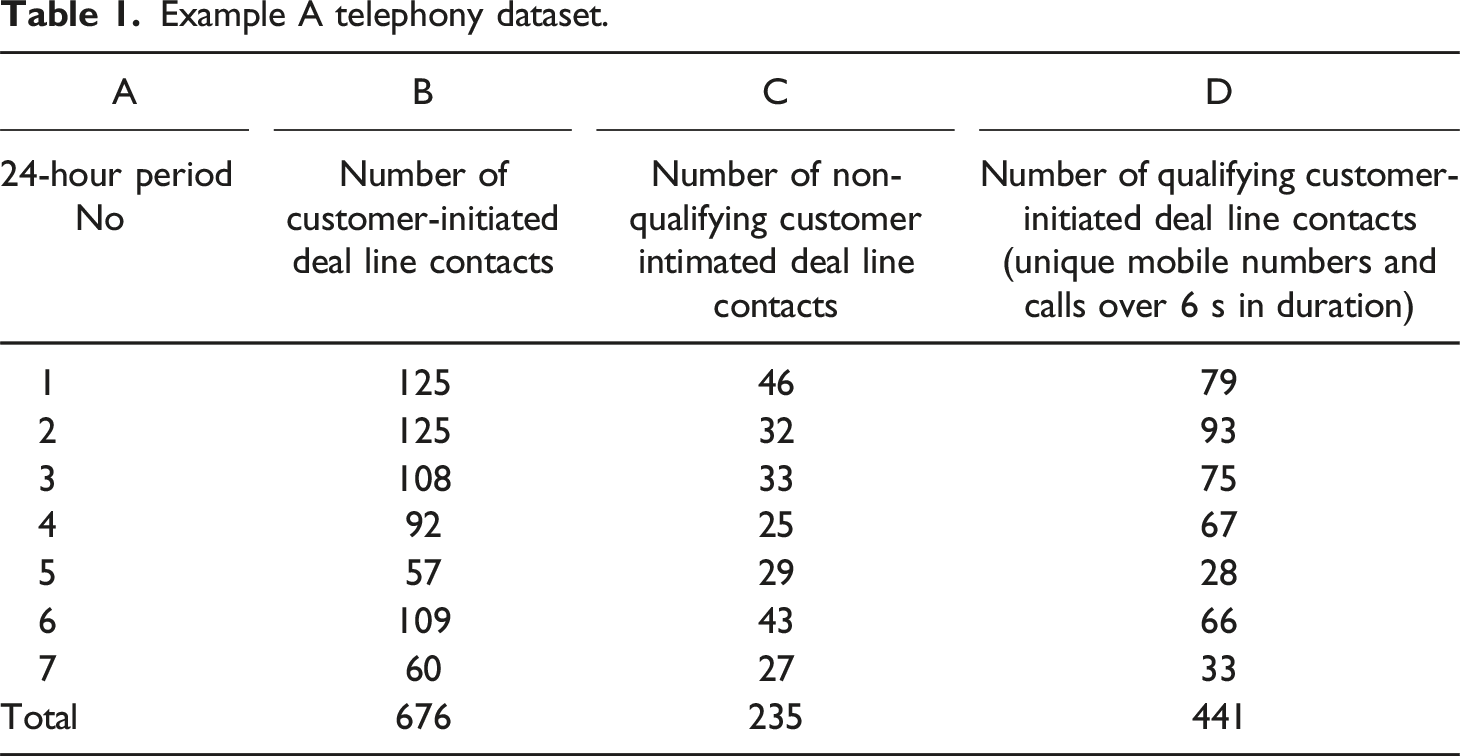
The MPS Op. Orochi currently holds the largest CL case repository on one site, which includes a significant amount of telephony data. This repository has provided us with a unique and timely opportunity for developing a telephony-informed analysis towards offering a metric for understanding impact across counties and to society more widely, and filling research gaps identified within the Black (2020) drugs review. Accordingly, we have developed a bespoke conservative impact formula, which draws on (i) current understanding of line holder and users’ telephony behaviour as informed by the literature and the professional expertise and experiences of the Op. Orochi team, and (ii) the average daily consumption and average days of use per year of Class A drug users in the UK as reported by Black (2020). Given the evolving nature of CL and a lack of empirical evidence regarding telephony behaviour and that the type and amounts of drugs purchased per transaction cannot be ascertained from the Op. Orochi data, the impact formula is necessarily conservative (Leys et al., 2013; Putnick and Bornstein, 2016. Accordingly, we propose the following approach to calculating the value of a deal line, here providing an exemplar using a small telephony dataset in the first instance, collected over 1 week, as follows: i) Table 1 (below) sets out an exemplar data set A from Op. Orochi, where we illustrate seven 24-h periods in total. The number of customer-initiated deal line contacts per each 24-h period (indicated by individual/unique mobile phone numbers) are listed in column B and summed. ii) Of the number of customer-initiated deal line contacts listed in column B, not all ‘qualify’ for inclusion in the formula. Only, qualifying customer-initiated calls are included, listed in column D, which are then summed. Qualifying customer-initiated calls are defined as those lasting more than 6 s in duration in each 24-h period. In each 24-h period, irrespective of the number of times an individual customer contacts the deal line (even where calls last longer than 6 s) that customer is only ever counted once. Any call that is less than 6 s is excluded because it was imperative to ensure that we eliminated calls that were not substantive, whereby some networks do not make a clear distinction between ring time and call so a 6 s minimum would eliminate the possibility of including a missed or failed call (such as occurs in cases of a network drop-out). Likewise automated SMS replies were excluded, since these behaviours suggest that the caller may be responding to a bulk message asking to be left alone/communicating that they are not interested in becoming a customer. iii) The total number of non-qualifying customer-initiated contacts (listed in column C) is subtracted from the sum of customer-initiated deal line contacts (column B). In the case of the exemplar shown in Table 1 (above), the 235 one-time only contacts is then subtracted from the total customer-initiated contacts of 676, this leave 441 qualifying customers in communication with the line holder in this example. (iv) Multiply the final number of qualifying customers each week (here, 441) by the average ‘use day’ consumption of a Class A user in the UK. The average amount of crack consumed per use day is .4 g and the average amount of opiates (e.g. heroin) consumed per use day is .5 g (Black, 2020). Below, we provide examples where we have calculated the volume of drugs purchased assuming each customer purchases either (a) the combined average quantity of both types of drugs per day (.9 g), OR (b) only crack (.5 g), OR (c) only opiates (.4 g) (see Table 2 below). (v) If the sale price is known, the volume of drugs purchased using the above metric can then be assigned a monetary value per each period of offending. For example, using the average cost metric in the Black (2020) report of (a) £50 for 0.5 g of opiates, (b) £40 for 0.4 g of crack, and (c) £90 per 0.9 g of crack + opiates, 441 qualifying customers in the 1 week example in Table 1 above, would conservatively value the sales per line per week, as follows: £39,690 where 0.9 g of crack + opiates is purchased per customer, (ii) £22,050 where 5 g of opiate is purchased, and (iii) £17,640 where 4 g of crack is purchased. Example A telephony dataset. Calculated volume of opiates + crack, opiates only, and crack only.

Applying the Orochi impact formula
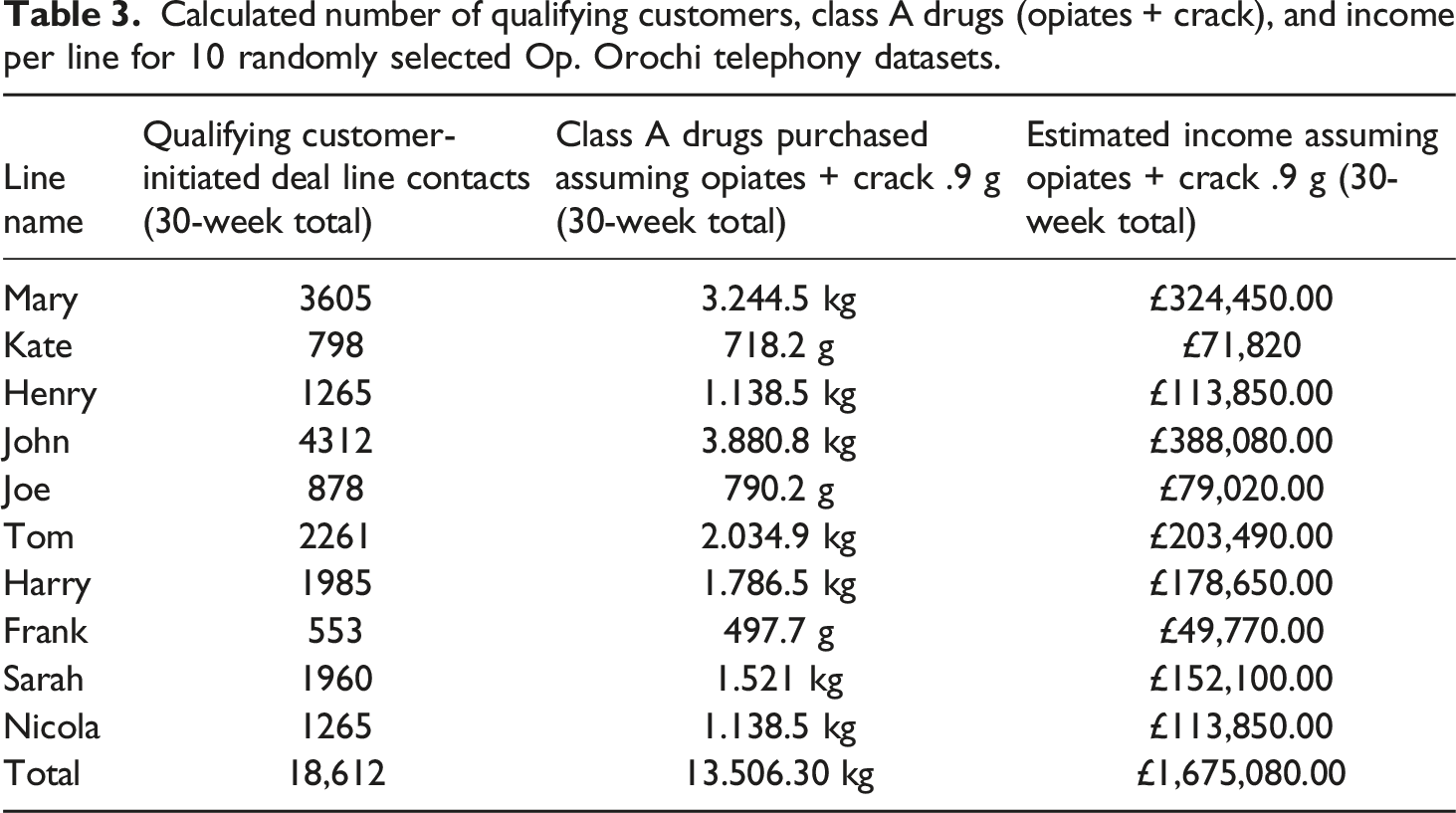
Calculated number of qualifying customers, class A drugs (opiates + crack), and income per line for 10 randomly selected Op. Orochi telephony datasets.
Discussion
The formula described offers just one conservative metric to help quantify the cost and impact of drug lines and can be adjusted to account for changes in behaviour, consumption patterns, and costs. As the example datasets reveal, not all lines are equal whereby over a 30-week period, some lines are clearly more impactful and damaging than others. Perhaps unsurprisingly, the three most impactful lines are based in the South of England (Surrey and Sussex) where the population is dense, and so demand is likely higher. Better understanding of the volume of sales and income could assist the CPS and Courts in sentencing and help raise wider awareness of the societal costs of CL by highlighting Class A drug use linked to CLs. The formula also addresses the rapidly changing nature of CL, with potential to provide a systematic statistical analysis of CL customer and line holder telephony behaviour thereby revealing how they change over time and across areas, for example.
We wish to reiterate that the approach described in this current paper does not account for customers who place orders solely by text message or who may use another person’s phone or make collective purchases on behalf of others. Textual messages have been excluded here since these behaviours can often simply be in response to a bulk message asking to be left alone or communicating that they are not interested in becoming a customer, and a such out inclusion and telephony inclusion and exclusion criteria described would not be applicable. Our approach to developing and sharing our formula in the first instance is to offer a timely, robust, but fair method of gathering and analysing metrics, since it is highly likely to come under scrutiny if used in criminal prosecution cases, for example. Nonetheless, it may be possible to include textual messaging as an additional metric as we move to develop this approach further, albeit that end- to-end transcription can hamper criminal investigations and prosecutions, although not always (e.g. Hartel and van Wegberg, 2023; National Crime Agency). Our approach also cannot account for instances where individuals are provided with drugs in exchange for services related to the line (e.g. in exchange for the use of premises) and communications made directly in person to a ‘runner’ or ‘cuckooed’ individual since here no telephony data exists.
Nonetheless, conservatively determining drugs line ‘facts’ for prosecution and sentencing purposes in the proposed manner within the context of a criminal trial recognises the importance of contextualised evidence and proof for wider perceptions of law and process. However, the formula proposed requires access to high quality, robust and secure telephony data, such as that collected by the Metropolitan police Op. Orochi team. While the impacts of the ‘Orochi tactics’ have yet to fully emerge, in addition to the exemplar telephony data reported here and the novel impact formula, Op. Orochi has resulted in the collation of a large pool of unique behavioural data. These data are currently the subject of further in-depth analyses, and findings may prove key for shedding light on clusters or patterns of behaviours, such as gang membership, ranges of a line, operational models, modus operandi, and volume of cash seizures. These data may serve to direct future resources and effort, and improve understanding of the estimated cost and impact of drugs lines as we have reported here. Equally, this approach may offer a lens through which to quantify the impact of other types of organised crime whereby telephony communication may be a core method for quantifying financial, goods and services transactions.
Footnotes
Declaration of conflicting interests
The author(s) declared no potential conflicts of interest with respect to the research, authorship, and/or publication of this article.
Funding
The author(s) disclosed receipt of the following financial support for the research, authorship, and/or publication of this article: This research was funded by a Home Office Police Science Technology Analysis & Research (STAR) grant (Bid 56) awarded 2021.
