




Abstract
Policing by its very nature has been widely recognised as being inherently stressful with little that can be done to prevent police officers’ exposure to both primary and secondary trauma. Officers involved in the investigation of child abuse and sexual offences have been further recognised as working in some of the most stressful and demanding roles in policing. However, there has been little research within this high-risk group of officers which seeks to understand how they cope with both the organisational and occupational stressors they are exposed to, as well as which strategies help them to ‘get up in the morning’. Data were collected through twenty-three (23) semi-structured interviews, with Straussian Grounded Theory used as a framework to develop a model of coping. This study highlighted that although some officers were affected by the traumatic nature of their work, there were other risk factors present which appear to have impacted on them more significantly including ‘burnout’, ’compassion fatigue’ and ‘moral injury’. Protective factors were identified as ‘being in control’, ‘organisational, social and peer support’ as well as ‘having a purpose’ all of which impacted on an officer’s ability to cope with the work they do. The present findings extend our knowledge of key concepts relating to police officer coping which may help officers working in these high-risk roles to cope with challenges they face daily. Recommendations for further research on how to support this group of officers, as well as implications for practice are discussed.
Stress and coping in police officers
Policing by the very nature has been widely recognised as being inherently stressful (Collins and Gibbs, 2003; Skogstad et al., 2013), with little that can be done to prevent police officers’ exposure to traumatic events (Birch et al., 2017; Biggs et al., 2021). There have been a number of studies that have looked at the concept of ‘stress’ in policing linked to both organisational stressors such as burnout, high workloads, lack of superior support and shift work (e.g. Collins and Gibbs, 2003; Foley and Massey, 2021; Gershon et al., 2009; Gray and Rydon-Grange, 2019; Jackman et al., 2021) and occupational stressors such as exposure to trauma (Graf, 1986; Korre et al., 2014; Lucas et al., 2012; Violanti and Aron, 1995). This exposure to organisational and occupational stressors can in extreme cases lead to a deterioration of both physical and mental health (Burnett et al., 2020; Collins and Gibbs, 2003). Whilst all roles within policing clearly have their own complexities, those involving child abuse and sexual offences have been recognised as some of the most stressful roles within policing and are widely considered as high-risk roles (Brown et al., 1999; College of Policing, 2020; Foley et al., 2022, 2023; Roach et al., 2017). A number of these studies have been quantitative in nature and have not sought to interview officers in order to understand ‘why’ these are high-risk roles and ‘how’ some officers who work in these complex areas of policing manage to cope.
This study has undertaken qualitative research to try to understand the detailed description of participants’ experiences, opinions and feelings, as well as the ability to interpret the meanings of their actions (Corbin and Strauss, 2008). As the research question in this study sought to understand both how this particular population of officer’s cope with the work that they do and develop a model or theory of coping, grounded theory was the most appropriate methodology for this research. This research took a pragmatic approach, to provide an improved understanding of how individual and/or organisational coping strategies help officers cope with the potentially traumatic nature of their work. Using grounded theory methodology, a model of coping was developed within this population of officers. This is believed to be the first such study in UK policing trying to develop a model of coping with this particular group of police officers working in these high-risk roles.
Ethical considerations and approval
Full ethical approval was granted by both the researchers university and employer.
Grounded theory
Grounded Theory (GT) is currently one of the most popular and widely used research methodologies and is concerned with the generation of theory which is ‘grounded’ in the data (Birks and Mills, 2015; Birks et al., 2019). GT has been described as a flexible but structured methodology which is appropriate for research when little is known about particular social processes or behaviours of groups (Chun Tie et al., 2019). As a methodology, it has been described as a mechanism to construct theory about issues of importance in people’s lives (Glaser, 1978; Glaser and Strauss, 1967; Strauss and Corbin, 1998), with Clarke (2003) describing grounded theory as ‘an empirical approach to the study of social life, through qualitative research and analysis’ (Clarke, 2003: 557). Strengths of using grounded theory include that finding are grounded in the data and represent ‘real world’ settings as well as data collection and analysis being conducted at the same time which ensures that are findings truly develop from the data. Weaknesses of grounded theory methodology include the amount of time it takes to collect data to reach theoretical sufficiency and the difficulty in analysing the data and keeping track of what is emerging whilst using the constant comparative method (Glaser, 1965; Glaser and Strauss, 1967; Strauss and Corbin, 1998). The work of Strauss and Corbin, and their interpretative (or Straussian) grounded theory method was chosen as a framework to conduct this piece of research (Corbin and Strauss, 2008, 2015; Strauss and Corbin, 1990, 1998). This was chosen by the researcher due to the belief that the researcher should have a general idea of where to begin within the research; that the question may arise from personal experience or knowledge of the researcher; the fact that a literature review should be conducted before collecting data to enhance the researchers understanding of the area of study and finally the researcher can be active within the research (Corbin and Strauss, 2008, 2015; Jones and Alony, 2011; Mills et al., 2006; Polacsek et al., 2018; Strauss and Corbin, 1990, 1998). There was also a rigorous and detailed framework to follow in order to structure the research. This was important due to the researcher’s inexperience in using this methodology as following the framework added validity to the study (Qureshi and Ünlü, 2020; Straus and Corbin, 1990).
Participants
Summary demographic data of interview participants.
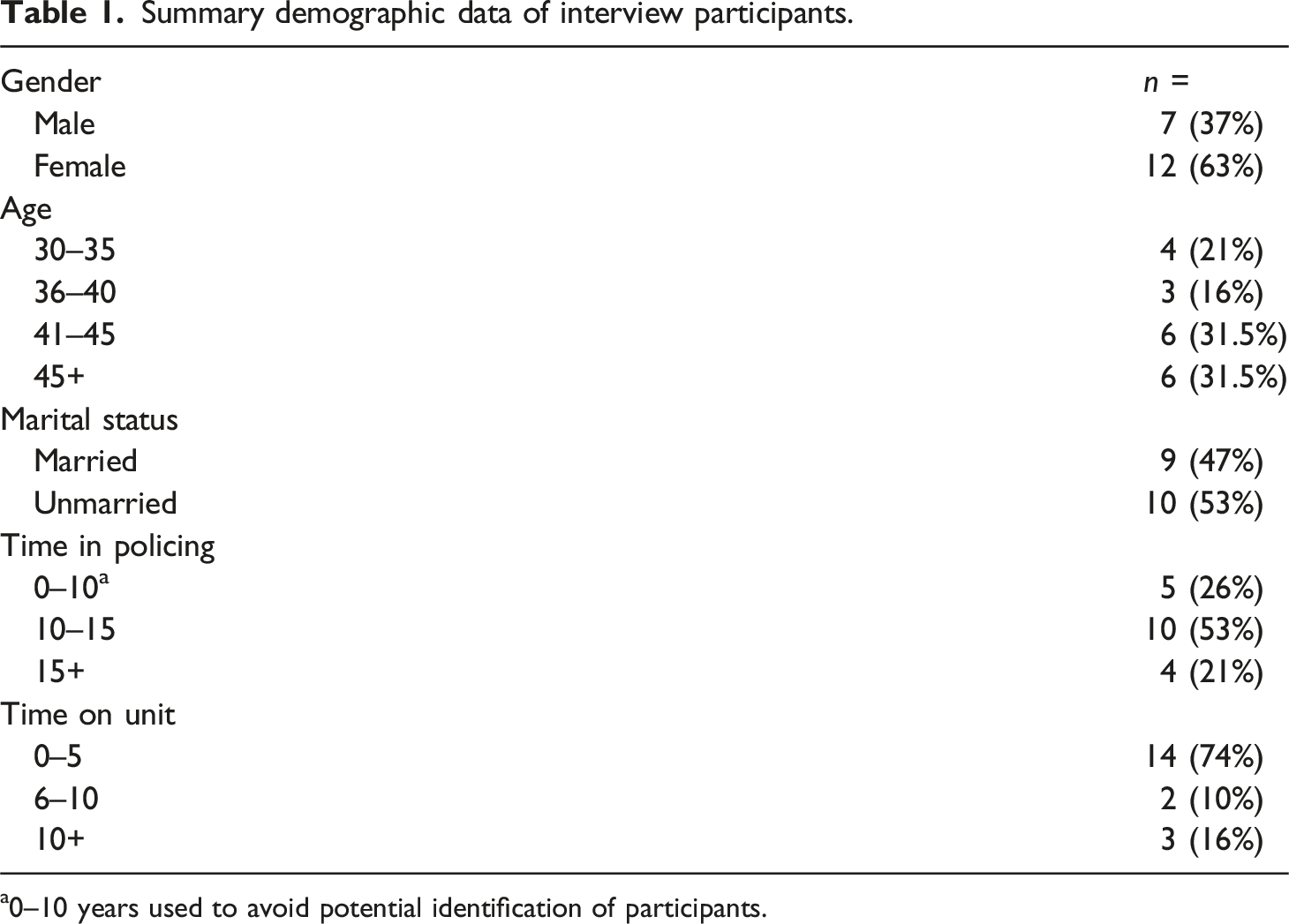
a0–10 years used to avoid potential identification of participants.
Interviews
In qualitative research, there are several differing methods used to obtain qualitative data, with interviewing being one of the most accepted methods (Legard et al., 2003; Seidman, 2013). The use of interviews in qualitative research allows for the in-depth understanding of a participant’s personal experiences to be gained, which is needed when trying to understand sensitive or complex phenomena (Ritchie, 2003). Semi-structured interviews were therefore conducted in person which allowed the participants to speak freely and the interviews to be participant rather than researcher led, although prompts were available if needed to elicit more information from the participant (Roulston and Choi, 2018). A semi-structured interview guide was developed and piloted. Based on feedback, some of the wording was changed to allow more open responses. After each interview, a debrief email was sent to the participant with details of help and support services that they may wish to contact should anything discussed as part of the interview bring back any traumatic memories. The initial interviews were recorded with the consent of each participant using two digital voice recorders, with initial interviews lasting between 1 and 2 h each.
Coding
Within grounded theory research, the main purpose of data analysis through coding is to support the development of theory (Vollstedt and Rezat, 2019). Data were read, and open, axial and selective coding used to identify codes, categories and concepts within the data, to gain a deeper understanding of participants’ experiences (Corbin and Strauss, 2008, 2015; Qureshi and Ünlü, 2020; Strauss and Corbin, 1990, 1998). Open coding describes the initial analysis where data is broken down and examined leading to the identification and labelling of a particular phenomenon. This analysis is a key first step on which further analysis is built upon (Strauss and Corbin, 1990). Strauss and Corbin (1990) describe axial coding as the ability to look at data and put it back together in new ways ‘making connections between a category and its subcategory’ (p. 97). Finally, selective coding is defined by Strauss and Corbin as both ‘the process for selecting the core category’ and ‘the process of integrating and refining the theory’ (Strauss and Corbin, 1990: 116; 1998: 143). In later editions of their book (Corbin and Strauss, 2008, 2015), the term ‘selective coding’ seems to have disappeared, although the importance of identification and integration of a core category still exists.
The key steps taken as part of this study are clearly explained in Figure 1. Grounded Theory method employed within this research (based on Strauss and Corbin, 1990).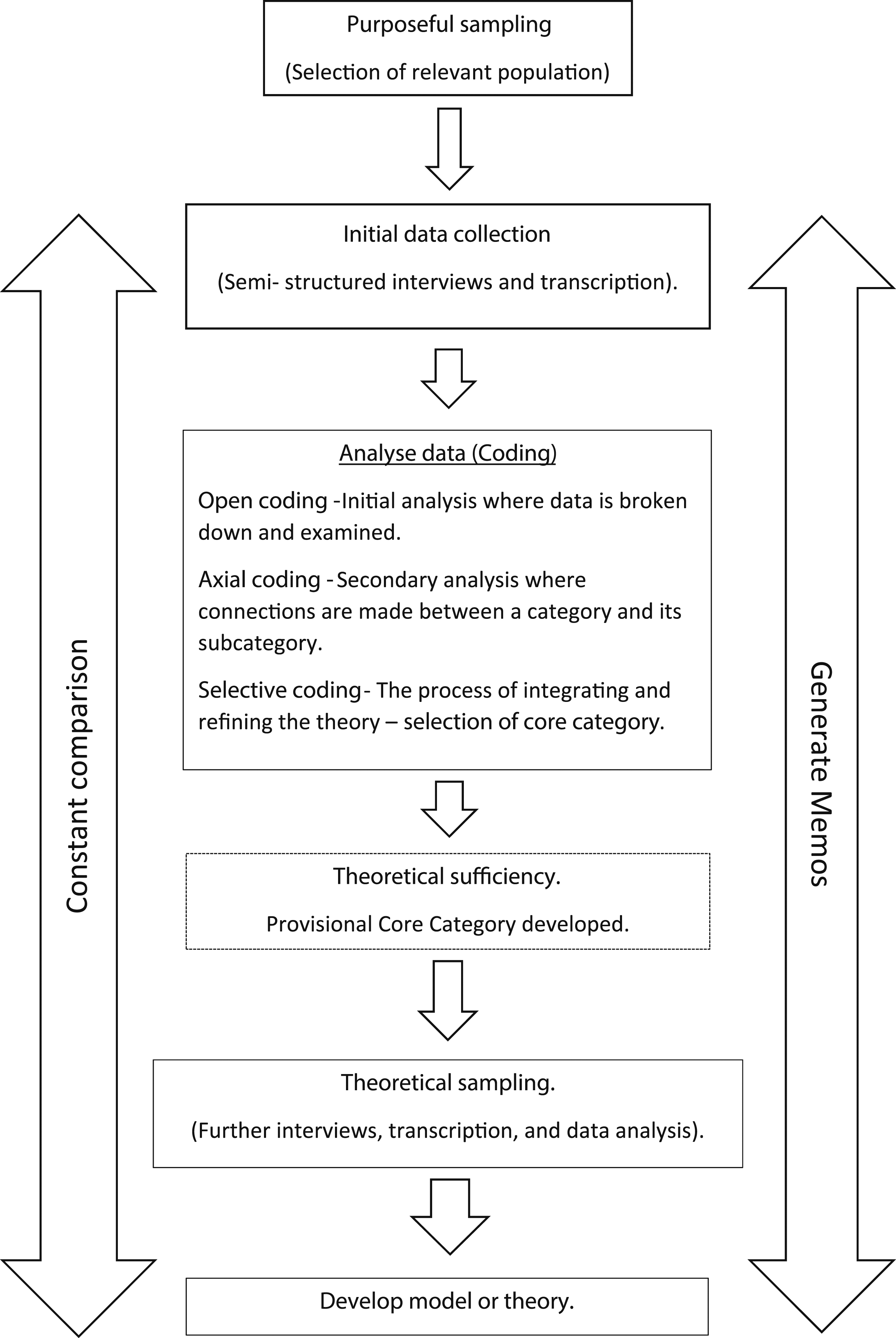
Data analysis
Whilst traditionally grounded theory uses an inductive approach (Charmaz, 2014) to allow the codes, categories and concepts to emerge which are grounded in the data, data analysis within this study used an abductive approach (Morgan, 2007). This abductive approach allowed for the iterative process whereby the researcher moved back and forth using the constant comparative method between data collection, analysis and theory/model development until theoretical sufficiency was reached and it was felt that no additional insight was being obtained from the data (Kennedy and Thornberg, 2018). It also allowed the researcher to identify if pre-existing theoretical assumptions that were being seen in the participants or whether the theory needed to be challenged, adapted or ignored (Alvesson and Kärreman, 2011). This approach also fitted the pragmatic approach of the researcher (Mitchell, 2018; Morgan, 2007, 2020).
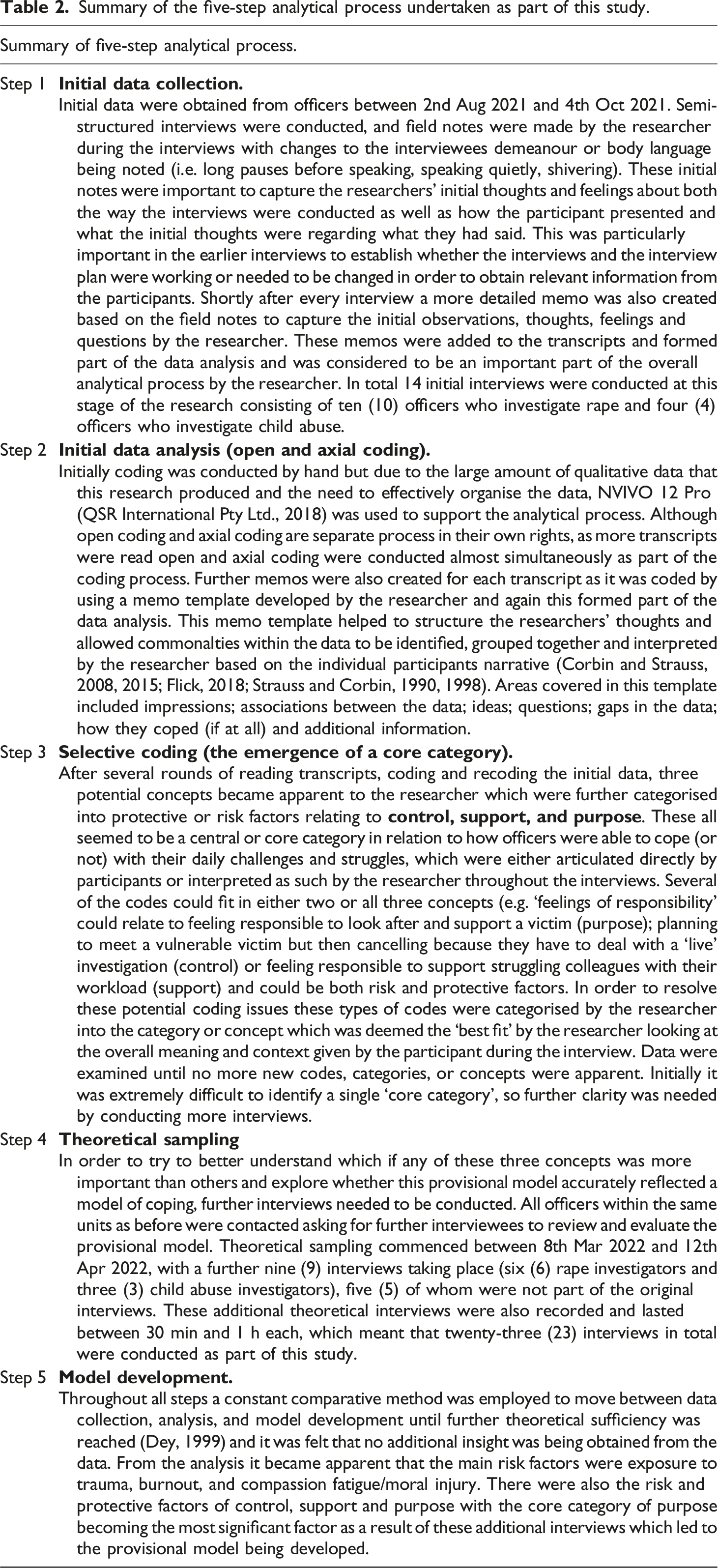
Data analysis was conducted, data interpreted and coded into the concepts of purpose, control and support. Within each of these concepts there were two categories which were conceptualised as ‘risk’ or ‘protective’ factors by the researcher. Within each of these categories there were a total of fifty-nine (59) individual codes.
The individual concepts, categories and codes can be seen in more detail in the Supplemental material.
Summary of the five-step analytical process undertaken as part of this study.
Findings
Purpose
As interviews were conducted and data analysed it became apparent that there were a large number of risk factors that were interpreted as relating to an officer’s ‘purpose’. This was an important finding and went some way to explain why some officers appeared to be struggling during the interviews, when others appeared to be coping. This apparent lack of purpose led to a number of officers questioning both why they were doing this role and, in some cases, policing altogether. There were a number of codes that related to the participants beliefs and values, as well as the use of very strong and emotive language to describe their experiences such as ‘broken’ teams and ‘false’ allegations (by rape victims). I absolutely love it. I love I love. I love being a detective and I love being in CAIT, but it’s just broken. (Participant 6)
There was also a suggestion that rape victims should have an ‘alternative disposal’ option in how their case was dealt with (e.g. independent support) rather than just arrest and charge. Although suggested as a good idea (for policing and victims) it was seen as ‘risky’ by the participants and not the direction that the (policing) organisation wanted to follow. However, it was suggested that any risk associated with this could be mitigated by following the principles of procedural justice (Thibaut and Walker, 1975; as cited in Hinds and Murphy, 2007). If it is just a case of, ‘I wanted to get it off my chest’, which is what some people want to do, ‘but I would like support’, okay, we can signpost you to an ISVA (Independent Sexual Violence Advocate), or the counselling services, and we can point you in that direction. (Participant 7)
This suggestion regarding an alternative disposal also went some way towards identifying the officer’s individual purpose. Whilst some police officers generally want to arrest and convict criminals, some of the officers appeared to want to ensure that the victims get what they want from reporting to police such as feeling listened too and supported, rather than conviction of the offender.
Support
A second concept of support, whether it be perceived or actual peer, social, supervisor or organisational support, also appeared to be a significant factor within this study. The importance of support as both a protective and risk factor was not unsurprising due to a large amount of research which highlights its importance to general policing. However, it was found that some officers do not want to rely on their family or overburden them with what they were going through – although for some the need to go to family when they are struggling at work, was the only option. Sometimes I will, I’ll go in and offload to hubby. He’d be the one and only that I ever do. Not, not in detail, names, depth or anything like that. But just, you know, as you do, ‘oh, how was your day?’ You know, as you come in the door, ‘oh, my goodness horrific’, you know, or whatever, and it’s a 5–10-minute conversation. He doesn’t want to know; he’s not really interested. I know that, but he’s a sounding board and it’s important. And he knows that, he's Ex Job, he gets it. He’s had some stressful tough situations, too. And I've you know, been there for him. (Participant 11)
An unexpected finding, however, was the importance of organisational support being available when needed due to negativity usually associated with seeking help. The importance of good supervision was highlighted by a number of officers as a strong and important protective factor. There was also a positive idea to create an informal drop-in service, where officers could ‘vent, moan and generally unload’ what is on their minds, which was previously in place for some officers. This it was suggested would help the officers both feel listened to but also cope better having got things off their chests, but this service no longer exists.
Control
The concept of control was the third significant concept which came out of this research and primarily related to an officer’s ability to control what they were doing day-to-day, as well as what is done to them by supervisors and the organisation. The power to have control over one’s day and workload was a protective factor when it happened, although frequently this control was taken off them by their supervisors due to operational reasons (e.g. dealing with a prisoner in custody). Other aspects of control included being able to take a break (from the work) when needed which was seen as a challenge by most and accepting that they can only do so much, which appeared to give them some control back. I’ve picked up smoking again and I shouldn’t have. But I think part of the reason I smoke now is not just for the nicotine, it’s to be able to get out of that office once every hour, and just, you know, get away from it. And I really need to do that. And that I find helps. (Participant 4)
Risk factors included having things (by supervisors or the organisation), done to them such as being posted into these units (against their wishes and without any risk assessments), the significant workloads they were carrying and dealing with the associated risk. Alcohol as a coping mechanism was also discussed by some of the participants, and to some it became a way to ‘switch off’. The ways that I will try, and cope would be, you know, to try and go for runs, or try and do some yoga or meditation and things and try and like, err on the healthy side of it, but then often, it would be, you know, drinking…. like really craving drink when I would come back from work because alcohol then has an association of being off duty. So, when I have been hating work so much, and alcohol, the taste of alcohol is represented is associated with freedom from work that you crave it even more, which is not helpful. (Participant 3)
Model development
The development of a tentative model of coping was created which demonstrates that these officers are continually exposed to both organisational and occupational stressors, and that an officer’s ability to cope depends on their actual or perceived levels of control, support and purpose. These levels may change frequently and regularly, moving from potentially risk to protective factors (and vice versa), depending on what an officer is being asked to do. This ongoing cyclical pattern of moving between both protective and risk factors throughout the day was referred to as a ‘whirlpool of misery’ by one participant (participant 3). It was therefore initially hypothesised that when there is a negative relationship either individually or collectively with control, support and purpose these factors may lead to an officer struggling to cope. Conversely, where there is a positive relationship either individually or collectively with control, support and purpose officers may be better able to cope with the work that they do.
Straussian grounded theory allows the researcher to go back out ‘into the field’ and gather data in a controlled and selective manner using theoretical sampling to refine the theory if needed (Strauss and Corbin, 1998). In order to test this hypothesis, and identify which, if any was more important that the others these risk and protective factors were discussed as part of nine (9) theoretical sampling interviews that were conducted. These nine officers were individually asked about the three protective factors and which if any was the most significant (i.e. the core category). All officers supported the proposition that having a positive purpose was the most important factor within the model and it was clarified as part of the interviews that if someone’s purpose was lost or eroded an officer could not cope even if support and control were positive. This highlighted the potential mediating effect of purpose and may go some way to explaining that if an officer still has their purpose, they will still be able to cope with the difficulties of the role, even if support and control are lost. How these three factors fit together is shown in a simple model of coping which can be seen in Figure 2. Simple model of coping.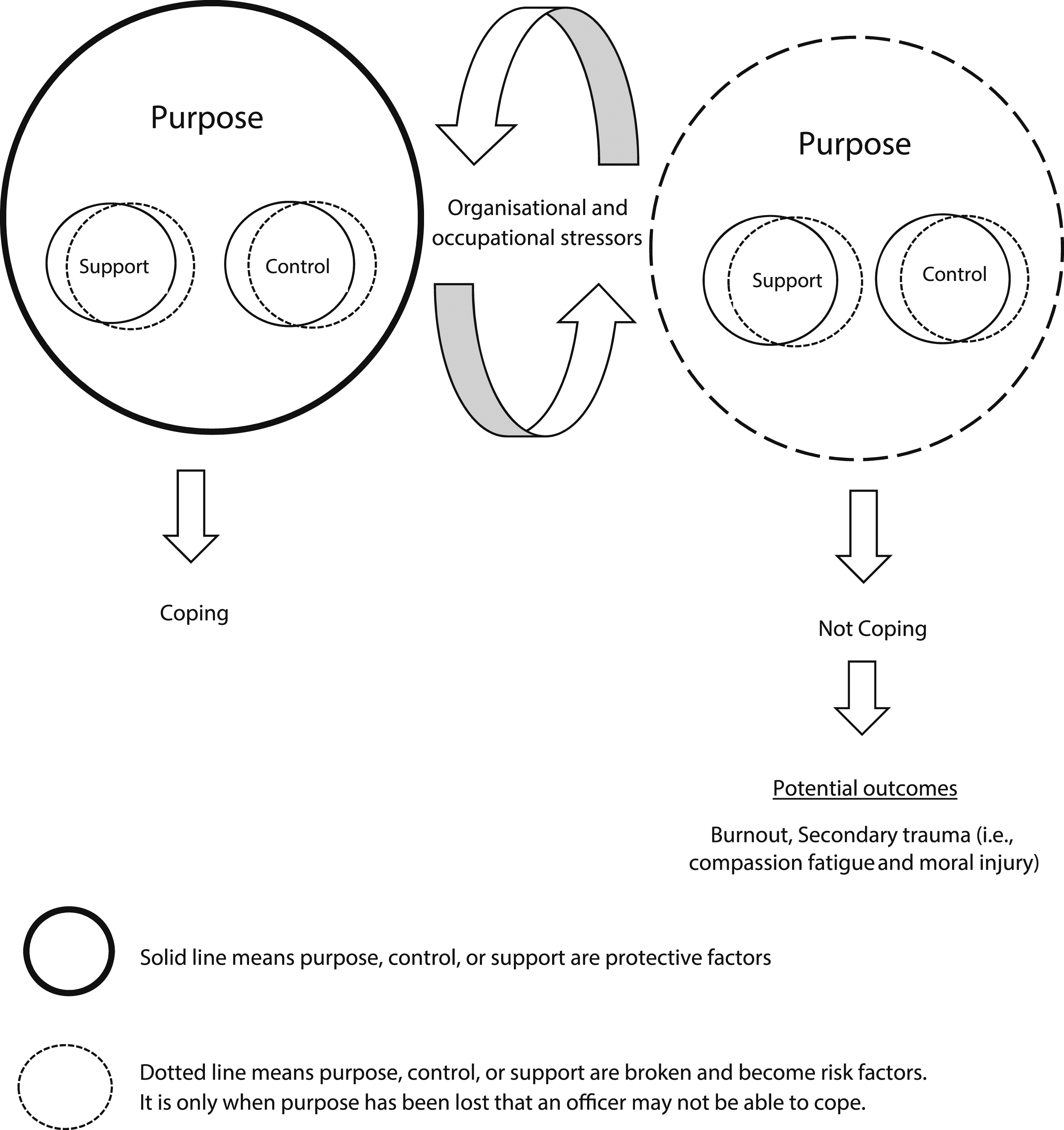
Discussion
The aim of this research was to develop a model in order to understand how officers who investigate rape and child abuse cope with the potentially traumatic nature of their work. It was initially hypothesised that listening to repeated disclosures of child abuse and rape would be traumatic and would significantly impact on those officers that undertake this particular type of work. However, this study identified that secondary trauma was not as prevalent as first thought, and even though nearly all officers acknowledged that their work was ‘horrific’, most felt that the nature of the work undertaken (e.g. interviewing and investigating allegations of rape and child abuse) did not impact on them. This research did, however, highlight the importance of purpose, support and control, as well as the potential exposure to burnout, compassion fatigue and moral injury, which officers may be exposed to on a daily basis. Further information regarding findings as well as the individual concepts, categories and codes can be seen in more detail in the Supplemental material.
The importance of purpose
Purpose is a term that the Cambridge dictionary describes as ‘why you do something or why something exists’ (Cambridge dictionary, n.d). Whilst there do not appear to be any studies looking at the concept of ‘purpose’ within policing there are external studies which support the importance of purpose in relation to increased mortality (Alimujiang et al., 2019; Cohen et al., 2016) as well as increased wellbeing (e.g. Ryff and Singer, 1998). Within this study, purpose meant officers strongly articulating that they originally joined policing as they cared or wanted to make a difference. Although this may be unsurprising as having a purpose appears to be a common theme amongst most police officers, it is tentatively suggested that purpose may be more relevant to those that have chosen to work with vulnerable victims of child abuse or rape compared to some other roles. Whilst having a sense of purpose may be a protective factor if it is being met, it was apparent that several officers felt that their sense of purpose was being eroded due to factors outside of their influence such as difficult victims, and third parties such as the CPS being barriers. The lack of research relating to policing may in part be due to the fact that a sense of purpose is personal and will be different even between those performing the same roles and even within the same teams, which was found in this study. However, although there are clearly differences in what purpose may mean to individuals, what became apparent for these officers was that if an officer’s purpose is eroded or lost, it is not easily recovered and will significantly impact on their ability to cope with the work that they do. This was a significant finding within this research and does not appear to have been found in other studies and is therefore a recommendation for future research.
The importance of support (organisational, internal and external)
The potentially protective effects of both actual and perceived peer, supervisor, social, family support and humour has been well documented in several studies (e.g. Evans et al., 2013; Foley et al., 2022; Graf 1986; Jackman et al., 2020; Sherwood et al., 2019; Tuttle et al., 2021) and as such the importance of both perceived and actual support as well as humour was expected. Several officers, however, felt that although their family and friends were there to support them and listen if needed, unless they were in ‘the job’ they would not fully understand what the officer was going through. There was also a fear of traumatising them with the detail if they did speak to them, which was therefore usually avoided. Some officers, however, would not even talk to their friends. Having organisational trauma support available when needed was an unexpected finding due to the stigma that is usually associated with seeking help. It also appeared that once an officer had overcome the stigma and mistrust of occupational health, the counselling provision provided was effective and helped provide improvements to the officer’s health and wellbeing. The importance of supervisory support as well as senior ranks understanding what officers must do as part of their role and were going through was also seen as being a significant factor as to whether an officer copes or not. Support by peers, supervisors, friends and family was seen as important mechanism to cope with the daily challenges of the role. Peer support is an important aspect of police culture, and there is a need for these formal or informal support mechanisms to be developed and embedded within policing and within these high-risk roles in particular. The relationship between supervisor and officer appears to be another important area that needs to be explored in future studies.
The importance of control
The concept of ‘control’ was also significant and related to having some control over what they were doing on a day-to-day basis. Throughout the interviews it became apparent that several officers used being organised and just focussing on what was in front of them to cope with the daily challenges they were experiencing, such as increased workload as well as the potentially traumatic nature of what they were doing. This became evident when asked about how they would feel if their day and plans (which had been organised) did not happen due to the needs of the role (such as dealing with a prisoner who had just been arrested) and most felt that they would struggle to cope and that it may be a ‘bad’ day. The concept of ‘control’ has not been widely studied in policing, although the studies that do highlight that poor control is an organisational stressor that may be linked to poor mental health (Bentley et al., 2015), excessive alcohol consumption (Houdmont and Jachens, 2021) and increased emotional exhaustion (Bhowmick and Mulla, 2021), which were all areas that were found within this study. Again, this is an area where research is limited and the need for actual or perceived control is not properly understood within policing. It is again suggested that this is another important area of research which needs to be explored further.
Burnout, compassion (victim) fatigue and moral injury
Burnout
Whilst some officers were struggling with trauma exposure in the role, most appeared to be coping. Burnout (Freudenberger, 1974), however, appeared prevalent in all officers and organisational stressors appeared to be the most significant factor that was causing the officers to struggle on a day-to-day basis. The World Health Organization International Classification of Diseases 11th Revision (World Health Organization, 2019) has recognised burnout not as a medical condition, rather an occupational phenomenon and is defined as:
Burnout is a syndrome conceptualised as resulting from chronic workplace stress that has not been successfully managed. It is characterised by three dimensions: • Feelings of energy depletion or exhaustion. • Increased mental distance from one’s job, or feelings of negativism or cynicism related to one’s job; and • Reduced professional efficacy.
Leiter and Maslach (2005) and Maslach and Leiter (2005) identify several potential factors that may impact on burnout and include increased workload, not enough resources, quality of senior management (including lack of recognition) and a lack of satisfaction within the role. Later they further identified that ‘job burnout’, is a psychological response to chronic interpersonal stressors and they support the ICD-11 (World Health Organization, 2019) definition (Maslach, 2006). However, not all agree that burnout is solely related to occupational factors with some authors suggesting that burnout as a concept is multidimensional and that the causes of burnout cannot just be related to work (Bianchi et al., 2014; Edú-Valsania et al., 2022). Within this study signs of burnout were witnessed and recognised by the researcher in participants, with burnout as a concept seemingly understood by participants as it was both referenced by name and described by a large number of individuals within this study. I had to complete and utter burnout. I had to work out well, how do I stop this happening again, and then realise that I can only you know, for a start I’m one person in this whole organisation........... you just burn out and then recover somehow and then burn out again.…… I had proper burnout in 2018, I think it was. But you just have to you just get on with it, because there's no there's no one else to help (participant 1).
Compassion (victim) fatigue
Compassion fatigue which was originally described by Joinson (1992) as a unique form of burnout, who described the concept as changes within her colleagues (who were nurses), who always wanted to do more for their patients even if they know they cannot help. Some of the symptoms of compassion fatigue as described by Joinson include exhaustion, inability to concentrate, anger, feelings of detachment and despair, depression, as well physical symptoms such as headaches and stomach pains. Compassion fatigue was mentioned and described by a number of officers within this study and recognised by the researcher in some participants. This also appeared to be a concept recognised by some participants although referred to as ‘victim fatigue’ in the interviews. If you are struggling with victim fatigue, emotional transference, just get them out of there, even temporarily ...... put more people up there. You know one of the TDC’s at the moment she suffered with victim fatigue, she was on Sapphire, she had six months off and they went ‘send her back she fixed now’ but she was like no I’m not, it's been six months (participant 6).
Within UK policing there has been research conducted relating to burnout and compassion fatigue in police officers (e.g. Bhowmick and Mulla, 2021; Goodman, 1990; Tehrani, 2016) with cynicism being seen as a recognised coping mechanism for burnout (Brown and Campbell, 1994), which was again identified in officers within this study. However, findings relating to burnout and compassion fatigue within officers is mixed, with some studies finding indicators of burnout and/or compassion fatigue within their populations (Angiolini, 2015; Bozga et al., 2020) with others finding minimal evidence of burnout or compassion fatigue (Gray and Rydon-Grange, 2019; Turgoose et al., 2017).
Moral injury
A surprising finding within this research was the potential discovery of what may be described as ‘moral injury’ (MI) within some officers. Although MI as a concept may be used to explain some of the psychological trauma that individuals are experiencing within this research, there are a number of challenges in linking it to this study and to policing. First there have been a number of attempts to define what is (and sometimes what is not) moral injury and it is suggested that the concept of MI has become more nebulous over time with no clear definition (Atuel et al., 2020; Litz and Kerig, 2019). However, the most widely accepted definition is that by Litz et al. (2009) who suggested that MI can be defined as ‘perpetrating, failing to prevent, bearing witness to, or learning about acts that transgress deeply held moral beliefs and expectations’ (Litz et al., 2009: 700). Farnsworth et al. (2017) added to existing literature on MI by defining a number of concepts including a ‘morally injurious event’ (a violation of something that is morally important to that individual); ‘moral pain’ (a sense of unhappiness and dissatisfaction in response to the morally injurious event which can present as feelings of guilt, shame, or anger) and ‘moral injury’ (social, psychological, or spiritual suffering relating to trying to cope with ‘moral pain’). As MI was originally conceptualised in relation to combat veterans (Griffin et al., 2019; Litz et al., 2009; Shay, 1995) there has been a limited amount of research relating to policing, particularly within the UK. Only two empirical studies were found relating to MI in officers viewing indecent images of children and its impact, which used the same six (6) officers (Doyle et al., 2022 and Tapson et al., 2022). Doyle et al. (2022) found that stigma regarding seeking help and exposure to a large amount of traumatic material where the main factors impacting on an officer’s trauma and moral injury within the study. Tapson et al. (2022) found that officers were not given the time to be able to process what they were experiencing leading to the use of dysfunctional coping strategies (e.g. alcohol and cognitive avoidance) as well as issues with identity, which ultimately meant that they were struggling with the moral trauma and injury which they were experiencing. The findings within this research had some similar findings to the studies of Doyle et al. (2022) and Tapson et al. (2022), in that officers were overworked so did not have time to decompress, were using maladaptive coping strategies such as using alcohol to cope, and expressed feelings of anger, guilt and shame. When you consider how and why these feelings of anger, guilt and shame are articulated by the officers, it appears that this relates to an officer’s belief and apparent failure in their inability to do the job that they want to do. It is therefore cautiously proposed that these findings in some officers are not only symptoms of MI, but also linked to an officer’s ‘purpose’. I think it was that it got to that stage where she hung herself……and she never told anyone. I think I felt …. not guilty because that would be wrong…... maybe a little bit, could have done more? (Participant 10).
Reflexivity
Reflexivity has been established as an important part of qualitative research and is considered an important step for a researcher to undertake in order to identify any preconceived ideas or biases that they may have, when undertaking qualitative research (Dorfler and Stierand, 2020; Yardley, 2000, 2008). Reflexivity can also allow a deeper understanding and enhance the credibility of the research (Cutcliffe, 2003; Dodgson, 2019). Reflexivity may take a number of forms including ‘bracketing’ (Ahern, 1999), keeping a reflexive journal or diary to document ‘thoughts and feelings’ during the research (Nadin and Cassell, 2006) as well as the use of memos and diagrams (Birks et al., 2008; Buckley and Waring, 2013), all of which were used as part of this study. In addition, frequent discussions were held with supervisors regarding data analysis in relation to transcripts, coding and findings. These discussions and reflexive steps were particularly important as part of this research in order to try to mitigate as much as possible the impact of the researchers own lived experience, understanding the impact of their position within the research and their insider status, all of which would likely impact on their interpretation of the results (Dorfler and Stierand, 2020).
Strengths and limitations of the research
Although it is felt that there were a number of strengths within this study like all research, there are several limitations which need to be considered which may have impacted on the interpretation and quality of this research. The strengths of this research relate to these interviews being conducted face to face (so nonverbal expressions could be seen) and took place in a venue of their choosing for the interviews. The fact that the researcher was known personally to nearly all participants so there was a degree of trust, and as an officer he understood what they were going through (this was articulated to the researcher a number of times throughout the interviews). Limitations included a single researcher conducting data analysis so results potentially influenced by researcher bias, and a relatively small sample size (19 officers, 23 interviews). In addition, this study did not go into detail regarding previous mental health or previous trauma exposure which may have impacted on the results. This was a deliberate omission as the researcher did not want to further traumatise officers by deliberately discussing previous trauma. Finally, an important factor that cannot be ignored in any policing research is the influence of police culture and potential stigma of admitting that you are struggling with mental health problems. This meant that the researcher was also mindful that to discuss previous trauma within the interview, could lead to concerns regarding confidentiality, which may mean that the participant is not as open and honest within the interviews. The impact of stigma within policing is widely understood and acknowledged as being an issue which may have impacted on this research.
Clinical implications and future research
This study has potential organisational and clinical implications in relation to supporting and treating officers who are not coping within their roles and may be suffering with PTSD and other common mental disorders such as anxiety and depression, as well as burnout, compassion fatigue and moral injury. Clinically, an understanding of the pressures that officers are under and the potential importance of having feelings of support, control and purpose may mean that clinicians can start to understand the ‘policing mind’. This it is suggested is an important step to start to help officers get those positive aspects of support, control and purpose back which may in the long term mitigate the effects of trauma and burnout as well as improving an officer’s wellbeing and mental health. It is also suggested that with the potential for moral injury to be present within officers there needs to be a greater understanding of the concept and the fact that due to an officers ‘moral code’ being damaged, officers may not be forthcoming regarding disclosure of the ‘morally injurious event’ which has led to the injury. This could lead to a misdiagnosis and ultimately no help or support for the officer.
From an organisational perspective several the key factors relating to burnout, compassion fatigue and moral injury including high workloads, poor working conditions, no staff, a lack of experience, poor supervision and a lack of purpose (not being able to help victims). It is recommended that organisations should try to take some simple and basic steps to support officers and reduce the burden upon them (e.g. reduction in workload, better training for officers and staff, better environmental conditions, etc). Whilst the researcher is under no illusion that this are not simple matters to resolve, organisations should try to support staff by limiting (if possible) the exposure to this stressors and develop positive peer support networks. This would also include team and individual debriefs on a regular basis (as highlighted by participant 1) as well as after a potentially traumatic event.
There are also a number of areas within this study that should be considered for further research. Firstly, how to reinvigorate an officer’s ‘purpose’. This may not be an easy task due to the individual nature of what purpose means to an officer, but the first step must be to try and understand the problem, which means greater education and awareness amongst officers and staff. The importance of ‘control’ and ‘support’ (actual or perceived) should be considered for further research. The relationship between officer and supervisor also appears significant, so further research should be conducted, particularly how this may support or impair an officer’s ability to cope with both organisational and operational stressors. The concepts of moral injury, burnout and compassion fatigue also need to be properly understood and may be important findings within this study. In particular, due to the scarcity of research, there needs to be a greater understanding regarding whether moral injury is an issue in policing and whether it can be mitigated or prevented? It is argued that only by understanding and raising awareness of these individual concepts can policing start to support officers and staff. These areas of future research relate to potentially significant findings which is why these are areas recommend for further research in UK policing.
Conclusions
The aim of this study was to understand how officers cope with the potentially traumatic nature of their work. This research highlighted a core concept of ‘having a purpose’ being developed from the data, which led to a model of coping which had purpose as the decisive feature as to whether an officer can cope or not. As the research developed it became apparent that most officers (although not all), were actually coping well with any apparent trauma and it was the organisational stressors such as burnout, which were the biggest challenges that officers were facing. The research shows that burnout can be managed and overcome, but the first step is to acknowledge that it is a problem within policing and provide bespoke support for officers who are ‘burning out’.
The finding of moral injury was unexpected as there is little empirical research regarding its importance to UK policing. This study however showed that for these officers, the lack of charging suspects and feelings of ‘helplessness’ in their ability to help victims, both children and adults seemed to erode their sense of purpose and cause officers to struggle within their role. This potential erosion of purpose may link to the findings of moral injury (feelings of guilt, shame and anger), so it may be that purpose and moral injury are connected. Certainly, within this study those that appeared to be struggling with the nature of the role, and had lost their purpose, did appear to have also had their moral beliefs damaged. Although purpose itself is difficult to properly define as it is a subjective concept and may be different even for those individuals who collectively have the same purpose, maintaining this purpose is clearly an important step to ensure that an officer can cope with the daily struggles that they have, whether organisational or occupational. When one participant asked what purpose meant to them, they simply defined it as ‘it’s why you get up in the morning’.
Supplemental Material
Supplemental Material - ‘It’s why you get up in the morning’. A Straussian grounded theory study of coping in police officers who investigate rape and child abuse
Supplemental Material for ‘It’s why you get up in the morning’. A Straussian grounded theory study of coping in police officers who investigate rape and child abuse by Jim Foley, Alex Hassett and Emma Williams in The Police Journal
Footnotes
Declaration of conflicting interests
The author(s) declared no potential conflicts of interest with respect to the research, authorship, and/or publication of this article.
Funding
The author(s) received no financial support for the research, authorship, and/or publication of this article.

Supplemental Material
Supplemental material for this article is available online.
References
Supplementary Material
Please find the following supplemental material available below.
For Open Access articles published under a Creative Commons License, all supplemental material carries the same license as the article it is associated with.
For non-Open Access articles published, all supplemental material carries a non-exclusive license, and permission requests for re-use of supplemental material or any part of supplemental material shall be sent directly to the copyright owner as specified in the copyright notice associated with the article.
