




Abstract
Case-based learning is an andragogical approach that requires students to apply knowledge by discussing scenarios resembling real-life situations. Despite its history of practical and effective application in several educational settings, little empirical research on case-based learning in Canadian police recruit training exists. For this study, administrators from six Canadian police recruit training institutions were interviewed on their approach to training and case-based learning. Four key themes emerged, including (1) interrelated training content, (2) andragogical methods, (3) case-based learning, and (4) resourcing challenges. Case-based learning is then discussed as a strategy to enhance knowledge acquisition and critical thinking among police recruits.
Introduction
In their seminal work, Bayley and Bittner (1984) suggested that front-line police officers exercise constant decision-making, as discretion is delegated to the lowest ranks. Similarly, Lipsky (1969) introduced the concept of ‘street-level bureaucrats’, arguing that officers operate in a complex web of competing demands, including those of citizens, constraints of law and policy, and organizational goals. Thus, they have discretion and must make real-time decisions, often with limited resources and information. Since their work, policing responsibilities in Canada have expanded and are conducted in a complex task and problem-solving environment (Huey et al., 2017; Blumberg et al., 2019). Modern police officers have many roles, acting as counsellors, mediators, law enforcers, negotiators, and problem solvers (Morgan, 2022; Shipley, 2019). Often, officers multitask these wide-ranging functions (Huey et al., 2017). Additionally, advancements in policing have placed an increased focus on community policing, de-escalation, procedural justice approaches, and trauma-informed practices (Morgan, 2022; Paterson, 2016). Police officers must integrate these evidence-based strategies into routine, front-line responses (Huey et al., 2017). Thus, to perform their work effectively, new police officers need skills not only in basic police operations but also in non-technical competencies, such as communication, problem-solving, critical thinking, and teamwork (Huey et al., 2017; Blumberg et al., 2019). As policing evolves to necessitate these non-technical abilities (Vodde, 2011; Morgan, 2022), training becomes a focal point.
The training of recruit police officers is a critically important induction into the policing career (Blumberg et al., 2019). Sato (2003) viewed recruit training as a socialization process where new officers learn the attitudes, behaviours, and knowledge required in policing. Historically, police training was delivered in a paramilitary model that focused on teaching technical skills and legal knowledge (Birzer, 2003; Bayley and Bittner, 1984; Haberfield, 2013). Birzer and Tannehill (2001) suggested that a structured and rigid training environment may undermine the adoption of community policing and other initiatives that require problem-solving, teamwork, and communication skills (see also, Chappell and Lanza-Kaduce, 2010; Morgan, 2022). Some Canadian police training programs integrated andragogy, or adult-education principles, to address these concerns (Birzer, 2003; Houlahan, 2018; Shipley, 2019). Andragogy shifts learning from instructor-centred to student-centred, aiming to develop reflective learners who critically analyze, evaluate options, and then respond (Knowles et al., 1996). In police recruit training, andragogical activities may include scenarios, simulations, case-based learning, group discussions, and reflection (Birzer, 2003). In case-based learning, instructors facilitate and guide learners through case studies that simulate real-world situations (Kantar and Massouh, 2015; George et al., 2015). This promising strategy has been found to develop competencies required for modern policing, such as communication, problem-solving, teamwork, and reasoning (Bennell et al., 2021). While this approach appears to align with modern expectations of police officers, there needs to be more research on its use and efficacy in the police recruit training environment. Through interviews with recruit training administrators, this paper explores the structure and approaches to Canadian police recruit training and examines the use, perception, and integration of case-based learning.
Literature Review
Structure of police recruit training
Provincially recognized police recruit training programs in Canada.
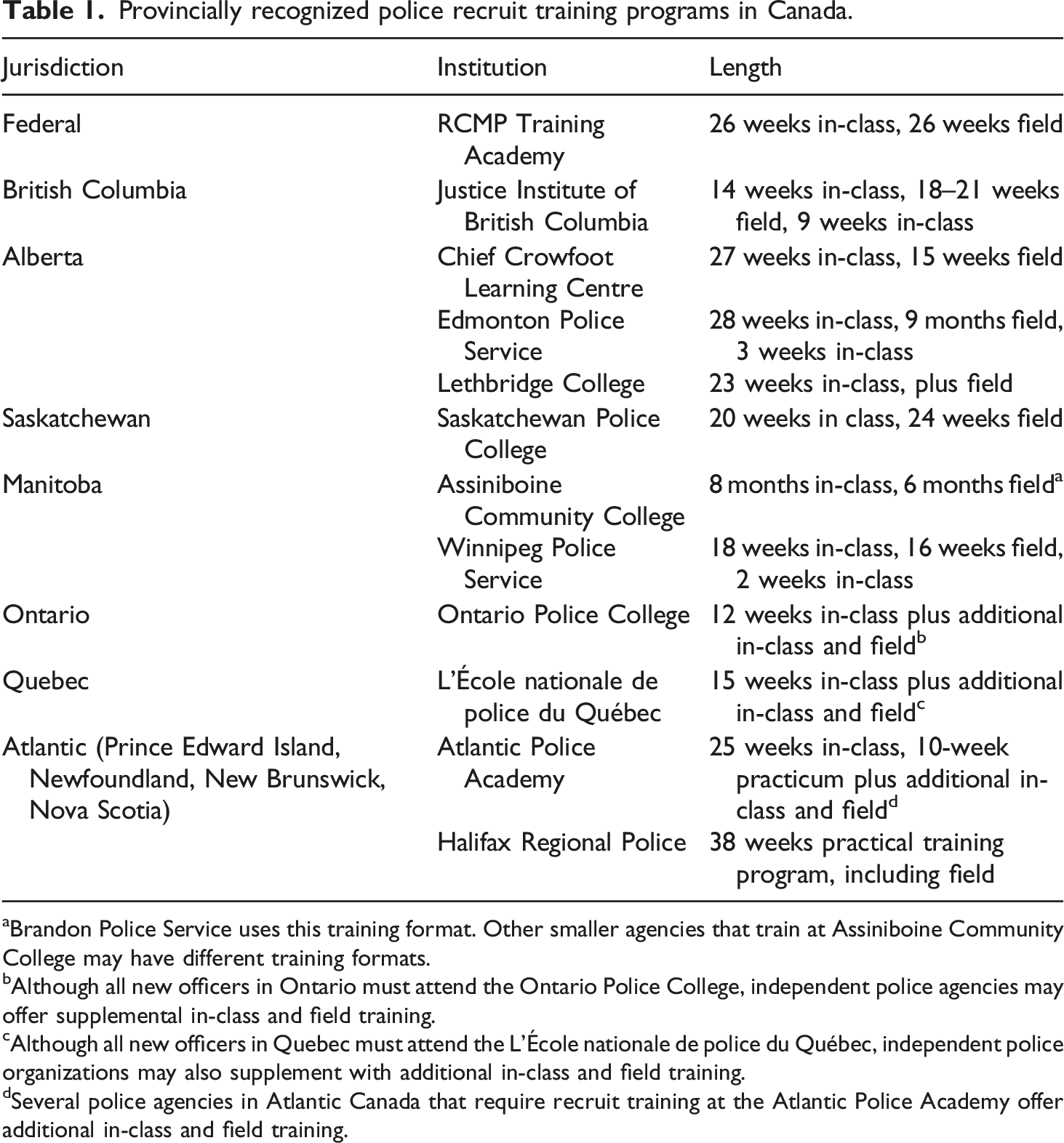
aBrandon Police Service uses this training format. Other smaller agencies that train at Assiniboine Community College may have different training formats.
bAlthough all new officers in Ontario must attend the Ontario Police College, independent police agencies may offer supplemental in-class and field training.
cAlthough all new officers in Quebec must attend the L’École nationale de police du Québec, independent police organizations may also supplement with additional in-class and field training.
dSeveral police agencies in Atlantic Canada that require recruit training at the Atlantic Police Academy offer additional in-class and field training.
Learning methodologies in police recruit training
Traditional and behavioural approaches
Given the range of recruit training programs (Jewell, 2013), different educational methods and strategies are expected to be utilized throughout Canada. Historically, police recruit training was conducted in a behavioural and paramilitary environment (Bayley and Bittner, 1984; Haberfield, 2013). Introduced by Watson (1930) and Skinner (1953), behaviourism is rooted in rote learning and reinforcement, where desired behaviours are taught through a conditioning process. Behavioural learning theory suggests that learning occurs over time when specific behaviour is rewarded or punished (Watson, 1930; Skinner, 1953). This teaching method relies on structured and repetitive exercises to change and reinforce behaviour (Watson, 1930; Skinner, 1953). Paramilitary training models strongly relate to behaviourist principles, requiring ‘structure, discipline, regimen, and curricular content’ (Vodde, 2011, p. 28). Behaviourist and paramilitary methodologies have been commonly used in several Canadian police training programs (Madsen, 2020; Jewell, 2013). For example, officer training for the RCMP (2019) consists of structured parades and drill classes, operational conditioning, a requirement to stay in residency, and strict expectations surrounding dress and deportment. Workman-Stark (2017) suggested that this intensive, 26-week program ‘is intended to strip recruits of their personal characteristics’ (p. 29) to adopt desirable behaviour for police officers. Further, McCreedy (1983) described paramilitary police training as a ‘punishment-centred experience in which trainees must prove themselves, and it helps screen out those who are not up to par’ (p. 32). These notions may still exist through employment structures where recruits are not formally hired until meeting performance benchmarks (RCMP, (2019). Although research is limited, behaviouralist and paramilitary principles can be found in some aspects of police recruit training in Canada (Workman-Stark, 2017).
Birzer (2003) suggested that behaviouralist and paramilitary education environments are linked to a warrior-like mentality among police recruits that inhibits learning and does not align with modern, community-oriented policing expectations. Even though some researchers argue that this environment may be effective when teaching procedural and technical skills (Bayley and Bittner, 1984; Vodde, 2011), it is ineffective in developing non-technical competencies such as problem-solving, communication, critical thinking, and leadership (Birzer, 2003; Birzer and Tannehill, 2001; Morgan, 2022; Vodde, 2011). Morgan (2022) explored the influence of a paramilitary police environment on procedural justice training through field observations at a large Australian state police academy. The training aimed to develop skills in resolving mental health crises, including treating others with dignity and respect, actively listening to concerns, establishing trust, and conveying neutrality. Morgan (2022) found that while some elements of procedural justice were included in the training, the procedurally unjust paramilitary environment was a barrier to learning. A lack of opportunities for recruits to provide input and thoughts into their educational program did not align with developing effective communication and listening skills (Morgan, 2022). Instead of the more empathetic communication and listening behaviour desired, Morgan (2022) observed that the paramilitary training environment fostered a ‘soldier-like, robotic mindset that has been imparted in the classroom’ (p. 888). Overall, they suggested that a traditional, paramilitary environment can limit understanding, internalization, and future use of procedural justice techniques (Morgan, 2022). This notion may place traditional training methods at odds with police initiatives that require competencies such as communication and problem-solving, particularly with police organizations adopting a community-based and procedural justice focus.
Andragogy and adult-oriented approaches
Birzer (2003) observed that some police academies have adopted adult-oriented or andragogical teaching philosophies instead of behavioural or paramilitary approaches. Knowles et al. (1996) pioneered andragogy and proposed four tenets of adult learning. They proposed that learning should be student-centred, experiential, relevant to the learner, and integrate past experiences (Knowles et al., 1996). These tenets do not rest with a single instructional method but rather emphasize holistic approaches focusing on the learner’s overall needs (Knowles et al., 1996). Drawing from Knowles et al.’s (1996) principles, Birzer (2003) suggested that interactive, participatory, and experiential training allows recruits to develop skills through problem-solving, discussions, case studies, simulation, and scenario activities. In Canada, some police recruit training programs have integrated these strategies (Birzer, 2003). For example, the Justice Institute of British Columbia revised its police recruit training program in 2016 to incorporate a competency-based framework that diverged from a lecture-based and behaviouralist model (Houlahan, 2018). Lectures were largely removed in favour of adult-oriented activities, including self-directed learning, case studies, simulation and scenario training, experiential activities, and reflection (Houlahan, 2018). Further, the block training structure allowed recruits to reflect on experiences from field training experiences during additional classroom training held afterwards (Houlahan, 2018). Other recruit training programs indicated that they are integrating more andragogical strategies, including the RCMP (2022) and Ontario Police College (Shipley, 2019). Therefore, there may be a trend in recruit training from behavioural and paramilitary methods to adult-learning approaches (Vodde, 2011; Jewell, 2013).
Although andragogy aligns with effective adult-learning principles, more research is required to critically evaluate its use in police recruit training programs. These methodologies rely on learners having a reference point and prior content knowledge (Knowles et al., 1996). In contrast, recruits are often introduced to policing concepts for the first time (Wyatt and Bell, 2014). Before integrating knowledge into scenarios, case studies, and simulations, a basic understanding of theory and content is needed. Similarly, some physical aspects, such as firearms, use of force, and tactics, may be better taught in a behavioural environment where skills are repeated over time and later integrated into experiential activities, such as scenarios or simulations. Shipton (2009) suggested that learning in police recruit training is not simply transmitting knowledge through lecture-based methods or acquiring skills through student-centred approaches but rather about transformational learning. In this learning-centred approach, instructors collaborate with students using a scaffolding technique (Shipton, 2009). Basic concepts are introduced first and then progress to more complex scenarios (Shipton, 2009). Shipton (2009) recommended this hybrid strategy to facilitate deeper learning while ensuring recruits have functional knowledge. Since both andragogy and transformational learning relies on multiple teaching techniques and activities, evaluating various strategies in the police recruit training context is essential to appropriately match strategies to learning outcomes.
Case-based learning
Case-based learning is an andragogical strategy that combines constructivist and experiential perspectives. Vygotsky’s (1978) constructivist theory suggests that learners construct knowledge rather than passively absorb it. Individuals integrate new information with prior knowledge, forming their own understanding (Kantar and Massouh, 2015; Vygotsky, 1978). In this model, instructors are viewed as facilitators who guide learners to an individual understanding of content. Similarly, Kolb’s (1984) experiential learning theory focuses on the importance of experiences in the learning process. Through ‘learning by doing’, real-world experiences provide context for knowledge and new information (Kolb, 1984; George et al., 2015). Experiential learning is a process where learners actively engage in meaningful and practical experiences that encourage them to think critically and reflect (Kolb, 1984). Fundamentally, Kolb (1984) proposed that effective learning requires experiencing, reflecting, conceptualizing, and experimenting. Both the constructivist and experiential perspectives stress the importance of integrating new understandings with prior knowledge and experiences.
Rather than relying on memorization and lecture-based explanations, case-based learning requires students to construct their own understanding by integrating new problems with past experiences and knowledge. Students apply knowledge and concepts by discussing scenarios resembling real-life situations from the field (Dunlosky et al., 2013; Yoo and Park, 2015). Ertmer and Russell (1995) defined case-based learning as ‘a teaching method which requires students to actively participate in real or hypothetical problem situations, reflecting the kinds of experiences naturally encountered in the discipline under study’ (p. 24). Theoretically, case-based learning engages students in understanding theories and content by ‘analyzing, evaluating, conceptualizing, and discussing applications’ (Kunselman and Johnson, 2004, p. 87). In practice, case studies expose learners to written cases requiring them to discuss and solve real-life problems (Ertmer and Russell, 1995). After reading the case, learners discuss the case and propose a solution in a team setting, either in small groups or as a class (Ertmer and Russell, 1995). Holkeboer (1993) propositioned that learners undergo a three-step process in case-based learning: (1) identifying the core problem, (2) generating possible solutions, and (3) evaluating and agreeing on a single solution. Since cases are typically written to integrate theory and concepts into the scenario, learners develop critical thinking skills by identifying and applying theory, enhancing analytical skills (Wolfer and Baker, 2000; Dunlosky et al., 2013). Through this analysis and discussions with peers, case-based learning also builds competency in communication, problem-solving, teamwork, reasoning, and knowledge transfer (Kantar and Massouh, 2015; Nkhoma et al., 2017). Since the case studies are written thematically based on course content, they can align with the knowledge, skills, and confidence required for future roles (Barrows, 1986; Dunlosky et al., 2013).
Case-based learning may be particularly effective in the policing environment, considering the interdisciplinary and complex nature of the work (Stentoft, 2017). Birzer (2003) suggested that case studies could be integrated into legal topics, mirroring their use in some law school programs. In law school, students are given a scenario where they must identify the issues, analyze multiple facts, and provide a legal rationale (Birzer, 2003). For example, when teaching search and seizure, recruits could be given a case study detailing a range of facts, asking if they would search or not. Case studies have also been used regularly in ethics training, where recruits are provided with a realistic scenario around officer discretion, accepting gratuities, or misconduct (Wyatt-Nichol and Franks, 2007). Case-based learning could be incorporated into other topics, including patrol tactics, community policing, and values-based decision-making. It is a promising strategy and would benefit from increased research on its integration and effectiveness in police recruit training.
Methodology
Study design
This study aimed to explore approaches to Canadian police recruit training and examine the use, perception, and integration of case-based learning. Since the literature review indicated that police recruit training and case-based learning are underexplored, qualitative research was well-suited to provide additional insight (Denzin and Lincoln, 2011). The semi-structured interview method was chosen, as it provided a framework of prearranged questions constructed from the research and the flexibility to steer the direction of the interview and probe various responses (Denzin and Lincoln, 2011). The purposive sampling method was used to select participants. The inclusion criteria were police officers with managerial oversight of a police recruit training program accredited by a Canadian province. Individual police agencies that offered supplemental training were excluded, as the training provided is not a complete police recruit training program. These participants were selected because they have deep knowledge and a high degree of control of their respective police recruit training programs. Thus, their perceptions can influence various teaching approaches and strategies. Participants were expected to clearly understand their training program’s content, strengths, and challenges.
Participants
After compiling a list of police recruit training programs as outlined in Table 1, the researcher contacted potential participants across Canada through e-mail to sample a broad range of experiences. In total, ten participants were contacted to participate, and six semi-structured interviews were completed. Participating agencies included provincial training academies, post-secondary institutions, and individual police agencies that deliver provincially recognized recruit training. The sample represents 50% of provincially recognized police recruit training programs in Canada and includes representation from Western, Central, and Atlantic Canada.
Procedure and analysis
The interview began with general questions about the participant’s police recruit training program, including the overall teaching methodology, teaching strategies used, and training challenges. Then, the researcher asked if the participant knew the case-based learning method and requested their personal definition. After recording these responses, the researcher read the following definition adapted from Ertmer and Russell (1995): ‘For this study, case-based learning is defined as a teaching approach that requires students to engage in group or class discussions of realistic scenarios that resemble situations they would encounter as a new police officer’. A series of questions about the use and perceptions of case-based learning followed. All responses were recorded through detailed notes and direct quotes by the researcher. Once all interviews were completed, responses were coded and grouped into themes following Colaizzi’s (1978) descriptive phenomenological method. After several iterations of coding were completed, four key themes emerged from the interviews.
Results
Theme 1: Interrelated training content
A reoccurring theme throughout the interviews was the complex and interrelated nature of police recruit training. Participants specified numerous training topics that can be broadly summarized in three categories: (1) physical skills, (2) investigation skills, and (3) general policing skills. Physical skills included firearms, use of force, defensive tactics, emergency vehicle operations, and subject control. Investigation skills included frequent Criminal Code investigations, Federal and Provincial statutes, obtaining witness and suspect statements, and search warrants. General policing skills included de-escalation, mental health, community policing, values-based decision-making, ethics, traffic, personal wellness, fair and impartial policing, trauma-informed practice, police stops or street checks, communication, and social psychology. Although many of these topics were common among recruit training programs, there were nuances. For example, one agency indicated that they included writing search warrants, while another removed this topic from their program as they found it too complex for recruits. Uniquely, one training program delivered by a community college enlisted a civilian professor to teach a social psychology course that focused heavily on human behaviour and various mental illnesses. Regardless of the differences in training content identified by participants, they all stressed the interrelated nature of police training. One participant summarized this concept by saying, ‘in policing, it is about [several] things and how they all intermingle, Charter rights, defences, communication, tactics - how recruits can piece it all together’.
Participants all agreed that recruits needed to take considerable skills and knowledge and integrate it into front-line policing responses. For example, a participant described a typical police call that requires a police officer to apprehend an individual suffering from a mental health disorder. The participant explained that the recruit must integrate skills and knowledge from various sessions throughout the program. The recruit is expected to determine the legal basis for the apprehension, identify and employ appropriate de-escalation and communication techniques, evaluate the individual’s behaviour to determine reasonable subject control and use of force, connect the individual to appropriate medical assistance and follow-up care, and document the interaction. In this one situation, the recruit needed to incorporate skills and knowledge of Provincial statutes, de-escalation, communication, arrest procedures, use of force, and mental health. Similarly, a different participant stressed the significant volume of information and skills that new police officers are required to learn and demonstrate. They said, ‘recruits really have to ingest a massive amount of information and synthesize it to turn into meaningful output. They actually have to demonstrate that they can do things’. Likewise, a different participant noted an increased focus on practical skills and reflected, ‘when I went through training, it was a lot different. It was very much death by PowerPoint, reading the criminal code and 4-hour exams. Not very conducive to what we do in policing’. All six participants stressed the importance of applying various theories and concepts to practice.
Theme 2: Andragogical methods
Participants described several andragogical methods in their recruit training programs, including scenarios, simulations, case-based learning, problem-based learning, group discussions, experiential learning, group projects, reflection, and field training. All participants indicated that field training was a required component, but three suggested that the academy had little or no involvement and relied on individual police agencies to administer. One participant said their role was to ‘prepare recruits for the field coach program’, but not oversee it. Although lectures were still relied on in some cases, there was a recognition that theoretical information needed to be applied in a practical or experiential setting. These notions can be summarized by one participant, who said, ‘there needs to be a mix between theoretical knowledge presented and then using cases or scenarios to cement the knowledge into their brain’. Four participants described using scaffolding to progress from basic to complex learning. Most discussions around scaffolding referred to scenario-based learning, a central part of many recruit training programs included in this study. One participant described this approach where ‘recruits have to learn the law, but that is all reinforced with scenarios. They get a little bit of academic, but then they are exposed to scenarios that cement those concepts. It is an incremental, step process, more academic top-up, more scenarios’.
Differences between training programs became apparent when discussing specific activities used in classes. A participant described their program as ‘not student-centred, more student-led. Students are responsible for their own learning. They are not spoon-fed but guided by facilitators’. Most of the course content and theory were self-directed, with the participant indicating, ‘the expectation is that recruits come “ready to go” with reading and self-guided quizzes done’. In class, recruits complete case studies, scenarios, experiential learning, and reflection facilitated by instructors. Comparably, one participant described their legal studies as ‘interactive’. There was a brief lecture or ‘download of information’ to review assigned readings in class. Then, the recruits went into breakout rooms and worked through the material through discussion in smaller groups. In some cases, the recruits presented or taught back the content to their peers. Participants described these methods as ‘outstanding’ and ‘a huge success’ in promoting comprehension, understanding, and skill acquisition.
One participant said that although they recognized adult education is more effective, their program was mostly lecture, and they were revising the content. They still pointed to some adult-oriented activities incorporated between lectures, including a group case study on a Criminal Code offence, a group project on a social issue, and a values-based decision-making exercise. A different participant described their recruit training program as paramilitary, referring to the program’s residency structure and strict expectations. Specifically, they depicted a requirement to live in shared dormitories, regular inspections of uniforms and dormitories, and stringent criteria with high expectations. Even though the program was described as paramilitary, some of the actual learning activities explained by the participant were adult-oriented, including self-directed online learning, group discussions and projects, and scenario-based training. Although the thematic analysis of interviews suggested that training topics and activities varied throughout Canada, all participants supported adult-learning approaches.
Theme 3: Case-based learning
There was no common term used to describe case-based learning among participants. Before the researcher defined case-based learning for participants, four indicated that they were unaware or unsure of the method. Once the definition was read, five of the six participants confirmed they used case-based learning in their recruit training programs but labelled it differently. Specifically, case-based learning was called ‘tabletop exercises’, ‘desktop exercises’, ‘group discussion’, and ‘scenarios’ by various participants. Additionally, before reading the definition, one participant suggested that case-based learning referred to judicial cases. In policing, judicial decisions and case law are significant components of legal training, so the similar terminology was confusing. Despite the different terms used, all participants indicated that their recruit training programs integrate some form of case-based learning based on the definition provided. The researcher asked several probing and clarifying questions to confirm that case-based learning was used in each program.
Participants described using case-based learning to teach numerous topics, from values-based decision-making to crisis communication. Two participants indicated that case-based learning was used throughout the program in every area, and recruits interact with case studies daily. One of these participants perceived classroom-based case studies as more time efficient than full, practical scenarios. A different participant indicated that case studies were used for specific topics and not integrated throughout the program. One participant described showing recruits videos of actual police incidents or body camera footage, asking the recruits to break it down and suggest what they would do in the situation. Another participant indicated that they base case studies on real situations or coroner’s inquests so that the actual result could be discussed in class. One participant described using the scaffolding method for case-based learning, where cases at the beginning of the program were basic and then progressed to complex cases by the end. Overall, case-based learning was integrated differently into each program, with some programs relying on the technique more than others.
There was broad support for case-based learning among all participants. One participant compared case studies to ‘the methodology of law school’, where ‘everything relates to a principle, but they understand how to interpret and apply principles to situations’. Four participants indicated that case-based learning allows recruits to apply concepts to real-life situations and consider other approaches. Nevertheless, some challenges were identified. One participant stressed the need for cases to be detailed and meet learning outcomes. They said, ‘you need time at the front to ensure that the case studies are written properly and have the right content in them’. Another indicated that ‘full case-based learning and group work is very time-consuming. That is why we do not do a lot of it in class during the academic sessions’. Several participants used a professional curriculum designer to assist in developing the cases, while police instructors wrote others. No programs had a formal training program for instructors on case-based learning, and one described instructor training as ‘learn-as-you-go’. Although challenges were identified, all participants said case-based learning was useful in recruit training.
Theme 4: Resourcing challenges
Finally, all participants acknowledged resourcing challenges in delivering their respective recruit training programs. These challenges broadly fell under three categories: program length, facilities, and instructional support. These challenges were also identified as barriers to integrating case-based and other andragogical approaches into training. Three participants indicated that short program lengths made adding additional content or activities difficult. One participant asked rhetorically, ‘what do you take out to replace it?’ To address program length, two participants noted that individual police agencies add additional post-training to supplement provincially mandated training. Securing and scheduling facilities were also identified as a challenge by three participants. Firearms range and classroom facilities were in short supply and could not accommodate training needs. One participant also noted the difficulty in scheduling breakout rooms to facilitate case-based learning and scenarios. These three participants perceived program length and a lack of facilities as barriers to adopting new teaching strategies.
All participants referred to increased workloads placed on instructors, particularly challenging when developing and implementing new training approaches. Two participants indicated that the limited instructor time made it challenging to create new activities and lesson plans while delivering the active training program. One participant stated, ‘when great ideas come up, it is hard to integrate without shutting down training’. Similarly, a different participant said, ‘it would be a great idea, but how do I release my instructor? Because I have a skeleton team. How do we develop that and integrate it into the program without stopping the program?’ A different participant explained that there was no increase in funding or instructors after their recruit training program transitioned from lecture-based teaching to adult learning. To properly use scenarios and cases in police recruit training, the participant suggested that the class size must be decreased or the number of instructors increased to provide more individual attention. They summarized, ‘We cannot sufficiently train the recruits the way they deserve to be trained. We do not have enough time to go through the number of examples and repetitions they need’. Finally, three participants pointed to a lack of continuity in instructional staff resulting in inconsistent expectations. In one program, temporary or guest instructors were used to supplement the shortage of permanent instructors resulting from funding gaps. Another participant indicated they make a concerted effort to keep a limited pool of instructors to ensure standardization due to ongoing issues with inconsistency. A different participant noted that they were struggling to find qualified police officers as instructors, which resulted in hiring retired police officers as a temporary measure. Therefore, both low funding and instructor availability resulted in a perceived lack of instructional support.
Discussion
The study’s first objective was to explore approaches to Canadian police recruit training. The results suggest that training administrators place high importance on recruits applying and integrating learning in practice. Recruits were expected to incorporate skills and knowledge from across the program into front-line police responses to demonstrate competence. In line with existing research, andragogy and adult learning appear well-suited for these needs identified by training administrators, as it focuses on learning by doing (Knowles et al., 1996). It also reflects a holistic approach to training and requires matching various techniques to learning outcomes (Knowles et al., 1996). Accordingly, the data indicates that several andragogical techniques are used in Canadian police recruit training, including scenarios, simulations, case-based learning, problem-based learning, group discussions, experiential learning, group projects, reflection, and field training. Additionally, the scaffolding method was used heavily in scenario-based training to encourage progression from basic to complex scenarios. While the study found these strategies are used and are perceived to be effective, they still need to be critically evaluated to determine if they achieve desired outcomes in police recruit training.
An important distinction emerged between the training environment and teaching methods. The training environment in one program was portrayed as paramilitary, given the residency requirement, inspections, and strict expectations. Despite the paramilitary label, the teaching methods and activities described were adult-oriented, including self-directed online learning, group discussions and projects, and scenario-based training. Recruit training can be delivered with a combination of methodologies, even if their underlying philosophies contradict each other. Future research could address how paramilitary training interacts with andragogical approaches. Adult-oriented learning requires participants to feel comfortable making mistakes or errors, and the accompanying reflection is a critical component of the learning process (Knowles et al., 1996). If instructors are overly critical when mistakes occur, it undermines the ability of learners to experience and learn from activities freely, as students might modify their behaviour to avoid critique or embarrassment. Combining paramilitary and andragogy could create a contradiction for learners with unclear expectations, and future research could explore how recruits navigate these different approaches within a single program. It could also address whether a paramilitary structure is incompatible with andragogical practices or whether they can coexist effectively.
The differences between paramilitary and andragogy are rooted in the interactions between instructors and learners. Paramilitary relies on instructors being enforcers at a higher hierarchical level than learners (Bayley and Bittner, 1984). In contrast, andragogy requires instructors to be facilitators of a student-centred learning process (Knowles et al., 1996). For andragogy, positive and supportive interactions are required (Knowles et al., 1996). Although not the focus of this study, the data collected suggests that instructor training is limited and underfunded. In several programs, instructors received no formal training and were often temporarily assigned, causing concerns over the consistency of program delivery. The data also indicated that some programs had difficulty finding qualified instructors. To effectively employ andragogical teaching, instructors should have strong interpersonal skills and understand the underlying teaching methodologies (Knowles et al., 1996). These findings may point to deeper issues with instructor recruitment, selection, and training. Another important finding was a perceived lack of funding and resources to deliver police recruit training programs effectively. Adult-oriented learning requires more resources than traditional, lecture-based approaches due to the increased instructor support provided to students (Knowles et al., 1996). Since police recruit training is foundational to police performance and development, governments should examine if they are appropriately funded.
The second objective of this study was to examine case-based learning. The data indicated that case-based learning was used in Canadian police recruit training. Some programs used the program extensively, while others selectively. For those that used case-based learning selectively, several barriers were identified. A key challenge was the strict and limited program length. A different lesson or activity would need to be removed to add case-based learning to the curriculum. Despite this observation, limited program time may be an advantage for case-based learning compared to scenario-based learning, a common activity in recruit training identified by participants in the study. Scenario-based learning inherently has downtime between scenarios while learners wait to participate. In contrast, learners are actively engaged throughout the case-based learning process. Therefore, there may be opportunities to leverage case-based learning for efficiency.
Another barrier identified was the resources required to draft case studies. Creating case studies is time-consuming, and instructional resources are scarce. This time requirement could be lessened with a centralized database of training material available to police agencies and academies throughout Canada. Training resources could be shared between agencies, creating an open-source network. This research noted innovative practices for case-based learning that other agencies could consider incorporating into their programs, including using videos of actual interactions, body camera footage, and coroner’s inquest documentation. An initiative to widely share case-based learning resources would benefit from support at the federal level or between multiple police recruit training programs, as privacy and confidentiality concerns naturally arise when involving police information.
The barriers to case-based learning identified were based on the resources required, not the method’s perceived effectiveness. Overall, training administrators supported case-based learning, as most perceived it enhanced learning among recruits. Interestingly, its usefulness in developing critical skills, such as problem-solving, communication, and critical thinking, did not emerge as a theme. The benefits cited were primarily related to the real-life application of case-based learning. This reasoning aligns with one of the themes that emerged: applying learning from training to front-line police responses. Training administrators recognized that discussing and analyzing common problems encountered in the field could translate into a better understanding of how they operate in practice. Therefore, case-based learning may have been perceived to assist recruits in practically applying training content rather than developing certain skills.
There was no common term used for case-based learning. It was referred to as ‘tabletop exercises’, ‘desktop exercises’, ‘group discussion’, and ‘scenarios’ by various participants. Different terminology may indicate that there is no shared language for police training used throughout Canada. The varying terminology also highlights a potential disconnect between the intent of a strategy and its implementation in practice. Although police administrators and instructors may intend to integrate a specific strategy, it may be mislabelled or incorrectly implemented. Although efforts were made in this study to verify that activities were case-based learning using probing questions and seeking clarification, additional observational research could verify their use and implementation in training. The varying terminology could also indicate a lack of standardized training for instructors and administrators. The study suggested that police instructors often found themselves without adequate training or preparation. Training on instructional methods could increase the likelihood of similar terminology being used and methods being implemented effectively.
A requirement to educate police trainers in andragogical practice at a level equal to or approaching those of higher education lecturers would be an effective step toward improving the overall quality of training and increasing the professionalism of new officers. Research demonstrates that ongoing professional development can improve the quality of instruction, increase student engagement, and enhance learning outcomes (Schostak et al., 2010). Further, opening training positions to civilians with higher-level education training, such as criminology or psychology lecturers, could be a cost-effective solution to a shortage of police trainers. These individuals bring a wealth of knowledge and experience that could be applied to recruit training programs while also encouraging fresh perspectives and innovative ideas. These recommendations are particularly important in the case of police recruit training, where the consequences of inadequate training can be severe.
Limitations
Significantly, this research relied on the perceptions and judgements of police training administrators, which are subject to bias. It did not attend to rigorously evaluate recruit training programs or activities used in them. Therefore, no conclusions can be drawn on the efficacy of various police recruit training models or activities. Additionally, the study was not systematic or quantitative when comparing the various recruit training programs. The similarities and differences noted were based on qualitative and thematic interpretations and are not exhaustive.
Conclusion
The role of a Canadian police officer is complex and changing. In addition to enforcing the law, police officers are expected to act as counsellors, mediators, negotiators, and problem solvers. These roles require strong non-technical skills, such as communication, problem-solving, critical thinking, and teamwork (Birzer, 2003). Prior research has identified andragogy and adult learning as more conducive to developing these skills than traditional approaches used in police training, such as paramilitary, behavioural, and lecture-based (Birzer and Tannehill, 2001). This study reinforces that attempts are being made to align Canadian police recruit training with adult-learning principles and strategies. Several andragogical strategies were identified and explored, including scenarios, case-based learning, reflection, and field training. Importantly, there is a positive perception of andragogical strategies among training administrators, indicating an openness to further integrate into Canadian police recruit training programs. Case-based learning is used in some recruit training programs and could be integrated further into others. In this study, training administrators stressed the importance of recruits applying learning to practical situations. By working through a case study, recruits can experience how training content and theories apply to everyday situations encountered in the field. Wider use of case-based learning could enhance the quality of training and better equip recruits for future roles.
Footnotes
Declaration of conflicting interests
The author(s) declared no potential conflicts of interest with respect to the research, authorship, and/or publication of this article.
Funding
The author(s) received no financial support for the research, authorship, and/or publication of this article.
