




Abstract
This paper explores organisational challenges of embedding ‘Evidence-Based Policing’ (EBP) using a mixed methods design sampled across a range of ranks/roles, in a case study UK police force. Key organisational constraints identified include limited awareness of/access to research evidence, lack of resources, capability concerns, and challenges related to organisational culture and leadership. Organisational constraints were disproportionately experienced by lower ranking officers and staff, and senior officers were not fully cognisant of these challenges. There is a need to better equip officers and staff of all ranks to engage with EBP and address the identified organisational challenges.
Introduction
The term Evidence-Based Policing (EBP) was coined by Sherman (1998), although police utilisation of research evidence has a longer history (Knutsson and Tompson, 2017). Several definitions of EBP exist, with a common thread that policing should adopt a systematic use of research and evidence to support and inform practice. The debate around EBP tends to focus on the nature of ‘evidence’; what form this should take, what counts as evidence and how this is best disseminated to policing (Sherman, 2015; Sparrow, 2016; Lumsden 2017; Wood et al., 2017; Fleming and Wingrove, 2017). Internationally, EBP has emerged as a key driver of contemporary police reform. In the United Kingdom, EBP is part of a broader professionalisation agenda with ambitions to make transformative change across the service, improve the quality of policing professionals and embed EBP to inform day-to-day practice (Fleming and Wingrove, 2017).
Evidence-Based Policing-related research in the United Kingdom has focussed predominantly on either the advantages EBP can bring to policing (in particular the identification of ‘what works’ in policing) or receptivity to research evidence. Although studies have begun to explore the implementation of EBP (e.g. Hunter et al., 2017; Fleming and Wingrove, 2017; Huey et al., 2021), there remains a paucity of studies that specifically examine the challenges and organisational constraints associated with embedding it in UK police forces. Moreover, research tends to reflect the views of senior officers (Hunter et al., 2015; Stanko and Dawson, 2016) with little consideration of the significant diversity of ranks and roles, and the heterogeneous nature of police organisations. A key gap explored in this paper is how perceptions and experiences of the organisational challenges of engaging in and embedding EBP vary by rank and role.
This research uses a mixed methods case study of one metropolitan UK police force. The findings are drawn from a wider study that more broadly explored the challenges and opportunities for embedding EBP in policing. The current paper focusses on identified organisational challenges. Findings from the wider study are beyond the scope of this paper, including the range of sources used to inform decision-making; officer and staff understanding of EBP; the role of police analysts in EBP and externally driven challenges associated with embedding EBP in policing.
The aim of this paper is to identify and critically examine what organisational constraints, as perceived and experienced by officers and staff, are the salient barriers to engaging with and embedding EBP. The key research questions are: • What are the perceived and experienced organisational challenges to embedding EBP in the cases study force? • To what extent did these perceptions and experiences differ by police officer/staff rank and role?
The definition of EBP adopted for this study was posited by the College of Policing (CoP) (no date-a) alongside the publication of their five-year strategy (CoP, 2014). ‘In an evidence-based policing approach, police officers, staff and volunteers create, review and use the best available evidence to inform and challenge policies, practices and decisions’. In particular, the CoP emphasised the role of research evidence in policing, stating ‘the College will support the direct involvement of officers or staff in designing, undertaking or critically reviewing research for policing’ (CoP, 2014, p. 14) and stated that the growing ‘evidence base’ would be directly embedded into standards and linked to selection and promotion processes (CoP, 2014). This aligned to the Policing Vison 2025, where the ambition was to make transformative change across the police service, which included embedding evidence-based practice to inform day to day policing practice (NPCC, no date).
At the time of this study, there were clear external pressures and expectations on police forces to ‘embed’ EBP. Further examples include: the establishment of the CoP ‘What Works Centre for Crime Reduction’ Centre (WWCCR); the publication of the CoP EBP Maturity Model (CoP, no date-b) and the release of the Police Knowledge Fund (CoP, 2015). All of which were designed to help embed an evidence-based approach in policing. At the time of data collection, chief officers in the case study force expressed a desire and expectation for officers and staff to engage in EBP, and an ‘EBP Steering Group’ was established to co-ordinate activity across the force. The overarching aim was to embed a broad conceptual approach in which EBP guides decision-making at all levels of the force.
It is acknowledged that for this study, there is an implicit assumption that EBP should be embedded in policing. This is the subject of a wider academic debate beyond the scope of this paper. However, an external expectation had clearly been placed upon the police service to ‘embed EBP’, and strong arguments have been proffered about why research evidence and EBP might be valuable to policing (Tilley and Laycock, 2017).
The organisational challenges of embedding EBP
This section offers a brief literature appraisal of identified organisational challenges to embedding EBP categorised as: police awareness and understanding of EBP; the accessibility and quality of the research evidence; organisational capacity; individual motivation and capability to engage with EBP; the role of police leadership and the relevance of police organisational culture and tacit knowledge.
Understanding, conceptualisation and awareness of EBP
A potential barrier to embedding EBP in policing is a lack of understanding of the term in practice. Lumsden (2017) suggests EBP as a concept is widely used in policing and acknowledged to have widespread potential benefit, but not well understood. Understanding practitioner knowledge about EBP is an important stage in translating research into practice (Telep and Somers, 2017). However, few UK studies have explored this in detail, and Lumsden (2017) acknowledged her small sample offered only a glimpse of practitioners’ understanding of EBP. A key finding of the Telep and Somers (p. 1) study, a large survey across several US police agencies, was that there was ‘a great deal of variability by rank’ in terms of how EBP was understood.
The quality and accessibility of the research evidence
An identified challenge to embedding EBP is the accessibility, quality and scope of research evidence. Bullock and Tilley (2009) draw from their extensive experience of Problem Oriented Policing (POP) to highlight likely parallels with EPB, including the limited evidence base available to police practitioners and the inaccessibility of the research evidence. This is supported by Hunter et al. (2017) who reported over 50% of officers in a national survey stated there had been occasions where they had sought research evidence to inform policy but could not find it. Beyond access and availability, studies have found the appropriateness and format of available research evidence as an obstacle to implementing EBP (Lum et al., 2012; Hunter et al., 2017). Challenges include how appropriately evidence is presented to the police community and difficulties for practitioners in digesting and interpreting this. Research evidence has been described as unclear and ‘full of jargon’ (Hunter et al., 2015: p. 6). Hunter et al. (2017) argue willingness to use research evidence is directly linked to relevance and interpretability. However, in attempts to address this, several police-academic partnerships have adopted a co-design approach to ensure police forces are integral to the production of research evidence (Murray, 2019; Mitchell, 2019).
Capacity and capability
Organisational resource constraints, predominantly, ‘capacity’ and lack of ‘time’ are frequently cited as a significant challenge to engaging with research evidence (Hunter et al., 2015; Fleming and Wingrove, 2017). Indeed, this has been described as a ‘luxury, ill-suited to the “treadmill existence”’ of policing (Fleming and Wingrove, 2017: p. 211). A further identified challenge is the capability of police officers to interpret research evidence and to design and conduct meaningful evaluations of policing activity. Hunter et al. (2015) reported that officers held limited confidence in their ability to critically assess the quality of research evidence, with 81% of respondents in their national survey reporting that they had not received training or ‘support’ around the use of research evidence. Likewise, Lumsden and Goode (2016) found that only a small number of officers felt they had the necessary skills to evaluate interventions and critically appraise evidence.
Police leadership
Leadership and the support of the ‘chief officer team’ are viewed as essential components to embedding EBP (Hunter et al., 2015). Police leadership may legitimise and promote EBP, or alternatively cast it as a threat to the professional identity of experienced practitioners (Hunter et al., 2015, 2017; Lumsden, 2017). In the Human Relations (HR) sector, leadership is viewed as fundamental to successful evidence-based practice implementation (Briner, 2017). There is emerging evidence of receptivity to EBP amongst senior leaders and increasing emphasis on police leadership to demonstrate their understanding and commitement to EBP practices and principles (Davis & Silvestri 2020). Evidence-based principles have also been incorporated into promotion processes in police organisations, and there appears to be an increasing commitement to EBP by senior leaders for organisational practices (Davis & Silvestri, 2020). However, whilst senior police leaders create formal policies and guidance, frontline officers may resist, misinterpret or even adapt these into something else (Panzarella, 2003; Wall, 1994). Successful translation, legitimacy and the credibility of messaging can be a challenge for police leadership, especially considering the need to navigate a complex cultural environment.
Police organisational culture and tacit knowledge
Police occupational culture is complex with several tensions that pose significant challenges to embedding EBP. Organisational norms are a potential hindrance to embedding EBP, linked to a longstanding and limited lack of robust evaluation activity in policing and a culture where police interventions are ‘doomed to succeed’ (Fleming and Wingrove, 2017). Pease and Roach (2017) argue that routine evaluation of everyday initiatives in policing is unusual and for most police forces, only large-scale events tend to be evaluated, on a post hoc basis. Moreover, recently promoted senior officers are often keen to try new ideas of their own, rather than consolidating previous interventions, even if there is evidence that they are successful (Pease and Roach, 2017). Lumsden (2017) identifies ‘performance culture’ as a barrier to EBP, driven by external political pressures and targets from external bodies. Linked to this, Lum and Koper (2015, p. 13) argue that the philosophy and culture of policing to embrace EBP may require a ‘sea change in law enforcement culture’ and fundamental changes in longstanding practices deeply embedded within policing. The inherent complexities of police organisational culture may impede any efforts to implement transformational change (Cockcroft, 2014). However, it is important to acknowledge that police cultures are not static, and indeed multiple and fluid cultures are present (Cockcroft, 2012). Some elements of police culture are embedded in police forces, whilst others are more fleeting and sporadic (Loftus, 2009).
Several studies highlight how police officers favour using ‘professional experience’, or tacit knowledge, to inform decision-making, linked to ‘collegially’ and a general lack confidence in research evidence (Lum et al., 2012; Hunter et al., 2015, 2017; Fleming 2015; Pease and Roach, 2017). Indeed, professional experience is heavily utilised and valued in police decision-making (Hunter et al., 2015, 2017) and there is growing consensus that tacit knowledge should be included in the conceptualisation of EBP (e.g. Fleming and Rhodes, 2016; Pease and Roach, 2017; Huey et al., 2021). Whilst professional experience might be viewed as an ‘intuitively obvious notion’ and a ‘default position when all else fails’ (Fleming and Rhodes, 2016 p.9), alternatively, it can be viewed as a ‘craft’ (Fleming and Rhodes, 2016), accumulated over time, based on specialist and experiential knowledge, on skills and judgements, gained from iterative and cumulative experiences of professional practice (Barends et al., 2014; Fleming and Rhodes, 2016; Pease and Roach, 2017). However, when used in isolation as a source of decision-making, there are a range of inherent cognitive biases and weaknesses that must be recognised by practitioners (Briner et al., 2009).
Methodology
This paper uses a mixed methods convergent parallel research design, with triangulation of findings from qualitative and quantitative analysis. Data collection, comprising interviews, focus groups and an online survey were carried out concurrently during a single-phase (2016/2017). Interviews enabled individual officers’ opinions and experiences of EBP to be explored; focus groups facilitated discussion of a range of points of view with several different policing teams and functions and the questionnaire enabled perceptions of EBP to be captured from a wider sample (Denscombe, 2010). Findings from the three data strands (survey, interviews and focus groups) were synthesised during the interpretation phase to provide further understanding, identify corroboration or highlight conflicting results (Creswell and Plano-Clark, 2007).
Semi-structured qualitative interviews (N = 25) and focus groups (N = 5) were conducted with officers and staff with a diverse set of roles. Interview participants were selected using purposive sampling and included senior leaders from across the case study force (the majority at Superintendent, Chief Superintendent and Chief Officer rank). Individuals were chosen based upon their professional role. Care was taken to ensure a representative cross-section of ‘senior’ officers and staff from a diverse range of roles, whilst also ensuring relevance by including those who had experience with EBP.
Focus group participants were selected through purposive sampling across different police ‘teams’ and/or functions to represent the heterogeneous nature of the force. Focus group One (N = 9) included ‘Operations’ Superintendents and two Chief Superintendents. Focus group Two (N = 8) represented the ‘Force Operations Planning department’ (four Constables and four Sergeants). Focus group Three (N = 12) comprised a ‘Neighbourhood Team’ (one Special Constable, two PCSO’s, four Constables, four Sergeants and an Inspector). Focus group Four (N = 16) represented Analysts (from the Corporate Analysis team, the Intelligence Analysis team, Basic Command Units (BCUs) and two Researchers, one Senior Analyst, one Business Analyst and the Head of Corporate Analysis. Focus group Five (N = 6) represented the central Audit and Inspection Team and comprised of two supervisors and four auditors.
Survey participant rank/grade breakdown (n = 308).
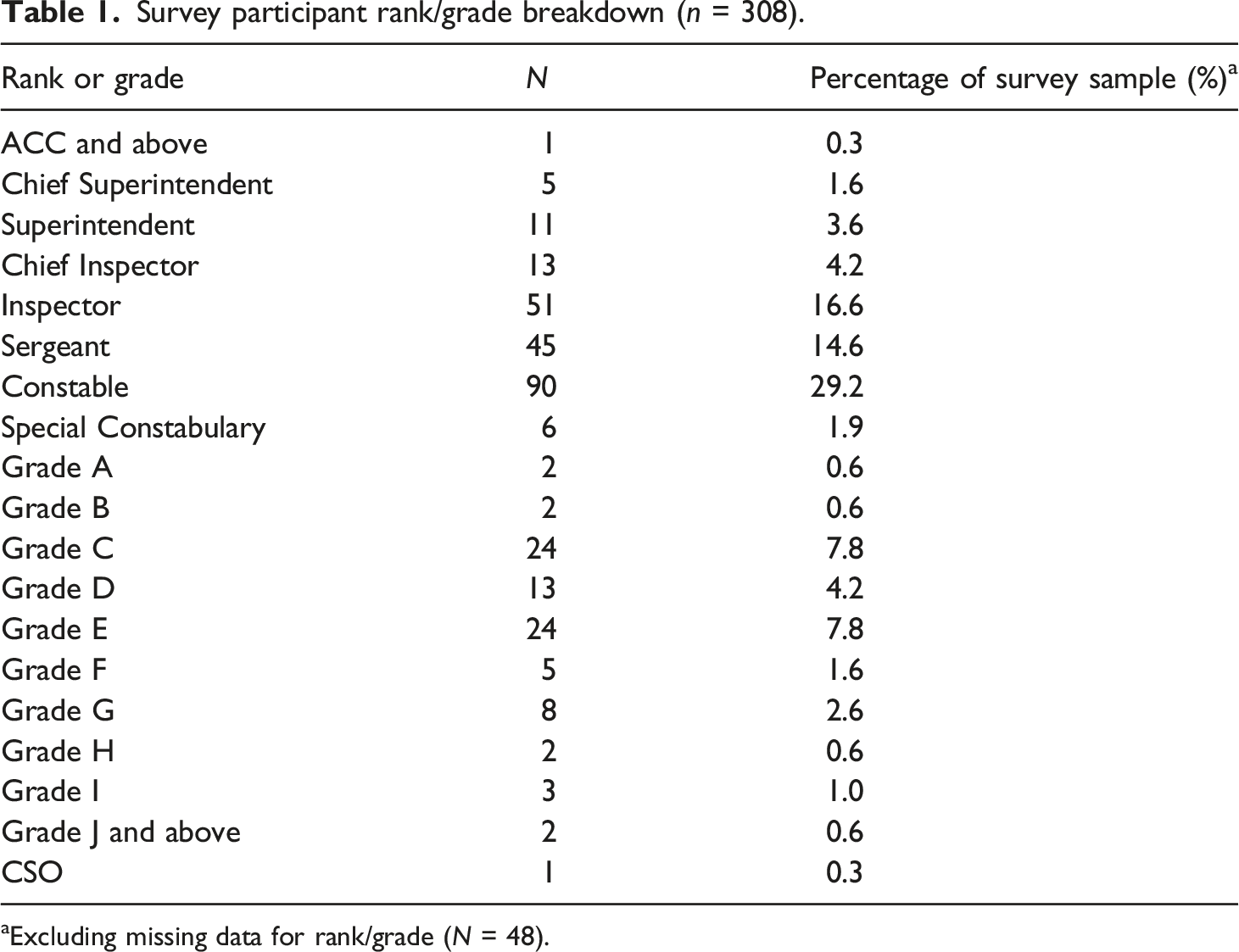
aExcluding missing data for rank/grade (N = 48).
The qualitative data was coded iteratively using Braun and Clarke’s (2006) six steps identification, and focused around searching for repetitions, metaphors and analogies; similarities and differences and linguistic connectors (Ryan and Bernard, 2003). Descriptive statistics and chi-square tests were used to analyse the survey data. Where the data was coded as categorical data, chi-square tests were conducted to identify any associations, by comparing the proportion of counts in each category with the expected proportions and testing for significance.
Survey sample characteristics
Sixty-nine percent of respondents were male (N = 245) and 31% female (N = 111). Thirty-nine percent of respondents were aged 45–54, with just over a quarter (25.6%) aged 35–44 and just under a quarter (24.6%) aged 25–34, a minority were either aged under 24 (2.9%), or over 55 (8%). Of these, 34.1% of officers and staff did not provide their rank or grade (N = 48). Just under one third of respondents (29.2%) were Constables, 16.6% Inspectors and 14.6% Sergeants. Police staff comprised of 27.6% of the sample. For analytical purposes, ranks and grades were further grouped together to produce six categories; ‘senior’ police officers (Chief Inspectors and ‘above’) (N = 30); ‘supervisory’ rank officers (Sergeants and Inspectors) (N = 96); ‘operational’ officers (Constables and Special Constables) (N = 96); ‘senior’ police staff (grade G and ‘above’) (N = 15); ‘mid-grade’ police staff (grades E–F) (N = 29) and ‘junior’ police staff (grades A–D) (N = 41). In summary, 86.1% of the police officers in the sample were ‘supervisory’ or ‘operational’ police officer ranks (41.7% and 44.4%, respectively).
The mean length of service of participants was 16.6 years, with a range of 1 year–40 years (SD = 8.9). Just under one third had 0–9 years’ service, one third had 10–19 years’ service and a further third had 20–29 years’ service. A small minority had over 30 years’ service. Respondents were asked what their highest level of educational attainment was. Overall, 38.6% reported having an undergraduate degree, 12.4% holding a master’s degree or postgraduate certificate/diploma and 10.1% were ‘currently studying for a qualification’.
Methodological limitations of this paper include biases in the self-selection of respondents in the questionnaire and that those who chose to complete the survey may have a particular interest in the EBP agenda. The use of purposive sampling in the interviews and focus groups limits the generalisations that can be made to the wider case study force, and it is not clear using a single case study how generalisable the findings are to other UK forces or internationally. However, triangulation of findings from the mixed methods convergent parallel research design does increase the robustness of the findings, as does the confidence from the broad agreement found with previous albeit limited literature identified.
Findings and discussion
The key organisational challenges and constraints to embedding EBP identified in the analysis were: a perceived lack of capacity and resources; concerns relating to access, awareness and capability; challenges relating to structure, leadership and culture; and the role of ‘professional experience’ (or tacit knowledge). In addition, there were several cross-cutting themes that emerged. The first of which was that inequality existed in opportunities to engage in EBP, and that there were variances in the experience of organisational constraints, related to rank and role. In addition, a set of external factors emerged as challenges to embedding EBP including the changing nature of crime and demand; the impact of historic austerity measures on capacity and perceptions regarding the scope and quality of the existing ‘evidence base’. A further important finding was the absence of a shared understanding of the concept of EBP within the case study police force (and more widely) which resulted in ambiguity and frustration amongst officers and staff. Discussion of how EBP was understood and conceptualised, and the external challenges are beyond the scope of this paper and will be explored in future publications. However, it is appropriate to highlight that the internal organisational challenges identified and now discussed further do not occur in isolation and are influenced by the wider context that policing operates in.
Awareness and access to research evidence
A key issue identified in the study was a lack of awareness regarding where to find sources of research evidence. Survey respondents were asked ‘do you feel that you know where to look to find research evidence?’ (N = 327), and just under half of participants responded positively (49.2%, N = 162). Chi-square tests revealed significant differences by rank and by respondents studying for a qualification. Overall, 85.7% of ‘senior’ officers responded positively compared to 48% of ‘supervisory’ rank officers, and 37.9% of ‘operational’ officers (χ2 (4, N = 221) = 22.82, p < .001). Moreover, 76.7% of respondents studying for a qualification they felt they knew where to look, compared to 46.1% who were not (χ2 (2, N = 299) = 10.29, p < .001). Officers and staff highlighted searching for research as time consuming and uncoordinated. The most widely used ‘search mechanism’ was a ‘general web search’, 71.8% reported using it ‘at least sometimes’, followed by ‘in-house expert/colleague’ (65.3%). Very few respondents were aware of additional sources available to speed up the search process. Several participants from the ‘Analysts’ focus group highlighted a lack of knowledge of what research evidence was (and was not) available and reported that they spent wasted time searching for evidence that did not exist. A further barrier cited was the lack of an internal ‘repository’ of research evidence; however, it was acknowledged that an internal ‘what works’ intranet page had recently been created, which was in early stages of development. At this stage, it was perceived as very limited in coverage of key ‘business areas’, and several interviewees were critical of its relevance and usefulness.
A further constraint identified was a lack of access to research evidence. Just over one third of survey respondents (37.9%) reported that they had access to ‘academic journals/sources of research evidence in their role’. This varied by rank and a significantly higher proportion of ‘senior’ officers reported access compared with ‘operational’ and ‘supervisory’ rank officers. When asked to respond to the statement they ‘do not have access to research evidence’, ‘senior’ officers were more likely to disagree (76.7%) compared to 20% of ‘supervisory’ rank officers (χ2 (8, N = 303) = 29.25, p < .001).
Resources and capacity
Less than a fifth (17.6%) of survey respondents agreed that ‘the organisation provides sufficient support and resources to implement evidence-based practice’. A higher proportion of ‘senior’ officers (36.6%) agreed with the statement, compared to ‘operational’ officers (10.5%) (χ2 (8, N = 220) = 20.05, p < .001). Analysis of the Neighbourhood Team focus group revealed several Constables, PCSOs and Specials did not have access to the internet, and a clear barrier given much of the available evidence is held outside of internal force systems. Participants generally accepted this as the norm and their immediate superiors (Sergeants and Inspectors) did not consider it to be problematic. These findings suggest that: ‘senior’ officers may not be aware of the lack of access to evidence-based resources experienced by lower ranking officers; the desire of senior officers to embed EBP approaches is not reflected in the approach of immediate supervisors and lower ranking officers are not aware of the expectations on them to engage with EBP.
‘Time’, including how long it takes to locate, digest and interpret research evidence, was the most widely cited organisational constraint to utilising research evidence, a finding replicated across the focus groups, interviews and survey, and consistent with previous literature (Hunter et al., 2015; Fleming and Wingrove, 2017; Lumsden, 2017). Whilst recognised as a challenge by all ranks and roles, those of lower ranks/grades identified time as a greater barrier than higher ranking officers. A higher proportion of ‘operational’ officers (34.4%) reported they ‘strongly agreed’ lacking time to engage with research evidence compared to ‘senior’ officers (16.7%) (χ2 (8, N = 221) = 10.65, p = .05).
Time was cited as a significant barrier by the Analyst focus group, who highlighted the considerable effort required to conduct empirical research and/or plan and conduct evaluations. Participants reported that they were rarely afforded the time to engage in such activities. Some of the participants had experience of working collaboratively with a local University (on a project funded by the Police Knowledge Fund). Whilst generally positive about this experience, several interviewees commented on the considerable ‘time’ investment required to conduct research. Those who been afforded the time to engage in the research process on this occasion held the view that this was likely ‘a one off’ and unlikely to become ‘business as usual’. In addition, some of the participants in the Analyst focus group had experience of supporting a randomised control trial (RCT) and there was a strong consensus this was a protracted and ‘resource intensive’ process.
Capability
Analysis of the survey and focus group data identified capability as an organisational constraint to embedding EBP. Less than a third (27.3%) of survey respondents reported having confidence in their ability to assess the quality of research evidence. A higher proportion of ‘senior’ officers reported they felt capable of assessing the quality compared with ‘operational’ officers (χ2 (8, N = 221) = 22.49, p = .03). Furthermore, analysis of the interviews and focus groups highlighted ‘senior officers’, in particular chief officers were more positive about EBP capability within the organisation than lower ranked officers and staff.
Less than one fifth (14.7%) of survey respondents reported having received any ‘formal training and/or support in the use of research’ and 10.4% had ‘ever received any training about how to identify or evaluate which strategies are effective at reducing crime’. Survey respondents were more likely to state that they would ‘identify officers who have used the tactics previously and seek their advice’ (73.8%), followed by ‘my previous experience with this tactic tells me it will work’ (71.6%) rather than ‘search for published works to inform the evaluation of activity’ (14%). This was supported by the focus groups, where no officers or staff reported receiving any training, except for a minority of Analysts. Further examination (of the survey data) by rank revealed a significantly higher proportion of ‘senior’ officers (26.7%) reported receiving training compared with ‘operational’ officers (6.4%) and ‘supervisory’ rank officers (9.4%).
Many senior officers, and some Analysts, were exposed to research evidence through alternative routes such as conferences/seminars, and access to other sources (e.g. CoP and/or Home Office resources). Over 57.1% of ‘senior’ officers reported ‘sometimes’ using ‘College of Policing’ information, in comparison to 28.3% of supervisory’ rank officers and 22.1% of ‘operational’ officers (X2 (6, N = 222) = 20.107, p = .00). Similar proportions were found regarding exposure to EBP via Home Office resources or via attendance at conferences or seminars; 54.7% of ‘operational’ officers reported ‘never’ using ‘conferences/seminars’, compared to 3.6% of ‘senior’ officers. Not surprisingly, survey respondents who were ‘currently studying for a qualification’ had a greater awareness, understanding and engagement with research evidence and EBP. During interviews, four ‘senior’ officers highlighted how their opportunity for postgraduate study had enhanced their ability to engage with EBP.
Leadership
Analysis of the interviews and the Superintendents focus group identified a lack of ‘strategy’ linking research evidence creation and dissemination with force priorities. Several interviewees discussed the need for strategic co-ordination of primary research with many highlighting the process ad hoc, and often not focused on force priorities. Police leadership should ensure a clear strategy and pathway for effective dissemination of research findings to those in the organisation tasked with improving policy and practice (Nutley et al., 2002; Boulton, 2020). It was evident from the interviews and focus groups that there was no such mechanism in place. Consequently, officers and staff frequently engaged in a time-consuming process to identify relevant and externally available research. This was compounded by a lack of access to resources, for example, ‘pay-walled’ academic journals, and in some teams even a lack of internet access.
The interviews at the most senior level revealed the force was strategically committed to embedding EBP, and many regarded it a necessity. This was in part driven by external factors, for example, austerity measures in place since 2010. However, the survey and focus groups found officers and staff frequently reported a lack of support to engage in EBP, principally in terms of being equipped with the necessary resources and opportunities. Further, a degree of ambiguity and frustration was evident regarding roles and responsibilities, and the expectations upon officers and staff to engage with EBP. The focus groups identified that specific procedures and processes about how to engage with EBP had not been effectively communicated. This hinders the development of a shared purpose and clear understanding of EBP (Silvestri, 2007). Analysis of the survey and focus groups revealed limited communication of definitions, procedures and processes, sources of research evidence and expectations. Officers and staff considered these all necessary to embedding EBP in force. To engender an organisational commitment to embedding EBP, it is necessary for leadership to identify clear roles and responsibilities of staff (Nutley et al., 2002). It was evident that several officers and staff did not consider their role to include specific responsibility to engage with EBP. For example, in the Neighbourhood Team focus group, the CSO argued that he/she is ‘supposed to be out on the street’ visibly engaging with the community, rather than ‘sitting behind a computer’. Indeed, no officers or staff in this team thought it their responsibility to engage with EBP. A clear barrier to EBP identified in this study, consistent with Fleming and Wingrove (2017), is a lack of information and clarity from leadership as to how EBP was relevant to the multiple and disparate roles that exist within the organisation, and which roles had responsibility for engaging with research evidence and EBP.
Despite chief officers expressing their support for EBP, just over half (52.4%) of survey respondents agreed that ‘there is no organisational emphasis on the use of research evidence to inform decision-making’, with nearly one third stating that they ‘neither agree nor disagree’ with the statement. Only one third (33.4%) of respondents agreed ‘evidence-based approaches are promoted by influential figures or leaders in my organisation’. This suggests chief officers had not fully communicated their support of EBP to the wider organisation. Further, many staff also felt they had little influence as how best to embed EBP. When asked, ‘do you feel that you “have a voice” if you have an idea about implementing a new tactic/strategy based upon research evidence?’ Over, 49.5% responded ‘yes’ and 50.5% ‘no’. However, ‘senior’ officers (and respondents who were ‘currently studying’) were more likely to respond ‘yes’; 86.7% of ‘senior ‘officers responded ‘yes’, compared to 23.9% of ‘operational’ officers (χ2 (2, N = 217) = 43.53, p < .001).
Organisational culture
Several obstacles were identified to embedding EBP directly linked to the organisational ‘culture’. For example, ‘swift action’ and ‘being seen to act quickly’ were perceived as engrained in the culture of the force. Three quarters (75.1%) of survey respondents agreed ‘decisions often have to be made quickly which makes it difficult to consider research evidence’; however, ‘operational’ officers were more likely to strongly agree with this statement than ‘senior’ officers (χ2 (8, N = 221) = 27.94, p = .02). The Analyst focus group suggested this was closely related to the ‘tasking’ of Analysts and the frequent requirement to produce short term, reactive analysis within tight deadlines. The Analysts reported that they were rarely afforded time to engage with research evidence, which restricted detailed analysis of a problem, and the quality of analytical products. Similarly, the Neighbourhood Team focus group highlighted that direct line managers considered engagement with research evidence as a poor use of their time.
Most interviewees identified ‘culture’ as a barrier to conducting evaluations and facilitating organisational learning. Lack of evaluation was recognised at the most senior level of the organisation, and all the chief officers highlighted it as a strongly embedded cultural norm within the organisation (and police service more widely). In the Superintendents focus group, several participants conceded they had previously personally led operations without conducting meaningful evaluation. Paradoxically, they expressed significant frustration at this ‘cultural norm’ and expressed a strong desire for change; ‘…going forward we’ve got to be honest about that and actually use [the data]… if the data shows that actually it hasn’t had the impact, we’ve got to be honest and say, Well okay that didn’t work, we tried it, thanks very much’’ (Superintendent focus group participant).
A consistent finding from interviews and focus groups across all ranks and roles was a cultural longstanding reluctance to admit ‘failure’ within the force. Consistent with Lumsden (2017), there was a strong consensus that ‘you never ever hear of an unsuccessful police operation… there’s never been an unsuccessful policing operation!..is every trial doomed to success?’ (Chief Officer interview participant). However, there appeared to be a strong desire, particularly at higher ranks and amongst Superintendents in particular, to recognise and challenge this: ‘Everything is a success in the police, isn’t it, but we’ve got to start being honest now, haven’t we, and say, “We tried something, it hasn’t worked”. Otherwise, what’s going to happen going forward is we’re going to put pieces of work in place, we’re going to say there a roaring success. Other people around the floor are going to think they’re a roaring success and take them on board’ (Superintendent focus group participant). Further probing of this reluctance to admit ‘failure’, in particular during the Superintendents focus group, highlighted operations and strategies as synonymous with individuals and perceived to be linked to promotion processes. Therefore, the reluctance to admit ‘failure’ appeared to be related to a perception that success or failure is personal to individuals.
At an operational level, participants of the Neighbourhood Team focus group did not perceive evaluation as important. Participants discussed a culture of ‘moving on to the next problem’ linked to the assumption that if the problem had ‘gone away’ the operation had succeeded. As earlier, this was exacerbated by the belief that engaging in EBP would not be viewed as a ‘good use of time’; ‘Because you’re trying to manage your time, are you really going to sit down for an hour and put that hour aside to learn? In theory, I mean, you should do, but in reality, I think the answer would be no, because you’re not allowed the time. We’ve got other work priorities, every day, to deal with. If we were sitting in the office for an hour, we would definitely be questioned what we’re doing’ (Neighbourhood Team focus group participant).
Participants of the Analyst focus group spoke at length about the lack of evaluation, with reference to the Scanning, Analysis, Response and Assessment (SARA) problem-solving model. A significant frustration for many Analysts who perceived evaluation as a key part of their role, was that the organisation ‘very rarely bothered’ with the final A (Assessment). Participants explained that in many instances they were expected to conduct a ‘cursory’ post hoc evaluation. The Operations Planning department also conducted post hoc evaluation, utilising the CoP (2013) ‘National Debriefing Model’ guidance after every event they were responsible for. In line with previous research (Pease and Roach, 2017), this serves to illustrate both the diversity of roles and associated working practices within the organisation, and the lack of routine evaluation of everyday working practices and initiatives.
The role of professional experience
The final identified organisational challenges related to ‘professional experience’ or tacit knowledge. In line with previous studies (e.g. Hunter et al., 2017), it was clear that there was a heavy reliance on professional experience and the professional experience of colleagues within the case study force. ‘Professional experience’ and ‘advice from colleagues’ were reported as the most frequently used and most useful sources to inform decision-making (90% and 97%, respectively, stated they ‘sometimes’, ‘very often’ or ‘always’ use it to inform decision-making). The next most frequently used source was ‘Local force guidance’ (87.8%) followed by ‘In-force Problem Profiles’ (48.7%). Other decision-making sources (e.g. CoP products and Home Office reports/bulletins) were utilised regularly by around one third of survey respondents. This strongly varied by rank, with higher-ranking officers more likely to use these sources. ‘Professional experience’ and ‘advice from colleagues’ were the most highly valued decision-making source, with 83.4% and 93.8% of survey respondents reporting that they found the sources to be either ‘somewhat ‘or ‘very’ useful. This compared to the perceived next most useful sources: ‘other forces’ at 52.9% and ‘Problem Profiles’ at 48.8%.
The frequent use of professional experience in decision-making was also identified through interviews and focus groups. Whilst professional experience is highly valued by police practitioners, and it can be argued, should be a key component of any decision-making model (e.g. Fleming and Rhodes, 2016), the limits associated with it must be recognised. At the most senior level, the limits of professional experience were partially recognised, for example, one of the chief officers stated that ‘professional experience does not always lead you in the right direction’. However, few operational officers or staff appeared to recognise the possible cognitive biases and limitations associated with either their own professional experience, or that of their colleagues.
Furthermore, some officers and staff held a perception that EBP was opposed to or devalues professional experience. This supports the notion that there is a perception amongst some officers and staff that EBP can undermine officers’ professionalism and serve the needs of management rather than the front line (Williams and Cockcroft, 2018), and that policy debates about what counts as good evidence, especially the primacy often given to experimental research, impacts upon practitioner receptivity. There was also a perception within the Operations Planning Team, that EBP was politically motivated; the government can then say ‘The evidence is if you do this, you don’t need as many police officers’. Is that the driver? (Operations Planning Team focus group participant).
Finally, there was a perception that ‘strong’ personalities within the organisation disproportionally influence decision-making. Related to this was the view these individuals ‘hold on to their own assumptions’ and are reluctant to consider other sources to inform their decision-making. As Lum et al. (2012, p. 81) found in their study of officer receptivity, although decision-makers are willing to change the status quo with new ideas, this is sometimes only the case if these ideas ‘do not go against their personal beliefs or daily routine’. Several interviewees alluded to a culture in which the organisation tended to repeatedly ‘do what they have always done’. This was reported by interviewees of varying ranks including some chief officers. Several interviewees and focus group participants also flagged the significance of hierarchy, including a chief officer who recognised that the hierarchical nature of the organisation was as a challenge to evidence-based decision-making being ‘driven by the professional judgement’ of senior officers.
Conclusion and recommendations
This paper identified a range of organisational challenges to embedding EBP in the case study force and makes several recommendations for policy and practice
A degree of ambiguity and frustration was evident regarding the expectations upon officers and staff to ‘engage in EBP’. There was a lack of communication regarding how EBP was relevant to the multiple and disparate roles that existed within the organisation, and which roles had responsibility for engaging with research evidence and EBP. A salient finding in this paper was the significance of role in relation to EBP. As Lumsden and Goode (2016, p.10) contend, police organisations tend to be regarded as ‘solidary and common-purposed’, whereas there are a diverse range of roles within police forces. The heterogeneity of ‘the police’ should be recognised in policy and scholarly endeavours, when examining the potential utility of EBP and opportunities to embed it in police forces.
This study highlights the necessity to build the capability of officers and staff in relation to EBP, especially the skills to critically appraisal research evidence and other decision-making sources, including tacit knowledge. Professional experience is highly valued by police practitioners and should be a key component of any EBP decision-making model (e.g. Fleming and Rhodes, 2016; Briner et al., 2009), but the limits associated with it must be critically appraised, along with other ‘evidence’ sources. Further, a shared understanding of EBP was lacking in the case study force, highlighting the importance of communicating and promoting a shared conceptualisation of EBP, explicitly acknowledging the role of tacit knowledge as part of this.
This research identified the need for a strategic approach to the collation and creation of research evidence, including the development of a central repository of research evidence, and the creation of a central ‘hub’ ensuring dissemination across the wider organisation. A strategic approach to the creation of evidence in priority areas has been identified by several cross-sector reviews as a requirement for improving evidence use in policy and practice, as has effective dissemination of research ‘to where it is most needed’ in the organisation (Nutley, et al., 2002, p. 2). However, it was evident from the interviews and focus groups that there was no process, or mechanism, in place for disseminating research within the organisation. Consequently, this placed the emphasis on officers and staff to search externally for research, which was time consuming, particularly where awareness of sources of research evidence was lacking, often compounded by a lack of resources (for example, access to sources such as academic journals) and/or the tools to search for them.
This study demonstrates how officers and staff were not fully equipped to engage with research evidence and EBP more widely. A clear recommendation is the need to build the capacity and capability of officers and staff with mechanisms such as training, exposure to external forums and access to sources of EBP. A range of mechanisms are required to overcome the identified challenges and facilitate organisational enablers, including access to resources, capacity to engage and opportunities to build capability for officers and staff of all levels. Support for engaging with EBP should be targeted at those who have had fewer opportunities to engage with EBP and tailored to role.
A number of organisational constraints were linked to the ‘culture’ of the organisation, in particular the ‘act swiftly and move on’ tendency, the value placed upon ‘swift action’, the lack of meaningful evaluation and reluctance to admit ‘failure’. Whilst cultural change is complex and difficult to achieve (Cockcroft, 2014), efforts to better embrace robust assessment and evaluation of interventions are clearly needed. There was a strong desire, particularly at Superintendent level for ‘cultural change’ in relation to this. Participants in the Analyst focus group argued that the role of police analysts could be developed to enable greater emphasis on robust assessment and evaluation, in support of the notion of the analyst as an essential professional within modern UK policing (Keay and Kirby, 2018).
In addition to the practice and policy recommendations, there are several avenues for further research. One of the outputs from the wider research study from which this paper was drawn, was an ‘Action Plan’ submitted to the case study force. The case study police force have embraced this plan and have subsequently implemented a wider EBP Strategy, and further research would provide an insight into progress that has occurred after the data collection period of this study, and the organisational challenges that persist. It would also be desirable to see replicability of this study beyond the case study force to examine the extent to which other police forces have identified and addressed organisational challenges to embedding EBP.
An area worthy of exploration is how the wider body of knowledge around organisational learning can be applied to understand and respond to the organisational barriers identified in this study. Future research should also recognise the likely changes and developments that have occurred in the wider professionalisation (of policing) agenda in the United Kingdom, and other similar initiatives internationally. For example, in the United Kingdom, the Policing Education Qualifications Framework (PEQF) has been implemented nationally, and this occurred after the data collection period of this study. EBP is envisioned as a central strategy of the professionalisation agenda (Brown et al., 2018) and is built into the curriculum across the PEQF. The introduction of the PEQF is a significant step towards EBP becoming fully integrated into routine policing and accepted as a fundamental part of the policing philosophy (Pepper, et al., 2020). Therefore, future studies should consider how this is impacting upon the challenges and opportunities to embed EBP in the police service.
Footnotes
Declaration of conflicting interests
The author(s) declared no potential conflicts of interest with respect to the research, authorship, and/or publication of this article.
Funding
The author(s) received no financial support for the research, authorship, and/or publication of this article.
