




Abstract
Worldwide different criteria are used for dealing with body height as an access restriction for the police service, but none of the defined minimum heights is supported by scientific research. Therefore, the objectives of the present work were to analyse tall and short men and women on their police-specific physical performance and their interaction with police-related personal protective equipment (PPE) in police-specific situations. For this purpose, the entire work was divided into four sub-studies, which included both laboratory and field tests. Wearing PPE significantly (p < 0.05) reduced vertical jump performance independently of body height. Resilience to external forces (impacts) and pulling force in different grip heights were significantly (p < 0.05) reduced for shorter subjects. Short subjects needed significantly (p < 0.05) more time for rescuing and recovering a person from a car than tall subjects. These results provide evidence that taller subjects perform superior in police-specific scenarios.
Introduction
In many occupations standards for body height are used to evaluate job applicants and future employees (Judge and Cable, 2004; Case and Paxson, 2008). Especially in jobs where physical fitness and performance is required, precise cut-off values are widely discussed. More than 50% of the countries of the European Union defined minimum height requirements for police officers. The range of cut-off values is quite high and varies from 1.52 m (Belgium) to 1.70 m (Greece) for both sexes. Further, the majority of countries defined gender-specific values (Kirchengast, 2011).
Several studies examined the effects of body height on typical parameters of general fitness and health like blood pressure, heart rate, oxygen consumption, bench press force, long jump distance or 3000 m run time (Luft et al., 1963; Lagestad, 2012). One may question whether these parameters represent the physical demands of police work. Police work seems to require different physical abilities in extraordinary police-specific situations. Strength, endurance and the ability to move have been stressed as highly significant (Shephard and Bonneau, 2002). Police officers have to run after suspects, cross barriers, climb, lift, carry, push, pull and hold (Bonneau and Brown, 1995; Lonsway, 2003). In addition, police officers also have to carry loads (e.g. equipment, uniform, weapons, riot gear), resist against external forces (e.g. strokes and hits), overbear disturbers with special techniques or rescue and save people (e.g. car accident).
The main reason for the precise definition and the fixing of minimum body height values is the symbolic power of a police officers’ anthropometry. The ideal image of a police officer is a tall, powerful, well-trained man. Body height symbolizes status, power and strength, which are considered typical characteristics of police officers representing the authority of a State. Further, tall police students felt that their height gave them confidence and physical advantages, and that their ability to resolve conflicts increased with height (Lagestad, 2012). Interestingly, in all countries the defined body height standards are not supported by experimental research (Kirchengast, 2011). No study has examined tall and short men or women in relation to police-specific physical performance (Lagestad, 2012). In 1975, White and Bloch (1975) have exposed the severe weaknesses of early studies showing short officers' performance to be inadequate or inferior (White and Bloch, 1975; Hoobler and McQueeney, 1973). They concluded that there are no data, which document that there is any difference in performance between tall and short officers of similar seniority and assignment. Thirty-six years later, Kirchengast (2011) pointed out that the main problem concerning the effects of body height on the duties of daily police work is the lack of reliable research (Kirchengast, 2011). This lack of information leads to the great variation of handling minimum height requirements for police officers not only in European countries but also worldwide. There appears to be no systematic evidence to indicate superior performance by taller police officers nor inferior performance by shorter police officers.
Experimental studies about the interaction between body height and police-specific physical performance are still missing.
Therefore, the purpose of this work was to determine police-specific physical performance of short and tall men and women. Two hypotheses have been stated. Hypotheses 1 indicated, that tall persons are showing higher police-specific physical performance than short persons. Hypotheses 2 concentrated on the interaction effect between daily used equipment and body height on physical performance. It was hypothesised that the additional mass by police-related personal protective equipment (PPE) results in a greater performance impairment for short persons than for tall persons.
Materials and methods
For analysing police-specific physical performance of men and women with different body heights, four sub-studies were obtained: (1) Centre of mass (COM) mechanical power of men and women with different body heights during complex motor tasks with and without PPE. (2) Passive resistance of men and women with different body heights against controlled, external force with and without PPE. (3) Pulling forces during maximum voluntary isometric contractions of men and women with different body heights. (4) Performance of men and women with different body heights while rescuing and recovering a person from a car.
Participants
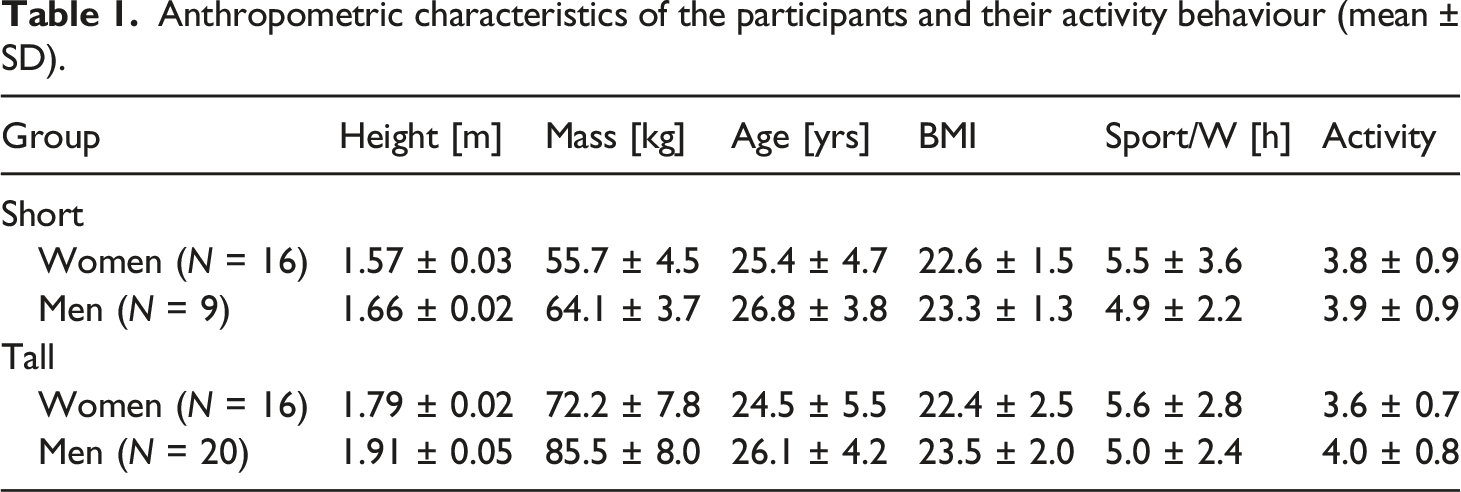
Anthropometric characteristics of the participants and their activity behaviour (mean ± SD).
Parameters
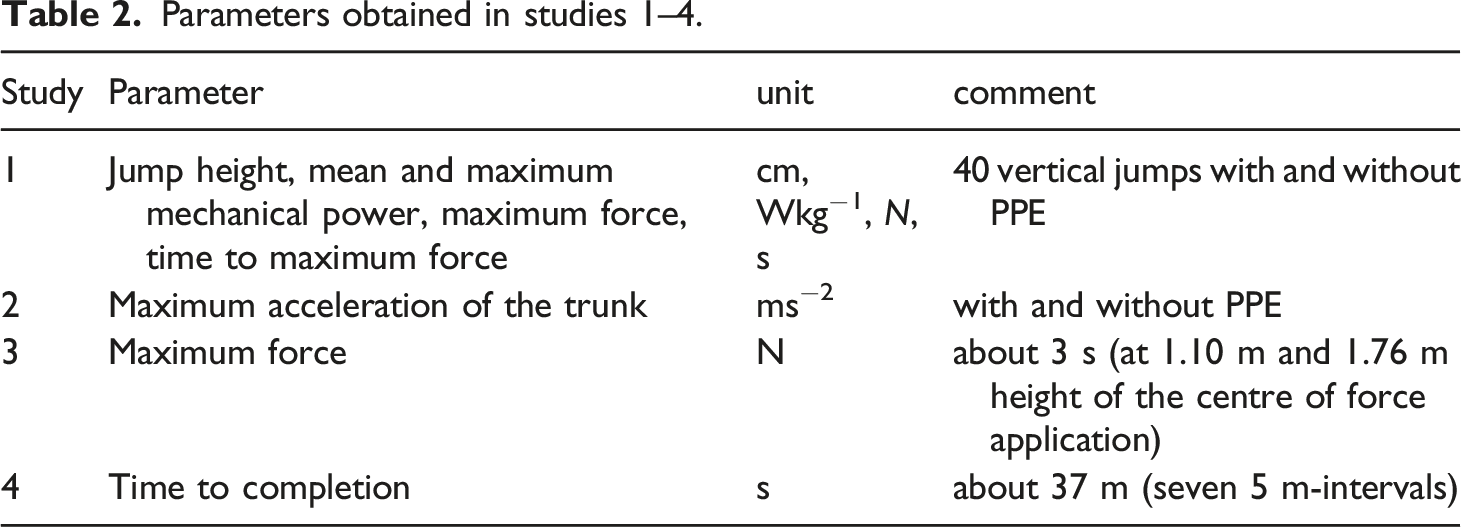
Parameters obtained in studies 1–4.
Police-related personal protective equipment
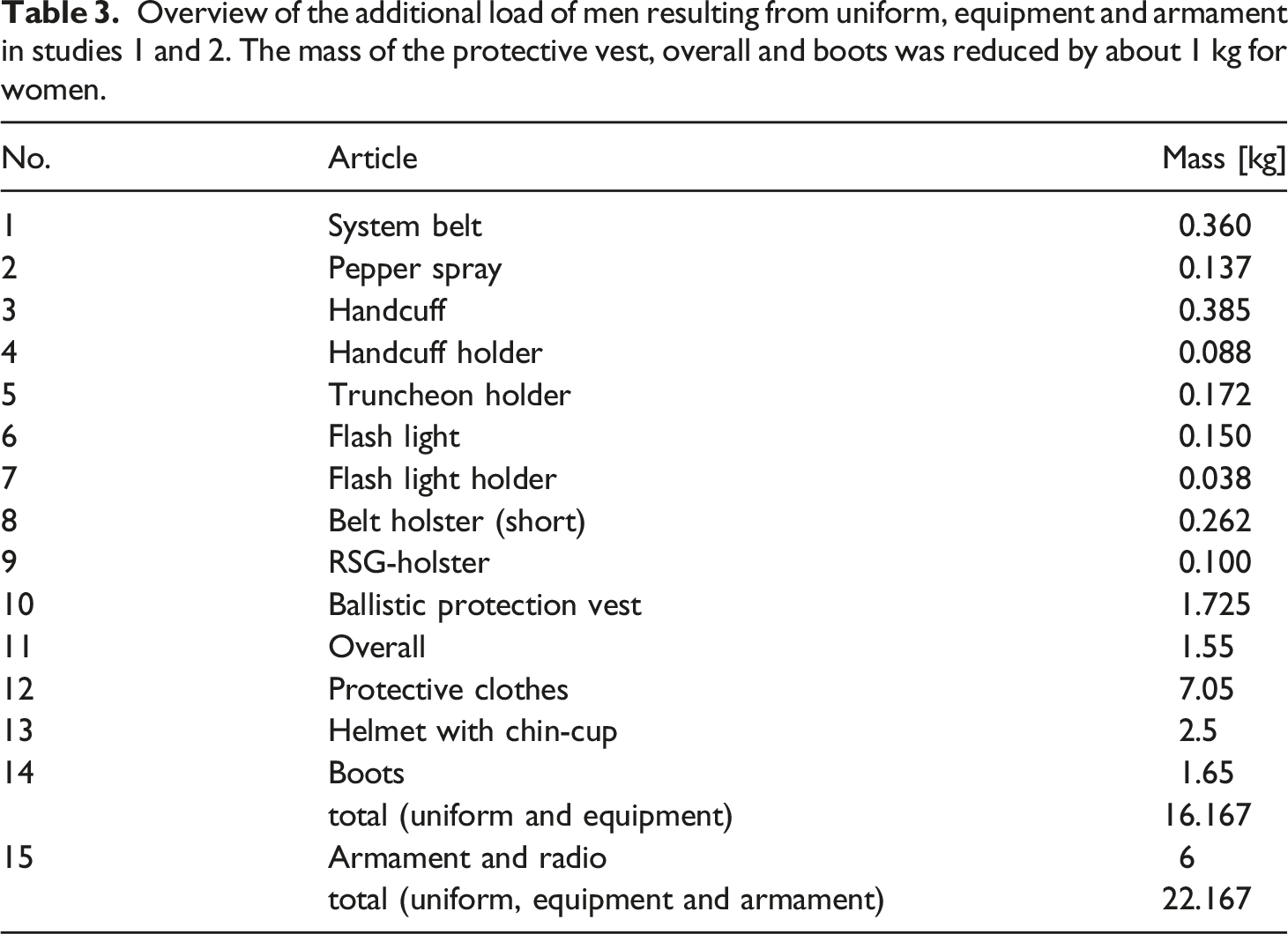
Overview of the additional load of men resulting from uniform, equipment and armament in studies 1 and 2. The mass of the protective vest, overall and boots was reduced by about 1 kg for women.
Study 1: COM mechanical power of men and women with different body heights during complex motor tasks with and without additional load by PPE
In order to examine the effect of the additional load by PPE on the performance of leg extensor muscles in tall and short men and women, the participants had to perform 20 vertical jumps (countermovement jumps without arm swing) both with and without PPE (Figure 1). Ground reaction forces were analysed with a force plate embedded into the ground (1250 Hz, Kistler, Winterthur, Switzerland). The rest period between each jump was 8 s. For donning PPE, rest period between the 20th and 21st jump was 15 min. The instruction of the researchers was: ‘Jump as high as you can’. Analysis of ground reaction forces (Matlab, The MathWorks, Natick, MA, USA) was used to determine jump height, mean and maximum mechanical power at the centre of mass, maximum vertical forces and time to reach maximum force. Vertical jump with countermovement on a force plate with additional mass by PPE.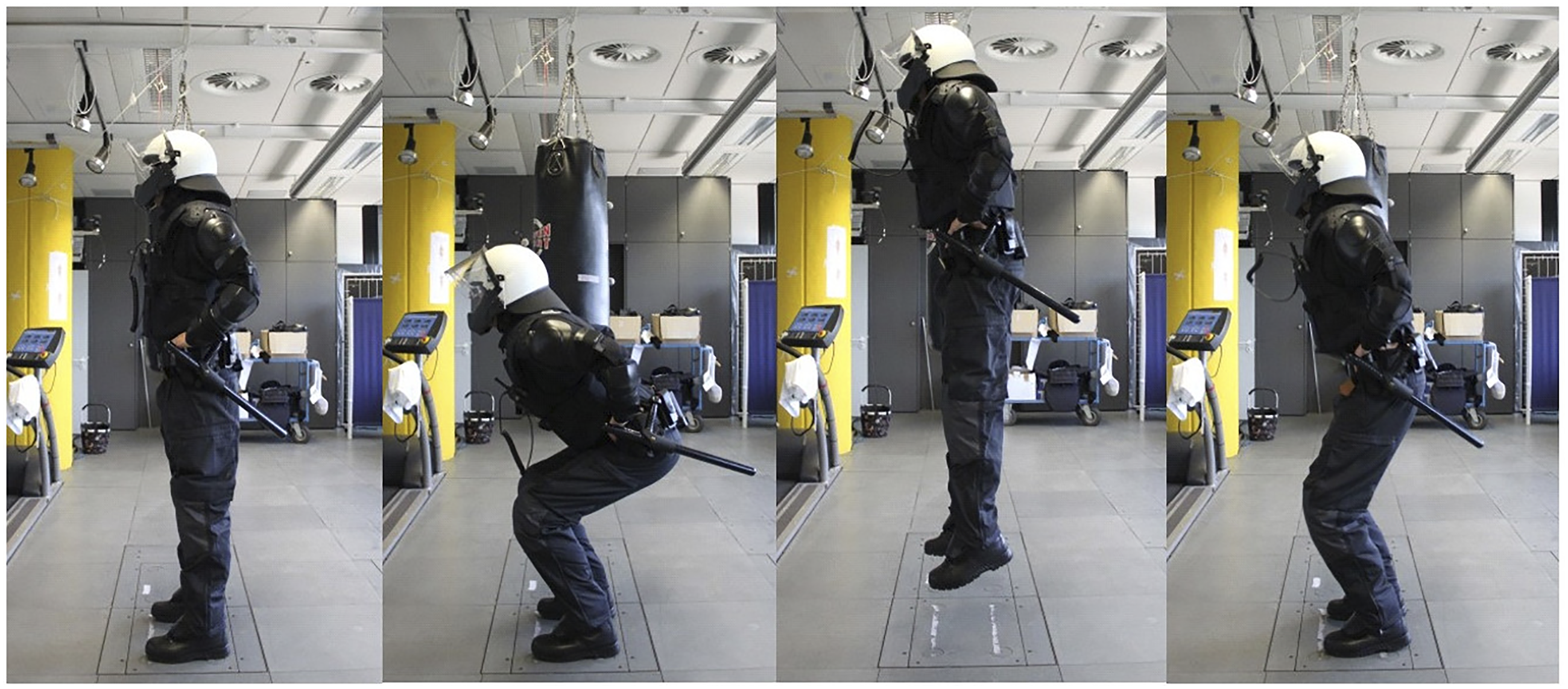
Study 2: Passive resistance of men and women with different body heights against controlled, external force with and without additional load (PPE)
In order to analyse the passive resistance of bodies of different heights against controlled, external forces, a freely oscillating pendulum (m = 30 kg) was fixed at a height of 2.30 m. The centre of mass of the pendulum was located at a height of 1.40 m and represented the height of the centre of mass of an applied upper arm of a medium-sized, German male (percentile 50, h = 1.80 m, microcensus 2013). The pendulum was dropped from a height of 2 m and hit the subject at the lowest point of its pendulum trajectory at a speed of 2.9 ms−1. According to preliminary tests, the velocity of 2.9 ms−1 was about the velocity of the hand of an offender who aggressively bumps or jolts an object. The kinetic energy of the pendulum at impact was 126.15 J. This energy corresponds to the kinetic energy of an 80 kg heavy offender, who bumps or jolts an object with a fast walking speed and an attached upper arm (e.g. body check against a police officer). In order to avoid anticipatory motion into the opposite direction, the participants stood on the right leg. The arms were crossed on the chest and the view directed forward. The movements of the trunk were recorded with four infrared cameras (250 Hz, Vicon, Oxford, UK) by attaching reflective markers (d = 14 mm) to the subjects' skin or protective vest at the level of the 10th thoracic vertebra, the seventh cervical vertebra and both shoulders (acromion). The test was carried out with and without additional load by PPE.
Study 3: Pulling forces of men and women with different body heights
Police officers have to be able to generate high push and pull forces when physically intervening against disturbers. This police-specific capability was assessed by an isometric force production test, where the subjects had to maximally pull on a stationary force transducer (1000 Hz, DMS, HBM, Darmstadt, Germany) in horizontal direction. The force transducer was fixed both at a grip height of 1.76 m (about the height of the centre of mass of the head of a 1.85 m disturber) and 1.10 m (about the centre of mass of a 1.85 m jammer). Maximum pulling force was defined as the mean value of the force plateau over 3s of the best out of three trials. In both conditions (different grip heights), the clothing of the subjects consisted of overall, boots, protective vest and belt with equipment (additional load m = 6.6 kg for men and m = 5.6 kg for women).
Study 4: Performance of men and women with different body heights while rescuing and recovering a person from a car
For the analysis of sport performance of tall and short men and women while rescuing and recovering a person from a car, the participants had to free a dummy (m = 70 kg) from the passenger seat of a car (VW Passat) and pull it away using the Rautek grip over a distance of 37 m.
The instruction of the researchers was: ‘Cover the distance as fast as possible’. The times required over five 5 m-intervals (5–10 m, 10–15 m, 15–20 m, 27–32 m, 32–37 m) and the total time were recorded by a light barrier system (Sportronic, Winnenden, Germany). The clothing consisted of an overall, boots, personal protective vest and belt with equipment (additional load m = 6.6 kg for men and m = 5.6 kg for women). Since the dummy’s feet were dragged over the ground during rescue and recovery, the net dummy weight to be moved was approx. 50 kg.
Statistics
The parameters of interest were first checked for normal distribution using the Kolmogorov–Smirnov test (α = 0.1). For the normally distributed parameters, a mixed two-factor ANOVA (body height, PPE) was performed with Bonferroni’s post-hoc test (α = 0.05). Effect sizes are reported in terms of partial eta squared η2. For non-normally distributed parameters, Friedman’s non-parametric test (α = 0.05) and the Wilcoxon test were used. Regarding study 3 and 4 an independent T-test was conducted in order to compare short and tall subjects. The statistical analysis was performed separately for men and women.
Results
Study 1
Jump height, mean and maximum mechanical power at the COM, maximum of the vertical ground reaction force, and time to maximum force of short and tall women and men during vertical jumps with and without PPE. Significant effects are highlighted in bold.
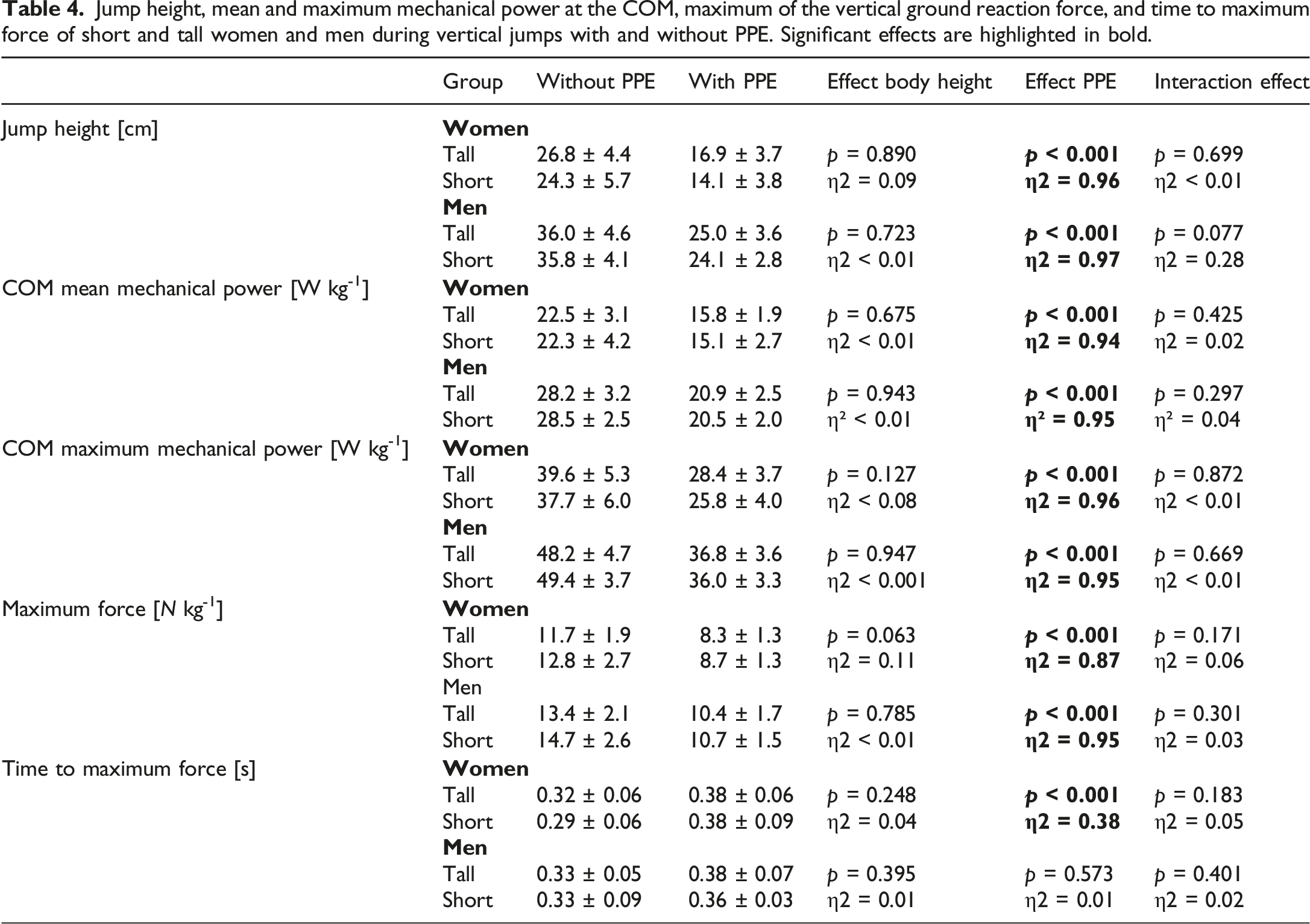
The same tendencies were found for the mean and maximum mechanical power at the COM and the maximum force but not for the time to maximum force. Wearing PPE was the only effect which impaired performance to a statistically significant effect.
Study 2
The accelerations of the trunk with PPE immediately after impact of the pendulum showed significant differences (p < 0.05) between short and tall women and short and tall men. Correlation between participants’ total mass and acceleration of the trunk after impact without (left, R2 = 0.24) and with PPE (right, R2 = 0.43).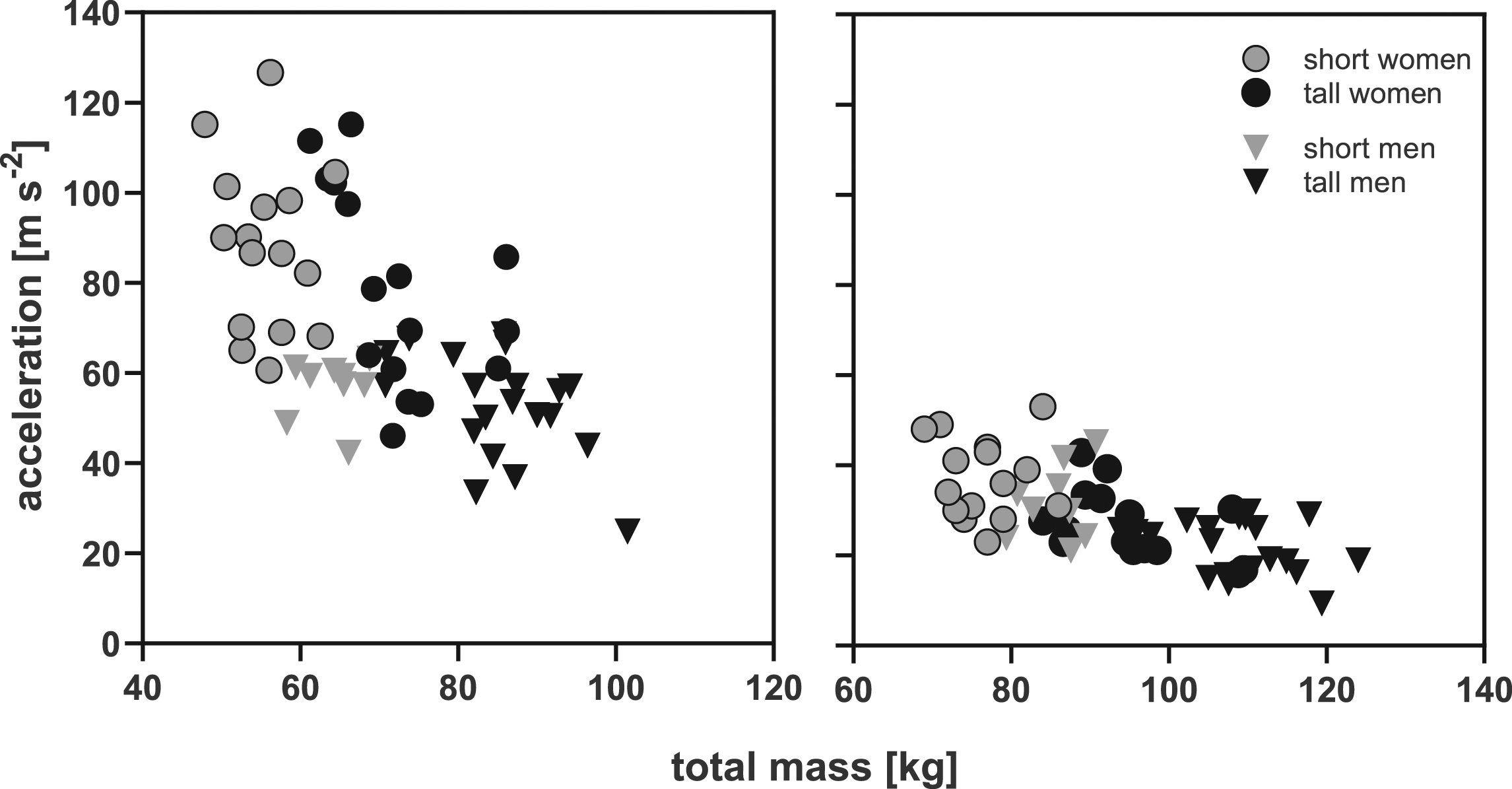
The passive resistance test revealed that both tall men (F (1, 27) = 4.86, p = 0.036, η2 = 0.15) and women (F (1, 30) = 6.90, p = 0.013, η2 = 0.19) experienced significantly lower COM accelerations following external impact than their short counterparts. Wearing PPE significantly increased the passive resistance of both men (F (1, 27) = 290.64, p < 0.001, η2 = 0.92) and women (F (1, 30) = 756.23, p < 0.001, η2 = 0.96) regardless of body height by decreasing the COM accelerations. In addition to that, wearing PPE did not significantly interact with body height for both men (F (1, 27) = 2.92, p = 0.099, η2 = 0.098) and women (F (1, 30) = 0.728, p = 0.008, η2 < 0.00). Figure 2 shows the relationship between participants’ mass without and with PPE and trunk acceleration after impact. PPE reduced accelerations by factor 2–4.
Study 3
At a height of 1.76 m, both short women (125 ± 22 N) and short men (186 ± 17 N) produced significantly lower forces (p ≤ 0.01) than tall women (217 ± 38 N) and tall men (289 ± 38 N) (Figure 3). Maximum pulling forces (mean and SD) of tall (black) and short (white) women (left) and men (right) at a height of 1.76 m (head height) und 1.10 m (hip height). *statistically significant differences between tall and short (p ≤ 0.05); ** statistically significant differences between tall and short (p ≤ 0.01); *** statistically significant differences between tall and short (p ≤ 0.001).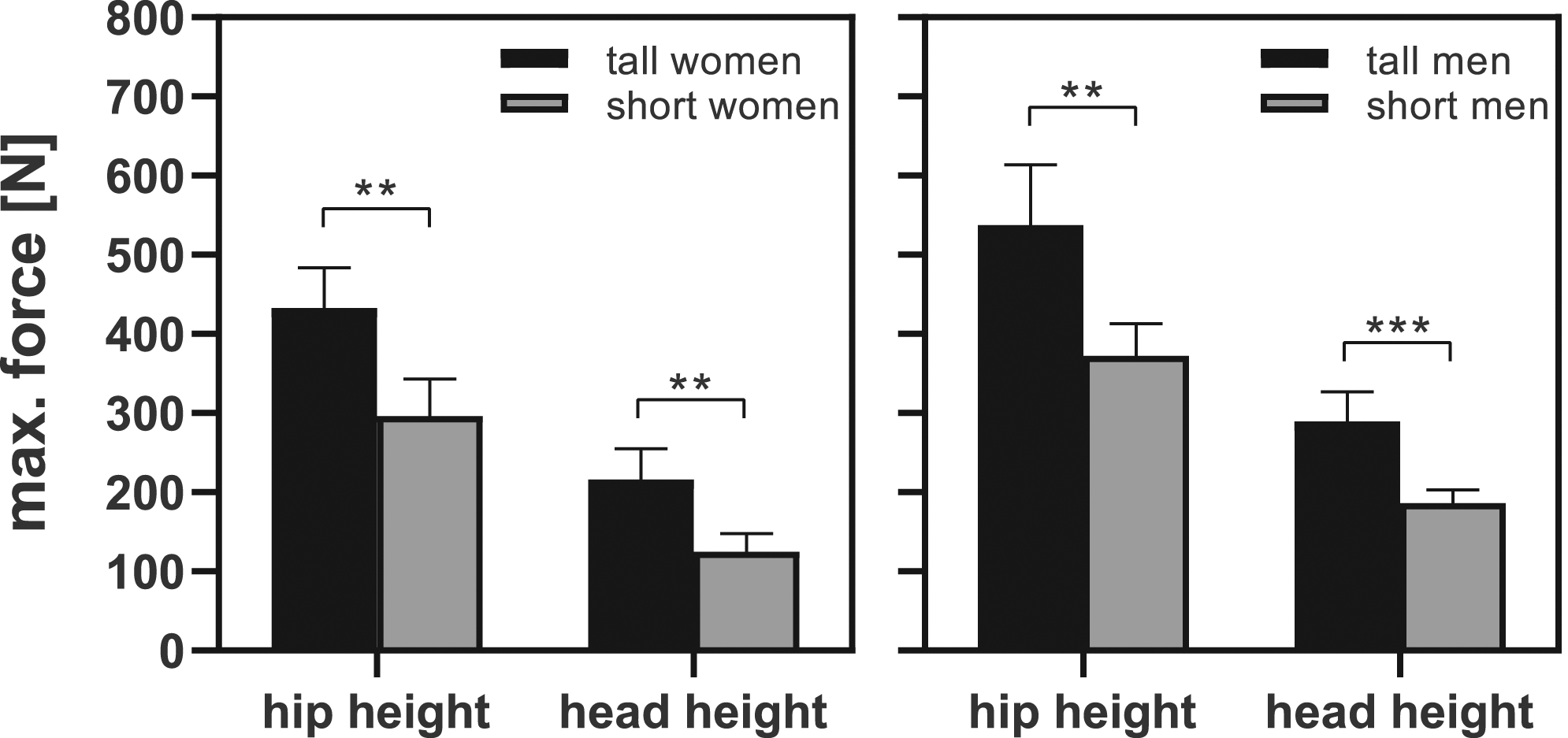
Even at 1.10 m grip height, short women (296 ± 47 N) and short men (372 ± 40 N) produced significantly lower forces (p ≤ 0.01) than tall women (433 ± 56 N) and tall men (538 ± 76 N). Short women produced 42% (head height) and 32% (hip height) lower forces at both grip heights than tall women did. Short men showed 36% (head height) and 31% (hip height) lower forces at both grip heights than tall men.
Study 4
Tall subjects of both sexes performed superior while rescuing and recovering a dummy out of a car compared to their short counterparts. Whereas tall men were able to complete the task within 29.29 ± 3.98 s, short men required significantly more time (33.92 ± 2.54 s, p < 0.001). Tall women outperformed short women as well (44.69 ± 8.45 s vs. 64.45 ± 19.36 s, p < 0.001). Considering the mean velocities for covering 5m, short women moved with mean velocities of 0.9 ± 0.08 ms−1, tall women with 1.2 ± 0.08 ms-1, short men with 1.55 ± 0.1 ms−1 and tall men with 1.85 ± 0.06 ms−1.
Discussion
The objectives of this investigation were to find out whether police-specific physical performance depends on body height (hypothesis 1) and whether the effect of PPE on performance differs between short and tall subjects (hypothesis 2). Since no significant interaction effects between body height and PPE were found, hypothesis 2 has to be rejected. This means that wearing PPE resulted in similar performance decreases (study 1) or increases (study 2) for both tall and short women or men, respectively. Regarding the body height of the subjects, tall persons were superior in the passive resistance task (study 2), the pull force test (study 3) and while rescuing and recovering a person from a car (study 4). Consequently, hypothesis 1 has to be accepted. Overall, tall persons performed physically superior in police-specific tasks.
Study 1
Vertical jump performance of both men and women was independent of body height. Wearing PPE however, reduced all measured performance related parameters (except the time to maximum force production for men) for both men and women regardless of body height. Additionally, the effect of wearing PPE led to comparable performance impairments for both tall and short subjects (men and women). Consequently, regarding the results of study 1 both hypotheses have to be rejected. The negative effect of additional load by wearing PPE on the mechanical power production during vertical jumps is in accordance with Jaric and Markovic (2013), who reviewed vertical jumps with different loading conditions and concluded that power output is maximised when the subjects only had to accelerate their own body mass.
Study 2
Being able to resist external forces is advantageous in overwhelming disturbers. In the present study, passive resistance was measured in terms of the acceleration of the torso following a controlled impact. This means that low resulting accelerations are favourable. The fact that the acceleration of an object depends on the external force and the mass of the object, implies that a given force (here exerted by the impact of the pendulum) should produce lower accelerations of heavier persons. The results of this study support this logic, because the tall groups (men and women) had a higher average body mass and experienced lower accelerations following impact. From a mechanical point of view, the superior performance of the tall subjects is due to their higher average body mass and not body height, but body height is positively correlated with body mass. Increasing the total mass of the subjects by wearing PPE positively affected the ability to resist external forces as well. Predictions with exponential functions based on the presented data in Figure 2 estimate that the force of the pendulum is not sufficient to accelerate masses over 300 kg. Overall, tall people performed significantly better in the passive resistance test than short people (independent of sex). Consequently, hypothesis 1 can be accepted. Since the positive effect of PPE on passive resistance was comparable between tall and short subjects, hypothesis 2 has to be rejected.
Study 3
Maximum force increases in absolute terms with increasing body mass, but it decreases relative to body mass (Ford et al., 1985). According to the results of a study by Janssen et al. (2000), body height is significantly (p < 0.001) correlated with muscle mass (women: r = 0.65; men: r = 0.69). Depending on the task, either the absolute force or the relative force has greater importance. Relative force is the limiting factor for tasks, which require accelerating one’s own body mass, whereas absolute force limits the ability to move heavy objects or resist external forces. During police-specific tasks like rescuing persons or overcoming disturbers the force capacity defined in absolute terms is crucial. The maximum pulling force test revealed that for both grip heights tall women and tall men were able to produce significantly higher forces than their shorter counterparts were. Consequently, hypothesis 1 has to be accepted. This difference might stem from the fact, that tall persons usually have greater body masses. It is questionable whether the force deficit of short persons, which was demonstrated in study 3, can be compensated by movement techniques when overbearing a disturber. Thus, high strength capacities of short people seem to be indispensable for the successful performance of police tasks, especially in intervention techniques.
Study 4
Both tall women and men were able to rescue and recover a dummy significantly faster than their shorter counterparts. Consequently, hypothesis 1 has to be accepted. The walking speed of tall men is close the walk-run transition which is approximately around 2 ms−1, (Raynor et al., 2002) whereas short women expectedly walk slower. In study 4, the rescue time of the dummy was greatest for the group of short women. This weaker performance might be a result of the slower walking speed in general and the anthropometric predisposition. The group of short women struggled to fixate the arm of the dummy using the Rautek-Grip, which was apparently restricted by their arm length and hand size. Additionally, the force deficit demonstrated in study 3 might have impeded the ability to lift the dummy out of the car and to transport it over 37 m. It is noteworthy that two of the short women were reportedly too exhausted to complete the whole task.
Limitations of the studies
In the present work it was attempted to minimise the physiological variance in the subject sample by the requested number of hours of exercise per week and the documentation of the participant’s activity behaviour. It should always be considered that the physical homogeneity of the groups could not be completely guaranteed. In the application of anthropological normative values of a population, not only the individual development (e.g. body size), but also the internal biological differentiation of humans is important (properties of muscles and tendons, skeletal geometry, energy supply). This internal biological differentiation is decisive for the externally measurable and complex physical performance. Apart from physical capabilities, there are other important non-physical skills needed for the police work, which cannot be assessed based on the test settings implemented in these studies. For instance, interpersonal communication skills, empathy, self-control and stress management have been shown to improve non-physical conflict management (Dryer-Beers et al., 2020). However, these aspects go beyond the aims of these studies, which focused on the determination of physical performance in police-specific scenarios.
Conclusions
The results of these studies provide evidence that body height positively influences physical performance in police-specific scenarios, which conclusively supports the implementation of cut-off values regarding body height as an access restriction for the police service. Nonetheless, the definition of precise cut-off values is not straightforward. For instance, there are ethnical differences in body height which would raise the need for different cut-off values in different countries and even within a single country a fixed minimum height as access criterion would neglect the cultural and ethnical diversity in a society. Instead of formulating cut-off values for body height, defining physical minimum performance requirements and corresponding test batteries would circumvent this problem while at the same time guaranteeing equality of opportunities.
Footnotes
Declaration of conflicting interests
The author(s) declared no potential conflicts of interest with respect to the research, authorship, and/or publication of this article.
Funding
The author(s) received no financial support for the research, authorship, and/or publication of this article.
