




Abstract
The Netherlands operates as a distribution hub for cocaine, due to its transit characteristics cocaine is imported from South America and distributed to the rest of Europe. To enhance the financial approach to organized crimes, this article proposes a new crime script: a financial crime script. With a special focus on the importing stage, 76 Dutch court rulings are analyzed to make a first financial crime script. This financial crime script provides new insight into the proceeds, costs, and means of payment of criminal organizations and therefore could aid law enforcement in calculating criminal gains.
Introduction
The number of cocaine consumers in Europe has been estimated at 3.6 million, consuming a total of 91,000 kg of cocaine with a street value of 5.7 billion euro (EMCDDA, 2019). The cocaine trade is considered to be a societal concern due to the serious consequences for addicts and the growing amount of violence that is associated with the trade (UNODC and Europol, 2021). The Netherlands, with an approximate use of 3600 kg of cocaine each year at a price of 45–50 euro per gram, creates a domestic turnover between 157.5 and 180 million euro. This turnover is without taking into account the extra turnover generated by cutting agents (Boerman et al., 2017; WODC, 2018: 159). Based on these numbers, the role of the Netherlands in the cocaine trade seems insignificant. However, the Netherlands operates as a transit country for international drug trafficking. This is illustrated by the fact that over 40,000 kg of cocaine were seized in the port of Rotterdam in 2020, which is over 10 times the amount of domestic consumption (Public Prosecution Service, 2021; Roks et al., 2020). Moreover, together with Antwerp and Hamburg, Rotterdam is now considered to be the primary entry point for cocaine reaching Europe (UNODC and Europol, 2021).
Dictated by the ideological belief that “crime should not pay,” law enforcement agencies increasingly aim to confiscate the illegal profits of criminal activities such as the cocaine trade, instead of focusing solely on imprisoning criminals and seizing the illegally traded goods (see Atkinson et al., 2017). Given that the principal motive for drug trafficking and other criminal activities is economic gain, the goal is set to “hit criminals where it hurts the most.” This is by taking away their illegal income. Hence, the goal of recovering the proceeds of crime is a priority for law enforcement agencies both in the Netherlands and internationally (FATF, 2012; Ministry of Justice and Security, 2018: 4; Europol, 2021; UNODC and Europol, 2021). At the same time, it must be noted that the attention for criminal money is far from new. For example, in the nineties the Dutch government adopted a new law that introduced the possibility for the police to start a so-called “criminal financial investigation” with the goal to investigate the size and location of the illicit economic gains in a criminal case. Since then, continuous efforts were made to give the “follow the money-approach” a central role in the fight of organized crime (Kruisbergen et al., 2012: 231; Kruisbergen, 2017). To this date the Dutch government sees the confiscation of illegal gains as one of its top priorities and continues to adopt new laws to improve the “follow the money-approach” (Dutch Government, 2021).
Despite the widely acknowledged importance of taking a financial perspective to organized crime, the approach to illicit financial flows comes with mixed results to date. In fact, it has been estimated that in the European Union (EU) over 98% of the proceeds of crime are not recovered (Europol, 2016). This is partly due to the fact that criminals go to great lengths to hide their criminal earnings abroad, which makes it difficult for law enforcement agencies to trace a money trail. Another part of the explanation is that when criminal proceeds are traced, attrition might occur during the judicial process. This attrition creates a substantial gap between the estimated criminal profit in a criminal case and the sum that is ultimately confiscated (Kruisbergen, 2017). Furthermore, it is also still not self-evident that a criminal police investigation includes a financial approach. Bokhorst et al. (2011) have shown that this lacking financial approach is also the case for cocaine trafficking cases.
Besides law enforcement agencies sometimes paying relatively little attention to the financial management of the cocaine trade, research on this topic is also scarce (Hall and Antonopoulos, 2017; Terenghi, 2020). Therefore, given the importance of enhancing a financial approach to (organized) crimes, this article builds on crime script analysis as a way to develop financial crime scripts. Whereas crime scripting is widely used by researchers and law enforcement agencies to map the logistic process of various types of crime, it is noted that these crime scripts generally pay little attention to the financial flows associated with these crimes. By developing financial crime scripts, it is suggested that law enforcement agencies can gain more insight into the monetary transactions of criminal activities as well as into the financial choices of the criminals involved. This, in turn, could also facilitate a more successful confiscation of illegal proceeds. Put differently, financial crime scripting could help researchers and state officials to understand and investigate the “criminal business model” through a financial lens. This article analyzes the cocaine trade in different ports of the Netherlands as a first and modest attempt toward financial crime scripting. With this, we hope to spark the imagination of academics and practitioners to follow up on this initiative.
Crime scripting and trafficking cocaine
Crime scripting finds its origin in the situational crime prevention paradigm. This paradigm does not focus on the motivations of a perpetrator, but on how a specific crime is committed and what tools and knowledge are needed to commit this particular crime (Clarke, 1992; Tompson and Chainey, 2011: 186). Since Derek Cornish his often-cited publication in 1994, crime script analysis became increasingly popular and has helped researchers and state agencies to gain knowledge about the “stages of the crime commission sequence” of various crimes (Cornish, 1994; Dehghanniri and Borrion, 2019). These insights subsequently help to pinpoint promising strategies to prevent crime. In the Netherlands, for instance, crime scripting was first adopted in 2004 by the Social Intelligence and Investigative Service to tackle organized illegal labor by undocumented migrants (Spapens, 2011). Because Dehghanniri and Borrion (2019) recently published a systematic review of over 100 scripts (including e.g., cybercrimes, fraud and environmental crimes), we will not describe examples of crime scripts at length in this paragraph. Instead, we will explain how crime scripting could benefit from adding a financial perspective. That is, whereas crime scripts do provide insight into the procedural steps a criminal has to take to “successfully” commit a crime, it is noted that less attention is paid to the (illicit) financial flows within these criminal steps.
In 2007, Dutch law enforcement agencies developed a crime script that breaks up the illegal hemp cultivation process into seven steps. The first step is to find a suitable location, which requires the (future) offender to buy or rent real estate or to convince someone to use their premises to cultivate hemp. In the second step, the offender needs to furnish the location by, for example, illegally installing electricity and the third step reveals that the offender needs various goods and materials (such as isolation material) to grow the hemp. Then follows the process of cultivation (step four), harvesting (step five), and the selling of the hemp (step six). The final step (step seven) involves the need to money launder the illicit gains before being able to spend it (Te Pest et al., 2012).
While this crime script provides helpful insights into the criminal business model of hemp cultivation, it pays only little attention to the illicit financial flows linked to this crime. For instance, how much money is an owner paid to (illegally) use their premise to cultivate hemp and is this owner usually paid in cash or in goods? Also, what are the costs of the materials needed to cultivate hemp and how much money does it cost to call in a mala fide electrician to install electricity? Furthermore, when the hemp is ready to be harvested, the offender might need an extra pair of hands to actually harvest the hemp. This again raises the question of how these accomplices are paid. Given the fact that a criminal often depends on third parties to set up a money laundering scheme, it is important to also zoom in on the financial flows between the offender and these third parties. By answering these and other financial questions, it becomes clear that money plays a crucial role in every scene of the crime script. In fact, without these financial flows illegal hemp cultivation is not even possible. This shows that crime script analysis would benefit from adding a financial lens.
As the previous example shows, by introducing financial crime scripting we do not mean to address a lack of available crime scripts on financial-economic crimes. The aim is to add a financial perspective to all sorts of crimes, including financial crimes. To show how this financial perspective can likewise be added to existing crime scripts of financial-economic crimes, we draw upon a crime script by Gilmour (2014), who identified five stages of money laundering through cash intensive businesses. The script starts by identifying a suitable cash intensive business, such as a tanning salon or auto garage. The money launderer then places illicit money in the company and alters the financial accounts of the business, after which more actions may follow to settle the business as a long-term money laundering scheme. After stage four, where the money is concealed by legitimate deposit of finances, the illicit money is used to make purchases (un)related to the cash intensive business in stage five (Gilmour, 2014).
To understand and effectively hinder this particular crime, law enforcement agencies, so we argue, will benefit from adding an extra financial lens to the various stages listed above. For instance, how much money does it normally cost to register a new business with the Chamber of Commerce and how does the money launderer pay for this fee, by cash or wire transfer? Also, if the money launderer decides to set up a tanning salon, the example used by Gilmour (2014), how much money does it usually cost to rent a location and buy a set of tanning booths? And again, how exactly are these legal goods financed before the criminal is able to launder money to begin with? In case the criminal decides to use an existing business for his money laundering scheme, how is the actual owner bribed to facilitate this illicit process and how is this money being spend out of sight of the authorities? Finally, in light of stage five, it would be worthwhile to zoom in on the purchases made by the criminal. Is it possible, based on previous criminal cases, to discern a spending pattern (e.g., an expensive car, boat, or second house abroad) so that it becomes possible, for example, the Tax Authority to better indicate potentially fraudulent transactions?
Despite the lacking financial perspective in crime scripting, earlier research on crime scripts can still provide useful insights. Since this article focuses on the finances of a specific crime, namely, the importing process of cocaine, it is worthwhile to review scripts on large-scale cocaine smuggling and financial crimes. Not only do these crime scripts contain useful findings on payment procedures and the process of smuggling cocaine, but we also build on the existing cocaine crime scripts to develop the financial crime script of the cocaine trade in the Netherlands. Starting by reviewing financial crimes, Lord and Jordanoska (2019) scripted the LIBOR fraud and described four stages: identifying a suitable collaborator, recruiting that person, the actual fraudulent transactions and last the compensation of the collaborator. Besides these stages, the authors also identified processes that transcended these stages and thus occur throughout the stages, one of these processes is the communication that continually takes place between the initiator and collaborator of the fraud. This is an interesting finding because it points to the possibility that communication and payments or the movement of money are interlinked. Finally, even though the aforementioned script of money laundering created by Gilmour (2014) lacks a certain financial perspective, the payment behavior of perpetrators can entail a process of money laundering, and thus, it is worthwhile to analyze if criminal transactions are linked to a money laundering process.
Second, the crime scripts on the large-scale smuggling of cocaine. The cocaine crime scripts were developed by Krekel (2019) and Starting et al. (2019). In short, this crime script starts with the production of cocaine in South America after which it is made ready for shipping (Krekel, 2019; Staring, et al., 2019). The cocaine is then shipped hidden inside the container, for instance, inside the floor or the cooling system, or by hiding it between the cargo and outside the ship (Pluimgraaff, 2016; Smits, 2014; Staring, et al., 2019). Depending on the transporting method, the cocaine is then dropped into the sea, taken off the ship, or taken out of the container (Krekel, 2019; Staring, et al., 2019). After this step, the cocaine can be prepared, cut, stored, and traded into smaller amounts until the final stage of consumption.
Methodology
Crime scripting can be applied on different levels: the track, script, protoscript and metascript level (Cornish, 1994). In the context of financial crime scripting, the script level focuses on the financial actions related to the cocaine trade, the protoscript level focuses on monetary actions in the entire illicit drug trade and the metascript focuses on the financial actions within illegal trade in general. This research centers around the track level, particularly focusing on the financial transactions related to the import and removal stages of the cocaine crime script (Krekel, 2019; Staring et al., 2019). We chose to zoom in on these two stages because of the transit role that the port of Rotterdam and other Dutch ports play in the cocaine smuggling routes (Staring et al., 2019). Besides this, the criminal investigations into the import and removal of cocaine tend to be more comprehensive and thus more informative than investigations related to other parts of the cocaine script (Vermeulen et al., 2018).
For this article, the Dutch openly available judiciary database (www.rechtspraak.nl) was used to collect convictions related to the importation and/or removal of cocaine through Dutch waters. The database was searched by using the Dutch words “import cocaïne” (import cocaine) and “uithalen cocaïne” (removal cocaine). This resulted in court cases that include the words “import,” “uithalen,” and “cocaïne” consecutively or separately somewhere in the judicial ruling. To gain an up-to-date insight into the modus operandi, only court cases that were published between 1 January 2016 and 30 March 2020 were included. Also, only cases involving wholesale imports of more than 10 kg were selected for further analysis. The database publishes cases of all Dutch courts. However, it is not a perfect search machine as it sometimes fails to include all the publications related to a particular case. To account for this, rulings with adjacent reference numbers were also reviewed to determine if these were part of the same court case.
This ultimately resulted in a total of 76 rulings in which at least one perpetrator was convicted. These 76 rulings were part of a total of 35 criminal investigations. Investigations differed substantially. Where some investigations involved only a small number of suspects who only once retrieved cocaine from a container, other investigations were into large-scale criminal organizations with more than 15 perpetrators who were not only importing and exporting cocaine but were also smuggling weed, heroin, and synthetic drugs. The court cases were analyzed by filling in a checklist for each investigation. This checklist was derived from the fourth and fifth Dutch Organized Crime Monitor, a study that periodically assesses the nature and extent of organized crime in the Netherlands (Kruisbergen et al., 2019; Kruisbergen et al., 2012). Some information, such as the costs and actions associated with founding a company, was missing in the court cases. Therefore, to construct the financial crime script as presented below, the analysis of the criminal cases was supplemented with the analysis of media reports.
The method of developing the financial crime script was partly derived from earlier crime script research (Sahramäki et al., 2017; Sytema and Pizza, 2018; Tompson and Chainey, 2011). The first step of constructing the financial crime script was determining which import and retrieval method was being used. Then the different stages within each method were identified. The third step was identifying the financial actions that took place in each stage. Last, the conditions that made these financial actions possible were identified. With these conditions, it is important to distinguish between a logistical and financial crime script. Whereas a logistical or traditional crime script tends to focus on the knowledge and contacts that enable certain actions, a financial crime script will primarily focus on the financial process. The answer to the question of how payments are enabled should thus be searched how the payments are made possible, for example, in the means of payment. To enhance the replicability of this research, every financial action is linked to the respective investigation in the financial crime script (Dehghanniri and Borrion, 2019). The investigations and their respective referral letters can be found under sources in Figure 1. Financial crime script on the different importing and subsequent removal stages of cocaine.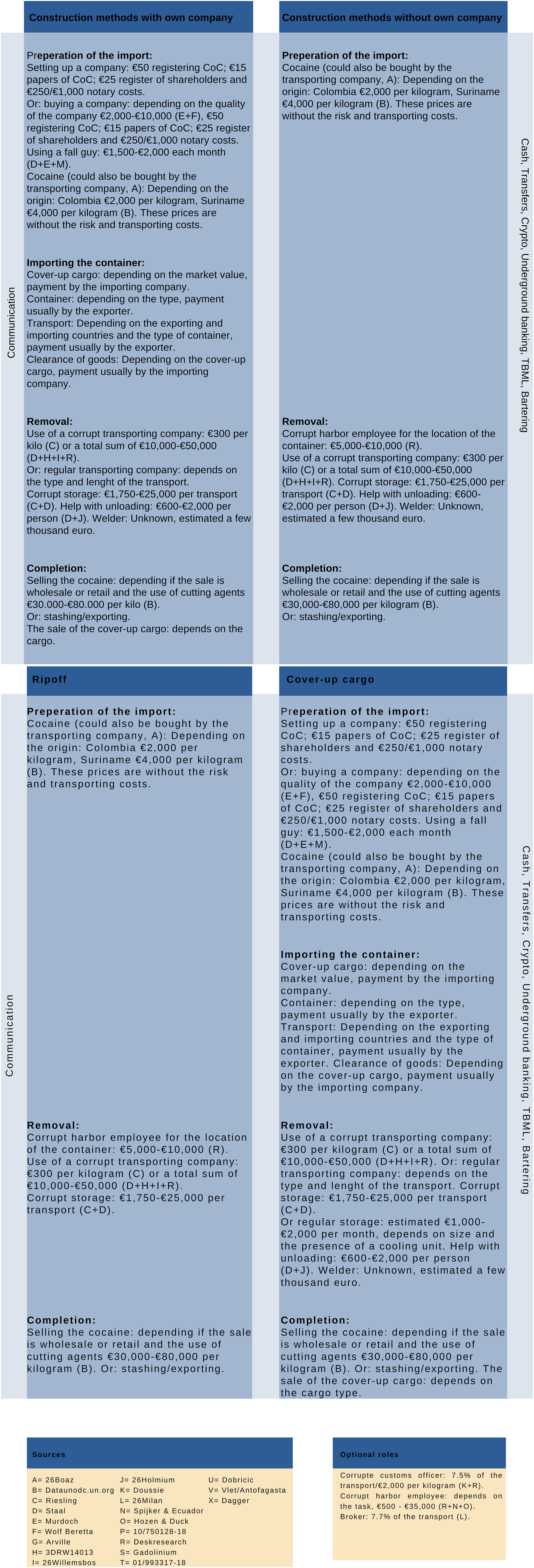
Results
In this paragraph, we will describe the results of the analysis. First, we will describe the different stages of the constructed financial crime script. After that, the financial actions in each stage are elaborated upon. Then it will be explained which conditions enable these financial actions. The constructed financial crime script of the import and removal of cocaine is presented in Figure 1.
Stages in the financial process
The court case analysis shows that the financial stages overarching the monetary actions are dependent on the import method. For example, with the rip-off and construction methods without ownership over a container, there is no stage relating to the finances of the container simply because the criminal organization does not rent a container. Besides this stage of financing the container, all importing methods share the same overarching financial stages. The first stage is always the preparation of the import. Depending on the import method, the second or third stage is the removal of the cocaine. The final stage concerns the completion of the import.
Financial actions in the different stages
In the first stage with the preparation of the import, the financial actions depend on the chosen import method. In rip-off and construction method without container ownership, there are only transactions related to buying cocaine. The price of the cocaine is dependent on the country of purchase (UNODC, 2020) and agreements on responsibility concerning the shipment of the cocaine. Analyzed cases show that the price will be higher when the agreement is made that the exporter is responsible for the entire shipment, compared to when the exporter is only responsible for putting the cocaine in a container. In case of full ownership over a container, extra financial actions are required in the importing process. These financial actions are interwoven with the logistical process. For example, a company is needed with importing permits and finances are subsequently directed toward owning such a company. These companies are thus established or bought, and usually by using fall-guys.
The financial actions on the import of a container relate to buying cover-up cargo, paying fees, the transport and the rent of the container. It is common practice that some necessities, such as the cover-up cargo and the clearance of goods, are bought by the importing company. However, criminals may divert from this by making their own agreements. Case F serves as an example here. In this case a criminal organization consisting of around 18 people was involved in importing cocaine, hash, and PMK. They bought multiple companies to import cocaine from the Dominican Republic using tiles as a cover-up cargo. At some point one of the offenders importing the cocaine paid for the entire shipment costs of the container, diverting from the regular financial process. This was due to the transport being canceled as the criminals thought that the company responsible for importing the container was compromised.
In the third stage, the removal of the cocaine, the monetary transactions are also dependent on the chosen import method. If criminals have ownership over a container then they know when this container will arrive in the port and after clearance, they can simply pick it up. Because they piggyback on the legal logistic process the criminal organization can also hire regular logistic services such as a transporting company and a warehouse. However, when there is no ownership over a container there is also no legal possibility to gain ownership over the container. Thus, the providers of services in this stage also have to be corrupt. Examples of these providers are a corrupt port employee who gives the whereabouts of the container, a corrupt truck driver that lends out their access pass, or a corrupt transporting company to pick up the container. An illustration of the latter is case C where a transporting company willingly gets involved in the cocaine trade by picking up several containers holding between 30 and 200 kg of cocaine from ports in the Netherlands. Depending on the scale of the transport, the offenders owning the transportation company were paid between 10,000 and 100,000 euro.
The fourth stage concerns the completion of the import. The importer sells the cocaine and depending on the import method the cover-up cargo is sold. The latter is not always the case; there are cases known where the cover-up cargo was unsellable due to poor quality. This is illustrated by case S; here the offenders imported cocaine and used glycerin as a cover-up cargo. However, 3 months later, they were unable to sell the glycerin and paid a disposal company to dispose the cover-up cargo. The proceeds of the cocaine vary widely because the price is dependent on a couple of variables. For instance, if the criminal organization exports cocaine from Rotterdam to London, it yields a higher profit. The proceeds can also be negatively impacted when, for example, a second criminal organization also invested in the cocaine shipment. The second criminal organization might want a discount on the cocaine that they are buying from the main importer, due to buying directly and in wholesale. From the cases analyzed, it remains unknown if the criminal organizations importing the cocaine also export the cocaine.
Besides the specified actors in the stages, other clandestine actors can be involved in the process. These illicit actors can be present in a single or in multiple stages. For example, a broker can link an exporter and an importer of cocaine, but a broker can also be involved in finding a corrupt transporting company for a cocaine importer. These roles of corrupt customs officer, port employee or broker are optional. Another role that is optional but is part of the criminal organization itself is the role of the bookkeeper. Whereas in most analyzed cases the leader or leaders of a criminal organization keep track of the incoming and outgoing payments, in some cases someone else maintains the bookkeeping.
Besides illicit actors, there are also legitimate actors involved in the financial process. For instance, a notary and the Chamber of Commerce are involved when a company is established or bought. Furthermore, custom agents are involved with the payment of importing fees in case there is ownership over a container. Also, again depending on the import method, a regular transporting company can be involved in the process. It is likely that, due to the legitimate nature of their operations, they are found and contacted via regular means such as the internet. Incidentally, criminals benefit from working with well-respected transporting companies to create the appearance of a regular operation.
From the analyzed cases, it becomes apparent that communication is a process that happens throughout each stage. Criminal organizations communicate about logistical aspects such as when a container is ready to be picked up, but also about the finances such as which debts are still open and what the proceeds are. In case C, one of the leaders even referred others to the bookkeeper when it came down to financial matters. Another part of communication that became apparent from the analyzed cases is that criminals tend to use cover-up language and PGP-cellphones to conceal their illegal activities. The usage of a PGP-cellphone, often costing more than a thousand euro, points to a criminal organization with a certain level of established wealth (McDermott, 2021; Squires, 2018).
Means of payment
Every action in each stage is in essence a payment and these payments are made possible by different payment methods. The payment methods that are discussed are in the following order: cash payments, bank and money transfers, bartering and underground banking.
Cash payments
In the analyzed court cases, cash plays an important role. For example, cash is used to make large deposits to bank accounts. These bank accounts are then used to pay for logistic services. This has been done in cases A, C, E, F, S, T, and U. In case U, the leader of the organization imported around 107 kg of cocaine by letting someone set up an importing company with a fall guy. The leader then deposited around 225,000 euro into the bank account of the company to pay for the cover-up cargo and the shipment. Payments for illegal services such as a corrupt customs officer or a corrupt transporting company were also partly in cash in the cases B, K, and V. In the case of K, cocaine was imported with the help of a corrupt customs officer. This corrupt custom officer partly deposited his received cash on the banking account of a thrift shop that he owned and on bank accounts of family members. Furthermore, in the cases L and X, it became clear that cash is also used to pay for the cocaine. In X, for instance, several members of the criminal organization traveled to Colombia to withdraw cash from an ATM to pay for the cocaine there in cash. Financial intelligence unit (FIU) analyses also show that large flows of cash are going to Latin America. There are also known cases where criminals used books to smuggle large quantities of cash (Brandsema and Mos, 2019).
Banking and money transfers
In different cases, banking transfers serve different purposes. In case T, money was transferred to a bonafide transporting and storage company for the transporting and storage of a container with cocaine. In investigation C, money was transferred to a bonafide garage company to repair the truck and trailer. Banking transfers are also used to pay for the cover-up cargo; this was the case in A, E, and S. Bonafide companies such as transport, storage, container companies and carriers will only accept banking transfers since this means of payment is part of their legitimate business operation. This means that certain import methods rely on the legal financial infrastructure. Besides the payment of regular companies, criminal activities can also be paid via banking transfers. In case C, a fall guy and a stash house were paid in this way. The cocaine can also be paid via banking transfers and this might have happened in A (Marcelissen, 2020). These banking transfers did not use elaborate schemes. However, in the investigation of K, the offender did use a more complex construction where he received a monthly “wage” of 5000 euro via a Russian company.
Money can also be transferred outside the regular banking system, via so-called Money Transfers. This was the case in the investigations of E and H. In the latter case, the transfers took place between the Netherlands and Sweden. Although it remains unclear for which purpose these transfers took place, the offenders in question used Sweden as a sales market for cocaine and methamphetamine precursors. Possibly, the profits of these sales were transferred to the Netherlands via a Money Transfer service. At the same time, it is also possible that financial support was transferred from the Netherlands to Sweden. In the case of E, the offenders set up and bought multiple companies, seven of which were used to import cocaine. Not only did their importing methods vary between using rip-off and cover-up cargo, the amount imported also varied between 30 and 8000 kg of cocaine. In total, over 15,000 kg was confiscated in this case.
Underground banking
Underground banking refers to an informal means of payment of which hawala banking is the most well-known (Nabi, 2013). The money is transferred via a network of bankers around the world, without physically moving the money from the payer to the receiver (Cassara, 2016). In investigation X, the cocaine was partly purchased via the aforementioned cash withdrawals in Colombia, but also partly with the use of underground banking. In the case of K, underground banking was used in a money laundering scheme: using underground banking money was transferred to a Panamese company to then be deposited to a banking account in Liechtenstein which was then used to buy a car.
Bartering
Bartering refers to the means of payment in kind where no money laundering process is involved. For example, a payment can be done in cocaine, other illegal goods, or criminal contacts. Only in the investigations J and V, a form of bartering was used. In the case of J, an offender helped with the loading and unloading of a truck filled with cocaine. Originally, the offender was supposed to get paid 1750 euro; however, he found out that the cargo in question was not a test cargo and that there was 1800 kg of cocaine in the cargo. After the criminal organization discussed the matter at hand, it was decided that instead of the 1750 euro, he would be rewarded with 1 kg of cocaine. In the analyzed cases, there is no mention of wholesale import being paid by bartering.
Toward financial crime scripting
This article addresses the lack of a financial perspective in existing crime scripts to subsequently explore the possible use of financial crime scripting. Using the import of cocaine in the Netherlands as a test case, criminal cases have been analyzed to investigate the financial flows linked to this type of crime. In this paragraph, first some key findings are summarized. After this, the methodological strengths and shortcomings of this study are discussed and areas for future research are highlighted. We conclude this article by arguing that financial crime scripting as a method could facilitate law enforcement agencies in the fight against (organized) crime.
This study shows that the logistical and financial processes are interwoven, meaning that the import method that is used by a criminal organization dictates the payments, expenses, and profits. Consistent with earlier research on drug trade within the ports of Rotterdam (Staring et al., 2019) and Antwerp (Colman, 2018) this research shows that criminal finances can be partly intertwined with already existing legal financial infrastructure. This is due to the fact that the import method determines the part of the logistical process and thus, for example, which other clandestine individuals need to be involved and subsequently paid for their services.
Contrary to earlier findings on the cocaine trade by Krekel (2019), the financial transactions consist of more than just direct cash or underground banking transactions as it is shown that bartering and banking transfers are also used (see also Terenghi, 2020). However, information about other payment methods, that is, cryptocurrency and trade-based money laundering (TBML) are absent in the analysis. This is surprising because both payment methods are known to be used by drug trafficking organizations (Cassara, 2016; Foley et al., 2019). It has been calculated that for cryptocurrency around 50 percent of the yearly bitcoin transactions are related to illegal activities (Foley et al., 2019). When it comes to TBML, the payment method and money laundering scheme is considered to be a growth industry for organized crime groups (Hataley, 2020). For example, organized crime groups can use the lack of regulatory supervision in freeports to manipulate trade invoices of shipments (Gilmour, 2021). These shipments of regular goods with an underestimated value can then be used to pay for a shipment of cocaine.
Furthermore, this article shows that money plays a crucial role in each stage of the script and that these financial flows are usually in control of only a few individuals, either being the leaders or the bookkeeper of the criminal organization. Also, it became apparent from the court cases that no legally obtained money is used for illegal uses. In the cases A, E, S, T, and U criminally obtained money is used to pay for the legal logistical process, such as the payment for transporting companies and registration with the Dutch Chamber of Commerce (see also Lord et al., 2017; Kruisbergen et al., 2012). This article also finds that communication plays the same prominent role as in the analysis of other types of crime (see also Jordanoska and Lord, 2019). The communication is not only about the logistics of the crime, such as about when a container arrives, but also about the finances of the crime, such as the costs, profits and when payments are due. Besides these findings, one must bear in mind some important shortcomings of this study.
The fact that for this analysis only court-approved information was used increased the internal validity of the study (Kruisbergen et al., 2012: 23). However, the downside of court rulings is that these often do not contain much financial information. This can be due to the simple idea that the initial criminal investigation did not include a financial approach to begin with. The financial information that was found was almost only available in the cases of the more sizable criminal organizations. This means that there is a bias in the current financial crime script toward larger criminal organizations. This bias is possibly amplified because not every court ruling is published, and it remains unclear on what grounds rulings are published. Also, it could also be the case that a select group of criminals, having a specific modus operandus, avoid criminal inquiries and are thus not taken into the analysis of this research. An example of a specific M.O. missing from the current financial crime script is wholesale import via airports. No court ruling was about a criminal organization who imported wholesale cocaine via an airport and thus this financial M.O. is missing from the financial crime script. Thus, future research should focus on the analysis of data sources that are exhaustive in the sense that they hold fewer biases. This could entail a more ethnographic approach by for example interviewing (convicted) cocaine traders.
Besides the importance of further validating the current analysis, it would be highly valuable to develop scripts of the different types of payment methods. For example, enhanced insight into certain TBML methods could also improve current intervention and prevention strategies. Also, these scripts on payment methods could also shed a light on the conditions that influence payment method. Furthermore, future financial crime scripts could focus on the agreements that criminals have around their payments. When do they make these agreements? When is a payment in advance needed and who is responsible for the money or the illegal goods when law enforcement agencies intervene? Why does one criminal choose for underground banking and another one for TBML? Answering these questions could help develop intervention strategies for law enforcement agencies.
Combating organized crime requires a broad spectrum of approaches where the financial approach is a vital one (UNODC and Europol, 2021). Financial crime script will help to give more attention to the financial processes of a criminal organization which will improve the intelligence position of law enforcement agencies. It will facilitate law enforcement agencies with insights into the specific roles of a suspect within a criminal organization and might help with setting intelligence and investigation priorities. By aiding law enforcement agencies in taking a financial perspective to crime, the financial crime script could make it easier for them to locate and confiscate criminal profits, ultimately hitting the criminal where it hurts the most.
Footnotes
Declaration of Conflicting Interests
The author(s) declared no potential conflicts of interest with respect to the research, authorship, and/or publication of this article.
Funding
The author(s) received no financial support for the research, authorship, and/or publication of this article.
