




Abstract
Public trust in the police is an almost ever-present feature of United Kingdom policy, political and indeed cultural debates, and this has been true right across the past quarter century. Concentrating on the population-level picture, and on England and Wales, in this article I outline what we know about changes in ‘trust and confidence’ over the past two decades or so, and make comparison with changes in other, closely associated, indicators. Why it might be that over this period trust in police first increased significantly, and then declined? Answers to this question implicate what might be termed the political economy of trust. Change in public trust may be due to a whole set of factors operating across multiple levels of policing and the society in which it takes place.
Introduction
Policy, media, academic and popular interest in public trust in the United Kingdom (UK) police, has, over the past quarter century, been almost ever-present. Naturally, across a period when so much about policing has changed – from the decline in ‘volume crime’ (Farrell et al., 2011) to mass use of digital technology and, now, the advent of artificial intelligence – the salience of this issue has waxed and waned. But its continued presence near the top of many police-related agendas has been striking.
At the time of writing (spring 2024), trust in the police is once more centre-stage, and has been for some time. Perhaps the most high-profile reason for this has been events linked to violence against women and girls, such as the police handling of the murders of sisters Bibaa Henry and Nicole Smallman in 2020, the murder of Sarah Everard by a serving police officer in 2021, and continuous revelations of the often-abject failure of police to deal appropriately with crimes of sexual violence (Stanko, 2022). In addition, the release in 2023 of Louise Casey's damning report on the internal culture of the Metropolitan Police (Casey, 2023), ongoing scandals about undercover policing,
1
the continued wounds caused by the policing of racialised minorities and a whole range of other factors have combined to produce, at this particular historical juncture, intense pressure on police. This pressure is often described, and justified, in and through the language of trust. Consider, for example, London Mayor Sadiq Khan's words when announcing a £14 million programme to ‘raise standards, improve performance and rebuild trust’ in the Metropolitan Police: I'm determined to … support the work that has started to deliver the urgent reforms and step-change in culture and performance Londoners deserve … This means empowering the commissioner, Sir Mark Rowley, to reduce crime further, raise standards, and restore trust between the police and the communities the Met serves … I will not be satisfied until Londoners have the police service they deserve - one that is representative, trusted and delivers the highest possible service to every community in our city.
2
What is trust in the police?
Despite its continued relevance to policy and wider debates, studies of public opinions of police have measured the concept of trust in a wide and often confusing variety of ways. An increasingly widely accepted definition, though, is that trust is a willingness to be vulnerable to another under conditions of risk (Hamm et al., 2017). On this account, people are willing to be vulnerable to police when they have formed positive evaluations and expectations of their competency and good intentions – that is, when they perceive police to be trustworthy. Viewed from this perspective most research on policing has not measured trust (a willingness to be vulnerable) but rather trustworthiness (the extent to which people feel police are effective, fair, etc.; see, for example Jackson et al., 2012; Van Damme, 2017, and Figure 1). Such measures indicate the presence of trust but are not coterminous with it (Bradford et al., 2022). People may judge the police generally positively, but be reluctant for a variety of reasons to make themselves vulnerable to individual officers, police organisations or the institution itself.
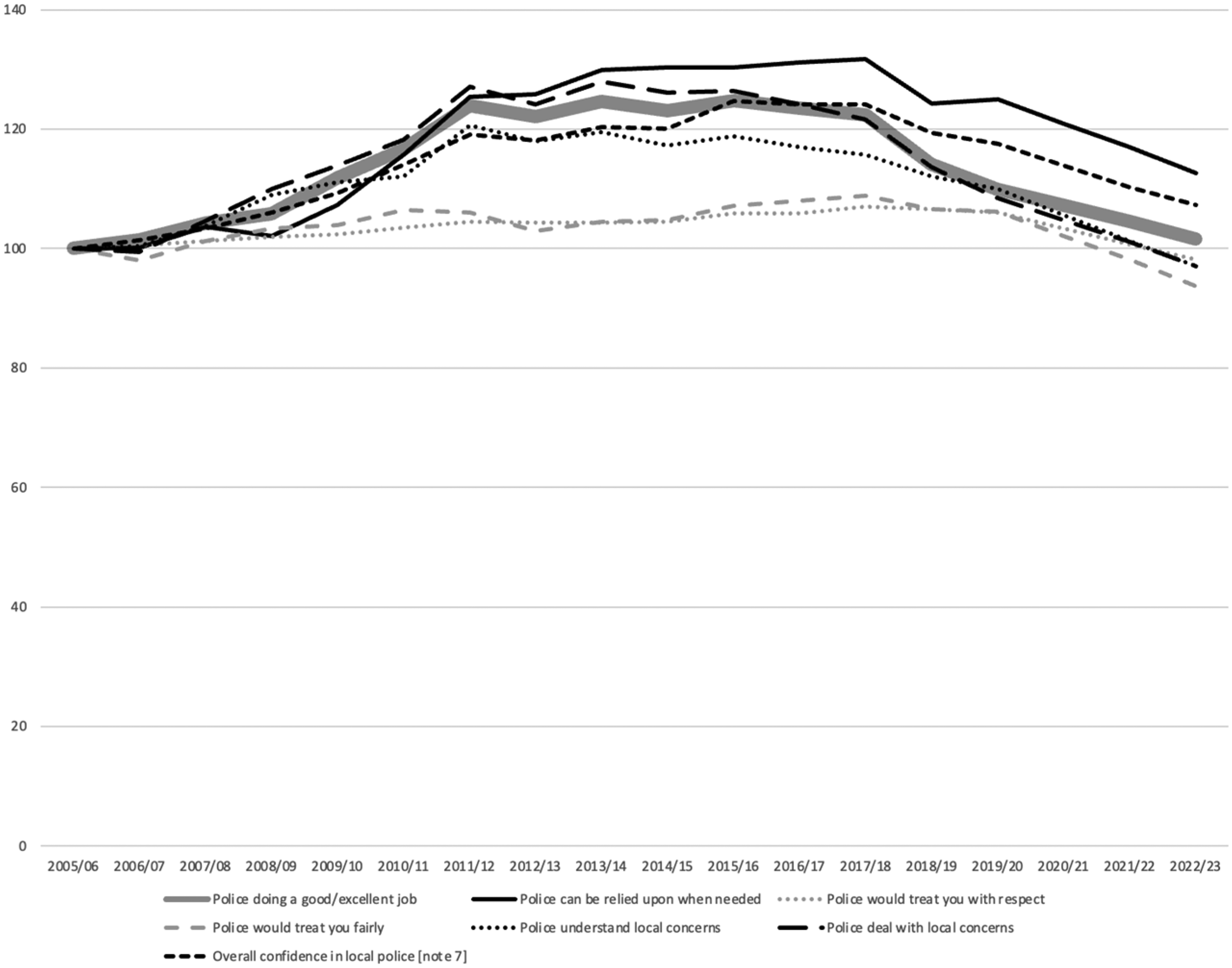
Change in trust in police, 2005/2006 to 2022/2023. All data indexed on earliest year. Source: Crime Survey for England and Wales. Note: Data for 2020/2021 and 2021/2022 are interpellated (owing to a change in survey methodology during COVID-19 comparable data are not available for these years).
To add to this confusion the phrase ‘trust and confidence’ is regularly used to represent a kind of summative judgement people might make about police – that they do or do not ‘do a good job’, as one key survey question puts it (Jackson and Bradford, 2009 and again see below). As commonly used, ‘trust’ in this phrase appears to have a meaning derived from everyday discourse (‘I just don’t trust the police’). ‘Confidence’ means something close to trustworthiness, representing people's views on whether police act fairly, are effective and in general make good decisions and behave in an appropriate manner. In this article, I take a pragmatic approach to these issues and talk, in a broad sense, about trust, where this wraps up the distinct yet clearly strongly related concepts of trust, trustworthiness and confidence.
A tale of three halves: Trust in the police over the past 25 years
At the turn of the millennium, police in England and Wales were in a period of crisis. The Macpherson report on the Stephen Lawrence enquiry had been published in 1999, and its conclusion that the Metropolitan Police were institutionally racist affected not just the London force, but police across the whole country. A whole series of policy responses were already in place, and more would follow over the coming years (Foster et al., 2005). The relationship between police and the public, particularly those from minority ethnic and other marginalised groups, was in question in ways that both replicated, yet also appeared to embed and extend, long-running issues in London and many other parts of the country (see, for example, Hall et al., 2017).
Over the next few years, though, something arguably unexpected happened. Figure 1 shows change in a range of indicators of trust in police, taken from the Crime Survey for England and Wales (CSEW), from 2005/2006 onwards. 3 Across all these indicators, trust grew from 2005/2006 to around 2010/2011 and then remained broadly stable until around 2016/2017, since when there has been a substantial decline, in many cases right back to earlier levels.
The thick grey line in Figure 1 represents the proportion of people responding ‘excellent’ or ‘good’ to the CSEW item ‘Taking everything into account, how good a job do you think police in this area are doing’. This item was, in fact, first fielded with comparable response categories in 2003/2004, when 48% responded excellent or good. In 2005/2006, 50% responded excellent or good; by 2011/2012 this had risen to 62%, a level where it remained until 2017/2018, after which it began falling, reaching 51% in 2022/2023. As noted, this item is commonly used as a summary measure of trust and confidence. This appears to be supported by the data in the chart – note how the thick grey line moves in ways closely aligned with the other indicators. The extent of the change in this headline figure is striking, with ‘excellent or good’ ratings increasing by over 20% over a ten-year period, and then falling by around the same amount in a period of little over five years.
In London the recent decline has been even more marked. The Mayor's Office for Policing and Crime Public Attitudes Survey scores on this same indicator fell from 69% excellent or good in June 2017; i.e. above the national average, to 48% in June 2023, below the national average. 4 This reflects and is reflected by the extent of debate and contest around the Metropolitan Police over this period, including most of the events and issues noted above.
Reasons for change
Over the past two decades, then, trust in police first increased, from what was probably something of an historic low at the turn of the century (Jackson et al., 2012). Then, after a period where trust appeared fairly stable, it very rapidly declined, with the inflection point sitting somewhere around 2017. What might have caused this?
Research regularly demonstrates that at the individual level the strongest predictors of trust in the police are fairness judgements. Cross-sectional observational studies regularly conclude that people who believe the officers are procedurally and/or distributively unfair (Tyler and Huo, 2002), and that they treat particular groups in inappropriate ways (i.e. over- or under-police them; Jackson et al., 2023), are much less likely to place trust in police. Moreover, a growing number of longitudinal and experimental studies show that changes in the fairness of police activity induce changes in outcome variables such as trust (Abril et al., 2023; Mazerolle et al., 2013; Oliveira et al., 2021; Slocum et al., 2016). But this does not necessarily mean that changes in fairness judgements are most important when it comes to changes in trust at the population level. Sindall and colleagues, for example, have found that changes in police visibility and police numbers, as well as in the crime rate (Sindall et al., 2012; Sindall and Sturgis, 2013), seem to be important ‘drivers’ of change in levels of trust (see also Yesberg et al., 2023).
This apparent contradiction is arguably less surprising than it might at first seem. Only a relatively small proportion of the population have meaningful direct or even indirect personal contact with police over a given period, and are thus able to draw strong conclusions about the procedural fairness, in particular, of police activity. But changes in police visibility or the crime rate affect, or are at least apprehendable by, much larger numbers (note from Figure 1 that the two items most closely associated with fairness concerns, ‘police would treat you with respect’ and ‘police treat everyone fairly’ changed the least over the period covered). Reasons for change at the population level may therefore be found in these other types of factors. People infer the trustworthiness of police from the information that they have available to them. This includes, and may be dominated by, personal or vicarious experience – when they have it (and this vicarious experience may include, of course, media stories relating to high-profile cases). But when they do not, police presence in their neighbourhood and/or a sense that crime and disorder is under control generates a sense that police are effective, addressing the right issues, and in a fundamental sense care about them and their community. By contrast, a perceived absence of police, or of an increase in crime and disorder, indicate distance and unavailability, or a lack of care, all of which are inimical to trust.
Picking up on this point, Figure 2 plots change in the summary ‘good job’ item, replicated from Figure 1, against four other potentially important indicators: the proportion of CSEW respondents saying they never see police patrolling in their area; the proportion of victims in the CSEW not satisfied with the police response; overall CSEW crime prevalence; and police officer numbers. Although ‘eyeballing’ charts is an extremely imprecise method of analysis, the relative patterns of change shown in Figure 2 may nevertheless be instructive.
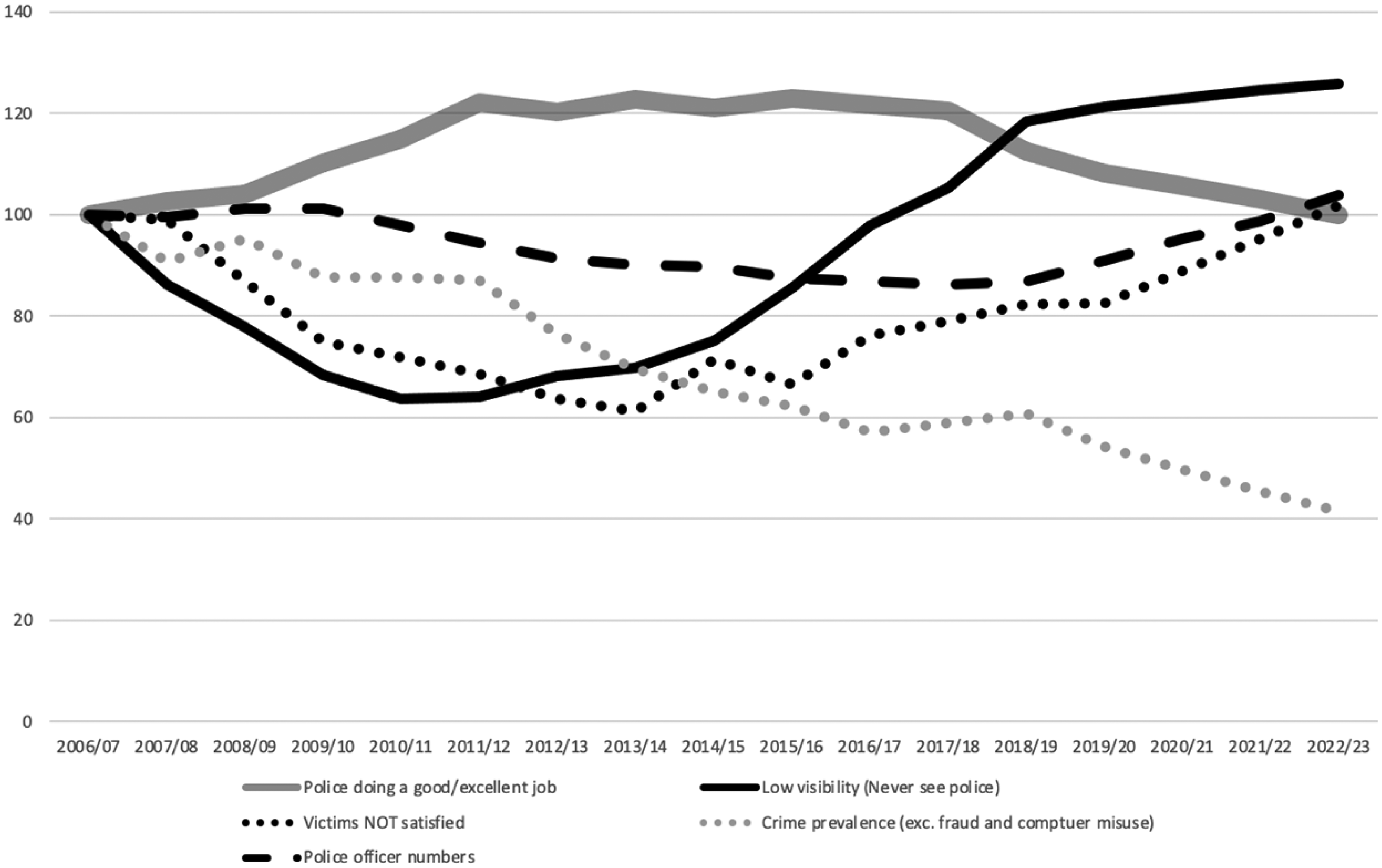
Change in ‘trust and confidence’ and other indicators, 2006/2007 to 2022/2023. All data indexed on earliest year. Source: Crime Survey for England and Wales; Home Office. Notes: Data for 2020/2021 and 2021/20222 are interpellated (owing to a change in survey methodology during the COVID-19 pandemic comparable data are not available for these years).
In the earliest years, crime victimisation was falling, as was dissatisfaction with the police response to victims and visibility. Officer numbers were broadly flat. Over this period, trust in the police rose. Around 2011, officer numbers started to decline, and dissatisfaction with visibility began to increase, followed by victim dissatisfaction. By 2017, all three indicators had been on negative trajectories for some years – only crime prevalence continued to improve (fall) – and it was at this point that trust in the police, which had plateaued around 2010/2011, began to decline. These trends appear to fit well with what we know about factors shaping public opinions of the police. Trust increased as visibility rose and victims were more satisfied (and crime fell). However, a few years after these indicators flipped direction trust began to fall, which among other things suggests a plausible lag effect. We would not expect public trust, measured at the national level, to fall simultaneously with or shortly after changes in police activity or behaviour. Rather, it seems more likely that developments take time to seep into experience and ‘public consciousness’ before they have an effect.
The year 2010 is clearly consequential here. This was when the coalition government lead by the Conservatives was elected, and there followed a long period of ‘austerity’ – cuts to the budgets of public services – that in many ways continues to this day. It is this austerity that accounts for the decline in officer numbers and in police visibility (Sindall and Sturgis, 2013), and in all likelihood victim satisfaction, too. Fewer officers means less patrol activity, and also less time to devote to victims; and although overall victimisation has continued to fall, crime recorded by police has increased in recent years, as has the complexity of many investigations, further limiting the time officers have to deal with individual cases.
Many forces have been open about the extent to which budgetary constraints limited their ability to deal with crime reported to them (Dearden, 2018). Perhaps the paradigmatic example of this were the announcements made by several forces that they would no longer attend all burglaries. This idea received significant negative media coverage and comment wherever and whenever it was suggested, and it was specifically repudiated by the National Police Chief Council in 2023. Henceforth, all police forces England and Wales are to attend all burglaries. Notably, Andy Marsh, CEO of the College of Policing, argued that this was ‘a necessary and welcome step towards regaining and improving community trust by returning to the fundamentals of policing’ (NPCC, 2023: n.p.). The language of trust is used to explain why a policy is bad and why it must be changed.
Although other factors are clearly in play – including the growing complexity of crime and its investigation, which has had significant implications across multiple areas of policing – it is hard to avoid the conclusion that cuts to police numbers are an important part of the story. But there are other reasons why austerity-induced change might affect public trust in police. Research has found that economic and social marginalisation – of the kind produced by changes to the social security system, for example – can affect trust in an institution many people closely associate with the state (Bradford and Jackson, 2018; c.f. Bowling et al., 2019). More broadly, dissatisfaction with the wider state, and/or other state actors, is likely to be closely linked to trust in the police, potentially in mutually reinforcing relationships (Jeong and Han, 2020; Silva et al., 2022). Although clearly aware of differences between different state institutions, it is likely that people also read across from the performance and behaviour of one to another. Post-Brexit issues, the Truss interregnum, the state of the National Health Service and a general sense of social and political decay are all, therefore, potentially implicated in declines in trust in the police.
One important example of how this process unfolds in practice may be found in the link between ‘low-level’ disorder and trust in the police. Research has consistently found that a very strong correlation between the two: when people experience their immediate physical and social environments as disorderly, they seem to infer that police are ineffective, poorly focused on locally important issues and/or failing in their basic mission to maintain social order at appropriate levels (Jackson and Bradford, 2009; Jackson et al., 2012; see also Kimaram et al., 2023). Yet, reasons for the existence of and levers to deal with many instances of low-level disorder – litter, nuisance noise, graffiti, petty vandalism – are often only tangentially connected to police, if they are at all. And if budget cuts mean this disorder seems to be increasing, as litter goes uncollected by local councils and vandalism to public buildings is left unrepaired, then it is possible to discern a potential mechanism linking cuts to other public services, and indeed general social malaise, to trust in the police. Notably, the proportion of people thinking anti-social behaviour – an important indicator of low-level disorder – is increasing in their area has increased in recent years, from 22% in 2015/2016 to 30% in 2022/2023 (ONS, 2023: Table S35).
The political economy of trust
Consideration of the wider processes affecting trust contextualises the likely effect of the high-profile events noted above. Whereas debates on trust in police tend to revolve around such cases, underlying social, economic and political factors – the political economy – may be equally if not more important. The Everard case, in particular, has been seen as an inflection point, a moment in which a change in views of police both occurred and were made visible. Such high-profile events can indeed have an effect on trust (Nägel and Nivette, 2022), and the case certainly seems to have produced a shift in the public discourse around policing. There are reasons to suspect, however, that the Everard case was not as defining as might be assumed. There is significant evidence of a regression to the mean effect in the aftermath of high-profile events, as, often, views quite rapidly return to longer-term averages after an initial ‘shock’ (Nägel and Nivette, 2022). And, as Figure 1 shows, trust in the police had been in decline for some time before Sarah Everard was murdered. This is not to claim that this case did not have an effect on public trust – it clearly has, as testimonies from women who say they no longer feel safe around police officers makes clear (End Violence Against Women Coalition, 2021). But it may be that the social and economic changes sketched out above laid the ground in which such signal events (Innes, 2004) took root.
It is notable that equally high-profile events occurred in the years around 2010, when trust was increasing, or at least stable and relatively high. These included the death of Ian Tomlinson in 2009, contention around stop and search and indeed continuous revelations of racism within policing, and the first round of exposés in the Spycops scandal (Lewis and Evans, 2013). An obvious hypothesis is that these events did not produce any long-term negative effects on trust because they occurred against a backdrop of improving visibility and victim satisfaction (as well as declining crime), and at the end of a period marked by significant increases in public expenditure on health, education and other public services; increases that halted, and even went into reverse, after 2010 (HM Treasury, 2023: Table 2).
A number of interlinked conclusions can be inferred from the discussion above. First, although it may be tempting to dismiss trust in the police as a soft indicator, ‘nice to have but not essential’ (Foster and Jones, 2010) and/or prone to more or less random shifts in response to media coverage, the story sketched out above says something different. Here, we see public trust in police – particularly in London – changing in entirely understandable ways in response to the kinds of police behaviours laid bare in the Casey Report. We also see trust falling in response to longer-term declines in the quality of service delivered by police and the wider web of public services within which they are embedded. Public trust thus becomes an important – although of course not the only – indicator of the state of policing, and something that policymakers and others rightly pay close attention to.
Second, much current literature on public trust in the police revolves around procedural justice theory. Nothing presented above undermines the core claims of the theory, and indeed many of the signal events described have involved manifestly unjust and inappropriate police behaviours that produced very strong public reactions. Yet, discussion of how and why levels of trust have changed over the past two decades clearly needs to attend to a wider range of factors. We cannot understand the broad sweep of public trust in the police – let alone individual instances of trust or distrust – without considering alongside procedural justice questions of crime, disorder, visibility, presence (Morrell et al., 2020) and, crucially, the economic and political decisions and processes that shape them. Fair process is central to how people think about policing, but so too are a whole range of other factors that affect their relationship with police and their views of its successes and failures.
Third, it is clear that policing is not an island, adrift from other aspects of public service delivery and the wider economy. Indeed, because police are so closely associated with the wider state and its activities, public trust in the police may be particularly prone to influence from people's experiences of the success or failure of other agencies, processes and outcomes. In some ways, this is merely to assert that individual and collective experiences of societies structured by multiple hierarchies and inequalities shape responses to an institution charged, ultimately, with maintaining these hierarchies and inequalities (Weitzer and Tuch, 2006). Given continuing social inequality, and the implication of police within the processes that maintain it, there will always be contest about and (often justified) distrust of policing. But there is also a danger in ‘inevitablism’ (Gopnik, 2004), the sense that trust was and is always going to fall as a result of the multiple pressures outlined above. At the current point in time, such a position may be defensible: given those pressures, perhaps a fall in trust was inevitable. But it remains unclear that the recent declines in trust are permanent – as we saw above, trust increased from a previous low point in 2000. More importantly, falling trust in the police can always at least partly be ascribed to decisions and actions undertaken at multiple levels within and around policing, often by specifically identifiable individuals. Most obviously, police organisations can choose to change the way they deal with members of racialised minorities, or women who have experienced sexual violence, and indeed some are currently trying to do just this (Stanko, 2022), albeit with as yet unknown levels of success. Equally, if more distally, local and particularly central government actors can choose to take into account trust in state institutions – that almost all will claim is central to the proper functioning of democratic governance – when making resource allocation and other decisions.
There is therefore a danger in privileging structure at the expense of agency, and overstating the argument that public trust in the police is shaped by economic and other forces beyond the control of police officers and organisations. In fact, it would be more accurate to say that the story sketched out above underlines the importance of what could be termed ‘policing decisions’ up and down the chain of command, and in Whitehall, Westminster and beyond. Often, the temptation is to blame individual officers, or units, for issues of public trust. In much the same way as the bad apple thesis functions to explain police corruption, the reasons for bad outcomes are pushed down the chain of command and onto the front-line. To be clear, we know from procedural justice theory, as well as the long history of police sociology, that individual, quotidian encounters between police and public are consequential, important ‘teachable moments’ in which the latter learn and draw conclusions about the former. And the egregious behaviours of, for example, officers at the scene of Bibaa Henry and Nicole Smallman's murders speak for themselves. But this is not enough to wholly explain public trust or distrust. Equally important can be decisions made by senior officers – on where to place resources, on which crimes to concentrate, on how communities are policed – and by civil servants and politicians, particularly around resource allocation not just to police, but to the wider set of public services of which policing is just one part. Indeed, in explaining the broad sweep of changes to trust in the police over the past 25 years, such wider, ‘bigger’ decisions may well have been the most important.
Footnotes
Declaration of conflicting interests
The author declared no potential conflicts of interest with respect to the research, authorship, and/or publication of this article.
Funding
The author received no financial support for the research, authorship, and/or publication of this article.
