




Abstract
One in five UK police officers suffers from Post-Traumatic Stress Disorder or Complex Post-Traumatic Stress Disorder, yet there is no gold standard measure of trauma exposure available. This study coded 4,987 exposures reported by 1,531 UK police officers, using their own language. The resulting checklist describes over 70% of typical ‘worst’ reported traumatic incidents (plus situational factors, including Covid19). The Police Traumatic Experiences Checklist is a practical tool of value for self-assessment and peer support, and can facilitate attempts by Occupational Health and management to improve monitoring and treatment access.
Introduction
Encountering events that are traumatic is commonplace in UK policing and global law enforcement (Cartwright and Roach, 2020; Syed et al., 2020; The Royal Foundation, 2020). Experiencing a traumatic event (defined as ‘an extremely threatening or horrific event or series of events’: Maercker et al., 2013) is required for a diagnosis of post-traumatic stress disorder. Over 90% of serving officers and staff report exposure to such events and one in five police officers currently have either Post-Traumatic Stress Disorder (PTSD) or Complex Post-Traumatic Stress Disorder (CPTSD: e43Brewin et al., 2020). Even in the absence of PTSD, trauma is known to significantly impair cognitive function, wider health and performance – including vital routine skills such as situational awareness (Miller, 2016: 532; Miller et al., 2017a, 2017b; Smith et al., 2015). Currently, however, there is no gold standard by which trauma exposure is measured in UK policing. Here we report the development of a new measure of trauma exposure based on the narratives of over 1,500 police officers and staff.
Trauma checklist literature
The most commonly cited trauma checklists were developed for civilians and include the Life Events Checklist (LEC; Gray et al., 2004; Weathers et al., 1993, 2013, United States Department of Veteran Affairs, 2020). Originally developed concurrently with the Clinician-Administered PTSD Scale (CAPS), the 17 item LEC is essentially a clinical tool used as part of the treatment pathway. It leads with items such as Natural Disaster and Fire or Explosion and makes no reference to policing. The Trauma History Questionnaire by Green (1996) is a civilian psychometric tool, consisting of 24 items asking about frequency and times of trauma in three specific areas: as a victim of crime-related events (such as robbery, mugging), general disaster and trauma (such as injury, disaster, witnessing death), and unwanted physical and sexual experiences. The references to crime are from a civilian and victim perspective and again the questions do not specifically refer to policing.
Firsts, worsts and mosts
Police-oriented trauma exposure checklists are non-UK based and seem to fall under the categories of those which reflect ‘firsts, worsts and mosts’ (first trauma exposures early in career, most severe exposure and most frequent trauma exposures). The lists have been generated in different ways, including: revisiting established checklists from early studies, consulting with psychologists and ‘paraphrasing’ qualitative data, but none make reference to original trauma descriptions from policing (see Hooper et al., 2011; Weiss et al., 2010).
The most recent study to compile a checklist for trauma exposure in policing was by Weiss et al. (2010). Their Critical Incident History Questionnaire for Police Officers looked at frequency (mosts) and severity (worsts) of traumas to which 700 officers in California were exposed. Replicated by Chopko et al. (2015), the list comprised 34 incidents with ‘shootings’ featuring prominently, alongside remarkable incidents such as man-made disasters. The scale of (and relationship between) frequency and severity of the incidents in the list is unclear.
The 60-item Spielberger Police Stress Survey (1981) was used by Violanti et al. (2016) with 365 officers from a police department in Buffalo. Analysis focused on the top five most frequently occurring stressors (mosts) for males and females. These were generic descriptors, such as responding to a felony in progress; dealing with family disputes and crisis situations; and fellow officers not doing their job. The lack of detail may offer the survey a degree of stability over time but its datedness and lack of specificity limit its validity.
In 2013, Hartley et al. looked at PTSD symptoms and frequency (mosts) and ‘recency’ of traumatic incidents among 359 officers using the nine-item Police Incident Survey (Volanti and Gherke, 2004). Over half the items referred to either firearms or seeing bodies and the study did not code the open-ended questions from the survey.
Karlsson and Christianson (2003) collected data on 165 Swedish police officers’ worst experiences, analysing by early career experiences (‘firsts’). The main focus of the study was the categorisation of experiences according to the memory systems likely to be involved in processing them (visual, auditory, olfactory, tactile memory or emotional). There were nine broad event codes (armed threats, traffic accidents, murder, threats, accidents, suicide, investigation, notification, taking children into custody and miscellaneous). There was no information regarding the applicability of the list to measure operational police trauma exposure beyond the confines of the study.
Frequency (‘mosts’) was the focus of a study by Carlier et al. (2000) with 82 police officers in the Netherlands with and without PTSD. Researchers first asked subjects to list as many police critical incidents as they could recall having personally experienced and to then expand on their list with two or more descriptive terms. Data were coded into 37 types of incidents, with 15 selected as the most frequently reported. The study did not publish detail on its coding methodology which makes replication difficult. However, the invitation for participants to expand on experiences enabled some consideration of more subtle dimensions to police trauma exposure, such as the contexts of helplessness, guilt feelings, sadness and revulsion. Similar contexts were also discussed in 2006 by Huddleston et al. who looked at the implications of being on or off duty when an incident happened, resource pressures and organisational stress.
Traumatic experiences of 506 New Zealand officers were assessed by Norris in 1990, by adapting 50% of the content of a civilian traumatic stress schedule (Stephens and Miller, 1998). The adaptation to make the screen more police-relevant included sourcing the New Zealand Police Trauma Policy and consulting with officers working in high-risk roles involving child abuse. Whilst locally relevant, the checklist is less useful to the wider policing population.
The Police Federation of England & Wales (PFEW) Demand, Capacity and Welfare Study developed a bespoke scale to gauge respondents’ lifetime exposure to psychological hazards (Elliott-Davies, 2018). Developed with reference to checklists familiar to this literature (such as Carlier and Gersons, 1992; Gersons et al., 2018; Gray et al., 2004; Hooper et al., 2011; Weiss et al., 2010; Leppma et al., 2018), the scale consisted of 20 incidents that could be considered extremely stressful, upsetting, or dangerous. Participants were also asked to describe any other traumatic incident that was not already covered. The scale offers a framework for assessing serving police officers up to the rank of Chief Inspector in England and Wales but does not represent trauma exposure in ranks above this, nor among staff in high-risk roles, nor in Northern Ireland nor Scotland. The PFEW open-ended data have been reviewed as a pilot for this study (see Methodology).
Summary
The trauma checklist literature to date typically covers civilian trauma or non-UK police trauma exposure. Within the latter, checklists address first trauma exposure, worst trauma exposures and the most frequently occurring trauma exposures. No list yet presents a list of most frequently occurring worst traumas. The police trauma lists have been devised using a variety of sources, but none are based exclusively on the actual accounts of officers and staff.
This study aimed to produce a contemporary UK-specific police checklist to represent the most frequently reported ‘worst’ trauma exposures that officers and staff report experiencing, based on data from the survey Policing: The Job and the Life (TJTL, 2018).
Methodology
Summary
The primary objective of the study was to extract and code all of the 1,531 available descriptions of trauma exposures gathered from responses to a single question, In this next section, we consider the possible impacts of troubling experiences during and outside of work. First, identify the experience that troubled (or troubles) you most and give a brief description of the experience. (TJTL, 2018)
Coding followed principles of Thematic Analysis, Interpretive Phenomenological Analysis and Grounded Theory (Currie et al., 2014, Braun and Clarke, 2006, Skinner et al., 2019). Data were coded into traumatic incident event types and the situational contexts in which they arose.
A pilot study of coding police trauma data was undertaken to test these mechanisms, comprising: Manually coding 71 police traumas reported in data from the Randomised Controlled Trial of trauma processing techniques (Miller et al., 2019). Generating a coding structure of event types and situational context from 1,000 free text responses to the question, ‘anything else [you] wish to tell us?’ (TJTL, 2018). Manually coding 373 (of 3,474) free text responses from the PFEW Demand, Capacity and Welfare Survey 2018 about potential psychological hazards experienced in the line of duty, into events and situations contexts (or ‘compounding factors’).
Pilot
Manually coding police traumas
Researcher A undertook preliminary coding of police trauma exposures, taken from a dataset of 71 new police recruits who were part of a trauma processing skills Randomised Controlled Trial (Miller et al., 2019). Data had been collected remotely (online) on a monthly basis and at two training sessions (n = 32, 28). Many of the 214 traumas (from 158 records) were ‘firsts’ for the new recruits and were categorised into four global themes of: death, extreme violence, suicide and road traffic collisions. These high-level themes were consistent with the literature. Results are provided in detail in Appendix 1a.
Generating event types and situational contexts
Researcher B tested the viability of a coding event types alongside situational context using 1000 free text responses to the final TJTL (2018) question, worded as: Before you finish this survey… Is there anything else you wish to tell us regarding trauma exposure and working conditions in your job that might be relevant to this research?
Manual coding of event types and situational contexts
Researcher C manually coded 373 (of 3,474) free text responses from the PFEW Demand, Capacity and Welfare Survey (2018). Respondents were asked if they had been involved in any traumatic incidents (that posed a threat to life or limb, that were extremely frightening, horrific, or caused them great distress), other than those previously listed in the 20-item scale provided. Situational context and factors that may have compounded trauma impact were also coded, from which 18 themes and six overarching global themes emerged. Results are provided in detail in Appendix 1c.
The main study: Trauma exposure in Policing: The Job & The Life (TJTL) survey 2018
The TJTL survey was conducted online between 15 October and 16 December 2018, covering issues about trauma management, wellbeing and working conditions, was hosted on the Police Care UK website using Qualtrics software and disseminated via social media and official communication channels within established UK policing networks. Selection bias was minimised by ensuring neutrality in the advertising of the survey on social media and by omitting specific mention of mental health. The survey was targeted at the population of currently employed UK Police Force officers and staff of all ranks, including community support officers and special constables. A raw total of 18,185 respondents from the 43 territorial police services of England and Wales as well as from Police Scotland, Police Service of Northern Ireland, British Transport Police and the National Crime Agency took part in the research. After removal of retired or non-serving police, reported age outside 18–70 years old, reported length of service over 50 years, difference between years of service and age below likely limits (<16), duplicated entry, straight-line responses to questionnaire items, and omission of explicit consent for data to be used in research, the final sample was 16,857. Due to the sampling methods it is not possible to calculate a response rate, but the eventual sample equates to 7% of all UK Police officers and staff as informed by official statistics from Home Office Records. Representation of police ranks was consistent with U.K. Home Office records. The study was approved by the Sociology Research Ethics Committee of the University of Cambridge, UK. Over 20% of the 7,662 respondents’ descriptions of trauma (n = 1,531) were used. This percentage is in line with common recommendations for the proportion of a dataset to be qualitatively coded, unless the data is particularly complicated (Syed and Nelson, 2015). Cases were randomly selected using SPSS (Statistical Package for the Social Sciences, IBM). The randomly selected cases were disaggregated into batches for four rounds of analysis using NVivo 10 coding software. 2
Data quality
In the main study, participants provided trauma descriptions in response to the question: In this next section, we consider the possible impacts of troubling experiences during and outside of work. First, identify the experience that troubled (or troubles) you most and give a brief description of the experience.
It is important to note (see Discussion) that the question did not specifically ask for additional information about context or compounding (‘peri-traumatic’) factors to a traumatic incident. Coding situational contexts was inferential on behalf of the coding team. Ambiguous or nonsensical responses (either due to grammar or due to avoidance of the subject matter) were left un-coded by consensus on a case-by-case basis. Examples of ambiguity included, ‘heart attack’ and ‘getting enough rest and sleep before the next duty’. Complex, protracted or nuanced responses were coded by consensus. One example of complexity was ‘giving CPR to a baby following a cot death’ which, given the ambiguity, was coded as ‘Failed Resuscitation’ as well as (regular) ‘Resuscitation’ (and Child Death).
Data analysis
Analysis overview
The majority of participants provided more than one 3 reference to a traumatic exposure in their narrative and the 1,531 case descriptions generated 4,987 trauma references.
Analysis of these references comprised three stages: Generating an NVivo code book to assess frequency of incidents under global themes and subthemes (the Code Book is provided in Appendix 2 and includes coding rationale for each theme). Sorting data by frequency to generate an interim index of the most frequently reported incidents from any theme, Reorganising the index into accessible, meaningful categories (without contradicting the hierarchy of frequencies in the data).
The essential approach was to separate the global themes of: Event Type, including the sub theme of Other Event (a theme to capture newly emerging or unusual events); Situational Context (or ‘compounding, peri-traumatic factor’) and Ambiguous Cases (which were excluded on the basis that they were ‘un-codeable’). The most frequently referenced themes were then placed in hierarchical order. (Initially, a nominal 1% reference rate 4 was set to reduce the 102 codes to a manageable level).
Exceptions and conditions in analysis
There were conditions in which there was logical deviation from the essential approach. Firstly, high scoring subthemes were allocated to global theme codes where there was a close relationship between them, such as Child Abuse and CSE being placed under the global theme code ‘Children’. Secondly, high scoring global theme codes that had few references of their own – but higher scoring subtheme codes – were replaced by that subtheme code in the hierarchy. This was the case for the global theme code ‘Physical Assault’, which had only 10 references, but its subtheme code ‘Being subject to a physical assault by a member of the public or at work’ had 82. Finally, high scoring codes that were similar in nature (in terms of sensory exposure and operational processes) were coupled and /or aggregated to make room for incidents that were high scoring and remarkable (justifying more representation on the list). One such case 5 was for Suicide with 190 references (of which 83 were Hanging) which was coupled with Murder (263). Combining references in this way made enough room to include the event type of Rail incidents, which meant those working for British Transport Police (with notoriously high trauma exposure to everyday rail-related deaths) could be appropriately represented within the hierarchy of 'Sudden or unnatural death'. Codes of ‘Exposure to toxic or infectious substances (14 references)’ under Event Type and ‘Victim Vulnerability’ (67 references) under Situational Context were also added to reflect the current climate of trauma exposure at the time of writing (COVID 19 pandemic, Spring 2020). This is explained further in the Discussion. It is worth noting that NVivo software typically refers to ‘parent’ and ‘child’ themes. To avoid confusion with the subject matter of trauma, which may refer to parents and children, we will use the terms ‘global themes’ and ‘subthemes’.
Interrater reliability
Kappa statistics were calculated where possible using NVivo. Percentage agreement between coders was calculated manually by annotating inconsistencies and queries within NVivo which were then jointly addressed by the research team. The dataset was triple-coded and all queries triple-checked, as illustrated in Table 1.
Summary of coding schedule and interrater reliability measures (n = 1531).
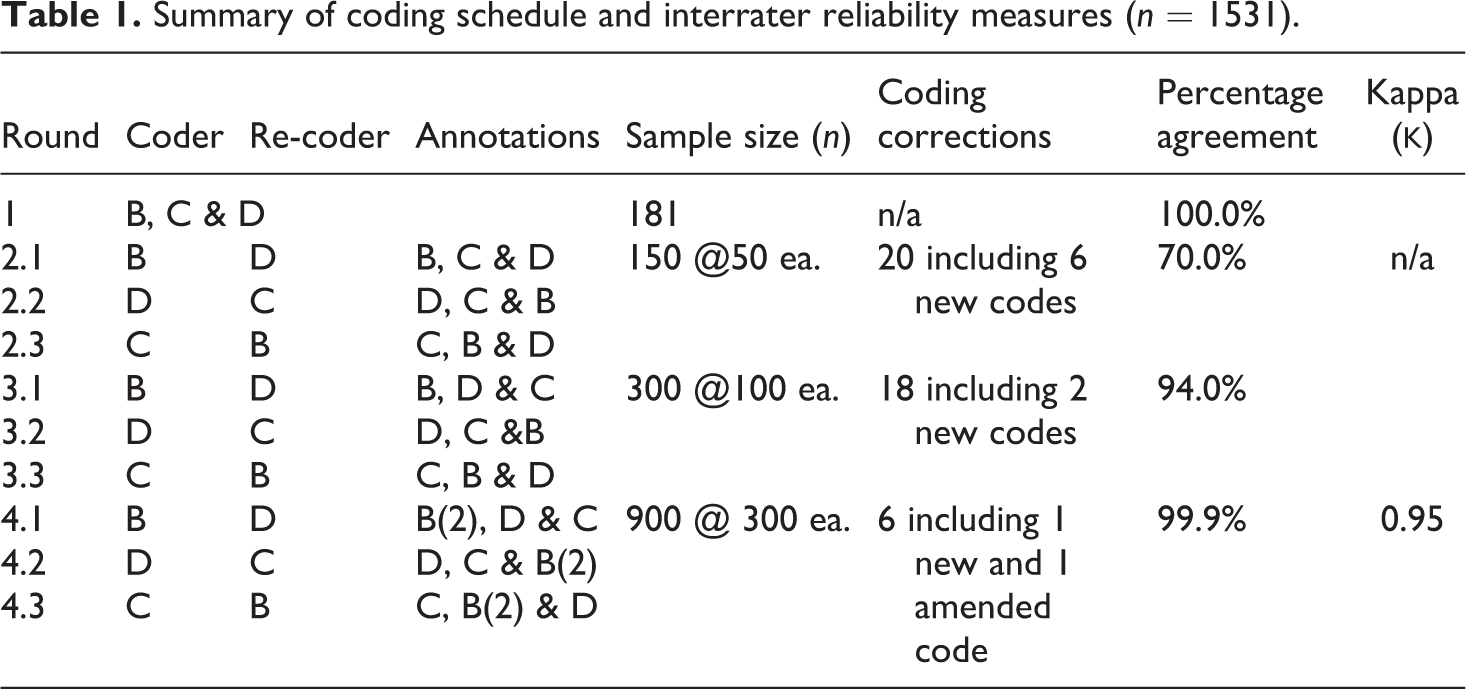
The coding schedule 6 produced over 94% agreement in 1,251 cases (80% of the cases) and achieved a Kappa score of 0.95 (n = 300) in the final round. [It is important to note that statistical interrater reliability calculation in NVivo was limited to the final round (n = 300) due to an undetected login error which precluded double-coding from being recorded accurately in the dataset.] The positive result was encouraging but should still be accepted cautiously, according to Kottner et al. (2011) who warn that while a Kappa score of between 0.8 and 1.0 is considered ‘almost perfect’, high scores ‘do not indicate practical or clinical relevance of the results’ (2011: 102).
Results
The main results are summarised here and additional graphics (such as Wordles, see McNaught and Lam, 2010) illustrate detail around content and examples are available on request.
Demographics
Without any clear evidence in the literature that demographics bias the phrasing of an incident description (and therefore their coding), demographic analysis of trauma descriptions was minimal. Of the 1,531 participants whose traumas were coded, 60.4% were male, 38.2% female and 1.4% preferred not to say. This was consistent with the wider UK policing population in the larger TJTL dataset of 2018 (n = 16,857) and Home Office figures. 7 One in 10 respondents referred to gender themselves in their descriptions of an event (of the 167 references, 100 were to males). The mention of a victim, offender or witness being of a certain gender was inconsistent and added no clear meaning to the trauma description. Researchers inferred that referring to gender was more likely to be an effect of operational habit (for example, when describing unidentified individuals over a radio or in a statement), rather than a reflection of any gender bias. A WordTree (NVivo) illustration of references to being female is available on request.
Events and situational contexts
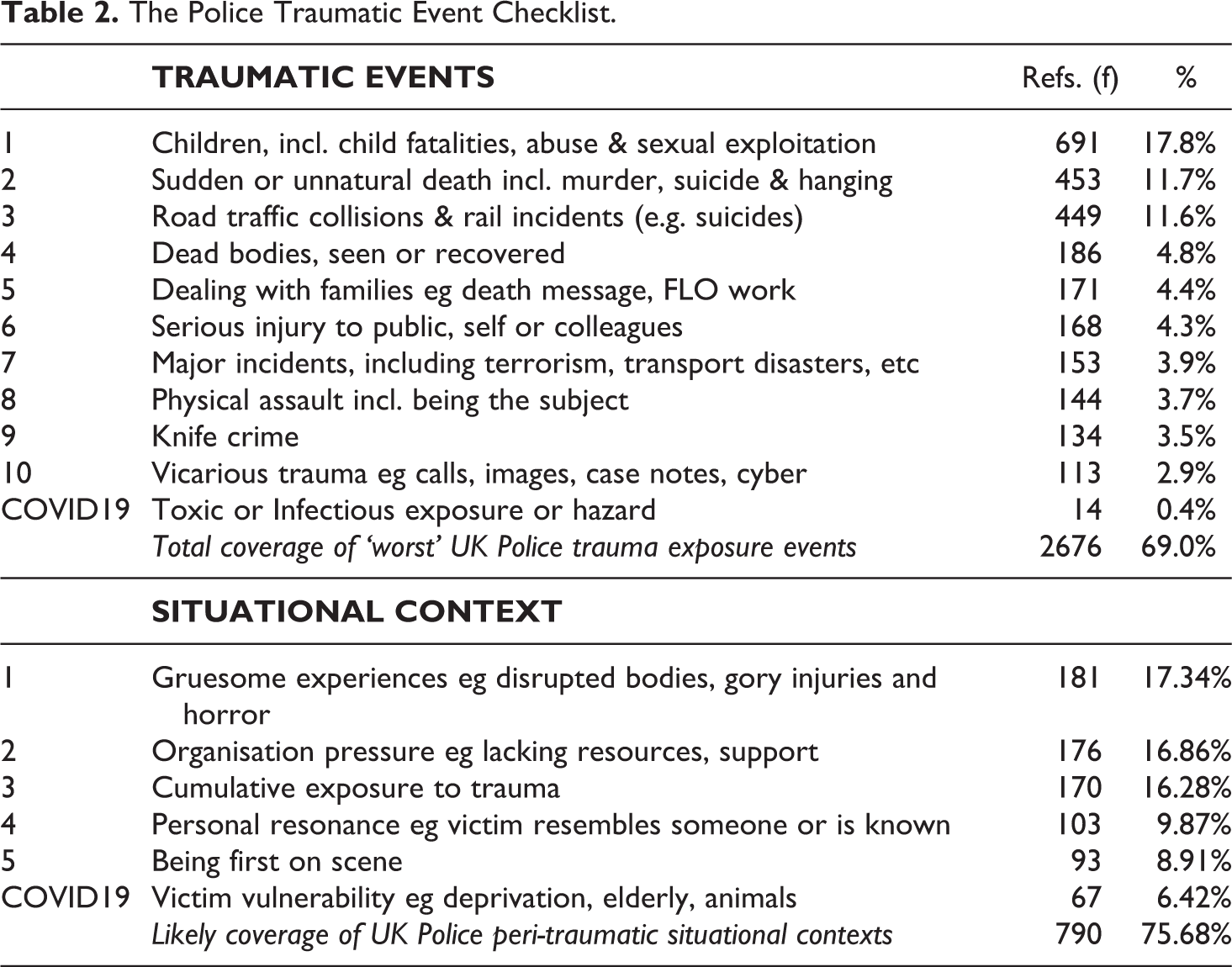
Coding the 4,987 reference points to trauma exposure from 1,531 individuals produced 10 predominant traumatic event types and five situational contexts. Single trauma references could feature in many separate event codes (such as a child’s death in an RTC would feature in three codes: child fatality, death and RTC). The references were coded under the global themes of Events (including Other Events), Situational Context and Ambiguous (which were excluded from analysis) and these are illustrated in Figure 1 (a, b, c). The event categories represent 69.7% of references to traumatic incidents and the context categories represent 69.3% of references made to situational factors. The most populated categories of worst traumatic incidents were: those involving children, RTC, murders, suicides, and dead bodies. The resultant Police Traumatic Event Checklist comprises 10 Event items (plus one for Covid19) and 5 Situational Contexts (plus one for Covid 19, see Table 2). Further detail on inclusion criteria per item is provided in Appendix 3.
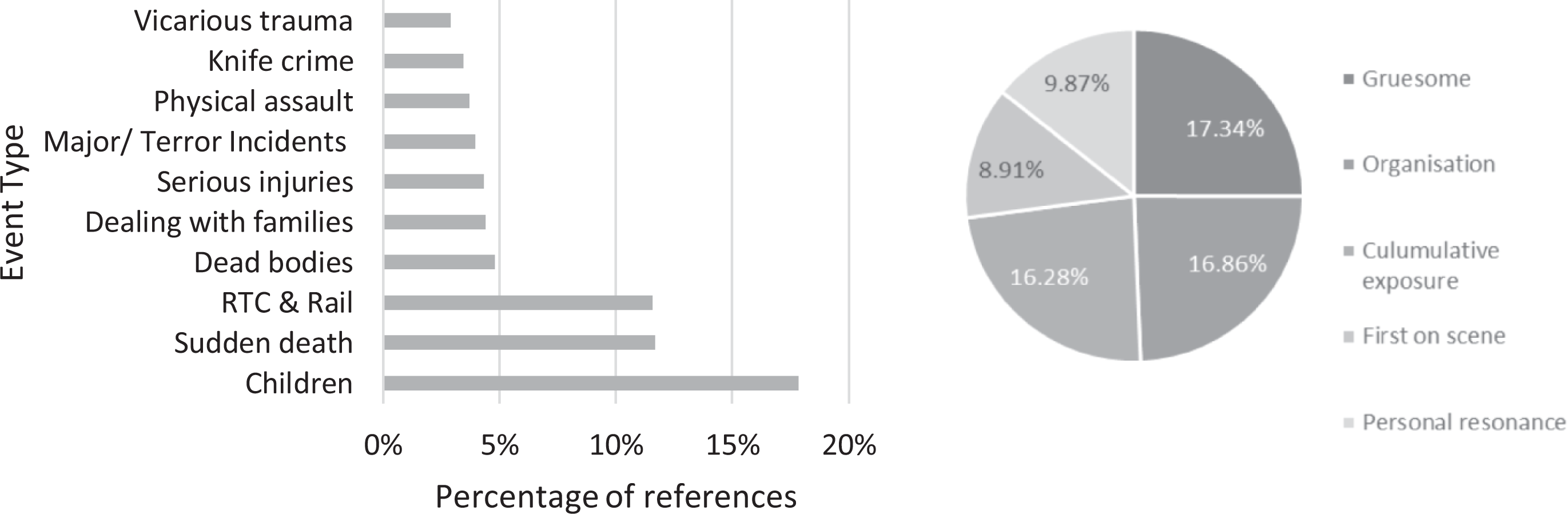
Police Traumatic Events Checklist Event Types (graph) and Situational Contexts (chart) coded from trauma descriptions provided in the Policing: The Job & The Life survey (2018, n = 3,874, 1,044).
The Police Traumatic Event Checklist.
Reference rates (percentages) for Event Type and Situational Context are illustrated in the Figure 1.
Other prominent events and contexts
Trauma exposures and the contexts in which they were experienced were diverse and 31.3% of individuals’ ‘worst’ traumatic events (and 30.7% of situational contexts) showed insufficient commonality to warrant inclusion in the final 15-item checklist, despite some being fairly prominent themes (including events involving fire and contexts involving a sense of personal responsibility). A comprehensive list of all references is provided in the PTEC NVivo Code Book in Appendix 2.
Discussion
Relation to previous literature
The Police Traumatic Events Checklist provides a new UK-relevant, up-to-date list of the most frequent ‘worst’ experiences reported directly by officers and staff, including consideration of situational contexts and constructed using a clear methodology with high interrater reliability. Global themes were consistent with the wider police checklist literature, including child-related incidents (Carlier et al., 2000; Hartley et al., 2013; Karlsson and Christianson, 2003; Weiss et al., 2010), seeing dead bodies (Hartley et al., 2013; Karlsson and Christianson, 2003; Volanti and Gnerke, 2004), road traffic accidents (Hartley et al., 2013; Karlsson and Christianson, 2003; Stephens and Miller, 1998), threats to life (Carlier et al., 2000; Karlsson and Christianson, 2003; Stephens and Miller, 1998; Weiss et al., 2010), murders and suicides (Hartley et al., 2013; Karlsson and Christianson, 2003; Stephens and Miller, 1998), and the death message or dealing with families (Karlsson and Christianson, 2003; Weiss et al., 2010).
The Checklist is structured so as to emphasise commonality in worst experiences. One predecessor, the Critical Incident History Questionnaire for police officers (Weiss et al., 2010) leads with the unusual experience of ‘killing a colleague’. In contrast, the Checklist presents officers’ and staff’s worst experiences in a hierarchy of frequency, increasing respondents’ sense of having their own experiences recognised. The list comprises exposures common to staff roles (including Child Sexual Exploitation), increasing the scope of the screen to be useful for those in non-frontline roles which are nevertheless at high risk for trauma exposure (such as taking emergency calls).
The relevance of the Checklist to police based in the UK is likely to offer an advantage, particularly given that the majority of non-UK checklists lists typically include shootings as a dominant exposure (e.g. Chopko et al., 2015; Hartley et al, 2013; Karlsson and Christianson, 2003; Weiss et al., 2010). The practical demands of the current policing climate are reflected in our consideration of the impact of 2020’s pandemic. Older screens, in contrast, may feature ‘being exposed to AIDS’ as the primary risk of toxicity on the job (Weiss et al., 2010).
Finally, the inclusion of a comprehensive list of frequently occurring Situational Contexts sets it apart from earlier checklists. Many predecessors have made reference to important contextual information about traumatic incidents which are consistent with this study’s findings, including: sense of responsibility or helplessness (Carlier et al., 2000; Weiss et al., 2010; Violanti et al., 2016), revulsion and gore (Carlier et al., 2000; Hartley et al., 2013; Weiss et al., 2010), and organisational factors such as lack of support (Carlier et al., 2000; Huddleston et al., 2006; Violanti et al., 2016). However, the new instrument goes further to produce a structured list of frequently occurring contexts. These were coded from original trauma descriptions using the language of UK officers and staff themselves, providing respondents with the opportunity to reflect on other factors and influences that may have contributed to the impact of the event upon them. By way of demonstration, a Police Traumatic Events Checklist ‘Matrix’ is provided in Appendix 4 and illustrates how users might benefit from reflecting on the commonality of the traumatic event as well as other situational factors present at the time. The grid may be used as a visual aid to monitor the impact that certain incidents and jobs may have had on them at a particular time. Instructions to users are simple and generic, so that the tool can be used for self-assessment by officers and staff on their own, or with a supervisor, health care or occupational health professional to help guide interactive discussion on trauma exposure.
Challenges, limitations, and development
To our knowledge this study is the first to systematically code original trauma descriptions in large numbers to generate a checklist from a UK policing population. Our approach has been greatly aided by the existence of coding technology (such as NVivo) to manage large datasets. Other researchers who initially preferred to use continuous or dichotomous data about specific trauma events (see Resnick, Falsetti, Kilpatrick, and Freedy, 1996, also in Hooper et al., 2011) have more recently recommended coding descriptive data for indexing worst traumas (Kilpatrick et al., 2013). In the 17 years between the 1996 and 2013 studies coding software has opened up new opportunities for social scientists to generate and manipulate qualitative data.
A limitation of this study was the restricted opportunity to calculate Kappa scores and further multi-rater and intra-class coefficients (as used by Fernández-Lansac and Crespo, 2017) due to the technical error in NVivo at the point of data entry. A second possible limitation involves the representativeness of the Situational Context items. Context categories were inferred from spontaneous trauma descriptions, rather than relevant information being explicitly requested in the original survey question (TJTL, 2018). Variation in roles (specifically those designated to staff or warranted officers) and ranks will no doubt mean that The Police Traumatic Events Checklist will be more relevant to some than others. For those in higher rank, it may be less relevant for current daily exposure monitoring, but maybe useful as a tool by which one can reflect on historic cumulative trauma exposure, if that is useful for individuals. For those in back-office staff roles, the checklist again may be less relevant for individuals’ own daily work, but may yet be useful to understand the breadth and range of trauma exposures experienced by those they may be supporting (directly or indirectly) on a daily basis.
The Police Traumatic Events Checklist will benefit from further development as a clinical and research tool. Appendix 4 provides some basic instructions for use. Used in conjunction with measures of Post-Traumatic Stress Disorder it may assist in the assessment of Criterion A of the DSM-5, which refers to qualifying trauma exposure in the course of professional duties 8 (APA, 2013). Validation of the list of exacerbating situational contexts through large scale surveys could improve its viability for assessing the interaction between working conditions in policing and UK prevalence rates of PTSD (Brewin et al., 2020; Syed et al., 2020; University of Cambridge and Police Care UK, 2018). The checklist may also be used by forces in their psychological risk assessment of specific roles which may be known to expose individuals to the trauma types depicted. Cognitive testing of the Police Traumatic Events Checklist will take place throughout 2021 with the University of Cambridge, involving 30–45 semi-structured interviews (and an online survey) with serving police officers and staff and stakeholders, such as The Police Federation of England and Wales, the College of Policing, the National Police Chiefs’ Council, and Police Care UK. There is also the development option of digitising the checklist and matrix for use in a mobile application or online platform. Results of the validation (and any associated technological development) of the Police Trauma Exposure Checklist will be made available through The University of Cambridge and Police Care UK.
Conclusion
Over one in five UK police officers and staff are probable cases of PTSD or Complex PTSD and, until now, means of consistently measuring trauma impact on the job (as opposed to non-work-related trauma) have been limited. The study provides an assessment tool that identifies over 75% of UK police trauma exposure and is based on the recent experiences of over 1,500 officers and staff on the front line. The Police Traumatic Events Checklist may be useful for self-assessment, for monitoring cumulative load during an officer’s career, for supporting Trauma Risk Management (TRiM) and Occupational Health treatment pathways, and for enhancing Psychological Risk Assessment for specific roles. It has potential applications in a variety of operational settings including supervisions, peer support activities, wellbeing assessments, and training. The checklist can be used in matrix format (see Appendix 4), enabling individuals to record the situational contexts that influenced the impact of the event at the time (such as few resources or being first on scene). More generally, the Checklist may go some way towards properly documenting the types and levels of traumatic stress to which police officers and staff are routinely exposed.
Supplemental Material
sj-pdf-1-pjx-10.1177_0032258X211002597 – Supplemental Material for The development of a UK police traumatic events checklist
Supplemental Material, sj-pdf-1-pjx-10.1177_0032258X211002597 for The development of a UK police traumatic events checklist by JK Miller, CR Brewin, M Soffia, M Elliott-Davies, BJ Burchell and A Peart in The Police Journal: Theory, Practice and Principles
Footnotes
Acknowledgements
With thanks to Gill Scott-Moore and Police Care UK, Ché Donald (PFEW) and Ian Hopkins (Greater Manchester Police). Heart-felt thanks to Magdalena, Mary and Alex for listening to and reading things no one should have to, day in and day out in their support of the UK Police who lived the experiences we can only imagine.
Declaration of conflicting interests
The author(s) declared no potential conflicts of interest with respect to the research, authorship, and/or publication of this article.
Funding
The author(s) disclosed receipt of the following financial support forthe research, authorship, and/or publication of this article: The 'Policing: The Job and The Life' survey was funded by the registered charity Police Care UK (1151322, formerly The Police Dependants' Trust) in 2017.

Supplemental material
Supplemental material for this article is available online.
Notes
References
Supplementary Material
Please find the following supplemental material available below.
For Open Access articles published under a Creative Commons License, all supplemental material carries the same license as the article it is associated with.
For non-Open Access articles published, all supplemental material carries a non-exclusive license, and permission requests for re-use of supplemental material or any part of supplemental material shall be sent directly to the copyright owner as specified in the copyright notice associated with the article.
