



Abstract
This article presents findings from a survey which explored exposure to sexual offence material in Police personnel (N = 384). Factor analysis determined that two types of coping strategies were employed: ‘detachment’ and ‘avoidance’, with a further factor regarding ‘negative coping beliefs’. Two types of adverse impact analogous to post-traumatic stress disorder symptoms were identified: ‘cognitive/affective changes’ and ‘increased suspicion/vigilance’. Multiple regression analysis found that avoidance-based coping strategies, holding negative beliefs about coping, being a parent, and having personally experienced sexual abuse were all predictive of increased levels of traumatic stress symptoms.
Interest in the psychological consequences of exposure to sexual offence material (SOM) in Police personnel has increased over the last 10 years (Hurrell et al., 2018; Tehrani, 2016). Adverse impacts include intrusive images and sleep disruption (Perez et al., 2010; Powell et al., 2015), self-consciousness about relationships with children and reduced sexual intimacy with partners (Craun et al., 2015; Wolak and Mitchell, 2009), overprotectiveness and distrust of others (Bourke and Craun, 2014a; Parkes et al., 2019b; Powell et al., 2014). A smaller body of literature addresses the coping strategies used to manage SOM exposure (Burns et al., 2008; Craun and Bourke, 2014; Parkes et al., 2019a). Most studies had small samples due to their qualitative methodologies and provide insight into the lived experience of Police personnel. Bourke and Craun (2014b) study offers a larger-scale quantitative examination of the coping strategies used in this context (N = 677), and applies a coping tool (COPE scale, Carver et al., 1989) measuring general coping ability. This study found that self-reported difficulty with viewing indecent images and using ‘denial’ coping strategies were linked to higher levels of secondary traumatic stress (STS). Effective supervisor support was correlated with lower STS scores. Overall, one quarter of participants in this study scored severe or high levels of STS.
Coping has been measured in range of professionals (Connor-Smith and Flachsbart, 2007) including social workers (Bride, 2007), first responders (Avraham et al., 2014), and emergency telephonists (Adams et al., 2015). When examined alongside measures of delayed recovery, emotional-based and avoidance-based strategies have been found to be maladaptive, while task-based and detachment-based strategies have been described as adaptive (Endler and Parker, 1990; Nelson and Smith, 2016; Roger et al., 1993). Studies have also found that problem-focused coping rather than emotion-focused coping is linked to more positive outcomes (Endler and Parker, 1990; Shin et al., 2014). These findings illustrate the challenges of utilising adaptive coping techniques in a Policing context, which involves highly stressful situations characterised by uncertainty.
There is some evidence that coping ability may be linked to stable personality traits. Neuroticism has been linked to the use of maladaptive strategies such as denial and disengagement, while conscientiousness has been positively related to active coping and planning (Jakšić et al., 2012). Other studies have found that high levels of extraversion and low levels of neuroticism were linked to reduced adverse impact in Police personnel who were exposed to general trauma (Madamet et al., 2018) or sexual trauma (Tehrani, 2016). However, focussing exclusively on an individual’s personality traits deflects attention away from employers’ responsibilities to provide adequate support resources and a work environment conducive to effective coping. Successful management of work-related trauma should involve a constructive interaction between the work environment, the individual, and the resources provided to support recovery from trauma exposure (Paton, 1997).
Police organisations have ‘the power to shape the professional and personal identities’ of their employees, with ‘a defining influence on psychological well-being’ (Burke and Paton, 2006: p. 196). Officers are expected to fulfil a dual role involving inconsistent emotional demands; being both approachable public servants and enforcers of the law (Schaible and Six, 2016), with masculinism and cynicism historically being emblematic of Police culture (Loftus, 2008, 2010). It is within this milieu that Police personnel must develop what they think are the most appropriate coping strategies for dealing with stress and distress. The cultural importance of impression management in Policing suggests that in terms of emotional labour (Hochschild, 1983), officers may be inclined to engage in ‘surface-acting’ (Grandey, 2000) when faced with traumatic situations, to hide their real feelings from others. In their meta-analysis of emotional labour studies, Hülsheger and Schewe (2011) found that surface acting was consistently detrimental to wellbeing. This indicates that routinely masking external indicators of distress or other negative emotions may result in adverse psychological consequences in a Police population.
In terms of demographic characteristics, there is limited evidence to suggest that gender differences affect the relationship between SOM exposure and overall well-being (Lane et al., 2010). Wolak and Mitchell (2009) found there were inconsistencies in whether people with children are impacted differently than those without. The current research adds to the corpus of data examining the effects of both gender and parental status on practitioners’ experiences, as well as exploring the impact of previous sexual victimisation. It outlines how coping techniques and beliefs around coping can predict traumatic stress symptoms as a result of exposure to sexual trauma. Analysis of qualitative responses provides further insight into Police professionals’ ability to manage the challenges of sexual offence work.
Method
Participants
Survey data were collected from 384 Police officers and civilian Police staff across three Police constabularies. 51% of respondents were male, 48% were female, and 1% non-binary. 90% of respondents who gave an ethnicity were White British, 1% were Asian British and 1% were Black British. Due to the low representation of Black and Ethnic Minority participants, ethnicity is not used as a variable in the following analysis. Of the participants who answered the question about parental status and sexual victimisation, 68% were parents, 30% were non-parents, 87% had not been sexually victimised and 8% identified as victims of sexual abuse or assault.
A link to the survey was posted on the staff intranet, with copies of the link further disseminated by managers of teams with frequent involvement in sexual offence cases. A decision was made to open the survey to all staff members based on findings from the earlier study in the current project, where participants had observed variations in experience of SOM exposure between members of staff working in a specialist and non-specialist teams.
Materials
The survey holistically explored the experience of working with SOM, with overarching themes derived from an earlier qualitative phase of the research project (Parkes et al., 2019a, 2019b). In the initial study, Police personnel were interviewed and the data analysed using interpretative phenomenological analysis (Smith et al., 2009). Themes identified included coping strategies and beliefs, motivations, operational factors and the impact of SOM exposure on self. No pre-existing measurement scales were incorporated into the survey, in order to remain grounded in the existing project data. The ‘coping’ and ‘impact’ items in the survey were all identified in the first study, although the impact items were subsequently found to map directly onto the symptoms of post-traumatic stress disorder (PTSD) outlined in the PCL-5 checklist (American Psychiatric Association, 2013). Survey items mirrored the words of the initial study participants, to add authenticity of language and tone which would resonate with a larger sample of Police staff. For example, the statement ‘I put things in a mental box and not think about it’ became the item ‘I put what I have seen or heard about sexual offences in a box in my head where I don’t have to think about it’. In other cases, participant responses from the earlier study were adapted into a more general question. For example, ‘The days when you think “I feel…crap today. I really shouldn’t go into work, but that would just leave X on their own”’ became a survey item about work pressures: ‘I have come into work when I have been unwell, so other people don’t have to cover my cases’.
Analysis
All statistical analysis was undertaken using IBM SPSS statistics software. Exploratory factor analysis using principal axis factoring (PAF) determined latent factors within the survey items relating to coping and adverse impact. An oblique rotation was selected due to the likely correlations between factors. In analysing the loadings, items which loaded onto more than one factor with a differential less than 0.1 were removed and factors with fewer than three items were discarded. Cronbach’s Alpha tested the reliability of each factor. Issues of multi-collinearity were explored by calculating the determinant of the R-Matrix. Standard linear multiple regression was used to determine whether different demographic and coping factors were predictive of traumatic stress symptoms. Examination of correlation matrices showed no evidence of problematic multi-collinearity and variance inflation factors (Field, 2013), confirmed that tolerance levels were unproblematic. One-way ANOVA with Games-Howell post hoc tests (Ruxton and Beauchamp, 2008) were used to explore differences in the coping strategy and traumatic stress symptom factors based on gender, parental status, and sexual victimisation status.
Ethical considerations and confidentiality
Ethical approval was granted by the [redacted for blind review] Ethics Committee. Responses to the survey came to the author via the SurveyGizmo online survey system, ensuring anonymity for participants. Information about the research and the contact details of the researcher were provided for participants who wanted more detail. Respondents ticked the electronic consent form at the start of the survey, which explained how the data would be used, the right to withdraw, and how confidentiality would be maintained. A debrief page gave details of general and Police-specific sources of support.
Results
Factor analyses
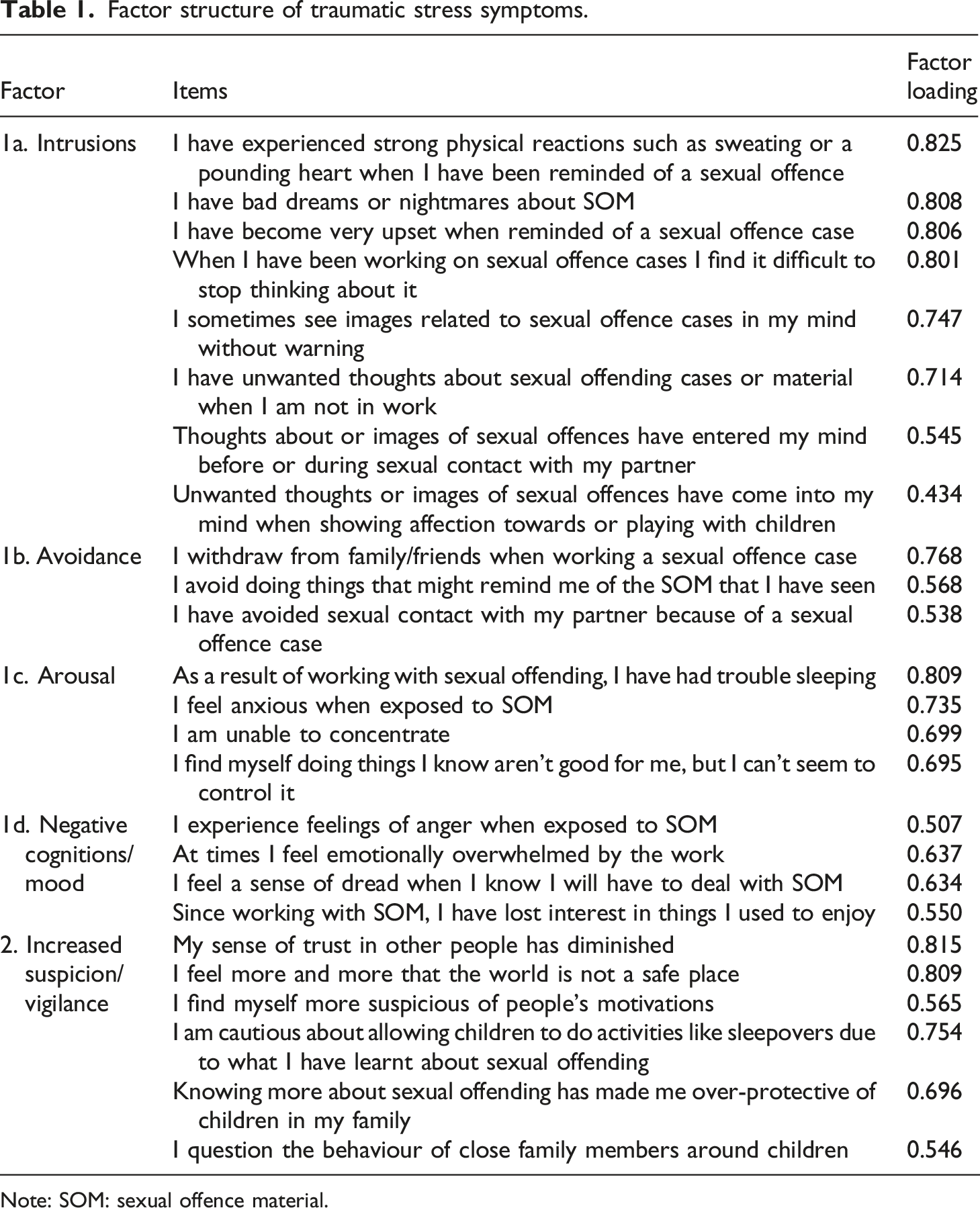
Factor structure of traumatic stress symptoms.
Note: SOM: sexual offence material.
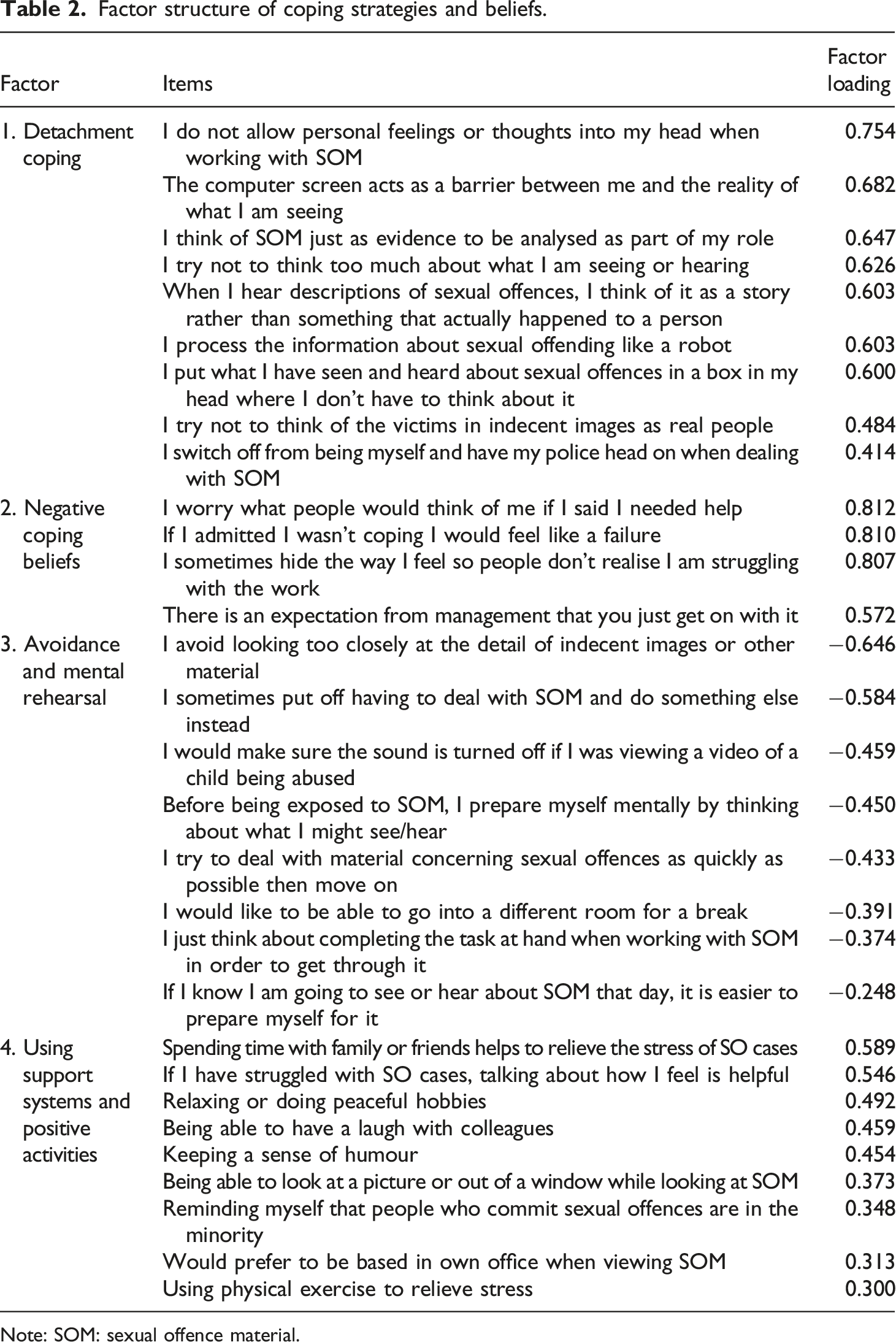
Factor analysis was undertaken on the items concerning direct coping strategies used while exposed to SOM, general coping strategies, and expectations about coping. One item was removed due to equal loading on more than one factor, and two items were removed due to low factor loading. The overall alpha for the remaining items was high: α = 0.818. Four factors emerged: ‘Detachment coping’, ‘Negative coping beliefs’, ‘Avoidance and mental rehearsal’ and ‘Using support systems and positive activities’.
Factor structure of coping strategies and beliefs.
Note: SOM: sexual offence material.
Descriptive statistics and analysis of variance
Mean, SD and range of traumatic stress symptoms and coping strategies/beliefs.
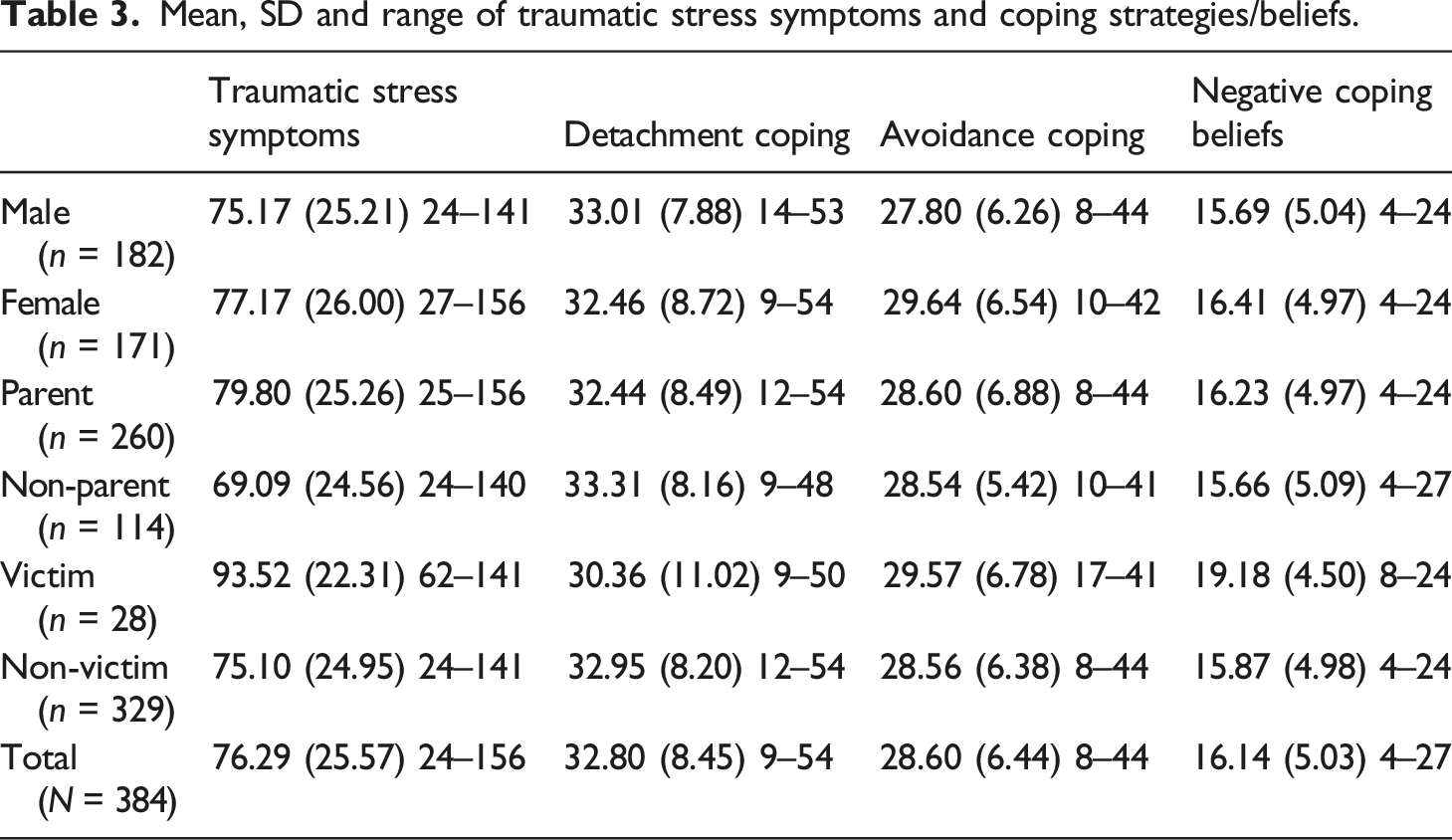
One-way ANOVA was conducted to explore the effect of gender, parental status and sexual victimisation status on the use of coping strategies. No significant differences between males and females were found in the use of detachment strategies [F (2, 354) = 1.05, p = 0.350, η2 = 0.006], or negative coping beliefs [F (2, 354) = 2.29, p = 0.103, η2 = 0.026]. However, there was a significant difference between genders in the use of avoidance and mental rehearsal strategies, with females being more likely to use these strategies than males [F (2, 354) = 4.70, p = 0.010, η2 = 0.041]. No significant differences between parents and non-parents were found in the use of detachment strategies [F (2, 379) = 0.576, p = 0.563, η2 = 0.003] or avoidance strategies [F (2, 379) = 0.045, p = 0.956, η2 = < 0.001]. There were significant differences relating to parental status in terms of negative coping beliefs [F (2, 379) = 5.23, p = 0.006, η2 = 0.027]. However, this significant difference only occurred between non-parents and those who declined to disclose their parental status, not between parents and non-parents. No significant differences were found between those who had been previously sexually victimised and those who had not in the use of detachment strategies [F (2, 377) = 1.28, p = 0.279, η2 = 0.007] or avoidance strategies [F (2, 377) = 349, p = 0.705, η2 = 0.002]. However, there were significant differences between victims and non-victims in terms of negative coping beliefs [F (2, 377) = 5.77, p = 0.003, η2 = 0.030], with those who had been previously sexually victimised having significantly higher levels of negative coping beliefs.
One-way ANOVA was conducted to explore potential effects of gender, parental status and sexual victimisation status in overall traumatic stress symptoms. No significant differences between males and females were found [F (2, 346) = 1.41, p = 0.244, η2 = 0.008]. Significant differences were found in traumatic stress symptoms between parents and non-parents [F (2, 370) = 7.12, p = 0.001, η2 = 0.037], with parents exhibiting significantly higher levels of symptoms. Significant differences were also found between people who had and had not experienced sexual abuse themselves [F (2, 368) = 6.74, p = 0.001, η2 = 0.035], with those who had previously been victimised experiencing higher levels of traumatic stress symptoms.
Regression analyses
A standard multiple regression was conducted to examine whether the gender, parental status, sexual victimisation status and use of different coping factors were significant predictors of the traumatic stress symptoms outlined in Table 1. The overall model was significant [F (6, 338) = 37.31, p = <0.001], with the model explaining 39% of the variance in traumatic stress symptoms (R2 = 0.398; Adjusted R2 = 0.388). Gender (B = −1.31, β = −0.027, t = −0.604, p = 0.547) was not significantly predictive of increased traumatic stress symptoms. Parental status was a significant predictor (B =5.73, β = 0.112, t = 2.62, p = 0.009). Victimisation status was also a predictor (B = 4.07, β = 0.850, t = 1.64, p = 0.036) ‘Detachment coping’ was a significant predictor (B = −0.862, β = −0.279, t = −6.64, p = <0.001), indicating that lower use of detachment coping was associated with increased traumatic stress symptoms. ‘Avoidance and mental rehearsal’ was a significant predictor (B = 1.21, β = 0.302, t = 6.54, p = <0.001) associated with greater levels of traumatic stress symptoms. ‘Negative coping beliefs’ was a significant predictor (B = 2.28, β = 0.449, t = 10.22, p = <0.001), indicating that hiding difficulties with SOM was associated with increased traumatic stress symptoms.
Summary of qualitative results
Participants provided qualitative comments at several points in the survey. Although detachment and avoidance strategies were used by participants at a comparable level, there were no free-text quotes articulating avoidant coping behaviour qualitatively. Several comments illustrated detachment strategies, including dissociating from the victim entirely and seeing material just as evidence:
“When dealing with SOM you just become a machine and get on with it. …I have no thoughts and feelings about what I deal with and no emotions for the people I deal with.”
“I do not think of the material as a child, just a picture I need to review and move on from. I leave this information at work when I go home and separate the two as much as possible.”
Examples of negative coping beliefs included a reluctance to admit being affected by sexual trauma. In some cases, this was credited to Police cultural stigma, including support-seeking being viewed as a weakness:
“Although I know there is support at occupational health I feel that if I ask for help, I will be seen as being weak.”
“There is a stigma in the police and in the public around stress and mental health and cops do not talk about struggling to cope as it is seen as failure, as a result they push, without the support and end up suffering.”
Some participants gave direct examples of ‘surface-acting’ used to hide their true feelings:
“There is a culture where I work that if you display any emotion or empathy it is a weakness and that the police are all about arrests, charges and convictions. I feel as if I play along with this to a certain extent to portray a harder version of myself.”
Negative coping beliefs can be underpinned by a perceived lack of support from supervisors and there was evidence of peer behaviour that made participants feel unable to share their difficulties:
“I am a uniformed officer who had no experience of [SOM]. I was shown support by my close supervision and colleagues however from departments who felt they were better than me i.e. PPU I felt patronised and embarrassed and was told when I said I was finding it hard to ‘GET A FUCKING GRIP’ There was no interest in how my professional nature would be affected going to 999 calls after just seeing a cat A image”.
“Colleagues have struggled when viewing material and there is an expectation from supervisors that they just get on with it.”
This statement highlights the negative consequences of failures in supervisory and peer support when difficulties are disclosed, and the challenges which may be present for officers untrained in working with sexual offences. These could include being required to manage the competing stressors of SOM exposure followed by interactions with the public in emergency situations.
Qualitative comments illustrated how being a parent informed participants’ difficulty coping with SOM exposure. This included the intersection of knowledge gained as a parent and the operational tasks involved:
“Having children and seeing other children who are similar ages being abused. Estimating the child’s age based on body type that is gained from the seeing my own children grow.”
“First video I ever viewed of a child being abused was a child the same age as my son at the time and it really hit home how young they were and affected me more than it should have because I automatically compared it to my family life thereby making it more personal.”
The separation of work and home life was difficult for some parents and this extended in some cases to significant fears about the potential abuse of their own children:
“I began to have strange thoughts that my children may have been abused. I was suspicious that my teenage son may have been sexually abused in a public toilet.”
“The intrusion of unwanted thoughts/memories when doing things in your own life i.e. doing personal care for your children and a horrible memory surfacing.”
The comments suggest that a tendency to closely relate the victims of sexual offences to loved ones may partly explain increased levels of traumatic stress symptoms in respondents who were parents.
Discussion
The study found that the use of avoidance coping strategies, holding negative coping beliefs, being a parent, and having previously been a victim of sexual abuse were all predictive of higher levels of traumatic stress symptoms, while detachment coping strategies were predictive of lower levels of these symptoms. Gender played a small role in the use of coping techniques, with females being more likely than males to use avoidance strategies. However, gender did not affect the level of traumatic stress experienced by participants. Parental status did not have any meaningful effect on the type of coping strategy used or the levels of negative coping beliefs, but having previously been a victim of sexual abuse was linked to higher levels of negative coping beliefs.
The Process Model of Emotional Regulation (Gross and Thompson, 2007) would characterise detachment-based coping strategies as a ‘cognitive change’ approach, where individuals intentionally alter how they interpret an emotional situation either in terms of its significance or their capacity to manage it. By contrast, avoidance-based coping represents a form of ‘attentional deployment’ (Gross, 2015) including distraction techniques such focussing on less emotive elements or moving attention away from the situation entirely. The finding that detachment strategies were linked to lower levels of traumatic stress symptoms and that avoidance strategies were linked to higher levels of these symptoms provides further evidence to support existing findings that active coping strategies tend to be adaptive, while passive strategies tend to be maladaptive (Nelson and Smith, 2016; Roger et al., 1993; Violanti et al., 2018). The differences in intentionality between detachment and avoidance strategies may also explain why participants who used deliberate detachment strategies mentioned these in the qualitative comments, while those who used avoidance strategies did not.
Holding negative beliefs about coping with exposure to SOM was predictive of higher levels of traumatic stress. Qualitative comments indicated that peer and supervisor attitudes and in a broader sense the ‘Police culture’ play a part in participants’ decisions not to be open about their feelings or seek support. Some Police organisations may perpetuate the idea that emotional expression represents personal or professional weakness (Loftus, 2010; Paton, 1997), and the importance of shifting this perception has been further highlighted in the current research. The culture of any profession is formed incrementally over time by the acts and attitudes of individuals working within it, and changes to cultural norms are made gradually when these acts and attitudes are either supported or discouraged. Therefore, Police employers play an important role in promoting a workplace culture where experiencing difficulties with exposure to sexual trauma is validated as a normal response. Constructive supervisor and peer support have been found to have a positive effect on wellbeing in teams where sexual trauma is routinely encountered (Bourke and Craun, 2014; Burns et al., 2008; Powell et al., 2014). This further illustrates the benefit of carefully calibrating organisational messages about the support available for Police personnel who experience difficulties coping with trauma exposure.
If the type of coping strategies used in SOM work are predictive of traumatic stress symptoms, more knowledge is required about the extent to which coping strategies for dealing with sexual trauma can be taught. Powell et al. (2015) suggest that any training designed to help staff to recognise and manage the potential physiological and psychological consequences of continued exposure to sexual trauma would ideally be combined with the operational training associated with sexual offending work. Based on the current findings, this approach could also contribute to the normalisation of discussions around the potential negative effects of exposure to sexual trauma, embedding these more effectively within the organisational culture. ‘Stress Inoculation Training’ (SIT) (Meichenbaum, 1985, 2007) is a model which could be easily adapted to provide the structure required. The SIT model adopts a transactional view of stress (Lazarus and Folkman, 1984) in which it is not the person alone that is responsible for the stress, nor is it the environment or situation alone. Instead it is the relationship between these things that influences the degree to which the individual is affected. Part of the environmental element involves the degree to which support and understanding is provided by colleagues and superiors, as well as training being commensurate with the level and nature of potential stressors involved. The use of SIT by Police employers would embody a cultural shift towards a shared responsibility for wellbeing by the individual and the organisation.
The study shows that parents appear to be at greater risk of traumatic stress than non-parents when exposed to SOM. Employers could provide information about the potential increased risks to parents prior to employment in roles which may involve SOM, and that the ongoing welfare of parents working with SOM involving children should be monitored. Individuals who have previously been victims of sexual abuse/assault also appear to be at greater risk of traumatic stress when exposed to SOM. These findings add to the body of knowledge about previous traumatisation as a risk factor for persistent traumatic stress symptoms. They also indicate that information should be provided prior to employment/role changes about the potential increased risk for survivors of sexual violence and the ongoing welfare of this group should be carefully considered by Police employers.
Strengths and limitations
The heterogeneity of the sample is strength of the study, as it provides a holistic view of the experiences of staff across different roles and locations. This captures the experiences of those who may otherwise feel forgotten, such as civilian typists and neighbourhood Police officers. As uniformed officers were involved in these cases it is important to consider how exposure to sexual trauma may impact on an officer’s cognitive and affective states immediately before responding to an emergency call. There may also have been merit in focussing only on those who undertake SOM work in specialist roles, as the analysis could have pinpointed factors predictive of adverse impact for those with the highest exposure levels. As with all survey research, it was not possible to guarantee that the sample was completely representative of the wider population. Due to the method of recruitment for the study, respondents were all serving Police Officers or civilian staff currently attending work. Therefore, the study does not capture the experiences of individuals on sickness absence or who have left the force. This group, while hard to include for ethical reasons, could provide valuable insight into the relationship between coping strategies for working with SOM and incidence of sickness absence or resignation due to the impact of trauma exposure.
The interplay of personality, coping behaviours and extreme adverse responses to sexual trauma exposure is complex, and will need to be thoroughly explored in future studies. Nevertheless, the finding that use of detachment-based strategies was a negative predictor and use of avoidance-based strategies was a positive predictor of traumatic stress symptoms is an important starting point for increasing awareness of the importance of adaptive coping behaviours. Future research could focus on two main areas. First, the role of personality traits could be further examined in terms of their impact on individuals’ ability to cope with repeated exposure to sexual trauma in a workplace setting. Second, new approaches to supporting Police personnel to manage SOM exposure could be implemented and their effectiveness evaluated, such as the piloting of programmes such as SIT. As illustrated by Paton (1997) seminal work on the management of workplace trauma exposure, these issues should be addressed in tandem. This will help to illuminate how personal and organisational factors intersect in a way which either supports or hinders Police personnel in coping with and recovering from frequent exposure to sexual trauma.
Footnotes
Author’s note

Declaration of conflicting interests
The author(s) declared no potential conflicts of interest with respect to the research, authorship, and/or publication of this article.
Funding
The author(s) received no financial support for the research, authorship, and/or publication of this article.