




Abstract
Despite numerous attempts to decrease homicides in the Latin American region, high homicide levels have persisted. Examining four cities in Rio de Janeiro, the research reveals the intense geographic concentration of homicides in each city, but illustrates differences in the extent of homicide concentration when using a variety of crime concentration measures. Single events involving multiple homicides and a homicide near repeat pattern are observed, with almost all these incidents taking place in areas of homicide concentration. The findings suggest that programmes targeted to areas of homicide concentration, including interventions that suppress the likelihood of future incidents, could decrease homicides.
Introduction
Countries in Latin America register homicide rates that are typically four times greater than those experienced in other parts of the world (UNODC, 2020). The region consists of just eight percent of the world’s population, but experiences 30 percent of the world’s homicidal violence (UNODC, 2019). The situation is expected to worsen if little is done or if measures to tackle homicide are not successful (Eisner, 2016; Vilalta, 2015). Most studies examining homicide in Latin America have analysed how structural factors such as governance, demographic characteristics, and socio-economic variables influence levels of homicide. Although these findings are valuable in helping to indicate the causes of homicide, all tend to rely on multi-sectoral responses to address these causes (Cano and Rojido, 2016, Neumayer, 2003). Merited as they are, organising multiple agencies to respond in coordination to these structural causes can be challenging. In addition, as the responsibility to decrease violence is most usually directed to security ministries and police agencies to lead, addressing factors such as social inequality can be difficult for them to influence.
Programmes that are targeted to specific places offer an alternative and complementary approach to interventions that aim to address structural causes, and have had a significant and more immediate impact in decreasing violent crime (Braga et al., 2019; Braga et al., 2014; Braga and Weisburd, 2012). Geographically-focused crime reduction activities draw from the well-established observation that crime concentrates at places and that these patterns of crime concentration are highly stable over time (Sherman et al., 1989; Weisburd et al., 2012). This observation has led Weisburd (2015) to claim that a law of crime concentration exists in all settings. Recent studies have begun to identify the high concentrations of crime that are present in Latin American cities (Chainey et al., 2019), however policies for decreasing violent crime in the region continue to have a macro rather than micro level focus (Cano and Rojido, 2016; Muggah et al., 2016). Other studies have also shown that where crime has previously concentrated is considered to reliably predict where most crime will occur in the future (Chainey et al., 2008; Drawve, 2014). If patterns of homicide are observed to geographically concentrate in Latin American urban environments, the geographic targeting of homicide reduction programmes to areas of previous homicide concentration could offer promise in helping to decrease homicides.
A substantial body of research also suggests that repeat and near repeat patterns of crime can act as useful predictors for where crime is likely to occur (Bowers et al., 2004). Repeat victimisation is the concept of a person, some other target, or a single location (e.g., a house or street junction) being subject to victimisation a number of times, with these repeats occurring quickly after the initial incident (Farrell and Pease, 1993, 2017; Polvi et al., 1991). Near repeat victimisation is the observation that targets near to a recent incident are at an increased risk of being victimised, with these nearby incidents more likely to take place soon after the initial incident (Johnson and Bowers, 2004; Townsley et al., 2003). The observations of repeat and near repeat patterns of crime have been used to inform the design of successful crime reduction programmes that aim to prevent repeat incidents (Chainey et al., 2018; Everson and Pease, 2001; Fielding and Jones, 2012).
Repeat victimisation of homicide against the same person, for obvious reasons, is not possible, however, single incidents involving more than one homicide bear similarities to the patterning features of repeat victimisation (i.e., multiple offences at the same location). Hence, an examination of the distribution of single incidents involving more than one homicide would be worthy of enquiry. To date, no study has examined near repeat patterns of homicide, and is, therefore, also considered worthy of study. In turn, the patterning observations that may come from these studies of the distribution of multiple homicides and near repeats, and how these distributions compare to the spatial concentration of all homicides, may offer potential for informing homicide reduction programmes.
The research described in this paper has five main objectives. First we examine if Weisburd’s (2015) law of crime concentration is applicable to homicide. The study examines homicide in four cities in the state of Rio de Janeiro, Brazil. Examining the concentration of homicide is often difficult in many settings due to the low number of homicides an area may experience. This is less of an issue in the state of Rio de Janeiro because of the high numbers of homicides that are committed. A low number of incidents also can limit an analysis of near repeats. In many Latin American urban environments homicide levels can be 10 to 100 times greater than those in western-industrialised cities (Igarapé Institute, 2018) where most near repeat victimisation research has been conducted. Our second objective is to provide results on the first known analysis of near repeat patterns of homicides. Our third objective is then to compare the distribution of homicide near repeats to areas where homicides highly concentrate. Our fourth and fifth objectives are to examine the spatial distribution of single events that resulted in multiple homicides and then compare where these homicides were committed in comparison to the areas where homicides highly concentrate.
Before presenting the findings of these analyses we begin with a short discussion of the determinants of homicide in the Latin America region and contend that an examination of the spatial characteristics of homicide may provide opportunities for helping to support homicide reduction policies. We also describe the theoretical principles that explain patterns of crime concentration, repeat victimisation and near repeat victimisation patterns in order to consider the relevance of these principles to homicide patterns.
Determinants of homicide, crime concentration, repeat incidents and near repeats
The global homicide rate has continued declining in recent years, with the Global Study on Homicide reporting a level at 6.0 homicides per 100,000 people in 2016 (UNODC, 2019). In the UK and USA, homicide rates were 1.2 and 5.4 per 100,000 people respectively in 2016 (UNODC, 2020). The fall in homicides has not extended to the majority of countries in Latin America (Vilalta, 2015). Although disparities do exist within the region, two-thirds of the countries in Latin America experienced homicide rates in 2016 that were over 15 per 100,000 population (Insight Crime, 2018), half of the region’s 300 largest cities recorded homicide rates that were at least five times the global average (Igarapé Institute, 2018), with little indication of any imminent reductions in the regional trend (Bergman, 2018).
A substantial body of research has examined a wide variety of structural determinants to explain the factors that influence the high levels of violence in Latin America. The most discussed of these relate to how social inequality, unemployment, poverty, and residential instability impact on homicide in the region (Briceño-León et al., 2008; Buvinic et al., 1999; Chioda, 2017; Fajnzylber et al., 2002), with others suggesting school absenteeism (Chioda, 2017), being a migrant (Vilalta and Muggah, 2014) and cultural factors (Neapolitan, 1994) also being correlated with high homicide rates. Although each of the studies that have examined structural and cultural factors have provided valuable insights into better understanding the causes of homicide in Latin America, structural and cultural factors are often difficult to change, and in particular difficult for police and citizen security agencies to influence when confronted with the challenge of reducing homicide. Significant multi-sectoral attempts have been made to address structural and cultural causes of homicide (Chioda, 2017; Muggah et al., 2016), yet high levels of homicide have persisted in the region. Moreover, in situations where the police are overwhelmed by the sheer demand for service that results from high levels of crime, homicide rates can be difficult to abate (Bergman, 2018).
Evidence shows that policies and interventions that are targeted at particular places where most crime occurs, and to particular people in these places, can have a significant and immediate impact on decreasing rates of violent crime (Abt and Winship, 2016; Beato and Silveira, 2015; Braga and Weisburd, 2011, 2012; Braga et al., 2019; Silveira et al., 2010). Examining whether homicide follows patterns of crime concentration provides the opportunity to consider how programmes that are targeted to particular places could support decreases in homicide in high homicide settings.
Since the 1980s, numerous studies have found that crime significantly concentrates at small geographic scales (Lee et al., 2017). This has led Weisburd (2015) to propose a law of crime concentration, oriented to micro-places, that states that a small number of places are responsible for a large proportion of crime. Weisburd (2015) suggests the concentration of crime falls within narrow bandwidths, and observed: For a cumulative proportion of 25 percent of crime, the bandwidth for the proportion of places was between 0.4 and 1.6 percent; for a cumulative proportion of 50 percent of crime, the bandwidth for the proportion of places was between 2.1 and 6 percent. These narrow bandwidths are considered to be applicable to all types of crime and in all settings, and have been repeatedly used in studies for comparing levels of crime concentration (Chainey et al., 2019; Lee et al., 2017).
Crime concentrates in places due to the characteristics of the places in which crime commission occurs. On one level this relates to the social organisation and collective efficacy in a neighbourhood – where the social ties within communities are too weak to influence how local people behave (Sampson et al., 1997), where illicit behaviour goes unchecked (Cruz, 2010), with the result of criminality being more likely (Misse, 2017). On another level this relates to the interaction and specific behaviours of people within the situational environment where crime may occur. In these situations, the commission of crime is the construct of a combination of factors that are influenced by the routine activities of people that place them in these environments (Cohen and Felson, 1979), the unequal spatial distribution of opportunities to commit crime (Brantingham and Brantingham, 1993), an offender’s assessment of the risks, efforts, provocations and rewards for committing a crime (Cornish and Clarke, 1986; Kennedy, 2009), and their proximity to home and areas of familiarity (Rossmo, 2000). The background norms of social disorganisation and collective efficacy, and the aggregation of these situational behaviours helps to provide a micro-level explanation of why crime concentrates in places.
Attention towards the micro-place as a unit of study for examining crime concentration also has practical benefits. First, it helps illustrate that city and neighbourhood level analysis hides much of the spatial heterogeneity that is apparent in criminal activity (Weisburd et al., 2009). If observers fail to recognise the spatial heterogeneity of crime, this can result in identifying unsafe neighbourhoods that are generally safe (Sherman et al., 1989) (i.e., when only a small area within the neighbourhood is unsafe). It can also lead to identifying other neighbourhoods as safe when micro-places within them are unsafe. When crime highly concentrates at micro-place levels, this provides an opportunity to design and target programmes that aim to counter the specific conditions that give rise to criminal activity, rather than implementing programmes at coarser scales where programme activity can become diluted and may fail to resonate. Second, studies that have examined reductions in crime have found that it was the small proportion of micro-places where crime was observed to concentrate that accounted for the majority of the crime reductions (Braga et al., 2010, 2011; Curman et al., 2015).
The concentration of crime at micro-place levels in Latin American countries has received little attention compared to more than 45 studies that have examined these patterns in western industrialised (mainly US) urban settings (Lee et al., 2017). If the law of crime concentration is universally applicable and its study is of wide practical relevance, it is essential to examine patterns of crime concentration where the settings are different to those within which the law was developed. The research that has begun to examine crime concentration patterns in other settings, including Latin American cities, has shown these concentrated patterns of crime appear to be consistently observed (Chainey et al., 2019; Mazeika and Kumar, 2017). This includes observations of the concentrated spatial patterning of homicides, suggesting there are potential benefits in targeting prevention efforts to those areas where concentrations of homicide are observed. These patterns need to be tested further.
Repeat victimisation is the concept of a person, some other target or single location being subject to victimisation a number of times. Research into repeat victimisation has shown that, overall, risk of additional crime against the target doubles following a victimisation, with these repeats occurring quickly after the initial incident (Farrell and Pease, 1993; Polvi et al., 1991). Since the primary studies of repeat victimisation in the 1990s, there has been continued empirical support for the observation of repeat victimisation for a wide range of crime types (Farrell and Pease, 2001, 2017). A repeat homicide against the same person is not possible, however, single events that consisted of multiple homicides bear similarities to repeat victimisation principles because these incidents involve more than one homicide taking place at the same location, with each homicide occurring swiftly after the first incident. A multiple homicide incident involves no significant timespan between the homicides that are associated with the event. For example, two people are shot dead by the same offender, one after the other.
Near repeat victimisation is the observed finding that targets near to a recent incident are at an increased risk of being victimised, with the level of risk decreasing with distance from the original target and over time (Johnson and Bowers, 2004; Townsley et al., 2003). Patterns of near repeats have mainly been observed in studies of burglary (Chainey et al., 2018), but have also been observed in shootings and gun assaults (Ratcliffe and Rengert, 2008; Sturup et al., 2019; Wells et al., 2011).
The reasons why repeat and near repeat victimisation occurs can principally be explained by the boost account, flag account, and optimal foraging behaviour. The boost account refers to an offender returning to commit crime against the same target, boosted by the success of previous crime commission (Pease, 1998). The flag account refers to the repeatedly victimised target possessing some enduring characteristic that flags it as being more vulnerable to crime than other targets (Pease, 1998). The boost account also applies to near repeat victimisation, referring to an offender returning to commit crime against nearby targets, boosted by their success of previous crime commission (Bowers and Johnson, 2004; Pease, 1998). Optimal foraging theory complements the boost account for explaining near repeats by suggesting the offender takes advantage of other good opportunities to commit crime within the same vicinity before moving on and avoiding the risk of capture (Johnson et al., 2009). The concepts of the boost account, flag account, and optimal foraging have not been studied in relation to homicides. We discuss these theoretical principles, and their applicability to homicide after our analysis of homicide patterns.
Repeat and near repeat patterns can also predict where crime may occur (Bowers et al., 2004) and inform the design of interventions that decrease crime (Fielding and Jones, 2012). Although most examples of crime reduction programmes that are based on repeat and near repeat patterns relate to crimes against property, the principles on which these examples draw involves countering the commission of these patterns with the use of targeted deployment strategies. Chainey et al. (2018) have also illustrated that an analysis of the number of repeats and near repeats that were previously observed can offer an indication of the estimated impact that a targeted intervention may have. To date, no known study has been conducted of interventions that have been designed to counter the empirical observations of near repeat patterns of homicide, nor the association of these patterns with the locations where multiple homicides take place. 1 This is likely because no known study has sought to examine the patterns of multiple homicides and homicide near repeats and their spatial distribution. By examining these patterns in the current study we aim to identify if there is potential for designing interventions that could counter the occurrence of multiple homicides and homicide near repeats. Often, repeat and near repeat patterns coincide with the locations where crime highly concentrates (Chainey et al., 2018; Townsley et al., 2000). This is because repeats and near repeats can substantially contribute to the existence of crime concentration in an area (Farrell and Pease, 2017). When these patterns are observed, crime reduction strategies that are designed to specifically prevent repeats and near repeats can also help decrease crime in the areas of high crime concentration.
This study examines the extent to which homicide is concentrated spatially in a Latin American urban context. The study then examines whether patterns of homicide near repeat victimisation and patterns of single events that consisted of multiple homicides are present, and whether these coincide with areas of high crime concentration. From this, we consider how the patterning of offending behaviours associated with the commission of single incidents involving multiple homicides and near repeats intersect with the neighbourhood and situational characteristics of the places where homicides concentrate.
Data and method
The study area consists of the four most populous cities in the state of Rio de Janeiro, Brazil – Duque de Caxias, São Gonçalo, Nova Iguaçu and the city of Rio de Janeiro. The city of Rio de Janeiro has a population of over 6,000,000, and the three other cities have populations between 800,000 and 1,000,000. The size of these cities are comparable to the range in size of cities in other studies of crime concentration. Two of the cities (Rio de Janeiro and São Gonçalo) have population densities that are over double the other two study areas.
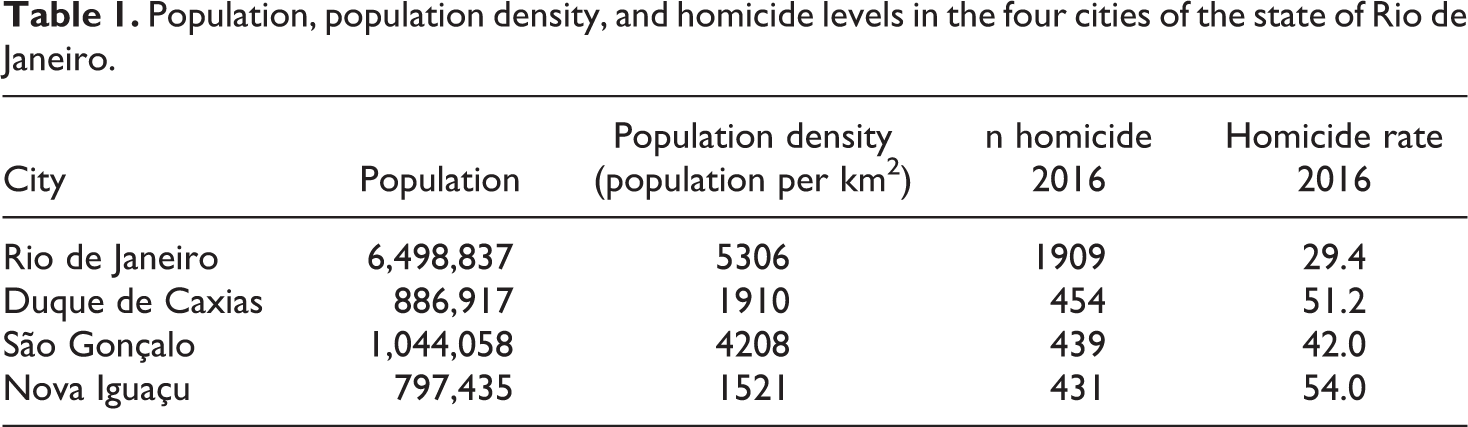
Recorded homicide data for the period 1 January 2016 to 31 December 2016 were used. These data refer to the occurrence of violent deaths (in Portuguese, letalidade violenta), which is equivalent to the health sector measure of homicide used in Brazil (MVLI: mortes violentas letais intencionais). The homicide data included intentional incidents, robberies that resulted in a homicide, other incidents where a person was injured which subsequently resulted in their death, and police killings. 2 In circumstances where two people were killed during a single event, this was recorded as two occurrences of homicide. The data were recorded by the Policia Civil of the State of Rio de Janeiro and were further checked for their quality and accuracy by the Rio de Janeiro Institute of Public Safety (ISP: acronym in Portuguese). ISP performed the geographic referencing of the homicide data using their advanced systems. This involved geographically referencing each homicide (using address and location information recorded for the homicide) to the location where the offence was recorded to have been committed (Mendes de Miranda and Ferreira, 2008). The seriousness of each offence meant that the Policia Civil visited each crime location, with their procedures requiring them to record detailed information on the location that would allow for accurate geocoding using ISP’s systems. The geocoding hit rate was 94 percent, above the 85 percent minimum threshold for reliability suggested by Ratcliffe (2004). For the data period, 3,233 homicides were recorded by the police. Homicide rates for each city ranged between 29.4 homicides per 100,000 population in Rio de Janeiro and 54.0 in Nova Iguaçu (see Table 1).
Population, population density, and homicide levels in the four cities of the state of Rio de Janeiro.
Street segments have been the micro-place unit of choice for most studies of crime concentration. In several Latin American cities street segment files do not exist, therefore, micro-grid cells can offer a practical alternative for aggregating crime data to a common geographic unit. Micro-grid cells have also been used in other studies of micro-place crime concentration, with these studies addressing any limitations in their use (Chainey and Monteiro, 2019; Hipp and Kim, 2017; Mohler et al., 2017). These limitations do not present issues for the current study. In Rio de Janeiro, authorities examine micro-place patterns of crime using 150 metres * 150 metres grid cells. These grid cells only cover built up areas, usable open spaces and the street network, rather than including mountains and inaccessible densely forested areas. Grids cells of 150 metres * 150 metres are comparable to the average street segment length of 144 metres used by Weisburd (2015) and were used for micro-place data aggregation.
The number of homicides within each grid cell for 2016 was calculated, from which the number of grid cells representing the most criminogenic 25 percent and 50 percent of all grid cells in each city was determined. Additionally, Lorenz curves and Gini coefficients were calculated to compare the concentration of crime across all places. Generalised versions of the Lorenz curve and the Gini coefficient were also calculated to address the issue of bias when there are more places than crimes (Bernasco and Steenbeck, 2017), as is typical with homicides. Although other techniques can help further examine the geographic clustering of crime (e.g., Local Moran’s I and the Gi* statistic), the research used the method described for comparing crime concentration against similar studies.
The analysis of single events involving multiple homicides and homicide near repeats used the original geographically referenced point data. Single events involving multiple homicides were identified in the data as those incidents that took place at the same location and same time. Additionally, homicides that took place in very close proximity (within 10 metres and within 1 hour) of a previous incident were examined to determine if these incidents were associated with the same event or were separate. This also helps to cater for any margin of error in the geocoding of homicides that occurred at the same location. This data checking process revealed no additional records to add to previous single events. The number of multiple homicide incidents were calculated for each city. Homicides could occur at the same location, but with substantial time between them. We do not include these types of incidents as repeats in our analysis but return to these types of occurrences in the discussion section.
Near repeats were identified using the Near Repeat Calculator, a tool that applies a Knox test for space-time clustering for generating observed over mean expected frequencies of near repeats (Ratcliffe, 2009). The analysis of near repeats involved examining the distance and time between homicides to determine if the pattern of near repeats was statistically significant. The spatial bandwidth in the Near Repeat Calculator was set to 150 metres for ease of comparison with the size of grid cells, and four bands were applied (i.e., < 150 metres, 151 to 300 metres, 301 to 450 metres 451 to 600 metres). 3 The temporal bandwidth in the Near Repeat Calculator was set to 3 days and three bands were applied (i.e., 0 to 3 days, 4 to 6 days, 7 to 9 days). These bandwidths were used because it is the examination of near repeats soon after and close to a recent incident that is of most practical interest, and are comparable to those used in previous studies of near repeat victimisation (Chainey and de Silva, 2016; Chainey et al., 2018).
Although a statistically significant pattern of near repeats may be present, this does not indicate how many incidents are categorised as near repeats. Additional analysis was conducted using the ESRI ArcGIS Crime Analysis Repeat and Near Repeat Classification tool (ESRI, 2018) to determine the number of homicide near repeats. Bandwidths of within 150 metres and 3 days, within 300 metres and 3 days, and within 300 metres and 7 days of an originator offence were chosen for practical purposes, following the procedures in-line with those used in the Near Repeat Calculator to test for statistical significance, and following the advice provided in Chainey et al. (2018) for estimating the potential crime reduction outcomes that could come from operational strategies that aim to prevent near repeats.
Hot spots of homicide for each study area were produced using the results from the crime concentration analysis. 4 Areas of high crime concentration that accounted for 50 percent of all homicides in each city were compared to the geographic distribution of near repeats and the distribution of single events involving multiple homicides.
Results
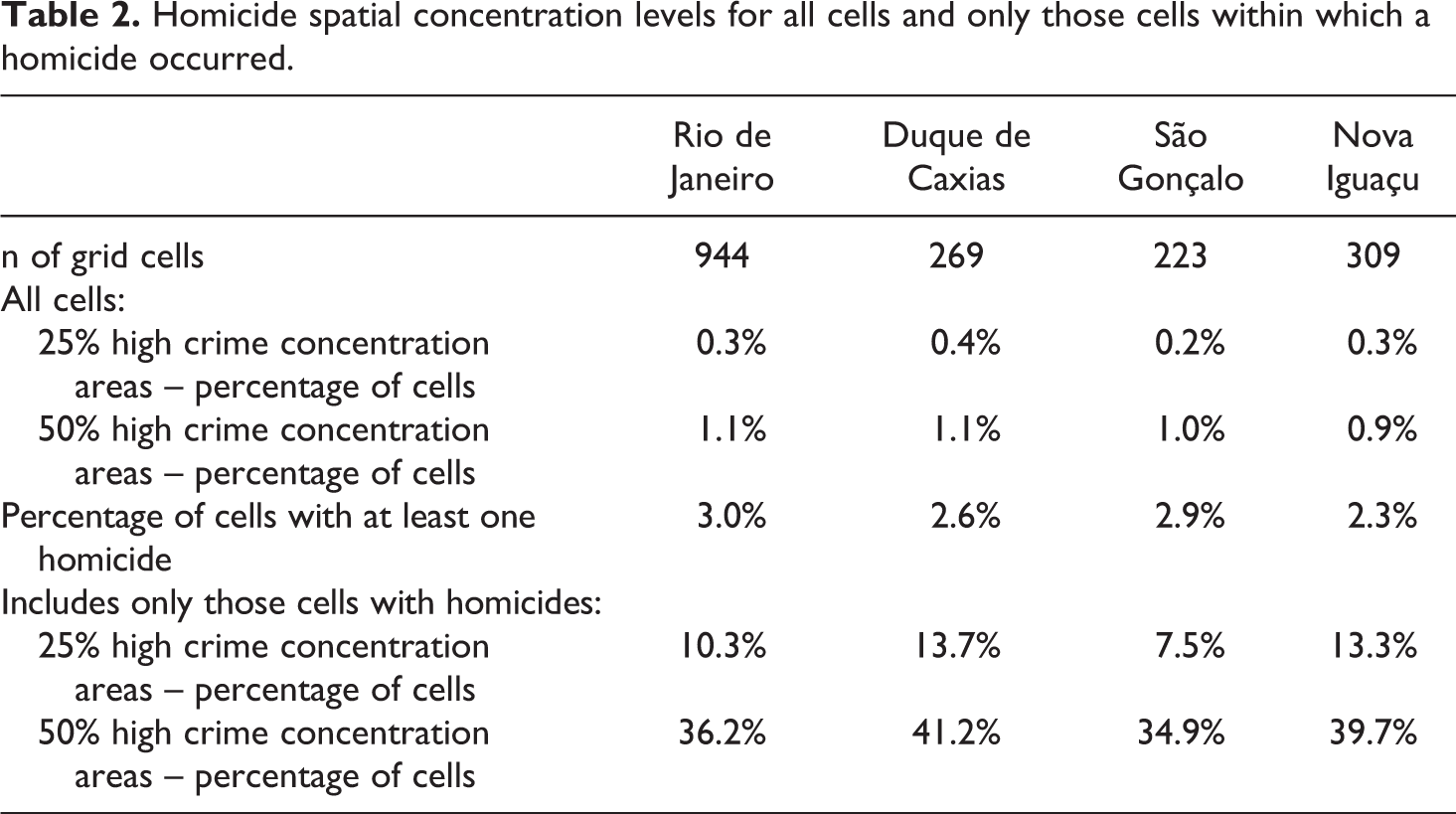
Homicides were highly spatially concentrated in each of the four cities in the state of Rio de Janeiro (Table 2). In each city, no more than 0.4 percent of places accounted for 25 percent of homicides and no more than 1.1 percent of places accounted for 50 percent of all homicides. The levels of homicide concentration differed little between each city, did not appear to relate to the population density of each city (comparing Table 2 results to population density data in Table 1), and in each case homicide concentration was greater than the concentration levels of crime observed by Weisburd (2015) and many other examples of crime (Lee et al., 2017). Homicide concentration levels were consistent with crime concentration patterns in Latin American settings observed by Chainey et al. (2019). However, no more than three percent of places in each city experienced a homicide. When only cells with homicides were considered, homicides were still highly concentrated, but less so than observed in other studies using generalised versions of the Lorenz curve and the Gini coefficient (Bernasco and Steenbeck, 2017).
Homicide spatial concentration levels for all cells and only those cells within which a homicide occurred.
An example of the spatial concentration of homicides in the four cities is shown for São Gonçalo in Figure 1. This example illustrates the high concentration of homicides when all places are considered, and how the Lorenz curve differs when only cells with homicide are considered (Lorenz curves for the other three cities are not reproduced here because they showed similar patterns 5 ). In each city, the Gini coefficients for homicide concentration were the same when not correcting for bias (0.98 – Table 3), further illustrating the high level of spatial concentration of homicides. However, the generalised Gini’s varied between 0.27 for Duque de Caxias and 0.40 for São Gonçalo suggesting the concentration of homicides was greater in São Gonçalo than in Duque de Caxias. This variation in homicide concentration did not appear to relate to variations in size of the city, population density, the number of homicides or homicide rate.
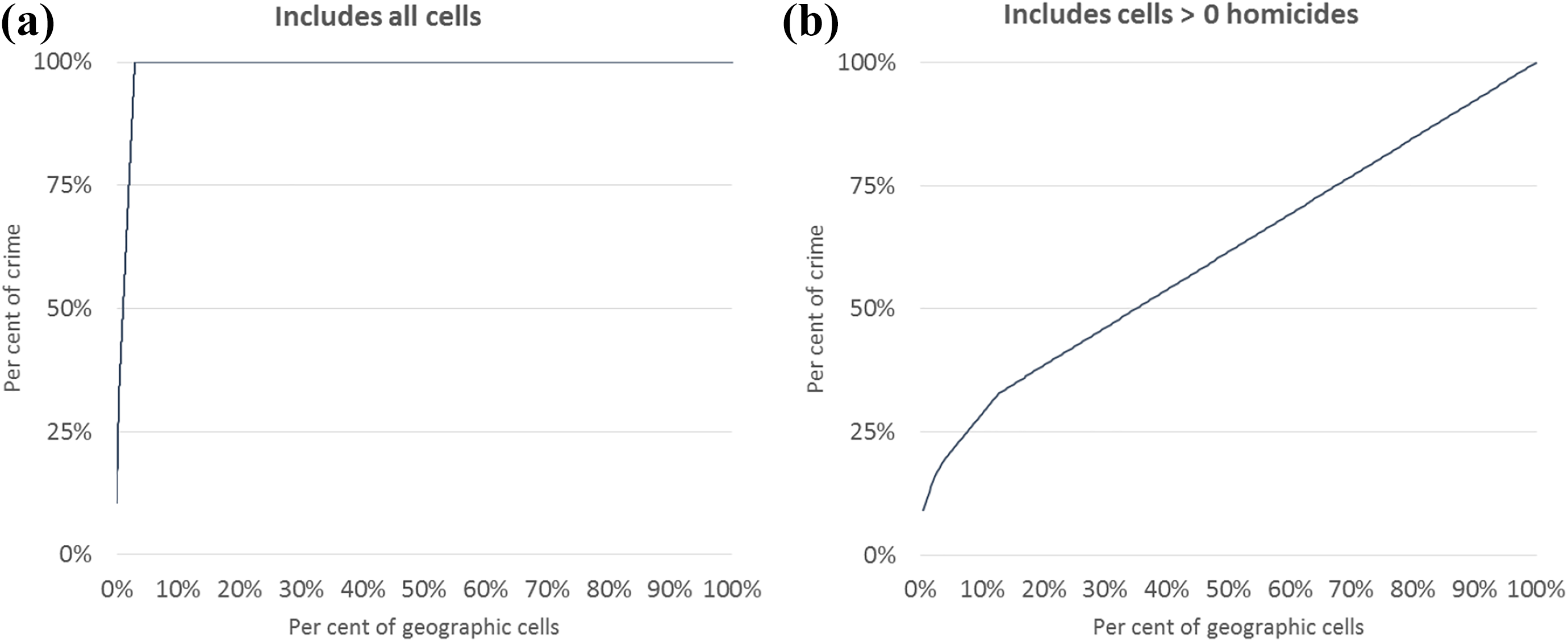
São Gonçalo (a) concentration of homicide for all places and (b) concentration of homicide for only those places with homicide.
Gini coefficients and generalised Gini coefficients of the spatial concentration of homicide.
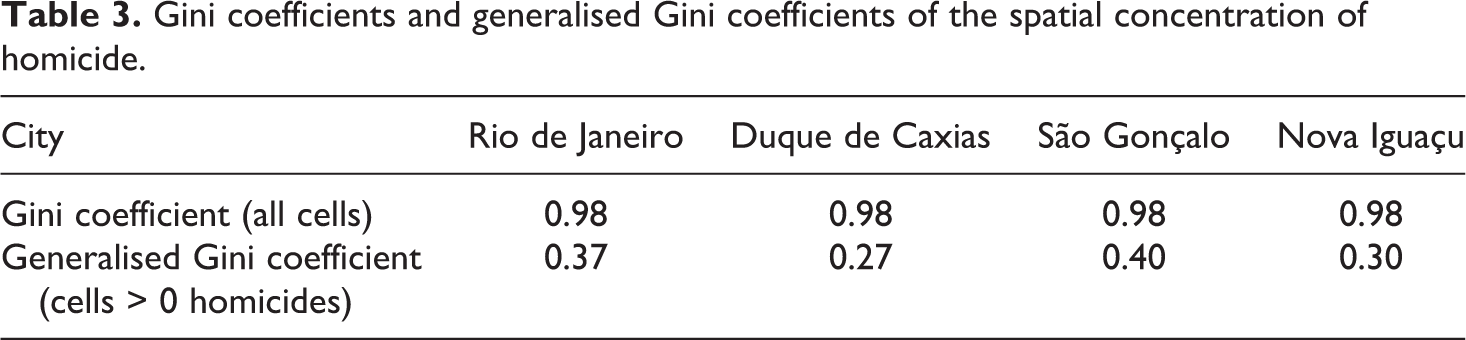
Table 4 shows that the pattern of homicide near repeats was statistically significant in each of the study areas (p < 0.05), and consistently strongest within 150 metres and 3 days of a previous incident. For example, in Duque de Caxias, the chance of another homicide taking place within 150 metres of where a previous homicide had been committed within the previous 3 days was 850 times greater than expected. A significant homicide near repeat pattern was also observed in Duque de Caxias within 3 days and 301 to 450 metres of a previous homicide, but the strength of this near repeat pattern was lower. These findings were consistent with the theoretical principal that the likelihood of another incident decreases with distance from a previous incident.
The presence of homicide near repeats (p < 0.05). Blank cells represent non-significant results.
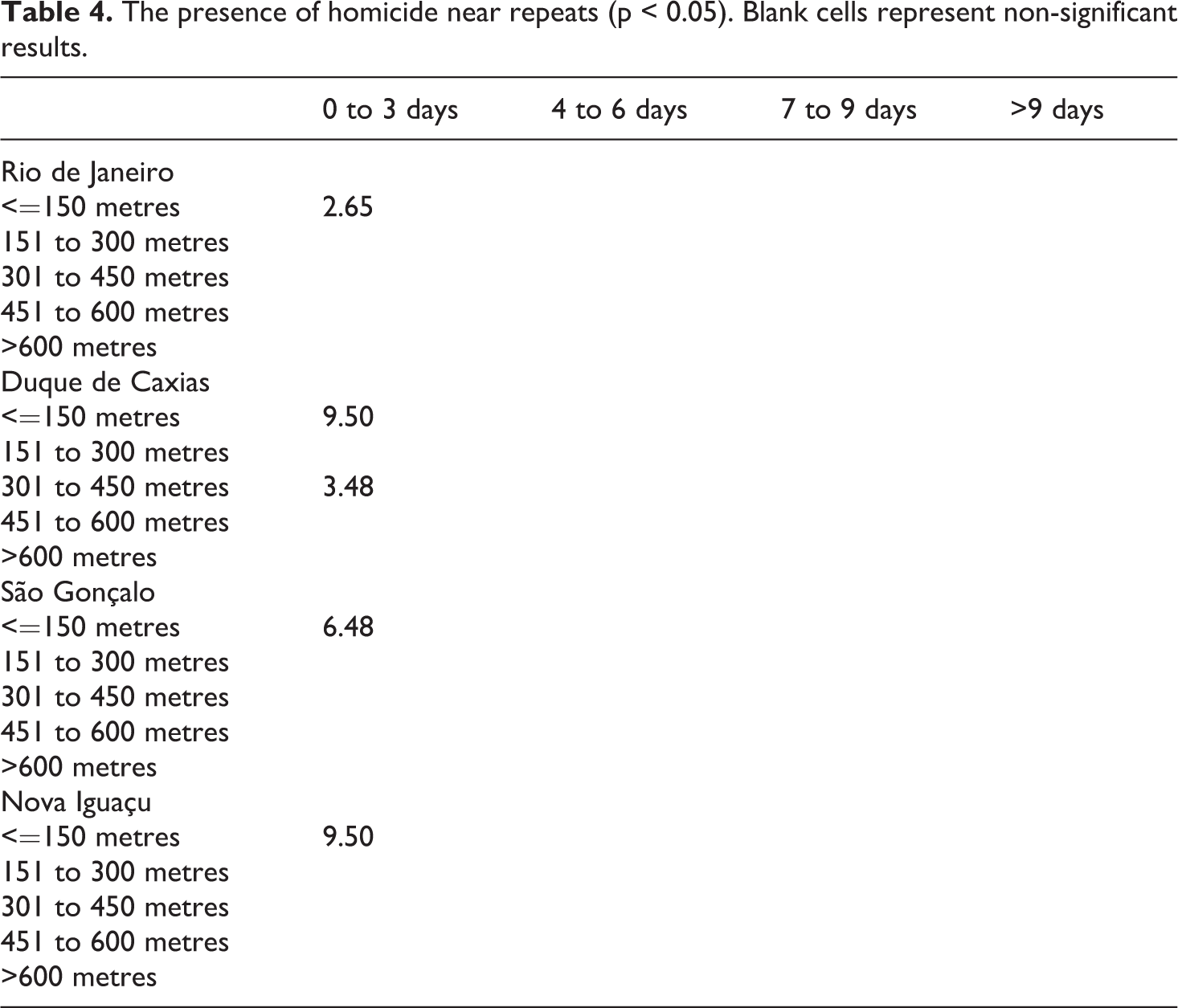
Table 5 shows that single events involving multiple homicides accounted for 10.5 to 20.7 percent of all homicides in each city. Homicide near repeats, defined in terms of homicides taking place within 300 metres and 7 days of a previous homicide, accounted for 3.2 to 6.1 percent of homicides across the four study areas, equivalent to 109 homicides committed in 2016.
Multiple homicides and homicide near repeats.
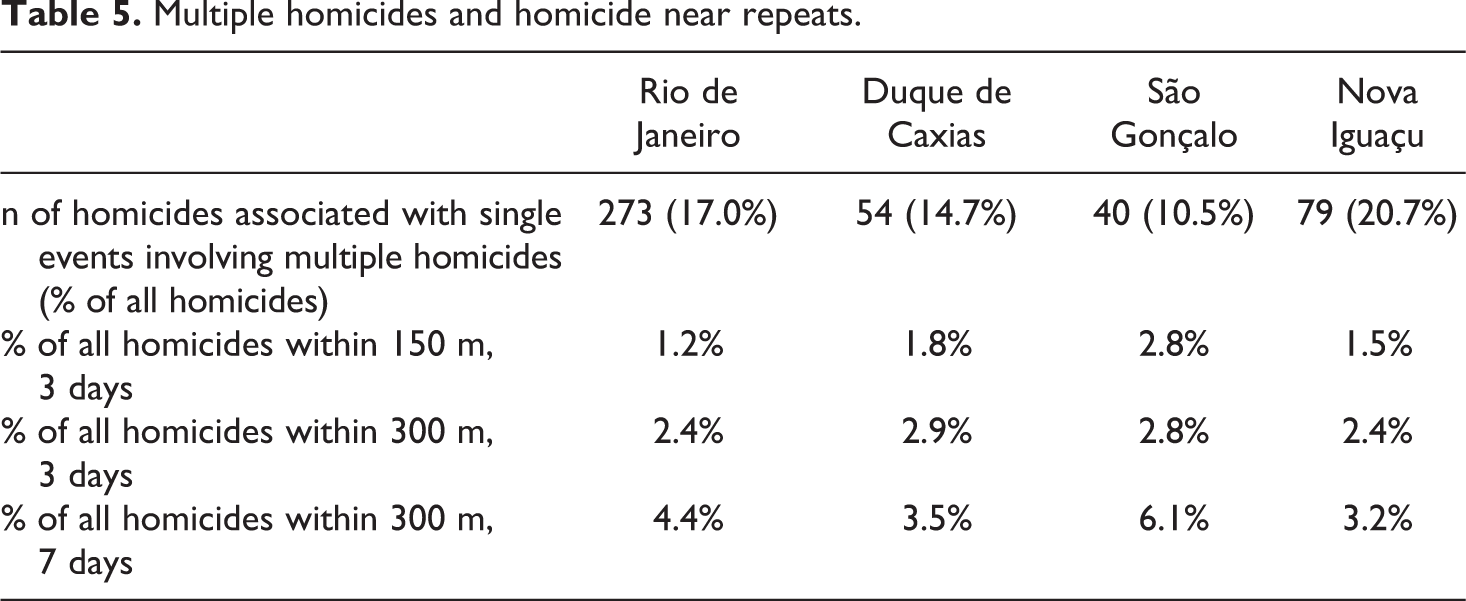
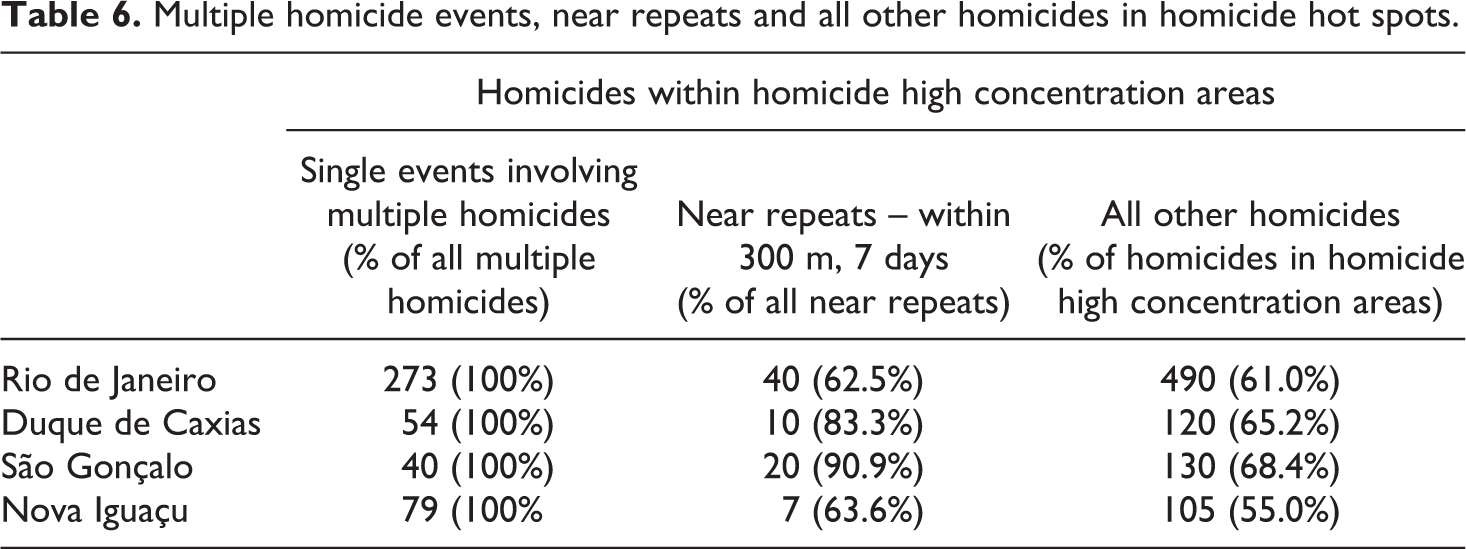
Table 6 shows the number and proportion of single events involving multiple homicides and homicide near repeats that took place in the homicide high concentration areas (hot spots) in each city. All incidents involving multiple homicides took place in these hot spots, indicating these single events contributed to defining why an area experienced a high concentration of crime. Additionally, 63 percent to 91 percent of all near repeat incidents took place in these hot spots. Although single events involving multiple homicides and the majority of near repeats occurred within the hot spots, over half of homicides that took place in these hot spots were other homicides. For example, in São Gonçalo two-thirds of the homicides (representing 130 homicides) in the city’s homicide hot spots were not associated with any multiple homicide events or near repeats (Figure 2). This suggests that areas of high crime concentration are not just defined as being locations where multiple homicide events take place, but are also defined by high volumes of other homicides.
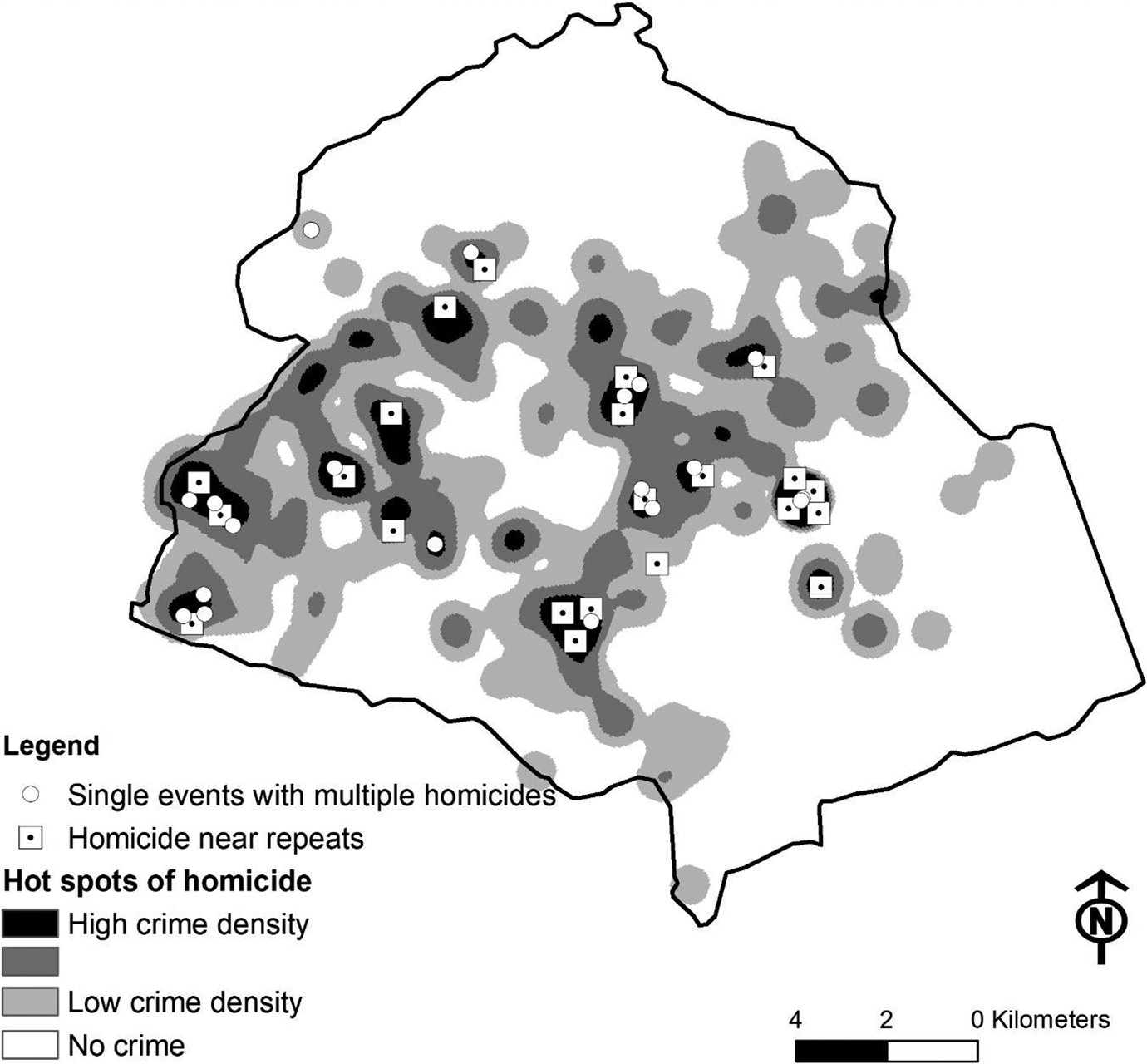
Homicide hot spots, homicide near repeats and single events involving multiple homicides in the city of São Gonçalo, Brazil.
Multiple homicide events, near repeats and all other homicides in homicide hot spots.
Discussion and conclusion
Using data from the four most populous cities of the state of Rio de Janeiro, homicides were found to highly concentrate in places, and more so in comparison to that predicted from observations of crime in western industrialised settings (Weisburd, 2015). This finding for homicides is consistent with the overall higher levels of crime concentration that have been observed in Latin American cities in comparison to other regions in the world (Chainey et al., 2019). The current study also showed the benefit of using a variety of crime concentration measures to reveal differences in crime concentration that were not apparent when simpler measures were used. For example, crime concentration levels using Weisburd’s crime concentration bandwidths and Gini coefficients were very similar for Duque de Caxias and São Gonçalo. However, the generalised Gini for Duque de Caxias was 0.27 compared to 0.40 for São Gonçalo, suggesting the concentration of homicides was greater in São Gonçalo than in Duque de Caxias.
Many discussions on explaining micro-place patterns of crime concentration have drawn from routine activities, rational choice and crime pattern theoretical principles (Weisburd and Telep, 2014). These principles focus on the opportunities for crime associated with the interaction and behaviours of people within the situational environment. Although the current study did not examine underlying situational conditions relating to the concentration of homicide, further examination of the homicide hot spots identified them to be located in deprived areas of each city. A significant body of research on the spatial heterogeneity of homicide shows social inequality and income to be consistent social-structural explanatory determinants. We posit that patterns of homicide concentration are likely to be influenced by a combination of social-structural neighbourhood conditions and the situational environment. Determining the extent of influence to which one has over the other on crime concentration is something we consider further below.
The results presented provide the first known findings of homicide near repeat victimisation, and the level to which single events involving multiple homicides and homicide near repeats occur in areas of high homicide concentration. Single events involving multiple homicides accounted for up to one in five of all homicides in each study area, with all located within homicide hot spots. The pattern of near repeats in each study area was statistically significant, and accounted for up to 6.1 percent of all homicides in each city. Although this level of near repeats was less than that observed in studies of burglary, it was noticeable that most homicide near repeats were observed within 150 metres of where previous incidents had occurred. We speculate these near repeats were associated with retaliation, revenge or escalation incidents and consider the theoretical basis for this below. Additionally, up to 9 out of 10 homicide near repeats were committed in the homicide hot spots. Overall, approximately a third to a half of all homicides in homicide hot spots were near repeats or single events involving multiple homicides.
Previous studies that have examined patterns of repeat victimisation and near repeat victimisation have used the boost account, flag account and optimal foraging theoretical perspectives to explain these patterns. Most uses of these theoretical perspectives have been applied to property crime. The boost account contends ‘that victimisation educates the returning offender about what he or she will encounter, so that [repeat] victimisation [against a target] becomes more likely’ (Pease, 1998: 8). Although the boost account cannot be applied to homicide against the same person, its principles can be used to explain multiple homicide incidents. That is, boosted by the success of killing one person, the same offender kills (attempts to kill or seriously injures) other people present when the first person was killed (such as associates of the first victim or witnesses to the event). 6 With consideration to optimal foraging, the same offender seeks to kill (or seriously injure) others, and do so quickly after and close to a previous incident. The flag account for explaining repeat victimisation refers to an enduring level of risk against a target. When a person has been killed, any enduring risk of victimisation against this person no longer exists. Hence, the flag account is less relevant for explaining other homicides that are part of a single event. However, more than one homicide could occur at the same location, with substantial time between each incident. For these occurrences, the flag account may refer to some enduring risk associated with that specific location.
Further inspection of the homicide data identified that many were committed when more than one offender was present. Most studies of repeat victimisation, and the application of the boost account have been applied to the behaviour of single offenders, rather than groups of offenders. Although described as being relevant to groups (Bowers and Johnson, 2004), to complement the boost account we introduce the group account that is explicit to group offending and subsequent offences, and in particular to reflect on the involvement of groups in the commission of serious violent crime. While the boost account refers to the same offender, or group of offenders returning to commit subsequent crimes, the group account refers to the involvement of individuals from either group (the group from which the offender or victim for the first offence belongs) in the commission of subsequent crimes. When two groups confront each other it is likely that a combination of boost account and group account principles are active. For example, when an offender kills an individual from a rival group, and other individuals from the rival group are present, the rival group may immediately retaliate and kill the offender of the first offence or other individuals present who are members of the offender’s group. The group account complements the boost account to explain single events involving multiple homicides.
We also posit that the group account provides an additional explanation to the boost account and optimal foraging theory for explaining homicide near repeats. The group account refers to other individuals being the victim of a homicide, shooting or other serious injury (e.g., stabbing) because these individuals are members of a group involved in the first incident (be it members of the group from which the victim of the first incident belongs or members of the group from which the offender who committed the first incident belongs). The boost account refers to the same offender, or group of offenders, associated with the first incident returning. The group account refers to any group members associated with the first incident (be they from the offending or victim group) returning to commit subsequent incidents. With consideration to the ecological principles of optimal foraging, the group is akin to a pack that seeks out targets to kill (or seriously injure), and do so quickly after a previous incident. We suggest that a combination of the boost account, group account and optimal foraging concepts can explain near repeat patterns for homicide, shootings or serious injury associated with retaliation, revenge, coercion, cooperation or escalation. Although the current study did not test the group account, we use our observations from this study to introduce it as a theoretical concept for understanding group involvement in the commission of crime, in particular homicide and other acts of serious violence, and recommend further research that empirically examines the group account explanation.
When crime is observed to highly concentrate at micro-place levels, this provides an opportunity to design and target programmes that aim to counter the specific conditions that give rise to criminal activity. The finding that homicides highly concentrate in places suggests there is an opportunity to target interventions to a very small number of areas. Hot spot policing is an effective type of intervention used for decreasing crime in areas where crime is observed to highly concentrate (Braga et al., 2019). Hot spot policing is, however, more suited to when there are higher volumes of crime, such as street robberies, rather than rarer incidents such as homicides. Violence interrupter programmes, involving trained individuals working in local communities to supress violence, have contributed to significant reductions in homicide (Ward et al., 2018; Whitehill et al., 2014). Although implemented in neighbourhoods that experience high rates of homicide, to date these programmes have not drawn from the empirical evidence of near repeat patterns and micro-place homicide concentration to determine the specific areas where violence interrupters are deployed. As homicide near repeats and single events involving multiple homicides appear to mainly occur in areas of high homicide concentration, this suggests that the specific targeting of violence interrupters to these areas may offer additional benefits to the impact this intervention is known to have. In particular, if any homicide incident occurs in any area identified as a homicide hot spot, this can signal the immediate need for a violence interrupter to respond to this area to prevent any further incidents occurring. This may not only suppress near repeats from occurring, but also other homicides that are prone to take place in these areas of high homicide concentration.
Boost account, group account, and optimal foraging theoretical concepts relate to opportunities for crime associated with the interaction and behaviours of people within the situational environment. At least a third to half of all homicides in homicide hot spots were single events involving multiple homicides and near repeats, and can be explained using these theoretical principles. This indicates the likely minimum level to which situational factors contribute to homicide in these hot spots, rather than these homicides primarily being determined by socio-structural factors. It also indicates the potential impact that targeted police and public safety interventions could have when countering these situational behaviours. The homicide hot spots also are likely to exist because of the socio-structural conditions that are present in these locations. Programmes that address socio-structural conditions tend to focus on neighbourhoods or larger areas within cities for programme implementation. To ensure programmes that address socio-structural conditions have impact, consideration should be given to the focused targeting of these programmes so their intentions are not diluted in the locations where homicides highly concentrate.
The spatial conditions that give rise to areas becoming high homicide concentration areas may also be the same spatial conditions that create hot spots for other crime types. The analysis of the distribution of homicide hot spots in comparison to the hot spots of other higher volume crime types would be a topic worthy of further research. For example, hot spot policing is particularly effective in decreasing street robbery (Braga et al., 2019). If street robbery hot spots are located in the same areas as homicide hot spots, this may make hot spot policing a viable type of intervention for decreasing homicides and robberies that are experienced in the same locations.
The homicide data used in the current study was considered to be reliable for the analysis conducted. While issues associated with under-reporting and content are always present when reliant on data recorded by police agencies, the homicide data used in this study underwent rigorous checking by ISP to ensure it was fit for the purpose of this study. The data, however, did not allow for non-domestic and domestic homicide incidents (e.g., when a husband murders his wife) to be separated. Geographic patterns of domestic homicides can be quite different to those that are non-domestic. This limitation may have affected the results. On closer inspection of the areas of high homicide concentration, these areas were most associated with non-residential areas suggesting that domestic homicides were unlikely to have occurred in these high concentration areas. If domestic homicides could be excluded from the analysis, the overall pattern of homicide concentration would likely be even more concentrated than our results have shown. This is because the inclusion of domestic homicides is likely to contribute to a wider spatial dispersion of homicide incidents across a study area. Further research on the spatial and temporal distribution of homicides that separates domestic and non-domestic homicides would add greater specificity to an analysis of these types of homicide, and reveal patterns that are different to each type. This greater level of specificity could also include examining crime concentration and near repeats patterns of intentional homicides, police killings and other crimes that result in death, and if the type of weapon used influences the patterns observed.
Homicide rates in Latin America are several times higher than those in most other parts of the world, and have remained stubbornly high for decades. The conditions that give rise to these homicide problems are multi-faceted. Social inequality can undermine collective efficacy, family disruption and school absenteeism can influence the risk of homicide, and a weakness in state institutions can result in the inadequate provision of citizen security and protection. Policies and programmes that aim to address these issues are merited but can be difficult to implement and take time to have impact. Furthermore, as it is police agencies and security ministries that are typically assigned the task of leading on homicide reduction (particularly when there is urgency to address an increase in homicide), demographic and socio-economic factors are not variables under their control to influence. Crime commission is also defined by the convergence in space and time of offenders who are motivated to commit a crime, and targets that are vulnerable to victimisation.
As the current research has shown, homicides concentrate at the micro-place scale. Patterns of homicide concentration are likely to occur because of a combination of structural factors present in certain neighbourhoods, and situational characteristics that make criminality more likely in specific locations. Boost account and optimal foraging theoretical principles help to explain the offending behaviours that relate to homicide near repeats and single events that involve multiple homicides, with these incidents most likely to occur in areas of high homicide concentration. The group account is introduced to help further explain these crime patterns. Collectively, the findings suggest there is potential in helping to decrease homicides if programmes are targeted to areas of high homicide concentration. Moreover, by specifically targeting multi-sectoral programmes that address structural factors to the neighbourhoods where homicides concentrate, alongside targeting programmes in the same areas that aim to counter the offending behaviours associated with escalation, retaliation, and revenge, the combination of these programmes may help address the conditions that give rise to these lethal patterns of crime.
Footnotes
Declaration of conflicting interests
The author(s) declared no potential conflicts of interest with respect to the research, authorship, and/or publication of this article.
Funding
The author(s) received no financial support for the research, authorship, and/or publication of this article.
