




Abstract
Mobile neighbourhood crime prevention has become increasingly popular in the Netherlands. Since 2015, 7,250 WhatsApp neighbourhood crime prevention (WNCP) groups have been registered online, most of which are initiated and moderated by citizens. This entails a form of participatory policing aimed at neighbourhood crime prevention, which may provoke increased feelings of anxiety and interpersonal surveillance. Community police officers and citizens need to adapt to changed interactions and trust relations in the neighbourhood. This mixed-methods research examines both the mediation of messaging applications and its implementation by both citizens and police, indicating the tensions and negotiations around formal and informal ‘policing’.
Introduction
Safety is not only a task for police and the judicial system. Citizens, companies, and organisations are jointly responsible.
It is only recently that mobile phone-based neighbourhood crime prevention (buurtpreventie in Dutch) messaging groups have emerged in ways that both supplement and supplant the patrol-focused neighbourhood groups. At present, these messaging groups rely upon mobile phone applications which connect neighbours and enable real-time discussions about safety and (potential) criminal activity. WhatsApp neighbourhood crime prevention (WNCP) groups are currently active in more than 7,250 neighbourhoods across the Netherlands and Belgium (WhatsApp Buurtpreventie, 2017), far greater numbers than their patrol-focused neighbourhood crime prevention counterparts. Within these mobile device-based groups, neighbours are connected via a chat application. Most often in the Netherlands this is through the application WhatsApp, but alternatives like Telegram and Nextdoor are also gaining popularity. These applications facilitate neighbours in exchanging warnings, concerns, advice and information about neighbourhood safety, and often the moderators of these groups are in contact with community police officers and/or with other neighbourhood watch group moderators.
The emergence of these groups has been rather spontaneous and unorganised. What is clear is that these groups first appeared in the past four to five years, with this becoming more organised recently. Professional organisations such as Nextdoor promote neighbourhood applications and in June 2015, a connection site emerged that allows persons to find and connect to different Whatsapp neighbourhood crime prevention groups (see https://wabp.nl/). It seems that the proliferation of smartphones, reliably available and affordable mobile data, the high penetration rates of particular messaging services like WhatsApp, a societal propensity towards ‘openness’ and a ‘long history advocating cooperation in the fight against so-called petty crimes’ (van Eijk, 2017: 5) have come together to make the mobile monitoring of neighbourhoods both desirable and accessible. As such, according to a recent study, WhatsApp neighbourhood crime prevention groups have led to a significant and prolonged decline of burglaries in certain neighbourhoods in the Dutch city of Tilburg (Akkermans and Vollaard, 2015). Yet this constant contact among neighbours can also result in increased interpersonal surveillance, ethnic profiling, vigilantism, increased anxiety, communication overload and tensions among participants (Lub, 2016). These practices can be seen as ‘do-it-yourself’ (DIY) policing, and the Netherlands has been mentioned as fulfilling a forerunner role in successfully using and encouraging DIY policing activities (van Dijk et al., 2014).
This might also be seen as a form of ‘participatory policing’ in which citizens, akin to the ‘If you see something, say something’ movements perpetuated by various homeland security agencies (see Larsson 2017), are encouraged to report to the police on suspicious activities they see. However, describing these practices simply as ‘participatory policing’ highlights only one aspect of mobile message-based neighbourhood watch groups. An empirical study of the participants in these groups reveals a rather complex and nuanced set of potentials and problems experienced by users on a daily basis. As such, and while most literature on neighbourhood watch groups is focused on the physical presence of patrolling groups or individuals observing neighbourhood practices, this study makes an initial examination of the mobile messaging groups in a large urban context in the Netherlands and their relationship to traditional policing. The focus here on mobile messaging devices shifts our attention towards the means by which communication technology facilitates and changes the ‘policing’, both informally and formally, of neighbourhoods. As such, this paper takes into account both the mediation of messaging applications and its implementation by both citizens and police. The relation between police and citizens proves to be delicate yet crucial for the effective functioning of participatory policing. As described below, this research is based on an exploratory mixed-methods study done in Rotterdam, the Netherlands with a number of citizen and police informants and a small-scale quantitative survey of citizen mobile neighbourhood watch messaging participants.
Concerns and potentials in relevant literature
This research sits at the intersection of a number of different social phenomena and research studies that raise both issues and potentials for relations between citizens and police. In current research and reports, these include a transition to digital monitoring, a number of boundary-crossing concerns from professional roles to privacy invasiveness, active citizen participation and trust in the police. Each of these have helped to frame this research and informed our results.
Digitally patrolling the neighbourhood: WhatsApp neighbourhood crime prevention (WNCP)
Citizens seem increasingly eager to join policing efforts to create safer neighbourhoods for themselves. A primary means for accomplishing this has been through organising and participating in neighbourhood watch patrol teams. However, as noted, in the Netherlands these have been supplemented and largely overtaken by the use of mobile messaging applications such as WhatsApp neighbourhood Crime Prevention (WNCP) groups. In these contexts, neighbours inform each other about suspicious situations through this messaging application. Recently, a body of literature has emerged about these groups in the Netherlands, consisting of reports issued by municipalities, local governments and police. These reports explore how, with the intention of preventing burglaries and other minor criminal activities, citizens aim to create more watchfulness among their neighbours (Akkermans and Vollaard, 2015; Bervoets, 2014; Bervoets et al., 2016; De Vries, 2016; Lub, 2016; Van der Land et al., 2014). WNCP groups were initially most often an extension of neighbourhood watch patrolling teams (Bervoets, 2014), but more recently have become independently organised in neighbourhoods without the presence of these ‘physical’ neighbourhood watch teams. In contrast to police-initiated digital neighbourhood watch projects (such as Project Eyewatch in Australia, see Kelly and Finlayson, 2015), WNCP groups are most often initiated by citizens. However, community police officers and municipalities actively participate in some of these groups (Akkermans and Vollaard, 2015; Bervoets 2014; Van der Land et al., 2014). WNCP groups generally have a bottom-up, network-like structure, with partners collaborating on equal footing, and are not connected to existing organisational structures (Van der Land et al., 2014). WNCP groups are frequently accompanied by a Facebook page and/or Twitter account (Bervoets et al., 2014).
According to Bervoets (2014), mobile messaging crime prevention groups can be more efficient than patrol-focused neigbourhood teams, because they have a lower participation threshold and require less intensive commitment efforts of citizens, municipalities and police. The low threshold of WhatsApp group participation is often mentioned as the major reason for the popularity of these groups in the Netherlands (Bervoets, 2014; Bervoets et al., 2016; Van der Land et al., 2014). The use of WNCP groups is said to result in increased social control and decreased social problems (Bervoets et al., 2016), with more alert citizens and collective empowerment (Lub, 2016), feelings of usefulness, increased social cohesion, and benefits for police services (Van der Land et al., 2014). More specifically, a study measuring burglary rates before and after the start of 35 WNCP groups in Tilburg reports a 40% decrease in burglaries in that area (Akkermans and Vollaard, 2016). The authors explain this effect by highlighting that public attention to these groups can have a deterrent effect on burglars, that participating neighbours become more alert and more willing to contact the police or their neighbours, and that citizens take more measures to prevent burglaries (Akkermans and Vollaard, 2015). However, existing literature not only addresses the positive effects of the use of WNCP groups, but also notes its possible pitfalls.
WNCP group concerns: Crossing police boundaries and invading privacy
The potential positive aspects of participating in these groups raise a different set of concerns stemming from this new relation between citizens and police. Specifically, these are: the implicit risks within DIY or participatory policing that allow citizens to act as ‘would-be police officers’ without any form of training; whether citizen policing initiatives decrease trust among citizens; and how to hold citizens accountable for their actions. What is clear is that citizens empowered by the information from WNCP groups can lead to harmful effects if acted upon irresponsibly (Van den Brink et al., 2016). The physical counterpart to these groups, patrol-focused neighbourhood teams, have been critiqued as creating negative effects, such as increased feelings of unsafety, the stigmatisation of groups, impulsive and possibly violent citizen actions and disproportionate social control (Lub, 2016; Van der Land et al., 2014). Lub (2016) argues that while the purpose of WNCP groups is to detect and report suspicious situations, citizens’ interpretations of suspicious behaviour can differ as they are guided by subjective feelings and beliefs. This can result in harmful stereotyping and racist behaviour (De Vries, 2016; Lub, 2016). These concerns highlight the thin line between citizens taking appropriate action and acting as less than legitimate law-enforcers.
This is in part due to the ease of use in relation to the technology. While the low threshold makes it easy for citizens to join, use and moderate WNCP groups, the ease of sending a message out on a WhatsApp group raises other issues. First, as this communication channel is used for a variety of other conversations, with messages sent within seconds, it is often impulsively used. WNCP group moderators often have to deal with irrelevant content and struggle to prevent noise in the conversations (Bervoets, 2014). Second, with the wide reach of conversations and the ease of further distributing content digitally, users are able to publicly name and shame fellow citizens by publishing names or pictures. Finally, some of the use of WhatsApp neighbourhood groups transcends the interpersonal sphere and concerns its commercial nature. Unsurprisingly, commercial parties have taken an interest in this phenomenon and services emerged selling collected information about WNCP groups (numbers of users, moderators, etc.) to municipalities and other interested parties (Bervoets et al., 2016). This commercial interest can lead to unwanted commercial surveillance, which is particularly sensitive when personal details are connected to specific neighbourhood locations.
These concerns about surveillance likewise raise concerns about privacy for WNCP group members. For instance, mobile phone numbers are visible for all group members that are a part of WhatsApp groups, something De Vries (2016) says can lead to privacy issues and judicial problems when police officers are members in the groups. Moreover, there are concerns about interpersonal/lateral surveillance and police surveillance as a risk of participating in WNCP groups. Some more specific mobile messaging privacy concerns are related to the limited privacy literacy of users with regard to aspects like locational privacy (Park and Jang, 2014), specific WhatsApp settings and its open nature (Church and De Oliviera, 2014), and things like the ‘last seen’ feature leading to strong expectations and social pressure (Pielot et al., 2014).
Active citizens with a strong sense of community
Despite these concerns, WNCP groups are about safety in neighbourhoods and about communicating information within these neighbourhoods, both of which are in part the basis for community. Prior academic research illustrates how social cohesion within neighbourhoods helps people to deal with unfavourable environments and may reduce crime (Sampson et al., 1997). According to (Chavis and Wandersman, 1990), a sense of community helps citizens improve their environment as people experiencing a sense of community are more encouraged to take action. This sense of community improves one’s perception of the environment, neighbour relations, and perceived control and empowerment within the community. A sense of community is both a trigger and a result of neighbourhood participation (Chavis and Wandersman, 1990). Moreover, there is a strong relationship between a sense of community and active citizenship, as feelings of membership, interpersonal sharing and emotional connection (i.e. a sense of community) have been shown to be significantly related to active participation in community actions (Talò et al., 2014).
However, it is not clear whether active citizenship and active participation in community actions always leads to a safer neighbourhood. While a highly active citizenship might be related to a safe environment, it might also lead to higher risks for the active citizens (Van Steden et al., 2011), which themselves are determined in part by the type of environment and type of housing (Cozens et al., 2002). Additionally, Van den Herrewegen (2010) indicates that active citizenship can also be detrimental to feelings of safety because active citizens do not always have the required skills and knowledge for certain situations, and they face the risk of becoming scapegoats when problems remain or re-emerge that may in fact be more structurally embedded. These factors can then decrease feelings of neighbourhood safety. In order to avoid these risks, Van Steden et al. argue that police and government authorities should be actively involved in citizen neighbourhood safety initiatives (2011).
Police involvement in communities and trust in police
Fundamentally, WNCP groups are intended to allow neighbours to work together in order to make their neighbourhood a safer place. Often community police officers are involved in the groups as advisors, external connections or direct participants (Bervoets, 2014; Van der Land, et al., 2014). In the Netherlands, both community policing and citizen-led initiatives are two key characteristics of the pluralised police system (Jones et al., 2009). Community policing is a locally-embedded, more proactive branch of police work that often collides with more impersonal, crime- and emergency-focused national police organisation (Goldstein, 1987; Reiss, 1992).
Goldstein (1987) highlights the two main characteristics of community policing as the freedom and independence left to the concerned officer and the community’s influence in priorities and forms of police service. However, there can be significant misunderstandings and frustration if police and citizens have different expectations of their collaboration (Terpstra, 2009), contrasting perceptions of the neighbourhood (Stein and Griffith, 2015), or if citizens generally lack trust in police (Grinc, 1994). As such, WNCP groups and community police officers need to find some sort of functional balance within their working together. When this is possible, research in the Netherlands shows that active police involvement in the neighbourhood can improve the social organisation of the neighbourhood and can decrease feelings of insecurity and fear, i.e. increase feelings of safety (Lasthuizen et al., 2005). However, in recent decades, the tasks of community police officers in the Netherlands have been refocused from a wide range of neighbourhood problems to core police goals like criminal investigation and maintaining public order (Groenendaal and Helsloot, 2015). Citizens have become key actors in local security networks.
The basis of effectively working together to increase (feelings of) safety is trust between citizens and police officers. Trust is crucial for the willingness to accept police authority and for the willingness of citizens to cooperate with police (Van Sluis and Van de Walle, 2015). In the Netherlands, trust in police is high in absolute terms as well as compared to other Dutch public institutions and to trust in the police in other countries. Community policing requires a mutual trust relation, whereby citizen-police contacts and commitment proved to be crucial factors (Van Sluis and Van de Walle, 2015).
Methodology: A mixed-methods two-phase approach
Taken together, the above set of concerns and issues raised in relevant literature and research have outlined the focus for this study. Specifically, they have shaped our examination of the everyday use of WNCP groups. Our aim is to provide an understanding of the (complex) choices and practices made by citizens and police in producing ‘safer neighbourhoods’ through these message groups. As such, this research is based in part on a number of interviews that have been used to solicit the subjective experiences of citizens and police officers (Lindlof and Taylor, 2011). As a preliminary examination of WNCP groups, this research further draws upon a quantitative survey of participants in our selected geographic location. This approach follows Greene et al.’s (1989) description of a ‘development’ approach for research, in which the findings from our in-depth interviews form the basis of a survey. By using two methods to sequentially analyse the same phenomenon, a more focused, in-depth and valid quantitative examination is presented here.
Qualitative research method
In order to develop an in-depth overview of the day-to-day use of WNCP groups and the collaboration between citizens and community police officers, our study draws upon a number of semi-structured interviews. These took place in seven different neighbourhoods in the Netherland’s second largest city, Rotterdam. The choice of focusing on Rotterdam preliminarily was based both on proximity and on the fact that its neighbourhoods are highly diverse, with some areas affected significantly by criminal activities, some that are seen as very safe, and others that struggle with the social capacities of inhabitants (see Gemeente Rotterdam, 2016b). The city reports that its citizens see crime, public safety and drugs as their biggest concerns (Gemeente Rotterdam, 2016a). Therefore, initiatives that improve public safety are especially important in this city. In total, 14 interviews were conducted with 17 respondents; four community police officers, 6 members and 7 moderators of WNCP groups. The interviews include one duo-interview (with two group moderators) and one interview with three persons (one moderator and two group members). Each interview was guided by one of two interview guides: one focused on neighbourhood perceptions and relations for WNCP moderators and members regarding the daily use of the groups, motivations, experiences, concerns and contact with community police; a second guide was for interviews with community police officers and focused on collaboration, interaction and contact with citizens. The interviews were audio recorded, transcribed and analysed with use of qualitative coding software (Atlas.ti). The inductive analysis, inspired by a constructivist grounded theory approach (see Charmaz, 2006; Mills et al., 2006), followed a three-stage procedure. The first round of open coding led to a great variety of descriptive codes such as ‘motivations for using WhatsApp’ and ‘interpretations of what is suspicious criminal behaviour’. Second, via axial coding, mutually exclusive sub-categories were formed, these categories have a more conceptual character, for example ‘citizens taking ownership in public safety’, ‘citizens influencing police focus’ or ‘frustrating/unrealistic expectations for police’. Finally, broader patterns were identified, which are articulated in the results section.
Quantitative research method
The findings of the interview analysis formed the basis of a survey about feelings of safety and WhatsApp neighbourhood watch. The online questionnaire was conducted using Qualtrics and generated in Dutch by applying existing Dutch translations of the measurements. The targeted population was participants in WNCP groups in Rotterdam. The online questionnaire was distributed in all accessible WNCP groups in Rotterdam (i.e. Nieuwe Westen, Nesselande, Molenlaankwartier, Schiebroek, IJsselmonde and Ommoord) via moderators of the WNCP groups (interview respondents). Given the focus on examining our qualitative findings on a more widespread basis, this survey relied upon a convenience sample. In total 183 respondents participated in the survey, of whom 7 failed to complete their demographic information and thus were left out of the sample. The final sample consists of 176 respondents with an average age of 45.8 (SD = 11.3; range = 18–73 years). Approximately 59.1% are female (N = 104) and 40.9% are male (N = 72). The majority of respondents are either full-time (47.2%; N = 83) or part-time (29.5%; N = 52) employed. With regard to education levels, 59.7% of the respondents (N = 105) completed higher education (i.e. university of applied sciences/university), while 25% of the respondents (N = 44) completed secondary education (high school).
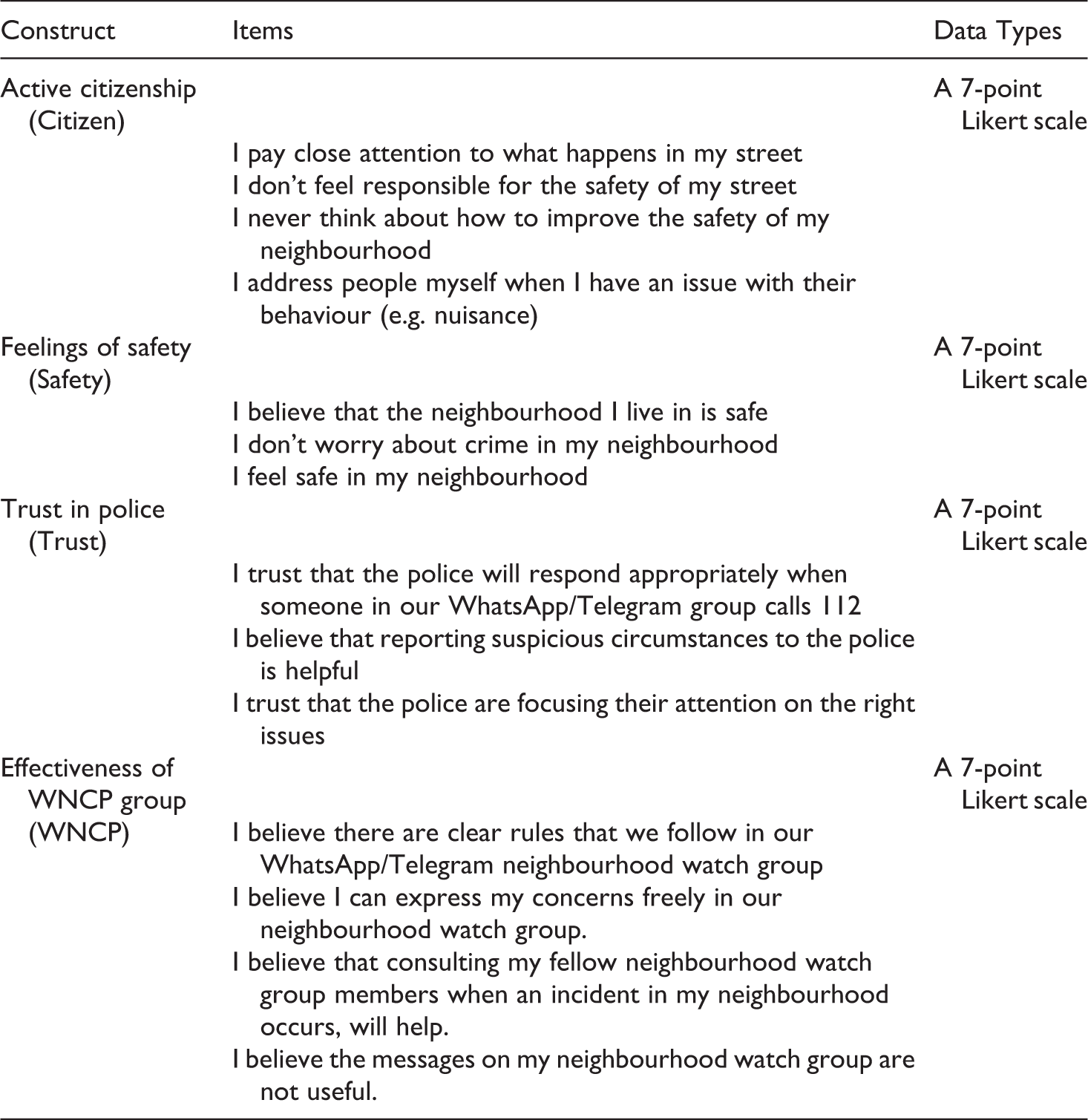
The latent variables – active citizenship, feeling of safety, trust in police and effectiveness of WNCP group – were first defined by indicators, then measured by self-reported responses on an attitude scale, as shown in Appendix A. Construction of the indicators was based on the interview findings. Active citizenship, for instance, was measured on a seven-point Likert scale (1 = strongly disagree, 7 = strongly agree). The Cronbach’s α for the four scale items is .63, suggesting that the internal consistency of the items is not ideal but still acceptable (see e.g. Hair et al., 2006; Moss et al., 1998; Nagpal et al., 2010). Feelings of safety – the dependent variable – were measured with three items: ‘I believe that the neighbourhood I live in is safe’, ‘I don’t worry about crime in my neighbourhood’ and ‘I feel safe in my neighbourhood’. A Cronbach’s α of .728 implies a good reliability of the three scale items. Trust in police was again measured with three items, with a Cronbach’s α of .868. Effectiveness of WNCP group was measured on a seven-point Likert scale: ‘I believe there are clear rules that we follow on our WhatsApp/Telegram neighbourhood watch group’, ‘I believe I can express my concerns freely in our neighbourhood watch group’, ‘I believe that consulting my fellow neighbourhood watch group members when an incident in my neighbourhood occurs, will help’ and ‘I believe the messages on my neighbourhood watch group are not useful’. The Cronbach’s α for the four scale items is .691, suggesting a relatively acceptable internal consistency. Table 1 presents the descriptive statistics and the correlation of all variables. As shown in the table, the independent variables – trust in police and effectiveness of WNCP group – are correlated with a feeling of safety, but at a modest level.
Descriptive statistics and correlations.
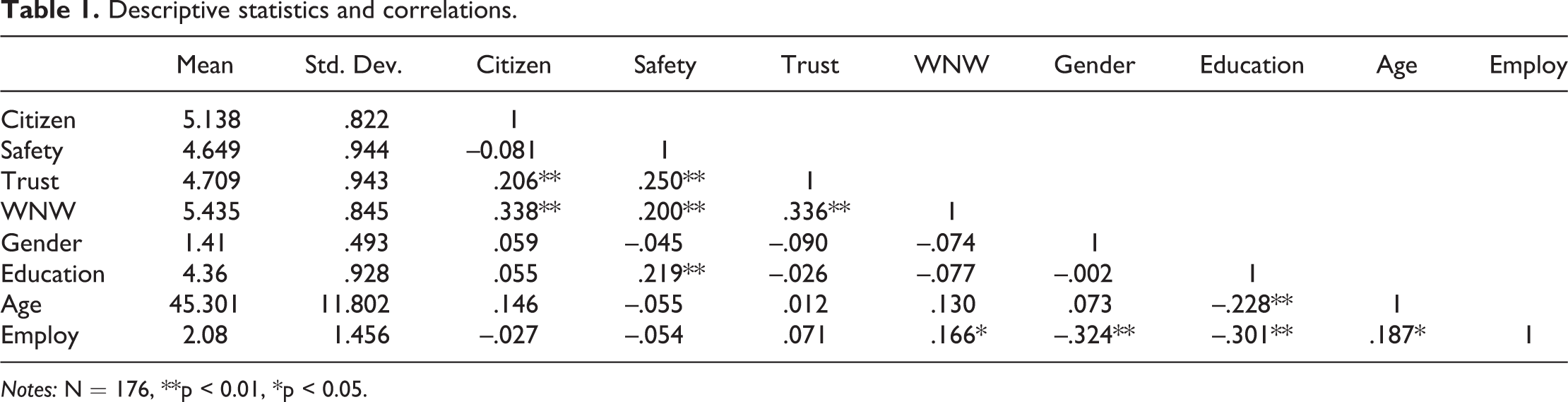
Notes: N = 176, **p < 0.01, *p < 0.05.
Results
Give the two-stage research approach, we first examine in depth the results of the findings from our interviews. These findings are evaluated in light of existing literature, and have lead us to three expectations based on ambiguities and contradictions inherent in this research. Subsequently, these expectations were further examined through our quantitative survey.
Interview results
Ambiguous WNCP group use on a daily basis
The primary and perhaps most unsurprising comment within the interviews was that the goal of WNCP groups is to create safer neighbourhoods. ‘It is truly meant to be a safety WhatsApp group’ noted Maria (WNCP group moderator). Nevertheless, most interview respondents highlighted the importance of community within these WNCP groups. Even though the contact on these groups primarily appears to be transactional and impersonal, it also seems to create more social and supportive relations. Leonard, a community police officer, states that these groups ‘naturally foster social cohesion, something you definitely need in neighbourhoods’, and community police officer Tom notes his surprise that ‘because of the WhatsApp groups, and something I couldn’t have imagined because of how they originated, that social cohesion has increased’. This is further visible when WNCP group members and moderators describe how they support each other. For instance, in taking action: Some people are afraid to do that, they’re afraid of calling [the police], they think ‘ooh.’ But if somebody else says ‘you have to call, because they don’t belong here’…So maybe that’s exactly what you need, to get you over that hurdle. (Albert, WNCP group moderator)
This cohesion and support enhances feelings of safety. It is not just that the groups contribute to safer neighbourhoods, but that they contribute to a safer experience of these neighbourhoods. In one neighbourhood, WNCP group members reassured each other about loud noises on the street, particularly in this case where a community police officer was involved: The day before yesterday somebody wrote: ‘I heard noises, it sounded like gun shots and I am worried’. Then I replied: ‘Yes, you can hear that more often, it sounds like fireworks’. And the community police officers wrote: ‘Sparta [local soccer team] won, that’s why there are fireworks’. So she was reassured. (Jessica, WNCP group member) But there are also people who say ‘Every week, I hear that a car is stolen and that makes me feel way less safe, because I hear so much more.’…however, there are more people who feel safer because of the WNCP group, but there is a small percentage who cannot handle the messages. (Michael, WNCP group moderator)
Active citizens creating a safer neighbourhood
A crucial part in the effective functioning of WNCP groups is active citizenship – taking ownership of neighbourhood safety. This mainly refers to citizens becoming more engaged and alert, which leads to some citizens acting on identified issues or concerns themselves or reporting these to the police, one of the perceived benefits of WNCP group participation (Akkermans and Vollaard, 2015; Lub, 2016). Membership in WNCP groups seems to increase awareness of public safety, as Lisa (WNCP group moderator) expressed: When people are members of the group, they are more watchful when they walk outside. They feel more responsible for the safety of the neighbourhood, so they become more alert. For instance, when they walk the dog, you know, they think: Hey, now that I’m part of the group. So one of the WhatsApp members says ‘hey who is also affected by this nuisance?’…And at some point there are about eight who respond. So the same person asks ‘who’s coming with me?’ And about five residents start a conversation [at the party]. And it was just a normal conversation. (Tom, community police officer)
However, when WNCP groups are seen as successful, neighbourhoods are believed to become safer places. Michael (WNCP group moderator) describes the benefits of what he has seen: ‘I see that we have results. We’ve had bike thieves arrested, after which [bike theft] stopped.’ Moreover, the sheer existence of WNCP groups are seen to serve a preventive purpose: [Criminals] are not stupid. If they know that there is a WhatsApp group and that citizens pay attention to them, and monitor them together, then they know: ‘Okay, we shouldn’t be in this neighbourhood, because people are monitoring us. (Alex, community police officer) It was about a guy who walked through the neighbourhood while carrying a bike. (…) at a given moment someone says: ‘I addressed the guy, he is living nearby and he just lost the key of his bicycle wheel lock. That’s why he is carrying his bike under his arm’, so this is alright.
WNCP groups can also be helpful in high-profile police investigations (Van der Land et al., 2014). Community police officer Tom describes how he used the WNCP group to find witnesses of a shooting, and found it to be more effective than traditional police work: The day after a homicide, a neighbourhood inquiry takes place. And that involves two or four colleagues going door-to-door, to ask people what they’ve heard or seen yesterday evening. And you have to keep track of everything, because someone who is not home might have heard something. I used WhatsApp for the first time and I got three witnesses after five minutes. Someone said: ‘Hey, someone is messing with a bike. Then a second person replied: ‘You have to call 112’…And a third person said: ‘Who is coming outside with me?’ So four people went outside and scared that man away. He is probably still running! Ha! No police officer can beat that. It is very powerful, and it takes work away from me.’ (Tom, community police officer).
Frustrations and harmful content
During the interviews, respondents also voiced concerns about the use of WNCP groups and discussed issues and incidents. One of the most often mentioned more practical pitfalls and largest frustrations of the use of WNCP groups (especially for moderators) is dealing with irrelevant content. WhatsApp groups easily become cluttered with irrelevant banter (see Bervoets, 2014) as citizens might have rather loose interpretations of the ‘rules’ of their WNCP group. Every single interviewee referred to instances where people became frustrated by content they deem irrelevant. WNCP group moderator Tom explains: That thing, WhatsApp, beeps all the time, and some people will say: ‘this was meant for emergencies’, they see bike theft, for example, not as an emergency. And then you’ll see that these people will leave the WhatsApp group.
WNCP group content can also be harmful for the people who are subject of the WNCP group conversations (De Vries, 2016; Lub, 2016). In a lot of WNCP groups, members share pictures of suspicious persons, events and vehicles. Police officer Alex sees no harm in sending pictures: If it [WNCP groups] work well, we can be informed really fast. It can be like: ‘there are suspicious persons in the neighbourhood, this is what they look like’. If they send a picture, click, bam, it is yours. That is great. While this woman was just someone looking for a specific house…And a picture was made of this particular woman and that really went wrong, because it was sent to the police, even though this lady had no bad intentions. If you see someone on the street where you think ‘hmm that’s a strange person’, and you would take a picture and send it around, then you really hit their privacy – because someone is innocent until proven guilty.…You have to be reserved with it. (Jessica, WNCP member)
Another moderator addressed a particular concern related to the WNCP group invading privacy on a different level than personal information. According to Daniel (WNCP group moderator), it can be invasive when members receive notifications when they are not in the neighbourhood: A while ago, we put something on WhatsApp and a girl reacted, who was in Portugal. She said: ‘I am in Portugal, I am not able to do something about it.’ So yes, you are also bothered when you’d rather not pay attention to it. We had the same with plants, there were bugs detected on plants, and people started talking about the plants of a neighbour who was on holiday. While, you are on holiday, so you probably don’t want to know. (Daniel, WNCP group moderator)
Citizens and police: a delicate collaboration
In instances in which citizens act independently from more official government bodies such as the police, there are concerns that these persons may act as private law enforcers. The irresponsible behaviour of citizens might not resolve immediate concerns but also further create harmful situations (Van den Brink et al., 2016). As noted above, police officer Tom has a sceptical view of this assumption: ‘Some are always afraid that residents will act weird, well that is hugely overestimated. People aren’t stupid.’ Yet other respondents expressed less confidence in citizens’ judgment abilities in neighbourhood incidents. Alex, a community police officer, mentioned specific types of less desirable citizens being involved: They are very active citizens, but they tend to be a bit ‘cowboy-ish’. Those guys, especially in this neighbourhood, a specific type, [well] they could say: ‘I will knock him out myself.’ And they will [try this], I think, you know, before even calling the police. That is obviously not very convenient, so there is a danger to it. (Alex, community police officer).
Part of the difference here is the tensions between what have been seen as police priorities and citizens’ priorities, tensions which are often enforced by misunderstanding between the two groups (Terpstra, 2009). In the Netherlands, the Dutch police priorities are focused on more pressing issues, described as ‘high-impact crimes’. Community police officer Leonard says: ‘[These are] crimes that directly impact people’, more specifically noting robberies, assaults, shootings, and domestic violence. In the Netherlands, these crimes only affect a small percentage of citizens; however, the success in mitigating these more-concerning criminal activities leaves open lower-impact crimes such as bike theft, vandalism or neighbourhood nuisances as a growing concern for citizens. As police officers Alex and Leonard explain, these issues have increased concern because these smaller issues are very familiar to the majority of people. When police primarily focus on high-impact crimes, citizens can feel unheard or unsupported, which can lead to a lack of trust in police. For instance, citizens often do not believe the police can intervene on time or see no value in reporting a stolen bike. Adam describes: ‘My bike was stolen, which I immediately reported [in the WNCP group]…but I know that it will not help anyway.’ Additionally, WNCP group moderators complain that it takes police too long to react: It takes quite some time before the police are on site. Many police stations are kind of being closed, so the distances become larger. And even if they say that they have quick response times, in practice you see that it takes a long time. And sometimes you call 112, and they tell you: this is not a priority. They received an alert that burglars were in that house, so they notified [the police], and then the police show up at 11:30 PM, while the events took place at 7 PM. You know…So yes, trust…has decreased. People find it really hard: When can I call 112 and when not? We always tell them: If you encounter a suspicious situation, and your gut tells you that it is suspicious, just call 112. Last week, we had one or two occasions where it took 8 or 9 minutes before group members called 112. There is some sort of fear about calling 112 which seems to be a barrier. People still have the feeling that when they call 112, they are known, and that police will tell offenders who called 112.
Bridging the gap between police and citizen priorities
By connecting with and informing citizens, community police officers might be able to bridge the gap between police and citizen priorities (see Terpstra, 2009). In our interviews, it was clear that the community police officers were putting tremendous effort into building trust relations with citizens. As Leonard (community police officer) explains: So what are the benefits if I’m in contact with people in the neighbourhood? Huge! It’s a major difference. People become more trustful if they have a familiar face. Some people in the neighbourhood are, and you have to make an effort to find them, they are, as I always say, your gems. These are often also the ones complaining or nagging, but they are gems as well, because they have the neighbourhood’s interests at heart, and keep an eye on the neighbourhood.
Particularly where community police officers are not in the WNCP group, moderators function as a mediator. Community police officer Leonard regularly asks WNCP group moderators to forward him relevant information or summaries of discussions, and Bart actively reaches out to administrator to exchange information and to give them hints: For example, in one street I know which citizens have a dog.…I can tell them [the moderators]: We have a situation at the end of the street, can you ask that person to walk his dog? So then that person can walk the dog in that direction in order to see what’s going on. (Bart, community police officer) They [community police officers] are not always working, so sometimes you will not receive a reaction until the next day. And it is very difficult to decide about which you can call the community police officer and for which you can better not approach them. (Michael, WNCP group moderator)
Measuring feelings of safety, trust in police and use of WNCP
As the interviews indicate, the benefits of WNCP groups can be seen as: increased feelings of safety, citizen awareness and active watchfulness, serving a preventative function, explaining suspicious situations, contributing to police work, and finally, enabling citizens to independently solve situations. However, interviewees also brought up the drawbacks of the use of WNCP groups as they addressed the risk of WNCP group content harming allegedly suspicious persons or the members of the group. In addition, they voiced their frustrations about incorrect and ineffective use of the WhatsApp groups.
Feeling safe proved to be one of the more significant issues raised in the interviews. Whereas respondents mainly reported experiencing increased feelings of safety due to WNCP group participation, one moderator described how his small-scale survey also indicated that some participants feel less safe. Moreover, existing grey literature points towards decreasing feelings of safety due to neighbourhood watch initiatives (Van der Land et al., 2014; Lub, 2016). Given the ambiguity in our and existing research, the exploratory research design includes a survey conducted among WNCP group members to further examine feeling safe as the main variable. Based on the interview findings, we formulated three expectations about the relation between feeling safe and three key variables. In terms of quantitative research, these expectations can be seen as hypotheses (H1–3). Our theoretical expectations are summarised in the conceptual model in Figure 1.
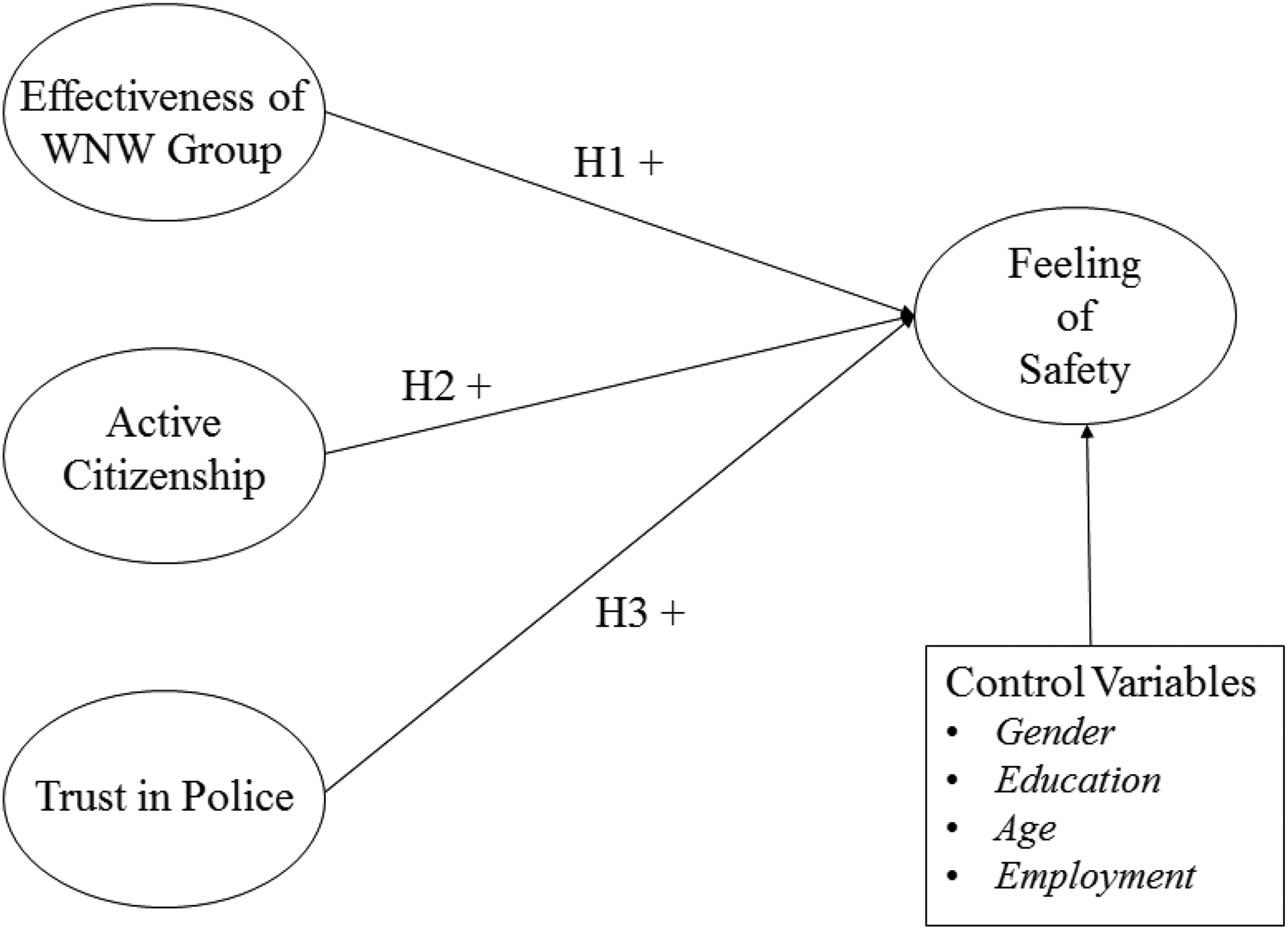
Conceptual model.
First, we sought to examine more widely how perceptions about the effectiveness of WNCP group participation were seen in relation to feelings of safety. Based on the mainly positive views of our participants, we expect that a positive judgment of the effectiveness of WNCP groups affects people’s feeling of safety in their neighbourhood positively (H1). Further, our interview results indicated that WNCP group participation leads to citizens being more active and to increased social cohesion in the neighbourhoods. Accordingly, a sense of community can trigger active citizenship (Chavis and Wandersman, 1990; Taló et al., 2014). As this notion of active citizenship was brought up by our respondents in close connection to feelings of safety, this lead us to assume that active citizenship itself also has a positive effect on feeling safe in the neighbourhood, though this premise was contradicted by Van den Herrewegen (2010). This leads us to the following statement; we expect that active citizenship affects people’s feeling of safety in their neighbourhood positively (H2).
Given the potentials and concerns regarding the collaboration between citizens and police, we sought to examine further empirically the trust relationships with the police and its effects on feelings of safety of WNCP participants. In some cases, a mutual understanding and support between the WNCP groups and the police was visible, while other respondents reported difficulties in relation to conflicting priorities, a lack of communication and a fear for irresponsible behaviour. The relation between police and citizens indicated in the interviews closely relates to theories about misunderstandings, contrasting perceptions and frustrations in police-citizen collaborations (Stein and Griffith, 2015; Terpstra, 2009). Given the importance of trust in community policing and cooperation (Grinc, 1994; Van Sluis and Van de Walle, 2015), we further examined the importance of trust in police in relation to feelings of safety of the WNCP group members in Rotterdam. Based on existing literature and our interview findings, we expect that trust in police affects people’s feelings of safety in their neighbourhood positively (H3).
Survey results
We employed the ordinary least squares regression with bootstrap method to test the expectations. The results are shown in Table 2. Model 1 presents the regression results with the direct effects only, while Model 2 controls the demographic variables (i.e. gender, education, age and employment). As shown in Model 1, all three independent variables – active citizenship, trust in police and effectiveness of WNCP group – influence feeling of safety significantly. Trust in police and effectiveness of WNCP group are observed with a positive impact (b = .227, p < 0.01; b = .211, p < 0.05) on the dependent variable. The impact of active citizenship, however, is negative (b = −.22, p < 0.05), which contradicts the theoretical prediction. These findings are further confirmed by the bootstrap results. The comparison of unstandardised coefficients in Model 1 and Model 2 suggests slightly stronger explanatory power of all three independent variables in the latter. Based on the regression results, we confirm the expectations in H1 and H3 that effectiveness of WNCP group and trust in police positively affect feeling of safety in one’s neighbourhood, respectively. The confirmation of expectation H1 adds an interesting layer to the assumption that neighbourhood watch initiatives can lead to decreasing feelings of safety (Lub, 2016; Van der Land et al., 2014), because feeling safe can both be a reason for and a result of WNCP group participation. The confirmation of expectation H3 is an important finding for community safety initiatives, as it supports the belief that community policing highly relies on a mutual trust relations (Van Sluis and Van de Walle, 2015), especially because active police involvement in the Netherlands is said to increase feelings of safety (Lasthuizen et al., 2005).
Regression results.
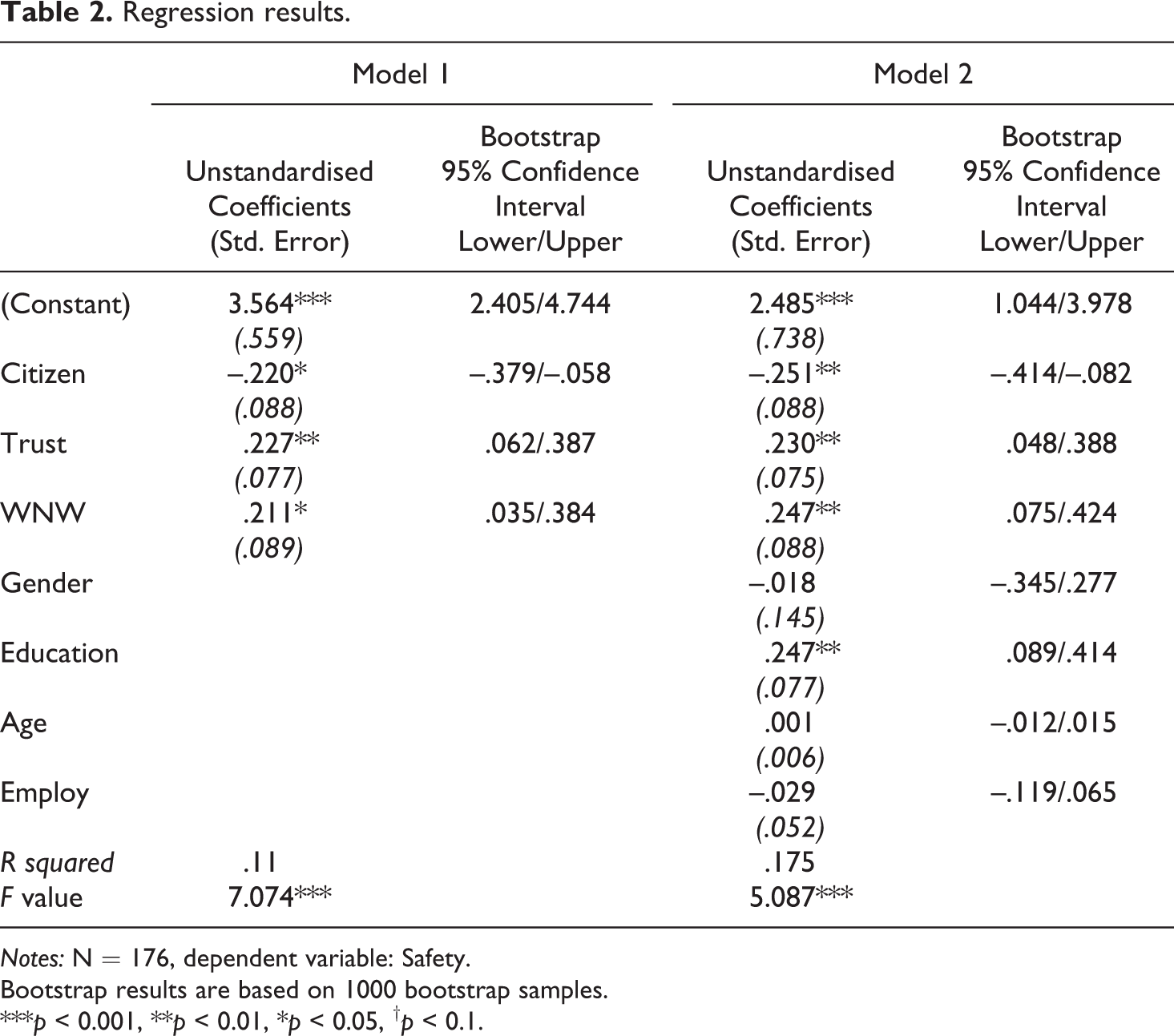
Notes: N = 176, dependent variable: Safety.
Bootstrap results are based on 1000 bootstrap samples.
***p < 0.001, **p < 0.01, *p < 0.05, † p < 0.1.
On the other hand, the negative relationship between active citizenship and feelings of safety rejects our expectation in H2. A potential explanation for the negative relation is that active citizenship, in this case accompanied by active involvement in a WNCP group, makes citizens more aware of potential threats and dangers in their environment. Similarly, increased feelings of being ‘unsafe’ are reported as a perverse effect of neighbourhood watch patrolling teams (Lub, 2016; Van der Land et al., 2014). Another explanation could be related to Van den Herrewegen’s (2010) assumption that active citizenship might lead to decreased feelings of safety and uncertainty because of a lack of skills and knowledge of how to handle problematic situations and the inability to solve more structurally embedded neighbourhood problems. Here, active involvement of community police in citizen initiatives might help decrease uncertainty and improve feelings of safety.
Conclusion
This study has begun to show some of the complexities the use of this new form of communication has created in relations between police and citizens within the Netherlands. Interestingly, in this context, the use of the word ‘police’ as a verb is not possible in the Dutch language. As a linguistic term, police do not ‘police’ the streets (or neighbourhoods) as might be described in English. Instead, in the Dutch language police may monitor, respond, patrol, secure, prevent, investigate or engage in other actions, but these actions are not encompassed in a singular verb ‘policing’ as in English. That means that ordinary citizens do not police either. They may monitor, respond, patrol, secure, prevent and investigate, much like police, but there is no equivalent notion of ‘participatory policing’ or ‘citizen policing’ in the Dutch language. And yet in the context of this research, the lines have begun to blur around ‘official’ police actions and the role of citizens in their neighbourhoods and the sense of safety they feel and produce through connected communication. To do ‘policing’ in these contexts is increasingly a communal effort.
We raise this linguistic point because what this study has indicated are the tensions and negotiations around those communal efforts of the verb ‘policing’. We note that citizens are engaged in normal activities which have no formal linguistic connection to the ‘police’ in the Dutch language. But by examining both the experiences and the perceptions of WNCP group moderators and members alongside those of police officers, and then testing these findings on a sample of members, we begin to indicate the complexities inherent in the use of these communication technologies to do ‘policing’. What WhatsApp affords is immediacy and interconnectedness with neighbours and sometimes with police, but it also brings concerns about criminality and other information much closer to home – literally and metaphorically. This invariably affects participants’ feelings of safety, as we have seen, in a somewhat ambiguous way. It both reassures participants and raises anxiety, yet problematises ‘the traditional model of police as knowledge brokers’ with regard to community safety and security (Nhan et al., 2017: 344). Future research needs to examine these interconnected and multidirectional channels of communication between citizens and police, rather than solely one-directional ‘crowdsourcing’ models as discussed in some participatory policing examinations (see for instance Kelly and Finlayson, 2015; Larsson, 2017).
Our study has a number of limitations. Most importantly, the research itself was focused on one city in the Netherlands and largely on the use of one particular mobile application in this context: Whatsapp. The interviews used for this and the participation in the quantitative study are with persons already involved in and making use of this technology. This limited sample does not intend to represent a large number of citizens in these neighbourhoods that do not participate in these groups. However, we believe that WNCP group members do demonstrate a motivated participation with police which is central to considering ways forward for police–citizen initiatives. As an exploratory study that relies on both qualitative and quantitative methodologies, we see this research as an important contribution to the ways in which new forms of communication technology have created new opportunities and challenges for contemporary policing and we rely on this sample to help articulate some of what we see as these opportunities and challenges.
WNCP groups can be seen to have emerged at the confluence of several factors – the presence in some areas of already existing neighbourhood watch groups, the emphasis on localised policing practice, efforts to make citizens more responsible and enabled to deal with local concerns and issues, and the ubiquity of smartphones and messaging apps. What remains to be seen is how the relations of neighbours, with the ease of monitoring neighbourhoods through messaging apps, will fully affect everyday ‘policing’ beyond these initial examinations. It is clear that keeping an eye on one’s neighbours, and by extension one’s neighbourhood, will also mean police themselves will become increasingly under scrutiny in terms of engagement and response.
Footnotes
Declaration of conflicting interests
The author(s) declared no potential conflicts of interest with respect to the research, authorship, and/or publication of this article.
Funding
The author(s) disclosed receipt of the following financial support for the research, authorship, and/or publication of this article: The authors received some financial support for the research and authorship of this article through the Dutch Research Organization (NWO) under project number 628.001.024.
Note
Appendix A. Latent variables and data types
| Construct | Items | Data Types |
|---|---|---|
| Active citizenship (Citizen) | A 7-point Likert scale | |
| I pay close attention to what happens in my street | ||
| I don’t feel responsible for the safety of my street | ||
| I never think about how to improve the safety of my neighbourhood | ||
| I address people myself when I have an issue with their behaviour (e.g. nuisance) | ||
| Feelings of safety (Safety) | A 7-point Likert scale | |
| I believe that the neighbourhood I live in is safe | ||
| I don’t worry about crime in my neighbourhood | ||
| I feel safe in my neighbourhood | ||
| Trust in police (Trust) | A 7-point Likert scale | |
| I trust that the police will respond appropriately when someone in our WhatsApp/Telegram group calls 112 | ||
| I believe that reporting suspicious circumstances to the police is helpful | ||
| I trust that the police are focusing their attention on the right issues | ||
| Effectiveness of WNCP group (WNCP) | A 7-point Likert scale | |
| I believe there are clear rules that we follow in our WhatsApp/Telegram neighbourhood watch group | ||
| I believe I can express my concerns freely in our neighbourhood watch group. | ||
| I believe that consulting my fellow neighbourhood watch group members when an incident in my neighbourhood occurs, will help. | ||
| I believe the messages on my neighbourhood watch group are not useful. |