



Abstract
WhatsApp Neighbourhood Crime Prevention (WNCP) groups are popular in the Netherlands. As a basic assumption, this kind of digital neighbourhood watch could prevent crime, but what is the evidence? Drawing on a mixture of qualitative research and a review of additional publications, we conclude that WNCP groups stimulate social cohesion rather than prevent crime. We reach our conclusion by applying the evaluation EMMIE framework – an acronym for Effect, Mechanisms, Moderators, Implementation and Economics – to the available data. A point for further discussion is the limited scope of the economic dimension. Moral costs must be calculated, too, as WNCP groups tend to deepen divisions between groups of citizens and fuel exclusionary practices in the name of community safety.
Introduction
One of Rembrandt van Rijn’s most renowned paintings is the Night Watch (1642), which portrays a civic guard marching off to patrol the city of Amsterdam. His masterpiece provides an excellent illustration of how, throughout history, citizens have played a major role in maintaining public safety and keeping the peace on the streets after dark. Historically, there have been parallels elsewhere. Rawlings (2003), for example, reports on the obligation of British communities to assist in the pursuit of suspected offenders, an ancient custom aptly named ‘hue and cry’. Since the dawn of modern police forces in the nineteenth century, most of these informal policing schemes have withered due to concerns about chronic corruption, their inability to prevent serious crime and, not to forget, the ideological belief that the state should hold the monopoly of force (Johnston, 1992). Ironically, despite official state policy, several night watches and thief-takers continued their activities and began selling their services to paying customers (Zedner, 2006). The private security industry was born.
This paper, however, pays attention to the persistence of non-paid citizen involvement in matters of local safety and security, a development which started to attract intellectual attention from the 1970s and 1980s onwards (e.g., Pennell et al., 1989; Rosenbaum, 1987; Yin et al., 1977). It is only recently that such attention has culminated in a real wave of empirical studies on the role of citizen patrols, neighbourhood watches and other forms of active citizenship in both Dutch and British community safety (Bullock, 2014; Butcher, 2019; Lub, 2018a; Schreurs, 2019; van der Land, 2014; van Steden, 2018; van Steden et al., 2011; Westall, 2019). Indeed, compared to the long-standing academic attention paid to private security officers, voluntary citizen participation in policing and crime control is an understudied social phenomenon. A possible explanation for neighbourhood watch currently gaining momentum in academia is the increasing ‘responsibilisation’ (Garland, 1996) of citizens facing financial austerity, as well as a waning of the welfare state. As individuals and in groups, people are either encouraged to undertake preventative action or else they spontaneously set up activities themselves.
Contemporary neighbourhood watches are fundamentally different from historical examples such as Rembrandt’s civic guards. While the latter were appointed and authorised by local government to maintain public order, deter criminal activity and provide law enforcement, today’s initiatives can be grouped under the banner of ‘do-it-yourself surveillance’. Jacobs (1961) originally came up with this term to describe ‘[a] network of doormen and superintendents, of delivery boys and nursemaids’, who informally supplement the police and supply the streets with natural eyes and ears for cultivating public life, where strangers could live peacefully together (pp. 39–40). Yet, within the present context of neighbourhood watches, the meaning of ‘do-it-yourself surveillance’ has turned 180° by putting its focus on driving strangers out and creating sanitised spaces for homogenous inhabitants. As Newman (2012) notes, vigilant citizenship is at odds with the role of ‘the state as a guarantor of equal rights for the public by placing a privileged, exemplary set of citizens in that role’ (p. 960).
In our digital era, ‘offline’ citizen patrols and neighbourhood watches have lately been accompanied by ‘digital’ or ‘online’ counterparts (Reynald, 2019), which are accelerating and deepening this development of vigilant citizenship. The novelty of digitally mediated neighbourhood watches, which makes them even more amenable to ‘doing-it-yourself’ than non-digitally mediated ones, means that many more people are able to join an invisible web of controls that increases the speed and extent of communication among social media users. WhatsApp Neighbourhood Crime Prevention (WNCP), in particular, is on the rise in the Netherlands, but is also popular in other countries, for example Britain and South-Africa (Dixon, 2017). WNCP can be defined as a smartphone-based neighbourhood watch messaging group that aims to ‘exchange warnings, concerns, and information and incidents, emergencies and (allegedly) suspicious situations related to their neighbourhood’ (Mols and Pridmore, 2019: 273). There are approximately 9,250 WNCP groups operating all over the Netherlands, crossing the border with Belgium and hosting tens of thousands of members, if not more. This number exceeds, by far, the contributions to traditional voluntary patrols and neighbourhood watches in the country. Many WNCP groups are also affiliated to Facebook pages with dozens of subscribers, allowing the police access to a huge amount of community-based intelligence (cf. Kelly and Finlayson, 2015). It makes an empirical assessment of the WNCP groups’ efficacy even more pressing.
Initially, the establishment of WNCP groups was a product of ‘self-responsibilisation’ (van der Land, 2014: 432), of ‘bottom-up’ citizenship independent of government, but the movement has gradually become more institutionalised. Various local authorities promote the proliferation of social media platforms and applications being used for monitoring neighbourhoods. There is also a special – privately owned – website (www.wabp.nl) that publishes detailed information on the number and geographical spread of WNCP groups, applicable house rules for group members, and how to buy official-looking stickers and streets signs displaying the warning Attentie WhatsApp buurtpreventie! – in English, ‘Attention! WhatsApp Neighbourhood Prevention’ (cf. Pridmore et al., 2019). Meanwhile, Dutch municipalities have been swamped by such stickers and signs depicting a villainous-looking icon.
The present study delves into the practices and intended or unintended effects of WNCP groups, and how outcomes can be explained. It does so against the backdrop of Bennett et al.’s (2008) literature review of studies evaluating physical neighbourhood watch programs, which culminates in their optimistic conclusion that these programs are ‘effective in reducing crime’ (p. 34). Is this true for digital neighbourhood watch too – and at what cost? In answering our questions, we have structured the paper as follows. The next section offers an overview of the small body of knowledge on WNCP groups and other social media platforms, in order to highlight common themes in the literature. Subsequently, we construct an analytical lens through which to assess the findings from our own research and from adjacent Dutch publications on the practices and effects of WNCP groups. Further sections include our methodology and empirical findings. The paper closes with some general conclusions and discussion.
A critical appraisal of WhatsApp crime prevention
Research on neighbourhood watch and similar citizen-led policing schemes is still relatively scarce and there is even less known about online or digital examples. Yet, there are a small number of scholars who have provided insight and reflection relevant for setting our specific question about the (un)intended effects of WNCP groups on crime prevention in a wider context. Drawing on an explorative, door-to-door survey among 214 inhabitants of a medium-sized Dutch city, Schreurs et al. (2020) asked why people engage in the fairly new online WNCP groups. Their results show that, on the individual level, members and non-members differ, with the former having a stronger belief that joining a WNCP group would lead to a safer neighbourhood. At the social level, members also have more experience with previous participation in the organisation of street barbecues, for example. Trust in the police, the authors’ institutional level of analysis, does not appear to have had any impact on whether or not people join a WNCP group. Overall, and consistent with publications on offline volunteer street patrols and watch schemes (Butcher, 2019; Westall, 2019), participants are not necessarily crime-busting cowboys. Rather, they represent a kind of ‘civic activism’ (Leach, 2003), a democratic expression of civil society.
Furthermore, Mols and Pridmore (2019) have vividly described the everyday practice of a WNCP group. Clearly, members send round digital text messages, and they are expected to do so according to the uniform ‘SAAR guidelines’. These guidelines are promoted by the official WNCP house rules and published on the website www.wabp.nl. SAAR is an acronym for
This brings us to the final and most sensitive topic: just like vigilante neighbourhood watches (Pennell et al., 1989), digital crime prevention is not without unpleasant ‘moral implications’ (Lub, 2018b) of stigmatisation, ethnic profiling and excessive social control. Mols and Pridmore (2019) argue that WNCP groups can potentially diverge from their intended civic and civil purposes, derailing in ambiguous, not to say reprehensible, directions. As Larsson (2016) quite rightly problematises: what exactly are ‘unusual and suspicious activities’? If people are constantly encouraged to be aware of anything and anyone ‘out-of-the-ordinary’, such a process may slowly but surely open the doors for harsh surveillance practices to creep into people’s normal lives. This, in turn, stimulates the erection of a digital pillory (Dennis, 2008), a witch-hunt for (assumed) paedophiles (Hadjimatheou, 2019), exclusive forms of ‘stranger danger’ (Dixon, 2017) and other potential for voyeuristic mob activism (Reynald, 2019). It is not difficult to recognise that democratic values of openness, tolerance and mutual respect are at stake here.
WNCP groups, as a novel iteration of the long-standing tradition of neighbourhood watch, do not thrive in solitude, but must be seen in parallel with other networked social media platforms. Nextdoor, for example, is also a popular app in the Netherlands and has a friendly image of neighbours fostering relationships around missing properties, home repairs and meal deliveries. Nevertheless, the logic of Nextdoor increasingly shifts towards crime prevention purposes, sparking similar discussions about unintended consequences of social media use such as the stigmatisation of ethnic minorities and the geographical entrenchment of inequalities. The company’s ‘resurrected discourse of small town community value’ (Lambright, 2019: 89) indirectly stimulates a perception of the neighbourhood as a pleasant ‘safe haven’ facing untrustworthy strangers. Furthermore, it creates an archipelago of geographically demarcated urban zones in which outsiders are kept under strong surveillance (Payne, 2017). A culture of distrust and xenophobia might be the net result.
With this, Kurwa (2019) observes the creation of ‘digitally gated communities’ due to the nationwide spread of Nextdoor as a carceral vehicle for regulating race in the gentrified areas of North American cities: ‘the co-production of community through participation in surveillance is often based on the exclusion and suspicion of others’ (p. 113). His observation fits well with a growing demand for over-the-counter surveillance mechanisms being pushed by multinational companies. Going further than WhatsApp (a division of Facebook) and Nextdoor, Amazon Ring represents ‘an assemblage of surveillance fixtures and apparatuses, social media networks, crime reporting partnerships and internet-connected cloud servers’ (Bridges, 2021: 834). What started as a doorbell with a fancy camera directed at public space now spills into facial recognition technologies with consumers acting as the harvesters of Big Data that can be potentially shared with public authorities under the guise of secretive contracts. Monitoring ‘the other’, in sum, has evolved into a multi-billion market and raises grave concerns about infringements of political liberties and human rights.
EMMIE
Within this rather disturbing context, it is important to judge WNCP groups on their own merits. There is a whole movement of ‘citizens policing citizens’ (van der Land, 2014) evolving in the Netherlands, notably supported by the government, but public professionals and WNCP group members have little basic knowledge about its impact on local crime and community safety. Do WNCP groups live up to their aspirations and expectations of crime prevention in the first place? How effective are widespread digital do-it-yourself-surveillance techniques in the Netherlands and how can outcomes be explained? In answering our questions, we turn to the idea that the functioning of the police and of wider ‘plural’ policing agents (Loader, 2000), including citizen patrols and (digital) neighbourhood watches, must be grounded in sound empirical research and evaluation. A scientific understanding of WNCP groups’ activities and outcomes is urgently needed.
Sherman (1998) introduced an evidence-based paradigm in the field of police and security studies. Inspired by the rigorous standards of evidence-based evaluations in medicine, he proposed a research cycle of ‘what works best when implemented properly under controlled conditions, and ongoing outcomes research about the results’ (p. 4). In a somewhat broader definition, evidence-based approaches try to determine a reasonable connection between ‘action’ and ‘outcome’, which requires ‘research, analysis, evaluation evidence and empirical evaluation’ (Lum and Koper, 2017: 13). This kind of scientifically sound evidence should also be made digestible for decision-makers who, for example, decide on the allocation of resources or subsidies to projects and programs. Knowledge about ‘what works’ (or not) and why it works thus aspires to break out of the ivory tower of academia and inform politicians, civil servants, street-level professionals and society at large about scholarly advances.
Evidence-based research often consist of large-scale literature reviews and quasi-experiments, but both strategies fail in evaluating WNCP groups. Although, as we will see, a few publications do assess the evidence-base of these groups in the Netherlands, the current body of knowledge remains limited. In addition, none of the relevant publications meet the ‘golden standard’ of classic designs with experimental groups, control groups, pre-tests and post-tests. It is also uncertain that quasi-experimental models of evaluation are feasible in testing the strength of WNCP groups, as the comparability of cases and the circumstances under which they operate cannot easily be controlled. Equally worrisome is that the best standards of evaluation continue to yield ‘inconsistent results, non-replicability, partisan disagreement and above all, lack of cumulation (Pawson and Tilley, 1994: 292). A pressing problem is that many evaluations fail to fully understand the unique circumstances, specific mechanisms and implied policy theories about what makes a program work. Realist forms of evaluation try to open this black box in order to unveil internal causations and give plausible explanations for the matter under scrutiny.
The lately developed EMMIE scheme, an analytical framework proposed by Johnson et al. (2015), represents a promising way forward. It serves as an analytical tool for synthesising literature reviews and empirical findings from fieldwork while offering a practical format for engaging policy makers and practitioners with scholarly evidence. Yet, in our view, going beyond technical interventions, the framework should heighten sensitivity to the social and moral implications of such interventions. Building on the aforementioned realist-inspired Context, Mechanisms, Outcome pattern Configurations model (Pawson and Tilley, 1994), the founders of EMMIE add that mediators (or ‘intermediate outcomes’ bridging an intervention and the ultimate outcome), moderators (or ‘variables that may explain variation in outcomes across different studies’) and budget considerations should also be taken into account to equip policy makers and practitioners with evidence-based information (Johnson et al., 2015: 462–463). This leads us to explain the second acronym of our paper. EMMIE stands for the:
For each dimension, it is possible to rate the methodological evidence of an intervention from ‘none’ to ‘very strong’ and make results digestible for policy makers. See, for example, the highly accessible online toolkit published by the What Works Centre for Crime Prevention in Britain in order to inform policy makers and operational practitioners about the strength or weakness of interventions in the criminal justice field (Thornton et al., 2019). So far, EMMIE has been used for discussing the evidence across the crime and security sciences (Bowers et al., 2017), for rating systematic reviews of single crime reduction measures (Tompson et al., 2020) and for examining the effectiveness of treatment as a response to drug-related offending (McSweeney, 2021), but with slight adaptations the scores ‘can and should also be awarded to primary studies’ (Johnson et al., 2015: 469). We will adopt EMMIE in a mixed way by adopting the framework as a prism through which to view the results of our own empirical research (Mehlbaum and van Steden, 2018) and to produce an overview of the wider literature on the effectiveness and normative magnitudes of WNCP groups. Costs and benefits should not only refer to financial issues, but to moral and social considerations too.
Methodology
Case studies
Since it was quite difficult to get access to WNCP groups, we decided to involve our own professional network in the Netherlands. The starting point of the research was a visit on 11 October 2016 to a small seminar about WhatsApp crime prevention attended by various municipal representatives. In addition, we issued a call through the national platform of police community officers for the contact details of WNCP groups willing to cooperate. This resulted in a ‘convenience sample’ of six groups operating across four Dutch municipalities, all of which were willing to cooperate and share information with us (Table 1). We offer a few more details about our case studies:
Six case studies.
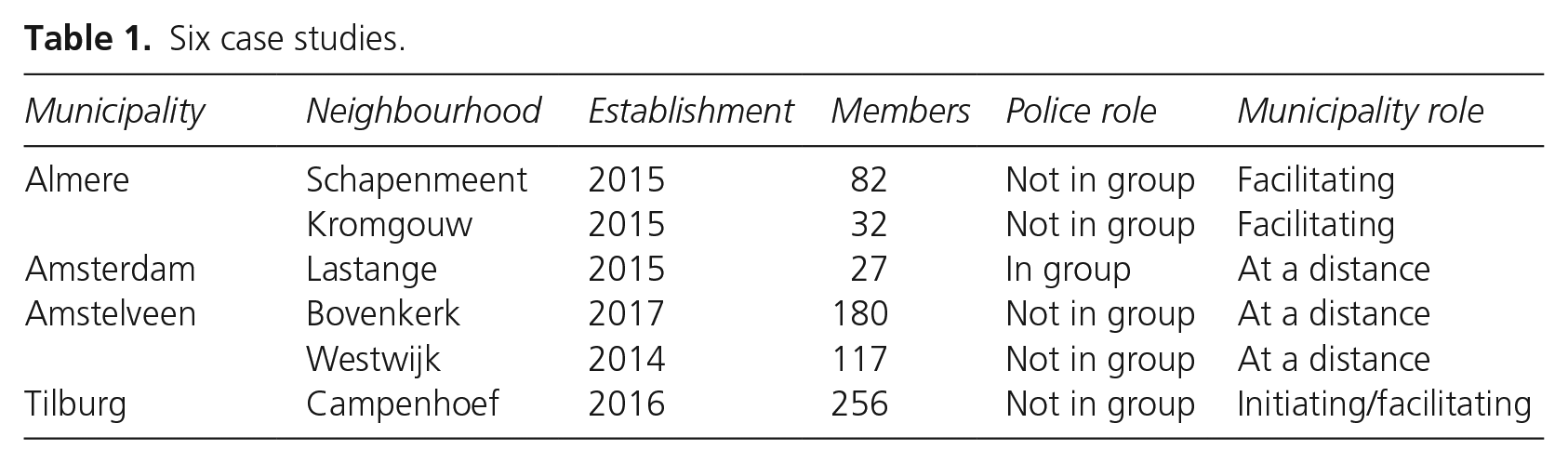
Two groups (Schapenmeent and Kromgouw neighbourhoods) are active in Almere Haven, a part of the city of Almere, populated by 22,800 inhabitants. The owner-occupancy rate is slightly over 50%. Having begun in 2015, a married couple now moderates all 68 WNCP groups in Almere Haven and a Facebook site (3400 followers) for non-crime-related messages about, for example, missing pets. There are affiliations with a physical neighbourhood watch of 25 people who patrol the streets in yellow jackets on a weekly basis in search of litter, broken streetlights and signs of misconduct. The number of burglaries (3–11, depending on the neighbourhood) in Almere Haven is higher than the annual national average of 5 burglaries per 1000 residents. Community police officers take no part in the WhatsApp groups, but follow the Facebook page anonymously and stay in regular contact with the moderators. The municipal safety manager facilitates the WNCP groups, for example by organising information evenings for local residents on the ‘do’s’ and ‘don’ts’ of digital crime prevention.
One group (Lastage neighbourhood) is active in the inner city of Amsterdam, a sixteenth-century borough with relatively young (mostly aged under 44), small (1.5 persons on average) and high income households (30%). The borough of approximately 10,000 inhabitants attracts a significant number of tourists due to its historical sites and the density of fancy pubs and restaurants. Theft and car break-ins are major crime problems, and, in response, a local resident initiated the WNCP group in late 2015. A community police officer, who is a full member of the group, uses the chats as an information channel for briefing his colleagues about possible car thieves and pickpockets. The municipal neighbourhood manager does not facilitate the group, yet he frequently meets up with the community police officer about crime and community safety issues.
Two groups (Bovenkerk and Westwijk neighbourhoods) are active in Amstelveen, a city bordering Amsterdam. In Bovenkerk (3500 inhabitants), housing stock is a mixture of rent and ownership, whereas in Westwijk (7500 inhabitants) most of the, comparatively young and children-rich, households have bought their homes. Burglary is the primary crime concern, but numbers are not higher that the annual national average. The Bovenkerk WNCP group started in 2017; the Westwijk group is slightly older and began in 2014. Both groups are connected to Facebook pages where people can post messages about non-urgent matters. The police and municipal authorities consider WNCP groups primarily as citizen-led initiatives, which means that facilitation is limited to the organisation of an information evening for local inhabitants and a website recommending digital crime prevention. Community police officers are not involved in the groups, but occasionally feed the members (via their moderators) with general information on incidents and accidents in their neighbourhoods.
The last group (Campenhoef neighbourhood; approximately 2500 inhabitants) is active in Tilburg, a city in the South of the Netherlands. Enduring concerns about burglary sparked the Campenhoef initiative when, in 2016, a volunteer and a community police officer met local residents about the issue. Actual burglary rates are comparatively low. Unlike most Dutch municipalities, the city of Tilburg has fully embraced digital neighbourhood watches to the extent that the person who first began the initiative in Campenhoef has been promoted to a paid position. He currently oversees all ninety WNCP groups and the nine related Facebook pages in Tilburg. Community police officers, who do not engage in the groups themselves, inform the moderators and group members about crime and community safety problems in their areas.
The six cases turned out to be useful for ‘establishing the plausibility of relationships among variables’, although, on the negative side, technically results cannot be generalised (Clark, 2017: 2). We did try to establish some variation between the cases in terms of geography, history, group size, the involvement of community police officers and the role of local authorities. We were able to follow all groups’ chat histories for up to 3 years – for between 11 (Amstelveen-Bovenkerk) and 34 (Almere Kromgouw) months to be precise – so it was possible to keep track of events, activities and impact on (crime) problems over a long period of time. We also conducted a literature review on the functioning of WNCP groups in other parts of the Netherlands with a view to incorporating some of the material into this study (see below).
Research activities
Our empirical research took place over 2016 and 2017 and consisted of five steps. Firstly, we had explorative talks with the WNCP groups’ moderators. They told us about the history and organisation of their groups and their contact with the police and municipal authorities. We also collected information from policy documents, websites and Facebook pages. Secondly, through the moderators, we became members of the app groups themselves, followed them and downloaded their chat histories to code and analyse these in detail, based on the number and content of identified incidents, actions undertaken by the group members, the police and/or local authorities, the outcomes of these actions and collaborations between all the actors.
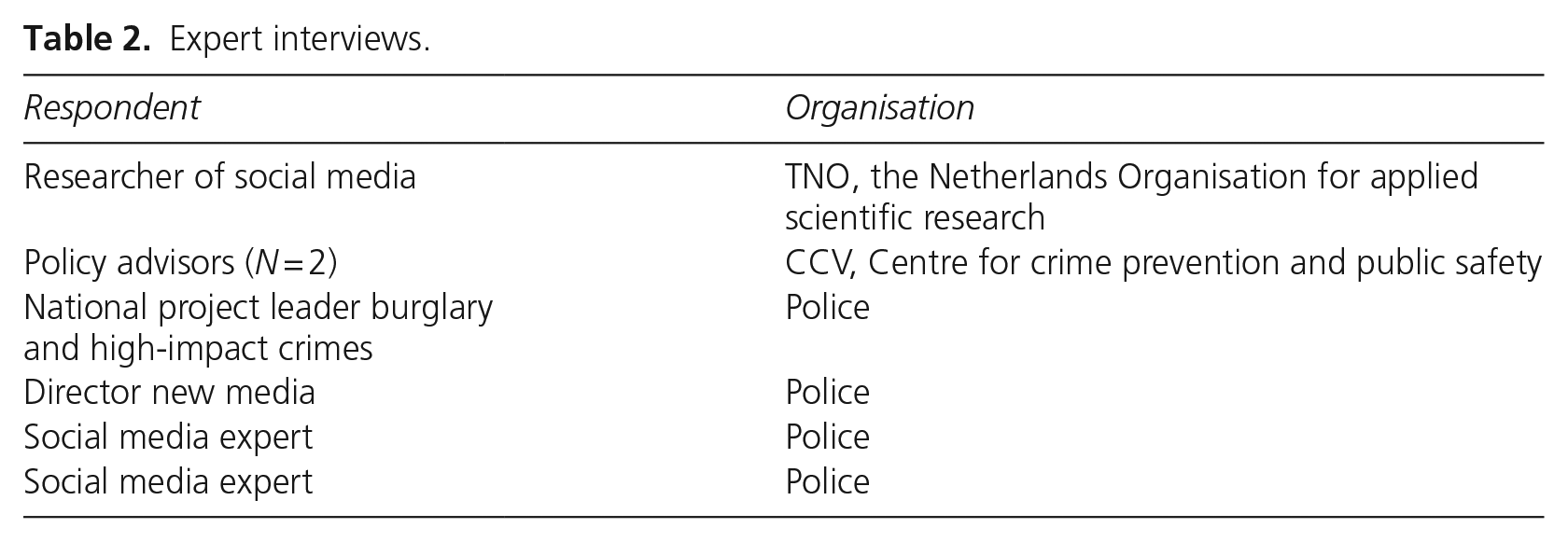
Thirdly, we arranged focus groups so as to reflect on our observations with moderators, group members, community police officers and municipal representatives. Meetings lasted for 90 minutes to 2 hours, and between three and six people contributed to our conversations in each group. We employed the above-mentioned themes (content of the chats: incidents, actions, outcomes, collaborations) to structure and analyse our data. Fourthly, we carried out semi-structured expert interviews with an independent researcher, two policy advisors and six police officers (Table 2) in order to transcend our local case studies. The topics we covered were the organisation of WNCP groups throughout the Netherlands, collaboration between citizens, the police and municipal authorities, the effects on crime and public safety and other desirable or undesirable effects of digital crime prevention.
Expert interviews.
Finally, through a nationwide network of colleagues and a small literature review, we brought together five academic publications on the practices and effects of Dutch WNCP groups. These publications include:
Vollaard (2016), a natural experiment and event-time analysis to explain the relationship between the start of a WNCP group, the number of 112 emergency calls to the police and its effects on the number of burglaries in Tilburg.
Bervoets et al. (2016), an explorative study on neighbourhood watches (a survey among 61 professionals (50% response), open-source research and interviews with nine experts) and three in-depth case-studies on WNCP groups (interviews with the moderators and documentary research) in the cities of Ede, Beverwijk and Tilburg.
Lub (2018a), a mixed-method study (questionnaires filled out by officials responsible for public safety in 340 Dutch municipalities and ethnographic research of four cases in Rotterdam and Tilburg) on the contribution of (digital) neighbourhood watches to public safety in Rotterdam and Tilburg.
Eysink Smeets et al. (2019), ten case studies of WNCP groups and 71 interviews with respondents to investigate the effects of these groups on crime and public safety in Rotterdam.
Pridmore et al. (2019), a mixed-method study of seven WNCP groups (qualitative interviews with 17 respondents and a survey among 183 participants) to explore effects on crime and feelings of safety in Rotterdam.
The publications found broadened our scope of research to a few other cities (mostly Rotterdam, the second largest city in the Netherlands) and added further insights on the city of Tilburg. Although none of these publications meet the golden standards of evaluation research, they offer illustrative cases and insightful analyses to illuminate the practices of WNCP groups. We present the results of our research below.
Contributions to local crime and community safety
Before turning to EMMIE, we briefly sketch what kind of activities are deployed in the WNCP groups under study (i.e. Eysink Smeets et al., 2019; Mehlbaum and van Steden, 2018). Sending messages back-and -forth about (allegedly) suspicious behaviour lies at the core of WNCP. Group members do so in short text streams, using ordinary language, for example to describe a person’s appearance (a photo or video can be added). How much back-and-forth there is depends on the situation. Conversations are pretty brief, on average, and usually spark general alertness rather than direct action after a situation is reported. Group members sometimes call the police, but officers do not necessarily respond quickly – if at all.
Effect
A fundamental assumption underlying neighbourhood watch, and most recently WNCP group interventions, is that such collective citizen action forestalls criminal activity and diminishes fear of crime (Rosenbaum, 1987: 214). Our own research doesn’t ratify this hypothesis since it is not easy to determine a direct connection between the spreading of WNCP groups and crime trends. On the contrary, according to the Amstelveen police force, the number of burglaries increased after people started their digital neighbourhood initiatives (Mehlbaum and van Steden, 2018). Other researchers arrive at parallel findings. Eysink Smeets et al. (2019) write that ‘none of the WNCP groups confirm the proposition that they would prevent local crime’ (p. 42). There is scant evidence that urgent notifications in the WhatsApp groups have led to effective police deployment (Eysink Smeets et al., 2019; Mehlbaum and van Steden, 2018). Similarly, the cause-and-effect relationship of citizen initiatives intended for community safety and crime reduction can scarcely be demonstrated (Bervoets et al., 2016: 30). Vollaard (2016) reported a decrease in burglaries after the extensive introduction of WNCP groups in Tilburg, but this measure coincided with a number of other actions such as the installation of CCTV cameras, more financial and personal resources being made available for police investigation and municipal subsidies to stimulate the purchase of robust locking devices. The scope of public investment in community crime prevention is thus more substantial than WNCP groups alone (Lub, 2018a). Again, it remains disputable that digital watch schemes have a unidirectional effect on the level of burglaries and other offences in a neighbourhood.
None of Eysink Smeets et al.’s (2019) respondents believed that the introduction of WNCP groups in their local areas would lead to an increased number of arrests. As we found too (Mehlbaum and van Steden, 2018), crime prevention is not the only, nor even principal, goal of such groups. People are curious about a novel communication technique, feel responsibility for their own neighbourhoods and like to know what is going on in their immediate surroundings. As an alternative effect, therefore, WNCP groups potentially increase feelings of safety among inhabitants. Involvement in digital networks intensifies proximity as members exchange WhatsApp messages about crime and disorder, and this, in turn, may trigger the reassuring emotion that people are watching over each other (Schreurs et al., 2020). However, as Pridmore et al. (2019) note, communications technologies being used to flag ‘do-it-yourself surveillance’ come with many drawbacks, because they also bring concerns about criminality and other information closer to home – literally and metaphorically. This invariably affects participants’ feelings of safety in a somewhat ambiguous way. It both reassures participants and raises anxiety [. . .] (p. 116).
As a result, we can speak of a ‘nuanced perception’ (van Eijk, 2013) of community safety. Participation in a (digital) citizen watch changes people’s feelings of safety positively and negatively. We repeat that the effects of WNCP groups persist in being highly ambivalent.
Insofar as there is general consensus about the effects of WNCP groups, this refers to a likely improvement in people’s sense of social cohesion (Bervoets et al., 2016; Eysink Smeets et al., 2019; Lub, 2018a; Mehlbaum and van Steden, 2018; Pridmore et al., 2019). Participation has created closer connection with each other, enables people to feel supported and has opened (indirect) communication channels to the police and local government. Whilst, normally, community police officers are not part of the WNCP groups themselves, they feed moderators with information about community safety and liveability problems. Municipal public servants, for their part, organise information evenings, set up warning signs on the streets and genuinely listen to people’s concerns about crime and insecurity. WNCP groups can also strengthen the collective efficacy of citizens, ‘because it is precisely via neighbourhood watch efforts that external help is mobilised more quickly, and outside sources of help (police, city authorities) can strike more efficiently’ (Lub, 2018a: 119). Still, this does not pay out in an unequivocal impact on crime rates: ‘Police efforts to involve citizens in policing’, as Sherman (1986: 379–380) concluded decades ago, ‘may have positive effects on community quality of life, which may have long-term benefits for crime control, but they show little evidence of short-term crime-control benefits’.
Yet, a serious downside of digital surveillance techniques furthering social cohesion between citizens is the explicit notion that they prevent all sorts of crime and incivilities. By their nature, WNCP groups are not meant to foster local comfort zones, let alone organise a cosy neighbourhood barbecue. This point of departure forms a fertile breeding ground for unintended side-effects such as ‘the “stretching” of safety threats’, not least because volunteers reflect different viewpoints on what a suspicious situation actually looks like (Lub, 2018b: 916). WNCP groups can lead to disproportionate social control, discrimination against ‘deviant others’ and unpleasant conversations in the app groups. Indeed, there is ample evidence for exclusionary behaviour among group members (Eysink Smeets et al., 2019; Lub, 2018a, 2018b; Mehlbaum and van Steden, 2018). On the other hand, we have seen that people have not hesitated to correct each other over stigmatising conduct, while several WNCP members ostentatiously left their group (Mehlbaum and van Steden, 2018). Although there were no strong signs of ‘digital vigilantism’ in the sense of people taking the law in their own hands (Eysink Smeets et al., 2019), we must not be blind to the moral fallacies of WNCP groups.
Mechanisms
Mechanisms are meant to explain how things work. Criminological literature lists assorted factors that plausibly mediate the effect of WNCP groups (Bennett et al., 2008; Lub, 2018a, 2018b; Reynald, 2019). As Bennett et al. (2008) explain, ‘[t]he most frequent recorded mechanism by which a neighbourhood is supposed to reduce crime is by residents looking out for suspicious activities and reporting these to the police’ (p. 3). Since the empirical studies mentioned above did not associate WNCP groups with reductions in crime, this mechanism seems flawed. Indeed, there were many instances of lively interactions among citizens, community police officers and municipal representatives, but these served to strengthen neighbourhood-government contacts rather than to prevent burglaries (Eysink Smeets et al., 2019; Mehlbaum and van Steden, 2018). Respondents generally felt that WNCP membership had shortened their lines of communication.
The same argument goes for popular theories about ‘guardianship’ (Reynald, 2019) limiting the opportunities to commit an offence, and for the notion of ‘deterrence’ (van Sintemaartensdijk et al., 2020): criminals may think twice before they strike as a result of warning signs, the omnipresence of vigilant citizens, and their perceived level of social cohesion in a living environment. Vollaard (2016) claims that burglary rates in Tilburg have dropped because of WNCP groups’ deterrence impact, but his assertion is far from undisputed. It is necessary for WNCP groups in Tilburg to be situated within deliberate local government prevention strategies, and any credible deterrence mechanisms are moderated by particular neighbourhood contexts (see below).
According to Lub (2018a, 2018b), watch groups need to create ‘critical mass’ (p. 132) in order to scare off criminals. Success in reaching this tipping point typically depends on the quality of communication lines with the police and on the number of ‘eyes and ears’ that can be effectively mobilised. Regarding the latter, ‘a small minority of users typically account for the vast majority of content and system activity’ (Reynald, 2019: 19). It is likely that most WNCP members do not participate very much. There was, at times, strikingly little information exchange within the groups under scrutiny – WhatsApp alerts sometimes remained silent for weeks, if not months (Mehlbaum and van Steden, 2018). Obviously, there might not have been much happening on the streets, but, as an alternative theory, citizen participation runs a high risk of failure over the longer term. It is uncertain whether more-or-less spontaneous citizen initiatives like WNCP will be sustainably prolonged into the future.
Another theoretical mechanism relates to the idea that active social control stimulates the direct apprehension of suspects (Huston et al., 1981). Perhaps WNCP members might more readily intervene in a suspicious or dangerous incident, due to their shared sensation of increased collective efficacy. But judging from the available empirical studies (Eysink Smeets et al. 2019, Lub 2018a; Mehlbaum and van Steden, 2018), this is not the case. Official policies even explicitly warn people not to approach burglars or deviant youth, but to alert the police. Conversely, the most plausible moderator relevant for the production of any effect is the creation of ‘social capital’, particularly in the fostering of social ties within neighbourhoods and between active citizens and government officials (cf. Crawford, 2006). Such ties are quite weak, as most WNCP members have no or very little face-to-face contact. They merely participate virtually.
Moderators
Mechanisms hardly ever work unconditionally since context affects the outcomes observed (Pawson and Tilley, 1994). Although, as outlined above, WNCP groups do not really live up to their expectation of preventing crime and enhancing feelings of safety, our respondents still thought that their activities were meaningful because digital neighbourhood watches inspire information flow and fuel a sense of control, whether genuine or not (Mehlbaum and van Steden, 2018). Having said that, a first moderating condition impacting on the practical functioning of the WNCP is the management of these groups. For example, in Tilburg, the municipal authorities opted for strict regulation: participants are only allowed to inform the app group in the event of an incident and must call the emergency number afterwards. This strictness is appreciated by participants and has possibly encouraged them to remain alert (Vollaard, 2016). As a matter of fact, in app groups where people frequently chatted about non-urgent issues such as lost pets, people tended to get annoyed and left (Mehlbaum and van Steden, 2018). The ‘low threshold for access and participation’ (Mols and Pridmore, 2019: 285) thus had the tendency to turn against itself.
The second moderating condition worth mentioning is an emerging pattern of area status. As Lub (2018a) has found, in lower-status neighbourhoods, the teams encounter varying degrees of support from professional agencies, [while] in the higher-status districts [. . .] volunteers actually feel that they are taken more seriously by agencies [. . .]. Compared with low-status areas, in high-status areas, neighbourhood agencies and the police may be less pressured by other matters’ (p. 134).
His observations indicate that, in comparatively affluent neighbourhoods, educating citizens, providing information to the police and deterrence are most likely to occur because the residents are more self-reliant and maintain good relations with public professionals. By contrast, in lower status neighbourhoods, residents lack good quality communication lines with the government and the police and therefore seem less successful in crime prevention efforts from the outset. Leaving aside those exceptions where a municipality does stimulate participation rates among less advantaged populations (Custers, 2020), volunteer civic involvement in poor neighbourhoods generally lags behind the more prosperous ones. Depicting cities as a patchwork of digital databases to gather information from tends to deepen this geographic segregation (Payne, 2017). Social media inspire citizens to look inwards and, in so doing, close themselves off from the urban areas surrounding them.
In addition, a previous U.S.-based publication on citizen participation in crime prevention concluded that, regardless of area status, residents feeling part of their neighbourhood (and thus experiencing social cohesion) ‘was the strongest predictor of involvement’ (Pattavina et al., 2006: 227). As elsewhere, the level of social cohesion and, with that, collective efficacy, varies substantially between Dutch neighbourhoods. Suburban areas, deserted during working hours, create a whole different dynamic from closely-knit towns and villages where many (elderly) people are at home. Lively inner-cities full of tourists and passers-by will tell another story. These intermediate factors have influence on an affective mooring – ‘a sense of rootedness’ (Dixon, 2017: 494) amongst people – through the use of social media platforms. The stronger the feelings of togetherness and collective presence are, the higher the chance that WNCP groups will adopt exclusionary practices.
Implementation
A central ambition behind the EMMIE framework is to make scientific knowledge more relevant and accessible for practitioners. As Johnson et al. (2015) stress, ‘practitioners need to know if interventions are easy or difficult to implement’ (pp. 468–469). The interesting thing about the emergence of WNCP in the Netherlands is that it largely embodies a spontaneous spirit rather than top-down government policy. WNCP groups implement themselves. In furtherance of this implementation, some municipalities, such as the city of Tilburg, actively encourage citizens to set up groups and participate, but most municipalities only facilitate those groups informally (for example, by placing WNCP signs or organising a neighbourhood meeting or remaining at a distance). A nationwide policy on digital neighbourhood watches, with formal and measurable goals and expectations, is non-existent (Eysink Smeets et al., 2019; Lub, 2018a; Mehlbaum and van Steden, 2018). This might inspire a sort of ‘neoliberal citizenship’ (Newman, 2012: 961) through the articulation of digital watch groups as a desired form of urban entrepreneurship.
At the same time, as research points out, efforts to directly implant collective citizen participation are often doomed to fail: ‘there is little evidence that [. . .] block/neighbourhood meetings cause local residents to engage in neighbourhood surveillance, social interactions and bystander intervention’ (Rosenbaum, 1987: 127; italics in the original). With our Amsterdam case as a clear exception, community police officers generally do not take part in WNCP groups either. The police refrain from participating for two reasons: to avoid ‘information overload’ and deter the unrealistic expectation that they can act promptly on the messages and requests circulating in the app groups. However, community police officers mostly maintain good contacts with the WNCP group moderators, share information with them, keep an eye on vigilantism, and, at times, invite citizens to have a look round the central control centre at the police headquarters (Mehlbaum and van Steden, 2018). People accept such gestures as tokens of appreciation and recognition.
Economy
The estimated cost of innovations and interventions is a multifaceted and often underrated theme in scientific research on crime prevention. This dearth of economic information is striking, since decision-makers in policy and practice are always obliged by financial restrictions to choose from the best options available (Tompson et al., 2020). Back in the 1970s, Yin et al. (1977) had already concluded that volunteer citizen patrols operated widely on a ‘small budget’ (p. 29) and this may be even more so for WNCP, as expenses only related to members’ personal smartphones and minor municipal investments in signs, stickers and meetings. Bervoets et al. (2016) cautiously suggest that, according to the police, guiding digital neighbourhood watch is far less labour intensive than is their physical counterparts. Social media usage seems specifically ‘cost effective’ (Meijer, 2014: 13) since new information technologies, like WhatsApp, are able to replace time-consuming face-to-face contacts between police officers and citizens in the coproduction of community safety.
Nevertheless, and as outlined from the beginning, we should not be blinded by a limited financial calculation in determining WNCP effectiveness and efficiency. Firstly, the groups do not really meet their initial objective of preventing crime, and, secondly, social and moral costs must also be taken into the equation. This can be done by applying to digital neighbourhood watch the principles of ‘necessity’ (can the introduction of WNCP groups be justified on grounds of, for instance, burglary levels?), ‘proportionality’ (are intrusions of WNCP groups in balance with assumed risks?) and ‘minimalism’ (are the responses of WNCP groups not excessive when weighed against individual freedoms?) (Lub, 2018b: 921–922). It is thus worth initiating a broad political and societal debate about the pros and cons of citizen involvement in WhatsApp crime prevention, which has spread like a wildfire in the Netherlands.
Conclusion and discussion
In the previous pages, we have sought to answer the question of whether WNCP groups are effective in reducing crime and at what costs. The EMMIE framework (Johnson et al., 2015; Thornton et al., 2019) served as an analytical tool for assessing the quality of evidence on its five dimensions: Effect, Mechanisms, Moderators, Implementation and Economics. What do we find when utilising these dimensions to evaluate the practices and interventions of WNCP groups? Let us consider each letter of the acronym:
Effect: the direct impact of WNCP groups’ on crime, crime prevention and people’s feelings of safety can barely be gauged. Yet, there is general agreement that those groups stimulate social cohesion and social capital, both among participants and among participants, the police and municipal authorities. Perhaps these kinds of linkages will deter crime in the longer run.
Mechanisms: classic theories about physical neighbourhood watch (‘reporting suspicious situations to the police’, ‘deterrence’, ‘informal guardianship’ and ‘direct apprehension of suspects’) do not hold sufficiently for digital WNCP groups. The main mechanism at play here is that WhatsApp messaging shortens informal (among participants) and formal (among participants, the police and municipal authorities) communication lines.
Moderators: two moderators influencing the practices of WNCP groups are the management of those groups (strict regulation stimulates participants to stay alert) and neighbourhood status (WNCP groups seem to thrive best in higher-status neighbourhoods or in neighbourhoods with a previously existing high level of social cohesion).
Implementation: this dimension is not fully applicable since WNCP groups, by and large, successfully implement themselves. Local authorities and the police mostly simply facilitate the digital watches. It might be appropriate for governments to take a more active role in neighbourhoods with relatively high crime rates (and presumably lower social cohesion). Preventative efforts are most needed there.
Economics: the financial costs of WNCP groups are low, but undesirable social and moral by-products (such as discrimination, stigmatisation and exclusion of strangers) must be taken into account too.
Following from the above, we witness an interesting contrast with Bennett et al.’s (2008) systematic literature review which ‘concludes that neighbourhood watch is associated with a reduction in crime’ (p. 2). This contrast might be explained by the fact that WNCP embodies an invisible scheme. Apart from a warning sign, there are no real guardians out on the street whose mere presence is effective ‘when it comes to discouraging those inclined to burgle from actually doing so’ (van Sintemaartensdijk et al., 2020: 14). WNCP groups’ weakest spot is that their digital presence, unremitting though it is, remains pretty abstract.
Another point worthy of discussion is the limited scope of the second ‘E’ of EMMIE: Economics. In gathering evaluative evidence about the assumptions behind policies, practices and interventions, not least in the field of criminal justice, scholars should look further than cost-benefit calculations by paying attention to the unintended moral and social consequences of actions. An effective and affordable crime reduction toolkit can easily be to the detriment of what people think of as a ‘good society’. We started our research into WNCP groups from the critical notion that digital neighbourhood watch may fuel undesirable divisions and tensions between groups of citizens.
As such, the normative dimension of digital watch groups must be placed in the foreground of discussion. There is little to no empirical evidence suggesting that WNCP activities have a measurable impact on crime. Instead, these activities do more to bolster an affective sense of social cohesiveness and civic connectedness, which may, in the long run, lead to crime reductions, though by no means deterministically. The flipside of this conclusion is that WNCP groups bring out the potential ‘dark sides’ of social cohesion such as the risk of radical profiling, deepening patterns of urban segregation, and an obsession with strangers entering the neighbourhood. Digitally mediated watches seem to cause more problems than they solve.
The present study has three important limitations. Firstly, our explorative research draws on a limited sample of participants living in the capital city or in larger municipalities around the Netherlands. In addition, the other studies examined were also restricted to urban settings and, in the case of Tilburg, overlapped with our own selection of municipalities. Findings may look different in rural communities and can thus not be generalised to larger populations. Further research is necessary, although, at first glance, variations in municipalities and in neighbourhood type had little or no direct effect on citizens’ ability to prevent crime nor on any increased feelings of safety through their contribution to digital networks.
Secondly, we followed the WNCP groups for, at maximum, 34 months, while there is a good chance that deterrent effects will only occur over a longer period of time. As was most visible in Tilburg, a mixture of crime prevention strategies fitting to the unique characteristics of each neighbourhood will probably be more effective than relying on the singularity of WNCP groups. WNCP groups should be placed in a larger setting of local security governance.
Finally, all publications presented are of a qualitative or ethnographic nature: scholars have measured the perceptions of digital neighbourhood watch participants, police officers and civil servants and supplemented their viewpoints with chat histories and with other data such as documents or police statistics. Future research would gain from a more quantitative approach that longitudinally registers crime rates by comparing neighbourhoods with and without WNCP groups. Will there be any detectable effect?
Footnotes
Author’s Note
Ronald van Steden is a Senior Researcher at the Netherlands Institute for the Study of Crime and Law Enforcement (NSCR).
Funding
The author(s) disclosed receipt of the following financial support for the research, authorship, and/or publication of this article: This research was supported by the Dutch Police and Science Committee (Commissie Politie en Wetenschap).
