




Abstract
Motivating today’s adolescents to read is a challenge. Martha Abele Mac Iver, Marcia H. Davis, and Douglas J. Mac Iver discuss the kinds of literacy instructional practices that address what we know about adolescent motivation. They also review several evidence-based literacy interventions designed to engage and motivate adolescent readers that can potentially lead to improvements in student reading motivation and academic outcomes.
Keywords
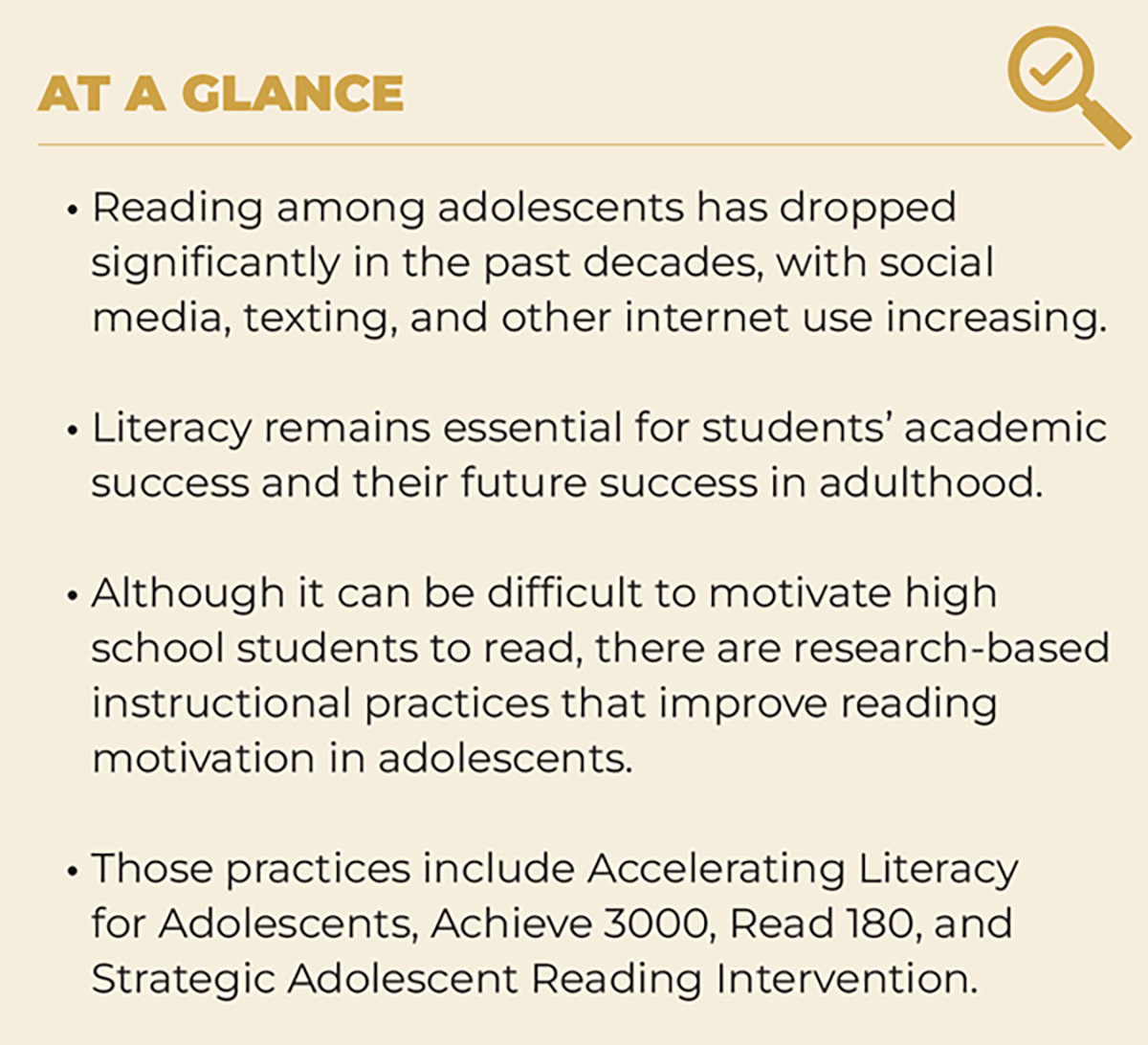
The more high school students read, the better they perform academically, but encouraging struggling readers is difficult. These research-based instructional approaches may help.
The problem of low reading motivation and achievement is even more pronounced in neighborhoods of concentrated poverty. Many adolescents in those areas enter high school with underdeveloped reading skills that often lead to academic failure, motivational roadblocks, and pervasive disengagement in school. The achievement gap between students from high- and low-income groups remains, even as the gap in school readiness rates has narrowed somewhat (Reardon & Portillo, 2016). Lack of success in the past makes students less likely to want to read, which leads to a continued downward spiral. How do we reverse these trends?
Research has shown that motivation contributes significantly to reading achievement (Retelsdorf, Köller, & Möller, 2011; Schiefele et al., 2012) and that improvement in reading is hard to achieve when students lack motivation (Baker & Wigfield, 1999; Guthrie & Wigfield, 1999; Unrau & Schlackman, 2006). One of the five recommendations in the federal What Works Clearinghouse’s guide for improving adolescent literacy focuses on the need to “increase student motivation and engagement in literacy learning” (Kamil et al., 2008, p. 26).
Motivating students to read more is a critical step for increasing their academic achievement and preparing them for adulthood. But finding ways to help struggling adolescent readers without sacrificing a standard high school English language arts (ELA) curriculum has proved challenging for most schools. Although students may flounder in a standard ELA course, excluding them from that curriculum hinders their ability to catch up to their peers. Fortunately, there are instructional practices that improve reading motivation and promising adolescent literacy interventions that could help increase student motivation to read.
Increasing reading motivation in the classroom
In secondary schools, reduction in reading instruction, lack of choice, weak personal connections with teachers, lack of real-world connections, and use of complex texts may explain why adolescents have lower levels of reading motivation compared to elementary school students (Guthrie & Davis, 2003). However, increasing reading motivation in high school students is not impossible. Research shows that there are several instructional practices that, when included in a reading program, could support the growth of reading self-efficacy, frequency, engagement, and motivation for reading. Not surprisingly, these instructional practices address students’ needs for autonomy, belonging, and competence, sometimes described as the “ABCs of Motivation” (Anderman & Leake, 2005).
Autonomy
When students have opportunities to exercise their autonomy and make choices while learning, their intrinsic motivation increases (Guthrie et al., 2004). They take ownership and try harder than students who are not provided choices (Beymer & Thomson, 2015). Providing choice leads to outcomes such as increased effort, improved task performance, perceived competence, and preference for challenge (Patall et al., 2008). The opportunity to choose relates strongly to secondary students’ reading behavior, engagement, and achievement (Davis et al., 2020).
Belonging
Creating a sense of belonging in the classroom and encouraging student collaboration in learning also can increase students’ reading motivation. Research shows that through discussion of comprehension questions with their peers, students can draw meaning from complex texts (McKinstery & Topping, 2003). Students are interacting with the text as they search for references or inferences to defend their answers during class discussion. They also gain a deeper meaning of the text when they hear others’ reactions and make comparisons. On post-reading comprehension measures, students who participated in collaborative learning experiences outperformed those who worked individually (Klingner et al., 1998; McKinstery & Topping, 2003; Stevens et al., 1987). Adolescent students who rate themselves as pro-social during reading activities also report higher levels of reading behavior, frequency, and reading achievement (Davis et al., 2020).
Competence
Another way to encourage reading motivation and self-efficacy involves building students’ reading competence by teaching them how to use reading strategies independently. When students become proficient and independent users of reading strategies, they become more confident in their reading skills (Schunk & Pajares, 2002; Schunk & Rice, 1992). Students with high confidence in reading will persist at difficult reading tasks and work to complete those tasks (Schunk, 1989, 2003); use a greater variety of cognitive strategies for processing information (Pintrich & DeGroot, 1990); place a higher value for tasks at which they succeed (Wigfield, 1994); and earn higher grades (Pintrich & DeGroot, 1990) than students with low confidence. Self-efficacy relates highly to reading behavior, engagement, and achievement for secondary students (Davis et al., 2020).
To make reading strategy learning interesting for students, instruction should use conceptual themes (Perkins & Unger, 1999) and driving questions (Blumenfeld et al., 1991) that “provide a natural context for teaching and understanding” (Guthrie & Cox, 2001, p. 290). Having deep interest in a topic helps motivate students to learn difficult skills, such as reading comprehension strategies (Filippatou & Kaldi, 2010; Kaldi et al., 2011). Research indicates that strategy instruction based within a content-rich approach, using deep discussion around specific content, is more effective than learning strategies through direct instruction alone (McKeown, Beck, & Blake, 2009).
We also support student motivation when we provide them with interesting texts on their reading level. As texts become more complex in secondary school, struggling adolescent readers disengage (Guthrie & Davis, 2003). Matching materials to reading levels brings students success and increases their self-efficacy (O’Connor et al., 2002).
Promising adolescent reading interventions
How do we translate this motivation research into practice in reading instruction? According to a recent research review (Baye et al., 2019), the most effective adolescent reading interventions emphasize student motivation and relationships in the classroom. These researchers found that programs with the largest positive effects on student reading involved one-on-one tutoring, individualized learning, or cooperative learning. Effective adolescent literacy interventions highlighted in both this review and the What Works Clearinghouse (WWC) include Achieve 3000, Read 180, and Strategic Adolescent Reading Intervention (STARI).
Achieve 3000
McGraw Hill’s Achieve 3000 is a supplemental online reading program that engages students individually in nonfiction texts at their reading level and provides opportunities for them to respond to the text in different ways. Teachers receive professional development that equips them to use Achieve3000 data on student progress to respond to individual student weaknesses in literacy, including vocabulary and comprehension skills. Studies have shown potentially promising effects on reading comprehension (WWC, 2018). The program is available through the Achieve 3000 website.
READ 180
Houghton Mifflin Harcourt’s READ 180 is a widely used year-long intervention, delivered in a 90-minute block period, designed to supplement regular ELA instruction (WWC, 2016). It involves a combination of whole-group and small-group instruction and individualized computer-assisted instruction and practice in grammar, writing, vocabulary, and comprehension skills. The intervention includes professional development and a learning management system for teachers. Several studies have found significant positive effects on reading achievement, while other studies showed indeterminate effects (WWC, 2016).
STARI
The Strategic Adolescent Reading Initiative (STARI) seeks to address reading motivation through engaging and relevant texts and instructional strategies that meet students at their reading level, encourage student voice, and emphasize collaboration (Kim et al., 2017; Vaughn et al., 2022). The full-year course serves as supplemental reading instruction to the regular ELA course. The impact study demonstrated that the intervention’s effect on reading outcomes was impacted by student engagement in the instructional activities, and it had a significantly positive effect on several reading outcomes. STARI is available from the Strategic Education Research Partnership (SERP) Institute website.
ALFA
ALFA (Accelerating Literacy for Adolescents) Lab, developed by our team at Johns Hopkins University School of Education, is a recently evaluated one-semester elective designed to boost reading achievement, motivation, and frequency among struggling 9th-grade readers taking a regular grade-level English course (Schoeneberger et al., 2023). ALFA’s multicultural curriculum includes high-interest readings and associated activities for three units (Feisty Felines, Heroes, and Galaxy). Similar in some ways to READ 180 and STARI, ALFA involves both whole-class instruction and rotation of small groups of students to four stations during each 90-minute lesson. ALFA’s small-group components include: Main Station, where teachers lead guided reading activities. Collaboration Station, where students collaborate to construct and apply knowledge from a text. Wordology, where students master key vocabulary and use it in writing. Media Madness, which uses media to research unit-related information and produce a capstone project. When students have opportunities to exercise their autonomy and make choices while learning, their intrinsic motivation increases.
Professional development includes summer training for teachers and assistants and monthly coaching and implementation supports.
The external evaluation found positive (though not statistically significant) overall impacts of ALFA on reading achievement, motivation, and reading frequency (Schoeneberger et al., 2023). However, the impact of ALFA on reading frequency for male and Hispanic students — groups that may struggle more than others with reading motivation — was large and statistically significant. There is some evidence that the positive effects of ALFA on reading achievement were at least partially boosted through its impact on reading motivation and frequency. Given that the evaluation’s promising results occurred during the pandemic, continued attempts to assess ALFA’s effectiveness appear to be warranted. Curriculum materials (teacher manual, lesson plans, and student materials and activities) are available at no cost online (https://alfa.every1graduates.org/).
Literacy is a top priority
Motivating today’s adolescents to read is a challenge. Literacy interventions designed to engage and motivate adolescent readers can potentially address this challenge and lead to improvements in academic outcomes. We encourage school leaders to try out evidence-based literacy programs such as those we have highlighted above. And as the cultural milieu continues to evolve for adolescents, developing additional relevant and engaging literacy programs remains a top national priority if we are to raise up a new generation of readers.
Footnotes
Note:
The development and external evaluation of ALFA was supported by the Institute of Education Sciences, U.S. Department of Education, through grant R305A180154 to Johns Hopkins University. The opinions expressed are those of the authors and do not represent views of the institute or the U.S. Department of Education.