




Abstract
Research on engagement in schools as well as research from the Challenge Success-Stanford Survey of School Experiences on how high school studentsʼ perceptions of classroom practices correlate with their engagement levels shows that more students are engaged in school when educators emphasize practices that promote learning and mastery. Authors Sarah Miles, Denise Pope, and Caitlin Ciannella offer mastery-based strategies teachers can use to increase student engagement by tweaking some approaches to grading and assessment.
Keywords
When teachers promote learning and mastery over grades and test scores, student engagement and motivation increases, research shows.
Remedying this flawed system will take both a dismantling and a rebuilding of the ways schools approach assessment and how students perceive their own success. Based on our research and literature from other scholars, we believe that more students will be engaged in the classroom if we emphasize learning and mastery over and above grades and test scores.
Our research has shown how students’ perceptions of classroom practices correlate with their engagement levels. We’ve developed concrete strategies teachers can use to increase student engagement by tweaking some approaches to grading and assessment.
The ABCs of engagement
We know that engagement in school leads to academic achievement for all students (Harackiewicz et al., 2002; Kaplan & Maehr, 1999; Urdan & Kaplan, 2020; Wang & Peck, 2013; Wigfield, Eccles, & Rodriguez, 1998). However, measuring engagement is not easy. We can see how students demonstrate engagement through certain actions and behaviors, but we also need to ask about students’ internal thoughts and experiences.
The Challenge Success-Stanford Survey of School Experiences, a survey tool developed by Stanford University researchers and the nonprofit school reform organization, Challenge Success, examines student well-being; belonging; and the affective, behavioral, and cognitive dimensions of student engagement (Finn & Zimmer, 2012; Fredricks, Blumenfeld, & Paris, 2004). Often referred to as the ABCs of engagement, each area measures different aspects of schoolwork:
Interest and enjoyment: The affective engagement scale measures students’ interest in and enjoyment of schoolwork. Students are asked, for example, “How often do you find your schoolwork interesting?”
Effort and assignment completion: The behavioral scale relates to effort, hard work, and the completion of assignments. Sample questions include, “How often do you try as hard as you can in school?” and “How often do you pay attention in your classes?”
Attitudes and perceptions: The cognitive engagement scale measures students’ attitudes toward the value and importance of their schoolwork. For example, students are asked, “How often do you find your schoolwork meaningful?”
We examined survey data from approximately 46,000 individuals at 55 public, independent, and charter high schools between fall 2021 and spring 2023 to understand the current state of high school students’ engagement. By combining the results from all three of these dimensions, we can develop a more robust picture of student engagement within a given population.
Defining levels of engagement
When we combine the three types of engagement into a comprehensive measure, we can see where students are within a range of disengaged to fully engaged (see Figure 1). Categories include:
Engagement types among high school students
Disengaged (12%): Students who reported that they are “never” or “rarely” affectively, behaviorally, or cognitively engaged (on average).
Doing school (52%): Students who are “almost always” or “always” behaviorally engaged but “never” or “rarely” cognitively and affectively engaged.
Purposefully engaged (20%): Students who reported “almost always” or “always” being behaviorally and cognitively engaged in school but “never” or “rarely” affectively engaged.
Fully engaged (12%): Students who reported that they are “almost always” or “always” affectively, behaviorally, and cognitively engaged.
Others (4%): These students don’t fit into any of the above categories.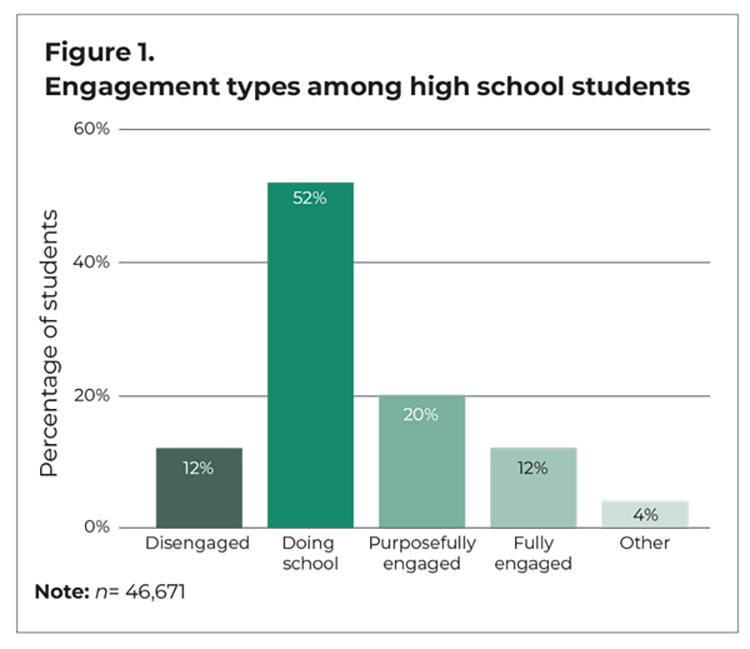
An emphasis on mastery
Students’ perception of the purpose of their schoolwork is directly tied to their engagement and motivation (Barron & Harackiewicz, 2001; Urdan, 2010). Through their actions, teachers give signals concerning what is most valued or important in each classroom. Certain pedagogical practices and classroom policies signal an emphasis on learning, understanding the material, getting the right answer, or getting a good grade (Hemi, Madjar, & Rich, 2023). For instance, the way a teacher responds to a student who has made a mistake sends a message about the extent to which the teacher sees mistakes as opportunities to learn. When a teacher allows students to make corrections to an assignment or retake parts of an exam, for example, it shows that the teacher prioritizes understanding the material.
To gain a deeper understanding of this from the student perspective, we asked students in our survey about their perceptions of the emphasis placed on learning and improving in their classes as well as the emphasis placed on getting good grades and getting the right answers (see Figure 2). The four questions we used are based on the Patterns of Adaptive Learning scale developed by Carol Midgley and her colleagues (2000) to measure the degree to which achievement goals emphasize mastery or performance. The relationship between students’ perceptions of the goal of classroom learning and their engagement and academic achievement is well-established across diverse populations in social science research (Bardach et al., 2019; Hemi, Madjar, & Rich, 2023; Shannon, Salisbury-Glennon, & Shores, 2012).
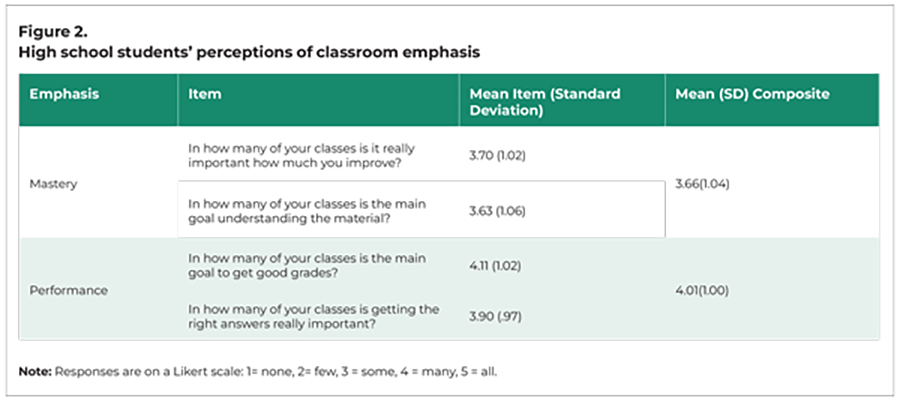
High school students’ perceptions of classroom emphasis
Students responded to the questions using a Likert scale from 1 (none of my classes) to 5 (all of my classes). To create a mastery composite and a performance composite, we combined the two items in each category into one mean “score.” As seen in Figure 2, the mean mastery score across the entire high school sample is 3.66, indicating that, on average, students report between some (3) and many (4) of their classes emphasize mastery. The mean performance score (4.01) is significantly higher, with students indicating that, on average, it is more common for them to perceive that the main goal of their classes is to get good grades and that having the right answers is important.
Based on our own work with schools and the literature on goal orientation, we hypothesized that students who perceive more of their classes to be focused on mastery also would be more likely to engage more fully in their classes. Thus, we analyzed students’ reports of a mastery orientation in their classes by their type of engagement.
Mastery and engagement
In our analysis of the relationship between high school students’ perceptions of their classes as emphasizing mastery and their engagement type, we find a statistically significant relationship between mean mastery emphasis and engagement type (Figure 3). In other words, when teachers emphasize learning and understanding (mastery), students showed higher levels of full engagement. In addition, we find the following: Students who were almost always or always disengaged in their classes are more likely than all other engagement types to report that their classes don’t emphasize mastery. Students who were almost always or always “doing school” are significantly less likely than both purposefully and fully engaged students to perceive their classes as emphasizing mastery. Fully engaged students are significantly more likely than disengaged, doing school, and purposefully engaged students to perceive their classes as emphasizing mastery.
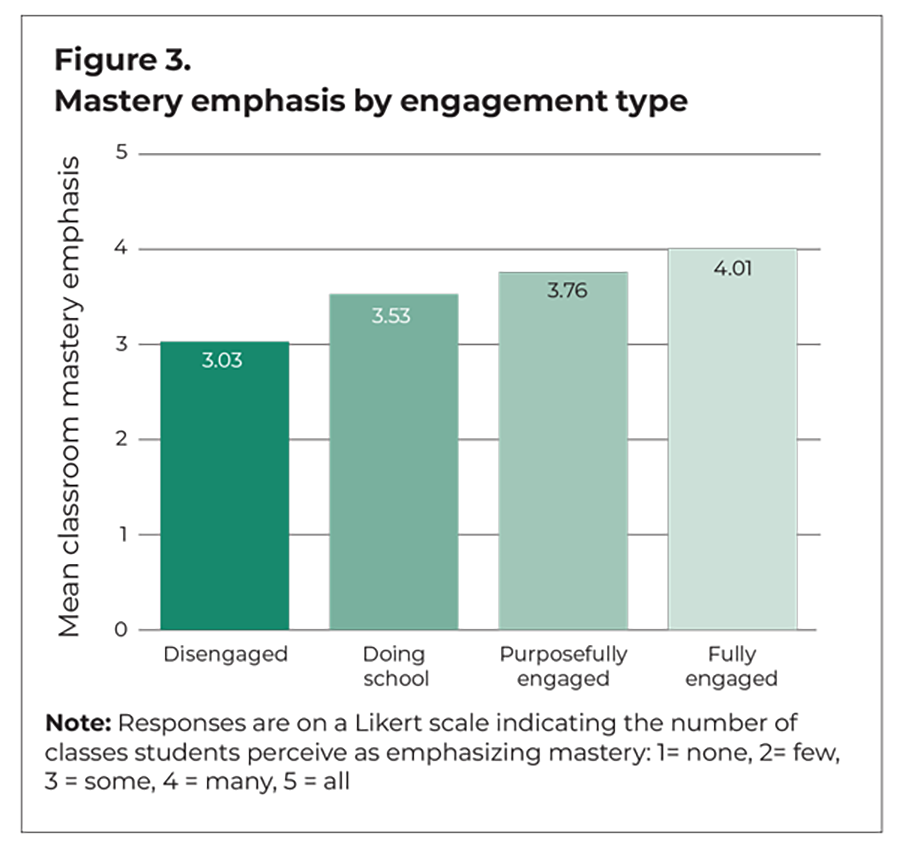
Mastery emphasis by engagement type
In other words, students who are almost always or always finding their schoolwork interesting and meaningful, and are working hard and putting forth effort, are also more likely to perceive their classes as emphasizing mastery. Furthermore, students who are almost always or always disengaged in school and are working hard but never or rarely finding their schoolwork interesting or meaningful, are more likely to perceive fewer of their classes as emphasizing learning.
Given this relationship between engagement and mastery-based classrooms, how can we help educators find more effective ways to emphasize mastery? How can we align our assessment and grading systems to help students to learn and grow?
Classroom practices and policies that emphasize mastery
We have learned quite a bit about effective strategies for promoting learning and mastery in classrooms through our work with school communities as well as our reviews of the education research (Skinner, 2023). A key component of what we have learned builds on educational psychologist Benjamin Bloom’s work in this area which, among other things, emphasizes using assessments as opportunities to encourage learning, not merely evaluations of what a student has learned. Bloom also found that teachers who use assessments in this way are more likely to reduce gaps in achievement and effectively address student learning differences (Bloom, 1971a, 1971b).
In our educator survey, we measure faculty and staff well-being, belonging, and engagement, along with the extent to which teachers implement specific strategies associated with a mastery goal orientation: Allowing students to skip an assignment if they have already demonstrated mastery of the topic. Providing opportunities for students to demonstrate that they know a topic before the teacher moves on to a new topic. Allowing opportunities for students to revise and resubmit an assignment. Allowing test corrections.
Each of these practices signals to students that the main goal of the class is not just to get a grade and then move to the next unit. The focus on learning from mistakes, revising assignments and exams, and demonstrating understanding before moving on to a new topic all signal a priority on mastery.
When we asked educators how often they practice these strategies in their classroom, we found that, in most cases, the majority do not regularly use them. Specifically, of the more than 500 teachers we surveyed at 15 high schools (public, independent, and charter) in 2022-23, 65% have never provided opportunities for students to skip an assignment if they have already demonstrated mastery of the topic, whereas 7% offer this opportunity to students weekly or more. Similarly, 38% of teachers surveyed have never provided opportunities for students to demonstrate that they have learned a topic before moving on to the new topic, whereas 15% have done so at least once a week (see Figure 4). When we ask teachers how often they provide opportunities for students to revise and resubmit assignments in the classes they teach, 53% report that they do so in many or all their classes. And 45% of teachers reported that they allow students to make corrections to their assignments in many or all the classes they teach.
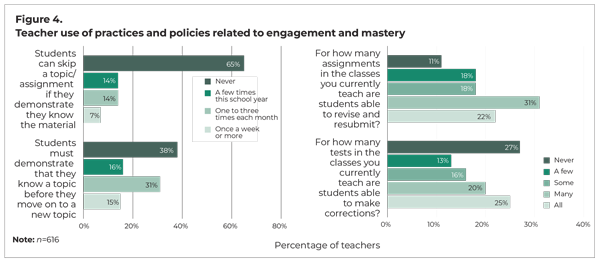
Teacher use of practices and policies related to engagement and mastery
Practices like the ones in Figure 4 can help students understand that learning and mastery are a priority. Specific examples of how teachers can emphasize mastery to help boost student engagement include: Using pre-tests to determine which students may have some level of mastery at the beginning of a unit and then differentiating instruction accordingly. Incorporating more frequent, low-stakes, formative assessments throughout a unit to gauge understanding and to signal that students can learn from these activities to prepare for the summative assessments to follow. Making homework assignments optional, so students who already feel confident with the material don’t have to complete the extra work. Or letting students skip sections of the homework when they demonstrate understanding of the concept. Offering narrative feedback on an assignment with an opportunity for revision before assigning a grade. (This is also a nice way to get students to read your comments!) Making some assignments pass/no credit or non-graded.
Engage more students
These strategies can signal to students that we value growth, learning, and improvement; and teachers can use them to engage more students in school. While we have focused on grading and assessment strategies in this article, there are many more strategies that can have a positive impact on students’ motivation and engagement. These include finding ways to build on students’ interests, seeking out and valuing students’ opinions about what happens in class, and fostering a sense of mutual respect and care (Skinner, 2023; Urdan, 2010).
We understand and acknowledge the many reasons teachers may have not felt able to offer this kind of flexibility to their students, including the quantity of material they are required to cover, the number of students in their class, behavioral challenges, and more. Even when teachers are limited in their ability to offer chances for revisions or some of the other strategies we’ve outlined, our findings demonstrate that teachers send powerful signals to students through what they emphasize in class. When teachers let students know that mistakes are expected and can lead to deeper understanding, and when they believe in every student’s capacity to succeed in school, they remind students that the goal of being in school is to learn and grow. Students can then internalize mastery goals even in a world where grades and test scores appear to be the most important.