



Abstract
Athletes have better dynamic visual acuity (DVA) while seated compared to the general population. However, it is unclear whether athletes maintain superior DVA during standing and walking.
Purpose
To examine DVA performance while standing and walking relative to seated for athletes compared to students from the general population.
Methods
Interuniversity athletes (Athlete = 16; age = 20.7 ± 1.4) and recreationally-active students (Student = 17; age = 21.3 ± 1.4) performed a custom DVA task. A Tumbling ‘E’ was presented in four possible orientations moving in random (R) or horizontal (H) motion at 30°/s. DVA was performed during four conditions: seated, standing, low-intensity and moderate-intensity treadmill walking. Change in DVA from seated was calculated as the difference in log of the minimum angle of resolution (logMAR) from each condition and response time (RT, ms) was recorded using a keypad. Repeated measures mixed ANOVAs were conducted to compare DVA change scores and RT between groups for each condition.
Results
During R-motion, the Athlete group improved DVA change scores from seated to all conditions, whereas the Student group had worse DVA change scores (p = 0.015, f = 0.51). Both groups responded significantly faster for R-motion during moderate-intensity walking (p = 0.001). For H-motion, no differences were observed in DVA change score or RT.
Conclusion
Athletes improved performance on an random and unpredictable DVA task from seated to standing and walking compared to recreationally-active students who exhibited worse changes in DVA accuracy despite faster responses. Spatiotemporal properties of the DVA task appeared to modulate performance based on level of complexity.
Introduction
To achieve success in high performance sport, athletes must divide attentional resources simultaneously between cognitive and motor tasks during situations with challenging balance and physical exertion demands (Alves et al., 2013; Faubert, 2013). Perceptual-cognitive skills developed through sport experience over time may transfer to enhance performance on different cognitive tasks, such as dynamic visual attention and response time, compared to the general population (Faubert, 2013; Heppe et al., 2016; Scharfen & Memmert, 2019). In addition, greater sport experience may enhance the resilience of neural networks for motor control against detrimental effects of traumatic brain injury or concussion (Smeha et al., 2025). However, increased exposure to repetitive head impacts in contact and collision sports may counteract these mechanisms, potentially altering visual and cognitive functions over time (Brooks & Dickey, 2024; Watson et al., 2025; Zeff & Martini, 2025). The variable effects of sport experience on vision and cognition underscores the need to develop multimodal approaches that better encompass sport-relevant demands to evaluate athletes, including dual-task conditions (Mitchell et al., 2025) and physical exertion (Mitchell et al., 2024; Sicard et al., 2021). Therefore, to better understand the clinical utility of a multimodal approach, it is critical to first understand potential differences in visual-cognitive performance between athletes and the general population.
Dynamic visual acuity (DVA) is a correlate of visuoperceptual processing as it integrates visual acuity, oculomotor function, and higher-order dorsal and ventral stream pathways to recognize the details of a target in the presence of motion (Brown, 1972). Athletes at various levels typically have superior DVA performance characterized by various methods compared to individuals from the general population or non-athletes (Filippini et al., 2025; Uchida et al., 2012; Yee et al., 2021). A recent study by Yee and colleagues (2021) utilized a valid and reliable custom DVA software program to compare performance across three populations: interuniversity team athletes, video game players, and non-athletes (Hirano et al., 2017; Yee et al., 2021). Their findings revealed that athletes had significantly better DVA scores during random motion at a higher target motion speed threshold (30°/sec) compared to non-athletes while seated. Athletes had superior DVA scores despite having no differences in oculomotor function, static visual acuity, or refractive error (Yee et al., 2021). Although athletes demonstrated better visual-cognitive performance in a seated (balance-controlled) position, there is potential for sport-related situations with different balance and movement conditions to further exploit differences in DVA performance compared to the general population (Wilkins, 2024).
Performing a cognitive task while standing and walking requires greater investment of attention compared to a seated position (e.g. walking while using on a mobile device) (Lajoie et al., 1993). Most often the neural resources required to perform the concurrent task interferes with similar resources, such as vision, needed to maintain balance. The postural control system integrates information from multiple sensory resources, relying heavily on vision as an external reference to interpret the surrounding environment and vestibular and proprioceptive systems for internal position awareness (Drew & Marigold, 2015; Lajoie et al., 1993; Patla, 1991; Winter, 1995). During a dual-task, increased supraspinal inputs are required to adapt multi-sensory integration and postural responses to maintain balance control based on the interference of the secondary cognitive task (Lajoie et al., 1993; Mac-Auliffe et al., 2021). Lajoie and colleagues (1993) revealed that adults had slower response times during a verbal dual-task proportional to increased balance control demands from seated to standing and walking (Lajoie et al., 1993). Although a cognitive task performed during locomotion may be a greater challenge, the higher energy cost may provide exercise-induced cognitive benefits with different intensities affecting activation of attentional networks (Davranche & Audiffren, 2004; Fontana et al., 2009; Kamijo et al., 2007).
The exercise-cognition relationship may be influenced by various individual and task-related factors. Engaging in moderate exercise during a dual-task (approximately 50 to 60% of age-predicted maximum heart rate (HRmax)) may be optimal to facilitate cognitive processing compared to lower or higher intensities (Davranche & Audiffren, 2004; Fontana et al., 2009; Hüttermann & Memmert, 2014). One factor that may interact with dual-task performance during exercise is the complexity of a secondary cognitive task (Kamijo et al., 2007; Olson et al., 2016). For example, the Eriksen flanker task evaluates attention and response inhibition by presenting a set of arrows and individuals must identify the direction of the central arrow facing either the same or opposite direction of the surrounding arrow. Olson and colleagues revealed that young adults from the general population exhibited a speed-accuracy trade-off during the Eriksen flanker task despite pedalling within moderate intensities of 40% and 60% of maximal oxygen consumption (VO2 max) (Olson et al., 2016). Sport experience may also affect dual-task performance during exercise with athletes eliciting benefits at more vigorous intensities (Hüttermann & Memmert, 2014). One previous study by Park and colleagues (2021) examined performance on a three-dimensional multiple-object tracking (3D-MOT) task with elite-level athletes from strategic, interceptive, and static sports. The findings revealed that athletes maintained performance on the 3D-MOT with progressively increasing target speeds during high-intensity treadmill running intervals (Park et al., 2021). These results from this study are promising such that treadmill exercise may be effective to challenge dual-task performance for athletes. Further research is required to understand how different individual and task constraints may interact with the exercise-cognition relationship during a visual-cognitive task.
The impact of sport experience on visual and cognitive functions may be an important consideration for clinical management of sport-related injuries, including concussion. As a form of traumatic brain injury, concussion may directly affect an individual’s ability to see, think, and move efficiently with a myriad of neurological dysfunctions across various clinical domains (Patricios et al., 2023). Emerging research reflects a conflict between the benefits of sport experience (Smeha et al., 2025) and potential side effects of repetitive head impact exposures on visual and cognitive functioning (Brooks & Dickey, 2024; Watson et al., 2025; Zeff & Martini, 2025). A DVA software program may be a feasible solution to better characterize visual-cognitive performance for athletes, specifically during more ecologically-valid dual-task conditions to develop more robust clinical strategies, specifically for return-to-sport progressions.
Therefore, the purpose of the current study was to examine how performance on a custom DVA task may be affected by different balance and physical exertion conditions between healthy interuniversity athletes and the general university student population. It was hypothesized that athletes would perform better on the DVA task characterized by (1) improved (more negative) change in DVA scores and (2) faster (decreased) response times during standing and treadmill walking conditions relative to a seated position compared to the general student population.
Methods
Participants
Participant Demographic Information by Group, Including Age and Sex, and Group Characteristics (e.g., Current Sport Participation, and Binocular Static Visual Acuity)
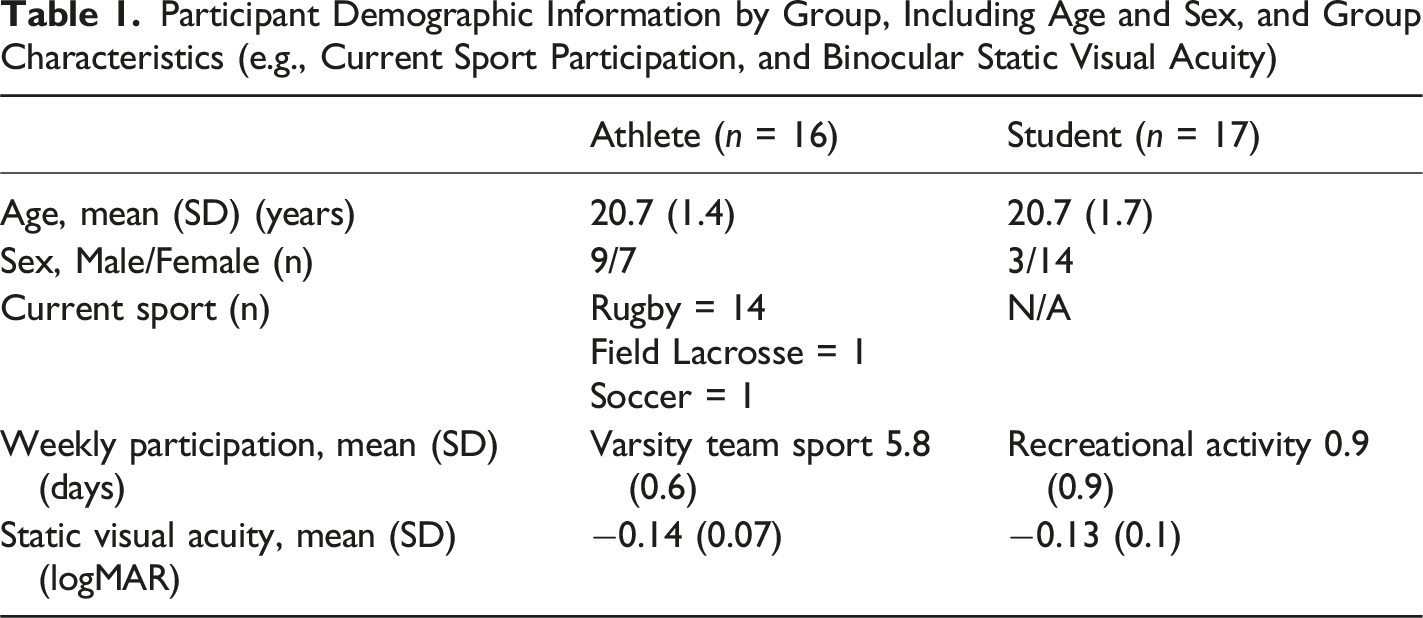
Participants were included in the current study if they reported normal or corrected-to-normal vision and were instructed to wear corrective lenses if they wore them for sport and/or recreational activities. Participants were excluded from this study if they reported a history of concussion injury within the previous four years, greater than two reported lifetime concussions, vestibular-ocular motor deficits, neurological conditions, binocular vision disorders and/or impairments (e.g., strabismus, amblyopia, and/or nystagmus). Prior to arriving for their study session, each participant was instructed to avoid exercise up to 2 h as well as caffeine for a minimum 3 hours prior to mitigate potential performance-enhancing effects on DVA performance (Mitchell et al., 2024; Redondo et al., 2021).
Experimental Design
Pre-screen Assessment
Participants completed a detailed medical and health history questionnaire to screen for concussion, orthopaedic, and visual-vestibular history. In addition, each participant provided information regarding previous sport participation and training including days of sport-specific training per week (Table 1). Prior to beginning the protocol, all participants completed a screening assessment of static visual acuity (SVA) using the Early Treatment Diabetic Retinopathy Study (ETDRS, Precision Vision, Illinois, USA) eye charts viewed at 4-m for monocular (i.e., left and right) and binocular vision. SVA was scored as the log of the minimum angle of resolution (logMAR), where higher scores (i.e., larger target sizes) indicate worse visual acuity (Bailey & Lovie-Kitchin, 2013; Kuo et al., 2011). Participants were included in the study if their binocular SVA was equal or lower than 0.3 logMAR (equivalent to 20/40) and a difference between left and right monocular SVA no greater than 0.1 logMAR (Casson & Racette, 2000; Rubin et al., 2000).
DVA Assessment
The DVA assessment was conducted using a custom software program, the moV& V&MP Vision Suite, developed in the School of Optometry and Vision Science at the University of Waterloo (Waterloo, Canada). Participants viewed the DVA task on a 55” LCD monitor with a 120 Hz refresh rate (Samsung Electronics Co., Ltd., South Korea) at a distance of 4-m for all conditions. The luminance of the screen was measured to ensure all four corners of the monitor were within 295 ± 15 lux using a handheld luxmeter prior to beginning the DVA protocol with each participant. External lighting was used to supplement illuminance of the testing area during different lighting conditions. During the task, a Tumbling ‘E’ optotype was displayed during two motion conditions: (1) random (R); and (2) horizontal (H). During R-motion, the target motion was continuous and unpredictable, moving spontaneously in Brownian-like motion, randomly exiting, and re-entering the screen for up to 20 s in duration. In contrast, H-motion was predictable but not continuous, with each target presented beginning from the left, moving linearly across the centre of the screen, and immediately exiting on the right side. In both conditions, each target presentation appeared in one of four orientations at random based on the prongs of the ‘E’ (e.g., up/down/left/right) while moving at a speed of 2.31 m/s (30°/sec). The target speed selected were informed by the recent study by Yee and colleagues (2021), which was the most sensitive to differences in DVA score between athletes and non-athletes while seated using the R-motion and H-motion types (Yee et al., 2021).
Participants were provided with a handheld keypad labelled with corresponding arrows. Participants were instructed to select the correct arrow to match the orientation of the moving target presented, quickly and accurately. The starting DVA size threshold was set to a minimum of 0.5 logMAR above each individual binocular SVA logMAR score. For each size threshold, the Tumbling ‘E’ target was presented up to five times with a minimum of three correct responses (3/5) required to continue the task. When three correct responses were achieved, the task proceeded with the target reducing in size by 0.1 logMAR. Stopping criteria included three incorrect responses at a given target size threshold, which resulted in the termination of the DVA task.
Experimental Protocol
All participants were provided with detailed instructions and demonstrations of the DVA task by the research team prior to completing a familiarization trial of each motion type. After performing a familiarization trial while seated, participants completed one trial of each motion type (R and H) in four different conditions: (1) Seated; (2) Stand; (3) low-intensity (Walk Low; 45% HRmax); and (4) moderate-intensity (Walk Mod; 60% HRmax) treadmill walking (Figure 1). The Seated and Stand conditions were counterbalanced as the first condition to mitigate learning effects. During the Stand condition, participants stood in a sharpened Romberg stance with feet together on a firm surface holding the keypad with both hands. To determine individual walking speeds for the Walk Low and Walk Mod treadmill conditions, heart rate (beats per minute, bpm) was used to calculate the level of intensity based on age-predicted maximum heart rate (HRmax = 220 – age) (Bruce et al., 1973; Yamaji et al., 1978). Heart rate was measured using a Bluetooth chest strap heart rate monitor (Dash Wearables, Germany) connected to the Polar Beat iOS mobile application (Polar Electro, Finland) during each trial. Participants completed a total of eight DVA trials (2 motion x 4 conditions) in approximately 45-min, with breaks provided as needed. The DVA task was performed during (A) Seated, (B) Standing, and (C) both treadmill walking conditions (Walk Low and Walk Mod)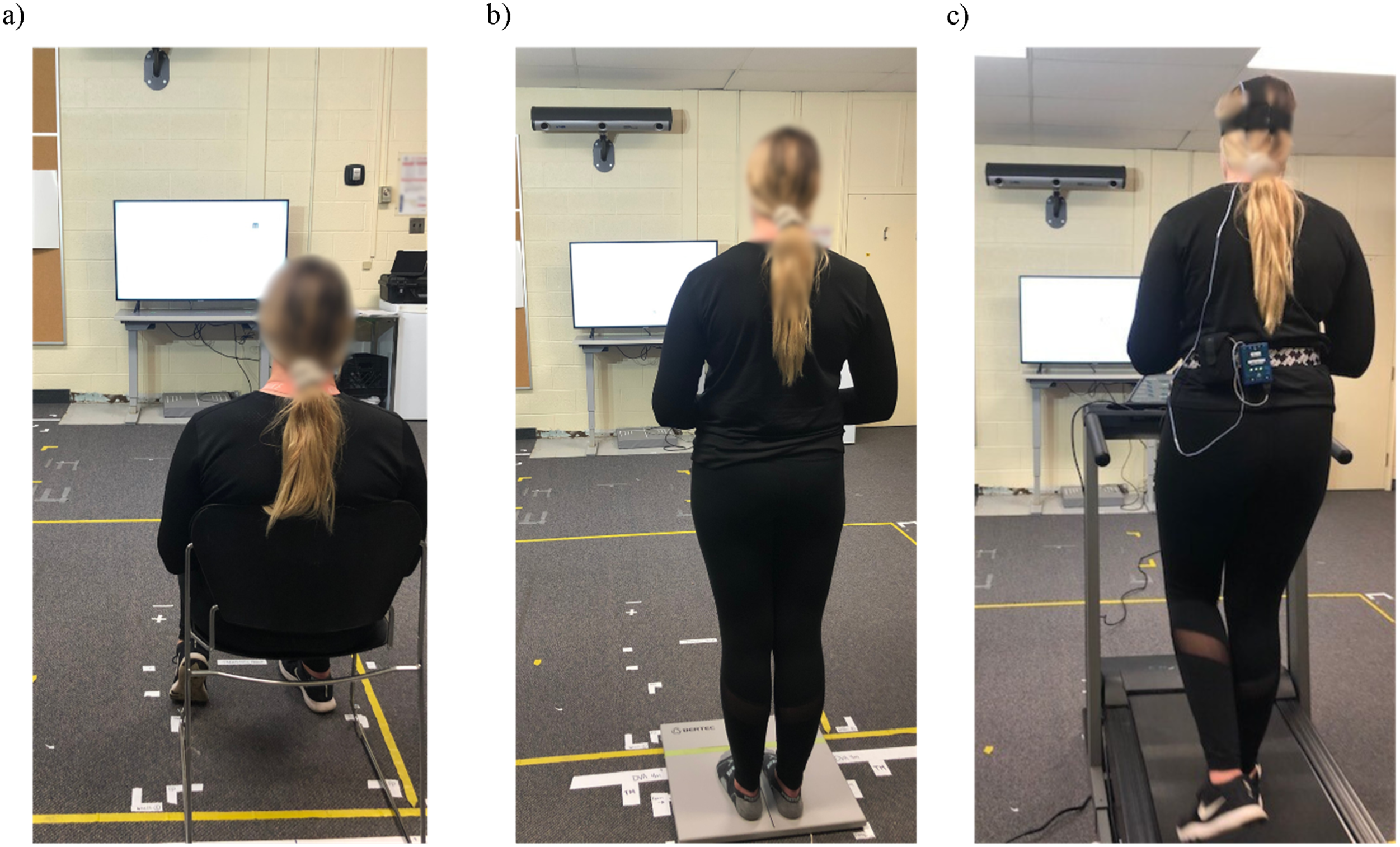
Data Analysis
For DVA score accuracy, the resultant logMAR score for each trial was calculated using per-letter scoring with the following equation:
The lowest line read represents the smallest target size recognized correctly during the task, 0.02 represents the value of each target presented at a given size threshold (i.e., total sum of five targets for each size threshold was 0.1 logMAR, 0.1/5 = 0.02), and number of total errors is the sum of incorrect responses selected using the keypad throughout the full trial. Similar to the SVA charts, a negative score represents a lower logMAR score (i.e., smaller target size), indicating better performance on the DVA task.
To characterize the change in attentional demands of standing and walking conditions relative to the seated position, a relative change in DVA score was calculated as the difference of the Seated logMAR score from Stand, Walk Low, and Walk Mod conditions. A positive change in logMAR score from Seated indicates decreased performance (e.g., smallest target size increased), whereas a negative change indicates improved performance (e.g., smallest target size decreased). A clinically meaningful difference in logMAR score was characterized by a difference equal to five targets or 0.1 logMAR in reference to values for adults using ETDRS charts viewed at 4-m (Sánchez-González et al., 2021).
Response time (RT) was recorded in milliseconds (ms) from the onset of a new target presentation to a button press response using the keypad. For each trial, median RT was calculated for each participant starting from a normalized target size threshold of 0.5 logMAR above their individual SVA score for all conditions. RT was characterized as a median value due to the progressive difficulty of the task as the moving target reduced in size which may bias a mean value.
Statistical Analysis
Descriptive statistics were analyzed for participant demographics and group characteristics are presented in Table 1. Independent samples t-tests were conducted to examine binocular SVA and DVA while seated between groups for each motion type (R and H). Effect sizes were calculated using Cohen’s d, for which meaningful differences were estimated as medium (d = 0.5) or large (d = 0.8) effects.
Data were tested to meet the assumptions of normality, sphericity, and homogeneity of variances between groups. If sphericity was violated a Greenhouse-Geisser correction was applied. All data was assessed for potential outliers that were two or more standard deviations outside of the mean. To examine DVA change scores relative to Seated, a repeated measures mixed analysis of variance (rm ANOVA) was conducted separately for each motion type (R and H) with one between-subjects variable of group (Athlete and Student) and one within-subjects variable of condition with either three levels (DVA Change Score: Stand, Walk Low, and Walk Mod). Similarly for RT, a rm ANOVA was conducted for each motion type between the two groups and within-subjects for condition with four levels (Median RT: Seated, Stand, Walk Low, and Walk Mod), respectively. The dependent variables, including DVA change scores relative to Seated and median RT are presented as estimated means and 95% confidence intervals (95% CI). Effect sizes were calculated as Cohen’s f, with small (f = 0.10) medium (f = 0.25), and large (f > 0.4) effects characterizing meaningful differences. Significant interactions between group and condition as well as main effects of group and condition were further analyzed using Holm’s correction (Holm-Bonferroni) for post-hoc pairwise comparisons of group means to mitigate family-wise error rate. Statistical significance for all analyses conducted was set to an alpha level of p < 0.05. All statistical analyses were conducted using jamovi version 2.7.15.0 (Sydney, Australia) (Jamovi, 2025).
Results
SVA and DVA Scores (Seated)
Binocular SVA was not significantly different between groups while seated (p = 0.978; see Table 1). For R-motion, DVA logMAR scores between Athlete (Mean = 0.17 ± 0.09) and Student (Mean = 0.12 ± 0.09) were not significantly different in the Seated condition (p = 0.066; d = 0.67). Similarly for H-motion, DVA logMAR scores while seated were not significantly different between groups (Mean: Athlete = 0.18 ± 0.09; Student = 0.16 ± 0.10; p = 0.600).
Exercise Intensity
During treadmill walking conditions, each group achieved similar target heart rates for low-intensity (Mean: Athlete = 94.2 ± 3.2 bpm; Student = 94.1 ± 5.0 bpm) and moderate-intensity (Mean: Athlete = 121.3 ± 2.4 bpm; Student = 121.4 ± 3.0 bpm) exercise.
Relative Change in DVA Score from Seated
All data met the required assumptions and no potential outliers were identified for removal from the statistical analysis. For R-motion, there were no significant interactions between condition and group (F(2, 62) = 0.29, p = 0.746). A main effect was revealed between groups for DVA change scores (F(1, 31) = 6.71, p = 0.015, f = 0.51; see Figure 2(A) and Table 2). Post hoc analysis of pairwise comparisons indicated that the Athlete group improved DVA change scores relative to Seated for all conditions with an overall mean difference of −0.08 logMAR compared to the Student group. During the Walk Mod condition, 35% (6/17) of students had a clinically meaningful worse change in DVA scores (range = 0.14 – 0.4 logMAR) compared to 13% (2/16) of athletes (range = 0.1– 0.14 logMAR;). Relative change in DVA scores from Seated (logMAR) plotted as the means and 95% confidence intervals (95% CI) for (A) R-motion: Athlete maintained or improved (more negative) DVA scores, whereas Student had worse (more positive) scores for each condition (p < .05); (B) H-motion: Both groups performed similarly for each condition maintaining or improving DVA scores from Seated DVA Change Score (logMAR, Mean [SD]) and Percentage (%, n) of Participants Who had a Clinically Meaningful Positive or Negative Change in logMAR Score (0.1 logMAR) for Random (R) and Horizontal (H) Motion During Standing and Treadmill Walking Between Groups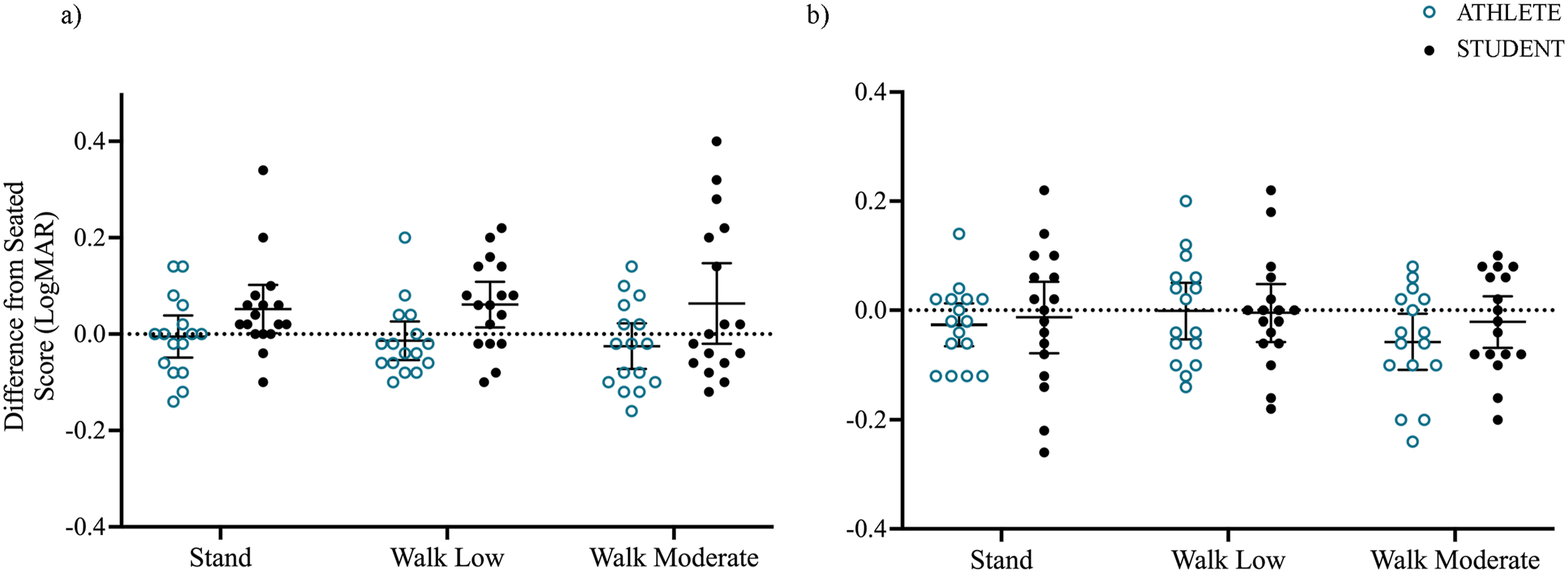
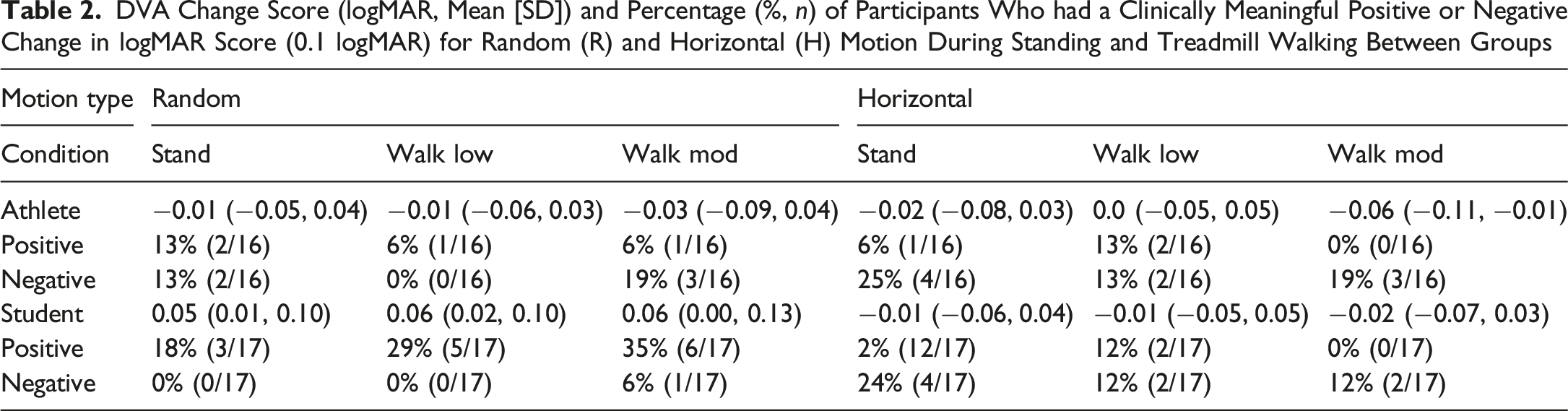
For H-motion, there was no significant interaction between condition and group (F(2, 62) = 0.453, p = 0.638). Similarly, no main effects between groups (F(1,31) = 0.343, p = 0.562) or condition (F(2, 62) = 3.06, p = 0.054, f = 0.33) indicate that both groups performed similarly on the DVA task for each condition relative to Seated (see Figure 2(B) and Table 2). Clinically meaningful positive and negative changes in DVA scores for each group are reported in Table 2.
Response Time
For R-motion, there was no significant interaction between condition and group (F(3, 93) = 0.50, p = .683) or main effect between groups (F(1,31) = 0.20, p = 0.658) for median RT (Figure 3(A)). A significant main effect of condition (F(3, 93) = 5.83, p = 0.001, f = 0.47) was revealed with pairwise comparisons indicating that both groups improved RT from Seated (Estimated Mean (95% CI): Seated = 1914.64 ms (1691.06, 2138.22)) with significantly faster responses during moderate-intensity treadmill walking (Walk Mod = 1524.02 ms (1307.12, 1740.91), p = 0.005). Median RT plotted as the means and 95% confidence intervals (95% CI). Both groups performed similarly with faster RT on the DVA task from seated to treadmill walking conditions for (A) R-motion (p < .05) and (B) H-motion (p < .05)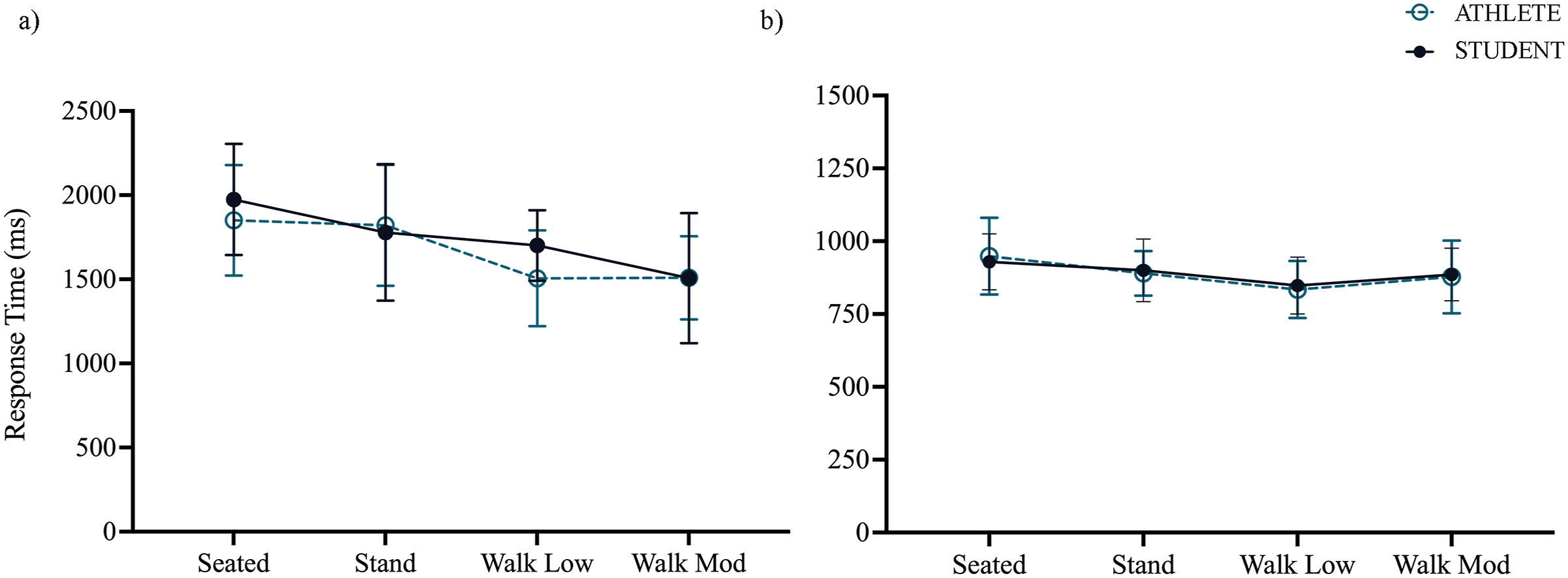
For H-motion conditions, there was no interaction between condition and group (F(3, 93) = 0.21, p = 0.888) or main effects of group for RT (F(1,31) = 0.00, p = 0.960; Figure 3(B)). There was a significant main effect of condition (F(3, 93) = 5.85, p = 0.001, f = 0.47), with post hoc pairwise comparisons indicating that both groups responded significantly faster relative to Seated (Estimated Mean (95% CI): Seated = 938.78 ms (861.36, 1016.20)) during low-intensity treadmill walking (Walk Low = 841.16 ms (774.75, 907.57), p < .001) and not moderate-intensity treadmill walking (Walk Mod = 881.63 ms (808.38, 954.88), p = 0.075).
Discussion
The aim of the current study was to examine how performance on a DVA task was affected by standing and walking conditions at low- and moderate-intensities relative to a seated position between current interuniversity athletes (Athlete) and students from the general university student population (Student). It was hypothesized that participants in the Athlete group would achieve better DVA performance characterized by more negative change in DVA logMAR scores during standing and treadmill walking conditions and faster (decreased) RT relative to Seated compared to Student. Overall, the findings from the current study partly agreed with the hypothesis such that the Athlete group improved DVA performance for all conditions relative to Seated compared to Student during R-motion only (Figure 2(A) and Table 2). Specifically, a greater portion of the Athlete group improved with a negative change in DVA scores during standing and walking conditions relative to Seated, whereas the Student group performed worse overall with positive changes in DVA scores. However, both groups exhibited similar RT across each condition with significantly faster responses during moderate-intensity treadmill walking. In contrast to R-motion, there were no group differences in overall DVA performance for H-motion conditions (Figure 2(B)), as both groups had similar DVA change scores and RT for each condition relative to Seated.
The findings from the current study expand upon previous research suggesting that interuniversity athletes may have superior DVA performance during R-motion at the same speed threshold (30°/sec) (Yee et al., 2021), with the addition of standing and walking conditions. Unlike the previous study, there were no differences in DVA logMAR scores while seated between the Athlete and Student groups for either motion type. The lack of differences in DVA scores while seated compared to findings by Yee and colleagues (2021) may be attributed to differences in experimental design, as the previous study evaluated repeated DVA trials at different target speeds while seated, with 30°/sec as the fastest of four speed conditions. Further consideration of participant characteristics, such as previous sport experience (Smeha et al., 2025), may also attribute to differences in findings for comparison of varsity athletes to a “non-athlete” group in the previous study (Yee et al., 2021) and the recreationally-active university students, of which some reported previous youth sport participation in the present study. In addition, the results align with previous findings indicating no significant differences between groups for RT with either DVA motion type (Yee et al., 2021). Interestingly, both groups significantly improved RT during treadmill walking conditions at a low-intensity (H-motion) or moderate-intensity (R-motion) which may be due to increased facilitation of attentional networks during physical activity (Giesbrecht et al., 2025). Overall, the findings suggest that progressive standing and walking conditions may be an appropriate challenge as a potential clinical assessment strategy for athletes using the custom DVA task.
The differences in DVA performance observed between groups in the current study may be attributable to the specific spatiotemporal properties of each motion type. The unpredictable and continuous nature of the R-motion DVA condition may better represent the complex visual search demands of a constantly evolving field of play in strategic team sports (van Paridon et al., 2022). Athletes participating in high performance strategic team sports may be at an advantage with frequent exposures to more chaotic visual scenes under higher levels of physical exertion (Davids et al., 2005; van Paridon et al., 2022). An increase in physiological arousal appeared to facilitate visual processing speed similar to previous studies (Huertas et al., 2011; Lin et al., 2021; Olson et al., 2016) during moderate-intensity treadmill walking as both groups responded faster during R-motion conditions. Only the Athlete group appeared to elicit exercise-induced benefits to enhance DVA score accuracy and faster responses during R-motion (Ferris et al., 2007; Huertas et al., 2011). Whereas the Student group exhibited a speed accuracy trade-off for R-motion DVA with faster response times and worse (more positive) change in DVA scores as the exercise intensity increased during moderate-intensity treadmill walking (see Figures 2(A) and 3(A)). Olson and colleagues (2016) reported a comparable speed-accuracy trade-off with individuals from the general population responding faster with less accurate responses on an Eriksen flanker task during low- and moderate-intensity pedalling. The results demonstrate potential transfer of sport experience during the R-motion DVA task in agreement with the cognitive-components approach (Heppe et al., 2016; Schumacher et al., 2018; Verburgh et al., 2014), albeit during more sport-relevant exercise conditions. The Athlete group was comprised of varsity-level team athletes who train or compete in their sport over five days per week during their respective seasons. Although the two-dimensional DVA task isn’t a true representation of the field of play, the results of this study suggest that athletes training at this level may elicit benefits on visual and cognitive performance during dual-task conditions compared to the general population.
In contrast to R-motion, the H-motion condition follows a predictable target path across the screen with a brief presentation, which may have elicited a different visual search strategy during the task. Such differences in motion characteristics may allow participants to anticipate the trajectory of the horizontally moving target more easily using anticipatory eye movement behaviours (Berry et al., 1999; Nijhawan, 1994). In addition to high predictability, horizontal visual motion may be more familiar for the general population; typically experienced during everyday activities, such as riding in a vehicle or walking down a busy street. Due to limitations with the subsequent reduction in target size, higher target speed, and 4 m viewing distance, it was not possible to accurately capture gaze behaviours throughout a full DVA trial using an eye tracking device. For RT during H-motion, both groups had the fastest responses during low-intensity treadmill walking relative to Seated. The rapid viewing time for each target presented during H-motion resulted in more marginal differences in RT between treadmill walking conditions compared to R-motion. Since the increased dynamic postural control demands of walking require greater attentional resources (Lajoie et al., 1993), the treadmill conditions in the current study may have modulated exercise-induced benefits on DVA performance compared to stationary pedalling in previous studies (Lambourne & Tomporowski, 2010; Olson et al., 2016).
Overall, the findings indicate that sport experience and task constraints have important modulatory effects on visual-cognitive performance with athletes demonstrating the greatest improvements in DVA score accuracy and RT for R-motion during concurrent treadmill exercise. The results of the current study may have meaningful clinical implications to inform more robust strategies to characterize visual and cognitive deficits, specifically following a concussion injury. Since a concussion may affect several clinical domains of neurological function such as vision (Master et al., 2016; Murray et al., 2020), cognition (e.g., dual-tasking) (Büttner et al., 2020; Howell et al., 2018), and exercise tolerance (Leddy et al., 2015, 2019), it is imperative to develop evidence-informed multimodal assessment progressions for athletes to help determine readiness for return to full sport demands. The current study provides the foundational groundwork for the development of such clinical strategies that accounts for level of sport experience to support long-term health outcomes.
The current study is not without its limitations. The sample size was limited due to previous disruptions experienced during the COVID-19 pandemic. Recruitment for the study began prior to the restrictions placed on interuniversity sport competition, which left athletes isolated from their team training environments for several months through 2020 and 2021. Following this period of time away from sport, the research team chose to discontinue recruitment for the current study to avoid any potential confounding effects on DVA performance. As a result, the findings should be interpreted with caution as the sample size did not meet the requirements of a priori power calculations (n = 20 per group). Further considerations are warranted for the order of test conditions included in the experimental protocol which may be subject to potential fatigue or learning effects on DVA performance. In addition, the normalization of DVA scores from standing and treadmill walking to a seated position may have implications for interpretation of the analysis and future studies may consider exploring different approaches. The results of this study may not be generalizable to youth and/or professional-level athletes or different age groups beyond the university population. Perceptual-cognitive pathways required to perform the DVA task continue to evolve throughout the lifespan developing throughout adolescence and begin to decline for middle-aged adults and more so for older adults (Burg & Hulbert, 1961). In addition, participants were not excluded from the Student group if they had previously competed in local-level youth strategic sports. Although these students reported no sport participation within the previous four years, prior sport experience may have influenced the current findings. Other factors may have influenced DVA performance in this study may include time on task as performance improved with subsequent trials, sleep quality, and/or caffeine intake beyond a 3-h period. Future research recommendations include evaluating the reliability of test conditions and clinical utility of the DVA task for athletes with concussion using the current paradigm to characterize recovery of visual dysfunctions, cognitive and/or balance control impairments.
Conclusion
The findings from the current study highlight the modulatory effects of sport experience and task constraints on DVA performance between athletes and students from the general population during different balance and exercise conditions. Specifically, athletes performed better on an unpredictable DVA task with improved score accuracy and response times during standing and treadmill walking relative to seated compared to students from the general population who had worse changes in DVA scores. However, both groups maintained DVA performance similarly for all conditions during a more predictable horizontal motion task. The current findings have important implications for the development of multimodal assessment strategies to better detect motor control deficits for athletes and recreationally-active individuals following concussion.
Footnotes

Consent for Publication
All participants in the current study provided written informed consent of publication.
Funding
The authors disclosed receipt of the following financial support for the research, authorship, and/or publication of this article: This work was supported by the Natural Sciences and Engineering Council of Canada under Grant #2019-05894 to M.E. Cinelli.
Declaration of Conflicting Interests
The authors declared the following potential conflicts of interest with respect to the research, authorship, and/or publication of this article: KD is a coinventor of the moV& (V&MP Vision Suite, Waterloo, Canada) software used in this study to examine dynamic visual acuity and is currently exploring commercialization options for this device; however, the device is not available commercially at the moment.
Data Availability Statement
The data in the current study is not available to be shared publicly.
Research Ethics Board Approval
Wilfrid Laurier University (REB #6010)