



Abstract
Keywords
Introduction
The ageing population is growing in many societies due to changes in living conditions and improved access to health care services. The ageing process leads to changes in different body systems including impairment in cognitive function and declines in functional behaviours such as walking and postural stability that lead to an increased risk of falls (Ferrucci et al., 2016). Ageing can produce other deteriorating structural changes in aerobic capacity, perceptual and muscle function, impairing an individual’s ability to perform everyday activities in life and subsequently increasing the risk of a sedentary lifestyle and chronic disease (Guralnik et al., 1995; Young, 1997).
Scientific evidence supports the impact of lifestyle factors, such as physical activity, quality and quantity of sleep and diet on slowing the rate of age-related declines in psycho-motor, physiological and functional behaviours (Fratiglioni et al., 2004). The benefits of an active lifestyle in older adults are well-documented (Paterson et al., 2007). Physical activity is associated with reduced mortality and risk of cardiovascular disease, diabetes, bone disease (Fishman et al., 2016; Sabia et al., 2012; Schmid et al., 2016) and cognitive decline (Bherer et al., 2013). In late adulthood (+65 years), participation in moderate to vigorous physical activity is also associated with increased independence (Edholm et al., 2019; Paterson & Warburton, 2010).
Sport is defined as an institutionalised, organised activity with a game-like structure that has rules and regulations, involves strategies, requires special facilities and equipment and takes place at a certain time and place (Barcelona et al., 2015). Voelcker-Rehage and colleagues (2008) have proposed that older adults can gain additional health-related benefits from participating in sports, rather than simply undertaking physical conditioning activities, which provide well-documented advantages. Many sports, including golf, racket sports (tennis, badminton, squash, etc.), swimming, bowls, archery, cycling and walking football can challenge the perceptual-motor capacities of older adults, affording potential health benefits for this population (Jenkin et al., 2016). Studies have shown that participation in sport can reduce the rate of mortality and risk of cardiovascular disease, diabetes and osteoporosis in older populations (Andersen et al., 2000; Randers et al., 2010; Sabia et al., 2012). There is compelling evidence that older adults who participate in sports maintain better health and wellbeing, tend to feel part of a social community group and experience an enhanced sense of control over the ageing process (Jenkin et al., 2016; Stenner et al., 2020).
Despite older adults being aware of the physical health benefits of sport participation, their perception of benefits tends to be only limited to the physical fitness components (Stenner et al., 2020) or psychological factors (Jenkin et al., 2017). However, less is reported on the benefits of participating in sports in maintaining or improving underlying perceptual-motor skills in older adults. These skills are fundamental to the quality of everyday life and are enhanced by interactions with more adaptive environments and via practising sport skills (Rudd et al., 2020). The adaptive movement capacities exploited during sport participation can enhance the general functionality of an individual and, to a great extent, can enrich the perceived quality of life (Rudd et al., 2020; Schmidt & Wrisberg, 2007). More needs to be understood about the preservation of sport skills across the life span, a trend that depends on continued interactions between individuals, environments and the nature of tasks (Rudd et al., 2020). For example, individual differences in motor plasticity and visuomotor adaptations in older adults are associated with changes in sensory (vision, hearing, proprioception) and cognitive functioning (problem solving memory recall, fluency and reaction time) that could lead to performance changes in motor skills (Baltes & Lindenberger, 1997). In addition, older adults can preserve performance in actions that have a low level of difficulty and complexity and with high contextual familiarity (Voelcker-Rehage, 2008).
In sports skills such as the tennis serve, golf swing and bowling in cricket, the temporal sequencing of the body movement organisation is critical for successful performance (Kenney et al., 2008). The available evidence suggests that consolidation of the learned movement sequence in older adults may be impaired (King et al., 2013) due to functional declines and neural changes in the hippocampus and cortical-striatal network (Rieckmann & Bäckman, 2009). There are some gaps in understanding the benefits of regular sports participation on preserving temporal organisation in older adults. First, regardless of underlying mechanisms that contribute to declines in movement organisation in older adults, previous studies have mainly investigated performance in non-sport skills (King et al., 2013), typically in traditional laboratory experiments (Voelcker-Rehage, 2008) that lack representativeness. Some studies have examined performance of a sport skill with specific emphasis on achieving performance outcomes, such as scoring points in a lacrosse catching task (Voelcker-Rehage & Willimczik, 2006), lap times in swimming (Lepers et al., 2019), distance running (Knechtle & Nikolaidis, 2018) and cross-country skiing (Nikolaidis & Knechtle, 2018). There have been few attempts to investigate the quality of temporal movement organisation in performance of complex (multi-articular) sport skills in different age groups. Second, the findings of previous studies on age-related declines in performance of complex sport skills are inconsistent and contradictory (Voelcker-Rehage, 2008).
In this study, we selected the tennis serve as a multi-articular action with a high level of organisational complexity in terms of involving multiple motor system degrees of freedom, accuracy requirements in timing of movements and the importance of perception and cognition coupling in action planning. We investigated how much the natural ageing process could influence the demands of this skill in terms of biomechanical re-organisation. Because the ranges of motion in the trunk and arm during fundamental manipulative skills, such as throwing for force, is reduced in older adults (Williams et al., 1991), we hypothesised that these functional changes could be generalised in more advanced motor skills such as the tennis serve and any change in the timing and coordination of this skill could reflect the age-related adaptations in the motor system. Thus, the aim of this study was to compare the temporal structure of movement (re)organisation including temporal patterning, temporal variability and temporal regularity of coordinating the tennis serve between young and older adults. We hypothesised that the temporal structure of the tennis serve may be different between the two age groups although some older adults may lose some aspects of movement quality due to age-related declines.
Methods
The type of study chosen for this analysis was cross-sectional, in which two groups of young and older adults were compared on the temporal structuring of movement organisation when performing the tennis serve in successive attempts.
Participants
Ten young adults (mean age = 24.5 ± 3.27 years; male = 5/female = 5; training experience = 6.8 ± 3.71 years) and 11 older adults (mean age = 71.64 ± 5.64 years; male = 8/female = 3; training experience = 31.82 ± 9.86 years) were selected voluntarily from local tennis clubs to take part in this study. The sample size was estimated by using G*power software and a total sample of 20 participants was obtained with the power of test (0.80), confidence interval (95%), small effect size (0.18-0.20) and two-tailed test. We used the mixed model of 2 (groups) and attempts (20) to estimate the sample size.
All participants were non-competitive, recreational-level performers, right-handed and free of injury before and during the testing sessions. They practised tennis 2-3 times per week, recreationally (for health and fitness benefits) and without any intention to compete in formal competitive tournament games. The older participants were apparently healthy and without reported musculoskeletal problems, cardiac or neurological diseases that affected their daily living activities. All participants signed the consent form after reading the participants’ information document and completing a health questionnaire. A local ethics committee at Sheffield Hallam University approved the study design.
Procedure
Participants were observed and assessed on the execution of the tennis serve during their routine training sessions on a tennis court. They undertook a 10-min structured general (e.g. stretching, slow-pace walking, joints mobility) and a 10-min specific warm-up routine (e.g. moving rackets, side-stepping, forward lunge, fast and variable short-distance running, hitting the balls and slow-pace serves) before performing services. The warm-up and test parts were supervised by a research member who was a qualified tennis coach and had enough experience in working with different age groups.
Participants were asked to serve in a real-size court from the baseline and try to hit the ball accurately and with appropriate velocity into the service zone. They performed the serves always from the same place on the baseline area. All participants were asked to use their typical first-serve strategy, combining appropriate accuracy and power in all trials. To control the differential effects of external pressure as a confounding factor in our focus on movement timing organisation between the age groups, we did not provide augmented feedback on performance outcomes (scoring) and all service attempts were performed into a service area without an opponent present. We asked participants to perform only one type of selected serve action (top spin, flat or slice) and not to change it over successive attempts. All participants performed 20 serves with a 30-second rest period between trials.
A high-speed digital video camera (GoPro Hero 8, GoPro inc, USA) with high resolution (Full HD: 1080) and high frame rate (240 fps) was set up on a tripod on the left side of the midline near the net to record the full body movements of the participant in action. The camera view angle relative to the midline was equal to 45°. The recorded video footage was saved on an SD card and transferred to a PC for further analysis.
Data Analysis
The whole sequence of the tennis serve was segmented into 4 phases including preparation, back-swing, acceleration and follow-throw (see Figure 1). The 4-phase model was adapted from that of Kovacs and Ellenbecker (2011). The stage-like model of the tennis serve reflects the main dynamic functions of the action including storing energy (preparation phase), releasing energy (acceleration phase) and decelerating the action (follow-through phase), revealing activation of the main large muscle groups for the efficient functioning of the kinetic chain (Kovacs & Ellenbecker, 2011). In this study, the timing of the whole serve action and each phase was analysed with specialised software (Simi Motion, Simi Reality Inc. Germany). To identify the accurate start moment and end moment of each phase, we used the forward-backward frame-by-frame method. Then, we digitised the frames to reveal timing criteria for calculating phase duration. The phase duration of each serve attempt was calculated and then converted into data on temporal patterning (average time for all trials, mean), temporal patterning variability (coefficient of variation for all trials, CV) and temporal regularity (auto-correlation coefficient for all trials, ACC). The variability in the serve timing refers to the overall discrepancy of each serve time relative to the mean serve time, whereas temporal regularity refers to how much the timing of the next trial is related to the timing of the previous trial (lag 1). A higher value (close to 1.0) represents a stronger relationship between the serves and a lower number (close to 0) represents a weaker relationship. The ACC has been used, generally, as a non-linear method in human movement analyses (Robertson et al., 2013) for calculating movement regularity (Moe-Nilssen, 1998). Different phases of a tennis serve. Preparation: from the start of racket-arm motion until the ball release. Back-swing: from releasing the ball until the end of maximal shoulder external rotation. Acceleration: from the upward motion of the racket until the ball-racket contact moment. Follow-throw: from the ball contact to the end of action.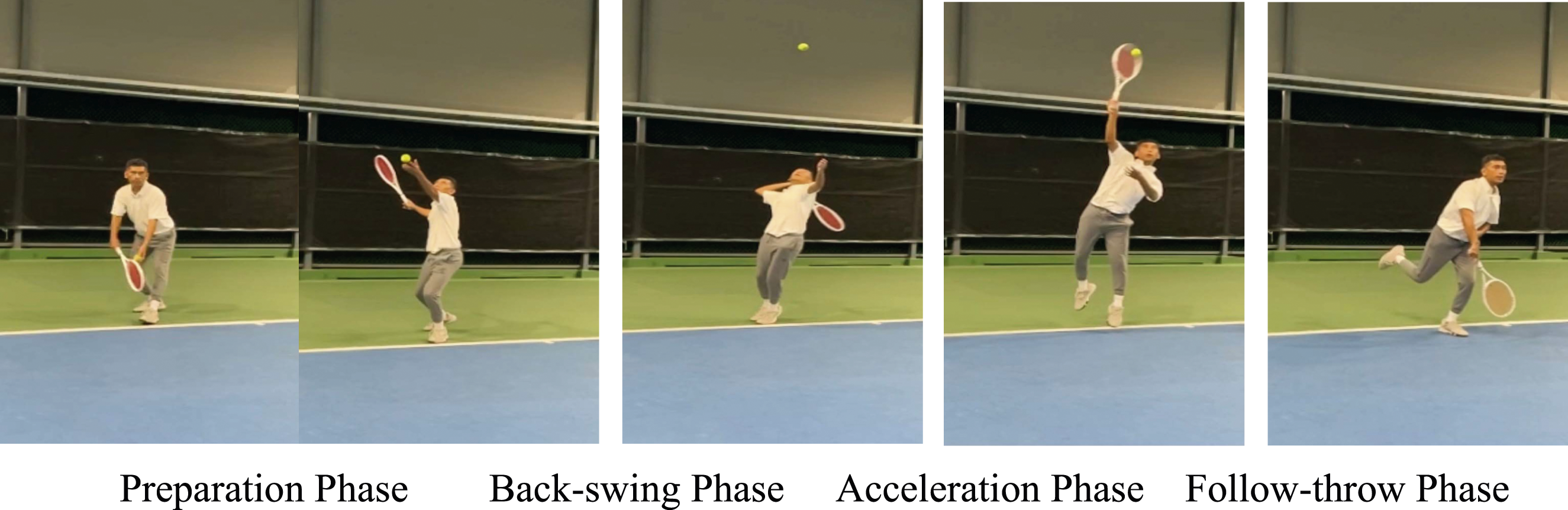
To control the effect of training experience (practice effect over trials) and individual differences, we used the Mixed Linear Model (MLM). We selected age and phase (fixed), subject (random) and experience (covariance) in mixed analysis with repeated measures on the phase. A least significant difference (LSD) test was used as a post hoc test if the test outcome achieved statistical significance levels. We used Cohen’s d to report the effect size (ES) of the main independent variables. The confidence interval was set at 95% (two-tailed). All analyses were carried out in SPSS (ver. 22) software package (IBM Corp, 2013).
Results
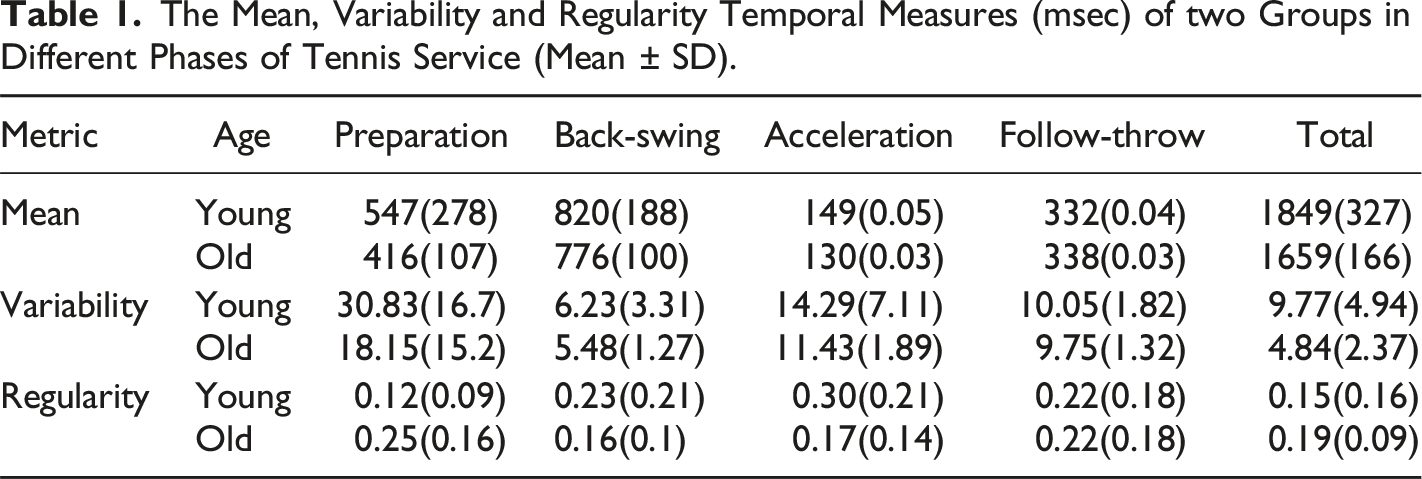
The Mean, Variability and Regularity Temporal Measures (msec) of two Groups in Different Phases of Tennis Service (Mean ± SD).
Whole Serve Time
Temporal Pattern
The result of the MLM showed no significant differences (F = 3.17, p > .05, ES = 0.75) between the two groups on the temporal pattern of the tennis serve (see Figure 2). The variance due to the individual differences on the main effect of group was negligible (0.019). The mean (±SD) temporal pattern, variability and regularity of the whole tennis serve.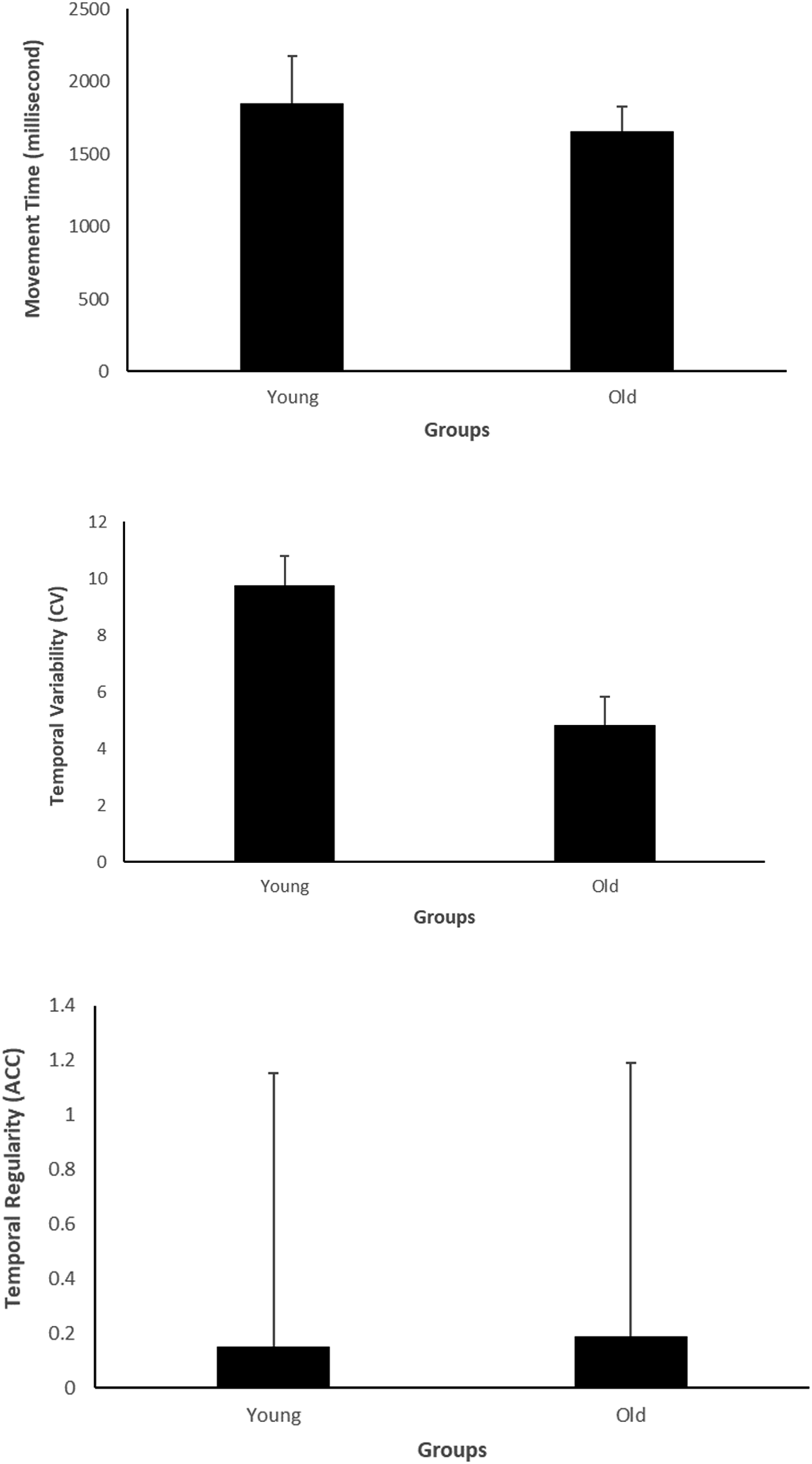
Temporal Variability
The results showed that young adults (9.77 ± 4.94 sec) displayed significantly greater temporal variability (F = 9.68, p < .05, ES = 1.27) in performing the serve, compared to the older adults (4.84 ± 2.37). The variance due to the individual differences on the main effect of group was small (4.38).
Temporal Regularity
There were no significant differences between the two groups on the regularity of the whole serve time (F = 0.55, p > .05, ES = 0.32). The variance due to the individual differences on the main effect of group was negligible (0.004).
Serve Phase Time
Temporal Pattern
The results of the MLM revealed that only the main effect of phase (F = 104.7, p < .05) was statistically significant. The main effect of the group and the interaction between the group and phase were not significant (p > .05). The results of the post hoc test showed that the back-swing phase had the longest duration and the acceleration phase had the shortest duration than other phases (see Figure 3). The variance due to the individual differences on the main effect of group, phase and other factors was negligible (0.000001). The covariance effect of experience was not significant. The mean temporal pattern, variability and regularity of each phase of the tennis serve.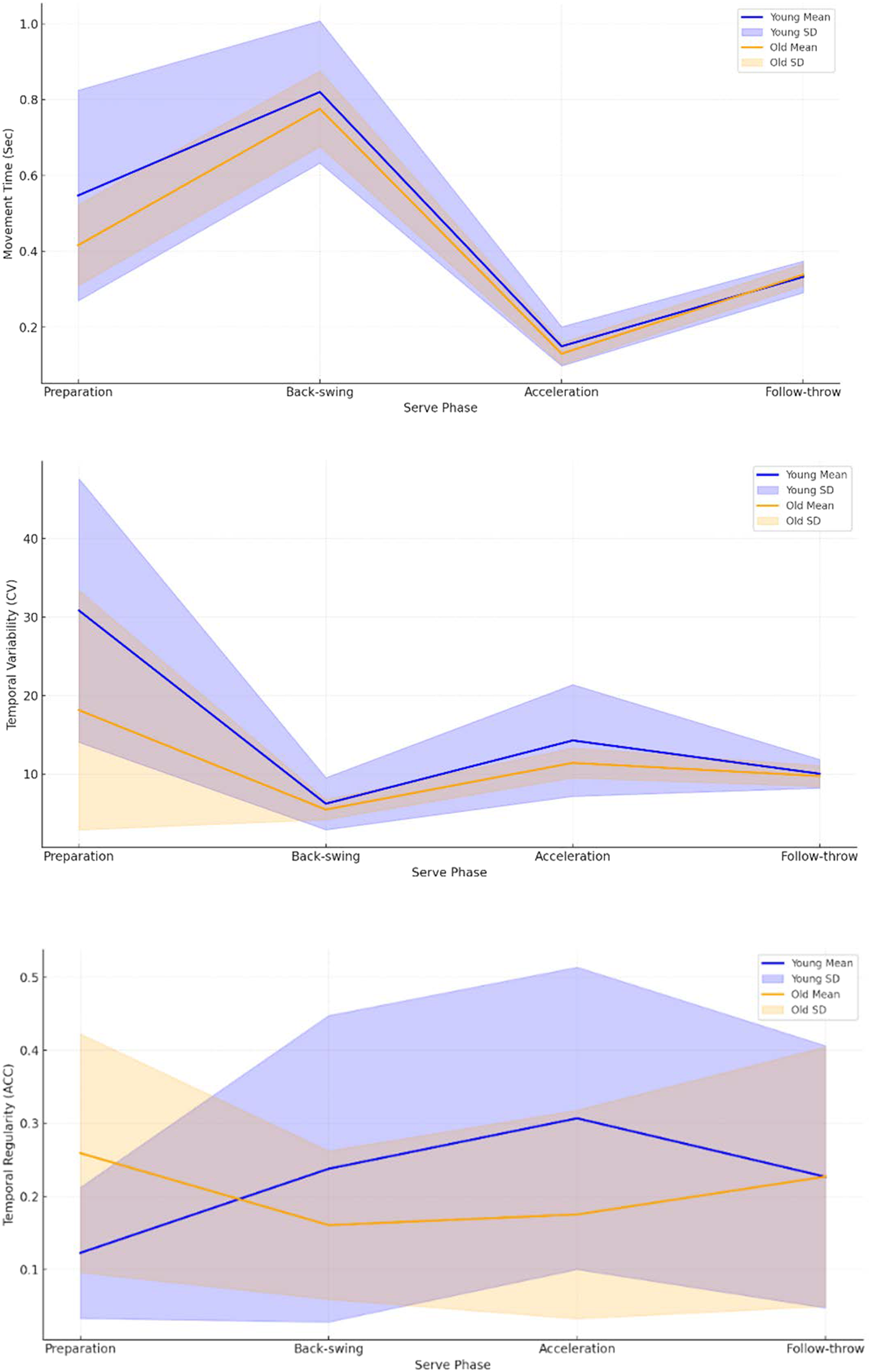
Temporal Variability
The results of MLM showed that the main effects of phase (F = 19.6, p < .05) and group (F = 6.33, p < .05) were statistically significant, but the interaction between them was not (p > .05). The post hoc follow up test showed that the preparation phase had greater variability and the back-swing phase had lower variability than other phases (see Figure 3). In addition, young adults displayed greater temporal variability than older adults (mean difference = 4.14, p < .05). The variance due to the individual differences on the main effect of group, phase and other factors was negligible (0.000001). The covariance effect of experience was not significant.
Temporal Regularity
The results of MLM showed that only the interaction between group and phase (F = 3.89, p < .05) was statistically significant and the main effects of phase and group were not (p > .05). The follow-up test results showed that younger adults showed greater regularity in the back-swing and acceleration phases than older adults (see Figure 3). The variance due to the individual differences on the main effect of group, phase and other factors was negligible (0.0006). The covariance effect of experience was not significant.
Discussion
The main aim of this study was to compare temporal structure (temporal pattern, temporal variability and temporal regularity) of the tennis serve between young and older adults. The findings of the study showed that older adults tended to preserve the temporal patterning and temporal variability (after controlling for practice effects and individual variability) of the whole serve timing and movement phase timing. But, they did not retain temporal regularity in the back-swing and acceleration phases.
These findings contrast with other evidence supporting age-related declines in motor performance (accuracy and speed) in activities such as postural sway and walking (Seidler et al., 2010). Functional declines in movement coordination in older adults have been mainly associated with structural and physiological changes in central and peripheral nervous systems and musculoskeletal systems (Bacsi et al., 2005; Faulkner et al., 2007). However, evidence in active participants have shown that regular participation in sports such as judo (Ciaccioni et al., 2020), golf (Kanwar et al., 2021) and karate (Pliske et al., 2016; Witte et al., 2017) improved walking speed, hence, the speed-accuracy trade-off concept (Seidler-Dobrin et al., 1998) that suggests losing speed to improve accuracy by older people is not apparent in active older adults. Our comparison of the temporal organisation in performance of the tennis serve revealed no differences between young and older adults in the duration of the whole service action and of each phase of movement pattern. Furthermore, the proportionally high levels of individual variations (CV values) in temporal variability during the serve indicated the adaptive capacity of both age groups when (re)organising the multi-articular and complex skill such as the serve.
These findings can reflect the important benefits of long-term participation in sports on retention of functional movement capacities such as timing and movement rhythm in coordination of a complex action. One reason for maintaining the timing abilities in the tennis serve in older adults may be related to the nature of the task. In other words, the current findings can be explained in terms of stability of learned multi-articular organisation and contextual familiarity. In tennis service, a specific sequence of actions is repeated each time with subtle modifications in joints motions. Based on dynamical systems theory (Kelso, 1995), repeating this sequence by practice (and through participation in a sport) over a long period could help an individual to create a stable order parameter (rhythm, timing) by exploiting intrinsic self-organisation tendencies (consolidate) of an adaptive coordination pattern (Davids et al., 2005). It seems that long-term effects of practice in sport may mediate the structural and physiological changes due to ageing, such as losing neuromotor plasticity and visuomotor adaptations (Baltes & Lindenberger, 1997). In terms of contextual familiarity, a study by Voelcker-Rehage and Willimczik (2006) of groups of young and older adults without prior experience in lacrosse catching showed a performance decrement with increasing age after 60 years and lower performance improvement with practice. Smith et al. (2005) investigated a novel visuomotor task (object retrieval task with different difficulty levels) in both the right and left hand, revealing a lower performance speed and a higher level of performance variance after the age of 62 years. These findings may be explained by a smaller learning capacity/adaptation in older adults because of task novelty. In contrast, in our study, the task context was familiar to the participants in terms of environmental constraints (the same training court), the task (e.g., training sessions and the same personal timetable) and situational adaptations (without an opponent) that might facilitate stabilisation of overall movement time and temporal sequencing of the tennis serve in the sample of older adults. However, this area requires more studies in future to investigate the effects of environmental and task constraints on adaptations of sports skills in older adults.
The overall temporal variability in executing tennis serves was approximately 0.5 smaller in the older adults than in the younger group which is contrary to findings of previous studies that reported an increased variability in older adults in force production tasks (Ketcham et al., 2002; Voelcker-Rehage & Alberts, 2005), goal-directed timing tasks (Myerson et al., 2007; Yan et al., 1998) and throwing (Williams et al., 1998). One issue in interpreting the greater variability of older adults’ movement performance in previous research may be because much of that previous data is based on performance during brief initial exposure to an experimental task which required participants to use limited movement system degrees of freedom (Hultsch et al., 2002). Also, prior training experience was not taken into account or has been difficult to control, due to the nature of study design and the task investigated. Furthermore, there have been no studies of age-related changes in the temporal variability of organisation of a complex, multi-articular sports skill. Existing knowledge of movement variability in older adults is mainly limited to analysis of functional movement capacities such as postural regulation, locomotor, pointing and manipulative skills (Christou, 2011; Marmon et al., 2011). Our findings regarding the higher temporal variability in the tennis service action in younger adults provides some interesting insights on the temporal (re)organisation of ontogenetic skills with age. The data supported the idea that long-term participation in sports can mitigate the age-related changes in the underlying mechanisms (King et al., 2013) of temporal movement organisation through preserving temporal adaptations (Voelcker-Rehage, 2008).
In our study, temporal regularity was observed to be greater in young adults in the back-swing and acceleration phases. The interaction between age and task was interesting. Each phase of tennis has different physiological and biomechanical properties that could affect the organisation of movements in older adults. For example, the specific functions in the preparation and back-swing phases are to store energy for the ball-racket contact and a powerful serve. In the acceleration phase, stored energy is released with high power and speed and the follow-throw phase requires deceleration of the racket-arm for maintaining stability and prevention of injuries or falling (Kovacs & Ellenbecker, 2011). It seems that this coordination problem was resolved in older adults by relying on regularity in utilising the same degree of timing organisation in actions over successive attempts. Greater spatial and temporal movement variability in older adults, resulting in less movement consistency and regularity are well-documented in previous studies (Seidler et al., 2010) and, to some extent, depend on peripheral changes in the neuromuscular system (Faulkner et al., 2007). Other reasons for inconsistent timing might be related to kinematic constraints in older adults (reductions in range of motion and angular velocity) when the body requires postural adjustments to facilitate coordination between head-trunk-arm rotations in the back-swing and acceleration phases. We did not assess multijoint coordination in this study, although previous studies have shown that high-speed body turning (90–180°) can negatively affect coordination (Khobkhun et al., 2021) and reactive postural variability in older adults (Mileti et al., 2019). Thus, it is plausible to explain that in a high-velocity, multi-articular action, such as the tennis serve, sustaining temporal regularity of the back-swing and acceleration phases may be more prone to age-related changes due to physiological and mechanical task demands. Furthermore, losing mobility in upper body components during coordinated actions, such as throwing an object (e.g. ball or racket) through a forceful effort (Williams et al., 1991), and age-related structural changes in the muscular system that affect the force-velocity relationship (Callahan & Kent-Braun, 2011), can be responsible for movement changes (coordination and timing) in the tennis service. For example, trunk and hip rotation in the back-swing phase (see Figure 1) could be limited by reduced mobility and muscle flexibility following ageing (Williams et al., 1991) which could negatively affect the shoulder and arm backward rotation that is required to generate force in racket contact with the ball in the air (Roetert et al., 2009). The chest and trunk muscles also are primary accelerators for the powerful motion of the racket before and after ball contact through a smooth kinetic chain in the acceleration phase, whilst in the follow-through a significant deceleration of movement by the back muscles is required (Ellenbecker & Tiley, 2001).
However, this issue requires further investigation in future studies.
We acknowledge some limitations in this study. The specific goals of the serve (more focus on the quality instead of scoring), regulation (the first-serve strategy only applied) and type of serve (selecting and using one preferred serve in all attempts) were constrained in this study. It is unlikely, but these specific tasks and environmental constraints may have changed the temporal structure of service in the two groups. The sample of participants was at a recreational level but had enough skill and experience in performing the serve. Thus, the findings should be interpreted with respect to this population. We provided enough rest between attempts, but the participants might be prone to some physiological effects, such as fatigue, that require further investigation and methodological considerations.
Conclusion
The findings of this study showed that older adults who regularly participate in sports can preserve temporal patterns and variability in complex motor skills, despite significant changes to neurophysiological and anatomical systems with ageing. This preservation of important functional capacities could transfer to their everyday living activities, supporting healthy ageing, and protecting them against age-related declines in physical functions such as postural stability, losing balance and falling and walking performance as they get older. Our findings suggest that there are some valuable healthy ageing benefits of sport participation on manintaining functional perceptual-motor skills (e.g. coordination timing and temporal variability). However, other qualities such as temporal regularity are more sensitive to age-related declines and the task demands.
Footnotes
Declaration of Conflicting Interests
The author(s) declared no potential conflicts of interest with respect to the research, authorship, and/or publication of this article.
Funding
The author(s) received no financial support for the research, authorship, and/or publication of this article.
