



Abstract
Learning to write relies on the effective integration of sensory feedback and a transition from motor control based on written tracings to motor control based on expert writing movements. This study aimed to test whether the photographic technique of light painting (LP) would facilitate this transition. To achieve this, we conducted two experiments using different LP setups. LP involves moving a light source in a dark environment while taking a long-exposure photograph. LP entails both a real-time reduction of product-related visual information and a post-trial addition of process-related visual information. In the first experiment, we conducted a pre-test, training, and post-test in which 16 adults wrote four new characters with the non-dominant hand. During the training sessions, participants stood and wrote in a vertical frame (1 × 1.2 m) two characters in the control condition (with a marker on the vertical support) and two characters in the LP condition (with a flashlight in the air). In the test phases, participants were seated at a table and copied the four characters into a square (4 cm * 4 cm) on a fixed sheet of graphics paper. As in-air writing strongly differs from classical handwriting situations, we performed a second LP experiment. The aim was to implement LP training in a condition closer to writing. Sixteen new participants followed the same protocol but sat at a table and wrote in a horizontal square (20 cm * 20 cm). In both experiments, participants who trained with the LP method wrote faster and with less pressure than those trained in the control condition. We also observed an improvement in spatial accuracy in Experiment 2, whatever the training condition. LP seemed to have led participants to focus on the writing process, probably because it modified the nature and timing of the visual information used for writing. LP may be a promising technique for remediating writing difficulties.
Introduction
Light painting (LP), also called light drawing, is a photographic technique that uses long exposures in a dark environment to capture images of a moving light source (e.g., lamp, light-emitting diode). The light source is usually attached to a finger, or another body part moved by the light painter. Through a long photographic exposure or retinal persistence, an observer can watch the light source turn into a graceful and luminous movement trail. Keeping the camera’s shutter open for a long time creates a photograph with the entire luminous trail, whose length and thickness result from the movement’s speed. The faster the movement, the thinner and less luminous the trail. Conceptually, a long-exposure photograph captures the spatiotemporal unfolding of a movement into a static image, providing visual feedback of movement kinematics.
The LP technique has been used for many years, in many contexts, and for many purposes. A few years after inventing chronophotography with Etienne-Jules Marey, Braun (1999) created the first known LP photograph of a person’s clinically disturbed walking gait, to describe the successive phases of this movement. Several years later, Gilbreth and Moller Gilbreth (1917) used LP in an industrial application to track workers’ movements and thereby improve productivity and working conditions. Pablo Picasso used this technique artistically with the photographer Gjon Mili for Life magazine in 1949 (Baitinger & Ouaki, 2012). However, the LP process has seldom been studied scientifically; it has mainly been tested as a new type of creative art therapy (Connan & Raynal, 2013; De Benedetti et al., 2019; Hu et al., 2020).
Although LP has historically been applied with the person moving the light in a standing position, the resulting image mimics handwriting in a way that is reminiscent of the ku-sho method of finger-writing in the air that readers spontaneously perform as a cue to retrieve Chinese characters (Flores d’Arcais, 1994). In fact, writing with light substantially influences motor control in handwriting. LP modifies visual feedback (FB) both during writing (i.e., in real-time) and after the movement when its image is viewed. In real-time, as the light trail follows the movement of its source, it gradually fades, resulting in diminished visuospatial information. This prohibits writers from comparing their production with the model. However, as the length of the light trail depends on movement speed, it provides real-time visual feedback on handwriting speed. Thus, the LP technique changes the online processing of visual information in the control of handwriting (see Supplementary File 1). Furthermore, after the performance, the photographic image provides supplementary feedback. The light painter can see variations in the thickness and intensity of certain portions of the trail, reflecting variations in the movement speed: the slower the gesture, the brighter the line. Likewise, if the painter pauses during the movement, dots appear along the trail. The LP technique therefore gives painters retrospective feedback about both the produced shape and the movement speed and fluency. The static (product) and dynamic (process) aspects of handwriting are therefore considered simultaneously, which may be an interesting way of improving learning to write or improving handwriting.
Learning to write is known to rely on the efficient integration of visual and proprioceptive feedback. The internal model theory (e.g., Wolpert & Ghahramani, 2000) provides a fruitful framework for better understanding motor control and motor learning for handwriting. According to this neurocomputational model, handwriting motor control is acquired by implementing internal models built from the specification of expected outcomes. More specifically, so-called inverse models use the desired and actual pen positions as inputs to estimate the necessary motor command (coded as a vector; Georgopoulos et al., 1993) and transform a current pen position into a desired one (Grossberg & Paine, 2000). From a copy of this motor command (i.e., efference copy), the forward feedback model predicts the hypothetical sensory consequences of the pen movement, to compare them with the real-life sensory feedback or to modulate the processing of this sensory feedback, depending on the degree of confidence in the prediction (Wolpert & Ghahramani, 2000). Initially, in handwriting, vision and visual attention play a major role in both determining the motor command and ensuring that the shape appearing on the paper is correctly drawn and reproduced. At first, there is very low confidence in the associated predictions (Grossberg & Paine, 2000). With practice and development, the motor control of handwriting gradually switches from control that is based on this visual confirmation of the written trace to control that is based mainly on the writing movements themselves (i.e., in expert writers). Handwriting acquisition, therefore, involves a gradual transition from a feedback mode of movement control to a feedforward mode of control (for a review, see Palmis et al., 2017). An unanswered question to date is to what extent might modifying the visual perception of the written trace that occurs in LP lead writers to focus better on their ongoing movements and facilitate this motor learning process.
Prior investigators have explored the influence of several visual changes that are inherent to the LP technique when learning handwriting. For instance, Søvik and Teulings (1983) reported that providing supplementary visual feedback immediately after a written production had a positive effect on handwriting speed in 11-year-old children. The online reduction of visual information has also been investigated, either by asking participants to write with their eyes closed (Chartrel & Vinter, 2006), or by preventing them from seeing both their hand and the written trace (Chartrel & Vinter, 2006; Portier & van Galen, 1992) or just the written trace (Bara & Bonneton-Botté, 2021). These methods improved the kinematics of the writing movement, but impaired spatial accuracy in the written product. This deterioration in the result can be attributed to the participants’ lack of information during production about the shape they produced.
In sum, LP may be a fruitful technique for facilitating motor learning in handwriting, as it reduces feedback about the handwriting product whilst increasing feedback about the handwriting process, both during and after the movement. Since this technique might facilitate graphomotor learning or rehabilitation. We conducted two experiments to test the effect of LP when participants performed it either while standing or while sitting. As LP consists of the dual modification of visual feedback (reduction of visuospatial information and enrichment of kinematic information) during and after the movement, we expected it to improve the handwriting processes (movement velocity, fluidity) without decreasing the quality of the end product (spatial accuracy).
Experiment 1: LP in the Standing Position and in the Vertical Plane
LP offers many possibilities of movement, depending on the user’s position. It is usually practiced in a standing position, with the painter producing arm movements in the air. These movements involve proximal joints (shoulder, elbow), are very large, and involve considerable speed variations, thereby maximizing proprioceptive feedback. Therefore, the standing position will encourage the participant to mobilize different muscles during training, using more proximal joints than in the sitting position. During the test phase, participants sit at a table and write in a much more restricted space. According to Bernstein’s (1967) approach and the concepts of motor flexibility and adaptability, we can expect a transfer of learning between the training and the test phases, thanks to the constancy of the ‘movement product’ and despite significant changes in motor implementation (Wing, 2000).
This technique echoes procedures in a study by Bara and Bonneton-Botté (2018), but also one by Dahech et al. (2021), in which kindergarten children were trained with gross motor movements. Bara and Bonneton-Botté (2018) asked children to learn to write cursive characters using arm movements (tracing characters in the air), body movements (following the outline of characters while walking), or no movement (visual training). The use of body movements improved legibility during the testing phase, but it did not improve movement velocity or fluency. The authors attributed these differences to the idea that 5-year-old children have limited working memory skills and poor proprioceptive sensitivity, such that the cognitive load that was incurred during writing led them to favor the visual shape of the product rather than the representation of movement.
In our study, to control for this developmental variable, we studied adults and presented a more difficult task in which they had to write unknown characters with their non-dominant hands. A similar procedure has already been proposed in handwriting (Connan et al., 2021, 2023; Danna et al., 2015). The use of the non-dominant hand in a learning task for unknown characters in adults allows a sufficiently large margin of progression to observe a learning curve, with post-effects transferable to a post-test. Consequently, we expected participants trained in the LP condition to have a better performance (at both process and product levels) than those trained in a control condition of writing with an erasable marker on a wall-mounted whiteboard.
Experiment 2: LP in the Sitting Position and on a Horizontal Graphic Tablet
A second experiment was conducted with new participants. Our goal then was to implement LP training while participants wrote horizontally sitting at a table to limit the potential effects of suppressing the writing surface. In this context, participants benefitted from the proprioceptive feedback that is usually sent from the hand during writing on paper (i.e., friction signals resulting from pen-tablet interaction). We also decreased the size of the characters to be produced in the training phase to promote the use of more distal muscles. Finally, we recorded participants’ performance during the training session to distinguish the effect of LP during the learning phase from the transfer effect in the post-test. We expected an analysis of the training trials to allow to observe a gradual improvement in performance across the trials, as well as a possible deterioration during the transfer from the LP condition to the classic writing condition. In Experiment 2, we predicted that LP would have a greater effect on writing speed than the CTRL condition, possibly with positive effects on movement fluency and accuracy.
Method – Experiment 1
Participants
Participants were 16 female adult volunteers (Mage = 21.06 years, SD = 2.91). All were right-handed for writing, French native speakers, and they did not all know Tamil script (from where our letter characters came). All had normal or corrected-to-normal vision. The experiment was conducted following the Declaration of Helsinki, and all participants provided their written informed consent before starting the experiment.
Task and Experimental Design
The task consisted of learning to write novel characters with the non-dominant hand, either in the LP Figure 1(a) or a control condition (CTRL; Figure 1(b)). The characters were extracted from Tamil script (Figure 1(d); one character was slightly modified so that it could be drawn without a pen lift) and printed on a 20 × 20 cm sheet of paper. A red dot was added to each model to indicate a starting point. Experimental Design.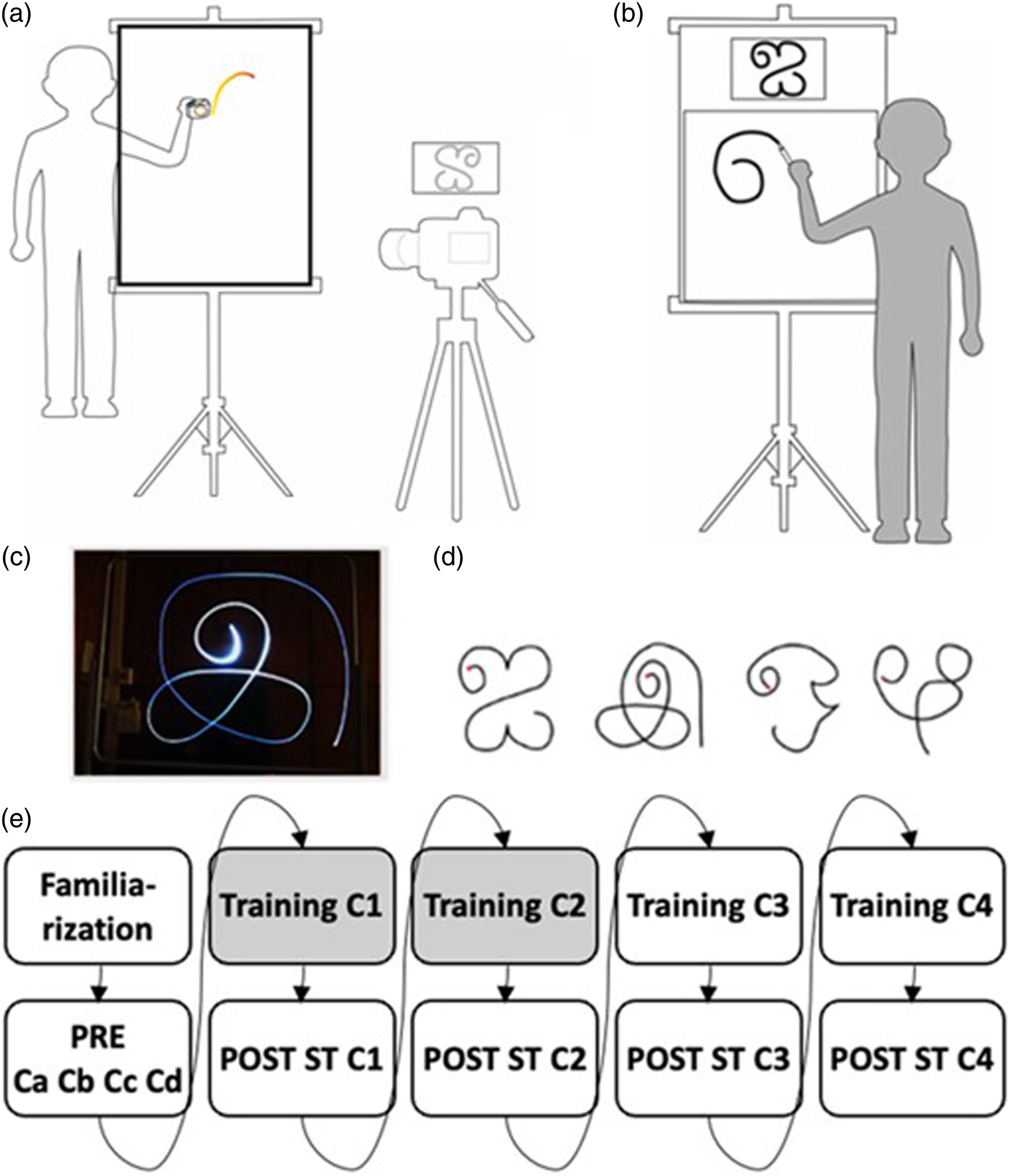
In the LP training condition, participants stood in front of a vertical metal structure delimiting a 100 × 120 cm rectangle, holding a flashlight of similar size to an erasable marker. Inside this rectangle, they reproduced a character presented on a sheet of paper two meters away, next to a laptop. They were asked to place their hand at the starting point, and the experimenter then started the camera (EOS-D Cannon 70D). Participants had to indicate when they finished drawing the character, and the experimenter then stopped the exposure. At the end of each trial, the trail made by the flashlight was displayed on the laptop screen, and participants were invited to compare this trail with the model. In the CTRL training condition, participants stood in front of a 100 × 120 cm rectangle drawn at the top of a wall-mounted whiteboard, holding an erasable marker. They then reproduced the character in the rectangle.
Before and after the training phase, participants sat at a table and performed handwriting tests. The pretest (PRE) and short-term post-test (POST ST) involved writing the character twice with an inking pen in a 4-cm square printed at the bottom of a sheet of paper attached to a graphic tablet (Wacom Intuos Pro Large; 21 × 29.7 cm, sampling frequency 200 Hz) connected to a laptop. Data were recorded with open-access Java software (Gilhodes et al., 2023). In PRE and POST ST, the characters were presented at the top of the sheet. POST ST was always preceded by an interference task that consisted of drawing a circle in a 20-cm square printed on a sheet of paper. In the long-term post-test (POST LT), participants had to pick out a character they had learned from a set of four. Three distractors were created for each learned character: its mirror image, a transformed version with a displaced feature, and the mirror image of the transformed character.
The procedure was as follows: short familiarization phase, PRE, four training sessions, POST ST, and POST LT 1 week later (Figure 1(e)). The familiarization phase consisted in reproducing a new character (not used for the experiment) three times in each condition (CTRL and LP). During the training sessions, participants wrote the character to be learned 15 times. Two of the characters were trained in the CTRL condition, and the two others in the LP condition. Characters were counterbalanced across conditions and participants. Finally, half the participants started with the CTRL condition, and the other half with the LP condition.
Data Analysis
For PRE and POST ST, we computed the quantitative variables from the recordings of handwriting performance by the graphic tablet. Data were prepared with an open-access program (Gilhodes et al., 2023) extracting the position and axial pressure of the stylus on the tablet. Based on the stylus signal, we removed the in-air strokes immediately before and after each character. We then computed five variables: three related to the handwriting process, and two to the handwriting product as follows: - Mean velocity (mm/s) corresponded to the mean absolute velocity from the time the stylus first came into contact with the tablet to the completion of the character; - Mean disfluency corresponded to the number of abnormal velocity peaks computed using the SNvpd method (Danna et al., 2013). These abnormal velocity peaks resulted from the difference between the number of velocity peaks after filtering the absolute velocity with a cutoff frequency of 10 Hz and the number of velocity peaks after filtering the tangential velocity with a cutoff frequency of 5 Hz. The lower the number of peaks, the more fluent the movement; - Mean stylus pressure, an arbitrary unit normalized between zero and 1, corresponding to the mean axial pressure of the stylus. It should be noted that this variable was not calibrated; - Trace length (mm) corresponded to the total distance traveled by the stylus from the point when it first came into contact with the tablet to the completion of the character; - Spatial error (arbitrary unit), a measure of the spatial accuracy of the handwriting product, corresponded to the mean distance between the character produced by the participant and a reference character. This distance was calculated using an algorithm developed on MATLAB®. The reference character, used for all participants, was a model produced by an expert writer with his dominant hand. The stylus signal was then filtered with a fourth-order low-pass Butterworth filter with a cut-off frequency of 5 Hz. The characters to be compared were normalized between zero and 1 on x and y, to allow their superimposition. The coordinates were interpolated to 1000 points using a cubic polynomial interpolation. As described by Connan et al. (2021), an iteration was performed to calculate the smallest Euclidean distance between the 1000 points that formed the product trait and the points that formed the reference trait; The number of errors was the last variable. An error was counted when participants chose a distractor or omitted a learned character. However, when we collected the number of correct responses in each condition at POST LT, of the 64 responses we had recorded, we only found two errors. This variable was therefore not used any further.
Statistical Analysis
A total of 256 trials were collected at PRE and POST ST. Some trials (2.3%) could not be analyzed, either due to technical problem (n = 1), or to errors in the overall shape of the written character (n = 5). We tested the distribution of the variables. Disfluency, stylus pressure, trace length, and spatial error satisfied the criteria for skewness (between −1.3 and +1.3) and kurtosis (between −2 and +2 (Howell, 2016). Mean velocity was log-transformed to satisfy the criteria. We used a linear mixed model (LMM, GAMLj module; Galluci, 2019) and omnibus tests with two fixed factors with repeated measures of Test (PRE vs. POST ST) and Condition (LP vs. CTRL), and two random factors (Participant and Character). Fisher’s LSD post hoc analyses with Bonferroni correction were applied for multiple comparisons. Statistical analyses were performed using JAMOVI® software (R Core Team, 2019; The jamovi project, 2020). All significance levels were set at p < .05.
Results – Experiment 1
Participant performances for each variable are illustrated in Figure 2. Graphic Representation of Differences between Test Phases of Experiment 1 (pre-vs. post- ST) by Training Condition (CTRL VS. LP) for (a) Velocity, (b) Disfluency, (c) Trace Length, (d) Stylus Pressure, and (e) Spatial Error.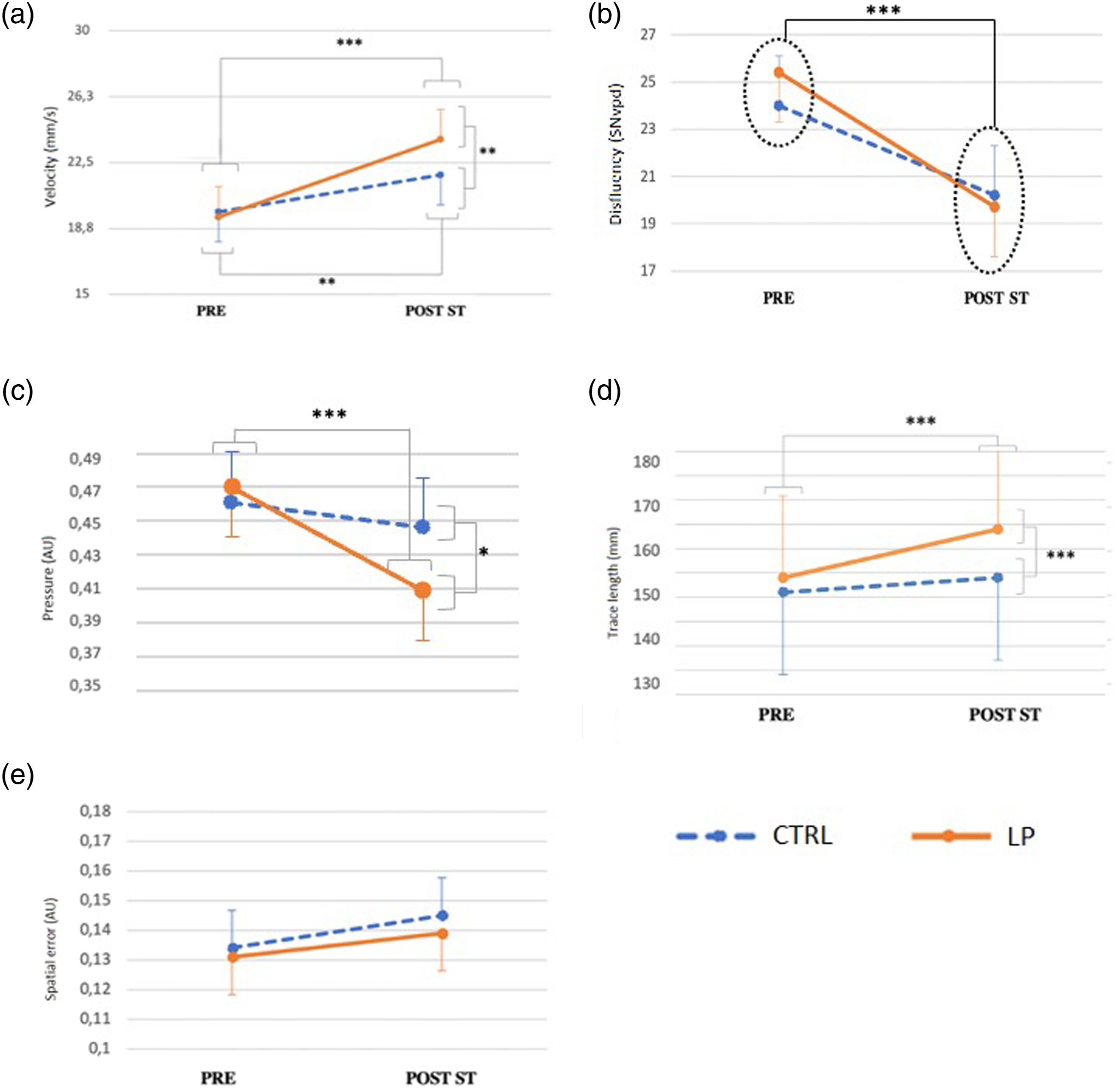
Velocity
Our analysis revealed significant main effects of Test, F (1, 228) = 52.46, p < .001, (Figure 2(a)) and Condition, F (1, 228) = 5.82, p < .05. The interaction between Test and Condition was also significant, F (1, 228) = 7.39, p < .01. Post hoc tests revealed a significant difference between PRE and POST ST for the LP condition (p < .001) and for the CTRL condition (p < .01). Post hoc tests also revealed a significant difference between the LP and CTRL conditions at POST ST (p < .01). LP induced greater velocity than CTRL. Regarding the statistical model, note that ICC values for the Participant and Character random factors were .54 and .39, respectively. The r-squared conditional and marginal were .67 and .08, respectively.
Disfluency
The omnibus test only revealed a significant main effect of Test, F (1, 228) = 41.12, p < .001, (Figure 2(b)) and showed a reduction in disfluency after training in the standing position. ICC values for the Participant and Character random factors were .56 and .15, respectively. The r-squared conditional and marginal were .62 and .06, respectively.
Stylus Pressure
There was a main effect of test, F (1, 228) = 18.02, p < .001, (Figure 2(c)) and the interaction between Test and Condition was also significant, F (1, 228) = 6.81, p < .05. Post hoc testing revealed a significant increase in pressure between PRE and POST ST in the LP condition (p < .001) and a significant difference between the LP and CTRL conditions at POST ST (p < .05). LP training led to a greater decrease in mean stylus pressure, compared with CTRL training. Note that ICC values for the Participant and Character random factors were .71 and .02, respectively. The r-squared conditional and marginal were .72 and .03, respectively.
Trace Length
The omnibus test revealed main effects of Test, F (1, 228) = 15.95, p < .001, (Figure 2(d)) and Condition, F (1, 228) = 16.49, p < .001. The interaction between Test and Condition was also significant, F (1, 228) = 4.18, p < .05. Post hoc tests revealed a significant increase in trace length between PRE and POST ST in the LP condition (p < .001) and a significant difference between LP and CTRL at POST ST (p < .001). LP training induced a greater increase in trace length at POST ST than CTRL training. Note that for trace length, ICC values for the Participant and Character random factors were .47 and .87, respectively. The r-squared conditional and marginal were .88 and .02, respectively.
Spatial Error
Analysis failed to reveal significant effects of Test and Condition (Figure 2(e)). ICC values for the Participant and Character random factors were .05 and .15, respectively. The r-squared conditional and marginal were .19 and .01, respectively.
Discussion – Experiment 1
Experiment 1 examined the effect of LP training in the standing position on learning to write new characters. Our results showed that participants wrote larger characters faster and with less stylus pressure after LP training than after CTRL training. The learning phase improved handwriting fluency on the post-test of participants in both conditions, but there was no significant difference between the CTRL and LP conditions. Finally, we did not observe any effect of learning on spatial accuracy. Almost all the characters were correctly identified, regardless of training conditions, suggesting that learning was efficient in both training sessions.
LP and Feedback Modulation
There were two types of visual feedback modifications during LP training, one in real-time (reduction in visuospatial information, increase in speed information) and the other after the movement (supplementary information on speed variations). The effects of LP on movement velocity and character size were consistent with findings in previous studies on the online reduction of visual information in both adults and children (Bara & Bonneton-Botté, 2021; Chartrel & Vinter, 2006; Connan et al., 2023; Guilbert et al., 2018; Portier & van Galen, 1992; van Doorn & Keuss, 1992). Diminished vision of the trace hinders product-based control, leading writers to focus on the writing movement, which, in turn, promotes more proactive control, that helps the vision-diminished participants to write more quickly. Furthermore, studies in both adults (Chartrel & Vinter, 2006; Portier & van Galen, 1992; van Doorn & Keuss, 1992) and children (Bara & Bonneton-Botté, 2021; Chartrel & Vinter, 2006) have found that an online reduction in visual information led writers to produce larger characters. Prior investigators assumed that this finding reflected the strategy of maximizing kinesthetic information (van Doorn & Keuss, 1992). Overall, LP training may reinforce the consequences of the standing position, whilst maximizing the combined increases in speed and trace length. These variables are linked according to the isochrony principle, whereby there is a direct relationship between the size and speed of writing such that the larger the character, the greater the speed (Viviani & Terzuolo, 1982).
Finally, the light trail that followed the movement of the lamp in the LP condition encouraged participants to write faster to increase the portion of the trace that was visible, even though they could not compare it with the model. This situation seems to facilitate the transition from the stroke-by-stroke execution by beginners to the motor control of larger units observed in expert writers (Séraphin Thibon et al., 2018). It avoids repeated checking of the shape during the movement, which slows down the writing. Nevertheless, it can also prevent writers from learning the correct shape.
Effect of LP Training on Stylus Pressure
One surprising transfer of the effect of LP training was a reduction in the pressure exerted by the pen on the paper. This result was unexpected, as many studies based on the reduction of visual feedback in either adults (Chartrel & Vinter, 2006; Portier & van Galen, 1992; van Doorn & Keuss, 1992) or children (Bara & Bonneton-Botté, 2021; Chartrel & Vinter, 2006) found that participants pressed harder on the pen in this situation. The common interpretation was that the reduction in visual sensory information was compensated for by maximizing proprioceptive feedback (van Doorn & Keuss, 1992). As suggested by Connan et al. (2023), when the trace was not visible, writers were less confident about the contact between the pen and the paper. They therefore pressed harder to increase the level of confidence related to this information. In our design, LP training precluded the presence of any writing surface, meaning that there was no tactile-kinesthetic information related to the writing surface (friction force) during the training phase. Finally, going back to the proprioceptive compensation hypothesis (Connan et al., 2023; van Doorn & Keuss, 1992), we might also assume that the modification in visual feedback that informed our writers about their movement speed (i.e., lengths of luminous trails varied according to velocity) was accompanied by a provision of kinesthetic information that overrode the somatosensory channel. More experiments are needed to disentangle these variant sensory mechanisms that may explain our discrepant pen pressure findings.
Learning in the Standing Position
Few investigators have examined the effect of gross motor training on handwriting (Bara & Bonneton-Botté, 2018; Dahech et al., 2021). Our results confirmed the benefit of working with large movements to learn new characters and improve the motor processing of writing. At the process level, the increases in speed and fluency reflected a gradual mastery of the motor control. However, the spatial accuracy did not improve, and the trace length was longer for all participants at the post-test, indicating that the writing product was not improved by learning in the standing position. The increases in handwriting speed and length can be linked to the principle of isochrony described earlier (Viviani & Terzuolo, 1982). From this perspective, we can reasonably hypothesize that training in the standing position with large movements induced an increase of the velocity, later transferred to the test trial in the classic writing condition.
Concerning the handwriting product, the absence of an effect of LP training on accuracy was not consistent with the results of Bara and Bonneton-Botté (2018) in children. In their study, gross motor training was compared with purely visual training. It improved the legibility of the writing, but not its speed and fluidity, even though the movement was supposed to provide sensory information that would reinforce the internal representations of the letters for these 5-year-olds. We assume that participants’ age differences in our study and that of Bara and Bonneton-Botté (2018) probably explain this discrepancy.
Limitations of Experiment 1
Experiment 1 had several limitations. First, our LP condition (i.e., standing and writing in the air) brought about many modifications that were difficult to disentangle from the effect of modified visual feedback, including the absence of a writing surface. This setup was far removed from the classic writing condition, limiting the transfer effect to writing on paper (Schmidt et al., 2018) because of its specificity (Proteau et al., 1998). Furthermore, we could not measure the effects of visual feedback modification during the training phase. This lack of information strongly limited our understanding of the effects of LP training on motor control and transfer. We therefore developed a second experiment to more closely approximate classic writing conditions.
Method – Experiment 2
Participants
Experiment 2 participant volunteers were 16 adults (15 females, 1 male; Mage = 21.44 years, SD = 4.53). All participants were right-handed in handwriting, French native speakers. They had no knowledge of Tamil script and had normal or corrected-to-normal vision. The experiment was conducted in accordance with the Declaration of Helsinki, and all participants provided their written informed consent before starting the experiment.
Task and Experimental Design
As in Experiment 1, the task consisted of learning to write new characters with the non-dominant hand in either the LP or CTRL condition. The procedure was identical to that of Experiment 1, except that the participants sat in front of a table on which a graphic tablet was placed (Wacom Intuos Pro Large; sampling frequency 200 Hz).
In the LP training condition, a 20-cm square was delimited on the graphic tablet with tape, and participants wrote with a non-writing stylus, with a diode attached to the tip of the pen (Figure 3(a)). Participants reproduced the character in the square (Figure 3(b)). The character they had to reproduce was displayed on a sheet of paper at the top of the tablet. Participants were asked to place their hands at the starting point, and the experimenter then started the camera (EOS-D Cannon 70D). When they indicated that they had completed the character, the experimenter stopped the exposure. At the end of the trial, a photo showing the trail of the diode was displayed on the laptop screen, so that participants could compare their drawings with the template (Figure 3(d)). Experimental Setup.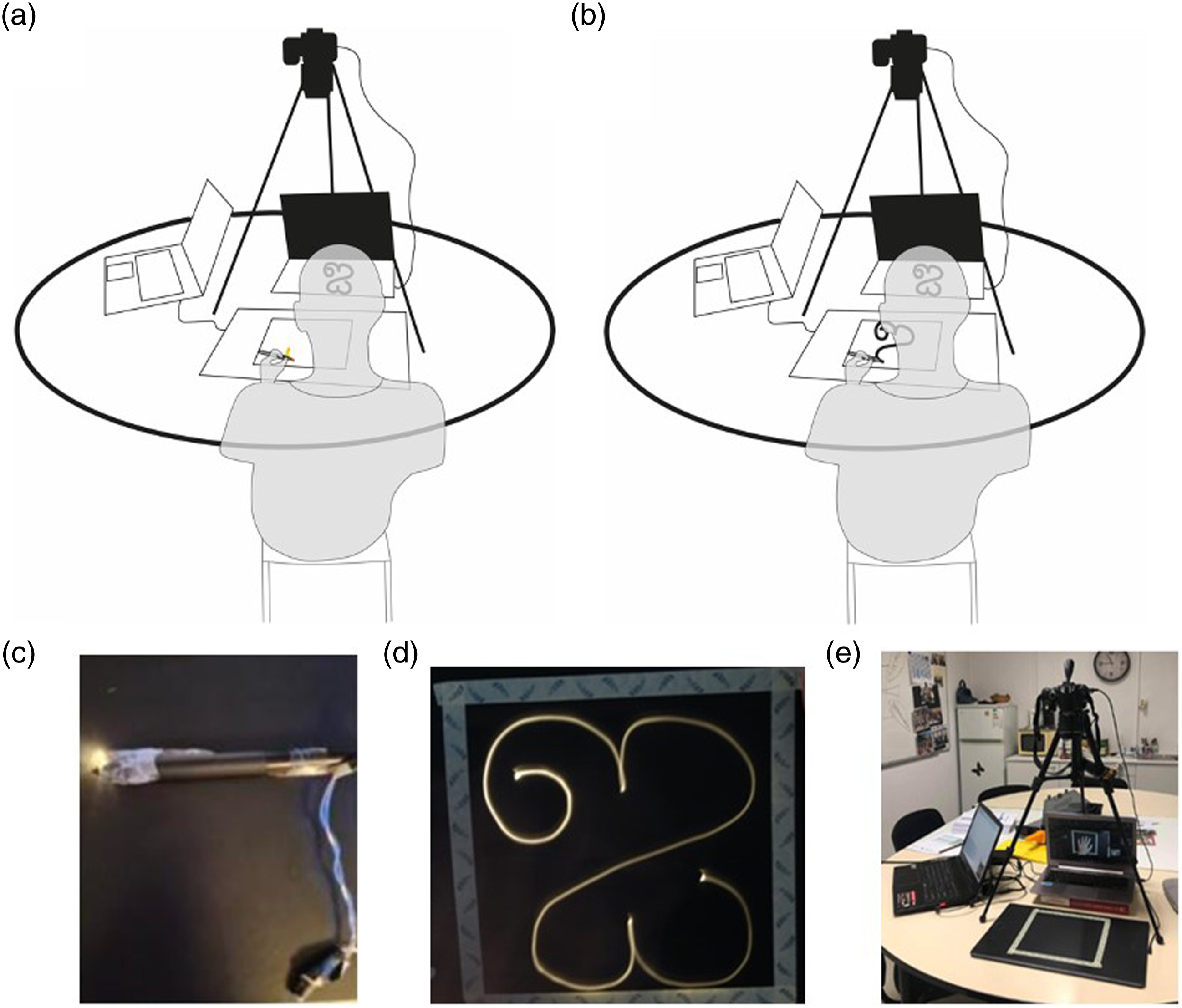
In the CTRL training condition, participants copied the model using an inking pen onto a 20-cm square printed on a sheet of paper (21.0 × 29.7 cm) affixed to the graphic tablet. The character they had to reproduce was presented on a sheet of paper at the top of the tablet. The laptop screen was switched off.
PRE, POST ST, and POST LT were identical to those in Experiment 1. Using the inking pen, participants had to write the character twice in a 4-cm square printed at the bottom of a sheet of paper fixed to a graphic tablet. At PRE, the characters were printed at the top of the sheet. POST ST was preceded by an interference task consisting in drawing a circle in a 20-cm square printed on a sheet of paper. As in the first experiment, POST LT consisted in picking out each learned character from among three distractors.
During each training phase, participants wrote each character 15 times. Two training sessions were conducted in the CTRL condition and two in the LP condition. Characters were counterbalanced across conditions and participants. Half the participants started in the CTRL condition, and the other half in the LP condition. The initial familiarization phase consisted in reproducing each new character (not used for the experiment) three times in both the CTRL and the LP condition.
Data and Statistical Analysis
For PRE, POST ST, and POST LT, the same variables as in Experiment 1 were used. These variables were also recorded during each of the 15 training trials. Concerning the POST LT, no statistical analysis was performed, as participants only made two errors.
We recorded a total of 1216 trials during the PRE, POST ST, and training trials. Some trials could not be analyzed owing to a technical error (n = 29), or an error in the shape of the character (n = 17), representing 3.78% of the dataset. We tested the distribution of the variables. Velocity, pressure, and trace length satisfied Howell’s (2016) criteria for skewness (between −1.3 and +1.3) and kurtosis (between −2 and +2). Disfluency and spatial error were log-transformed to satisfy these criteria.
We ran two analyses with LMM (GAMLj module; Galluci, 2019) and omnibus tests. The first one focused on the training session, with two fixed factors with repeated measures (Trial: training trials 1–15; and Condition: LP vs. CTRL), and two random factors (Participant and Character). This analysis was not conducted for stylus pressure, as two different styluses were used in the LP and CTRL conditions. We therefore ran separate analyses of the training session for the LP and CTRL trials: one fixed factor with repeated measures (Trials 1–15) and two random factors (Participant and Character). For the other variables, we conducted the same analysis as in the first experiment. We ran Fisher’s LSD post hoc analyses with Bonferroni correction for multiple comparisons. Statistical analyses were performed using jamovi® software (R Core Team, 2019; The jamovi project, 2020). All significance levels were set at p < .05.
Results – Experiment 2
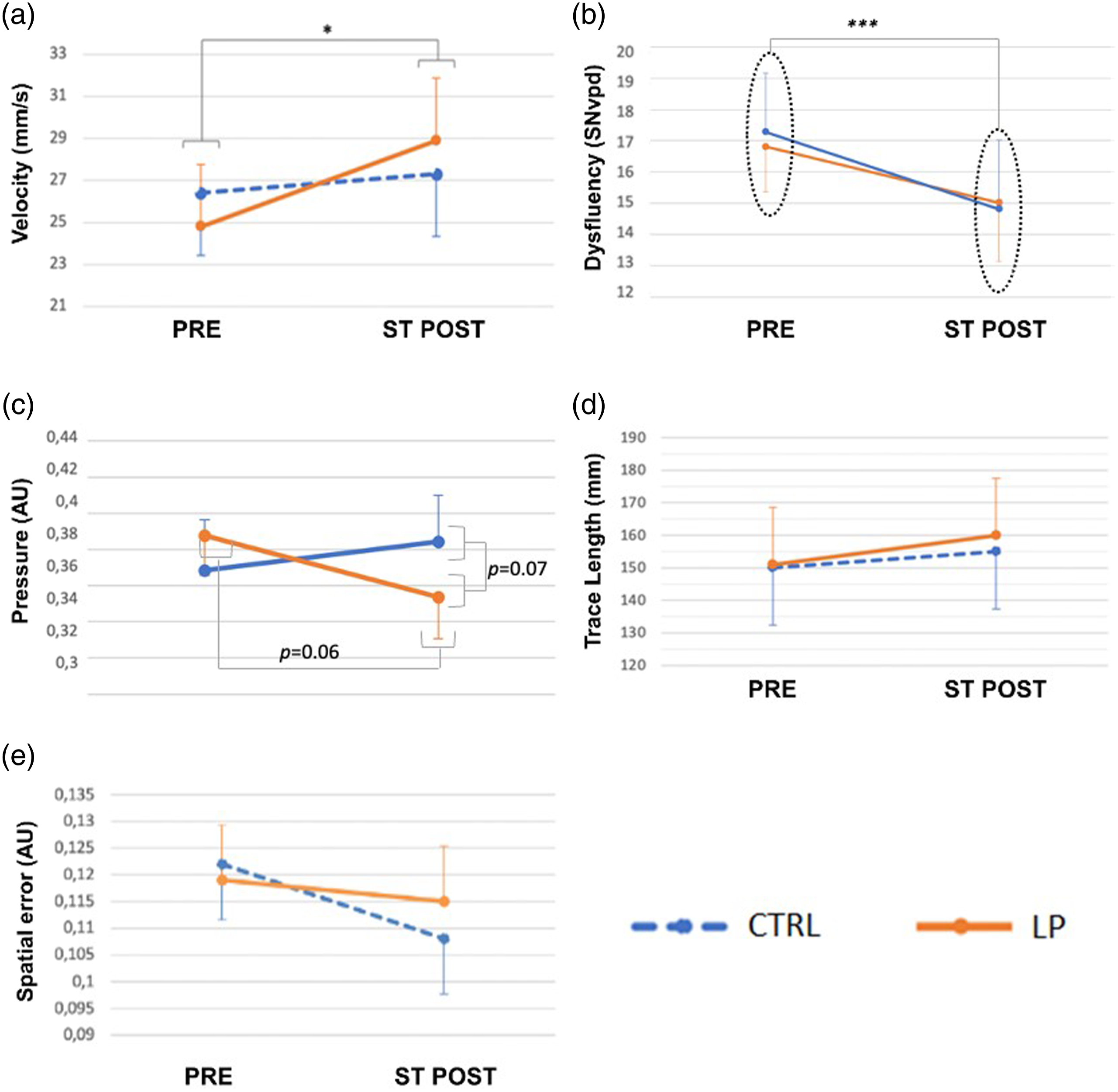
Participant performances during the training phase are illustrated in Figure 4 and performances in the test phases are illustrated in Figure 5. Graphic Representation of Training Trials (1–15) According to Training Condition (CTRL vs. LP): (a) Velocity, (b) Disfluency, (c) Trace Length, and (d) Spatial Error. Graphic Representation of Differences between Test Phases (pre-vs. post- ST) According to Training Condition (CTRL VS. LP).:(a) Velocity, (b) Disfluency, (c) Trace Length, (d) Stylus Pressure, and (e) Spatial Error.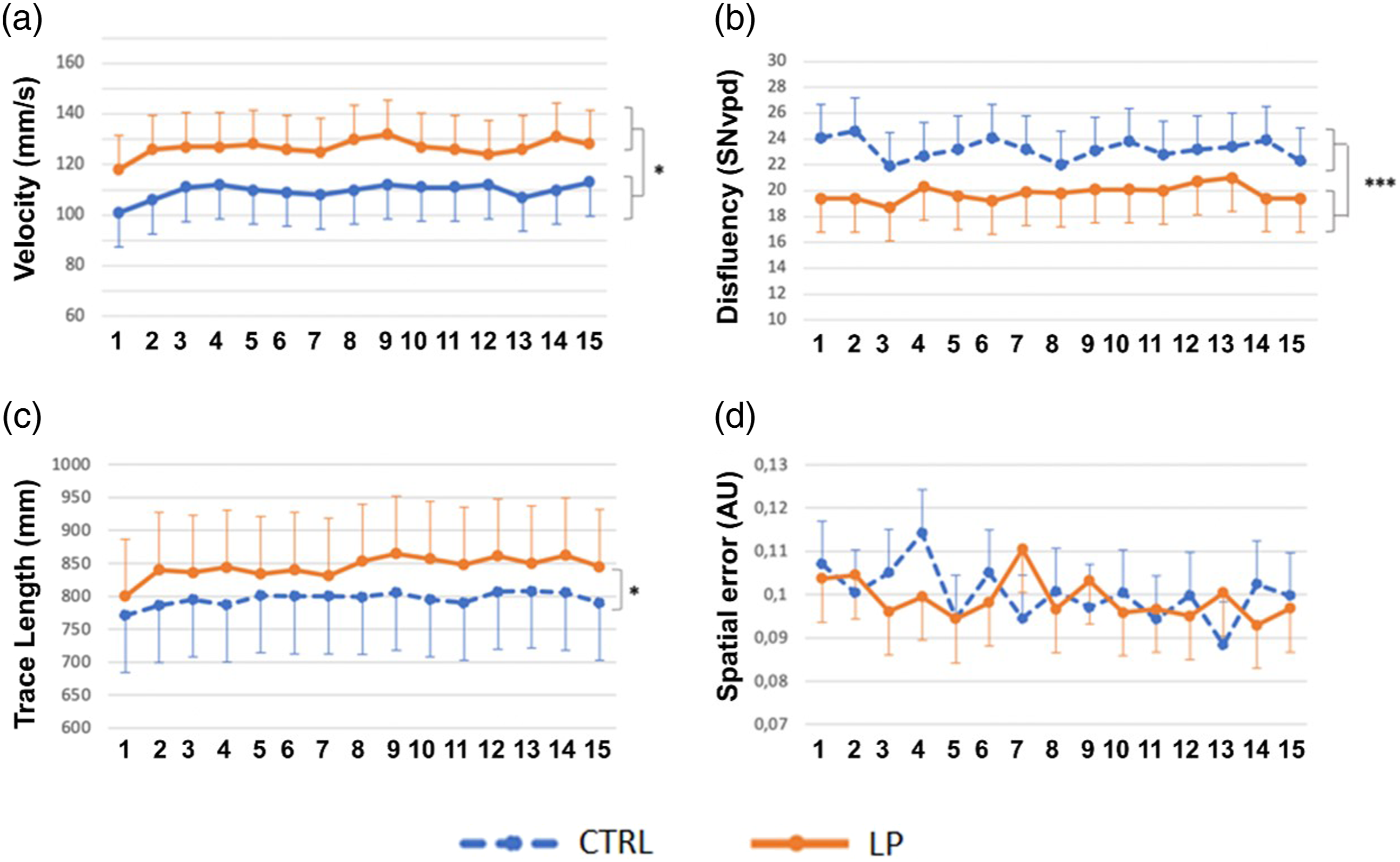
Velocity
Statistical analysis revealed that training conditions differed significantly, F (1, 881), p < .001, as participants wrote faster in the LP than CTRL condition (Figure 4(a)). In the test phase, ICC values for the participant and character random factors were .77 and .45, respectively. The r-squared conditional and marginal were .81 and .02, respectively.
The effect of Test was also significant, F (1, 219) = 18.90, p < .001, as was the interaction effect between Test and Condition, F (1, 219) = 7.91, p < .01. The increase in velocity differed significantly between PRE and POST ST in LP (p < .001; Figure 5(a)). Regarding the statistical model for velocity in the test phase, ICC values for the Participant and Character random factors were .75 and .40, respectively. The r-squared conditional and marginal were .79 and .03, respectively.
Disfluency
Concerning the disfluency during the training phase, the analysis revealed that the participants wrote more fluently in the LP condition than in the CTRL, F (1, 881) = 84.492, p < .001 (Figure 4(b)). ICC values for the Participant and Character random factors were .63 and .19, respectively. The r-squared conditional and marginal were .67 and .03, respectively.
In the test phase, the analysis only revealed a significant effect of Test, F (1, 219) = 12.54, p < .001 (Figure 5(b)): the characters were produced more fluently at the post-test whatever the training condition. ICC values for the Participant and Character random factors were .56 and .11, respectively. The r-squared conditional and marginal were .59 and .02, respectively.
Pressure
For pressure, the effects of Trial were not significant during the training phase in either condition. During the test phase, the analysis only revealed an interaction between Condition and Test, F (1, 222) = 6.88, p < .01. The decrease in pressure at POST ST was greater after LP training than after CTRL training (Figure 5(c)). Post hoc tests revealed nonsignificant differences between PRE and POST ST in the LP condition (p = .06) and between the two conditions at POST ST (p = .07). Note that the ICC values for the Participant and Character random factors were .38 and 0, respectively. This random factor was therefore not considered in the analysis. The r-squared conditional and marginal were .68 and .01, respectively.
Trace Length
For trace length during the training phase, the analysis revealed significant main effects of Trial, F (14, 881) = 3.406, p < .001, and Condition, F (1, 881) = 84.492, p < .001 (Figure 4(c)). Trace length increased during the training phase and was higher in the LP condition. Note that ICC values for the Participant and Character random factors were .29 and .91, respectively. The r-squared conditional and marginal were .92 and .02, respectively.
During the test phase, the effects of Test, F (1, 219) = 28.27, p < .001, and Condition, F (1, 219) = 4.41, p < .05, were also significant. Participants produced larger handwriting at POST ST than at PRE (Figure 5(d)). ICC values for the Participant and Character random factors were .32 and .91, respectively. The r-squared conditional and marginal were .91 and .01, respectively.
Spatial Error
For spatial error, the training trials did not induce any trial effect, and the difference between conditions was not significant (Figure 4(d)). During the test phase, analysis of the tests only revealed a significant effect, F (1, 219) = 4.23, p < .05 (Figure 5(e)). ICC values for the Participant and Character random factors were .17 and .18, respectively. The r-squared conditional and marginal were .32 and .01, respectively.
Discussion – Experiment 2
The purpose of Experiment 2 was to test the effect of LP training in a sitting position and with a horizontal writing surface on the learning of new characters. The configuration of the training phase was closer to a classic writing situation. Experiment 2 results showed that, during the training phase, participants wrote faster, more fluently, and produced larger characters in the LP condition than in the CTRL condition. At post-test, the characters were written faster, with less pressure and were larger in size after LP training than after CTRL training. Finally, practice improved movement fluency and spatial accuracy independently of the training conditions.
LP and Feedback Modulation During Training
Results revealed that LP training induced specific effects on the process of learning to write. Throughout the 15 trials of the training phase, writing velocity, fluency, and size were higher in the LP condition than in the CTRL one. These results were in line with our hypotheses and confirmed previous observations of the effect of real-time modifications of visual information (Bara & Bonneton-Botté, 2021; Chartrel & Vinter, 2006; Connan et al., 2021). Concerning the trace length, our results confirmed those of Experiment 1, and were consistent with previous investigators’ findings, showing that, regardless of the type of reduction performed during the movement, participants produce larger handwriting. This effect has often been interpreted either as the maximization of proprioceptive information or as related to the principle of isochrony.
Surprisingly, we found this increase in speed and fluency from the very first trial, probably because the partial deletion of the trace strongly changed the online control of the movement. A similar effect was also observed in a recent study involving the partial deletion of the trace (Connan et al., 2023) and in a study where supplementary real-time auditory feedback was provided (Danna et al., 2015). What these two strategies have in common is that they encourage writers to focus on the writing process from the very first attempt. Interestingly, the increases in movement speed and fluency were not detrimental to spatial accuracy. According to Connan et al. (2021), postponing the visual perception of the shape of the character to the end of each trial is a promising strategy for leading writers to focus on the trace quality after execution.
Post-Test Effects of LP
Unfortunately, the effect of LP observed during the training phase was not fully transferred to the post-test phase. This can probably be explained by either the learners’ dependence on feedback modification (Ronsse et al., 2011) and/or expertise in a particular type of visual control (Proteau et al., 1998). The beneficial effect on movement fluency disappeared at the post-test, such that the remaining effects concerned velocity, trace length, and pen pressure. Overall, these results replicated those we observed in Experiment 1 and confirmed that the effects were not related either to the standing position during training or to the absence of a writing surface. Stylus pressure decreased more in the LP condition than in the CTRL condition, and this result appeared to be specific to the change in visual feedback in the LP condition.
General Discussion
The two experiments yielded innovative data for experimentation in learning to write in several respects. First, a few past investigators have analyzed the impact of modifying visual feedback, and we were the first to use LP to do so. The LP training technique combined real-time and post-movement visual feedback modifications, and we tested it among adult participants in both standing (Experiment 1) and sitting (Experiment 2) positions. The results showed that participants were faster following LP training in both cases, and this improvement was not associated with a deterioration in spatial accuracy.
Effects of Training While Standing or Sitting on Learning to Write New Characters
Interestingly, in both experiments, participants carried out the training sessions in a larger ‘writing space’ than the one used for the test phases, but to a different degree. The large, vertical writing area used in Experiment 1 led participants to mobilize a large part of their body and thus to become bodily involved in the writing. In Experiment 2, the training surface was also larger than in the test phase, but the participants were sitting and used much the same joints and muscles as in classic writing conditions.
At first glance, the results confirmed the positive effect of using global motor skills from a standing position when learning to write, as suggested by Bara and Bonneton-Botté (2018). This may be relevant for the learning and remediation of handwriting in children. However, the velocity increase may be either the cause or the consequence of the increase in trace length during LP, according to the isochrony principle (Viviani & Terzuolo, 1982). Furthermore, producing larger handwriting is not relevant for children with dysgraphia, as macrography is one of the characteristics of this disorder (for a review, see Biotteau et al., 2019). By contrast, this technique might be very useful for improving micrographia and dysgraphia related to Parkinson’s disease (for a review, see Letanneux et al., 2014).
It should be noted that a difference between the two experiments was observed in the effects of training on spatial accuracy, which improved after the training phase in the second experiment only, irrespective of the feedback condition (CTRL or LP). This may be due to the joints and muscles involved in the training phase in Experiment 1: In the standing position, the muscles producing movement are different from those used for writing, and gravity introduces an asymmetric load on upstrokes and downstrokes. This finding suggests that the number of repetitions in the training phase would not be sufficient to encode actions in the central nervous system in terms that are more abstract than commands to specific muscles, leading to motor equivalence (Wing, 2000).
Contribution of LP to Motor Control and the Learning to Write Process
LP specifically induced an increase in handwriting size, velocity, and fluency during the training phase. Furthermore, the increase in trace length and velocity was still present during the test phase. There are three possible reasons why visual feedback modifications induced an improvement in movement control in terms of speed and fluency during the training phase. First, following our hypothesis, the partial deletion of the trace in LP prevented participants from engaging in the time-consuming visual control of the movement, perhaps permitting improved velocity and fluency. Indeed, Chartrel and Vinter (2008) reported that applying instructions related to temporal constraints in a writing task forced a reduction in visual control and allowed for the programming of longer movements, resulting in improved velocity and fluency.
Second, in the LP condition, participants’ visual feedback concerned variations in the pen tip position over time. This visual information perfectly matched the kinesthetic information provided by proprioception. This modification of the trace therefore may have induced greater coherence in the feedback from different sensory channels (i.e., visual and proprioceptive). We know that uni-sensory perceptual cues that are consistent with each other are more easily integrated (Spence, 2011). Thus, we hypothesize that this unified multisensory integration led to better information processing, perhaps explaining this improved performance.
Third, the increases in length and movement velocity may have maximized proprioceptive feedback (Danna & Velay, 2015). Proprioception plays an important role in the updating of an internal model of limb dynamics used to program motor commands (Danna & Velay, 2017; Krakauer et al., 1999; Sainburg et al., 1995). LP therefore may facilitate the shift from visual trace-centered motor control to process-centered motor control.
Possible Emotional Contributions of LP
With the LP setup, the performance is captured on a photo which provides feedback afterwards. In this way, the writing performance is rewarded by a photograph that informs the writer on the correctness of the movement. This additional reward status of the final performance implies the involvement of an additional neural network for information processing, namely the mesolimbic pathway, which is known to contribute to the reinforcement and learning of motor functions related to a reward and the subjective perception of pleasure (Leyton, 2010). Perhaps for this reason, most participants reported that LP was a more fun way of learning to write new characters. Consequently, artistic activities can stimulate intrinsic motivation (Wulf & Lewthwaite, 2016) and flow state (Csikszentmihalyi, 1975, 2004; Vallerand, 1997), which are beneficial to learning. The use of a questionnaire for user interface satisfaction (Chin et al., 1988) would provide more quantitative information on this point.
Limitations and Directions for Further Research
This study presents several limitations restricting the generalization of its results. From a technical point of view, the LP is an experimental situation in which it is difficult to obtain fine control. For instance, the delay between the end of the movement and the experimenter stopping the photographic exposure can lead to parasitic movements and additional traces on the photos. In addition, the speed at which the pen is moved determines the presence or absence of a light trace, changing the experimental situation from a partial reduction to a complete reduction of the written trace when the movement is very slow. Finally, the procedure required the participants to analyze the photo to correct themselves on the next trial. Even if we set a minimal duration for this step, this post-movement feedback relies on metacognitive strategies (self-evaluation, problem-solving, Schmidt 2018) whose duration varies considerably from one participant to another.
This study also offers several perspectives. First, it would be relevant to test LP, which has an artistic and playful aspect, with children who have difficulties learning to write. The LP could offer these children a tool other than the pencil to approach the rehabilitation of their handwriting. Obviously, care must be taken to ensure that the removal of visual feedback does not impair their performance, especially in younger children for whom visual feedback is very important (Chartrel & Vinter, 2006). Another perspective is to adapt LP to a digital tablet to allow more efficient control of the setup while still benefiting of the effect of FB modification (e.g., Connan et al., 2023).
Conclusion
Our study established a proof of concept that there may be a specific effect of LP on the motor control involved in learning or rehabilitating handwriting. We found that LP use led participants to focus their attention on the writing process, by modifying the nature of the visual information transmitted to the light painter. As many children, especially those with developmental coordination disorder, have problems with fine motor skills and writing (Rosenblum, 2015), this novel way of learning to write, developed through gross motor movements without the need to hold a pencil, seems a promising technique for remediating writing difficulties.
Supplemental Material
Footnotes
Acknowledgments
The authors would like to thank Céline George for creating the figures for the experimental set-up.
Author Contributions
JFC: Conceptualization, Methodology, Data acquisition, Data analysis, Writing- Original draft preparation. MJ: Writing- Reviewing and Editing. ML: Methodology, Data acquisition, Data analysis. ASC: Writing- Reviewing and Editing. JD: Conceptualization, Writing- Original draft preparation.
Declaration of Conflicting Interests
The author(s) declared no potential conflicts of interest with respect to the research, authorship, and/or publication of this article.
Funding
The author(s) disclosed receipt of the following financial support for the research, authorship, and/or publication of this article: This work has benefited from support from the French Fondation called Fondation Pour la Recherche en Psychomotricité et Maladies de Civilisation (FRPMC).
Ethical Statement

Supplemental Material
Supplemental material for this article is available online.
Author Biographies
References
Supplementary Material
Please find the following supplemental material available below.
For Open Access articles published under a Creative Commons License, all supplemental material carries the same license as the article it is associated with.
For non-Open Access articles published, all supplemental material carries a non-exclusive license, and permission requests for re-use of supplemental material or any part of supplemental material shall be sent directly to the copyright owner as specified in the copyright notice associated with the article.
