



Abstract
Our aim in this study was to examine the impact of fans (vs. no fans), geographical location of league, and team ability on home winning percentage (HW%) or home advantage (HA) in professional European basketball. Data were collected from five prestigious professional, national basketball leagues within Europe (Spain, Germany, Italy, Greece and Israel) across 16 regular seasons (2005-2006 to 2020-2021). We conducted comparisons between matches with and without fans, location of leagues, team ability (High, Medium, Low), and combinations of these factors via non-parametric tests (e.g., Mann-Whitney tests, Kruskal-Wallis). We found significantly greater HA during matches with fans for leagues in Germany (p = .001), Italy (p = .012) and Spain (p = .002). For matches with fans, HA and HW% were significantly different between several, but not all, leagues for high (p < .05), medium (p < .05) and low (p < .02) team abilities. In conclusion, HA and HW% were enhanced by spectator attendance, with this phenomenon varying by location/region and team ability. Consideration of these multiple contextual factors may assist coaches and sport organizations to develop key strategies for enhanced team success.
Introduction
Identifying variables affecting winning in team sports has been a major focus of sport science, with the number of research studies that have focused on key performance indicators having expanded over recent years (Castillo et al., 2021; Esteves et al., 2020; Fernández-Leo et al., 2020; Fox et al., 2020; Gonzalez et al., 2013; Zhang et al., 2020). Of particular importance has been a focus on the advantages of home teams who are afforded such benefits as not travelling long-distances before matches and playing in their home stadiums where most spectators are cheering/supporting them (Alonso et al., 2022). Such benefits can translate into a home advantage (HA) that has been documented as a key contributor to successful match outcome in many team sports (Almeida & Leite, 2021; Inan, 2020; Sánchez & Lavín, 2020) including basketball (Alonso et al., 2022; Pollard & Gomez, 2007; Pollard & Gómez, 2013). The HA within basketball has been attributed to many factors, including greater team ability (Alonso et al., 2022; Pollard & Gomez, 2007), greater levels of crowd support/cheering, and referee bias (Alonso et al., 2022; Wunderlich et al., 2021), geographical region of the competition or league (Gómez & Pollard, 2011; Pollard & Gómez, 2013) and resultant travel fatigue/jet lag for the opposition (Huyghe et al., 2018; Song et al., 2017). However, the existence of a HA has recently been impacted by the global coronavirus disease (COVID-19) pandemic that has affected sporting competitions in unprecedented ways (García-pérez-de-sevilla et al., 2021; Vaudreuil et al., 2021). One significant COVID-19 consequence has been the absence of fans during matches (i.e., ghost matches) played from 2020 and a year or more onwards for most professional leagues (e.g., the United States National Basketball Association (NBA) or European soccer leagues such as Serie A) (Alonso et al., 2022). This worldwide pandemic has also provided a unique chance to investigate the effect of fan attendance and HA in professional sports like basketball across multiple leagues and gain a greater understanding of HA at the elite global level. For example, the most prestigious basketball leagues in Europe (i.e., Spain, Germany, Italy, Israeli and Greece) consist of players who have a significant impact on both the national and international stage (e.g., Olympics, FIBA World Cup), that may have been affected individually and collectively as a team by the pandemic. Recently, HA was examined for matches played with and without fans in five professional European basketball leagues across 37,319 matches (Alonso et al., 2022). This study reported greater match success for the home team (i.e., a HA) in the pre-pandemic period (with fans) compared with the post-pandemic period (without fans), suggesting that the absence of fans reduced the HA (Alonso et al., 2022) with positive crowd noise likely a key contributor to the HA effect (Alonso et al., 2022; Sors et al., 2020; Tilp & Thaller, 2020). Others have suggested that the geographical region of the competition (Pollard & Gómez, 2013; Pollard & Gomez, 2014; Sánchez & Lavín, 2020) and/or different team abilities (Pollard & Gómez Ruano, 2007) may interact significantly with crowd noise to influence HA in professional basketball with further work needed.
Region and team ability can significantly impact HA, making this phenomenon intriguing to analyze. Regionally, factors such as geographic location, climate or the time spent on travel by the visiting team can create conditions that favor the home team (Inan, 2020; Sánchez & Lavín, 2020). Teams in regions with extreme weather or high altitudes may have a natural advantage, as they are acclimated to these conditions, while visiting teams may struggle to adapt. Additionally, the support of passionate local fans can create an intimidating atmosphere for opponents. Team quality also plays a vital role; stronger teams often perform well regardless of the venue, whereas weaker teams rely heavily on the benefits of playing at home (Alonso et al., 2022). In this regard, analyzing these factors is important because understanding the dynamics of the HA can provide insights into team performance, fan behavior, and strategic decision-making (Lago-Peñas et al., 2013; Pollard et al., 2017). Therefore, our aims in this study were to examine the impact of the following key factors on match success and HA in professional basketball: (a) presence or absence of fans; (b) geographical locations of league (i.e., country); and (c) team ability.
Methods
Participant Sample
As part of larger previously reported research (Alonso et al., 2022), we undertook a retrospective analysis of data collected from five professional, national basketball leagues within Europe (Spanish Liga (ACB), German Bundesliga (BBL), Italian Lega Basket Serie A (LBA), A1 Ethniki Greek League and Israeli Basketball Super League) across 16 regular seasons (2005-2006 to 2020-2021). This timespan provided the entire dataset from the online source to enable robust conclusions for global use. These leagues were considered the most competitive and prestigious basketball leagues in Europe with players having a significant impact on the national and international stage (e.g., Olympics, FIBA World Cup). Additionally, data from these leagues was generally more readily available compared to other European and international leagues and allowed us to conduct comprehensive and in-depth analyses. The dataset analyzed included a total of 37,359 matches played with 35,067 matches played in front of fans (i.e., no COVID-19 pandemic, 2005-2006 to 2019-2020 seasons; 1163 contributing team samples) and 2292 matches played without fans (COVID-19 pandemic, 2020-2021 season; 77 contributing team samples).
Procedures
Data were extracted from the open access Web site – www.flashscore.es. The match variables collected were the year of the competition season, country of league, number of wins at home per season, number of wins away per season, number of total wins per season, number of total matches played per season, and number of total matches played at home per season. Extracted data were inputted into customized Microsoft Excel (version 16.0, Microsoft Corporation, Redmond, WA) spreadsheets for further calculation of HA (%, total number of home wins/number of all wins (Gómez & Pollard, 2011; Pollard & Gomez, 2007), percentage of home wins (HW%), match wins at home considering all games played at home independently of the score outcome (Gómez & Pollard, 2011; Pollard & Gómez, 2013), and team ability. All matches played prior to the 2020-2021 season were considered with fans matches while those during the 2020-2021 season were considered without fans matches.
We quantified team ability as the percentage of matches won by the end of the season (e.g., a team that won30 out of 36 matches would have a match success of 30/36 = 83.3%) (Gómez & Pollard, 2011). Using a two-step cluster analysis, we classified team ability into three different groups based on match success (Win%) as follows: low ability (Win% = 32.85%, n = 524 teams or 42.3% of total dataset), medium ability (Win% = 52.27%, n = 507 teams or 40.9% of total dataset) and high ability (Win% = 80.22%, n = 209 teams or 16.9% of total dataset).
Statistical Analysis
We calculated the means and standard deviations (SD) for all variables after confirming the normality of data distributions through the Kolmogorov-Smirnov normality test. To analyze group comparisons (with vs. without fans), we conducted nonparametric Mann-Whitney tests separately, based on team ability (High, Medium, Low), and league country. Furthermore, we employed a Kruskal-Wallis one-way analysis of variance to detect differences in data across leagues, team abilities, and groups (with vs. without fans). Additionally, within-group and between-league differences (e.g., Germany vs. Greece; Israel vs. Italy; Germany vs. Spain, etc.) were determined using Mann-Whitney tests. All analyses were conducted using IBM SPSS for Windows (version 23, IBM Corporation, Armonk, New York), Figures were generated using Microsoft Power Bi Desktop (version: December 2021). For all analyses, we set statistical significance at p < .05.
Results
HA and HW% Differences Between Matches With and Without Fans Across Leagues
Compared to matches without fans, matches with fans were characterized by significantly greater HA in the German league (p = .001), Italian league (p = .012) and Spanish league (p = .002) (Figure 1(A)). Moreover, there were significantly greater HW% in matches with fans compared to those without fans in the Italian league (p = .026) (Figure 1(B)). No other significant differences were apparent when comparing matches with and without fans (Figure 1). (A) Home Advantage for Matches With and Without Fans by League. (B) Wins at Home (%) for Matches With and Without Fans by League.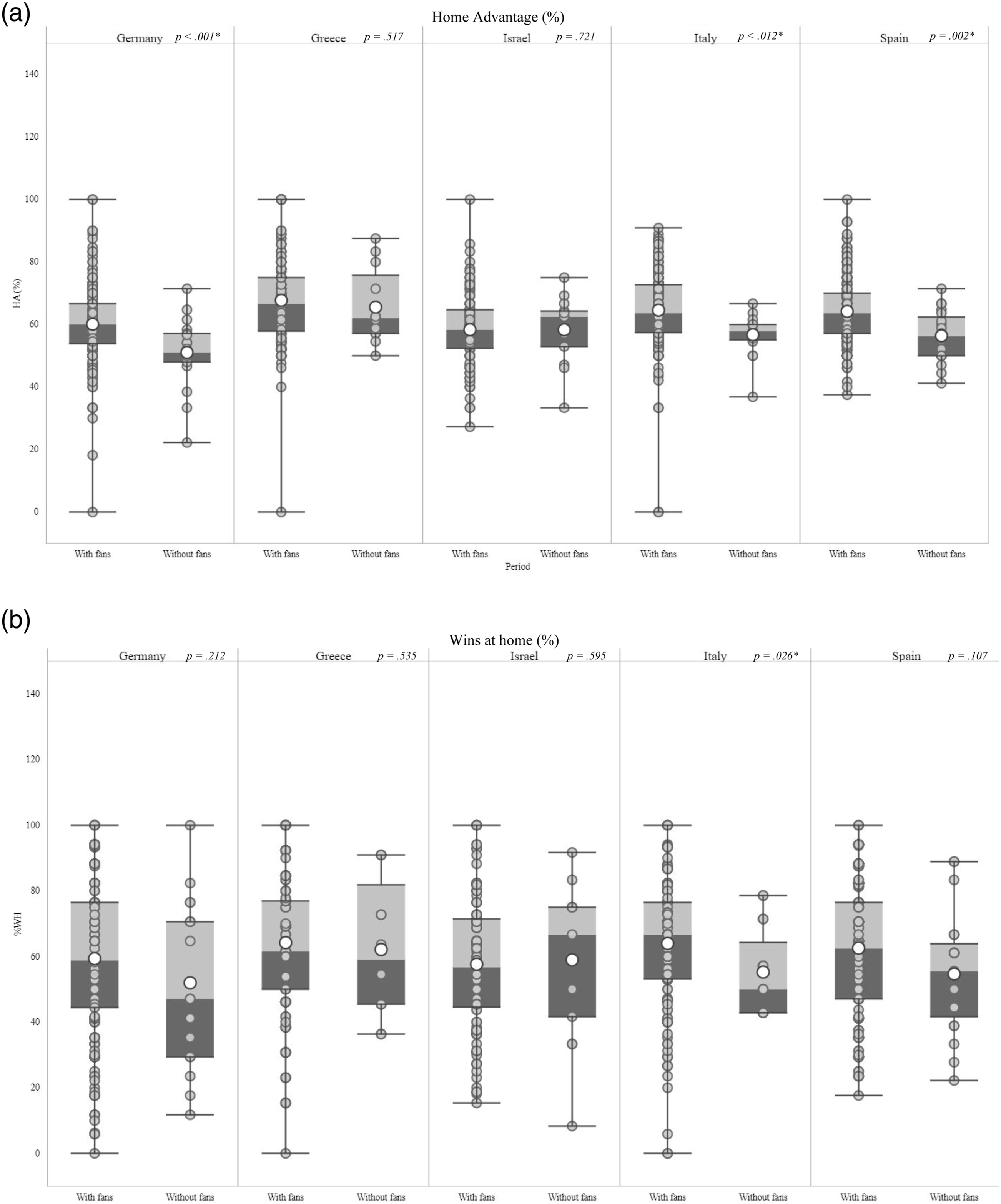
Differences Between Matches With and Without Fans Across Both Leagues and Team Abilities
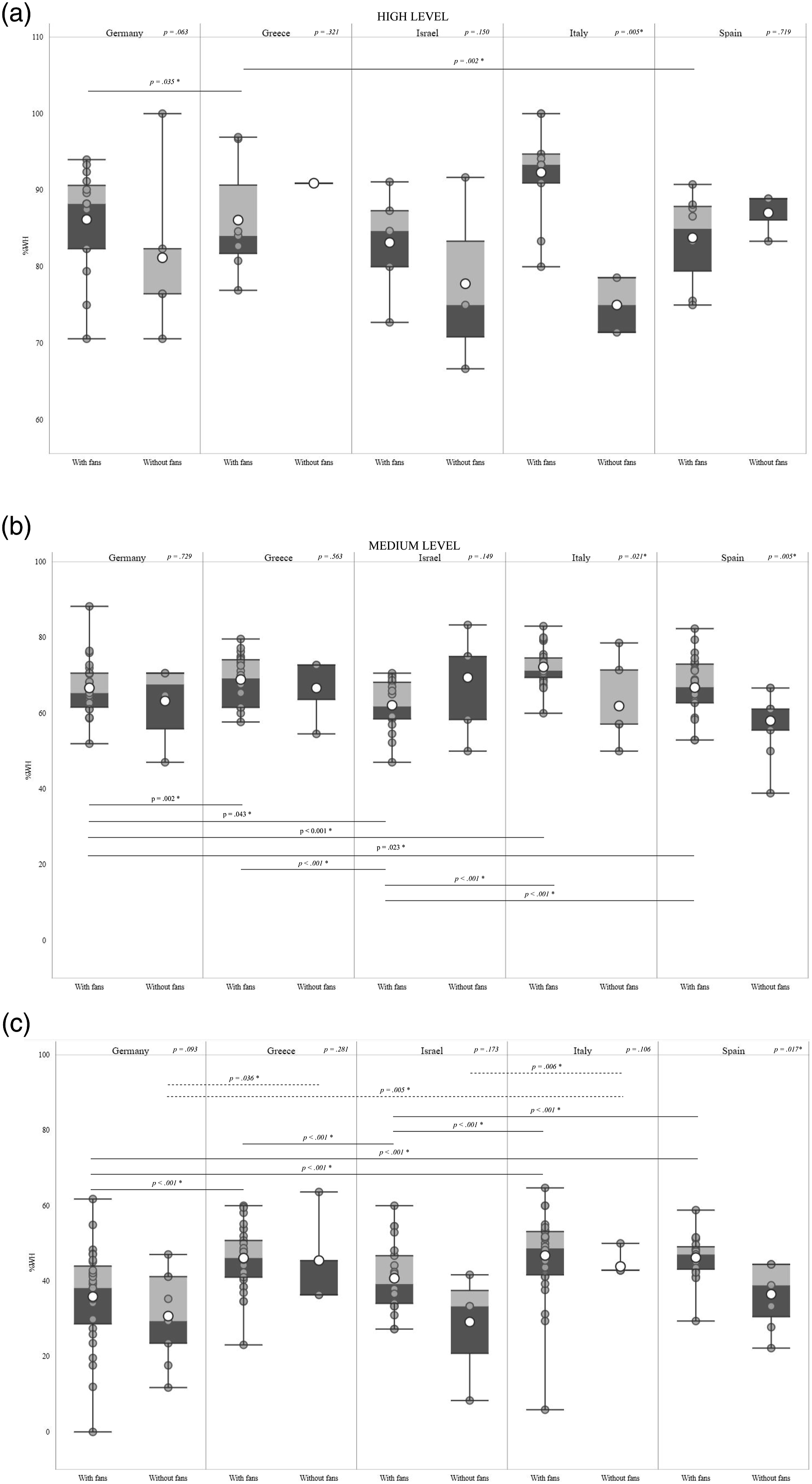
When considering leagues and team ability, HA and HW% were significantly greater during matches with than without fans for high-level teams in the Italian league (Figures 2(A) and 3(A)), HA was significantly greater for medium team ability in the Greek league (p = .028), the Italian league (p = .016) and the Spanish league (p = .003) (Figure 2(B)), and HW% was significantly greater for medium ability teams in the Italian (p = .021) and Spanish (p = .005) leagues (Figure 3(B)). For low level team ability, HA was significantly greater for matches with than without fans within the German league (p = .012), and HW% was significantly greater in matches with than without fans within the Spanish league (p = .017) (Figures 2(C) and 3(C)). There were no other significant comparative differences amongst leagues and team abilities with fans present or absent (Figures 2 and 3, respectively). (A) Relationship Between High Team Ability and League on Home Advantage for Matches with and without Fans. (B) Influence of Medium Team Ability and League on Home Advantage for Matches with and without Fans. (C) Influence of Low Team Ability and League on Home Advantage for Matches with and without Fans. (A) Influence of High Team Ability and League on Wins at Home (%) for Matches with and without Fans. (B) Influence of Medium Team Ability and League on Wins at Home (%) for Matches with and without Fans. (C) Influence of Low Team Ability and League on Wins at Home (%) for Matches with and without Fans.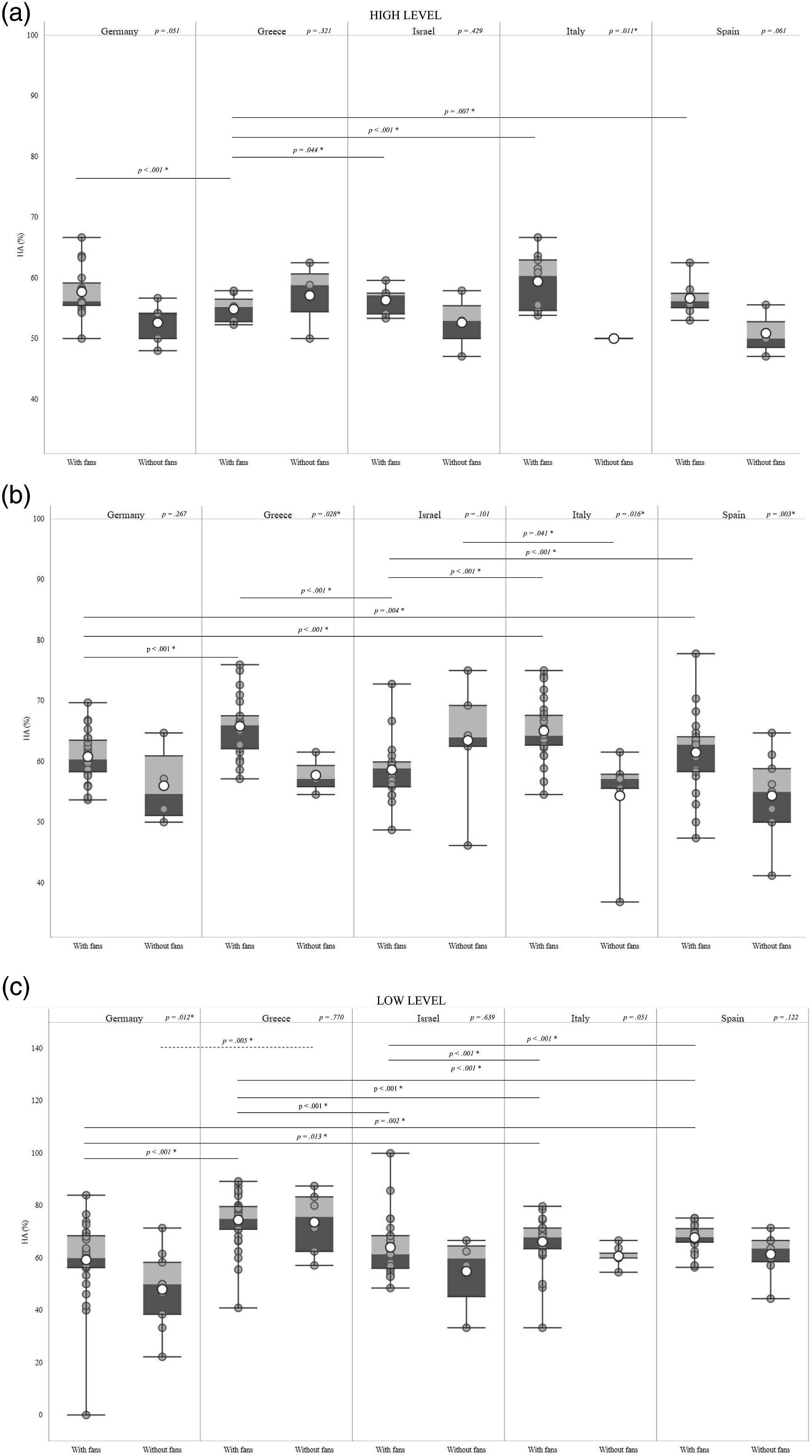
HA and HW% Differences Between Leagues and Team Abilities in Relation to Fan Presence or Absence
When considering just team ability and leagues, significant differences were evident between leagues for HA and HA% (Figures 2 and 3). For matches with fans, HA was significantly different between some league pairings for high ability teams (Germany > Greece p < .001; Greece < Israel p = .044, Italy p < .001 and Spain p = .007; Figure 2(A)), medium ability teams (Germany < Greece p < .001, Italy p < .001 and Spain p = .004; Greece > Israel p < .001; Israel < Italy p < .001 and Spain p < .001; Figure 2(B)) and low ability teams (Germany < Greece p < .001, Italy p = .013 and Spain p = .002; Greece > Israel p < .001, Italy p < .001 and Spain p < .001; Israel < Italy p < .001 and Spain p < .001; Figure 2(C)). For matches without fans, HA was significantly different between leagues for medium ability teams (Israel > Italy p = .041; Figure 2(B)) and low (Germany < Greece p = .005; Figure 2(C)).
Regarding HW%, significant differences were identified between some league pairings for matches with fans and high ability teams (Germany < Greece p = .035; Greece > Spain p = .002; Figure 3(A)), medium ability teams (Germany < Greece p = .002, Italy p < .001 and Spain p = .023; Greece > Israel p < .001; Israel < Germany p = .043, Italy p < .001 and Spain p < .001; Figure 3(B)) and low ability teams (Germany < Greece p < .001, Italy p < .001 and Spain p < .001; Greece > Israel p < .001; Israel < Italy p < .001 and Spain p < .001; Figure 3(C)) team abilities. For matches without fans, HW% was significantly different between leagues for low ability teams (Germany < Greece p = .036 and Italy p = .005; Israel < Italy p = .006; Figure 3(C)).
Discussion
Previous studies examining HA within elite basketball confirmed that European teams had a greater HA and HW% for matches with (versus without) fans prior to the COVID-19 pandemic period, independent of the team’s playing ability (Alonso et al., 2022). In the current study, we expanded these results to demonstrate significant relationships between fan presence, league country (e.g., Germany, Spain, Italy) and team ability. The results of this study indicated that the presence of fans tended to have a positive impact on HA and HW% across different team abilities and leagues.
One of the key outcomes of the current study was the positive impact of fans on high-level teams in the Italian league. Both HA and HW% were significantly greater during matches with fans compared to those without fans. This suggested that the presence of fans in the stadium provided a significant enhancement to the performance of top-tier teams in the Italian league. Similar positive effects were observed for medium-level teams in various leagues, such as the Greek, Italian, and Spanish leagues. In these cases, HA was significantly greater when fans were presented. This indicated that even teams with moderate abilities can benefit from the support and energy provided by their fans. Additionally, HW% was significantly greater for medium-level teams in the Italian and Spanish leagues when fans were in attendance, further highlighting the importance of fan support in securing victories. For low-level teams, the results were mixed. While HA was significantly greater for matches with fans, HW% was not different between matches with and without fans in the German league. In contrast, HW% was significantly greater for matches with fans in the Spanish league. This suggests that the impact of fans on low-level teams may vary depending on the league and other contextual factors.
The current results highlight the complex interplay between fans and team performance in basketball. While fans can have a substantial positive influence on high and medium-level teams in certain leagues, the relationship is more nuanced for low-level teams and may depend on specific circumstances. In this regard, the study indicates that the impact of fans on team performance is not uniform across different leagues and can vary depending on the level of team ability. Previous basketball investigations reported that league country or region was a determining factor of HA (Gómez & Pollard, 2011; Pollard & Gómez, 2013), with ethnic and cultural characteristics potentially important to HA for some teams in Europe. While we did not specifically investigate the relationship between ethnic or cultural characteristics and HA and HW%, it is possible that these factors could also play a role in match outcome (Bustamante-Sánchez et al., 2022; Pollard & Gomez, 2014). For example, cultural beliefs around sport participation (e.g., in a culture emphasizing victory at any cost, athletes may be driven by a win-at-all-costs mentality, potentially compromising their sportsmanship for the sake of victory) could affect an athlete’s motivation and level of engagement during matches. Additionally, cultural factors such as local diet and sleeping habits might affect an athlete’s physical health and energy levels during matches. Finally, variations in climate across countries/regions or cultural factors such as language barriers could affect an athlete’s ability to successfully communicate with their coaches and teammates (Gómez & Pollard, 2011).These factors, could then influence athletes’ performance and stress levels during matches (Tilp & Thaller, 2020).
Importantly, the presence of fans resulted in a clear HA for some leagues prior to the COVID-19 period. This fan presence resulted in likely greater home crowd cheering, which would logically be a deterrent for the visiting team (Alonso et al., 2022). In contrast, during the COVID-19 pandemic, the HA was reduced due to the lack of fans (Alonso et al., 2022). While there was a clear HA when fans were present, this response was only observed in some leagues in Europe. Studies examining soccer reported that the league or region of competition was related to the presence of a HA (Inan, 2020), and that HA remained stable or was increased in four of the five analyzed countries/leagues (i.e., Italy, Spain, England & Portugal). This HA effect was apparent even though performance (goal-scoring actions & tackles) decreased in all leagues, highlighting that team ability was not significantly related to HA. In contrast, in the current study we found that both league country/region and team ability were significantly related to HA during basketball matches when fans were present. These unique contextual outcomes could have resulted from crowd pressure (Inan, 2020; Leota et al., 2021; Pollard & Gomez, 2014), travel distances for the opposition team (Pollard & Gomez, 2014) or average team ability within the league (Alonso et al., 2022).
Practical Implications
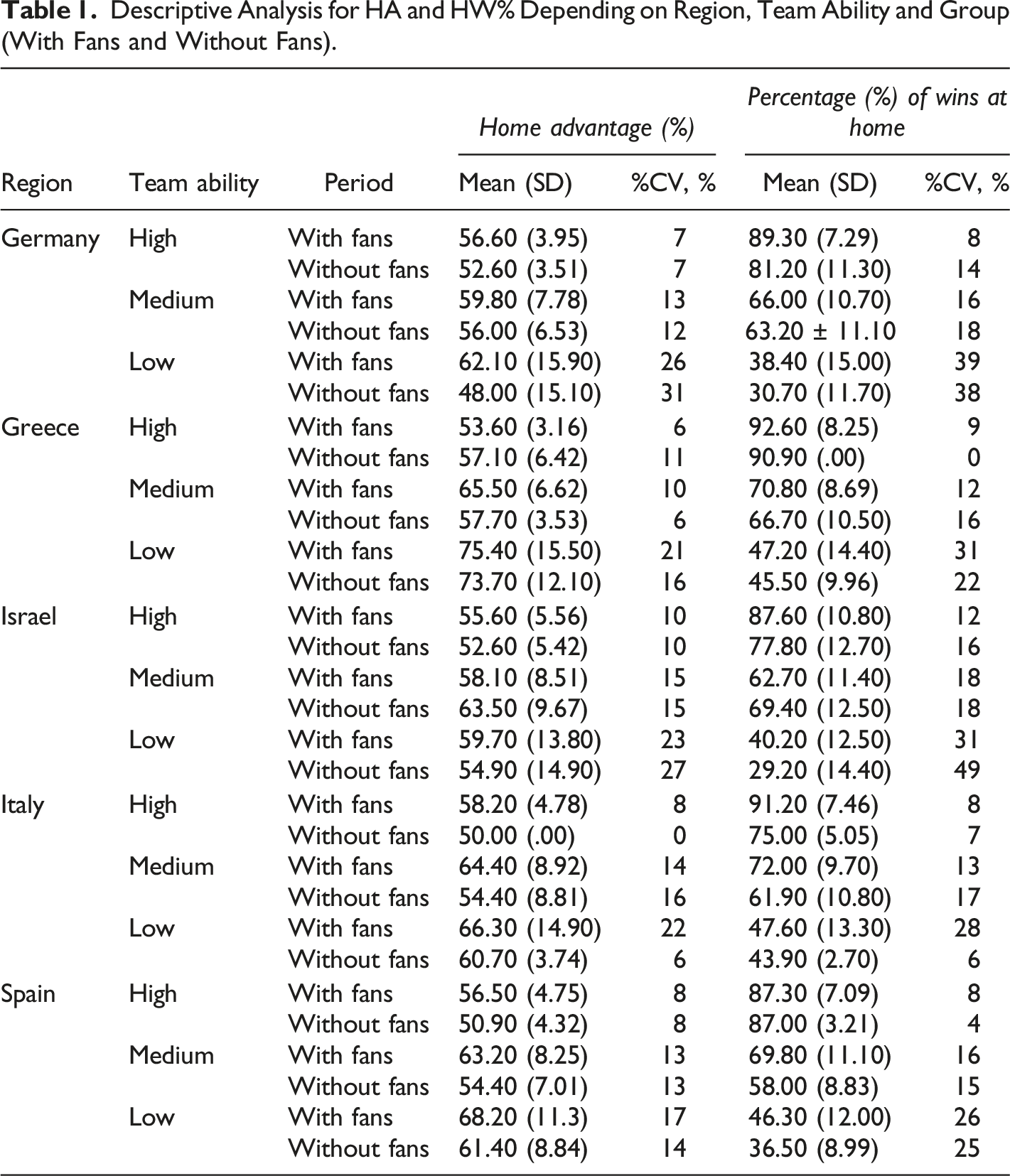
Descriptive Analysis for HA and HW% Depending on Region, Team Ability and Group (With Fans and Without Fans).
Limitations and Directions for Further Research
While we have shown that the presence of fans, location of leagues and team ability were significantly related to HA in five elite European basketball leagues, there are some limitations to the current work. Notably, HA is a multifactorial phenomenon with many possible underlying contributors (e.g., travel fatigue, hostility of supporters, availability of athletes for matches, stadium capacity and occupancy, and team tactical preferences) (Alonso et al., 2022), not explicitly considered in the current study. Additionally, it is possible that resources available to teams could vary by region or country within Europe (Gómez & Pollard, 2011; Pollard & Gómez Ruano, 2007) and therefore significantly contribute to match and team success. For example, those leagues with small or limited budgets, long-distance and expensive travel may potentially affect the timing of travel arrangements and quality of accommodation that impacts recovery strategies for visiting teams. Further research is encouraged to consider these additional contextual factors for a thorough understanding of elite basketball success. Future research using complex multivariate statistical procedures, very large datasets and an examination of multiple possible explanatory variables may further refine our understanding of the basis for HA.
Conclusions
Within the prestigious elite basketball leagues of Europe, HA was significantly related to fan attendance/unattendance, with this effect varying by league/country (e.g., Germany, Spain, and Italy) and team ability. Across different league regions/countries and team abilities, matches with fans generally resulted in a greater HA and HW% for high-level teams in the Italian league, medium-level teams in the Greek, Italian, and Spanish leagues, and low-level teams in the German and Spanish leagues. Understanding the effects of fan presence on HA and HW% has significant implications. Integrating these findings into strategies and decision-making can optimize team performance and success and enhance the overall sports experience for fans.
Footnotes
Declaration of Conflicting Interests
The author(s) declared no potential conflicts of interest with respect to the research, authorship, and/or publication of this article.
Funding
The author(s) received no financial support for the research, authorship, and/or publication of this article.
