




Abstract
We investigated pupillary responses to the world’s shortest fixed verses, Japanese haiku as aesthetic poetry (AP) and senryu as comic poetry (CP), in comparison with non-poetry control stimuli (NP) comprised of slogans that had the same rhythm patterns. Native Japanese speakers without literary training listened to these stimuli while we recorded their pupil diameters. We found that participants’ pupils were significantly dilated for CP compared to NP in an early time window. While AP also evoked larger dilations than NP, the latency for AP-related pupil dilation was relatively long. Thus, lay people experience quick and intense arousal in response to funny and humorous words, while aesthetic properties of words may also elicit intense but slower changes in listeners’ arousal levels, presumably because they evoke more implicit and subtle emotional effects. This study is the first to provide evidence that poetic language elicits human pupillary dilation. A better understanding of the cognitive and neural substrates for the sensitive awareness of pleasures expressed via poetic language will provide insights for improving mental and physical health. Hence, pupillometry can act as a useful convenient measurement to delineate the sympathetic activation of emotional contexts via language.
Introduction
Words may elicit emotional arousal based on their affective properties. Poetry, the art of words, represents beauty and humor through sophisticated language forms that have evolved in every culture. Poets attempt to determine the best words to express emotion (e.g., passion, joy, pathos, anger, sadness) and readers can perceive emotions through these words (Borges, 2000). Particularly, fixed verse, which refers to a type of poetry with a specified number of syllables along with required rhyming, is based on a structured interplay of words and ethnic rhythm, with which poets pursue succinct expressions of thoughts and feelings. However, the neural mechanisms by which fixed verses inspire emotional life in humans remain unclear.
Pupillometry is a measurement method that is known to register emotional arousal, attention, and cognition (Schwarz & Luo, 2015). Particularly, pupillary dilation reflects emotional arousal, since its change is almost exclusively driven by the activity of norepinephrine as an excitatory neurotransmitter, which is released by sympathetic stimulation in the locus coeruleus (LC) of the pons (e.g., Clewett et al., 2018). Neural activity in the LC contributes to the relaxation of the sphincter pupillae muscle, which, in turn, dilates the pupil (Gilzenrat et al., 2010). This automatic function has been found in response to emotional experiences evoked by visual stimuli, such as pictures of partially nude persons of the opposite sex (Hess & Polt, 1960), as well as by auditory music stimuli (Laeng et al., 2016; Weiss et al., 2016). Furthermore, pupillary dilation is reported to increase to the same degree by both positive (e.g., pleasant pictures and sounds) and negative stimuli (e.g., unpleasant pictures and sounds), relative to neutral stimuli (e.g., Bradley et al., 2008; Partala & Surakka, 2003), supporting that pupil response reflects emotional arousal, regardless of whether the stimuli are pleasant or unpleasant. The arousing powers are also evident in affective verbal stimuli, especially in poetry, song, and fantastic literature, which contain affective values and rhythms (Trevarthen, 2015). This study is the first to examine whether pupil dilation can be observed through poetry. We focused on the world’s shortest fixed verses in Japanese (i.e., haiku and senryu).
Poetic Language as an Emotionally Arousing Stimulus
Poetic language contrasts with prosaic language in terms of relevance, which refers to a trade-off between contextual clarity and processing effort (i.e., clearer contexts make less processing effort and vice versa; Sperber & Wilson, 1986). Competent prose users pursue optimal relevance of a word for efficient interpretation. Contrarily, poets deliberately impede relevance to make the word sequences more equivocal (i.e., less relevant in the context), allowing them to imply an affective atmosphere. Since poetry relies on words with limited relevance, readers may require more advanced inference skills to decipher the message expressed in a poetic piece.
Poetic words can arouse emotions in readers before there is a linguistic understanding of word sequences (Scofield, 1988), because the musicality of poetic narrative is found in spontaneous interactions between mothers and infants or fetuses, contributing to their motives and preferences for speech produced by adults (Dissanayake, 2011). The emotional effect is facilitated by qualities of poetry that are realized through rhetorical devices, such as caesuras (line breaks), meters, and rhymes (Obermeier et al., 2013), as well as sophisticated word choice. These poetry techniques employ ethnic qualities of music, expressed in various forms of fixed verses across the world, such as in the English sonnet, Greek alcaic, Italian terza rima, and Chinese quatrain, to name a few. The native speakers’ innate emotional link to ethnic musicality guides their process of learning to use language to communicate with other persons in a way that balances individual integrity of health and independence of action in accordance with the purposes of conscious agency and experiences (Trevarthen, 2015).
In particular, Japanese haiku and senryu have the form of five–seven–five morae (i.e., the syllabic unit in Japanese speech; Kubozono, 1999 for details), representing the shortest fixed verses in world literature. The former pursues the beauty of nature, while the latter serves as a means of humor and laughter (Ueda, 1999). Since the five–seven–five rhythm is an integral element of Japanese folk songs (Shirane, 1998), typically developed native Japanese speakers are supposed to feel comfortable with and pleasure in response to this rhythm.
Haiku is a style of aesthetic poetry (AP) aimed at conveying the beauty of nature during the four seasons in Japan; it requires the inclusion of a kigo (meaning “season word”) (Shirane, 1998), as exemplified below in (1), the most famous haiku poem written by Basho Matsuo in 1686, with the English translation by Shirane (1998). (1) an old pond… furuike ya a frog leaps in, kawazu tobikomu the sound of water mizu no oto
This haiku is poetic in that it provides a fresh twist to the seasonal association of kawazu (meaning “frog”) with the bouncy joy of spring (Shirane, 1998). Specifically, the sudden movement of the frog suggests the awakening of life, although the word “awakening” is left unsaid. It is also evident to Japanese poets that haiku connotes a certain musical quality brought about by a kire (“line break”). In (1), a kire is created by ya, a poetic particle called kire-ji (“letter to break”), at the end of the first line, making the verse rhythmic and affective.
The short verses of senryu, unlike those of haiku, represent a type of comic poetry (CP) that betrays a human foible, making readers laugh (Ueda, 1999), as exemplified below in (2), a winning entry in a senryu contest in 2021 (English literal translation by the last author). (2) having a heated discussion, gekiron mo I’m clad in pajamas pajama sugata no on the bottom kahanshin
This piece depicts an unorganized scene from the recent remote working environment, where an employee participates in an online meeting wearing a jacket on top and pajama pants below. This is harmless fun, consistent with the Aristotelian analysis that laughter requires oddness, distortion, folly, or some such “version of the ugly,” but without pain. Considering the explicitness of the ugly, senryu are more prosaic and less qualified as verses (poems) that essentially require high aesthetic quality.
Neurophysiological Effects of Poetic Language Stimuli
Recent neuroimaging studies using functional magnetic resonance imaging (fMRI) have provided evidence that poetry elicits both cognitive empathy (CE; also referred to as theory of mind: ToM) and affective/emotional empathy (AE) in which one infers and responds to others’ mental states (e.g., intention, knowledge, belief, emotion), respectively (Dziobek et al., 2008). One study on poetry without specific rhythm patterns (Liu et al., 2015) found that activity in the medial prefrontal cortex (mPFC), responsible for CE, varied with the assessed artistic quality of the poetry and during its creative processes. Wassiliwizky et al. (2017) studied the brain activities of participants experiencing chills (i.e., peak emotional responses) as an indicator of AE and found activity in the nucleus accumbens (NAcc) in the mesolimbic system, the hub of the reward circuit for the peak aesthetic pleasure experienced in response to recited poetry.
Substantial evidence suggests that music arouses pleasant emotions. Music-evoked pleasure is associated with the activation of a phylogenetically old reward network that functions to ensure the survival of the individual and the species (Koelsch, 2014). Brain activities in regions that include the prefrontal, motor, auditory and limbic and paralimbic systems are known to be interconnected for music appreciation (Schaefer, 2017). A psychophysiological examination of music (Mori & Iwanaga, 2017) demonstrated that pleasure is induced by both happy and sad songs. Furthermore, pupillometry has been used to demonstrate the impact of music (Weiss et al., 2016); vocal melodies induced greater pupil dilation than instrumental melodies, illustrating the importance of the human voice as a privileged signal in expressive performance. An electroencephalographic (EEG) study reported that the neural effects of poetry with a traditional musical property were evident even in lay people who could not distinguish poetic characteristics (Vaughan-Evans et al., 2016).
The Current Study
While sharing the same rhythmic pattern, the AP and CP have different functional semantic characteristics that may be differentially reflected in pupillometry patterns. AP is more poetic because the writer leaves many things open to the reader’s interpretation and free imagination, as induced by written words (Eco, 1962). By contrast, CP more explicitly discloses comical and silly human states. Based on these assumptions, we formulated the following hypotheses: H1. Human pupils dilate more in response to poetic language than to prosaic language. H2. Within poetic language, human pupils dilate more acutely in response to humor in CP than to aesthetic connotations in AP.
Method
Participants
We recruited 41 native Japanese speaking graduate and undergraduate students (18 women, 23 men; M age = 20.63 years, SD = 1.96) with no literary training to participate in the experiment. The participants had normal hearing and normal or corrected-to-normal vision. We determined the number of participants we needed from an a priori power analysis that suggested 38 participants would be needed to detect a main effect of a three-level within-participant factor with an effect size (f) of .25 and power (1 − β) of .80 in repeated measures analyses of variance (ANOVAs). We performed this power analysis with G*Power (ver. 3.1, Faul et al., 2007) and set α level to .05 and the repeated-measures correlation to .30.
We excluded data from two participants because of either computer malfunction during the experiment or excessive amounts of missing pupillary data (>50%); thus, we used data from 39 participants (17 women, 22 men; M age = 20.64 years, SD = 1.98) for the final analysis. All participants provided written informed consent before the experiment and received monetary compensation for their time and inconvenience. The experiment, as well as the pilot study, were conducted in accordance with the Declaration of Helsinki and were approved by the Institutional Review Board of Tohoku University at Kawauchi-Minami Campus, Japan.
Stimuli
Example Stimuli of Contemporary Japanese Fixed Verses and Slogans.
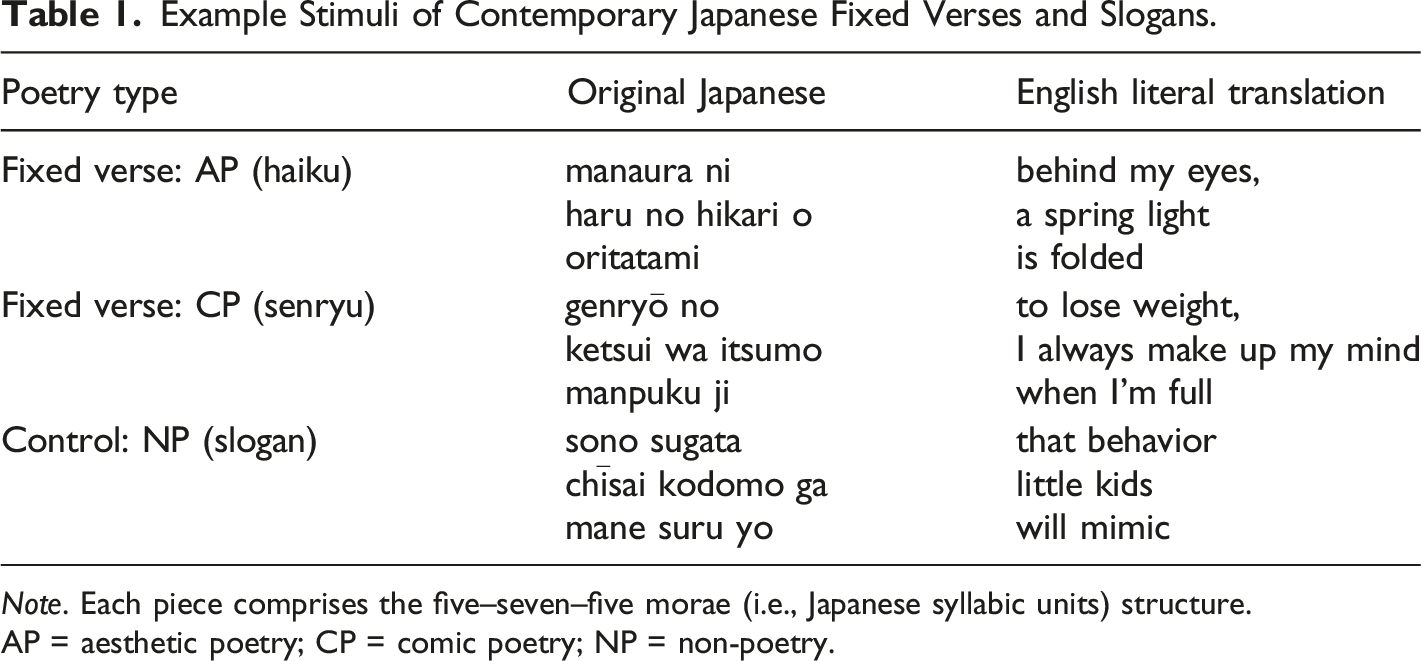
Note. Each piece comprises the five–seven–five morae (i.e., Japanese syllabic units) structure.
AP = aesthetic poetry; CP = comic poetry; NP = non-poetry.
All auditory stimuli were presented by a female native Japanese-speaking haiku poet in her 20s, because narration is generally more understandable when presented by female speakers than male speakers, irrespective of the listener’s sex (Linek et al., 2010). The recitation of each piece required less than 4 s and was recorded in WAV format at a sampling frequency of 12000 Hz using Praat (Boersma & Weenink, 2021).
Apparatus
We used an EyeLink 1000 Plus eye tracker (Desktop Mount; SR Research, Canada) to measure pupil diameters. Although the sampling frequency of the eye tracker was set to 1000 Hz during the experiment, the data were down sampled to 250 Hz for the analyses because our software could not process the original data from all the participants. Auditory stimuli were presented through headphones (QuietComfort 25, BOSE, USA) at approximately 65 dB, and visual stimuli (fixation crosses) were presented on a 19-in liquid crystal display (FlexScan L797, EIZO, Japan) placed approximately 80 cm from the participants’ eyes. The luminance of the display was 7.8 cd/m2. The experiment was controlled using a computer (Latitude E5530, DELL, USA) and the Python programming language (ver. 2.7.3). The PsychoPy (Peirce, 2007) and PyGaze (Dalmaijer et al., 2014) Python packages were used for stimulus presentation, collecting responses, and controlling the eye tracker.
Procedure
The participants individually listened to and rated the artistic qualities of the recited AP, CP, and NP in a quiet, dimly lit room (< 30 lx), while their pupils were measured. Before the proper experiment, they reviewed the stimuli by reading the written version aloud. We performed this step because the Japanese language relies heavily on the writing system, especially kanji (i.e., the Chinese logographic writing system) to determine the appropriate meaning among many homophones. After reviewing the stimuli, they were asked to rest their chin on a chinrest and press their forehead firmly against a headrest. In each trial of the proper experiment, they were asked to fix their eyes on a white fixation cross (+) at the center of the display with a black background (Figure 1), and also asked to refrain from blinking when the fixation was presented. One second after the fixation onset, a recorded stimulus of AP, CP, or NP was auditorily presented twice with a stimulus onset asynchrony of four seconds. Eight seconds after the first stimulus onset, the fixation was replaced by three horizontal crosses (+++). When the three crosses were presented, the participants rated the artistic quality of the presented auditory stimulus on a four-point scale (1 = not artistic to 4 = highly artistic), using a USB response box (MilliKey Response Box SR-5, LabHackers, Canada) and were allowed to blink during the rating phase as well as during the intertrial interval of five seconds. The order of the stimulus presentation was randomized for each participant. Before the experimental session, the participants completed four practice trials. The entire session, excluding the reviewing phase, lasted approximately 50 minutes, with short breaks after every 40 trials. Flow of the Stimulus Presentation in a Trial. Note. The eye tracker measured and recorded the participants’ pupil diameters during the visual presentation of fixation. ITI = intertrial interval.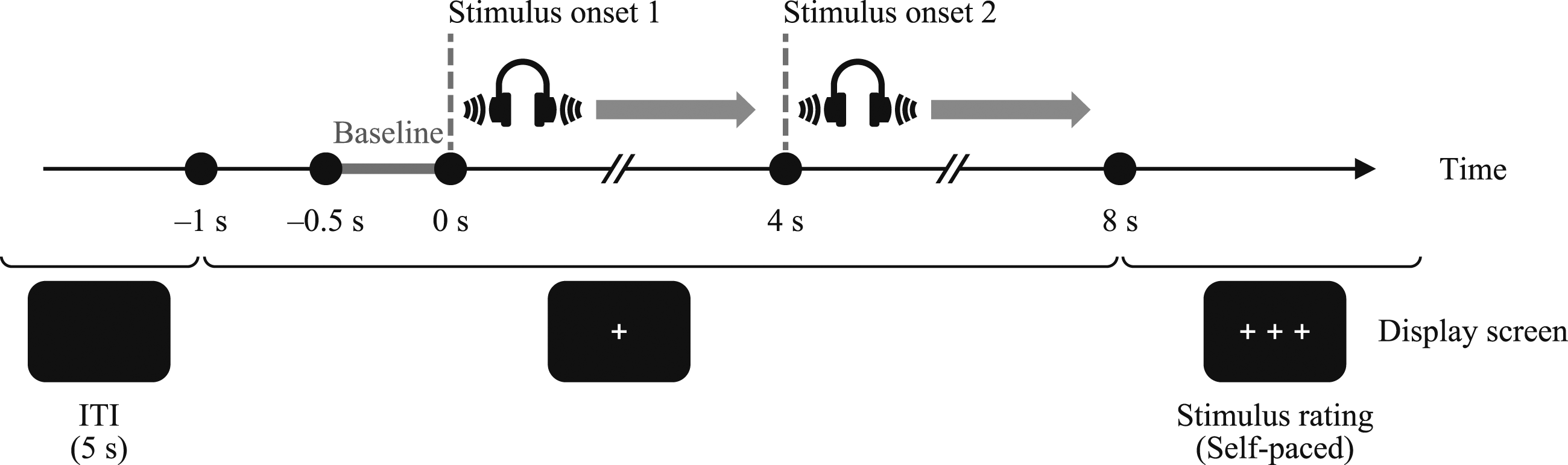
Data Preprocessing and Statistical Analysis
We analyzed pupil-size data (right eye, diameter) between −0.5 seconds and 8 seconds from the first stimulus onset for each trial. We transformed the pupil diameter values, which were in arbitrary units (i.e., the number of pixels in the eye tracker camera image), into z scores. Trials with greater than 50% track loss for the 8.5 second time window were excluded from the data (3.9% of the data). The pupil values during blinking that were detected by the eye tracker, were linearly interpolated. We then smoothed the data using a 21‐point (84 ms) moving average (Weiss et al., 2016). Then, a baseline correction was conducted by subtracting the median pupil value during −0.5–0 seconds from each value for the 0–8 seconds duration for each trial (Mathôt et al., 2018). Finally, baseline-corrected data from the 0–eight second time window were aggregated into one second time bins (Weiss et al., 2016) and entered into two-way ANOVAs by participant (F1) and item (F2), using Poetry Type (3: AP, CP, and NP) and Time Bin (8: 0–1 s, 1–2 s, 2–3 s, 3–4 s, 4–5 s, 5–6 s, 6–7 s, and 7–8 s) as the independent variables. The mean pupil value for the corresponding one second time bin was used as the dependent variable. Greenhouse–Geisser corrections were applied when the sphericity assumption was not satisfied. The analyses were performed using R programming language (R Core Team, 2019), employing the gazeR package (ver. 0.1, Geller et al., 2020) to preprocess pupil data.
Results
Subjective Evaluations
The participants’ subjective evaluations of the artistic qualities of the stimuli are summarized in Figure 2. By-participant and by-item one-way ANOVAs revealed a significant main effect of Poetry Type, F1 (1.69, 64.32) = 40.57, p < .001, ηp2 = .516, 95% confidence interval (CI) = [.350, .636]; F2 (2, 117) = 130.60, p < .001, ηp2 = .691, 95% CI = [.594, .750]. Multiple comparisons with Shaffer’s method revealed that the mean rating score for AP was significantly higher than those for CP (p1 < .001; p2 < .001) and NP (p1 < .001; p2 < .001) and that the mean rating score for CP was significantly higher than that for NP (p1 < .05; p2 < .01). Mean Ratings (1 = not artistic to 4 = highly artistic) for Each Poetry Type. Note. Error bars show standard errors of the participants’ means.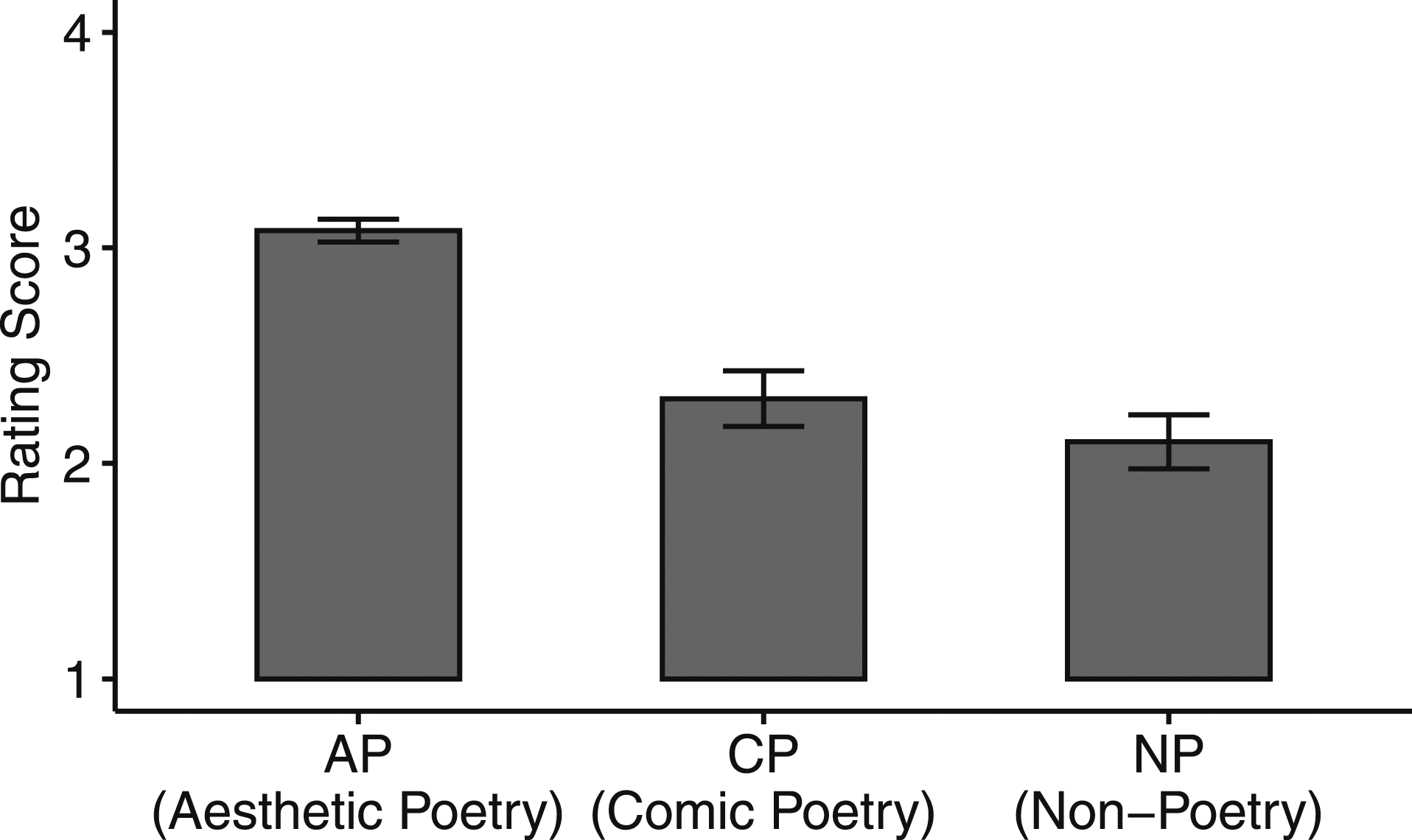
Pupil Dilation
Figure 3 shows the mean baseline-corrected pupil values by time bin for each poetry type. The ANOVAs demonstrated significant main effects of the Time Bin, F1 (1.63, 62.05) = 34.69, p < .001, ηp2 = .477, 95% CI = [.359, .582]; F2 (2.59, 303.21) = 441.37, p < .001, ηp2 = .791, 95% CI = [.752, .813], and significant interactions between the Poetry Type and Time Bin, F1 (4.58, 174.02) = 4.69, p < .001, ηp2 = .110, 95% CI = [.042, .168]; F2 (5.18, 303.21) = 4.56, p < .001, ηp2 = .072, 95% CI = [.028, .113]. The main effect of Poetry Type was significant in the by-participant analysis but not in the by-item analysis, F1 (2, 76) = 3.16, p = .048, ηp2 = .077, 95% CI = [.002, .188]; F2 (2, 117) = 2.88, p = .060, ηp2 = .047, 95% CI = [.003, .136].
1
Mean Baseline-Corrected Pupil Values During Stimulus Presentation. Note. Baseline corrections (subtractive correction: Mathôt et al., 2018) were applied to the z-transformed pupil diameters (Right Eye). The baseline period was −0.5 to 0 seconds from stimulus onset. Error bars show standard errors of the mean by participant.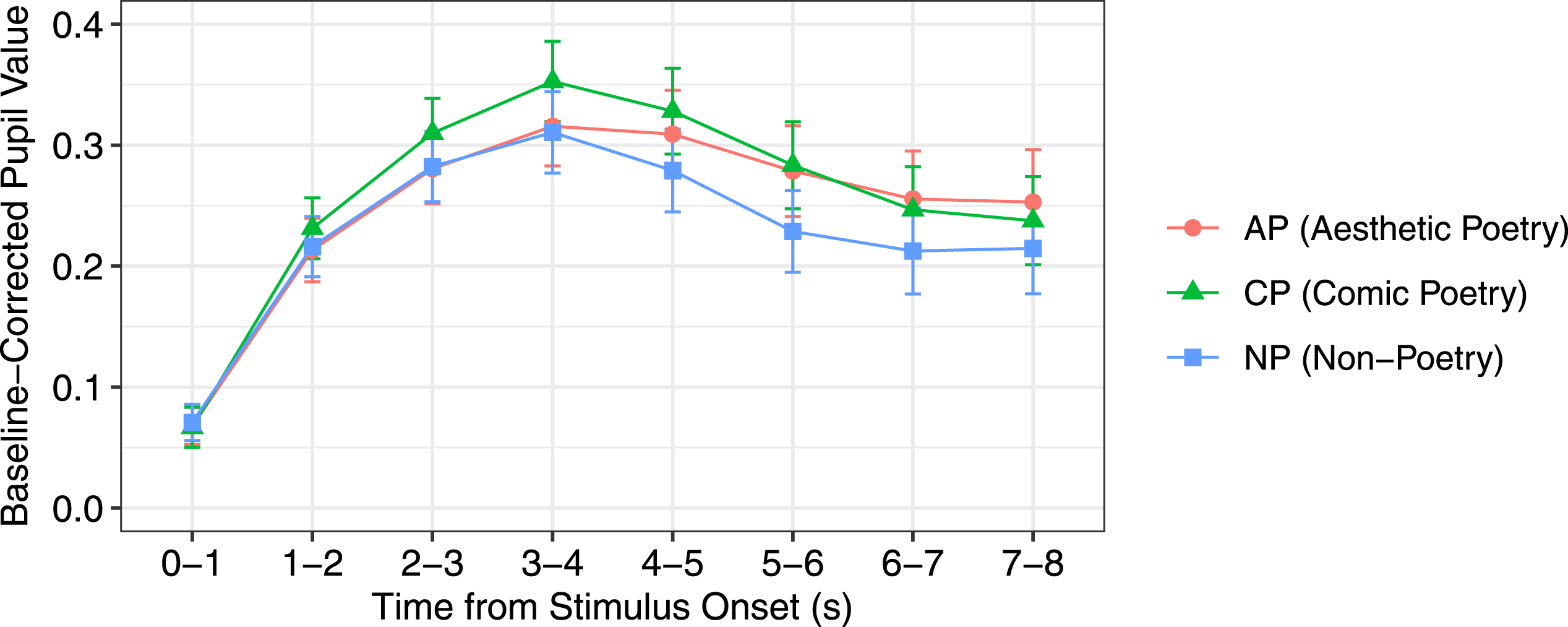
Summary of the Follow-Up Analyses of Pupil Diameter Changes for the Poetry Type × Time Bin Interaction.
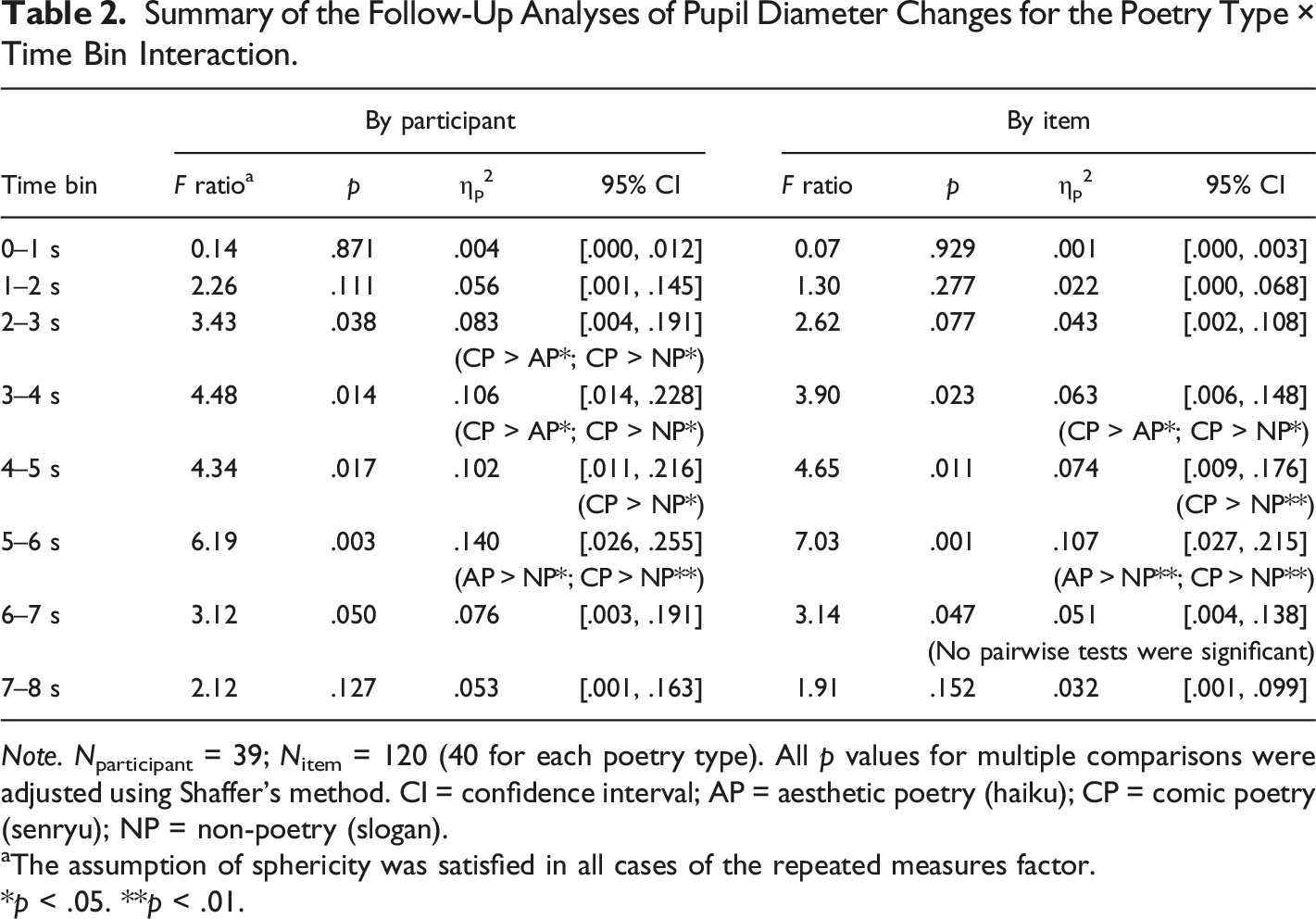
Note. Nparticipant = 39; Nitem = 120 (40 for each poetry type). All p values for multiple comparisons were adjusted using Shaffer’s method. CI = confidence interval; AP = aesthetic poetry (haiku); CP = comic poetry (senryu); NP = non-poetry (slogan).
aThe assumption of sphericity was satisfied in all cases of the repeated measures factor.
*p < .05. **p < .01.
In addition, we examined the correlations between the by-item means of the scores of the subjective artistic evaluations and the mean preprocessed pupil values for each time bin. All the Pearson’s correlation coefficients (r) were within the range of −.19 and .07 for all time bins, which indicates little correlation between the artistic qualities of the stimuli and the degree of pupil dilation evoked by them.
Discussion
Consistent with our first hypothesis, we found that the pupils of the participants dilated to a greater extent when they listened to the Japanese AP and CP as poetic languages than when they listened to the Japanese NP as prosaic language, supporting the idea that human pupil diameter acted as an index of emotional arousal in response to verbal auditory stimuli. This could not detected in terms of subjective artistic evaluation. Our second hypothesis was also generally supported, because the participants’ pupils dilated more in response to CP than to AP at an earlier stage of exposure. Of note, however, after a short time delay, AP induced dilation to the same degree as CP. This suggests that the comical aspects of poetry evoked more rapid and intense emotional changes, while aesthetic properties of words also elicited intense but slower changes in listeners’ arousal levels, presumably because AP induces more implicit and subtle emotional effects driven by word combinations, at least in lay people.
Pupil size changes are reflexive, and partially voluntary; it constricts in response to brightness and near fixation, and dilates in response to mental effort such as cognition, emotion, and motivation (Mathôt, 2018). To mobilize the body mechanisms to meet conditions of stress, the pupillary dilation is driven by the activity of sympathetic nervous system (SNS), which needs to be coupled with the contrastive activity of conservation and restoration of the body by the parasympathetic nervous system (PNS) as a parallel branch of the autonomic nervous system (ANS), enabling homeostatic control of the organism’s internal environment (Kardon, 2005). The coordinated activity of SNS and PNS can be observed with techniques in cardiovascular physiology such as pre-ejection period influenced by the SNS and respiratory sinus arrhythmia reflecting the PNS, in response to physical and mental tasks including speech (Weissman & Mendes, 2021). In line with this, the present study has demonstrated the possibility of pupillometry as another convenient measurement to delineate the ANS coordination in physiological responding to emotional contexts via language.
As a function of visual optimization to better observe the world, the steeper and greater changes in pupillary dilation are generally induced by the increased psychological intensity of mental effort demanded by emotion, attention, or cognition (see Mathôt, 2018 for a review). Indeed, the pupillometric study of music appreciation (Weiss et al., 2016) suggests a special role for the human voice. Our study involving emotional verbal stimuli demonstrated that CP, representing human affairs, has earlier saliency than AP, concerning nature. Comical elements of human affairs naturally produce laughter, which is considered a social emotion (Scott et al., 2014). The intense engagement in the harmless human ugliness of CP is consistent with the idea that comical verbal materials act as an essential social signal and have evolved for human adaptation to novel environments (Fogarty & Kandler, 2020).
Conversely, AP induced slower pupil dilation, although with the same peak intensity as CP at a later stage. The longer latency for AP may underlie the limited relevance among words (Sperber & Wilson, 1986) because aesthetic haiku better qualifies as a verse than comical senryu. AP does not heavily rely on literal interpretations but focuses more on the connotations of a limited number of words that are left open for the listeners so that they move outside the strict control of the author and determine a possible interpretation as they prefer (Eco, 1962). Such flexible subtlety of the fixed verse as an art of words may gently arouse a pleasant emotion in lay people, resulting in their pupils dilating more slowly. Our verbal stimuli were the shortest fixed verses among the various poetic forms worldwide. As Birkhoff (1933) noted, artistic quality increases as complexity decreases; thus, the simple structure of Japanese haiku and senryu might contribute to inducing strong emotional power that was sufficient to differentiate pupillary responses in terms of latency and intensity according to their semantic properties. However, the different time courses of the levels of engagement with AP and CP need to be further investigated by employing tools with higher time resolution for emotional and cognitive processing (e.g., EEG).
The pupillary patterns for the two types of poetry are consistent with previous neurophysiological evidence. Presumably, acute pupil dilation in response to CP delineating the harmless ugliness of human affairs is associated with the psychological process of CE/ToM as a social skill for inferring others’ mental states. This is evidenced by the findings of an fMRI experiment, indicating stronger activity in the mPFC, the region responsible for CE/ToM, as well as the hippocampus, when appreciating comic stories (Iidaka, 2017). Another fMRI study also indicated that artistic evaluation of poetry is associated with divergent connectivity in the mPFC in addition to the dorsolateral PFC (Liu et al., 2015). The mPFC plays a major role in perspective-taking (Ye et al., 2020). A person engaged in CE may be required to have a bystander’s viewpoint to grasp every person’s perspective to understand their social behavior (Thomas et al., 2016). The social ability to understand the difference between the standpoint of the self and that of the other may underlie laughter.
Considering a seminal fMRI study on poetry appreciation, we can interpret the pupillary changes induced by poetry. Wassiliwizky et al. (2017) found that aesthetic pleasure is driven mainly by NAcc activity in the meso-limbic reward system, in which they noted the resemblance of the aesthetic experience in response to recited poetry and pleasurable emotional responses to music. The aesthetic value system is believed to result from reinforcement learning that incorporates the effects of sensory inputs, rewards, and motivational states (Aleem et al., 2020), which in turn enables children to culturally acquire the cognitive and emotional aspects of language (Panksepp, 2015). Thus, the slow but intense pupillary response to the recitation of fine aesthetic fixed verses demonstrated in this study may reflect a certain role of the neural reward pathway in realizing aesthetically emotional experiences that are individually and culturally reinforced to an extent that facilitates language acquisition.
Several neuroimaging studies have consistently attributed the psychological basis of aesthetic pleasure in response to music to the ability of AE as a re-experiencing of the other person’s emotions, driven by intrinsic functional connectivity among social-emotional regions between the cerebral cortex and the limbic system (Cox et al., 2012). In particular, the amygdala and insula subserve evaluative and affective processes of music experience (Berntson et al., 2011). Subsequent neuroimaging studies should further investigate the neural basis by which humans are aware of the musical qualities of recited poetry. These findings will help improve pedagogical and clinical practices utilizing poetry, since better creation and appreciation of poetry are achieved by well-balanced skills of AE and CE (Joshi et al., 2022), which are disrupted in a dissociable manner in mental disorders (Cox, et al., 2012). Indeed, expert poets are skillful in experiencing and reconciling complex mixed feelings within the aesthetic sequences of poetry, and such poets’ skills contribute to integration of loss and grief in their poetry that people often experience in their old age (Stroebe, 2018).
In addition to emotional arousal, the AP used in this study may have more cognitively demanding qualities than other types of CP and NP, as the subtle expressions of AP are supposed to be unfamiliar to those without literary training, as indicated by the pilot survey (i.e., CP and NP were rated to be easier than AP). One may argue that the intense pupil dilation by AP, found in the present experiment, is dependent on its cognitive demanding quality, since the pupil is known to dilate in response to a semantically greater cognitive load (Kadem et al., 2020). If the increased cognitive load of the AP significantly influenced our participants’ poetry appreciation, the AP would have dilated the pupils more promptly than the CP. However, the result was the opposite, which we interpret as indicating that CP acts as a prompt social signal to arouse pleasant emotions during lay people’s poetry appreciation. In light of the evidence that a music intervention contributes to the ANS function (Ellis et al., 2012), the socio-emotional power of poetries that depict laughter and beauty with sophisticated words and ethnic musicality, may act as a therapeutic method to promote individuals’ greater SNS-PNS coordination.
Limitations and Directions for Further Research
As the first examination of pupillary responses to poetic language processing, this study has limitations. First, we analyzed pupil diameter without differentiating the emotional valence of the AP. Consequently, it remains unclear whether pupillary responses to poetry differ with the valence of semantic content. Given the substantial neurophysiological evidence that pupil dilation depends on arousal (intense vs. neutral) rather than valence (Bradley et al., 2008), we expect increased pupil dilation in response to AP to have been caused by the beauty of both positive (e.g., happy) and negative (e.g., sad) feelings. The emotional valence of APs should be compared in future studies.
Next, we utilized Japanese haiku and senryu as the shortest fixed verses worldwide, because simplicity was assumed to contribute to higher artistic quality (Birkhoff, 1933). However, the Japanese language has a highly complex orthographic system, using logographic/morphographic kanji and syllabographic kana. The orthographic complexity of Japanese can increase native speakers’ cognitive load when the stimuli are presented visually. In addition, we did not analyze the differences in the orthographic complexity as we utilized auditory stimuli. Therefore, future cross-linguistic comparisons with varying orthographic complexities and poetry lengths should disambiguate the pupillary changes elicited by cognitive and emotional responses.
Third, although our experiment used auditory poetic stimuli recited by a proficient female poet, people are often exposed to written poetry in daily life. It remains unclear whether the arousing effects of poetry are similarly evoked by other types of stimulus presentations (e.g., male voices and lay people). Therefore, future researchers need to replicate the present study’s findings by investigating the effects of different ways of stimulus presentation to further clarify what dimensions of poetry appreciation play more fundamental roles regarding emotional arousal.
Furthermore, future studies should examine individual differences in the physiological sensitivity to the aesthetic qualities of poetic language from diverse perspectives, considering the consistent previous reports that women are more sensitive than men regarding emotional language processing, both at semantic and prosodic levels (e.g., Chapman et al., 2022), and also that the effect of pupil dilation is smaller in depression (Jones et al., 2015). Additionally, a recent study suggested that the individual visual imagery ability is associated with the person’s perceived levels of aesthetic appeal of haiku (Hitsuwari & Nomura, 2021). To accurately determine the extent to which the pupils of an individual dilate in response to poetry as an extremely arousing verbal stimulus, investigators need to examine the pupillary responses in poets for whom the aesthetic experience of poetry is imperative. It can be assumed that proficient poets will be more emotionally sensitive to poetic language than laypeople; thus, the dilation of their pupils when listening to poetic language relative to that of AP will be more acute. Even among people with fewer poetic experiences, some seemed sensitive to the artistic quality of poetic language. Considering the association between aesthetic preference and the psychological processes of empathy (Cox et al., 2012), the aptitude for poetic appreciation may be accounted for, to some degree, by the both CE and AE of empathy or the balance of the two.
Conclusion
To our knowledge, our study was the first to provide evidence that human pupillary responses reflect changes in arousal elicited by recited poetry. The comical aspect of fixed verses can induce intense pupil dilation at an earlier stage of exposure, while the aesthetic quality of the verses also elicits intense changes, but more slowly. These physiological reflex changes could not be detected in terms of subjective evaluation. Overall, the findings demonstrated that pupil dilation depends on emotional arousal according to the semantic content of poetry as an emotional language, including the beautiful and the ugly. A better understanding of cognitive and neural substrates for the sensitive awareness of pleasures expressed via the aesthetic and comical poetic language will provide insights for improving mental and physical health. Hence, pupillometry can act as a useful convenient measurement to delineate the sympathetic activation of emotional contexts via language.
Supplemental Material
Supplemental Material - Pupil Dilation Reflects Emotional Arousal Via Poetic Language
Supplemental Material for Pupil Dilation Reflects Emotional Arousal Via Poetic Language by Keiyu Niikuni, Ming Wang, Michiru Makuuchi, Masatoshi Koizumi, and Sachiko Kiyama in Perceptual and Motor Skills
Footnotes
Acknowledgments
The authors are grateful to the talented haiku poets Michio Nakahara, Keiichi Noe, Koichi Hasegawa, Yoshinao Asakawa, and Keina Soma for their invaluable advice throughout this experimental project, as well as to participants of the haiku meeting held in 2019 at the Tohoku University Botanical Gardens for creating novel poems, some of which were utilized as stimuli of this study. They also thank Shiori Kato for her help in data collection.
Declaration of Conflicting Interests
The author declared no potential conflicts of interest with respect to the research, authorship, and/or publication of this article.
Funding
The author disclosed receipt of the following financial support for the research, authorship, and/or publication of this article: This study was funded by the Program for Creative of Interdisciplinary Research at the Frontier Research Institute for Interdisciplinary Sciences of Tohoku University, Sendai, Japan (awarded to SK in 2018), the Kitano Foundation of Lifelong Integrated Education, Tokyo, Japan (awarded to SK in 2019), JSPS KAKENHI Grants (JP19H05589, JP19H00532, and JP21K12989 awarded to MK, MM, and KN, respectively), and the Mayekawa Hitodukuri Foundation, Tokyo, Japan (MHF2020-A012 awarded to KN).

Supplemental Material
Supplemental material for this article is available online.
Notes
References
Supplementary Material
Please find the following supplemental material available below.
For Open Access articles published under a Creative Commons License, all supplemental material carries the same license as the article it is associated with.
For non-Open Access articles published, all supplemental material carries a non-exclusive license, and permission requests for re-use of supplemental material or any part of supplemental material shall be sent directly to the copyright owner as specified in the copyright notice associated with the article.
