




Abstract
In this study, we examined the psychometric properties of a French version of the Perceived Motor Competence in Childhood (PMC-C) questionnaire. The participants were 219 French-speaking children (aged 5-12 years), recruited from elementary schools in the Canadian Province of Quebec. Results supported the validity and reliability of a second-order confirmatory factor analytic (CFA) model, including one higher-order factor. Additional analyses supported the complete measurement invariance of the first- and second-order factor structure across sex and indicated no differential item functioning or latent mean differences in PMC-C factors as a function of selected predictors (i.e., age, body mass-index and physical activity/sport involvement). Thus, this French version of the PMC-C has satisfactory psychometric properties (i.e., factor validity and reliability, measurement invariance and differential item functioning) and can be used to assess French-speaking children’s perceived motor competence.
Introduction
In a seminal publication, Stodden et al. (2008) proposed a conceptual model to investigate the potential role of motor skills in the “initiation, maintenance, or decline of physical activity” across early to late childhood (p. 290). In this model, the authors hypothesized that the developmental relations between motor skills and physical activity would be mediated by children’s perceptions of their motor competence. Although several studies have since examined these associations, most have relied on questionnaires measuring physical self-perceptions rather than perceived motor competence (Robinson et al., 2015). This observation led to the development of newer self-report questionnaires specifically designed to measure children’s perceived motor competencies. For instance, Barnett et al. (2015) developed a pictorial instrument based on differentiation of locomotor and object control among fundamental movement skills. This instrument was especially designed for children with low literacy levels and for researchers using one-on-one interviews.
Building upon this instrument, Dreiskämper et al. (2018) developed the Perceived Motor Competence in Childhood (PMC-C) questionnaire, suitable for older children and group interviews. The PMC-C includes 24 items measuring eight motor competence dimensions (i.e., three items per dimension) in line with items from the third version of the Test of Gross Motor Development (TGMD; Ulrich, 2019): (a) running, (b) jumping, (c) hopping, (d) leaping, (e) throwing, (f) catching, (g) bouncing, and (h) kicking. Children answer each PMC-C item using a four point Likert-type scale represented by different smiley faces, with response options ranging from “1” strongly disagree (with a very sad face) to “4” strongly agree (with a very happy face).
Dreiskämper et al. (2018) examined the psychometric properties of the PMC-C among a German sample of 197 children aged between 7–13 years. Confirmatory factor analysis (CFA) supported a higher order factor structure including the eight a priori first-order factors and two second-order factors (locomotion: formed of the running, jumping, hopping and leaping factors; and object control: formed of the throwing, catching, bouncing, and kicking factor). Subsequent analyses revealed acceptable scale score reliability for all subscales (α = .79–.91), as well as significant positive relations between the PMC-C subscales, and ratings of physical activity and sport enjoyment. Finally, their results also revealed that: (a) boys presented significantly higher scores in object control than girls; and (b) there were no significant mean differences between age groups.
PMC-C’s Limited Validation in Other Languages and Cultures
To our knowledge, the PMC-C has solely been validated in German, which considerably limits its applicability for research with participants who speak other languages and come from other countries. Thus, in the present study, we attempted to validate a French version of this instrument. This effort is particularly important, given an absence of any validated self-report questionnaire for investigating perceived motor competence among French-speaking children. Practically speaking, the availability of a French version of the PMC-C will greatly facilitate comparing children across various European (e.g., France, Belgium, Switzerland, Luxembourg), North-American (Canada) and North-African (e.g., Algeria, Morocco, Tunisia) countries in which French is the first or second spoken language.
PMC-C Measurement Invariance and Latent Means Differences
An important issue in the investigation of the PMC-C’s psychometric properties is whether it can be used to compare observed or latent mean scores across different subpopulations, such as younger versus older children, or boys versus girls (Millsap, 2011). Indeed, measurement bias may occur when the factor structure of a questionnaire (also named configural invariance) differs across distinct subpopulations from the main population of interest (e.g., Maïano et al, 2015, 2021). Such measurement biases may also occur across subpopulations (Maïano et al., 2015, 2021) in relation to: (a) associations between test items and latent factors (factor loadings); (b) average patterns of item responses (intercepts or thresholds); and (c) item-level measurement error (uniquenesses or residuals). Importantly, any finding of factor loading non-invariance between certain groups precludes any group-based comparisons, whereas findings of items intercepts or response thresholds only preclude group-based mean comparisons. Finally, findings non-invariance of item uniquenesses precludes group-based comparisons that rely on observed scale scores, but not those based on latent factors. Although the previous taxonomy of invariance tests applies well to the consideration of categorical grouping of variables, it cannot be directly transposed to the investigation of measurement biased (or differential item functioning – DIF) as a function of continuous characteristics. For such characteristics, an alternative approach, relying on multiple causes multiple indicators (MIMIC) analyses is required to more directly assess the presence of DIF in item responses to a questionnaire as a function of continuous characteristics (e.g., Morin et al., 2013).
Unfortunately, despite their report of analyses focused on the identification of an age or sex difference in PMC-C scores, Dreiskämper et al. (2018) did not report evidence of measurement invariance or lack of DIF of children’s responses to the PMC-C as a function of these two characteristics. More generally, although the role of a variety of common attributes or characteristics (e.g., age, body mass-index or BMI, physical activity/sport involvement and sex) are frequently assessed in studies examining children’s perceived motor competence (e.g., Carcamo-Oyarzun et al., 2020; Clark et al., 2018; Estevan et al., 2018; Morano et al., 2020), there is no current evidence that the PMC-C can reliably (i.e., without biases) investigate associations between perceived motor competencies and these characteristics. Previous research has reported mean differences in perceived motor competence as a function of: (a) age (i.e., older children tended to present significantly higher scores than younger children; e.g., Estevan et al., 2018; Morano et al., 2020); (b) BMI (i.e., children having higher BMI tended to present lower scores than those with a lower BMI; e.g., Carcamo-Oyarzun et al., 2020); (c) physical activity/sport involvement (i.e., physically active children tended to score higher than inactive children; e.g., Famelia et al., 2018); and (d) sex (i.e., boys tended to present significantly higher scores than girls; e.g., Carcamo-Oyarzun et al., 2020; Clark et al., 2018; Estevan et al., 2018; Morano et al., 2020). However, pending a demonstration that perceived motor competence measures perform equivalently irrespective of children’s levels on these various personal characteristics, group invariance cannot be assumed.
Present Study Objectives
The main objective of this study was to examine the psychometric properties (i.e., factor validity and reliability, measurement invariance and DIF) of the French version of the PMC-C among a sample of French-speaking Canadian children. First, the PMC-C was translated into the French language. Second, the factor validity and reliability of PMC-C responses were examined using a higher-order CFA approach. Third, we measured PMC-C response invariance as a function of children’s sex. Finally, we examined the presence of DIF in responses to the PMC-C as a function of children’s age, BMI and physical activity/sport involvement.
Method
Participants and Procedures
We recruited a sample of 219 French-speaking, 5-12 year old children (M = 8.00, SD = 1.74) from six elementary schools located in the Canadian Province of Quebec. Among these, 49.3% were boys and 82.9% were involved in physical activity/sport outside of school. Potential participants were not included in the study if they presented a characteristic likely to bias their PMC-C responses or limit their ability to complete the instrument. More precisely they were excluded if they: (a) needed assistance to move, (b) had sensory or physical disabilities, (c) had a neurological disorder, and/or (d) had a developmental delay.
Parents or legal representatives of children enrolled in the participating schools (corresponding, approximatively, to a potential sample of 400) received an information letter about the study, and those who expressed interest in the study were contacted to sign an informed consent form, and to subsequently complete a questionnaire about their child. Children for whom parental/legal consent was obtained were met at school by four members of the research team who explained the study’s objectives and procedures and invited interested children to sign a separate consent form and respond to the PMC-C. The study protocol was approved by the research ethics committee of the first author’s University, and by the school board of the participating elementary schools.
We administered the PMC-C individually, at school. Four members of the research team read aloud the instructions for the PMC-C and all its items. For each item, children were asked to point out their answers on a cardboard display of the PMC-C answer array. The interviewer then recorded each answer onto a separate response sheet. Participating children were eligible for a drawing for three $30 gift certificates.
Measures
Demographic and Anthropometric Characteristics
Parents/legal representatives completed a questionnaire soliciting information regarding the children’s age, sex, height, weight, and involvement in physical activity/sport practice outside of school (i.e., “Does your child practice a physical activity or a sport outside of school?”). Data about the children’s height and weight were then used to estimate each child’s BMI [Weight/(Height*Height)]. In the present study, BMI values ranged between 11.29 and 31.86 kg/m2 (M = 16.64, SD = 3.01).
Perceived Motor Competence in Childhood
The PMC-C was adapted into French using standardized translation and back-translation techniques (Hambleton, 2005) by two independent professional bilingual translators. Discrepancies between the original and back-translated versions were resolved by a committee comprised of members of the research team and the translators. The final French items and response scale of the PMC-C are reported in Table S1 of the Online Supplements and can be used freely by researchers.
Data Analysis
Analyses were conducted using Mplus 8.2’s (Muthén & Muthén, 2017) robust weighted least squares (WLSMV) estimator to account for the ordered categorical nature of the data (Finney & DiStefano, 2013). To account for the few missing responses at the item level (0.46% to 1.83%; M = 0.74), models were estimated based on algorithms implemented in Mplus in conjunction with the WLSMV estimator (Asparouhov & Muthén, 2010), allowing us to retain all participants.
In a first stage, the aforementioned a priori higher order factor structure of the PMC-C was examined using a CFA approach. The composite reliability of the PMC-C factors was estimated using McDonald’s (1970) omega (ω). The goodness-of-fit of the original factor structure of the PMC-C was assessed using a variety of fit indices (e.g., Hu & Bentler, 1999; Marsh et al., 2005; Yu, 2002): the comparative fit index (CFI), Tucker-Lewis index (TLI), and the root mean square error of approximation (RMSEA). CFI and TLI values ≥.90 suggested an acceptable level of fit to the data, whereas values >.95 suggested an excellent level of fit. For the RMSEA, values ≤.08 and ≤.06 respectively suggested an acceptable and excellent fit, respectively.
Second, the measurement invariance of the retained CFA model was examined between boys and girls. As recommended by Morin et al. (2011), the invariance of the first-order factor structure was first examined without including the second-order factor structure in the following sequence: (a) configural invariance; (b) weak invariance (invariance of loadings); (c) strong invariance (invariance of thresholds); (d) strict invariance (invariance of item uniquenesses); (e) invariance of the latent variances/covariances; and (f) invariance of latent mean factors. Then, the invariance of the second order factor structure was examined (starting from the measurement invariance model retained for the first-order factor structure, up to strict invariance) in the following sequence (Morin et al., 2011): (a) configural invariance; (b) invariance of second-order loadings (weak invariance); (c) invariance of second-order intercepts (strong invariance); (d) invariance of second-order disturbances (strict invariance); (e) invariance of the second-order latent variances/covariances; and (f) invariance of the second-order latent means. Invariance was supported when ΔCFIs/ΔTLIs were ≤.01 and ΔRMSEAs ≤. 015 between a model and the previous one (Chen, 2007; Cheung & Rensvold, 2002). Due to their known oversensitivity to sample size and minor misspecifications, the WLSMV chi-square test of exact fit (Wχ2) and changes in its values (ΔWχ2 estimated using the Mplus DIFFTEST function) will only be reported, but not interpreted (e.g., Hu & Bentler, 1999; Marsh et al., 2005).
Third, MIMIC tests of DIF were conducted to verify the association between age, BMI, and physical activity/sport involvement and PMC-C responses. Although physical activity/sport involvement was a categorical variable, it was impossible to conduct the more extensive tests of measurement invariance applied to sex due to the low sample size of children not involved in physical activity/sport, leading to the decision to also rely on the MIMIC approach for this characteristic. These MIMIC tests of DIF were performed separately for each predictor in the following sequences (Morin et al., 2013): (a) null effects model (paths from the predictors to the PMC-C latent factors and item responses were constrained to be zero); (b) saturated model (paths from the predictors to the item responses were freely estimated, while paths from the predictors to latent factors were constrained to be zero); (c) first-order factors only model (paths from the predictors to the first-order latent factors were freely estimated, while paths from the predictors to the second-order latent factors and item responses were constrained to be zero); and (d) second-order factors only model (paths from the predictors to the second-order latent factors were freely estimated, while paths from the predictors to the first-order latent factors and item responses were are constrained to be zero). Improvement in fit (ΔCFIs/TLIs ≥.01 and ΔRMSEAs ≥.015) between the factors only models and the saturated models relative to the null effects model provided support for the presence of associations between predictors and item responses. Furthermore, improvement in model fit for the saturated model relative to the factors only models provided support for DIF.
Results
Factor Validity and Reliability
The goodness-of-fit statistics of the a priori higher-order CFA model (model 1-1) including two second-order factors (object control and locomotion) is reported in the top section of Table 1. This model resulted in an acceptable level of fit to the data. Parameter estimates from this model are reported in Table S2 of the Online Supplements, and they revealed that all first- and second-order factors are well defined through high factor loadings, and satisfactory estimates of composite reliability. However, the correlation between the two second-order factors was high enough to suggest conceptual overlap (r = .928), indicating that they might, in fact, have reflected a single second-order factor. This alternative model was thus estimated (model 1-2), and it resulted in a satisfactory level of fit to the data that did not meaningfully differ from the fit of the a priori factor structure, despite its greater parsimony. Parameter estimates form this alternative model are reported in Table 2, and they revealed that all first- and second order factors are well defined through high factor loadings, and satisfactory estimates of composite reliability. This model was retained for further analyses.
Goodness-of-Fit Statistics of Confirmatory Factor Analyses (CFA) for the PMC-C.
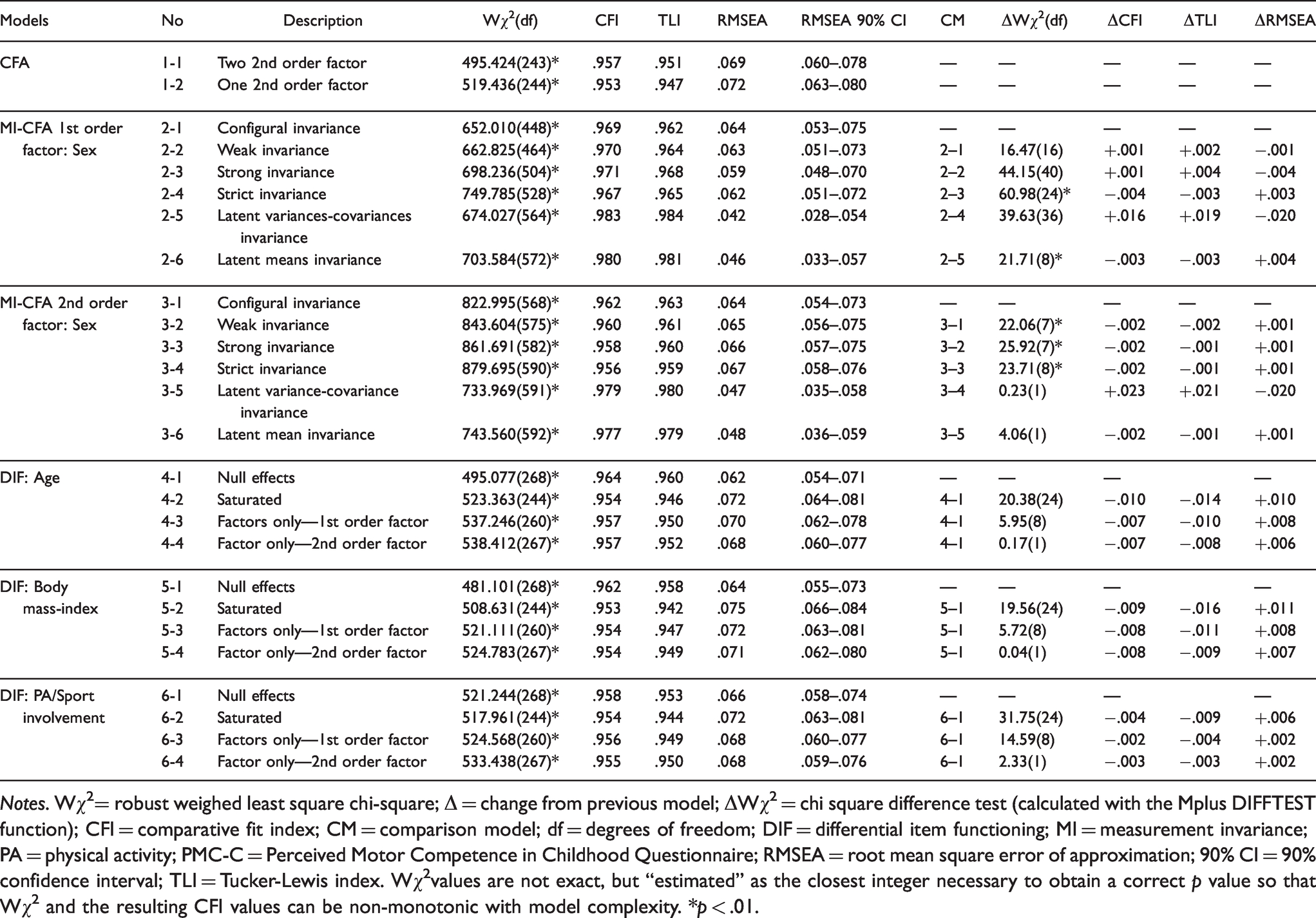
Notes. Wχ2= robust weighed least square chi-square; Δ = change from previous model; ΔWχ2 = chi square difference test (calculated with the Mplus DIFFTEST function); CFI = comparative fit index; CM = comparison model; df = degrees of freedom; DIF = differential item functioning; MI = measurement invariance; PA = physical activity; PMC-C = Perceived Motor Competence in Childhood Questionnaire; RMSEA = root mean square error of approximation; 90% CI = 90% confidence interval; TLI = Tucker-Lewis index. Wχ2values are not exact, but “estimated” as the closest integer necessary to obtain a correct p value so that Wχ2 and the resulting CFI values can be non-monotonic with model complexity. *p < .01.
Standardized Parameters Estimates from the One Second Order Factor CFA of the PMC-C.
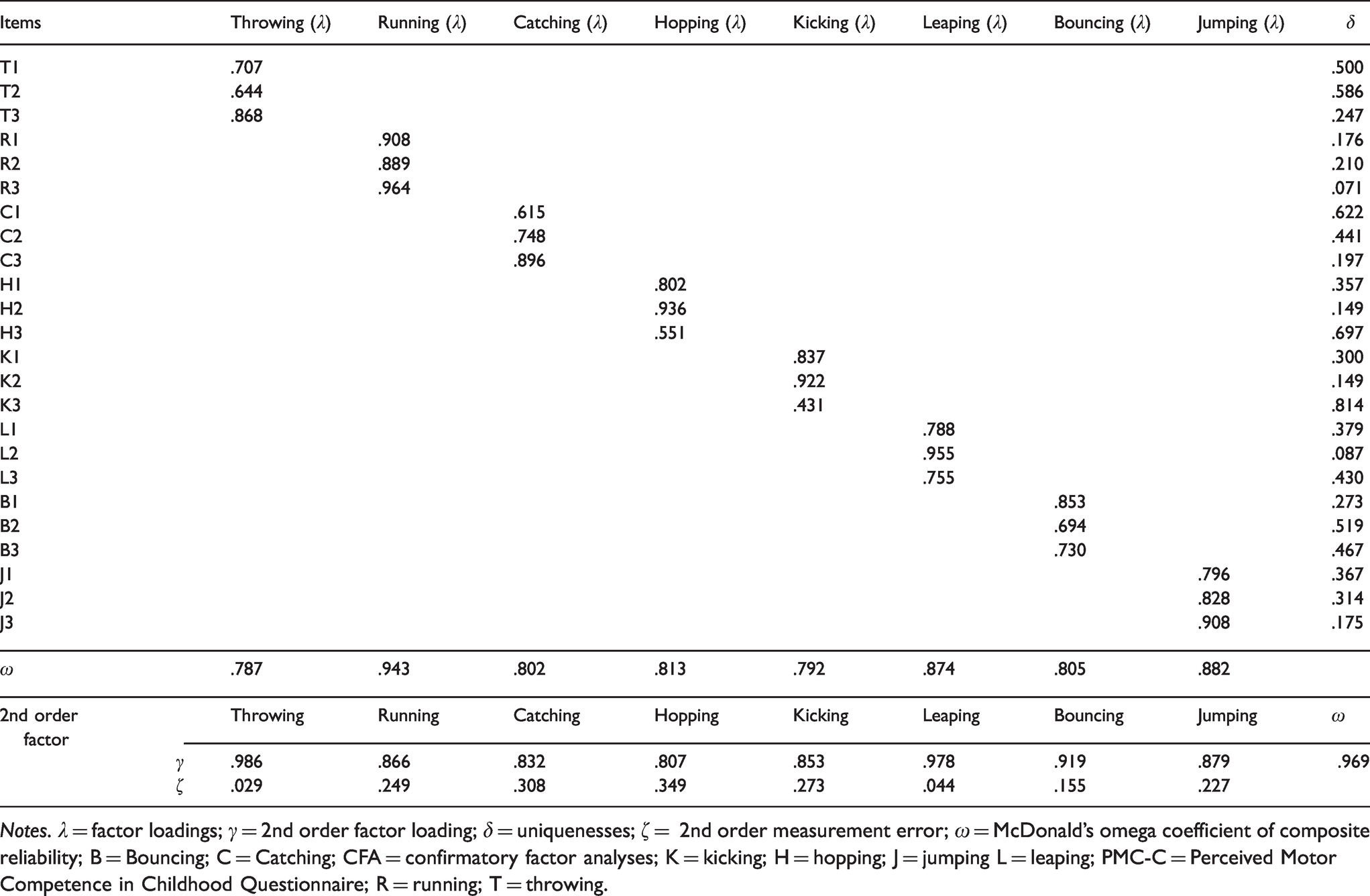
Notes. λ = factor loadings; γ = 2nd order factor loading; δ = uniquenesses; ζ = 2nd order measurement error; ω = McDonald’s omega coefficient of composite reliability; B = Bouncing; C = Catching; CFA = confirmatory factor analyses; K = kicking; H = hopping; J = jumping L = leaping; PMC-C = Perceived Motor Competence in Childhood Questionnaire; R = running; T = throwing.
Measurement Invariance and DIF
Measurement Invariance Across Sex
The goodness-of-fit statistics of measurement invariance of models are presented in the second and third sections of Table 1. These results supported the complete invariance (weak, strong, strict, variances/covariances, and latent means) of the first-order factor structure across sex (models 2-1 to 2-6). Furthermore, results also supported the complete invariance (weak, strong, strict, variances/covariances, and latent mean) of the second-order factor across sex (models 3-1 to 3-6). Given that sex differences in latent means were of substantive interest and that the ΔWχ2(df) difference was significant at this step, latent mean differences across sex were examined. Results showed that boys tended to have significantly higher latent means than girls in throwing (.666, p ≤.01), catching (.352, p ≤.05), kicking (.552, p ≤.01), and on the higher-order motor competence factor (.310, p ≤.05).
DIF Across Age, BMI and Physical Activity/Sport Involvement
The goodness-of-fit statistics of the MIMIC models estimated for all three predictors are reported in the bottom three sections of Table 1. These results showed that the saturated (models 4-2, 5-2, 6-2), first-order factor-only (models 4-3, 5-3, 6-3) and second-order factor-only (models 4-4, 5-4, 6-4) models did not result in a substantial improvement in model fit when compared to the null effects model (models 4-1, 5-1, 6-1). Thus, these results suggested a lack of DIF, and failed to support significant associations between BMI 1 or physical activity/sport involvement with responses on the PMC-C scales.
Discussion
This study sought to verify the psychometric properties (i.e., factor validity and reliability, measurement invariance and differential item functioning) of a newly developed French adaptation of the PMC-C among a sample of French-Canadian children. All analyses supported the a priori first-order factor structure of the PMC-C, systematically revealing eight well-defined and reliable factors reflecting running, jumping, hopping, leaping, throwing, catching, bouncing, and kicking. However, the analyses failed to support the presence of two well-differentiated second-order factors, rather suggesting that children’s responses to the PMC-C reflected a single (well-defined and reliable) higher-order motor competence factor.
Building upon limited prior knowledge regarding the assessment of children's perceptions of motor competence, this study was able to establish its first- and second- order measurement invariance as a function of sex, and we also reported a lack of DIF in PMC-C responses as a function of children’s age, BMI, and physical activity/sport involvement. Thus, these results indicate that observed and latent mean scores on any of the PMC-C factors can confidently be used to compare French-speaking children as a function of their age, BMI, involvement in physical activities and sports, and sex.
In addition, and supporting results previously reported by Dreiskämper et al. (2018), and others (e.g., Carcamo-Oyarzun et al., 2020; Clark et al., 2018; Estevan et al., 2018; Morano et al., 2020), boys presented slightly higher scores than girls on the throwing, catching, kicking, and global motor competence factor. Likewise, and also supporting previous results (e.g., Dreiskämper et al., 2018) there were no age-related differences on any of the PMC-C factors. Furthermore, there were no significant differences on any of the PMC-C factors in relation to children’s BMI, and involvement in physical activities and sports, generally contradicting previous research conducted with other types of measures (e.g., Carcamo-Oyarzunet al., 2020; Famelia et al., 2018). However, this lack of associations may be due in part to the limited number of children in this sample who were not involved in physical activities or sports outside of school, possibly resulting in a slight reduction in BMI variability among this sample. Nevertheless, because this is the first study to examine these latent mean differences in PMC-C factors, caution is required when generalizing these results, and further research will be needed.
Limitations and Directions for Future Research
Three main limitations should be considered when interpreting these results. First, we examined the psychometric properties of the French version of the PMC-C in a single sample of French-Canadian children, possibly limiting generalizability of these results to other French-speaking populations, or to other linguistic groups. More precisely, while we proposed no evidence of the cross-linguistic invariance of the French version of the PMC-C, it would be interesting to examine the measurement invariance of the French version of the PMC-C with (a) French-speaking samples of children from North-America (Canada), Europe (Belgium, France, Switzerland, Luxembourg) and North-Africa (Algeria, Morocco, Tunisia); and (b) other linguistic samples. Second, the present study did not examine the test-retest reliability and longitudinal invariance of the French version of the PMC-C. These psychometric properties should thus be more thoroughly examined in future research. Third, we proposed no evidence of the convergent validity of the French version of the PMC-C, meaning that additional research is needed to determine how this instrument relates to other questionnaires measuring perceived motor competence or movement skills, and to results from objective assessments of fundamental movement or motor skills.
Conclusion
In conclusion, the current study supported the psychometric properties (i.e., factor validity and reliability, measurement invariance and differential item functioning) of a newly developed French version of the PMC-C. This French version can be used to reliably and validly assess perceived motor competence in samples of French-speaking children with similar characteristics and in the context of group-based comparisons related to age, BMI, physical activity/sport involvement and sex. However, given the limitations of this study, the use of the French version of the PMC-C in cross-linguistic and longitudinal studies remains premature.
Supplemental Material
sj-pdf-1-pms-10.1177_00315125211000862 - Supplemental material for Psychometric Properties of a French Version of the Perceived Motor Competence in Childhood Questionnaire
Supplemental material, sj-pdf-1-pms-10.1177_00315125211000862 for Psychometric Properties of a French Version of the Perceived Motor Competence in Childhood Questionnaire by Christophe Maïano, Alexandre J. S. Morin, Johanne April, Maike Tietjens, Charlaine St-Jean, Cynthia Gagnon, Dennis Dreiskämper and Annie Aimé in Perceptual and Motor Skills
Footnotes
Declaration of Conflicting Interests
The author(s) declared no potential conflicts of interest with respect to the research, authorship, and/or publication of this article.
Funding
The author(s) received no financial support for the research, authorship, and/or publication of this article.

Supplemental material
Supplemental material for this article is available online.
Note
Notes
References
Supplementary Material
Please find the following supplemental material available below.
For Open Access articles published under a Creative Commons License, all supplemental material carries the same license as the article it is associated with.
For non-Open Access articles published, all supplemental material carries a non-exclusive license, and permission requests for re-use of supplemental material or any part of supplemental material shall be sent directly to the copyright owner as specified in the copyright notice associated with the article.
