



Abstract
Crop improvement plays an important role in enhancing yield potential and strengthening climate resilience in agricultural systems. Although adoption rates of hybrid maize varieties in Kenya are relatively high, the replacement of older varieties with newer ones remains below expectations. Varietal turnover is commonly used to assess the diffusion and impact of new generations of hybrid varieties at the national or regional level; however, little is known about variety replacement at the household level. This study explores maize variety use and replacement among 82 smallholder households in two Kenyan counties. Farmers were interviewed to document changes in their maize variety portfolios over three consecutive growing seasons, including both long and short rainy seasons, and to explore the reasons underlying these decisions. The results show that farmers in our study managed diverse and dynamic portfolios of local and hybrid maize varieties. Most farmers changed their maize portfolio between seasons, with many sowing a variety more or a variety less, and switching both from older to newer hybrid varieties and from newer to older ones. These findings indicate that farmers were not reluctant to switch varieties. Farmers’ decisions were driven primarily by trait preferences such as yield potential, early maturity, and drought tolerance, alongside experimentation and economic constraints related to fertiliser use. Overall, this study shows how a household-level perspective helps to understand variety use and replacement dynamics that are not captured by conventional varietal turnover studies.
Introduction
Maize variety development and use in Kenya
Since the 1960s, the development and dissemination of crop varieties have been central to governments and national and international agricultural research centres, to increase agricultural productivity (Evenson and Gollin, 2003). In Kenya, the first generation of hybrid maize varieties was released in the 1960s and 1970s (Gerhart, 1975; Harrison, 1970). Adoption of hybrid maize remained relatively stable in the following decades, with ∼69% of maize area planted with hybrids in 2009 (De Groote et al., 2015). The adoption of these hybrid maize varieties, together with agricultural practices such as soil fertility management and the use of agricultural inputs, contributed to a substantial increase in maize yields in those decades (De Groote and Omondi, 2023; Mathenge et al., 2014; Smale and Jayne, 2003). Over the last two decades, new challenges driven by climate change have led to a new generation of yield-enhanced, stress-resilient, and nutrient-rich hybrid maize varieties (Cairns and Prasanna, 2018; Ekpa et al., 2018; Prasanna et al., 2021; Walker and Alwang, 2015). Besides investments in crop breeding, efforts have been made to improve smallholder farmers’ access to seeds of these newer varieties (Donovan et al., 2021). In Kenya alone, more than 80 new hybrid maize varieties have been released in the period 1995–2015 with an average of 11–12 variety releases per annum (De Groote et al., 2015; Krishna et al., 2023). In addition, the Kenyan maize seed sector has seen a growing number of seed companies and an extensive agro-dealer network (De Groote et al., 2015; Smale and Olwande, 2014).
Despite the advances, maize yields in Kenya have hardly increased over the past two decades (De Groote and Omondi, 2023; Mathenge et al., 2014; Van Ittersum et al., 2016). Explanations for stagnating yields include climate stress, soil degradation, crop management practices, limited policy support (for a detailed account of these factors, see De Groote and Omondi, 2023; Tittonell and Giller, 2013), as well as the slow replacement of older hybrid maize varieties with newer ones (Atlin et al., 2017; Nagarajan et al., 2019). As a result, the frequently heard claim is that many farmers do not benefit from the genetic gains offered by recent breeding efforts (Cairns and Prasanna, 2018; Spielman and Smale, 2017; Walker and Alwang, 2015). This situation gives rise to the so-called ‘second-generation challenge’: that of older varieties to be replaced by newer ones (Khed et al., 2024; Rutsaert and Donovan, 2020). This challenge is reflected in low varietal turnover rates (Atlin et al., 2017; De Groote and Omondi, 2023; Nagarajan et al., 2019).
The slow adoption of the new generation of hybrid maize varieties in Kenya is influenced by both supply and demand-side factors (De Groote et al., 2025). Several studies indicate that, despite an increase in the number of seed companies in Kenya, the maize seed market remains highly concentrated among a small number of companies (Christinck et al., 2018). As a result, few dominant hybrid maize varieties, such as H614, released more than 40 years ago, continue to occupy a large market share, while the availability of seed of newer varieties remains limited (Hassan, 1998; Naseem et al., 2018; Smale and Olwande, 2014). On the demand side, studies suggest that farmers may be reluctant to use new hybrid maize varieties due to preferences for older varieties, risk aversion, or lack of information about the performance of newer ones (Naseem et al., 2018; Smale and Olwande, 2014; Voss et al., 2021). Nevertheless, there is also evidence suggesting that farmers regularly purchase seed of different hybrid maize varieties from agro-dealer shops (Rutsaert and Donovan, 2020).
The concept of varietal turnover
Varietal turnover is defined as the ‘replacement by farmers of an older variety with a more recently developed improved variety, a process that entails a genetic change’ (Spielman and Smale, 2017). Varietal turnover is an important measure of the impacts of plant breeding programmes (Brennan and Byerlee, 1991), and it has become a key priority for government and donor-funded breeding programs focused on sustaining yield gains under greater climate variability (Atlin et al., 2017). Accelerating varietal turnover is considered crucial to translate the genetic gains to on-farm productivity. The most used metrics to ‘measure’ varietal turnover are two proxies: average variety age (AVA) and the weighted average variety age (WAVA). The AVA represents the simple mean age – measured in years since release – of all hybrid varieties grown (Spielman and Smale, 2017), while the WAVA weights each hybrid variety's age by its share of the total cultivated area in a given region (Brennan and Byerlee, 1991). A WAVA below 10 years is considered to indicate rapid varietal turnover, while a WAVA approaching 20 years implies that recently released varieties are not competing well with older hybrids (Walker and Alwang, 2015). In Kenya, estimates of WAVA for hybrid maize varieties ranged from 10 to 19 years in the period between 2004 and 2021 (Chivasa et al., 2022; De Groote and Omondi, 2023; Naseem et al., 2018; Smale and Olwande, 2014), highlighting the persistence of older hybrid maize varieties in farmers’ fields despite the genetic gains made in breeding programs (Abate et al., 2017; Naseem et al., 2018; Smale and Olwande, 2014).
This study
Although national-level indicators such as AVA and WAVA are widely used to assess varietal turnover, these measurements provide limited insight into how farmers use and manage seed at the household level. They capture aggregate replacement patterns but obscure household dynamics, particularly seasonal decision-making, as well as differences between farmers related to farm size and gender. This study examines how smallholder farmers manage portfolios of maize varieties over three consecutive seasons. Using a mixed method approach, drawing on household-level data in two Kenyan counties, we analyse both the size and composition of farmers’ maize variety portfolios, the types of changes made between seasons, and their motivations underlying these decisions. In addition, we calculated the WAVA of the hybrid varieties being planted. We disaggregate our data by season, farm size and gender, as previous studies have shown that seasonal conditions and farmer characteristics are associated with differentiated seed choices (Almekinders et al., 2021; Kimanthi, 2019; Smale and Olwande, 2014). As a result, conclusions about ‘slow varietal turnover’ may reflect the structure of seed markets and input constraints as much as farmers' use of varieties. Rather than focusing solely on whether farmers adopt individual varieties, this study examines how smallholder farmers manage portfolios of maize varieties over three consecutive seasons. This study does not aim to provide nationally representative estimates of varietal turnover, but rather to explore household-level dynamics of variety use and replacement across consecutive seasons, providing a basis to reflect on maize variety use and varietal turnover in Kenya.
Materials and methods
Description of the study areas
This study was conducted in two Kenyan counties: Kakamega and Kirinyaga (Figure 1). The counties are major target areas for maize research and development projects led by the Kenya Agricultural and Livestock Research Organisation (KALRO) and the International Maize and Wheat Improvement (CIMMYT), reflecting the crop's importance for local households and the country. Farmers in both areas usually plant maize twice a year, mainly under rainfed conditions and often intercropped with beans and local vegetables (Table 1).

Map of the agro-ecological zones and study areas in Kenya.
Main characteristics of the study areas.

Data from 2018 (Ministry of Agriculture, 2018a).
Data from 2018 (Kenya National Bureau of Statistics, 2022).
Data from 2016 (World Food Program, 2016).
Data from the County Government of Kirinyaga (2018).
Data from Mugalavai et al. (2008).
Sampling strategy and data collection
An exploratory visit to both study areas was conducted in early April 2023, which included semi-structured interviews and focus group discussions with maize farmers. Insights from this visit informed the selection of study sites and the refinement of the research instrument. Later that month, the data collection team completed a four-day training on interview procedures and pre-tested the research instrument. Households taking part in the study were selected using a three-stage sampling approach that combined purposive and quota sampling. In the first stage, the two counties were purposively selected because of the importance of maize in local livelihoods. In the second stage, sub-counties and villages were purposively selected to ensure that the same portfolio of hybrid maize varieties was available to all farmers within each of the study areas, as required for a previously published study (Garcia-Medina et al., 2026). In May and June 2023, the four-person research team split into two groups, each moving in opposing directions along accessible roads and paths within the selected villages and stopping at each house on the route. One respondent was interviewed in each boma (extended family homestead) with selection based on sex and age to ensure diversity if more than one person was present. Interviews were conducted in Kiswahili, Luhya, Kikuyu and English, using a structured questionnaire. Each interview lasted ∼ 99 minutes and consisted of three sections. The first section registered individual, household demographics and farm characteristics. Through a participatory mapping exercise of each household's farmed maize plots, the second section collected information on varietal use, seed sourcing practices, and maize end uses for three consecutive growing seasons: the long rainy season 2022 (LRS 22), the short rainy season 2022 (SRS 22) and the long rainy season 2023 (LRS 23). The third section applied the means-end chains (MEC) method to explore farmer preference for seed and variety traits, following a protocol developed for and reported by Garcia-Medina et al. (2026).
All participants met the following conditions: (i) had grown maize in the last long-rainy season 2023 without irrigation, (ii) were actively involved in maize production and decision making, and (iii) had not received maize seed samples during the long-rainy season 2023.
Clarification of the main concepts used
The following terms and definitions are used throughout the next sections:
Seed lot: Seeds of a specific maize variety selected by a farmer and sown during a growing season; this term refers to a physical unit. Variety: Seed lots used by a farmer under the same name and considered a homogenous set; it is associated with a specific name. Type of variety: Classification of a variety as local or hybrid. We did not encounter improved open-pollinated maize varieties in our study areas, and all commercially sold seed was hybrid seed. Local maize variety: A maize variety identified by farmers as local and usually cultivated continuously over many years. Hybrid maize variety: A maize variety produced from the controlled crosses by a breeding program, and of which seeds are labelled and packaged in paper or plastic bags. Variety portfolio: The set of different maize varieties used by a household in a given season (regardless of the area).
Results
Participants characteristics and household's maize production and use
Of the 82 farmers participating in the study, 41 were women and 41 were men. Of these, 43 were from Kakamega and 39 from Kirinyaga. Table 2 summarises the characteristics of the 82 participants we interviewed at the moment of data collection in LRS 23. Women in our study were slightly younger than men but reported more years of experience managing maize plots. Men reported larger landholdings than women, although data were recorded at the household level. The average land area owned was slightly larger in Kakamega than in Kirinyaga. Maize occupied most of their cultivated land in both counties during the LRS 23. Two-thirds of the households cultivated, on average, up to half a hectare of maize (1.24 acres). Approximately a third cultivated between 0.51 and 1 hectare (1.25 and 2.47 acres), and only five farmers cultivated more than 1 hectare of maize (2.48 acres). A larger percentage of households in Kakamega reported agriculture as their main source of income than in Kirinyaga. More than 70% of the households in the study reported to have purchased maize in the form of grain or flour in the previous six months, regardless of the farm size.
Individual and HH characteristics of participants during the LRS of 2023 by study area, gender and farmer category.

HH: household; LRS 23: long rainy season 2023.
Categories based on the average maize area cultivated over the three rainy seasons: F1 = households with very small farms (≤ 0.5 ha); F2 = households with small farms (0.51–1.0 ha); and F3 = households with medium-size farms (≥1.1 ha).
Table 3 presents the maize production of the participating households over LRS 22, SRS 23 and LRS 23. Overall, the area cultivated with maize and the number of maize plots per household were similar in the two study areas and over the three growing seasons. Most interviewed households cultivated one or two maize plots, with an average of 1.4–1.6 plots per household. Across study areas and growing seasons, most maize plots were intercropped with beans or other crops.
Characteristics of maize production at the household level over three growing seasons.

LRS 22: long rainy season 2022; SRS 22: short rainy season 2022; LRS 23: long rainy season 2023.
Categories based on the average maize area cultivated over the three rainy seasons: F1 = households with very small farms (≤0.5 ha); F2 = households with small farms (0.51–1.0 ha); and F3 = households with medium-size farms (≥1.1 ha).
More than 80% of farmers reported using part of their maize production for household consumption, with a higher percentage doing so in the SRS 22 than in the LRS 22 (Supplemental Table A). In turn, fewer farmers reported selling part of their production in the SRS than in the LRS. Men, farmers in Kirinyaga, and those with larger farms (F3) mentioned using maize for fodder or silage more often than women, farmers in Kakamega, and those with smaller farms (F1), respectively. Households in Kakamega also used maize to pay school fees and support school feeding programs, while such uses were less common in Kirinyaga. In both counties, many households also donated maize to mosques and churches.
Use of local and hybrid maize varieties and seed sources
Collectively, farmers reported the use of seven local maize varieties and 39 hybrid maize varieties over the three studied growing seasons (Table 4). Farmers in Kakamega reported using more different maize varieties in total (23) than those in Kirinyaga (9), particularly for hybrid varieties (Supplemental Table B). Farmers did not always provide the full or exact names of the hybrid maize varieties they planted. Some appeared to confuse or forget the numerical codes associated with the variety names, while others referred to the seed company name rather than the specific variety. One participant recognised a variety as a hybrid but could not recall any part of its name. In Kakamega, 18 hybrid varieties were reported with complete and correct names, and 13 were recorded without complete or correct names. In Kirinyaga, the corresponding numbers were 7 and 7, respectively.
Number of local, hybrid and unespecified maize varieties mentioned by farmers as planted in each growing season in Kakamega and Kirinyaga, and Weighted Average Varietal Age (WAVA) of hyrbid varieties.

LRS 22: long rainy season 2022; SRS 22: short rainy season 2022; LRS 23: long rainy season 2023.
Using the National Variety list of the Kenya Plant Health Inspectorate Service (KEPHIS, 2023), we identified the year of release for each maize variety reported by farmers. Based on this list, the oldest hybrid maize variety used by farmers in Kakamega was H625, released 42 years prior to data collection, whereas the newest was H514, released 6 years earlier. In Kirinyaga, the oldest hybrid maize variety planted was Pioneer 3253, released 27 years prior to data collection, and the newest was Pannar 3M-05, released 5 years earlier. The WAVA ranged from 16.7 to 19.1 across counties and seasons, with an overall average of 18.1. WAVA values remained relatively stable across the three seasons, despite multiple changes observed in the variety portfolios of individual farmers. This indicates that older hybrid varieties continued to occupy a substantial share of cultivated area, with the WAVA being slightly lower in Kirinyaga than in Kakamega.
Based on the number of seed lots planted by farmers, the most planted variety in Kakamega was WH505 (released 20 years ago, 15%–20% of all seed lots), while in Kirinyaga it was Duma 43 (released 19 years ago, 39%–44% of all seed lots) (Figure 2). Two local maize varieties, Opapari in Kakamega and Makueni in Kirinyaga, were also popular, with the largest number of seed lots planted after the most planted hybrid maize variety in each county (13%–15% and 13%–23% of all seed lots, respectively).
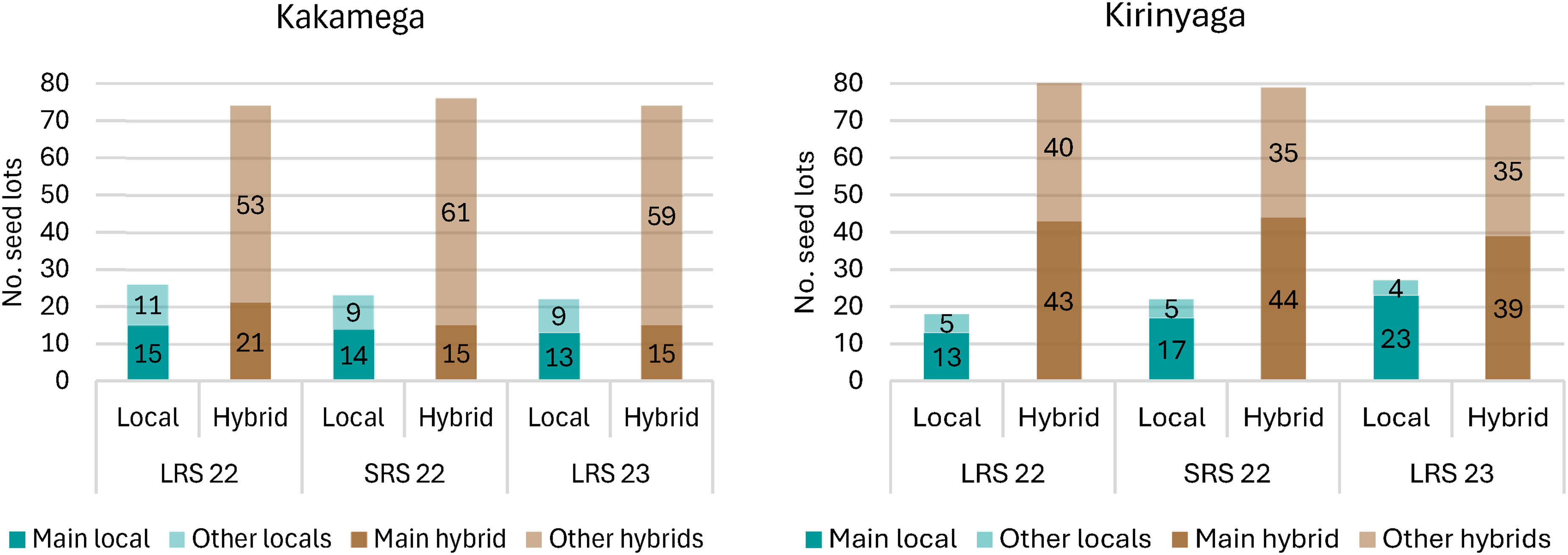
Number of local and hybrid maize seed lots planted by farmers in Kakamega (n = 43) and Kirinyaga (n = 39) in different growing seasons.
For all household categories, regardless of study area, gender, or farm size, the number of maize varieties per growing season was similar: households used more than two varieties per season (Table 3), with only one-quarter of the farmers planting a single variety. On average, the number of hybrid varieties used per household exceeds that of local varieties (Supplemental Table C). In Kirinyaga, farmers planted more seed lots of local varieties in LRS 23 than in LRS 22 (Figure 2). They cited drought resistance as a key reason for returning to local maize varieties. Overall, 71%–55% of all households used only hybrid maize varieties. The use of local and hybrid maize varieties differed between farmer groups and categories (Supplemental Table D). A substantial proportion of very small farmers (F1) in our study (20%) planted exclusively local varieties, whereas medium-sized farmers (F3) mostly planted hybrid maize varieties and reported using local maize varieties only in the LRS 23 (Figure 3).

Percentage of households in the three farmer categories (*) using local, hybrid, or both types of maize varieties in different growing seasons. *Categories based on the average maize area cultivated over the three rainy seasons: F1 = households with very small farms (≤0.5 ha); F2 = households with small farms (0.51–1.0 ha); and F3 = households with medium-size farms (≥1.1 ha).
Agrodealers were the primary source of seed, particularly for hybrid maize varieties, and this reliance was stronger in the short rainy season. For the long rainy seasons in Kakamega, farmers accessed hybrid seed from the NGOs One Acre Fund, Apollo Agriculture, the local government (through subsidy programs), and local retail shops (dukas). Seed of local varieties was mainly recycled from farmers’ own harvests, while purchase in local markets or exchange with other farmers only played a minor role in seed sourcing (Figure 4).

Total number of maize seed lots planted obtained from diverse seed sources in different growing seasons and study areas.
Maize variety portfolio dynamics and motivations to change
We analysed changes in farmers’ maize variety portfolios for two seasonal comparisons: the short and long rainy seasons of the same year, and two consecutive long rainy seasons. Based on the number of varieties (size of the portfolio) and the composition (type of variety), we defined four categories (Figure 5):
Change in size of the portfolio only: Households increased or decreased the number of varieties grown. When adding one, they kept the other varieties. When dropping one or more varieties, they kept at least one variety. Change in variety portfolio only (variety substitution): Households planted the same number of varieties but replaced one or more varieties with different ones. Change in both size and composition: Households simultaneously changed the number of varieties and the type of varieties grown. When dropping one or more varieties, they also changed one or more of the remaining. In addition to adding a variety, they also changed one or more of the other varieties. No change: Households maintained both the same number and the same type of varieties.

Percentage of households by maize variety portfolio change between growing seasons, by study area.
Overall, most households modified their maize variety portfolios in both seasonal comparisons (Figure 5). Between LRS 22 and SRS 22, 65% of households changed their portfolios, and this percentage increased to 72% between LRS 22 and LRS 23. The extent of portfolio modification varied by county and by seasonal comparison. In Kakamega, a large majority of households changed their portfolios in both seasonal comparisons: 78% between LRS 22 and SRS 22 and 80% between LRS 22 and LRS 23. In Kirinyaga, portfolio change was less frequent than in Kakamega, with 50% of households changing between LRS 22 and SRS 22 and 63% between LRS 22 and LRS 23. The nature of portfolio changes also differed between the two countries. In Kakamega, most changes involved switching maize varieties while keeping a similar portfolio size, with a larger percentage of households adjusting the size of their portfolio between LRS 22 and LRS 23. In Kirinyaga, fewer households switched varieties and modified their portfolio size at once.
Among the households that switched varieties (for both counties and each comparison, on average 41% of all households, see Figure 5), hybrid-to-hybrid turnover was the most common in both counties and in both seasonal comparisons. Around or < 10% of those farmers switched between local and hybrid varieties in either seasonal comparison, with a larger percentage of farmers switching from hybrid to local varieties in Kirinyaga between LRS 22 and LRS 23.
For the subset of households that kept same number of varieties and only switched type of varieties (24 households in the LRS 23 to SRS 22 comparison and 18 in the LRS 22 to LRS 23 comparison), and of which we had the full specification of the variety names, (KEPHIS, 2023) farmers switched from older to newer hybrid maize varieties as frequently as they switched from newer to older ones (Supplemental Table E).
We asked farmers for their motivations to switch maize varieties. Half of the farmers who changed at least one variety between LRS 22 and LRS 23 cited multiple reasons for doing so (Table 5). Overall, the most frequently cited motivations for changing varieties were variety trait-related (51%), particularly higher yield and early maturity or drought tolerance. Farmers in both counties reported multiple trait preferences, although higher yield was more frequently mentioned in Kakamega, while drought tolerance and early maturity were more commonly emphasised in Kirinyaga. Overall, a 15% of the farmers reported trying a different maize variety out of curiosity or for experimentation. Regarding access to seeds, 12% of participants reported changing varieties because their preferred variety was not available. In both study areas, around 10% of farmers mentioned crop rotation as a reason to change to another maize variety, and the same percentage cited economic constraints. Farmers explained that these constraints were less about the price of seed itself and more about their ability to afford fertiliser top-ups, which they considered necessary for hybrid maize varieties to perform effectively.
Percentage of households reporting reasons for changing a maize variety from LRS 22 to LRS 23 a .

LRS 22: long rainy season 2022; LRS 23: long rainy season 2023.
#Percentages refer to the share of farmers reporting each reason; totals exceed 100% because farmers (n = 37) could provide multiple responses, resulting in 87 responses.
When looking at the motivations of those who only switched between older and newer hybrids, there were no discernible differences, although the number of observations is small. Farmers who switched from newer to older varieties (n = 8) mentioned yield (4 times), seed availability (2 times), drought tolerance (2 times), agricultural practices and experimentation as reasons. Those who switched from older to newer varieties (n = 7), were mentioned yield (4 times), seed availability (1 time), early maturity (2 times) and specific trait preferences (e.g. grain characteristics).
Discussion
Diverse and dynamic maize portfolios
This study demonstrates that smallholder farmers in Kakamega and Kirinyaga managed diverse and dynamic maize variety portfolios. The presence of numerous hybrid varieties in farmers’ fields can be considered positive and suggests that farmers have multiple options. At the same time, we also observed the presence of very old hybrid varieties (released three and four decades ago) alongside the relative reliance on hybrids released two decades ago. These findings are consistent with earlier research documenting the dominance of a few older varieties in Kenya (Abate et al., 2017; De Groote et al., 2015; Rutsaert and Donovan, 2020; Smale and Olwande, 2014). Also, Rutsaert and Donovan (2020) observed that farmers change varieties relatively frequently, but their sample only included clients in agro-dealer shops. What our research adds to the literature is that, despite the presence of old varieties, farmers were very dynamic in their variety choices and did not stick to old hybrids alone. Farmers rarely relied on a single maize variety; instead, over 75% of the households planted more than two varieties per season, often combining hybrid and local varieties (22% of all households). The diversity of farmer's maize portfolios therefore reflects both multiple hybrid options and the continued use of local varieties, particularly among very small farmers.
These findings also have implications for how smallholder seed systems are often understood in relation to in situ conservation. Smallholder farmers are frequently portrayed as maintaining relatively stable mixtures of varieties over time through the recycling of seed, thereby conserving genetic diversity in situ. However, our results suggest another dynamic process. Rather than preserving varieties through recycling seed only, farmers actively adjust and reconfigure their maize portfolios across seasons, using seed from a range of different sources. As a result, farmers in the two counties cultivated a relatively broad pool of maize varieties, combining both local and hybrid varieties within their fields. These patterns suggest an integrated seed system in which local and commercial seed sources coexist, with continued recycling of seeds of local varieties for a relatively limited area. Further analysis is required to assess the value in terms of in-situ conservation and the potential of the seed system to respond to variability in input prices, disease incidence, or climatic shocks.
By comparing variety use in different seasons of individual households and then aggregating the (type of) changes, this study offers a view of the dynamics of household-level variety use and replacement that remains hidden when, what is usually done in adoption studies, individual household-level data are first aggregated and then compared. A high percentage of households changed their maize variety portfolios from one season to another. It is a minority that did stick to the same portfolio (35% and 28% for the two seasons' comparisons). Our results suggest that farmers in Kakamega engaged in more continuous and flexible experimentation with maize varieties, while farmers in Kirinyaga adjusted their portfolios more selectively, depending on the seasonal context. Most variety switching was between different hybrid maize varieties, both from older to newer varieties and from newer to older varieties, at similar rates. Farmers’ motivations to switch varieties were driven primarily by trait preferences and experimentation. Some farmers also cited limited availability of preferred varieties and economic constraints related to fertiliser costs, while seed price itself was mentioned only rarely. Taken together, these findings suggest that, in the study areas, the continued presence of older hybrid maize varieties in the seed system may reflect other factors than farmer reluctance to change (Smale and Olwande, 2014), which has been usually referred to as a major barrier to varietal turnover (Naseem et al., 2018). These can include the continued commercialisation of established varieties by seed companies (De Groote and Omondi, 2023).
The importance of the short rainy season for maize production
The results suggest that the short rainy season is not of secondary importance for maize production in our study areas: households planted similar land area, managed a comparable number of maize plots, and used a similar number of maize varieties in the SRS as in the LRSs. At the same time, we found differences in variety use between the long and the short rainy seasons, but without a clear pattern. Contrary to some studies in western Kenya that report a greater reliance on local varieties in the short rainy season (Almekinders et al., 2021; Smale and Olwinde, 2014), local varieties played an important role in our study areas in both seasons, particularly for farmers cultivating smaller areas. The fact that 78% of households in Kakamega and 50% of households in Kirinyaga modified their portfolios between LRS 22 and SRS 22 indicates that farmers treated the SRS as a distinct decision-making season, but not necessarily one requiring an entirely different portfolio of maize varieties. Overall, these findings suggest that farmers’ seasonal strategies are context-specific and mediated by local climatic conditions and household needs.
Rethinking varietal turnover measurements
Comparing the maize variety portfolios over three growing seasons highlights the limitations of aggregate indicators such as adoption rate and AVA for capturing the complexity of variety use and replacement. When data from household surveys are first aggregated, and then aggregated values are compared to show differences between seasons, years, regions or categories of farmers, the connection of what individual households do from season to season is lost. Using data on changes at the level of individual households offered a nuanced understanding of how and why farmers switched to other maize varieties. Although many policy and breeding strategies rely primarily on aggregate adoption studies at the regional or national level, incorporating evidence of household-level dynamics can provide an additional dimension for evaluating the efforts of crop breeding and seed systems development. If the goal is to accelerate meaningful genetic gain – defined not only by aggregated replacement of varieties but also by fitting farmers seasonal and household and needs – the use of complementary measurements may be necessary.
Conclusion
This study examined maize variety use and replacement at the household level over three consecutive growing seasons in two Kenyan counties. Contrary to interpretations of slow varietal turnover as evidence of farmer reluctance to use new maize varieties, our findings show that smallholder farmers in the two study counties actively experimented with and adjusted their maize variety portfolios in response to their needs, preferences and climate conditions. While this study is exploratory and findings cannot be labelled as representative, it provides insights into household-level dynamics that are not captured by aggregate indicators and challenges the assumption, often implicit in varietal turnover metrics, that farmers either ‘adopt’ or ‘do not adopt’ new varieties.
While adoption studies provide a snapshot of the landscape and often suggest stagnation in varietal turnover, our household-level perspective shows a diverse and dynamic use of maize varieties. Disaggregation of data on household-level changes based on seasons and farm size further helped to understand these dynamics. The results indicate that farmers in the two counties experimented with new varieties, when possible, but also retained or returned to older varieties when these better fit their agronomic conditions, input constraints, and household objectives. The performance of newer varieties was not always perceived as sufficiently superior to justify full replacement, and older varieties may continue to provide valued traits suited to long and short rainy seasons, mixed cropping systems, fodder needs, and household food security. Consequently, newer hybrid maize varieties form part of farmers’ portfolios but do not necessarily displace existing varieties.
While the study only looks at a relatively small number of households in two counties, and representativeness is thus limited, there are also no reasons to believe that the findings are unique. Our study shows how taking a household-perspective on changes in variety use is useful to understand the world behind adoption studies: it highlights the limitations of commonly used aggregate indicators – such as adoption rates and average variety age – for understanding farmers’ behaviour and motivations underlying their variety use and replacement. A more nuanced assessment of varietal turnover requires attention to seasonal dynamics, trait preferences, and the broader production context in which farmers make seed decisions.
Supplemental Material
sj-docx-1-oag-10.1177_00307270261451432 - Supplemental material for Slow varietal turnover or overlooked dynamics at the household level? A study of smallholder maize farmers in Kenya
Supplemental material, sj-docx-1-oag-10.1177_00307270261451432 for Slow varietal turnover or overlooked dynamics at the household level? A study of smallholder maize farmers in Kenya by Mariana Garcia-Medina and Conny JM Almekinders in Outlook on Agriculture
Footnotes
Acknowledgements
The authors extend their thanks to the project funders, research participants, and colleagues from CIMMYT Nairobi who contributed with ideas and feedback on the study design. Special acknowledgements go to Gorrety Achieng, Veronica Gichohi and Sheillah Ajiambo, who provided valuable support with data collection and insight into the research context. Thanks are also due to Jinghan Li, from Wageningen University, for guidance with the analysis and to Ana Leite from the Norwegian University of Life Sciences for producing the location map used in this article. The authors also thank the Editor and the two anonymous reviewers for their valuable feedback.

Ethical approval and informed consent statement
Ethics approvals were attained at the CIMMYT level, at the country level through the Jomo Kenyatta University of Agriculture and Technology (JKUAT), and via the International Livestock Research Institute (ILRI) Institutional Research Ethics Committee. COVID-19 precautions were adopted throughout. Before the interviews, the goals of the study and steps of the interview were explained to participants, who were then asked if they were available and willing to participate. Verbal informed consent was provided by all participants included in the study. To safeguard the right of the respondent, the consent statement made clear that the respondent had the right to stop the interview at any stage, request the data to be expunged, and they did not have to explain the reason for ending the interview. At the end of the interview, participants were modestly compensated for their time.
Author contributions
Mariana Garcia-Medina: conceptualisation, methodology, investigation, data curation, formal analysis, visualisation, writing–original draft, supervision, and project administration; Conny Almekinders: conceptualisation, methodology, investigation, writing–review and editing, and visualisation.
Funding
The authors disclosed receipt of the following financial support for the research, authorship, and/or publication of this article: This study was carried out in the framework of the Accelerating Genetic Gains project, which is supported by the Bill and Melinda Gates Foundation (grant numbers INV-003439 and INV-018951) and CGIAR Initiative Seed Equal. The first author was supported by the Mexican Consejo Nacional de Ciencia y Tecnología (CONACYT) through a doctoral scholarship. The second author was supported by the NL-CGIAR SEP II program. The contents and opinions expressed in this paper are those of the authors and do not necessarily reflect the views of their associated and supporting institutions.
Declaration of conflicting interests
The authors declared no potential conflicts of interest with respect to the research, authorship, and/or publication of this article.
Data availability statement
Data available on request.
Supplemental material
Supplemental material for this article is available online.
References
Supplementary Material
Please find the following supplemental material available below.
For Open Access articles published under a Creative Commons License, all supplemental material carries the same license as the article it is associated with.
For non-Open Access articles published, all supplemental material carries a non-exclusive license, and permission requests for re-use of supplemental material or any part of supplemental material shall be sent directly to the copyright owner as specified in the copyright notice associated with the article.
