




Abstract
In this perspective, we unpack how carbon farming is presented in current European Union (EU) policies. Specifically, we examine three EU frameworks: the European Green Deal, the Common Agricultural Policy (CAP) and the Carbon Removals and Carbon Farming (CRCF) regulation, assessing their claims related to carbon farming on arable land. Key problematic tensions emerge. The European green deal sets broad expectations of carbon removals but the role of carbon farming is undefined. In the CRCF, market-based incentives and their resulting economic benefits take centre stage, but the policy remains silent on the end-use of carbon removal and carbon reduction credits. This omission risks turning a formal separation of removals and reductions into a practical equivalence, exacerbating the risk of mitigation deterrence (i.e. the delay of essential emission cuts). Meanwhile, the CAP employs broad indicators without explicitly measuring soil carbon sequestration, creating ambiguity about the real mitigation impact. We argue that underpinning these tensions is a tendency to simplify soil processes and narrow them into measurable units, ignoring important uncertainties, and creating an illusion of control and progress. In doing so, policies risk becoming a form of symbolic reassurance, appearing effective while stalling further meaningful action and missing opportunities to link carbon farming with broader environmental goals and ensure the sustained adoption of farming practices.
Keywords
Introduction
A single sentence in the latest Intergovernmental Panel on Climate Change (IPCC) report strikes powerfully: ‘the deployment of carbon dioxide removal (CDR) to counterbalance hard-to-abate residual emissions is unavoidable if net-zero emissions are to be achieved’ (Pathak et al., 2022). With this declaration, the IPCC shifted the grounds of the CDR debate (Carbon Market Watch, 2024; Grundmann, 2023). Now, the question is no longer if CDR is justified, but rather how, how much, and how rapidly society should deploy these technologies. This invites an evaluation of how CDR strategies are articulated and embedded within current policy frameworks.
Agricultural soil carbon sequestration (SCS) 1 is recognised within climate policy as an attractive form of carbon removal, appealing due to its perceived co-benefits for soil fertility, biodiversity, and farmer livelihoods. Within the European Union (EU), the concept of carbon farming has emerged as a preferred term to describe the adoption of practices aimed explicitly at enhancing soil carbon stocks (European Commission, 2025b). Carbon farming has gained prominence in recent EU legislative and policy developments such as the EU Green Deal, the inclusion of Specific Objective 4 within the Common Agricultural Policy (CAP) 2023–2027 and the Carbon Removal and Carbon Farming (CRCF) regulation.
Farmers are increasingly expected to ensure not only Europe's food security but also to deliver high-quality, nutritious produce, conserve biodiversity, regenerate degraded soils, restore ecosystems, and actively reduce greenhouse gas emissions. Since not all of these objectives can always be achieved (or maximised) simultaneously on the same land, farmers are forced to navigate trade-offs between competing environmental and production goals (Meuwissen et al., 2020). These demands influence how SCS is perceived and operationalised, shaping farmers’ willingness, capacity, and motivation to engage with carbon farming.
Understanding how agricultural SCS is presented in current policies reveals what policymakers expect and how they plan to act. For example, presenting SCS as a measurable, market-based solution emphasises its perceived reliability, economic appeal, and compatibility with emerging carbon markets. In contrast, focusing on uncertainties or ecological variability might lead to more cautious policies. Therefore, analysing how agricultural SCS is presented in EU policies can uncover implicit assumptions about how practical, credible, and achievable policymakers think these strategies are, influencing how farmers will perceive and respond to them (Gonzalez Lago et al., 2019).
Here, we offer an agronomy-informed perspective that interrogates key policy claims about carbon farming in EU instruments and develops a set of arguments about their plausibility and consequences for arable systems. Following, we identify risks, opportunities and derive related recommendations.
Our main scope is agricultural land with emphasis on arable cropping systems. We focus on claims directly relatable to carbon farming (i.e. measures, incentives and certification rules that aim to increase or account for soil-carbon outcomes) or its applicability in the broader climate change mitigation debate. For this purpose, we examined primary EU texts (regulations, impact assessments and delegated acts where available), Member State CAP Strategic Plans, Commission guides and evaluations, and other institutional grey literature (e.g. JRC, EEA, ECA, NGO and think-tank reports). Illustrative examples and quotations are extracted from these sources to evaluate claims and show concrete implications.
Our reading was guided by three lines of inquiry: (1) what does each policy claim to achieve and through what mechanism, (2) how are these claims translated into practice through rules, eligibility, and measurement systems, and (3) what are the consequences or openings these designs create for credible and effective action.
Three EU policy frameworks collectively define the entire pathway from climate targets to farm-level implementation and accounting. These three instruments, by establishing targets, funding mechanisms, eligibility rules, and certification criteria, directly influence how carbon farming is understood, supported, and reported. Their combined impact makes them essential for evaluating the agronomic realism and practical credibility of carbon farming policies. The recently approved Soil Monitoring Law will soon provide additional support to this policy architecture; of which we examine:
The European Green Deal: General frame that shapes expectations for land-based removals within EU climate targets, we focus on the Climate law and the Land Use, Land Use change and Forestry (LULUCF) regulation. CAP: central to farm-level implementation and reporting, its where carbon farming is made operational. CRCF regulation: sets quality and sustainability criteria that determine what ‘counts’ and on what terms to credit carbon farming.
Carbon farming in EU policies
To understand how carbon farming is operationalised, it is essential to consider the distinct but interconnected roles of the main EU policy instruments that shape it. The European Green Deal, including the European Climate Law and the LULUCF Regulation, defines long-term climate ambitions and binding targets for greenhouse gas reductions and removals, guiding the broader trajectory of EU climate governance. The CAP provides the principal mechanism for delivering public payments to farmers and includes a variety of agronomic practices that emphasise climate mitigation and SCS. Meanwhile, the newly adopted CRCF introduces a novel legal basis for certifying soil and land-based removals credits. Although these instruments share some overlapping goals (e.g. upscaling carbon farming) they rely on different instruments, incentives, and timelines. In the following sections, these three policy pillars are analysed in relation to how they frame and operationalise agricultural SCS. Particular attention is given to the CRCF, as it is the only policy where carbon farming is a central focus. In contrast, the CAP and Green Deal address soil carbon more indirectly.
The European Green Deal and climate neutrality
The European Green Deal outlines a comprehensive vision for EU climate policy, designed to align Europe's climate action with the commitments established by the Paris Agreement. It encompasses several legislative instruments, among which the LULUCF regulation is particularly relevant for its focus on agricultural and land-based carbon sinks. An important piece of legislation inside the Green Deal is The European Climate Law, which sets the ambitious goal of achieving climate neutrality by 2050. However, this law remains unclear regarding the specific roles and expectations for CDR, beyond a general call to enhance natural carbon sinks.
Europe's primary natural carbon sink is currently represented by the LULUCF sector, with an estimated capture capacity of 236 Mt CO₂eq/yr in 2022 (EEA, 2024). The EU has recently introduced binding targets for Member States in the LULUCF Regulation, aiming at a collective increase of this capture capacity to 310 Mt CO₂eq/yr by 2030 (Regulation EU 2018/841). Forest management (afforestation, reforestation and conservation) and peatland restoration are often identified as the largest potential contributors towards achieving these targets (Verkerk et al., 2022). Yet recent trends indicate a declining capture capacity of these natural sinks across Europe (Korosuo et al., 2023), raising doubts on the feasibility of meeting the target (Verkerk et al., 2022).
The LULUCF Regulation offers little detail on operationalising the target, particularly with regard to agriculture's role. Agricultural SCS and carbon farming are not explicitly mentioned, leaving Member States responsible for devising specific strategies and practices. Long-term strategies in the Member State's plans mention interventions such as reduced tillage, increased soil carbon content, agroforestry, grassland restoration, and wider crop rotations. However, the inferred meaning and emphasis on these practices varies considerably across Member States (Di Lallo et al., 2024).
Carbon farming in the CAP
The CAP is the EU's primary policy instrument to support agriculture, aiming to maintain farm incomes, food security, and promote sustainability across Member States (see Box 1). With over seven million beneficiaries across the EU, CAP-subsidies represent the prevailing model of agricultural support (European Commission, 2025a). As a result, the standards embedded within the CAP exert a significant influence on how farming is structured and practised throughout the continent.
The CAP outlines nine specific objectives, covering economic, social, and environmental dimensions. Crucially, one of these objectives explicitly addresses SCS, namely Specific objective 4; ‘to contribute to climate change mitigation and adaptation, including by reducing greenhouse gas emissions and enhancing carbon sequestration’ (European Commission, 2019).
Summary of CAP structure and relevant connections to carbon farming.
Established in 1962, the CAP was one of the first common policies and remains a central pillar of EU integration (Giuliani and Baron, 2025). Roughly one-quarter of the EU budget is allocated to the CAP, primarily to fund farm subsidies and support rural development (European Commission, 2024). Over time, the CAP has undergone successive reforms: while early support was tied to agricultural output, payments since the ‘Fischler Reform’ of 2003 are decoupled from production and instead are allocated on the basis of the holdings’ land area, and depend on compliance with defined environmental, animal welfare and agronomic standards (Giuliani and Baron, 2025). The latest reform (2023–2027) introduces a new delivery model (less centralised), where the EU sets overarching objectives, while Member States programme tailored national CAP Strategic Plans detailing how these objectives will be met. These plans are subject to European Commission approval.
To achieve its objectives, the CAP uses a structured approach composed of an overarching conditionality principle and two main pillars:
Conditionality principle: Applies to all farmers receiving CAP direct payments. Farmers must adhere to certain mandatory Good Agricultural and Environmental Conditions (GAECs). Relevant GAECs for carbon farming include:
Maintenance of permanent grasslands (GAEC 1) Protection of wetlands and peatlands (GAEC 2) Minimum soil cover (GAEC 6) Crop rotation or diversification (GAEC 7) Protection of environmentally sensitive grasslands (GAEC 9)
Pillar I (Direct Payments to farmers including Eco-schemes, and market measures): Provides annual financial support to farmers, market intervention tools and trade promotion measures to stabilise agricultural markets. A key innovation in the current CAP period is the inclusion of eco-schemes which replace the previous mandatory ‘greening’ measures. Echo-schemes are voluntary measures offering additional payments for practices deemed beneficial for climate, biodiversity, or animal welfare. However, eco-schemes vary significantly in ambition and included practices across Member States.
Pillar II (Rural Development Measures): Finances measures to improve the competitiveness of agriculture and forestry, promote sustainable resource management, and foster balanced territorial development in rural areas, including multi-year voluntary interventions called Agri-Environment-Climate Measures. These interventions encourage more ambitious environmental commitments such as agroforestry, organic farming, or peatland restoration, usually involving more substantial and lasting environmental benefits.
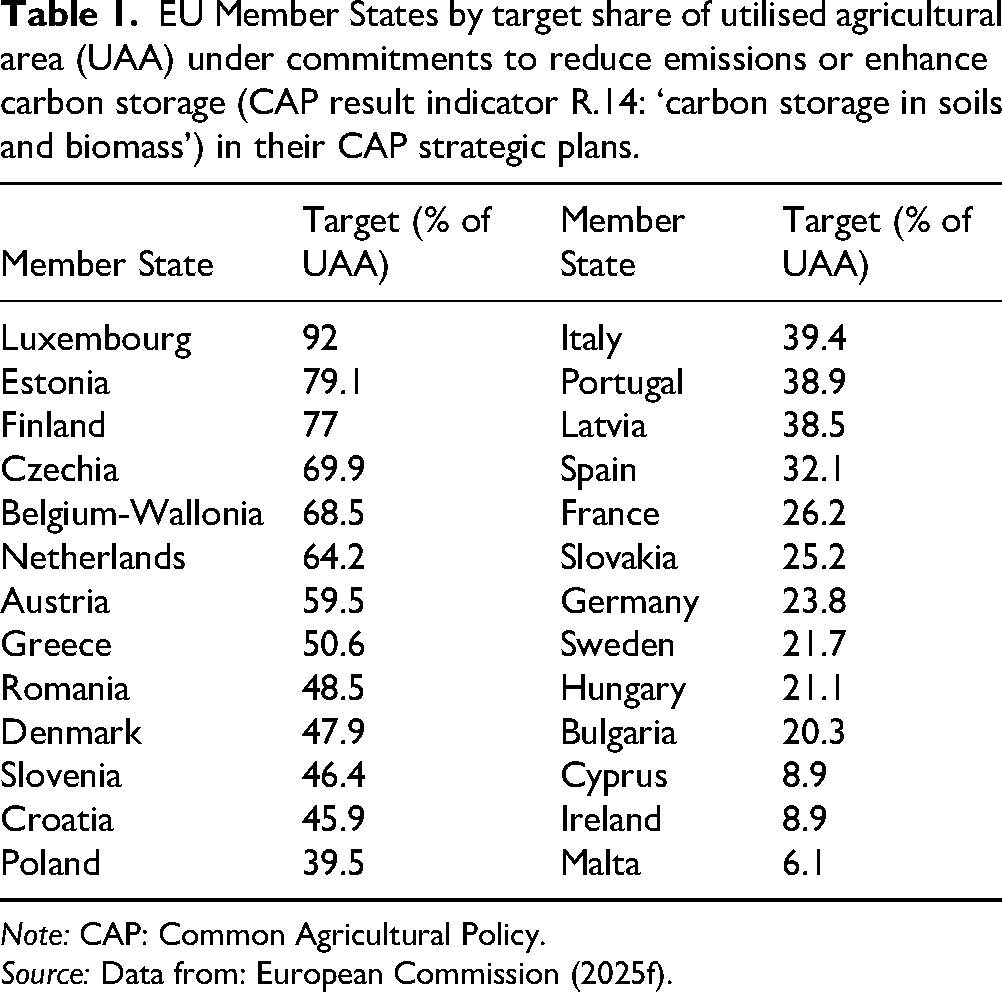
Carbon farming practices aimed at fulfilling the CAP's climate objective are monitored through a specific result indicator (namely, indicator R.14). This indicator tracks the share of agricultural land receiving subsidies that are justifiably linked to ‘carbon storage in soils and biomass’ in Member State strategic plans (European Commission, 2025d). Each Member State has set a target for the share of agricultural land receiving such subsidies, to be achieved after the CAP transition period. Targets vary widely across countries (Table 1). However, these targets do not necessarily reflect how committed a Member State is to use the CAP as a climate change mitigation tool. As highlighted in an EU Parliament report (Münch et al., 2023), the strategic plans vary considerably in how many of their interventions are explicitly linked to climate objectives. Some countries set high R.14 targets but allocate relatively few interventions to climate-related outcomes. This suggests that R.14 commitments alone are not a reliable proxy of climate mitigation ambition in CAP implementation across Member States.
EU Member States by target share of utilised agricultural area (UAA) under commitments to reduce emissions or enhance carbon storage (CAP result indicator R.14: ‘carbon storage in soils and biomass’) in their CAP strategic plans.
Note: CAP: Common Agricultural Policy.
Source: Data from: European Commission (2025f).
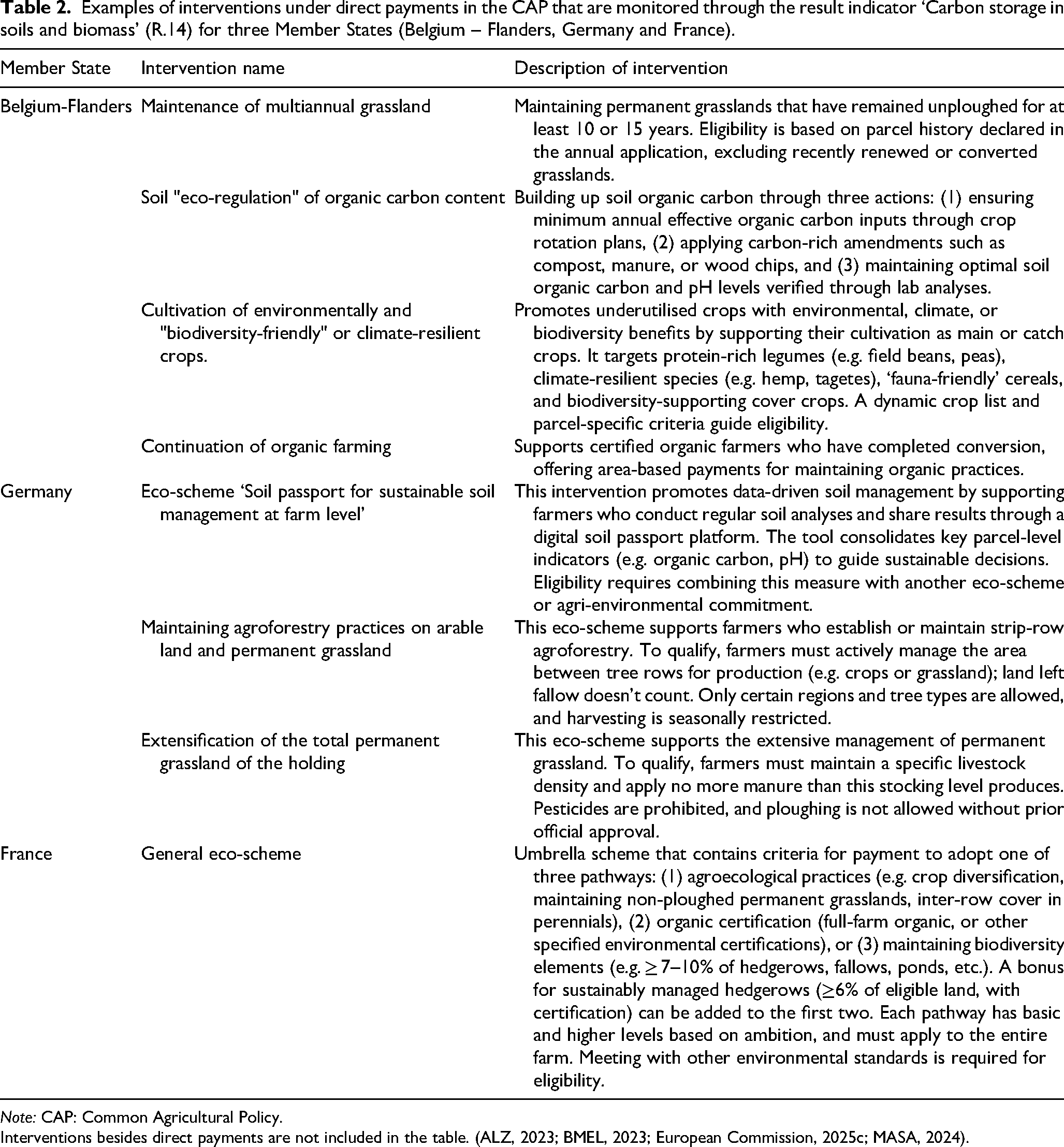
A central challenge in the depiction of carbon farming under the CAP lies in the lack of clear definitions and quantified climate targets. As noted in a recent report (European Court of Auditors, 2024), result indicators measure the area under commitments broadly associated with carbon storage, but not the effectiveness of those practices. This ambiguity gives Member States wide discretion in interpreting what qualifies as climate-relevant. Some interventions, like permanent grassland maintenance or agroforestry, have clearer links to SCS. Others, such as promoting protein crops or digital soil tools, rely on more indirect justifications (Table 2). While interventions are framed as contributing to the climate objective, their actual impact on mitigation varies, reflecting a broader issue: the CAP's design allows the inclusion of diverse measures under a shared indicator, without ensuring their comparability or quantifiable impacts.
Examples of interventions under direct payments in the CAP that are monitored through the result indicator ‘Carbon storage in soils and biomass’ (R.14) for three Member States (Belgium – Flanders, Germany and France).
Note: CAP: Common Agricultural Policy.
Interventions besides direct payments are not included in the table. (ALZ, 2023; BMEL, 2023; European Commission, 2025c; MASA, 2024).
The carbon removal and carbon farming regulation
The CRCF is a legislative initiative by the European Union (Regulation EU 2024/3012) designed to establish a clear and consistent EU-wide standard for certifying carbon removal activities. The primary purpose of the CRCF is to create a framework that addresses existing limitations and uncertainties in voluntary carbon markets. This is done by setting criteria for carbon removal and emission reduction activities, defining rules for verification and certification processes, and outlining the standards for certification schemes. The framework targets three categories of carbon removal activities: carbon farming, permanent carbon removal technologies, and carbon storage in durable products. Among these, carbon farming includes practices aimed at enhancing carbon sequestration in soils and biomass, as well as activities designed to reduce soil-related emissions, such as peatland rewetting and optimised fertiliser application. Activities must be maintained for a minimum duration of five years to qualify for certification.
The CRCF outlines four main verification and certification criteria – quantification, additionality, long-term storage, and sustainability – to ensure the reliability of certified activities. Certified removals must deliver a measurable net benefit by clearly exceeding established baselines or statutory requirements. However, specific methodologies and detailed quantification standards are not included in the CRCF itself; these will be developed through delegated acts by the European Commission. Certification processes will involve accredited certification bodies conducting independent audits aimed to ensure accountability, adherence, and compliance with the certification framework. Certified units, audits and certificates of compliance will be publicly accessible through a unified EU registry. The CRCF provides the foundational legal structure, while specific methods and detailed rules will follow in later stages through delegated acts involving Member States and the European Commission.
From the readings of the CRCF three important claims are attributed to carbon farming: (1) as a promising climate mitigation solution; (2) as a market-oriented approach with economic opportunities; (3) as a credible and robust mitigation tool. We take a closer look at each of these claims and its arguments below.
As a promising climate mitigation solution
The CRCF explicitly claims that carbon farming is a promising climate mitigation strategy essential to achieving climate neutrality. Within this policy, carbon farming is clearly presented as beneficial, feasible, and critical for reaching the EU's climate goals. The CRCF describes carbon farming as having ‘strong potential to deliver win-win solutions for sustainability’, emphasising its capacity to simultaneously address climate change and improve ecological conditions, despite acknowledging that some trade-offs may exist (EU Regulation 2024/3012). For example, investments under the CRCF may not benefit soils with most ecological needs for carbon increases, as those soils often do not have the largest sequestration potential (Moinet et al., 2023). In contrast, biomass might be diverted to soils with higher sequestration potential but fewer ecological benefits. The positive framing of the CRCF aligns with observations from Jaschke and Biermann (2022), who notes that SCS policies commonly highlight win-wins, emphasising aspects such as enhanced biodiversity and improved soil health, which contrasts significantly with other carbon removal technologies presented as riskier or less beneficial.
As a market-oriented approach with economic opportunities
The CRCF positions carbon farming as a market-oriented approach, emphasising economic opportunities through certification schemes that make carbon farming financially attractive to farmers and land managers. This aligns with broader EU policy language in the European Green Deal, where economic growth and environmental sustainability are harmoniously integrated (Eckert and Kovalevska, 2021). By relying heavily on certification, market incentives, and quantifiable carbon accounting methods, the CRCF clearly aligns with business-oriented sustainability narratives, framing carbon farming as economically viable and attractive for widespread adoption (Boettcher et al., 2023).
As a credible and robust mitigation tool
Finally, the CRCF emphasises the scientific credibility and technical robustness that links carbon farming and SCS. It underlines the importance of transparent and rigorous quantification, supported by expert-driven methodologies. By establishing clear quality criteria and measurement standards, the CRCF aims to foster trust and legitimacy, presenting carbon farming as not only environmentally beneficial and economically promising but also scientifically sound and reliable (EU Regulation 2024/3012). Thus, the policy carefully constructs an image of carbon farming that combines pragmatic optimism with little acknowledgement of potential uncertainties and complexities.
Risks and opportunities
Carbon farming carries daunting expectations; to deliver major CDRs, while maintaining or increasing crop productivity, improving soil functions, creating business opportunities for farmers, and providing reliable offsets for industries. It is portrayed as a win-win solution, a tool whose outcomes can be easily, affordably, and robustly measured and monitored. But in chasing every promise that carbon farming can deliver, policy may fall short, delivering the pledge rather than the deed. When policy feels accountable and trusts that progress is on track, momentum for further action slows. This is what we call symbolic reassurance, the first of two risks discussed in the next section. It underpins the risk of mitigation deterrence and the missed opportunities to broaden environmental goals and secure sustained adoption of farming practices.
Symbolic reassurance
Policies portray carbon farming outcomes as credible, based on claims of robust measurement, monitoring, and certification. But what are the assumptions behind these assurances, and what do they obscure? The question can be posed if these approaches track meaningful outcomes, or simply convey an appearance of accountability. We argue that simplified understandings of soil processes, coupled with the reliance on proxy metrics, can downplay uncertainties. This can lead to ‘symbolic reassurance’; the illusion that sufficient measures are already underway, which discourages further action.
Soil organic carbon is in constant motion; its fluxes are a reflection of interacting biological, chemical, and physical processes influenced by soil types, climate, and management history (Gelardi et al., 2023; Ingram et al., 2025). However, carbon farming polices often assume that a specific management shift (e.g. adopting no-till) results in an easily quantified change of soil organic carbon, which can be claimed as carbon sequestration (or a certified removal). This oversimplification hides how soil processes interact in complex ecosystems (Kosoy and Corbera, 2010). The urge to simplify is understandable: discrete, measurable units are desired in reporting and verification protocols. Yet, reducing complexity carries many risks: it obscures uncertainties, flattens differences across contexts, and overlooks trade-offs that occur beyond what is measured. For example, a practice like reduced tillage may or may not increase soil carbon stocks, depending on local conditions such as soil type and climate (Bai et al., 2019). Whether such changes are accurately captured also depends on where, how, and how often measurements are taken. Any leakage effects or trade-offs; such as greater weed pressure, lower yields or higher pesticide use (Cooper et al., 2016), fall well outside what these metrics capture. We must admit that simplification is a necessary evil, in both science and policy, to manage and understand complex ecosystems. The greater concern lies in how these simplified processes are portrayed and acknowledged, whether their limitations are recognised to better navigate uncertainty, or set aside in favour of a cleaner, more reassuring story.
There is an evident tension in how academic literature and policy texts portray the quantification and reporting of soil carbon changes. While uncertainties in quantifying soil carbon changes are widely discussed in the academic literature (Gelardi et al., 2023; Paul et al., 2023), they often vanish in the texts of policy documents. In the CRCF, we are promised ‘robust Measurement, Reporting, and Verification (MRV) approaches’ that are ‘relevant, conservative, accurate, complete, consistent, transparent and comparable’ (CRCF: Regulation EU 2021/1119). Similar language would be hard to find in academic literature.
Monitoring soil carbon for national inventories, CAP indicators, or credit-grade certification under the CRCF serves very different purposes and each carries distinct uncertainties. At the farm scale, uncertainties are significant, stemming from sampling design, analytical methods, and substantial spatial variation within and between fields (Goidts et al., 2009; Smith, 2004). Detecting meaningful changes requires repeated measurements over long periods, which dramatically increases the cost and feasibility of credit-grade verification. Aggregation at larger scales, as in national inventories, can greatly reduce random variation, but it may mask local dynamics and introduce uncertainties from model assumptions or incomplete data (Ogle et al., 2010). Despite this, most monitoring approaches do not explicitly quantify or communicate their uncertainty (Goidts et al., 2009), indicating a problematic confidence on their outputs.
Confidence in measured outcomes extends to the indicators used to show progress toward policy targets, with a strong reliance on proxied metrics. The lack of clear, region-specific assessments of the current baselines of adoption (additionality) and the scope for upscaling carbon farming limits the credible assessment of policy effectiveness. Measuring soil carbon and attributing changes to specific policy interventions is inherently difficult. As a result, simplified indicators are derived, giving policies an appearance of clarity and accountability, yet they carry high uncertainties, and risk creating an illusion of precise governance (Rosin et al., 2017; Stanley, 2024). A clear example in the CAP is the R.14 indicator used to reassure progress towards ‘increasing SCS in agricultural soils’, yet it measures the area of land under a wide variety of practices with questionable linkages to actual sequestration on farms.
The reliance on proxy indicators and the portrayal of robust MRVs helps maintain the appearance of accountability, and as a result, actors may claim climate benefits based on simplified assumptions, even when actual changes are uncertain. This form of symbolic reassurance is politically effective but scientifically fragile. It displaces the production of knowledge about soil processes and associated uncertainties with the confidence on proxied metrics. The comfort of certainty thus risks institutionalising inaction; policy looks accountable, yet uncertainties remain.
Mitigation deterrence
Mitigation deterrence can be defined as ‘the prospect of reduced or delayed mitigation resulting from the introduction or consideration of another climate intervention’ (Markusson et al. 2018). Thus, mitigation deterrence can be interpreted as a consequence of symbolic reassurance, when the confidence of future removals weakens the drive for immediate emission cuts; the foundation of effective climate action. In what follows we examine how the ambiguity in treating carbon reductions and removals poses a risk of mitigation deterrence.
The CRCF encompasses a broad range of activities, including practices resulting in temporary carbon storage, permanent removals and reductions in soil emissions. For example, the CRCF explicitly defines carbon farming as including activities that reduce emissions rather than directly removing atmospheric carbon dioxide. Although incentivising emission reductions is essential, and distinguishing the different activities is a good first step, it is important to note that the CRCF is not explicit on the end use of the certified credits, creating ambiguity on the distinct roles and applications of emission reductions versus removals (Brad and Schneider, 2025; Don et al., 2024). Theoretically, credits certified under the CRCF could serve diverse purposes: inclusion in national GHG inventories, contributions to broader climate objectives (such as the EU's net-zero target), potential integration within the European Emissions Trading System or use for corporate sustainability claims. If non-permanent removals, emission reductions, and permanent removals all feed into the same ‘bucket’ of applicability (without clear limits or distinct end uses), this leads to what some authors name perceived fungibility, where emissions reductions and removals are treated undistinguishably (Brad and Schneider, 2025), increasing the risk of mitigation deterrence. Current legal frameworks and scientific consensus maintain a clear hierarchy: emission reductions must always go before carbon removals due to their greater effectiveness in mitigating climate change (Günther et al., 2024). This prioritisation is well supported by EU law, including the European Climate Law (Regulation EU 2021/1119) and the precautionary principle under the Treaty on the Functioning of the European Union (TFEU; EU 2016/C 202/01), which stipulates emission reductions should take precedence. The current CRCF approach, in its ambiguity, risks diluting this critical distinction and delaying essential emission reduction actions (Günther et al., 2024).
As the EU moves closer to determining the binding climate targets for 2040 (a mid-way target towards climate neutrality in 2050), the European Scientific Advisory Board on Climate Change has recommended to the Commission the design of three separate targets: emissions reductions, permanent carbon removals and non-permanent removals (EEA, 2025). This approach would help safeguard the climate hierarchy by preventing trade-offs between the different mitigation actions. However, in its recent legislative proposal, the European Commission has signalled a preference for a single consolidated target (European Commission, 2025e), driven by regulatory simplification, cost-efficiency, and political acceptability (Brad and Schneider, 2025). This context further emphasises the need for the CRCF to become clearer and explicit on the applicability of carbon farming credits to avoid any potential delay on emissions reductions.
Broader environmental goals
The same reductionist tendencies that foster symbolic reassurance (an oversimplification and overconfidence in quantifiable outcomes), also promote a narrowing of attention to soil organic carbon as a quantifiable and tradable mitigation metric. When soil organic carbon is commodified, complex ecological properties, are standardised into isolated market units (Baumber et al., 2020, 2022; Kosoy and Corbera, 2010). By treating soil carbon primarily as a commodity, policies shift attention away from broader but essential ecosystem functions, such as nutrient cycling, biodiversity maintenance, and water regulation (Ingram et al., 2025; Vrebos et al., 2017). Additionally, emerging carbon removal markets, largely driven by corporate net-zero targets, further emphasise this commodification process. Corporate involvement often leads to a narrowing of carbon removal practices toward methods easily integrated into existing market frameworks or corporate strategies (Battersby et al., 2022). This emphasis on market compatibility can prioritise measurable carbon outcomes over more holistic ecological or societal benefits, potentially reinforcing reductionist perspectives that fail to capture the broader environmental implications of SCS (Brad et al., 2024).
Sustained adoption
Renowned economist Elinor Ostrom stated that for the successful governance of socio-ecological systems rules should be ‘congruent with ecological conditions’ (Dietz et al., 2003). Yet, current carbon-farming policies often assume that broadly defined practices will deliver similar outcomes across diverse farming contexts. This generalisation offers the comfort of a universal win-win solution but weakens prospects for lasting adoption of carbon farming practices.
From the design of the CRCF we could fall into the assumption that making an intervention financially feasible would translate into substantial adoption of carbon farming practices or enrolment in crediting schemes. However, adoption of agricultural practices involves complex decision-making processes that extend beyond mere economic incentives Delaroche (2020), and heavily rely on farmers’ intrinsic factors, including knowledge, perceptions, and attitudes (Rosário et al., 2022). Financial incentives undeniably play a critical role in farmers’ decision-making processes; however, incentives alone do not guarantee the adoption of management practices nor its sustained adoption. Farmers’ decisions aim at optimising farm performance according to their objectives, capacities, and knowledge. Economic incentives become relevant if financial constraints limit farmers’ capacity to adopt practices which are already perceived as agronomically advantageous or aligned with their farm management strategies (Kaine and Wright, 2022).
Moreover, when changes in farm management are based on subsidies or payments for ecosystem services, farmers might revert back to their old practice once payments stop, losing with it all the carbon temporarily stored. This is additive to assessments already highlighting that the magnitude and permanence of SCS gains, may be overly optimistic (Moinet et al., 2023; Schlesinger, 2022). In contrast, when farmers change their management for co-benefits – such as improved soil fertility, erosion control or reduced nutrient losses – and have the capacity to sustain the change, reversal risks decrease and chances for permanent adoption increase. Evidently, which co-benefits occur where will depend on local agro-ecological conditions and farming contexts.
Identified opportunities for EU policies on carbon farming to improve communication, operationalisation and credibility.
Based on our assessment, we identify the following three opportunities to improve EU policies on carbon farming:
Acknowledge ecological complexity and uncertainty in policy communication. Avoid portraying carbon farming as universally effective or easily measurable; be transparent about its limits, trade-offs, and regional variability.
Avoid over-reliance on proxy metrics, and use them as activity indicators rather than outcome evidence.
Communicate and quantify uncertainties associated with MRV protocols.
Separate targets for emission reductions, permanent removals, and temporary removals.
Clarify the end-uses of certified carbon farming credits, establishing boundaries between compliance markets, national inventories, and voluntary claims.
Raise awareness on the risk of mitigation deterrence in all CDR-related policy documents.
Tailor carbon farming interventions to regional agronomic conditions, differentiating between feasible practices and baselines.
Expand policy interventions beyond market-based financial incentives to encompass knowledge-building, institutional support, and alignment with existing farm management practices, addressing farmers’ diverse motivations and constraints.
Concluding remarks
European policies present carbon farming as technically reliable, market-ready, and economically appealing. This simplifies complex ecological processes into quantifiable market units and positions uncertain outcomes as assured progress. In this manner, opportunities are missed to reach broader sustainability goals and to better relate with local farming contexts. Thus, the challenge ahead is not only technical but interpretive. Openly communicating uncertainty, recognising context, and setting honest expectations may prove far more constructive than maintaining the illusion of certainty, which merely feeds symbolic reassurance.
Footnotes
Acknowledgment
We thank Ken Giller for his early encouragement and suggestions, and an anonymous reviewer for the insightful comments that significantly improved the manuscript. Any errors or omissions remain our own.

Funding
The authors disclosed receipt of the following financial support for the research, authorship, and/or publication of this article: This work was commissioned and financed by Environmental Defense Fund with an award from King Philanthropies.
Declaration of conflicting interests
The authors declared no potential conflicts of interest with respect to the research, authorship, and/or publication of this article.