




Abstract
This paper analyses controversy over a marine carbon removal trial in St Ives Bay, UK, and how place-based demonstrations contested the proposed experiment and the affected public. Based on ethnographic research with communities mobilised by local protests, we examine how the proposed ocean alkalinity enhancement (OAE) “test” was recast as an intervention that would directly affect the Bay's communities. We describe how protests brought into being a local network that produced evidence of potential harms, lobbied for regulatory intervention and proposed counter-experiments. Our analysis shows how, using place-specific practices of demonstration, the groups at the centre of this network disputed claims that the Bay was an “ideal” field site for testing OAE technology. We detail how the experiment design enacted a liquid public that could be flexibly invoked and projected as the aggregate beneficiary of future technology deployment. Juxtaposed with stakeholders connecting science and markets, the Bay's communities could be fixed in onshore space and framed as a threat to a promising climate solution. We show how practices of “shoreline demonstration” used by the Bay's communities made visible nearshore-onshore entanglements and potential impacts not accounted for in the experiment design, connecting together concerns about regulatory decision-making, coastal economies, protected ecosystems and geochemical uncertainties. We argue that contestation over the scale and impact of the OAE test rested on competing constructions of the Bay and its place in everyday community life. In concluding, we discuss what this controversy signals about the emerging innovation regime around which carbon removal projects and trials are proliferating.
Introduction
“It feels like we are the experiment” (I12)
In April 2023 a protest took place on the sand dunes of St Ives Bay, in Cornwall UK, against a trial of an OAE method for removing carbon dioxide from the atmosphere. 1 The proposed trial had made national headlines a month earlier (Vaughan, 2023), with the planned release of magnesium hydroxide (Mg(OH)2) into the Bay characterised as a “mineral dump” and reports of a previous small-scale release the year before that had taken place without public announcement. The timing of the news story was not insignificant, published days before the project owners, Planetary Technologies (Planetary), planned to convene a “public information and dialogue” 2 meeting in Hayle, the community most physically proximate to the trial site. A blog written by an observer at this meeting, from the pressure group Carbon Gap, refrains from characterising the atmosphere of the occasion but suggests the Question and Answer format may not have been well-suited for engaging local concerns. 3 In the analysis that follows, we explore how those mobilised in this protest contested the experiment design of the OAE test and a construction of the public that fixed the Bay's communities in onshore space. While those taking part in the protests were labelled by some as opponents to the OAE trial, we show how many closely scrutinised the experiment design and explored other potential roles for marine carbon removal methods in the Bay. In practice, we suggest, the protest was far from simply an act of resistance against research and development of marine carbon removal but rather a demonstration that recast the OAE “test” 4 as an experiment that would directly affect the Bay's communities.
The account we develop describes how demonstrations of local concern brought into view a space around which public contestation would play out: the shoreline. Most visibly, those participating in community protests drew on traditions of environmental activism in staging their demonstrations in the place they argued would be impacted by the trial. But, other practices of, what we will call, “shoreline demonstration” also developed in the wake of the protest that contested the science of the OAE experiment. Following the protest, a loosely-associated network of activists, conservation groups, researchers, businesses, local representatives and residents organised to produce evidence of potential harms, lobby for regulatory intervention and propose their own experiments to assess the effectiveness of marine carbon removal methods. In bringing together such diverse actors, the network connected the elaborate spectacle of the protest with concerns about regulatory decision-making, coastal economies, protected ecosystems and geochemical uncertainties. By following diverse practices of shoreline demonstration, we show how local concerns could be both publicised for mass media and couched in the expert vernaculars of the companies and regulators. At issue in the shoreline demonstrations, we argue, were not only questions about risks to the marine ecology or the efficacy of Planetary's OAE method but competing constructions of St Ives Bay and the public that would be affected by the experiment.
In what follows, we first situate the controversy that emerged around the OAE trial in relation to wider studies of carbon removal, technology demonstrations and affected publics. Our analysis of the controversy first outlines Planetary's OAE test design and events that mobilised the Bay's communities before elaborating how four distinct shoreline features became a focus for demonstrations of local concern and contestation of the experiment. In concluding, we discuss what the controversy signals about the emerging innovation regime around which carbon removal projects and trials are proliferating.
The place of the public in carbon removal trials
Demonstration has long been studied as a strategic practice in which the settings of experimental performance are used to dramatise the “placeless” character of scientific knowledge (Guggenheim, 2012; Haraway, 2004; Latour, 1993). As Latour (1993) polemically argued about Louis Pasteur's animal vaccination demonstrations, the making of the provincial farm at Pouilly le Fort into a legendary site of French scientific progress was also the making of the secluded microbiology laboratory. For our purposes, there are two important implications that follow from such observations. First, the persuasive force of a demonstration can only be grasped by studying how local dimensions of experiments are strategically foregrounded (or conversely rendered obscure) in their public performance as outdoor field trials. Second, emerging technologies do not necessarily contradict the singular socio-cultural identity that makes somewhere a “place”: the particularities of a place are often flexibly invoked to spatially situate technoscience projects and the publics they affect (Devine-Wright, 2013; Landström and Kemp, 2020; Marres, 2024).
Today, technology demonstrations are often closely linked to regimes for governing innovation and emerging public issues (Rosental, 2013): the staging of experiments not only a focus of researchers but also the backers of technoscience projects – such as officials or financiers – using demonstrations to connect science and markets (Barry, 2001; Jasanoff, 2005; Rosental, 2013). In such regimes, demonstrations are explicitly staged for audiences presumed to hold decision-making power over technology development and future deployment. Projects demonstrating carbon removal methods, for example, are (as we discuss below) typically oriented towards “investor-facing” spaces (c.f. Biltekoff and Guthman, 2023) and justified against so-called “technology readiness levels” (TRLs); technology planning devices used by government agencies and funders (Smith et al., 2023: 18–19).
The most prominent account of carbon removal demonstrations can be found in the recent State of Carbon Removal (SoCDR) reports (Smith et al., 2023, 2024). The first SoCDR report (Smith et al., 2023: 35-45) represents demonstrations of carbon removal methods on a linear innovation model where they occupy a critical position between research and development, on one hand, and technology “scale-up”, on the other. In this linear model – focused on addressing the so-called “valley of death” problem (Nemet et al., 2018: 6) – government support for demonstrations plays a critical role in stimulating investment and developing nascent markets for removals. Demonstrations, in this model, are (to use terminology from Planetary's publicity) “small-scale tests”. This model was adopted as the underlying structure for the second SoCDR report (Smith et al., 2024), making clear its importance not just for innovation activities but also for the organisation of carbon removal as a scientific field (c.f. Markusson et al., 2024). The SoCDR reports characterise demonstrations using the administrative language of contemporary governance, e.g., as pilot projects (see e.g., Ehrenstein and Muniesa, 2013; Grommé, 2015), with classical terminology of experimental science markedly absent. Organised within demonstration projects, we suggest trials can therefore be positioned within an emerging innovation regime focused on coordinating expectations about future technology deployment between governments, companies and investors, required for the commercial development of carbon removal (see e.g., von Rothkirch et al., 2024).
While emphasising the centrality of investor audiences to demonstrations, the SoCDR reports also make clear that carbon removal projects are now widely obliged to engage with potentially affected publics. It has long been observed that in the siting of technology and infrastructure projects, category boundaries between affected communities and other affected publics like stakeholders or civil society groups can often appear fluid (Barry, 2013). In the case of OAE methods, specifically, Satterfield et al. (2023) suggest that the composition of affected publics are likely to vary across different phases of research. In another example, the Frontier carbon removal fund requires projects to outline plans for engaging “stakeholders and communities” and develop a community benefit plan. 5 Notions of blurriness between categories of affected publics can also arguably be found in the SoCDR reports. For example, under the heading Who is “the Public”? the second SoCDR report (Smith et al., 2024) states: “This report uses interested parties as an umbrella term to include adopters of CDR technology, CDR experts, directly affected communities, and people with a professional interest in CDR” (p. 106). While acknowledging a multiplicity of interests may be at play in the development of any given CDR method, the SoCDR reports also assert a generalised need for (some level of) future carbon removal for climate policy (c.f. McLaren et al., 2021). The SoCDR reports’ explicit emphasis on social groups interested in (and affected by) 6 CDR projects, in this sense, rests on an assertion of scientific authority that enacts (more implicitly than explicitly) the public as a global aggregate 7 on behalf of whom scientists advise governments, companies and other administrative entities on climate strategy.
While practices of public engagement are often portrayed as socially inclusive, in practice they often enact boundaries between those actors that can and can’t legitimately contest the aims of, and justifications for, research and development. There is a long-observed tendency for scientific institutions to identify stakeholders based on expert-defined public goods that technological innovation will realise, in relation to which civil society groups are framed as a “threat” (Marris, 2015; Wynne, 2016). This can be further illustrated via a contrast with the way affected communities have often been framed by their physical proximity to sites of technology deployment (discussion in Barry, 2013). One prominent expression of this tendency is the labelling of expressions of local concern as ‘not in my backyard’ (NIMBY) reactions (Devine-Wright, 2013; Landström and Kemp, 2020; Papazu, 2017). As Papazu (2017) shows, by framing communities as fixed in physical space, NIMBY labels represent local concerns as opposition to, rather than engagement with, science and technology. Following Papazu, NIMBY labelling can be situated alongside longstanding observations of scientific institutions devaluing the knowledge of actors holding place-specific or indigenous identities (Verran and Turnbull, 1995; Wynne, 1992).
There are now many examples where attempts to isolate local concerns from legitimate contestation of technology exacerbate, rather than reduce, uncertainties around research and development (Callon et al., 2009). In a now infamous example, the elaborate spectacles staged by French anti-GMO activists in the early-2000s – who entered fields in broad daylight to destroy crops while dressed in laboratory white coats – powerfully challenged framings of field trials as secluded technology tests for audiences of industry actors and regulators: activists reframing field trials as sites where the support of national and European policy-makers for GM technologies could be locally contested (Bonneuil et al., 2008). We could arguably draw various parallels between such controversies over GM crop trials and the case analysed here. However, an important distinction is that notions of field-scale are complicated by the longstanding association of carbon removal methods with geoengineering: technical definitions of field sites are a poor guide for anticipating how scales of atmospheric experimentation are perceived (Bellamy et al., 2017).
The OAE trial analysed here has been linked to geoengineering by a variety of social actors (for an overview, see Stilgoe, 2024). But, as recent studies show, planetary-scale framings of carbon removal have also been shown to be closely linked with particular experts and interest groups. In a wide-ranging analysis of climate engineering experiments (including a selection of carbon removal methods), Low et al. (2022), for example, highlight that researchers rarely publicise field trials as geoengineering but that this label is widely used by an international alliance of environmental non-governmental organisations (ENGOs) 8 to contest the motivations for experiments. In the case of marine carbon removal, concern about the uncertain scales of experimental intervention is openly voiced within expert communities (Boettcher et al., 2021; Nawaz and Lezaun, 2024). As Lezaun (2021) argues, planetary-scale framings (whether advanced by experts or activists) are, in practice, likely to obscure the near-shore and onshore impacts of marine carbon removal trials. Highlighting that in place-based conflicts social and environment impacts are often difficult to disentangle, Lezaun proposes that trials can be approached as a “localized form of climate action” (2).
In approaching the protests and wider mobilisation of the Bay's communities as practices of demonstration, an instructive example is Fredriksen's (2019) study of controversy over a tidal energy trial in the Bay of Fundy's Minas Passage. Fredriksen describes how the controversy gave rise to a socio-ecological space in which competing knowledge claims about impacts of the trial on marine wildlife could be contested. In what follows, we follow Fredriksen in charting how St Ives Bay was recast as a similarly complex socio-ecological space, with demonstrators showing how the “ideal” field site enacted in Planetary's experiment design covered over nearshore-onshore entanglements.
Navigating the controversy from the shoreline
The approach taken here draws on ethnographic science and technology studies and, in particular, methodologies for studying public controversies. The analysis below is composed using various empirical materials, primarily interviews with participants in the community protests, participant observation and a document archive curated by the Seal Research Trust (SRT) 9 as well as documents we collected during the research such as council meeting minutes and web pages. We conducted interviews with 12 individuals who participated in the community protests, which were brokered by the SRT's director, Sue Sayer MBE, who acted as a gatekeeper for the study. A local conservation and citizen-science charity, the SRT had featured prominently in media coverage of the controversy with Sayer voicing concerns about the trial's impact on the Bay's globally rare grey seals, and wider marine biota/abiota, and calling for both statutory consultation and an environmental impact assessment. We contacted Sayer after seeing the media coverage of the community protests and the study subsequently developed in close dialogue with the SRT. Alongside the recorded interviews, we attended one of the protests, held multiple conservations with protest organisers Keep Our Seas Chemical Free (KOSCF), including presenting at a workshop they organised. We follow common controversy analysis conventions (e.g., Papazu, 2017) in assuming that the positions of organisations implicated can be interpreted from published statements; for this reason we did not interview representatives from Planetary.
The interviews aimed to articulate experiences and concerns of diverse individuals involved in the community response and explore the significance of the trial for everyday life in the Bay. In exploring their relationships to the Bay, we note that participants articulated various (and sometimes multiple) identities, including as professionals, conservation experts, activists, business owners, scientists, officials, recreational users and residents. In the interviews we invited participants to discuss their relationship to the site of the proposed trial, how they found out about the experiments and got involved in the community response as well as their views on the OAE method and carbon removal more generally. All interviews were conducted online, transcribed and analysed in NVIVO software. Given the complexity of individual identities we simply use randomly assigned numbers when referring or quoting participants e.g., I1, I2 etc.
Our account of the controversy over the OAE trial draws on a timeline of events available on the SRT's website. 10 A documentary about the community response to the trial has been produced by KOSCF. 11 Both the SRT's website and KOSCF's documentary provide an overview and guide to the timeline of critical events and it is therefore not the aim of this analysis to rehearse this timeline. Rather, our analysis of the controversy connects these events to particular features of the shoreline that became an organising focus of the network that emerged around KOSCF and the Cornwall Carbon Scrutiny Group (CCSG).
There has now been much debate about the application of controversy analysis methodologies that came to prominence in studies of laboratory sciences – and, in particular, the principle that all knowledge claims should be analysed symmetrically (i.e., applying a common analytical criteria, regardless whether true or false) – to study public affairs (Marres, 2007; Venturini and Munk, 2021; Whatmore, 2009). Public controversies have now been widely studied as occasions in which novel collective identities are often forged (Barry, 2001; Callon et al., 2009; Whatmore and Landström, 2011). The significance of this latter insight derives from a methodological proposition – elaborated most prominently in actor-network theory – about the generative power of controversies to make the problematic dimensions of science and technology public and pose troubling issues for politics (Birkbak and Papazu, 2022; Latour, 2005; Marres, 2007). Controversies, according to this proposition, are not only knowledge disputes that play out (and resolve) in bounded expert settings but situations in which physical environments of social life are rendered “matters of concern” (Latour, 2005); the material fabric of society appearing malleable, even molten (Venturini, 2010), as actors demonstrate competing knowledge claims (Nold, 2018; Tironi, 2015). In approaching the mobilisation around the OAE trial as a public controversy, we therefore treat the demonstrations of Bay's communities and those of the trial's designers and other experts in symmetrical fashion: as engagements with a shared matter of concern. A central question we therefore sought to explore was what kind of collective identity could be ascribed to the loosely-associated network that emerged around the OAE trial.
Our analysis initially focused on the formation of the CCSG: the named entity under which local conservation groups, scientists, activists and other experts had met and engaged the companies and officials. However, in interviews relatively few participants mentioned the CCSG. If a novel collective had emerged, its identity was not obviously characterised by this group alone. The more pertinent question appeared to be how the network had connected-together the community protests organised by KOSCF with the diverse expertise and experiences assembled through the CCSG; styles of issue engagement that are not always complementary. It was here that the Bay's shoreline appeared critical, as a place of connection for this network. Our account therefore focuses on the shoreline space around which the KOSCF, the CCSG and the wider network connecting them emerged.
From ocean to shoreline: how the OAE trial became a public controversy
At the time of writing the OAE trial had been postponed and, as our account was finalised, media reports announced that it had been “scrapped”. 12 The reason given for the delay and ultimate closure of the project by Planetary in April 2024 relates to the sourcing of the alkaline material required; 13 which, in the original design, involved the use of brucite sourced from mines in China to produce magnesium hydroxide. This change in sourcing policy was a response to the findings of an independent assessment of the trial published in February 2024 by the Water Research Centre (WRc) (2024) – a “pre-trial audit” undertaken at the request of the Environment Agency for England (EA) – which had questioned the traceability of the brucite and highlighted concerns about social responsibility in the governance of Chinese mines.
However, at the time of the WRc's report release, the question of alkalinity sourcing appeared far from obviously the issue on which the question of the project's implementation would be decided. In a blog post, the project owners had publicly welcomed the report as endorsing the potential of Planetary's OAE method to achieve “significant net carbon removal” and that "our proposed trial represents a “very low” risk to marine organisms". 14 This interpretation of the report was, arguably, echoed in national media coverage with headlines foregrounding statements about risk. 15 However, the drawing of simple conclusions about the trial's safety and efficacy were challenged by the SRT and many of our interview participants who (amongst other concerns) pointed out that the report also highlighted the “medium risk” of precipitation that could reduce, or even reverse, the carbon sequestration effect. 16 For many actors implicated in controversy over the trial, the closure of the project was far from an obvious consequence of the WRc's report.
Analytically, we cannot therefore equate the closure of the project with the closure of the controversy that emerged around it. In reconstructing the latter, our analysis therefore remains agnostic towards competing claims about the risk and efficacy of Planetary's experiment design. Before elaborating on how practices of shoreline demonstration contested the proposed “small scale test”, we first present an overview of both the experiment design and the groups (KOSCF and the CCSG) at the centre of the network brought into association through the community protests.
The “ideal” field site and the liquid public
“The Cornish coast was chosen as a project site both because Planetary's founders have personal connections to the area and because Cornwall provides ideal conditions for OAE” 17
Planetary's website was the primary vehicle through which the OAE trial was publicised and is therefore a critical source against which to compare technical documentation and reports relating to the experiment design. 18 Notably, while Planetary's webpage publicising the trial has changed with time, one feature appears consistent: the emphasis on the “ideal” conditions of this part of the Cornish coast for the OAE trial.
The scope and design of the trial was initially elaborated in the report submitted by Planetary as the result of a proof-of-concept project funded by the UK's Department of Business, Energy and Industrial Strategy (BEIS) (Planetary Hydrogen, 2022). 19 Like the SoCDR reports, this document does not use classical experimental science terminology but describes a “pilot” that will prove the OAE method is “a low risk, lower cost, scalable solution” (p.11). A critical emphasis of the experiment design is on developing monitoring, reporting and verification (MRV) protocols for deploying the OAE method at scale. This document presents the results of a technical and regulatory assessment of the Hayle waste-water treatment works as well as a topographic and hydrodynamic analysis of the “outfall location”. Notably, St Ives Bay is not mentioned by name.
Planetary's construction of St Ives Bay as an ideal site for testing the OAE method can therefore be seen to follow primarily from analysis of physical characteristics derived from hydrodynamic modelling. Situated on the rocky, north-west facing coast of Cornwall with a large sand dune beach enclosed by cliff-fronted headlands, St Ives Bay is a site of consistently powerful tidal flows (Planetary Hydrogen, 2022: 10). The Bay's distinctive tidal conditions would enable the treated slurry to mix quickly and remain in the upper layer of the water column where it would react with the air, maximising the potential for air-sea carbon sequestration before dispersion (see Water Research Centre, 2024). St Ives Bays provided an “ideal” field site in so far as it exemplified a specific oceanic condition, against which Planetary's models of the CO2 removal and sequestration process could be calibrated.
However, in constructing the Bay as an oceanic exemplar, Planetary's experiment design implied that the Bay's communities could be easily disentangled from the marine environment. The “ideal” field site, in this sense, implied a social construction of the Bay that fixed its communities in onshore space.
The design of Planetary's OAE test, we argue, enacted a liquid public: a global aggregate that, grounded in the theoretical-realism of an ocean physics model, could be projected as the beneficiary of future technology deployment. What defined this liquid public, we’ve suggested, was not so much the particular social collectives it could aggregate together as its fluid ontology: the liquid public was a device which could be flexibly invoked to demarcate stakeholders interested in OAE technology from an affected community whose interests derived from its physical proximity to the field site. Stakeholder identities would be defined by their technical expertise to evaluate the costs, risks and scalability of the OAE test. An early webpage for the St Ives trial, for example, provides a list of “local universities, scientists and organisations that have been encouraged and motivated by our research”. 20 In contrast, the affected community would be fixed in onshore space. Where the competing interests of stakeholders in connecting science and markets might indicate a dynamic political economy within which OAE technology was emerging, competing knowledge claims and expertise mobilised by the Bay's communities could be coded as “lay”. Set against a promising (and scientifically-backed) climate solution, concerns expressed by the Bay's communities could be easily depoliticised. For example, following the public meeting in Hayle, Planetary's director published a blog on “the moral question of carbon removal” 21 – arguing that risks of “moral hazard” were outweighed by the “moral imperative” of future carbon removal – and, following protests, was quoted in media coverage positioning the company as acting on behalf of future humanity: “together, we can save our planet”. 22
Contesting the OAE experiment: the mobilisation of the Bay's communities
“Planetary think it's the best place they could have picked…. [but] there are lots of reasons why you could argue it's the worst possible place you could pick.” (I4)
Concerns articulated in the response of the Bay's communities did not exactly align with the official responses of the local authorities, which themselves took opposing views. 23 A few days before the first protest, a public meeting of St Ives Town Council had debated the proposed OAE trial and passed a strongly worded motion stating that: “the Council did not support the experiments in the Bay under any circumstances”. 24 Minutes and a video 25 of the meeting, however, reveal a far more nuanced discussion. An initial motion had been proposed by Councillor Senara Wilson-Hodges, who was also one of the protest organisers. Wilson-Hodges’ motion called for pausing the experiment by six months, a full environmental impact assessment and a statutory consultation, questioning why an initial test in the Bay six months earlier had not been publicly announced nor the results published. Several residents present gave evidence supporting this motion, casting doubt on whether Planetary's claims about the quantities of carbon sequestered would be realised in practice, given the carbon footprint of the China-imported brucite used to produce magnesium hydroxide.
Their discussions in the meeting covered a patchwork of concerns, including uncertain impacts on the marine ecosystem and the grey seals’ breeding season; the lack of a license or approval for South West Water to treat slurry with magnesium hydroxide; the potential for toxic impacts of the magnesium hydroxide on marine sediment in the Bay, which had long been contaminated with heavy metals from nearby mines; and the opaque business model of the company and lack of a clear benefit for the Bay's coastal economies. Despite presenting a carefully-evidenced motion, a revision was proposed by others at the meeting rejecting the OAE trial “under any circumstances”. The response of Councillor Wilson-Hodges to this revision is, we suggest, indicative of an ambivalence towards the trial that could be detected in many interviews we conducted: “I’m very very conflicted about this because there is something about science that is very important for all of us… scientific experiment is very important to us […] I worry that a flat out “no” might send an anti-science message. …the climate crisis is based on science and modelling, that's why we know it's happening”
26
Behind the blanket pronouncements of the local authorities, many of those mobilised by the protests were in practice closely scrutinising the experiment design of the OAE trial and pursuing their own inquiries into its material consequences for the Bay's communities.
The network that emerged following the protests centred around the activities of two groups, both formed in response to the trial: KOSCF and the CCSG (see Appendix 1 for full timeline of events). The former (KOSCF) led the organisation of the protests in April 2023 and May 2024. Formed in close association with the Bay's long-established activist communities, linked to groups such as Extinction Rebellion and Surfers Against Sewage, KOSCF centred around a Facebook page which posted regular updates on developments around the trial. The latter (CCSG) organised attempts by the Bay's communities to engage directly with Planetary and the Environment Agency concerning the design and regulation of the trial. As highlighted above, conservationists and experts played a prominent role in the CCSG which was organised around an email list managed mainly by the SRT.
In what was perhaps the most direct challenge to Planetary's ambitions for the OAE trial, the SRT, in collaboration with other groups and researchers in the network, proposed their own trials with “nature-based” carbon removal methods, including seagrass and saltmarsh restoration and trials of kelp forests. 27 Here, the OAE trial could not only be rhetorically positioned – contrary to Planetary's publicity which presented the OAE method as simply speeding up “natural” processes 28 – as an un-natural intervention. While Planetary publicised the trial as a test for “scaling-up” OAE deployment, the proposed nature-based experiments repositioned the problem of marine carbon sequestration as a potential focus for conservation practices. The proposed experiments therefore demonstrated not simply the scientific credentials of the Bay's conservation communities but translated the OAE trial's aims into a programme of climate action in which the Bay's communities would themselves directly participate.
We cannot, however, satisfactorily explain the effectiveness of KOSCF and the CCSG to publicise their concerns simply by reference to their scientific expertise. As interview participants highlighted, demonstrations of local concern took shape around, and in various ways relied on, intimate connections between the Bay's communities. For example: “So, we’ve done things like… a Community Larder, a Repair Café… Climate Cafes where people can go and talk about their feelings about climate grief and just general experience of the climate emergency.” (I2)
Everyday and inter-personal connections, we suggest, were not incidental to knowledge claims mobilised by the network around the CCSG and KOSCF. While the Bay's professional conservationists proved particularly effective at engaging the companies and officials, not all shoreline concerns required translating into scientific discourses in order to attract publicity; in practice, many could be demonstrated through embodied actions e.g., when protestors entered the sea for a mass swim.
Shoreline demonstrations: the Bay as place of socio-ecological connection
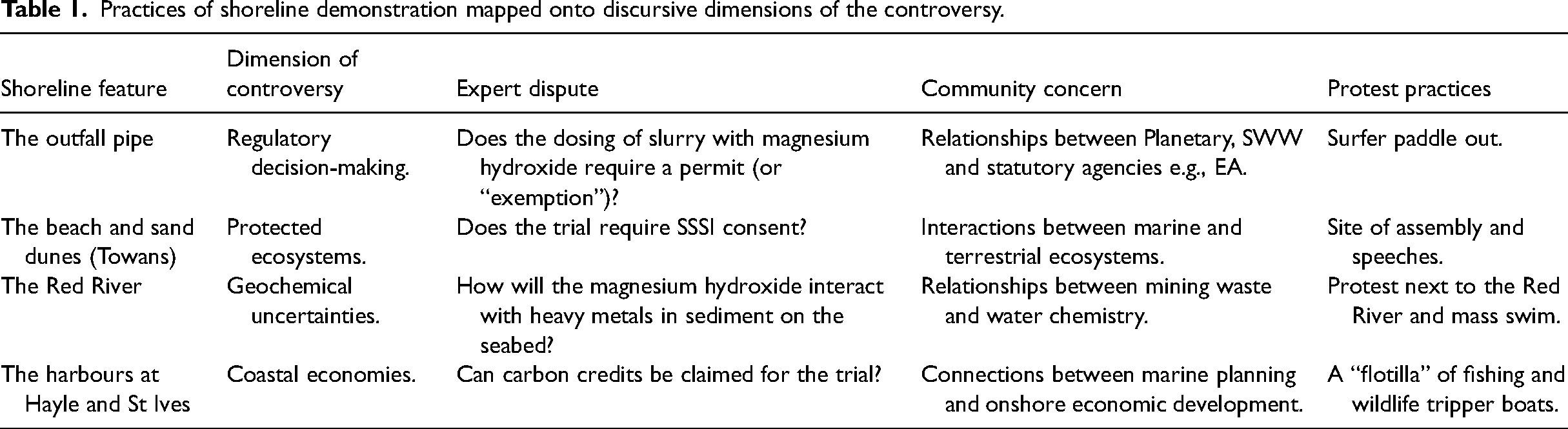
We now turn to four features of the shoreline (see Figure 1) that appeared to feature prominently in the controversy that emerged around the trial. In Table 1 we outline how the network around the KOSCF and the CCSG organised around these shoreline features to articulate their concerns about the trial: mapping the discursive themes of the controversy onto these shoreline features, although in practice they are far from discreet categories. In the analysis that follows, we elaborate how demonstrations around these shoreline features made visible entanglements between nearshore and onshore environments, reframing Planetary's “ideal” field site as a place of socio-ecological connection.
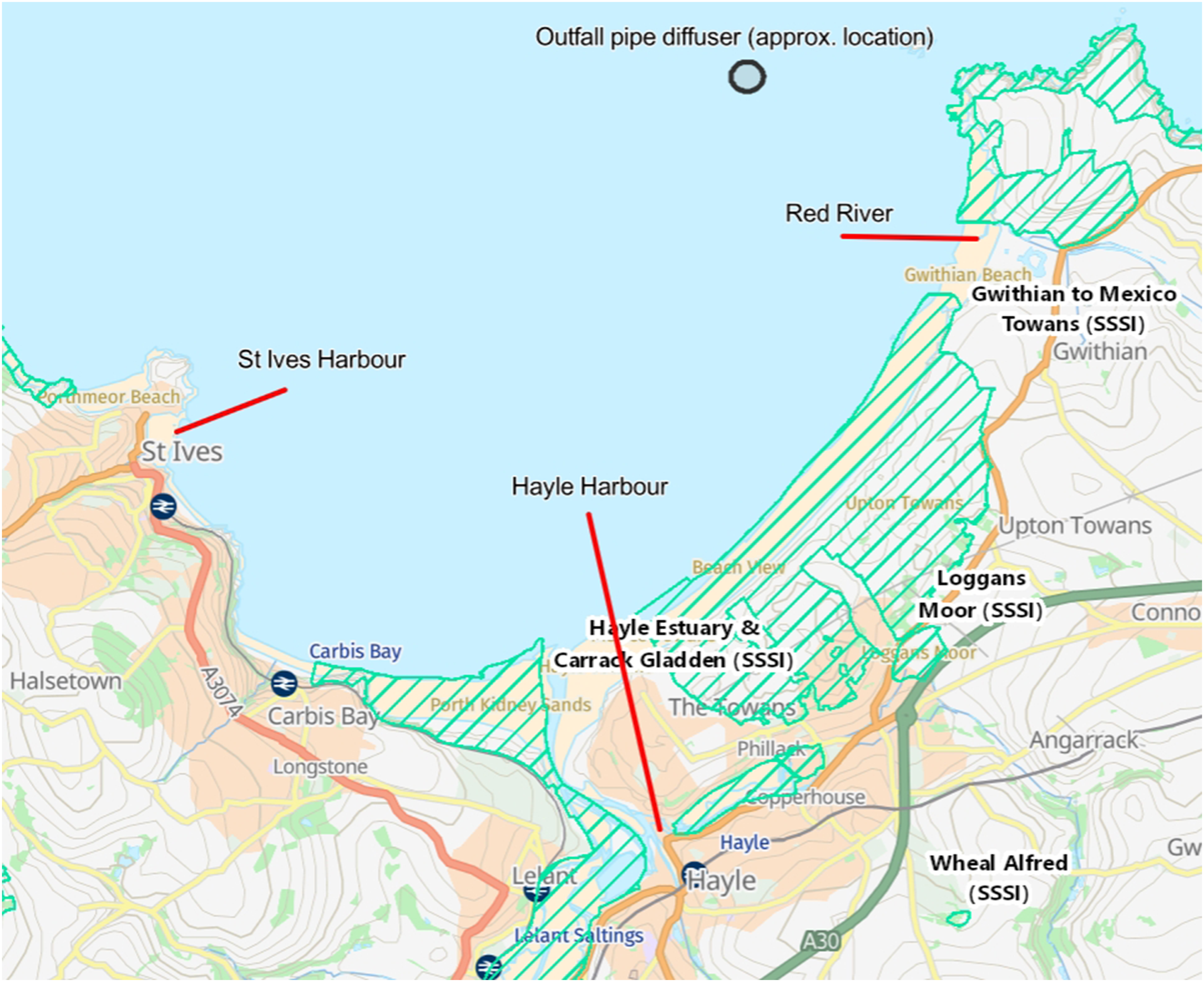
A map of St Ives Bay showing the four shoreline features (the outfall pipe, the Red River, the Towans and SSSI designations, and the harbours). The approximate location of the outfall pipe draws on the map included in Planetary's (2022) experiment design. Generated using the Magic Map tool developed by the UK Department of Environment and Rural Affairs. The base map can be found at: https://magic.defra.gov.uk/MagicMap.html?chosenLayers=sssiPIndex,sssiIndex&box=143585:35117:168154:46055.
Practices of shoreline demonstration mapped onto discursive dimensions of the controversy.
The outfall pipe
The outfall pipe owned and operated by SWW provided the infrastructure used to transport the magnesium hydroxide treated effluent and disperse the resulting slurry in the Bay. The pipe's diffuser (the end of the pipe) was the point source around which the physical zoning and boundaries of the marine field were conceptualised (Water Research Centre, 2024). The outfall pipe was also a prominent focus in the first protest and feature in media coverage (Weeks, 2023). Not simply an instrument of the trial's technological apparatus, the outfall pipe also became an object around which regulatory controversy centred.
As part of the first protest, surfers had organised a “paddle out” into the Bay, using aerial drone footage to film the ritual and demonstrate how surfers could directly interact with the trial site.
29
In unfortunate timing for the project owners, in the previous year water companies in England and Wales had come under intense public criticism and scrutiny following reporting on the quantity of untreated sewage being regularly released into the sea and rivers. For many of those protesting, the outfall pipe was symbolic of England's privatised water infrastructure, which had suffered from decades of under-investment by water companies and was now routinely failing to manage surges caused by wet weather. As one interview participant put it: “the elephant in the room was South West Water… they’re not very good at communication, what's going on in the Bay in terms of effluent getting into the Bay and particularly from Redruth and Camborne through the Tolvaddon sewage works, there are constant problems. The thing about Penzance and Hayle is that their sewage goes out to a pipe… and that's the pipe that Planetary were wanting to use. So, there is this conflict with South West Water… nobody had any idea what was happening to the pipe and whether or not they were pumping out raw sewage” (I8)
The appearance of faecal puns in headlines describing the trial as a “laxative release” and a “chemical dump” illustrated how easily news media framings of the water industry crisis could be extended to the use of magnesium hydroxide for the OAE trial (e.g., Summerfield, 2023; Vergnault, 2023). Organised around the pipe, the OAE trial was therefore, from the outset, associated with an infrastructure that had come to represent the pollution of environmental commons by private interests.
Contention over the outfall pipe also surfaced ambiguities around the regulation of the trial, in particular the distribution of responsibilities between the companies and the role of statutory agencies, principally England's Environment Agency (EA). Planetary's original trial design had proposed that no new permit was needed, since the impact of the magnesium hydroxide on changes in the pH of the water chemistry and suspended solids in the water column would not exceed SWW's existing permit. However, correspondence from the EA to the SRT seemed to cast doubt on this assertion. From March 2023, the SRT and members of CCSG lobbied the EA, calling for a full environmental impact assessment and a public consultation to be led by a statutory agency. Written responses from the EA to the SRT in 2023 appear notably vague about the regulation of the trial, one stating that the agency was waiting for “further information” before making a “decision on the risk the additional trials pose” and noting only that if SWW were to permanently dose magnesium hydroxide they would require a permit and full statutory consultation. It wasn’t until February 2024 that the EA published an information page on their website dedicated to the trial, stating that it had received notification about the proposed trial almost a year earlier in Spring 2023.
30
On this page the EA stated: “The addition of magnesium hydroxide to the treated wastewater is not an activity that is currently permitted on South West Water's discharge permit.”
The webpage goes on to explain that a temporary exemption (termed a “Local Enforcement Position”) could be granted, “should we choose to give it”.
But, the regulator's information page also appeared (and to many involved, still appears) to leave various questions unanswered. If Planetary's initial “methods test” in September 2022 would have breached SWW's existing permit, why was this not subject to a similar decision-making procedure? Moreover, if an independent audit of Planetary's proposal was required before a decision could be reached, why had Planetary publicised May 2023 as the trial's start date? And, relatedly, what then was the rationale for the public information events in Hayle and Truro in March 2023 which, while organised by Planetary, were widely understood by interview participants to have been undertaken at the behest of the EA?
Far from a neutral transporter of alkaline material into the trial site's “mixing zone”, in the protests and news headlines the outfall pipe was represented as the infrastructure of the failing water industry. Against the backdrop of this charged symbolism, the pipe became a material focus for contention over the regulation of the trial. We see here how the shoreline demonstrations not only exposed uncertainties over what was and was not covered by the SWW's existing permit but also ambiguities over the role of the EA and what kind of decision-making procedure, if any, would be required for the trial to take place.
The beach and sand dunes (Towans)
A distinctive feature of St Ives Bay are the sandy beaches and sand dunes (“Towans” in Cornish) that comprise a 3-mile stretch between the Hayle estuary and the headland at Godrevy, and which are designated a Site of Special Scientific Interest (SSSI). The Towans provided the stage for the protests, at Gwithian and Godrevy respectively. As shoreline features connecting the sandy seabed with onshore wildlife and biodiversity, the Towans could be used to demonstrate why ecological concerns about the marine environment also implicated particular terrestrial ecosystems.
Alongside the Towans, St Ives Bay contains two further designated SSSI areas: the Hayle estuary, where the water treatment works operated by SWW is located, and the maritime cliffs to the north of the Bay from the Godrevy headland to St Agnes.
31
Local conservation groups argued that the trial would require consent because the discharge location fell within the “risk impact zone” of all three designated SSSIs.
32
In making this argument, they drew attention to the limitations of neat demarcations between marine and terrestrial ecosystems. Here, the sand dunes could be positioned as both distinct environments in their own right while also knitted into wider a patchwork of shoreline habitats. Rather than organised around the terrestrial-marine demarcations, conservation concerns foregrounded species existing at their intersection: I7: “there are some really important habitats around the maritime cliff and slopes, the sand dunes, the heathlands […] There are a number of rare birds [and] species, like the silver studded blue butterfly, but particularly the breeding birds assemblage. So, that includes… raptors,… peregrine, chough, but also a lot of the seabirds. The seabirds assemblage includes… fulmar, auks, like guillemot, razorbill, shag… herring gull and more common birds, but also the nesting clifftop species, like, linnets, stonechats… [my main] concern when I first heard about this project was that there's a lot of interplay between the [the former and the] marine species, like seals”
While professional conservationists raised the issue of SSSI consent, concerns about protected ecosystems also highlighted the presence of networks of citizens voluntarily engaged in marine conservation. This includes 18 + groups involved in the Your Shore Network, as well as a variety of citizen science and volunteer programmes supported by Cornwall Wildlife Trust. 33 Just as shoreline habitats cut across demarcations between marine and terrestrial ecosystems, so too did the networks of Cornwall's conservation groups.
Nonetheless, others also highlighted asymmetries in knowledge of the Bay's ecologies. Specifically, few direct observations of the seabed had been made because (as Planetary's scientists also experienced) the tidal conditions created challenging conditions for dive surveys. Knowledge of the Bay's seabed was therefore largely inferential and derived from a wider variety of experiences and practices. For example, one interview participant suggested that some knowledge of the Bay's seabed could be inferred from the fishing take: “it is quite a mobile seabed, and sandy seabed, [based on] what they’re fishing for and what they’re bringing up in their nets” (I9). In a quite different example, a surfer linked changes in wave quality to shifting sandbanks: “this is purely opinion based, but I believe that some of the waves that we have will be lost as the sea level rises because [of] the topography… like, Sandy Acres beach, Gwithian Beach, it's all sand based, so the banks shift, the waves shift and some years they’re better than others. They’ve got worse in the time that I’ve been here…So the banks are shifting more frequently and therefore the wave quality is being affected.” (I6)
In the context of highly organised and visible conservation networks, the surfer's caveating of their observation as “purely opinion” here appears not insignificant; arguably evincing not simply individual reflexivity but also a sensitivity to hierarchies of expertise concerned with the Bay's ecology.
In articulating concerns about protected ecosystems and SSSI designations, the Bay's conservation groups and networks could advance demands on behalf of rare and indicator species and wider wildlife. As volunteer networks and inferences about the Bay's mobile sands illustrated, conservation expertise were not obviously opposed to (and in various cases appeared to rely on) everyday knowledge about interconnections between marine and terrestrial ecosystems.
The Red River
Impacting the water chemistry of the marine environment was a technical aim of the alkalinity enhancement trial, but also became a focus of prominent concern relating to the historical contamination of marine sediment in the Bay with heavy metals. A feature of the Bay representing such concerns was the Red River, which gained its name historically from the visible presence of tin mining residues. In relation to the Red River, concerns about the water chemistry focused not only on the reaction of the magnesium hydroxide with the sea water and metals in sediment but also signalled wider geochemical uncertainties and the connection of the OAE experiment with onshore mining.
The Red River had provided a setting of past environmental protests, most recently by Extinction Rebellion who had staged a mock chemical testing demonstration. Multiple interview participants drew direct associations between the Red River and the water chemistry of the Bay: “they also haven’t taken into account that there's a large amount of mining waste in the sediment around St Ives Bay that has come out of the Red River that contains a lot of heavy metals. […] They hadn’t tested on seawater that might be contaminated with heavy metals that might produce a different reaction with the magnesium hydroxide.” (I1) “the Red River is so polluted… [and] is still a litmus paper I suppose of what the condition of the water going into the sea… my [relative] who's a surfer and a local chef, is forever telling holiday makers, look, that water may look nice but it's just rained, please don’t let your kids go in there because actually it's toxic.” (I3)
As we see here, concerns about historic contamination of the Red River could be articulated both in technical language and at the level of everyday experience. Regardless of whether significant reactions of magnesium hydroxide with heavy metals would occur in practice, the lack of explicit reference to historic contamination in publicity for the trial appeared to many as ignorance of the trials site's geological and industrial history.
Following community protest, Planetary undertook a two-day marine environmental baseline survey of the Bay and it is notable that the survey's publication includes a dedicated chapter on historical metals data. While for many interview participants the baseline survey represented a recognition that their concerns were legitimate, several were unclear what the precise aim of the survey was and how it related to the “desk-based” WRC report commissioned by the EA (see above):
34
“without any announcement [or] a discussion with the community, they did a baseline survey last year where they monitored… did some surveying around the outlet and a control site” (I8)
Prior to publication, the CCSG hosted a meeting where Planetary presented the survey's findings. 35 Amongst the various questions posed by CCSG participants, a central line of criticism was that a 2-day survey did not constitute a representative “baseline” from which the trial could proceed, details of which are elaborated on the SRT's website and in KOSCF's documentary. Planetary's presentation of the survey maintains that it “provides a reference point to identify changes and trends going forward” and notes that “data collection will continue, including before, during, and after the project's operations”. 36 The dispute about the baseline can be seen as playing out a central dynamic of the controversy: uncertainties about impacts on the Bay framed by Planetary as questions about acceptable risk and safety and by the CCSG as betraying a lack of transparency in the experiment design.
Beyond methodological criticisms, concerns about geochemical uncertainties also opened up opportunities for novel collaborations to develop between the SRT, marine scientists and international ENGOs. The SRT is currently conducting its own seabed surveys of the Bay and advancing a Nature Based Blue Carbon Plan for St Ives Bay. 37
While expert assessments focused on the trial's impact on the water chemistry of the marine environment, KOSCF and the CCSG argued that questions about water chemistry were inseparable from geochemical uncertainties linked to onshore mining, indexed by the historically contaminated Red River.
The harbours at Hayle and St Ives
A prominent focus of contention over the trial was whether Planetary would monetise it by selling carbon credits. It was no secret that the trial was philanthropically funded through Elon Musk's private foundation, and associations were often drawn with Silicon Valley capitalism. The CCSG had contested the issue of carbon credits by engaging climate policy audiences, couching their concerns in the expert discourse of “moral hazard” 38 and invoking the London Protocol's distinctions between legitimate scientific research on marine geoengineering and commercial operations. Planetary subsequently announced that they would not sell credits from the St Ives trial, otherwise a central feature of the company's business model. However, in the interviews we conducted, discussions about carbon credits appeared less tied to questions about climate policy but were often closely connected with concerns about marine planning and the financing of economic development in and around the Bay. Specifically, the harbours at Hayle and St Ives appeared distinctive features for connecting nearshore and onshore environments and a focus for concerns about how the OAE trial would impact the Bay's coastal economies.
Multiple interview participants highlighted that the Bay's fishing and tourism industries, and local conservation groups had at times found themselves on opposing sides of marine planning decisions, such as on marine conservation zones. In this sense, the protests marked a distinctive occasion of collective action among prominent marine planning stakeholders in the Bay. One protest notably featured a “flotilla” of local fishing and “wildlife tripper” boats which (temporarily pausing otherwise fierce competition for local tourists) collectively mobilised to meet the protestors swimming from the shoreline; the spectacle captured in drone footage. More generally, interviews highlighted how the OAE trial could also easily provoke associations between marine planning issues and recent scandals around onshore development in the Bay.
Various interview participants drew associations between the financing of the OAE trial and recent scandals over onshore development. A conference of G7 leaders in 2021 had been hosted in a hotel at Carbis Bay – a resort in the middle of St Ives Bay – which was subsequently found to have removed an ecologically rich clifftop habitat and built structures without planning permission. Further along the Bay, a luxury development on the North Quay of Hayle Harbour had also recently ceased after the developer went into administration. The below quotation provides one example (of several we identified in interviews) illustrating how the OEA trial and both scandals could be drawn into association: “For the [Hayle Harbour North Quay] development they had to mitigate what they were doing by making a dune area… But it wasn’t for the community, and actually it was marketed by this huge company as being just like the Caribbean. And then the G7 was happening and the hotel owner at Carbis Bay put in retrospective planning for the land that he’d desecrated by knocking down trees and removing coastal areas of natural beauty where they knew there were also badger sets, birds, so on. So we did two big protests at Carbis Bay when that was all happening, and that became quite a hot topic. […] I think people's voice, if it's heard and if it's promoted in the right way, can be very powerful, and I think it's been demonstrated in the two St Ives Bay protests that we don’t want any chemicals in our Bay” (I3)
While at the level of official planning the OAE trial had little to do with onshore development policy, for some interview participants the trial nonetheless appeared to fit a longstanding pattern of community exclusion from decisions on economic development. One participant, for instance, likened Planetary's approach to planners: (I5): “they’re a commercial entity and just like… planners trying to get planning on a building site… that's effectively what they’re doing.” Another likened the OAE trial to “the planning permission scenario… [of] putting in planning on places… for long enough that people [contesting it] tail off.” (I6) Here, we see how planning could be articulated not only as a specific policy concern but also as a metaphor associating the OAE trial with the politics of the Bay's coastal economies.
In discussing economic developments around the Bay, contrasts were often drawn between St Ives and Hayle: the former an historic fishing port and tourism icon, the latter an historic port for mining and heavy industry with a former iron foundry on the quay now restored as a local heritage centre. As highlighted above, with respect to the OAE trial there also appeared important differences between the local authorities: in contrast to St Ives Town Council, Hayle Town Council had passed a motion in support of the trial. Various interview participants drew socio-economic contrasts between St Ives and Hayle linking the historic industries, for example: “Also, the insult was, they’ve not come to us, Planetary haven’t come to us at all with anything at all, it was all done through Hayle Town Council. The thing about St Ives Town Council is that when you are in St Ives, you look across the Bay, visually it's your Bay, it's St Ives Bay. Hayle is a very different community than St Ives. St Ives, has it, within it, some very articulate, very well-educated people who are passionate and will speak up. Hayle doesn’t have that, Hayle is much more of a working-class community […] because of its industrial history, [Hayle] hasn’t got that kind of articulate, that artistic, that academic background… So, they are two very different communities.” (I8)
The drawing of contrasts between St Ives and Hayle by interview participants was rarely simply to expose the existence of a class politics within the Bay's communities. They also highlighted how generalisations about the Bay's “local economy” could obscure historic and contemporary inequalities underlying conflicts over contemporary economic development.
It is not insignificant perhaps that Planetary's publicity for the trial proposed – under the heading “Jobs” – that “De-acidification work will help support local fishing and shellfish industries”. 39 Regardless of whether such promise would be realised in practice, it highlights how the trial's designers focused consideration of economic impacts primarily on the nearshore marine environment, largely disassociated from onshore economic development.
Discussion and conclusion
In the controversy that emerged over the OAE trial in St Ives Bay, the proposed “small scale test” came to be seen as an experiment of direct consequence for the Bay's communities. At issue, we have argued, were not only questions about potential harms to the marine ecology or the efficacy of the OAE method for carbon sequestration. The controversy also recast the OAE trial as a particular way of knowing the Bay and surfaced competing constructions of it. For Planetary the Bay represented an “ideal” marine environment in which to test and scale-up OAE technology; for the shoreline demonstrators the Bay was a place of socio-ecological connection. Questions about the scale and impact of the OAE trial became inseparable from contestation over the place of the Bay in everyday community life.
In foregrounding how community protests made visible nearshore-onshore entanglements, we have argued that the controversy revolved around (what we have termed) a liquid public enacted in Planetary's experiment design. Characterised by the fluid ontology of an ocean physics model – that constructed the Bay as an exemplar of particular oceanic conditions – the public could be invoked as a global aggregate and projected as the beneficiary of future technology deployment. The liquid public, we have argued, was a device with which stakeholder identities could be differentiated and demarcated from the affected community; the latter fixed in onshore space with its interests, knowledge and expertise coded as “lay”. In drawing analogies between Planetary's experiment design and the model of demonstration found in the SoCDR reports, we intend to signal the significance of this public controversy for the emerging innovation regime around which carbon removal projects and trials are taking shape. Significantly, as we have shown, the liquid public could be invoked to frame the Bay's communities as a threat to the promise of an ocean-scale climate solution.
In contesting the liquid public, the shoreline demonstrations showed that the identities of those mobilised around KOSCF and the CCSG were not easily reducible to fixed notions of the affected community. Rather, community identities themselves appeared fluid as actors like the SRT not only became “stakeholders” but also collaborated with ENGOs and scientists to propose their own counter-experiments. The identity of the network around KOSCF and the CCSG was not only defined by these groups but, we have shown, also by the shoreline location around which its connections were forged. As we have shown, the shoreline features around which the demonstrations were organised – the outfall pipe, the sand dunes, Red River and the harbours – were, in various respects, already objects of local concern and contention around water pollution, species and habitat protection, historic mining contamination and socioeconomic inequalities. In this respect, the shoreline demonstrations can also be seen as resisting a depoliticised account of the Bay's communities: they did not erase existing conflicts in the Bay but showed how the trial would intervene in (and in some cases reanimate) them. Our analysis therefore casts doubt on whether consultative approaches to community engagement would ever have generated “acceptance”, in the conventionally imagined form of a consensus about potential benefits and risks of experiments.
In practice, what was remarkable about the shoreline demonstrators was how many of those we interviewed remained open to the proposition of experimentation in the Bay: those participating in KOSCF and the CCSG often did not outright oppose the trial or research and development of carbon removal. We therefore suggest caution in conceptualising the network that took shape around these groups as a “counter-public”, 40 which might imply that dynamics of contestation over the OAE trial can be understood by analogy with social movements. While climate movement and activist identities certainly featured prominently among the Bay's mobilised communities, the shoreline demonstrations, collectively at least, also often appeared directed towards (and did not explicitly seek to contest) official science-policy interfaces. Rather, in revealing the patchwork of agencies, regulations and evidentiary protocols governing marine interventions in the Bay, they showed that governance implications could not straightforwardly be derived by modelling the Bay as a physical space. The force of such concerns was not simply that they could be couched in expert discourse but, we have argued, also demonstrated in the place-based practices. The controversy, we propose, shows why the politics of the emerging innovation regime (represented in the SoCDR reports) will not simply turn around institutions governing science-market relations but also environments of everyday community life.
While there now seem many reasons to question the selection of St Ives Bay for the trial, relatively few of those we interviewed felt that the Bay was inherently the “wrong” place for OAE experiments. The controversy, we suggest, rather raises fundamental questions about how trial designs for carbon removal methods anticipate place-based impacts. An urgent challenge for trial designers, as we see it, is how not simply to identify stakeholders, civil society and community representatives to consult but to locate them in relation to the everyday ecologies (Chilvers et al., 2018) in which experiments will intervene.
Highlights
Analyses controversy over a marine carbon removal project trialling an ocean alkalinity enhancement (OAE) method.
Discusses practices of public engagement in carbon removal projects.
Develops the concept of “shoreline demonstrations” to characterise how community protests contested the OAE experiment.
Argues that contestation over the scale and impact of the OAE trial rested on competing constructions of the Bay and its place in community life.
Footnotes
Acknowledgements
The authors would like to thank all those who participated in research interviews. Sue Sayer MBE, founder and director of the Seal Research Trust, acted as a gatekeeper for this study. Sue's support for our research was critical and we are grateful for the time and energy she committed to supporting the study.
Author contributions
Data availability statement
Anonymised metadata for the recorded interviews is available on request.
Ethical approval and informed consent statements
Ethical approval for this study was granted by the University of Manchester's UREC committee, reference 2023-17413-30889. Written consent for publication was given by all participants in the study.
Funding
The authors disclosed receipt of the following financial support for the research, authorship, and/or publication of this article: This work was supported by the CO2RE Hub, funded by the Natural Environment Research Council (Grant Ref: NE/V013106/1).
