




Abstract
This article explores the implications for development-oriented agronomy of the growing interest in (in)equity as part of the story of food system transformation. We argue that while agronomy is not in a position to lead on addressing (in)equity among farmers, to say nothing of within the food system more broadly, ignoring the on-going debate about food (in)equity would be professionally irresponsible. Agronomy and agronomists must find ways to engage with (in)equity that are rooted in awareness, reflection and realism. We suggest how this might be done.
Introduction
In some academic, policy and activist circles the idea of food system transformation has moved to centre stage (e.g. Lartey et al., 2018; Webb et al., 2020; Ruben et al., 2021; Kaljonen et al., 2023; von Braun et al., 2023). Calls for transformation generally highlight one or more of a wide variety of concerns, including soil health, water pollution, biodiversity loss, overuse of pesticides, lack of resilience to climate change, CO2 emissions, food insecurity, overconsumption of livestock products and ultra-processed foods, poor nutritional outcomes, food waste, corporate control, globally extended supply chains, animal welfare, exploitation of workers, and the inability of small farmers to make a living. Addressing (in)equity is central to some discussions and visions of transformation (e.g. Fanzo et al., 2021; IPES-Food et al., 2021; Kalibata, 2022; HLPE, 2023). We recognise that there is considerable overlap between equity and concepts like justice and fairness, but in this paper we privilege the notion of equity. For recent treatments of food justice see, for example Whitfield et al. (2021) and Murray et al. (2023).
Cabral and Devereux (2022) introduce a recent paper on equity and food with three assertions. First, that ‘Equity is a normative concept that refers to the pursuit of fairness and equality of opportunity’ (p. 10). Second, that ‘Food systems are characterised by inequities in every component, from production conditions through to consumption outcomes’ (p. 8). Depending on the time and place, these inequities might be seen, for example in access to food; in nutrition and health outcomes; in relations between actors in a supply or value chain; in returns on investment; in labour relations (on farms, in abattoirs and packing houses, supermarkets, restaurants, etc.); in influence on the direction of policy and technology development; in animal welfare; and in environmental impacts. And third, citing Leach et al. (2020), that ‘Underlying all of these inequities are imbalances in power relations between diverse actors at multiple scales’ (p. 8). The analysis of different perspectives on equity presented by Cabral and Devereux highlights the fact that they all share a central focus on (re)distribution: they differ, however, in relation to what is to be (re)distributed; to whom; and, under what circumstances.
This perspectives paper asks what the calls for food system transformation, and specifically transformation with a strong focus on (in)equity, might mean for agronomy and agronomists. Agricultural research, including agronomy, is considered by some commentators to be an important part of the food system problem (e.g. Branford, 2011; Chambers, 1989; Pimbert et al., 2010). Specifically, agricultural research has been critiqued for being reductionist and linear, overemphasising yield, focusing on ‘techno-fixes’, favouring larger farmers and agro-industry, and being out of touch with small-scale producers, women, indigenous communities and other marginalised groups (Cornwall et al., 1994; Pretty and Chambers, 1993; Richards, 1985; Shiva, 1994). At the same time, agronomic research is thought by some to have an important, indeed essential, role to play in any transformation of the food system (Reardon et al., 2019; von Braun et al., 2023).
The argument we make is in three parts. First, that concerns about (in)equity have been introduced into development-oriented agronomy primarily through the inputs of social scientists. Second, to some degree these introductions have changed both the discourse and practice of development-oriented agronomy, even if the link to (in)equity remains largely implicit. And third, we argue that while agronomy is not in a position to lead the way in addressing (in)equity, ignoring on-going debates about (in)equity in the food system would be professionally irresponsible.
The article proceeds as follows. Drawing on Cabral and Devereux (2022), the next section explores five perspectives on equity and how they relate to some prominent food-related concepts. Following this, we explore how (in)equity has been addressed within agronomy, highlighting the influence of social science. The next section sets out a continuum of possible responses by agronomists to the heightened focus on (in)equity. The final section concludes.
Inequity and the food system
Cabral and Devereux (2022) explore five perspectives on equity which they label as: the liberal tradition – welfare economics; capabilities and rights; Marxist; feminist; and political ecology. These perspectives are informed by and reflect different disciplines, histories and ideologies. As illustrated in Table 1, the perspectives also differ in relation to the questions: (re)distribution of what? to whom? and under what circumstances?
Perspectives on equity.
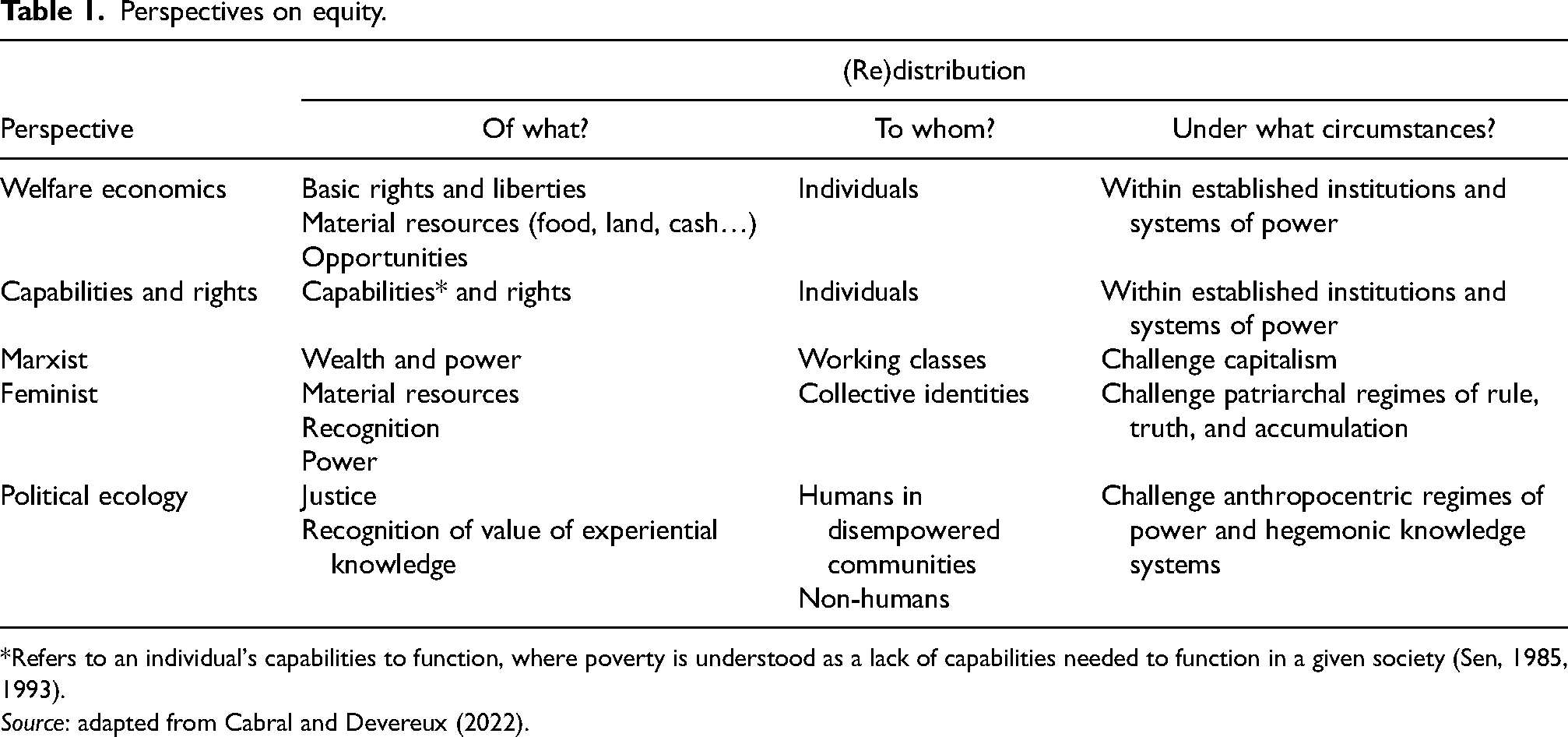
*Refers to an individual's capabilities to function, where poverty is understood as a lack of capabilities needed to function in a given society (Sen, 1985, 1993).
Source: adapted from Cabral and Devereux (2022).
The five perspectives fall into two broad groups. The first includes welfare economics, and capabilities and rights, both of which privilege the (re)distribution of rights and material resources to individuals, and neither of which explicitly challenges established institutions or systems of power. Here, that which is (re)distributed comes primarily from or through the state, development programmes or charitable organisations: the hoped-for result of redistribution is improvement in life circumstances, but with no attendant structural change. The second group includes the Marxist, feminist and political ecology perspectives, which are concerned to redistribute power, recognition and justice, in addition to resources and wealth. All three of these perspectives focus their attention at levels above the individual (e.g. households, communities, institutions, etc.), and some recognise non-humans as having interests, and as potential beneficiaries of redistribution. Significantly, the perspectives in this group all challenge one or more aspects of what Watts and Peluso (2013) refer to as regimes of power. In this sense, they can be considered radical, as they seek fundamental transformation of social, political and economic structures and relations. Specifically, redistribution here suggests shifts in power from elite to marginalised or subordinate groups.
Navigating these diverse understandings of equity poses a significant challenge, particularly as in the food and agriculture literatures, the way that equity is being used is frequently not specified. To help address this, Cabral and Devereux (2022) map nine prominent food concepts to the perspectives. Concepts like food aid, food assistance, food security and food entitlements highlight redistribution of food or cash to individuals without challenging established institutions and regimes of power. In contrast, others like food justice, food sovereignty and agroecology highlight redistribution to class- or identity-based groups of both material and non-material (recognition, voice, power) resources. To one degree or another, this latter group of concepts is predicated on challenging, and changing, existing regimes of power associated with inequity.
Agronomy, development and (in)equity
The discipline of agronomy is often described as the science of crop production (including soils, crop improvement, management, pastures, irrigation, farming systems and so on). Formal agronomic research includes all three activity types identified by the OECD (2015, Chapter 2): basic research, applied research and experimental development (Table 2). It takes place in a variety of organisational settings including universities, government institutes, international institutes, non-governmental organisations and private firms, and may be organised by crop, sub-discipline, objective, farming system, agro-ecological zone, and so on. As such, agronomic research employs a wide range of concepts, frameworks, approaches and methods. Agronomists often work in multidisciplinary teams alongside social scientists and economists, and with farmers, and are to be found on farmers’ fields and experimental stations, in glasshouses, at the lab bench, and behind computers. Some also engage in policy-oriented work and advocacy – testifying before legislative or congressional committees, sitting on advisory boards, engaging in public debate, etc.
Three types of research.
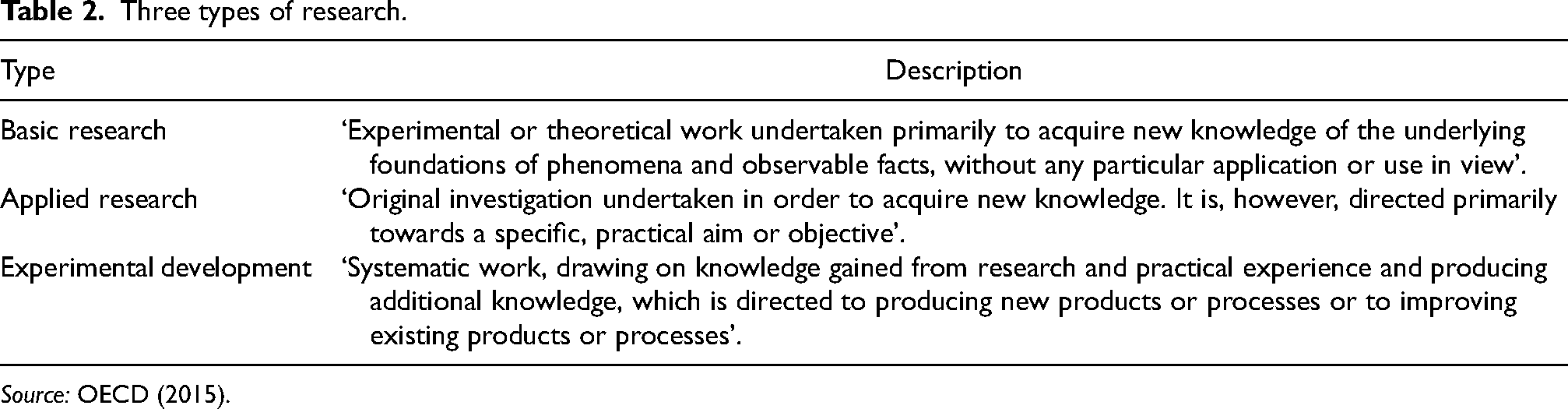
Source: OECD (2015).
In this article, we are interested in ‘development-oriented agronomy’, meaning agronomic research and development that is framed as a component of, or as contributing to, agricultural development in the global south (see Andersson and Sumberg, 2017). Development-oriented agronomy involves applied research, experimental development, promotion and evaluation: it draws from but is broader than the science of crop production. Specifically, it integrates perspectives and methods from economics and the social sciences including sociology and social anthropology (Figure 1).
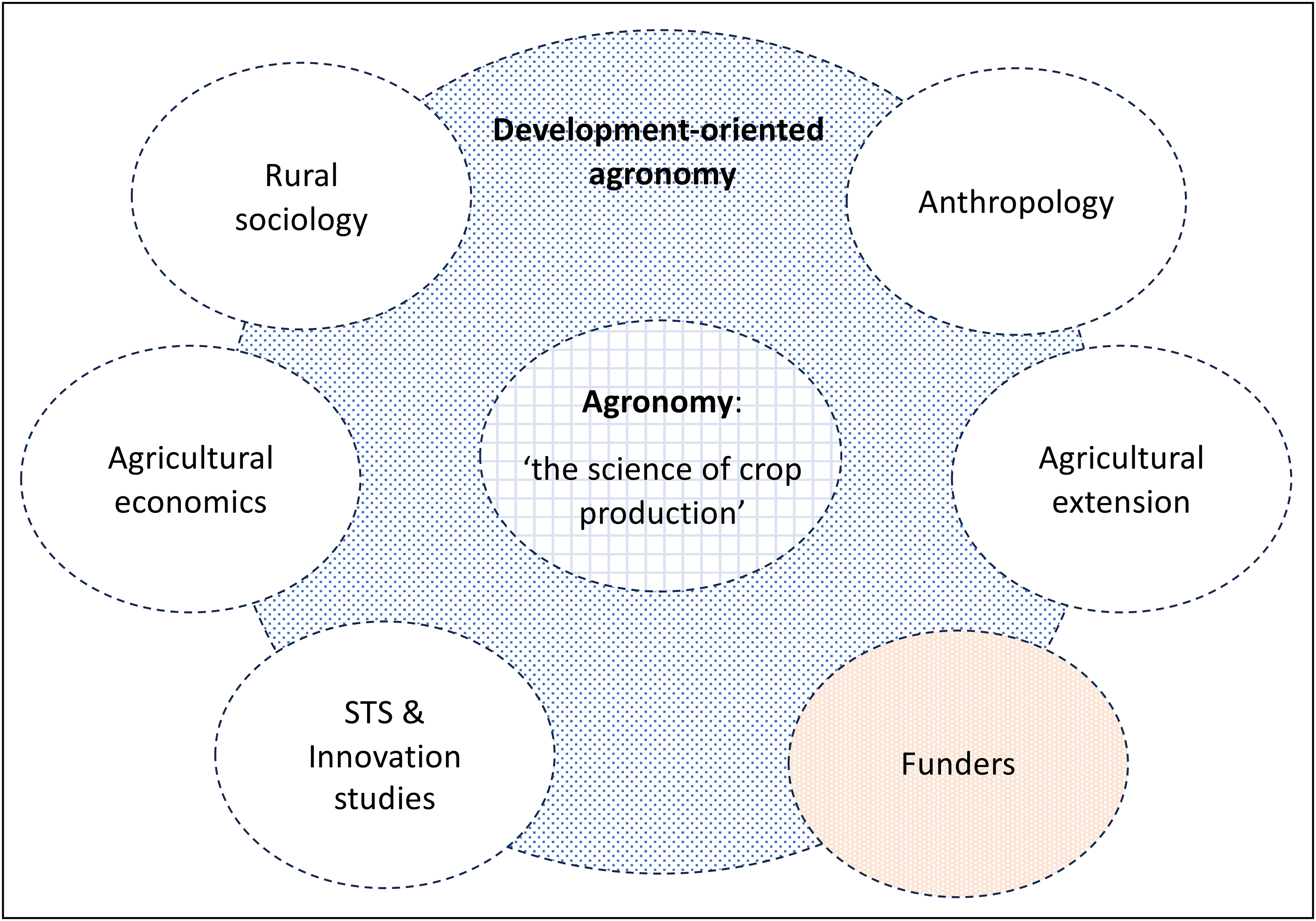
Development-oriented agronomy.
The figure presents an unapologetically agronomy-centric perspective on what might otherwise be seen as agricultural development. This reflects the fact that the introduction of new agricultural technology and practice still occupies a central place in much agricultural and rural development.
Historically, (in)equity was not a concern of the science of crop production (the innermost circle in Figure 1). Nevertheless, it is possible to retrospectively frame long-standing concerns of development-oriented agronomy (the outer circle) in terms of (in)equity. For example, reflecting the modernisation and intensification agendas, increasing crop yield could, in theory, help address inequity in food availability (both rural and urban), farm incomes and returns to rural labour. Similarly, biofortification of crops produced and/or consumed by the poor might help address diet-related health inequities. However, the problem with trying to draw a direct line between technical interventions like these and reduced inequity is that such an exercise requires heroic assumptions and simplistic causal chains. These essentially bracket the context, including the social relations, within which the interventions are introduced.
Perhaps more importantly, since the 1960s, (in)equity has been brought into development-oriented agronomy, implicitly and less often explicitly, through the influence of economics and social science, a broadening development agenda and a changing institutional context. The resulting opening up of development-oriented agronomy changed both discourse and practice; and, ushered in a new age of contestation within and around agronomy (Moseley, 2021; Sumberg et al., 2012; Sumberg, 2017; Taylor et al., 2021). An important aspect of this evolution was the shift from agronomy being beholden to or acting as a handmaiden of state policy, to engagement with a more diverse array of funders and partners with different and sometimes competing agendas. This shift has not necessarily facilitated engagement with (in)equity, as hierarchical relationships have been reproduced, and research organisations remain resistant to change (Conti et al., 2021). Despite these changes, the institutions, programmes and individuals who undertake agronomic research – particularly at the applied and experimental development end of the research spectrum – continue to play the role of ‘agent’ to one or more ‘principals’ (e.g. a national government, development bank or foundation) that commission and fund research. In many cases, the principal will exercise some influence over problem framing, research objectives, approaches, methods, target groups, research sites and so on. It is through this influence over problem framing that concerns about (in)equity have been made more explicit, but there are relatively few examples of these concerns being addressed directly in the subsequent work.
In the remainder of this section, we briefly explore two examples of how (in)equity has been brought into development-oriented agronomy, and assess whether and how practice has been affected as a result (Table 3).
Topics, methods and interventions that introduced (in)equity into development-oriented agronomy.
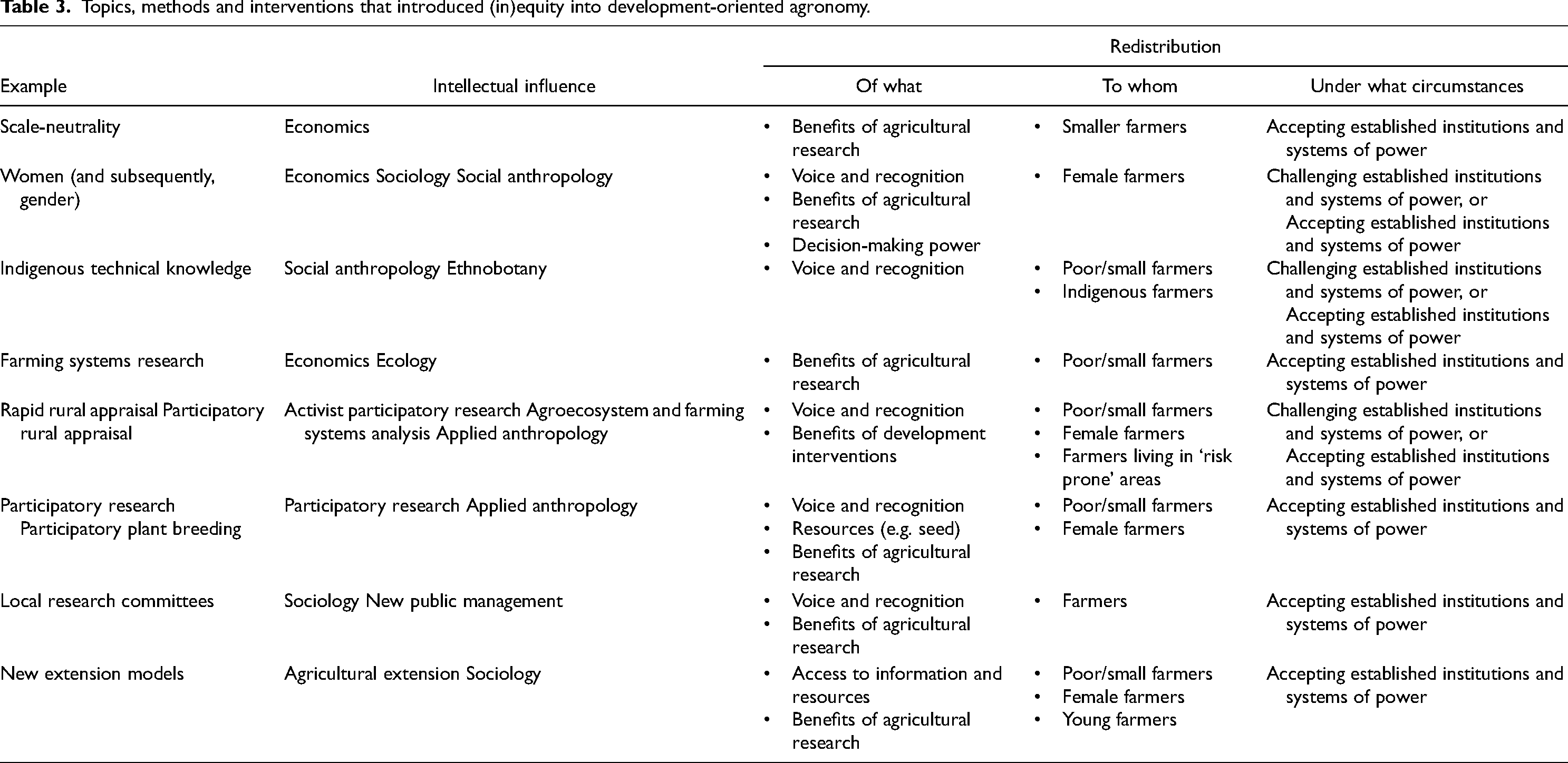
An important set of questions that arose during the period of the Green Revolution interrogated the characteristics of the farmers who were able to benefit from the new high yielding crop varieties and associated technologies. One such characteristic was farm size, with questions framed in terms of scale-neutrality. In other words, was the new technology scale-neutral (i.e. with farmers able to benefit regardless of farm size), or did it favour those farming at larger-scale? For development economics this is a bread-and-butter question of distributional or equity effects, and indeed the published work on scale-neutrality of Green Revolution technology is dominated by economists (e.g. Feder, 1980; Feder and Umali, 1993; Johl, 1975; Prahladachar, 1983). Scale-neutrality continues to be debated by economists in relation to on-going efforts to promote a Green Revolution in Africa (e.g. compare Mosley (2002) and Fischer (2016)).
Much of the work on scale neutrality suggests a welfare economics perspective on (in)equity. In terms of redistribution, the focus is on the ability of individuals, within the existing institutional context and power structures, to benefit from opportunities arising from agricultural research.
The focus on scale neutrality helped stimulate considerable reflection on breeding objectives (e.g. high yield vs stable yield); on conditions for testing breeding material and candidate varieties (e.g. ‘ideal’ conditions on experiment stations vs. farmers’ conditions); and on different management strategies (e.g. high vs low-external input). More broadly it also highlighted the importance of institutional barriers in constraining access to and successful use of multiple component technology packages. Although not commonly or explicitly framed in terms of (in)equity, these questions have become part of the fabric of development-oriented agronomy. One example discussed below is the normalisation of both on-farm and participatory research methods, while another is the awareness of gender and gender relations in processes of technology development and technological change. The CGIAR's work on ‘gender-responsive’ and ‘gender-intentional’ maize breeding is a recent example of development-oriented agronomy that specifically aims to address gender-based inequity (for a recent review of this work, see Voss et al., 2021).
As suggested above, the interest in on-farm research and participatory research methods was rooted in the observation that significant segments of the rural farming population – e.g. poor farmers, small farmers, women farmers, and those living in marginal and risk prone areas – were not benefiting from investments in agricultural research. Drawing on multiple intellectual traditions, including critical pedagogy, adult education, systems theory, action research and farm management (Chambers, 1994; Norman, 2022) the idea was that this important inequity could be addressed by changing the dynamic between farmers and agricultural researchers. The resulting participatory turn in development-oriented agronomy was reflected in the growth of interest in farming systems research, on-farm research, client-driven research and participatory varietal selection and plant breeding, as well as, for example local and indigenous technical knowledge, and farmers’ experiments. There are now significant literatures around these topics, with both methodological and empirical papers published in mainstream agronomy and agricultural journals (and elsewhere).
The proposition was that redistribution of the benefits of agricultural research depended on small, poor and/or female farmers being given respect, voice and recognition within the research process. Some framed the need for greater participation and participatory methods in terms of empowerment, and a desire to shift power relations. However, Okali et al. (1994) noted the gap between the rhetoric of empowerment and the fact that in implementation, the interest of agricultural researchers was often primarily in doing better or more effective trials, which did not necessitate challenging power relations.
Nevertheless, there can be no doubt that the turn to participation has had important implications for both the discourse and practice of development-oriented agronomy. As with the scale-neutrality example, the interest in and push for greater participation did not primarily come from agronomy or agronomists. And while the integration of participatory methods has certainly been beneficial, important questions have been raised about how, in what circumstances and with what kinds of technologies these methods can be used most effectively (e.g. Sumberg et al., 2003).
In summary, to the degree that concerns about (in)equity are articulated, the vast bulk of today's development-oriented agronomy is in line with the welfare economics and capabilities and rights perspectives on equity (Table 1). Thus, redistribution:
Of what? Information, knowledge and skills, germplasm; and to some extent, power within the research process and recognition of other knowledges and experiences To whom? Individuals who make crop-related decisions Under what circumstances? Within existing institutions and systems of power.
Development-oriented agronomy's orientation towards methodological individualism and tacit acceptance of existing regimes of power is perhaps not surprising given its focus on crop production, its institutional and funding contexts, and the fact that it most often plays the role of agent to powerful principals. Some of this may change depending on how the growing interest in agroecology, and particularly its ambition to challenge established institutions and power relations (e.g. De Molina, 2013; van der Ploeg, 2021), are taken on by development-oriented agronomy (or its funders).
A recent paper by McGuire et al. (2024) offers an approach to integrating (in)equity concerns into agricultural research. First, two Agricultural Innovation Systems ‘frameworks’ and two Agricultural Research for Development (AR4D) ‘tools’ were reviewed in the light of six approaches to social theory. Then seven ‘equity principles’ are proposed that ‘aim to identify key leverage points to generate more effective innovation and scaling for positive social outcomes through an inclusive systems approach’ (p. 10). These principles include: (1) Recognise AR4D Power Dynamics, (2) Define Goals, Anti-Goals, and for Whom, (3) Build Global ‘Horizontal’ Partnerships, (4) Acknowledge Social Differences among Innovation Users and Non-Users, (5) Innovate and Curate Innovation Appropriately, (6) Assess Impact and Reflect, and (7) Develop Inclusive Systems Capacity.
These principles certainly seem sensible, but we note that while they are called ‘equity principles’, McGuire et al. (2024) equate equity with social transformation and ‘leaving no one behind.’ The failure to unpack the notion of (in)equity leaves the central equity questions posed above – redistribution of what? to whom? and under what circumstances? – unasked and unanswered. We suggest that it is only in getting down to this level of detail that consideration of (in)equity will have the potential to contribute to development-oriented agronomy.
Lead, engage or ignore?
In this section, we step away from the frameworks, tools and practical principles that are the focus of McGuire et al. (2024). Instead, we explore broader options for development-oriented agronomy in the light of calls for food system transformation and specifically, the increasing interest in (in)equity within the food system. We suggest that agronomy's possible responses can be seen along a continuum with ‘lead’ and ‘ignore’ at the two extremes, and ‘engage’ located somewhere in between.
It might be inspiring to think that development-oriented agronomy can or should take the lead in seeking to address inequity amongst farmers and/or other food system actors. However, this view must be tempered by the acknowledgement that there is little in the domain of development-oriented agronomy that is, or could be expected to be, unambiguously equity enhancing.
Inequity is a relational phenomenon, it is produced and reproduced through power imbalances in the political, economic and social spheres. Inequity is not embedded in technological artefacts. It follows that the potential (and actual) equity effects of agronomic interventions – from the apparently straightforward like biofortified crop varieties, to the more complex like digital apps or wholly new cropping systems – depend on the context within which they are introduced, and how they are promoted and used. Local institutional arrangements, social and power relations that determine differential access to land, information, technology, finance, markets and so on are critical aspects of this context.
For example, it may be easy to conclude that, in general, young people in rural areas experience inequitable outcomes because key institutions are controlled by their elders. However, for a development-oriented agronomy programme it is critically important to understand how this plays out in a particular context – in relation to a particular intervention, particular institutions, particular young people and so on. It is only through such analysis that (in)equity implications can be understood. This suggests a need for detailed analysis requiring skills, tools and time to which most agronomists do not have access. And neither do they generally have a mandate from their funders (or other principals) to prioritise detailed analysis of the underlying dynamics of inequity.
It is certainly true that many development-oriented agronomy programmes have a social science ‘component’. However, these are often too narrowly conceived, too poorly funded, too instrumentally framed and too marginalised to deliver the subtle and contextualised understanding required. The kinds of insights that social science can generate are a pre-requisite for high quality project conception and design. However, expecting the social science component to pick up the pieces following a poor design process does nothing for the ability of development-oriented agronomy to address (in)equity, or for the participating social scientists.
At the opposite end of the spectrum, it would be short-sighted and irresponsible for agronomists to simply ignore current debates about (in)equity. The food system framing and calls for transformation of the food system have gained significant traction and must certainly be taken seriously. Further, there can be no justification for ignoring the potential, if inadvertent, (in)equity effects of agronomic interventions.
This draws our attention to the ‘engage’ part of the spectrum: we use engage in the sense of recognising there is an important issue (i.e. inequity) and reflecting on what it might mean for problem framing, research priorities, methods and processes. We have argued that individuals within development-oriented agronomy are generally in a position of agents (as opposed to principals), which places constraints on their ability to set their own research agendas. But even this constrained room for manoeuvre will likely provide some opportunity to begin to bring recognition of and reflection on (in)equity into both the discourse and the practice of agronomy.
This part of the spectrum potentially offers a variety of different kinds or shades of, or spaces for, engagement. For example, an engaged approach might draw further attention to how baskets of options (Descheemaeker et al., 2019; Ronner et al., 2021), and the propositions and encounters associated with them, are designed (Glover et al., 2019). Whether, how, by whom and for what purposes research outputs are used are ultimately out of the hands of agronomists, but the idea would be to work towards the best conditions for them to be equity enhancing.
An important opportunity is for agronomists to better understand the politics of agenda and priority setting, in order to more effectively influence them. For example, Sumberg et al. (2012) suggest focusing on questions like: What evidence is used to justify the objectives set for agronomic research? To what extent are research programmes rooted in an understanding of farmers’ practices and priorities (and equally important, of which farmers)? Through what processes are decisions made, and how is influence and power brought to bear on these processes? And who gains and who loses as a result? Underpinning all of this must be an appreciation of the role and influence of epistemic communities (Andersson and Giller, 2012), and how development-oriented agronomy might mobilise such communities to draw more attention to the intersections of agronomy and (in)equity.
There are clearly other examples that could be cited, but the important point is that what we are suggesting here cannot be reduced to a simple slogan (e.g. ‘equity sensitive agronomic research’), a mandatory checklist, a set of principles, a heuristic (e.g. poor farmers’ participation in agricultural research is good for equity, so more participation is always better) or addressed by simplistic training (for a thought provoking cautionary tale along these lines see McLellan, 2021).
Rather, an engaged stance towards (in)equity must reflect an understanding that both agronomic research and agricultural change take place within complex, dynamic systems; and that there is tremendous diversity amongst food systems actors, including farmers, and rural contexts. Because of this, in most cases, the outputs of agronomic research must be conceived of and promoted as nothing more or less than potential contributing factors to long-term processes of change. This points to the importance of both disciplinary humility, and realism, despite the fact that the politics of funding, a constant demand for ‘success stories’ and the imperatives of career advancement all push in the opposite direction.
Conclusion
In this perspectives paper we have explored what calls for food system transformation with a focus on (in)equity might mean for development-oriented agronomy. Our aim is to stimulate discussion and debate within agronomy, and more broadly, on the implications of this apparent turn toward equity for the kinds of research undertaken, the questions addressed, and the methods used.
We recognise that food systems are characterised by inequity, and to the degree that agronomic research is framed by the Sustainable Development Goals, or aims like Zero Hunger or Zero Poverty, (in)equity must certainly be on agronomists’ radar. However, we argued that agronomy is not well placed to lead the way in addressing the inequity experienced by small farmers, but neither can it simply ignore or leave others to engage with the current debates around food system transformation and (in)equity.
There is potentially fertile ground between these two poles, where agronomy's engagement with (in)equity could be both appropriate and valuable. This engagement will need to build on the decades of use of participatory research methods in development-oriented agronomy. If used sensitively and creatively, these methods can potentially help address inequity within the research process in terms of whose voices are heard, and whose views and knowledges are recognised. However, to what degree these methods can yield problem definitions, technologies or targeting strategies with greater potential to address inequity remains to be seen.
But taking (in)equity seriously demands so much more than participatory methods. Development-oriented agronomy needs to be able to draw on (and needs to draw on, as a matter of course) in-depth, contextualised knowledge about rural institutions and social and economic relations, and how these shape processes of technological change (within households, across generations, over time and so on). This is not simply a call for more social science to be loaded into development-oriented agronomy programmes, and it is certainly not a call for social scientists to be cast as change-makers. Indeed, we are suggesting that social science needs to be liberated from the subaltern, instrumental role it too often plays within agricultural development. Addressing (in)equity requires serious analysis of the social, economic, political and technological dynamics within rural settings. It is time to face the fact that this cannot be done as an afterthought, or on a shoestring, or through a few short field visits. Rather, it will require new funding models, longer timelines, and a return to the understanding that research is always a step into the unknown.
What might this mean in practice? Perhaps a more explicit recognition in the framing of research calls that both agronomic research and agricultural change take place within complex, dynamic systems; and that there is tremendous diversity amongst food systems actors, including farmers, and rural contexts. Perhaps a period of extended review, synthesis and field work by social scientists before the initiation of project design. Perhaps a move to funding calls that are less prescriptive, and less target driven. And perhaps significant investment in capacity building around new models of interdisciplinary collaboration. While principles such as those identified by McGuire et al. (2024) may well be useful, unless their use is informed by the deep, place-based social science understanding we are calling for, they will likely change little.
The resulting knowledge base would provide an invaluable resource for development-oriented agronomy. Drawing from it would require patience and skill, and a profound commitment to learning on the part of all those engaged in development-oriented agronomy.
Are agronomists and their funders ready to take up this challenge? We sincerely hope so.
Footnotes
Acknowledgements
We acknowledge Lidia Cabral for her helpful comments on an early draft, and the useful suggestions of an anonymous reviewer.
Declaration of conflicting interests
The authors declared no potential conflicts of interest with respect to the research, authorship, and/or publication of this article.
Funding
The authors received no financial support for the research, authorship, and/or publication of this article.
