




Abstract
Weedy species invasions are a huge problem in rangeland and natural areas as they degrade the quality and quantity of forage for livestock and reduce biodiversity. Weed suppression using native grasses is an ecologically driven method of weed management, representing an opportunity for low-input and management over long temporal scales if these systems can be successfully established. A systemic literature review was conducted to explore the interactions between native grasses and weeds, and revealed the potential of native grasses to provide a reduction in weed presence through interactions with other biological communities. We proposed the merging of agronomic and breeding techniques with restoration efforts such as using specialized seeding techniques to establish native grasses in these systems. A generalized planning framework for land managers is also presented, emphasizing the consideration of functional traits for competitive advantage against weeds and germplasm availability as the main considerations for species selection. Management strategies that provide advantages to native grasses such as land clearance and strategic disturbances were also discussed. Suppression can occur through a variety of mechanisms including direct competition with weeds, indirect interactions through trophic levels of arthropods and grazers, and human-induced disturbances. From our results, we believe that native grasses can potentially play an important role in efficacious weed suppression if utilized tactfully.
Introduction
Disturbances in natural areas such as extreme wildfires that have resulted from anthropogenic suppression of natural fire regimes, or overgrazing in dryland environments, can result in environments that are suitable for non-native weed invasions and succession (Bisigato and Bertiller, 1997; Ditomaso et al., 2010). Upon clearance of native vegetation, weed species can rapidly colonize disturbed spaces (Lebbink et al., 2022). For instance, when pastures and rangelands are grazed at high stocking rates, the reduction in vegetation cover and competition can potentially create conditions favorable for weed establishment (Shabbir et al., 2013). Weeds cause many problems for land managers such as the loss of economic value of the site (Duncan et al., 2004). Other problems include lowering the quality and productivity of forage, inhibiting biodiversity, and depleting water and soil resources (Brain and Cousens, 1990; Duncan et al., 2004; Tessema et al., 2016).
Weeds are classified by their fast-growing growth habit, competitive nature, and high seed production with a dormancy period that allows them to establish a long-term soil seed bank (Baskin and Baskin, 1985; Benvenuti, 2007). Once a weed establishes on a landscape, it can persist and even extend its abundance depending on invasive qualities such as multiple seed dispersal methods, growth and reproduction rate, flowering phenology, and high fecundity (Bewley et al., 2013; Milanović et al., 2020).
There is an urgent need to find ecological-driven weed management, specifically through the use of biology and biodiversity. Native plant communities such as native grasses can sustain their population through long temporal scales as they are well adapted to the local climate and soil conditions, and are potentially more resilient in the face of climate change (Craine et al., 2013; Kimball et al., 2018). Native grass establishment could provide long-term weed suppression by providing perennial vegetation cover and preventing bare soil for invasion (Török et al., 2011). This is poignant for rangeland systems that are intrinsically low-resource input and have minimal management due to their large geographical area (Malmstrom et al., 2009). Consequently, using native grasses as an ecologically driven strategy for weed suppression could be viable in the long-term provided they can be established. We would like to acknowledge that other types of plants such as forbs and desirable non-native species can also be utilized for suppressing weeds (Cong et al., 2018). In this review, other types of plants were considered as an add-on option to using native grasses.
This review focused on how native grasses and weeds interact in natural and rangeland systems, and if native grasses can have a suppressive effect on weeds. This was accomplished by conducting a systematic review of published research on the topic using the Scopus database. The search results yielded a small number of studies relating to this topic and showed no consolidation of previous research. We approached our scoping review with the following questions: (1) can native grasses compete against weeds, (2) what are the supporting mechanisms and functional traits involved with weed suppression, (3) what are the interactions occurring among native grasses, weeds and the landscape at different spatial-temporal scales, and (4) how does management affect the efficacy of using native grasses for weed suppression?
Materials and methods
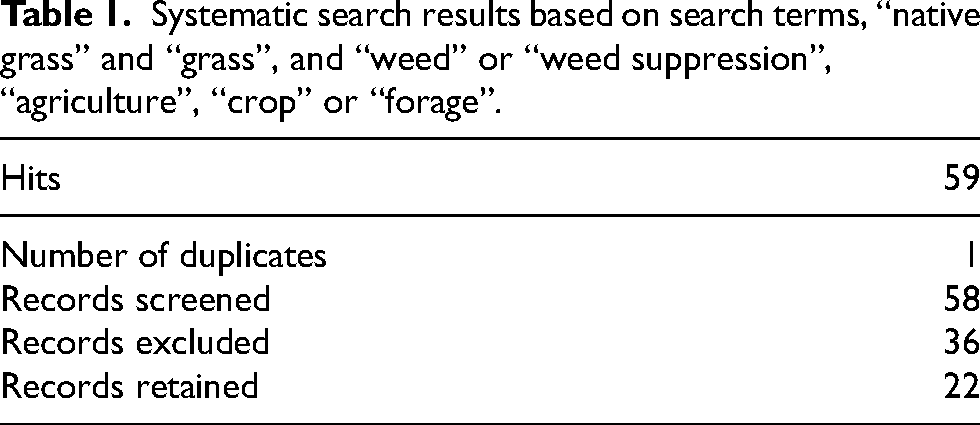
We conducted a systematic search using the “Scopus” database on 15 February 2022 (PST) using previously outlined methods with the following boolean search terms: TITLE-ABS-KEY (“native grass” AND “grass”) AND TITLE-ABS-KEY (“weed” OR “weed suppression”) AND TITLE-ABS-KEY (agriculture OR crop OR forage) (Koutsos et al., 2019; Moher et al., 2009). There were a total of 3 screening rounds using title, abstract, and full paper review. Studies were rejected for the main reasons of (1) unrelated topics, (2) not applicable to range and natural areas, (3) no discussion of native grass-weed interactions, and (4) publication in a language other than English (Table 1).
Results
The majority of studies selected for this review, 18 out of the 22, focused on semi-natural agroecosystems mainly characterized by grazing. These systems have reduced potential for human intervention due to the large land area and have an explicit need for ecologically-driven solutions for weed management. The remaining four studies examined the role that native grasses can play in cropping ecosystems. Consequently, the discussion is focused on discussing native grass–weed interactions, generalizing management strategies, and workflows for the adoption of native grasses for weed suppression on rangelands and natural areas.
Discussion
Combining agronomy and restoration ecology
The establishment of native grasses in disturbed areas can be difficult and resource-intensive (Asay et al., 2003). Beyond seeding native grasses, agronomic practices can be utilized to enhance the chances of success in their establishment. Adoption of agronomic practices can be challenging due to factors such as physical location, scale of operation, and lack of competitiveness of the native grass species in question (Asay et al., 2003; Terblanche et al., 2016). The use of native grasses is a context-specific solution limited primarily by a given location and the weed-native grass species interactions that can take place. The agronomic practices discussed in this section are not applicable across all geographical areas, but rather these are specialized tools that require careful planning, implementation, and monitoring under suitable contexts for weed suppression to occur.
Using native grasses for weed suppression often means managing for both agricultural and restoration purposes, with the end goal of sustainable use of the landscape to meet human needs. There were several agronomic considerations proposed in the selected studies to meet grazing goals and optimize stand establishment in specific systems. Native grasses can be effective at suppressing weeds, however, not all species have strong enough vegetative growth to meet grazing demand. The combination of fast-growing introduced species with perennial native grasses allows for sustained vegetative cover throughout the year - one of the most important considerations in preventing weed growth (Dhakal et al., 2020; Nie and Zollinger, 2012). A few case studies have shown promising results. Interseeding alfalfa (Medicago sativa L.) with native grasses reduced weed biomass by 43% over grass-only stands (Dhakal et al., 2020). Similarly, the planting combination of forage kochia (Bassia scoparia), an introduced perennial grass species, or alfalfa with native grasses, showed promising results (Aryal and Islam, 2019; Török et al., 2011; Waldron et al., 2005).
The use of alfalfa with native grasses for restoration and weed suppression was a significant search result. As Török et al. (2011) found, in the early stages of grassland restoration, alfalfa occupied 75% of the total vegetation cover but gradually decreased to 2% as the field aged. Perennial graminoids showed a reverse of this trend, increasing from 0% to 5% to 50% cover. The technique of using alfalfa ensured none of the early restoration stages were dominated by weeds and provided a spontaneous succession process to native species over time. It is important to note that this was an actively managed system with plowing and timely alfalfa cuttings, and would be difficult to replicate at scale given that grazing is the main option for management. The key message is the creative and flexible use of species to maintain vegetation cover. A complete transition to native vegetation happens over long temporal scales and therefore in the short term may not be effective at mitigating grazing disturbances, aggressive weeds, or a combination of the two. Introduced species fulfill grazing requirements in the short term and can also play a transitional role by stabilizing weed populations in a restoration project.
Seeding of native grasses is a key part of restoration design as it influences spreading and establishment. Search results revealed that the mixing of varieties, like those used in Török et al. (2011), and the use of strip seeding as promising techniques. Strip seeding is a technique that seeds a set percentage of an area by spacing out the seeded areas in strips (Silva et al., 2019). Strip seeding provides insights into the spatial configuration and the extent of covered area needed for restoration processes. Vegetation cover can act as a physical barrier to weed spread through mechanisms such as reducing bare soil for invasion if they can be established (Nie and Zollinger, 2012). Silva et al. (2019) did not find that seeded strips provided invasion resistance for unseeded strips, but did provide a potential mechanism for native grasses to spread. Smaller seed applications (33% coverage) were reported to have improved weed control, albeit on a smaller scale. In cases where 100% seeding is not possible, seeding a designated proportion of the restoration area can still provide some degree of weed suppression. It remains true that an agronomic practice such as strip seedling is difficult to replicate at a landscape level in a rangeland system.
Generalized guidelines for using native grasses for weed suppression
To ensure strategies outlined in this review are successful, management goals need to be defined and a site study should be created to ensure intended results are possible. With the identification of target sites and weed species, native grasses with suitable functional traits, e.g., drought tolerance, high forage biomass, can be identified. If there are specialized germplasm available, these can be used instead of germplasm sourced from wild collections. If wild collections are used, seeds or material should be collected in areas with similar conditions to increase predictability in performance.
After study site and species selection occur, site preparation and seeding methods can be chosen (Figure 1). Restoration sites can be cleared through mowing, prescribed burning, or herbicide application to create space for native grass growth (Di Tomaso et al., 2006). The technique of seeding should match management goals, such as intercropping with forage for higher grazing needs, and strip seeding in patches if planting across large areas. Seed mixes need to be formulated with succession considerations in mind for both seeded varieties and transitioning of weedy/introduced species to native communities (Sheley et al., 2006).
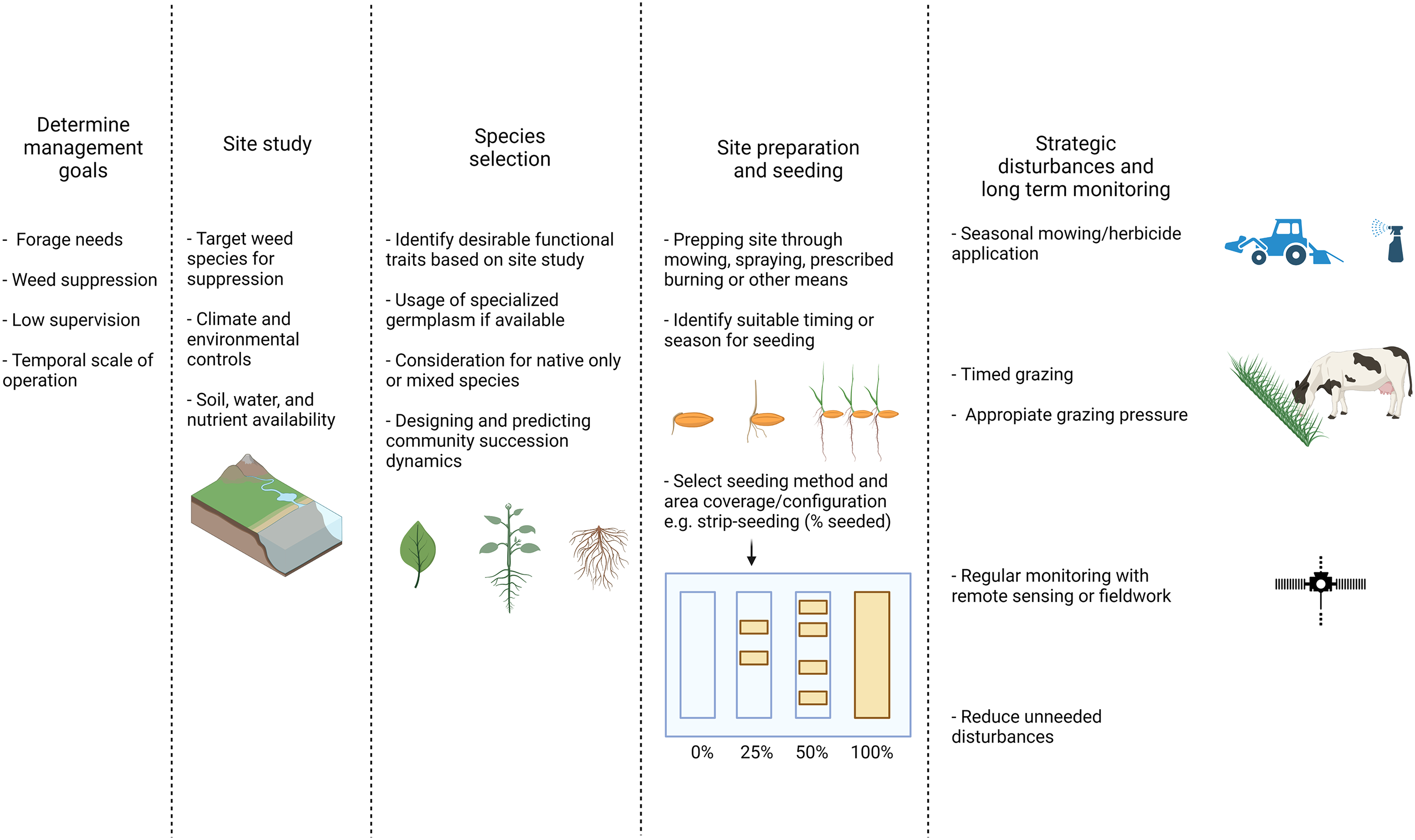
Planning framework for using native grasses in weed suppression.
Native populations require years to stabilize, so human-induced disturbance should serve to provide a competitive edge to native species over weedy competitiors, e.g., herbicide application to weeds, or mowing at weed emergence (Nie and Zollinger, 2012). Native grasses are unlikely to compete effectively with aggressive and vigorously growing weeds during the initial phase of restoration. Strategically disturbing the environment to reduce weed population fitness can hasten native establishment. Remote sensing technology, such as drones, can be used to track weed suppression performance and shifts in community structure in large restoration sites (Malmstrom et al., 2009). When native grass populations have stabilized, they can maintain their population through various means, such as self-reseeding in annuals, or regeneration from roots in perennials, and can provide long-term weed suppression (Funk et al., 2008). Management strategies such as nitrogen fertilization rates also need to be targeted to enhance the population fitness of native grasses (Schwinning et al., 2005).
Although this outline is more applicable to natural and rangeland systems, we also found instances of native grasses being used in cropping systems as a cover crop and provided weed suppression (Ingels et al., 2005). We acknowledge that such a technique has the potential to be adopted in cropping systems, but underscore that it is context specific to the cropping system in question and has its own set of challenges, especially when managing for crop yield and weed suppression goals.
Native grasses’ performance is dependent on functional traits and temporal scales
A key finding is that the performance of native grasses in weed suppression is context-dependent and is reliant on the functional traits of the native species. Figure 2 depicts the major advantages that specific functional traits of annual grasses can have over weeds. Native species that phenologically overlap with the target weeds are more antagonistic (Silva et al., 2019). The physical presence of native grasses alongside late-season weeds increases competition for resources at the plant community level through various mechanisms. For example, increased drought tolerance can be achieved by increasing the presence of deeper root systems to access soil moisture from deeper soil depths, allowing native grasses to outcompete weeds that are not well adapted to dry summers in California (Holmes and Rice, 1996). Fast lateral colonization was also found to be critical for native grasses. Western wheatgrass (Pascopyrum smithii [Rybd.] A. Löve) was a strong competitor in mixed stands and rapidly filled plot areas due to its rhizomatous nature, reducing areas for weeds to persist or grow in (Stonecipher et al., 2019). Similarly, the early-successional traits of Canada wildrye (Elymus canadensis L.) allowed it to quickly establish earlier in the season when weeds are dormant, competing with annual weeds early in the seeding year and reducing the weed establishment area (Jungers et al., 2015).
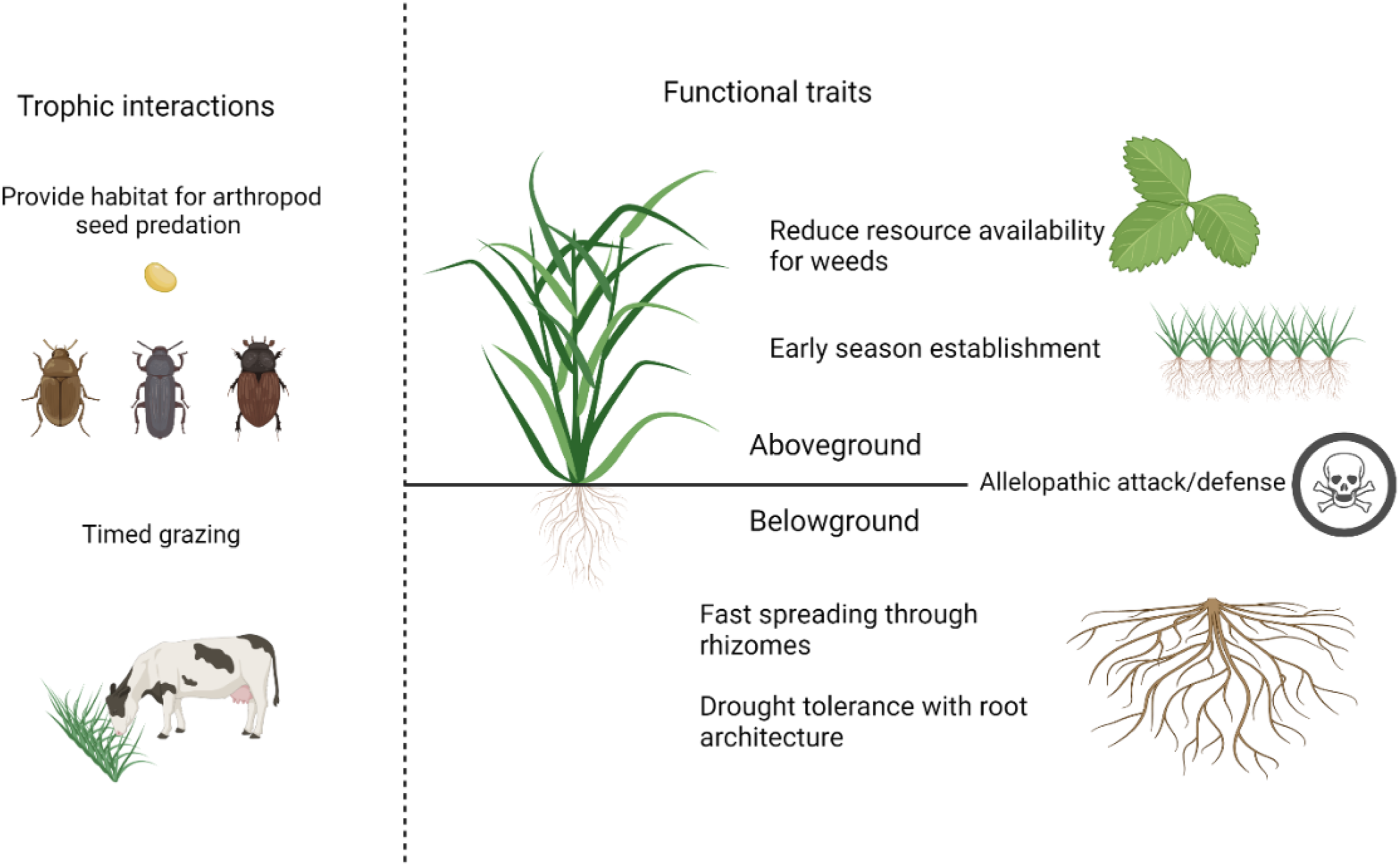
Functional traits and trophic interactions affecting the performance of native grasses in weed suppression.
Another functional trait identified was the ability of natives to self-protect, which can be both offensive and defensive. Offensive strategies include the usage of allelopathy to reduce germination rates in seeds of other species (Scrivanti and Anton, 2021). The South American native species of Bothriochloa spp. produced allelopathic chemicals that had a strong inhibitory effect on weed seed germination (Scrivanti and Anton, 2021). Conversely, a defensive approach is the ability of native species to resist allelopathy from weeds (Shang et al., 2011). Poa crymophila was the least susceptible to Aconitum pendulum allelopathy out of five forage native grasses tested and was best suited for restoration of land meadows dominated by A. pendulum in Tibet. Such a trait would likely assist in the maintenance of established grass stands by reducing the efficacy of allelopathic attack from weed species. As there were only two studies that examined allelopathic traits, this is a potential way for weed suppression to occur but requires further empirical verification.
The above is not an exhaustive list of functional traits that allow native grasses to suppress weeds but was a summary of mechanisms outlined in the selected studies. The takeaway is that native grasses should be selected to reduce the population fitness of weeds while maximizing the opportunity for native grass to dominate the landscape. These can include more efficient resource acquisition, such as deep root architecture, resource removal, e.g., rapid spreading that shades the soil and inhibits weed seed germination, or disrupting the life cycle of the weed with a mechanism like allelopathy (Figure 2). Functional traits are diverse and selection of the right combination of native species to suppress targeted weed species is needed for a weed suppression strategy to be successful.
The temporal scale is of pivotal importance for community composition to shift from weeds to native grass species. Both Silva et al. (2019) and Stonecipher et al. (2019) found weed suppression via native grasses restoration took 5 and 16 years, respectively, indicating the long temporal consideration in the adoption of this strategy. These findings suggest that in the short term, weed suppression may not be as effective compared to other methods such as chemical control. Native grasses do not necessarily confer weed suppression and establishment can be difficult, underscoring the context-specific nature of this method (Ralphs et al., 2007). However, with the selection of species that possess favorable functional traits in tandem with sufficient time for their establishment, weed suppression can occur.
Trophic interactions with native grasses
Native grasses also interact with other organisms at the landscape or field level through trophic interactions to provide weed suppression (Figure 2). A single study was found during the review process that determined the presence of native grasses did not have a positive effect on seed predation (Fox et al., 2013). The authors attributed this to maximized weed seed predator activity density. As restoration was carried out in an organic field with high basal resources for weed seed predators, restoration of field margins did not increase weed seed predation. Weed seed predation via the integration of native grasses should be further investigated as this is still a potential mechanism for weed suppression. Anthropogenically generated habitats (e.g., hedgerows) can provide favorable habitat that improves fauna-mediated ecosystem services (Morandin et al., 2014). Specific predators can be encouraged within these habitats with strategic planting (Pollard and Holland, 2006).
The livestock trophic level in rangeland systems plays an important role in supporting native grass establishment and weed suppression (Figure 2). Overgrazing disrupts native grass establishment by spatially resetting the landscape through vegetation cover removal (Ditomaso et al., 2010). By grazing at an appropriate grazing pressure, native grasses have the opportunity to remain highly competitive (Cowie et al., 2021). Native grasses can establish large tuffs over time, consequently acquiring various above and below-ground resources to prevent weed reinvasion.
The timing of grazing can affect the ability of native grasses to suppress weeds and can be used to reduce the proportion of annual weeds. For instance, grazing a pasture in early spring before seed head emergence can prevent weeds from reaching maturity and setting seed (Nie and Zollinger, 2012). Immediate competition to perennial native grasses is reduced in these scenarios. Future competition to native grasses is also reduced by preventing additions to the weed seed bank. Properly timed high-intensity, short-duration grazing events can be an effective strategy in disrupting the biology of annual weeds. However, this strategy requires optimum timing compared with traditional grazing methods, making its implementation prohibitive to some land managers (Nie and Zollinger, 2012). This strategy can damage native grasses if the grazing pressure applied is too high (Milchunas et al., 2011). Timed grazing needs to be at an intensity that suppresses weeds but does not cause soil compaction or extensively damage native grasses in order to provide desirable species with a competitive advantage. This process is context specific and depends on the desirable grass and undesirable weed. Should timed grazing be utilized successfully, it would likely result in significant weed suppression, but not complete eradication.
Beneficial disturbances in the landscape
Native grasses can be effective at weed suppression with little to no human-induced disturbances (Waldron et al., 2005), but their establishment requires a significant amount of time, labor, and resources as previous discussed. Strategic disturbances that facilitate native grasses establishment include grazing, the use of chemical control (Beran et al., 2000), and the use of allelopathic cover crops (Milchunas et al., 2011) according to the search results.
Although the use of native grasses is an ecologically driven technique, chemical methods should not be discounted (Beran et al., 2000). By utilizing herbicides that cause minimal damage to native grasses, weeds can be suppressed pre- and post-emergence. Niches that were previously occupied by weeds are released after herbicide injury and can be occupied by native grass establishment. Such a technique can be used as part of site preparation before planting, and can also be used after planting to provide space for the establishment of natives that in turn provide long-term weed suppression. While this is not an ecologically-based strategy, it can reduce the timing for native grass establishment by rapidly eliminating problematic weed species.
Allelopathic cover crops have a similar effect. Milchunas et al. (2011) determined that sorghum, a crop with known allelopathic properties, planted before seeding with native grasses resulted in large increases in rhizomatous western wheatgrass (Pascopyrum smithii) (native grass) compared to fields previous planted with wheat-fallow rotations. Allelopathic chemicals likely resided in the soil and halted weed growth during native grass restoration, although the chemicals were not characterized. Additional research is needed in this area of weed management to determine crop effects and weed suppressive effects.
Breeding as a tool for native grasses improvement
Restoration can utilize germplasm bred for weed suppression (Asay et al., 2003). Search results yielded 3 studies that examined genomic improvements of native grasses (Asay et al., 2003; Jensen et al., 2012; Norton et al., 2005). Given that functional traits of native species likely play a huge role in the success of weed suppression selection for desirable traits and transferring these traits to germplasm used for restoration can potentially increase the predictability and performance of seeded plant populations.
Biomass and palatability to livestock were traits suggested to be evaluated to better determine forage availability and appropriate grazing intensity (Norton et al., 2005). Accessions of native and introduced species can be utilized for better system-level performance in order to meet both forage demand and vegetation cover to prevent weed invasions. However, it was also noted that the selection of cultivars needs to be done in the context of the ecosystem in question, and that considerable planning and long-term breeding efforts are required if this strategy is to be implemented successfully.
Other functional traits that aid with reproduction, establishment, and spread can also be considered. Yearly regrowth is a key mechanism for reproduction and spread as native grasses establish on the landscape. Regrowth happens through a variety of mechanisms such as seed germination, and regrowth from rhizomes (Ziska and Dukes 2011). Variability in seed fecundity through a range of spatial-temporal scales is thus important and was evaluated by Jensen et al. (2012). Traits examined included seed yield, 100-seed weight, and seed emergence from various soil burial depths, and were specifically examined for the purposes of improved seedling establishment to compete with weeds. These phenotypic traits could be impactful at individual and community levels in sustaining and spreading native species, under the assumption that initial establishment is successful. Although evaluation and selection of these traits could potentially aid in weed suppression, our review has found a small number of publications on this topic. More empirical validation is needed and different traits should be evaluated depending on the biology of the native grass species in question.
Genetic improvement should be utilized with caution as the use of improved cultivars has the potential to alter the genetic structure of natural populations. In Jensen et al. (2012), molecular genetic diversity suggested that improved lines of Snake River wheatgrass (Elymus wawawaiensis) were from a common gene pool compared to the local ecotypes and likely will not cause shifts in genetic structure if used. Such an observation raises a salient point – the usage of improved varieties is a balance between maintaining genetic structure, an acceptable phenotype feasible for the local system, and selecting for favorable traits that improve competition with weeds. Along with breeding for useful traits, state and academic institutions should also provide support to land managers by developing suitable germplasm and guidelines for their establishment that are required for restoration endeavors (Asay et al., 2003).
Conclusion
Weed suppression using native grasses is a complex and resource-intensive process. To establish native grasses, restoration generally has to be paired with agronomic techniques such as herbicide application, prescribed burns, timed grazing, and strip-seeding. This is an actively managed system and is difficult to replicate at a landscape level. Key considerations of a restoration program lie in the selection of appropriate species, or specialized cultivars if available, and providing competitive advantages to natives through strategic disturbances.
If established, native grasses interact with other communities at the ecosystem level through direct competition with weeds, indirect interactions through trophic levels of arthropods and grazers, and also with human-induced disturbances. Mechanisms for weed suppression included having improved drought tolerance within native species, providing habitat for weed seed predation, and using or resisting allelopathy. The most important consideration is selecting species with traits that provide robust vegetative cover, allowing native grasses to outcompete weeds, and prevent seeds from germinating and establishing in bare soil.
The use of native grasses to suppress weeds is an ecologically intensive management strategy that can provide long-term stable weed suppression services by altering the landscape and inter-species population dynamics if they can be established. With potentially increased ecological controls and resilience, human intervention can be reduced over time. We see this approach as a valuable opportunity. However, additional research is needed at the local and regional levels to elucidate diverse opportunities to use native grasses as a weed suppression strategy for the given context. Specific processes and functional traits that can aid weed suppression have been outlined, but they should be empirically verified through site-specific field experimentation. The use of native grasses as an ecologically driven method of weed management can potentially play a part in the long-term management of weeds provided establishment is possible in a given landscape.
Systematic search results based on search terms, “native grass” and “grass”, and “weed” or “weed suppression”, “agriculture”, “crop” or “forage”.
Footnotes
Acknowledgments
The authors would like to thank Asia Jones, Amanda Wong, Thomas Fenster, and especially Valerie Eviner for their critical feedback that elevated the quality of the work. Figures presented were created with BioRender.com.
Declaration of conflicting interests
The author(s) declared no potential conflicts of interest with respect to the research, authorship, and/or publication of this article.
Funding
The author(s) received no financial support for the research, authorship, and/or publication of this article
