




Abstract
We review the Canadian federal government‘s recently enacted Food Policy for Canada (FPC). Three arguments are developed. First, the development and vision statement of the FPC implies that improving Canadian food security is a specific objective of the policy. Second, if assessed by the measure of food insecurity promulgated by Statistics Canada, the effectiveness of the FPC in reducing Canadian food insecurity will primarily depend on the extent to which it improves household incomes and/or lowers food prices. We evaluate the current programmatic content by these criteria. Third, and related to the second point, we argue that the variation in the severity of food insecurity is an important consideration in assessing the effectiveness of FPC programs in reducing food insecurity as measured by Statistics Canada. Finally, we combine these three arguments into a simple figure/heuristic that can serve as a guide to the assessment and development of FPC programs seeking to enhance food insecurity in Canada.
Introduction
In 2019, the federal government established a national food policy for the first time in Canada’s history: the Food Policy for Canada (FPC). In government-led public consultations to inform the development of the FPC, food security was one of the four priority themes (AAFC, 2018). As discussed more fully in later sections of this paper, the FPC‘s vision statement includes aspirational language — e.g., “[a]ll people in Canada are able to access a sufficient amount of safe, nutritious, and culturally diverse food” (AAFC, 2019, pg. 5) — that identifies food security as a central objective of the FPC.
Presently, the government provides no measure by which one can assess the FPC‘s aspirational goal of food security. Put differently, one cannot presently provide information regarding the percentage of Canadians who are “able to access a sufficient amount of safe, nutritious, and culturally diverse food”. However, the government does use a measure of food insecurity to describe household food security status in Canada. Health Canada defines food insecurity as “the inability to acquire or consume an adequate diet quality or sufficient quantity of food in socially acceptable ways, or the uncertainty that one will be able to do so” (Health Canada, 2020a). Importantly, Canada’s measure of food insecurity focuses on household food insecurity due to financial constraints, and hence an element of the aspirational definition of food security (Health Canada, 2004). Given the clarity around the meaning and measure of food insecurity, we believe it appropriate to use this measure to assess the potential of the FPC to address issues of food security. 1 We develop the definition of food insecurity more fully in later sections of the paper.
In 2017/18, 12.7% of Canadian households were considered food insecure (Tarasuk and Mitchell, 2020). The prevalence of household food insecurity is directly concerning because it identifies vulnerable households with respect to food consumption. However, we believe it is important to recognize that food insecurity is associated with a host of other concerns. For example, previous literature identifies an association between food insecurity, poor health outcomes, and high health care costs (e.g. Che and Chen, 2001; Jessiman-Perreault and McIntyre, 2017; Men et al., 2020; Muirhead et al., 2009; Tarasuk et al., 2013, 2015; Vozoris and Tarasuk, 2003). Furthermore, the severity of adverse health outcomes has been shown to be related to the severity of the experience of food insecurity (e.g. Jessiman-Perreault and McIntyre, 2017; Tarasuk et al., 2013).
In this paper, three arguments are developed. First, as anticipated above, the development and vision statement of the FPC implies that improving Canadian food security is a specific objective of the policy. This argument may seem straight-forward, but we believe it is important to establish at the outset because it underscores the fulcrum of our second argument. Our second argument is that if we assess the food security efforts of the FPC by the measure of food insecurity promulgated by Statistics Canada, then the effectiveness of the FPC in reducing the prevalence of food insecurity depends to a large part on the extent to which interventions effectively increase household income and/or address related issues like food prices, housing and transportation costs, etc.
Third, and related to our second point, we argue that the variation in the experience of food insecurity is an important consideration in assessing the effectiveness of FPC programs as they relate to food insecurity. Some households identified as food insecure experience hunger. These households are categorized as severely food insecure. Other households’ experience of food insecurity might be limited to worrying about having the capacity to afford the food they need. These households are categorized as marginally food insecure. Hence, there is variation in the severity of food insecurity amongst households that are broadly categorized as food insecure. We raise this concern because the effectiveness of some programmatic efforts may depend on the extent to which food insecure households choose to participate. 2 In some cases, the group participating in a program differs significantly from the group that does not participate. This participation issue could stymy the effectiveness of the FPC to address food insecurity in general, or address the needs of severely food insecure households.
Our study contributes to a well-developed literature that emphasizes the strong association between higher incomes and a lower likelihood of food insecurity holding other factors constant (e.g. Che and Chen, 2001; Deaton, Scholz and Lipka, 2019; Tarasuk, Fafard St-Germain and Mitchell, 2019; Tarasuk and Vogt, 2009). Our emphasis on the variation in the severity of food insecurity amongst households categorized as food insecure is well articulated in government publications (Health Canada, 2020a) and previous research (e.g. Brown and Tarasuk, 2019; Loopstra and Tarasuk, 2012, 2013; Tarasuk, Fafard St-Germain and Mitchell, 2019; Tarasuk and Mitchell, 2020). Our article is most similar to Dachner and Tarasuk (2018). They also emphasize the importance of economic access to food in their discussion of a national food policy in Canada. That said, this paper provides more specific information on, and critique of, the programmatic content of the FPC. 3 An additional contribution of our paper is our focused discussion on how the effectiveness of food insecurity interventions may be compromised by the potential that some programs may not elicit participation from food insecure households, especially those households categorized as severely food insecure. Finally, though not an academic contribution, we develop a simple decision tree (see Figure 2) to support administrators in the design and assessment of specific FPC programs intended to address food insecurity. The decision tree is not intended to be a complete list of considerations, but we believe it will be useful for some of the key considerations associated with the Canadian measure of food insecurity. In this regard, our paper intends to make a unique and applied contribution to ongoing policy efforts to address food insecurity as measured in Canada. 4
A limitation of our paper is that we do not explore alternative definitions and measures of food security that could be advanced under the broad mandate of improving food security described above. For example, the measure of food insecurity used by Statistics Canada (which we describe below) does not take into account “culturally diverse” foods. Should alternative measures be forthcoming, they will benefit from an assessment using the general approach outlined here. The approach does not address all dimensions of food security, but we believe our focus on income and price is important and accords with well-established measures of food insecurity.
The paper proceeds as follows. The next section, section two, details the meaning and measure of food insecurity as reported by Statistics Canada. The third section briefly establishes our first argument: i.e., that improving food security is a stated objective of the FPC. The fourth section uses economic theory and previous literature to develop our second argument: income and food price considerations are paramount issues for assessing the extent to which a policy will influence food insecurity. We then assess the programmatic content of the FPC by these considerations. The fifth section develops the third argument: the variation in food insecurity is an important consideration when developing and evaluating policies designed to alleviate food insecurity. The sixth section introduces a very simple framework that combines our three arguments in a manner to support the design and evaluation of the programmatic content of the FPC. Finally, the last section provides concluding remarks that underscore the need to assess the FPC by specific measures.
The meaning and measurement of food insecurity in Canada
The 1996 World Food Summit provided a broad definition of food security: “[f]ood security exists when all people, at all times, have physical and economic access to sufficient, safe and nutritious food to meet their dietary needs and food preferences for an active and healthy life” (FAO, 1996). While clearly aligned with Canada’s aspirations, the Canadian measure of food insecurity focuses on “income-related” household food insecurity (Health Canada, 2004). Hence, the present measure of food insecurity in Canada is related to, but distinct from, the broader concept of food security as it is commonly defined.
Canada’s food insecurity measure is derived from the Household Food Security Survey Module (HFSSM) of the Canadian Community Health Survey (CCHS). 5 Simply put, this measure identifies situations in which a respondent indicates that their household‘s food quality or quantity has been compromised due to financial limitations or the concern thereof. The HFSSM is a questionnaire consisting of 18 questions in two scales: an adult scale with 10 questions, and a child scale with 8 questions. The number of affirmative responses to the questions determines household food security status. 6 Originally developed and applied in the United States, the HFSSM has been validated in numerous studies and is a highly regarded survey tool to measure food insecurity in Canada.
Importantly, the design of the HFSSM allows for the number of affirmative answers to be interpreted as a measure of the severity of food insecurity. In Canada, food insecure households are empirically categorized as marginally food insecure, moderately food insecure or severely food insecure. Households that are marginally food insecure are concerned about inadequate food consumption, but experience little or no compromises in their diet. This is the least severe level of food insecurity. Moderate food insecurity includes compromises in quantity or quality of food, while severe food insecurity ranges from skipping of meals to going for days without food. Health Canada (2020b) provides the following definitions of each of these categories as follows:
Marginally Food Insecure: At times during the previous year these households had indications of worry about running out of food and/or limited food selection due to a lack of money for food.
7
Moderately Food Insecure: At times during the previous year these households had indications of compromise in quality and/or quantity of food consumed. Severely Food Insecure: At times during the previous year these households had indications of reduced food intake and disrupted eating patterns.
According to this classification scheme and CCHS results from 2017 and 2018, 12.7% of Canadian households experienced some level of food insecurity (Tarasuk and Mitchell, 2020). Four percent of Canadian households were categorized as marginally food insecure, 5.7% were categorized as moderately food insecure, and 3% were categorized as severely food insecure.
The variation in food insecurity among households — i.e., the severity of the household experience of food insecurity — is an important consideration in the evaluation of policy efforts to address food insecurity. For example, one common way to assess the effectiveness of a food insecurity intervention is to examine the change in overall prevalence: i.e., did the program reduce the number of food insecure households? Another way to assess program effectiveness is to consider the impact on the subset of households experiencing severe food insecurity.
Figure 1 illustrates the distinction between a reduction in the overall prevalence of food insecurity, achieved at the margin — i.e., by reducing the number of marginally food insecure households — and an amelioration of the experience of the most severely food insecure households. The first row identifies the initial prevalence of food insecurity, 12.7% overall, and in addition groups the prevalence of food insecurity into the three categories: marginal, moderate, and severe. Consider a hypothetical scenario, Scenario A, that results in moving from the upper row to the middle row and reduces the overall prevalence of food insecurity to 10.7%. This change achieves a reduction in food insecurity by removing marginally food insecure households. Scenario A might be consistent with a programmatic effort that altered the experience of marginally food insecure households so that they no longer identified as food insecure. In this case, food insecurity decreases overall, but the number of moderately and severely food insecure households remains unchanged. This effect can be contrasted with Scenario B that involves a change from the initial prevalence of food insecurity in the upper row to the prevalence of food insecurity identified in the bottom row. Note that the prevalence of food insecurity is unchanged in Scenario B: i.e., the upper and bottom rows identify the same percentage of households as food insecure. However, and importantly, the experience of food insecurity amongst the food insecure has changed dramatically, as fewer households experience food insecurity in its most severe form.
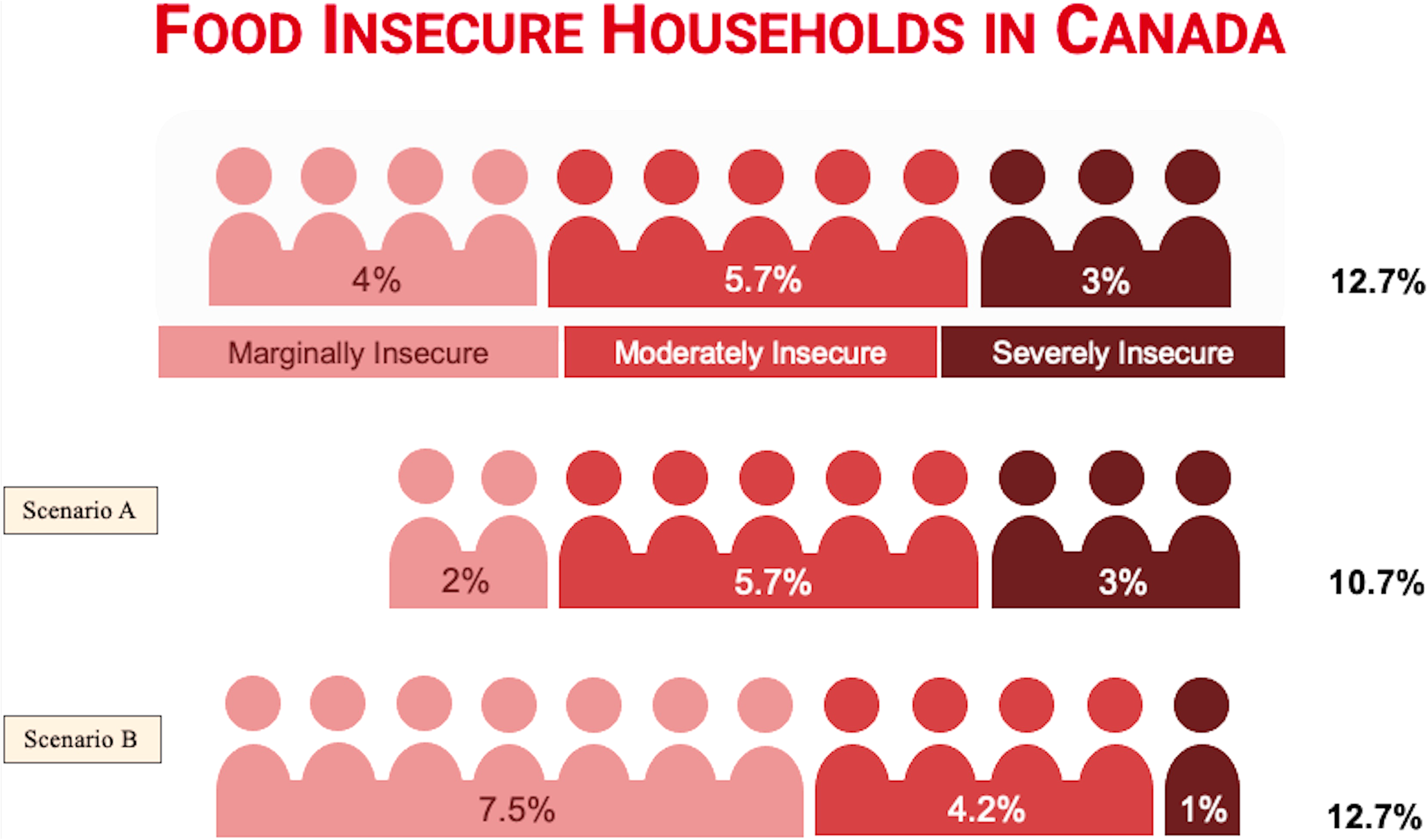
Reduction in prevalence and amelioration of severity of food insecurity.
In summary, the Canadian measure of food insecurity identifies income-related food insecurity and can be conceptualized in terms of the severity of the experience: marginal, moderate, or severe. This understanding will be used to enhance our subsequent assessment of food security efforts in the FPC. Anticipating the forthcoming discussion, two key points are worth mentioning from the standpoint of the measure described above. First, programs that increase accessibility to food may not diminish food insecurity. For example, access to local or healthy food may only influence the prevalence of food insecurity if this access also reduces the financial constraints to consumption. Second, programs are unlikely to be experienced similarly by differently food insecure households. In particular, some programs may appeal to those experiencing food insecurity marginally, while others may be perceived as more essential to those experiencing food insecurity most severely.
Argument 1: the FPC seeks to improve food security in Canada
In its vision statement, the FPC includes a variation on the widely accepted 1996 World Food Summit definition of food security. Specifically, the vision statement declares the following. “All people in Canada are able to access a sufficient amount of safe, nutritious, and culturally diverse food. Canada’s food system is resilient and innovative, sustains our environment and supports our economy.” [emphasis added] (AAFC, 2019).
The emphasized part of the statement addresses food security from a consumption standpoint. The non-emphasized portion of the statement reflects a vision concerned about production levels, the character of farming, and environmental quality. These two statements are not necessarily at odds, but they are not necessarily complementary either. Much depends on the programmatic content of the policy and the measures used to assess expected outcomes. While the exact indicators that will be used to assess the FPC are unclear, we discuss the programmatic content in the context of food insecurity as presently measured by Statistics Canada. 8 By this measure, households that are not identified as food insecure are presumed to be food secure.
The FPC identifies four areas of action: (1) access to healthy food in Canadian communities; (2) Canadian food as the top choice in Canada and abroad; (3) food security in Northern and Indigenous communities; and (4) food waste reduction (AAFC, 2019). While only one of these action areas explicitly mentions food security, healthy food access is also associated with broader definitions of food security. Moreover, government leaders suggest that the programmatic content of the FPC is intended to enhance food security. For example, when announcing Canada’s “Food Waste Reduction Challenge”, the Honourable Marie-Claude Bibeau, Minister of Agriculture and Agri-Food, stated that [r]educing food waste is necessary for so many reasons: it can help save consumers money, improve food security, [and] support efficiency…” [emphasis added] (AAFC, 2020).
Under the theme of ‘access to healthy food‘, the FPC lists a Local Food Infrastructure Fund ($60 million in funding), an initiative dedicated to address the issue of food fraud ($24.4 million), and the intention to develop a national school food program (Government of Canada, 2019). 9 The largest spending item, the Local Food Infrastructure Fund, covers projects that intend to strengthen food systems and improve food access for vulnerable populations. Specifically, the Local Food Infrastructure Fund is comprised of two funding streams: one that provides funding to enhance infrastructure and equipment related to food access for community-based organizations (e.g. community kitchens or gardens, greenhouses, refrigeration, food storage, or transportation equipment) and a second stream supporting larger projects that aim to reduce food insecurity through enhanced local food systems (Government of Canada, 2022).
For the second action area, ‘Canadian food as the top choice in Canada and abroad‘, the food policy lists a Buy Canadian Promotion Campaign ($25 million). This initiative intends to promote the consumption of Canadian agricultural goods. Similar in size of allocated funds, under the theme of ‘food waste reduction‘, the policy lists a Food Waste Reduction Challenge ($20 million) dedicated to funding innovative ways to reduce food waste. The policy also lists a second initiative to reduce food waste within the federal government ($6.3 million in existing funds).
The action area most explicit in terms of food security, ‘food security in Northern and Indigenous communities', describes a Northern Isolated Communities Initiatives Fund ($15 million). This fund covers community-level projects to strengthen local food systems in order to reduce food insecurity. More specifically, the fund intends to support local food production projects and acquisition of equipment related to growing, harvesting, and processing food, e.g., greenhouses and community freezers (Government of Canada, 2020a).
In summary, about half of the $144.4 million in new funding in the FPC — i.e., the Local Food Infrastructure Fund and the Northern Isolated Communities Initiatives Fund — are associated with initiatives that most clearly target food insecurity. Although the exact nature of programs under the Local Food Infrastructure Fund and the Northern Isolated Communities Initiatives Fund is unknown, these initiatives appear to target community-based programs that focus on food production and distribution such as community gardens, community kitchens, urban farms, greenhouses, community freezers, and other aspects of food storage and transportation. Will these programs improve food security by Canada’s measure of food insecurity? And if so, will they address the needs of those whose experience of food insecurity is most severe? We address these questions in the next two sections.
Argument 2: income and food price considerations are paramount
The current measure of food insecurity in Canada links the experience of food insecurity to financial constraints (i.e. lack of money). In this context, income considerations are linked to price considerations for food and other key items such as housing. Intuitively, higher (lower) incomes result in reduced (increased) food insecurity by expanding (reducing) the amount and/or quality of food that can be purchased at a given price. Equally intuitive, lower (higher) food prices enable the consumer to buy more (less) of the same food with a set amount of income. With respect to food prices, economic theory identifies two effects on demand worth noting. One effect is the substitution effect, where reductions (increases) in the price of food relative to other goods may shift consumption towards (away from) food. The second effect — termed the income effect — indirectly links changes in the price of food to income in an important way. The income effect reflects the idea that reductions (increases) in the price increase (reduce) the purchasing power of a household in a similar way as changes in income would. Importantly, changes in the price of many related goods — e.g., the rental rate of housing — have indirect effects that can influence food consumption and thus food insecurity. 10
Spending on food and housing are portions of the total household spending budget. Consider, as a thought experiment, how much food prices and housing costs would need to fall to reduce annual household spending by an amount equivalent to $1000. We use the example of $1000 because below we reference a study that provides evidence on the effect of a $1000 increase in income on the likelihood of a household being food insecure. For a number of reasons — including the substitution effect described above — increases in income and reductions in price are not directly comparable, but we find this thought experiment useful for understanding how income constrained choices depend on both income and the prices/costs.
Consider that, in 2019, the average share of total household spending on goods and services in Canada was 14.9% for food and 29.3% for shelter (Statistics Canada, 2021). For households in the lowest income quintile these shares were 15.7% and 34.1% respectively, which indicates that these households spent $5560 on food and $12,093 on shelter (Statistics Canada, 2021). For these households, average food prices and housing costs would have to decrease by about 18% and 8.3% respectively to reduce spending by $1000 (assuming the quantity and quality of food and housing remain unchanged). 11 This thought experiment, though admittedly oversimplified, emphasizes the idea that the income constraint to households is lessoned by declines in the costs of important household budget items. Moreover, these items are a portion of income, and this fact is reflected in magnitudes of price changes necessary to achieve specific reductions in overall spending. Our focus in the remainder of the paper is on food-related costs but we endeavoured to recognize that other costs — e.g., housing, transportation, etc. — are important constraints to income and subsequently influence food insecurity.
Previous research has established an important association between income and the risk of food insecurity: e.g., a $1000 increase in income reduces the odds of severe food insecurity by 5% (Tarasuk, Fafard St-Germain and Mitchell, 2019). In the context of Canadian First Nations, Deaton, Scholz and Lipka (2019) find that individuals in the lowest income category — $1-$9999 — are approximately 13 times as likely to be food insecure as individuals with an income of $90,000 or more. This general finding with respect to income and food insecurity is well established in other studies as well (e.g. Che and Chen, 2001; Tarasuk and Vogt, 2009). Programmatic efforts that influence household income appear successful in diminishing the prevalence of food insecurity. 12 For example, Ionescu-Ittu et al. (2015) found that the Universal Child Care Benefit (UCCB) program, a federally administered income supplement to all households with children under the age of six, was effective in reducing food insecurity among eligible households in Canada — and particularly, among low-income households. Another example is the study by McIntyre et al. (2016), in which the authors found that receiving senior benefits lowered the likelihood of being food insecure among low-income Canadian seniors.
Research on the role of food prices for food insecurity, on the other hand, is relatively scarce. Some evidence from the United States suggests that higher (lower) food prices are associated with higher (lower) rates of food insecurity (Courtemanche et al., 2019; Gregory and Coleman-Jensen, 2013). As suggested in our thought experiment, spending on food is only a portion of one‘s income; accordingly, relatively large reductions in average food prices would be needed to achieve the equivalent of an increase in income of $1000.
In the context of the FPC, the effectiveness of food-based interventions — under the Local Food Infrastructure Fund and Northern Isolated Communities Initiatives Fund — in reducing food insecurity will thus depend not only on the extent to which programs increase access to food, but also on whether this access reduces the financial constraints to consumption. As discussed above, efforts to reduce food insecurity by alleviating financial constraints to consumption will need to enhance household income and/or reduce the price of food. This goal can be achieved through various pathways. In the case of income, conventional Canadian agri-food policies are typically designed to support producer incomes (e.g. supply management, business risk management); not the incomes of food insecure consumers, who are characterized by lower incomes and, in some cases, limited capability to manage finances. 13 In the case of food prices, the price of food can effectively be lowered through subsidies (e.g. Nutrition North Canada) or through a variety of programs designed to provide food at reduced (or no) costs to the consumer: e.g., food banks, community gardens, or greenhouses. The price of food is also lowered by the broad suite of policies designed to ensure a globally competitive agri-food sector that supports low food prices for consumers. 14
While other dimensions of food security like access to “healthy” food may be less likely to be captured by the Statistics Canada measure of food insecurity, the consumption of healthy food may be related to income and price in important ways. A recent study by Allcott et al. (2019) finds that improved access to healthy foods has a marginal impact on the consumption of healthy foods. 15 In the study, the authors estimate that differences in access to healthy food (proxied by the entrance of new supermarkets into neighbourhoods) account for only about 10% of the observed differences in healthy food consumption between high and low-income households. Instead, healthier eating seems mostly determined by the income constraints of households. Modelling household demand for food, the authors find that higher income households have higher demand for healthy foods, and that consumption of healthy foods among low-income households can be meaningfully increased through a subsidy which effectively lowers the price.
The above discussion emphasizes key considerations when evaluating FPC interventions by their effectiveness on food insecurity. As discussed above, one paramount consideration is whether the program increases incomes (of presently food insecure households). Another related consideration is whether the program effectively reduces the price of food and by how much. Programs that promote other attributes of food — e.g., local food production, or access to healthy food — but fail to effectively raise income or reduce the price of food may be less likely to reduce food insecurity by the Canadian measure.
Argument 3: FPC program effectiveness and participation
As mentioned earlier, some of the FPC programs reference activities such as community gardens or community kitchens. Because these programs involve community members who voluntarily decide to participate, program effectiveness depends on the extent to which food insecure households participate.
In Kirkpatrick and Tarasuk‘s (2009) study of low-income areas of Toronto, the authors surveyed 484 households. Sixty-five percent of the households were categorized as either moderately or severely food insecure. Only a very small number of food insecure households participated in community gardens or community kitchens. For example, only 3% of the 134 households identified as severely food insecure participated in a community garden over the last twelve months despite “ample access” (pg. 138). In contrast, 40% of these households used a food bank.
In another study, Roncarolo et al. (2015) examined the characteristics of participants in various food security interventions in Montreal. The authors found differences between those who used food assistance programs such as food banks and soup kitchens, and those who engaged in community-level food programs such as community gardens and community kitchens. In particular, users of food assistance programs were more likely to report more severe manifestations of food insecurity (and lower incomes) than those using community gardens and kitchens. Other empirical research in Canada has found similar results regarding severity of food insecurity and participation in food banks and other community food insecurity interventions (see e.g. Loopstra and Tarasuk, 2015).
The above examples regarding ‘who‘ participates in different food insecurity interventions illustrate the importance of understanding the extent to which a program will elicit participation by food insecure households. Moreover, attention needs to be paid to the extent to which participation varies by the severity of household food insecurity: i.e., marginal, moderate, and severe. Presently, many of the FPC food insecurity efforts include community gardens, community kitchens, urban farms, greenhouses, community freezers, and other aspects of food storage and transportation. To the extent that the primary benefits of such programs accrue to participants in these programs, design (and subsequent evaluation of the program) should consider questions like: (1) To what extent are food insecure households to participate? (2) Are marginal, moderate, and severely food insecure households equally likely to participate? And, to what extent will participation reduce food insecurity for participants? 16
Focusing on the issue of which households participate can be applied to other ongoing efforts to enhance food consumption. For example, Nutrition North Canada (NNC) is a subsidy program that subsidizes food retailers in remote northern communities and requires that retailers pass on the full subsidy to the end consumers. Food insecurity rates in Nunavut rank highest in Canada: 57% of households experienced food insecurity in 2017/18 (Tarasuk and Mitchell, 2020). Importantly, the program applies to all consumers in a geographic region, regardless of income. So, to the extent that all consumers in the region visit these stores, all households have the potential to participate in NNC. However, the subsidy does not apply to all food items. If the food consumption bundle differs between the food secure and food insecure (or between marginally, moderately, and severely food insecure households) then the benefits of NNC will vary between households based on their consumption choices.
In a recent study, Naylor, Deaton and Ker (2020) assessed the effectiveness of NNC in lowering retail food prices in Nunavut. They found that most (if not all) of the subsidy was passed on to consumers in the form of lower food prices. The authors find that each dollar spent by NNC essentially reduces the food price by about one dollar. The following example from the study illustrates the effect of the food subsidy. The authors compare the average price (per kg) of ground beef and hamburgers in Nunavut, where the NNC program is in effect, with prices in Ottawa, where the NNC program is not in effect. In Nunavut, ground beef receives a subsidy, but hamburgers do not. Hence, it is instructive to compare the differences in prices between Nunavut and Ottawa with respect to ground beef, a product that is subsidized through NNC, and hamburgers, a product that is not subsidized. The authors find that while the average price of ground beef was only approximately 3% higher in Nunavut than in Ottawa, the average price of hamburgers was approximately 90% higher in Nunavut.
Evidence on the effectiveness of NNC in lowering food prices is one thing, but its effectiveness in improving food insecurity is another. Recent evidence from a study comparing rates of food insecurity in Nunavut before and after the implementation of NNC suggests that food insecurity rose after implementation of the program (Fafard St-Germain, Galloway and Tarasuk, 2019). The persistent rates of high food insecurity in Nunavut could indicate that the NNC subsidies, albeit a viable option to lower the price of food in remote communities, may not be high enough to lead to overall reductions in food insecurity. In addition, subsidized food products may not align with the food preferences of food insecure households. Consistent with the theme of this section, future research might compare food consumption bundles of food insecure and food secure households to better understand the extent to which food insecure households comparatively participate in NNC through their choice of food. This same assessment is relevant for comparisons amongst households categorized as either marginally, moderately, or severely food insecure.
A roadmap for decision-making
Thus far we have identified two important questions for assessing programs in the FPC from the standpoint of food insecurity as it is measured by Statistics Canada: 17 (1) Will the program meaningfully increase income or reduce the price of food? (2) Will the food insecure participate and if so which subset of the food insecure is expected to participate in the program? Figure 2 illustrates a roadmap for assessment using a hypothetical example: assessing a project to build a community greenhouse in northern Canada 18 .
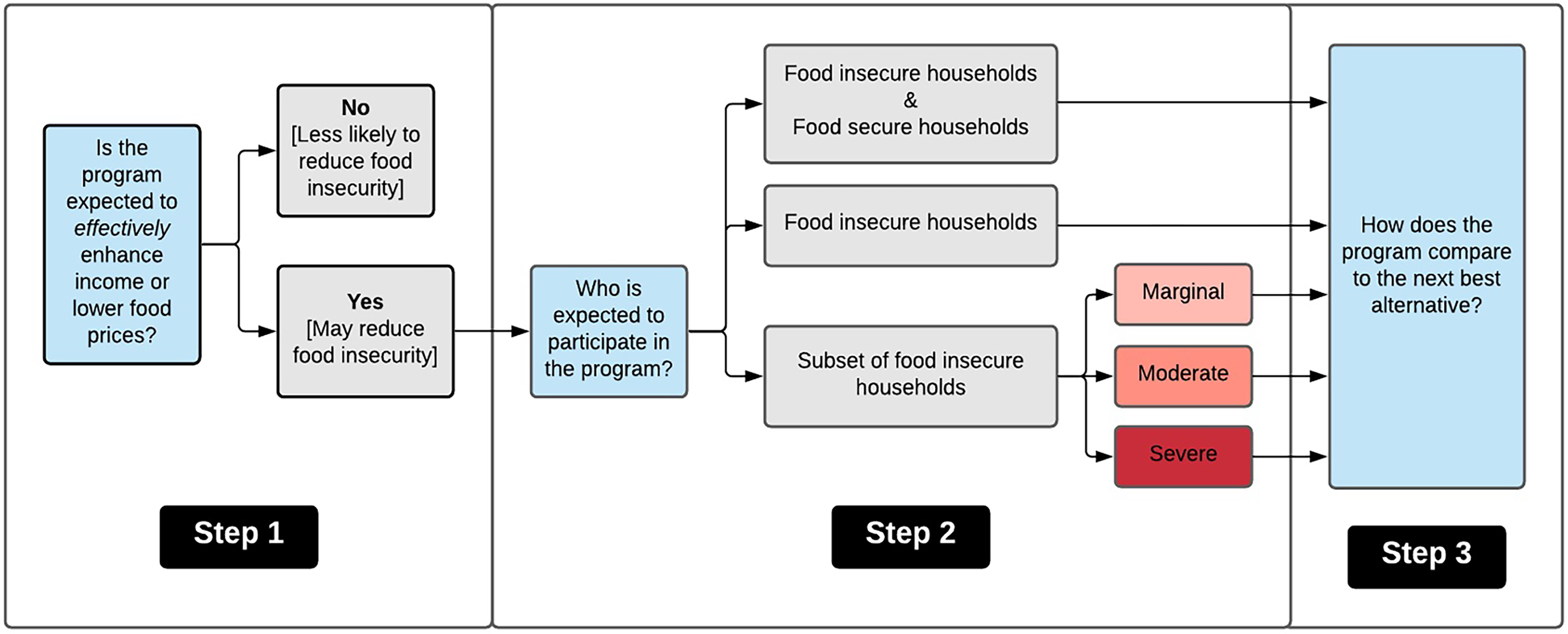
A guide for funding consideration for efforts to reduce food insecurity as presently measured.
A community greenhouse project is a relevant example because funding is presently available for greenhouse projects under both the Local Food Infrastructure Fund and the Northern Isolated Communities Initiatives Fund. Drawing on the above discussion, food availability without enhanced income or reduced food prices may be unlikely to alter consumption patterns. 19 Hence, a specific question with more relevance to food insecurity concerns might be: does this program reduce the price of food and/or enhance household income? This initial consideration is depicted as Step 1 in Figure 2. If the answer to this question is “no”, then the program is unlikely to influence the experience of food insecurity as presently measured in Canada. If the answer is “yes”, the next step — Step 2 in Figure 2 — is to determine the likely beneficiaries of the program. For example, does the program broadly influence food prices and household incomes in general, or are the expected effects experienced by a subset of participants? If, as would seem very likely from our standpoint, the program effects of a community greenhouse project are focused on a subset of participants, a range of questions regarding self-selection are appropriate. For example, how many households will be involved, and are food insecure households likely to participate in the program? If so, does the program attract marginally food insecure, moderately food insecure, severely food insecure, or all groups of households?
A third question, not developed in our discussion above but worthy of brief mention here and inclusion in our diagram — illustrated as Step 3 in Figure 2 — concerns the allocation of scarce funds across competing projects. Answering the question of how a program‘s effect on food insecurity compares to the next best alternative requires being fairly specific about the project and the end objective. From the standpoint of reducing food insecurity, we might assess whether money spent on a greenhouse project is more likely to alleviate food insecurity than an equal amount of money given directly to low-income households. For example, estimates for the cost of a greenhouse in northern Canada range from $52,000-$200,000, depending on the size of the greenhouse (Allen, 2014; Green Iglu, 2020). In addition, a greenhouse may need to receive ongoing subsidies to remain sustainable (Allen, 2014). One might consider how this investment compares to directly providing income to food insecure households. Or, alternatively, as discussed earlier, how does such an effort compare to programs like NNC that aim at lowering the price of food. In the 2018-2019 fiscal year, the total funding for NNC was $77.8 million (Government of Canada, 2020b). As we described earlier, the study by Naylor et al. (2020) finds that almost the entire subsidy is passed on to consumers in lower prices. The cost-effectiveness of these programs, compared to others, and the distribution of benefits amongst the food insecure — marginally, moderately, and severely — are important considerations when evaluating the effectiveness of FPC efforts from the standpoint of food insecurity.
Conclusion and implications for policy
The Food Policy for Canada establishes a new federal effort, in a portfolio of ongoing efforts, to influence the capacity of the agri-food sector to improve Canadian life. In this effort, the FPC seeks to achieve food security for all Canadians in a broad manner. In a departure from more conventional government policy efforts, which seek to enhance the competitiveness and sustainability of the agricultural sector, the FPC is establishing a markedly different programmatic effort. 20 One aspiration of that effort is to address food insecurity.
Understanding and assessing the aspirational goal of food security requires a measure of food security, and a substantive understanding of that measure. Both the measure and its meaning will be useful in guiding the programmatic content of the FPC and the assessment thereof. Presently, the most prominent measure, collected by Statistics Canada, identifies households as either food secure or food insecure by the extent to which household members experience food insecurity due to financial constraints. A direct implication of this measure is that policies that promote the supply of food with particular attributes — e.g., “local food” — can succeed in increasing local food supply but fail in reducing food insecurity. The latter outcome is almost assured if the program does not impact food prices for the food items consumed by the food insecure.
By the measure of food insecurity used in Canada, the severity of the household experience of food insecurity varies — i.e., either marginal, moderate, or severe. In this paper, we argued that this variation held implications for both future program design and assessment. For example, some programs may serve the needs of marginally food insecure households more readily than households experiencing food insecurity most severely.
An additional consideration is the variation of food insecurity by geography and ethnicity. Specifically, in Canada, residents in places above the 60th parallel face heightened food insecurity issues compared to those living in more southern locations. Moreover, households that identify as Indigenous or Black have greater odds of experiencing food insecurity compared to those identifying as White (Tarasuk and Mitchell, 2020). Programs designed to address food insecurity will benefit from careful consideration of these issues when considering ‘who‘ is expected to participate in the programs designed to address food insecurity.
As is the case with most government policies, there are asymmetric interests in shaping interventions. Being motivated by the public good, many will have intense interests in these policies; conversely, ulterior motives of personal gain or interests might steer programmatic efforts in a manner that is counter-productive to increasing economic access to food for the most vulnerable. Our findings indicate that a strategy for minimizing the latter occurrence is to put a very thoughtful and precise focus on the definition of food security, its measure, and assessment. The responsibility for this deliberative approach falls primarily to the government, given that the public at large will have more diffuse interests in food security efforts. For similar reasons, the government is also responsible for making sure that the intended beneficiaries — the food insecure themselves — are a central consideration; though they are the intended beneficiaries of these efforts, their direct benefits may be relatively small given the magnitude of their other concerns, and they may not be sufficiently empowered to act. For these reasons, we anticipate that the conceptual issues we advance in this paper — e.g., the meaning of food security, its measure, and appreciation of the variation in the severity of food insecurity — will improve the government‘s evolving effort to assess and improve the programmatic content of the FPC in order to improve food insecurity in Canada.
Footnotes
Acknowledgements
The authors would like to thank Bethany Lipka and Jamie Naylor for helpful comments on earlier drafts. That said, all opinions and any errors should be attributed to the authors alone. Support for this article was received through McCain Family Chair in Food Security.
Declaration of conflicting interests
The author(s) declared no potential conflicts of interest with respect to the research, authorship, and/or publication of this article.
Funding
The author(s) received no financial support for the research, authorship, and/or publication of this article.
